




Introduction
In 1936 one of the largest mass disrobings of Buddhist monks and novices in modern history took place in northern Thailand.Footnote 1 Around 1,000 monks and novices were disrobed, with some estimates as high as 2,000.Footnote 2 The disrobed monastic clergy were members of the ‘Tiger Order’ (Traa Sya). The movement took its name from its leader, Khruba Srivichai (1878–1939), who was born in the Year of the Tiger.Footnote 3 Considered a saint, newspapers of the period describe Srivichai as having had the support of some 80 per cent of the northern population.Footnote 4 He and his disciples oversaw the building or restoration of over 100 temples across northern Thailand. Their efforts to construct an 11.5 kilometre mountain road leading up to Wat Phrathat Doi Suthep, the venerated temple overlooking the Chiang Mai valley, drew thousands of volunteers from across the northern region. Today Srivichai remains the most famous monk of northern Thailand; his lieux de mémoire can be found across northern Thailand, ranging from photographs on calendars hanging on the walls of homes and small statues on car dashboards to life-size replicas in temples and gigantic monuments along roadsides. Stories abound of his magical powers which even today reveal lottery numbers, assist women to become pregnant, and help students to obtain visas to study abroad. However, during his lifetime Srivichai was placed under temple arrest multiple times and sent down to Bangkok for investigation in 1920 and 1935–1936 under charges that included treason.Footnote 5
In the early twentieth century, the central Thai government sought to bring the population of the once-independent northern Lanna kingdoms under its jurisdiction. The disrobings were part of the central Thai government’s effort to gain control of northerners by forcing Srivichai and his disciples to accept the authority of the central Thai monastic order. Although tensions between the northern and central Thai monastic orders (sangha) can be dated to Srivichai’s first arrest in circa 1915, they intensified after 1924 when the 1902 Sangha Act came into effect in the northern region, then called Monthon Phayab. The Sangha Act sought to integrate monks and novices across the country into a national monastic administrative hierarchy based in Bangkok. As the government instituted new regulations that affected both the monastic order and the broader population, Srivichai’s Tiger Order arose in resistance.
The first evidence of the formation of the Tiger Order as a political movement is found in a 21 July 1934 article in the Bangkok Times Weekly Mail (hereafter BTWM) which mentions an unnamed district in Lamphun province ‘in which there are 36 wats, only 8 of them have agreed to submit to the control of the Church dignitaries, the remaining 28 preferring to be under the sole control of Phra Sri Vijai’.Footnote 6 In the same article, the correspondent records that at Wat Kawga in Lamphun’s PakBong district, Srivichai had ‘sent a name board to be put up showing that the Wat in question belonged to him’.Footnote 7 The ecclesiastical report of 28 June 1935 notes that an additional 50 temples in ten districts in Chiang Mai province had seceded.Footnote 8 As the BTWM later elaborates, ‘The monks there have ceased to use the identification papers issued to each of them by the Church and have adopted the identification document issued by Phra Sri Vijai instead.’Footnote 9 The report of the government’s cabinet meeting dated 3 February 1936 notes that in Chiang Mai province alone, the number of temples in the Tiger Order had grown to 90.Footnote 10
Srivichai was arrested on 1 November 1935 and sent down to Bangkok for a second time. During his prolonged detention there, his disciples were given an ultimatum: either agree to come under the administrative structure of the central Thai monastic order or disrobe. The forced disrobings were justified on grounds that these monks and novices had been illegally ordained by Srivichai who was not recognized by the government as an authorized preceptor, that they had not entered the military draft, or were otherwise known to be strong supporters of Srivichai. Some of Srivichai’s disciples fled into the surrounding mountains or to the Shan States and elsewhere in neighbouring Burma. The majority were forced to disrobe, changing from yellow to white robes before becoming laity. With his followers in disarray, on 21 April 1936 Srivichai signed a document agreeing to abide with the regulations of the central Thai monastic order. He was finally allowed to return to the north on 14 May 1936; he died on 21 February 1939.
Srivichai’s arrest and the subsequent mass disrobing were crucial turning points in the formation of the modern nation-state of Thailand. The northern and central Thai regions spoke different dialects, each written in different scripts. Following the Sangha Act’s implementation in northern Thailand in 1924, only monks who were officially appointed by Bangkok could serve as temple abbots or ordination preceptors (upachaaya). To be promoted, monks needed to pass examinations based on a curriculum written in central Thai. Gaining control over the northern monastic order enabled the central government to make major changes beyond the monastic order itself. It was then able to enforce the Military Conscription Act, which ensured that all males entered the draft before being ordained as monks, and the Compulsory Education Act, which compelled northerners to attend secular schools that taught in the central Thai language and script rather than temples teaching traditional religious texts written in the northern language and script.
The extraordinary disrobing of the 1,000–2,000 members of the Tiger Order has been virtually erased from historical memory, its magnitude and subsequent impact minimized or even entirely ignored by scholars and Thais alike. In 1936 the English-language BTWM newspaper simply noted in passing that ‘a large number of monks and novices in the north are retiring from the yellow robe’.Footnote 11 Despite recognizing that many northern monks ‘had openly severed connections with their ecclesiastical superiors’, Virginia Thompson, the primary source of subsequent scholars, wrote simply that ‘some of these leaders were arrested’.Footnote 12 Ignoring the mass disrobings entirely, Thompson paints a benign picture, writing:
The year 1935 found him [Srivichai] once again in Bangkok, and this time he was even more tactfully treated. He had been sent for because he apparently did not understand the rules of the Buddhist church … After a sojourn of several months in the capital, Phra Sri Vijaya saw the light, signed an agreement to abide by the laws of the church, and returned to his home, to be welcomed back by more than eight thousand people.Footnote 13
Accordingly, the noted anthropologists Charles Keyes concludes that, following Srivichai’s arrest, ‘there have been no efforts since that time to suppress Yuan practices’ and Stanley Tambiah adjudges that Srivichai ‘was treated carefully’ and ‘schism was avoided’.Footnote 14 Writing more recently, legal historian David Engels suggests Srivichai ‘reached an accommodation with Bangkok’.Footnote 15
Even Thai accounts that mention the disrobings misleadingly conclude that ‘after the Phayab Circle Monkhood had completed its investigation and training of Khruba Sriwichai for six months and 17 days and was satisfied with the results, it was announced that “Phra Sriwichai has been exonerated (phon khoh klaohaa) and was permitted to return to his temple”’.Footnote 16 For many older northerners, the mass disrobing became telescoped into the disrobing of one of Sriwichai’s key disciples, Khruba Khao Pii (1889–1977); they recall seeing him because he remained in white robes for the rest of his life (khao meaning ‘white’; he was also often called PhaaKhao Pii, phaa meaning ‘cloth’, referring to his white robes). All northerners have heard of Srivichai. However, because neither Srivichai’s arrests nor the mass disrobing of his disciples are topics of current discussion and because no mention of this is made in Thai school textbooks, some among the younger generation of educated northern Thais whom I have met even deny that such disrobings even took place.
Historical memory is the result of a dialectic with history that involves both remembering and forgetting. As Paul Ricoeur summarizes poignantly, ‘Forgetting indeed remains the disturbing threat that lurks in the background of the phenomenology of memory and the epistemology of history.’Footnote 17 Most of the literature on memory has focused on what is remembered; less attention has been paid to the complex processes of forgetting. In his study of the shifting memories of the massacre of 6 October 1976 in Thailand, Thongchai Winichakul remarks that historical silences are ‘usually the result of a conscious effort to suppress memory, either by power or authority (being silenced) or voluntarily (being silent)’.Footnote 18 This article seeks both to highlight the historical fact of the mass disrobing of the Tiger Order and to analyse the processes of its erasure from memory.
My discussion draws upon archival sources and oral histories conducted with over 200 northern monks and villagers.Footnote 19 In researching the lives of the disrobed disciples of Srivichai, I began by travelling to villages with temples (wat) or abbots named in government reports of 1935–1936. I asked local villagers to identify the oldest people in their respective villages who might know about village history; I also sought out current and former abbots, current and former lay temple leaders (ajarn wat), or descendants and other relatives of disrobed monks. I also conducted interviews in villages where Srivichai had built or restored temples, asking both about villagers’ knowledge of Srivichai and the disrobings.
This article is divided into four sections, highlighting four phases in the chronopolitics of forgetting.Footnote 20 The first section considers the role of psycho-social trauma in contributing to the initial silencing of discussions about the disrobings. The second section examines how the everyday facts of life contributed to their erasure over subsequent decades. The third section considers how shifts in government policy led to the erasure through growing accommodation with the northern monastic order. The final section explores how northern pride is shaping historical memory, consciously erasing the interlinked facts of both Srivichai’s arrests and the mass disrobing of his followers. Processes of remembering and forgetting underlie the paradox of both the idolization of Srivichai and the erasure of the disrobing of his disciples over the course of the past century.
Erasure by psycho-social trauma
In his famous book States of Denial, noted sociologist Stanley Cohen highlights the impact of psycho-social trauma on victims, perpetrators, and observers.Footnote 21 As this section will show, the disrobings were traumatic experiences for each of these groups. Accordingly, in the initial aftermath of the mass disrobing, each group fell silent, mere words failing to articulate the complexity of the emotions stemming from their involvement.
The wave of mass disrobing followed on the heels of Srivichai’s arrest on 1 November 1936 at Wat Phra Singh, the temple located in Chiang Mai city where Srivichai was the de facto abbot. The atmosphere was already tense. There were hundreds of disciples in residence at the time because they had been helping him construct the mountain road leading up to Wat Phrathat Doi Suthep. Police and ecclesiastical officials had already come in October to interrogate Srivichai about his role in ordaining monks and novices in violation of the Sangha Act.
The first disrobing following Srivichai’s arrest was that of Khruba Khao Pii, widely known as Srivichai’s right-hand disciple and the person Srivichai had assigned to take charge of Wat Phra Singh during his absence.Footnote 22 Already controversial, Pii had been disrobed in 1924 and jailed for six months for failing to register for the military draft. Upon his release from jail Srivichai reordained him, but he was again disrobed circa 1926.Footnote 23 Again wearing white robes, he continued to assist Srivichai. Pii was reordained for a third time on 19 May 1935, this time with the support of the ruler of Chiang Mai, Chao Kaeo Nawalat, and Chiang Mai’s representative in parliament, Luang Sri Prakat. On 4 December, Pii was ordered to disrobe. Rumours were rife that Srivichai himself would be disrobed, imprisoned, or even executed. Hoping to protect Srivichai, Pii immediately sent a telegram to the prime minister and the members of the parliament, writing, ‘The sangha has ordered me to disrobe within 7 days. Request delay until Khruba Srivichai returns to Chiang Mai’.Footnote 24 His request was denied. His disrobing was a sign to Srivichai’s followers that even the northern elite was powerless to defend them. Pii remained in white robes for the rest of his life.
The major wave of forced disrobings took place over the five months between December 1935 and April 1936 (Figure 1). Former monks and novices described their fear as police arrived at temples across the north. One former novice described how, at Wat Phra Singh, he and a group of more than ten other novices fled and hid in a space under the altar in the Viharn Laikham hall, carrying kerosene lamps; only when the officials finally left did they emerge, covered in grime and soot.Footnote 25 At Wat Baan Pang, the temple built by Srivichai in his natal village, an elderly villager described terrified monks and novices bolting in all directions as they headed to the surrounding mountain forests (baj phae baj doi).Footnote 26 Five local monks and novices were disrobed and jailed on charges of avoiding military conscription.Footnote 27 As word spread that Srivichai would not be allowed to return unless they disrobed, more also disrobed. One former novice at Wat Baan Pang said he and five others finally agreed to disrobe in mid-April (New Year’s Day).Footnote 28 Villagers looked after the temple in their absence. When Srivichai was finally allowed to return in May, some of the monks and novices who had fled also returned and were allowed to remain to take care of Srivichai.
Temple mural showing Khruba Wong’s disrobing. Painted by Jamnong Ratthanakul in 2016. Wat Phrabat Huai Tom. Source: Photo by the author.

Figure 1 Long description
The mural shows a group of monks wearing robes, positioned on a tiled area outside a temple. The temple features steps leading to its entrance, with architectural details visible. The monks are interacting with a man dressed in blue attire, who stands facing them. The scene includes greenery on the right side, adding to the setting's ambiance. The monks are arranged in a line, some standing on the steps, while others are on the ground level, creating a dynamic composition.
The 1936 February–March report of the ecclesiastical head of Monthon Phayab reveals both the hardball tactics of officials seeking to enforce compliance and the determined resistance of leaders of the Tiger Order in Chiang Mai province.Footnote 29 In Sansai district, the district ecclesiastical head convened a district-wide meeting to inform the abbots that anyone refusing to comply with the Sangha Act would be forcibly disrobed with assistance from the police. Thereafter five abbots refused and were ordered to disrobe. According to the report, before the police force arrived, four of the abbots ‘informed their underlings at the temple that they would be worshipping various temples in Chiang Tung’ and fled. On 6 February the provincial ecclesiastical head summoned the remaining nine recalcitrant abbots and their underlings to his temple, Wat Thungyuu, in Chiang Mai city. The provincial head convinced all who came to comply and had them sign a statement to that effect. However, the abbot of one temple (Wat Sannamaeng) said he was ill and sent his junior monks instead. The provincial head then ordered the district head to investigate, with instructions that if the abbot really was sick, he could come to sign when he recovered; but if he was not sick, he should be disrobed immediately because his behaviour was ‘not trustworthy’ (maj waaj wangcaj). He also ordered the district head to travel to those temples where the abbots had fled or been disrobed to meet with the remaining monks, novices, and respected elders; he was to appoint new abbots and disrobe any who still refused to accept sangha administration.
The same report describes the scene of the forced disrobing of three of the leading monks of Baan Mae district (now Sanpatong) at Wat Thungyuu itself:
Regarding Baan Mae district, on 8 February 2478 [1936], the provincial ecclesiastical head held a meeting ordering the disrobing of three abbots, namely Phra Panyaa of Wat Phrabat Yangwiit, Phra Khamphira of Wat Thung Tum, and Phra Suwaan of Wat Sanpatong Luang. These three were important leaders opposing central sangha authority. They were given three days advance notice.
On the appointed day they were to hear the orders at Wat Thungyuu. Before reading the order, the provincial head discussed their opposition to the sangha administration. The three abbots refused to comply, claiming they would only follow the orders of Phra Khruba Srivichai. The head saw that they would not conform, so he ordered secular police officials to enforce order and successfully (duaj dii) had them disrobed. Phra Panyaa and Phra Khamphira were disrobed there. Phra Suwaan asked to disrobe at his temple within three days and disrobed on 30 February. On the same day, monks and novices at Wat Sanpatong Luang numbering ten asked to come under the sangha authority.
Monks and novices at Wat Yangwiit and Wat Thung Tum who were ordained by Phra Srivichai have all disrobed at both temples.Footnote 30
Understanding the traditional expectations surrounding the ritual process of disrobing adds to the anguish of such forcible disrobing. The monastic regulations for disrobing are simple: the monk must be in a right state of mind, must intend to leave, must make a clear statement to this effect, and his statement must be witnessed by another person who can understand what the monk is saying.Footnote 31 Traditionally novices or monks take leave from their preceptors. Viewed as vulnerable, like a newborn baby (hae), the newly disrobed monk or novice then observes a period of quarantine (yuu kam).Footnote 32 At Wat Phrabat Huai Tom, a temple in Lii district where Khruba Wong, one of Srivichai’s followers, was abbot, disrobed monks were expected to remain for seven days; during this time they carried sand into the temple to replace what they may have carried out and, with scented water (nam sompoi) and flowers, visited each house that had offered them food and other donations to ask for forgiveness (sumaa) for any offence.Footnote 33 Being forcibly disrobed by police was a jarring psychological contrast, violating the normal process and attendant ritual practices.
Both secular and monastic officials themselves often felt conflicted. In 1985, I interviewed the nephew of Phrakhruu Unhyan (circa 1888–1973) who was the ecclesiastical head of Paphai subdistrict in Sansai.Footnote 34 Then a temple boy (dekwat), the nephew accompanied his uncle during two disrobings, one at Wat Sansai Luang and the other at Wat MaeKet Luang. The nephew recounted that even before the disrobings, the sangha hierarchy had sent out a letter forbidding monks from participating in Srivichai’s various construction projects. The nephew witnessed the disrobing of over 20 monks and novices. He explained that Unhyan supported Srivichai ‘in his heart’ (naj caj), but as he had an official position, he had no choice but order the disrobings.
Local police charged with physically disrobing monks also felt torn between their traditional reverence for the monastic order and their orders. Khruba Duangtaa was a famous disciple of Srivichai in Lamphun province. Like Khruba Khao Pii, Duangtaa was arrested, disrobed, and jailed several times. Although he wore white robes for many years, he later married. According to his wife’s account, the police who were ordered to arrest him were afraid of supernatural retribution, fearing that they would meet untimely deaths or other misfortunes. Accordingly, the police treated Duangtaa with tremendous deference and did not ‘arrest’ him, but ‘invited’ him to come with them to the jail (bo cap, chyyn). While Duangtaa was in jail, so many people came to make offerings to him that everyone at the prison ate well. It seems the police had reason to be afraid because, as Duangtaa’s wife commented with karmic satisfaction, all the people who had ordered his arrest indeed met untimely deaths.Footnote 35
In addition to the victims and the perpetrators, the disrobings were traumatic for the village observers. Two oral history accounts provide insight into the emotional anguish caused by the disrobing of Phra Panyaa. One account was provided by Poh Ui Noi Caj (age 93 in 2015); his father was the lay leader (ajarn wat) of the neighbouring village temple of Wat Makhamluang.Footnote 36 The other account was from Panyaa’s nephew, Phrakhruu Inthaa, for whom Panyaa’s disrobing was deeply personal (Figure 2) as his father was Panyaa’s older brother.Footnote 37 As Inthaa explained, ‘Tu Panyaa disrobed and in that night, about 3 am, I was born. So Tu Panyaa said “good, he can replace me in the sangha (ben tu thaen haa)”’.Footnote 38 Inthaa was born 26 February 1936 and is today the abbot of Wat NamBoLuang in Sanpatong.
Phrakhruu Inthaa Dharmabhirom, Phra Panyaa’s nephew. Source: Photo by the author.

Figure 2 Long description
Inthaa Dharmabhirom is seated on a chair, wearing traditional attire. His right arm rests on the chair's arm, while his left hand is placed on his lap. Behind him, there are two tall candles and a framed picture of a man in a suit. The setting appears to be indoors, with a tiled floor and a cabinet displaying various items.
Panyaa was the abbot of Wat Phrabat Yangwiit (Makhunwaan subdistrict). According to his nephew, he was also the head of the Tiger Order’s southern wing (huanaa saaj taj), overseeing some 80 temples in the region south of Chiang Mai. When Srivichai was planning the road up Doi Suthep, he had Panyaa survey the monks in the southern wing to determine how many households in each of these villages would join to ensure he had enough manpower for this massive undertaking; they counted the number of strong healthy men under the age of 60 and the number of women in the villages. Officials from the Department of Religious Affairs came to see Panyaa twice, but he refused to comply with their demands. The third time they escorted him to Wat ThungYuu.
Relatives and fellow villagers, as well as some other 20–30 village monks and novices, joined Panyaa on the trip to the city. Both Inthaa’s and Caj’s fathers were among them. As Caj commented, ‘They hadn’t made any preparations for clothing (bo daj triam ayang, pen phaa, pen khua).’ The villagers then went to the Kaat Luang market to buy white clothes for him and the other monks and novices at his temple who also decided to disrobe. Panyaa’s relatives begged to be allowed to keep his robes for worship, but the provincial ecclesiastical head refused. Instead he had his secretary take Panyaa’s main robe (jiworn) and write on it, in large letters, ‘This is the Robe of Phra Panyaa, Wat Phrabat Yangwiit; Now Disrobed (Jiworn Phra Panyaa Wat Phrabat Yangwit; Syk Laew)’. Then, as Inthaa explained ‘They hung the jiworn over the compound walls at Wat ThungYuu so everyone would see it, so all his followers would see it and be afraid of their power.’
Villagers then accompanied the disrobed monks and novices back to their village. Inthaa summarized the day’s event, ‘They walked in lines of yellow into town, monks and novices, and came out wearing white. Heartrending (naasangwet). The villagers were in tears (rohng ok, rohng haj). They went as monks, but came back in white.’ As Caj explained, ‘The villagers were upset, but there was nothing they could do about it. They were powerless (suu khao bo daj). They were tricked (don lohk) into thinking that if they didn’t agree to this, Khruba Srivichai would die (ca sia chiwit).’
The trauma of the disrobings served to silence all involved. However angry or bitter they felt, the disrobed monks and novices had been subdued by their defeat. Police and other officials who followed the orders of their superiors were silenced by guilt or feelings of powerlessness. Monastic officials were censored by ‘fear of demerit’ (klua baap) and monastic rules against fomenting schism; even today many northern monks are reluctant to discuss the arrests of Srivichai and his disciples for these reasons. In villages where everyone sympathized with the disrobed monks and novices, there was nothing more that could be said. In villages with differences of opinions, to avoid continuing conflict, silence was also the logical outcome.
Erasure by everyday life
If trauma was the first step, the course of everyday lives in the subsequent decades was the second phase in the chronopolitics of historical erasure. The majority of disrobed novices and monks married and became householders. The erasure was facilitated by Buddhist village practices whereby it was already a normal pattern for village youth to be ordained as novices or monks and then disrobe to marry and become householders. Their status as former novices or monks was marked by the addition of ‘Noi’ or ‘Naan’ respectively to their names, thereby acknowledging their religious background, but obscuring the reason for their disrobing. However devastating disrobings were for individual monks—notably for abbots who had planned to remain in robes their entire lives—this pattern of ordination as a life passage made their transition to laity less remarkable.
Accordingly, most of the names of Srivichai’s disrobed disciples are lost to history.Footnote 39 In Lamphun province, official documents identifying monks to be disrobed appear not to have survived. However, the February–March 1936 report identifies nine abbots who were Srivichai’s most recalcitrant disciples in Chiang Mai province: five in Sanpatong and four in Sansai district.Footnote 40 An earlier report in August 1935 identified another abbot named Phra Duang in Phayao district of Chiang Rai province.Footnote 41 Although the four abbots in Sansai district and Phra Duang in Phayao district evidently fled before being disrobed, the five abbots in Sanpatong district are recorded as having been disrobed.
This section details my efforts to learn more about the five abbots named in Sanpatong district, namely Phra Panyaa, Phra Khamphira, Phra Suwaan, Phra Suriya, and Phra Bunmii; the first three were explicitly described as ‘important leaders opposing central sangha authority’.Footnote 42 Phra Bunmii was abbot of Wat KhohSaaj; unfortunately, because temple names themselves change, I was unable to determine where Wat KhohSaaj was and so I can provide no further information on Phra Bunmii other than that he reportedly disrobed on 12 February. Accordingly I will discuss the remaining four abbots, each of whose lives reveals mechanisms of erasure, namely, men who died when their children were still young, who moved elsewhere, whose underlings agreed to be subordinated, or who disappeared into village beliefs about magical powers. Despite their importance in the Tiger Order, I found it telling that villagers today had only vague memories. If key disciples such as these individuals can be erased, it is hardly surprising that the other unnamed monks and novices have disappeared into the passage of time.
Phra Panyaa: Died leaving young children
In the case of Phra Panyaa, as already noted, I was fortunate to have met Caj and Inthaa to gain an overview of his life. After his disrobing, Panyaa returned to his natal village of Makhamluang. He eventually married and had three children, a son who died when young and two daughters, the older of whom was only born in 1951.Footnote 43 Neither daughter knew when Panyaa was born. The older daughter recalled that he died while she was pregnant with her first child who was aged 48 in 2020; she thought he was about 73–74 when he died, so Panyaa lived circa 1898–1972. Accordingly, he was about 38 when he was forced to disrobe and in his forties when he finally married. He had three younger brothers, all of whom were also ordained as monks; they may have disrobed together with Panyaa, but are now deceased. Although noting that their father meditated daily and that at New Year their house was full of people coming to pay their respects (dam hua), his daughters described Panyaa as an ordinary villager farming paddyland and raising oxen. His daughters knew their father had been a monk, but had no knowledge of their father’s early life or why he had disrobed.
Phra Khamphira: Moved elsewhere
Phra Khamphira of Wat Thung Tum was disrobed together with Phra Panyaa (their two temples are located in Makhunwaan subdistrict; Srivichai helped restore both temples). In addition to Caj and Inthaa whose fathers had accompanied both abbots into town, I interviewed Poh Ui Dii Tuntui.Footnote 44 Born in 1922, Dii had been a temple boy (khayom) of Phra Khamphira and had helped build the road up Doi Suthep. Accordingly to Dii, there were some 20–30 monks and novices at Wat Thung Tum in those days; all were forced to disrobe. The villagers were upset, but there was nothing they could do (ia ayang bo daj).
After Khamphira and his fellow monks and novices were disrobed, the temple became deserted. Khamphira was originally from Mae Taeng and Dii thought that he returned there. Accordingly nothing more is known of Khamphira. In the written account of the village temple, Srivichai’s role is mentioned, but not Khamphira or his relationship with Srivichai.Footnote 45 With the death of Dii, and with the possible exception of those who listened to my interview with Dii, one can expect that the local memory of Srivichai will continue to be celebrated, but the memory of the disrobings of Khamphira and his fellow monks and novices will disappear.
Phra Suwaan: Underlings accepted subordination
Phra Suwaan was the abbot of Wat Sanpatong Luang, located in Yuwa subdistrict. According to the February–March 1936 report, Suwaan disrobed, but the remaining ten monks and novices agreed to come under the sangha authority. Although the temple list of abbots included Suwaan, the current abbot knew little about him. The granddaughter (age 92 in 2015) of Khun Yuwa, the wealthy leader after whom the subdistrict is named, remembered Suwaan, but not why he disrobed; instead she highlighted her grandfather’s close personal relationship with Srivichai.Footnote 46 I tried to interview Suwaan’s two nieces, the younger of whom was 85 in 2015; they lived in a house with high metal fence and were protected by howling dogs, and they were too afraid to be interviewed.
The former ajarn wat, Poh Naan Kham Suthatan (age 88 in 2015), was the most knowledgeable, although he was not a local as he had married into the village.Footnote 47 Kham had spearheaded the construction of the village temple’s shrine to Srivichai during the 1970s. Although Kham had heard that monks had disrobed because they refused to come under Thai jurisdiction (khao thai), he had never heard of any connection between Suwaan and Srivichai. Suwaan had died before Kham became ajarn wat in 1981. Kham remembered Suwaan as having a huge rice granary (indicating significant landholdings) and making the fireworks used at temple festivities. Although Suwaan had married after disrobing, he had no children. Instead of Suwaan, Kham’s narrative highlighted the village’s close relationship with Srivichai through Yuwa and through Khruba Uppala, Suwaan’s predecessor as temple abbot.Footnote 48 Srivichai was an age-mate (sio) and close friend of Uppala and the two visited each other often. Although the connection between Srivichai and their temple was remembered, Suwaan’s role had faded from memory, evidently masked by the decision of the other ten monks and novices to come under the Sangha Act.
Phra Suriya: Magical victory
Tracking what happened to Phra Suriya of Wat Johmjaeng (NamBoLuang subdistrict) proved even more difficult. The temple boasted a shrine to Srivichai, but it was newly made. There was no signage linking the temple to Srivichai or Suriya, and Suriya’s name does not appear in the temple’s list of abbots. The current abbot was a newcomer, sent to this temple from Wat Phra Singh. The current village headman had no knowledge of Suriya.
By chance, I met a local historian (a shopowner and former schoolteacher) in Sanpatong town who had heard stories about Khruba Suriya.Footnote 49 As this historian summarized, ‘Khruba Srivichai controlled hearts; Bangkok only controlled soldiers, but Bangkok had soldiers watching over Chiang Mai.’ According to the 1936 report, Suriya requested three days before agreeing to disrobe. According to this historian, Suriya told officials he would go to Wat Phra Singh because he had been ordained there by Srivichai. Apparently Suriya was so close to Srivichai that the two were able to commune mystically with each other. Villagers accompanied Suriya to Wat Phra Singh, travelling in a caravan of oxcarts. However, even though they had all left together, somehow Suriya arrived at Wat Phra Singh before them. Villagers found him already there, sleeping. At the moment when he was about to disrobe, the sky grew dark. In the midst of thunder and lightning, he magically disappeared.Footnote 50 In this telling, Suriya’s disrobing disappeared into a narrative of victory, its mythical tropes popular in village folklore masking the historical reality.
Disappearing disciples
If villagers have largely forgotten the roles of their own village abbots who were once considered important leaders in the Tiger Order, it is not surprising that other disciples have also disappeared into the quotidian obscurity of everyday life. Abbots in particular were typically older when they were disrobed; if they married and had children, their children were often too young when they died to remember much. Their replacements often came from elsewhere and had no reason to preserve local village histories.
The erasure of the disrobings was facilitated by villagers’ complex reactions to Srivichai’s former disciples’ lives as householders in the subsequent decades. If they stayed in white robes maintaining sexual abstinence, they remained revered, but as householders they became mere mortals.Footnote 51 Most former disciples became ordinary—some even poor—villagers. Those who had planned to remain in robes for their entire lives had given up inheritance rights and either had no land or none of the knowledge necessary for farming, trading, or other forms of livelihood. Because Srivichai was believed to have never touched money, former disciples who became wealthy were also criticized. One former disciple profited from his sale of herbal medicines. As one catty villager confided to me, this former monk was not worthy of respect (bo napthyy) because he earned money to support his wife and family (haa ngen liang mia liang khrohpkhrua); he added derogatorily that the former monk had been seen in a little hut (krathohm) counting bank bills. He also made amulets and blessed sacral water (nammon), practices criticized as running counter to Srivichai’s teachings. Thus, although many former monks such as Panyaa maintained strict discipline and meditated daily, former disciples who became ordinary householders were open to criticism, rather than being seen as heroic victims.
Although the names of the majority of disrobed monks and novices have been lost, hints of likely disrobings remain, sometimes in temple signage where there are gaps in the lineage of abbots circa 1936 and sometimes with villagers who remember a disrobed relative who had particularly close ties with Srivichai—but did not know why they disrobed.Footnote 52 Overall, the disrobed monks seem to have been reluctant to discuss the past with their wives or children, some perhaps because they felt too angry, too bitter, or too ashamed, and others perhaps worried lest their past negatively affect their children’s futures. Some former disciples marked their allegiance to Srivichai silently by wearing black.Footnote 53 Northerners in general took solace in their ‘weapons of the weak’, telling stories about how the various monks and government officials involved in Srivichai’s arrest and the disrobings met unusual, untimely deaths (plaek palaat).Footnote 54 Increasingly, attention centred on northerners’ shared collective public devotion to Srivichai rather than personal bitterness over any individual local villager who had been disrobed.
Erasure by state-sangha accommodations
Whatever memories of disrobings that had not been erased by the immediate trauma and the general course of everyday village life were further erased by shifts in state policies in the ensuing decades. Following his return to the north in May 1936, Srivichai fell ill and died in 1939. With Srivichai’s death and the disrobings a fait accompli, both monastic and secular officials could become more generous in their appraisals of him. In his measured biography of Srivichai written following Srivichai’s death, Wimolayaanamunii, the provincial ecclesiastical head of Lamphun province, wrote that whatever the controversies, Srivichai had many accomplishments and he was pleased ‘to raise his ten fingers in respect’.Footnote 55 Srivichai’s cremation in 1946 was a gala event that lasted 15 days, attended notably by high-ranking secular and monastic officials from Bangkok as well as a sea of northerners. In 1956, a northern member of parliament sponsored the construction of an enormous shrine to Srivichai at the foot of the road leading up Doi Suthep mountain, now visited annually by millions of Thai and international tourists. As Taylor Easum notes, ‘The monument to Sriwichai may have sought to “tame” the memory of the problematic monk by transferring some of his charisma to the central state.’Footnote 56
Shifts in state policy were increasingly shaped by the Cold War. Although the Communist Party of Thailand (CPT) was not founded until 1942 and there was minimal evidence of communist activity among the peasantry before then, Thailand passed an anti-communist law in 1933. Following the Second World War, the political climate liberalized, with the civilian government repealing this law in 1946 as part of its initiative to join the United Nations. In the wake of the communist victory in China in 1949 and growing alignment of the Thai government with the United States, the Phibulsongkhram government passed a new anti-communist law in November 1952. Although there is no evidence linking Srivichai’s disrobed disciples with the early spread of the CPT in the north, by the late 1960s and 1970s, northern guerrillas were using Srivichai as a rallying cry against the long-entrenched military junta. This section will describe three major phases of the state’s process of gradual accommodation with Srivichai’s disciples which facilitated the forgetting of the mass disrobings.
1940s: Allowing reordinations
In 1936, disciples of Srivichai who agreed to come under Bangkok’s control were allowed to remain in robes. However, in addition to charging Srivichai’s disciples with failure to enter the military draft or illegal ordination, bureaucratic means were found to pressure these monks into disrobing. Poh Naan Singkham Kehang was one of the four abbots ordered to disrobe in Sansai district. Although he not been ordained by Srivichai, he was known to have had close ties to him.Footnote 57 Singkham was not liable for the military draft because his name had been accidently omitted. However, the phrakhruu of Sansai used bureaucratic technicalities to pressure him into disrobing. When Singkham went to help Srivichai build the road up Doi Suthep, he had applied for leave. However, later the phrakhruu said he had received Singhkham’s application, but had not approved it. When Singkham made a request to transfer to a different district, the phrakhruu also refused to approve it. In frustration, Singkham decided to disrobe. At the time of his disrobing, Singkham was aged circa 37; he had been a novice for 12 years and a monk for 17 years.Footnote 58
In the early years, once-disrobed disciples encountered challenges when attempting to be reordained. Particularly targeted were disciples whom Srivichai had personally ordained. Thus Poh Noi Muang Chinachon (age 99 in 2017) had been ordained as a novice by Srivichai when the road up Doi Suthep was being built; he had wanted to be ordained as a monk, but monastic officials refused permission.Footnote 59 Other disciples refused to be ordained by anyone except another monk in Srivichai’s lineage. Thus Novice Caj (Sutcaj) fled to Wat Luang KhunWin in Mae Wang district (then in Sanpatong) to avoid being disrobed; he remained a novice his entire life rather than be ordained by anyone else.Footnote 60 Accordingly, a generation of villagers were never ordained as monks but remained novices, were never reordained, or refused to be ordained at all.
Tensions began to ease after Srivichai’s death in 1939 as the sangha gradually began to allow the reordinations of his disrobed disciples. The first of the disrobed monks to be reordained appears to have been Khruba Wong (Chaiyawongsaa Patthanaa). Wong was not ordained by Srivichai, but had worked closely with Srivichai and Pii building the road up Doi Suthep mountain. On 28 March 1936, while he was residing at Wat CohmMohk, a remote temple in Mae Tyyn subdistrict in Omkoi district of Chiang Mai, a police officer was sent to summon Wong to meet with ecclesiastical subdistrict head at Wat Dohnchai. The subdistrict head told him he must disrobe within two days because he had failed to register for the military draft or to provide a list of monks and novices residing at the temple. Wong disputed both charges to no avail. He disrobed on 31 March 1936.Footnote 61
Wong spent over three years in white robes, but was reordained as a monk on 31 May 1939.Footnote 62 It is likely that his reordination was made possible because his preceptor was a famous monk named Khruba Phromma Phrommacak (1898–1984). Phromma came from a well-known, influential Lamphun family; in 1919 Phromma became the first monk in Lamphun province to pass the naktham monastic exam.Footnote 63 Nonetheless Wong was not allowed to leave his temple without permission for some five years (tukh kak boriwen). In 1944, the Lii district officer invited Wong to restore Wat Phrabat Huai Tom, which was then deserted, and this became his primary residence.Footnote 64 He subsequently became known as a ‘development’ monk, working with the government building roads and temples. In aligning with the Bangkok sangha, many Srivichai supporters considered Wong to be a traitor who betrayed Srivichai’s legacy, an attitude that continues to be held among Pii followers to the present day.Footnote 65
Monks and novices who had fled gradually began returning to their temples. Of the four abbots in Sansai district in Chiang Mai who had been reported as having fled, two returned and resumed their former positions as abbots.Footnote 66 Monks also appear to have been allowed to return in Chiang Rai province. In Wiang Papao district, Phra Duang of Wat Mae Khachan (Tambon Mae Jedi) was described as ‘the most important figure’ in the Tiger Order there.Footnote 67 Known for his skills in woodcarving and his dog, which carried his carpentry tools in his mouth, Duang was carried by palanquin (hae saliang) when he travelled.Footnote 68 Local accounts suggest that Duang never disrobed, but fled to Wat Mae Jedi in Mae Jedi Mai subdistrict. A local abbot at Mae Jedi Mai said officials chased Duang because he had been ordained as a monk with Srivichai at Wat Phra Singh and they were worried that Srivichai was leading a revolt (koh mohb).Footnote 69 Poh Naan Thaa (age 98 in 2015), a former village headman and ajarn wat in Mae Jedi Mai, recalled seeing Duang.Footnote 70 Thaa said that Duang was close to Srivichai and travelled often to Chiang Mai. According to Thaa, Srivichai had ordained Duang as a novice when Srivichai came circa 1928 to build a jedi (stupa) on the mountainside not far from Wat Mae Jedi.Footnote 71 Although Thaa remembered monks fleeing from Chiang Mai, he did not associate Duang’s presence in his remote subdistrict with the mass disrobings of 1936. Instead Thaa recalled that the then abbot of Wat Mae Jedi had refused to work with Srivichai when he was building the nearby jedi. After some time, Duang was then invited to return to his temple and resumed his former position as abbot.
It is likely that the return of Srivichai’s disciples was facilitated not only by Srivichai’s death but also by the ambiguous politics of the Second World War when Thai elites both in the north and elsewhere were divided in their support for Allies and Axis powers.Footnote 72 Following the war, the political climate liberalized during the interregnum of civilian rule as civilian, royalist, and military factions reached an uneasy truce. As monks and novices who had been Srivichai’s disciples were allowed to return or be reordained and resume their former positions in their temples, tensions between northerners and the monastic hierarchy began to ease. Memories of them ever having fled to avoid disrobing faded.
1950s: Continuing surveillance
If the majority of northern monks and novices became resigned to their incorporation into the national sangha, tensions remained among the broader populace. Sangha officials of Chiang Mai and Lamphun provinces reported that many village temples remained factionalized; on holy days villagers were sleeping in separate parts of the temple and even chasing out their abbots.Footnote 73 Khruba Khao Pii, Srivichai’s right-hand monk, continued to be highly influential.Footnote 74 Monks trained in Bangkok were being appointed as abbots. In 1951 Pii published a screed attacking Bangkok-trained monks.Footnote 75 The tension was exacerbated when the government launched an effort to promote education in the central Thai language by burning northern Thai religious texts, further enraging northerners.Footnote 76 However, sangha officials of both provinces held a joint meeting in response, hoping to assuage Pii’s followers. Between its tacit acceptance of the return of Srivichai’s disciples and its conscious efforts to send northern monks for training in Bangkok, a gradual accommodation was reached between villagers and the monastic hierarchy.
However, hold-outs remained. As reflected in the greater numbers who wore white robes for extended periods of time, resistance to the monastic hierarchy was most intense and long-lasting in Lamphun, Srivichai’s natal province.Footnote 77 Indeed, one abbot I interviewed said that after Srivichai’s arrest, nearly everyone in temples in the southern region of Lamphun, including temples from Doi Lor (southern Chiang Mai province) and Mae Phrik (Lampang) down to Sukhothai, wore white.Footnote 78 Of these white-robed former monks, four had been particularly famous disciples of Srivichai whom worshipers carried on palanquins. In addition to Pii (1889–1977) and Wong (1913–2000), they included Khruba Duangtaa (1918–2009) and Khruba Khampan (1912–2002).
Accordingly, the government continued monitoring Srivichai’s remaining disciples, whether in white or yellow robes. A 1951 survey by an attaché at the American consulate in Chiang Mai concluded that ‘the Buddhist hierarchy in Thailand’s northern regions were now willing to “lead the secular population in an effort to prepare the country against” communist take-over’, suggesting the growing imbrication of government surveillance in Cold War logics.Footnote 79 The lives of Duangtaa and Khampan provide evidence of continuing government surveillance and suppression, as well as signs of emerging accommodation.
Khruba Duangtaa (or PhaaKhao Duangtaa) Panyachaloern was first arrested in 1936 for failure to register for the military draft (Figure 3).Footnote 80 A novice at the time, he was paroled and ordered to enter a subsequent draft. However, because he continued to refuse to enter subsequent drafts even after he ordained as a monk, he was arrested and sentenced to six months in jail on 10 April 1939. Upon his release from prison, with the assistance of Lamphun’s provincial ecclesiastical head, Wimolayaanamunii, Duangtaa was able to reordain. However, Duangtaa once again ran foul of authorities in 1945 when he held an ‘illegal’ ordination ceremony. This violation was filtered up through the monastic hierarchy by the local monastic official (chaokhana tambon). Duangtaa was then disrobed and detained in jail for 15 days. Thereafter no preceptor was willing to reordain him and he continued to wear white robes.
Khruba Duangtaa with his wife and daughter. Source: Photo of the original by the author.

Figure 3 Long description
Duangtaa is standing to the left, holding his daughter. He is wearing a light shirt and dark trousers. His wife is seated to the right, wearing a dress with decorative patterns. The daughter is held in Duangtaa's arms, wearing a small outfit. They are positioned indoors, with a patterned floor visible beneath them.
Although today Srivichai is frequently portrayed next to Pii and Wong, in earlier decades Pii was considered as Srivichai’s right hand and Duangtaa as his left hand, with Pii responsible for the southern regions of the north and Duangtaa responsible for the northern region. Even in white robes, Duangtaa continued travelling in the region, helping to build temples and roads as before.Footnote 81 Because of his close ties to Srivichai, Duangtaa received a portion of Srivichai’s ashes after his cremation in 1946. However, circa 1951—for reasons that remain unclear—Duangtaa apparently once again fell foul of government authorities and was no longer even able to wear white robes.Footnote 82 Accordingly, in 1952, at age 35, he married and with his wife raised six children. During his lay life, he remained in contact with Pii. Because he spent over five decades as a layperson, few today are aware of his disrobing. Instead he is remembered primarily for his role building a reliquary containing Srivichai’s forehead bone on the top of Doi Ngom mountain; government officials assisted Duangtaa in providing funding for the winding road leading to the reliquary.
Khruba Khampan (or PhaaKhao Khampan) Thamasen provides another example of continuing government surveillance, but also of the divisions emerging among government officials. Khampan had been ordained by Srivichai as a novice at the age of 12 at Wat Baan Pang and in 1933 as a monk, and he accompanied Srivichai on his various travels.Footnote 83 In 1934 Srivichai assigned Khampan to oversee Wat Wang Luang in his natal village in Baan Hong district (PaPhlu subdistrict) of Lamphun province.Footnote 84 In 1936 police were sent to arrest him. Already famous as a champion-boxer, villagers said police were unable to capture him because of his magical powers. Khampan escaped disrobing in Lamphun province by fleeing to Wat Phra Phutthabat Tamoh, a remote temple in Doi Tao district of Chiang Mai province.
Events caught up with Khampan in 1959 when he was accused of having illegally ordained two novices. Although Khampan had asked for official permission, the chaokhana of Chiang Mai’s Doi Tao district refused to grant it because he said Khampan was illegally ordained by Srivichai.Footnote 85 Two police officers and two district officials were sent to disrobe him. Over the next two days, crowds gathered and the atmosphere grew heated. To avoid the looming threat of violence, Khampan decided to disrobe. Further defusing tensions, the district officer of neighbouring Lii district in Lamphun province invited Khampan to help with the construction of Wat Phrathat Haa Duang, thereby bringing Khampan under his protection in a different jurisdiction.Footnote 86 Khampan remained in white robes for the rest of his life, refusing to be reordained by a different preceptor. Yet, despite his former fame, today few remember him beyond supporters at Wat HuaKhua (A. ThungHuaChang, Lamphun), where he died and where local villagers have built his reliquary.
1960s–1970s: Growing state accommodation
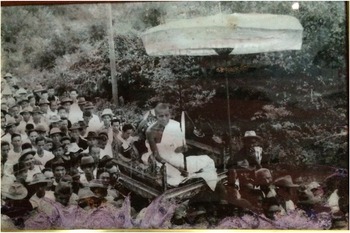
If Pii was exacerbating tensions between Srivichai’s village supporters and the government in the early 1950s, by 1957 he had developed a close working relationship with government officials (Figure 4). Pii was known to view Prime Minister Phibulsongkhram as evil incarnate (haanii), evidently associating him with the Bangkok government that had ordered the mass disrobings of Srivichai’s followers. However, for reasons that remain to be studied, Pii became close to Prime Minister Sarit Thanarat, even before Sarit’s coup in 1957.Footnote 87 Sarit’s ties to the north can be traced back to 1941 when he was stationed as a military officer in Lampang province. Among the justifications for the coup was a conflict over the plans to construct the Bhumiphol Dam. Because dam construction would flood their villages, Pii ‘mobilised thousands of Karen and demonstrated against the construction of the dam’.Footnote 88 Nevertheless, construction began in earnest in 1957 and the dam was completed in 1964. However, according to villagers in PhaaNaam (T. PaaPhai, A. Lii. Lamphun), Pii successfully negotiated with Sarit to obtain 400 rai (about 64 hectares) of land for villagers to resettle there. Pii worked closely with Khruba Khampan, the hands-on administrator in charge of overseeing the development of communities at PhaaNaam and later Wat HuaKhua. Although Pii had been at odds with government officials for most of his life, over the course of the 1960s until his death in 1977, he received numerous government awards for his help in building some 100 elementary schools, roads, bridges, hospitals, health centres, and even district headquarters.Footnote 89
Khruba Khao Pii being carried by palanquin. Source: Photo of the original housed at Wat PhaaNaam, Lamphun, by the author.

Figure 4 Long description
Pii is seated in a palanquin, which is elevated and covered with a canopy. He is surrounded by a large crowd of people, both men and women, who are walking alongside the palanquin. The scene is set outdoors, with trees visible in the background, suggesting a rural or natural environment. The crowd appears to be following or accompanying the palanquin, indicating a procession or event. The people are dressed in various styles, with some wearing hats and they are closely packed together, creating a sense of gathering or communal activity.
In part because of the Bhumiphol Dam, Srivichai’s widespread reputation among Karen minorities, and Wong’s own travels among Karen, in the early 1960s growing numbers of Karen migrated to Lii district. In about 1970 Wong established a Karen community near Wat Phrabat Huai Tom comprising some 1,200 relocated households fleeing flooding caused by the Bhumiphol Dam.Footnote 90 Because he ran the community like a commune with a rice bank and shared revenue, Wong was increasingly rumoured to be a communist. However, such rumour-mongering abated when, in 1973, the Thai king met with Wong in person.Footnote 91 In 1979, the king instituted a royal project to assist Wong and secured 2,500 rai (400 hectares) of state-owned land for the community.Footnote 92 Once under royal protection, Wong became an increasingly revered figure; today worshippers travel from across the country to pay respects to his gilded body which now lies in state.
Convergence on Srivichai
Initially the threat of disrobing was a useful means for the Thai government to enforce its goals. As Srivichai’s disciples were allowed to return to resume their former positions and as more northern monks were trained in Bangkok, tensions gradually eased. However, the government continued to monitor his followers and disrobe any monk who violated the Sangha Act. Over the ensuing decades, spurred by the growth of the communist movement, the government increasingly saw the benefits in co-opting Srivichai’s influential disciples. As northern villagers who personally remembered the mass disrobing passed away, the government’s earlier reasons to thwart northerners’ passionate devotion to Srivichai faded; monks who were known as Srivichai’s disciples developed their own reputations not based in their disrobings but for building temples, schools, and hospitals, for prowess in meditation, or for clairvoyance in predicting lottery numbers. Ironically, government budgetary support actually contributed to factionalization among the followers of Pii, Khampan, and Wong, who increasingly focused not on any past injustices but on disagreements over whose praxis was most in line with Srivichai’s. Although new hagiographical biographies of Srivichai were published after the popular uprising that ousted the military junta in 1973, neither the Thai government nor the communist guerrillas had reason to remind villagers of the humiliation of his disrobed disciples.Footnote 93 Memories of the injustices perpetrated against Srivichai lingered, but memories of the mass disrobings virtually disappeared.
Erasure by northern pride
The fourth phase in the process of historical erasure is the ongoing paradoxical politics of modern nation-state formation. Srivichai is now a symbol of northern pride, whose reputation as a saint has contributed to the modern wave of urban Thais from across the country seeking out northern monks who present themselves as khruba.Footnote 94 In the outward-facing narratives written for modern pilgrims and tourists, Srivichai’s arrests have become inconvenient truths best ignored. The many folksongs written about Srivichai and still performed on northern radio stations avoid mentions of his arrests. Even the signage at Wat Baan Pang, Srivichai’s temple in his natal village, makes no mention of any arrests. The once politicized monk of the north is being turned into a depoliticized monk of Thailand.
Currently there are groups of northerners working together to have Srivichai recognized by UNESCO as one of the world’s ‘great personalities’ in time for the 150th anniversary of his birth in 2028.Footnote 95 This initiative has led to a resurgence of research on Srivichai’s life. Hoping to gain support from the national government and Thais across the country, those involved in this initiative are deliberately seeking to avoid controversy. Despite their awareness of Srivichai’s arrests and the disrobing of his disciples, they are choosing to portray Srivichai as a forest monk, celebrating his prowess in meditation, his magical powers, his strict adherence to monastic praxis, and his vegetarianism. This depoliticized portrayal of Srivichai is reflected in this Bangkok Post summary in April 2024: ‘He [Srivichai] was known for his strict vegetarian diet, not smoking and drinking, and praying alone in forests. He also led groups of villagers to renovate old temples and pagodas in the North.’
Memories of the mass disrobings are necessarily tied to recognition of Srivichai’s arrests, particularly of his 1935–1936 detention in Bangkok. Awareness of his arrests forces an uncomfortable engagement with questions of why he was arrested, whether he was innocent or guilty, and whether the charges were legitimate. To discuss them involves considering whether Srivichai was a hapless innocent victim, an ignorant village monk, a deliberate rebel, a victorious hero, a defeated loser, a misguided traditionalist, a future Buddha, or a traitor to the nation (one of the charges against him in 1920). As this section will show, northerners today are eliding references to Srivichai’s arrests or—if his arrests are mentioned—confounding the reasons for his 1935–1936 detention with that of his 1920 detention. Whether Srivichai’s arrests are elided or confounded, there no longer exists a need to even remember the mass disrobings of his disciples.
Remembering the 1920 detention
The prevailing explanation for the series of Srivichai’s arrests leading up to his 1920 detention in Bangkok is that he was in violation the 1902 Sangha Act for ordaining monks and novices without being officially appointed as a preceptor. Some northerners and biographers dismiss the first arrest as the result of local monastic officials being jealous of Srivichai. Most accounts try to minimize it as the result of a ‘misunderstanding’ with Bangkok authorities, suggesting that Srivichai was just a village monk who did not know the new regulations. Despite the fact that Srivichai was the de facto abbot of Wat Phra Singh, one of the most important temples in Chiang Mai province, for over a decade and had commissioned the writing of thousands of Lanna religious texts, he is being portrayed as just a poor, illiterate, ignorant monk from a remote mountain village who was not familiar with the new laws being issued by the Bangkok sangha. Thus Sukich Nimmanhaeminda (1906–1976), a prominent northerner who twice rose to become deputy prime minister of Thailand, wrote, ‘Srivichai posed no danger. He was born in Lamphun and had no education. He could barely read other than a few words in northern Thai. He knew little of conventions such as monastic ceremonies. In those days very few people were literate or knowledgeable.’Footnote 96
Many northerners assured me that Bangkok’s investigation found Srivichai innocent, some even claiming he returned victorious.Footnote 97 In fact, the ruling of the sangharaja (the supreme patriarch of the Bangkok-based sangha) was more nuanced and ambiguous. Of the eight charges Srivichai faced in 1920, the sangharaja found Srivichai to have already been punished by the northern monastic order—even overly punished—for the first five.Footnote 98 He declared Srivichai innocent of the remaining three charges and arranged for his return to the north by train, giving him a gift of an additional 60 baht. The sangharaja’s ruling allows northerners to ignore the sangharaja’s finding that Srivichai was in violation of ordination regulations, and to highlight the sangharaja’s reprimand of the northern ecclesiastical monks. Highlighting the rebuke of the northern monks allows northerners to declare Srivichai innocent, while simultaneously evading a consideration of the legitimacy of the various new government regulations.
As I have noted elsewhere, explanations based on the Sangha Act of 1902 are not plausible because 1) the Sangha Act was not enforced in Monthon Phayab until 1924, and 2) the Sangha Act itself had no provisions regarding ordination. Instead, I have argued that Srivichai was in violation of the Conscription Act enforced in Monthon Phayab in 1914; the issue was not whether Srivichai was a legal preceptor, but that the monks and novices he ordained had not entered the military draft.Footnote 99 Indeed, the prevailing explanations mask the tense history of northern relations with the encroaching central Thai state at the time.
Forgetting the 1935–1936 detention
Even if Srivichai had been uninformed and therefore innocent of charges in 1920, this claim was certainly not true in 1935. The evidence is clear that Srivichai continued to ordain monks and novices and therefore was in violation of the Sangha Act then in force. There is no doubt that Srivichai was well aware of the Sangha Act and new regulations governing ordination, yet he continued to ordain hundreds of monks and novices (Figure 5).Footnote 100 From the perspective of Thai state officials, Srivichai was guilty as charged. For northerners across the political spectrum, ranging from irredentists to integrationists, the 1935–1936 arrest poses varying narrative complications. To find Srivichai innocent in 1935 would suggest the ordination regulations of the Thai monastic order were illegitimate. To find Srivichai guilty poses a problem in explaining to fellow Thais and international visitors how their revered saint could be guilty of a crime.
The Tiger Order stamp, housed at Wat Baan Pang, Amphur Lii. Source: Photo by the author.

Figure 5 Long description
The image shows an oval stamp with a detailed illustration of a tiger in the center. Surrounding the tiger is text in multiple languages, including the words 'PRA SRIVICHAI CHANA'. The border of the stamp is decorated with a pattern. Below the stamp, there is additional text in a different script.
Eliding the 1935 arrests allows integrationists to avoid arriving at a controversial conclusion that Srivichai may have been leading a rebellion against Bangkok. Eliding these events allows irredentists to avoid the emotionally painful consideration of whether Srivichai was defeated when he was forced to submit to central Thai authority. Some northerners argue that in fact Srivichai never really signed, but deliberately changed a letter in his name. Unspoken is the painful possibility that Srivichai’s feelings about his treatment at the hands of the new central Thai government contributed to his death three years later. Srivichai’s 1935–1936 arrest occurred after the 1932 coup which ended the absolute monarchy and instituted a constitutional monarchy; it is portrayed as the origin of democracy in Thailand today. Srivichai has often been portrayed as a ‘Monk of the People’, the title of one of his biographies.Footnote 101 Ignoring the 1935–1936 events also allows everyone to avoid asking why the allegedly democratic government did not support Srivichai and his disciples. A more careful reading of the historical period may lead Srivichai’s modern supporters to wonder if he was wrong to oppose the effort of the central Thai government to promote compulsory education, an effort partially linked to the new government’s claim to establish a fully electoral democracy when only half of the population was literate (in central Thai).
Accordingly an interesting conflation of Srivichai’s 1920 and 1935–1936 detentions has occurred. Unlike the 1935–1936 arrest, the 1920 arrest allows for claims of Srivichai’s innocence and victorious return, claims appealing to both integrationists and irredentists alike. Whenever possible, biographers avoid discussing the second arrest. Thus Sommai Premchit’s biography of Srivichai goes into detail about the 1920 investigation and discusses his myriad construction projects, but makes no mention of the 1935 arrest.Footnote 102 When the Kruba Chao Srivichai Foundation celebrated their ground-breaking ceremony for the construction of their centre, they selected a biography written in 1929 as their first major translation into central Thai; although an invaluable document in its own right for its description of Srivichai’s early years, it too allows avoiding a consideration of the traumatic events of 1935–1936.Footnote 103
When included, discussions of 1935–1936 are typically kept brief, seeking to reiterate the narrative of Srivichai’s exoneration and triumphalist return.Footnote 104 If northerners can avoid having to discuss Srivichai’s 1935 arrest, it follows logically that as a consequence the disrobings of his disciples are also necessarily erased. Avoiding a discussion of the 1935 arrest allows northerners and non-northerners alike to ignore whether the state necessarily had to disrobe so many monks and novices or whether Srivichai’s disciples would have been wiser to comply than disrobe, let alone to consider the full magnitude and possible impact of the mass disrobings of monks and novices on the north. Ironically, the more Srivichai is portrayed as a forest monk engaged in solitary meditation, the less impetus there is to remember the role of his disciples in the Tiger Order.
Conclusion
This article has highlighted the largest mass disrobing of Buddhist monks and novices in modern Thai history and the interplay of both conscious and unconscious processes in its extraordinary erasure from public memory. Both the disrobings and their erasure are elements in the chronopolitics of the formation of the modern nation-state of Thailand. In order to bring the population of the once independent northern Lanna kingdoms under the jurisdiction of the central Thai government, the state sought to bring the northern monastic order under its control. The efforts of the secular state to enforce military conscription and compulsory secular education shifted the role of the northern sangha from once serving as a check on state power to becoming its subordinate.Footnote 105 Under the leadership of Khruba Srivichai, the Tiger Order arose in resistance.
Srivichai’s decision to continue to ordain monks and novices after 1924 was clearly in defiance of the 1902 Sangha Act. Various scholars have lamented the government’s decision to arrest Srivichai rather than recognize him as a legal preceptor. Such laments fail to consider the government’s view of the threats posed by Srivichai, his disciples, and the northern population. Understanding Srivichai’s reasons for continuing to ordain monks and novices and the reasons of some 1,000 monks and novices for deciding that they would rather be disrobed than agree to be subordinated to the central Thai monastic order also deserves more scholarly attention. That Srivichai was arrested during the time of the constitutional monarchy remains an unexplored but inconvenient truth for today’s national narrative which heralds the 1932 coup that overthrew the absolute monarchy as the origin of Thai democracy.
An argument can be made that highlighting Srivichai’s arrest and the mass disrobing of his disciples is a luxury that historians may indulge in, but is harmful to political efforts to unify a nation. As Ernest Renan noted over a century ago, ‘Forgetting, I would even go so far as to say historical error, is a crucial factor in the creation of a nation, which is why progress in historical studies often constitutes a danger for [the principle of] nationality. Indeed, historical enquiry brings to light deeds of violence which took place at the origin of all political formations.’Footnote 106 As this article has shown, northerners have played varying roles in the erasure of Srivichai’s arrests and the disrobing of his disciples up to the present day. Indeed, when I have given talks about the political context of Srivichai’s life, audience members have risen to protest that Srivichai was above politics. Others believe that more attention should be paid to Srivichai’s accomplishments rather than the negative moments of his life.
However, to truly become a single nation, citizens should have a sense of how their divergent histories have shaped their present experiences. I have been surprised at how many Bangkokians have no idea who Srivichai was, let alone of the emotional resonances Srivichai holds for northerners such that northern politicians begin their electoral campaigns at his shrine or protestors stage their demonstrations there. In the 1920s Srivichai was known as a tonbun, an incarnation of the future Buddha, Maitreya, able to end suffering and bring about social justice.Footnote 107 Today he is being transformed into a keji ajarn, a type of saint with magical powers now found across Thailand who are known particularly for their abilities to foretell winning lottery numbers. The principles which Srivichai and his followers in the Tiger Order were seeking to defend remain obscured in history. To understand their beliefs and the threat they were seen to pose necessarily involves remembering Srivichai’s arrest in 1935 and the mass disrobings of his followers. Only by remembering the drama of these events can we begin to appreciate and evaluate the fascinatingly complex processes by which the once independent Lanna kingdoms were incorporated into the modern nation-state of Thailand. Forgetting is the threat to understanding.
Acknowledgements
In addition to countless villagers who have shared their memories of Khruba Srivichai, I would like to thank Phra Prakohpbun Siriyano, Ratsamin (Mint) Thepmanee, Nopharat Fangsiang, Sopa Mcauliffe, Phra Adul Silakit, Naren Punyapu, Phuchitchai Bongkotphohngamphai, Pensupha Sukkata, Sanguan Phongmanee, Chao Chuankhit na Lamphun, Pisith Nasee, Anatole Peltier, Direk Incaj, Mala Khamchan, Phonsiri Wannasai, Prakirati Satasut, Kwanchewan Buadaeng, Wasan Panyakaew, Paul Cohen, Thanet Charoenmuang, Taylor Easum, Napakadol Kittisenee, Chaiyaporn Singdee, Thongchai Winichakul, Thomas Borchert, Sue Darlington, Arjun Subrahmanyan, Larry Ashmun, Tyrell Haberkorn, James Bowie-Wilson, Matthew Wilson, Hugh Wilson, Adrian Avery-Johnson, Erick White, Narinthip Viriyabanditkul, Narong and Kongchan Mahakhom, Robert Oppenheim, and the anonymous reviewers of this journal, and above all, Amornwat (Aod) and Phunnaphat (Ning) Watcharawichaisri, whose help remains immeasurable.
Competing interests
The author declares none.




 Open access

