

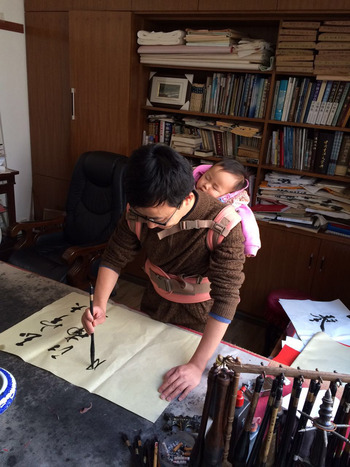
Several years ago I invited Professor Yoshiaki Shimizu, my teacher of Japanese art in graduate school, to give a public lecture and demonstration of calligraphy at my university. He brought all the paraphernalia except for his inkstone, intending to borrow mine. Upon discovering that I had only bottled ink—though made in Japan—he chaffed me for not owning one of the most essential writing tools. Sometime later I was given a hefty inkstone, a stick of ink-cake, two celadon water droppers, and two paperweights, all made in Korea. They were given to me by my teacher of Chinese art, Professor Robert Bagley, who had received them as a gift from an American acquaintance, who had in turn received them as a birthday present from a Korean friend. I began using them for my daily calligraphy practice. It takes ten minutes of laborious grinding to yield a small pool of ink that can write, on new newsprint, which is less absorbent than the rice paper Chinese calligraphers normally write on, eighty-four characters, each about four inches high and consisting of anywhere from one to twenty strokes. For young calligraphers pressed for time, grinding ink is an unaffordable luxury, says Dr. Lu Rong 盧蓉, a professor of calligraphy from Fujian Quanzhou who was a visiting scholar in my institution (Figure 1).Footnote 1 But older calligraphers do not use inkstones more often than younger ones, for as their fame grows so does the demand for their writing. One early nineteenth-century calligrapher's writing was in such a high demand that his servant boy broke his wrist grinding strenuously without pause.Footnote 2 Dr. Lu's father-in-law, Mr. Wang Naiqin 王乃欽, is a prominent calligrapher in Fujian who owns several Duan 端硯 and She 歙硯 inkstones. Dr. Lu says that he uses them only as containers of ink and ornaments for his writing table. But I like the ink I grind myself better than bottled ink because I can control its viscosity, thereby obtaining a broad range of black and gray shades. The fragrance of freshly ground ink is intoxicating and the slow circular motion is calming. Although my inkstone is too big to play with, I like its cool touch and wooden sound when clinked. Countless writers before me must have felt the same way. That luminaries like Zeng Guofan 曾國藩 (1811–1872) would grind their own ink rather than let their servant boys do it is silent testimony to their feelings.Footnote 3 Vocal testimony in the form of critical writings about the qualities of various inkstones began to appear in abundance in the Northern Song period,Footnote 4 most famously in Yanshi 硯史 (An Account of Inkstones) by the eccentric Mi Fu 米芾 (1052–1107), who as a calligrapher of towering prestige set connoisseurial fashions for the first group of inkstone aficionados and collectors in Chinese history.
Calligrapher Li Lei 李雷 practices calligraphy at home. Two bottles of the Yi De Ge ink are visible behind the brush rack (photograph taken by his wife Wang Xiaoxue 王曉雪 in 2017).
Dorothy Ko's new book, The Social Life of Inkstones, succinctly recounts the eleventh-century genesis of inkstone collecting (160–64); but collecting occupies only one part of her enchanting study of this stone tool. She guides us through a long and winding journey from prospectors and quarrymen deep in the mountains of Manchuria and Guangdong to carvers and customers in the alleys of Suzhou and Fuzhou, not to mention imperial patrons and bondservant designers behind the high walls of the Forbidden City. Taking her inspiration from the anthropologist Igor Kopytoff's classic essay “The Cultural Biography of Things,” which traces the career of a slave, Ko finds a parallel between the changing meanings attached to an inkstone in the course of its life and the social status of the people it encounters along the way.Footnote 5
The rich written records and abundance of actual works available to Ko make it possible to write the complete biography of a single type of object. Biography of this kind can answer fundamental questions: Why was art made, for whom and by whom? How was it made, why does it look the way it does? Where did it live, who made up its audience, what were the occasions of viewing, what were the reactions? Implicit in this string of questions is an acknowledgement that any work of art is the result of myriad activities carried out by the cooperation of people who form what sociologist Howard Becker calls the art world, the world of all the people without whose contributions the work could not have come into being, a world whose conventions for the division of labor are most familiar to us from the list of credits at the end of a Hollywood movie.Footnote 6 In the art world of inkstones Ko encounters an inquisitive emperor in northeast China and a commando prospector in the south, both wandering the mountains in search of the most beautiful stones; naked miners harvesting thin veins of stone in pitch black tunnels; experienced assessors mapping out the internal structure of an unopened boulder; bondservant and bannerman technocrats designing inkstones and ink-cakes; crafts(wo)men legendary or nameless carving inkstones; emperors, governors, and aspirant scholars commissioning, collecting, commemorating, bestowing, and coveting inkstones.
The chronological focus of Ko's inkstone world is half a century during the reigns of Kangxi 康熙 (r. 1662–1722) and Yongzheng 雍正 (r. 1723–1735), from the 1680s through the 1730s. Ko chooses this period for several reasons. First, as a salient symbol of Chinese literati culture, the inkstone was seen by Kangxi as an object onto which he could graft his Manchu identity by using a hitherto unheard-of new stone quarried in the Manchu homeland. Kangxi and his successors showered their Chinese as well as Manchu officials with gift inkstones made in the newly established imperial workshops. Second, imperial inkstone-making ushered in a new element in material culture that put a premium on technical knowledge. The respect for crafts shown by the two emperors and by the bannermen and bondservants they put in charge of manufacture was communicated to all levels of Qing society. It contributed to the rise of two new groups among the literate, groups whose lives were entangled with inkstones: one group abandoned hopes for a career in officialdom to become professional stone carvers; the other persevered in classical learning, hoping to use connoisseurial knowledge and carving skills to gain them a foothold in government. The third and perhaps most important reason for Ko's focus is that the imperial inkstones failed to win the affections of Chinese connoisseurs, who adhered to the traditional choice of Duan and She stones quarried and carved in southern China. The connoisseurs created a parallel world of inkstones, full of its own inventions and new knowledge.
***
The non-royal and Chinese world of inkstones is the heart of Ko's book, occupying four of its five chapters, but since it was the Manchu conquest that began the reshaping of material and intellectual culture during the early decades of Qing rule, Ko logically begins her story at the Forbidden City in her first chapter, “The Palace Workshops: the Emperor and his Servants.” Royal workshops had been in operation since the Bronze Age, but only from the Imperial Workshops of the Qing do we have both complete archives and countless products kept in the two palace museums of Beijing and Taipei. A watershed in Qing studies was the 2005 publication of the fifty-five-volume Qinggong Neiwufu Zaobanchu dang'an zonghui 清宮內務府造辦處檔案總匯 (Comprehensive Archival Records from the Qing Imperial Household Department's Workshops, hereafter ZBC). For Chinese scholars the possibility of matching extant objects with archival records has been the driving force behind a steady stream of studies on everything from lacquer to painting. Their attempts to identify well-known art works with items recorded in palace archives often read like gripping detective stories, and they sometimes challenge theories that have long been accepted in academic circles.Footnote 7 This rich source of information has received less attention from scholars in North America, partly because, influenced by distinctions between high art and craft made centuries ago by both Chinese and Italian writers on art, they have traditionally focused their interest and expertise on painting at the expense of other media. But no such distinction is to be found anywhere in the Qing imperial archives. Instead we find the emperors spending endless hours ordering the making and repairing of all sorts of objects, commenting on qualities of design and workmanship, rewarding or punishing artisans, and inquiring about the whereabouts of things they used in their youth. To see the making of art through the eyes of the patrons who commanded it we must step outside our own culture's explicitly formulated conception of art, whether Chinese or Western, and that is exactly what Ko aims to do, “making the inkstone the protagonist of this book and the craftsman's skills its motive force” (6), “restor[ing] the craftsmen to historical legibility” (9).
The story begins with the Kangxi emperor's claim personally to have discovered a new kind of green stone in a hill near his ancestral tombs at Shengjing (Mukden) in 1682, right after his elimination of the Three Feudatories in the previous year. Recognizing its suitability for inkstones, he ordered his craftsmen to make test pieces. These he found far superior to inkstones from the famous Duan quarries in Guangdong. Thereafter green stones from Manchuria were often called “green Duan” in workshop archives (239n64). The generic name for the new stone was “Songhua” 松花, but in the inventory lists of the workshop storehouse it was called “Ula stone,” presumably because it was discovered in the Ula mountains or because the court routinely ordered the Ula general to replenish supplies.Footnote 8
Since the mechanics of quarrying Songhua stone are unclear, Ko takes us straight to the designing process, the next step in the making of green inkstones.Footnote 9 Her hero is the bannerman Liu Yuan 劉源. Liu spent six years in Suzhou pursuing his interest in painting, then gained access to officialdom by flattering Kangxi with a set of portraits. He eventually became the emperor's trusted designer of porcelain, seals, ink-cakes, and inkstones. Ko chooses three ink-cakes and one inkstone to illustrate Liu's visual invention and consummate workmanship. She also recounts personal interactions with the emperor that shaped his designs (22–30). Even if it reproduced her illustrations, no summary could convey the fascination of Ko's concrete observations; I must content myself with noticing that her analysis contains all three of the key statement types that Michael Baxandall detected in the writing of the best art historians: (I) comparative or metaphorical, as represented by Ko's vivid description of the dragon's flying mane “chiseled strand by strand as if combed by iron-wire”; (II) causal or inferential, as in her observation that Liu created an illusion of depth by “meticulous manipulation of layers—by rhythmic alternations between building up and cutting down—and by deft use of soft, round profiles of uneven depths”; and (III) descriptions of the beholder's reaction: “Instead of the appearance of a dragon being carved onto the surface of a stone, the overall effect is one of a dragon materializing from the core of the stone.”Footnote 10
Ko's description makes it clear that Liu the court designer was also the carver who executed his designs for inkstones. How easy, after all, would it have been to separate conception from execution? How would Liu instruct a carver to manipulate layers and depths in ways too fine to be conveyed in drawings? Ko's emphasis is nevertheless on Liu's imagination, and it is indeed reasonable to see a separation between conception and execution in media that Liu designed but did not execute, for instance porcelain and seals, the making of which typically began with annotated color drawings, cardboard or wax models, or existing works he had designed.Footnote 11 It is in Liu's imagination that Ko sees a key feature of Qing workshop practice in both the royal and non-royal spheres, namely, the borrowing across media of design ideas and techniques. Gilding routinely used in making ink-cakes was transplanted by Liu to his inkstone designs. From jade working he borrowed the idea of making one motif—a dragon or cloud—extend from one plane to adjacent planes, applying it to his designs for porcelain, ink-cakes, and inkstones. The mingling of artisans from different trades and different regions—Liu received his artistic training in Suzhou—both in the palace workshops and in the craftsmen's quarters must have made such cross-fertilization easy.
Routine archiving procedures were established upon Yongzheng's ascending the throne, and we immediately begin to find written records of individual craftsmen making objects in several media: carvers of ivory and bamboo also carved inkstones. Ko reasons that those who in the archives were categorized as “inkstone craftsmen” were mainly producing large quantities of gift inkstones in a geometric shape devised for the hard and dense Manchurian Songhua stone in the last two decades of Kangxi's reign (about 1700–1722), while the more skillful ivory and bamboo carvers recruited from south China were occasionally called upon to make one-of-a-kind inkstones as well as to advise the emperor in artistic matters (31–34, 38). Since the logs of orders and objects in the published archives rarely mention which artisan was responsible for which order, and since orders for routine gifts for major holidays were usually not logged,Footnote 12 Ko's hypothesis is hard to substantiate. But the chance survival of another kind of record from the ninth year of Yongzheng's reign (1731) reveals that the jade craftsmen were ordered to make reserve inkstones in bulk. Volume 5 of ZBC records in full the communiqués from the workshops to the Guangchusi 廣儲司 (Department of the Privy Purse, part of the Imperial Household Department), apparently because the Guangchusi was in charge of the work schedules of artisans and also of a crucial material, the abrasives (called baosha 寶砂, literally precious sand) used to slice the raw stones.
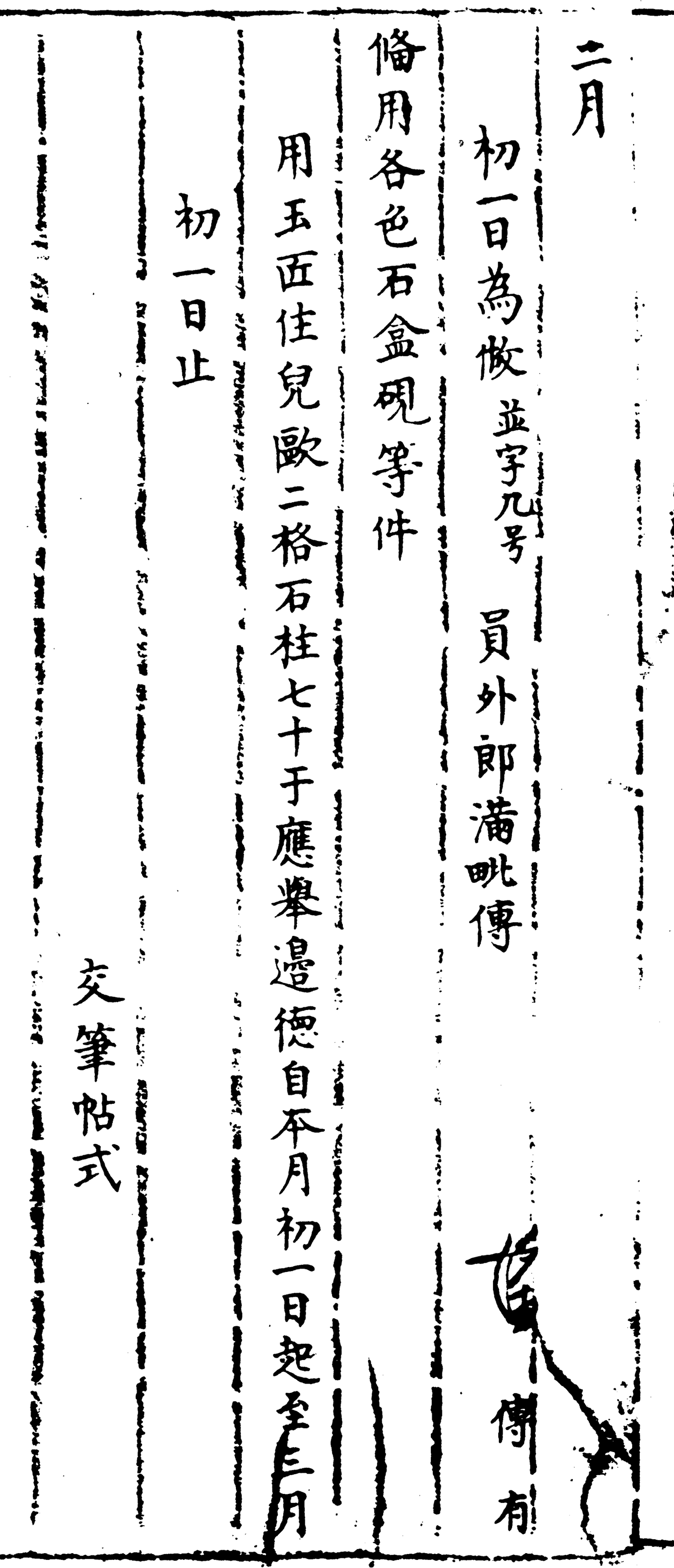
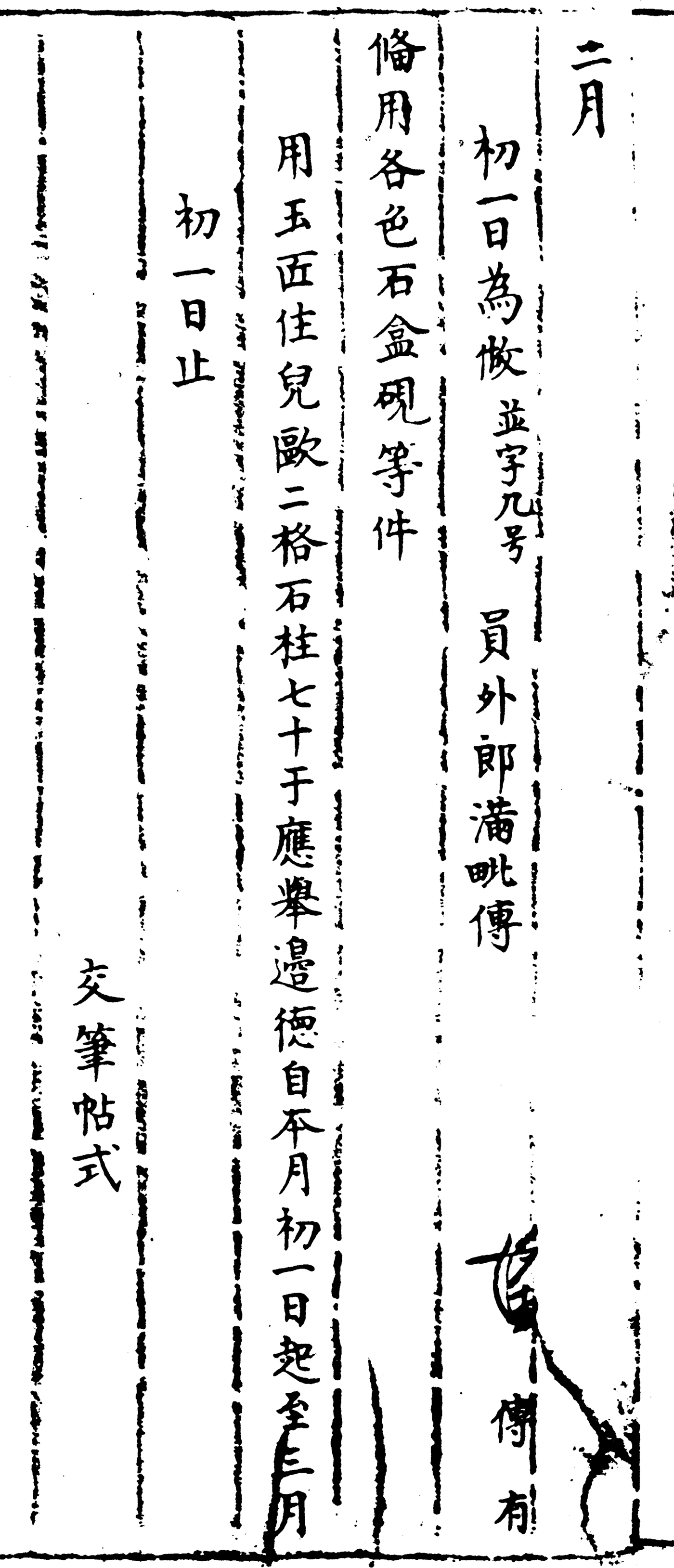
This is a body of material I have been exploring myself for a seminar on the imperial workshops. Figure 2 is a typical record of this kind, which reads:
[Text 1] On the first day of the second month, for filling the order (number so-and-so) conveyed by Vice Director of Section Manpi to make boxed inkstones of various kinds, use the jade craftsmen Zhu'er, Ou Er'ge, Shi Zhu, Qishi, Yu Yingju, and Bian De,Footnote 13 from the first day of this month to the first day of the third month. Pass to the clerk.Footnote 14
Table 1 summarizes the Guangchusi records concerning inkstone-making (ZBC 5.151–209). In four instances the records can be matched with the order logs, as indicated in the last column.
A communiqué from the Imperial Workshop to the Department of the Privy Purse, after ZBC 5.155.
Work Schedules and Abrasives Used for Making Inkstones in 1731

15 It is curious that in two cases twenty inkstones were ordered but only eighteen were recorded as having been submitted. Were the remaining two kept as models for future works?
16 For this type of inkstone see 235n38 in Ko's book.
As the raw materials for both trades are stone, the use of jade craftsmen to make inkstones should not surprise us. But jade is much harder than the stones used for inkstones (the hardness of nephrite is 6.5 on the Mohs scale while the Duan and Songhua stones are between 3 and 4). Jade has to be cut, shaped, and polished with abrasives. Since geometrical slab-shaped inkstones were the order of the day during Yongzheng's reign, and since slicing slabs from a boulder is one of the most basic operations in jade working, it makes sense that the jade workers were assigned to do the drudgery when there was a monthly quota to meet. But jade and inkstone makers also shared a mindset. Ko notes that when Liu Yuan designed the aforementioned inkstone “he positioned the natural mineral markings on the stone prized by Chinese collectors (‘scorched patch’ and ‘rouge halo’ in this caseFootnote 17 ) at the center of the inkpool” (25). This is exactly how a jade worker thinks: he focuses on exploiting the colors and patterning of a particular piece of stone.
Beautiful colors and patterning were equally important to emperor Yongzheng, whose exacting standards for design and workmanship have been the subject of several lengthy Chinese studies synthesized by Ko (36–43). She further points out a quirk of Yongzheng's taste in art in general and in inkstones in particular. “His love of the container exceeding that of the implement inside,” he liked using new materials to fashion inkstone boxes that would affront Chinese connoisseurs, and in so doing created “fresh visual and material possibilities” (40 and 42). The following log supplies a nice illustration of her point:
[Text 2] On the seventeenth day [of the fourth month, 1733], according to the note from Yuanmingyuan, eunuch Wang Changgui handed in nine Duan inkstones in Butter Stone boxes [interlinear note:] tributes from Omida, the governor-general of Guangdong, and conveyed the imperial order: “Outfit the Butter Stone boxes with inkstones in green ‘Duan’ or purple Duan for the purpose of bestowal. If the patterns of the original Duan stones are inferior, modify them to better patterns and outfit them with imperial lacquer boxes or stone boxes. Respect this.”
On the thirteenth day of the eighth month, nine green ‘Duan’ inkstones were made. The Storehouse Keeper Changbao and the Head Eunuch Samuha submitted them together with the original Butter Stone boxes [to the throne]. Order filled.
On the twenty-seventh day of the tenth month, nine boxes in maki-e lacquer were made, inside which are nine modified Duan inkstones. The Storehouse Keeper Changbao and the Head Eunuch Samuha submitted them [to the throne]. Order filled. (ZBC 6.3, my translation)
Ko calls Yongzheng's love for boxes “the tail wagging the dog” (41). An even more apt saying might be maidu huanzhu 買櫝還珠, “buy the jewel box but return the pearls.”
Records like the one translated above are numerous—reproduced at 1:4 scale they fill six modern volumes, each of about 800 pages, for Yongzheng's thirteen-year reign, and forty-nine volumes for Qianlong's sixty-year reign. They make it clear that “the massive system of manufacturing, logistical supply, and record-keeping served the whims and needs of the emperor, and him only” (34). They often contain enticing information about back-and-forth exchanges between the patron emperor and his artisans—usually through his bondservant and eunuch agents—that vary from the general to the very particular. Yongzheng's interventions often happened at the stage of model-making, for he insisted on using models to foster what he called “styles made respectfully in the inner court” 內廷恭造樣式 (36). The most often cited case is his two-month series of orders commanding modifications to the wax model for a Guandi sculpture (37). As Ko shrewdly observes, “Yongzheng often only had abstract qualities in mind at the beginning of a project; his preferences sharpened and found increasingly concrete form only upon seeing the model made by his artisans. He did not know what he liked until he saw what he did not like” (37). A telling illustration is his intervention in the designing of heated inkstones. In the second month of 1732 he complained about the old design and described his solution in words, asking for models to be made. These were submitted on the twenty-seventh day of the eleventh month. The next day Yongzheng complained that they were too tall and the water pools too deep; the pools should be just one finger segment deep. After the changes were made he complained, again on the next day, this time about the shape of the stove's feet. One month later four heated inkstones were finally submitted and accepted without further complaint (ZBC 5.545–6). Pointing to models or to existing works is a universal way for patrons to convey their wishes to their artists.
The three log entries in Text 2 tell us not only about Yongzheng's involvement in design but about the social life of his inkstones. The series begins with inkstones made in Guangdong (where the Duan quarry, subject of Ko's chapter 2, is located) and sent by its governor as domestic tribute. The tribute prompted the emperor to commission the making of new inkstones as well as the reworking of the ones from Guangdong, work that was duly carried out in the next six months. From Table 1 we have already seen that to fill the emperor's orders the workshops administration had to coordinate with the Department of the Privy Purse to set up work schedules and release abrasives from the latter's storehouse. But much more work was done within the workshop system itself. There the operational sequence involved six offices,
each with its designated functions and record-keeping procedures. The emperor's orders regarding the types and quantity of things to be made in the workshops were first conveyed to the Project Management Office (Huoji Fang), which forwarded the orders to the specific works concerned. The Office of Auditing (Suandang Fang) estimated the size or volume of the articles and commuted the material and labor costs accordingly before the Warehouse (Qianliang Ku) would release the requisite materials and silver from its vault. The Office of Overseers (Ducui Fang) made sure that the work plan was followed without undue delays, whereas the Office of Accounting (Huizong Fang) reconciled the account books upon inspection of the completed order. At year's end, the books were sent to the Archive Office (Dang Fang) for storage. (34)
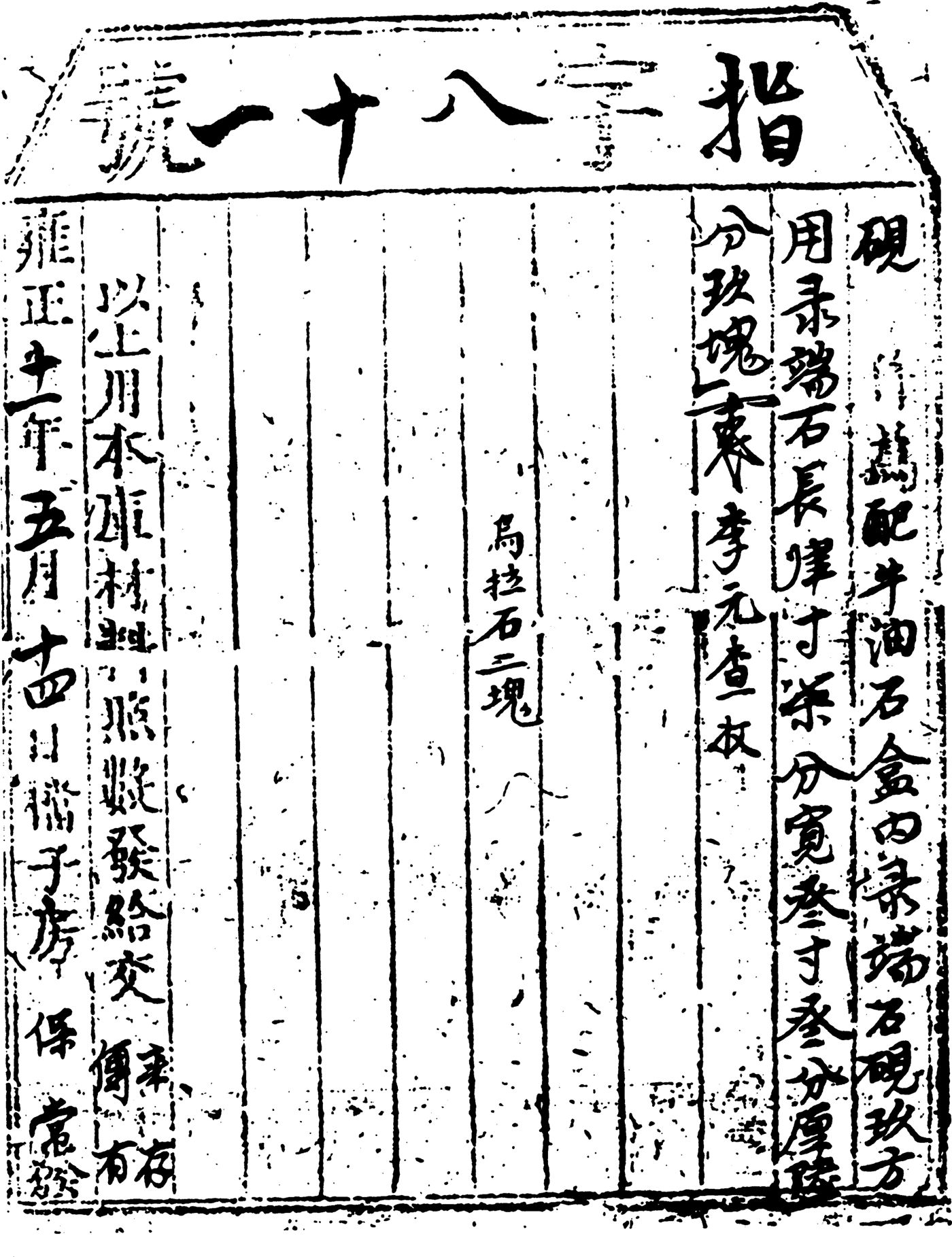
What is interesting about Text 2 is that it can be matched with two receipts issued by the Warehouse (Figures 3 and 4). The first receipt reads:
No. 81 in the Zhi series
In order for the Inkstone Works to make the nine green ‘Duan’ inkstones for matching the Butter Stone boxes, use nine green ‘Duan’ stones, each four cun 寸 seven fen 分 in length, three cun three fen in width, six fen in thickness.
-
Checked and received by Li Yuan.
-
[On day XX there is an order to withdraw] two Ula stones.
-
[in print] The aforementioned should be released from this warehouse.
-
[partly in print] Yongzheng's eleventh year, fifth month, fourteenth day. Archive Office. [signature] Baochang. (ZBC 6.106, my translation)
A warehouse receipt concerning the withdrawal of stone for making inkstones in 1733. After ZBC 6.106.
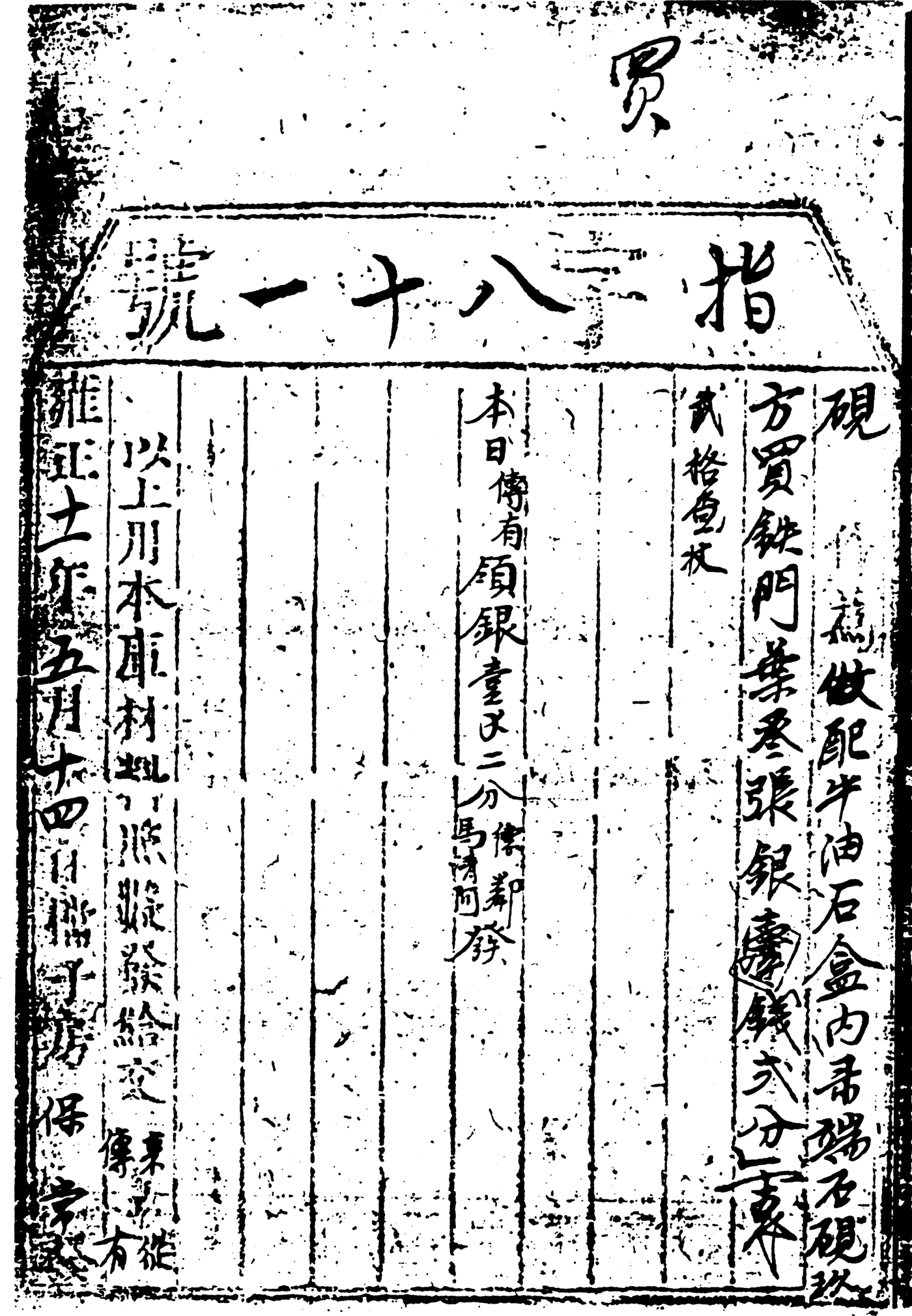
A warehouse receipt concerning the withdraw of silver for making inkstones in 1733. After ZBC 6.83.
This receipt confirms once again Ko's observation that the green ‘Duan’ stone in Qing archives referred to the green stone “discovered” by Kangxi and variously called Ula and Songhua stone in the next two reigns. It sounds as though the two Ula stones issued by the warehouse were enough to make the nine slabs requested by the Inkstone Works.
The second receipt concerning the same order reads:
BUY
No. 81 in the Zhi series
In order for the Inkstone Works to make the nine green ‘Duan’ inkstones for matching the Butter Stone boxes, buy three iron door hinges, (costing) silver one qian 錢 two fen.
-
Checked and received by Wuge.
-
On this day there is an order to withdraw silver one qian two fen.
-
Released by Huilin and Ma Qing'a.
-
[in print] The aforementioned should be released from this warehouse according to the specified quantity.
-
[partly in print] Yongzheng's eleventh year, fifth month, fourteenth day. Archive Office. [signature] Baochang. (ZBC 6.83, my translation)
I have no idea why door hinges were needed to make inkstones, but it is fascinating to know the craftsman's tools and their market price. In receipts for making lacquers the variety of raw materials, from different grades of gold leaf to pigments, is astonishing, and it tells us much about the process of manufacture.Footnote 18 In studying the making of art, materials and their prices are key information. As Ko states at the end of chapter 1, “The Qing was a veritable material empire in which everyone, from the emperor on down, knew the value and the price of things” (45, her emphasis). The issue comes back in chapter 5 when she discusses the formation of an inkstone market (162–63).
All of the eighteen inkstones mentioned in Yongzheng's work order, nine of them tribute from his governor in Guangdong, would in turn be bestowed on the emperor's subjects, reiterating the ruler–subject relationship in material form. Ko contrasts the attitudes of the Ming and Qing courts, the former intent on taking inkstones, the latter preoccupied with giving. Yet “the boxed Songhua inkstone set that epitomizes early Qing imperial taste had no apparent impact on literati preferences” (45). Chinese collectors were adamantly committed to the time-honored Duan and She stones from southern China. In chapter 2 Ko therefore heads south to investigate the Duan quarries in Guangdong. Before we go with her, I want to linger a little longer in the Forbidden City to see what happened to the inkstones that remained in the palace.
Many of the imperial inkstones were used as props for household display, for which Yongzheng often gave specific instructions. Ko notes that in doing so “Yongzheng appears more an interior decorator than an emperor or scholar” (43). Displaying objects made by the imperial workshops became an institutionalized practice, so much so that special inventories were kept for each palace, temple, garden, hall, and room, all the way from 1694 to 1922.Footnote 19 These inventories have been in process of publication since 2014 and they will no doubt help us visualize the Qing court in a new way.Footnote 20 From a few published excerpts we can already see the prominence of inkstones. For example, the Qianqing palace 乾清宮 was the first of the three central buildings of the inner court, and its east wing 東暖閣 was where the Kangxi emperor daily conducted the affairs of state.Footnote 21 According to the earliest inventory of its furnishings, which dates from 1835, one zitan 紫檀 wood table was placed at the left side of the room, on top of which was displayed one inkstone inside a zitan wood box and one heated Songhua inkstone inside a gilded bronze box, among ten other antiques, brushes, imperial calligraphy carved on jade, and so on, all of which were either contained in zitan wood boxes or fitted with zitan wood stands.Footnote 22
Another example: Kangxi's sleeping quarters in the Zhaoren palace 昭仁殿 were later used to house Qianlong's most precious books. For the right side of its main hall an inventory from Qianlong's reign (1776) lists a small writing table that was even more crowded than the one in the Qianqing palace, its furnishings including “an old Duan inkstone with ‘banana leaf white’ markings and gourd leaf motif in a zitan wood box” 舊端蕉白瓠葉硯一方 紫檀盒盛.Footnote 23 This very inkstone was recorded in the Catalogue of Inkstones from the Chamber of Western Purity 欽定西清硯譜, which was compiled in Qianlong's time. The catalogue says only that it was kept in the Zhaoren palace, but the inventory gives us its precise location and a complete list of the objects that accompanied it.
Although this inkstone seems to have been made during Qianlong's reign,Footnote 24 putting it outside Ko's chronological scope (235n37), Qianlong played an important role in the social life of the inkstones ordered by his grandfather and father, not only because his catalogue recorded some of them (46), but also because he was a recipient of gift inkstones. In the ninth year of his reign (1744.11.20) he ordered the making of a large number of boxes to hold gifts he had received from Kangxi and Yongzheng when he was a prince. He specified that they should all have labels saying that what the box contained was an imperial gift from Kangxi or Yongzheng. Among the fifteen gifts listed as from Kangxi was an inkstone in West Hill stone contained in an agate box. Among the ninety from Yongzheng were sixteen inkstones: seven in Duan stone and seven in Songhua (including one called green ‘Duan’) stone, all of which were in boxes of stone or lacquer or gilded bronze made in the shape of heated inkstones (ZBC 12.594–7).
Remarkably, Yang Yong and Liu Yue, two researchers at the Palace Museum in Beijing, have managed to identify some of these gifts in the collection there with the help of three key documents.Footnote 25 The first is an edict issued in Qianlong's sixtieth year (1795) which says that Qianlong ordered his heir apparent and other princes to go to the Chonghua palace 重華宮 to check and re-inventory the gifts from Kangxi and Yongzheng, which they did accordingly. Qianlong then said that because the Chonghua palace was his residence when he was only a prince (a unique privilege bestowed on him by Kangxi), now that he was the emperor it would be closed to others, depriving them of the joy he once had there. But, he continued, why not keep everything as before and let his sons and grandsons come here to remember the place as the origin of their fortunes? He therefore ordered mementos of four kinds to be kept in a pair of cabinets that were part of the dowry of his beloved first wife, Empress Fuca: (1) the top compartments of the east cabinet would store gifts from Kangxi; (2) the top east compartment of the west cabinet would store gifts from Yongzheng; (3) the top west compartment of the west cabinet would store gifts from Qianlong's mother; (4) the bottom compartments of both cabinets would store clothes and objects Qianlong used when he lived there as a prince. “Sons and grandsons from future generations should examine them whenever they want, so that ancestral mementos will survive. They are to be used to earnestly yearn for and eternally long for (the ancestors). Everlastingly follow your ancestors” 後世子孫隨時檢視,手澤、口澤存焉,用以篤慕永思,常懷繼述. Finally, Qianlong ordered two copies of this edict made, one to be kept in the Chonghua palace, the other in the Palace School (Shangshufang 上書房), in order that his descendants should obey his will for generations to come.Footnote 26
Qianlong's command was apparently obeyed to the very end of his dynasty. The second of Yang and Liu's three documents is one of the aforementioned display inventories made in 1876, entitled Archives of Mementos (Chonghua palace) 遺念(重華宮)檔. It has three parts. The first two correspond to the two lists of gifts from Kangxi and Yongzheng recorded in the workshop archives of Qianlong's ninth year (1744); the third seems to correspond to the gifts from his mother and his own belongings mentioned in the edict of his sixtieth year (1795). So the imperial gifts that Qianlong kept as mementos in his old residence were still intact at the beginning of Guangxu's reign. Nor did the tenacity of Qing imperial curators diminish in the last years of Qing rule. In 1924, after Puyi and his family were ordered to move out of the Forbidden City, a committee was formed to inventory everything in the Forbidden City, resulting in a massive report arranged according to the locations where the objects were found.Footnote 27 Yang and Liu used this report to locate objects originally stored in the Chonghua palace, and they found many that can be matched with the 1744 gift lists in Qianlong's workshop archives and in the 1876 inventory of mementos. Several of them still keep their original boxes and labels.Footnote 28
Later in her book Ko cites Natalie Davis's The Gift in Sixteenth-Century France (2000) to suggest how a “gift register” created value and meaning for the scholar collectors in Fuzhou (180). The same register also operated in the imperial court, most conspicuously between lord and minister for the outer court, father and son for the inner court. One of the sixteen inkstones from Yongzheng has an encomium carved onto its back that begins with a long poem praising the high quality of the Duan stone from the old pits and expressing Qianlong's gratitude to his father. The poem is followed by a simple note about the date of bestowal, but the 1876 inventory mentions that many mementos were accompanied by Qianlong's memos (shiyu 識語) written on a separate piece of paper. One memo accompanying a set of jade prayer beads tells us that four years previously his father had discussed Chan Buddhism with the princes and ministers and then bestowed on him this set “from his own hands. Therefore I have to record it.” Another memo says that Yongzheng discussed Chan Buddhism again with his sons two years later. Since only Qianlong understood the doctrine, he was given a headband in bright yellow—the imperial color that a mere prince should not have—“therefore I have to record it.”Footnote 29 Memos he wrote for the gifts from his grandfather convey the same message. Among the many princes, Qianlong was singled out for special treatment by both emperors. Could it be a coincidence that all these memos were written in the first year of his reign (1736), and that sixty years later he asked his descendants to examine the mementos as time allowed?
Legitimation was certainly in Qianlong's mind, but we should not underestimate the emotional charge that these mementos held for him. Like the Fuzhou collectors Ko describes in chapter 5, Qianlong would “fondle” (mosuo 摩挲) these gifts, and the memories they brought back would make him cry “every time.” For the Manchu rulers, as for people everywhere, objects could embody and retain memory.Footnote 30 Some of the personal belongings of the deceased emperor, empress, and dowager empress would be distributed to their descendants, officials, and attendants. These belongings, ranging from clothing and armor to stationery and religious utensils, were explicitly called mementos (yinian 遺念) and were mostly made by the imperial workshops. The majority of them were labeled and kept in various buildings within the Forbidden City and at Mukden.Footnote 31 Qing palaces were museums with growing collections constantly augmented by the imperial workshops.
Can objects really hold memories, asked the distinguished ceramic artist Edmund de Waal, who in The Hare with Amber Eyes sought to use an inherited collection of netsuke to revive the memory of his once prominent Jewish banking family? To judge by the runaway success of his book, he achieved his aim, but not with netsuke alone; his fingers “are tacky from old papers and from dust” after almost two years of intensive “looking at the scribbles in the margins of books, the letters used as bookmarks, the photographs of nineteenth-century cousins, the Odessan patents of this and that, the envelopes at the backs of drawers with their few sad aerogrammes.”Footnote 32 It seems that in the long run it is always the textual records that win the upper hand, without which even the story of Qianlong's objects would have been lost to us. “Texts are powerful conduits of information through time, and by reading them against the material remains one can glean their discursive limits, hence better able to read them all” (Ko, 8). In the rest of her book Ko reads an amazing array of texts against the stones coveted by Chinese connoisseurs, and she tells us a story long forgotten.
***
The first stop on Ko's southern tour is the Duan quarries in Guangdong (chapter 2, “Yellow Hill Villages: The Stonecutters”). Stoneworkers in a cluster of villages here have made their living off the purple stone at least since the seventeenth century. Ko first describes the qualities of the Duan stone that enable it to meet the connoisseur's requirement for “producing ink without hurting the brush” (50–51), above all the fine balance of coarseness and hardness. In the discourse on qualities Ko discovers a three-party contest involving the stoneworkers, local scholars claiming first-hand knowledge of the quarried stones, and scholar-connoisseurs living far from Guangdong. Her main objective is to make the voice of the stoneworkers heard, for they did not and still do not write down what they know. Since the business of quarrying continues to this day, her first way of getting close to them is to describe their trade, basing herself on field interviews conducted by a Chinese researcher in 2004–2009 (242n12). For the prospectors and miners of Duan stone the first order of business is to make their own tools, chisels and hammers of varying size and hardness. The skills used in forging these tools are jealously guarded trade secrets; they discourage outside competition by creating a high threshold for entry (54). The knowledge of prospectors and miners is not easily obtainable by outsiders either, for it is “embodied, situated, and highly specific.” The prospector has to know the topography intimately to see through rocks. The miner in a dark tunnel has to intuit the course of a thin vein to chisel out useful stone. None of this knowledge was written down because the stoneworkers “have no use for abstraction, nor has it been in their interest to make the localized knowledge that has been their dominion accessible to others. To textualize and to generalize is the scholar's métier, not the stoneworker's” (61).
Ko's second way of restoring the stoneworker's legibility is to read between the lines in incidental writings left by scholars from the Northern Song to Qing dynasties. Some of these authors admit that they have never been to the quarries. To describe them they rely on personal observation of finished inkstones, hearsay, and quotations from historical and fictional accounts (63). Some, epitomized by the arbiter Mi Fu, claim that they interviewed the stoneworkers only to confirm their own opinions on the nature and quality of Duan stones. For them the stoneworkers were ignorant natives who had no authority in connoisseurial matters because they did not grind ink; to prolific calligraphers such as Mi Fu, “[w]hen it comes to classifying and ranking inkstones, the most important criterion is its ability to activate ink; second is its color; the refinement or coarseness of its craftsmanship and shape comes last” (67). From the patron's perspective these are reasonable criteria. But Ko sees here a “strategic use of a discourse of function to police the boundary of the scholar-literati group,” a group who were in effect claiming that the judgment of stone was their province, not the province of quarrymen. Whose was the first-hand knowledge that really mattered? The scholars’ knowledge of grinding ink or the stoneworkers’ knowledge of prospecting and quarrying?
We learn from Ko that the rise of “evidential scholarship” in the Qing period prompted scholars to trek to the Duan area in quest of first-hand knowledge. One consequence was the appearance of schematic maps purporting to educate the readers “about an ever-shifting internal hierarchy” among the seventy or so quarries “as new pits were opened or familiar lodes exhausted” (68). Scholarly obsession with the most celebrated quarry, the Underwater Lode, gave rise to X-ray-like maps that show the relative positions of each shaft dug during successive operations. “The structure of knowledge … shifted from an ordering of the seventy-some quarries scattered in the Duan area to an ordering of the stones gathered from the same shaft of the submerged quarry but in different years,” prompting the inkstone aficionado to trace the origin of his stone back “to a particular cave on the southern edge of the empire” (70). Wine connoisseurs would be sympathetic. But Ko argues that such authority claims were necessarily fanciful because the shafts were empty. Even if the connoisseur were to crawl naked into the tunnel “seeking the truth from concrete facts,” he would find no clue to connect it with the colors and surface qualities of his inkstone (71–72). True to her intention to question the system of knowledge constructed by the literati and taken for granted by scholars in Chinese studies today (6), Ko here offers her alternative judgment:
But of course this inconvenient reality was never made explicit in the discourse. The knowledge useful to the inkstone connoisseur is constructed ex post facto and shored up by faith in the authority claims of someone else. It is the opposite of what is usually meant by authentic, in situ, or indigenous knowledge (72).
The undeclared contest between the scholar and the stoneworker was intensified when a third party joined the discourse in the Qing period: the local scholar, represented in Ko's book by the little-known writer He Chuanyao 何傳瑤, who in the early nineteenth century published a treatise on Duan stones. In his book He not only published maps of the Underwater Lode, labeled with logistical information to help in mining the quarry, he also subverted the hierarchy of quarries long cherished by scholars elsewhere in the empire. He charged the stoneworkers with feeding out-of-province scholars false information in order to safeguard their profits. It is precisely in He's rebuttal of the stoneworkers that Ko finds the most reliable written evidence of the latter's “hidden transcript” (to borrow the anthropologist James Scott's termFootnote 33 ):
For centuries, they [the stoneworkers] manipulated knowledge about Duan inkstones and the criteria of their assessment by dint of their privileged status as native informants to visiting scholars. The prevalent valuation schemes that connoisseurs had promulgated in their treatises ever since the time of Mi Fu were in fact by and large those of these craftsmen. They affected the vicissitudes of fads for particular hues and mineral markings by making new stones and desirable features available to the buyer. Their power to name new quarries, stones, and mineral features generated new tastes in the marketplace. When He Chuanyao accused the stoneworkers of (mis)naming stones, the offense was really one of usurping the métier of the scholar. (Mis)naming is exactly what He himself proceeded to do when he sought to set the record straight (77).
On the stoneworkers’ side the contest was a struggle for power in the marketplace. Ko marvels at the perseverance of the underdogs in the face of challenges from the prestigious literati, and she laments that the inkstone carvers at Suzhou and Fuzhou, heroines and heroes of her next two chapters, had less success in their close encounters with the scholars.
***
After leaving the Duan quarries in Guangdong, Ko takes us north to a small lane in Suzhou, the Zhuanzhu Lane 專諸巷,Footnote 34 dubbed “Craftsman Central” by Ko (83). Workshops of all kinds were congregated here, among them the inkstone workshop run by Gu Erniang 顧二娘, a female carver and the central figure of Ko's chapter 3, “Suzhou: the crafts(wo)man.” As is the case with so many professional artists before her, very little is known about Gu Erniang's life—after ten years of painstaking research Ko comes up with a one-paragraph biography. Gu Erniang married into the Gu family and apparently learned to carve inkstones from her father-in-law and husband. After their deaths she inherited the family business of inkstone-making, achieving local and national fame between about 1700 and the date of her last reliable work in 1722. She probably died toward the end of the 1720s, survived by an adopted son, whose death ended the family business (88).
The paucity of biographical information forces Ko to piece out Gu Erniang's career mainly from Yanshi (硯史, Inkstone Chronicle), a compilation of inkstone encomia written by some of Gu Erniang's patrons. These patrons were all from Fuzhou and “were intimate with one another as calligraphy teachers/students, marital relatives, neighbors, and lifelong friends” (91). Outside Fuzhou their lives intersected at Suzhou because they traveled frequently to take the civil service exams and to seek jobs, and Suzhou was an obligatory stop in their journeys. It is through this tight circle of Fujian scholars that we glimpse how a carver received commissions and might become famous beyond her/his native city. Like parents today referring friends and neighbors to their children's music teachers, the Fuzhou travelers introduced their compatriots to Gu Erniang by word of mouth. As portable, durable, and desirable objects, not to mention indispensable writing equipment, her inkstones were brought back to Fuzhou or taken wherever the Fuzhou scholars were posted, including the imperial capital. Gu Erniang's works thus entered a network of scholar-officials that included imperial officials who were routinely posted to different parts of the empire every few years in accord with the “rule of avoidance,” spreading her fame to the rest of the empire (91–2). For students interested in the intersections of political history and art history, this is a concrete case.
Gu Erniang had local patrons in Suzhou, of course, one of whom left a note about his dealings with the artist. From his note and those in Inkstone Chronicle, Ko reconstructs a general picture of the commissioning process. The patron would typically acquire a raw stone—not necessarily but very often from the Duan quarries—at a considerable price. He would discuss the general shape and design with Gu Erniang: he might have in mind a particular inkstone he owned or had seen; she might suggest a design prompted by the particular shape, color, and other features of the stone. Time of delivery and price must have been part of the negotiation, but we have no contracts or account books to give such information. Once the deal was struck, Gu Erniang was left alone to carve and polish the inkstone as she saw fit. Sometime after the finished inkstone was inspected and accepted by the patron, he might compose a text to commemorate its making, intending to carve it onto the back of the stone himself or hire a professional to carve it. In the end the text might not get carved yet still find its way into the collected writings of the patron, or into a work such as Inkstone Chronicle, one of an emergent genre that collects only encomia (92–97). Since the encomium was written not by a maker or dealer but only for the benefit of the patron, and mentions Gu Erniang as the maker only in passing, it seems a comparatively trustworthy source for reconstructing her career.
Conspicuously, however, neither in text nor in the text's description of the inkstone can any recorded encomium be matched with an extant inkstone bearing the “signature mark” of Gu Erniang. Ko notes a further discrepancy: whereas the inkstones now attributed to Gu Erniang “announce” her authorship “primarily in the form of a signature mark, none of Gu's known patrons mentioned signature marks” (91). How do we identify inkstones that are actually from Gu's workshop? How do we detect imitations? Ko faces the problem head-on. She first examines the signature marks and points out that no two resemble each other. This suggests that they were not carved by the same hand, nor could they have been a recognizable brand logo. In the next chapter she closely compares two inkstones bearing such signature marks—a classic exercise in attribution—concluding that one of them is contrived and unimaginative while the other probably has the best claim to be from Gu Erniang's hand for its high-quality material, outstanding workmanship, motif recorded to have been made by Gu, and apparent influence from Suzhou embroidery, an influence alluded to by one of Gu's patrons (116–23). Yet even this attribution is far from secure. Given that Gu Erniang's name became celebrated after her death (chapter 4), Ko suggests that the majority of the inkstones attributed to Gu are “most likely downright forgeries”:
The name Gu Erniang had become such a powerful sign that its mere presence, auratic or otherwise, augmented the value of an inkstone. In this talismanic economy, the rigors of connoisseurship and its goal of authentication mattered less than the contagious desire of owning a piece of the legend. Authentic or not, Gu Erniang's signature marks in all of their stylistic varieties provide solid evidence for an unprecedented phenomenon: a female inkstone maker had become a super-brand (103).
A super-brand starts as a local brand but by some mechanism is promoted, propagated, emulated, and transformed across media in markets beyond its place of origin. We have already met the itinerant scholars and officials who did the promotion and propagation of Gu Erniang's inkstones. Another group of key players were the traveling artisans who did the emulating and transforming. Ko introduces five such artisans in chapters 3 and 4 (“Beyond Suzhou: Gu Erniang and the Super-brand”), four of whom were Fuzhou natives. They all had classical educations but “gave up early on the exam pipe dream” and became what Ko terms “artisan-scholars,” carvers of seals, steles, woodblocks, and so on, arts that enabled them to make use of their literacy. Some of them studied inkstones that Gu Erniang's Fuzhou patrons brought back to Fuzhou; some traveled with their patrons to Beijing for the civil service exam; some traveled to serve patrons who happened to be posted to Guangdong, near the Duan quarries, as resident inkstone carvers; some who traveled to Suzhou to pay homage to Gu Erniang left a set of poems hinting at what must have been a sort of master class. It is an intriguing possibility that these Fuzhou carvers forged works with Gu's signature marks. Forgeries no less than encomia are testimony to her prestige (109). Ko analyses three inkstones carved by two Fuzhou carvers who had direct contact with Gu, illustrating their debt to Gu in painterly designs as well as significant innovations of their own in iconography and carving techniques (106–7, 124–8).
Ko concludes her account of five artisans with Wang Xiujun 王岫君, the only one of the five who was not a Fuzhou native (135–41). In a sustained analysis of two inkstones with Wang's signature marks, Ko shows how Wang took Gu Erniang's pursuit of three-dimensionality and painterly effect in a new direction by translating two standard motifs of literati painting—bamboo and landscape—into the medium of stone. What stands out is Wang's chisel marks, “deliberately applied and then smoothed out, but made to appear as ‘natural’ cuts” (140), an effect that sounds like the axe-cut strokes in a Song landscape painting. Ko's attention to workmanship is unusual and makes us wish for a close-up picture of Wang's chisel marks. As David Pye remarks in a thought-provoking book on workmanship, a designer can make drawings with perfect joins, but it is the workman who makes the actual joins, their quality is dependent on his/her care, judgment, and dexterity:
This domain of quality is usually talked of and thought of in terms of material. We talk as though the material of itself conferred the quality. Only to name precious materials like marble, silver, ivory, and so on, is to evoke a picture of thrones and treasures. It does not evoke a picture of grey boulders on a dusty hill or logs of ebony as they really are—wet dirty lumps all shakes and splinters! Material in the raw is nothing much. Only worked material has quality, and pieces of worked material are made to show their quality by men, or put together so that together they show a quality which singly they had not … In speaking of good material we are paying an unconscious tribute to the enormous strength of the traditions of workmanship still shaping the world even now … We talk as though good material were found instead of being made. It is good only because workmanship has made it so.Footnote 35
As with any other super-brand, the pre-eminence of the name Gu Erniang rested on comparisons. Her base in Suzhou was itself an advantage, automatically conferring on her works the prestige of all things made there. Called Suzuo 蘇作 (“Su-ware”) by contemporaries, Suzhou products had a regional style that arose from a game of imitation and competition between Suzhou and Guangdong craftsmen, craftsmen who also vied with each other in the palace workshops discussed in chapter 1. “Guang-ware” and “Sihui style” inkstones (Sihui kuan 四會款, Guangdong) were born in this competitive atmosphere. Besides the known players in the art world of Duan-inkstone making, Ko alerts us also to the
unnamed carvers, quarriers, and curio shop owners; the butlers (allegedly even monkeys) who washed the inkstones or ground ink; not to mention the millions of students who wrote essays in their daily grind. Each in their own ways, these people altered the look and feel of the inkstones found in museums or collectors's cabinets today (128).
To this list Ko adds the early Qing emperors, whose Imperial Workshops
established an empire-wide framework for the circulation of skills, craftsmen, and things between court and society. What might have appeared in chapter 1 as a top-down system of material statecraft controlled by a vigilant emperor and his tireless bondservants is revealed to be more multivalent and involving more agents, each masters of their own small worlds (149).
Nevertheless the inner court of the Qing emperors was a relatively closed world, and it did not directly contribute to Gu Erniang's fame. For that we have to look more closely at the market fostered by the Fuzhou collectors we have briefly met.
Since the Northern Song the main arenas for inkstone collecting had been the capitals and the increasingly rich Jiangnan area. The major collectors were the royal houses, metropolitan families of scholar-officials, and, starting from the Ming, rich merchants in Shanxi and Jiangnan. Ko finds that throughout this history there had always been two markets, one in contemporary inkstones for daily use, the other in antique inkstones for collecting (177–78). But in the time of Kangxi and Yongzheng a decisive change to this pattern was wrought by a group of Fuzhou collectors at the southeast edge of the Qing empire. They elevated contemporary inkstones to the “category of collectible objects worthy of emotional and financial investment” (178). They did so by arguing that the highest craftsmanship
-
has to await the present era,
-
Bearing deep into the marrow, skills honed to the utmost.
-
The stage we have entered is the best ever,
-
How can old things ever hope to hold our fancy? (176)
Ko suspects that the motivation for the Fuzhou scholars to collect and to advocate contemporary inkstones on the ground of superior craftsmanship came from their acute awareness of their marginality. Since they could not afford to compete with the major collectors for antique stones, they changed the rules of the game (193).
It was in this new, provincial, and radical milieu that the skills of Gu Erniang were appreciated and promoted. So the last stop in Ko's journey is Fuzhou (chapter 5, “Fuzhou: the Collectors”), and the setting is again a small lane, Guanglu Lane 光祿坊,Footnote 36 where a score of scholarly families formed an intricate social web over several generations. The male members of the first generation began their love affair with inkstones in their childhood, when they were given the task of washing the ink off inkstones used by their elders. They forged a “fellowship of stone” and passed it on to the next generation. Except for a few inkstones inherited from the first generation, scholars of the second generation built their collections almost from scratch, buying finished inkstones from shops and other collectors, or buying uncut stone and commissioning inkstones from Gu Erniang and other artisans.
But the main market for inkstones was still in metropolitan centers larger than Fuzhou, chiefly Beijing and Suzhou, but also in Guangdong, where one of the Fuzhou aficionados was appointed to office near the Duan quarries. During their travels the Fuzhou collectors combed the markets. Their extensive shopping gave them not only a knowledge of the inkstone market but also connoisseurial knowledge about the origin of stones, equipping them to authenticate objects. And it was during their shopping in Suzhou that they discovered Gu Erniang's workshop.
Having acquired inkstones during two decades of frequent travel, second generation members of the inkstone circle retired to Fuzhou and devoted themselves wholeheartedly to inkstone connoisseurship. They declared themselves arbiters of taste, judging “whether a man is elegant or vulgar by the presence or absence of a [good] inkstone on his desk” (158). Their most important prescription was a new criterion for assigning value to an inkstone: it had to have an encomium written by a notable figure. As Ko's analysis shows, the Fuzhou collectors anticipated the eventual loss of their collections, through willing or unwilling gifts or even outright theft. To alleviate their anxieties they resorted to the written word, believing that “whoever wrote about a thing ‘owned’ it in perpetuity” (186), so much so that “the encomium has come to stand in for the reality of the material inkstone” (159). One cannot help but be reminded of what Frederick Mote says about the Chinese literati's sense of the past as “a past of words, not of stones.”Footnote 37 His analysis of Maple Bridge—one of Suzhou's most famous sights—as an idea perpetuated by a string of famous poems about it, finds a resounding echo in Ko's analysis of the encomia: “When everything is alienable, writing and inscribing constitute the most agentic act and the most reliable relationship a man can form with a piece of stone” (186).Footnote 38
We are now in a better position to understand the urgent need felt by Lin Fuyun 林涪雲, one of the core members of the inkstone circle, to publish rubbings and copies of the encomia collected by various families. His Inkstone Chronicle was his bid to immortalize their “fellowship of stone.” Ko has combed extant copies of it in Beijing, Shanghai, Fuzhou, and New York (appendix 4), and has brought to life the poignant emotions these writers invested in their inkstones and in their fellowship.
The Lin family made a name for itself as well as for the fellowship. For generations they were prominent specialists in writing fine copy for carving on printing blocks; they also carved inscriptions on stone.Footnote 39 Lin Fuyun himself made inkstones and carved encomia. The members of the Lin family were not different in what they did from the “artisan-scholars” Ko describes in chapters 3 and 4, but she puts the Lin family in a different category, “scholar-artisans,” because “their social and cultural postures were different” (199, her emphasis). The Lin family did not need to make a living by writing and carving. The male members still aspired to enter government service through their classical learning. Unlike traditional scholars immersed in book learning, however, they and other scholar-artisans took a decidedly hands-on approach to scholarship. To study epigraphy from ancient inscriptions carved on metal and stone, they argued, you must be able to carve inscriptions yourself. Ko calls this approach “the craft of wen” and offers an intriguing hypothesis: the craftsman-like approach to learning and writing of the Fuzhou collectors actively contributed to the rise of evidential scholarship through its attention to the craft of reproducing the written word. Their approach “was part of a larger attentiveness toward collecting, collating, and annotating ancient and modern texts integral to the epistemological shift toward evidential scholarship” (192). This hypothesis alone would no doubt arouse the interest of Qing specialists, but Ko does not stop here. She immediately expands her episteme of the craft of wen to include all the carving practices described in her book, from Liu Yuan in the Imperial Workshops to Gu Erniang in Suzhou, from the anonymous carvers in Guandong to the artisan-scholars and scholar-artisans in Fuzhou. Using an analogy with the “vernacular science” that historians of the scientific revolution in Europe have championed to give agency to local networks of knowledge production and transmission, Ko asks: Could it be the case that the craft of wen
established the parameters of corporeal and material experience needed for evidential scholarship to be thinkable, thus anticipating its flowering in the Qianlong and Jiajing periods, much as the sixteenth-century artisans laid the groundwork for the theoretical turn of the scientific revolution in Europe? (200–01)
In effect Ko is asking whether down-to-earth crafts can influence abstract ideas, whether material culture and technology can change intellectual history. Francis Bacon gave an affirmative answer when he wrote in 1620 that the world had been changed by three great inventions of “obscure and inglorious” origin—gunpowder, the magnetic compass, and printing.Footnote 40 He knew that technologies matter. More recently other historians of science and technology have given richly documented case studies of the dependence of abstract theories on practical knowledge. Cyril Stanley Smith, for instance, has made a compelling case that the determined effort to imitate Chinese porcelain in eighteenth century Europe eventually led to a revolution in geology.Footnote 41 More research is needed to substantite Ko's provocative hypothesis, of course, but she is certain that future scholars will have to take a hands-on approach and use the carver's knife themselves. She practices what she preaches: “Instead of proffering a high-sounding methodological statement, I refrain from writing about things I have not tried my hands in fabricating, nor do I discourse at length about specific objects that I have not examined in person” (7).
It was this unpretentious but firm statement that gave me the courage, audacity really, to review her book, despite knowing little about her subject. By training and profession Ko is a historian who works primarily with texts, yet she has frequented museum storerooms and private collections like an art historian—her endnotes make it plain that many inkstones were examined twice.Footnote 42 The late James Cahill once lamented that many historians are “deeply doubtful of any scholarship that isn't based in reading texts.”Footnote 43 He would have been pleased to read a book by a historian who reads objects with ease.
Ko also has much to teach the art historian about reading texts. Her nuanced reading of Gu Erniang's names (89–90), of the past tense and verbs in poems (109 and 166), and of the changing narratives of the Gu genealogy (147–48), not to mention her effortless application of her Cantonese (56), are constant causes for admiration and envy. A more significant contribution is her gendered reading of the texts, which yields a wealth of information about the freedom enjoyed and restraints faced by a female artisan in the gender-biased society of the early Qing, the masculine nature of the inkstone obsession, and the concomitant erasure of feminine use of and attachment to the inkstone. This is a very significant aspect of her book, one that I greatly admire but feel ill-equipped to discuss. I am sure the deficiency will be supplied by more expert reviewers.
What I might do instead is mention another collectible item that parallels the inkstone in interesting ways and that should be made known to Western readers. The Yixing teapot (its most famous color, like the Duan stone, is purple) has been collected by tea cultists since the Ming period. From the Ming period to the present day Yixing potters known by name outnumber inkstone carvers. The most famous from the time of Kangxi and Yong-zheng is a man named Chen Mingyuan 陳鳴遠. Jiangnan scholars vied to invite him to their residences so that he could make them instant collectibles. For Chen we have even less biographical information than for Gu Erniang, but his fame equals hers, and more than two hundred teapots and ornamental accessories for the scholar's desk bearing his signature marks are extant (Figure 5). They were not all made by him. In the early twentieth century, Shanghai merchants recruited the best Yixing potters to create forgeries of Chen Mingyuan works of the highest quality. One of these potters lived to 1986 and identified several pieces as forgeries by her and her father.Footnote 44 Attribution remains a vexing problem with teapots no less than inkstones.
Teapot in form of prunus branch with Chen Mingyuan’s signature and seal. Late 17th century – early 18th century. Yixing ware; reddish-brown stoneware with colored slip. 10.8 × 14.61 × 11.11 cm. Eugene Fuller Memorial Collection, 41.3, Seattle Art Museum. Photo: Susan Cole.

Because deposits are almost exhausted, the mining of Yixing clay was banned in 2005, but the ban was revoked in 2010. Today the finest clay sells for thrice its weight in gold. Problems of attribution demand attention, of course, if only to serve the needs of the art market, but readers of Ko's book on inkstones may feel that a more pressing need is a biography of Yixing pottery as a coveted collectible, and a study of its making that restores the legibility of miners and potters. The textual and material sources are rich. Yongzheng and Qianlong ordered experiments for new types of Yixing pot and left detailed records. Chen Hongshou 陳鴻壽 (1768–1822, better known by his polite name Mansheng 曼生), a famous seal carver and a magistrate of a county adjacent to Yixing, collaborated with the best potter of his district by designing shapes, composing and carving encomia (sometimes with quite large serial numbers), and stamping his seals on them. Excellent studies of manufacture have covered everything from mining to the making of about thirty kinds of potting tools (Figure 6), from step-by-step illustration of shaping to the final firing process.Footnote 45 But while female potters and tea drinkers certainly existed in Chen Mingyuan's time, they remained silent until the twentieth century, when we suddenly see women designated as National Masters of Craft. The earlier history of collecting and of the related discourse of connoisseurship—did it too contribute to the rise of evidential scholarship?—remain murky. Ko's book on inkstones is a model for what Yixing pottery needs.
Some tools used by Yixing potters. Water color drawing and legend by Ma Jiani 馬佳妮.

As Ko says twice in her book, it takes an expert to know an expert (111 and 113). But it does not take an expert to foresee the future of a book so thoroughly researched, lucidly written, and beautifully illustrated. Meticulously worked like the best stone from the old pit, it surely will be bought, read, discussed, envied, and remembered by the students of generations to come.