

Introduction
The shift from foraging to farming is a defining moment in human history. Unsurprisingly, it is also one of the most scrutinised archaeological processes, from Childe's 'Neolithic revolution' to the recent contribution of genetics. In the European case, most of the literature revolves around evaluation of the respective role of local foragers and of incoming Neolithic farmers. Despite several theoretical and empirical limitations, the debate remains mostly set in these terms (e.g. Reference FortFort 2012). Alternatively, approaches that consider what is spread, and how, are starting to cast fresh light on this transition (e.g. Coward et al. 2008).
After their initial establishment in the Greek Peninsula during the seventh millennium cal BC, farming practices diffuse across Europe following two main routes, inland and maritime. The inland stream initially corresponds to the Starčevo-Körös-Criş complex across the Balkans and, from 5600 cal BC onwards, then expands across continental Europe as the Linearbandkeramik culture. The maritime stream is associated with the Impressa complex in the Adriatic and Tyrrhenian seas, and the French Mediterranean coast, and then with the Cardial culture across the western Mediterranean Basin. Differences between the streams are marked in terms of pottery assemblages and are also perceptible in other traits (e.g. Bocquet-Appel et al. 2012). Yet, the formal characterisation of these differences remains to be undertaken, as does the elucidation of the mechanisms at play in creating and maintaining the coherence of each stream.
Project aims
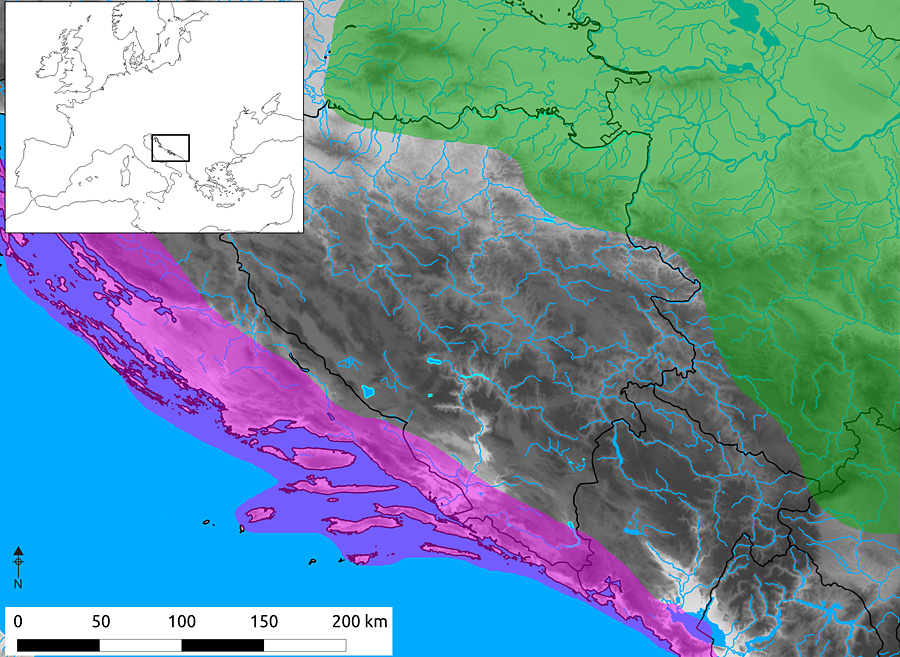
EUROFARM research area. Pink: Impressa complex. Green: Starčevo-Körös-Criş complex.

The EUROFARM project focuses on the processes of cultural transmission associated with the spread of farming across Europe. This is investigated through comparison, within and between both streams of neolithisation, of four technological innovations: farming practices, landscape use, pottery and lithics.
The transmission of innovations depends upon several factors, including the identity of the actors involved, the context of their interaction, and the nature of the innovation being transmitted. The archaeological literature dedicated to early farming mostly focuses on the first two factors (i.e. the respective roles of and contact between foragers and farmers), while few studies have addressed the way farming techniques are transmitted and acquired. Furthermore, for each technological innovation, the manner of transmission will likely differ significantly, if only because of differences in abilities and knowledge required by the actors.
Analytical work will characterise the cultural recipe of each technological innovation (Mesoudi & O'Brien 2008). Given the variety of studied technologies, it is expected that a complex set of elements are involved in their transmission, which makes any comparison difficult. Cultural recipes allow us to overcome this limit by focusing upon the structure of the sequences of actions involved. This comparative stage will evaluate the patterning in the four technological innovations, their modes of transmission, and their relative weight in shaping both inland and maritime streams.
Our objectives are thus to:
-
• describe the neolithisation of Europe in terms of transmission of technological innovations;
-
• compare formally the structure of the two main streams of diffusion of farming across Europe;
-
• add to our documentary knowledge of the Mesolithic-Neolithic transition in a keyyet overlookedregion of Europe.
Research area and pilot data
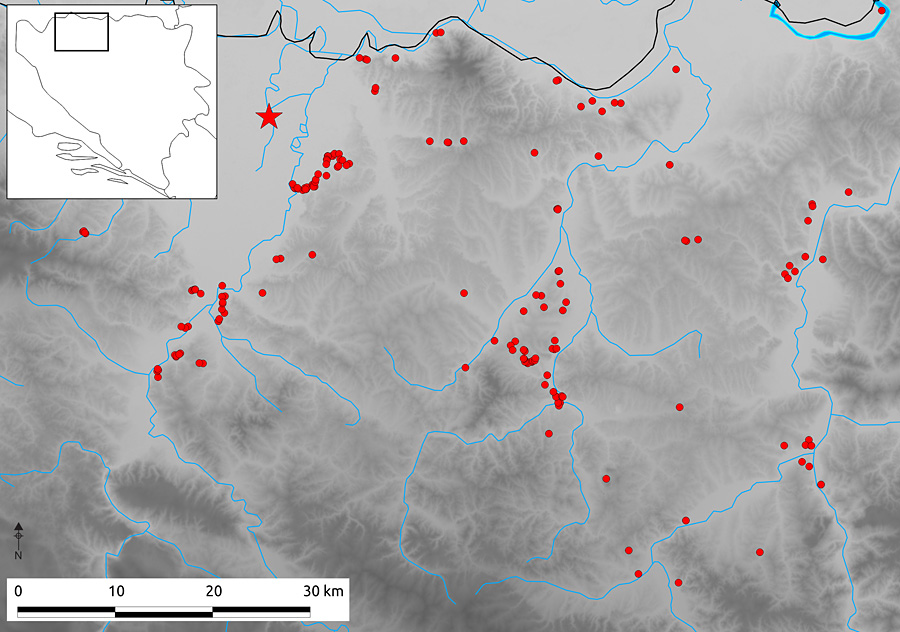
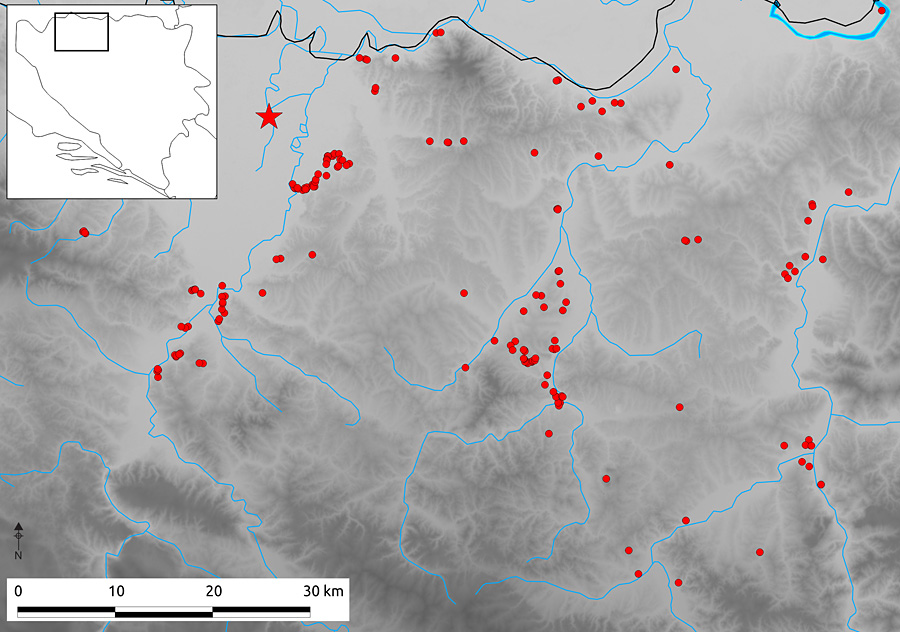
Prehistoric sites surveyed in northern Bosnia (20062010). The site of Kočićevo is indicated by a red star.
The EUROFARM research area is the western Balkans (Figure 1). With the geographical origins of both streams of neolithisation proving elusive, this constitutes the best region to carry out the investigation. It is the first area where the two streams are discernible and the only one where they are present in such close geographical proximity. Our knowledge, however, of the local Mesolithic-Neolithic transition remains limited in comparison to other parts of Europe, especially for Bosnia and Herzegovina. A combination of fieldwork, analysis of museum collections, and re-evaluation of the literature is planned for the countries of Bosnia and Herzegovina, Croatia, Montenegro and Serbia.
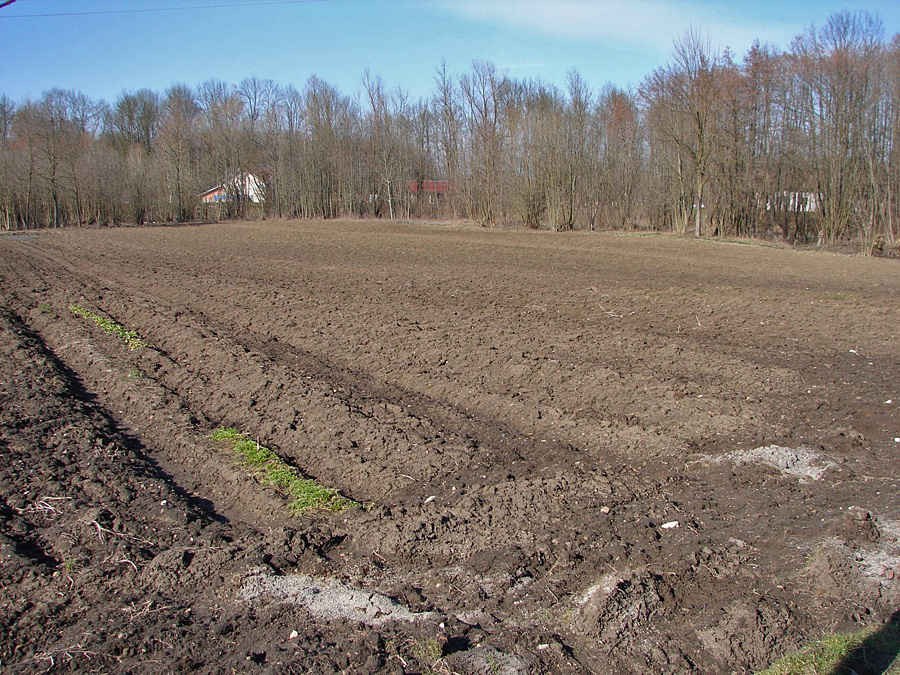
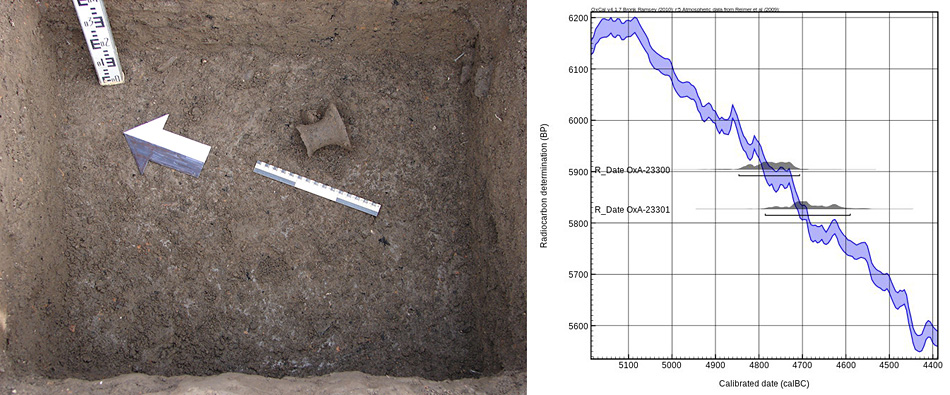
Recent field activity conducted by the universities of Cambridge, Leicester and UCL, in collaboration with several Bosnian institutions, has started to address this gap. Six survey seasons targeting the alluvial terraces of tributaries of the Sava River have led to the identification of dozens of prehistoric sites, ranging from Palaeolithic to Iron Age with a strong Neolithic component (Figure 2). Small-scale excavations have been undertaken at several locations, notably the site of Kočićevo. Located on a palaeo-riverbank, this site has yielded archaeological features and a rich material culture dated to 48004500 cal BC (Figures 3 and 4).
General view of the site of Kočićevo.

Kočićevo: test pit with Neolithic finds (left) and corresponding 14C dates (right).

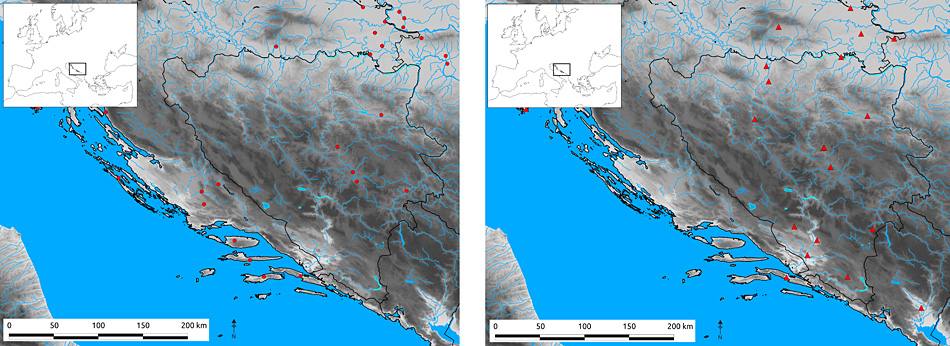
Radiocarbon dates were also obtained for previously and recently excavated sites across the entire area, with a focus upon Bosnia and Herzegovina (Figure 5). While farming appears in parts of this country during the mid sixth millennium cal BCalready several centuries later than in the core areas of the two streamsthe bulk of the dates point to the early fifth millennium cal BC. This suggests that there were successive episodes of expansion of farming practices into the area between the two early streams of neolithisation (see also Forenbaher & Miracle 2005).
Distribution of existing 14C dates for the Mesolithic and Early Neolithic periods in the EUROFARM research area (left); pilot 14C data for Mesolithic and Early Neolithic periods in the EUROFARM research area (right).

Within the comparative framework of the EUROFARM project, the implications of this sequence are twofold:
both inland and maritime streams involved an initial phase in their respective core areas, followed by subsequent infilling phases, the exact pattern and tempo of which remain to be established. Did both streams follow similar trajectories and, if so, how can we account for these similarities?
As already suggested (Perić 1995; Reference HofmannHofmann 2012), these secondary episodes of farming expansion seem to correspond to the meeting and mixing of both inland and maritime streams. How can we account for this in terms of cultural transmission?
Similar situations can be observed in other European regions (e.g. Vander Linden 2011) pointing to the importance of cultural transmission in the neolithisation process. More work is needed, however, in order to characterise the types of cultural transmission at play, and whether or not the transmissions of multiple technologies (e.g. farming, pottery, etc.) are connected. Such investigation opens new paths to describe and unravel the complexity of local situations that constitute the neolithisation of Europe.
Acknowledgements
The EUROFARM project is funded by the European Research Council under the European Union's Seventh Framework Programme (FP/2007-2013) / ERC Grant Agreement n. 313716. Pilot data were obtained thanks to funding provided by the Heritage Office of the Republika Srpska; the Framework Programme 6 of the European Commission; St John's College, McDonald Institute for Archaeological Research and McBurney Laboratory, Cambridge; and the British Academy.