


If a political party’s visibility in the media shapes the public support it receives, then the media attention given to different political parties can have significant implications for democracy. In the United Kingdom, critics allege that the media has often paid disproportionate attention to the populist, right-wing UK Independence Party (UKIP), but media elites claim that the high levels of media coverage given to UKIP have been a function of public support for the party. Descriptively, media attention to UKIP has been greater than that given to other, similarly sized parties on the right as well as the left (Goodwin and Ford Reference Goodwin and Ford2013; Stevenson Reference Stevenson2014; Soussi Reference Soussi2014), but UK media regulator Ofcom and the BBC have publicly defended the amount of attention paid to UKIP on the grounds of public support for the party (Sweeney Reference Sweeney2015; Wintour Reference Wintour2015). Implied in this elite reasoning is a causal model – that public support drives media coverage, rather than vice versa.
Yet previous research from proportional representation systems suggests that public support does not drive media coverage for populist right-wing parties, but that media coverage drives their public support (Boomgaarden and Vliegenthart Reference Boomgaarden and Vliegenthart2007; Boomgaarden and Vliegenthart Reference Boomgaarden and Vliegenthart2009; Vliegenthart, Boomgaarden and Spanje Reference Vliegenthart, Boomgaarden and Van Spanje2012). By leveraging this insight to investigate the causal dynamics of UKIP support and media coverage, we fill an important gap in current research on the visibility–support nexus and contribute pragmatically relevant insights to a contentious public policy debate of broad social significance (Gerring Reference Gerring2015). First, we contribute to current research on the visibility–support nexus by testing a key insight from this research in a new institutional context in which the hypothesized relationship should be less likely. Because proportional representation systems are associated with a greater number of small parties (Duverger Reference Duverger1972) and tend to produce more diverse news (Baum Reference Baum2012; Benson Reference Benson2009; Kumlin Reference Kumlin2001; Sheafer and Wolfsfeld Reference Sheafer and Wolfsfeld2009; Stromback and Dimitrova Reference Stromback and Dimitrova2006), research confined to such systems is arguably most likely to reflect a model in which media coverage generates support for populist right-wing parties. In a first-past-the-post system, where we typically expect only two parties and the media to be less diverse, these institutional pressures make it more difficult for the media to generate support for smaller populist, right-wing parties. Thus testing this theory using time-series data from a first-past-the-post system contributes to either refining the scope conditions of previous research (in the case of unexpected findings) or extending and strengthening our confidence in the media-support relationship. Secondly, we contribute to a pressing regulatory question in UK national politics, as the democratic quality of UK media regulation with respect to political party favoritism, especially regarding populist right-wing parties, remains on public trial. This article lends insight into the causal dynamics that are implied but rarely (if ever) tested within such popular policy debates.
The article begins by outlining the theory before moving to a discussion of our data, method and research strategy. We then present quantitative and qualitative analyses of the relationship between UKIP support and UKIP media coverage. The final section concludes.
Theory
A large body of research suggests that mass media coverage, as the primary channel through which the electorate receives information about politicians and parties, affects many different aspects of electoral politics (Beck et al. Reference Beck2002; Dalton, Beck and Huckfeldt Reference Dalton, Beck and Huckfeldt1998; Norris Reference Norris2000; Paletz Reference Paletz1996). If media coverage of political parties is driven by public support for the parties – even if media coverage then increases public support further – it could be argued that the media are facilitating popular sovereignty. However, if media coverage independently changes public support rather than reflecting it, this could distort the functioning of democracy, depending on how we understand the role of journalism in democracies.
The latent normative motivation for the present investigation is whether the quantity of UKIP’s media coverage might represent a kind of media bias that generates rather than reflects public opinion, or if the media’s fascination with UKIP is a democratically appropriate effect of public opinion. Of course, the professional norm of ‘objectivity’ can be implemented in different ways (Skovsgaard et al. Reference Skovsgaard2013). If the appropriate role of journalists is to function as a watchdog, for instance, then events might lead journalists to increase their coverage of a party without any change in public support. If support for the party then changed, this would not represent an anti-democratic effect. If the role of journalists is to instead give voice to latent citizen interests in a fashion proportionate to their distribution in the population, however, media coverage should be more likely to track public support for a party than vice versa.
One current of previous research on the dynamics of media coverage and party support finds evidence consistent with the argument that the quantity of media coverage given to a political party drives public support for that party. Walgrave and De Swert find, using time-series data from Belgium, that newspapers and television stations helped to increase the electoral results of the Vlaams Blok by emphasizing political issues owned by the extreme right-wing party (Walgrave and Swert Reference Walgrave and De Swert2004). Boomgaarden and Vliegenthart find that in the Netherlands, the quantity of media coverage of immigration-related topics is associated with a subsequent increase in the vote share of anti-immigrant parties, controlling for objective factors such as levels of immigration (Vliegenthart and Boomgaarden Reference Vliegenthart and Boomgaarden2010). Boomgaarden and Vliegenthart also find, using time-series data from Germany, that media coverage of immigrant actors is associated with subsequent changes in public attitudes toward immigration, conditional on objective factors such as immigration levels (Boomgaarden and Vliegenthart Reference Boomgaarden and Vliegenthart2009). While much of the previous research described above considers the political implications of issue coverage in the media, Vliegenhart, Boomgaarden and Van Spanje advance this current further by analyzing time-series data on the coverage of parties and public support for anti-immigrant parties in Belgium, the Netherlands and Germany (Vliegenthart, Boomgaarden and Spanje Reference Vliegenthart, Boomgaarden and Van Spanje2012). That study finds evidence suggesting that party and party leader visibility is associated with the electoral outcomes of the parties, but not vice versa. In another study, media coverage was found to be one of the best predictors of electoral success in Denmark’s 2007 election (Hopmann et al. Reference Hopmann2010). Finally, it has been shown that in the Netherlands, media coverage of Fortuyn appears to have improved the party’s polling performance before the 2002 election (Koopmans and Muis Reference Koopmans and Muis2009).
Considering research at the individual level, panel data from the Netherlands suggests that media coverage drives perceptions of right-wing populist politicians as well as mainstream politicians (Bos, van der Brug and de Vreese Reference Bos, van der Brug and de Vreese2011). Media coverage has also been found to help explain individual-level party preferences in Germany (Semetko and Schoenbach Reference Semetko and Schoenbach1994) and the Netherlands (Oegema and Kleinnijenhuis Reference Oegema and Kleinnijenhuis2009). Based on this research, we test the following hypothesis.
Hypothesis 1: Increases in media coverage of UKIP will be associated with future increases in public support for UKIP, controlling for previous changes in public support.
It is also theoretically plausible, as some scholars have argued, that changes in party support lead to changes in media coverage (Oegema and Kleinnijenhuis Reference Oegema and Kleinnijenhuis2009). As Vliegenthart and Boomgaarden consider, the quantity of media coverage may be driven by the power and position of political figures (Vliegenthart and Boomgaarden Reference Vliegenthart and Boomgaarden2010). This pattern has been observed in America (Sellers and Schaffner Reference Sellers and Schaffner2007) and Switzerland (Tresch Reference Tresch2009). Sellers and Schaffner (Reference Sellers and Schaffner2007) find that the types of events US senators hold, and the guests of those events, affect the number of news stories written. Tresch (Reference Tresch2009) finds that the amount of coverage given to Swiss legislators is most importantly a function of leadership and authority criteria related to the individual politicians. Although both of these studies focus on politicians rather than political parties, they suggest that variable aspects of political entities have predictable effects on media visibility. In a study on the diffusion of populist discourse in the media, Rooduijn (Reference Rooduijn2014) studies five Western European countries (Italy, France, Germany, Netherlands and United Kingdom) and finds that the electoral success of populist parties affects the degree of populism in the media.Footnote 1 There has been surprisingly little scholarship in this field on either the UK or UKIP. As a rare example, Deacon and Wring (Reference Deacon and Dominic Wring2016) offer a case study of newspaper coverage of UKIP over a similar time period covered in this article. They conclude that when media coverage did increase, this was because UKIP’s political standing made it hard to ignore. They offer a causal logic that it was the political support that drove media coverage rather than the reverse.
In line with this current of research, British media and media regulators have publicly argued that media coverage given to political parties is based on public support for the parties. In its draft electoral guidelines published in January 2015, the BBC classified UKIP as deserving a degree of coverage comparable to the ‘larger parties’, because it ‘demonstrated a substantial increase in electoral support’, as measured by electoral and polling results, between 2010 and 2015 (BBC 2015; Sweeney Reference Sweeney2015). Ofcom (2015), the UK broadcast regulator, also included UKIP as a ‘major party’ for the purposes of the 2015 general election, also explicitly on the grounds of improved electoral and polling results since 2010 (Wintour Reference Wintour2015). Based on this current of previous research and the stated reasoning of elite entities with uniquely strong influence on media agendas, we propose the following additional hypothesis opposite to Hypothesis 1.
Hypothesis 2: Increases in public support for UKIP will be associated with future increases in media coverage of UKIP, controlling for previous changes in media coverage.
Finally, there are many particular mechanisms that could operate within the coverage–support nexus. Previous research has identified several factors or ‘news values’ that help to explain what journalists find newsworthy (Galtung and Ruge Reference Galtung and Ruge1965). One relevant news value driving coverage of UKIP could be negativity, in the dual sense that UKIP’s populism tends to disproportionately highlight negative aspects of the British political establishment, and that populist challengers appear negatively, at least through establishment lenses (as rude, mean, dishonorable, etc.) (Galtung and Ruge Reference Galtung and Ruge1965, 68, 71). News value theory might shed some light on why journalists find UKIP newsworthy, but what specific mechanisms could lead coverage to produce support, or support to produce coverage?
With respect to Hypothesis 1, the most parsimonious mechanism is that ‘mere visibility’ of the party in the media could increase support for the party directly (Hopmann et al. Reference Hopmann2010; Oegema and Kleinnijenhuis Reference Oegema and Kleinnijenhuis2009). Just as media coverage of an issue increases the perceived importance of that issue (agenda setting), the same logic can be applied to evaluations of parties (Weaver Reference Weaver1996). Other possible mechanisms involve issue-ownership and agenda-setting issue effects, or a combination of the two (Walgrave and Swert Reference Walgrave and De Swert2004). If UKIP is seen as the best party for dealing with particular issues (issue ownership), such as immigration or the EU, then increasing the salience of those issues (through external events or the media’s agenda setting) could increase support for the party. Fluctuations in coverage of UKIP could operate through the issue-ownership or agenda-setting mechanism, priming the public to UKIP’s issue ownership or increasing the salience of its issues. Some combination of both could be at work, as found in the case of the Vlaams Blok in Belgium (Walgrave and Swert Reference Walgrave and De Swert2004). With respect to Hypothesis 2, the most plausible mechanism is classic supply and demand: political news responds to consumer preferences (Gentzkow and Shapiro Reference Gentzkow and Shapiro2010). Polls showing increased support for UKIP may function as signals of increasing consumer demand for UKIP, leading journalists to increase their supply of coverage accordingly, as required by market competition. The statements by BBC and Ofcom cited above, explaining attention to UKIP in terms of responsiveness to the national audience, would be consistent with this mechanism, even if these entities are not standard firms competing in an open market. To be clear, the focus of this article is testing for the presence of a general coverage–support nexus, and characterizing the stylized facts about its causal ordering. We will not be testing for these mechanisms, but we offer them here as lenses for thinking about the general empirical patterns we might expect to observe. In the concluding section we reflect briefly on how our data may provide some pointers for future research on the mechanism at work.
Data, Method and Research Strategy
To measure public support for UKIP, we gathered monthly aggregate polling data on vote intentions from Ipsos MORI (2017). Polls have many imperfections as measures of public opinion, such as the risk of unrepresentativeness, as found in the 2015 British general election polling (Sturgis et al. Reference Sturgis2016). Nonetheless, they remain one of the best available resources for studying public opinion over time. We constructed the variable Support from the percentage of respondents reporting an intention to vote for UKIP according to the Ipsos MORI polling for each month. For most months, this was straightforward because the Ipsos MORI poll is conducted approximately monthly. For months with multiple polls, we used the poll closest to the middle of the month.Footnote 2 For the very few months with no poll or a poll at the border between the previous or following month, the value was counted as missing and then all missing values were linearly interpolated.
To measure media coverage of UKIP, we gathered monthly counts of all articles mentioning either ‘UKIP’ or ‘UK Independence Party’ in any ‘UK National Newspaper’ in the database Nexis.Footnote 3 This resulted in 65,416 articles over the time period covered. There have been criticisms of such computer-assisted approaches, mostly notably by Althaus, Edy and Phalen (Reference Althaus, Edy and Phalen2001), but we follow Boomgaarden and Vliegenthart in believing that, for these types of studies, this is a reasonable and valuable way of measuring media coverage (Boomgaarden and Vliegenthart Reference Boomgaarden and Vliegenthart2007). This is the most efficient way to analyze large amounts of media content over a long period of time, an approach that is especially suitable to our present purposes given that we are only looking at the quantity or intensity of coverage (that is, the number of articles each month).
The resulting monthly time series consists of 160 observations from January 2004 to April 2017. Our statistical models contain slightly fewer observations, as first-differencing and inclusion of lags produces missing values at the beginning of each series.
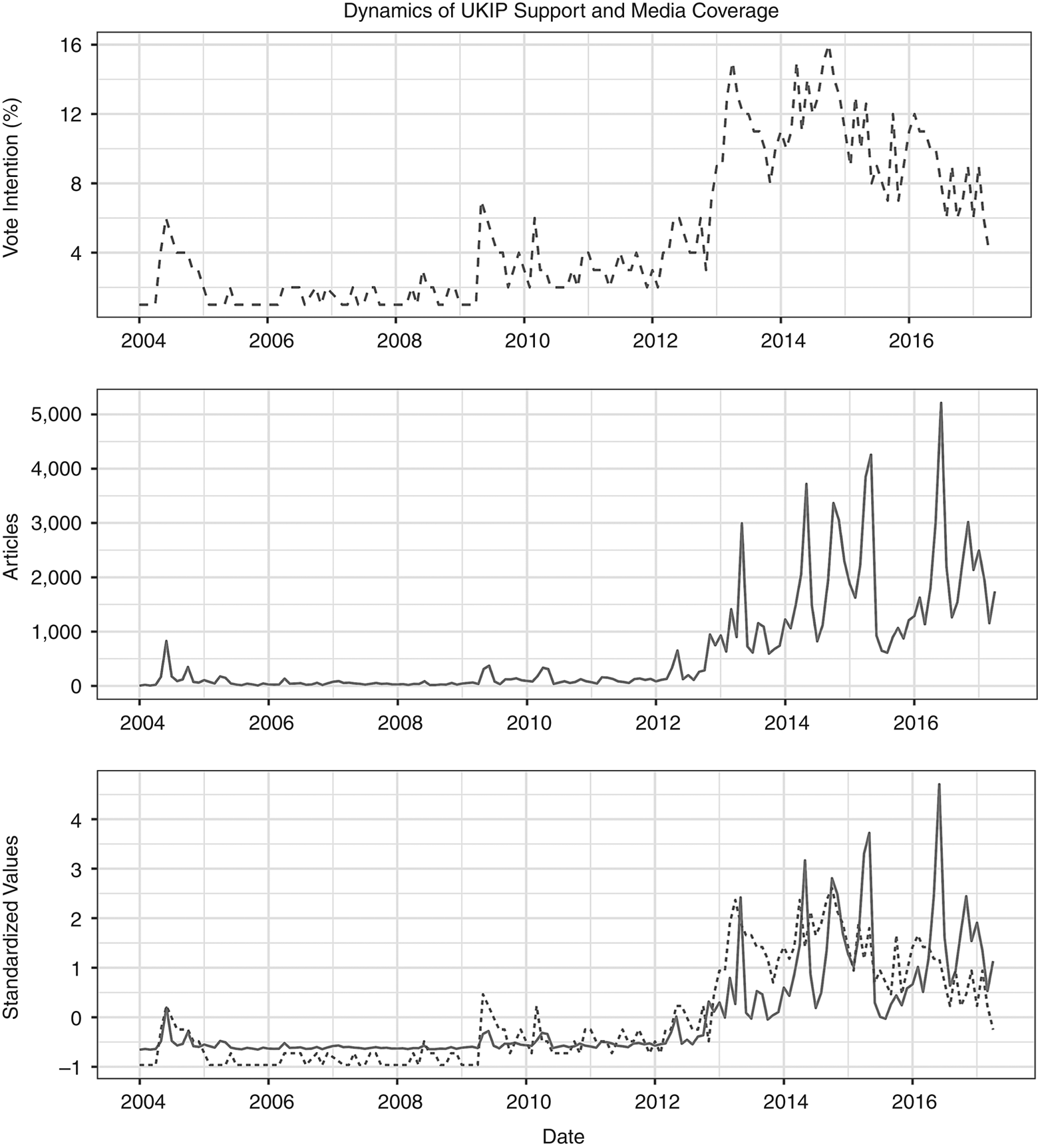
The variable Articles reflects the number of articles Nexis returns from the first day of each month until the last day of each month. Figure 1 provides a summary view of the two main variables of interest. The dotted line represents Support and the solid line represents Articles. Raw values are displayed in the first two (top) panels. For ease of direct comparison, the bottom panel displays standardized scores in which each value is derived by subtracting the mean of the particular time series and dividing by one standard deviation.
Dynamics of UKIP support and media coverage.
It is also plausible that elections have an independent effect on coverage and support due to general increased media attention and campaigning. For this reason, we have included eponymous dummy variables for the months of each national and European election within the sampling period.Footnote 4 The elections included are three European elections (June 2004, June 2009 and May 2014) and three general elections (May 2005, May 2010, and May 2015).
Finally, it is possible that other economic and political dynamics shape media coverage and/or support for UKIP. In particular, we gathered data on two potential confounders, unemployment and the salience of immigration (Boomgaarden and Vliegenthart Reference Boomgaarden and Vliegenthart2007). The variable Unemployment is a monthly measure of the unemployment rate for those aged 16 and over, from the Labour Market Statistics time-series dataset of the Office for National Statistics. The variable Immigration is the proportion of respondents reporting immigration to be the most important problem (MIP) in surveys conducted by Ipsos MORI. Like the vote intention data from Ipsos MORI, the MIP data are collected approximately once per month; just as we gathered the vote intention data, for months with more than one survey we used the one closest to the middle of the month.
We first use econometric techniques to test for, and distinguish the ordering of, potential causal dynamics between media coverage and public support for UKIP. An ideal approach to testing the presented hypotheses is vector autoregression (VAR) with Granger causality tests (Brandt and Williams Reference Brandt and Williams2007; Vliegenthart, Boomgaarden and Spanje Reference Vliegenthart, Boomgaarden and Van Spanje2012). Specifically, we estimate a VAR by ordinary least squares (OLS) per equation, using the following form:
 $$y_{t} {\, \equals \, }A_{1} y_{{t{\minus}1}} {\plus}\,\ldots\,{\plus}A_{p} y_{{t{\minus}p}} {\plus}D_{t} {\plus}u_{t} ,$$
where y t is a K×1 vector of endogenous variables and u t is the error term. In our case the endogenous variables are Support and Articles. The coefficient matrices A 1,…, A p are of dimension K×K. By convention, p denotes the ‘order’ of the VAR, or the number of lags used. Typically this is determined empirically, as we do below. In addition, D t refers to a vector of exogenous regressors. In our case the exogenous regressors include a constant term, a trend term and selected control variables (election dummies, unemployment, immigration salience). We then use the conventional F-type Granger-causality test for each of the two endogenous variables in the system. The vector of endogenous variables y t is divided into two vectors  $y_{1} t$
and
$y_{1} t$
and  $y_{2} t$
of dimensionality (K 1×K) and (K 2×1) with K=K 1 + K 2 (Pfaff Reference Pfaff2008). The null hypothesis is that no lags of variable
$y_{2} t$
of dimensionality (K 1×K) and (K 2×1) with K=K 1 + K 2 (Pfaff Reference Pfaff2008). The null hypothesis is that no lags of variable  $y_{{1t}} $
are significant in the equation for variable y 2t. If
$y_{{1t}} $
are significant in the equation for variable y 2t. If  $\alpha _{{21,i}} {\equals}0$
for I=1, 2, …, p, we say that y 1t does not ‘Granger-cause’ y 2t.
$\alpha _{{21,i}} {\equals}0$
for I=1, 2, …, p, we say that y 1t does not ‘Granger-cause’ y 2t.
Additionally, a brief qualitative historical analysis of the dynamics is conducted to further probe any potential causal process(es). It is arguably a blindspot of quantitative time-series research to neglect inquiry into the substantive historical processes corresponding to the statistical properties of time-series data. In particular, the substantive nature of the puzzle at hand requires the identification of a historical narrative that would not necessarily follow from a statistical fact such as Granger causality. Even with econometric evidence suggesting an association in one direction or the other, it would not necessarily follow that a substantively and historically significant process has occurred in the particular and contingent history behind the time series. For instance, it could be the case that media coverage formally Granger-causes public support and that exogenous increases in media coverage have played no particularly important role in the rise of UKIP support. This is because statistical properties of time series in no way preclude the possibility that the historically key moments of UKIP’s rise could have been random or contingent consequences of other factors. Also, it is always possible in any particular historical process that Y 1 has an average effect on Y 2 that is statistically significant but in key, contingent moments certain shifts in Y 2 may explain unique changes in Y 1 in a fashion which happens not to be statistically distinguishable. In the latter case, media-caused increases in public support might themselves be responding to, and amplifying, contingent but exogenous increases in public support in an arguably democracy-consistent fashion, even if increases in support do not statistically predict increases in media coverage.
To provide the strongest possible investigation of a possibly dynamic relationship between media coverage and UKIP support, we will need to assess the degree to which increases in media coverage have been followed by increases in public support for UKIP following stagnant or decreasing levels of support in preceding months. We will then also need to assess the degree to which such identifiable historical moments were related to the relatively few key moments in which support for UKIP rises most dramatically. We explore these substantive questions with a brief narrative of the political events and media topics that lie behind our time-series data.
Findings and Discussion
Because both variables are non-stationary, VAR is estimated with first differences of each variable. Optimal lag length is determined by the Akaike Information Criterion to be VAR(3). The model includes a constant and a trend term. Diagnostics suggest that using the log of each variable before differencing is necessary to reduce heteroskedasticity and serial correlation of errors as revealed by ARCH-LM and Portmanteau tests, respectively. Using log-transformed series also has the benefit of making the model coefficients interpretable as elasticities, or the expected percent change in the dependent variable associated with a 1 per cent change in the independent variable. Finally, to assess temporal stability, for each model we compute an empirical fluctuation process using the cumulative sum of OLS residuals. We find no evidence of temporal instability. The Appendix contains more detailed visual and statistical diagnostic information.
Table 1 presents the results from two pairs of vector autoregressions. In the first pair (Columns 1–2), the exogenous control variables include only the election dummies. In the second pair (Columns 3–4), first differences of Unemployment and Immigration are added. The initial VAR results show little evidence that changes in public support predict media coverage, but statistically significant evidence that media coverage drives public support. As the numerical results in Table 1 show, there is no statistically discernable correlation between past changes in public support and changes in media coverage, as the coefficients for each distributed lag of ΔSupport are insignificant in each model of ΔArticles. However, past changes in media coverage have a statistically significant correlation with future changes in public support, as the coefficients for  $\Delta Articles_{{t{\minus}1,t{\minus}3}} $
are positive and significant in each model of ΔSupport. Both models meet the assumption of serially uncorrelated errors and constant error variance. Detailed visual and statistical diagnostic information is provided and explained in the Appendix. In our interpretation of the data below, using impulse response functions, we rely on the simpler first model.
$\Delta Articles_{{t{\minus}1,t{\minus}3}} $
are positive and significant in each model of ΔSupport. Both models meet the assumption of serially uncorrelated errors and constant error variance. Detailed visual and statistical diagnostic information is provided and explained in the Appendix. In our interpretation of the data below, using impulse response functions, we rely on the simpler first model.
Vector autoregressions, UKIP media coverage and public support
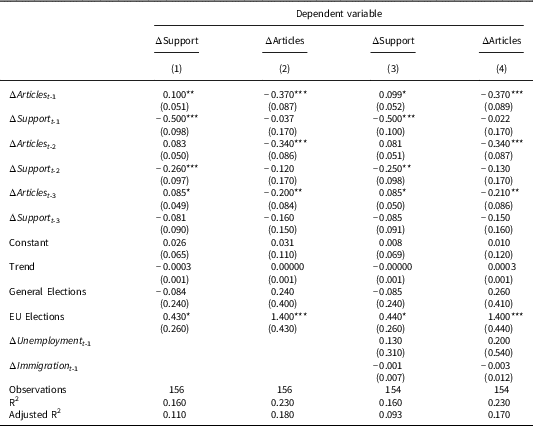
Note: *p<0.1; **p<0.05; ***p<0.01
Although the coefficients for Articles on Support are not significant at t–2, Granger causality tests reported in Table 2 suggest that, overall, Articles Granger-cause Support (p=0.032 in the first specification, p=0.039 in the second specification), but Support does not Granger-cause Articles (p=0.71 and p=0.73). These models are therefore consistent with Hypothesis 1 – that changes in media coverage are associated with future changes in public support, and inconsistent with Hypothesis 2, that changes in support are associated with future changes in media coverage.
Granger causality tests

Note: number in parentheses refers to the model number in Table 1 corresponding to each causality test. For each test, the null hypothesis is that the named dependent variable is not Granger caused by the other endogenous variable of interest (articles or support).
UKIP coverage and UKIP support are uncorrelated with general elections, the unemployment rate and immigration salience, after controlling for the past three periods of each endogenous variable. EU elections, however, are consistently, positively and significantly associated with UKIP coverage and support.
Because our endogenous variables are first differences of the natural logarithm, the coefficients in Table 1 can be interpreted as elasticities. That is, the coefficients are approximations of the expected growth rate in Y 2 associated with a 1 per cent increase in Y 1 at each of its lagged values. To gain a sense of how Support responds to Articles, the typical approach is to use impulse response functions, which trace the effect of a random one-unit shock in one variable on future values of a second variable in the system.
In Figures 2 and 3, we display orthogonalized impulse response plots from the VAR results reported in Columns 1 and 2 of Table 1. We consider orthogonalized or uncorrelated shocks because we are most interested in what happens when one variable changes for reasons that do not also lead to changes in the other variable. The x-axis reflects time periods following an initial shock in the error term of one variable, while the y-axis reflects the expected changes in the other variable.
Impulse response of articles from support. Note: plot shows effect on articles from an exogenous increase in support.

Impulse response of support from articles. Note: plot shows effect on support from an exogenous increase in articles.

To interpret the estimated effect of media coverage on UKIP support, consider the impulse response function plotted in Figure 3. The maximum number of monthly articles observed in the sample is 5,212, therefore a 1 per cent increase in articles is equal to a monthly increase of about 52 articles. The maximum value of Support is 16, so the first period of the impulse response (0.18) suggests that in response to a 52-article increase, Support would increase by about 18 per cent of 1 per cent of 16 per cent. This amounts to an increase of roughly 0.03 per cent of the population reporting an intention to vote for UKIP. While this hypothetical effect of a small increase in coverage is minute, the history of UKIP’s media coverage contains several months of exceptionally large increases in reporting. Those months in the top 1 per cent of article growth (the 99th percentile) were characterized by article growth of 1,847 articles or more, that is, a growth rate of 35.43 per cent or greater. By the preceding calculations, a 35.43 per cent increase in articles would be associated with a 6.25 per cent growth rate in Support, equivalent to a 1-point increase in the percentage of the population reporting an intention to vote for UKIP.
We note there are limitations of the data that may make it difficult to identify the full range of causal effects in a VAR approach. First, it is possible that monthly measures are too infrequent to capture causal effects if the real lag between effects is shorter than one month. We address this concern by also considering weekly data, as we discuss in the following section. Also, importantly, structural tests on all models suggest strong evidence of instantaneous causality.
To conclude the main analysis, the VAR results suggest clear but imperfect and, for reasons discussed above, inherently limited evidence for Hypothesis 1 that increases in media coverage lead to increases in public support. The VAR results provide no evidence for Hypothesis 2, that increases in public support lead to increases in media coverage. Given the problem of instantaneous causality, we cannot rule out the possibility that both variables drive each other in periods shorter than one month or that both variables are driven by some third unobserved variable. Nonetheless, an empirical fact of our data is that media coverage Granger-causes public support and not vice versa.
Robustness
To check the robustness of our results, we also conducted a battery of additional analyses. Due to space constraints, detailed information about our approach and the results for each robustness check are provided in the Appendix.
First, it is possible that monthly data may be insufficient to capture the causal dynamics between coverage and support. If media coverage in one week responds to public opinion in the previous week, the models presented above would lead us to incorrectly reject Hypothesis 2, that public support drives media coverage. To check this possibility, we also gathered data on weekly media coverage and constructed a weekly measure of public support for UKIP.Footnote 5 The VAR results and Granger causality tests using weekly data are substantially consistent with the results presented here using monthly data.
Secondly, it is possible that our analyses have so far neglected to include potentially significant confounding variables. This would mean our inferences could be subject to omitted variable bias. In auxiliary analyses, we re-estimated the models presented in Table 1 using two additional sets of control variables. First, if coverage or support responds to UKIP’s electoral success, then including dummy variables for general and European elections, as we have done in the previous models, may be insufficient. Thus, we also check if our results are robust to controlling for the vote share won by UKIP in each election, rather than controlling for the simple occurrence of each election. Secondly, a number of notable events could plausibly have independent effects on coverage and/or support. While we cannot account for any and all such possible events, we check whether our results are robust to controlling for at least three notable events we identified in our qualitative analysis (below): the EU referendum, the lifting of work restrictions on Bulgarian and Romanian nationals, and Cameron’s infamous reference to UKIP as ‘fruitcakes’, ‘loonies’ and ‘closet racists’ in April 2006. Our main findings remain unchanged.
Thirdly, it might be questioned whether the causal ordering identified here would be different if media coverage of UKIP is conceptualized as coverage of the party’s leaders. It is possible that media coverage responds to degrees of public support, but only in the sense that media coverage of leaders is responsive to public support (for example, television debates, which are arguably leader-centered media). An additional, more charitable test of Hypothesis 2 might therefore use a measure of party leader coverage. Although we theorize that party leader coverage is highly correlated with party coverage, as Vliegenhart, Boomgaarden and Van Spanje find in multiple Western European countries (Vliegenthart, Boomgaarden and Spanje Reference Vliegenthart, Boomgaarden and Van Spanje2012, 333), we nonetheless consider the possibility empirically. We report coefficients for Articles, with respect to the dependent variable Support, somewhat less consistent than those reported in the main models of party coverage, and our confidence levels for the Granger causality results are slightly weaker (for one model, p=0.084). Overall, however, the VAR results and Granger causality tests for these models suggest the same substantive interpretation as that which we identify here (support for Hypothesis 1, no support for Hypothesis 2).
Qualitative Analysis
To what extent are the statistical regularities identified by the vector autoregression historically significant causal factors in the rise of public support for UKIP? To facilitate a qualitative investigation of the dynamics, we quantitatively identified months that meet criteria similar to the concept of Granger causality. Any month (t) that is immediately preceded by two months (t−1, t−2) of stagnating or declining public support but increased media coverage, we designate as a month of uncaused or exogenous coverage. Symmetrically, any month that is immediately preceded by two months of stagnating or declining media coverage but increasing public support, we consider a month of uncaused or exogenous public support. To mitigate the probability that we will be counting mere noise as meaningful increases, we count only those increases greater than 0.05 standard deviations. All other months are considered ‘stagnating or decreasing’. Figure 4 presents the standardized values of each time series, with dot-dash vertical lines indicating months of exogenously increasing coverage and long-dash vertical lines indicating months of exogenously increasing public support. A first consideration of Figure 4 reveals that increases in media coverage unwarranted by public support are not only roughly as frequent as uncaused increases in public support, but they are found at multiple pivotal months in periods of the most dramatic increases in UKIP’s public support. To be clear, we are not claiming to pinpoint key moments of causal effect; at any particular point of the time series, it is impossible to know whether a particular pattern represents a random or systematic component. Rather, we take the evidence from the VAR to be our warrant for exploring the qualitative data in search of examples whereby the substantive significance of the statistical evidence may either be better illustrated or possibly discounted due to untheorized contingencies. Based on Figure 4, we focus on two key periods: from July to September 2012, and the second half of 2013.
Standardized time-series of UKIP support and media coverage. Note: vertical dot-dash lines indicate exogenous increases in coverage and vertical long-dash lines indicate exogenous increases in support.

In order to put the quantitative analysis into its full context, a brief historical analysis of UKIP is required. UKIP, formed in 1993, began fielding European parliamentary candidates in 1994 and British parliamentary candidates in 1997. Since then, the party has enjoyed mixed but notable increases in public support and in electoral outcomes, particularly in the European Parliament where the party was the largest in the 2014 election. Until the 2015 general election, UKIP’s domestic electoral success had been much less impressive, receiving just 3.1 per cent of the vote in 2010. UKIP’s success peaked with the referendum on the UK’s European Union membership. In the snap 2017 general election, UKIP’s vote share decreased by 11 per cent, and they lost their only sitting Member of Parliament (MP), resulting in a change of leadership and soul searching over the future purpose of the party. Like other small or new parties, it has a history of infighting, changes of direction and leadership, and problems with financial mismanagement (Whitaker and Lynch Reference Whitaker and Lynch2011). As recently as 2011, a lack of media attention was cited as a factor in UKIP’s poor performance (Ford, Goodwin and Cutts Reference Ford, Goodwin and Cutts2012). Indeed, the historical pattern of both media coverage and public support for UKIP over much of its recent history, from 2004 to 2009, was a series of small increases that consistently returned to low baseline quantities of few political consequences.
The party experienced its first increases in both coverage and voting intention in 2004 with the European election, in which they received 16 per cent of the vote; media coverage reached 829 articles in a single month, their record amount of coverage at the time and the greatest amount of coverage the party would experience until 2012. During this spike, both media coverage and voting intention increased proportionately, and as would be expected if coverage was driven by public opinion: Figure 4 indicates no exogenous increases in coverage or support in this instance. Both coverage and support decayed afterwards and returned to politically negligible levels. Over the next eight years, there was a range of events that did not attract very much media attention or public support. One example is the 2008 defection from the Conservatives of Bob Spink, who became UKIP’s first MP; similar events that occurred in later years generated more media attention. The vast majority of coverage refers to everyday factual information such as reports of election results, or else it tends to report claims of fraud and infighting. Indeed, Figure 4 shows that this period was characterized by several small, quickly decaying increases in support not predicted by media coverage, consistent with the claim that a lack of media coverage failed to facilitate public support during this period (Ford, Goodwin and Cutts Reference Ford, Goodwin and Cutts2012).
Apart from the 2005 election, in which UKIP received little coverage and performed poorly (it was mentioned in just 149 articles that month) (The Guardian 2005; Morris Reference Morris2005), UKIP saw little change in public support or media coverage until the European elections of 2009. It experienced a small boost in both support and coverage in April 2006, when David Cameron called the party ‘fruitcakes, loonies’ and ‘closet racists’ (White and Watt Reference White and Watt2006). Interestingly, this rise in media coverage was followed by a small but sustained boost in public support, which persisted for three months. In April 2008, Conservative MP Bob Spink defected, giving UKIP their first MP which generated very little coverage, despite being called a coup (Winnett and Prince Reference Winnett and Prince2008). Even the European election in 2009, in which UKIP came in second place, generated far less coverage than the 2004 European election, where it came in third place (829 to 320 articles in a month, respectively). Despite this, it was still hailed as a ‘political earthquake’ (White and Watt Reference White and Watt2006) and garnered coverage for UKIP’s leader Nigel Farage.
Following this, there are at least two sets of months in which increased media coverage was not caused by changes in UKIP’s public support but was followed by some of the party’s most historically crucial increases in public support. Using Figure 4 as a guide, we consider in greater detail the two months of ‘uncaused’ increases in coverage near the middle of 2012 (July and September) and the second half of 2014 (August and November). An additional plot that magnifies this section of Figure 4 is available in the Appendix. This period includes three by-elections (Corby, Middlesborough and Rotherham), many of which were controversial,Footnote 6 as well as the UKIP party conference. All three of these by-elections occurred in November 2012; UKIP placed second in two and third in Corby; the Rotherham by-election’s 21 per cent vote share was the party’s highest up to that point. In July 2012 UKIP’s public support was unremarkably near its average and was declining from June, after it had been stagnant since May. But media coverage held relatively steady, slightly decreasing once but slightly increasing twice (and slightly increasing overall) from June to September, from 123 to 261 articles. It is only at this point that public support increased notably from September to October and was followed by a spike in media coverage that likely represented a moment of positive feedback ending in the first truly significant rise of UKIP into mainstream public consciousness – up to 15 per cent support in April 2013.
Between August and November 2012, the number of articles covering UKIP increased from 198 to 948, the most they had ever received in one month at the time, beyond three standard deviations from their long-term mean. To be clear, this dramatic surge in UKIP support appears to launch with a moment of positive feedback between support and media coverage, beginning with a notable spike in public support. However, in July and September 2012 media coverage was slightly increasing despite stagnant or declining levels of public support; these dynamically unresponsive months of media coverage preceded the spike in support observed in October. Of course, it is impossible to distinguish these slight increases in media coverage in July and September from random noise in the polling; but the statistical analysis suggests that such moments of unresponsively increasing media coverage are at least comparatively more likely to be predictive of changes in support than vice versa. Thus while it would be impossible to demonstrate conclusively that these months of media coverage played a causal role in the dramatic rise in support achieved by November, our model suggests it is more likely that these unresponsively stable and slightly increasing months of media coverage played a causal role in the increased support in October, than it is that the increased support in October played a causal role in the then-highest level of media coverage seen in November. In turn, the unprecedentedly high levels of media coverage in November likely played more of a role in the following spike in support than the October spike in support played in the November spike in media coverage. This interpretation is enhanced by the additional fact that after the spike in support in October, November returned to the lowest level of support observed in several months. Again, while we cannot confidently read causal dynamics in particular data points, the increase in support from October, which ostensibly seems to be followed by a spike in media coverage ultimately leading to UKIP’s real debut, is a less plausible interpretation of the data than one based on Hypothesis 1.
Now consider the period between July 2013 and December 2014. Despite public support declining rapidly and steadily from its high point in April 2013, media coverage from July to August increased considerably, from 613 to 1,154 articles in the month. Public support continued to decline through August until November, decreasing from 11 per cent to 8 per cent. While media coverage appeared to adjust dynamically downward after its ‘uncaused’ increase in August, yet again in November media coverage stabilized and slightly increased. It is only at this point in November that support ended its long and steady decline and began another substantial increase until it returned to the high levels of April 2013. Again, in these two months we identify apparently minor but potentially crucial non-dynamically responsive levels of media coverage that may be functioning as a floor preventing support from continuing to decline and making possible the surge beginning in November 2013. While of course these spikes and drops in support may simply represent volatility around UKIP’s new, higher mean levels of support, the key point here is only to explore and give possible instances of the statistical findings. Unlike the previous instance of exogenous coverage explored above, where political events such as by-elections and the party conference season may have played roles, in this case there are no obvious and directly party-related events shaping the dynamics in this period. However, one key event that may have played a role at this time is the lifting of work restrictions on Romanian and Bulgarian nationals which occurred in January 2014 (Martin Reference Martin2013), with media coverage intensifying in the months leading up to January. Although we do not test this here, it is possible that the increased salience of issues related to migration and the European Union may help to explain changes in media coverage independent of UKIP’s support. Interestingly, considerable coverage also surrounded Farage’s comment, in December 2013, that Britain should accept Syrian refugees (Goodman Reference Goodman2013).
Previous studies have relied on statistical models similar to the one we have presented here. However, a qualitative appreciation of the data indicates at least two key examples where increased media coverage unwarranted by changes in public support take place in key periods of UKIP’s rise.
Conclusion
This study has made three contributions. First, to our knowledge this is one of the first articles to study the dynamics of right-wing populist party support and quantity of media coverage in the context of a majoritarian system and the UK in particular; previous research has primarily focused on other West European democracies such as Belgium, the Netherlands and Germany. Despite the change in political system, this study has shown quantitative and qualitative evidence that media coverage may have played a unique causal role in increasing support for UKIP, in a fashion irreducible to previous levels of support or election outcomes. Previous evidence of a coverage effect on support for right-wing populist parties has come from electoral systems in which such an effect appears most likely: their greater number of small parties (Duverger Reference Duverger1972) and the corresponding tendency to produce more diverse news would seem atypically conducive to media coverage having the capacity to shape public support for small parties, thus potentially aiding the break-through of right-wing populist upstarts (Baum Reference Baum2012; Benson Reference Benson2009; Kumlin Reference Kumlin2001; Strömbäck and Dimitrova 2006; Sheafer and Wolfsfeld Reference Sheafer and Wolfsfeld2009).
One of the wider implications of our findings is, therefore, to increase our confidence that a coverage–support dynamic may be a feature of many liberal democracies, as we find this pattern even in a context where the capacity for media coverage to affect vote intention would seem most hampered (a first-past-the-post, historically two-party, liberal democracy). In a liberal market economy such as the United Kingdom, we should expect consumer preferences to be a strong determinant of journalistic activity, as journalists produce news for firms that compete on an open market. If unelected journalists can drive support for right-wing populist parties in a historically two-party, liberal market economy, against the preferences of the median voter and consumer, then the power of unelected media to shape political outcomes is not just an important normative question for a few high-visibility cases but, likely, for liberal democracy in general.
Secondly, the findings are of significance to contemporary public debate in the UK concerning the perception that unfair quantities of media coverage are given to UKIP. Some have argued that extensive media coverage of UKIP is justified due to public support for the party. The findings here, however, are mostly inconsistent with this argument: the extraordinary media coverage that has been given to UKIP cannot be explained or defended on grounds of public opinion dynamics as measured by polls. We find that media coverage has no reliable relationship to public opinion polls in the one month, two months or three months before a particular month of coverage. Indeed, we find that coverage may have independently and uniquely driven some of the very public support that media regulators would later point to as their justification for the extraordinary coverage given to UKIP. That said, media coverage of UKIP could be a function of past support in some way that is not captured by polling. We find some evidence that the EU referenda and EU elections are associated with subsequent changes in public support for UKIP.
Our findings raise some questions about the function of media coverage in a democratic political system. Journalists do not generate support for UKIP by generating news about UKIP ex nihilo; of course, they typically report on UKIP in the context of issues and events unfolding in the world. In this case, EU-related events appear to be particularly strong spurs to journalists discussing UKIP. Nonetheless, our analyses also highlight a number of instances in which media coverage of UKIP increases for no discernible reason, and several instances in which coverage of UKIP increases to an extraordinary degree (for example, more than 2,000 mentions in the week of the Brexit referendum). While journalists do not shape public opinion toward UKIP as if by whim or on purpose, neither is journalistic attention to UKIP fully explained as a proportionate response to other phenomena, at least as far as we could observe. If journalists and other media actors wish for their coverage to be in some form of balance with overall public interest in the various political parties, they should discount some of what they see as public interest in a party such as UKIP, as some of that public interest is likely an artifact of their own past reporting. Finally, we should stress that the normative implications of our findings are conditional on what one takes to be the appropriate function of journalism in a democracy. While we have discussed the possibly anti-democratic quality of media coverage that causes public opinion, one could make the argument that it is desirable to have an independent media unaffected by the vicissitudes of public opinion.Footnote 7 The normative implications of our findings are ultimately an open question for future research.
Thirdly, this article contributes to currently ongoing efforts to advance the methodological aspects of research on media and public opinion.Footnote 8 Unlike many quantitative studies, we provide an analytically sophisticated qualitative investigation of our statistical findings. Most previous research on the coverage–support nexus relies primarily on statistical evidence, which cannot necessarily address important questions relating to the substantive historical narrative of a particular political party. We find that, in two periods, increases in media coverage came after two months of stagnating or declining public support but was then followed by historically pivotal increases in support. These junctures suggest that the contingent, historical unfolding of UKIP is consistent with the inference, suggested by our statistical analysis, that media coverage appears to have played a causal role in the rise of public support for UKIP.
Given our purposes, adjudication among several plausible mechanisms was beyond the scope of this article. Our data provide some reason to believe that media coverage of UKIP may operate on public opinion through a mechanism related to UKIP’s ownership of the EU issue. In our main models of monthly party coverage and support, and in our auxiliary models checking weekly data, we find consistent evidence that EU-related political events (EU parliamentary elections and the Brexit referendum) predict media coverage of UKIP. The weekly models also suggest that UK general elections predict media coverage; the monthly models show no such evidence, but this may be due to the coverage dropping after an election but within the same month as the election. Our qualitative analysis of the monthly data identified rising media coverage around the UK by-elections of November 2012 and the lifting of work restrictions on Romanian and Bulgarian nationals in January 2014. Finally, visualization of the time series reveals that, descriptively, the weeks of the 2015 general election and the 2016 Brexit referendum were moments of extraordinary UKIP media coverage, with the amount of articles greater than six standard deviations from the mean. These observations taken together suggest that when there are spikes in the salience of the EU issue – through EU-related events or election campaigning – media coverage of UKIP may increase.
If the combination of party cues and issue ownership triggers increases in party support in experimental studies (Bos et al. Reference Bos2016), and UKIP coverage responds especially to EU-related events, it seems possible that UKIP coverage may cause party support because it combines UKIP party cues with issues UKIP owns. If issue-ownership effects are a privilege of opposition parties (Thesen, Green-Pedersen and Mortensen Reference Thesen, Green-Pedersen and Mortensen2017), it is plausible that issue ownership may have an especially strong effect on UKIP support, given the anti-establishment party’s marked distance from responsibility in national British politics. This would also be consistent with our observation that vote share in EU elections is negatively correlated with future UKIP support, as relative success in EU elections would dampen the ownership effects from the EU issue. Ultimately, coverage of UKIP may increase support for UKIP directly, simply by increasing the visibility of the party (Hopmann et al. Reference Hopmann2010; Oegema and Kleinnijenhuis Reference Oegema and Kleinnijenhuis2009), and/or it may turn out to be a more nuanced causal story connecting issue-ownership and agenda-setting theories (Bos et al. Reference Bos2016; Walgrave and Swert Reference Walgrave and De Swert2004). Future research is needed to better understand the mechanism(s) at work.
Future research on the dynamics of the coverage–support nexus in the United Kingdom and beyond might consider two broad avenues. The first is integrating a consideration of qualitative aspects of media coverage such as tone. One striking feature of our findings is that coverage of UKIP predicts increased support for the party despite our anecdotal impression that this coverage has been largely negative in tone. This is surprising, because some previous research suggests a positive association between tone and support. Thus our findings suggest that either coverage of UKIP is not as negative as some might believe, or the relationship between tone and coverage may be more complicated than previously assumed. For instance, it is plausible that negative coverage may have positive affects on public support, but only for anti-establishment or protest parties. If UKIP supporters tend to mistrust the mainstream media for the same reasons they reject the dominant, larger parties, then negative media coverage might be interpreted positively by such voters. Thus a party’s populist credibility and sufficient voter disillusionment with mainstream media might be crucial scope conditions for the conversion of negative media coverage to increasing public support. The second avenue of future research is to consider whether the relationship reported here also holds with respect to other forms of media. From this one study it is impossible for us to know whether our results generalize across other media, so future research should investigate the robustness of the coverage–support dynamic in other forms of media. This question is especially relevant as traditional print media is increasingly crowded out by other forms of media, most obviously social media and online news more generally.
Supplementary Material
Replication data sets are available in Harvard Dataverse at: https://doi.org/10.7910/DVN/JU8B9V. The supplementary material for this article can be found at https://doi.org/10.1017/S0007123418000145.
Acknowledgements
The authors would like to thank Will Jennings, Raimondas Ibenskas, and discussants from the 2016 conference of the Political Studies Association for providing valuable comments on an earlier version of this article. The authors would also like to thank the editors and anonymous reviewers of the British Journal of Political Science for their constructive feedback throughout the review process.



