


Introduction
In an ever more secular and liberal Europe, churches are struggling to maintain influence on the regulation of moral issues. Same-sex marriage, abortion, terminal care and sex work are examples of morality policies that are characterized by conflict and decision-making based on first principles (Mooney, Reference Mooney and Mooney2001). Churches have long monopolized the discussion of these questions but have recently been replaced as moral elites by secular actors (see, for example, Sevelsted (Reference Sevelsted2023) for the Danish case). Research shows that churches try to maintain their prerogative in moral areas by influencing policy decision-making (Grzymała-Busse, Reference Grzymała-Busse2015; Ozzano & Giorgi, Reference Ozzano and Giorgi2016). However, in ever more secular states, it is becoming increasingly difficult to intervene in policy formulation of moral issues. So, how do churches maintain their moral influence over morality policies?
We argue that churches aim to influence morality policies at a later stage of the policy cycle: the policy implementation phase. Due to historical institutionalization, churches and their charities engage in a range of social issues through charitable work, in which they provide social services on behalf of the state (Bäckström et al., Reference Bäckström, Davie, Edgardh and Pettersson2020; Glatzer, Reference Glatzer2020; Manuel & Glatzer, Reference Manuel and Glatzer2019). Importantly, churches do not only engage in the implementation of “classical” social services like elderly care or early-childhood education, but also that of morality-based social services like counseling in terms of abortion, terminal care, sex work, or same-sex marriage. Specifically, churches can guide their target groups and policy outcomes to be aligned with their ideology through information provision, resource provision, or active regulation.
Existing research on Western Europe either focuses on the engagement of churches via the provision of social services (Bäckström et al., Reference Bäckström, Davie, Edgardh and Pettersson2020; Manuel & Glatzer, Reference Manuel and Glatzer2019), or on church involvement in morality policymaking in the agenda-setting or formulation phase (Hennig, Reference Hennig2018; Knill et al., Reference Knill, Preidel and Nebel2014; Sevelsted & Toubøl, Reference Sevelsted and Toubøl2023). This study provides the first cross-national and cross-sectoral evidence on the involvement of religious organizations in morality policy implementation (i.e., a phase in the policy-making process where “policy decision are translated into action” (Howlett & Ramesh, Reference Howlett and Ramesh2003, p. 185)). By integrating the previous, diverse literature into a single theoretical model, we argue that church engagement in morality policy implementation is not only dependent on country-level factors but is also influenced by the moral doctrines of Protestant churches, which are shaped by their respective traditions.
We describe and explain the engagement of the key Protestant churches (excluding Evangelicals) in three countries: Germany, England, and Denmark. Our analysis is based on secondary sources and fifteen semi-structured interviews that illustrate how and why churches provide services related to abortion, terminal care, sex work, and same-sex marriage.Footnote 1 We find that Protestant churches in Germany often actively implement morality policies. Meanwhile, the Protestant churches in Denmark and England rather provide information or support to other non-profit social service providers in moral-laden fields such as abortion, sex work or euthanasia. These country-level differences can be explained by the variation in the churches’ legal room to maneuver in the social market, as well as the congruence between policy regulations and church doctrines.
Religious Organizations and Their Role in Social Service Provision and Morality
Policymaking
The term "morality policy" refers to the regulation of issues such as abortion, sex work, or same-sex marriage. In contrast to instrumental policies, morality policies involve fundamental questions, for example about life and death (Knill et al., Reference Knill, Adam, Hurka, Knill, Adam and Hurka2015a). While the clear-cut delimitation of morality and non-morality issues is contested (Euchner, Reference Euchner2019), the lowest common denominator is that value conflicts over "first principles" and "battles between right and wrong" are indicative of this type of policy (Mooney, Reference Mooney and Mooney2001). Thus, morality policy is used as umbrella term for political decisions that touch on values of primary identities such as race, gender, sexuality or religious affiliation (Mooney, Reference Mooney and Mooney2001, p. 4). Accordingly, such morality-based conflicts are especially prominent between secular and religious actors because religious dogma regarding moral behavior clashes with the secular ideals of liberalism (Mourão Permoser, Reference Mourão Permoser2019). Religious actors, such as churches and affiliated charities, often attempt to stabilize their position as a moral authority within society by influencing morality policymaking (Grzymała-Busse, Reference Grzymała-Busse2016).
The first empirical contributions on the adoption of morality policies showed that the share of fundamentalist Protestants in the U.S. population hampers the liberalization of moral issues such as gambling and liquor drinking (Fairbanks, Reference Fairbanks1977; Morgan & Meier, Reference Morgan and Meier1980). For the European context, scholarship focused mainly on the Catholic Church’s influence on policy output, which varies across cultural and institutional contexts (Engeli et al., Reference Engeli, Green-Pedersen and Larsen2012; Ozzano & Giorgi, Reference Ozzano and Giorgi2016). This research identifies the church-state regime of a country as a main factor determining the possibilities of Church intervention. For instance, Knill and Preidel (Reference Knill, Preidel and Nebel2014) suggest that favorable institutional opportunity structures of the Church hampered the adoption of same-sex marriage in Italy. And Euchner (Reference Euchner and Preidel2018) even shows that the historical cooperation in education policy between the state and Christian churches is a key explanatory factor for the model adopted with regard to Islamic religious education in German federal states.
While the impact of religious actors on morality policy during the adoption phase is well-studied, the implementation phase of policymaking has received less scholarly attention. A small number of studies show that the congruence of ideas between the faith group and the state policy determines the group’s willingness to engage in the policy’s implementation. For instance, Schneider (Reference Schneider2016) notes that Catholic charities in Washington, D.C. reduced involvement in foster care services because their teachings did not allow them to place children with same-sex foster parents. Kaspersen and Lindvall (Reference Kaspersen and Lindvall2008) discuss how in Denmark, the possibility to open free schools was used by groups of believers to counteract the secularization of the education system. And Joyner (Reference Joyner2017, p. 16) shows that the Catholic Church in Honduras failed to provide comprehensive sex education because it was committed to abstinence-only education.
Further insights can be gained from the literature on faith-based organizations (FBOs)Footnote 2 and their provision of social services in welfare regimes. For example, the FACIT project (Cordis, 2022) maps the local engagement of FBOs in European cities and how these faith-based initiatives can help to fight urban poverty and exclusion. Welfare retrenchment and devolution of social services have been identified as main drivers of this FBO engagement (Beaumont & Cloke, Reference Beaumont and Cloke2012; Göçmen, Reference Göçmen2013). Meanwhile, FBO researchers have emphasized the importance of the financial relationship between the church and the state. FBOs often face difficulties in keeping up their service supply if they are not sufficiently financed by public funds. Alexander (Reference Alexander1999, pp. 68–69) shows that the lack of financial and human resources impedes the ability of FBOs to meet the government’s contractual expectations. Thus, the governance capacity needed to succeed as a social service provider is crucially dependent on public funding.
FBO research often neglects the historical link between the church-state system and welfare regimes. Manow and van Kersbergen (Reference Manow, van Kersbergen, van Kersbergen and Manow2009) demonstrated that the cleaving of historic church-state regimes leads to the formation of religious parties. Once these parties entered the government, they installed the church as a major social service provider of the newly founded welfare state. Yet, religious parties’ success in entering governments varies greatly across Europe until today. Thus, this explanatory framework summarizes how the development of welfare state regimes and church-state systems were mutually dependent. Both of these institutions were rooted in the same church-state cleavage, which influenced the extent to which religious actors can be active in the provision of social services in the present day.
Our review of the literature reveals a substantial amount of research into the FBOs’ engagement in social and morality policymaking in European states. This literature is focused on the policy-adoption phase and relies on individual case studies. We provide a new cross-national and cross-sectoral perspective of church engagement during the implementation of morality policies. Additionally, existing literature provides several explanations for church engagement in the social sphere, such as the church-state regime, religious doctrine, and welfare state regime. So far, these explanatory concepts have largely been studied separately. By integrating them into a unified model explaining the level of church engagement in morality policy implementation, we aim to provide a more comprehensive account and to understand interactions between singular factors.
Protestant Churches’ Engagement in Morality Policy Implementation: A Question of Room to Maneuver, Governance Capacity, and Policy Congruence
Opposed to a majority of existing studies, our analysis focuses specifically on mainline Protestant churches in Western and Northern European countries. These churches share similar characteristics, as they usually have a close relation to the state, are organized in a decentralized manner and share a general social ethic (Körtner, Reference Körtner and Bedford-Strohm2013). Employing a policy-implementation angle, we conceptualize Protestant churches as third-party actors, whose engagement in the implementation process of social services is dependent on three specific factors: (1) the legal room to maneuver, (2) governance capacity, and (3) policy congruence with respect to morality policies (Table 1).
Summary of theoretical concepts

Concept |
Room to maneuver |
Governance capacity |
Policy congruence |
|---|---|---|---|
Argument |
The legal framework of church involvement in the respective sector |
Financial and human resources define governance capacity and consequently the ability to act |
Theological concepts determine the political congruence with the legal status quo and consequently the willingness to act |
First, the ‘legal room to maneuver’ defines the extent to which churches are legally capable of being social partners of the state during the policy implementation process. This room depends on two aspects: (1) country-level rules defining the relationship between church and state, and (2) policy-specific rules specifying the implementation process and thus, the way and manner in which social services are offered (e.g., abolitionist vs. regulative policies in terms of prostitution). Classical concepts such as political opportunity structures (for churches) (cf. McAdam et al., Reference McAdam, McCarthy and Zald1996) or the classification of church-state relationships (Fox, Reference Fox2015) largely ignore public policies and are thus not specific enough to properly explain churches’ engagement in implementation processes. Historically, Christian churches have been key providers of social charity, running hospitals, nurseries, and old people’s homes. For example, Bauer (Reference Bauer1990) traces the cooperation between church and state in the German welfare sector back to eighteenth century Prussia. Today, religious charities must share the social market with for-profit welfare providers. However, in some countries, religious charities still dominate the social market due to the historic interplay between church-state relations and the welfare regime (van Kersbergen & Manow, Reference van Kersbergen and Manow2009). Churches that maintain a strong integration with the welfare sector enjoy a large room to maneuver in the social sector and are often explicitly viewed as implementers of social policies.
Second, ‘governance capacity’ refers to churches’ dependency on financial and human resources to engage with policymaking (Skocpol, Reference Skocpol, Evans, Rueschemeyer and Skocpol1985, cf. Euchner & Preidel, Reference Euchner and Preidel2018). As previously mentioned, studies have shown that government funding is crucial to the ability of FBOs to provide services within the social sector (Smith & Sosin, Reference Smith and Sosin2001). How churches finance themselves varies between countries and cannot necessarily be deduced from the church-state system. Churches use a range of income sources (Hammer, Reference Hammer, Birk and Ehlers2011); which can be roughly separated into three categories: financing from the state, financing from members, and financing from private sources. While some churches may rely on only one of the three, others draw their budget from all three sources. If churches and their charities have more money and staff, their ability to engage in social service provision increases, while a lack of such resources diminishes their ability to engage as a provider of social services.
Third, the ‘policy congruence’ between Protestant doctrines and state policy increases the Church’s willingness to engage in morality policy implementation (cf. concept of substantial representation by Pitkin (Reference Pitkin1967) and opinion-policy congruence by Lefkofridi (Reference Lefkofridi, Rohrschneider and Thomassen2020). Due to the overall trend toward permissive morality policy regulation in Western Europe (Knill et al., Reference Knill, Adam and Hurka2015b), state policy and Protestant doctrines will collide in some sectors. Research shows that religious organizations tend to avoid the provision of social services if doing so would violate their moral doctrines (Joyner, Reference Joyner2017). We thus argue that incongruence between the state’s policy and the Church’s ecclesiastical moral doctrine decreases the latter’s willingness to provide related services on behalf of the state. Policy congruence is especially important in this context of morality policy implementation (in contrast to general social services) because value-clashes can be expected to be more frequent and severe.
Research Design, Case Selection, and Methods
We conduct a cross-national comparative case study across Denmark, Germany, and England. These countries were chosen due to the differences in their church-state systems and their welfare regimes. This allows the investigation of different contexts for church engagement in morality policy implementation and a nuanced examination of key explanatory conditions. We concentrate on the engagement of the main Protestant churches in each country: the Church of England (CoE); the Danish People’s church, known as Folkekirken (FK); and the Evangelical Church in Germany (EKD) and its welfare organization Diakonie. Although these churches are Protestant, they differ regarding their denominations and hence, their moral doctrines; potentially affecting their congruence with morality policies. We focus on the implementation of four morality policies: abortion, same-sex marriage, sex work, and terminal care. These morality policies pertain to individual values and beliefs that are often linked to religious dogmas (Knill et al., Reference Knill, Adam, Hurka, Knill, Adam and Hurka2015a). We assume that religious engagement is basically possible and plausible in all those policy fields.
To understand the engagement of Protestant churches in the three countries of interest, we analyze fifteen semi-structured interviews with representatives of each church and their associated charities (see Appendix 1). The cited interviews include four representatives from Germany, six from England, and five from Denmark. Interview partners were selected regarding their position and role within the organization. All interviews were audiotaped and transcribed. Further literature and ecclesiastical documents were used for additional information and confirmation of interview partners’ statements.
To measure religious engagement in contested policy fields, we developed a new two-dimensional measurement tool that describes (1) the intensity and (2) the coverage of engagement. To measure the intensity, we modify the scheme described by Vedung et al. (Reference Vedung, Rist and Bemelmans-Videc2007) regarding the instruments of central governments by expanding it to include religious organizations. We propose a four-point measurement that corresponds to different degrees of policy intervention (Ciornei et al., Reference Ciornei, Euchner and Preidel2016). The first category indicates no involvement (Rank 1). With the provision of information or the symbolic support of other charities involved in the policy area, churches can contribute to the implementation of a morality policy (Rank 2). When the church invests a significant number of resources into the provision of a moral-laden social service, its engagement in the field becomes institutionalized (Rank 3). Finally, the church provides a service with regulative authority by implementing a service on behalf of the state (Rank 4).
The second dimension measures the coverage of engagement. This category reflects the spatial prevalence of public services as well as the prominence of Protestant churches compared to the state and other providers in the respective fields. Similarly, no engagement indicates that Protestant churches were not involved (Rank 1). A minor coverage suggests that a church and its charity were insignificant suppliers of a service (e.g., the church manages only one project in a specific city) (Rank 2). Equality indicates that the church serves as an equal provider of the specific services among other private actors in a country (Rank 3). Finally, dominance indicates that the Protestant Church holds a dominant position as a prominent service provider in a country and can cover large geographical areas (Rank 4).
We assess the factors that affect intensity and coverage of engagement in a binary fashion by determining if a factor is present or absent in a particular church-state regime. To capture the church’s room to maneuver, we determine the ability of each church to act as a provider of value-laden social services within their respective welfare state regimes. We inspect legislative texts of each morality policy to see if Protestant organizations were mentioned as possible implementers and listened carefully to the interviewees’ statements about the informal forms of cooperation between the church and the state in the social sector. This way we can differentiate whether a particular Protestant church has installed itself as a social partner of the state in welfare matters.
We measure the churches’ governance capacity by examining their yearly budget. We also consider the type of financing; i.e., whether the church was financed by the state, by church taxes, or by private donations and asset management (cf. Hammer, Reference Hammer, Birk and Ehlers2011). Generally, the more diverse the church’s financing portfolio, the greater its governance capacity and its ability to engage in the implementation of value-laden social services.
Finally, policy congruence assesses the ideological positions of the Protestant churches with respect to the current state regulations of each of the morality policies investigated. Interviews with church representatives allow us to illustrate the churches’ positions regarding certain morality policies. State regulations were acquired from legislative texts and compared to how these national regulations have been categorized in the literature (Knill et al., Reference Knill, Adam and Hurka2015b).
Empirical Analysis: The Engagement of Protestant Churches in the Implementation of Morality Policies
Figure 1 illustrates the engagement level of every Protestant church regarding each morality policy in each of the three countries.
Intensity and coverage of church engagement in morality policy implementation

Protestant Engagement in Sex Work
Regulation of sex work differs strongly across Europe. In Germany, sex work is recognized as a profession that requires registration. In England and Denmark, sex work is not forbidden, but related activities such as soliciting, curb crawling, or pimping are illegal. Religious organizations are mostly involved through the provision of shelters and advice centers for sex workers.
In England, church projects that provide refuge and counseling to sex workers are mostly initiated by local parishes, as the emergence of these services is highly influenced by local demand (Interview_GB4). These initiatives are not coordinated or registered by the CoE. In many cases, local churches support local charities that provide services to sex workers rather than directly engaging with service provision (Interview_GB6). This indicates that the CoE is a minor provider in the field of sex work that primarily supplies information and third-party funding.
In Denmark, the FK is not directly active in the field of sex work. Instead it provides symbolic support to Reden International, a network that consists of four sex work shelters. Reden International provides sex workers with information and help. This organization receives most of its funding from the municipality and operates independently from the church as described by this church representative:
It’s like a partnership […] I think we do not interfere in each other’s matters […]. I cannot go [to Reden International] to tell them to do something. I can tell them "You are doing a great job! Can we do something together?" But I cannot tell them what to do, they have their own responsibilities and their own authorities. (Interview_DK4)
While Reden International is one of the most dominant and important providers in the field in terms of its coverage, as an organization it is formally independent from the FK.
In Germany, the Protestant charity Diakonie runs nine street-level organizations for sex workers; these centers work in close cooperation with the local authorities to provide shelter and counseling to sex workers. While religious organizations do not implement laws on behalf of the state, they provide resources that facilitate this implementation. Nevertheless, the Diakonie is only one equal provider among many (secular) ones offering their services in this field.
Protestant Engagement in Terminal Care
Regarding terminal care, current regulations in England, Germany, and Denmark allow for passive euthanasia but outlaw active euthanasia. This means, doctors can stop life-prolonging measures at their patient’s behest but they cannot actively assist with the patient’s death (Preidel & Knill, Reference Preidel, Knill, Knill, Adam and Hurka2015, p. 8). Protestant churches mostly operate as carriers of hospices and palliative centers or by offering chaplaincy services to hospitals.
In England, terminal care is an integral part of hospital and hospice work. The foundation of the hospice movement was explicitly Christian; however, it was not tied to any particular wing of the church, nor was it proselytizing (Clark, Reference Clark2001). Today, England’s hospice community has retained its Christian underpinnings but does not form an integral part of the CoE. The only way in which the CoE is directly involved in terminal care is through its various chaplaincy services in hospitals and hospices across England:
Most hospices would have a chaplain, who would offer support and care. And within parishes, most parish clergy would be engaged with people to use the service. There’s a huge amount of pastoral work that goes into the support of people. (Interview_GB3)
These chaplains are an important resource for hospices and palliative stations as they provide free spiritual welfare to the patients. Furthermore, Protestant chaplaincy care is provided nationally, which makes the CoE one of the most dominant providers in the field.
In Germany, the Protestant church and its charity, the Diakonie, are extensively engaged in the field of terminal care through the management of hospices and hospitals with palliative-care departments. In fact, over one-fifth of stationary hospices in Germany are run by the Diakonie (2019). As per the Hospice and Palliative Care Law,Footnote 3 the Diakonie is also part of the committee that sets the level of quality in hospice and palliative care. Furthermore, the Diakonie recruits and trains volunteers to provide spiritual care for the terminally ill (Interview_DE3). The Protestant church and the Diakonie are equal providers in the field of terminal care, administering resources and regulating the field.
The FK is inactive in the field of terminal care in Denmark. Only two hospices in Denmark have Christian roots: the Saint Lukas Foundation and the Diakonissenstiftelsen, two foundations that are located in Copenhagen. Like Reden International, these foundations are organizations financed by the state (regions) and by private donations (Interview_DK3). The organizations are legally and economically independent; however, they are regarded as “part of the FK family” (Interview_DK6). Moreover, there are personal interdependencies, as the bishop of Copenhagen appoints a member on the Diakonissenstiftlesen’s board (Interview_DK6). Formally, however, the FK is not engaged in the field of terminal care.
Protestant Engagement in Abortion
In most European countries, abortion is generally regulated using a time-limiting model that allows women to abort their child until the third month of their pregnancy. In England and Denmark, women can abort within this timeframe without any special authorization; in England, abortion is even possible for up to twenty-four weeks after insemination. In Germany, women must undergo a counseling session before seeing a doctor who will terminate their pregnancy. Protestant churches mainly engage in this field by providing information, counseling, and support.
The Protestant community in Germany is active in the field of abortion. In particular, the Diakonie runs 297 of the 1600 abortion counseling centers (Diakonie Deutschland, 2019).
In these centers, counselors advise women about their decision to terminate their pregnancies and the medical treatments involved in such a procedure. As women can only abort after having received such counseling according to §218a of the German Penal Code, the Diakonie officially implements the law on behalf of the state (cf. Pregnancy Conflict Law).Footnote 4
In England, the CoE only sparingly engages with the issue of abortion on a practical level. It very sporadically cooperates in projects dealing with genetic engineering and medical genetics, in which abortion is a subtopic (Interview_GB1). In these cases, the CoE provides relevant information about the issue. However, compared to other providers (such as the British Pregnancy Advisory Service and Marie Stopes), the CoE is only a minor provider.
Finally, the FK is not active in the field of abortion in Denmark. An abortion may only be performed by a physician in a state or communal hospital or a clinic attached to the hospital (Mossialos et al., Reference Mossialos, Wenzl, Osborn and Sarnak2016). In addition, there are no religiously affiliated hospitals and the Church does not offer specific counseling in this field. Therefore, there is no engagement of the FK in the field of abortion.
Protestant Engagement in Same-Sex Marriage
Even though the FK is practically a state-church, the relation between the FK and the state has formally not been settled. The understanding is that the church regulates confessional matters, while the state regulates non-confessional matters (Johansen & Pedersen, Reference Johansen and Pedersen2016, p. 735). As the regulation of same-sex marriage in the church touched upon questions of anti-discrimination and equality, the parliament decided to take on the matter (Johansen & Pedersen, Reference Johansen and Pedersen2016). The majority of the bishops, pastors and church council were in favor of the regulation, and same-sex marriage has been legal in Denmark since 2012 (ibid.). As it is now, the law ensures that same-sex marriage is possible in every parish (individual pastors can still opt-out). In 2022, 112 homosexual couples were married in an FK church, while 389 decided to have a civil marriage (Danmark Statistiks, Reference Statistiks2023). Thus, the FK officially implements homosexual marriages and, in addition to the municipalities, is a dominant provider of this service in the country (Interview_DK1).
In Germany, same-sex marriages were legally introduced in 2017. The EKD officially approves the provision of same-sex marriage by its churches; the independent regional Protestant churches in Germany are encouraged to provide same-sex marriage ceremonies. A majority of these churches (15) offers homosexual marriages, while a minority (5) only blesses homosexual couples during church ceremonies (Interview_DE1). As only civil marriage is legally recognized in Germany, Protestant churches do not implement marriages on behalf of the state; however, they play an active cultural function, complementing the service of civil marriage with the service of religious marriage. We classify this as the provision of an important resource to religious people. Protestant churches, together with the registry offices, are the dominant providers of same-sex marriage, as the Catholic Church refrains from offering this service.
Although civil marriages between homosexual couples have been allowed in England and Wales since 2014, the CoE is not involved in the provision of same-sex marriages. This was the result of intensive internal debates within the church (Interview_GB5). Consequently, the clergy of the CoE is prohibited from blessing homosexual unions.
How can these Differences be Explained?
We find that the role of Protestant churches in the implementation of morality policy is founded on third-party support in Denmark and on regulatory activities in Germany. In contrast, the church is barely involved in these fields in England. We argue that this variance can be explained by the varying degrees of the churches’ room to maneuver, governance capacity and policy congruence.
In Denmark, the conditions under which the FK can engage in morality policy implementation appear to be favorable at first glance. The main source of financing for the FK is church taxes, and it also receives substantial state subsidies (Hammer, Reference Hammer, Birk and Ehlers2011, p. 73). Its yearly budget was found to be equivalent to 1.3 billion U.S. dollars in 2019 (Kirkeministeriet, 2022). Considering the small size of the Danish population (5.8 million people), this budget would allow for significant engagement in the social market (Interview_DK2). Hence, the governance capacity of the FK is rather favorable.
In addition, the FK’s policy congruence with all morality policies is high. Danish Lutheranism has undergone a transformation from an orthodox to liberal theology, which was particularly influenced by the theologian Grundtvig (1811–1872). Grundtvig’s ideas of secularization and liberalization have found broad support among the Danish population (Bach-Nielsen, Reference Bach-Nielsen2012, p. 309). Today, the Danish Church emphasizes that with regard to morality policy, “every person is free to take her own stance” (Interview_DK5). And it is liberal ideas that prevail among the bishops, as their vote in favor of same sex marriage shows.
Thus, the FK’s participation in policy implementation is not impeded by governance capacity or policy congruence. However, the church lacks the room to maneuver that is necessary to become active in policy implementation. Denmark has a social-democratic welfare regime, with the state providing most social services and little room for second- and third-sector actors:
In Denmark, most of the welfare, and the health care, and social care is a part of the state system in opposition say to Germany. […] Therefore, the state runs nearly everything, nearly all the hospitals, nearly all elderly houses, nearly all schools. (Interview_DK3)
This quote indicates the FK’s limited room to maneuver within most policy areas. There is an exception in the field of same-sex marriage, where the FK is explicitly allowed to engage as an implementing institution. Indeed, the Minister of Ecclesiastical Affairs ordered the Evangelical-Lutheran Church in Denmark to change the marriage ritual to include same-sex couples (L106 2011/12) (Johansen & Pedersen, Reference Johansen and Pedersen2016, p. 731).
In contrast to Denmark, Germany is classified as a corporatist welfare state with a strong legal institution of third-sector welfare provision (Göçmen, Reference Göçmen2013). Here, the church is formally tasked with being an active social service provider, going back to the principle of subsidiarity. This grants the EKD and Diakonie a large room to maneuver.
In addition, the EKD has sufficient financial resources at its disposal. Most of the church’s income stems from church taxes, but it also relies on state subsidies and public remuneration for social services (Willems, Reference Willems, Winter and Willems2007, p. 317). In 2014, the Protestant church had an annual budget of approximately 13.3 billion U.S. dollars, a majority of which came from church taxes (43%) and public funding (26%).
EKD and Diakonie also benefit from tax exemptions and are free to enforce their proper working law (Hien, Reference Hien2014). Hence, the EKD and the Diakonie have a favorable position with respect to their governance capacity: both organizations have sufficient resources and the autonomy to independently decide how to use them.
We also found that the EKD holds a modestly liberal position toward most of the value-laden social issues discussed. Indeed, there is a policy congruence between the state and the EKD regarding terminal care (passive euthanasia), sex work (permission), abortion (permission subject to time limits and counseling obligations), and same-sex marriage. The Protestant position regarding most of these moral issues is that prohibition would not help those in need, and only worsen their despair and vulnerability. A church representative outlines this reasoning with respect to the issue of pregnancy termination:
[R]eligious doctrines do not solve the problem between the protection of life and the situation of women. […] So that one cannot weigh one against the other, so to speak. That is our position and we say that clearly, the Protestant Church does not oppose abortion, but expresses itself in a differentiated way, seeing the distress of the woman. (Interview_DE2)
The CoE’s position on morality policy regulations in England is not as acquiescent. Although the CoE views sex work unfavorably, it is accepting of the current regulations, which permit sex work if it does not take place in public spaces (Interview_GB2). The CoE’s position and the state regulation regarding terminal care, which is restricted to passive euthanasia, are congruent. However, the CoE opposes the current state law on abortion, which is based on the time-limiting model that allows abortion until the 24th week of pregnancy. Furthermore, it refrains from offering same-sex marriage on the grounds of Canon B30, where marriage is defined as “a union permanent and lifelong, for better for worse, till death do them part, of one man with one woman”:
The official line is that the Church of England is against same-sex marriage, and the church is [also] not allowed by law to conduct a same-sex marriage. […] The official line is that any form of sexual activity outside marriage, marriage being defined as between a man and a woman, is not right. (Interview_GB6)
The lack of policy congruence is rooted in a conservative moral doctrine that the CoE is not willing to reform. This is, in part, due to the institutional fragmentation of the CoE. Over the centuries, Reformist, Catholic, and liberalist forces have shaped the CoE, which is why the Church has highly heterogeneous theological and social doctrines. Smith (Reference Smith2019, p. 16) notes that this heterogeneous profile limits the Church’s governance capacity and forces the church to fall back on its status quo: the constant risk of institutional fragmentation hampers its ability to engage in more secular activities and take an active role in shaping society.
Furthermore, although the CoE is a state church and thus enjoys several privileges, it does not receive a church tax or state-sponsoring. Instead, the CoE is financially dependent on donations and its investments. This interviewee cites the CoE’s lack of financial resources as a substantial impediment to its involvement in the social market:
The lack of resources hugely hampers the work that can be done. And one of the big factors is that grants are often short. You get a grant only for two years and then you’re not sure if the grant will be renewed […]. (Interview_GB6)
Not only is the CoE barely willing to and certainly unable to engage in morality policy implementation, but in many cases, it is also legally not allowed to do so. The CoE’s primary role is that of a religious institution, with its foremost mission being to cater to the spiritual wellbeing of the English population (Smith, Reference Smith2019). Therefore, the CoE’s room to maneuver in the social sphere is limited — its focus is on the provision of religious services and on providing ‘a spiritual home for all people in England’ (Smith, Reference Smith2019, p. 167). An exception to this is the field of same-sex marriage, where the CoE was encouraged by the state to provide blessings and marriage services but refrained from doing so because of its strict moral doctrine. Here, the lack of policy congruence impeded the actions of the church in a scenario in which it otherwise had available room to maneuver. In this regard, the room to maneuver is not sufficient for the Church’s engagement in morality policy implementation. Indeed, room to maneuver and policy congruence can be considered necessary factors for such engagement.
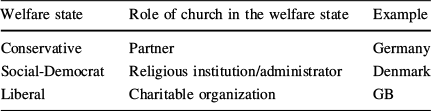
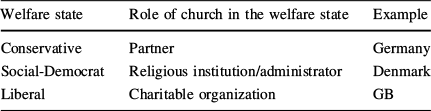
In summary, the level of Protestant engagement varies considerably across countries and moral fields. In Germany, the EKD and especially the Diakonie are important actors in welfare provision with room to maneuver their interests. In combination with high governance capacity and policy congruence, the Church has a strong role in policy implementation. Within the German corporatist welfare state, the protestant church is a partner with influence on both the adoption and the implementation of morality policy. In contrast, the Danish FK is only active symbolically (i.e., it only supports other organizations) despite a larger governance capacity and policy congruence. In this case, the restricted room to maneuver hampers church involvement. The Danish peoples’ church is hence limited to the role of a religious institution and at best, a provider of infrastructure for the administration of the universalist welfare state. The CoE is neither legally allowed to act as a service provider (except for same-sex marriage), nor does it have the necessary resources (i.e., governance capacity) to do so. Additionally, there is little policy congruence as the CoE follows a relatively conservative moral doctrine and thus rejects state regulation. It therefore serves as a charity organization, filling the gaps that the liberal welfare state has left in the provision of social services connected to morality policies. Table 2 illustrates the relation between the welfare state and the role of the church in welfare provision in general terms.
Welfare state regime and church role in welfare provision
Welfare state |
Role of church in the welfare state |
Example |
|---|---|---|
Conservative |
Partner |
Germany |
Social-Democrat |
Religious institution/administrator |
Denmark |
Liberal |
Charitable organization |
GB |
Conclusion
Although churches in Europe have lost the influence over the liberalization of moral issues during secularization, our empirical analysis illustrates that the provision of social services can still serve as a means by which churches can exert moral authority. This is especially the case if these social services touch on moral issues, such as abortion, sex work, same-sex marriage, or terminal care. By focusing on Denmark, England, and Germany, three countries that vary significantly with regard to their church-state relations and their welfare regime, we showed that room to maneuver, governance capacity, and policy congruence are three factors that enable religious involvement in these policy areas. Our analysis reveals that churches need both the room to maneuver and policy congruence for the involvement in morality policy implementation.
This article is one of the first papers that systematically assesses and compares Protestant churches’ involvement in morality policy implementation based on first-hand empirical evidence and an innovative measurement scheme that captures the intensity and the coverage of churches’ engagement. In doing so, we advance existing literature by illustrating how Protestant churches can maintain moral influence in secular times. An important result is that in the countries under study, protestant churches were able to influence morality policy at the implementation stage, and that the degree of influence is moderated by the respective welfare regime of a country.
Our study is not without limitations. Our results can provide only a snapshot of church engagement regarding morality policy regulations in a limited number of countries. More importantly, we are unable to tell whether governance capacity is a necessary condition for churches to engage in morality policy implementation. However, we assume that governance capacity is especially important in the absence of policy congruence or room to maneuver, as in these scenarios, the church would be able to set up its services separately from state infrastructure.
Despite these shortcomings, we believe that our paper makes a valuable contribution to the literature on religion and politics: we provide a model that can explain church involvement in morality policy implementation across countries. The explanation we provide is not idiosyncratic, and the model can be used to study church engagement in other countries. We would like to see a reevaluation of our model within a range of different church-state regimes and welfare state settings, such as in France or Israel. Furthermore, future research should investigate the involvement of various religious denominations within a multi-comparative model.
Funding
Open Access funding enabled and organized by Projekt DEAL. Deutsche Forschungsgesellschaft (DFG) and Schweizer Nationalfond (SNF), Projekt: Religion and morality policy: An analysis of the influence of religious groups in the policy implementation stage (2017–2022) (Grant no. 324172465 (DFG)).
Declarations
Conflict of interest
The authors report there are no competing interests to declare.
Appendix 1: List of Interviews

Shortcut |
Expert |
Date |
|---|---|---|
England |
||
Interview_GB1 |
Member of the Archbishops Council, Member of the General Synod, Vicar, London |
7th of November 2018 |
Interview_GB2 |
Director of Mission and Public Affairs, London |
9th of November 2018 |
Interview_GB3 |
Archdeacon Church of England, London |
6th of November 2018 |
Interview_GB4 |
Director of Mission and Ministry, Manchester |
8th of November 2018 |
Interview_GB5 |
Local Vicar, London |
19th of February 2019 |
Interview_GB6 |
Representative of the Church of England |
8th of November 2018 |
Denmark |
||
Interview_DK1 |
Bishop of Copenhagen |
30th of October 2018 |
Interview_DK2 |
Expert on Danish State Church Affairs |
30th of October 2018 |
Interview_DK3 |
Secretary General of the Caritas Denmark |
7th of November 2018 |
Interview_DK4 |
Bishop of Aarhus |
2nd of November 2018 |
Interview_DK5 |
Head of Communication of Folkekirken |
5th of July 2018 |
Interview_DK6 |
Leader Church and Diakonia |
7th November 2018 |
Germany |
||
Interview_DE1 |
Speaker of the Assembly of the Protestant Church in Bavaria |
17th of October 2018 |
Interview_DE2 |
Board Member Diakonie Germany |
25th of January 2019 |
Interview_DE3 |
Head of Diakonie Berlin |
29th of August 2018 |



 Open access

