

1. Introduction
Bovine trichomoniasis is a venereal disease that is responsible for significant losses to the US beef industry. The protozoan parasite, Tritrichomonas foetus, can exist in the prepuce of asymptomatic carrier bulls and can be transmitted throughout a cow herd during coitus (BonDurant, Reference BonDurant1997; Rodning, Reference Rodning2007). Infection in the cow herd can result in numerous reproductive consequences, such as abortions and other reproductive losses (Ondrak, Reference Ondrak2016). Correspondingly, previous work has estimated that the average net return expected per cow is reduced within the range of 5.1–35.2% depending on the within-herd prevalence of Trichomoniasis infection (Rae, Reference Rae1989).
The USDA Animal and Plant Health Inspection Service recognizes bovine trichomoniasis as an endemic disease in beef cattle with no federal control regulation implemented (USDA-APHIS, 2024c). However, multiple states have enacted trichomoniasis control procedures that often include measures such as the testing and culling of infected bulls and restricting the importation of animals infected with trichomoniasis (Yao, Reference Yao2021). For example, Wyoming instated a bovine trichomoniasis control program in 2000 and is now considered to be nearly absent of the disease (Jin et al., Reference Jin, Schumaker, Logan and Yao2014; Yao, Reference Yao2021). In addition to state control procedures, bovine trichomoniasis prevalence is influenced by the production practices employed by cattle producers. Leading risk factors include natural service for breeding, no defined breeding season, extensive range management, commingling of cattle, and infection in neighboring herds (Ondrak, Reference Ondrak2016).
The US beef industry may benefit from reducing or eradicating bovine trichomoniasis. However, because no federal regulation is in place, substantial variation exists in terms of state policies that influence prevalence, competing interests across markets, and trichomoniasis-related reproductive losses across the states. Correspondingly, the costs and benefits of reducing or eradicating bovine trichomoniasis likely vary from state to state. Therefore, understanding the economic impacts across the meat animal industry attributed to reducing or eradicating bovine trichomoniasis would provide valuable insights for policy development. Control of bovine trichomoniasis is often considered to require a multi-hurdle approach and can include factors such as the testing and culling of positive bulls, the use of artificial insemination, the use of virgin bulls, herd biosecurity, and vaccination (Ondrak, Reference Ondrak2016). However, it is possible that some of these control techniques may be underutilized in practice. For example, of the producers that introduced new cattle onto the operation, only 21.4% required the new cattle be tested for trichomoniasis before arrival (USDA-APHIS, 2020b).
Farm-level decision-making pertaining to disease management has been extensively discussed in the loss assessment framework of McInerney (Reference McInerney1996). The author details that a producer will employ disease control inputs (such as vaccination and testing) in a manner that minimizes the total cost of the disease. The total cost accounts for both the production losses and the cost of disease control inputs. If a disease is scarcely present, then the expected production losses will also be low. Consequently, more modest levels of disease management become optimal for the individual producer. However, as highlighted by Hennessy and Rault (Reference Hennessy and Rault2023), this framework does not consider the positive externalities generated from disease management by a herd. Correspondingly, it is possible that a producer’s chosen level of disease control will lead to less than socially optimal outcomes because the positive externalities generated from disease control are not accounted for in an individual producer’s loss assessment. Control efforts for bovine trichomoniasis within the US beef cattle population may be impeded by such circumstances. Additionally, given that the disease impacts the beginning of the beef supply chain, it likely leads to downstream welfare impacts. Previous studies on bovine trichomoniasis have evaluated the disease only at a farm level (Rae, Reference Rae1989; Villarroel et al., Reference Villarroel, Carpenter and BonDurant2004). Expanding to understand the distributional impacts of reducing bovine trichomoniasis across the beef supply chain would provide essential insights for policy development for bovine trichomoniasis and other endemic diseases to beef cattle.
Therefore, the objective of this study was to assess the economic impact of reducing bovine trichomoniasis prevalence in the US beef herd. To answer this question, two scenarios were considered: the first included a 100% reduction in the herd-level prevalence of bovine trichomoniasis, and the second included a 50% reduction in the herd-level prevalence of bovine trichomoniasis. We hope this work stimulates discussion about how bovine trichomoniasis control may be an advantageous pursuit that benefits the US cattle industry.
2. Methods
We employed an equilibrium displacement model (EDM) to assess the economic impacts of reducing bovine trichomoniasis prevalence in the US beef cattle population. The original model was developed by Brester et al. (Reference Brester, Marsh and Atwood2004) and has been extensively used to estimate impacts of various disease and production disruptions in the cattle industry (Dennis et al., Reference Dennis, Schroeder, Renter and Pendell2018; Pendell et al., Reference Pendell, Brester, Schroeder, Dhuyvetter and Tonsor2010; Shear and Pendell, Reference Shear and Pendell2020). Briefly, we first estimated the expected increase in the feeder cattle supply associated with reducing bovine trichomoniasis-attributed reproductive challenges. Next, we assessed how this change to primary feeder cattle supply influences equilibrium prices and quantities in the beef, pork, and poultry sectors. Lastly, we calculated changes to producer and consumer surplus as a measurement of economic welfare.
Consistent with previous work that has employed this model, four markets in the beef sector were included in the EDM: retail (consumers), wholesale (packers), slaughter (feedyards), and feeder (cow-calf). To account for retail substitution, the model also included the pork and poultry sectors. Because the pork and poultry markets are more vertically integrated relative to beef, the pork sector contained three markets (retail, wholesale, and slaughter), and the poultry sector contained two markets (retail and wholesale). International trade was included in the model at the wholesale levels for beef and pork.
Through total logarithmic differentiation, we arrived at an EDM that was driven by elasticities. As noted by previous literature, econometrically estimating the elasticities is prohibitive due to identification problems associated with simultaneously estimating supply and demand (Tonsor and Schroeder, Reference Tonsor and Schroeder2015; Brester et al., Reference Brester, Marsh and Atwood2004). Consequently, we used the common technique of employing previously published elasticities to parameterize our model, with elasticities being obtained from Pendell et al. (Reference Pendell, Brester, Schroeder, Dhuyvetter and Tonsor2010). We simulated the EDM over 10 years as this is roughly the length of the cattle cycle and because it has been shown through state-level control procedures that trichomoniasis reduction is a multiyear process (Yao, Reference Yao2021). Elasticities were linearly adjusted from short run to long run as employed by previous literature (Schroeder and Tonsor, Reference Schroeder and Tonsor2011; Tonsor and Schroeder, Reference Tonsor and Schroeder2015). Changes to producer and consumer surplus in the beef, pork, and poultry markets are used to quantify the economic impacts, as defined by Lusk and Anderson (Reference Lusk and Anderson2004). Baseline price and quantity values are from 2018 and were obtained from a variety of USDA and other peer-reviewed literature sources as documented in the Appendix.
Our model assumed that 25% of the increase in feeder cattle supply attributed to reducing bovine trichomoniasis prevalence occurred during years 1–2 and 8–10. The remaining 75% increase was assumed to occur during years 3–7. This resulted in the typical “S” shaped curve associated with changes to production practices. The EDM is further detailed in the Appendix. Two scenarios were considered. The first scenario assumed that bovine trichomoniasis in beef cattle would be eradicated over a 10-year period. The second scenario assumed a 50% reduction in bovine trichomoniasis prevalence over a 10-year period.
The primary positive shock associated with reducing bovine trichomoniasis prevalence is the increase in the feeder cattle supply due to a reduction in reproductive complications. This results in a rightward shift in the supply of feeder cattle. Subsequently, a chain reaction of endogenous shifts to equilibrium prices and quantities in the EDM follows.
The increase in feeder cattle supply was calculated as the numerical increase in the number of feeder calves marketed multiplied by the average weight of feeder cattle entering the feedlot, obtained from Peel (Reference Peel2023). The increase in total head of feeder cattle marked were calculated as follows. First, the total number of feeder cattle marketed if bovine trichomoniasis were to be eradicated, Calf e , was calculated as:
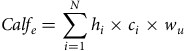 $$Calf_{e}=\sum _{i=1}^{N}h_{i}\times c_{i}\times w_{u}$$
where h i is the total number of beef cow herds in state i, c i is the average herd size in state i, and w u is the national average weaning rate of herds uninfected with trichomoniasis. The total number of beef cow herds and beef cow inventory used to calculate average herd size was obtained from the 2022 NASS Census of Agriculture (USDA-NASS, 2022). The national average weaning rate of herds uninfected with bovine trichomoniasis was estimated to be 0.844 and was calculated as the all operations calving percentage less the all operations percentage of beef calves that died or were lost prior to weaning from the USDA National Animal Health Monitoring System (NAHMS) Cow-Calf Management Report 1 and 2 (0.917–0.033 = 0.884) (USDA-APHIS, 2020a, 2020b). Next, the number of calves marketed with trichomoniasis present, Calf t , was calculated as:
 $$Calf_{t}=\sum _{i=1}^{N}([h_{i}\times t_{i}\times c_{i}\times w_{t}]+[h_{i}\times (1-t_{i})\times c_{i}\times w_{u}])$$
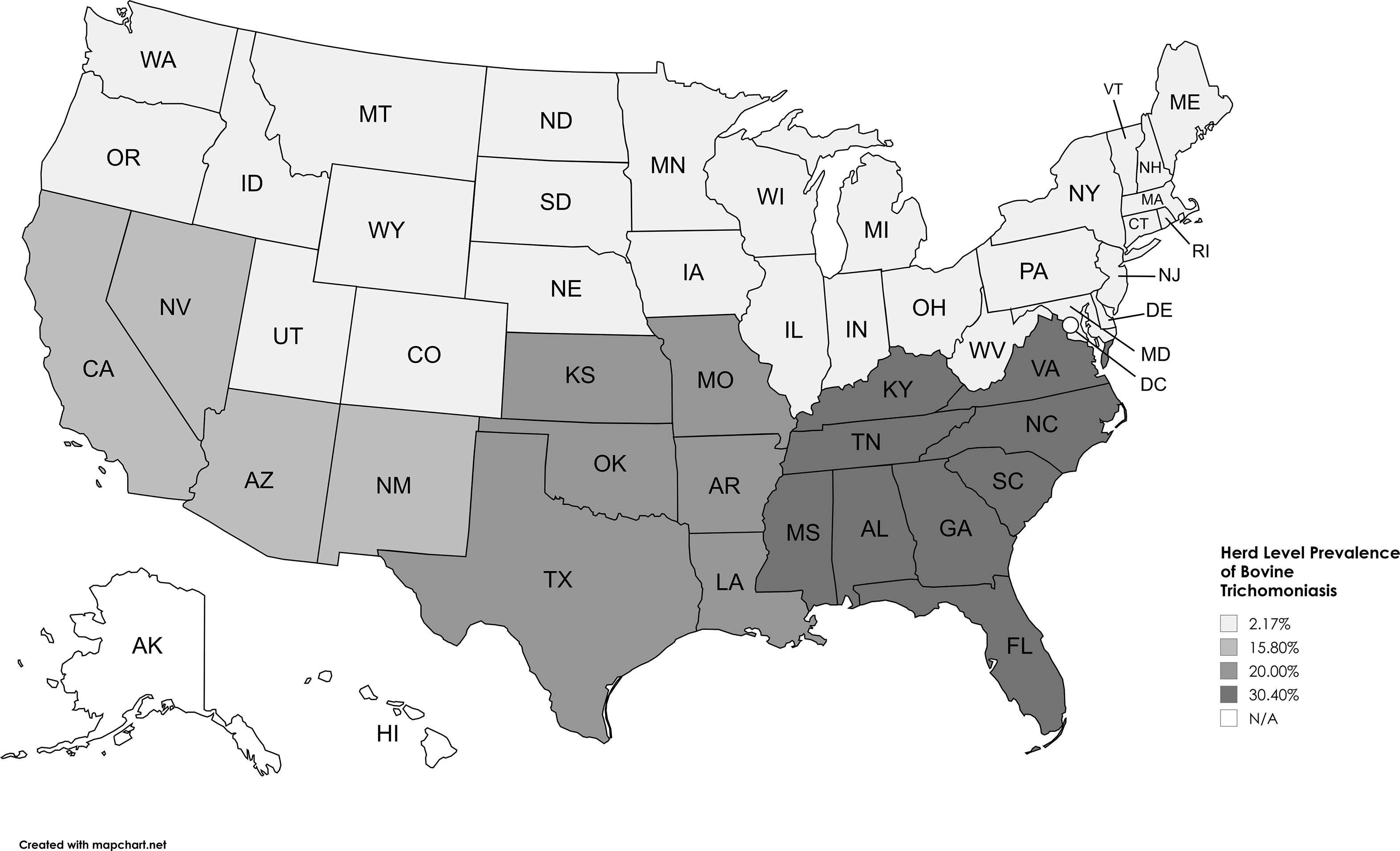
where t i is the herd-level prevalence of bovine trichomoniasis in state i and w t is the weaning rate in herds infected with bovine trichomoniasis, which was estimated to be 0.723. Each state’s herd-level prevalence is mapped according to the regions outlined in Figure 1. For example, Texas and South Dakota were assumed to have a herd-level prevalence of 20% and 2.17%, respectively. Clark et al. (Reference Clark, Dufty and Parsonson1983) found that bovine trichomoniasis infection reduced calving rates by 17.6%. Using this estimate and the reported all operation calving percentage from USDA-APHIS (2020a), the calving percentage in infected herds was calculated as: (−0.176 × 0.917 + 0.917 = 0.756). Subtracting all operation preweaning death loss resulted in a weaning rate for herds infected with bovine trichomoniasis of 0.723. Region-specific herd-level bovine trichomoniasis prevalence estimates were used for each state to account for the known regional differences and are visualized in Figure 1.
Regional herd-level prevalence of trichomoniasis in beef herds used for analysis. Notes: Western state prevalence (15.80%) obtained from Bon Durant et al. (1990), Texas region state prevalence (20.00%) obtained from Rutherford (Reference Rutherford2015), Southeastern state prevalence (30.40%) obtained from Rae et al. (Reference Rae, Crews, Greiner and Donovan2004), and Northern state prevalence (2.17%) obtained from Yao et al. (Reference Yao, Bardsley, Litzman, Hall and Davidson2011).
3. Results
When bovine trichomoniasis was reduced by 100%, the estimated total number of calves marketed in a given year was 25,752,116 calves. With bovine trichomoniasis present, the estimated total number of calves marketed in a given year was 25,057,514. Hence, in a given year, the US beef industry loses roughly 694,602 calves due to bovine trichomoniasis. Multiplying this value by the average weight of cattle entering the feedlot (757 lbs from Peel, Reference Peel2023), the 100% reduction scenario and the 50% reduction scenario led to an estimated 1.4444% and 0.7222% increase in feeder cattle supply, respectively. Under the 100% reduction scenario, this resulted in a 0.0722% increase in feeder cattle supply during years 1, 2, 8, 9, and 10, and 0.2167% during years 3, 4, 5, 6, and 7. Under the 50% reduction scenario, this resulted in a 0.0361% increase in feeder cattle supply during years 1, 2, 8, 9, and 10 and a 0.1083% increase during years 3, 4, 5, 6, and 7.
The Appendix contains the results for changes in equilibrium prices and quantities across years 1–10 under each scenario. Within each market of the beef sector, equilibrium quantities increase under each scenario. This is the result of the increase in the primary supply of feeder cattle. In the retail and wholesale markets, equilibrium prices drop years 1–10. This is because the effect of the increase in derived supply was larger than the effect of increasing retail beef demand as consumers substituted away from pork and poultry. During years 1 and 2, when supply was relatively inelastic, the equilibrium price of slaughter and feeder cattle increased. This is due to the increase in primary demand at the retail level and the corresponding trickle-down effects causing an increase in the derived demand of slaughter and feeder cattle. However, as supply and demand become more elastic, we see a reduction in equilibrium prices to feeder and slaughter cattle, which fits a priori expectations for the effect of an increase in primary feeder cattle supply. The same pattern of changes to endogenous prices and quantities hold true under the 50% reduction of trichomoniasis scenario, the changes are simply smaller relative to the 100% reduction scenario.
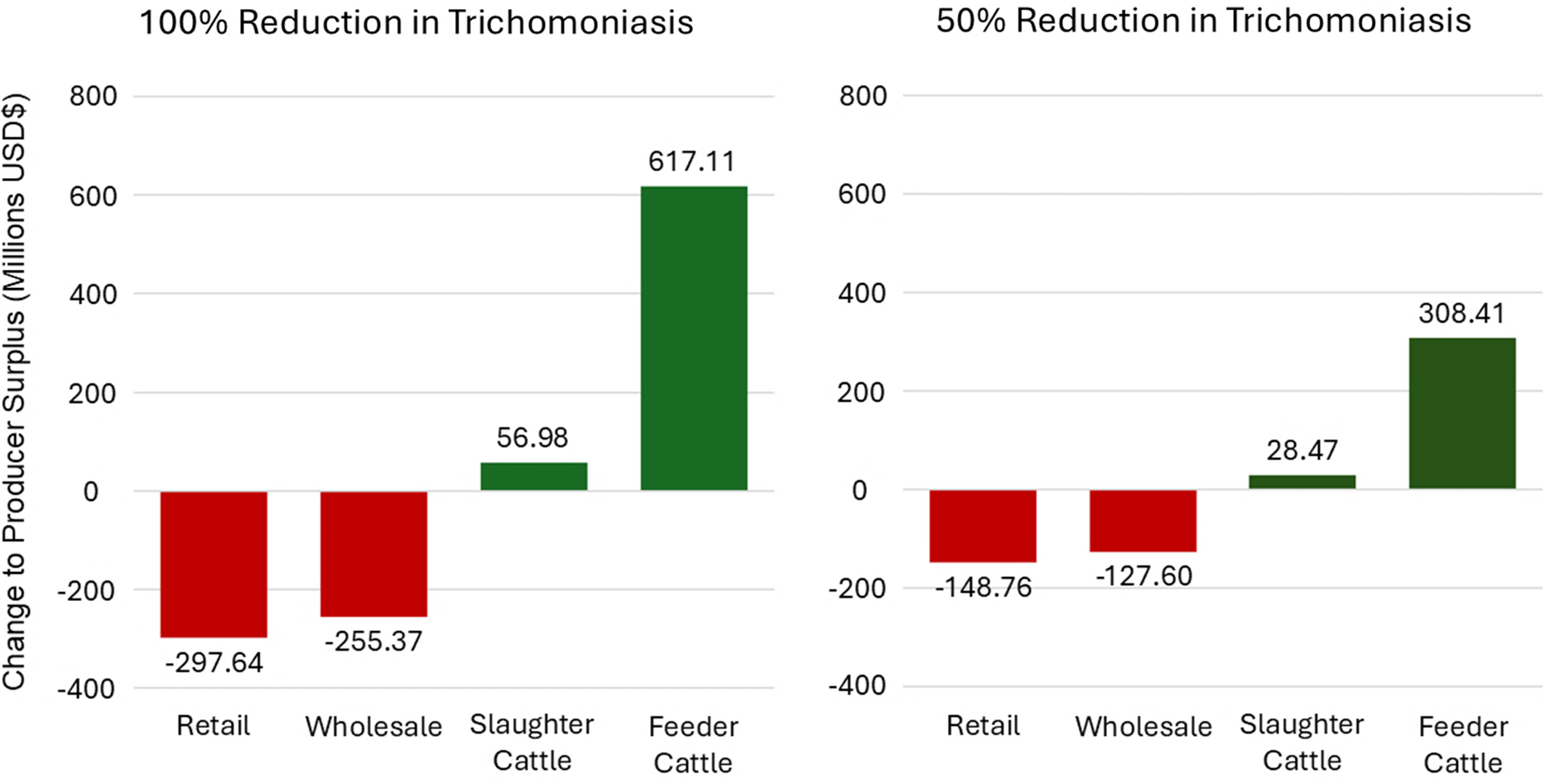
Tables 1 and 2 contain changes to consumer and producer surplus for each market under the 100% reduction and 50% reduction scenarios, respectively. The changes to beef producer surplus for each market are highlighted in Figure 2. Feeder cattle producers stand to gain the most due to a reduction in bovine trichomoniasis prevalence. Under the 100% and 50% reduction scenarios, the cumulative present value of changes to feeder cattle producer surplus are $617.108 and $308.407 million, respectively. This finding is driven by the fact that the increase in primary supply and equilibrium quantity are greater than reductions to equilibrium price, leading to positive producer surplus. Correspondingly, feeder cattle producer surplus increases years 1–10, with gains becoming smaller as demand and supply become more elastic. Slaughter cattle producers also gain modestly under each scenario, with the cumulative present value of changes to slaughter cattle producer surplus being $56.983 and $28.471 million for the 100% reduction and 50% reduction scenarios, respectively. The gains for slaughter cattle producers are largely driven by the first and second year. After the second year, the slaughter cattle producer surplus is reduced because the increase in equilibrium quantity is not large enough to offset the reductions to the equilibrium price of slaughter cattle. Wholesale and retail producer surplus decreases across years 1–10. This is because the increase in equilibrium quantity is not large enough to offset the reductions in price, leading to decreases in producer surplus.
Cumulative present value of changes to producer surplus within the beef sector due to reductions in bovine trichomoniasis herd-level prevalence (in millions of USD). Notes: Changes to producer surplus are relative to no change in the prevalence of trichomoniasis.
Changes to producer and consumer surplus due to a 100% reduction of bovine trichomoniasis over 10 years (in millions of USD)

Changes to producer and consumer surplus due to a 50% reduction of bovine trichomoniasis prevalence over 10 years (in millions of USD)
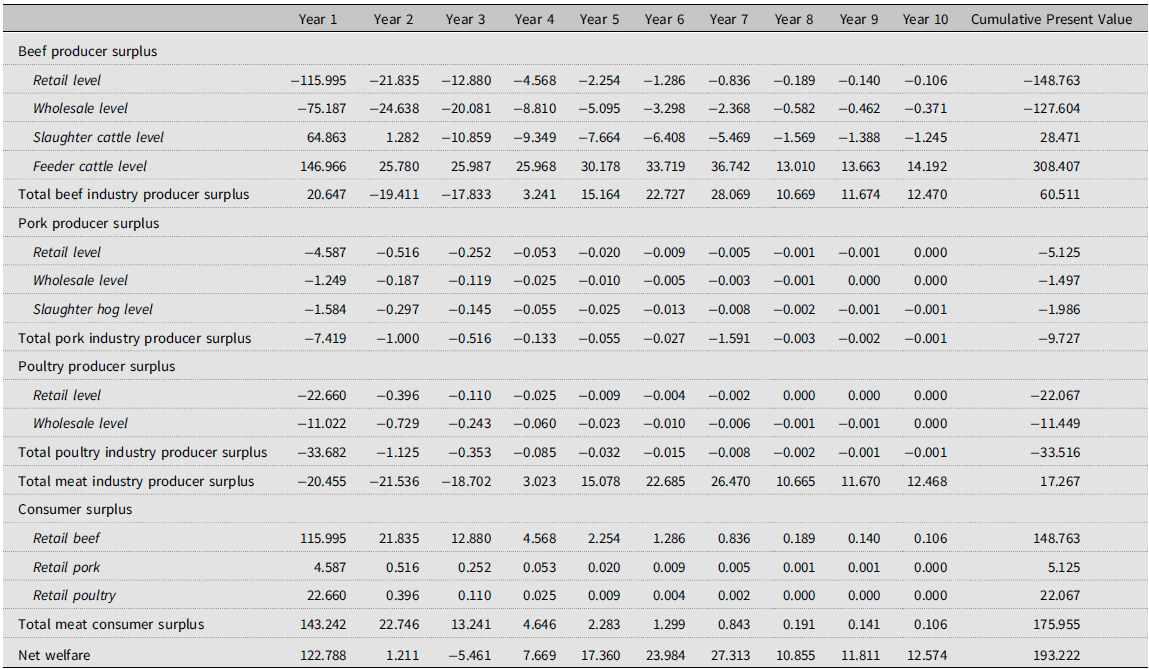
Pork and poultry producers experience reductions in producer surplus across years 1–10. This is largely a consequence of the reduction in retail prices for beef and the corresponding substitution of beef for pork and poultry by retail consumers. However, after year 1, the reductions in pork and poultry producer surplus can be considered negligible.
Retail consumers, primarily retail beef consumers, are the other group who significantly gains from the reduction of bovine trichomoniasis in beef cattle. Under the 100% reduction scenario, the cumulative present value of changes to retail consumer surplus for beef, pork, and poultry are $297.644, $10.249, and $44.133 million, respectively. Under the 50% reduction scenario, the cumulative present value for retail consumer surplus is $148.763, $5.125, and $22.067 million for beef, pork, and poultry, respectively. These gains are due to the reduction in retail prices and increase in equilibrium quantity for each animal protein.
Overall, the cumulative present value of changes to aggregate beef industry producer surplus was estimated to be $121.075 million under the 100% reduction scenario. Under the 50% trichomoniasis reduction scenario, the cumulative present value of the changes to the beef industry producer surplus was $60.511 million. Adding the changes to total pork producer surplus, total poultry producer surplus, and total retail meat consumer surplus, the estimated cumulative present value of changes to net welfare was $388.856 million and $193.222 million for the 100% reduction and 50% reduction scenarios, respectively.
4. Discussion
Bovine trichomoniasis causes significant losses to feeder cattle producers and the entire beef sector. We estimate the beef industry loses roughly 694,602 calves annually due to bovine trichomoniasis. At a time where the US beef cow inventory is at a 63-year low, the reproductive consequences of bovine trichomoniasis infection exacerbate the already limited supply of beef calves, leading to record-high prices for cattle and beef products through 2023 and 2024 (Peel, Reference Peel2024). Using an EDM, we estimated the changes to producer and consumer surplus associated with reducing herd-level prevalence of bovine trichomoniasis by 100% and 50%. By analyzing the economic effects of reducing bovine trichomoniasis over a 10-year period, we capture price and quantity fluctuations across a full cattle cycle. We find that feeder cattle producers and retail beef consumers stand to gain the most from reducing the prevalence of bovine trichomoniasis in the US beef population. Overall, the cumulative present value of net welfare was increased by $388.856 and $193.222 under the 100% and 50% reduction, respectively. This begs the question of what private and public policy options are available to reduce bovine trichomoniasis, as well as the economic viability of such options.
Applying the framework from Hennessy and Rault (Reference Hennessy and Rault2023) to our study, it is likely that the current level of bovine trichomoniasis control is less than socially optimal. This is due to the positive externalities generated from bovine trichomoniasis management not being accounted for in an individual producer’s loss assessment. Consequently, the allocation of trichomoniasis control is less than socially optimal. The positive externalities from bovine trichomoniasis control include health benefits such as reducing the risk of bovine trichomoniasis infection and reproductive losses for neighboring herds. These health benefits can be considered public goods because they are characterized by nonrivalry and nonexcludability (Eloit, Reference Eloit2012; Sandler and Arce, Reference Sandler and Arce2002). As with most public goods, economic agents acting independently will underproduce a public good because they do not consider how the public good benefits others (Nicholson and Snyder, Reference Nicholson and Snyder2017). Similar findings have been noted in Railey and Marsh (Reference Railey and Marsh2019). Consequently, some form of intervention may be warranted.
Subsidizing trichomoniasis control measures should, in theory, help achieve social gains. The USDA-APHIS has previously subsidized state-federal livestock disease eradication programs with success. For example, the Cooperative State-Federal Tuberculosis Eradication Program has nearly eliminated M. bovis from cattle in the United States (USDA-APHIS, 2024b). Another example can be found in the Cooperative State-Federal Brucellosis Eradication Program. In 1956, there were 124,000 affected herds in the United States. Currently, the number of affected domestic herds is in the single digits (USDA-APHIS, 2024a). However, there are differences in the above two examples and bovine trichomoniasis, most notably being that tuberculosis and brucellosis are transmissible to humans, while bovine trichomoniasis is not. For tuberculosis and brucellosis, the benefits greatly outweighed the costs of a command-and-control approach, largely driven by reducing human health risks. The same will likely not be true for bovine trichomoniasis. If we consider reduction rather than eradication, it is likely that significant knowledge barriers exist in determining what the subsidy should be in order to achieve optimal levels of bovine trichomoniasis reduction (Nicholson and Snyder, Reference Nicholson and Snyder2017). Additionally, governmental failure has been shown to impede the supply of public goods (Montgomery and Bean, Reference Montgomery and Bean1999). These knowledge barriers are coupled with substantial costs associated with reduction or eradication, something we leave for future work. In the case of eradication, the majority of this cost is borne by the state-federal taxpayers. For eradication, increased costs for testing efforts are warranted to identify and eradicate infected animals, but indemnity payments may not be needed because positive animals can be sold for slaughter. In addition to the costs borne by taxpayers, individual producers face the opportunity costs of their labor and management associated with increased handling of animals for testing. Therefore, the costs associated with command-and-control approaches to bovine trichomoniasis control can potentially be prohibitive.
If feeder cattle producers were to consider the external benefits realized by other producers in their area associated with trichomoniasis control, then the industry would move toward more efficient trichomoniasis management and the corresponding public good of cattle health. In other words, managing bovine trichomoniasis can be characterized as a collective action problem that requires cooperation and coordination among cattle producers. A rich literature exists that documents the theory of collective action and successful case studies (Ostrom, Reference Ostrom1990, Reference Ostrom2000, Reference Ostrom2010) as well as the assessment of the potential for collective action over a common pool resource or private goods (Charnley et al., Reference Charnley, Kelly and Fischer2020; Colin-Castillo and Woodward, Reference Colin-Castillo and Woodward2015; Ostrom, Reference Ostrom1990). Ostrom (Reference Ostrom1990) proposes characteristics that lend way to the ability of a group to engage in collective action, which include factors such as most individuals highly valuing engaging in the given activity and shared feelings of reciprocity and trust. In the case of bovine trichomoniasis management, leveraging the existing social capital embedded in entities such as state cattlemen associations may allow for the communication and education needed for a collective-action-like resolution to bovine trichomoniasis control that does not require governmental oversight. The other group that significantly benefits from bovine trichomoniasis control is retail beef consumers. Enacting this group to prioritize bovine trichomoniasis control would require different approaches relative to feeder cattle producers. The most conventional approach to engaging this group is food labeling. However, this approach couples the “food product (aka beef)” with the “animal health benefit,” thereby preventing non-meat consumers who care about animal health from expressing their demand in the meat market (Lusk, Reference Lusk2011). An innovative approach is outlined in Lusk (Reference Lusk2011), who proposes creating a separate market for animal welfare. This market, in theory, would rectify the positive externality associated with bovine trichomoniasis control and overcome the limitations of food labeling. Similar approaches to externalities have been applied in the emerging carbon market in the dairy industry.
Our study is not without limitations. Epidemiologically, data pertaining to the herd-level prevalence of bovine trichomoniasis is sparse and dated. It is possible that the current regional prevalence may differ from what is reported in the literature. Economically, the dollar value of producer and consumer welfare changes depend on the base year prices and quantities entered in the model. Hence, since prices have increased since 2018, the dollar value of changes to producer and consumer surplus associated with reducing bovine trichomoniasis also likely would be larger.
5. Conclusion
The results of this study suggest that the reduction of bovine trichomoniasis prevalence in the US beef cattle population would lead to increases in net social welfare. Under the 100% and 50% reduction scenarios, the cumulative present value of net welfare increased by $388.856 million and $193.222 million, respectively. Feeder cattle producers and retail beef consumers stand to gain the most from enhanced bovine trichomoniasis control. Future work should assess the viability of various options to achieve enhanced control of bovine trichomoniasis, particularly for the case of collective action among beef cattle producers.
Supplementary material
The supplementary material for this article can be found at https://doi.org/10.1017/aae.2025.7.
Data availability statement
Data is available upon request.
Acknowledgments
We appreciate the feedback of Dr Blaine Johnson on the conceptual and methodological framework of this manuscript.
Author contributions
Conceptualization, B.A.S., J.K., R.B.W.; methodology, B.A.S., R.B.W.; formal analysis, B.A.S.; data curation, B.A.S.; writing – original draft, B.A.S.; writing – review and editing, B.A.S, J.K., R.B.W.; supervision, J.K., R.B.W.; funding acquisition.
Funding statement
This research received no specific grant from any funding agency, commercial, or not-for-profit sectors.
Competing interests
The authors declare no competing interests.
AI contribution to research
AI was not used in the creation of this manuscript.


 Open access

