


1. Introduction
It is part of the design research community’s self-conception to develop, validate, and transfer design methods into practical use. Such methods support both industry and education in designing better products more effectively and efficiently (Reference Cash, Daalhuizen and HekkertCash, et al. 2023; Reference GerickeGericke et al. 2020; Reference Jagtap, Warell, Hiort, Motte and LarssonJagtap et al. 2014). Over the past decades, a large number of design methods have been developed with the aim of supporting specific tasks within the product development process (PDP). They specify how to achieve particular goals by defining which input information to use, which actions to perform, and how to represent results (Reference Gericke, Eckert and StaceyGericke et al. 2022). Each method is therefore based on a core idea and prescribes a procedure that its users are expected to follow within an intended use case, e.g. method content theory of Reference Daalhuizen and CashDaalhuizen and Cash 2021. To ensure acceptance and improve the applicability of design methods, extensive research has been conducted on appropriate forms of method description and delivery (e.g., standardized templates (Reference Reiss, Bavendiek, Diestmann, Inkermann, Albers and VietorReiss et al. 2017), guidelines, or tool-based representations (Reference Albers, Nicolas, Nicola, Benjamin and GladyszAlbers et al. 2015; Reference Bavendiek, Inkermann and VietorBavendiek et al. 2016). Implicit in this research is the assumption that design methods must be selected, understood, adapted, and applied by individuals or teams (Reference Cash, Daalhuizen and HekkertCash et al. 2023). As a result, well-structured descriptions of design methods are available in textbooks, repositories, and standards (Reference Pahl, Beitz, Feldhusen and GrotePahl et al. 2007; Reference Ponn, Hutterer, Braun, Birkhofer and EhrlenspielPonn et al. 2024). The increasing integration of artificial intelligence (AI) into engineering and product development raises new questions on how knowledge about design methods will be applied in the future, and what role developers, AI systems, and researchers should take. If AI systems are to support or even automate parts of engineering tasks and decision-making, knowledge about methods must be translated into procedural instructions that AI systems can interpret and execute. In this sense, design methods may serve as a communicative medium between engineers and AI systems. However, different levels of AI autonomy and interaction are conceivable – from AI-supported assistance to AI-driven decision-making – each with distinct implications for method use. Therefore, this paper presents an exploratory study examining possible forms of interaction and collaboration between engineers, design methods, AI systems, and researchers. The objective is (1) to identify and illustrate different modes of collaboration between engineers and AI systems to perform engineering tasks supported by design methods, and (2) to develop an initial framework for the application of design methods in the context of AI. Furthermore, a road map for the future teaching, application, and development and research on design methods is derived.
1.1. Generative AI in engineering design
Recent research shows a rapidly increasing adoption of AI across the engineering design process (Reference Choudhury, Eisenbart and KuysChoudhury et al. 2025; Reference Jonuschies, Siewert, Michaelsen and GerickeJonuschies et al. 2025; Reference Regenwetter, Heyrani Nobari and AhmedRegenwetter et al. 2021). Rather than being limited to isolated tools or prototypes, AI is embedded in multiple engineering tasks and across all major phases of the PDP. A consistent finding in recent literature is that AI supports three recurring activities, that are generation, evaluation, and description, which reappear in every phase of the PDP, although with different emphases and model types (Reference Chiarello, Barandoni, Škec and FantoniChiarello et al. 2024). In requirements definition, for instance LLMs assist in the generation of stakeholder needs and functional requirements from unstructured language inputs, the evaluation of completeness and constraints, and the description of structured specifications (Reference Chiarello, Barandoni, Škec and FantoniChiarello et al. 2024; Reference Choudhury, Eisenbart and KuysChoudhury et al. 2025). During ideation, LLMs and deep generative models help to produce alternative principle solutions and early sketches (generation), similarity and clustering models support quick screening (evaluation), and textual rationales or morphological representations are formalised automatically (description) (Reference Regenwetter, Heyrani Nobari and AhmedRegenwetter et al. 2021). In conceptual and embodiment design, Variational Autoencoders, Generative Adversarial Networks and diffusion models can create 2D and 3D geometry variants (generation), surrogate models can assess performance and manufacturability (evaluation), and parameters, interfaces and bills of materials are formalised (description) (Reference Yüksel, Börklü, Sezer and CanyurtYüksel et al. 2023). In detailed design, AI supports the generation of tolerances and material variants, the evaluation of manufacturability and DFA/DFM constraints, and the description of drawings and change documentation (Reference PicardPicard et al. 2023). Finally, in verification and release, LLMs help to generate test cases and acceptance criteria, learned evaluators compare test data to requirement baselines, and compliance reports are documented automatically (Reference Jonuschies, Siewert, Michaelsen and GerickeJonuschies et al. 2025). Across all phases, LLMs currently dominate language-centric tasks such as requirements, rationale and documentation, whereas deep generative geometric models provide shape- and layout-level variants that can be transferred into CAD or simulation environments (Reference Regenwetter, Heyrani Nobari and AhmedRegenwetter et al. 2021). The prevailing motivation behind this adoption is productivity: repetitive work can be automated and design iterations are accelerated. However, lessons from software engineering show that productivity gains do not guarantee long-term quality (Reference Vaithilingam, Zhang and GlassmanVaithilingam et al. 2022). Autogenerated results may be syntactically correct but difficult to maintain, leading to increased downstream effort for modification and error handling (Reference AmershiAmershi et al. 2019). Initial observations in engineering design suggest similar risks: faster creation of concepts or documentation does not ensure manufacturability, traceability or compliance, which may shift effort into later phases (Reference Choudhury, Eisenbart and KuysChoudhury et al. 2025; Reference Yüksel, Börklü, Sezer and CanyurtYüksel et al. 2023).
1.2. Focus and contribution of this research
Although AI is increasingly integrated into engineering tasks and supports recurring activities such as generation, evaluation, and documentation, current applications remain fragmented and typically demonstrate the potential of individual AI models rather than focusing on their systematic integration into the PDP. This raises the question of how design knowledge and in particular knowledge about design methods must be represented and controlled when AI participates in engineering tasks. Following this question, the aim of this research is to conceptualize and demonstrate an initial framework that helps to integrate design methods into human–AI collaboration within engineering tasks. Therefore, the following research questions are in focus:
-
• RQ1: Which modes of collaborations should be distinguished when integrating AI systems into engineering tasks?
-
• RQ2: Which elements and transitions must be considered to form a framework to describe the the integration of design methods into human-AI collaboration?
The framework is illustrated using two illustrative examples, from which a road map for the future teaching, application, and development and research on design methods in the context of AI is derived. The remainder of this paper is organized as follows: Section 2 introduces the theoretical background on interaction and collaboration with AI in engineering tasks as well as the framework to integrate design methods into human–AI collaboration. Section 3 presents two illustrative examples highlighting the use of the proposed framework. Section 4 discusses implications and future research directions, with a particular focus on the modelling of engineering methods, method education, and method research and validation. Section 5 concludes the paper with limitations and a summary of key findings.
2. Human–AI co-creation in engineering design
Engineering design is commonly conceptualised as an iterative reasoning process in which goals are defined, solution variants are generated, analysed against constraints, and selected or rejected based on informed judgement. Foundational models such as the systematic design approach by Reference Pahl, Beitz, Feldhusen and GrotePahl et al. (2007) and the VDI 2221 (2019) describe this logic through recurring phases of planning, synthesis, analysis and decision-making, which continue until a viable solution is achieved. Comparable iterative structures also underpin computational optimisation approaches in engineering design (Reference Bendsøe and SigmundBendsøe & Sigmund 2004), indicating a stable theoretical foundation for analysing how AI can be embedded into design reasoning. Recent research shows that AI is increasingly integrated into this iterative logic, not merely as an isolated automation technology but as an active participant in engineering tasks. Studies on human–AI collaboration describe this as co-creation, where human designers and AI systems jointly contribute to generating, evaluating and selecting design alternatives under varying collaboration strategies (human-led, machine-led or balanced) (Reference MaMa et al. 2024). From a Human–Computer Interaction (HCI) perspective, this development aligns with principles of mixed-initiative interaction (Reference HorvitzHorvitz 1999) and human–AI teaming (Reference Lyons, Sycara, Lewis and CapiolaLyons et al. 2021), which emphasise shared initiative, explanation, negotiation and adaptive role allocation, rather than one-directional automation. Reference Song, Zhu and LuoSong et al. (2024) highlight that effective human–AI collaboration depends not only on technical AI capabilities (e.g. prediction, generation, recognition), but also on interaction qualities such as transparency, directability, predictability and adaptability, which directly influence trust and accountability. Across different phases of the product development process, AI-supported activities typically involve the generation of design artefacts, the evaluation of alternatives and the description or formalisation of results. These recurring activities can be observed in requirements engineering, ideation, conceptual design, embodiment design and verification, albeit with different model types and degrees of autonomy (Reference Chiarello, Barandoni, Škec and FantoniChiarello et al. 2024; Reference Choudhury, Eisenbart and KuysChoudhury et al. 2025; Reference Jonuschies, Siewert, Michaelsen and GerickeJonuschies et al. 2025; Reference Regenwetter, Heyrani Nobari and AhmedRegenwetter et al. 2021; Reference Yüksel, Börklü, Sezer and CanyurtYüksel et al. 2023). Instead of replacing the iterative structure of design reasoning, AI redistributes responsibilities and transforms how planning, synthesis, analysis and decision-making are coordinated between human and machine. The following sections does no focus on redefining the design cycle itself, but on characterising how AI participates in engineering tasks and how design methods can be integrated into this emerging human–AI co-creation landscape.
2.1. Levels of AI autonomy in engineering tasks
The extent to which AI participates in planning, synthesis, analysis and decision-making varies significantly across current engineering applications. While some systems operate as narrowly scoped automation tools, others function as adaptive collaborators that generate alternatives, evaluate trade-offs and provide explanations. Drawing on research into human–AI collaboration in engineering design (Reference MaMa et al. 2024), mixed-initiative interaction (Reference HorvitzHorvitz 1999; Reference Song, Zhu and LuoSong et al. 2024) and AI-supported systems engineering (Reference ZhangZhang et al. 2025), four levels of AI autonomy are distinguished in this work, cf. Figure 1.
Different level of AI-autonomy in engineering tasks including forward and backward tasks as well as responsibility for task planning

Figure 1 Long description
A diagram representing different levels of AI autonomy in engineering tasks. The diagram is divided into four panels, each depicting a different level of AI autonomy. Panel A: Human-Based Design. A person is shown interacting directly with design elements, indicating that the design process is primarily driven by human input. Panel B: Augmented Engineering Tasks. A person is depicted using AI tools to assist in the design process, with arrows indicating the interaction between the human and the AI tools. Panel C: Autonomous Engineering Assistance. The diagram shows AI systems taking a more active role in the design process, with arrows indicating the AI's ability to make decisions and suggestions independently. Panel D: Human-AI Co-Engineering. The diagram illustrates a collaborative approach where humans and AI systems work together closely, with bidirectional arrows indicating the exchange of information and decision-making between the two.
These levels reflect how initiative, responsibility and interpretation are distributed between human engineers and AI systems. They also differentiate between:
-
• Forward tasks, in which AI modifies or creates artefacts, e.g. geometry generation, parameter updates,
-
• Backward tasks, in which AI analyses existing artefacts and reports insights, e.g. constraint checking, manufacturability assessment.
The following four level are distinguished, c.f. Figure 1:
-
1. Human-based Engineering. All steps of the engineering cycle are carried out manually. Digital tools serve only as passive artefact manipulators (e.g. manual CAD modelling, manual meshing). Planning, synthesis, analysis and decisions remain entirely human-driven.
-
2. Augmented Engineering Tasks. The engineer retains full responsibility for planning and decisions, while AI automates clearly defined sub-tasks such as rule-based dimensioning, automated checking or batch processing. Automation may affect forward or backward tasks, but interpretation and control remain human.
-
3. Autonomous Engineering Assistance. The engineer defines goals and constraints, while AI plans and executes subtasks independently. Examples include surrogate-based optimization or LLM-based requirement analysis identifying gaps or inconsistencies. The system provides contextual feedback and explanations, yet final decision authority remains human.
-
4. Human–AI Co-Design. Humans and AI jointly contribute to planning, synthesis, analysis and decision-making. Generative design systems propose variants, evaluate performance and explain trade-offs, while adaptive AI assistants negotiate intent and adapt behaviour dynamically. Comparable collaborative patterns are reported in MBSE contexts. Responsibility becomes distributed and negotiated, consistent with human–AI teaming principles.
Figure 1 visualizes these four levels and illustrates how initiative shifts from human dominance to shared control. As autonomy increases, forward and backward tasks become increasingly intertwined, and the AI evolves from a passive executor to an active reasoning partner. While real-world systems may combine characteristics across levels, this classification offers a structured lens for positioning existing AI applications in engineering design.
2.2. Framework to integrate design methods into human–AI co-creation
To describe how engineering design methods can be enacted under varying degrees of human and AI involvement, an initial framework is proposed that integrates design task theory, c.f. VDI 2221 (2019), method theory (Reference Daalhuizen and CashDaalhuizen & Cash 2021; Reference GerickeGericke et al. 2020) and human–AI collaboration models (Reference MaMa et al. 2024). The framework conceptualises design method application as an iterative loop, c.f. Figure 2. Following existing theories (Reference Daalhuizen and CashDaalhuizen & Cash 2021), it integrates three core elements, namely design task context, design method description, and result and three transitional processes (method selection & input, method execution, result checking and integration), all embedded in domain-specific knowledge and subject to different degrees of human and AI responsibility (co-creation zone).
Core Elements of the Framework. The framework comprises three interconnected elements representing the logical structure of method-based design activity:
-
1. Design Task Context. The Design Task Context represents the situational starting point for method application. It includes the analysis and definition of the design problem, the intended objectives and outputs, and the relevant constraints. This element reflects the situated and task-specific nature of design work, acknowledging that methods are not applied in abstraction but always within a concrete problem environment. The context defines the conditions under which a method is selected and determines the relevance, scope and expected outcomes.
-
2. Design Method Description. The Design Method Description captures the conceptual representation of the method itself and corresponds to the traditional understanding of design methods in engineering design research. It comprises the core idea or principle of the method, required input, procedural steps and underlying logic, and the expected output, including its specified structure and representation. This element formalises the method as an epistemic tool that structures reasoning and problem-solving processes. It serves as the reference point for both human understanding and AI interpretation when operationalising the method.
-
3. Result. The Result element represents the concrete output generated by the execution of the design method. It is characterised by level of detail, structural organisation, representation and formalisation, and correctness in relation to objectives and constraints. The result is not merely an artefact but a basis for evaluation, learning and further design progression.
Framework for integrating design methods into human–AI co-creation

The three core elements are connected by directed transitions that structure the flow of method application and form an iterative loop. The transition from Design Task Context to Design Method Description represents Method Selection & Input. In this phase, the problem context is interpreted and mapped onto a suitable design method. At the same time, the required inputs for the method are specified and prepared. This step marks the shift from problem understanding to methodological framing. Subsequently, the transition from Design Method Description to Result corresponds to Method Execution. Here, the defined procedural logic of the method is enacted, transforming the provided inputs into a structured result. This phase encompasses the concrete operationalisation of the method, including sequencing of steps, application of rules and generation of outputs. Finally, the transition from Result back to Design Task Context constitutes Result Checking & Integration. In this phase, the generated outcome is evaluated in relation to the original problem, objectives and constraints. Insights gained from this evaluation are reintegrated into the task context, leading to refined problem understanding, adapted constraints or revised objectives. Through this feedback mechanism, the cycle closes and enables iterative progression of the design task. In combination, these transitions ensure that design method application is not a linear operation but a continuous and adaptive process.
Human–AI Responsibility and Degrees of Autonomy. A defining feature of the framework is that each core element and each transition can be realised under varying degrees of human and AI responsibility. Context analysis, method selection, procedural execution and result evaluation may be carried out entirely by human designers, entirely by AI systems, or through collaborative configurations that distribute tasks between both agents. This flexibility aligns with the four levels of AI autonomy, c.f. Figure 1, ranging from fully human-led execution to AI-led decision-making and intermediate co-creative arrangements, c.f. co-creation zone. By representing responsibility as a continuum rather than a binary distinction, the framework allows each stage to be positioned according to its specific configuration of control, initiative and interpretation. In this way, different implementations of Human–AI Co-Creation can be systematically compared and analysed within a consistent conceptual structure.
Domain Knowledge as Integrative Foundation. At the centre of the framework lies Domain Knowledge, which constitutes the shared cognitive foundation for all activities within the cycle. This includes disciplinary expertise, technical principles, experiential knowledge and contextual understanding. Domain knowledge informs the interpretation of the task context, supports the meaningful application of design methods and guides the evaluation of results. It therefore underpins both human reasoning and AI-supported processes and remains indispensable irrespective of the degree of automation.
By explicitly linking task context, method description and result within a structured cycle and embedding this cycle within a continuum of human–AI responsibility, the framework reconceptualises design methods as dynamic mediators within a socio-technical design system. It provides a coherent structure for analysing how methods are selected, executed and evaluated in AI-rich environments while maintaining transparency, traceability and theoretical consistency. At the same time, it is important to emphasize that this is an initial framework that must be validated and evaluated in further research in order to be used as a theory for the application and development of design methods in the context of AI. In the following chapter application of the framework is illustrated by two examples, highlighting different configurations of method execution and human–AI collaboration.
3. Illustrative examples of human–AI collaboration
This section presents two examples highlighting the proposed Human–AI Co-Creation framework introduced in Section 2. These illustrative examples are structured around its three core elements and the associated transitions of method selection, execution and result integration. The aim is not to evaluate AI performance, but to demonstrate how the framework can be used as an analytical lens to describe concrete configurations of Human–AI collaboration. It highlights how design methods act as mediating structures and how their operationalization changes depending on whether AI supports the execution of a predefined method or contributes to the selection and specification of methods in early design phases. Two contrasting examples are therefore presented: the first focuses on augmented engineering with AI-supported method execution, while the second examines AI-supported method selection.
3.1. Example 1: AI-supported execution of a given design method
This example exemplifies an augmented engineering configuration in which the design task context and the design method are defined by a human engineer, while the execution of the method is supported by an AI system. The morphological box was selected as the method, following the description of Reference LindemannLindemann (2009), and provided to the AI (ChatGPT 5.1 plus) as a structured procedure. The design task was defined as follows:
“I want to develop a workpiece holder for clamping cylindrical workpieces for machining in a milling centre. Using a morphological box, possible partial solutions shall be collected and structured. Three sub tasks were defined: (1) generate clamping force; (2) align cylindrical workpiece; (3) fix workpiece holder to machine table.”
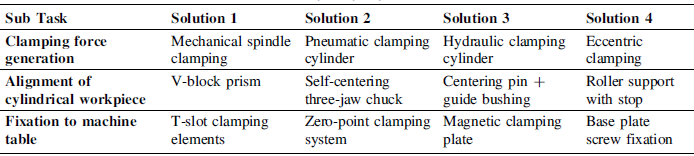
Based on this design task and the given method description, the AI system was instructed to execute the morphological box method and structure suitable partial solutions for the three defined sub tasks. The following morphological box summarises the resulting solution space.
Morphological box for cylindrical workpiece clamping, generated based on the method instruction and prompt by ChatGPT 5.1

Following the creation of the morphological box, solution combinations were generated and reduced by selecting the most relevant functions and promising alternatives. A compatibility check eliminated redundant or technically unsuitable combinations. Examples of feasible overall concepts include, mechanical spindle clamping & V-block prism & T-slot clamping elements, or pneumatic clamping cylinder & self-centering three-jaw chuck & zero-point clamping system, reflecting different priorities with regard to robustness, precision and changeover time. Finally, selected concepts were varied stepwise, for example by exchanging the clamping principle or the alignment mechanism while keeping the fixation strategy constant. This illustrates how the AI system supported structured method execution, whereas the human retained responsibility for evaluating feasibility, selecting combinations and interpreting results. The case illustrates that the morphological box, as an inherently operational method, is well suited for AI-supported execution. The AI system demonstrated a good understanding of the defined sub task and produced solution variants that were technically plausible and logically structured. However, the prioritisation of functions and solution principles remained weakly justified. This is explicable, as no explicit evaluation criteria were provided. Notably, the AI did not actively request such criteria but instead followed the procedural instructions in a strictly compliant manner. This behaviour underlines a central challenge for Human–AI Co-Creation: without explicit guidance on decision criteria, AI systems tend to execute methods formally rather than critically, reinforcing the importance of human oversight and the explicit specification of evaluation criteria in method-based design contexts.
3.2. Example 2: collaborative identification of suitable methods
This second example examines a configuration in which AI supports the selection of suitable design methods for a given decision task. The scenario is situated in the conceptual phase, where several alternative concept sketches exist and a justified choice of one solution concept is required. Within the framework, the human defines the Design Task Context by describing the decision problem and available solution concepts, while the AI contributes to Method Selection by proposing evaluation methods and identifying the information needed for their application. Final judgement and responsibility remain human-driven. The following prompt was provided to the AI system (ChatGPT 5.1 plus):
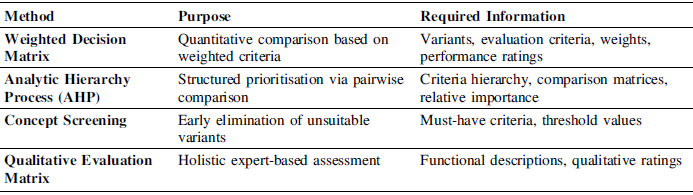
‘Several alternative solution concepts in the form of sketches are available from the principle phase of the design process. A justified selection of one solution concept shall now be made. Propose suitable design methods to support this decision-making process and explain which information is required to apply these methods properly. Present the method overview in a table.”
Based on this instruction, the AI generated the following overview of suitable methods, c.f. Table 2.
Overview of proposed methods for concept selection, generated by ChatGPT 5.1 based on the prompt above

The AI acted as a method advisor by providing a set of candidate methods. While the proposals were coherent and aligned with common evaluation practices, the specification and prioritisation of criteria remained dependent on human expertise. The task description in this case was unspecific, which limited the contextual precision of the AI’s proposals. Although the suggested methods are generally suitable for concept selection, they are not fully adapted to the exploratory character of the conceptual design phase and rely on broadly defined, generic requirements. This indicates that the AI operated primarily as a generic method advisor, structuring the problem but not sufficiently contextualising it. Consequently, decisive aspects such as the specification and prioritisation of evaluation criteria remained dependent on human expertise, underscoring the continued necessity of human judgement and task refinement in AI-supported method selection.
4. Contribution, limitations and research road map
This paper presents an initial conceptual framework for analysing how design methods can be integrated into Human–AI Co-Creation in engineering tasks. By structuring method application around the design task context, method description and result, and by linking these elements to different levels of AI autonomy, the framework offers a coherent perspective on how responsibility, initiative and interpretation may be distributed between human engineers and AI systems. The illustrative examples demonstrate how the framework can be used to describe concrete configurations of AI-supported method execution and method selection. In this way, the paper contributes a structured analytical lens rather than a prescriptive model for method application.
4.1. Limitations
The contribution of this work is conceptual and exploratory in nature. The proposed framework has not been empirically validated across multiple domains, tasks or AI system configurations, nor has it been applied in controlled experimental or industrial settings. The illustrative examples are intended to clarify the applicability of the framework and to highlight typical challenges in Human–AI collaboration, such as transparency, responsibility allocation and procedural interpretation. However, they do not provide evidence regarding validity, efficiency or the effectiveness of specific collaboration modes, and they should not be interpreted as evaluations of AI performance or method quality. In addition, the analysis does not compare different AI models, architectures or levels of technical capability, and it does not investigate how variations in model behaviour, prompting strategies or system integration may influence method execution or interpretation. The framework therefore remains agnostic with respect to specific AI technologies and focuses instead on structural relationships between task context, methods and results. Furthermore, the study does not address organisational, ethical or legal aspects of AI-supported engineering work in detail, nor does it consider long-term effects on design practice, such as changes in skill development, role distribution or decision accountability. As a result, the generalisability of the framework and its implications for sustained design practice remain open. Further empirical studies are required to examine how the framework performs in different application contexts, how robust it is under varying collaboration settings, and how it supports reliable and transparent method use over time.
4.2. Research road map
Despite these limitations, the framework and illustrative examples allow several focused directions for future research to be outlined. These directions do not follow as normative requirements, but rather emerge as logical extensions of the analytical perspective developed in this paper and the configurations of Human–AI collaboration discussed in Sections 2 and 3.
Modelling of Engineering Methods. The examples indicate that when AI systems participate in method execution or method selection, conventional narrative method descriptions may be insufficient to support consistent interpretation and operationalization. In particular, the illustrated cases show that AI systems tend to follow procedural instructions literally, while implicit assumptions, decision criteria and contextual nuances remain underspecified. Future research can therefore explore modelling approaches that represent design methods in a more explicit and structured manner, including inputs, procedural steps, decision points and expected outputs. Existing work on elementary design methods (Reference Zier, Kloberdanz, Birkhofer and BohnZier et al. 2011) and process-oriented representations provides a promising starting point, as these approaches already decompose methods into executable units with defined input–output relations. An open research question concerns how such representations can balance the degree of formalization required for AI-supported execution with flexibility, interpretability and situational adaptability for human designers, particularly across different levels of AI autonomy.
Education and Communication of Methods. The framework suggests that AI-supported method use places increased emphasis on understanding methods as guiding structures for reasoning and coordination, rather than as fixed procedural recipes. From an educational perspective, this highlights the relevance of teaching how methods are selected, adapted and interpreted in context, especially when parts of the execution or analysis are delegated to AI systems. Building on the collaboration patterns illustrated in the examples, future studies may investigate how students and practitioners interact with AI-supported methods, how responsibility, trust and accountability are perceived, and which competencies are required to critically assess AI-generated intermediate and final results. Students should therefore develop an understanding of methods as conceptual frameworks guiding problem-solving, rather than as rigid step-by-step prescriptions. In the context of AI, this includes the ability to
-
• critically select and adapt methods based on task context,
-
• translate method logic into procedural instructions that AI systems can execute or interpret, and
-
• evaluate AI-generated outputs in terms of correctness, appropriateness and traceability.
Educational formats may thus benefit from incorporating AI-supported design scenarios in which students actively negotiate task allocation with AI, experience different autonomy levels (cf. Section 2.1), and reflect on the implications of shared control and shifting responsibilities.
Development and Validation of Methods. The presented examples further indicate that the performance and perceived usefulness of a design method depend not only on the method itself, but also on the specific configuration of Human–AI collaboration in which it is applied. This suggests that future validation studies could extend traditional evaluation approaches by considering the interaction setting as an integral part of method application. Potential research questions include how transparency, traceability and controllability of method execution vary across different levels of AI autonomy, and how these characteristics influence design reasoning, confidence and decision-making over time. Correspondingly, emerging validation approaches may go beyond traditional performance metrics and incorporate criteria such as
-
• transparency and traceability of method execution,
-
• robustness and error tolerance of AI-supported processes,
-
• impact on designer cognition and decision quality, and
-
• long-term maintainability of generated artefacts.
In addition, longitudinal studies may help to explore how sustained AI-supported method use affects design competence, organisational learning and method literacy, as well as potential risks such as over-reliance or reduced critical engagement. Take together, this research road map outlines how the proposed framework can serve as a reference point for more targeted empirical studies that build incrementally on the analytical foundations provided in this paper. Rather than claiming a transformation of design methods, the discussion highlights gradual shifts in how methods may be represented, taught and evaluated as AI systems increasingly participate in engineering tasks.



 Open access

