


The ‘policy mood’, a measure of aggregate public opinion, is generally defined as the public's latent preferences regarding government policy.Footnote 1 Public opinion, in turn, is one of the most important determinants of public policy in advanced industrial democracies, especially in the United States.Footnote 2 Unsurprisingly, given the centrality of policy mood in influencing public policy outcomes in US politics, scholars have extensively explored its determinants, generally using Stimson's measure, ‘Mood’.
The policy mood within the American public has been found to have a main dimension that links issues in terms of a ‘left/right’ or ‘more government/less government’ scope of activity. In Stimson's wording, ‘the first dimension of American public opinion is the welfare state/size of government controversy that divides the parties’.Footnote 3 Erikson, MacKuen and Stimson, in perhaps the most systematic study of Mood, reported that current inflation and changing unemployment are associated with rightward and leftward shifts (respectively) in Mood during the period 1956–96.Footnote 4
However, marked changes in the US economy in the past few decades have had important implications for both the economic realities facing citizens and their preferences about the role and size of the government. Of particular interest to this article is the US economy's growing integration into the world economy in terms of flows of goods, services and finance, with resulting direct and indirect effects on growth, prices, employment, wages and job security. The impact of this increased economic integration on aggregate measures of the public's attitudes has yet to be studied, a lacuna we seek to address.
In this article, we incorporate insights from international political economy (IPE) and international economics into the literature on aggregate US public opinion. We propose that citizens whose livelihoods depend on the success of import-competing, export-oriented and multinational firms face an economic reality that indicators of unemployment or growth only loosely reflect. Therefore, by introducing indicators of imports and exports into the empirical analyses of Mood, we will improve the explanatory power of the resulting models by better capturing the microeconomic climates associated with citizen exposure to trade.
The article proceeds as follows. We begin by reviewing the literature on the determinants of Mood, as the macroeconomic determinants and econometric methods of this literature form the baseline of our investigation. We next review the literature on the internationalization of the US economy, particularly focusing on multinational corporations, foreign direct investment, and trade in goods and services. We review (1) the theory and findings regarding the economic outcomes of import-competing firms compared to those of export-oriented and multinational firms and (2) studies on the consequences of economic globalization for attitudes toward government spending.
We propose that economic globalization variables influence policy mood through their effect on the real economy, and do so in a manner consistent with what IPE research terms the ‘compensation hypothesis’. We use Stimson's ‘Mood’ as the dependent variable in the investigation. To test the hypotheses, we use Error Correction (EC) and instrumental variables (IV) models. In particular, IV methods allow us to account for unobservable variables that are potentially related to firm-specific characteristics but that might also be correlated with trade flows.
The main period of study is the US policy mood from 1956–2011. We also examine the separate effects on Mood of within-firm imports or exports (that is, intrafirm trade flows) by US multinational corporations (MNCs) and US affiliates of foreign multinationals, compared to non-intrafirm trade flows from 1983–2011. (The sample is determined by data availability.) We find that rising imports (exports) are associated with a leftward (rightward) shift in Mood. The estimated effects are particularly pronounced for increasing non-intrafirm imports into the United States. The key results for the effects of imports on Mood are generally robust, providing strong support for the main argument of this article. Finally, we examine whether Mood's established effect on social expenditures is moderated by changing trade flows. In very exploratory work, we find that import flows, especially non-intrafirm imports, moderate Mood's effect on social expenditures.
PRIOR STUDIES OF THE DETERMINANTS OF MOOD
Previous models of the determinants of Mood can be grouped into those that emphasize broad macroeconomic conditions and those that focus on previous policies. Foremost in the first group is work that has focused on the effect of the state of the macroeconomy on Mood. Erikson, MacKuen and Stimson found that increasing rates of unemployment lead to a liberal policy mood shift, while increases in consumer price indices bring forth a conservative shift.Footnote 5 In other words, the public prefers more government spending when unemployment is high, and less government spending when inflation is high.
Durr suggested that prospective economic expectations influence policy mood.Footnote 6 In a study of the quarterly version of Mood from 1968–88, Durr found that citizen expectations of weak future economic performance moved Mood rightward (which he interpreted as being consistent with a ‘budget’ model), whereas expectations of prosperity led citizens to support greater government involvement in the economy.
Stevenson builds on Durr's work, and proposes a version of a ‘consumer choice’ model, which he extends to an analysis of fourteen advanced democracies, using two measures of policy mood: Kim and Fording's indicator of median voter ideology and an indicator of ideological self-placement.Footnote 7 Like Durr, Stevenson argues that policy mood will move to the left when the economy is expanding and to the right as it contracts, because voters make demands subject to a budget constraint.Footnote 8 This hypothesis is similar to Durr's, though Stevenson uses lagged values of economic performance rather than an expectations measure. Stevenson's results show that prior levels of growth (positively), inflation (negatively) and unemployment (negatively) influenced Mood.Footnote 9
An alternative explanation for shifts in policy preferences, which was first proposed by Wlezien, suggests that citizens respond ‘thermostatically’ to prior policies.Footnote 10 In other words, preferences move leftward after periods of lower levels of government spending and rightward after periods of higher levels of government spending. Similarly, Stevenson proposes a policy reaction hypothesis, in which government spending and partisanship are used as a heuristic for current policy.Footnote 11 Erikson, MacKuen and Stimson also found that an indicator of prior government policies was negatively associated with Mood, confirming Wlezien's finding of a thermostatic reaction to government policies.Footnote 12 They found that higher levels of government involvement produce a conservative shift, and lower levels produce a liberal shift.
The literature has not examined the possible effects of increased cross-border trade linkages on policy mood. Increasing international trade integration has changed the structure of the US economy and introduced new factors that might also shape the policy mood.
INTRAFIRM AND NON-INTRAFIRM TRADE AND THE ECONOMY: FIRM-SPECIFIC MICROECONOMIC CLIMATES
The increasing integration of the United States into the world economy has important consequences for public preferences regarding the role and size of government. Imports plus exports of goods and services (as a percentage of gross domestic product, GDP) have risen from under 7 per cent in 1956 to roughly 29 per cent in 2010.Footnote 13 Within these flows, however, is evidence of deterioration in the US economy's relative world position. The United States has gone from a net exporter to a net importer: the trade deficit averaged −4.5 per cent of GDP for the first decade of the twenty-first century.
Multinational corporations (MNCs) play a central role in US trade flows. Considering intrafirm, related party and arm's length trading jointly, MNCs mediate 90 per cent of US imports and exports.Footnote 14 Much of the growth in US trade flows over time, and over 60 per cent of the US trade deficit from 1982–2010, arises from intrafirm trading by MNCs.Footnote 15 In turn, intrafirm trading follows from MNC foreign direct investment (FDI) to and from the United States. In 2010, intrafirm imports by MNCs totaled just over $800 billion, accounting for roughly 5.5 per cent of US GDP and 35 per cent of total imports. An additional $300 billion in imports came from ‘related party’ trading.Footnote 16 In contrast to MNC intrafirm imports, a much smaller share of US exports is classified as MNC intrafirm exports ($500 billion in 2010, or a little more than 25 per cent of US exports), and related party (but not intrafirm) trading accounts for a vanishingly small share of exports (2 per cent).Footnote 17
This article assumes that the magnitude and direction of trade flows influence the US policy mood. We further posit that intrafirm and non-intrafirm flows will differently affect Mood through different distributional consequences for citizens. That is, the presence or absence of an ownership relationship between the parties involved in trade flows will influence the effects of the trade flows on Mood.
We begin by reviewing the recent literature on the behavior of firms engaged in trade and FDI. We next discuss the implications and evidence regarding the economic consequences of firm activity in exports and imports on citizens. Drawing on what is termed in economics the ‘heterogeneous firms’ (or ‘new new’) trade theory, we suggest that the effects of trade on the economy are primarily generated through the behavior of heterogeneous firms involved in either intrafirm or non-intrafirm trading.Footnote 18
Heterogeneous Firms in FDI and Trade
The primary insight from the heterogeneous firms trade theory is that firms with different levels of productivity also have different international strategies, with divergent consequences for their respective demands for skilled, semi-skilled and unskilled labor. Yeaple and Tomiura empirically confirm earlier findings that only firms with productivity levels above a certain threshold are able to engage in exporting, and demonstrate that only those above an even higher cut-off undertake FDI and engage in subsequent intrafirm trading.Footnote 19 In a study of US firms, Ramondo, Rappoport and Ruhl found that the largest MNCs (with very high levels of US employment) were most responsible for intrafirm imports into and exports from the United States.Footnote 20
In particular, purely domestic firms in the tradable sectors (that is, those that face import competition) have different value chains and factor inputs from non-MNC export-oriented firms, which in turn have different value chains and factor inputs from MNCs. Both exporters and MNCs employ more skilled labor than less productive, domestically oriented firms. Multinationals employ even more skilled labor than domestically based exporters.Footnote 21
Because the United States is relatively well endowed with skilled labor and capital, firms in labor-intensive tradable goods industries tend to face greater import competition. These firms are likely to fail or change industries, and their plants are both more likely to close and more likely to have lower employment and wage growth.Footnote 22
Yet firms that export generally have superior economic performance on many dimensions (higher employment, sales, wages, productivity and investment) than firms that do not export.Footnote 23 Thus rising exports tend to benefit employees of exporting firms, which on average utilize skilled labor more intensively.
The exceptions to increasing firm mortality and morbidity in import-competing industries are firms that have relocated production abroad (for example, offshoring), and are importing back into the United States. Intrafirm imports are often intermediate goods that MNCs use to lower the prices of final products and to otherwise enhance the productivity of the home-based operations; as a result, they are not threatening to MNC employees.Footnote 24
Winners and Losers from Intrafirm and non-Intrafirm Trade
The gains from trade tend to be focused among exporting firms and firms with extensive intrafirm trade, while the burdens of trade and trade adjustment tend to be focused on import-competing firms in the tradable sector. Thus citizens who benefit from trade tend to be skilled workers employed by exporting or multinational firms, while citizens hurt by trade tend to be unskilled workers in import-competing firms that do not export or engage in intrafirm trading.
This is in contrast to standard trade models, which interpret the distributional consequences of trade as manifested across factors (Heckscher-Ohlin) or sectors (Ricardo-Viner) or both. One of the key insights of heterogeneous firms theory is that the distributional consequences of trade do not follow industry or factor lines. This is also true of FDI patterns and the resulting intrafirm trading. Even though intrafirm trade is concentrated among a small number of very large MNCs and their affiliates, the MNCs are distributed across a very wide range of industries.Footnote 25
Workers in import-competing firms face a variety of adjustment costs, including effects on the level of employment, wages and job security. In a survey of displaced workers, Kletzer finds that manufacturing workers displaced by import competition are less likely to be re-employed than manufacturing workers displaced for other reasons.Footnote 26 Furthermore, export-competing industries do not account for a large share of re-employment due to different factor demands. Among workers displaced from import-competing sectors, those re-employed have weekly earnings that are 13 per cent lower on average; approximately 25 per cent report wage losses of 30 per cent or more.Footnote 27
Holders of unskilled labor employed by import-competing firms are especially threatened by rising imports from low-wage countries, such as China, which have increased dramatically in low-wage, labor-intensive industries (such as textiles and apparel). Autor, Dorn and Hanson found that US local labor markets that are:
exposed to rising low-income country imports due to China's rising competitiveness experience increased unemployment, decreased labor-force participation, and increased use of disability and other transfer benefits, as well as lower wages.Footnote 28
Heterogeneous firms trade theory implies that the microeconomic conditions facing employees will vary depending on their firms’ value chains, product markets and strategies. Changes in (and levels of) trade flows will proxy for the firm-specific conditions facing employees in this study. MNC intrafirm imports are likely to be less threatening in terms of employment than are non-MNC imports due to the benefits for at least some employees and others affiliated with the MNCs. MNC intrafirm imports are therefore likely to have ambiguous effects on Mood. In contrast, non-intrafirm imports are likely to be threatening to lower-skilled workers without having intrafirm beneficiaries.
Furthermore, these studies of the effects of firm strategies on employee work life suggest that the effect of the increasing importance of international trade in the US economy on Mood cannot be fully understood theoretically or econometrically by analyzing the unemployment rate alone. First, the distributional or welfare consequences of trade extend beyond employment levels. Trade changes the composition of firms in the economy; it is not just the quantity of work in the import-competing sectors that declines, but also its quality and composition in terms of wages, benefits, job security and skills. Secondly, trade is likely to affect Mood before the effects of rising imports or exports are reflected in the unemployment rate. Even before import-competing firms cut jobs, workers can anticipate the effects of reduced production orders (for example, shorter hours, reduced wages, eventual lay-offs). Employees of firms in the import-competing sector might retain their jobs or find new ones, but the terms of employment are likely to worsen in quality.
In summary, we expect that these different climates will affect citizen preferences regarding the role of government with a resulting shift in Mood. The argument about the palliative effect of MNC intrafirm trade flows vs. non-intrafirm flows on the demand for redistribution is consistent with recent studies on firm demands (or non-demands) for trade protection.Footnote 29 The next section further explores the literature on trade and citizen demands for protection and redistribution.
THE MICRO-CLIMATE FROM TRADE AND THE POLITICAL DEMAND FOR COMPENSATION
Although analysis of policy mood has generally centered on American politics, insights from the IPE literature have important implications for models of policy mood, in particular how the distributional consequences of the different facets of trade discussed above are likely to influence the demand for government spending. The ‘compensation’ model is a prominent international relations theory concerning how democratic governments manage the risks of international economic integration so as to generate continued support for integration and its associated benefits.Footnote 30 Its core thesis, as Kim puts it, is that ‘economic globalization bolsters rather than undermines the welfare state by increasing public demand for social protection against externally generated economic instability’.Footnote 31 The compensation literature provides an important link between the distributional consequences of trade and preferences over government spending.
The starting point of the compensation hypothesis is that exposure to economic globalization increases the sense of economic insecurity, particularly of those in import-competing sectors. In a systematic study of British respondents, Scheve and Slaughter find that inward FDI, and globalization more generally, generated increased risk (in terms of the volatility of wages and employment), thus increasing feelings of insecurity among workers.Footnote 32 Similarly, Walter finds in a study of Swiss respondents that individuals hurt by globalization, particularly trade, are more likely to express feelings of economic insecurity.Footnote 33 In a more general study of job insecurity, Aldrich et al. find that those with greater feelings of job insecurity are more likely to favor increased government spending and government provision of jobs.Footnote 34 Rehm argues that preferences regarding redistribution are a function of income and income prospects; those who are more exposed to risk are more likely to favor redistribution.Footnote 35 If trade has the distributional consequences posited above, Mood will likely shift leftwards among those whose current and future economic well-being is hurt by trade.
Therefore we expect citizens to feel greater insecurity regarding non-intrafirm imports for two main reasons. First, when operationalizing risk as the volatility of trade flows, as is standard, we observe markedly different patterns regarding the volatility of intrafirm MNC trade flows vs. non-intrafirm trade flows. For the available period, non-intrafirm imports and exports, measured as a percentage of US GDP, were more volatile (standard deviations of 1.8 and 1.2, respectively) than intrafirm imports and exports (standard deviations of 0.8 and 0.4, respectively).Footnote 36 Non-intrafirm trade flows also grew at a faster pace (2.6 per cent per year for imports; 2 per cent for exports) compared to intrafirm trade flows (1.8 per cent for imports; 0.8 per cent for exports). Secondly, while both intrafirm and non-intrafirm imports are likely to improve the efficiency of the US economy, the employment benefits to US citizens are likely to be far lower for non-intrafirm imports than intrafirm imports.
Micro-level evidence regarding the relationship between increasing integration with the world economy and spending confirms the broad trends described above. In surveys, the American public expresses limited enthusiasm for free trade per se, unless it is accompanied by ‘government programs to help workers who lose their jobs’.Footnote 37 US respondents are concerned about workers losing jobs from trade because respondents generally believe that free trade hurts job security, and that imports cost more jobs than exports create.Footnote 38 This evidence suggests that a substantial portion of the public continues to have reservations about free trade because of its distributional effects on the number of jobs, wages and job security. In a study of US respondents, Ehrlich finds that those who report being hurt by trade are more likely to support trade-related unemployment insurance, and those who benefit from trade are more likely to oppose this form of compensation.Footnote 39 Walter finds that how one is affected by globalization affects preferences over welfare spending more generally, and that preferences over welfare spending affect vote choice.Footnote 40 Though not directly related to the argument tested in this article, recent studies by Margalit and Rickard suggest that politicians recognize the need, and have some ability, to garner public support for liberalization through compensation.Footnote 41
Alternatively, technological innovation may produce some of the same costs and benefits to skilled and unskilled workers as does trade integration. Even if the US economy were to be closed to trade, technological innovation would likely benefit more highly skilled workers, and put downward pressure on wages and employment security for lower-skilled workers.Footnote 42 Thus increases in the skill premium or other indicators of technological advance may lead to a leftward shift in Mood, as unskilled workers in particular experience a decline in economic conditions and an increase in job insecurity. The processes of increasing technological innovation and increasing economic globalization are likely to occur in many firms simultaneously, a point that we address in the empirics.
Summary
The prior literature on the determinants of Mood has emphasized domestic macroeconomic conditions – primarily inflation, unemployment and growth – and citizen reactions to prior government policies. However, the structure of the US economy has changed such that citizens’ microeconomic experiences can no longer be fully represented by these domestic macroeconomic indicators. From heterogeneous firms trade theory, we propose that the increasing integration of the US economy into the world economy produces firm-specific microeconomies that are likely to influence their employees’ Mood. Intrafirm imports by MNCs are likely to produce conflicting effects, since many MNC employees are likely to benefit from the enhanced profitability and employment opportunities of successful international firms. In contrast, increasing non-intrafirm imports are likely to have a broad leftward effect on Mood with little countervailing pressure.
HYPOTHESES
We propose that trade affects aggregate policy preferences, as measured by Mood, via political demands for more or less compensation, and that the direction and intensity of these demands depend on the relative gains or losses from trade. Although inflation and unemployment are still likely to be important determinants of Mood, trade affects a growing proportion of Americans and should therefore also be considered as a possible explanatory factor for shifts in aggregate public opinion.
As suggested above, trade has different distributional consequences for different segments of the US population.Footnote 43 We propose that the distributive consequences of trade shift spending preferences to the left (larger or more active government) or right (smaller or less active government) according to the expectations presented in Table 1. Though employees observe specific firm-level characteristics, we cannot directly observe the microeconomic conditions facing citizens. Thus we look to macroeconomic indicators that capture these conditions. We suggest that individual microeconomic conditions, and thus relevant macroeconomic indicators, vary systematically according to whether citizens are employed in import-competing, export-oriented/multinational firms or firms in the non-tradable sector. Unemployment continues to capture microeconomic conditions for individuals in the non-tradable sector, while imports and exports capture at the macro level some of the microeconomic conditions for those employees in the tradable sectors.
Macroeconomic and Microeconomic Conditions Affecting Mood
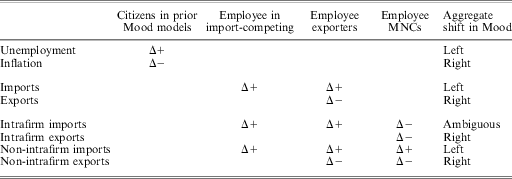
Note: Δ+ indicates a leftward shift in Mood; Δ− indicates a rightward shift in Mood; a blank cell indicates no expected effects on Mood.
Across all segments of the population, we expect that rising inflation will produce conservative shifts in policy mood, as suggested by the existing literature. However, we expect segmentation among workers regarding their responses to imports and exports, which depend on their employer's exposure to trade. Workers in the non-tradable sector are likely to be economically indifferent to the influences of trade per se (as their economic circumstances are unaffected), and therefore we have no expectation that their Mood will move systematically in response to trade.Footnote 44
Our expectation is that increasing import shares will bring forth a leftward shift in policy mood among those employed by import-competing firms and domestically based export-only firms. Both types of firms face import competition without benefiting from internal-to-the-firm imports, and are likely to reduce hours and wages in response to reduced demand. Recognizing this, workers at these firms are likely to demand greater government spending to compensate them for rising economic insecurity. It is the microeconomic conditions facing the workers in these firms, and not unemployment per se, which will likely condition their policy mood preferences.
However, rising exports benefit workers employed by exporting firms, which will lead to a conservative shift in opinion among them. As wages and employment increase, workers are better off, both in terms of current economic well-being and future job security (in other words, risk).
Intrafirm imports and exports, however, generate a new microeconomy for employees of multinationals. These intrafirm imports and exports benefit employees of multinational firms. Jensen, Quinn and Weymouth found that firms that engaged in FDI and subsequent intrafirm trade (that is, offshoring) were far more likely to survive than firms that did not engage in intrafirm importing.Footnote 45 Intrafirm importing and exporting are likely to enhance at least some employees’ job security, leading to a conservative shift in opinion for those employees.
In terms of aggregate shifts in public sentiment, we propose one case in which employees across different types of firms will shift their opinion in opposite directions in response to different types of imports. Intrafirm imports generate a leftward shift in opinion among employees of non-multinationals (as do imports in general), but this is likely to be offset by a competing rightward shift among employees of multinationals, who benefit from intrafirm imports.Footnote 46 Thus the aggregate effect of intrafirm imports on Mood is ambiguous.
We propose these testable implications for the relationship between increased US trade integration and Mood (controlling for other macroeconomic conditions and prior government policies):
Hypothesis 1: Rising imports will produce a liberal shift in Mood.
Hypothesis 2: Rising exports will produce a conservative shift in Mood.
Exports and imports are proposed to have divergent, and therefore offsetting, effects on Mood, which can be summarized in the US trade balance, which is equal to exports minus imports.
Hypothesis 3: Increases (decreases) in the US Balance of Trade will lead to a conservative (liberal) shift in Mood.
Hypothesis 4: Rising non-intrafirm imports will produce a liberal shift in Mood.
Hypothesis 5: Rising intrafirm MNC imports will have, in aggregate, a null effect on Mood.
Hypothesis 6: Increases (decreases) in the US non-intrafirm Balance of Trade will lead to a conservative (liberal) shift in Mood.
Importantly, our argument does not require that people necessarily have a clear causal understanding of how trade flows affect macroeconomic outcomes. The behavior of firms in an open economy has real microeconomic effects in terms of the level of employment, wages, productivity gains and so forth. Citizens do not have to be conscious of the macroeconomic linkages: they can observe the real microclimate around them, make inferences about future income and job security, and respond. Mood among uninformed individuals, as well as among political sophisticates, responds to basic economic cues, though sophisticates may respond more strongly to information.Footnote 47 Moreover, rising sentiments of economic insecurity, regardless of whether the source is clearly known, are likely to have implications for policy preferences.Footnote 48 Thus our argument does not require individuals to have an awareness of the real macroeconomic effects of trade. We will, even so, explore the possibility that trade's effects on Mood occur through a media effects channel.
DATA AND METHODS
In this section, we introduce the data and methods used to test the hypotheses. Although our argument generalizes to other countries, we test it in the context of the United States using annual data from 1956–2011.Footnote 49 As discussed in more detail below, an error correction specification fits the theory and allows us to account for possible unit roots.
The dependent variable is change in policy mood, measured using Stimson's ‘Mood’ (through 2011).Footnote 50 Mood is a measure of global attitudes toward government, which reflects the aggregate public's underlying support for government programs or involvement on a liberal-conservative scale across a variety of issues.Footnote 51 Latent factors are extracted from survey marginals (that is, the percent supporting the liberal position minus those supporting the conservative one) on policy-related survey items using an algorithm similar to principal components analysis.Footnote 52 This produces ‘a composite measure, a weighted average, of survey respondents to many different policy issues’.Footnote 53 Mood is widely used in studies of American public opinion and public sentiment.
US Mood has a main dimension relating to the role and size of government in the economy. We use the change in Mood, which conveys variation along an axis of more or less government, where higher values indicate greater demand for government spending.Footnote 54 We include the lagged level of Mood as an independent variable.
The main independent variables are measures of international economic activity. First we examine the trade balance, which is equal to exports minus imports as a percent of GDP, as is standard in the IPE literature. Because we expect the direction of trade to affect Mood, exports and imports as a percent of GDP are included separately in our main specification. (See the appendix for sources.) Data for US intrafirm exports and imports by US MNCs and US affiliates of foreign firms are available in a continuous series from 1982 onward. We create indicators of non-intrafirm imports and exports as well as indicators of intrafirm imports and exports, also as a percentage of US GDP.Footnote 55
We also include other independent variables shown to influence Mood, including inflation and unemployment.Footnote 56 We use economic growth as a control, as proposed by Durr and Stevenson.Footnote 57 Finally, following Stevenson, we use government social expenditures as a percent of GDP as a proxy for prior policies.Footnote 58
A necessary assumption of standard ordinary least squares (OLS) estimations is that the data are stationary. Many of the series are, however, possibly non-stationary, which can lead to biased inferences or potentially spurious regressions in an OLS framework. The possibility of unit roots in most of the series in levels cannot be rejected. We find, as have other investigators, that Mood potentially has a unit root. So too do the series for exports, imports, level of unemployment and government social expenditures in levels.Footnote 59 Inflation, growth, and changes in unemployment, imports and exports are stationary.
A standard estimation approach to time-series modeling in the presence of possible unit roots are Error Correction (EC) models, as used in Durr; Erikson, MacKuen and Stimson; Kelly and Enns and others.Footnote 60 EC methods are increasingly common in economics and political science in time series models where unit roots are suspected. One of the important properties of EC models is that they allow the dependent variable to respond to short-term changes in independent variables, and exhibit an equilibrium relationship with the longer-term levels of the independent variables. For variables that are in an equilibrium relationship with Mood, a shift in one of these variables causes Mood to shift as well, at an adjustment rate equal to ß1 .
We note that Mood, a bounded variable, is potentially able to be in an equilibrium relationship with imports and exports because the estimated effects of imports and exports on Mood can offset each other. The estimated effect of the US Trade Balance summarizes the joint effects of imports and exports on Mood.
DeBoef and Keele suggest that EC models are also useful when examining the dynamic properties in stationary data.Footnote 61 Regarding model specification, we follow their recommendation to first examine the unrestricted model where variables have both short- and long-run effects. We include the lagged levels (the long-run variables) and the contemporaneous changes (the shock variables) for all independent variables. The unrestricted base EC Model 1 is:
 $$no{ {\rm{\rDelta }}\,Moo{{d}_t}\, = \, & {{\beta }_{\rm{0}}}\, + \,{{\beta }_{\rm{1}}}(Moo{{d}_{t{\rm{ - 1}}}})\, + \,{{\beta }_{\rm{2}}}(Inflatio{{n}_{t{\rm{ - 1}}}})\, + \,{{\beta }_{\rm{3}}}({\rm{\rDelta }}\,Inflatio{{n}_t})\, + \,{{\beta }_{\rm{4}}}(Unemploymen{{t}_{t{\rm{ - 1}}}}){} \cr & + \,{{\beta }_{\rm{5}}}({\rm{\rDelta }}Unemploymen{{t}_t})\, + \,{{\beta }_{\rm{6}}}(Growt{{h}_{t{\rm{ - 1}}}})\, + \,{{\beta }_{\rm{7}}}({\rm{\rDelta }}Growt{{h}_t})\, \cr &+ \,{{\beta }_{\rm{8}}}(Social\,Expenditure{{s}_{t{\rm{ - 1}}}}) + \,{{\beta }_{\rm{9}}}({\rm{\rDelta }}Social\,Expenditure{{s}_t})\, \cr & + \,{{\beta }_{{\rm{10}}}}(Import\,share{{s}_{t{\rm{ - 1}}}})\, + \,{{\beta }_{{\rm{11}}}}({\rm{\rDelta }}Import\,share{{s}_t}){} + \,{{\beta }_{{\rm{12}}}}(Export\,share{{s}_{t{\rm{ - 1}}}})\, \cr & + \,{{\beta }_{13}}({\rm{\rDelta }}Export\,share{{s}_t})\, + \,{{{\epsilon}}_t}\,\,\,\,\,\,\,t\, = \,{\rm{1956}}\,{\rm{ - }}\,{\rm{2011}} $$
An alternate version of the model combines the import and export terms in the Trade Balance:
 $$ + \,{{\beta }_{{\rm{10}}}}'(Trade\,Balanc{{e}_{t{\rm{ - 1}}}})\, + \,{{\beta }_{{\rm{11}}}}'(\Delta Trade\,Balanc{{e}_t})$$
To maintain degrees of freedom, we eliminate short-term adjustment terms if their coefficient estimates have t-statistics that never approach or surpass 1.00.
To explore the possibly divergent effects of intrafirm MNC and non-intrafirm trade flows on Mood, we estimate alternative versions of Model 1. The data on intrafirm trade flows is available from 1982, which limits the degrees of freedom and therefore the number of covariates that can enter the model. For non-intrafirm trade flows, we estimate:
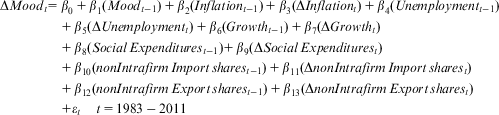 $$no{ \rDelta Moo{{d}_t} = \, {{\beta }_{\rm{0}}}\, + \,{{\beta }_{\rm{1}}}(Moo{{d}_{t{\rm{ - 1}}}})\, + \,{{\beta }_{\rm{2}}}(Inflatio{{n}_{t{\rm{ - 1}}}})\, + \,{{\beta }_{\rm{3}}}(\rDelta Inflatio{{n}_t})\, + \,{{\beta }_{\rm{4}}}(Unemploymen{{t}_{t{\rm{ - 1}}}}) \cr \quad + \,{{\beta }_{\rm{5}}}(\rDelta Unemploymen{{t}_t})\, + \,{{\beta }_{\rm{6}}}(Growt{{h}_{t{\rm{ - 1}}}})\, + \,{{\beta }_{\rm{7}}}(\rDelta Growt{{h}_t})\, \cr \quad + \,{{\beta }_{\rm{8}}}(Social\,Expenditure{{s}_{t{\rm{ - 1}}}}) + \,{{\beta }_{\rm{9}}}(\rDelta Social\,Expenditure{{s}_t}) \cr \quad + \,{{\beta }_{{\rm{10}}}}(nonIntrafirm\,Import\,share{{s}_{t{\rm{ - 1}}}})\, + \,{{\beta }_{{\rm{11}}}}(\rDelta nonIntrafirm\,Import\,share{{s}_t}) \cr \quad + \,{{\beta }_{{\rm{12}}}}(nonIntrafirm\,Export\,share{{s}_{t{\rm{ - 1}}}})\, + \,{{\beta }_{{\rm{13}}}}(\rDelta nonIntrafirm\,Export\,share{{s}_t}) \cr \quad + {{{\epsilon}}_t}\; \; \; \; t\, = \,{\rm{1983 - 2011}} $$
For MNC trade flows, we estimate Model 2, substituting:
 $$no{\qquad\qquad + \,{{\beta }_{{\rm{10}}}}'(Intrafirm\,Import\,share{{s}_{t{\rm{ - 1}}}})\, + \,{{\beta }_{{\rm{11}}}}'(\rDelta Intrafirm\,Import\,share{{s}_t}) \cr + \,{{{ß}}_{{\rm{13}}}}'(Intrafirm\,Export\,share{{s}_{t-1}})\, + \,{{ß}_{{\rm{13}}}}'\,(\rDelta Intrafirm\,Export\,share{{s}_t}) $$
Based on the initial results of Models 2 and 2′, we empirically establish a best-fit model. We estimate related models for intrafirm and non-intrafirm trade balances, and follow the same procedures as above.
We estimate error correction models using OLS. The standard errors are Newey-West standard errors, which correct for possible autocorrelation and heteroskedasticity in the error terms.
We address the possibility that an unmeasured factor might drive both trade flows and the policy mood, thereby creating a spurious estimated relationship between trade and Mood. Such a concern is warranted when variables observed by respondents (but unobserved by investigators) are present. Firm-specific technologies and strategies are particularly problematic in this setting, since a firm's decision to import or export might be correlated with its decisions regarding technological innovation or other strategies.
The instrumental variable (IV) approach is the standard way to account for possible omitted variable bias.Footnote 62 The instruments used here for imports, exports and trade balances are the global averages (excluding the United States) of government regulatory restrictions on (1) the ability of non-US citizens to receive payments for US and other imports, (2) the ability of non-US citizens to make payments for US and other exports and (3) the ability of non-US citizens to receive or remit payments on trade in services (respectively). These measures are components of the Quinn-Toyoda index of international financial restrictions, which codes laws and regulations pertaining to cross-border flows of capital using the International Monetary Fund's (IMF) Annual Report on Exchange Arrangements and Exchange Restrictions (AREAER).Footnote 63 We create global averages of restrictions for each of the three payments listed above, excluding data on the United States. We lag these instruments.Footnote 64
The instruments satisfy the exclusion restriction necessary for instrument validity, as the instruments are strongly correlated with the explanatory trade variables but are not correlated with changes in Mood except through the endogenous explanatory variable. That is, the long lags of indicators of global restrictions on exchange payments and receipts for world trade are exceptionally unlikely to be theoretically (or empirically) connected to contemporaneous changes in the US policy mood, but are correlated both theoretically and empirically with US exports and imports: the more liberalized the index, the fewer restrictions there are on trade payments with the United States, and the greater the flow of trade with the United States. In contrast, changes in Mood are unlikely to respond to multiyear lags in global trade financing regulations of countries other than the United States, and global averages of trade financing restrictions are unlikely to respond to expectations about future shifts in the overall US policy mood.
MAIN RESULTS
To examine our theory, we modify a standard model of the domestic determinants of Mood suggested by Erikson, MacKuen and Stimson and Stevenson.Footnote 65 The base variables include inflation, unemployment, economic growth and social spending. In keeping with the recommendation of DeBoef and Keele for error correction models, both short-term change and level terms are entered.Footnote 66
In Model 2.1, we include the trade balance as the first test of our argument. We find that the trade balance has a negative and significant effect on the policy mood, as expected. That is, when the trade balance is negative (that is, imports exceed exports), Mood moves in a liberal direction (−β*−X), and when the trade balance is positive, Mood moves in a conservative direction (−β*X). Change in the trade balance also has a contemporaneous effect; in other words, a shock to the trade balance has an immediate effect on the change in Mood. This provides initial support for our hypothesis that international economic integration affects Mood, though it assumes that exports and imports have a symmetric effect on Mood. In Model 2.2, we test Hypotheses 1 and 2 by including separate measures of imports and exports, as specified in Equation 1. We find that imports have a positive and significant estimated effect on Mood, as hypothesized. The coefficients on both the short- and long-run import terms are positive and statistically significant. Neither exports nor the change in exports have statistically significant effects on Mood, although the coefficient estimate for exports in levels is more than one and a half times the standard error, and the model contains nuisance parameters. In terms of explanatory power, it is difficult to distinguish between the models with the trade balance and separate imports and exports.
Models 2.3 and 2.4 of Table 2 present more parsimonious specifications of our main results, eliminating three nuisance parameters and improving the fit of the models.Footnote 67 As in Model 2.1, the coefficients on trade balance and change in trade balance are negative and statistically significant. Additionally, the coefficient on growth is now negative and statistically significant at the 90 per cent level.
Determinants of Mood

*p < 0.1, **p < 0.05, ***p < 0.01. Parentheses contain Newey-West standard errors.
The significance and magnitude of the main coefficient estimates in Model 2.4 are very similar to those in 2.2, except that the change in unemployment now has a positive and statistically significant coefficient estimate. A 1 per cent increase in unemployment shifts Mood by 0.64 points to the left in the current period, the same direction of effect found in Erikson, MacKuen and Stimson.Footnote 68 Imports again have a positive and statistically significant effect on Mood. A 1 per cent increase in imports shifts Mood to the left a total of 2.07 points (β10/(−β1)). Additionally, exports now have a negative and statistically significant effect at the 90 per cent level, as hypothesized. A 1 per cent increase in exports shifts Mood a total of 1.42 points to the right.Footnote 69
The other variables are control variables, but we note that inflation in levels always has a negative and highly statistically significant estimated coefficient, which is consistent with prior expectations. Social spending in levels is negative and statistically significant in all models in Table 2. This is consistent with previous findings in support of thermostatic response to prior policies, and the ‘compensation mechanism’, as discussed above. Change in unemployment has a statistically significant and positive coefficient in the parsimonious models that control for trade flows (Models 2.3 and 2.4), as expected. Though growth has the expected sign in all models except Model 2.2, it does not have a robust statistically significant effect on Mood. In a series of robustness checks (available in the online appendix), we control for additional possible confounding variables, including inequality, technological innovation, media effects and the deficit level. We find continued support for our hypotheses.
In Models 2.5 and 2.6, we include the trade balance, imports and exports, respectively, in the logged-level form, rather than as a share of GDP. We again find support for Hypothesis 3, that an improvement in the trade balance shifts Mood to the right, while rising imports lead to a leftward shift in Mood.Footnote 70
The results of our preferred model specification, two-stage least squares instrumental variables regression with Newey-West standard errors, are provided in Models 2.7 and 2.8 of Table 2. The first-stage regressions of the IV models, which instrument for trade balance, imports and exports as a per cent of GDP, are presented in the online appendix, and show that the various instruments have good explanatory power for the trade variables.Footnote 71 In the second-stage results in Models 2.7 and 2.8, the instrumented trade variables maintain their signs and levels of statistical significance compared to Models 2.3 and 2.4. The coefficient estimates for the instrumented trade variables are larger, and the standard errors are slightly larger compared to the original variables, but the p-value for the t-statistics on the instrumented trade variable in levels remains at less than 0.05. A 1 per cent improvement in the trade balance shifts Mood a total of 2.13 points to the right and, conversely, a 1 per cent decline shifts Mood a total of 2.13 points to the left.Footnote 72 In Model 2.8, the estimated coefficient estimates for exports and imports are larger than for the OLS estimates. A 1 per cent increase in imports shifts Mood a total of 3.14 points to the left, while a 1 per cent increase in exports produces a 4.68-point total shift to the right.Footnote 73 This suggests that hard-to-measure variables that are collinear with the trade variables cause a downward bias in the OLS estimates, which we correct with the instrumenting procedure. As a measure of model fit, we calculate the generalized R2 developed by Pesaran and Smith for instrumental variables regression and apply a correction for the number of parameters.Footnote 74 The results suggest that Model 2.7, which uses the trade balance, performs better than Model 2.8, which uses imports and exports.
In summary, the core results broadly confirm the long-standing view that policy mood is influenced by economic outcomes. New, however, is the finding that increasing globalization of the US economy influences Mood. In particular, imports influence Mood in a manner that is consistent with the ‘compensation’ hypothesis from IPE. When we account for hard-to-measure variables like technological change using IV, exports have a negative and statistically significant effect on Mood. The estimated effects of the trade balance, which summarizes the theorized offsetting effects of exports and imports on Mood, offer modest to substantial improvements in explanatory power compared to the estimated effects of exports and imports separately.
INTRAFIRM TRADE
Heterogeneous firms theory suggests that not all imports and exports have the same distributive consequences. Therefore, we separate intrafirm (MNC) trade from non-intrafirm (non-MNC) trade.Footnote 75 Intrafirm trade data is available between 1982 and 2010. We follow the same guidelines regarding nuisance parameters as above in order to maximize the degrees of freedom. In the interest of space, we limit our discussion to the main independent variables of interest.
Tables 3 and 4 present the results of our analyses that look at intrafirm and non-intrafirm trade as specified by Equation 2 above. In Table 3 we examine the trade balance. Model 3.1 presents the aggregate trade balance model for the sample restricted to 1983–2011 for comparison with the intrafirm models. The trade balance result for the term in levels (3.1) is consistent with the result in Table 2 (2.3), showing that the temporal composition of the sample only modestly influences the trade results. In Model 3.2, we include the trade balance for non-intrafirm trade. We expect an improvement in the non-intrafirm trade balance to shift Mood rightward and, indeed, the coefficient on non-intrafirm trade balance in levels is negative and statistically significant. The coefficient on the contemporaneous effect is not statistically significant. In Model 3.3, we instead include the MNC-intrafirm trade balance, which also has a negative and statistically significant effect on Mood in levels. Model 3.2, which includes non-intrafirm trade, explains 41 per cent of the variation in Mood and has greater explanatory power than models of aggregate trade (Model 3.1) and intrafirm trade (Model 3.3) with adjusted R2s of 0.38 and 0.35, respectively.
Intrafirm/Non-intrafirm Trade Balance

*p < 0.1, **p < 0.05, ***p < 0.01. Newey-West standard errors in parentheses.
Intrafirm/non-Intrafirm Imports and Exports

*p < 0.1, **p < 0.05, ***p < 0.01. Newey-West standard errors in parentheses.
In Model 3.4, we include the levels of both non-intrafirm and intrafirm trade balance (and drop the contemporaneous terms, which are nuisance parameters). Only the effect of non-intrafirm trade balance is negative and statistically significant, and the effect of the intrafirm trade balance is no longer significant.Footnote 76 This supports Hypothesis 4, which suggests that it is non-intrafirm trade that largely shapes Mood. In Model 3.5, we present our preferred OLS specification, which includes only non-intrafirm trade balances and which improves model fit. We find that non-intrafirm trade balance again has a negative and statistically significant effect on Mood. Overall, Model 3.5 explains 42 per cent of the variation in Mood, which is the highest of the OLS models.
Finally, in Model 3.6 we instrument for non-MNC trade balance using the same instrument as above, and we again find the hypothesized effect regarding imports. A 1 per cent improvement in the trade balance shifts Mood to the right a total of 2.73 points.Footnote 77 The adjusted generalized R2 suggests that the model performs well overall.
In Table 4, we present the analogous results for intrafirm and non-intrafirm imports and exports. In Model 4.1, we find that aggregate imports have a positive and statistically significant effect on Mood for the sample period 1983–2011, which is consistent with our findings in Table 2. In Model 4.2, we include the levels and changes of non-intrafirm imports and exports, and find that non-intrafirm imports have a long-run positive and statistically significant effect on Mood. Similar results are found in Model 4.3, which eliminates nuisance parameters. The coefficient on non-intrafirm imports is positive and statistically significant. The coefficient on non-intrafirm exports is not statistically significant.
Turning to MNC intrafirm imports and exports, Model 4.4 includes the changes in (and levels of) intrafirm imports and exports. None of the intrafirm coefficient estimates is statistically significant, which suggests that the effects of intrafirm and non-intrafirm trade on Mood vary accordingly with heterogeneous firms theory. In Model 4.5 we exclude nuisance parameters and find that the coefficient on intrafirm exports in levels is negative and statistically significant. However, this effect is dominated by the effect of non-intrafirm imports, as shown in Model 4.6, which includes both intrafirm and non-intrafirm imports and exports. The coefficient on non-intrafirm imports is positive and statistically significant, as suggested by Hypothesis 4, while the coefficient on intrafirm imports is not statistically significant, as suggested by Hypothesis 5.Footnote 78 Neither of the estimates for the export terms is statistically significant. A comparison of adjusted R2 suggests that Model 4.3, which contains only the level of non-intrafirm imports, has superior explanatory power.
Finally, in Model 4.7, we instrument for non-intrafirm imports using the instrument described above. We again find that non-intrafirm imports have a positive and statistically significant effect on Mood. A 1 per cent increase in non-intrafirm imports shifts Mood leftward 3.05 points in the long run.Footnote 79 A comparison of the adjusted generalized R2 suggests that Model 3.6 instrumenting for the non-intrafirm trade balance performs slightly better than Model 4.7, which instruments for non-intrafirm imports.
In summary, the results presented in Tables 3 and 4 suggest that intrafirm and non-intrafirm trade flows have different effects on Mood, as hypothesized. We show that underlying the aggregate trade effects, non-intrafirm imports (rather than intrafirm imports) are responsible for producing a leftward shift in Mood. Intrafirm trade flows do not have a robust effect on policy mood.
We note that the effects of inflation and unemployment have changed in Tables 3 and 4, compared to Table 2 and previous findings. In the shorter sample, the estimated coefficient for change in unemployment is no longer statistically significant. Additionally, the coefficient estimate for inflation no longer has a negative long-run effect on Mood; indeed, the contemporaneous effect of inflation is positive and statistically significant in several models in Tables 3 and 4. This is an area for further research.
EXTENSIONS
One possible extension of the analysis is to explore whether changes in US trade flows moderate the relationship between changes in Mood and government social spending.Footnote 80 Scholars have shown that government policy responds to changes in public preferences, particularly regarding government spending. For example, Kang and Powell demonstrate that the median voter's ideology is an important determinant of welfare spending.Footnote 81 The above findings lead us to expect that trade will moderate the effect of Mood on social spending.Footnote 82
Here we present exploratory results that suggest that imports condition the impact of policy mood on changes in social spending. We use error correction methods to model changes in social spending, measured as a percent of GDP. In our basic model specification, we include political and economic variables that routinely appear in studies of spending.Footnote 83 We control for government partisanship using a dummy variable to indicate whether the president is Republican. To capture demand for social spending, we include the percent of the population that is sixty-five year or older. The baseline model is:
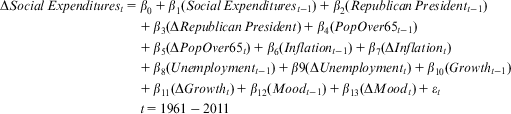 $$no{ {\rm{\rDelta }}Social\,Expenditure{{s}_t}\, = \, &#x0026; {{\beta }_{\rm{0}}}\, + \,{{\beta }_{\rm{1}}}(Social\,Expenditure{{s}_{t{\rm{ - 1}}}})\, + \,{{\beta }_{\rm{2}}}(Republican\,Presiden{{t}_{t{\rm{ - 1}}}}) \, \cr + \,{{\beta }_{\rm{3}}}({\rm{\rDelta }}Republican\,President)\, + \,{{\beta }_{\rm{4}}}(PopOver{{65}_{t{\rm{ - 1}}}})\, \cr + \,{{\beta }_{\rm{5}}}({\rm{\rDelta }}PopOver{\rm{6}}{{{\rm{5}}}_t}) \, + \,{{\beta }_{\rm{6}}}(Inflatio{{n}_{t{\rm{ - 1}}}})\, + \,{{\beta }_{\rm{7}}}({\rm{\rDelta }}Inflatio{{n}_t})\, \cr + \,{{\beta }_{\rm{8}}}(Unemploymen{{t}_{t{\rm{ - 1}}}})\, + \,\beta {\rm{9}}({\rm{\rDelta }}Unemploymen{{t}_t}) \, + \,{{\beta }_{{\rm{10}}}}(Growt{{h}_{t{\rm{ - 1}}}})\, \cr + \,{{\beta }_{{\rm{11}}}}({\rm{\rDelta }}Growt{{h}_t})\, + \,{{\beta }_{{\rm{12}}}}(Moo{{d}_{t{\rm{ - 1}}}})\, + \,{{\beta }_{{\rm{13}}}}({\rm{\rDelta }}Moo{{d}_t})\, + \,{{{\epsilon}}_t} \cr t\, = \,{\rm{1961 - 2011}} }$$
To this specification, we add imports and exports, as well as the interaction between imports and Mood. The main results are presented in Table 5. Robustness checks, including additional measures of partisanship and alternative controls, such as deindustrialization, can be found in the online appendix. We limit the discussion to key variables in the interest of space.
Determinants of Social Spending, 1961–2011

*p < 0.1, **p < 0.05, ***p < 0.01. Newey-West standard errors in parentheses.
Model 5.1 presents our base model of change in social spending. The estimated coefficient on Mood is positive and statistically significant, which is consistent with previous literature and suggests that a liberal shift in preferences leads to an increase in social spending. Unemployment has a positive and immediate effect on spending. The coefficient on the percent of the population over sixty-five is also positive, as expected, and statistically significant. Model 5.2 eliminates nuisance parameters from Model 5.1, and the coefficient on Mood is again positive and statistically significant.
Next we introduce the trade balance in Models 5.3 and 5.4. The coefficient on trade balance in levels is not statistically significant in Model 5.3, nor is the interaction with Mood statistically significant in Model 5.4.
In Model 5.5, we include the levels of imports and exports; the coefficient estimates on imports and exports in levels are negative, though not statistically significant. Trade flows appear to have no direct effect on changes in social spending, while Mood again has a positive and statistically significant estimated effect on social spending.
In Model 5.6, we include an interaction between Mood and imports. Mood's coefficient estimate is now negative, though the conditional interpretation of the estimate is when imports as a percentage of GDP take the value of zero, which is out of sample. The conditional coefficient on imports is negative and statistically significant, though Mood never approaches zero. The coefficient on the interaction between Mood and imports is positive and statistically significant.
In Figure 1, we present the marginal effect of Mood on spending, conditional on observed levels of imports (accounting for the covariances of the coefficient in computing the standard errors).Footnote 84 The estimated effect of Mood on changes in social spending increases with the level of imports. The marginal effect of Mood is statistically different from zero at levels of imports above approximately 8 per cent of GDP, which has been true for the United States since the mid-1970s. Substantively, a one standard deviation increase in Mood (4.62 points) increases spending by 0.18 per cent and 0.51 per cent at the mean (9.99 per cent) and maximum (17.89 per cent) levels of imports, respectively. (For reference, the dependent variable, change in social spending, ranges from −0.80 to 2.15, with a mean of 0.21 and a standard deviation of 0.52.) The increase in explanatory power in Model 5.6 over the other models is, however, modest.
Marginal effect of mood on change in social spending, conditional on imports. Note: estimates based on Model 5.6, for observed levels of imports, 1961–2011. Dashed lines represent 95 per cent confidence interval.

These exploratory results suggest that the effect of policy mood on social spending is conditional on the level of imports. In the online appendix, we present analogous results for the shorter sample that look separately at intrafirm and non-intrafirm trade. This is an area for further scholarly investigation.
CONCLUSIONS
The theory and findings presented here have important implications for the relationship between public sentiment and trade globalization in the United States. We ask if, and how, the policy mood of the public toward the role of government responds to the changing nature of the US economy and its trade integration into the world economy. We hypothesize that increasing imports directly shifts the policy mood in a more liberal direction, and that increasing exports shifts it in a more conservative direction.
The evidence strongly shows that Mood responds to rising imports in a manner consistent with our hypotheses, which are derived from findings in the ‘heterogeneous firms’ literature (also known as the ‘new new’ trade theory literature) in international economics and the ‘compensation’ hypothesis studies from the IPE literature. Citizens appear to prefer higher levels of government involvement in the face of deterioration in the US trade position. In particular, rising imports lead to an immediate and long-term leftward shift in Mood. In contrast, rising exports appear to influence Mood in some specifications, though those results appear in specifications (instrumental variable models) that address omitted variable bias. The effects of trade are centered on non-intrafirm imports and exports, a result that is suggested by the ‘new new’ trade theory. We use various methods and changes in the conditioning information in the models to assess the reliability and robustness of the results.
This analysis provides an important link, not only between separate literatures in American politics and IPE, but also between studies of individual preferences and domestic policy outcomes. One area of future research is whether shifts in policy mood, influenced by increasing economic integration, are systematically reflected in domestic spending outcomes. In that vein, we offer some exploratory work showing that imports potentially moderate the effect of Mood on social spending. Exploring whether and how other facets of economic integration, especially international financial integration, influence Mood is another important direction for further work.
APPENDIX: MEASURES AND DATA SOURCES
Economic growth. We estimate models with real growth per capita, which is available from the IMF's International Financial Statistics.
Exports and imports. Exports and imports are as a percentage of GDP from the IMF's International Financial Statistics. These are standard indicators in IPE.Footnote 85 In robustness checks of logged trade flows, for data on aggregate imports and exports prior to 1960 we use UN historical data on trade in goods, and adjust the measure to account for trade in services. However, results are robust to the sample limited to 1960.
US intrafirm exports and imports; non-US intrafirm exports and imports. Intrafirm exports equal the sum of exports from US parents to their foreign affiliates and exports from US affiliates of foreign parents to the foreign parent group. Similarly, intrafirm imports equal the sum of imports of US parents from foreign affiliates and imports by US affiliates of foreign parents. After 2001, the Bureau of Economic Analyses (BEA) surveys were asked only of majority-owned US affiliates of foreign firms. Therefore our data from 2002–10 is based on Ruhl's calculation, which includes non-majority US affiliates of foreign firms. Also note that related party data from the census includes foreign MNC affiliates. See also Bureau of the Census 2006, 2010.
Prior government policies. We follow Stevenson (Reference Stevenson2001) and use government social expenditures as the indicator of prior government policies. The data are government social benefits as a percentage of GDP, and are taken from the BEA website (Table 3.12, line 1).
Inflation and unemployment. The unemployment series is the unemployment rate of economically active individuals from the BEA website; the Consumer Price Index is from the Bureau of Labor Statistics.
GINI coefficients. We take GINI data from the US Census Bureau,Footnote 86 which changed methodology between 1992 and 1993. The Census Bureau notes that it was ‘unable to determine precisely the proportion of the increase in income inequality between 1992 and 1993 that is attributable to this change’.Footnote 87 See Appendix Figure A1 for a visual representation of the magnitude of the effect. To offset the methodological change, we estimate the GINI models with a step indicator starting in 1993.
Change in US Gini indicators. Note: the figure depicts the effects of a change in census methodology between 1992 and 1993. Source: Department of the Census, ‘Current Population Reports: Selected Measures of Household Income Dispersion, Table A-2’.

Media. The Vanderbilt University Television News ArchiveFootnote 88 is used to construct an index of the salience of international trade. Using ABC, NBC and CBS news broadcasts from 1968 until the present, we collected headline and abstract-level mentions of ‘trade’, ‘trade deficit’, ‘trade surplus’ and ‘trade balance’, and aggregated them by year. We similarly experimented with ‘exports’ and ‘imports’ in the headlines and story abstracts. Data available upon request.
Patents. We use the number of patents awarded, measured in 1,000s.Footnote 89
Skills premium. These data are the ‘composition adjusted college/high-school log weekly wage ratios’ from Figure 1 in Acemoglu and Autor.Footnote 90 The data measure the skill premium paid to more educated workers over time, adjusting for the composition of work.Footnote 91



