





Clozapine is considered the most effective treatment option for patients with treatment-resistant schizophrenia (TRS). Reference Siskind, McCartney, Goldschlager and Kisely1 Patients experience a persistence of significant symptoms despite prior adequate pharmacological treatment with at least two non-clozapine antipsychotic drugs. Reference Howes, McCutcheon, Agid, de Bartolomeis, van Beveren and Birnbaum2 However, because of its potential adverse effects, including the risk for clozapine-induced agranulocytosis (CIA), clozapine is underutilised in patients with TRS. Reference Farooq, Choudry, Cohen, Naeem and Ayub3 To limit the risk of CIA, the use of clozapine requires regular haematological monitoring in most countries. Reference Oloyede, Blackman, Whiskey, Bachmann, Dzahini and Shergill4 Haematological monitoring is intended to identify an early fall in absolute neutrophil count (ANC) before an episode of agranulocytosis. In the UK, clozapine use currently requires weekly monitoring for the first 18 weeks, fortnightly monitoring during weeks 18–52 and 4-weekly monitoring thereafter for as long as the patient uses clozapine. Clozapine use will be stopped if absolute ANCs fall below 1.5 × 10⁹/L or white blood cell counts fall below 3.0 × 10⁹/L. Reference Oloyede, Blackman, Whiskey, Bachmann, Dzahini and Shergill4
Monitoring guidelines build on the assumption that agranulocytosis occurring in patients using clozapine are actually caused by clozapine. However, severe neutropenia and CIA may be wrongly attributed to clozapine and a large number of patients are unnecessarily withdrawn from clozapine treatment. Reference Taylor, Vallianatou, Gandhi, Casetta, Howes and MacCabe5–Reference Taylor, Vallianatou, Whiskey, Dzahini and MacCabe7 Several recent studies have made a case for restricting indefinite haematological monitoring on the basis that almost all CIA cases occur within the first months of initial treatment, with a notable decrease in risk thereafter. Reference Rubio, Kane, Tanskanen, Tiihonen and Taipale8–Reference Oloyede, Taylor and MacCabe10 Indeed, evidence from the COVID-19 pandemic shows that extending haematological monitoring intervals for patients long-established on clozapine did not increase the incidence of life-threatening agranulocytosis. Reference Oloyede, Dzahini, Abolou, Gee, Whiskey and Malhotra11,Reference Taylor, Gee, Helthuis and Oloyede12
Haematological monitoring can be costly. First, patients may refuse to use clozapine because of the requirement for frequent haematological monitoring or ANC cut-offs unnecessarily prohibit clozapine treatment. Reference Farooq, Choudry, Cohen, Naeem and Ayub3,Reference Taylor, Vallianatou, Gandhi, Casetta, Howes and MacCabe5–Reference Taylor, Vallianatou, Whiskey, Dzahini and MacCabe7 In these cases, patients are restricted from clozapine, a treatment option that can substantially lower healthcare costs. Reference Davies, Barnes, Jones, Lewis, Gaughran and Hayhurst13,Reference Butler, Pillinger, Brown, Borgan, Bowen and Beck14 Annual average healthcare costs have been estimated to amount to over 10 000 GBP before clozapine initiation and to around 1500 GBP after clozapine initiation. However, frequent haematological monitoring is associated with high costs itself. Assuming average costs of 48 GBP for titration and monitoring each week and a median time of clozapine use of 603 days, Reference Butler, Pillinger, Brown, Borgan, Bowen and Beck14 this adds up to total costs of over 2000 GBP under the current UK monitoring practice, not including the opportunity costs for patients or patients’ families.
Three prior studies have assessed the cost-effectiveness of haematological monitoring for clozapine use. The studies suggest that the long-term extensive haematological monitoring and relatively high ANC cut-offs that mandate clozapine discontinuation are not cost-effective. Reference Girardin, Poncet, Blondon, Rollason, Vernaz and Chalandon15–Reference Ninomiya, Saito, Okochi, Taniguchi, Shimasaki and Aoki17 In light of the most recent studies that question current monitoring practices, Reference Taylor, Vallianatou, Gandhi, Casetta, Howes and MacCabe5,Reference Taylor, Vallianatou, Whiskey, Dzahini and MacCabe7–Reference Oloyede, Taylor and MacCabe10,Reference Oloyede, Bachmann, Dzahini, Lopez Alcaraz, Singh and Vallianatu18 the aim of this study was to examine the cost-effectiveness and budget impact of haematologic monitoring schemes that either lower the ANC cut-off that mandates clozapine discontinuation and/or extent haematological monitoring intervals for patients with TRS using clozapine in the UK.
Method
Study design and model
To assess the cost-effectiveness of haematologic monitoring schemes, we modified a previously developed continuous-time semi-Markov model with four health states (Fig. 1): Reference Girardin, Poncet, Blondon, Rollason, Vernaz and Chalandon15 treated with clozapine and with normal ANCs (health state 1), treated with clozapine and an ANC that mandates clozapine discontinuation (health state 2), treated with a non-clozapine antipsychotic drug (health state 3) and death (health state 4). All patients enter the model in health state 1 and may either stay in health state 1, switch to a non-clozapine antipsychotic drug for reasons unrelated to ANCs, develop an ANC that mandates clozapine discontinuation or die for reasons unrelated to CIA. The ANC that leads to treatment discontinuation may either be classified as mild to moderate neutropenia (ANC 0.5–1.5 × 10⁹/L) or CIA (ANC <0.5 × 10⁹/L). Patients with mild to moderate neutropenia switch to a non-clozapine antipsychotic drug as soon as it is detected by haematological monitoring. Patients who develop CIA are at risk of sepsis. If patients develop sepsis before CIA is detected, they may either die or recover and switch to a non-clozapine antipsychotic drug. If CIA is detected during haematological monitoring, patients switch to a non-clozapine antipsychotic drug with no sepsis. Patients who are treated with a non-clozapine antipsychotic drug are at risk of dying.
Semi-Markov model. ANC, absolute neutrophil count.

Study population
The study population included a hypothetical cohort of 100 000 men and women aged 18–65 years who were diagnosed with TRS and who received clozapine after failure of two non-clozapine antipsychotic drugs.
Comparators
We compared five haematological monitoring schemes: the current UK scheme, which requires weekly monitoring for 18 weeks, then every two weeks until week 52 and monthly monitoring thereafter, Reference Oloyede, Blackman, Whiskey, Bachmann, Dzahini and Shergill4 was the reference case. Clozapine treatment is discontinued at ANC <1.5 × 10⁹/L. The second scenario included a lowering in the ANC cut-off that mandates clozapine discontinuation by 0.5 × 10⁹/L as introduced in the USA. Reference Oloyede, Whiskey, Casetta, Dzahini, Dunnett and Gandhi6 The monitoring interval was not changed. The third scenario was the Dutch case, where patients have the option to stop haematological monitoring after the first 6 months of clozapine use, although occasional monitoring of four times a year is recommended. The scenario assumed weekly monitoring for the first 18 weeks, then every 4 weeks until week 26 and four times a year, thereafter. 19 As in the UK, clozapine treatment was discontinued at ANC <1.5 × 10⁹/L. The fourth scenario was a combination of the US and Dutch schemes, which included the Dutch monitoring guidelines and clozapine treatment discontinuation at ANC <1.0 × 10⁹/L. For the four monitoring strategies ‘current UK scheme’, ‘US scheme’, ‘Dutch scheme’ and ‘US–Dutch scheme’ weekly monitoring was assumed to occur with fluctuations of ±2 days. Finally, no monitoring at all was considered as the ‘do-nothing’ alternative, as current strategies for haematological monitoring have previously been found to be not cost-effective. Reference Girardin, Poncet, Blondon, Rollason, Vernaz and Chalandon15
Transition probabilities
Table 1 (column 2) displays the parameters used for the base-case analysis. We assumed that the lifetime incidence of ANCs of <1.5 × 10⁹/L, <1.0 × 10⁹/L and <0.5 × 10⁹/L was 4%, 1.24% and 0.8%, respectively. Reference Oloyede, Whiskey, Casetta, Dzahini, Dunnett and Gandhi6,Reference Oloyede, Bachmann, Dzahini, Lopez Alcaraz, Singh and Vallianatu18 Some 43.3% of falls in ANCs occur within the first 18 weeks. Reference Oloyede, Bachmann, Dzahini, Lopez Alcaraz, Singh and Vallianatu18 It was assumed that 97% of patients with CIA develop sepsis within 14 days. Reference Girardin, Poncet, Blondon, Rollason, Vernaz and Chalandon15 The relative mortality of sepsis induced by CIA was set to 0.7%. Reference de Leon, Arrojo-Romero, Verdoux, Ruan, Schoretsanitis and Rohde20 Patients who did not die from sepsis and transitioned to health state 3 were assumed to have an all-cause 3-year mortality of 1.2% under non-clozapine antipsychotic drug treatment (health state 3 to death). Reference Cho, Hayes, Jewell, Kadra, Shetty and MacCabe21
Parameter values for the semi-Markov model

ANC, absolute neutrophil count; CIA, clozapine-induced agranulocytosis.
a. Includes costs (median) for in-patient and out-patient services and social support.
b. Includes costs for titration and monitoring.
c. Includes costs for hospital admission and additional complications. More details on the underlying study populations are provided in Supplementary Material S.1.
Patients who did not develop ANCs that discontinue clozapine treatment were at risk of clozapine discontinuation for other reasons (health state 3) or of death (health state 4). It was assumed that 45% of patients discontinue clozapine treatment for other reasons within 2 years. Reference Legge, Hamshere, Hayes, Downs, O’Donovan and Owen22 A 3-year all-cause mortality rate of 0.7% was estimated under clozapine treatment (health state 1 to death). Reference Cho, Hayes, Jewell, Kadra, Shetty and MacCabe21 Patients who did not transition to health states 2–4 remained on clozapine treatment during the whole time horizon.
Costs
Costs were regarded from the healthcare perspective. Daily costs for health services use were estimated at 2.43 GBP for patients treated with clozapine and 5.68 GBP for patients treated with a non-clozapine antipsychotic drug. Reference Butler, Pillinger, Brown, Borgan, Bowen and Beck14 Costs for haematologic monitoring were set to 47.99 GBP per screening. Reference Butler, Pillinger, Brown, Borgan, Bowen and Beck14 Daily costs for a 300 mg dose clozapine (tablets) were set to 1.12 GBP. 23 Weighted average daily costs for non-clozapine antipsychotic drugs (tablets), that is, treatment with antipsychotic polypharmacy, olanzapine (10 mg daily), aripiprazole (10 mg daily) or quetiapine (300 mg daily), were estimated at 0.05 GBP. 23 The non-clozapine antipsychotic drugs were administered with the following likelihood: antipsychotic polypharmacy (27%), olanzapine (23.2%), quetiapine (13%), aripiprazole (12.1%), other (24.7%). Reference Luykx, Stam, Tanskanen, Tiihonen and Taipale24 Costs for antipsychotic polypharmacy were assumed to be 38% higher than for antipsychotic monotherapy. Reference Zhu, Ascher-Svanum, Faries, Correll and Kane25 Costs for sepsis were estimated at 7065.72 GBP per case. Reference Hex, Retzler, Barlett and Arber26 All costs were inflated to year 2023 GBP prices using the gross domestic product deflator. 27
Outcomes
The clinical outcome considered was the mean days of survival by a patient. The main outcome for the cost-effectiveness analysis was quality-adjusted life years (QALYs). QALYs were calculated from the time spent in different health states multiplied by utility values with UK tariffs. The utility for treatment with clozapine was 0.81 and for treatment with a non-clozapine antipsychotic drug was 0.74. Reference Davies, Barnes, Jones, Lewis, Gaughran and Hayhurst13,Reference Aceituno, Pennington, Iruretagoyena, Prina and McCrone34 Death was assigned a utility of 0. The incidence of sepsis was assigned a decrease in utility by 13.2% for 6 months. Reference Griffiths, Hatch, Bishop, Morgan, Jenkinson and Cuthbertson31
Economic evaluation and budget impact analysis
We calculated the incremental cost-effectiveness ratio (ICER) by relating the incremental costs to the incremental effects. Reference Drummond, Claxton, Sculpher, Stoddart and Torrance33 Costs and consequences were considered over a 3-year horizon, which was assumed to be long enough to capture all meaningful differences in costs and effects as CIA occurs chiefly in the first 18 weeks of treatment. An annual discount rate of 3.5% was applied to both costs and outcomes. 32 An ICER below 20 000 GBP per QALY was regarded as cost-effective. 32
A 3-year budget impact analysis was conducted to estimate the financial consequences of revising current haematological monitoring practices for the healthcare system. The eligible population included the prevalent population of adult patients with TRS in the UK in year 1 and the incident population of patients expected to develop TRS in years 2 and 3. Some 30% of potentially eligible patients were assumed to be treated with clozapine (Supplementary Fig. S.1 available at https://doi.org/10.1192/bjp.2025.10424). 35,Reference Whiskey, Barnard, Oloyede, Dzahini, Taylor and Shergill36 A hypothesised increase in clozapine use because of revised monitoring guidelines of 30% and 50% was assumed. The budget impact was calculated as the difference in total costs between the monitoring strategies. Costs were not discounted per standard practices. Reference Sullivan, Mauskopf, Augustovski, Jaime Caro, Lee and Minchin37
Sensitivity analyses
Deterministic one-way sensitivity analyses were conducted by setting parameter values to rather extreme yet plausible upper and lower bounds, Reference Drummond, Claxton, Sculpher, Stoddart and Torrance33 which were derived from the literature (Table 1, column 3). The risk of an ANC cut-off that mandates clozapine discontinuation was lowered to 0.7% (<1.5 × 10⁹/L), 0.064% (<1.0 × 10⁹/L) and 0% (<0.5 × 10⁹/L). Reference Brandt, Nucifora, Zandi and Margolis28 We assumed that 85–99% of patients with CIA would develop sepsis within 14 days. Reference Girardin, Poncet, Blondon, Rollason, Vernaz and Chalandon15 We varied sepsis-related mortality between 0.5 and 23%. Reference Andersohn, Konzen and Garbe29,Reference Li, Zhong, Lu, Zheng, Wang and Rao30 Utilities for treatment were varied by plus/minus one standard deviation. Reference Davies, Barnes, Jones, Lewis, Gaughran and Hayhurst13 A decrease in utility because of sepsis was assumed to be either 0 or 23.3%. Reference Griffiths, Hatch, Bishop, Morgan, Jenkinson and Cuthbertson31 Costs for health services use were set to the lower and upper quartiles. Reference Butler, Pillinger, Brown, Borgan, Bowen and Beck14 Costs for clozapine were varied by the costs for the minimum and maximum dose that could potentially be prescribed. 23 Similarly, the range of costs for non-clozapine antipsychotic drugs was calculated as weighted average daily costs considering only the lowest and highest doses for treatment. 23 We assumed plus/minus 20% when varying the costs for haematologic monitoring. The range of costs for sepsis was based on low and high cost scenarios. Reference Hex, Retzler, Barlett and Arber26 Finally, the discount rate per annum was varied between 1.5 and 5%. 32,Reference Drummond, Claxton, Sculpher, Stoddart and Torrance33
To further characterise uncertainty regarding input parameters, we assigned normal distributions to the parameters of time to clozapine discontinuation for other reasons and time to an ANC that discontinues clozapine treatment. Reference Girardin, Poncet, Blondon, Rollason, Vernaz and Chalandon15 Standard deviations were estimated from the data of the respective studies. Reference Oloyede, Bachmann, Dzahini, Lopez Alcaraz, Singh and Vallianatu18,Reference Legge, Hamshere, Hayes, Downs, O’Donovan and Owen22 We assigned a beta distribution to the utilities for treatment and a gamma distribution to the cost parameters. Reference Drummond, Claxton, Sculpher, Stoddart and Torrance33 Shape and scale parameters were derived from the mean and standard deviation (for utilities) and interquartile range (for costs) of the original studies. Reference Davies, Barnes, Jones, Lewis, Gaughran and Hayhurst13,Reference Butler, Pillinger, Brown, Borgan, Bowen and Beck14 In the case in which the randomly chosen utility parameters were smaller for treatment with clozapine than with a non-clozapine antipsychotic drug, the utility parameter of clozapine treatment was set equal to the utility parameter of the alternative, assuming that clozapine is the superior treatment option. Reference Siskind, McCartney, Goldschlager and Kisely1 Similarly, costs of health services use for patients treated with clozapine were set equal to those of patients treated with a non-clozapine substitute if costs for patients treated with clozapine were randomly chosen to be larger, as costs have been shown to be lower for this group. Reference Butler, Pillinger, Brown, Borgan, Bowen and Beck14,Reference Morris, Hogan and McGuire38 Some 10 000 hypothetical patient cohorts were simulated in the probabilistic sensitivity analyses.
Cost-effectiveness acceptability curves (CEACs) were plotted to assess the probability that a scenario is cost-effective compared to the current UK scheme for a range of maximum monetary values λ that a decision maker might be willing to pay for a change in one QALY. Reference Fenwick, O’Brien and Briggs39,Reference Fenwick and Byford40
Statistical analysis
The continuous-time semi-Markov model was estimated using the procedure by Cao et al. Reference Cao, Buskens, Feenstra, Jaarsma, Hillege and Postmus41 The programs were written and executed in R version 4.5.1 for Windows (R Foundation for Statistical Computing, Vienna, Austria; see https://www.R-project.org). 42
Results
Base-case analysis
For a simulated cohort of 100 000 patients using clozapine, indicators of mortality and mean days of survival did not significantly vary over a 3-year time horizon among the five monitoring strategies (Table 2). Quality of life (QoL) adjusted mean days of survival were 795.83 for the current UK scheme, 797.08 for the US scheme, 795.79 for the Dutch scheme, 797.03 for the US–Dutch scheme and 797.22 for no monitoring at all.
Baseline results

ANC, absolute neutrophil count; N/A, not applicable; ICER, incremental cost-effectiveness ratio; QALY, quality-adjusted life year. Data in parentheses are 95% confidence intervals from the probabilistic sensitivity analyses.
Mean total costs per patient were 6388.34 GBP for the current UK scheme and 6390 GBP if the US scheme was applied. Costs decreased to 5569.77 GBP for the Dutch scheme, to 5548.50 GBP for the US–Dutch scheme and to 4485.48 GBP for no monitoring at all.
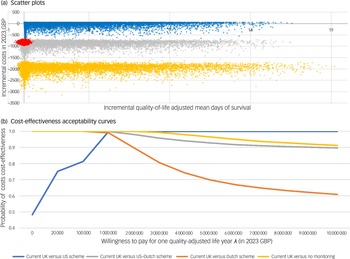
The ICERs that resulted from relating incremental costs to incremental effects ranged from 482.55 GBP per QALY (US scheme) to 6.6 million GBP per QALY (Dutch scheme) if compared to the current UK monitoring practice. This relatively high number is because of the relatively small loss in QALYs (compare Fig. 2(a)). The US–Dutch scheme and no monitoring at all were dominant strategies, meaning that these strategies were associated with lower costs and favourable effects compared to the current UK monitoring practice.
Results of probabilistic sensitivity analysis.

Budget impact analysis
Over a 3-year time horizon, total costs for the healthcare system amount to 823.8 million GBP in the current UK monitoring scheme (Table 3). A change in monitoring practices results in a budget decrease of 4.09% (Dutch scheme), 4.20% (US–Dutch scheme) and 9.47% (no monitoring at all) if no change in clozapine use is assumed. An increase in clozapine use by 30% decreases total costs by 4.54% (Dutch scheme), 4.69% (US–Dutch scheme) and 11.5% (no monitoring at all). Costs further reduce to −5.03% (Dutch scheme), −5.19% (US–Dutch scheme) and −13.03% (no monitoring at all) if 50% clozapine use uptake is assumed. Reductions in total costs are driven by large savings in costs for health services use and reduced monitoring (Supplementary Table S.2).
Three-year budget impact analysis results (in year 2023 GBP)

a. Total costs include costs for health services, pharmaceuticals, monitoring and sepsis treatment.
An application of the US scheme with no change in clozapine uptake would slightly increase costs by 0.01%, because costs for continued monitoring and clozapine are not completely offset by a decrease in costs for health services use (Supplementary Table S.2). Accordingly, an increase in clozapine use by 30 and 50% increases total costs by 0.78 and 1.13%, respectively (Table 3).
Sensitivity analyses
A variation in model parameters regarding the risk of an ANC cut-off that mandates clozapine discontinuation, time to sepsis and sepsis-related mortality does not substantially affect mean QoL adjusted days of survival (Supplementary Table S.3). By contrast, a variation in utility measures can substantially affect mean QoL adjusted days of survival. Similarly, parameter estimates for costs of drugs and health services use influence mean total costs per patient. The ICERs that result from a variation of model parameters in the deterministic sensitivity analysis remained in a similar range for most parameter changes: the US scheme, US–Dutch scheme and no monitoring at all are either dominant or cost-effective compared to the current UK monitoring practice. The Dutch scheme results in relatively large ICERs ranging from 3.82 to 24.52 million GBP per QALY. As in the base-case analysis, these relatively large values are because of a relatively small change in QALYs. A variation in the discount rate, which accounts for different time profiles of costs and benefits, does not substantially change the results (Supplementary Table S.3).
The scatter plot of the probabilistic sensitivity analysis shows that the strategies ‘US scheme’, ‘Dutch scheme’, ‘US–Dutch scheme’ and ‘no monitoring at all’ can each result in lower costs compared to the current UK scheme (Fig. 2(a)). For the US scheme, incremental costs can be slightly higher as longer periods of clozapine use are associated with longer haematological monitoring. A substantial share of simulations results in an increase of QoL adjusted mean days of survival, implying that all of the alternatives can be dominant strategies compared to the current UK scheme. The other share of simulations results in a relatively minor loss in QoL adjusted mean days of survival up to 0.62 days at the maximum. The very small loss of QALYs that is caused by extending haematological monitoring intervals is in line with the relatively large ICERs that are found in the base-case (Table 2) and deterministic sensitivity analysis (Supplementary Table S.3).
Figure 2(b) shows that the CEACs of the ‘Dutch scheme’, ‘US–Dutch scheme’ and ‘no monitoring at all’ are a decreasing function of λ. In the case in which the decision maker is unwilling to pay anything for health gains (λ = 0), the CEACs have a value of 1 as the three monitoring strategies are associated with costs less than or equal to the costs of the current UK monitoring practice. With increasing decision makers’ willingness to pay for health gains (λ > 0), the CEACs decrease because not all estimations involve health gains. Still, health losses are relatively low (compare Fig. 2(a)). The CEAC of the ‘US scheme’ does not cut the y-axis because 48.28% of model replications involve cost savings. The CEAC increases as a lowering of the ANC cut-off that mandates clozapine discontinuation does not involve any health losses. Thus, Fig. 2(b) suggests that if one is willing to accept a very small reduction in mean QoL adjusted days of survival, any of the considered alternatives can substantially reduce total costs compared to the current UK monitoring practice.
Discussion
Our findings
Haematological monitoring for clozapine use can be less onerous and less costly without sacrificing safety. A revision of current UK monitoring practices can reduce costs borne by the healthcare system with no significant increases in mortality and improved QoL adjusted mean days of survival. Scholars have requested a relaxation of haematological monitoring frequency and a revision of the ANC cut-off that mandates clozapine discontinuation. Reference Oloyede, Whiskey, Casetta, Dzahini, Dunnett and Gandhi6,Reference Rubio, Kane, Tanskanen, Tiihonen and Taipale8–Reference Oloyede, Taylor and MacCabe10,Reference Brandt, Nucifora, Zandi and Margolis28 Our study contributes to the literature by relating the health effects of these changes to their costs and by analysing the impact on the healthcare system’s budget.
Findings in the context of previous studies
The Netherlands introduced the option to stop haematological monitoring for clozapine use in 2006 (off-label). 19 Using the Dutch case as an example, our model confirms what has been previously addressed by studies, Reference Oloyede, Dzahini, Abolou, Gee, Whiskey and Malhotra11 that is, that fatal outcomes of clozapine use are low even if haematological monitoring intervals are extended. In July 2025, the Pharmacovigilance Risk Assessment Committee (PRAC) of the European Medicines Agency recommended to reduce the frequency of haematological monitoring to every 12 weeks after 1 year, and to once a year after 2 years, 43 which would have very similar effects to the Dutch scheme presented in the main analysis (see Supplementary Tables S.4 and S.5 for the PRAC criteria). In addition, our model shows that lowering ANC cut-offs that discontinue treatment by 0.5 × 10⁹/L increases QoL adjusted mean days of survival while not substantially increasing or even lowering total costs if combining with the Dutch monitoring strategy. Taylor et al recently suggested a new set of criteria to improve the specificity for detecting true CIA, including a consecutive ANC of <0.5 × 10⁹/L (despite withdrawal of clozapine) on two consecutive days, among others. Reference Taylor, Vallianatou, Gandhi, Casetta, Howes and MacCabe5,Reference Taylor, Vallianatou, Whiskey, Dzahini and MacCabe7 The application of these ‘pattern-based’ criteria instead of one ANC <0.5 × 10⁹/L could further increase QoL adjusted mean days of survival by further reducing the number of patients unnecessarily withdrawn from clozapine treatment and reduce associated costs (see Supplementary Tables S.4 and S.5 for an application of ‘pattern-based’ criteria).
Our results show that revised haematological monitoring guidelines can be beneficial from the health economic perspective. A robustness check shows that this does not only apply when costs from the UK healthcare system are considered, but also to cost data from the Australian and German healthcare systems, where the cost structures for health services use, drugs and sepsis treatment differ (see Supplementary Table S.6 for estimated costs). A comparison between countries shows that ‘no monitoring at all’ leads to the largest reduction in mean total costs per patient among the five monitoring alternatives considered (UK: –29.79%, Australia: –2.35%, Germany: –4.39% for ‘no monitoring at all’ versus ‘current UK scheme’). However, a restriction of haematological monitoring frequency (UK: –12.8%, Australia: –0.77%, Germany: –0.83% for the ‘Dutch scheme’ versus ‘current UK scheme’), a reduction of ANC cut-offs (UK: +0.03%, Australia: –0.5%, Germany: –2.15% for the ‘US scheme’ versus ‘current UK scheme’) or a combination of both (UK: –13.14%, Australia: –1.29%, Germany: –3% for the ‘US–Dutch scheme’ versus ‘current UK scheme’) can also reduce costs (see Supplementary Table S.7 for a comparison of mean total costs). A comparison between the countries shows that a reduction in the monitoring frequency does not save much on the healthcare systems budget, if costs for haematological monitoring are relatively low. In countries where differences in costs for health services use between patients using clozapine and those using a non-clozapine antipsychotic drug are relatively high, patients will not only experience clinical benefits from clozapine treatment but also the economic burden associated with TRS will be reduced. For example, German and Australian cost data reveal substantially higher differences in costs for health services use between patients who are treated with clozapine and those who are treated with a non-clozapine antipsychotic drug, as well as lower costs for haematological monitoring if compared to the UK. In these cases, mean total costs per patient can be reduced by continuously treating patients with clozapine, even without restricting haematological monitoring. In all cases, high costs of sepsis treatment do not have a great impact on the overall costs borne by the healthcare system in the three countries, as sepsis cases are relatively rare.
Limitations
Costs were considered from the healthcare perspective, which does not include opportunity costs for the patient or the patients’ family. This is because of a lack of studies that report these costs for TRS. Reference Butler, Pillinger, Brown, Borgan, Bowen and Beck14 For patients with schizophrenia, it has been shown that productivity losses can make up 35.9–83% of the total societal costs of illness, whereas direct healthcare costs contribute 13.5–64.1%. Reference Jin and Mosweu44 A similar pattern is expected for patients with TRS. Second, the analysis focuses on the cost-effectiveness of haematological monitoring guidelines, such that costs for clozapine initiation are assumed to be the same among all patients and not considered. Costs of clozapine initiation may differ by in-patient and out-patient setting, which is, in turn, a question that stands for itself. Reference Butler, Pillinger, Brown, Borgan, Bowen and Beck14 Third, it is assumed that clozapine treatment will be stopped if ANCs fall below certain thresholds. While this applies to the US monitoring guidelines and has also been recently recommended by the PRAC, clozapine treatment in the UK is currently discontinued if ANCs fall below 1.5 × 10⁹/L or white blood cell counts fall below 3.0 × 10⁹/L. Reference Oloyede, Blackman, Whiskey, Bachmann, Dzahini and Shergill4,43 Fourth, our model ignores the possibility that patients might be successfully re-challenged with clozapine. Reference Schulte, Veerman, Bakker, Bogers, Jongkind and Cohen45 Fifth, our model is estimated over a time horizon of 3 years. While this time horizon is assumed to be long enough to capture all meaningful differences in costs and effects, the parameter values used for estimation are, in certain cases, reported over a shorter time horizon and extrapolated to 3 years (e.g. parameter values for utilities and costs, Supplementary Table S.1). It can be assumed that benefits would be greater over a longer time period.
Implications
Here we show that a revision of haematological monitoring guidelines for clozapine use should entail a change in the ANC cut-off that mandates a clozapine discontinuation and a relaxation of haematological monitoring frequency. Revised ANC cut-offs avoid an early discontinuation of clozapine treatment with positive impact on patients’ QoL and costs for health services use. A relaxation of monitoring frequency reduces patients’ burden that is associated with frequent visits and the costs borne by the healthcare system.
Supplementary material
The supplementary material is available online at https://doi.org/10.1192/bjp.2025.10424
Data availability
All model parameters are described in detail in the tables and the manuscript text. References are provided. The analytic codes are available on request from F.D. (freya.diederich@uni-bremen.de).
Acknowledgements
The authors would like to thank Dan Siskind for providing us with data on the Australian healthcare system. This manuscript is an honest, accurate and transparent account of the study being reported; no important aspects of the study have been omitted; and any discrepancies from the study as planned have been explained.
Author contributions
F.D.: conceptualisation, methodology, data curation, formal analysis, validation, writing – original draft. E.O.: conceptualisation, methodology, validation, writing – review and editing. D.T.: conceptualisation, methodology, validation, writing – review and editing. C.J.B.: conceptualisation, methodology, validation, writing – review and editing. All authors have reviewed the manuscript draft critically for important intellectual content and approved the final version to be published, and agree to be accountable for all aspects of the work in ensuring that questions related to the accuracy or integrity of any part of the work are appropriately investigated and resolved.
Funding
This research received no specific grant from any funding agency, commercial or not-for-profit sectors.
Declaration of interest
C.J.B. is a member of the European Clozapine Task Force, an independent affiliation of clinicians supportive of increased access for patients to clozapine treatment. D.T. has received lecture fees from Lundbeck, Otsuka and Janssen, and consultancy payments from Viatris, Idorsia and Teva. He has received research funding from Johnson and Johnson.




 Open access


eLetters
No eLetters have been published for this article.