

Introduction
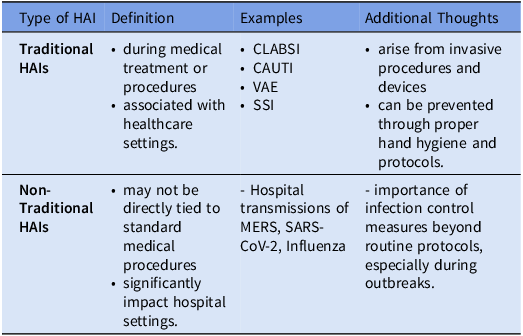
Healthcare-associated infections (HAIs) are infections acquired by patients during medical treatment, and previously were known as nosocomial infections, which referred specifically to acute-care hospital admissions. This definition now encompasses infections occurring in various healthcare settings. Reference Haque, Sartelli and McKimm1 HAIs develop during care in a facility and were not present at admission. Reference Haque, Sartelli and McKimm1 They can be categorized into traditional types, such as central line-associated bloodstream infections (CLABSI), catheter-associated urinary tract infections (CAUTI), surgical site infections (SSI), and ventilator-associated pneumonia (VAP), and non-traditional types, including outbreaks, emerging infectious diseases (EIDs), and multidrug-resistant organisms (MDROs) (Table 1). Reference Yokoe, Anderson and Berenholtz2
Traditional and non-traditional healthcare associated infections

*Abbreviations:.- CLABSI: Central Line-Associated Bloodstream Infection.
- CAUTI: Catheter-Associated Urinary Tract Infection.
- VAE: Ventilator-Associated Event.
- SSI: Surgical Site Infection.
- MERS: Middle East Respiratory Syndrome.
- SARS-CoV-2: Severe Acute Respiratory Syndrome Coronavirus 2.
HAIs are a significant global health concern, affecting millions annually and posing substantial challenges to healthcare systems. Patients with HAIs experience 2–20 more days of hospitalization than those without infections. The mortality rate among infected patients ranges from 7% to 64.6%, and the economic burden includes extended hospital stays, additional tests, and invasive procedures, Reference Gonçalves and Carmo TIG3,Reference Gidey, Gidey and Hailu4 for example traditional HAIs are associated with a case-fatality rate of 2.3–14.4%. Reference Al-Tawfiq and Tambyah5
This review examines both traditional and non-traditional HAIs, focusing on their prevalence, impact, and management strategies. By addressing these elements, the aim is to enhance healthcare professionals’ understanding of HAIs and effective prevention methods. Ultimately, we will explore the “Striving for Zero” initiative to determine if it serves as a target, vision, or guiding philosophy in combating these infections.
Traditional healthcare-associated infections (HAIs)
Traditional HAIs remain a significant challenge in healthcare settings mainly for CLABSI, CAUTI, VAP, and SSI.
Burden of traditional HAIs
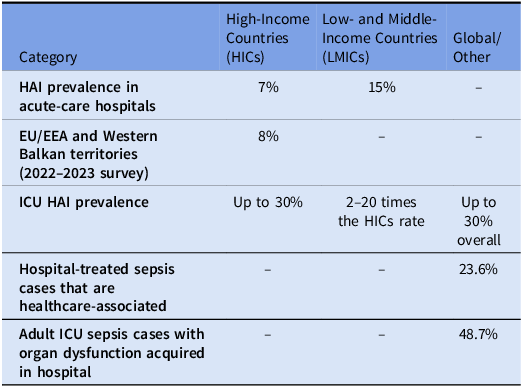
Based on the 2011 World Health Organization (WHO) Report on the Burden of Endemic HAIs, there is a variation in the burden among high-income countries (HICs) and low- and middle-income countries (LMICs). The prevalence of HAI in HICs is typically lower, typically less than 10%. The prevalence of HAI in LMICs is much higher there than in HICs; there is a lack of data because of surveillance resource limitations. 6 In addition, there is regional variations with a rate of 11.8% in the Eastern Mediterranean Region, 10% in South East Asia and 4.6–9.3% in the European Region. Reference Haque, Sartelli and McKimm1 According to data from 55 countries, the overall prevalence of HAI is estimated to be 8.7%. Reference Jabbari Shiadeh, Pormohammad and Hashemi7 Prevalence is lower in the Western Pacific Region than in other regions. Reference Jabbari Shiadeh, Pormohammad and Hashemi7 A most recent report from the WHO in 2024 also shows variable HAIs in different countries (Table 2). 8 The data highlights the significant disparity in HAI prevalence between high-income countries and low- and middle-income countries, particularly in intensive care units. The high rates of healthcare-associated sepsis cases, especially in adult ICUs, underscore the critical need for improved infection prevention and control measures globally, with a particular focus on resource-limited settings. 8
A summary of the key statistics on healthcare-associated infections (HAIs) across different healthcare settings and regions. Data from WHO 2024 report [8]

CLABSI rates vary across healthcare settings, with a reported baseline rate of 2.1 per 1,000 catheter days in a study of 250 hospitals in the USA. Reference Furuya, Dick and Perencevich9 Risk factors for the development of CLABSI include: immunocompromised or neutropenic patients, severe burns or malnutrition, prolonged central line catheterization, femoral site insertion and multiple catheter lumens. One study examined factors were associated with CLABSI and were the duration of ICU stay; duration of catheter insertion; and APACHE II score. Reference Moriyama, Ando and Kotani10
CAUTIs are a significant concern, with varying rates reported. In Saudi Arabia, the CAUTI rate was 1.68 per 1,000 catheter-days across 99 hospitals and 15 ICUs, with the highest rates in pediatric medical (5.73) and adult medical (2.02) ICUs. Reference Aldecoa, Alanazi and Bin Saleh11 Another study found a slightly lower rate of 1.64 per 1,000 catheter-days from 47,926 patients and 61,047 catheterizations, noting a higher pediatric rate of 2.08 compared to 1.61 in adults. Reference Letica-Kriegel, Salmasian and Vawdrey12 SSI rates range from .5% to 3% of surgical procedures. Reference Seidelman, Mantyh and Anderson13 Risk factors include patient conditions (eg, diabetes, obesity), surgical complexity, procedure duration, and preoperative preparation.
Prevention of traditional HAIs
Guidelines for preventing CLABSI include evidence-based strategies such as a comprehensive bundle approach, proper hand hygiene, maximal sterile barrier precautions, and Chlorhexidine skin antisepsis, which reduces CLABSI risk by 49% compared to povidone-iodine. Reference Chaiyakunapruk, Veenstra and Lipsky14 Other measures involve avoiding femoral site insertion, daily catheter necessity assessments, adequate staffing, and bundle implementation. Reference Buetti, Marschall and Drees15
The AHRQ reports significant progress in reducing CAUTI rates through initiatives like the Comprehensive Unit-based Safety Program. A study of 926 hospital units showed a 32% decrease in CAUTI rates in non-ICUs, from 2.28 to 1.54 infections per 1,000 catheter-days, though rates in ICUs remained unchanged. Reference Saint, Greene and Krein16 CAUTI prevention strategies include limiting catheter use, proper insertion techniques, maintaining a closed drainage system, and regular necessity assessments. Reference Patel, Advani and Kofman17
To reduce SSI rates, evidence-based interventions include avoiding razors for hair removal, using chlorhexidine gluconate with alcohol, maintaining normothermia, and ensuring perioperative glycemic control. Reference Seidelman, Mantyh and Anderson13,Reference Liu, Dumville and Norman18–Reference Calderwood, Anderson and Bratzler20 Implementing these practices can significantly lower HAIs, enhancing patient outcomes and reducing healthcare costs.
Non-traditional healthcare-associated infections
Multi-drug-resistant organisms (MDROs)
Non-traditional HAIs present significant challenges beyond typical infectious diseases in healthcare settings, with MDRO outbreaks being a major concern. These MDRO complicate treatment, leading to longer hospital stays, increased costs, and higher mortality rates. Reference Magiorakos, Srinivasan and Carey21 MDROs include pathogens like methicillin-resistant Staphylococcus aureus (MRSA), vancomycin-resistant enterococci (VRE), and carbapenem-resistant Enterobacteriaceae (CRE), which can cause severe and hard-to-treat infections. Reference Sun Jin and Fisher22,Reference Wang, Zhang and Breland23 The rise of plasmid-mediated colistin resistance (mcr-1) raises alarms about widespread drug resistance among gram-negative bacteria Reference Sun Jin and Fisher22,Reference Wang, Zhang and Breland23 and complicates treatment and control efforts. Reference McArthur24 Of importance, the emergence of Candidozyma (Candida) auris has raised concerns due to its persistence in healthcare environments and outbreak potential. Reference Chen, Tian and Han25,Reference Kim, Nguyen and Kidd26 Factors contributing to MDRO emergence include antibiotic overprescription, poor infection control practices, and global interconnectedness. Reference Weiner-Lastinger, Abner and Benin27,Reference Weiner-Lastinger, Abner and Edwards28 Key strategies for prevention of MDROs include antimicrobial stewardship, strict hand hygiene, environmental cleaning, and appropriate isolation precautions. Reference Popovich, Aureden and Ham29 Collaborative efforts among infection control specialists, microbiologists, clinicians, and public health authorities are crucial as well. Reference Banach, Bearman and Barnden30
Emerging infectious diseases (EIDs)
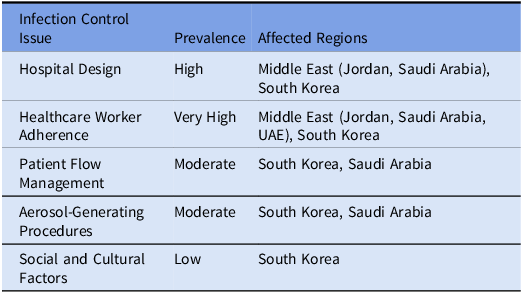
In parallel, the rise of EIDs poses additional challenges to healthcare settings. In the recent years, the 2009 H1N1 influenza pandemic, the Ebola outbreaks in West Africa (2013–2015) and the Democratic Republic of the Congo (2018–2020), poliomyelitis (2014–present), Zika (2016), and COVID-19 (2020–2023), the 2022–2023 and 2024 Mpox outbreaks were designated public health events of international concern by the World Health Organization (WHO). Reference Wilder-Smith and Osman31–Reference Weber, Rutala and Fischer35 The Middle East Respiratory Syndrome Coronavirus (MERS-CoV) had caused multiple healthcare associated outbreaks and were related to multiple factors (Table 3). Reference Al-Tawfiq and Auwaerter36 Healthcare workers (HCWs) are at high risk of acquiring and spreading emerging infections within healthcare facilities. Reference Alghamdi, Alharbi and Hadid37 Studies have shown that healthcare-associated COVID-19 outbreaks can be substantial. In Taiwan, a nationwide study reported 54 healthcare-associated COVID-19 outbreaks involving 512 confirmed cases between January 2020 and July 2021. The median number of affected cases per outbreak was six, with a median outbreak duration of 12 days. Reference Wu, Su and Chien38
Main infection control issues and their prevalence in relation to middle east respiratory syndrome coronavirus outbreaks [Reference Al-Tawfiq and Auwaerter36]

In a PCR study of SARS-CoV-2, 326 HCWs had COVID-19, with ten infection clusters identified; HCWs were the index case in nine clusters and a patient in one. Reference Saad, Molaeb and Almoosa39 Transmission dynamics in healthcare settings are complex, with HCW-to-HCW transmission being significant. A Swedish study found that 78% of HCW cases during an outbreak were linked to co-workers. Reference Mathabire Rücker, Gustavsson and Rücker40 Key risk factors for HCWs included direct care of COVID-19 patients and positive family contacts, with adjusted odds ratios of 8.4 and 9.0, respectively. Reference Mathabire Rücker, Gustavsson and Rücker40 COVID-19 rates among HCWs often mirrored community cases, suggesting that strict infection control in non-clinical areas may not always be necessary. Reference Zheng, Hafezi-Bakhtiari and Cooper41
The potential for nosocomial spread of EIDs is concerning due to delayed recognition of novel pathogens, which can hinder early infection control measures. Reference McArthur24 Close contact with infected patients increases HCWs’ risk of acquiring and spreading infections, especially in facilities housing immunocompromised individuals. Resource-limited settings may lack adequate personal protective equipment (PPE) or isolation capabilities during outbreaks. Reference Al-Tawfiq, Garout and Gautret42
Effective management of EIDs requires understanding the pathogens, modes of transmission, and treatment strategies. Surveillance and response protocols are essential for early detection and containment as well. Reference Wang, Li and Wang43 Awareness, preparedness, and collaboration across sectors are vital to mitigate EID impacts. Reference Petersen, Koopmans and Go44,Reference Ellwanger, Chies and Kaminski V45
The CDC has developed a strategic plan focusing on surveillance, research, prevention, and strengthening public health infrastructure to address emerging infectious disease threats Effective response strategies depend on collaboration among healthcare providers, microbiologists, and public health professionals. Reference Ellwanger, Chies and Kaminski V45 Healthcare facilities must implement policies for early identification of highly communicable diseases, immediate isolation, and proper management to prevent transmission. Reference Weber, Rutala and Fischer35 Additionally, protocols for early identification and isolation of suspected EIDs, ensuring adequate PPE supplies, training staff in infection control, and developing surge capacity plans are crucial . Reference Mathabire Rücker, Gustavsson and Rücker40 Designating entire units with dedicated HCWs for SARS-CoV-2 patients may also be beneficial. Reference Al-Tawfiq, Garout and Gautret42 As new threats emerge, healthcare systems must remain vigilant and adaptable to protect patients and HCWs.
The interactions between traditional and non-traditional healthcare-associated infections (HAIs)
The interaction between traditional and non-traditional HAIs is a complex and continually evolving within healthcare settings and can significantly worsen patient outcomes and complicate infection control efforts. For instance, certain non-traditional HAIs, such as viral infections, can suppress the immune system, rendering patients more susceptible to traditional bacterial HAIs. Reference Manna, Baindara and Mandal46,Reference Al-Tawfiq, Alhumaid and Alshukairi47
Moreover, non-traditional HAIs, particularly those that necessitate broad-spectrum antimicrobial treatment, can disrupt the patient’s normal microbiome. This disruption may increase the risk of traditional HAIs, such as Clostridioides difficile infections. Reference Sartelli, Marini and McNelis48 In one study, carbapenem resistant Acinetobacter baumannii and C. auris were the most common causes of reported MDRO outbreaks during the COVID-19 pandemic. Reference Thoma, Seneghini and Seiffert49 In addition, CAUTIs caused by a carbapenem-resistant Enterobacteriaceae (CRE) are significantly more challenging to treat than one caused by a susceptible organism. Reference Tompkins and van Duin50 Pathogens, like C. auris, have a propensity for biofilm formation. This can enhance the colonization of medical devices, potentially increasing the risk of traditional device-associated infections like CLABSI. Reference Dadi, Radochová and Vargová51 Outbreaks of non-traditional HAIs can strain healthcare resources, potentially leading to lapses in standard infection control practices that prevent traditional HAIs. Reference Cawcutt, Starlin and Rupp52 The presence of non-traditional pathogens can create opportunities for synergistic interactions with traditional HAI-causing organisms, potentially leading to more severe or persistent infections. Reference Dadi, Radochová and Vargová51 One such interaction is an increase in antimicrobial consumption as seen during the first wave of the COVID-19 pandemic, especially in ICUs. Reference AlBahrani, Almogbel and Alanazi53
To address these complex interactions, healthcare facilities must adopt comprehensive infection prevention strategies that consider both traditional and non-traditional HAIs. This includes robust surveillance systems, judicious use of antimicrobials, and innovative approaches to infection control that can adapt to emerging threats. Reference Thoma, Seneghini and Seiffert49,Reference Barlam, Al Mohajer and Al-Tawfiq54
Achieving Zero Healthcare-Associated Infections
HAIs continue to pose a significant challenge in clinical settings, yet many can be prevented through evidence-based interventions. Reference Cagle, Hutcherson and Wiley55,Reference Schreiber, Sax and Wolfensberger56 They can be divided into two categories: potentially preventable HAIs, which can be avoided by following infection prevention protocols, and potentially unpreventable HAIs, which occur despite adherence to recommended measures. Reference Wenzel and Edmond57 Addressing modifiable risk factors is essential for prevention and involves both vertical and horizontal strategies. Vertical strategies target specific pathogens, such as actively detecting and isolating MRSA and VRE, while horizontal strategies focus on reducing the transmission of multiple pathogens through strict hand hygiene, thorough disinfection, skin decolonization with chlorhexidine, appropriate PPE use, and antibiotic stewardship. Reference Haque, Sartelli and McKimm1,Reference Wenzel and Edmond57
The investigation process is critical for determining the preventability of HAIs and identifying areas for improvement. This process aims for zero potentially preventable infections, aligning with the healthcare principle of “primum non nocere” (first, do no harm). Reference Dellinger58 Effective implementation requires a multifaceted approach involving patients, healthcare systems, and workers. Reference Cagle, Hutcherson and Wiley55 Evidence-based strategies may prevent 30% to 70% of HAIs. Reference Schreiber, Sax and Wolfensberger56 However, the law of diminishing returns applies; as prevention efforts intensify, additional benefits may decrease over time . Reference Schreiber, Sax and Wolfensberger56
The concept of “zero tolerance” for HAIs emerged in the early 2000s, evolving into a “targeting zero” approach that acknowledges the complexities of healthcare systems while striving for zero preventable infections. 59 This“zero harm” philosophy represents a paradigm shift in how healthcare organizations address preventable infections, challenging the notion that some HAIs are inevitable. It sets an aspirational goal of eliminating all preventable harm to patients. 59,Reference Bearman, Doll and Cooper60
Implementing comprehensive HAI prevention programs is crucial for achieving the goal of zero HAIs. These programs typically involve multi-faceted interventions including systemic changes and strong support from hospital administrators and clinical leaders. 61 Fostering a culture of safety where all healthcare workers are empowered to prioritize infection prevention is essential. 59 To effectively prevent infections, it is crucial to implement and consistently follow proven measures, such as proper hand hygiene and device management protocols. Additionally, establishing strong data collection systems can help identify areas for improvement and track progress. Reference Sartelli, Bartoli and Borghi62 An integrated approach that addresses multiple aspects of infection prevention simultaneously is also essential for achieving better outcomes. Reference Sartelli, Bartoli and Borghi62
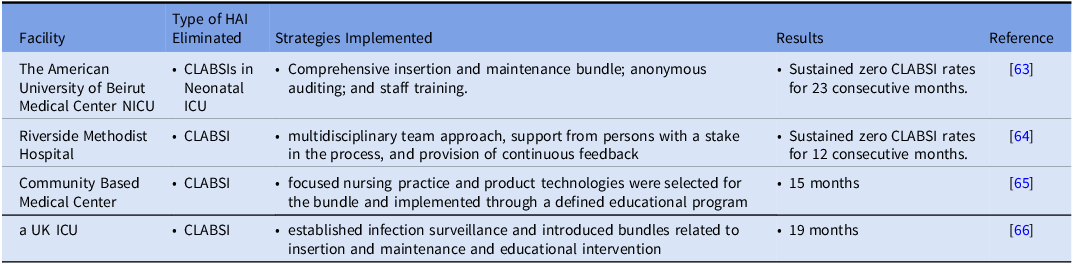
Achieving “zero-target” of HAIs is a challenging but potentially attainable goal, as demonstrated by several healthcare organizations (Table 4). For instance, the American University of Beirut Medical Center’s NICU achieved zero CLABSIs for over 23 months by implementing a comprehensive safety bundle, anonymous auditing, and staff training. Reference Al Bizri, Hanna Wakim and Obeid63 Riverside Methodist Hospital eliminated CLABSI through a multidisciplinary team approach, securing stakeholder support and providing continuous feedback, resulting in zero CLABSI rates for 12 months. Reference Southworth, Henman and Kinder64 The Community Based Medical Center implemented a targeted nursing practice with specific product technologies in their CLABSI prevention bundle, leading to 15 months without infections through a well-defined educational program. Reference Harnage65 In a UK ICU, infection surveillance and insertion/maintenance bundles, along with educational interventions, sustained a reduction in CLABSI rates for 19 months. Reference Longmate, Ellis and Boyle66
Examples of published studies of achieving zero healthcare-associated infections (HAIs)

These examples highlight the importance of evidence-based practices, multidisciplinary collaboration, and a culture of safety in combating HAIs. Common strategies include comprehensive infection control protocols, ongoing staff education, strict hand hygiene adherence, and thorough environmental cleaning. By tailoring interventions to specific HAIs and patient populations while maintaining strong surveillance and accountability, healthcare facilities can significantly lower infection rates and enhance patient outcomes. These success stories serve as valuable models for institutions aiming for zero HAIs. However, some initiatives, like the Spanish Zero Surgical Infection Project (ZSIP) from 2017–2021, did not achieve zero targets. Reference Navarro-Gracia, Gómez-Romero and Lozano-García67
Achieving zero HAIs requires persistent and rigorous monitoring and evaluation at all times. This involves setting clear, measurable goals for reducing HAIs across various types of infections, such as CLABSI, CAUTI, and SSI. 61 It is also essential to implement systems for timely reporting and analysis of infection data, allowing for real-time tracking. Conducting thorough investigations of any HAIs that do occur to identify and address systemic issues. Reference Wilson, Sinno and Hacker Teper68 Regularly communicating progress and challenges to all stakeholders, including frontline staff. 61
Additionally, prevention strategies should be continuously refined and updated based on new evidence and emerging best practices. Reference Sartelli, Bartoli and Borghi62 While the goal of zero HAIs is ambitious, evidence suggests that significant reductions are achievable. For example, one healthcare system reported a 34% decrease in CLABSI after implementing a zero harm initiative. Reference Wilson, Sinno and Hacker Teper68
Implementing “Target zero” initiatives
Implementing “Target Zero” initiatives for HAIs requires a multifaceted approach. Successful programs feature strong leadership that prioritizes HAI prevention and actively supports infection control initiatives by allocating resources, motivating staff, and fostering a culture of safety. Reference Bearman, Doll and Cooper60 In contrast, unsuccessful programs often lack this commitment . Reference Welsh, Flanagan and Hoke69,Reference Nasiri, Shahrbabaki and Sharifi70 Transforming hospital culture to prioritize patient safety and securing steadfast leadership support are essential for a successful “Target Zero” program. Reference Knobloch, Thomas and Musuuza71–Reference Sagana and Hyzy74 Table 5 outlines a roadmap with a structured framework for implementing these initiatives, promoting a culture of safety and measurable improvements in patient outcomes.
Striving for zero: reducing healthcare-associated infections (HAI) - a target, vision, or philosophy

Leadership must promote open communication, encourage questioning of assumptions, and prioritize safety over productivity. Education and training are critical for effective HAI reduction, with successful programs investing in continuous training for HCWs on hand hygiene, appropriate PPE use, and protocol adherence. Conversely, programs that neglect staff education often see increased infection rates. Ongoing education covering fundamental knowledge, skills, and regulatory compliance is essential for HAI prevention. Reference Cardo, Dennehy and Halverson75–Reference Zhang, Wu and Ibrahim77
Successful programs utilize robust data collection and analysis to monitor infection rates and identify patterns, allowing healthcare facilities to pinpoint areas for improvement and assess intervention effectiveness. Inadequate surveillance in unsuccessful programs hinders performance evaluation and necessary adjustments. By addressing avoidable factors and implementing effective infection prevention and control strategies, healthcare systems can significantly reduce HAIs and enhance patient safety. As the World Health Organization (WHO) states, “No one should get sick seeking care,” yet millions are affected by avoidable HAIs each year, highlighting that no health system can claim to be free of them. 78
Effective HAI reduction also requires collaboration among departments and stakeholders within healthcare facilities. Reference Puro, Coppola and Frasca79 Open communication fosters a team approach to infection control and enables the sharing of best practices, while poor communication can lead to siloed operations and fragmented prevention efforts. Successful programs recognize the importance of involving patients in infection prevention, enhancing awareness and compliance through education and encouraging active participation in their care. Ineffective programs often overlook patient education, diminishing their overall impact.
Education and training are crucial in preventing both traditional and non-traditional HAIs. Continuous education for HCWs is essential to uphold high infection prevention standards, keeping them updated on the latest advancements in practices, treatments, and diagnosis. Reference Aboelela, Stone and Larson80,Reference Ruis, Shaffer and Shirley81 This is especially important for addressing emerging infectious diseases and multidrug-resistant organisms.
Competency-based training ensures HCWs are proficient in infection prevention practices, with measurable skills that can be regularly assessed. Tools like the Infection Control Assessment and Response (ICAR) help identify competency gaps. Reference Bhurtyal, Nguyen and Clarke82 A study during the MERS outbreak highlighted that following established procedures reduces cross-infection risks, prioritizes safety, and expedites patient treatment. Reference Al-Tawfiq, Rothwell and Mcgregor83 Training on recognizing, containing, and managing MERS-CoV cases was crucial for nurse educators. Reference Al-Tawfiq, Rothwell and Mcgregor83
Simulation-based training has proven effective for HAI prevention, enhancing HCWs’ competence, confidence, and compliance with infection measures, ultimately reducing HAI rates and healthcare costs. Reference Kang, Nagaraj and Campbell84 National initiatives like the CDC’s STRIVE program emphasize education in improving infection prevention practices through multimodal strategies that include educational materials and guided facilitation. Reference Patel, Popovich and Collier85,Reference Fowler, Forman and Ameling86
Hand hygiene is a cornerstone of infection prevention and requires ongoing educational reinforcement. Despite its importance, compliance rates are low, averaging around 40% in hospitals. Educational materials, such as training films and visual posters, effectively promote hand hygiene practices. Reference Al-Tawfiq, Rothwell and Mcgregor83,Reference Al-Tawfiq, Treble and Abdrabalnabi87
Challenges and limitations of the “Target zero” approach
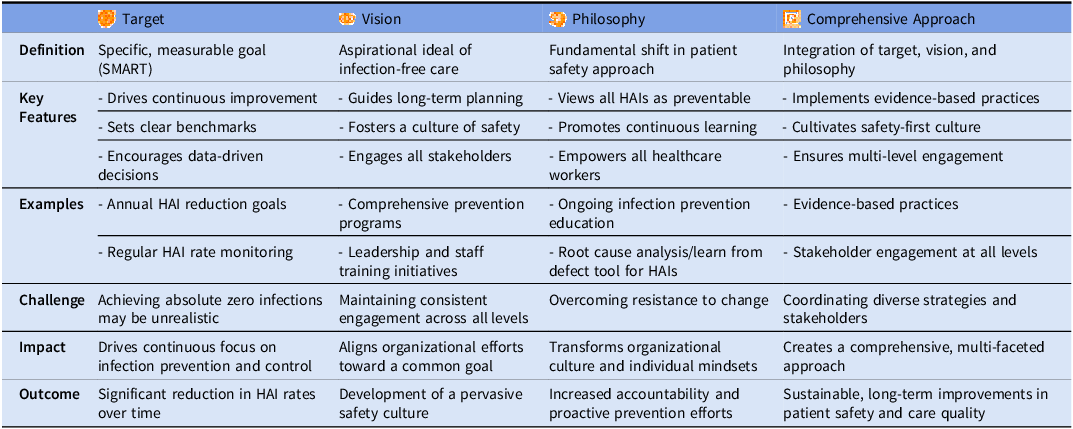
Achieving zero HAIs requires a comprehensive commitment to patient safety. While absolute zero may be difficult, striving for this goal can significantly enhance infection prevention practices. Effective HAI reduction programs rely on evidence-based methods, including checklists, bundles, and regular training for HCWs. One study included 116 intensive care units and showed a significant reduction of 43.5%, 52.1%, and 65.8%, for CLABSI, VAP and CAUTI, respectively. Reference Tuma, Vieira and Ribas88 The reduction was linked to the VAP prevention bundle, CAUTI and CLABSI insertion and maintenance bundles, all showing inverse correlations with HAI incidence densities. Reference Tuma, Vieira and Ribas88 Pursing Zero HAIs serves as a goal, a vision, and guiding philosophy encompassing the interconnected elements of healthcare quality improvement. As a goal, it is a clear, quantifiable objective. Even though it might be difficult to achieve, establishing this ambitious goal motivates ongoing efforts for improvement. As a vision, it represents a perfect scenario in which patients receive treatment without contracting avoidable infections. Long-term planning and decision-making are guided by this aspirational perspective. As a philosophy, it indicates a significant change in the way medical facilities handle patient safety. Prioritizing infection prevention as a fundamental element of high-quality care with multiple elements such as encouraging a culture of continuous improvement and learning from defects and to assume responsibility for infection prevention (Table 5).
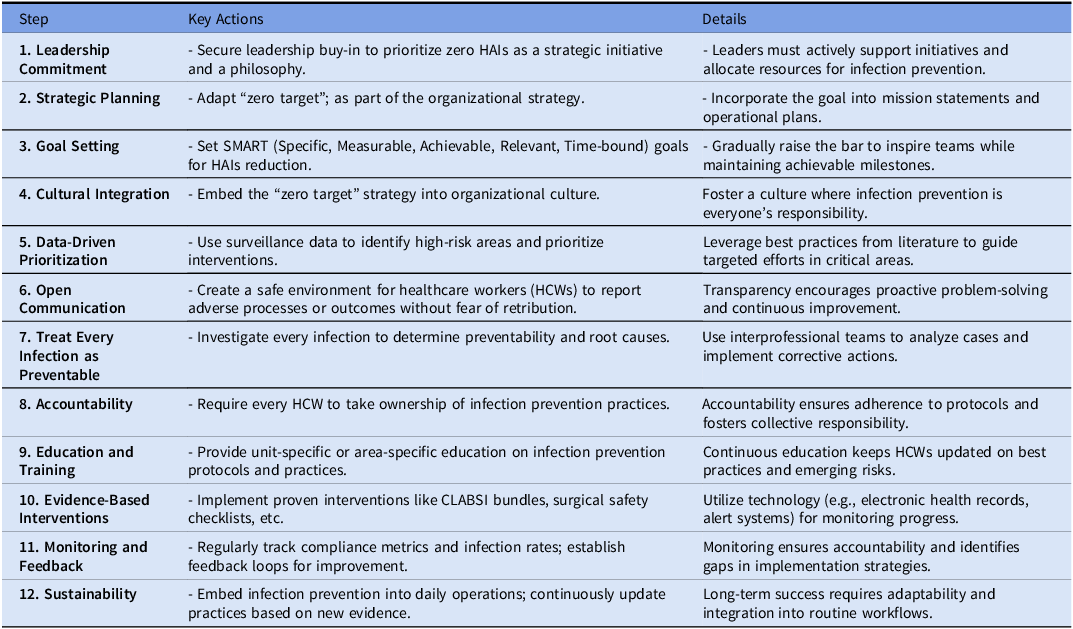
Achieving the ambitious goal of “zero HAIs” requires a strategic approach with several steps Reference Al-Tawfiq, Memish and Soule89 (Table 6).
Roadmap to achieve zero healthcare-associated infections (HAIs)

Securing leadership commitment is crucial for prioritizing infection reduction and integrating it into the organization’s strategic plan. Setting an inspirational goal enables initial achievements, with expectations for gradual increases over time. This strategy should become part of the organizational culture, making infection prevention a shared value. Priorities must be based on surveillance data and best practices. Creating a safe environment for HCWs to report adverse processes is essential. Each infection should be viewed as potentially preventable, prompting investigations into prevention failures. An interprofessional/multidisciplinary team should analyze infection cases to foster collaboration. Every HCW must be held accountable for preventing HAIs, with unit-specific education to enhance knowledge and skills. Infection prevention should be seen as a comprehensive system, considering all components in care processes. The ultimate goal should be the lowest possible infection rate, ideally a ‘zero target,’ driving continuous improvement and patient safety. Healthcare leaders must receive thorough education on infection prevention strategies, their impact on patient outcomes, and the economic implications of HAIs. This knowledge empowers leaders to make informed decisions on resource allocation and budget prioritization, ensuring support for effective infection prevention initiatives. Reference Al-Tawfiq, Memish and Soule89
In conclusion, achieving zero HAIs is a priority, even though reaching absolute zero might be difficult, it encourages ongoing advancements in patient safety and stems from its capacity to encourage a culture of alertness, creativity, and cooperation. The emphasis is on data analysis, cutting-edge technologies, and evidence-based practices. Closing the gaps in patient safety will require staff engagement, unwavering leadership commitment, and the integration into daily workflows. By sticking to this objective, healthcare systems can continue to lower the morbidity, mortality, and financial burden related to HAIs. Maintaining the goal of zero HAIs does not only enhances patient outcomes for each individual but also advances the general objectives of public health and healthcare quality improvement. Reference Exline, Ali and Zikri90,Reference Lisboa and Rello91
Data availability statement
Not applicable.
Acknowledgements
This review was based on a presentation given during the International Congress of Infectious Diseases meeting, in Cape Town, South Africa (https://doi.org/10.1017/ash.2025.10031).
Financial support
None to declare.
Competing interests
None to declare.

 Open access

