




Impact statement
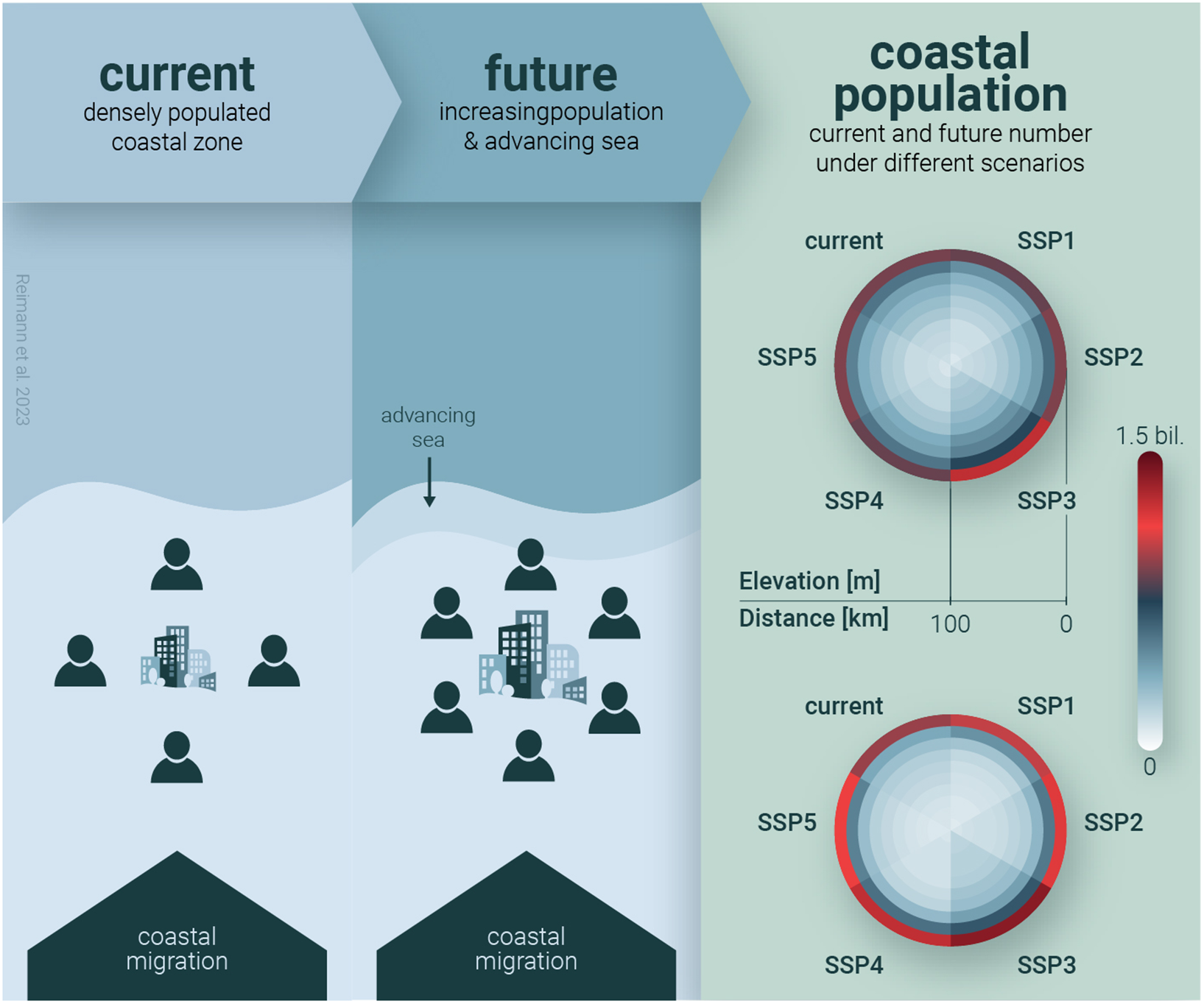
Coastal risks will increase in the course of the 21st century due to climate change, the future impacts of which will largely be driven by socioeconomic developments in coastal locations. Coastal zones have been attractive for human settlement for centuries, resulting in higher population growth in coastal compared to inland locations. Globally, these trends are expected to continue in the future, resulting in an increase in coastal exposure, the extent of which depends on changes in socioeconomic conditions that drive population growth and coastal migration processes. These processes have thus far not been accounted for in continental- to global-scale coastal risk assessments in a systematic manner. Beyond illustrating the need to mainstream the use of socioeconomic scenarios to explore future coastal exposure, this review highlights the importance to additionally account for aspects of social vulnerability in assessing coastal risks, including socioeconomic characteristics of exposed populations (e.g., age, education levels, and ethnicity), adaptation responses, and migration decisions. Furthermore, more systematic reporting of data and methods used in such assessments is necessary to enable comparison of the outcomes of various continental- to global-scale studies. By establishing hotspots of exposure and vulnerability, the results of such assessments can inform coastal policies and risk management strategies that are sustainable under a wide range of coastal futures.
Introduction
Coastal areas are susceptible to various natural and climatic hazards such as coastal erosion, saltwater intrusion into soils and coastal aquifers, and coastal flooding due to extreme sea levels (Brown et al., Reference Brown, Nicholls, Woodroffe, Hanson, Hinkel, Kebede, Neumann, Vafeidis and Finkl2013; Oppenheimer et al., Reference Oppenheimer, Glavovic, Hinkel, van de Wal, Magnan, Abd-Elgawad, Cai, Cifuentes-Jara, DeConto, Ghosh, Hay, Isla, Marzeion, Meyssignac, Sebesvari, Pörtner, Roberts, Masson-Delmotte, Zhai, Tignor, Poloczanska, Mintenbeck, Alegría, Nicolai, Okem, Petzold, Rama and Weyer2022). In particular, in river mouth locations, these coastal hazards can be compounded by fluvial (i.e., river) flooding due to increased river discharge during conditions of heavy precipitation or increased snow melt upstream (Zscheischler et al., Reference Zscheischler, Martius, Westra, Bevacqua, Raymond, Horton, van den Hurk, AghaKouchak, Jézéquel, Mahecha, Maraun, Ramos, Ridder, Thiery and Vignotto2020). Furthermore, coastal areas are increasingly prone to pluvial (i.e., rain) flooding as a consequence of soil sealing and altered hydrology associated with urbanization (Dodman et al., Reference Dodman, Hayward, Pelling, Castan Broto, Chow, Chu, Dawson, Khirfan, McPhearson, Prakash, Zheng, Ziervogel, Pörtner, Roberts, Tignor, Poloczanska, Mintenbeck, Alegría, Craig, Langsdorf, Löschke, Möller, Okem and Rama2022). These hazards are expected to aggravate in the course of the 21st century and well beyond as climate change gradually leads to changes in precipitation patterns and river discharge regimes, as well as to rises in sea levels, thus resulting in an increase in the frequency and intensity of coastal flooding and other coastal hazards (IPCC, Reference Masson-Delmotte, Zhai, Pirani, Connors, Péan, Berger, Caud, Chen, Goldfarb, Gomis, Huang, Leitzell, Lonnoy, Matthews, Maycock, Waterfield, Yelekci, Yu and Zhou2021; Oppenheimer et al., Reference Oppenheimer, Glavovic, Hinkel, van de Wal, Magnan, Abd-Elgawad, Cai, Cifuentes-Jara, DeConto, Ghosh, Hay, Isla, Marzeion, Meyssignac, Sebesvari, Pörtner, Roberts, Masson-Delmotte, Zhai, Tignor, Poloczanska, Mintenbeck, Alegría, Nicolai, Okem, Petzold, Rama and Weyer2022).
The impacts of these hazards can be significant due to the high concentration of population and assets in exposed areas as coastal regions have historically been attractive locations for human settlement, for example, for trading, fisheries, and tourism (Neumann et al., Reference Neumann, Vafeidis, Zimmermann and Nicholls2015; Kummu et al., Reference Kummu, de Moel, Salvucci, Viviroli, Ward and Varis2016). Future socioeconomic development will determine the severity of coastal impacts in places where high increases in population and urbanization levels are expected, thereby leading to an increase in coastal assets (Merkens et al., Reference Merkens, Reimann, Hinkel and Vafeidis2016; Hoornweg and Pope, Reference Hoornweg and Pope2017). Impacts are largely driven by the socioeconomic trajectory taken (Rohat, Reference Rohat2018; Rohat et al., Reference Rohat, Flacke, Dosio, Pedde, Dao and van Maarseveen2019): more equitable development and high economic growth will likely result in an increase in coastal assets (hence exposure) globally, while high inequalities and dampened economic growth may result in high population growth, particularly in poorer countries, with large shares of vulnerable populations affected during extreme events, particularly due to a lack of adaptive capacity (Hinkel et al., Reference Hinkel, Lincke, Vafeidis, Perrette, Nicholls, Tol, Marzeion, Fettweis, Ionescu and Levermann2014; Reference Hinkel, Aerts, Brown, Jiménez, Lincke, Nicholls, Scussolini, Sanchez-Arcilla, Vafeidis and Addo2018). Additionally, human-induced land subsidence related to groundwater extraction and exploitation of oil or gas reservoirs (Shirzaei et al., Reference Shirzaei, Freymueller, Törnqvist, Galloway, Dura and Minderhoud2021) as well as the weight of buildings (Nicholls et al., Reference Nicholls, Marinova, Lowe, Brown, Vellinga, Gusmao, Hinkel and Tol2011) further exacerbates coastal risks, particularly in delta regions (Nicholls et al., Reference Nicholls, Lincke, Hinkel, Brown, Vafeidis, Meyssignac, Hanson, Merkens and Fang2021; Magnan et al., Reference Magnan, Garschagen, Gattuso, Hay, Hilmi, Holland, Isla, Kofinas, Losada, Petzold, Ratter, Schuur, Tabe, van de Wal, Pörtner, Roberts, Masson-Delmotte, Zhai, Tignor, Poloczanska, Mintenbeck, Alegría, Nicolai, Okem, Petzold, Rama and Weyer2022). The uncertainties in future impacts related to future changes in socioeconomic conditions in the coastal zone can be explored with the help of socioeconomic scenarios such as the Shared Socioeconomic Pathways (SSPs), which are the current standard socioeconomic scenarios used in climate change research (O’Neill et al., Reference O’Neill, Carter, Ebi, Harrison, Kemp-Benedict, Kok, Kriegler, Preston, Riahi, Sillmann, van Ruijven, van Vuuren, Carlisle, Conde, Fuglestvedt, Green, Hasegawa, Leininger, Monteith and Pichs-Madruga2020; Box 1).
The Shared Socioeconomic Pathways (SSPs).
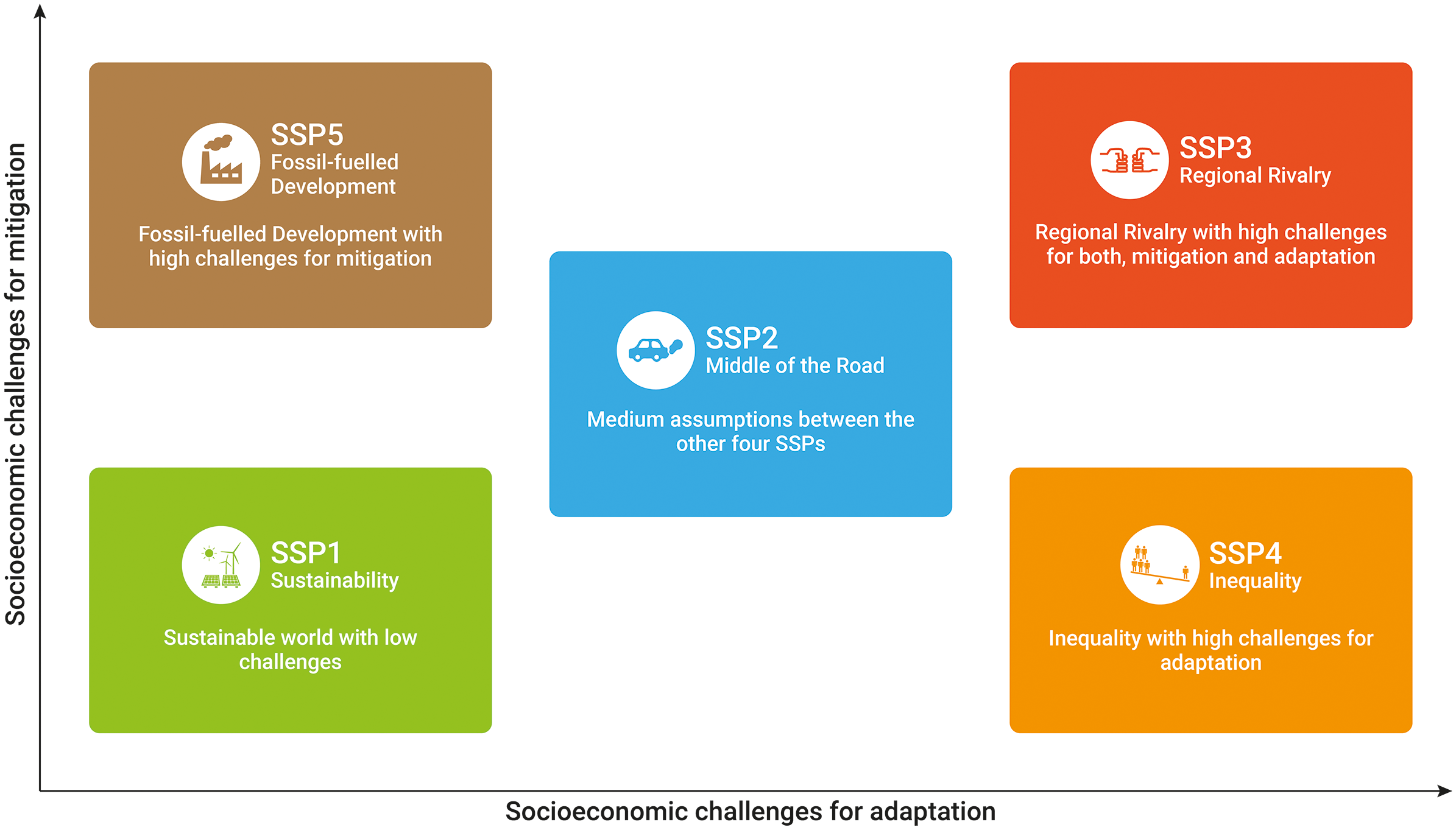
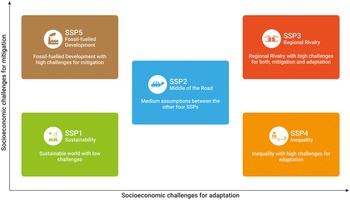
The SSPs are one component of the current scenario framework in climate change research, which consists of climate scenarios (Representative Concentration Pathways, RCPs), socioeconomic scenarios (SSPs), and climate policy scenarios (Shared Policy Assumptions, SPAs) (van Vuuren et al., Reference van Vuuren, Kriegler, O’Neill, Ebi, Riahi, Carter, Edmonds, Hallegatte, Kram, Mathur and Winkler2014; O’Neill et al., Reference O’Neill, Carter, Ebi, Harrison, Kemp-Benedict, Kok, Kriegler, Preston, Riahi, Sillmann, van Ruijven, van Vuuren, Carlisle, Conde, Fuglestvedt, Green, Hasegawa, Leininger, Monteith and Pichs-Madruga2020). Five SSPs describe plausible alternative trends in global-scale societal development in the course of the 21st century based on their socioeconomic challenges for mitigation and adaptation (O’Neill et al., Reference O’Neill, Kriegler, Riahi, Ebi, Hallegatte, Carter, Mathur and van Vuuren2014; Figure 1). Each SSP has an underlying narrative that qualitatively describes a broad range of socioeconomic developments in the form of a story (O’Neill et al., Reference O’Neill, Kriegler, Ebi, Kemp-Benedict, Riahi, Rothman, van Ruijven, van Vuuren, Birkmann, Kok, Levy and Solecki2017). In SSP1, challenges are low as society develops sustainably; in SSP2, historic patterns in socioeconomic development continue, leading to moderate challenges; SSP3 has high challenges due to resurgent nationalism and limited global cooperation; SSP4 has high adaptation challenges as inequalities are high within and across countries; and SSP5 is characterized by rapid economic growth based on fossil fuels, which lead to high challenges for mitigation. Several key variables of socioeconomic development have been quantified with the help of the assumptions described in each SSP narrative, resulting in national-level projections of population, age, education (KC and Lutz, Reference KC and Lutz2017), urbanization (Jiang and O’Neill, Reference Jiang and O’Neill2017), and Gross Domestic Product (GDP) (Crespo Cuaresma, Reference Crespo Cuaresma2017; Dellink et al., Reference Dellink, Chateau, Lanzi and Magné2017) until 2100. These projections as well as their underlying qualitative assumptions provide boundary conditions for downscaling exercises that account for trends such as internal migration and urban development patterns, which influence the spatial distribution of the population.
The five SSPs with their challenges for mitigation and adaptation (adapted from O’Neill et al., Reference O’Neill, Kriegler, Ebi, Kemp-Benedict, Riahi, Rothman, van Ruijven, van Vuuren, Birkmann, Kok, Levy and Solecki2017).
Although the importance of socioeconomic development in driving coastal impacts is well established, future changes in impacts are often assessed by combining future hazard projections with current population numbers, particularly at continental to global scales (e.g., Muis et al., Reference Muis, Verlaan, Nicholls, Brown, Hinkel, Lincke, Vafeidis, Scussolini, Winsemius and Ward2017; Kulp and Strauss, Reference Kulp and Strauss2019); or by accounting for the dynamics of socioeconomic development, but without considering differences in attractiveness between inland and coastal locations (e.g., Hinkel et al., Reference Hinkel, Lincke, Vafeidis, Perrette, Nicholls, Tol, Marzeion, Fettweis, Ionescu and Levermann2014; Brown et al., Reference Brown, Nicholls, Lowe and Hinkel2016; Nicholls et al., Reference Nicholls, Brown, Goodwin, Wahl, Lowe, Solan, Godbold, Haigh, Lincke, Hinkel, Wolff and Merkens2018; Vafeidis et al., Reference Vafeidis, Schuerch, Wolff, Spencer, Merkens, Hinkel, Lincke, Brown and Nicholls2019). Few studies, however, do account for internal migration processes such as rural–urban and inland–coastal migration (e.g., Neumann et al., Reference Neumann, Vafeidis, Zimmermann and Nicholls2015; Merkens et al., Reference Merkens, Lincke, Hinkel, Brown and Vafeidis2018) or dynamics in the development of urban settlements (e.g., Tiggeloven et al., Reference Tiggeloven, Moel, Winsemius, Eilander, Erkens, Gebremedhin, Diaz Loaiza, Kuzma, Luo, Iceland, Bouwman, van Huijstee, Ligtvoet and Ward2020; Vousdoukas et al., Reference Vousdoukas, Mentaschi, Hinkel, Ward, Mongelli, Ciscar and Feyen2020) in driving coastal impacts. Despite these advancements, recent work has pointed out the persisting bias in coastal impact assessments toward focusing on the hazard rather than on changes in socioeconomic conditions, thereby stressing the need to account for dynamics in socioeconomic development in a more systematic manner (Hinkel et al., Reference Hinkel, Feyen, Hemer, Le Cozannet, Lincke, Marcos, Mentaschi, Merkens, de Moel, Muis, Nicholls, Vafeidis, van de Wal, Vousdoukas, Wahl, Ward and Wolff2021; Oppenheimer et al., Reference Oppenheimer, Glavovic, Hinkel, van de Wal, Magnan, Abd-Elgawad, Cai, Cifuentes-Jara, DeConto, Ghosh, Hay, Isla, Marzeion, Meyssignac, Sebesvari, Pörtner, Roberts, Masson-Delmotte, Zhai, Tignor, Poloczanska, Mintenbeck, Alegría, Nicolai, Okem, Petzold, Rama and Weyer2022; Rasmussen et al., Reference Rasmussen, Kulp, Kopp, Oppenheimer and Strauss2022).
This review article aims to take a first step toward addressing this need by synthesizing the literature related to current and future population development in coastal locations at continental to global scales. Building on the methods used in previous studies (see section “Coastal population analysis”), we present current (see section “Observed population development in coastal locations”) and future (see section “Projections of future coastal population development”) spatial population distributions by distance from the coast and by elevation. To illustrate the uncertainty related to future coastal development and to provide a first estimate of how socioeconomic development may drive future coastal impacts, we present differences in future coastal population for each SSP. Furthermore, we discuss the importance of incorporating aspects of social vulnerability to characterize socioeconomic processes in a comprehensive manner in section “Beyond exposure – Consider aspects of vulnerability.” Last, we propose a number of action points for future research in section “Action points for future work,” addressing uncertainties that have hampered the inclusion of socioeconomic development in continental- to global-scale coastal impact assessments in previous work.
Coastal population analysis
We enhanced the coastal population numbers reported in the literature with results from additional analysis that we conducted using recently published datasets. To enable comparison with the numbers presented in the literature (mainly Small and Nicholls, Reference Small and Nicholls2003; Kummu et al., Reference Kummu, de Moel, Salvucci, Viviroli, Ward and Varis2016), we analyzed both the current and future population distributions by distance from the coast (up to 100 km) as well as by elevation (up to 100 m). We used this inclusive definition of the coast as urban settlements, in particular megacities, can extend several tens of kilometers inland (see MacManus et al., Reference MacManus, Balk, Engin, McGranahan and Inman2021 for an example) and constitute an important migration factor (Hugo, Reference Hugo2011; Seto, Reference Seto2011). Furthermore, as uncertainty in future coastal population development is high due to the multitude of factors that drive socioeconomic development in general (O’Neill et al., Reference O’Neill, Kriegler, Ebi, Kemp-Benedict, Riahi, Rothman, van Ruijven, van Vuuren, Birkmann, Kok, Levy and Solecki2017) and internal migration more specifically (Black et al., Reference Black, Adger, Arnell, Dercon, Geddes and Thomas2011a), using smaller distance increments than the 10 km increments used here would give a false sense of certainty related to such drivers of spatial population patterns.
To assess the current population distribution, we calculated these numbers based on the WorldPop population dataset of 2020 (constrained version), which modeled spatial population by distributing it across settlements as established based on satellite imagery (Bondarenko et al., Reference Bondarenko, Kerr, Sorichetta and Tatem2020). We first merged the data for each country into one raster layer with a spatial resolution of ~100 m (3 arc sec, WGS 84). To calculate the population by elevation (in 10 m increments), we used the Multi-Error-Removed Improved-Terrain Digital Elevation Model (MERIT DEM) (Yamazaki et al., Reference Yamazaki, Ikeshima, Tawatari, Yamaguchi, O’Loughlin, Neal, Sampson, Kanae and Bates2017) and overlaid each elevation increment with the population at the native spatial resolution (i.e., 3 arc sec). To assess population distributions by distance, we calculated the Euclidean distance from the coast based on a water mask derived from MERIT DEM, and then summed up the population by 10 km distance increment. We used the same procedure to analyze the future population (in 2100) based on the spatial population projections of Merkens et al. (Reference Merkens, Reimann, Hinkel and Vafeidis2016) who accounted for inland–coastal as well as rural–urban migration processes per SSP. As these projections were produced at a spatial resolution of 30 arc sec (approximately 1 km at the equator), we conducted the same analysis steps as described above after aggregating all data to this resolution.
Observed population development in coastal locations
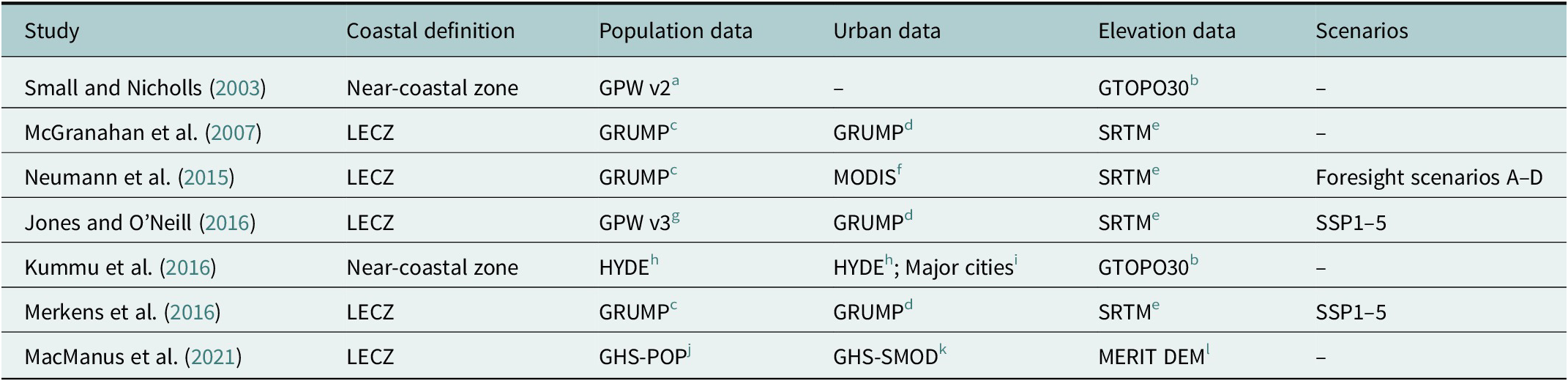
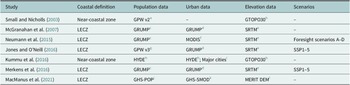
In 1990, about 1.2 billion people lived in the near-coastal zone, defined as all land within 100 km from the coast at an elevation of up to 100 m, meaning that 23% of the global population lived in 9% of the global land area (Small and Nicholls, Reference Small and Nicholls2003). By 2010, over 27% of the global population (~1.9 billion) lived in the near-coastal zone (Kummu et al., Reference Kummu, de Moel, Salvucci, Viviroli, Ward and Varis2016), which further increased to 2.15 billion in 2020 (based on WorldPop). Considering the low-elevation coastal zone (LECZ), defined as land with an elevation of up to 10 m in hydrological connection to the sea and often used as a proxy for all land potentially affected by future coastal hazards, over 10% (634 million) of the global population lived in this low-lying coastal zone in 2000, covering 2% of the global land area (McGranahan et al., Reference McGranahan, Balk and Anderson2007; Balk et al., Reference Balk, Montgomery, McGranahan, Kim, Mara, Todd, Buettner, Dorélien and Guzmán2009; MacManus et al., Reference MacManus, Balk, Engin, McGranahan and Inman2021). Almost 75% of the global LECZ population lived in Asia, with less than 10% in all other world regions (Merkens et al., Reference Merkens, Reimann, Hinkel and Vafeidis2016). In 2015, the LECZ population amounted to 815 million, corresponding to almost 12% of the world population (MacManus et al., Reference MacManus, Balk, Engin, McGranahan and Inman2021), and grew to 898 million in 2020 (based on WorldPop). We must note that the numbers presented here may not be fully consistent due to the use of different population, urban settlement, and elevation datasets employed in each study (Table 1).
Overview of reviewed studies including their assumptions and datasets used (extended from Merkens, Reference Merkens2019)
a CIESIN (2000).
b USGS (1996).
c CIESIN et al. (2011).
d CIESIN (2011).
f Schneider et al. (Reference Schneider, Friedl and Potere2009).
g CIESIN et al. (2005).
h Klein Goldewijk et al. (Reference Klein Goldewijk, Beusen and Janssen2010).
i ESRI (2011).
j Schiavina et al. (Reference Schiavina, Freire and MacManus2019).
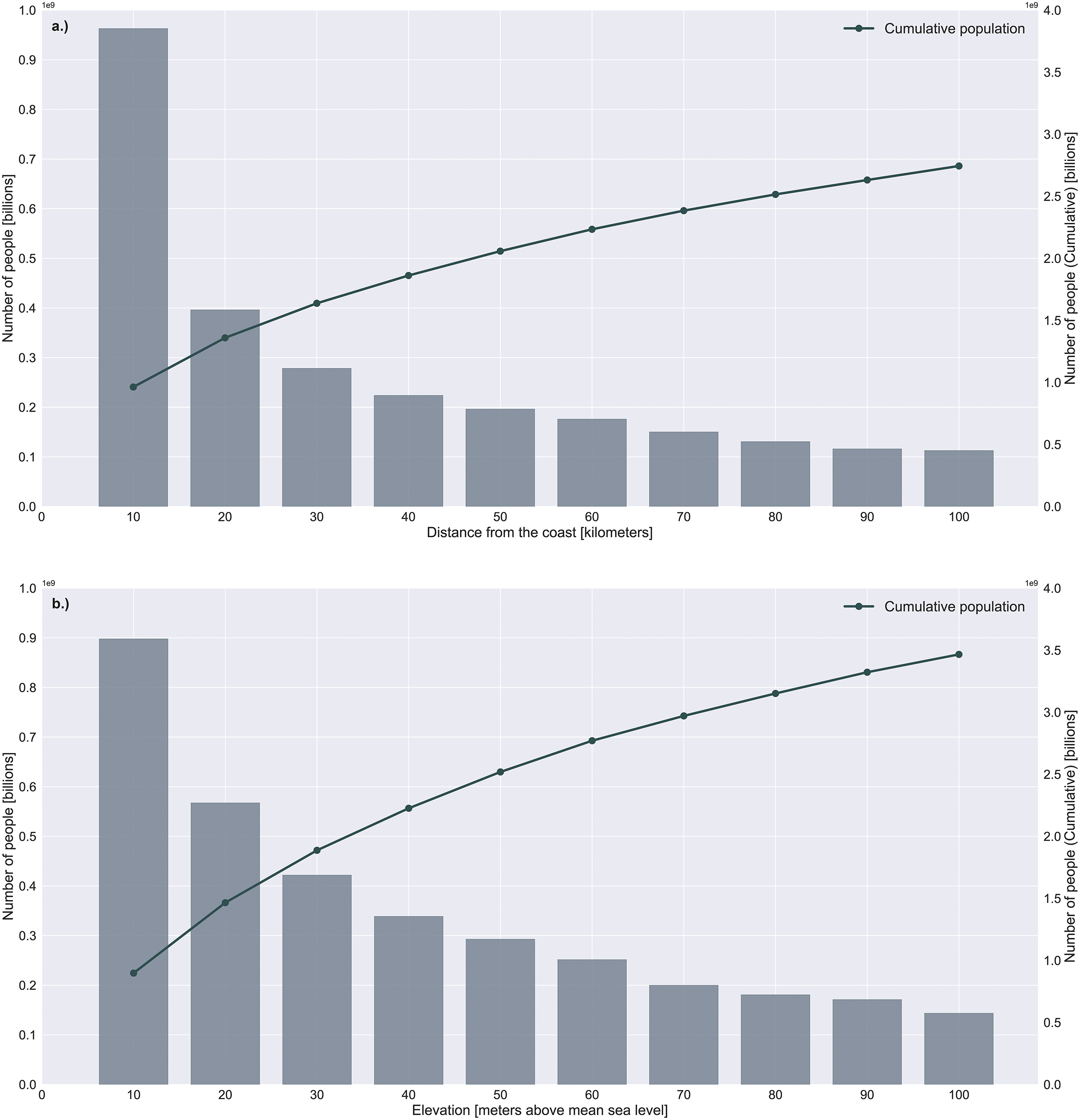
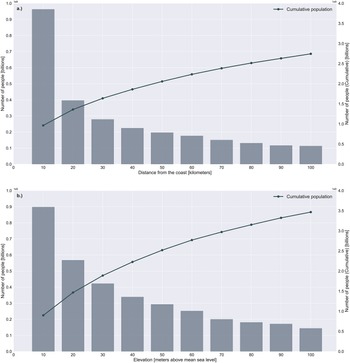
Analyzing the number of people by distance from the coast, we find almost 1 billion people living within 10 km of the coastline, with a continuous decrease in the population living further away from the coast (Figure 2a). In total, more than one-third (2.75 billion) of the world’s population lives within 100 km from the coast. We observe similar patterns when assessing the distribution of global population by elevation increment: almost half (3.5 billion) of the global population lives up to 100 m above sea level, with the largest share in the 10-m elevation increment (i.e., the LECZ) (Figure 2b). While these spatial population patterns closely match those reported in previous work (Small and Nicholls, Reference Small and Nicholls2003), the number of people living in each 10-km distance and 10-m elevation increment has increased considerably from 1990 to 2020.
Global population (in billions) in 2020 by (a) distance from the coast and (b) elevation.
In line with these population patterns, coastal locations are more urbanized compared to inland locations, with 34% of the global urban population living in the near-coastal zone in 2010 (Kummu et al., Reference Kummu, de Moel, Salvucci, Viviroli, Ward and Varis2016). The urban population living in the LECZ increased from 360 million in 2000 (McGranahan et al., Reference McGranahan, Balk and Anderson2007) to 487 million in 2015, corresponding to over 14% of the global urban population (MacManus et al., Reference MacManus, Balk, Engin, McGranahan and Inman2021). Similarly, almost 40% of all cities with more than 1 million inhabitants are located in the near-coastal zone (Kummu et al., Reference Kummu, de Moel, Salvucci, Viviroli, Ward and Varis2016) and more than two-thirds of all megacities (over 8 million inhabitants) in the LECZ (Brown et al., Reference Brown, Nicholls, Woodroffe, Hanson, Hinkel, Kebede, Neumann, Vafeidis and Finkl2013). Furthermore, urban land located in the LECZ has been observed to expand at a significantly faster rate than in inland areas (Seto et al., Reference Seto, Fragkias, Güneralp and Reilly2011). The concentration of urban areas in coastal locations also results in a high concentration of infrastructure such as airports (Yesudian and Dawson, Reference Yesudian and Dawson2021), roads and railways (Koks et al., Reference Koks, Rozenberg, Zorn, Tariverdi, Vousdoukas, Fraser, Hall and Hallegatte2019), economic assets (Kummu et al., Reference Kummu, de Moel, Salvucci, Viviroli, Ward and Varis2016), and cultural assets (Marzeion and Levermann, Reference Marzeion and Levermann2014; Reimann et al., Reference Reimann, Vafeidis, Brown, Hinkel and Tol2018b) in locations potentially at risk from coastal hazards.
Projections of future coastal population development
Future coastal population growth is driven by different aspects of socioeconomic development (e.g., demographic changes, economic growth, policies, and institutions); internal migration, including rural–urban and inland–coastal migration; as well as spatial development patterns (i.e., more sprawling versus compact development). The SSPs (Box 1) are a suitable tool for exploring future changes in socioeconomic development based on the five narratives (O’Neill et al., Reference O’Neill, Kriegler, Ebi, Kemp-Benedict, Riahi, Rothman, van Ruijven, van Vuuren, Birkmann, Kok, Levy and Solecki2017) as well as the national-level population (KC and Lutz, Reference KC and Lutz2017) and urbanization projections (Jiang and O’Neill, Reference Jiang and O’Neill2017).
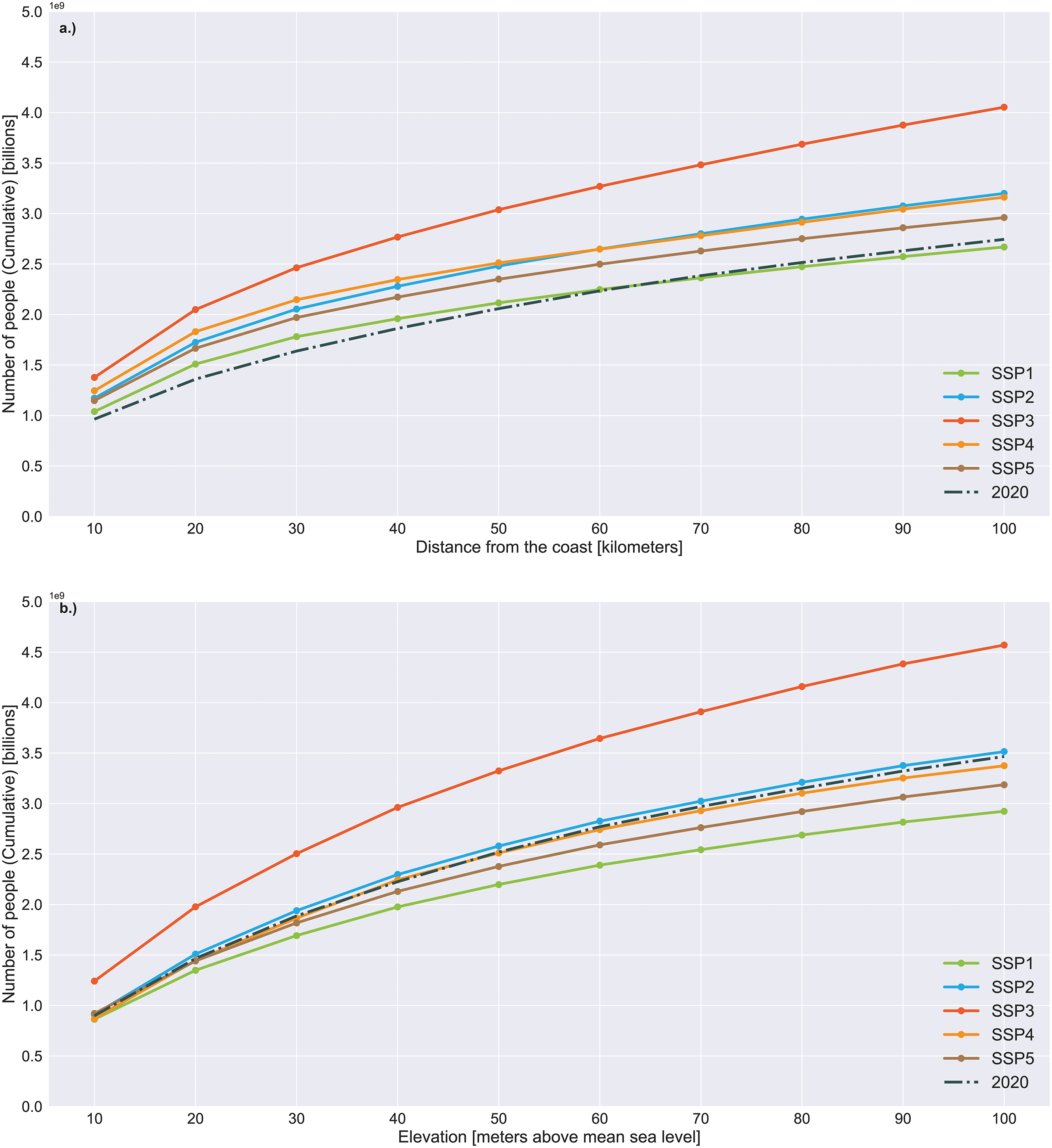
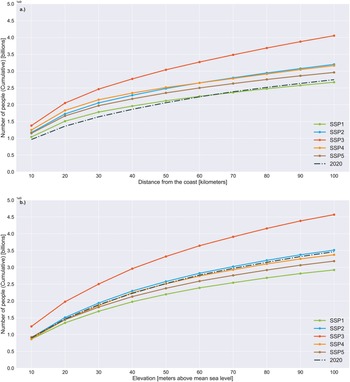
Merkens et al. (Reference Merkens, Reimann, Hinkel and Vafeidis2016) developed spatially explicit population projections based on the SSPs, accounting for rural–urban as well as inland–coastal migration. Their results project 2.1 billion (SSP1) to 2.9 billion (SSP3) people to live in the near-coastal zone by 2100, which corresponds to a 3.5% decrease (SSP1) to 36% increase (SSP3) compared to 2020. As shown in Figure 3a, the population living within 100 km of the coastline is almost consistently higher under all SSPs in 2100 compared to 2020, except for locations 70–100 km away from the coastline under SSP1. The largest differences, compared to the current distribution of population, are projected under SSP3, where the cumulative population is roughly 1.5 times higher per distance increment. Considering elevation (Figure 3b), we see more people living in locations up to 100 m above sea level in 2100 under SSP2 and SSP3, and fewer people under SSP1 and SSP4 compared to 2020. In SSP5, the population in the 10-m elevation increment (i.e., the LECZ) is slightly higher (2.5%) in 2100 than today, but consistently lower in all other elevation increments, reflecting the widespread assumption that the LECZ will remain attractive for human settlement in the future (Nicholls, Reference Nicholls2004; Neumann et al., Reference Neumann, Vafeidis, Zimmermann and Nicholls2015; Merkens et al., Reference Merkens, Reimann, Hinkel and Vafeidis2016; Reimann et al., Reference Reimann, Jones, Nikoletopoulos and Vafeidis2021a).
Global population (in billions) in 2020 versus 2100 by (a) distance from the coast and (b) elevation.
Other global-scale studies project future population in a spatially explicit manner, accounting for inland–coastal migration, but not using the SSPs (Nicholls, Reference Nicholls2004; Nicholls et al., Reference Nicholls, Wong, Burkett, Woodroffe and Hay2008; Neumann et al., Reference Neumann, Vafeidis, Zimmermann and Nicholls2015); or accounting for spatial development patterns only (Jones and O’Neill, Reference Jones and O’Neill2016). Based on the so-called Foresight scenarios that describe four worlds (A–D) of varying future economic growth and political, social, and economic governance (Foresight, 2011), Neumann et al. (Reference Neumann, Vafeidis, Zimmermann and Nicholls2015) project up to 1.4 billion people to live in the LECZ by 2060. These results stem from distinct population growth rates in coastal versus inland locations, which are based on the assumption that coastal areas are more attractive for human settlement than inland areas, the intensity of which depends on the scenario. Not accounting for coastal migration, but assuming differences in sprawling versus compact spatial development per SSP, Jones and O’Neill (Reference Jones and O’Neill2016) estimate a LECZ population of 493 million (SSP4) to 1.1 billion (SSP3) in 2100. These numbers are lower than those projected by Merkens et al. (Reference Merkens, Reimann, Hinkel and Vafeidis2016) where the global LECZ population ranges from 830 million (SSP4) to 1.2 billion (SSP3) in 2100 due to continued migration toward the coast under all SSPs, the assumptions of which they derived from coastal SSP narratives specifically developed for their study. Two continental (i.e., Mediterranean)-scale studies account for inland–coastal migration (Reimann et al., Reference Reimann, Merkens and Vafeidis2018a, based on Merkens et al., Reference Merkens, Reimann, Hinkel and Vafeidis2016) and additionally for spatial development patterns (Reimann et al. Reference Reimann, Jones, Nikoletopoulos and Vafeidis2021a, based on Jones and O’Neill, Reference Jones and O’Neill2016) under the SSPs, based on the coastal SSP narratives extended with socioeconomic development drivers specific to the Mediterranean region. Both studies project Mediterranean LECZ population numbers that are comparable to those produced by their respective global counterparts, but also show marked differences with deviations ranging from −15% to 25% in Mediterranean LECZ population, stemming from the refined scenario assumptions (Reimann, Reference Reimann2021). Considering both inland–coastal migration and urban sprawl, Reimann et al. (Reference Reimann, Jones, Nikoletopoulos and Vafeidis2021a) find that migration toward the coast has a larger effect on the future LECZ population than spatial changes in settlement patterns.
Although future estimates of urban population in the LECZ are not reported in the global-scale literature, coastal population patterns are largely driven by the urbanization assumptions underlying the SSPs. In 2100, more than 90% of the world population is projected to live in urban areas in SSP1, 4, and 5; around 60% in SSP3; and roughly 80% in SSP2 (Jiang and O’Neill, Reference Jiang and O’Neill2017). These urbanization rates combined with the attractiveness of coastal locations for human settlement will likely amplify the currently observed higher urbanization levels in coastal locations (Merkens et al., Reference Merkens, Lincke, Hinkel, Brown and Vafeidis2018), as projected for the Mediterranean region (Reimann et al., Reference Reimann, Jones, Nikoletopoulos and Vafeidis2021a). Several other studies have developed spatial population projections based on the SSPs at global (e.g., van Huijstee et al., Reference van Huijstee, van Bemmel, Bouwman and van Rijn2018; Murakami and Yamagata, Reference Murakami and Yamagata2019; Boke-Olén and Lehsten, Reference Boke-Olén and Lehsten2022) to continental scale (e.g., Batista et al., Reference Batista, Silva, Dijkstra, Martinez and Lavalle2016; Boke-Olén et al., Reference Boke-Olén, Abdi, Hall and Lehsten2017; Lückenkötter et al., Reference Lückenkötter, Hurth and Schonlau2017; Terama et al., Reference Terama, Clarke, Rounsevell, Fronzek and Carter2019), which we do not include here as they do not report numbers of coastal population development.
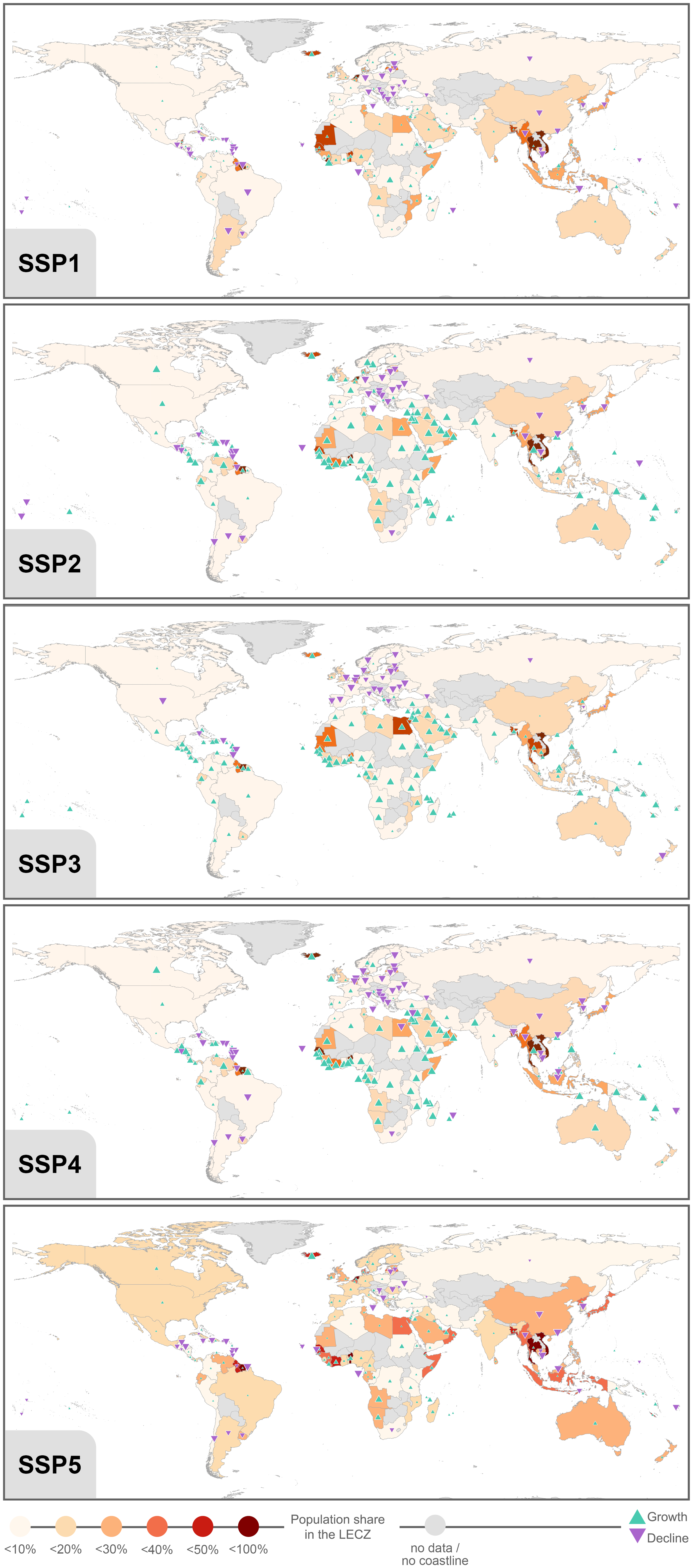
Future coastal population development differs markedly across world regions, with a 2.5- (SSP5) to almost 5-fold (SSP3) increase in LECZ population in African countries projected until 2100 (Merkens et al., Reference Merkens, Reimann, Hinkel and Vafeidis2016). In Asia and Latin America, the highest increase of 66% and 105%, respectively, is expected in SSP3; while in North America, Oceania, and Europe the highest growth is projected under SSP5, with a more than 3-, 4.5-, and 2-fold increase, respectively. Furthermore, North America and Europe are expected to see an up to 28% decrease in LECZ population in SSP3. The highest total number of people living in the LECZ (784 million; SSP3) in 2100 is projected in Asia, corresponding to 66% of the global LECZ population, followed by Africa that makes up 22% (265 million). Despite the substantial increase in LECZ population in African countries, the share of the population living in the LECZ (6–8%) is projected to be lower than in most other world regions where it constitutes up to 18% (Oceania; SSP5) of the total population (Merkens et al., Reference Merkens, Reimann, Hinkel and Vafeidis2016).
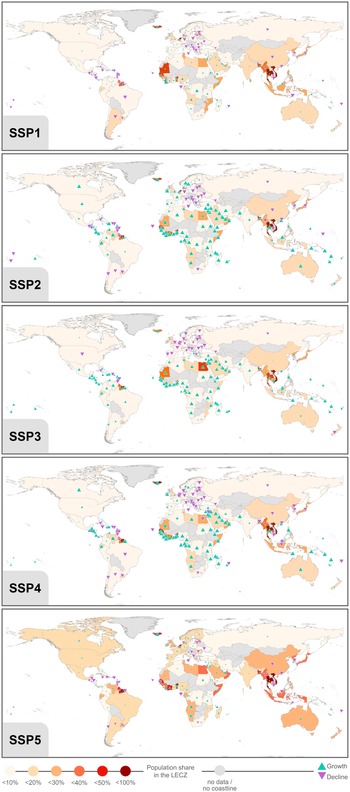
These coastal population patterns are further disaggregated in Figure 4 which shows population shares (2100) and growth (2000–2100) in the LECZ for each SSP and country. Figure 4 illustrates that the future LECZ population varies not only between world regions, but also across countries within the same region; and that future coastal population patterns differ considerably across the five SSPs. For example, we see marked differences on the African continent where coastal population development is largely dominated by the Nile delta; however, coastal population may experience rapid growth (e.g., SSP3) or an increase in the share of people living in the LECZ despite population decline (e.g., SSP5), in particular in western Africa and varying greatly by SSP. In countries of the Global North, opposite patterns in population distribution may occur, with a decline in coastal population under SSP3 and an increase under SSP5, for instance in the USA (Zoraghein and O’Neill, Reference Zoraghein and O’Neill2020a; Zoraghein and O’Neill, Reference Zoraghein and O’Neill2020b).
Population share (%; year 2100) and growth (%; from 2000 to 2100) in the low-elevation coastal zone (LECZ) under the five SSPs.
Beyond exposure – Consider aspects of vulnerability
Globally, the population in the near-coastal zone as well as in the LECZ is expected to continue growing throughout the 21st century, leading to increased exposure to coastal hazards under all SSPs (Merkens et al., Reference Merkens, Reimann, Hinkel and Vafeidis2016). Coastal population growth patterns differ considerably across world regions and countries (Figure 4); this trend is primarily driven by the socioeconomic developments per SSP (O’Neill et al., Reference O’Neill, Kriegler, Ebi, Kemp-Benedict, Riahi, Rothman, van Ruijven, van Vuuren, Birkmann, Kok, Levy and Solecki2017), but also by geographical (e.g., the spatial distribution of cities) or local climatic conditions (e.g., heat and humidity). The prevailing global trends suggest that socioeconomic development and human pressure at the coast will be the main driver of coastal risks throughout the 21st century. However, an increase in exposure does not necessarily equate to increased impacts, as impacts are additionally driven by the socioeconomic characteristics of the exposed population that drive their vulnerability and adaptive capacity (Field, Reference Field2012; Hardy and Hauer, Reference Hardy and Hauer2018; IPCC, Reference Pörtner, Roberts, Tignor, Poloczanska, Mintenbeck, Alegría, Craig, Langsdorf, Löschke, Möller, Okem and Rama2022).
Aspects of social vulnerability are inherent in the SSPs that have been developed based on their challenges for adaptation, with highest challenges (i.e., low adaptive capacity) in SSP3 where high exposure and vulnerability coincide (O’Neill et al., Reference O’Neill, Kriegler, Ebi, Kemp-Benedict, Riahi, Rothman, van Ruijven, van Vuuren, Birkmann, Kok, Levy and Solecki2017). However, impacts may differ considerably across world regions: Africa, Asia, Latin America, and Caribbean are projected to experience the highest growth in coastal population exposure under SSP3 (low adaptive capacity), while Europe, North America, and Oceania experience the lowest growth or even decline under this scenario, potentially leading to substantially lower impacts in the Global North compared to the Global South, thereby reinforcing already existing global disparities. Conversely, in the Global North the highest increase in coastal population is projected under SSP5, where high adaptive capacity (e.g., due to rapid economic growth) makes potential impacts more manageable (Merkens et al., Reference Merkens, Reimann, Hinkel and Vafeidis2016; Figure 4).
Similarly, urban areas are expected to experience different development pathways in each SSP, with poorly managed urban settlements in SSP3 and large shares of informal settlements in SSP4 driven by high inequalities, especially in lower-income countries (Jiang and O’Neill, Reference Jiang and O’Neill2017; O’Neill et al., Reference O’Neill, Kriegler, Ebi, Kemp-Benedict, Riahi, Rothman, van Ruijven, van Vuuren, Birkmann, Kok, Levy and Solecki2017). With a high concentration of urban settlements in coastal areas, such developments may considerably increase future vulnerability to coastal hazards in these settings. Current coastal impact assessments at continental to global scale do not account for such vulnerability characteristics in a systematic manner due to a lack of consistent data (Hinkel et al., Reference Hinkel, Feyen, Hemer, Le Cozannet, Lincke, Marcos, Mentaschi, Merkens, de Moel, Muis, Nicholls, Vafeidis, van de Wal, Vousdoukas, Wahl, Ward and Wolff2021; Oppenheimer et al., Reference Oppenheimer, Glavovic, Hinkel, van de Wal, Magnan, Abd-Elgawad, Cai, Cifuentes-Jara, DeConto, Ghosh, Hay, Isla, Marzeion, Meyssignac, Sebesvari, Pörtner, Roberts, Masson-Delmotte, Zhai, Tignor, Poloczanska, Mintenbeck, Alegría, Nicolai, Okem, Petzold, Rama and Weyer2022; Rasmussen et al., Reference Rasmussen, Kulp, Kopp, Oppenheimer and Strauss2022). However, if such aspects of vulnerability are not considered in studies assessing coastal risks, these studies may potentially over- or underestimate future risk. Therefore, extended SSP narratives that explicitly account for vulnerability characteristics specific to coastal (urban) locations (for instance the work of Merkens et al. (Reference Merkens, Reimann, Hinkel and Vafeidis2016) and Reimann et al. (Reference Reimann, Merkens and Vafeidis2018a)) can form an important basis for more comprehensive assessments of future coastal risks.
Climate change impacts such as sea-level rise will further exacerbate future coastal exposure and vulnerability, thus requiring adaptation responses (Hauer et al., Reference Hauer, Fussell, Mueller, Burkett, Call, Abel, McLeman and Wrathall2020; Oppenheimer et al., Reference Oppenheimer, Glavovic, Hinkel, van de Wal, Magnan, Abd-Elgawad, Cai, Cifuentes-Jara, DeConto, Ghosh, Hay, Isla, Marzeion, Meyssignac, Sebesvari, Pörtner, Roberts, Masson-Delmotte, Zhai, Tignor, Poloczanska, Mintenbeck, Alegría, Nicolai, Okem, Petzold, Rama and Weyer2022) and/or migration to reduce coastal risk (Black et al., Reference Black, Bennett, Thomas and Beddington2011b; McMichael et al., Reference McMichael, Dasgupta, Ayeb-Karlsson and Kelman2020; Lincke and Hinkel, Reference Lincke and Hinkel2021). However, the SSPs – by definition – do not account for feedbacks between climate change and socioeconomic development (O’Neill et al., Reference O’Neill, Kriegler, Riahi, Ebi, Hallegatte, Carter, Mathur and van Vuuren2014) that may affect the attractiveness of coastal locations for human settlement (Horton et al., Reference Horton, de Sherbinin, Wrathall and Oppenheimer2021). For example, multiple or more frequently occurring events, coastal squeeze in locations where coastal infrastructure inhibits wetland migration (Schuerch et al., Reference Schuerch, Spencer, Temmerman, Kirwan, Wolff, Lincke, McOwen, Pickering, Reef, Vafeidis, Hinkel, Nicholls and Brown2018) or gradual decline of available land due to land subsidence can affect livelihoods at the coast by exacerbating risk, potentially driving migration away from the coast (Chen and Mueller, Reference Chen and Mueller2018; Hauer et al., Reference Hauer, Fussell, Mueller, Burkett, Call, Abel, McLeman and Wrathall2020). Although people may move out of the hazard zone in the future, it is likely that they will remain in the proximity of the wider coastal zone (Hauer et al., Reference Hauer, Fussell, Mueller, Burkett, Call, Abel, McLeman and Wrathall2020).
As the response of people to coastal hazards depends on the interactions of a multitude of factors that include, among others, the implementation of adaptation policies, socioeconomic characteristics and social networks (Black et al., Reference Black, Adger, Arnell, Dercon, Geddes and Thomas2011a), potential feedbacks between increasing risk, policy responses (adaptation) and migration need to be considered and explored when projecting future coastal population development (Wrathall et al., Reference Wrathall, Mueller, Clark, Bell, Oppenheimer, Hauer, Kulp, Gilmore, Adams, Kopp, Abel, Call, Chen, DeSherbinin, Fussell, Hay, Jones, Magliocca, Marino, Slangen and Warner2019; Duijndam et al., Reference Duijndam, Botzen, Hagedoorn and Aerts2022). In this context, the SPAs (Box 1) can be combined with the SSPs to explore such policy-related feedbacks; however, the integration of SSPs and SPAs has received very limited attention in previous work. A recent study, which explores the potential effects of adaptation policies on sea-level rise-related internal migration patterns based on combinations of SSPs and SPAs, shows that future migration patterns may be substantially influenced by the type of adaptation policies pursued (e.g., nature-based versus highly engineered solutions) (Reimann et al., Reference Reimann, Jones, Bieker, Wolff, Aerts and Vafeidis2023). This raises questions regarding the possible role of socioeconomic thresholds or tipping points in coastal development, where increased coastal risk could result in a positive feedback loop of migration away from the coast, possibly resulting in abandonment of some coastal stretches, while potentially increasing the proportion of vulnerable populations (Benveniste et al., Reference Benveniste, Oppenheimer and Fleurbaey2022); however, current understanding of these issues is limited (McLeman, Reference McLeman2011; McLeman, Reference McLeman2018; van Ginkel et al., Reference van Ginkel, Haasnoot and Wouter Botzen2022; Duijndam et al., Reference Duijndam, Botzen, Hagedoorn, Bubeck, Haer, Pham and Aerts2023).
In order to reduce future coastal risk, it is likely that densely populated urban areas will rely on hard protection measures, particularly in the developed world (Lincke and Hinkel, Reference Lincke and Hinkel2018), which may enhance population growth in protected locations (so-called “levee effect”) (Di Baldassarre et al., Reference Di Baldassarre, Viglione, Carr, Kuil, Yan, Brandimarte and Blöschl2015). However, maintaining safe human settlements in poorer rural areas will be challenging (Lincke and Hinkel, Reference Lincke and Hinkel2018), potentially leading to migration away from the coast (Lincke and Hinkel, Reference Lincke and Hinkel2021), which will often occur autonomously, that is, without policy support (Black et al., Reference Black, Bennett, Thomas and Beddington2011b; Hauer et al., Reference Hauer, Fussell, Mueller, Burkett, Call, Abel, McLeman and Wrathall2020). Policies addressing managed retreat are, however, not well developed due the complexity of issues surrounding retreat (e.g., compensation, liability for loss and damage, equity) (Hauer et al., Reference Hauer, Fussell, Mueller, Burkett, Call, Abel, McLeman and Wrathall2020; Mach and Siders, Reference Mach and Siders2021). As the coastal adaptation solution space shrinks with rising sea levels, managed retreat becomes a serious option in some low-lying coastal areas (Haasnoot et al., Reference Haasnoot, Lawrence and Magnan2021); and its effects on the distribution of coastal population needs to be explored in order to increase the effectiveness of adaptation policies (Reimann et al., Reference Reimann, Jones, Bieker, Wolff, Aerts and Vafeidis2023).
A systems approach to early adaptation planning with a long-term perspective, also beyond 2100 (Brown et al., Reference Brown, Nicholls, Hanson, Brundrit, Dearing, Dickson, Gallop, Gao, Haigh, Hinkel, Jiménez, Klein, Kron, Lázár, Neves, Newton, Pattiaratachi, Payo, Pye, Sánchez-Arcilla, Siddall, Shareef, Tompkins, Vafeidis, van Maanen, Ward and Woodroffe2014), is instrumental for avoiding disruptive changes in coastal systems that can lead to tipping points such as the abandonment of coastal stretches. To achieve this objective, long-term adaptive planning will be essential in order to avoid maladaptation, lock-ins, increased residual risk (e.g., levee effect) and lack of resources (e.g., sufficient sediment for beach nourishment; de Schipper et al., Reference de Schipper, Ludka, Raubenheimer, Luijendijk and Schlacher Thomas2021). Otto et al. (Reference Otto, Donges, Cremades, Bhowmik, Hewitt, Lucht, Rockström, Allerberger, McCaffrey, Doe, Lenferna, Morán, van Vuuren and Schellnhuber2020) discuss several social tipping interventions that can help promote societal transformation to sustainable development, with spatial planning being a potentially powerful tool in the coastal context.
Action points for future work
Estimating current coastal population and projecting its future development is essential for assessing future coastal risk. Different continental to global studies, however, have produced varying results, stemming from different definitions of the coastal zone (e.g., defined by elevation, distance, and combinations); and from different input data and methods employed for the analyses (e.g., elevation and population data uncertainties, definition of the coastline, methods for addressing data mismatches, scenario assumptions, methods for distributing population) (Lichter et al., Reference Lichter, Vafeidis and Nicholls2010; Hinkel et al., Reference Hinkel, Feyen, Hemer, Le Cozannet, Lincke, Marcos, Mentaschi, Merkens, de Moel, Muis, Nicholls, Vafeidis, van de Wal, Vousdoukas, Wahl, Ward and Wolff2021; MacManus et al., Reference MacManus, Balk, Engin, McGranahan and Inman2021; see also Table 1). As differences in results due to these methodological choices are very difficult to comparatively assess, we emphasize the importance of clear reporting of the underlying definitions, assumptions, data, and methods employed. Regarding the use of population and urban settlement data, for instance, the POPGRID Data Collaborative offers an effective overview to guide application of these datasets in policy and research (Leyk et al., Reference Leyk, Gaughan, Adamo, de Sherbinin, Balk, Freire, Rose, Stevens, Blankespoor, Frye, Comenetz, Sorichetta, MacManus, Pistolesi, Levy, Tatem and Pesaresi2019; POPGRID, 2020).
As coastal population development will continue being a major driver of coastal risks in the future, we emphasize the need to mainstream the use of socioeconomic scenarios (i.e., the SSPs) in order to address uncertainties related to these drivers of risk, while accounting for both, changes in exposure as well as vulnerability. One step toward addressing this need is the development of globally consistent, spatially explicit datasets to characterize both, current and future vulnerability, including indicators such as age, gender, ethnicity, education, and income (Cutter et al., Reference Cutter, Boruff and Shirley2003; Hardy and Hauer, Reference Hardy and Hauer2018; Madajewicz, Reference Madajewicz2020). Furthermore, uncertainties related to feedbacks between changes in climatic conditions (e.g., sea-level rise), adaptation responses, and migration in driving future coastal population and vulnerability need to be explored more systematically. While the assessment of climate- and sea-level rise-related migration at continental to global scale has received increasing attention in recent years (e.g., McLeman and Gemenne, Reference McLeman and Gemenne2018; Rigaud et al., Reference Rigaud, de Sherbinin, Jones, Bergmann, Clement, Ober, Schewe, Adamo, McCusker, Heuser and Midgley2018; Cattaneo et al., Reference Cattaneo, Beine, Fröhlich, Kniveton, Martinez-Zarzoso, Mastrorillo, Millock, Piguet and Schraven2019; Lincke and Hinkel, Reference Lincke and Hinkel2021), the majority of studies focus on estimating the total number of migrants rather than spatial patterns of migration (exceptions are Rigaud et al., Reference Rigaud, de Sherbinin, Jones, Bergmann, Clement, Ober, Schewe, Adamo, McCusker, Heuser and Midgley2018, Reference Rigaud, de Sherbinin, Jones, Abu-Ata and Adamo2021; Clement et al., Reference Clement, Rigaud, De Sherbinin, Jones, Adamo, Schewe, Sadiq and Shabahat2021), rarely accounting for potential effects of adaptation on migration decisions (Wrathall et al., Reference Wrathall, Mueller, Clark, Bell, Oppenheimer, Hauer, Kulp, Gilmore, Adams, Kopp, Abel, Call, Chen, DeSherbinin, Fussell, Hay, Jones, Magliocca, Marino, Slangen and Warner2019; Horton et al., Reference Horton, de Sherbinin, Wrathall and Oppenheimer2021).
Reducing epistemic uncertainties, related to limited knowledge of the system (de Moel et al., Reference de Moel, Jongman, Kreibich, Merz, Penning-Rowsell and Ward2015), would involve better understanding the factors that drive migration to and from the coast. Although the attractiveness of the coast is well established in the literature, it is unclear which factors exert the highest influence in this process. At the same time, there are several studies that analyze what drives migration away from the coast, particularly in response to natural disasters, but these patterns vary considerably depending on the geographic, climatic and socioeconomic context and are still not well understood. These knowledge gaps can be addressed by conducting empirical surveys, aiming at establishing specific factors that drive migration decisions (Duijndam et al., Reference Duijndam, Botzen, Hagedoorn and Aerts2022). The insights of such survey results can be implemented in modeling approaches that combine bottom-up (i.e., individual decisions) and top-down (i.e., aggregate human behavior) methods (Wrathall et al., Reference Wrathall, Mueller, Clark, Bell, Oppenheimer, Hauer, Kulp, Gilmore, Adams, Kopp, Abel, Call, Chen, DeSherbinin, Fussell, Hay, Jones, Magliocca, Marino, Slangen and Warner2019, Horton et al., Reference Horton, de Sherbinin, Wrathall and Oppenheimer2021). A further epistemic uncertainty is the potential effect of shocks such as pandemics or war on socioeconomic development and coastal population, which may be beyond the plausible ranges projected as part of the SSPs. Such events are deliberately excluded from the SSPs; our understanding of these processes is limited, but can be explored in extreme scenarios (so-called “wildcards”) (O’Neill et al., Reference O’Neill, Carter, Ebi, Harrison, Kemp-Benedict, Kok, Kriegler, Preston, Riahi, Sillmann, van Ruijven, van Vuuren, Carlisle, Conde, Fuglestvedt, Green, Hasegawa, Leininger, Monteith and Pichs-Madruga2020).
The points raised above highlight the complexities associated with the process of coastal population development and its role as a determinant of risk. Importantly, they also suggest the need for a shift from projecting population numbers to better accounting for the characteristics of these populations with respect to their vulnerability to coastal hazards, including demographic characteristics such as age and gender, as well as aspects of inequality in shaping adaptive capacity in urban versus rural locations and how these inequalities may affect the ability and willingness to migrate. Such work can build on insights from local studies that have focused on characterizing social vulnerability (e.g., Rohat et al., Reference Rohat, Wilhelmi, Flacke, Monaghan, Gao, van Maarseveen and Dao2021; Balk et al., Reference Balk, Tagtachian, Jiang, Marcotullio, Cook, Jones, Mustafa and McPhearson2022) and scale these up to the continental to global scale, thus allowing for a more integrative approach to understanding the temporal and spatial evolution of risk in coastal areas. Therefore, we would encourage future work that aims to extend and/or update the SSPs, to account for the specific characteristics of socioeconomic development in coastal locations in order to facilitate risk assessments that explore the uncertainties related to these developments and their influence on future population exposure and vulnerability in coastal locations.
Open peer review
To view the open peer review materials for this article, please visit http://doi.org/10.1017/cft.2023.3.
Data availability statement
All datasets used for the analysis are publicly available at the corresponding references.
Author contributions
L.R. developed the paper concept and outline in collaboration with A.T.V. L.E.H. conducted the data analysis and prepared the figures. L.R. and A.T.V. wrote the manuscript with input from L.E.H. All authors reviewed and approved the final manuscript draft.
Financial support
L.R. was supported by the ERC-funded project COASTMOVE (Grant No. 884442). A.T.V. was supported by the CoCliCo project, which is funded by the European Union’s Horizon 2020 research and innovation program (Grant No. 101003598).
Competing interest
The authors declare no competing interests.

 Open access


Comments
Dear editor,
as agreed, we are now submitting the commissioned review article with the final title "Population development as a driver of coastal risk: Current trends and future pathways".
On behalf of all co-authors,
Sincerely yours,
Lena Reimann