

INTRODUCTION
Conservation in the tropics appears to be on a new governance trajectory as market-based approaches look for ways to economically value ecosystem services, thereby making conservation more cost-effective. This neo-liberal approach to conservation is presumed to be more effective than earlier top-down conservation practices and more recent ‘populist’ or bottom-up paradigms that emerged in the 1980s (Ferraro & Kiss Reference Ferraro and Kiss2002; Robbins & Williams Reference Robbins and Williams2005; Wunder Reference Wunder2006; Igoe & Brockington Reference Igoe and Brockington2007; Shiferaw et al. Reference Shiferaw, Okello and Reddy2009). The benefits of the commodification of nature are heavily contested, as we lack a strong empirical foundation to understand how such market-based approaches may affect local resource rights, decision-making powers, sustainable resource management and livelihoods in poor, resource dependent communities (Liverman Reference Liverman2004; Igoe & Brockington Reference Igoe and Brockington2007; Sullivan Reference Sullivan2009; Vatn Reference Vatn2010; van Dam Reference van Dam2011).
This paper examines the application of a payment for ecosystem services (PES) programme to promote sustainable pasture management (silvopastoral practices) and forest conservation in a watershed in the Eastern Andes, Colombia. Under the PES system, a buyer enters into a voluntary contract with a service provider (often a farmer or rural community) to purchase with cash or in-kind, an environmental service (Wunder Reference Wunder2005, Reference Wunder2006; Engel et al. Reference Engel, Pagiola and Wunder2008). Similar to recommendations derived from studies in agriculture and rural development, PES advocates contend that conservation practices must be economically rewarding and that this requires linking conservation to market systems (Dorward et al. Reference Dorward, Kydd, Morrison and Urey2004; Pagiola et al. Reference Pagiola, Arcenas and Platais2005; Engel et al. Reference Engel, Pagiola and Wunder2008; Spielman et al. Reference Spielman, Ekboir, Davis and Ochieng2008; Shiferaw et al. Reference Shiferaw, Okello and Reddy2009).
In Latin America, where agricultural expansion is a principal cause of deforestation (Angelsen & Kaimowitz Reference Angelsen and Kaimowitz1999; Geist & Lambin Reference Geist and Lambin2001), international organizations such as the World Bank and the Food and Agricultural Organization of the United Nations (FAO) have promoted PES arrangements to encourage farmers to change to silvopastoral pasture management practices and conserve their remaining forest lands (Pagiola et al. Reference Pagiola, Ramírez, Gobbi, de Haan, Ibrahim, Murgueitio and Ruíz2007, Reference Pagiola, Rios and Arcenas2008; Engel et al. Reference Engel, Pagiola and Wunder2008). Under the silvopastoral system, the use of live fences and dispersed trees in pastures, pasture fertilization and fodder banks are promoted to control agricultural expansion by improving the quality of smaller pasture parcels and thereby increasing the quantity of milk produced per cow per hectare (Nair Reference Nair1985; Dagang & Nair Reference Dagang and Nair2003; León & Harvey Reference León and Harvey2006; Pagiola et al. Reference Pagiola, Ramírez, Gobbi, de Haan, Ibrahim, Murgueitio and Ruíz2007). In order to compensate farmers for these land-use changes, buyers (most often a non-governmental organization [NGO] or multilateral funding agency) cover the start-up costs of the silvopastoral system. It is assumed that if these initial costs are covered, the profits from increased milk production (estimated rates of return for Latin America are c. 4–14%) will provide sufficient incentive for farmers to continue to conserve forests and sustainably manage pasture (Pagiola et al. Reference Pagiola, Arcenas and Platais2005, Reference Pagiola, Ramírez, Gobbi, de Haan, Ibrahim, Murgueitio and Ruíz2007, Reference Pagiola, Rios and Arcenas2008). In addition, the contingent contracts signed by the participants are presumed to further ensure compliance with the new land-use practices.
However, it remains uncertain whether the economic incentives and contingent contracts necessarily produce sustained land-use changes and conservation practices. Previous findings in agricultural adoption, conservation and development, economics and psychology point to several concerns in the PES model (Wilshusen et al. Reference Wilshusen, Brechin, Fortwangler and West2002; Igoe & Brockington Reference Igoe and Brockington2007; Pagiola et al. Reference Pagiola, Ramírez, Gobbi, de Haan, Ibrahim, Murgueitio and Ruíz2007; Engel et al. Reference Engel, Pagiola and Wunder2008; Murgueitio Reference Murgueitio2009; Sullivan Reference Sullivan2009). First, it is questionable whether farmers’ decision-making processes necessarily correspond to the PES model. While access to markets and increased production are clearly important for creating a programme that is economically rewarding, previous research indicates that smallholder farmers may not base their decisions solely on economic benefits in accordance with the neoclassical decision model (van den Bergh et al. Reference van den Bergh, Ferrer-i-Carbonell and Munda2000; Petheram & Campbell Reference Petheram and Campbell2010; Vignola et al. Reference Vignola, Koellner, Scholz and McDaniels2010; Gsottbauer & van den Bergh Reference Gsottbauer and van den Bergh2011). Smallholder farmers are often faced with a number of household demands and temporal restrictions that they must satisfy via a complex set of livelihood strategies (Ashby Reference Ashby1985; Holden et al. Reference Holden, Shiferaw and Wik1998; Murgueitio Reference Murgueitio2009; Shiferaw et al. Reference Shiferaw, Okello and Reddy2009). In weighing their land-use decisions, on-farm investments to sustain silvopastoral systems may not be perceived to offer the most immediate or practical benefits (Kiptot et al. Reference Kiptot, Hebinck, Franzel and Richards2007; Murgueitio Reference Murgueitio2009).
Second, there is little understanding of how the payments and practices are perceived by the farmers, and how they influence a farmer's decision to participate in a PES programme and sustain the silvopastoral practices. Research in social psychology, behavioural change and farmer decision-making illustrate that, in addition to economic considerations, cognitive factors, in particular an individual's perception of the problem and their perceived control over the proposed solution, often determine whether new farm management behaviours will be sustained (Bandura Reference Bandura1977; Bunch Reference Bunch1982; Ajzen Reference Ajzen1991; Maddux & DuCharme Reference Maddux, DuCharme and Gochman1997; Hellin & Haigh Reference Hellin and Haigh2002; Hellin & Schrader Reference Hellin and Schrader2003; McGinty et al. Reference McGinty, Swisher and Alavalapati2008; Vignola et al. Reference Vignola, Koellner, Scholz and McDaniels2010). In models of behavioural change, perceived self-efficacy or the perceived control that an individual has to perform a particular activity is considered critical in predicting whether an individual will execute a specific behaviour (Bandura Reference Bandura1977; Ajzen Reference Ajzen1991; Maddux & DuCharme Reference Maddux, DuCharme and Gochman1997; Grothman & Patt Reference Grothmann and Patt2005). Likewise, in agricultural development, perceived ownership over the practices and belief in personal ability and resources to make the requisite changes, irrespective of outside support, has also been found to be particularly important for sustained agricultural adoption, and many caution against the use of external incentives or donations (Bunch Reference Bunch1999; Hellin & Haigh Reference Hellin and Haigh2002; Robbins & Williams Reference Robbins and Williams2005; McGinty et al. Reference McGinty, Swisher and Alavalapati2008). Kiptot et al. (Reference Kiptot, Hebinck, Franzel and Richards2007) warn that external incentives may encourage the participation of pseudo-adopters, or those resource users that begin to use a new land-management technology to receive programme benefits, but stop the new practice once the benefits end. Even more troubling, research in economics has found that in some cases, payments have actually diminished the degree to which an individual was previously inclined to perform the desired activity (Cárdenas et al. Reference Cárdenas, Stranlund and Willis2000; Gneezy & Rustichini Reference Gneezy and Rustichini2000; Frey and Jegen Reference Frey and Jegen2001; Clements et al. Reference Clements, John, Nielsen, An, Tan and Milner-Gulland2010; Murtinho et al. Reference Murtinho, Eakin and Lopez-Carr2010). Although PES scholars argue that the cash or in-kind payments are not donations, rather direct compensation for a service provided, given that many PES arrangements involve a wide array of buyers purchasing ill-defined environmental services, it may be difficult for a recipient to understand that they are engaging in a market transaction and not simply receiving a donation (Muradian et al. Reference Muradian, Corbera, Pascual, Kosoy and May2010).
Third, the effectiveness of the contingent contracts is dubious when applied in developing country settings amongst minimally literate populations. In many cases, semi-literate peoples may be asked to sign contracts written in complex legal terminology that commits them to land-use definitions and restrictions that are often foreign to their own constructs of human and environment interactions, committing them to extended periods that are difficult for them to envision (Escobar Reference Escobar1998; Holden et al. Reference Holden, Shiferaw and Wik1998; Ferraro Reference Ferraro2008).
Finally, it is important to assess whether PES payments and contracts are able to instil characteristics such as self- determination, social learning and innovation, each found critical in sustained behavioural change and adaptive resource management (Pretty & Shah Reference Pretty and Shah1997; Bunch Reference Bunch1999; Hagmann & Chuma Reference Hagmann and Chuma2002; Hellin & Haigh Reference Hellin and Haigh2002; Johnson et al. Reference Johnson, Lilja and Ashby2003; Sumberg et al. Reference Sumberg, Okali and Reece2003; Mercer Reference Mercer2004; Armitage Reference Armitage2005; Folke et al. Reference Folke, Hahn, Olsson and Norberg2005; Robbins & Williams Reference Robbins and Williams2005; German et al. Reference German, Mowo and Kingamkono2006; Spielman et al. Reference Spielman, Ekboir, Davis and Ochieng2008; Shiferaw et al. Reference Shiferaw, Okello and Reddy2009). In studies of resource management, externally mandated land-use rules have been shown to reduce farmers’ sense of ownership, thwart innovation and potentially ‘crowd out’ successful local resource management practices (Ostrom et al. Reference Ostrom1990; Cárdenas et al. Reference Cárdenas, Stranlund and Willis2000; Agrawal & Chhatre Reference Agrawal and Chhatre2007). In the PES system, the reliance on binding contracts and land-use practices designed by external experts calls into question the degree to which farmers are able to assert their own autonomy over the land-use practices, experiment, and ultimately adapt the practices to current and future conditions on their farms.
Before continuing to promote the use of payments and contracts as a means of sustainable land management, a better understanding of how such market-based conservation systems are perceived by the recipients and actually operate ‘on-the-ground’ is required. I aim to draw on findings from the PES experiment underway in the Eastern Andes, Colombia in order to improve understanding of how the silvopastoral PES model of in-kind payments and contingent contracts influences farmers’ commitment to and perceived ability to sustain the silvopastoral techniques and forest conservation measures. Specifically, I assess the sustainability of the PES silvopastoral system by examining (1) how farmers perceive the silvopastoral practices and their ability to continue with the practices, (2) the role of the economic benefits and contracts in encouraging behavioural change and (3) how the PES programme influences social learning, self-determination and innovation; these factors are considered critical for adaptive resource management and agricultural adoption.
Oak Corridor, Eastern Andes, Colombia
The Colombian Andes, given its biological richness and high levels of endemic species, is one of the most biodiverse regions in the world and a conservation hotspot (Armenteras et al. Reference Armenteras, Gast and Villareal2003). A conservation priority is the ‘Oak Corridor’ located in the departments of Santander and Boyacá, north of Bogota, on the western slope of the Eastern Andes. The Oak Corridor covers approximately 10 730 km2 and contains the last remnants of the Colombian oak (Quercus humboildtii), and endemic and endangered flora and fauna.
In the Oak Corridor, the majority of the forest remnants are located on smallholder farmers’ lands in the poorest regions of the two departments (Solano et al. Reference Solano, Roa and Calle2005; Solano Reference Solano and Andrade2007). Most residents are mestizo (of mixed Spanish and indigenous descent) farmers, whose families first moved to the region in the early 1900s to exploit the forests for timber for the railroads, mines, construction materials for the nearby towns and cities, and the production of charcoal (Avella & Cárdenas Reference Avella and Cárdenas2010). The region has a long history of minifundistas (farmers owning 1–5 ha of land) and microfundistas (farmers owning < 1 ha of land), and, unlike other regions of Colombia, this sector has maintained a relatively stable tenure system and it has not faced displacement or other conflicts resulting from the civil war (Solano Reference Solano, Roa and Calle2005).
Today, farmers maintain individual titles to their small parcels of land where they practise subsistence agriculture. Although technically illegal, small-scale timber extraction continues, mostly for local subsistence purposes (Solano Reference Solano, Roa and Calle2005). In recent years, agricultural expansion, particularly extensive cattle grazing practices, has become the principal threat to the ecosystems in this region (Solano Reference Solano, Roa and Calle2005; Avella & Cárdenas Reference Avella and Cárdenas2010).
PES silvopastoral programme
In 2006, in an effort to curb agricultural expansion and promote sustainable livelihood development in the region, a consortium of national NGOs, in association with international donors and governmental agencies, created a silvopastoral PES programme. The programme was designed by Fundación Natura, a Colombian NGO with a history of promoting conservation in the region, and the Centre for the Investigation of Sustainable Agricultural Production Systems (CIPAV), an organization with over twenty years experience of working with agriculture and pasture management in Latin America. Although the NGOs did not conduct a formal market analysis, through discussions with local farmers, they identified poor milk production as one of the principal economic barriers, in addition to the costs required to transport the milk to the nearest city market (farmers often depend upon intermediaries for transportation). Thus, the project goals were to promote forest conservation by providing economic incentives for farmers to switch to more sustainable silvopastoral pasture management practices that would increase milk production and maintain the remaining forests on their private lands.
In order to be eligible to participate in the Oak Corridor programme, a farmer must be located in the designated watershed region, have forest (forest sizes range from 0.25 ha to 200 ha), have at least 3 ha of pasturelands that can be improved, and hold a de facto title to their land. Farmers sign a contract in which they pledge to adopt silvopastoral practices and protect their forests and, in exchange, they receive materials and extension support for three years to cover the initial start-up costs and pay them for agreeing to switch to a silvopastoral system and conserve their forest lands. The specific land-use practices that farmers commit to, in addition to forest conservation, include: (1) the use of fertilizers for pasturelands; (2) rotation through small parcels of pasturelands using electric wires to guide grazing; (3) live fences; and (4) fodder banks. In return, farmers receive as ‘payment’ several applications of fertilizers to recuperate pasturelands, fence posts, barbed wire and tree seedlings. If a farmer does not comply with the contract, he must pay back all of the investment made in his farm (c. US$ 1444 ha−1, September 2009).
Study sites
The specific study sites were seven communities, consisting on average of approximately 50 families, and located at c. 2500–3000 m elevation above sea level in the River Guacha watershed, along the border between two municipalities: Belen, Boyacá and Encino, Santander (Fig. 1). Although the communities neighbour a national park, park officials rarely visit the communities, as other regions are purported to be of greater political priority (local NGO worker, personal communication July 2011). Fundación Natura has a private forest reserve in the region and, in previous years, the organization has worked with women in neighbouring communities to produce knitted goods for sale in local markets. Prior to the introduction of the silvopastoral programme, however, the communities had not received any systematic external support for agriculture or pasture management and there were no formal agricultural or dairy cooperatives operating in the communities.
Study area in the Oak Forest Corridor, Colombia.

Residents practise small-scale potato and dairy farming on the surrounding hillsides. Farmers use minimal technology; land preparation is done by hand or using animals, and crops are rain-fed. While most farmers use chemical fertilizers and pesticides for potato production, few farmers fertilize their pasturelands, use green manures or fodder banks, and most cattle production is dependent upon relatively extensive grassland grazing. Residents sell their agricultural products (mostly potatoes) and dairy products to local and regional markets in cities that are located 1–2 h away by car. In recent years, many farmers have switched their crop lands to extensive pasture lands for dairy production, as the price of potatoes is considered to be more volatile than dairy (Solano et al. Reference Solano, Roa and Calle2005; CIPAV, personal communication July 2008).
METHODS
This is an ex-ante assessment of a programme in progress. The programme began initially as a pilot project with 23 participants (2006–2009) who signed three-year contracts. In September 2009, the programme was expanded to include c. 60 new participants who signed five-year contracts. I conducted the research for this analysis July–September 2009. Data gathering included interviews with programme specialists, examination of NGO reports and presentations, farm visits and semi-structured interviews with select participants. In addition, I administered a participant questionnaire to both pilot project participants and new participants (Appendices 1 & 2, see supplementary material at Journals.cambridge.org/ENC). Twenty-one of the 23 pilot participants were interviewed in August 2009, just after the termination of the pilot project. In September 2009, an additional questionnaire was administered to 54 of the c. 60 new participants who had signed contracts at the end of August. The initial research design included interviews with non-participants; unfortunately, given the popularity of the programme, it was difficult to identify sufficient non-participants in the communities and they were thus not included in this analysis. For some questions, the new participants’ responses may serve as baseline data to compare to the pilot participants, as the new participants had yet begun the silvopastoral practices or received programme benefits.
I structured the data gathering using previous work on agricultural adoption and adaptive management (Bunch Reference Bunch1982; Folke et al. Reference Folke, Hahn, Olsson and Norberg2005; Birner et al. Reference Birner, Davis, Pender, Nkonya, Anandajayasekeram, Ekboir, Mbabu, Spielman, Horna and Benin2006) and concepts from the Ajzen's theory of planned behaviour, which considers perceived behavioural control and stated intent to be strong predictors of actual behavioural achievement (Ajzen Reference Ajzen1991, Reference Ajzen2006). I aimed to assess how participants perceived farm-level problems and the potential solutions that the PES programme offered, the likelihood that the silvopastoral and conservation practices would be sustained by participants, and the contribution that the PES programme made to the adaptive management capacities of the participants. I also gathered background information on the participants’ age, education, household size, occupation, farm practices and community involvement.
In order to assess the participant's adoption of silvopastoral practices and the sustainability of said practices, the study measured: (1) participants’ practices prior to beginning the programme; (2) pilot participants’ stated intent to continue with programme practices; (3) pilot participants perceived behavioural control, or self-efficacy, assessed by participant's responses to whether they could continue to implement the practices without external assistance; (4) the economic viability of the programme when perceived benefits are compared with farmers competing economic priorities; and (5) participants’ perceptions of the legitimacy of the contracts and their contractual commitments. Finally, I assessed the contributions of the Oak Corridor programme to adaptive management by analysing pilot participant's perceptions of self-determination (specifically who made the silvopastoral farm-level decisions), pilot participants experimentation with any of the pasture management practices, and by identifying social learning that had occurred with the pilot and new participants.
RESULTS
Participants and their practices prior to programme participation
The participants were generally middle-aged males (72%), with a few years of primary education, maintaining an average of six cows on five hectares of pasturelands (Table 1). The characteristics of the pilot and new participants did not differ significantly.
Characteristics of participants in the Oak Corridor PES programme. SD = standard deviation.

Prior to working with the programme, only 18% of all participants (pilot and new) fertilized their pastures, and even fewer used live fences or fodder banks. Although most (73%) used electric wire to guide grazing, very few rotated their cattle through small parcels on a weekly or bi-weekly basis.
In interviews, when asked what they perceived to be their most important household needs (list two), the participants’ top three responses were improved pasturelands (70%), water (45%) and food (32%). Correspondingly, when asked about the silvopastoral programme benefits, participants consistently cited the fertilization of pasturelands as a principal benefit. This was followed by the provision of live fences, which, according to respondents, would relieve them from having to spend money (and trees) to replace the fence posts every couple of years and, in the future, would provide fuel wood and building materials.
Stated likelihood to sustain the silvopastoral practices
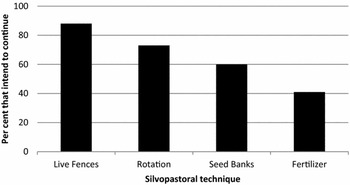
The results show that, despite farmers’ explicit appreciation for the silvopastoral techniques, after completing the programme, few pilot participants stated that they would continue to use each new silvopastoral technique in the next year (Fig. 2). The most promising change in land-use behaviour appears to be the use of live fences. Less than half of the participants (41%) stated that they were likely to continue to fertilize their fields, despite improvements in the production of their pastures.
Stated intent to use silvopastoral techniques in future (n = 21).
Perceived behavioural control
The majority of farmers felt dependent on outside help to sustain the system as 60% of the farmers interviewed (pilot and new participants) stated that they could not make such farm-level changes without external help to provide materials and technical advice. Pilot participants were significantly more positive about their abilities to sustain the silvopastoral improvements than new participants were that they could begin without external assistance (Fig. 3; Pearson χ2 = 10.71, p = 0.005). However, even after receiving the initial assistance package, many farmers did not perceive sufficient behavioural control in the form of resources, knowledge and motivation to continue with the project. Less than half of the pilot participants (48%) were confident that they would be able to sustain the changes without additional external help. Common complaints were that they did not have the economic resources to maintain the silvopastoral system, particularly the fertilizers, and that they needed the extension agents to continue to provide them with information and the motivation to continue.
Ability to implement and sustain silvopastoral system without external assistance.

Perceived economic viability of silvopastoral practices
Results from the Oak Corridor cast doubt on whether the linear economic decision-making model of the PES system accurately captures farmers’ decision-making processes. In the Oak Corridor, programme specialists estimated that under the silvopastoral practices, and normal market conditions, milk production increased by 2–4 bottles per cow per day, providing the average farmer with an additional 2580–5160 pesos d−1 or c. US$ 43–86 mo−1 (CIPAV, personal communication July 2008). In order to sustain the system, at least part of this additional income must be invested in the farm in the form of fertilizers. However, when new participants were asked how they might spend an additional 100 000 pesos (US$ 55 mo−1) earned from increased milk production, 48% responded that they would spend the additional income on food. This was followed by general household needs, buying additional cows and education. Only one participant specifically mentioned that he would spend the additional money to fertilize his pasturelands.
Interview results indicate that, in addition to more pressing household spending needs, the reluctance to spend any additional money on fertilizers may be due to the inability to identify the direct benefits from such investment in the pasturelands. Prior to starting the programme, 89% of the new participants stated that they thought that the programme would improve their farms greatly. After completing the programme, only 47% of the pilot farmers thought that the programme had greatly improved their farm. While many noted that their pastures improved (62.5%), especially after the fertilization treatments, fewer (28%) were able to link these changes to increases in milk production. Although the programme encouraged farmers to keep track of their milk production, extension agents reported that few did so, thereby making the gains in milk production difficult to perceive. Given alternative spending priorities, a feeling of dependency on outside support and, unclear production benefits, many farmers felt unwilling or unable to continue with the new silvopastoral practices.
Perception of contracts and commitment to practices
In interviews with the new participants, 80% supported the contract and stated that they believed that the NGOs have a legitimate right to create agreements restricting individuals’ land uses. However, in describing the specifics of the contract, participants seemed unsure of their conservation measure commitments. When asked about the commitment of the NGOs, all stated that the NGOs would provide the materials and technical assistance. In return, 70% of the participants responded that their principal commitment was to provide the labour; 59% stated a commitment to protect the newly-planted trees; but only 13% stated that they were required to conserve forests on their lands. While programme extension agents did threaten to expel farmers for non-compliance, the lack of understanding of the contract commitments and weak monitoring and enforcement mechanisms in the region produced minimal confidence that the contracts in themselves were serving to secure forest conservation.
Adaptive capacity: self-determination, innovation and social learning
With respect to self-determination over the programme practices, interview results showed that just 10% of the pilot participants considered the farmer the principal decision-maker in the silvopastoral practices. Fifty per cent of the pilot participants responded that they considered the majority of the farm-level programme decisions to have been made jointly, and 40% considered programme extension agents to have been the principal decision-maker.
Furthermore, of the 21 pilot participants interviewed, only two participants stated that they had made any changes or innovations to better adapt the system to their own farm. Pilot participants were quick to respond that no, they had not modified the silvopastoral techniques in any way and, using similar language as that used to describe the contracts, they said that they continued to ‘care for’ the materials given to them.
The study did show evidence of informal social learning, as 58% of the new participants stated that seeing the pilot participants’ experiences with the programme was a principal influence in opting to join the programme. In addition, pilot programme farmers were significantly more likely to have tried to teach their neighbour a farming technique than were new programme participants (n = 77, continuity correction value = 10.828, p = 0.001).
DISCUSSION
Findings from the Oak Corridor silvopastoral programme suggest that policymakers and practitioners need to re-examine the principal tenants of the PES system when applied to promote silvopastoral practices in poor rural peasant communities. First, the findings suggest that the PES decision-making model may not necessarily coincide with peasant farmers’ decision-making processes. Although the programme has succeeded in convincing the majority of community members to participate in the silvopastoral programme, thereby planting hundreds of metres of live fences and designating thousands of hectares of forest for conservation (Oak Corridor programme specialist, personal communication 2009), after receiving financial and technical support to cover the initial start-up costs, less than half of the participants stated that they could continue to sustain the pasture management techniques without external assistance.
The disjuncture between the programme model and the farmers’ land-use decisions can be explained in part by the farmers’ perceptions of the initial start-up payments and their subsequent spending priorities for any additional household income. The results show that for the farmer, the initial start-up investments were often perceived as short-term donations. When asked why they wanted to participate in the programme, many farmers responded ‘por qué no?’ (why not?) with approximately half citing programme materials, specifically the fertilizers and live fences, as the greatest programme benefit. Furthermore, very few farmers perceived a connection between increased milk profits and their responsibility to maintain the silvopastoral practices; only one farmer stated that he would use the additional profits from milk production to reinvest in his pasturelands. The majority stated that they were likely to spend any additional earnings on more pressing spending priorities such as food, household improvements and education.
Thus, for many farmers, the decision to participate in the silvopastoral programme was influenced by perceived immediate gains, not the illusive long-term benefits of the new management system. Although the programme plans to encourage farmers to consider the long-term benefits of the silvopastoral system by supporting more stringent record keeping of milk production and organizing a dairy cooperative that would further increase profits by reducing reliance on intermediaries and decrease transportation costs, this remains a long and complicated process with relatively distant economic benefits.
Second, the findings suggest that written contractual commitments that stipulate very specific land-use practices may not be appropriate for rural populations or dynamic land-use systems. In the Oak Corridor, one of the principal reasons for investing in the farmer's pasturelands is to ensure that the remaining forests are conserved. Although participants generally approved of the contract and felt that it gave the programme greater legitimacy, only 13% of the participants understood that in signing the contract they had committed to conserving their forests. Furthermore, many specifically stated that their responsibility was to ‘care for’ the materials given to them by the programme. This illustrates not only a vague understanding of their contractual commitments, but also a failure to establish ownership over the silvopastoral practices.
Thirdly, policymakers and practitioners must critically examine how the PES programme's use of externally mandated direct incentives and contingent contracts affects farmers’ abilities to innovate, learn and adaptively manage their farms. Results from the Oak Corridor indicate that the use of contractual arrangements created a management model where farmers were rarely consulted about the land-use decisions, leaving them passive programme participants on their own farms, rather than collaborative partners (Biggs Reference Biggs1989). In interviews, very few participants considered themselves the principal decision maker in the implementation of the silvopastoral techniques. Furthermore, only one person had tried to adapt the techniques to fit his farm conditions. This is surprising, given that in informal conversations, a number of participants criticized the suitability of the original tree species used for the live fences and noted that the fodder banks often failed because the soil or altitude conditions on their farms were not suited to the fodder crops. PES proponents contend that direct payments based on contingent contracts offer a policy alternative that may be more effective and efficient at obtaining conservation goals than traditional command and control policies or elusive integrated conservation and development programmes (ICDPs) (Ferraro & Kiss Reference Ferraro and Kiss2002; Wunder Reference Wunder2006). The results from this study suggest that PES programmes may still suffer from the ills of previous conservation and development programmes that prioritized outside expertise over local knowledge and assumed that economic incentives were sufficient to change land-use behaviours. Rather than dismissing past programmes, the PES approach could benefit from examining lessons from previous experiences in conservation and agricultural development, specifically in looking for ways to avert its top-down tendencies and engage with local resource users in the design and application of the programmes. Research on agricultural adoption and innovation finds that formal agricultural models and outside techniques can serve as a starting point for agricultural development, but that successful farm-level adoption demands farmer experimentation to modify and adapt land-use practices (Johnson et al. Reference Johnson, Lilja and Ashby2003; Sumberg et al. Reference Sumberg, Okali and Reece2003; Robbins & Williams Reference Robbins and Williams2005; Shiferaw et al. Reference Shiferaw, Okello and Reddy2009; Spielman et al. Reference Spielman, Ekboir, Davis and Ochieng2008). There are a number of ways in which the PES programme might move towards a more collaborative model of land-management that promotes farmer self-efficacy, innovation and adaptation. For example, increased farmer participation in writing the contracts and in selecting the land-use practices are means to incorporate local resource users’ knowledge into PES policy design and ensure that local resource users understand their contractual commitments.
Agroecological approaches have a history of supporting farmer self-efficacy and decision-making autonomy by incorporating local knowledge and resources into land management practices (Bunch Reference Bunch1982; Altieri Reference Altieri2000; Holt-Gimenez Reference Holt-Gimenez2006). In particular, the use of green manures, or leguminous plants, has been shown to enhance soil fertility while relying on locally produced resources (Nair Reference Nair1985; Tilman Reference Tilman1998; Altieri Reference Altieri1999). While not a panacea for sustainable land management, such practices do reduce the need for external hand-outs and may correspond more accurately to farmers land-use strategies and provide production benefits without drawing on farmers’ limited monetary funds.
Finally, participatory extension methods, such as farmer-to-farmer training, farmer field schools, and local agricultural research committees that encourage experimentation and exchange of information between farmers and extension agents (see Chambers et al. Reference Chambers, Pacey and Thrupp1989; Ashby & Sperling Reference Ashby and Sperling1995; Braun Reference Braun2000; Godtland et al. Reference Godtland, Sadoulet, Janvry, Murgai and Ortiz2004; Holt-Gimenez Reference Holt-Gimenez2006), are ways to support farmer-driven adaptive management.
CONCLUSIONS
The Oak Corridor silvopastoral programme charts relatively new territory in forest governance by experimenting with, and adapting, PES schemes to fit the conservation and livelihood priorities in the region. PES proponents estimate that by 2030, an array of PES arrangements could benefit up to 78 million low-income households in developing countries (Milder et al. Reference Milder, Scherr and Bracer2010). However, these benefits will only be sustained if the programme is able to move away from policies that implement standardized programmes irrespective of the local conditions. If PES is to supersede previous ills in conservation and development, and the current critiques of neoliberal models, PES arrangements must incorporate farmers’ perspectives of the problem and plausible solutions into the management plans. By integrating the farmer into the decision-making processes, PES can support a collaborative partnership that produces not only efficient conservation measures, but also provides farmers with the tools needed for sustained livelihood development and adaptive management.
ACKNOWLEDGEMENTS
I wish to acknowledge the funding support provided by Seattle University and logistical support provided by Fundación Natura, Colombia and CIPAV. Special thanks to Luis Mario Cárdenas and Fernando Diaz for their help in developing this analysis. And, many thanks to the participants at the IASC North American conference in Tempe Arizona, Felipe Murtinho and two anonymous reviewers for comments on earlier drafts of this paper. Any errors or omissions are my own.



