


Natural disasters are catastrophic events caused by atmospheric, geological, or hydrological factors that can occur fast or slowly, negatively impact people’s lives and have negative economic, health, and social implications. 1 Flooding, drought, fire, extreme heat, landslides, earthquakes, volcanic events, storms, and tsunamis are the most well-known natural disasters. Between 2010 and 2019, the world’s most common natural disasters were floods, storms, earthquakes, extreme temperatures, landslides, drought, fire, and volcanic occurrences. According to data from the United Nations Office for Disaster Risk Reduction (UNDRR) and the Centre for Research on the Epidemiology of Disasters (CRED), 2020, earthquakes, storms, severe temperatures, and floods are the disasters that kill the most people. 2
In 2023, 62 162 people worldwide died because of natural disasters. 3 The majority of these deaths were caused by the 2 major earthquakes, which struck Kahramanmaraş and devastated 11 provinces in total, most notably Kahramanmaraş and Hatay. According to official estimates, 50 783 people died, 115 353 were injured, and 37 984 buildings were destroyed in the earthquakes. 4 These earthquakes had an impact on health care facilities as well. A total of 42 hospitals (27 from the Ministry of Health, 6 from universities and 9 from the private sector, were severely or moderately damaged. Furthermore, 94 hospitals, 75 from the Ministry of Health, 12 from universities, and 7 from the private sector, sustained minor damage. 5
Disasters have various repercussions on the health of people in affected communities. They can cause mortality due to trauma, unhealed wounds, burns, and wound infections. Interrupting obstetric and neonatal services raises the risk of pregnancy and birth-related morbidity and mortality. 1 The incidence of infectious diseases increases due to population displacement, housing in crowded places, environmental pollution, inadequate sanitation, deterioration of sewage, exposure to dead bodies, disruptions in the collection of solid waste, and vectors.Reference Nashwan, Ahmed and Shaikh 6 Psychiatric conditions such as psychological distress, acute stress disorder, post-traumatic stress disorder, depression, panic disorder, and suicide attempts increase.Reference Leppold, Gibbs and Block 7
Chronic disease management also becomes challenging after natural disasters. Furthermore, managing chronic diseases becomes difficult in people with chronic diseases due to various factors such as damage to the health infrastructure, lack of access to health care services, inability to access treatment, lack of access to disease-related equipment, physical inactivity, increased stress, and insufficient sleep and dietary changes. As a result, cardiometabolic outcomes deteriorate and the risk of complications and mortality rises. 1 , Reference De Rubeis, Lee and Anwer 8 Accordingly, people with diabetes, hypertension, cardiovascular disease, asthma, COVID-19, chronic obstructive pulmonary disease, and mental health disorders are more likely to experience abnormal disease outcomes and develop a range of complications in the aftermath of a disaster.Reference Hassan, Nguyen and Buchanan 9
Diabetes is a chronic condition characterized by elevated blood sugar levels, which can cause major consequences in organs and systems over time. The most prevalent type is Type 2 diabetes, which often develops in adulthood when the body becomes insulin resistant or fails to produce sufficient insulin. Both the number of cases and prevalence of diabetes have progressively increased during the previous few decades. Approximately 422 million people worldwide have diabetes and 1.5 million deaths each year are directly attributed to diabetes. 10
Type 2 diabetes can be managed by keeping the body mass index within normal ranges, engaging in enough physical activity, maintaining a nutritious diet, and taking medications as prescribed. These necessitate sufficient and effective disease self-management. Good disease self-management in diabetes patients improves glycemic control, delays the onset of acute and chronic problems, and lowers hospitalization and health care expenditures. Because of this, individuals’ ability to adequately manage their own diabetes is essential for controlling type 2 diabetes, maintaining positive outcomes and avoiding complications from the disease.Reference Karaaslan Eşer, Doğan and Kav 11 , Reference Sayeed, Qayyum and Jamshed 12
Many circumstances can have a negative impact on disease self-management in patients with Type 2 diabetes. Disasters are one of them. They can reduce treatment compliance, diminish disease self-management, disrupt health care delivery, and result in bad disease outcomes.Reference Ogawa, Ishiki and Nako 13 –Reference Nab, van Vehmendahl and Somers 15 Many factors, including damage to health care, health care demand procrastination behaviors, dietary changes, decreased access to food, incapacity to exercise, and decreased access to medicine and stress, may affect glycemic control in Type 2 diabetes patients following disasters.Reference Fujihara, Saito and Heianza 16 Various studies have shown that glycemic control is impaired and HbA1C values rise in diabetic patients during disasters such as floods, hurricanes, nuclear accidents, and earthquakes.Reference Ogawa, Ishiki and Nako 13 , Reference Suneja, Gakh and Rutkow 14 , Reference Fonseca, Smith and Kuhadiya 17 –Reference Kondo, Miyakawa and Motoshima 19
Individuals affected by disasters may demonstrate health care demand procrastination behaviors and a decrease in the health services utilization. Maeda et al.Reference Maeda, Nishi and Harada 20 determined that there was a considerable rise in diabetics postponing clinic appointments throughout the pandemic period.Reference Maeda, Nishi and Harada 20 In another study conducted during the COVID-19 epidemic, it was reported that 1 in 5 people postponed their health requests in seeking emergency care. Almost half of the participants stated that the epidemic caused a delay in health seeking behaviors.Reference Nab, van Vehmendahl and Somers 15 Gebrehiwet et al. found that only 21% of patients with chronic diseases in Tigray (Ethiopia) who were treated prior to the war received therapy during the war.Reference Gebrehiwet, Abebe and Woldemichael 21 Peña-Vargas et alReference Peña-Vargas, Toro-Morales and Valentin 22 found that exposure to seismic activity was associated with barriers to health care access after the 2020 earthquake in Puerto Rico.Reference Peña-Vargas, Toro-Morales and Valentin 22
Reduced disease self-management and postponing or avoiding medical care might exacerbate pre-existing conditions and cause new ones during disasters. Furthermore, there may be a rise in complications, morbidity, and mortality. In a Spanish study, patients with acute coronary syndrome who delayed seeking medical attention for a long time had higher in-hospital and 1-year mortality rates than those who sought treatment right away.Reference Rivero, Bastante and Cuesta 23 So, disease self-management and health care demand procrastination behaviors should be examined in diabetes patients to avoid deteriorating disease outcomes following the earthquake. However, the literature analysis revealed that no study had been done with this purpose in the world or in Türkiye. Based on this, this study was conducted to assess post-disaster diabetes self-management and health care demand procrastination behaviors in earthquake victims with Type 2 diabetes. The findings of the study will reveal the health care demand procrastination behaviors, diabetes self-management levels, and contributing factors among earthquake victims with Type 2 diabetes. It will also make a substantial contribution to the literature on this topic and point out areas that need development.
Methods
Study Setting and Design
This descriptive cross-sectional study was conducted between February 5, 2024 and February 21, 2024 in 7 distinct container towns (temporary accommodation complexes) in Hatay province, where people affected by the February 6 earthquakes were accommodated. Table 1 displays data on the total number of containers in container cities, the total number of earthquake victims residing, the presence of a health cabin that provides health care services, the presence of physicians and nurses in the health cabins and the presence of a psychosocial support units.
Characteristics and the health services provided in the container cities where the study was conducted

Study Population and Sample
This study’s population consisted of earthquake victims with Type 2 diabetes whose homes were damaged in the earthquake that occurred in Hatay following the February 6 earthquake, which was centered in Kahramanmaraş, and who were relocated to container cities within Hatay province. Because it was aimed to include all Type 2 diabetes earthquake victims who volunteered to participate in the study, no sampling techniques were used. A power analysis was conducted to estimate the minimal number of samples required in line with Bujang and Baharum’sReference Bujang and Baharum 24 sample size guideline for correlation analysis. As a result, the minimal sample size required to get a correlation coefficient between the 2 scales above 0.2 and at least 0.40 with 80% power and a 0.05 type I error was 163. Considering possible losses, it was planned to add 15% additional sample to the determined samples number and to reach at least 188 people. Individuals with Type 2 diabetes who willingly agreed to participate in the study were included, whereas those who refused to participate and had Type 1 diabetes were omitted. A total of 214 diabetic patients were interviewed as part of the data collection procedure. According to the inclusion and exclusion criteria, 1 person was excluded due to having Type 1 diabetes, while 11 participants with Type 2 diabetes were excluded because they did not consent to participate. Eventually, the study was completed with a total of 202 samples.
Data Collection Tools
The data of the study were collected using the Introductory Information Form, Type 2 Diabetes Self-Management Scale and Healthcare Demand Procrastination Scale.
Introductory Information Form. It was created by researchers in accordance with the literature.Reference Inche Zainal Abidin, Sutan and Shamsuddin 25 –Reference Feyisa, Kitila and Lemu 34 It included 41 questions about sociodemographic factors, anthropometric measurements, diabetes-related variables, and post-earthquake health behaviors among people with Type 2 diabetes.
Type 2 Diabetes Self-management Scale. It was created by KoçReference Koç 30 in 2020. It is a 5-point Likert scale with 3 sub-dimensions (Healthy Lifestyle Behaviors, Blood Sugar Management and Health Service Utilization) and a total of 19 items. For each item on the scale, participants chose 1 of the alternatives “Always,” “Often,” “Sometimes,” “Rarely,” or “Never.” Higher scores on the scale indicate better self-management, while lower scores indicate poor self-management. The Cronbach alpha value for the scale was determined to be 0.856 in the development study.Reference Koç 30 In this study, the Cronbach alpha value of the scale was 0.758.
Health Care Demand Procrastination Scale. It was created by Söyler et alReference Söyler, Uyar and Kıraç 35 in 2022. The scale has 3 sub-dimensions (Self/Individual Remedy Search, Avoidance, and Not Taking Action) and 11 items. Participants are prompted to mark 1 of the alternatives “strongly agree,” “agree,” “undecided,” “disagree,” or “strongly disagree” for each scale item on a 5-point Likert scale. According to development study, the scale’s overall Cronbach alpha value was determined to be 0.854.Reference Söyler, Uyar and Kıraç 35 The Cronbach alpha value for the scale was found to be 0.854 in the development study and 0.806 in this study.
Data Collection
Data were obtained through face-to-face interviews in 7 separate container cities in Hatay between February 5, 2024 and February 21, 2024, exactly 1 year after the earthquake. The researcher first met with the management of the container cities to notify them of the study. Then, people with Type 2 Diabetes were searched by visiting each container individually. When the researcher came across people with Type 2 diabetes, they were informed about the study and asked if they would be interested in participating in the study. Literate participants were given an informed consent form and asked to read it, while illiterate participants were told about the study by the researcher reading the form’s contents out. The survey questionnaire was provided in hard copy to those who agreed to participate and they were requested to read it through and mark their own responses on the hard copy. Those who claimed they couldn’t read, see, or mark the answers were given survey questions and their answers were recorded on the survey form by the researcher.
Statistical Analysis
Data were analyzed using the “IBM SPSS 22” package program. Descriptive statistics (number, median, mean, frequency, standard deviation) were used to analyze and report sociodemographic data, Type 2 diabetes-related data, diabetes self-management scale scores, Healthcare Demand Procrastination Scale scores, and subscale scores. Conformity of the data to normal distribution was assessed with the Shapiro Wilk test. The Independent Sample t test, One Way ANOVA, Mann Whitney U, and Kruskal Wallis tests were used to determine whether there were differences in scale score averages across the groups. Spearman’s correlation test was used to assess the relationship between the diabetes self-management scale scores and the Healthcare Demand Procrastination Scale scores. Whether the data conformed to a normal distribution was assessed using the Shapiro Wilk test. The accepted threshold for statistical significance was P < 0.05.
Ethical Considerations
All data in the study were gathered in line with the Declaration of Helsinki. Participants were informed about the study’s objective and value, as well as data collection forms, that participation was voluntary, that answering the questions would take around 8-10 minutes, and that they could stop answering whenever they want. Those who decided to take part in the study provided written consent by filling out an informed consent form. Individuals who agreed to participate in the study but declined to sign a consent form were requested to simply enter their name, last name, and city on the form.
The Ankara Yıldırım Beyazıt University Health Sciences Ethics Committee assessed the study’s ethical acceptability and approved it on October 27, 2023 (Decision No: 294-08). Written consent was received from the authors to utilize the Diabetes Self-Management Scale and Healthcare Demand Procrastination Scale. The Disaster and Emergency Management Presidency of the Ministry of Internal Affairs of the Republic of Türkiye granted written authorization to conduct the study in container cities within the borders of Hatay province (Date: 11.01.2024, Number: E-58881389-044-817517).
Results
A total of 214 diabetic patients were interviewed as part of the data collection procedure. After 1 person was excluded due to having Type 1 diabetes and 11 participants with Type 2 diabetes were excluded because they did not consent to participate, data from 202 persons with type 2 diabetes were collected and analyzed. The results are presented under 5 main headings.
Data on Sociodemographic Variables and Access to Health Care Services
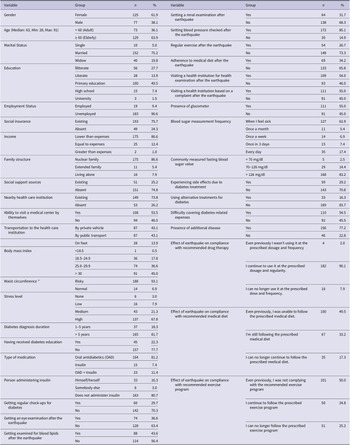
In terms of demographic variables, 61.9% of the participants were women, 75.2% were married, 49.5% were primary school graduates, 90.6% were unemployed, 75.7% had social insurance, 86.6% had incomes lower than their expenses, and 86.6% lived in nuclear families. The median age was 63 (minimum: 28, maximum: 91) and 63.9% of participants were 60 years or older. Given that the ideal waist circumference limit is 80 cm for women and 94 cm for men, 93.1% of the sample had a high waist circumference and 81.6% had a body mass index more than 25.0. Almost three-quarters (73.8%) said they had a nearby health institution they can go to if they need it, nearly half (46.5%) said they couldn’t go to a health institution on their own, 43.1% said they used public transportation to get there, and 43.1% said they drove themselves (Table 2).
Data on sociodemographic features, anthropometric measurements, using health services, diabetic characteristics, and post-earthquake health behaviors

n: Number, %: Percent, Min.: Minimum, Max.: Maximum, *>80cm for women and >94cm for men is considered a high value.
Participants’ Diabetes-related Characteristics
In terms of diabetes-related characteristics, it was determined that 81.7% of the patients had been diagnosed with diabetes for more than 5 years, 77.7% had not received diabetes education, 81.2% were treated with oral antidiabetic medicines, and 29.2% had treatment-related side effects. It was shown that 45% of the participants did not own a glucometer, 62.9% only measured their blood sugar when they felt ill, and 83.2% had fasting blood sugar levels that were consistently above 126 mg/dl. It was also found that 16.3% of them used alternative diabetic treatments, 70.3% did not receive regular diabetes-related health checkups, 54.4% struggled to cover diabetes-related health expenses, and 77.2% had other comorbidities (Table 2).
Participants’ Post-Earthquake Health Behaviors
Since the earthquake, 63.4% of participants have not had an eye examination, 56.4% have not had a blood lipid measurement, 68.3% have not had a renal examination, 14.9% have not had a blood pressure measurement, 73.3% have not exercised regularly, 65.8% have not adapted to the medical diet, and 46% have not visited a health institution for a health check-up, even a year later. It was also determined that 55% of them applied to a health institution due to various complaints (Table 2). After these complaints were evaluated, it was shown that 52.3% of them may have been related to diabetes. These problems were hypoglycemia, hyperglycemia, diabetic foot, vision problems (double vision, blurred vision, decreased vision), renal problems (urinary tract infection, edema, kidney pain), cardiovascular problems (angina, myocardial infarction, hypertension, hyperlipidemia, edema, syncope, palpitations), and foot pain that are estimated to be related to neuropathy.
Participants were asked about the earthquake’s impact on their medical care, nutrition, and exercise habits. Following the earthquake, 7.9% of participants reported being unable to follow the prescribed medical treatment, 17.3% with the recommended medical diet, and 25.2% with the recommended exercise program (Table 2).
Results Pertaining to the Diabetes Self-Management Scale Scores and Related Factors
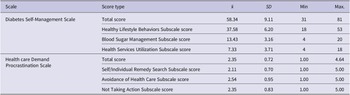
The participants’ average score on the Diabetic Self-Management Scale was found as 58.34 ± 9.11 (minimum: 31, maximum: 81). The average subscale scores were 37.58 ± 6.20 (minimum: 18, maximum: 53) for healthy lifestyle behaviors subscale, 13.43 ± 3.16 (minimum: 4, maximum: 20) for blood sugar management subscale, and 7.33 ± 3.71 (Minimum: 4, Maximum: 18) for health services utilization subscale (Table 3).
Participants’ Diabetes Self-Management Scale, Health Care Demand Procrastination Scale, and subscales scores

x̄: Mean, SD: Standard Deviation, Min: Minimum, Max: Maximum
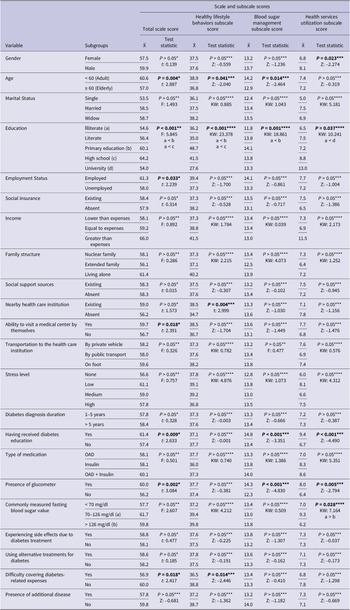
Those under the age of 60, employed, able to visit a medical center on their own, having received diabetes education, owning a glucometer, regularly exercising, adhering to medical diet, and getting regular check-ups for diabetes had significantly higher diabetes self-management scores, whereas those illiterate and having difficulty covering diabetes-related expenses had significantly lower diabetes management scores (P < 0.05). Respondents over the age of 60, who do not have a nearby health care institution, are illiterate, have trouble financing diabetes-related expenses, make exercise regularly, compliant with the medical diet after the earthquake, and get regular check-ups for diabetes had significantly lower scores on the healthy lifestyle habits subscale (P < 0.05). Those who were under the age of 60, owned a glucometer, exercised frequently, followed the medical diet following the earthquake, and had regular diabetes checkups had statistically significant improved blood sugar management subscale scores, whereas illiterates had lower scores (P < 0.05). Men, those who had taken diabetes education, those who owned glucometers, those who had regular diabetes examinations, and those whose fasting blood sugar was within normal levels all had statistically higher subscale scores on the health services utilization subscale, while illiterates had lower scores (P < 0.05) (Table 4).
Results of the significance tests comparing the groups’ scores on the Diabetes Self-Management Scale

X̄: Mean, P: Significance, KW: Kruskal Wallis H Test (χ2-table value), Z: Z-Table Value, *Independents Samples t test, **One Way ANOVA Test, ***Mann Whitney U Test, ****Kruskal Wallis Test, OAD: Oral Antidiabetics.
Results Pertaining to the Healthcare Demand Procrastination Scale Scores and Related Factors
The participants’ average score on the Healthcare Demand Procrastination scale was found as 2.35 ± 0.72 (minimum: 1.00, maximum: 4.64). The average subscale scores were 2.11 ± 0.70 (minimum: 1.00, maximum: 5.00) for self/individual remedy search subscale, 2.54 ± 0.95 (minimum: 1.00, maximum: 5.00) for avoidance of health care subscale, and 2.35 ± 0.83 (minimum: 1.00, maximum: 5.00) for not taking action subscale (Table 3).
Respondents who do not have a nearby health care institution, whose diabetes diagnosis duration is between 1-5 years, and who don’t have a glucometer had significantly higher scores on the Healthcare Demand Procrastination Scale (P < 0.05). The self/individual remedy search subscale score was shown to be statistically significantly higher among respondents with social insurance (P < 0.05). It was found that those without a glucometer and those whose diagnosis has lasted between 1 and 5 years had statistically significantly higher avoidance of health care subscale scores (P < 0.05). Additionally, the absence of a close health care facility, the presence of social support networks, self-transportation by vehicle, and the lack of a glucometer were associated with higher scores on the not taking action subscale, whereas illiterate people scored lower (P < 0.05) (Table 5).
Results of the significance tests comparing the groups’ scores on the Healthcare Demand Procrastination Scale

X̄: Mean, P: Significance, KW: Kruskal Wallis H Test (χ2-table value), Z: Z-Table Value, *Mann Whitney U Test, **Kruskal Wallis Test, OAD: Oral Antidiabetics.
Finally, a weak negative correlation between diabetes self-management scale scores and Healthcare Demand Procrastination Scale scores was determined (P < 0.001, r: -0.346).
Limitations and Strengths
The main limitation of the study was that we attempted to reach all people with Type 2 diabetes without using any sampling methods to obtain enough samples in accordance with the power analysis. This may limit the generalizability of study findings to the entire population. On the other hand, the study also has its strengths. The study is a multicenter study, as the study data were collected by interviewing Type 2 diabetics living in 7 different container cities. In addition, because the required sample size was reached, the study results can be generalized to Type 2 diabetics affected by the earthquake. Another important strength of the study is that it is the first to investigate post-earthquake diabetes self-management and health care demand procrastination behaviors of individuals with Type 2 diabetes who were affected by the earthquake.
Discussion
This study is the first to investigate post-earthquake diabetes self-management and health care demand procrastination behaviors of individuals with Type 2 diabetes who were affected by the earthquake, lost their homes, had to move away from their normal living space, and are trying to continue their lives with Type 2 diabetes in a new and unfamiliar living space they are not used to. It is a valuable study because it is the first study conducted for the stated purpose and on the other hand, it reveals important findings regarding earthquake victims’ diabetes self-management, health care demand procrastination behaviors, and affecting factors. The study’s findings are discussed under 2 headings as discussion of the findings regarding diabetes self-management and discussion of the findings regarding health care demand procrastination behaviors.
Discussion of the Findings Regarding Diabetes Self-Management
This study showed that following the earthquake disaster, Type 2 diabetics who had been affected by earthquakes had poor levels of diabetes self-management. Upon reviewing the national and international literature, no studies were found that evaluated diabetes self-management levels after the earthquake. However, studies conducted with individuals with Type 2 diabetes outside disaster periods in different countries (Indonesia, Iran, Türkiye Vietnam, South Africa) revealed that the diabetes self-management levels of individuals with diabetes were at an acceptable, medium, or high level.Reference İlhan, Telli and Temel 31 , Reference Kurniawan and Yudianto 36 –Reference Nguyen, Thi and Nguyen 38 As a result, the individuals in this study had lower diabetic self-management levels than those in studies done in disaster-free conditions. According to these findings, it can be said that the earthquake had a detrimental effect on the self-management of diabetics. This result may be due to losing their homes because of the earthquake, living in a new environment, being unable to obtain diabetes-related medical equipment from their destroyed homes, nearly half of the sample lacking a glucometer, high stress, and a low income in comparison to their expenses. Furthermore, difficulties in getting medical diets, inability to access health care, and a lack of adequate exercise surroundings may have hampered diabetes self-management.
The study revealed that people under 60 age years old had much greater levels of diabetes self-management, healthy lifestyle practices, and blood sugar management than those over 60. The results of the study align with existing research. Similar research has shown that older people have a lower level of diabetic self-management than younger people.Reference Kurniawan and Yudianto 36 , Reference Elliott, Das and Cavailler 39 A study conducted in South Africa found blood sugar monitoring performed on diabetics between the ages of 21 and 40 was shown to be superior to that of people over 60.Reference Mutyambizi, Pavlova and Hongoro 40 Utli and DoğruReference Utli and Doğru 41 found that people with diabetes over the age of 65 had poorer healthy life behaviors, such as physical activity and nutrition control, as well as overall diabetes self-management.Reference Utli and Doğru 41 This outcome is thought to have been caused by factors like aging-related physical decline, declining functionality, learning process slowdown, reduced ability to exercise, and inability to visit medical facilities alone.
This study indicated that female health service utilization scores were found to be lower than male. Utli and DoğruReference Utli and Doğru 41 found that women with diabetes used health care services more frequently than males, which contradicts our findings.Reference Utli and Doğru 41 The health services utilization among women for diabetes-related health checks or complaints may have remained low because male members of the family work during the day and women care for their family members in containers and may be hesitant to leave their family members alone because they believe it is an unsafe environment.
This study found that educational status was associated with both general diabetic self-management and self-management scores for different sub-dimensions. Other studies undertaken for similar aims have found that greater education levels relate to better diabetic self-management,Reference Khalooei and Benrazavy 29 , Reference İlhan, Telli and Temel 31 , Reference Kurniawan and Yudianto 36 –Reference Nguyen, Thi and Nguyen 38 healthier lifestyle practices,Reference Mogre, Abanga and Tzelepis 42 and better blood sugar control.Reference Al-Keilani, Almomani and Al-Sawalha 27 Our study’s findings are consistent with the literature.
We found that employed people had a greater level of diabetes self-management than unemployed people. In addition, individuals who stated that they did not have problems covering diabetes-related expenses were found to have higher diabetes self-management and healthy life behaviors scores. Parallel to our results, several studies have found that self-management, healthy lifestyle behaviors, and physical activity levels are better in employed individuals, those with a good economic situation, and those who do not have problems covering diabetes-related expenses.Reference Khalooei and Benrazavy 29 , Reference İlhan, Telli and Temel 31 , Reference Mutyambizi, Pavlova and Hongoro 40 Individuals with financial constraints might have poorer self-management and healthy living habits due to lack of access to medical devices, equipment, medical food, prescriptions, supplies, exercise, transportation, and health services. In fact, most people with Type 2 diabetes who live in containers do not work. Their homes were destroyed, their existing vehicles were damaged, and they lost their assets. They are supported by government entities, private groups, and volunteers. Due to budgetary constraints, they have restricted access to disease-specific foods, health services, and medical devices. All these circumstances may have resulted in lower diabetic self-management among people who were not working and had financial concerns.
We discovered that people with diabetes who can visit a medical facility on their own have better diabetes self-management. Furthermore, people who have a nearby health facility scored much better on the health lifestyle behaviors subscale. A study conducted in China found that elderly adults with diabetes who had good access to health care were more likely to comply with blood sugar monitoring.Reference Lu, Li and Zheng 43 Adequate access to health care and the presence of a local health facility can result in better complaint management, adequate professional counseling, better access to diabetes-related equipment, and improved compliance with diabetes-related health checks.
Diabetes self-management, blood sugar control, and health-care utilization were significantly improved in the participants who had previously received diabetic health education. According to Elliott et al.Reference Elliott, Das and Cavailler 39 and Kim & Han,Reference Kim and Han 44 participants with diabetes education experience had significantly higher diabetes management scores than those without in research on people with diabetic foot in South Korea and Syrian refugees in Lebanon.Reference Elliott, Das and Cavailler 39 , Reference Kim and Han 44 Our study findings are consistent with the literature.
We found that individuals with glucometers had significantly better diabetes self-management, blood sugar management, and health care utilization. Furthermore, people with normal fasting blood sugar levels were shown to have higher health care utilization scores. According to a review, participants’ abilities to manage their blood sugar were impacted when the glucometer broke down, which in turn impaired their ability to practice self-care.Reference Wilkinson, Whitehead and Ritchie 26 Based on this, it can be concluded that the use of a glucometer is critical in diabetes self-management. Furthermore, it can be assumed that those who use health services more regularly have better glycemic control and normal blood sugar levels because of the regular monitoring, testing, and professional counseling they receive.
Discussion of the Findings Regarding Healthcare Demand Procrastination Behaviors
This study revealed that the health care demand procrastination behaviors of earthquake victims with Type 2 diabetes was at a moderate level after the earthquake. Contrary to our finding, literature revealed that people with diabetes had high health seeking behaviors.Reference Espinosa and Espinosa 45 , Reference Karinja, Pillai and Schlienger 46 Espinosa & EspinosaReference Espinosa and Espinosa 45 demonstrated that people with diabetes exhibited good health-seeking behaviors when they experienced a symptom.Reference Espinosa and Espinosa 45 According to another study conducted by Karinja et al,Reference Karinja, Pillai and Schlienger 46 it was found that patients with diabetes and hypertension exhibited a high prevalence of appropriate health-seeking behaviors.Reference Karinja, Pillai and Schlienger 46 Considering that diabetes is a disease that should be taken into consideration even at the slightest symptoms and consult a health institution and can cause serious complications if ignored, it can be said that the result obtained in this study is not a desirable result. It could be attributed to damage to health systems and infrastructure, the distance between hospitals and container cities, transportation challenges (lack of personal vehicles, public transportation vehicles passing far away from the containers), and financial issues. All these circumstances may have led people to put off obtaining health treatment, even if they needed it.
Our study revealed that a range of internal and environmental factors influenced the individuals’ tendencies to delay health care demand. It was found that low education level, the absence of a nearby medical facility, the absence of social insurance, the presence of social support, the lack of a private vehicle for transportation, the diagnosis of diabetes less than 5 years ago and the lack of a glucometer all had a negative impact on health care demand procrastination behaviors and its sub-dimensions. In line with our study, a study conducted in China discovered that education, the presence of community health centers, and whether the patient has health insurance are all critical factors influencing health seeking and utilization of community health centers.Reference Zeng, Xu and Chen 47 Furthermore, various studies have found that education, health insurance,Reference Jalilian, Pezeshki and Torkzadeh 28 distance from health care facilities, diagnosis time, social support,Reference Inche Zainal Abidin, Sutan and Shamsuddin 25 traveling more than 30 minutes,Reference Feyisa, Kitila and Lemu 34 mode of transportation,Reference Lama, Baskota and Gurung 48 and taking self-measurements of the disease at homeReference Wang, Liu and Zhang 32 all influence health-seeking behaviors. Our study findings are consistent with the literature.
Conclusions
This study demonstrated that people with Type 2 diabetes affected by the earthquake had poor levels of diabetes self-management following the disaster and that the earthquake had an impact on the disease’s associated healthy lifestyle practices. It has been revealed that age, education level, employment status, ability to travel independently to a health care facility, having received diabetes education, ability to cover diabetes-related health expenses, and the presence of a glucometer are associated with diabetes self-management. On the other hand, it was shown that people with Type 2 diabetes exhibited a medium level of health care demand procrastination behaviors. Health care demand procrastination behaviors were found to be correlated with education level, the existence of a local medical facility, social insurance, social support, the mode of transportation to the health services, the length of time since diabetes diagnosis, and possession of a glucometer.
Based on these findings, to reduce the risks associated with disasters for people with diabetes, initiatives aimed at improving their self-management abilities and reducing health care demand procrastination behaviors should be planned. This planning should include diabetes self-management training, the provision of medical devices, food support compatible with medical diets, and areas for exercise for individuals with Type 2 diabetes who were affected by the earthquake and are currently living in containers. Furthermore, it is recommended to provide financial support, enhance the availability of transportation to medical facilities, and establish systems to support those who are unable to access medical facilities on their own. By putting these strategies into practice, diabetes self-management can be improved, and health care demand procrastination behaviors can be reduced to a minimum level in earthquake victims living in containers.
Author contribution
Erdal Ceylan: Design, methodology, data acquisition, analysis, interpretation of data, drafting the work and revising it critically, and final approval of the version to be published.
Acknowledgments
I would like to thank the earthquake victims in Hatay who, despite their challenging circumstances, opened the doors of their containers, volunteered to participate in the study, and cordially completed the survey questions.
Funding statement
This study did not receive any specific grant from funding agencies in the public, commercial, or not-for-profit sectors.
Competing interests
None.



 Open access

