

INTRODUCTION
The environmental consequences of food production have been studied extensively in recent years (Socolow Reference Socolow1999; Brentrup et al. Reference Brentrup, Küsters, Lammel, Barraclough and Kuhlmann2004; Pollan Reference Pollan2006; McMichael et al. Reference McMichael, Powles, Butler and Uauy2007; Galloway et al. Reference Galloway, Townsend, Erisman, Bekunda, Cai, Freney, Martinelli, Seitzinger and Sutton2008; Gruber & Galloway Reference Gruber and Galloway2008; Fedoroff et al. Reference Fedoroff, Battisti, Beachy, Cooper, Fischhoff, Hodges, Knauf, Lobell, Mazur, Molden, Reynolds, Ronald, Rosegrant, Sanchez, Vonshak and Zhu2010), revealing widespread, far-reaching costs. For example, agriculture is by far the largest use for land and freshwater by humans, on regional to global scales (Hutson et al. Reference Hutson, Barber, Kenny, Linsey, Lumia and Maupin2004; Nickerson et al. Reference Nickerson, Ebel, Borchers and Carriazo2011; FAO 2013), and the source of approximately 0·15 of the US greenhouse gas (GHG) emissions (Lal Reference Lal2004; French et al. Reference French, Jacob, Anderson, Kustas, Timmermans, Gieske, Su, Su, McCabe, Li, Prueger and Brunsell2005; Steinfeld et al. Reference Steinfeld, Gerber, Wassenaar, Castel, Rosales and De Haan2006; Doughty et al. Reference Doughty, Field and McMillan2011). Agriculture also disrupts flow of water and environmentally important solutes (Cuadra & Vidon Reference Cuadra and Vidon2011; Tomer et al. Reference Tomer, Wilson, Moorman, Cole, Heer and Isenhart2010), competes with biodiversity (Butler et al. Reference Butler, Vickery and Norris2007; Henle et al. Reference Henle, Alard, Clitherow, Cobb, Firbank, Kull, McCracken, Moritz, Niemelä, Rebane, Wascher, Watt and Young2008) and is the main cause of eutrophication, and thus of compromised continental, estuarine (Williams et al. Reference Williams, Filoso, Longstaff and Dennison2010) and coastal aquatic life (Galloway et al. Reference Galloway, Townsend, Erisman, Bekunda, Cai, Freney, Martinelli, Seitzinger and Sutton2008). However, food categories differ widely in their environmental impacts, with livestock accounting for a calorically disproportionate fraction of the total burdens (Socolow Reference Socolow1999; Smil Reference Smil2002, Reference Smil2013; Reijnders & Soret Reference Reijnders and Soret2003; Eshel & Martin Reference Eshel and Martin2006, Reference Eshel and Martin2009; Galloway et al. Reference Galloway, Burke, Bradford, Naylor, Falcon, Chapagain, Gaskell, McCullough, Mooney, Oleson, Steinfeld, Wassenaar and Smil2007; Glendining et al. Reference Glendining, Dailey, Williams, Van Evert, Goulding and Whitmore2009; Eshel et al. Reference Eshel, Martin and Bowen2010; Herrero et al. Reference Herrero, Havlík, Valin, Notenbaert, Rufino, Thornton, Blümmel, Weiss, Grace and Obersteiner2013).
Despite its potential to affect society significantly (Bittman Reference Bittman2009; Eshel Reference Eshel2010), to date the impact of the above line of work has been modest. This is partly because of an information mismatch. While existing environmental burden estimates address broad food categories, primarily plant v. animal-based foods (Socolow Reference Socolow1999; Eshel & Martin Reference Eshel and Martin2006, Reference Eshel and Martin2009; Pimentel & Pimentel Reference Pimentel and Pimentel2008; Eshel et al. Reference Eshel, Martin and Bowen2010), individual dietary choices and most policy objectives are often more specific. For example, for nutritional, dietary or environmental reasons, a person may well choose to consider the relative advantages of pork v. beef or wheat v. maize. Even if an individual estimate of the cost of one exists, it is unlikely to be accompanied by a directly comparable study of the second alternative considered. Furthermore, even if such a pair of studies exists, they are unlikely to consider, in a methodologically uniform manner, the costs in terms of more than one or two metrics. Therefore, environmentally motivated dietary choices and farm policies stand to benefit from more finely resolved enviro-nutritional information. Refining this information to allow food categorical specificity is thus particularly timely, and is the overarching motivation for the present work. To that end, a novel methodology for partitioning consumption of grains and by-product feed (hereafter ‘concentrates’), processed roughage, and pasture among the five edible livestock categories is presented. The method introduced allows splitting of the environmental tolls exacted by feed production for US livestock into the individual partial burdens due to each of the five edible animal categories. For example, in a follow-up paper, this method is deployed to partition overall land, irrigation water, reactive nitrogen (N) and GHG costs among the five livestock categories.
The method proposed is not the first to address this challenge, preceded most notably by life cycle assessments (LCAs) of US livestock (e.g. Phetteplace et al. Reference Phetteplace, Johnson and Seidl2001; Johnson et al. Reference Johnson, Phetteplace, Seidl, Schneider and McCarl2003; Pelletier Reference Pelletier2008; Pelletier et al. Reference Pelletier, Lammers, Stender and Pirog2010a , Reference Pelletier, Pirog and Rasmussen b ; Thoma et al. (Reference Thoma, Popp, Nutter, Shonnard, Ulrich, Matlock, Kim, Neiderman, Kemper, East and Adom2013)). While such analyses are extremely useful, and will hopefully continue and proliferate, their results depend strongly on, and vary by, geography, climate, methodology and agricultural practice. As such, only statistics derived from many LCAs, that sample widely all the above dimensions of environmental cost variability, can be generalized into national statistics. Indeed, different LCA studies often lead to broad differences in calculated impacts (e.g. De Vries & de Boer Reference De Vries and de Boer2010). For similar reasons, and because most LCAs address one livestock category, not all five, head-to-head comparison and relative ranking of the various categories is currently difficult to carry out or interpret. Consequently, national consistency (i.e. the resources concluded to be needed for the production of all five categories indeed sum to the respective known national livestock total expenditure within acceptable uncertainty) is not generally achieved. Similarly, using the relatively few existing individual LCAs of different US livestock categories, and multiplying their widely disparate reported environmental costs per unit product by total US production of those livestock categories, is currently unlikely to yield reliable, representative category specific national environmental burdens.
These difficulties with scaling the conclusions of specific bottom-up LCAs to national level motivate the development of the top-down approach presented in the present paper, in which cost estimates are derived mostly from national statistics. Not striving to outperform or usurp the bottom-up (LCA-based) approach, instead a parallel route that complements the LCA-based approach while maintaining a close dialogue with LCAs is devised. While not the current paper's main contribution, it is considered that facilitation of a dialogue between the two alternative approaches is an important secondary contribution. This view stems from the belief that the most effective route to discernibly improve estimates of livestock environmental costs is a co-evolution process. In this process, repeated retrospective consistency checks are envisioned, and mutual feedbacks between the two approaches, leading to gradual refinement and convergence of estimates based on either approach.
MATERIALS AND METHODS
One route to unification of environmental cost estimates of all livestock under a single methodological roof, and thus to self-consistent national statistics, is a method for partitioning a given food-related total environmental burden – say land used for feed – into the fractions attributable to specific food (livestock) categories. Motivated by the disproportionate environmental costs of animal-based categories mentioned above, a method expressly for and based on US livestock data are devised. Because costs incurred downstream of the farm gate (processing, packaging, retail and household) exhibit modest variations among the various livestock products (De Vries & de Boer Reference De Vries and de Boer2010), the present study focuses on the key upstream input, feed consumption. An exception discussed later in this section involves emissions of the non-energy-related GHGs methane and nitrous oxide (N2O). The present study facilitates the specific comparisons of environmental costs of individual livestock categories by splitting the total feed costs among the five principal livestock categories (beef, dairy, poultry, pork and eggs, hereafter jointly ‘the edibles’; the omission of fish is discussed in the online Supplementary material (Suppl Mat 1, Section S-1.1) available from: http://journals.cambridge.org/AGS). Limitations of the approach are detailed in the Discussion section.
The presented analysis merges various data sets that in general rely on distinct methodologies. As is typical of such mergers, the current analysis may well contain inconsistencies. While the present study is an effort to unify currently publicly available sources consistently, it highlights the need for a more coherent, internally consistent national data collection campaign. Once this campaign is launched and matures, the presented results should be revisited and the quantification updated.
While nearly all data analysed in the present paper are from the US Department of Agriculture (USDA), combining in one analysis unique raw USDA data sets may well introduce inconsistencies, potentially contradicting the afore-mentioned quest for uniformity. While impossible to fully eliminate, this potential is minimized by repeated, careful cross-referencing. That is, all potentially mutually related data sets of distinct origin are jointly checked for consistency. For example, data on slaughter weights are compared with total production mass divided by slaughter headcounts. While each of those variables (mean slaughter weight, total production and slaughter headcount) appears in a dedicated data set, they are used only after this consistency is reasonably demonstrated. Another example of potential inconsistency involves land use, grain production and yields. National annual mean yields and total production for all major crops are recorded in USDA data, as are total acreages occupied by each of those crops. Again, while these are related yet recorded in disparate data sets, those data sources are only used after demonstrating a clear consistency, in which national total acreage allocated for a given crop times national annual mean yield of the crop closely reproduces total national production of the crop.
Another limitation of the present work, rather straightforward yet worth mentioning explicitly as a cautionary note, is that the derived coefficients take note of environmental costs associated with feed production only, and thus do not represent the full farm-gate production costs. This is a very minor limitation for land use, irrigation water and reactive N costs, all due almost entirely to feed production. Conversely, this limitation is important to GHG emissions. All livestock production involves manure-management-related emissions of methane and N2O, and ruminant husbandry also involves significant additional methane emissions. For GHG costs, therefore, the additional manure management and enteric fermentation costs must be added to the feed-related costs obtained from the coefficients derived in the present work.
The USDA keeps detailed records of total consumption of the main feed sources [grain, soy, hay, silage and by-products (USDA Economic Research Service 2010, 2012a , b , c ; USDA National Agricultural Statistics Service 2011a )]. However, the portions of those totals that the five livestock categories consume individually are neither recorded nor known. A potential exception to this indeterminacy are the USDA's Animal Unit indices (USDA National Agricultural Statistics Service 2011a ), which in principle can facilitate partitioning. However, although these indices are updated annually, the underlying conversion factors used to translate headcounts into Animal Units have not changed since the late 1960s, when the USDA first introduced the indices. Since these indices are based on outdated farm practices, markedly different from today's, using them as the basis for any environmental costs partitioning is questionable (Westcott & Norton Reference Westcott and Norton2012).
To address the above limitations of currently available partitioning methods a novel partitioning method is devised, whose main steps are presented schematically in Fig. 1 and numerically in Table 1. First, overall feed requirements of each livestock category is calculated by combining extensive data on headcounts (USDA Economic Research Service 2011a , 2012b ; USDA National Agricultural Statistics Service 2009, 2011a , b , 2012), slaughter weights (USDA Economic Research Service 2011a ) and per head and per slaughtered weight feed requirements (National Research Council 1987, 1994, 1998, 2000, 2001) (top part of Fig. 1).
The partitioning methodology information flow. Fig. S-1 in the online Supplementary Material (Suppl Mat1; available from: http://journals.cambridge.org/AGS) is a more detailed version. First, total feed needs per animal category (t x) are calculated by multiplying average feed per slaughtered kg by total slaughtered mass (for pork and poultry) or by multiplying average feed needs per head by inventory (for eggs and cattle). Total feed availability data (by human-edible livestock categories, the five livestock categories considered in this paper; denoted edib. in the figure) from the USDA (leftmost column) are combined with feeding recommendations and common practices (e.g. the 60 : 28 : 12 ratio for concentrates, processed roughage and pasture feed fractions for dairy) to estimate each category requirements of the three main feed classes (rows 2–4). This results in the final feed partitioning among the five major animal categories (bottom box).

Feed consumption by each animal category. The total feed requirements for categories in rows a–d are the products of head counts, final weight per head and feed consumption per slaughtered weight. The feed requirements of the animal categories in rows e–j are calculated as standing stock head inventories multiplied by daily feed consumption per head. Note that the number of heads in rows a–d refers to slaughtered animals per year, whereas in rows e–j it refers to standing inventory. Uncertainties are calculated in Section S-3. Column II gives mature animals' body masses. We report values with the least significant digits required to reproduce column V's reported means. Individual rounding may yield slight apparent inconsistencies

* Other dairy: mostly heifers, plus the very small (not shown above) dairy bull subcategory that was added to Other dairy's total (h, V); Section S-2.4. Other beef: mostly steers and heifers, plus beef bulls; Section S-2.5.
† Final weights. Mean weight (which determines feed consumption) is the weighted average of the shown final weight and an assumed newborn calf weight=34 kg throughout, yielding dairy heifers' approximate mean weight of 278 kg, as described in the text.
These requirements are then combined with USDA estimates of overall US feed production and availability by class (USDA Economic Research Service 2010, 2011b , 2012a , b , c ; USDA National Agricultural Statistics Service 2011a ). Each feed class is considered separately, where the considered classes are concentrates (grains and by-products), processed roughage (hay, silage, haylage and greenchop) and pasture. Put together, these data yield the feed requirement estimates for each combination of livestock category and feed class, which constitute the required partitioning (Fig. 1's central table and results in the bottom row).
The calculations must, and do, take note of two thorny issues. First, feed used by horses, sheep and goats is estimated and subtracted from the national available totals, to arrive at the feed consumed by the five major edible livestock categories. This feed consumption category, collectively termed ‘others’ hereafter, jointly contributes <0·01 of the calories in an American human's diet (USDA Economic Research Service 2012c ). The second issue is that pasture feed contributions are unknown, and are thus inferred by subtracting the overall availability of known concentrates and processed roughage from the total livestock feed requirements (Fig. 1, central table and bottom row). The major steps in the partitioning methodology introduced are described in full detail in the online Supplementary materials (Suppl Mat 1, Suppl Mat 2; available from: http://journals.cambridge.org/AGS). Briefly, the calculation is as follows: the concentrated feed requirements of poultry, pork and egg production are made immediately apparent by calculating their total feed requirements, as poultry and hogs only consume concentrated feed. From the fractions these three feed classes constitute in dairy rations reported in the cited literature, the total requirements per feed class are obtained for dairy. Next, beef use of processed roughage feed is inferred from the total national supply of processed roughage minus dairy's, which is considered known from dairy cattle feeding recommendations. Following a similar procedure, beef's pasture requirement is also inferred. Finally, from knowledge of total beef feed needs, and these calculated feed supplied by pasture and processed roughage, beef's concentrates needs are inferred, completing the partitioning table.
The calculation uses statistics that include annual mean headcounts, slaughter weights and annual total production by mass (Table 1, columns I and II). Also used are feed, given for the various livestock categories as kg feed per either (head×day) or slaughtered kg (Table 1, columns III and IV) (National Research Council 1987, 1994, 1998, 2000, 2001).
The analyses are based throughout on means and sd derived from all annual mean data available over 2000–2012 inclusive (9–12 values in most data sets). While these are small samples, this choice represents a balance between enhancing statistical robustness by considering larger samples, and emphasizing the current state of US agriculture, which dictates considering only the last few years. This balance seems reasonable given that year-to-year variability of annual means exhibited by the data sets used is typically in the 0·06–0·10 range. For example, that inter-annual variability in the all-important data on domestic feed use of grains, introduced and discussed later, is 12 million metric tonnes (t)/year, ≈0·08 of the corresponding 150 million t/year mean.
For each livestock category, multiplying the relevant amount (headcount or slaughtered weight) by the corresponding feed requirements – kg feed per (head×day) or per slaughtered kg, respectively – yields the category's overall feed requirements. Those requirements are reported in Table 1, column V (where all feed masses are reported on a dry matter (DM) basis). The key calculation steps with their results are presented in the Results section, with further details presented schematically in Suppl Mat 1, Fig. S-1 (available from: http://journals.cambridge.org/AGS).
RESULTS
The USDA maintain records of livestock's domestic utilization of the main feed grains (maize, sorghum, barley and oats); soy; wheat; by-product feeds (such as various millfeeds, sugar beet pulp and citrus peel); and hay, silage and other processed roughage types (Table 1, USDA Economic Research Service 2012a , b , c ); (Table A-3, USDA Economic Research Service 2010); (Table 5, USDA Economic Research Service 2011b ); (Table 29, USDA Economic Research Service 2012a , b , c ) and (Tables 6–2, 6–10, 1–35 and 1–62, respectively, USDA National Agricultural Statistics Service 2011a ). The means and sd shown in Table 2 are derived from these data sets for the years 2000–2010. The reported uncertainty ranges are not exhaustive. For example, they do not take thorough note of uncertainties in the class fractions of dairy feed, or in feed per head or per slaughtered weight estimates. Not yet systematically quantified, these uncertainties are not considered in the present paper, highlighting the need for a dedicated follow-up research effort.
Annual domestic utilization of key feed sources (including the feed consumed by non edibles such as horses) in million metric tonnes (Mt) DM (dry matter)/year. For example, the sum of the top two rows, ctot≈186±11·1 Mt/year, is the national concentrate DM feed mass available annually

* Sum of maize, sorghum, barley, oats, and wheat.
† Sum of maize and sorghum silage, haylage and greenchop.
‡ Deduced from subtracting the concentrates and processed roughage from the total feed.
As each feed source (grain, by-products, hay, silage and pasture) constitutes a distinct proportion in each livestock category's rations, and exacts unique environmental impacts, splitting each livestock category's overall feed requirements (Table 1, column VI) into the masses supplied individually by the principal feed sources is required. This raises two challenges. First, while the total DM masses supplied by concentrates and roughage (Table 2) are known, those totals sustain both edible livestock and ‘others’ (horses, sheep and goats; Suppl Mat 1, Section S-2.7; available from: http://journals.cambridge.org/AGS). Feed consumption of horses, sheep and goats are thus subtracted from the total available feed based on standard feeding recommendation for those animals (Haugen Reference Haugen1996; Anderson Reference Anderson2001; National Research Council 2007a ; Rinehart & Baier Reference Rinehart and Baier2011). Second, there are no data on pasture contributions, which are thus deduced by subtracting all other feed sources from total feed requirement of all animals ((k, VI) in Table 1).
The edibles' feed consumption is the total available minus the mass that the ‘others’ consume (Suppl Mat 1, Section S-2.7; available from: http://journals.cambridge.org/AGS). Subtracting c other (concentrates DM consumption by ‘others’; Suppl Mat 1, Table S-1) from c tot (the sum of crops' and by-products' means in Table 2) yields the edibles' concentrate DM consumption c edib,
 $$\eqalign{c_{{\rm edib}} = & {\rm} c_{{\rm tot}} - {\rm} c_{{\rm other}} \approx ({\rm 186} \pm {\rm 11} {\cdot} {\rm 1}) - ({\rm 4} \pm 0 {\cdot} {\rm 57}) \cr & \approx {\rm 183} \pm {\rm 11} {\cdot} {\rm 1}\,{\rm million}\,{\rm t}\,{\rm DM}/{\rm year}} $$
where a minor inconsistency due to individual rounding occurs. The same logic was applied to processed roughage, yielding r edib (Suppl Mat 1, Section S-2.8).
The concentrated feed requirements of pork, poultry and eggs, who do not consume roughage, are unchanged from the total values reported in Table 1, (a, VI)≈43±16·8 million t DM/year, (b–e, VI)≈50±7·9 million t DM/year and (f, VI)≈8±3·3 million t DM/year, respectively.
As summarized in Table 3, assuming average concentrate consumption by dairy of 0·60±0·060 of their total DM consumption t dairy (see Suppl Mat 1, Section S-2.4) yields
 $$c_{{\rm dairy}} = 0 {\cdot} {\rm 6}\,t_{{\rm dairy}} = {\rm 44} \pm {\rm 7} {\cdot} {\rm 1}\,{\rm million}\,{\rm t}\,{\rm DM}/{\rm year}$$
Feed mass consumption (mean±sd) in million metric tonnes (Mt) for the five considered livestock categories. In the central columns, underneath the absolute values are the fractions of the column totals to which the absolute values correspond (italics). The uncertainty range for pasture is large as it is calculated by subtracting the concentrates and processed roughage classes from the total feed. Minor numerical inconsistencies occur due to rounding.

For beef, consumption of concentrates is the total DM consumed by beef (see Suppl Mat 1, Section S-2.5) minus the sum of pasture and processed roughage consumed by beef,
 $$\eqalign{c_{{\rm beef}} = & t_{{\rm beef}} - r_{{\rm beef}} - p_{{\rm beef}} \approx {\rm 38} \cr \pm & {\rm 24} {\cdot} {\rm 2}\,{\rm million}\,{\rm t}\,{\rm DM}/{\rm year}} $$
Of the edible livestock, only beef and dairy consume appreciable amounts of roughage. As discussed above, breakdown of roughage consumption to each of these two categories is not available, and must be estimated. Following standard recommendations (National Research Council 2001; Applegate et al. Reference Applegate, Ess, Frankenberger, Jones, Schutz and Sutton2002), a mean dairy diet deriving 0·28±0·070 and 0·12±0·035 of its DM mass from processed roughage (hay, silage, haylage and greenchop) and pasture is assumed, with the uncertainties reflecting spatiotemporal changes in dominance of widely varied agricultural practices (e.g. the ubiquity of pasture in small-scale dairies east of the Great Plains v. its absence in large western industrial dairies, or the increased importance of hay and silage over pasture in cold climate dairies such as Wisconsin).
Referring back to Table 1, dairy's total DM consumption is (g–h, VI)≈74±9·2 million t/year. With the above assumed roughage fractions in the dairy diet, dairy's processed roughage and pasture DM consumption are
 $$\eqalign{r_{{\rm dairy}} \approx & (0 {\cdot} {\rm 28} \pm 0 {\cdot} 0{\rm 7}0) \times ({\rm 74} \pm {\rm 9} {\cdot} {\rm 2}) \cr \approx & {\rm 21} \pm {\rm 5} {\cdot} {\rm 7}\,{\rm million}\,{\rm t}\,{\rm DM}/{\rm year}} $$
 $$\eqalign{p_{{\rm dairy}} & \approx (0 {\cdot} {\rm 12} \pm 0 {\cdot} 0{\rm 35}) \times ({\rm 74} \pm {\rm 9} {\cdot} {\rm 2}) \cr & \approx {\rm 9} \pm {\rm 2} {\cdot} {\rm 8}\,{\rm million}\,{\rm t}\,{\rm DM}/{\rm year}} $$
Given that only cattle consume processed roughage, beef's processed roughage consumption is the remainder
 $$\eqalign{r_{{\rm beef}} \approx & r_{{\rm edib}} - r_{{\rm dairy}} \approx ({\rm 166} \pm {\rm 4} {\cdot} {\rm 8}) - ({\rm 21} \pm {\rm 5} {\cdot} {\rm 7}) \cr \approx & {\rm 146} \pm {\rm 7} {\cdot} {\rm 5}\,{\rm million}\,{\rm t}\,{\rm DM}/{\rm year}} $$
Similarly, beef's pasture consumption is
 $$\eqalign{\,p_{{\rm beef}} & \approx p_{{\rm edib}} - p_{{\rm dairy}} \approx ({\rm 1}0{\rm 8} \pm {\rm 34} {\cdot} {\rm 1}) - ({\rm 9} \pm {\rm 2} {\cdot} {\rm 8}) \cr & \approx {\rm 99} \pm {\rm 32} {\cdot} {\rm 9}\,{\rm million}\,{\rm t}\,{\rm DM}/{\rm year}} $$
These inferred feed mass consumption by each livestock category are summarized in Table 3.
Dividing each individual categorical consumption estimate by the respective feed source total completes the partitioning. For example, dairy's share of concentrates' burden is c dairy÷c edib, and beef's share of processed roughage's burden is r beef÷r edib. This partitioning, presented as proportions in Table 3 and Fig. 2, is the main result of the present study. Grain and by-product feeds, consumed by all edible livestock, partition as beef 0·21±0·112, poultry 0·27±0·046, dairy 0·24±0·041, pork 0·23±0·093 and eggs 0·04±0·018. Pasture and processed roughage, which are consumed only by cattle, are apportioned as 0·92±0·034 and 0·87±0·031 to beef, respectively, with the remainder to dairy.
The final partitioning of the three principal feed sources among the five considered livestock categories in fractions from total. The shown spreads are ±1 sd presented in Table 3's three middle columns.

Using the partitioning results to infer the environmental impacts associated with producing each livestock category's feed consumption requires knowledge of grain consumption by individual livestock categories. In the absence of such detailed knowledge, grain is assumed to be distributed among the five animal categories in the same proportions as the combined concentrated feeds. This is equivalent to assuming that by-products amount to roughly the same portion of all concentrates in the five categories' rations, an assumption that should be revised once detailed information has been collected. This allows the interpretation of Table 3's leftmost numerical column as indicating, e.g. not only that egg production requires ≈0·04 of the total nationally available concentrated feed DM, but also that egg production is responsible for ≈0·04 of the national feed grain production, and thus also for 0·04 of this production's environmental costs. The proportions in Table 3 thus provide the fraction of total feed-related environmental burdens incurred in the production of the specified feed classes for which each of the five categories are responsible.
MAIZE FERTILIZATION: A CASE STUDY IN THE METHOD'S DEPLOYMENT
As stated in the Introduction, the proposed method can be used to partition any known total livestock feed-related environmental burden whose magnitude can be reasonably expected to be proportional to feed consumption. A straightforward, relevant example that lends itself naturally to quantification by the presented method addresses fertilization of maize, the largest feed grain fertilizer user, for which USDA data are readily available. As an example of the method's use, the method is brought to bear on partitioning environmental costs of fertilizing feed maize (the total annual national maize production minus maize allocated for such human destined uses as ethanol or edible syrup production).
Fertilizer use is societally important for several reasons. First and foremost, fertilization is the most common cause of aquatic ecosystem eutrophication (Socolow Reference Socolow1999; Galloway et al. Reference Galloway, Townsend, Erisman, Bekunda, Cai, Freney, Martinelli, Seitzinger and Sutton2008; Gruber & Galloway Reference Gruber and Galloway2008) and thus a key culprit in water quality degradation (Sharpley et al. Reference Sharpley, Meisinger, Breeuwsma, Sims, Daniel, Schepers, Hatfield and Stewart2002). Of particular importance is N discharge into coastal environments by rivers draining croplands, which often plays a key role in such coastal eutrophication ‘epicentres’ as the Northern Gulf of Mexico ‘Dead Zone’ (Luoma Reference Luoma, Morganwalp and Buxton1999; Howarth & Marino Reference Howarth and Marino2006; Aulenbach et al. Reference Aulenbach, Buxton, Battaglin and Coupe2007). Fertilizer runoff is also implicated in several non-geophysical societal issues – such as enhancing food supply disparities and incidence of illness and allergy – in the USA and globally (Townsend et al. Reference Townsend, Howarth, Bazzaz, Booth, Cleveland, Collinge, Dobson, Epstein, Holland, Keeney, Mallin, Rogers, Wayne and Wolfe2003). In addition, fertilizer – particularly N fertilizer – requires significant energy investment (quantified in Suppl Mat 1, Section S-4.2; available from: http://journals.cambridge.org/AGS). Finally, fertilizer production and application often enhance land–atmosphere fluxes of the GHGs methane (CH4) and N2O, which are roughly one and two orders of magnitude more radiatively active than carbon dioxide (CO2), respectively. These augmented fluxes, along with additional fluxes arising from the production and application chemical processes (see Suppl Mat 1, Section S-4.3) and the CO2 emissions associated with the above energy consumption, render fertilization, especially N fertilization, a significant anthropogenic climate change agent.
Given the far reaching impacts of maize fertilization, quantifying the relative fractions of various food categories in the overall effects is important for identifying desirable legislative and personal choices. Quantifying the five livestock categories' partial contributions to total maize fertilization environmental burdens is made possible by the proposed method, as follows.
Annual recent (2000–2010) feed-related maize N fertilization has totalled (20±3·6)×108 kg. N fertilizer comprises primarily (in descending order of mass) N solutions, ammonia, urea and ammonium. Additional phosphorus (P) and potassium (K) fertilization requirements are (7±1·3)×108 kg phosphate and (8±1·5)×108 kg potash. (Suppl Mat 1, derived in Table S-2, Section S-4.1, and references therein; available from:: http://journals.cambridge.org/AGS). Each of the three masses reported above represent 0·16–0·20 of the total use of the respective nutrient. While maize is fed to all five livestock categories considered, its fractional contribution to each category's rations is generally unknown, which is part of the present paper's motivation as discussed in the Introduction. Assuming maize constitutes the same fraction in each livestock category's concentrate feed mixture (an assumption that will clearly require revisiting once necessary data become available), the environmental burdens of maize fertilization are partitioned according to the concentrates sections of Fig. 2 and Table 3. Application of those partitioning coefficients to fertilizer consumption and associated environmental burdens (Suppl Mat 1, Table S-2; available from: http://journals.cambridge.org/AGS) results in the absolute attributions shown in Fig. 3.
Attribution of national annual total nitrogen fertilizer use (a) and overall maize fertilization-related energy use and GHG emissions (b) to the five considered livestock categories. Uncertainty ranges (vertical bars) span±1 sd. As a benchmark for (a), the 2000–2010 annual N load entering the Gulf of Mexico Dead Zone from the Mississippi is (13±3·0)×108 kg/year (Luoma Reference Luoma, Morganwalp and Buxton1999; Aulenbach et al. Reference Aulenbach, Buxton, Battaglin and Coupe2007). In (b) only the larger uncertainty bars, corresponding to energy (left vertical axis), are shown; GHG uncertainties are about a third smaller.
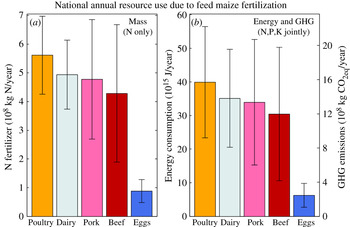
While only the USA as a whole is addressed in the present study, the spatial distribution of maize within the USA renders the analysis focused implicitly on the Mississippi basin. Because of the environmental significance of N discussed earlier, Fig. 3 a focuses on partitioning of N due to fertilization of feed maize.
The N masses used by all livestock categories except eggs are mutually comparable and statistically indistinguishable. As a benchmark, it is noted that in recent years total N flux feeding the Northern Gulf of Mexico Dead Zone is (13±3·0)×108 kg/year (Goolsby et al. Reference Goolsby, Battaglin, Aulenbach and Hooper2000; Aulenbach et al. Reference Aulenbach, Buxton, Battaglin and Coupe2007), which is about twice the usage by poultry (Fig. 3 a ‘s orange bar, consistent with the values reported by Robertson & Saad (Reference Robertson and Saad2013) and Matlock et al. (Reference Matlock, Thoma, Cummings, Cothren, Leh and Wilson2013)). The comparison is not entirely appropriate, because while the fertilizer inputs (the bars in Fig. 3 a) represent full raw agricultural N inputs, the flux into the Gulf (Goolsby et al. Reference Goolsby, Battaglin, Aulenbach and Hooper2000; Aulenbach et al. Reference Aulenbach, Buxton, Battaglin and Coupe2007) is only the unutilized fraction of the total N transported by runoff. Conservatively assuming an N runoff rate of 0·30, the basin's total N supply is 13×108 kg/year÷0·3≈43×108 kg/year. This value renders poultry's individual share of maize-related N fertilizer runoff, 6×10⁸ kg/year, about 0·13 of the annual N application in the Mississippi basin.
In Fig. 3 b, the individual costs of all three nutrients (Suppl Mat 1, Table S-2; available from: http://journals.cambridge.org/AGS) are combined into total energy and GHG costs, and are partitioned among the livestock categories. National total energy use and GHG emissions associated with livestock-related maize fertilization are (146±55·2)×1015 J/year and (57±14·6)×108 kg CO2e (Suppl Mat 1, Section S-4.1 and Table S-2 therein), of which poultry's share is 40×1015 J/year and ≈16×108 kg CO2eq/year. By comparison, given recent overall per capita US energy consumption of (9·9–10·3)×1019 J/year÷(310×106 Americans) ≈3·2×1011 J/person/year (U.S. Energy Information Administration 2011), poultry's ≈40×1015 J/year energy consumption amounts to the total annual energy needs of ≈120–125 000 Americans. Similarly, given recent years' per capita US GHG footprint of 21–25 t/year (United States Environmental Protection Agency 2012), poultry's ≈16×108 kg CO2eq/year emissions amount to the total annual GHG footprint of 64–76 000 Americans.
DISCUSSION
The current study presents a novel method for allocating the relative resource consumption characteristic of the five animal-based food categories and the three main feed classes. Although the resultant fractions can be normalized in various ways (e.g. resource use per serving or per kcal), the raw fractions are independently meaningful reflecting the current US food system, the technology it employs and the dietary preferences to which it caters. Thus, the present paper focuses on the raw fractions, reserving normalized results for a follow-up paper.
Due to insufficient data availability, the partitioning method depends on several unavoidable assumptions. These assumptions are discussed below, and observational campaigns needed for resolving the missing data are described.
First, it is assumed (see Suppl Mat1, Section S-1.2; available from: http://journals.cambridge.org/AGS) that feed-related environmental burdens scale as feed consumption. That is, if categories a and b consume x and 2x units of feed, category b's share of any impact of that feed class is assumed to be twice that of a. Second, feed consumption is assumed to be distributed uniformly in the sense that the fractions of maize, soy, wheat, etc. in concentrated feed are assumed fixed in the rations fed to all animal categories (such as poultry or pork). This assumption excludes the possibility that, e.g. pig growers favour feeding maize over barley, whereas poultry growers favour mostly wheat.
Another minor assumption – consistent with National Research Council (NRC) recommendations but not derived directly from data – addresses the bulk composition of the diets of horses, and goats and sheep (Anderson Reference Anderson2001; National Research Council 2007a , b ). The fraction by DM mass of pasture (processed roughage) is taken as 0·45 (0·35) for horses and 0·20 (0·65) for goats and sheep. As ‘others’ jointly consume only ≈0·06 of the total roughage, this assumption's impact is minimal.
One way to avoid making these assumptions is to keep detailed national records of the specific feed combinations each livestock category consumes. While recent efforts (Popp et al. Reference Popp, Thoma, Mulhern, Jaeger, LeFranc and Kemper2013; Thoma et al. Reference Thoma, Popp, Nutter, Shonnard, Ulrich, Matlock, Kim, Neiderman, Kemper, East and Adom2013) significantly remove some of the uncertainty, they typically address a single livestock category. There is a need to extend those efforts to all five livestock categories, and to unify them into a complete national picture. The current authors thus strongly support an effort (ideally led by the USDA) to collect and record such data, and indeed view the demonstration of the need for such an effort as a key secondary finding of the present paper. However, as this is not currently done, at this point both the partitioning method and the above assumptions are needed. As future data become available, they will permit replacing these two ad hoc assumptions by empirical reality, improving the current estimates.
The calculated raw fractions have several key characteristics. The concentrated feed demands of poultry, dairy, pork and beef are mutually similar, and significantly higher than eggs'. The interpretation of this result is complicated, however, by the widely varied human-destined caloric contributions of poultry, dairy, pork and beef, and by beef and dairy's additional reliance on processed roughage and pasture. As a result, the five categories' feed-to-product conversion efficiencies vary significantly.
Another important aspect is the relatively large uncertainty ranges for concentrated feed, which result in uncertainty-to-mean ratios of 0·30–0·50. While not ideal, these ratios are considerably narrower than ranges spanned by individual farms due to disparate agricultural practices and regions. For example, Fig. 9 of Thoma et al. (Reference Thoma, Popp, Nutter, Shonnard, Ulrich, Matlock, Kim, Neiderman, Kemper, East and Adom2013) shows a roughly eightfold range in GHG emissions per standardized (for fat and protein content) kg of milk. Similarly but less extreme, Table 4 of Pelletier et al. (Reference Pelletier, Pirog and Rasmussen2010b ) and Fig. 1 of De Vries & de Boer (Reference De Vries and de Boer2010) spans roughly a factor of 2 in land required per unit beef product. Figure 6 of De Vries & de Boer (Reference De Vries and de Boer2010) shows a >threefold variability in GHG emissions per unit beef product, among similar widely varied reported ranges. At this stage of agriculture environmental optimization, the uncertainties reported in the present study are tolerable, and represent a modest yet nontrivial improvement of the current state of the art. Consequently, the partitioning method they give rise to constitutes a provisionally solid foundation for policies and personal choices meant to optimize resource use related to concentrated feed production. At the same time, as agricultural environmental optimization matures, reducing uncertainties will be imperative. Unfortunately, at this point the data infrastructure necessary for significantly reducing uncertainties and producing an unambiguous partitioning is neither in place nor planned. However, the need for such data infrastructure, a corollary of the reported uncertainties, is one of this paper's clearest and most important messages.
The most helpful additional data will better characterize actual per animal consumption by the five key edible livestock categories. Further characterization of its variability under various practices (e.g. farm scale and intensity, preferred feed and roughage proportions in cattle diet, use of by-products, characteristic livestock lifespan) will be more advanced. While the USDA did collect data akin to these putative data in the 1960s (the Animal Unit indices (USDA Economic Research Service 2012a , b , c )), the underlying animal↔feed mapping has not been updated enough to reflect dramatic changes in agricultural practices. Consequently, current index values do not facilitate the necessary partitioning.
Also potentially very significant to lowering uncertainty is better pasture data: actual grass consumed on lands of the various pastureland categories (e.g. cropland pasture, range and grazed forest), inputs and outputs (fertilization, irrigation, mass and nutritional quality of yield), dependence on climate and seasonality (e.g. distinguishing south-western arid pastures from their moist southeastern counterparts, or monsoon-dominated southwestern lands from mountainous summer-only northwestern grazing land) and characteristic stocking densities.
Finally, better information about the somewhat small but by no means trivial feed consumption (i.e. headcounts and specific feed intake) by horses, sheep and goats will also reduce uncertainty somewhat.
An important issue not discussed in the present study is allocation of feed and the resulting burdens between animal categories. For example, culled dairy cows at end of life are consumed as beef and therefore some of their life-cycle feed should be allocated to beef to reflect environmental costs more accurately. A similar situation arises for laying hens consumed at end of life. Such feed allocations are not performed in the present paper and will be discussed in a future study.
The key objective of the present paper was to provide national category specific individual environmental burden estimates for beef, dairy, poultry, pork and eggs. The study results constitute a necessary first step towards meeting this challenge, providing burden estimates that can begin to guide specific choices of individuals and policy makers alike. A key necessary step for this outcome not pursued here, however, is the normalization of the raw results by various measures of each livestock category's nutritional contribution to human diet (e.g. energy, protein of a specified quality). As mentioned earlier, the further exploration of the results will be addressed in a follow-up paper.
The efforts reported in the present paper address the five key livestock categories simultaneously, using a unified methodology that analyses national statistics rather than a small number of farms at a specific location. As such, the presented analysis is more likely to prove nationally representative, serving as a yardstick for evaluating future national level meta-analyses.
The potential contribution of the derived category specific information to environmentally better personal choices is intuitive, and is similar to diet improvement by item specific nutritional information; a person may wish to compare environmentally eggs to dairy or pork to poultry, for which current coarsely aggregated information bundling together all animal-based foods does not suffice. While individual LCAs rapidly mature, and the picture they reveal comes rapidly into focus, they can vary considerably in methodology, domain definition, addressed product functional unit, and examined agricultural practice and geographical region. Consequently, translating LCA results to specific impact minimizing actions may be challenging. The results reported in the present paper may alleviate some of this ambiguity.
By identifying environmentally desirable agricultural directions, this specificity can also mitigate environmental impacts of farm policies. The employed tool in this case, agricultural market regularization, is traditional and customary throughout the world – e.g. maize or dairy prices are closely regulated by governments in most developed nations – yet food categories promoted by existing policies may well prove suboptimal against category specific environmental metrics derived from the present paper's partitioning method. In this use too, the proposed partitioning stands to contribute to reducing some of agriculture's environmental costs.
The main underlying, fundamental motivation of the present paper is the expectation that better, more specific food environmental impact estimates will aid voluntary and legislative steps to mitigate those impacts. While this is an optimistic view forward, not an assurance, we are particularly heartened by the keen and intensifying popular interest in food's environmental impacts (Pollan Reference Pollan2006; Bittman Reference Bittman2008, Reference Bittman2009), and by the expanding inclusion of food considerations in rapidly proliferating on-line ‘impact calculators’ (Global Footprint Network; available from: http://www.footprintnetwork.org/en/index.php/GFN/; World Wildlife Fund–United Kingdom 2013). While there is no assurance these trends and tools will indeed mitigate food's environmental burdens, the current inability to answer the very question they pose – from an environmental perspective, what food items should we reduce, or emphasize, in our diet? – is clearly an obstacle to realizing their potential. Diminishing this obstacle is the present paper's principal potential contribution.
The supplementary material for this article can be found at http://www.journals.cambridge.org/AGS



