


Introduction
The year 2023 saw significant political upheavals in Spain, particularly during the second half of the year due to several election processes. In May, the Partido Popular (PP), the liberal-conservative party, regained much of the territorial power it had lost in the 2019 elections. The populist far-right party, Vox, also achieved a good result, allowing it to gain access to significant local and regional government's headquarters, such as both the city and region of Valencia, alongside the PP. The Partido Socialista Obrero Español (PSOE) and other leftist parties experienced an electoral decline, leading to a call for early general elections, which were originally planned for autumn 2023.
On the eve of the fifth Spanish Presidency of the Council of the European Union (EU), Prime Minister Pedro Sánchez called for snap elections on 23 July. This decision was part of a multipurpose strategy. The primary reason was to draw attention to a new electoral campaign. Calling for a vote just before the summer holiday break was also seen as a strategy to discourage turnout, especially among PP voters. Additionally, it is worth noting the surprise effect on political opponents. Following its victory in regional and local elections, the PP focused on negotiating investiture agreements and coalition governments with Vox in several parts of Spain. On the left side of the political spectrum, the new Sumar platform launched by Yolanda Díaz, Minister for Labour, in April 2023 was also immersed in multilateral negotiations with a wide range of parties to consolidate its development.
The call for snap elections, just before the Spanish European semester, was also seen as a sign of prioritising domestic politics over European responsibilities. Tellingly, in contrast to well-established Council Presidencies’ practice, Pedro Sánchez did not even present the Spanish presidency programme to the European Parliament at the beginning of the country's semester in July 2023. The European Semester was successful in terms of legislative work, in particular with regards to the adoption of the Artificial Intelligence Act, but lacked lustre. Apart from the Granada Summits (the European Political Community conference and the informal European Council meeting held, respectively, on 5 and 6 October), the Spanish mandate almost passed unnoticed amidst the effervescence of national politics. In fact, even the negotiation of an addendum to the Spanish National Recovery and Resilience Plan including the option of loans, until then discarded by the government, and approved by the ECOFIN Council in October 2023, passed unnoticed in terms of public opinion.
Furthermore, 2023 marked the end of the so-called ‘new politics’ that arose during the 2014–2015 electoral cycle in an attempt to bypass the two-party system. The Podemos party practically disappeared from the electoral map. In 2023, it began with two ministries in the coalition government and representation in several local and regional parliaments and governments. However, by the end of the year, the party had only five seats in the Congreso de los Diputados, after splitting from the Sumar leftist platform. The situation of Ciudadanos (Citizens—Cs) was even worse, with the liberal party failing to obtain any seats in the regional elections and achieving only marginal results in the local elections. As a result, the party decided not to run in the general election of 23 July.
Following the July elections, forming a bare majority in the Parliament supporting a new government was challenging, since no single party or political block obtained a clear majority. This fragmentation resulted in two investiture sessions. The first one, attempted by Alberto Núñez Feijóo (PP) on 29 September 2023, failed. The second one, attempted by Pedro Sánchez (PSOE), was ultimately successful on 16 November 2023, after complex negotiations with Catalan pro-independence parties.
Election report
Regional and local elections
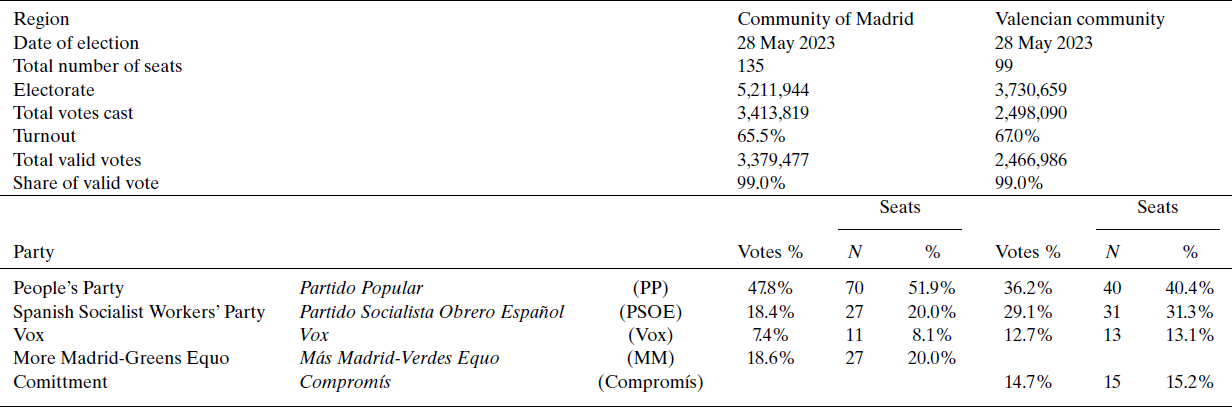
On 28 May 2023, Spain held local elections in its 8131 municipalities and regional elections in 12 out of the 17 regions (Autonomous Communities): Aragon, Asturias, the Canary Islands, Cantabria, Castilla-La Mancha, the Valencian Community, Extremadura, the Balearic Islands, the Community of Madrid, the Region of Murcia, Navarre and La Rioja. Regional election results are reported in Table 1 for the two most populous regions (Community of Madrid and Valencian Community).
Results of regional (Community of Madrid and Valencian Community) elections in Spain in 2023

Note: Since valid votes in Spain include blank votes, the share of votes by parties has been calculated on valid votes without blank votes.
Source: ARGOS (2023) (https://argos.gva.es).
At a local level, the People's Party received the most votes, retaining some important cities such as Madrid, Zaragoza and Alicante. The party also won in several large cities that were previously governed by the left, such as Valencia and Seville. However, there were some exceptions, such as Barcelona, where despite a leftist alliance of PSOE, Republican Left of Catalonia (ERC) and Comuns (the Catalan branch of Unidas Podemos [UP]) being technically possible, the PP and Comuns voted in favour of the PSOE candidate, Jaume Collboni, who became mayor of Barcelona. The support provided by the PP to the PSOE candidate on this occasion was seen as a conciliatory gesture from Núñez Feijóo (PP's leader) towards Sánchez, as well as an effort to prevent the city from being governed by Junts, the right-wing pro-independence party led by Carles Puigdemont, which came first in the local election.
A similar scenario occurred in the case of the regional elections. The PP achieved bare majorities in two Autonomous Communities (Community of Madrid and La Rioja) and was able to form parliamentary alliances, and even coalition governments, with Vox in six of them (the Valencian Community, the Balearic Islands, the Region of Murcia, Extremadura, Aragon, and Cantabria). It also became a kingmaker in the Canary Islands, where it provided support to the Coalición Canaria (CCa) party. The case of Valencia is particularly noteworthy because the PP and Vox formed an alliance at both regional and city levels, allowing the latter to gain access to two major Spanish administrations.
In contrast, the PSOE achieved one bare majority (Castilla-La Mancha) and managed to form left-wing coalitions in only another two Autonomous Communities (Asturias and Navarre).
In short, much of the local and regional power won by PSOE and its allies in the 2019 and 2015 elections went to the PP and Vox in 2023. At the end of 2023, the PSOE governed only in three out of 17 Autonomous Communities.
General elections
On 29 May, PSOE's defeat in the local and regional elections led Pedro Sánchez to call for snap general elections on 23 July. Thus, just before the summer holidays, Spain held general elections for both houses of Parliament: the Congreso de los Diputados and the Senado.
Most of the polls predicted a victory for the right (PP and Vox) with a bare majority (>175 of the 350 seats in the Congreso de los Diputados) (Reuters 2023). However, the formation of local and regional coalition governments in June and July, based on the PP-Vox partnership, encouraged the regrouping of a declining PSOE around the figure of its leader, Pedro Sánchez. The Podemos party, a minor partner in the governing coalition, eventually regrouped around Minister for Labour Yolanda Díaz and the movement she had launched in April and then registered as a political party in June, Sumar (which translates as ‘to add together’), a composite platform made up of 15 left-wing parties including, among others, Izquierda Unida (United Left; IU), Comuns, Más País (More Country) and the Valencian regional party Compromís (Commitment).
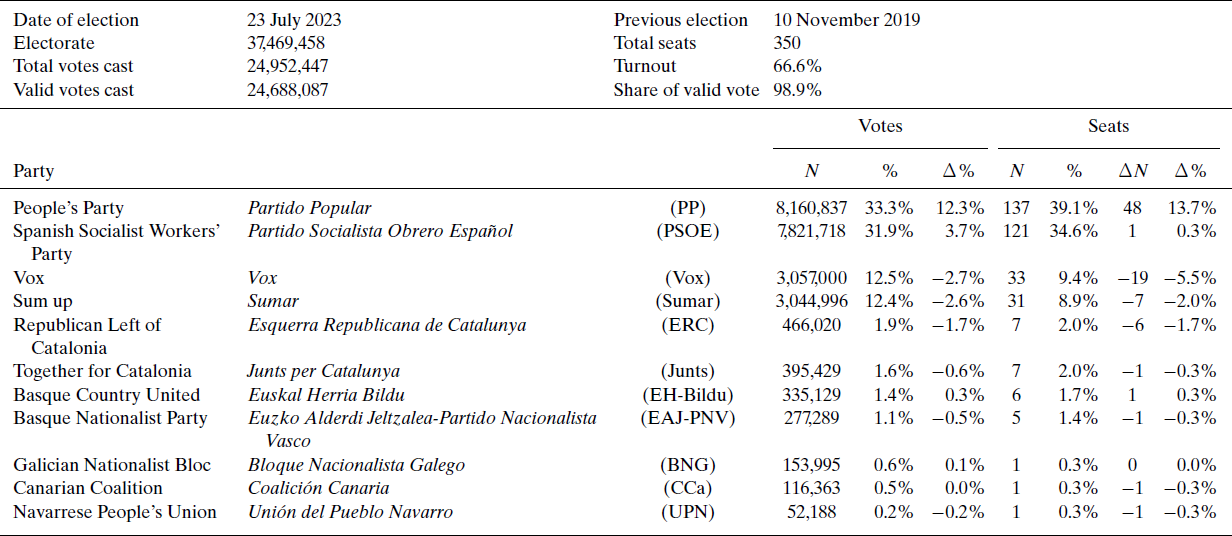
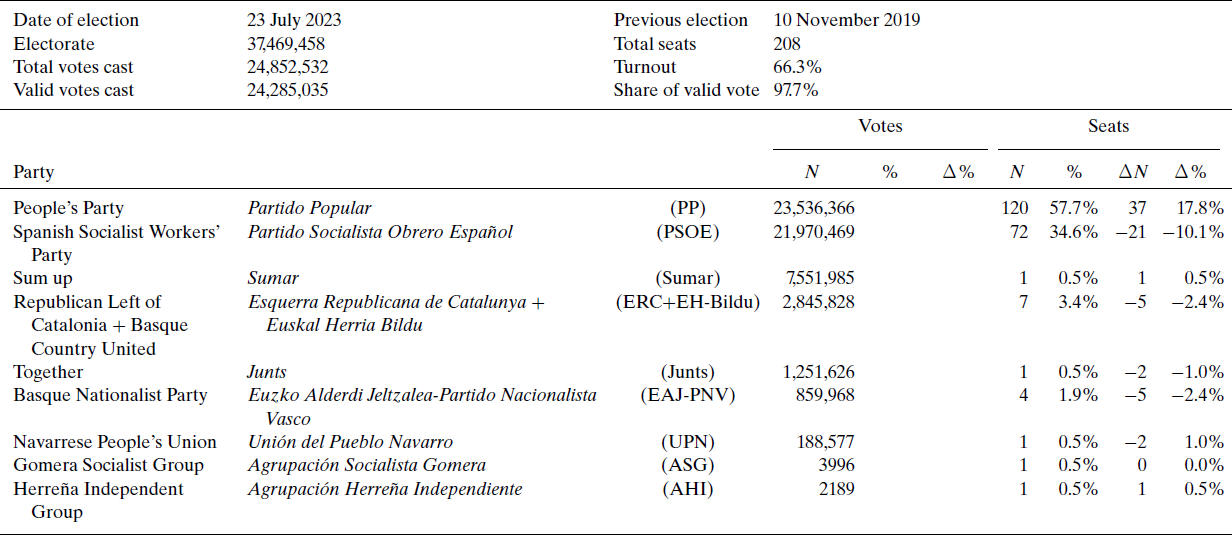
At the general election on 23 July, the PP, once again, won the most votes (see Tables 2 and 3). In the Senate election (Table 3), the PP secured an absolute majority of the seats at stake in the election (120 out of 208) and in the entire chamber with 144 out of 266 seats.Footnote 1 In the Congreso de los Diputados, the PP received over eight million votes and won 137 seats (+48 seats), while PSOE obtained 7.7 million votes and won 121 seats (+1 seat). This result allowed the PP to almost recover the votes lost in the 2019 elections (see Delgado et al. Reference Delgado, López, Redondo and Fernández2020). However, it was unable to form a government. PSOE and Sumar (this latter party obtained 31 seats in the lower house) were able to build a parliamentary majority with the support of regionalist and pro-independence political parties: Euskal Herria Bildu (Bildu), the Basque Nationalist Party (PNV), Esquerra Republicana de Catalunya (ERC), Junts, the Galician Nationalist Bloc (BNG) and CCa. Consequently, the leftist coalition government was reformulated (Table 2).
Elections to the lower house of the Parliament (Congreso de los Diputados) in Spain in 2023

Notes:
1. Since valid votes in Spain include blank votes (200,673), the share of votes by parties have been calculated on valid votes without blank votes (24,487,414).
2. PSOE includes the votes of the Socialists’ Party of Catalonia (Partit dels Socialistes de Catalunya, PSC-PSOE).
3. The number of seats obtained in 2019 by the parties that in 2023 joined Sumar was 38: United We Can (Unidas Podemos, UP: 35), More Country (Más País, MP: 2) and Commitment (Compromís: 1).
Source: InfoElectoral, Ministry of Home Affairs (Ministerio del Interior) (2023) (https://infoelectoral.interior.gob.es/es/elecciones-celebradas/resultados-electorales/).
Elections to the upper house of the Parliament (Senado) in Spain in 2023

Notes:
1. Since valid votes in Spain include blank votes (385,805), the percentages of votes have been calculated on valid votes without blank votes (23,899,230).
2. The Senate is elected with a Panachage open list system, according to which each voter has up to three votes, and hence the high number of votes. For this reason, the percentage of votes is complicated to interpret and it is not usually provided.
3. The Senator of Sumar was elected with a leftist coalition that included Sumar, PSOE, EUIB and Ara Eivissa.
4. Vox, BNG and CCa, which obtained representation in the lower house, obtained together 7,970,392 votes in the Senate election but no seats.
Source: InfoElectoral, Ministry of Home Affairs (Ministerio del Interior) (2023) (https://infoelectoral.interior.gob.es/es/elecciones-celebradas/resultados-electorales/).
As regards the other political parties in the Congreso de los Diputados, it is worth mentioning that Vox lost 600,000 votes and dropped from 52 to 33 seats. In the Basque Country, the far-left regional nationalist party Bildu won six seats, surpassing the traditional centre-right regional nationalist PNV, which won five seats. In Catalonia, ERC also dropped from 13 to seven seats.
In short, the possibility of a PP-Vox government stimulated the vote for PSOE and, to a lesser extent, Sumar across the country. Illustratively, in Catalonia, the Socialist Party went from being second to coming first in 2023, with over 1.2 million votes (+800.000), to the detriment of the pro-independence parties.
Cabinet report
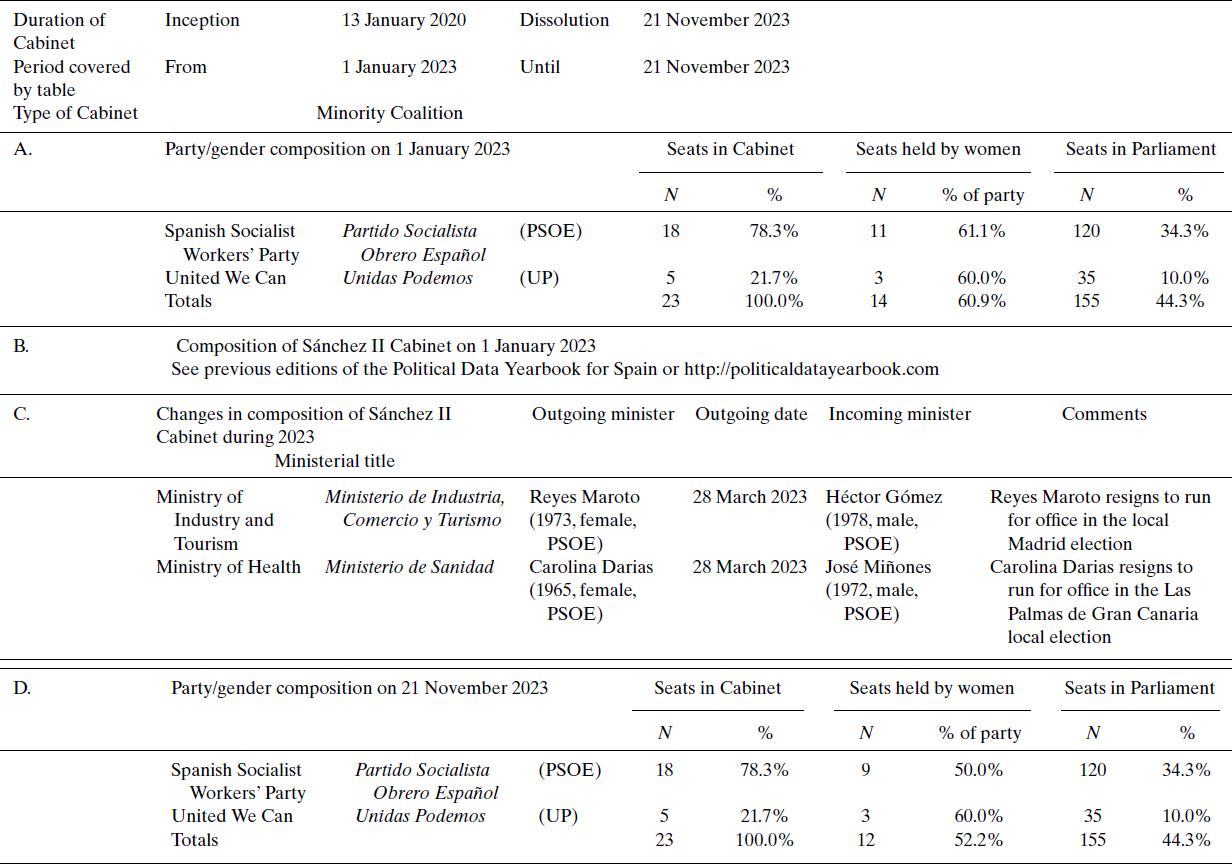
Before the general election that led to the third Sánchez government, there were two changes in the composition of the Cabinet (Table 4): Reyes Maroto, Minister for Industry and Tourism, and Carolina Darias, Minister for Health, both from PSOE, resigned to run, respectively, for the Madrid and Las Palmas de Gran Canaria local elections on 28 May. Only the latter was elected as mayor. In Madrid, the PP obtained an absolute majority.
Cabinet composition of Sánchez II in Spain in 2023

Note: Since 24 July 2023, after the general election, it was an acting government.
Source: La Moncloa (2023) (www.lamoncloa.gob.es).
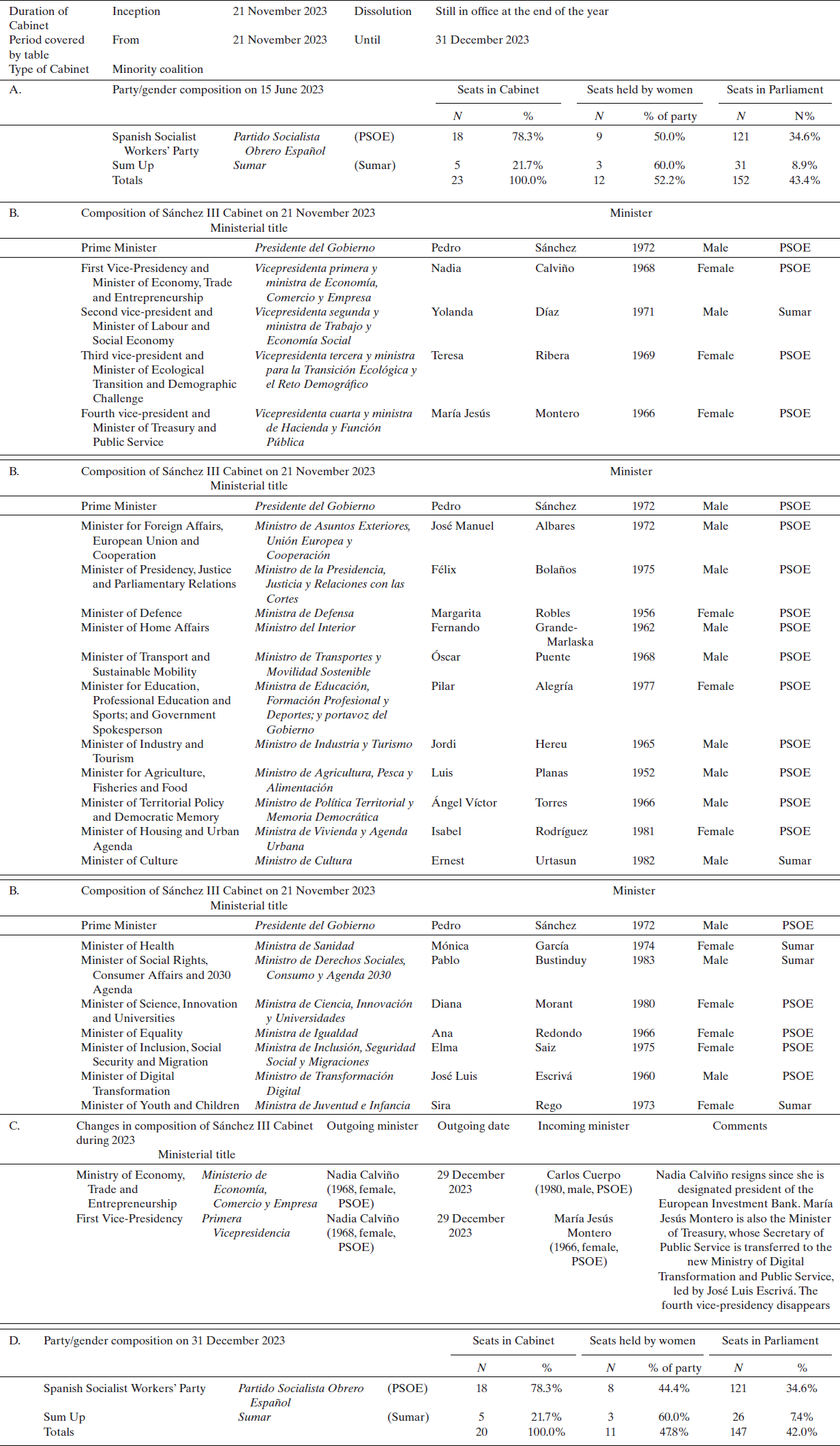
In November 2023, the third Sánchez government announced its new composition. The Cabinet was composed of 22 ministers (17 from PSOE and five from Sumar and its allies) (Table 5). In terms of structure, several changes were made. First, the Justice portfolio was integrated into the new Ministry of Presidency, Justice and Parliamentary Relations, led by Félix Bolaños (PSOE), former Minister for Presidency, Parliamentary Relations and Democratic Memory; a new Ministry of Youth and Childhood was created, with Sira Rego (Sumar) at its head; the Ministry of Transport, Mobility and Urban Agenda was split into two separate ministries: the Ministry of Transport and Sustainable Mobility (led by Óscar Puente, PSOE), and the Ministry of Housing and Urban Agenda (led by Isabel Rodríguez, PSOE). Moreover, the Ministry of Industry, Trade and Tourism was renamed Ministry of Industry and Tourism, with the former mayor of Barcelona, Jordi Hereu (PSOE), at its head; the Trade portfolio was transferred to the Ministry of the Economy (led by Nadia Calviño, PSOE); the State Secretary of Public Function, previously working under the Ministry of the Treasury, was upgraded to the category of Ministry and incorporated into the Ministry of Digital Transformation and Public Function (led by José Luis Escrivá, PSOE); the Ministry of Culture and Sports was divided into two separate ministries: the Ministry of Culture, led by Ernest Urtasun (Sumar), and the new Ministry of Education, Vocational Training and Sports, led by government spokesperson Pilar Alegría (PSOE). Finally, the Ministry of Territorial Policy was transformed into the Ministry of Territorial Policy and Democratic Memory, led by Ángel Víctor Torres (PSOE), and the former Ministry of Universities and the Ministry of Science and Innovation were merged to form the new Ministry of Science, Innovation and Universities, led by Diana Morant (PSOE).
Cabinet composition of Sánchez III in Spain in 2023

Note: The five MPs of Podemos abandoned the parliamentary group of Sumar on 5 December 2023. This left Sumar with 26 seats, instead of the 31 won in the election.
Source: La Moncloa (2023) (www.lamoncloa.gob.es)
In individual terms, the main key change was the non-renewal of the Podemos ministers: Irene Montero, who authored the controversial ‘only yes means yes’ law as Minister for Equality (see Fernández-Pasarín et al. Reference Fernández-Pasarín, Delgado and Bohigues2023), and Ione Belarra, former Minister for Social Rights and secretary-general of Podemos, where not included in the new Cabinet. However, Pablo Bustinduy, a former member of Podemos who joined Sumar in 2023, was appointed Minister for Social Rights. Alberto Garzón from the Izquierda Unida party (part of the Sumar platform) and former Minister for Consumer Affairs was also let go, but his party got the new Ministry of Youth and Childhood (with Sira Rego as minister). The appointments of Ernest Urtasun, spokesperson for Sumar (from the Comuns party) as new Minister for Culture, and of Mónica García, former regional opposition leader in Madrid for Más Madrid, as new Minister for Health, complete the list of ministerial portfolios obtained by Sumar. Yolanda Díaz, leader of Sumar, was appointed as second vice-president and Minister for Labour and remained as the only former UP minister in the new government.
In December 2023, the Sánchez government underwent a reshuffle after the Minister for Economy and Digital Transformation and first vice-president, Nadia Calviño, was appointed president of the European Investment Bank. Her role was split between Carlos Cuerpo (PSOE), who became the new Minister for Economy, Trade and Entrepreneurship; José Luis Escrivá (PSOE), the new Minister for Digital Transformation and Public Function; and María Jesús Montero (PSOE), Minister of the Treasury, who also became first vice-president.
Parliamentary report
In 2023, activities in Parliament were particularly intense. In terms of legislative production, four Organic Laws (LO), eight Royal Decree-Laws (RD), and 13 Ordinary Laws were adopted. LO amended existing regulations in the fields of sexual and reproductive health and voluntary interruption of pregnancy (LO 1/2023 of 28 February); the university system (LO 2/2023 of 22 March); animal welfare (LO 3/2023 of 28 March) and crimes against sexual freedom (LO 4/2023 of 27 April). RD were used in 50 per cent of cases to adopt urgent measures in various domains, such as ensuring the sustainability of the pension system (RD 2/2023 of 16 March), addressing agricultural issues resulting from the war in Ukraine, drought and climate conditions (RD 4/2023 of 11 May) and mitigating the economic and social consequences of conflicts in Ukraine and the Middle East (RD 8/2023 of 27 December). Ordinary Laws covered a wide range of topics, including the Labour Law 3/2023, the ‘Trans Law’ 4/2023, which focuses on ensuring real equality for trans people and protecting the rights of lesbian, gay, bisexual and intersex (LGTBI) individuals, the Housing Law 12/2023 and Laws 8/2023 and 9/2023, which dealt with Economic Agreements between the State and the Autonomous Communities of Navarre and the Basque Country, respectively.
In addition to legislative production, parliamentary life was marked by political upheaval, such as the reform of the controversial Law on Sexual Consent, informally known as ‘only yes means yes’, where the abolition of the criminal distinction between sexual abuse and rape had the perverse effect of reducing the sanctions for certain convicted criminals. The reform of the law, which intended to correct this problem, was passed with the support of PSOE, the PP, Ciudadanos, the PNV, four MPs from Junts, CCa, Foro Asturias (Asturias Forum), Teruel Existe (Teruel Exists), Partido Regionalista Cántabro (Cantabrian Regionalist Party), and Navarra Suma (Navarra Adds Up). In total, 233 MPs voted in favour, while the UP, ERC, Bildu, Más País, Compromís, the Candidatura d'Unitat Popular (Popular Unity Candidacy) and two independent MPs voted against it (59 votes). The remaining four Junts MPs abstained. Vox, with 54 seats, did not participate in the vote. Apart from the legal implications of this reform, it is worth highlighting the fact that the two coalition partners, PSOE and UP, voted differently in the Parliament for the first time in almost four years.
In March 2023, Vox presented a sterile motion of censure. The party nominated Ramón Tamames, a 90-year-old economist, as a candidate for the presidency of the government. Tamames only obtained 53 votes in favour (Vox and one independent MP); the rest of the 350 MPs abstained or voted against. In September, after the general elections, Alberto Núñez Feijóo (PP) also underwent a failed investiture as Prime Minister, with 172 favourable votes from PP, Vox, Unión del Pueblo Navarro (Navarrese People's Union, UPN) and CCa; the 178 votes against from PSOE, Sumar, ERC, Bildu, PNV, Junts and BNG prevented his appointment.
The negotiations between the Socialist party, the Basque nationalists (Bildu and PNV), and particularly, the Catalan pro-independence parties (ERC and Junts) were unprecedented due to the negotiation of an ad hoc amnesty law for people involved in the events leading to the 2017 illegal referendum on Catalonia's independence. Further compensation for the support provided by the Catalan pro-independence parties to the Sánchez government's investiture was the approval of the use of Spanish co-official languages (Catalan, Basque and Galician) in the Congreso de los Diputados in September. Taking advantage of the Spanish Presidency of the Council of the EU, there was also the petition for the recognition of Catalan as an official language of the EU, which was added to the agenda of the Council of the EU in September. On 16 November 2023, Pedro Sánchez was elected as the president of the government with 179 votes in favour (leftist, regionalist and pro-independence parties) and 171 votes against (PP, Vox and UPN).
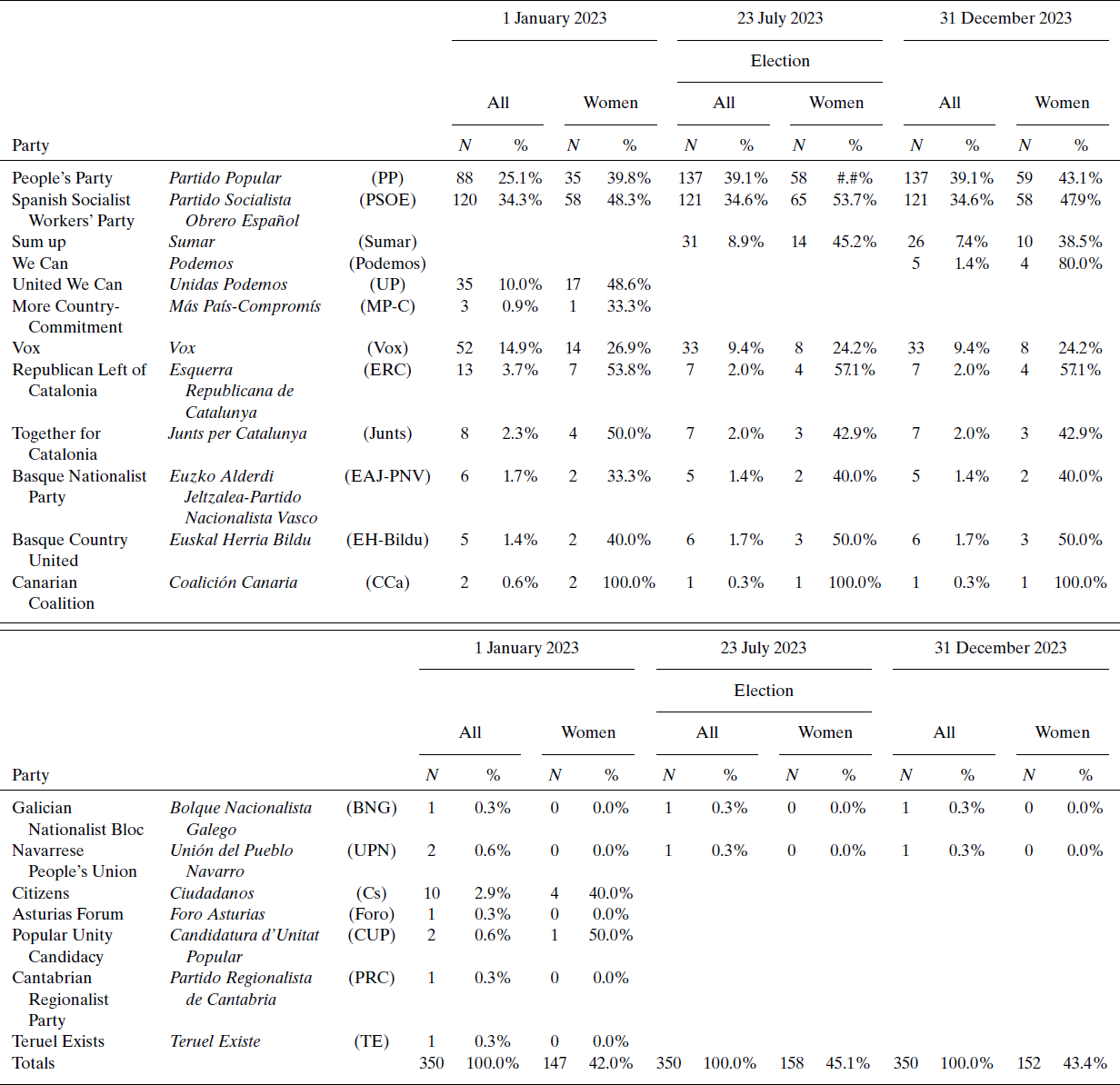
On 5 December, a split between Podemos and the Sumar parliamentary group took place. This was the culmination of longstanding tensions within the second Sánchez government between Podemos’ ministers Irene Montero and Ione Belarra, on the one hand, and Yolanda Díaz, leader of Sumar, on the other. The result was that five Podemos MPs left Sumar, thus leaving the coalition government with 147 seats instead of the 152 seats they originally held following the 23 July election (Table 6).
Party and gender composition of the lower house of the Parliament (Congreso de los Diputados) in Spain in 2023

Notes:
1. Sumar was created in May 2023 to run for the 23 July 2023 general election. UP and MP-C joined the coalition led by Sumar.
2. The five MPs of We Can (Podemos) abandoned the parliamentary group of Sumar on 5 December 2023. This left Sumar with 26 seats, instead of the 31 won in the election.
3. Cs did not run for the 23 July general election. Foro, CUP, PRC and TE did not obtain any seat in this election
Source: Lower House (Congreso de los Diputados) (2023) (www.congreso.es).
Political party report
The main new element during the year was the creation of Sumar, a leftist platform made up of 15 partners (including those that formed UP), which was converted by its leader, Yolanda Díaz, into a political party to run for the snap elections on 9 June. Despite ongoing tensions between members of the new platform, Sumar obtained a good electoral result: over three million votes, 31 seats, and five ministries in the third Sánchez government. However, as explained in the Parliamentary Report, Podemos broke away from Sumar only a few months after the general elections (Table 7).
Changes in political parties Spain in 2023

Source: Movimiento Sumar (2023) (https://movimientosumar.es/).
In May 2023, Ciudadanos announced that it would not participate in the general election. This decision came after the party's poor performance in the local and regional elections held on 28 May, which ultimately led to its collapse.
In August, one of the key leaders of Vox, Iván Espinosa de los Monteros, resigned. He had served as the party spokesperson in the Congreso de los Diputados since 2019.
Institutional change report
The crisis of the Constitutional Court, which was due for renewal after some of its members’ terms expired, came to an end through the appointment of four new members on 9 January 2023, ending years of deadlock (see Fernández-Pasarín et al. Reference Fernández-Pasarín, Delgado and Bohigues2023). Juan Carlos Campo, who served as Minister for Justice from 2020 to 2021, and Laura Díez, former vice president of the Council of Statutory Guarantees of Catalonia, were put forward by the government. María Luisa Segoviano and César Tolosa, both magistrates at the Supreme Court, were designated by the General Council of the Judiciary (Consejo General del Poder Judicial). On 11 January 2023, Cándido Conde-Pumpido and Inmaculada Montalbán replaced Pedro González-Trevijano and Juan Antonio Xiol as the new president and vice president, respectively, of the Constitutional Court.
The longstanding deadlock in the General Council of the Judiciary continued. Nevertheless, a major change occurred on 22 December 2023 due to an agreement between PSOE and the PP to negotiate the renewal of this institution under the supervision and auspices of the European Commission.
Issues in national politics
In 2023, Spain's macroeconomic data were relatively positive. The unemployment rate slightly decreased from 12.87 per cent in 2022 (Q4) to 11.76 per cent in 2023 (Q4), GDP grew by 2.5 per cent and although inflation was still high by Spanish standards (3.5 per cent), there was still a significant drop, compared to 2022 (8.4 per cent) (Instituto Nacional de Estadística 2024). The Spanish economy also benefited from the arrival of the Next Generation EU Funds. Tellingly, in March 2023, Spain received six billion euros in grants from the Recovery and Resilience Facility (European Commission 2024). Thus, the economic situation was positive overall.
In contrast, political matters did not go smoothly. Several legislative changes were surrounded by controversy. These included the law on sexual consent, which was finally amended due to high levels of concern among the public; the ‘Trans’ Law, which allowed, among other issues, the self-determination of gender; and above all, the negotiation of an Amnesty Law for the Catalan separatist leaders convicted for the events of 2017 (see Delgado et al. Reference Delgado, López and Redondo2018), amid increasing pressure on the Judiciary, accused of ‘lawfare’ by pro-independence leaders, which caused bitter debates both within and beyond the Parliament walls. Moreover, political tension also increased as a result of circumstances that have been mentioned in previous sections, such as the poor performance of the left in local and regional elections, the shift to the right involving coalitions between the PP and Vox across the country, the consolidation of Núñez Feijóo (PP) as leader of the opposition, the different rounds of investiture votes after the general elections, the conflict around the emergence of Sumar between the leaders of Podemos and Yolanda Díaz and the exclusion of former Podemos ministers Irene Montero and Ione Belarra from the third Sánchez government. After Podemos MPs left the Sumar parliamentary group in December, their support could no longer be taken for granted by the government. These events accentuated uncertainty around the stability of the government, which, given the crisis on its left, became even more dependent on highly conditional and case-by-case parliamentary support from Basque nationalist parties (Bildu and PNV, with 11 seats overall) and Catalan pro-independence parties (ERC and Junts, with 14 seats overall).
However, by far the most contested issue after the 23 July elections was the condition set by the Junts party, in exchange for supporting a PSOE-led government, that an amnesty law be passed that would apply to everybody involved in the events surrounding the 2017 Catalan independence referendum, including the Junts leader, Carles Puigdemont. In November, protests emerged against the negotiations between PSOE, Junts and ERC (the latter led the Catalan government), regarding a possible amnesty law. These protests, which were supported by right-wing and far-right organisations, the PP and, particularly, Vox, were held in front of the PSOE headquarters in different parts of the country, but mostly in Madrid, until the investiture of the new government. The protests were a clear example of the polarisation of Spanish politics over the last decade in relation to the Catalan question. Another example of tension occurred at the end of the year in the city of Pamplona, the capital of the Autonomous Community of Navarre. On 28 December, the leftist pro-independence party Bildu presented a vote of no confidence against the city mayor, Cristina Ibarrola, from the right-wing regionalist party UPN, and managed to have its candidate, Joseba Asirón, invested as the new mayor of Pamplona with the support of PSOE. This stance was perceived by the right (UPN, PP and Vox) as a new indicator of the PSOE's commitment to pro-independence nationalist parties.
In terms of intra-party political allegiances, the year 2023 was also worthy of note. The PSOE experienced a decline at local and regional levels but managed to maintain a parliamentary majority and form a government. Several socialist leaders who were defeated in local and regional elections while supporting Sánchez's leadership at the central level have been rewarded with positions in national politics. The Minister for Transport and Sustainable Mobility, Óscar Puente, served as mayor of Valladolid from 2015 to 2023. Similarly, the Minister for Territorial Policy and Democratic Memory, Ángel Víctor Torres, was the president of the Canarian government from 2019 to 2023. Also, the Speaker of the Congreso de los Diputados, Francina Armengol, held the position of president of the Balearic government from 2015 to 2023.
Overall, national issues were at the top of the political agenda in 2023. Although critical international questions such as the war in Ukraine and Gaza were the object of some headlines, public debate was concentrated on domestic concerns such as the different rounds of elections or the negotiations surrounding the investiture of a new government.


 Open access

