


The National Health Service (NHS) Plan (Department of Health, 2000) emphasises that health services need to change and modernise in order to improve service delivery. The role of psychiatrists is also going through a period of change (Department of Health, 2004). The expansion of nurse prescribing is an important part of this modernisation process. Independent nurse prescribing, from a limited formulary, was first introduced over 10 years ago. Qualitative studies have suggested that independent nurse prescribing has a positive impact on service delivery and patient satisfaction (Reference Luker, Austin and HoggLuker et al, 1998).
Nurse supplementary prescribing (NSP) was introduced in 2003 specifically for use in the management of chronic diseases such as asthma and diabetes, and in mental health, schizophrenia and dementia (Department of Health, 2003). Nurse supplementary prescribing is a voluntary partnership between an independent prescriber (the psychiatrist) and a supplementary prescriber (a suitably trained registered nurse), to implement an agreed patient-specific clinical management plan (CMP) that can include most medicines (Department of Health, 2003). The expected benefits of the introduction of NSP are:
-
• quicker and more efficient patient access to medication
-
• increased patient choice
-
• more efficient provision of services
-
• better use of nurses’ skills and knowledge.
If appropriate and indicated in the CMP, the supplementary nurse prescriber can adjust the dosages of medications, switch and stop medicines (Department of Health, 2003). Nurses are required to attend a 26-day university-based training programme, which is not mental health specific, and undergo a period of supervised practice with an experienced doctor in order that they may become a registered supplementary prescriber (Nursing and Midwifery Council, 2003).
Directors of nursing have a central role to play in the successful implementation of supplementary prescribing in England as it comes into practice. It is timely to map current practice within mental health services, NHS trust preparation, and explore nurse directors’ views and experiences of supplementary prescribing.
Method
A 32-item postal questionnaire was designed and developed specifically for this study by the National Institute for Mental Health in England (NIMHE) National Mental Health Nurse Prescribing Group. Directors of nursing were asked to respond to a series of questions that required factual information about their NHS trust, a yes/no response, or a rating on a three-point Likert-type scale (e.g. very confident, confident, not confident). The survey included questions on numbers and adequacy of preparation of mental health nurse prescribers; perceived benefits of, and barriers to, nurse prescribing; and clinical areas where NSP might be most usefully applied.
Data collection and analysis
We wrote to the directors of nursing in the 83 NHS mental health trusts in England explaining the aims and purpose of the survey and inviting them to participate. The questionnaire was sent out in March 2004, and again in June 2004 to those directors who had not responded.
Results
A total of 45 questionnaires were returned, giving a response rate of 54%.
Sample characteristics
The catchment areas served by the NHS trusts who responded were as follows: 18% urban; 13% rural; 18% suburban; 44% mixed; 7% regional and national. The trusts served a total population of 31 million (approximately 63% of the population of England). The 45 directors who responded employed a total of 26 306 qualified mental health nurses, a mean of 584 per trust.
Number of nurse prescribers
In the trusts surveyed, a total of 102 nurses had completed nurse-prescribing training; an average of two per trust. The majority (n=83, 81%) of qualified mental health nurse prescribers worked in four trusts. A further 128 mental health nurses were currently undertaking training. The majority of trusts (n=28, 62%), at the time of the survey, had no mental health nurses who had completed prescribing training or who were undertaking a prescribing role (n=37, 82%).
Benefits and barriers
The majority of directors of nursing (n=30, 68%) saw NSP as a ‘ very significant’ development for improving the experience of care for service users, with half reporting that their trust had a strategy for implementing nurse prescribing (n=21, 48%) and one-third seeing the implementation of NSP as high priority for their trust (n=14, 32%). The directors reported the main potential benefits from NSP as being:
-
• improving patient care and continuity of care (n=26, 57%)
-
• enhanced career development for nurses/extended nurses role (n=16, 36%)
-
• quicker access to medication (n=15, 33%).
Table 1 shows the service settings where nurse directors believed that NSP may have most potential benefit. Community-based services were those most frequently identified.
Where will supplementary prescribing be most useful?
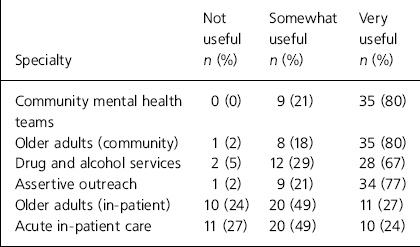
| Specialty | Not useful n (%) | Somewhat useful n (%) | Very useful n (%) |
|---|---|---|---|
| Community mental health teams | 0 (0) | 9 (21) | 35 (80) |
| Older adults (community) | 1 (2) | 8 (18) | 35 (80) |
| Drug and alcohol services | 2 (5) | 12 (29) | 28 (67) |
| Assertive outreach | 1 (2) | 9 (21) | 34 (77) |
| Older adults (in-patient) | 10 (24) | 20 (49) | 11 (27) |
| Acute in-patient care | 11 (27) | 20 (49) | 10 (24) |
Training and accessibility of appropriate courses
In the 24 NHS trusts where nurses were training for or were currently undertaking prescribing roles, half (n=12) reported that the feedback they had received about prescribing training was generally positive. However, only just under half (n=10, 42%) of respondents reported that they felt confident that the prescribing training alone had adequately prepared nurses to undertake a supplementary prescribing role. Directors reported that additional medication management training (e.g. Reference Gray, Wykes and EdmondsGray et al, 2004) either prior to or after completing prescribing training was required in 63% (n=15) of trusts where nurses were training for or were currently undertaking prescribing roles.
Medical supervision and support
The majority of the directors of nursing (n=29, 66%) who responded to the survey indicated that they did not think that psychiatrists were adequately prepared to mentor or supervise supplementary mental health nurse prescribers.
Consultant psychiatrists
When directly asked about the attitudes of psychiatrists to NSP, only a minority of directors (n=5, 12%) reported that, in their experience, psychiatrists had a negative attitude. Most were seen as having a positive (n=16, 37%) or neutral (n=19, 42%) attitude.
Discussion
Nurse supplementary prescribing is an important part of the modernisation process and potentially may make a substantial contribution to the changing roles of psychiatrists (Department of Health, 2004). Although this survey shows that, to date, relatively few mental health nurses have completed supplementary prescribing training or are undertaking a prescribing role, this is likely to change in the future, based on the views found in this survey. Such a major change in mental health practice takes considerable time to implement.
The barriers to the introduction of NSP identified by respondents do not appear to be insurmountable. Concerns about the training may be related to its non-mental health-specific nature. This is being tackled by trusts arranging for additional training. The lack of supervisor support suggests that there is a need to explore further the knowledge, skills and confidence of psychiatrists undertaking a nurse prescribing supervision role. Active resistance to implementation from psychiatrists seems relatively rare and may be tackled by trusts emphasising the potential benefits to both patients and staff by the introduction of NSP and by ensuring that early trials are well evaluated and publicised within trusts. Anecdotal evidence suggests that some resistance may arise from a misunderstanding as to the nature of NSP, with it being confused with independent nurse prescribing which takes place totally independently of a medical opinion.
It will be important for trusts to ensure that they have addressed local implementation issues prior to the commencement of training for mental health nurses as supplementary nurse prescribers.
Acknowledgements
We thank all the directors of nursing that participated in the survey.


 Open access


eLetters
No eLetters have been published for this article.