

Introduction
Wyndham Falls is a beauty spot in the Mirzapur district c. 80km west of Varanasi, located in a rocky outcrop of the Vindhya mountain range. The water cascades westwards from a plateau thick with vegetation in an area which forms part of a national park conserved by the Forest Department of Uttar Pradesh. Rock art was first discovered here by A.C. Carlyle, D.H. Gordon, Robert Bruce Foote and F.R. Allchin (Morhana Pahar) (Allchin et al.1997), and has been subsequently investigated by Vidula Reference JayaswalJayaswal (1982) and Rakesh Reference TewariTewari (2000). Jayaswal undertook an excavation of one rockshelter at Leheriahdih which brought to light microlithic assemblages chronologically associated with the paintings. Tewari has carried out a reconnaissance survey of a number of painted rockshelters in the region (although not Wyndham) and has reported on the main motifs found and the results of the analysis of the paint - a red ochre known locally as Geru. Meanwhile S.K. Reference TiwariTiwari (2000) listed at least 250 painted rockshelters in the Mirzapur region alone and identified the fauna depicted.
The Wyndham shelters
During the survey at Wyndham, which was carried out in September 2008 with the help of local field guides, we examined two new painted shelters (WYN 1 and WYN 2), and located a third (WYN 3). All of the paintings at the first two sites are executed in Geru and depict animals, human figures and some abstract designs.
Rockshelter WYN 1 (see Figure 1) is located beside a seasonal stream approximately 800m downstream from Wyndham Falls. Here a gorge (or Dari) carved out by the stream has created excellent surfaces for painting. Most of the surface of the Dari carries a blackish patination, probably created by rotting vegetation. One of our field guides, a local resident, has known of these rockshelters for some time and suggests that the black organic deposits may hide more paintings.
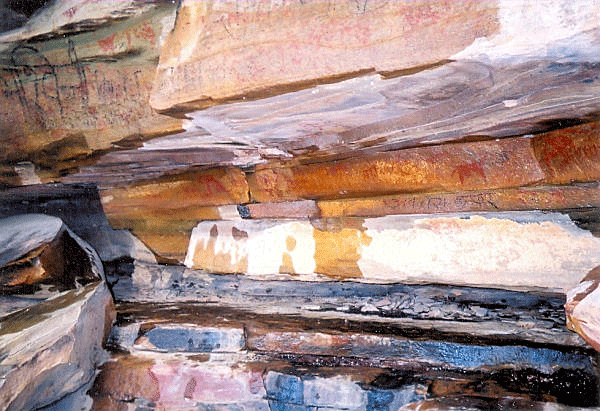
Remote view of five of the panels at WYN 2.

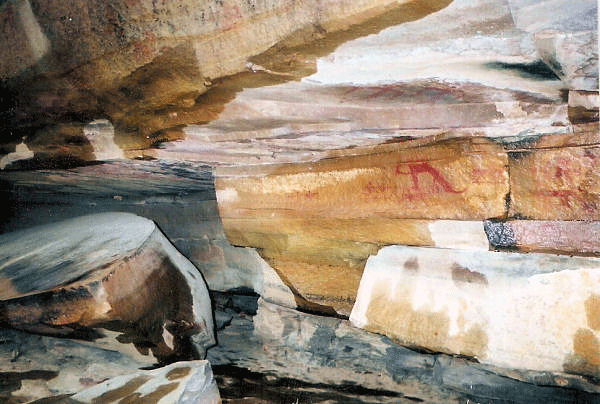
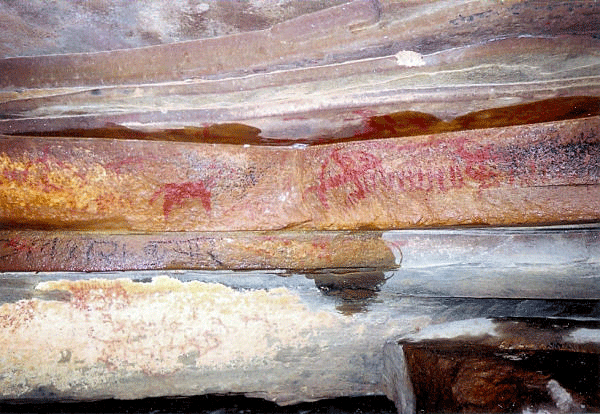
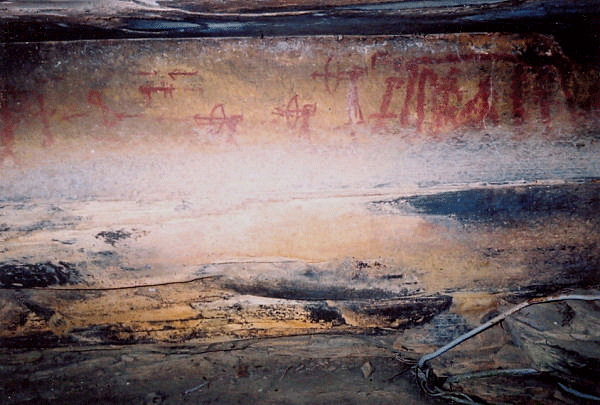
At WYN 2, c. 1.6km downstream from WYN 1, the paintings are more in evidence and present a profusion of wild game (Figures 2-4). Some panels also depict hunting scenes where human figures are seen shooting arrows at game of one kind or another. One unusual scene (Figure 4) shows human figures holding bows and seemingly shooting at each other, complete with arrows in mid-flight. There are also some geometric designs as well. Some of the paintings at WYN 2 are exposed to the elements and are therefore fading. Those located deeper inside the shelters, and thus protected from the weather, are still fresh. However, these latter ones also have copious modern graffiti.
Painted panel at the far left of WYN 2.

Painted panel at the centre of WYN 2.

Painted panel at the far right of WYN 2 showing human figures with bows shooting arrows which are illustrated in mid-flight.

Provisional assessment
Painted areas occur on Dari surfaces at all the major waterfalls in the state of Uttar Pradesh (e.g. Lekhania-Dari, Rajdari, Devadari). The sites appear to be associated with prehistoric hunting activities. However, they neither afford any shelter nor offer space for a hunting camp so it is possible that habitations may have existed elsewhere, perhaps on the opposite bank of the stream. The dating of these paintings raises problems of methodology. In the absence of scientific dating methods we traditionally tend to regard all paintings on one panel as contemporary and thus having the same date. If, as at Wyndham, there are some significant thematic associations between one figure and another, or within a group of figures, then in the absence of the correct dates, we may read such associations as belonging to the same composition. Similarly, the time-honoured stylistic method tends to designate whole groups of paintings to the same period - such as the Mesolithic at Bhimbetka.
The Times of India recently announced that British archaeologists from the University of Bristol had succeeded in the precise dating of rock art at southern European sites, using the uranium-thorium method. These results suggest that in a single cave, and in a single panel containing several paintings, each individual figure or group of figures may have been painted at different dates. Such cluster-paintings are, therefore, not collages of any sort but superimpositions. In places such as Chambdi Nallah, in Madhya Pradesh, which the first author has also surveyed, this point is abundantly clear. Here, in cluster-paintings, it is clearly evident that earlier images have faded but newer ones remain fresh (Pratap n.d.). This raises an important issue for the methodology used by Indian archaeologists in the study of Indian rock art. We must separate, for analytical purposes, the messages and meanings of rock art, that may be derivable through local history and content analysis and backed by excavation, from the issues regarding its chronology based on absolute methods (see Reference PettittPettit & Bahn 2003; Reference ValladasValladas & Clottes 2003).