


1 Introduction
Utilitarianism in normative ethics is focused on whether the consequences of an action maximize well-being (Reference MillMill, 1861). Thus, for example, in order to save five persons, one person can and should be sacrificed. Deontology, on the other hand, is often focused on whether the action accords with universal rights and duties (Reference Moore, Lee, Clark and ConwayKant, 1785). This implies that the consequences of the action are often immaterial. For example, an innocent person should never be sacrificed even if the sacrifice would lead to the survival of a much greater number of persons.
Given these sometimes counterintuitive implications, the structure and predictors of normative ethical positions, including utilitarianism and deontology, have been intensely studied in the last 15 years. One of the most popular frameworks of the psychology of moral judgment is the dual-process approach (see Reference FeldmanHall, Mobbs, Evans, Hiscox, Navrady and DalgleishGreene et al., 2001). In this perspective, deontological and utilitarian judgments can be explained on the basis of the operation of two separate mental processes. Type 1 processes are evolutionarily older, intuitive and automatic. Cycling for someone who is an experienced bike rider or recognizing an angry face in a crowd typically engages Type 1 processing. Type 2 processes, on the other hand, are evolutionarily more recent, analytic, controlled and reflective. Type 1 processing can be thought of as default, whereas the computationally more demanding Type 2 processes sometimes override the more automatic processes. Solving a novel type of problem or spotting a person in the crowd with a specific set of features engages Type 2 processing (Evans & Stanovich, 2003; Reference FrederickFrederick, 2005; Reference KahnemanKahneman, 2011; Reference Morewedge and KahnemanMorewedge & Kahneman, 2010; Reference Stanovich and WestStanovich & West, 2000).
In Greene et al.’s (2004) two-process model of moral judgment, utilitarian judgments stem from brain regions involved in analytic thinking whereas deontological judgments stem from brain regions related to emotional processing. The fact that making a utilitarian judgment typically takes longer than a deontological judgment has been offered as supporting this view.Footnote 1 Greene et al. (2004) also found that utilitarian responding in moral dilemmas is associated with activation in the high-effort thinking areas of the brain including the DLPFC and the anterior cingulate cortex (see also Cushman, Murray, Gordon-McKeon, Wharton & Greene, 2012, for similar findings). In addition, people primed to think analytically are more likely to make utilitarian moral judgments (Reference Kvaran, Nichols and SanfeyKvaran, Nichols & Sanfey, 2013).Footnote 2 One other support for the dual-process model is provided by mortality salience manipulations. Studies suggest that reminding people of their own mortality suppresses analytic thinking by creating a high cognitive load (Trémolière, De Neys & Bonnefon, 2014). Mortality salience also leads to a suppression of utilitarian judgments (Reference Trémolière, De Neys and BonnefonTrémolière, De Neys & Bonnefon, 2012). This finding seems to support Greene et al.’s (2001) dual-process account whereby mortality salience leads to a decrease in utilitarian judgments by suppressing analytic thinking (see also Reference Greene, Morelli, Lowenberg, Nystrom and CohenGreene, Morelli, Lowenberg, Nystrom & Cohen, 2008; Reference Paxton, Bruni and GreenePaxton, Bruni & Greene, 2014; but see Baron & Gürçay, 2016; Gürçay & Baron, 2017; Tinghög et al., 2016, for criticisms of the dual-process account).
Despite these findings, Kahane (2012) argues that choosing the utilitarian option in sacrificial dilemmas does not necessarily reflect an underlying utilitarian outlook. The main reason is that the utilitarian option involves actively harming someone and the tendency toward harm can be caused by a wide variety of motives. To find out the underlying cause of choosing the utilitarian option, Kahane et al. (2015) investigated the relation between responses in sacrificial dilemmas and utilitarianism in the traditional sense. They found that utilitarian choices were positively correlated with ethical transgressions in a business context, with sub-clinical psychopathy, and with rational egoism, and negatively correlated with giving to charity and with identification with humanity. Such choices were not related to real-world utilitarianism, self-sacrifice or impartiality. These findings seem to support Kahane’s (2012) view that utilitarian responses in sacrificial dilemmas are more indicative of psychopathy than of real-world utilitarianism. Insofar as we can infer anything from fMRI studies (see Uttal, 2011 for a critique), Wiech et al. (2013) demonstrated, consistent with Kahane’s (2012) view, that a brain area related to empathic concern (subgenual cingulate cortex), and not high-effort thinking areas, becomes active during utilitarian responses. Similarly, Koenigs et al. (2007) showed that damage to the prefrontal cortex, presumably an analytic thinking area, increases rather decreases utilitarian responding (but see Greene et al., 2004, for findings that link abstract reasoning regions in the brain and utilitarian responding). Finally, Djeriouat and Trémolière (2014) found that psychopathy as a personality trait is positively correlated with utilitarian responses and decreased harm sensitivity mediates this relationship (see also Reference Arutyunova, Alexandrov and HauserBartels & Pizarro, 2011, and Patil, 2015, for other findings linking psychopathy and utilitarianism).
Reference Greene, Morelli, Lowenberg, Nystrom and CohenRoyzman, Landy and Leeman (2015) extended previous research by having participants make moral judgments based on how permissible and how required an act is rather than just how right or wrong it is (see also Reference Banerjee, Huebner and HauserBanerjee, Huebner & Hauser, 2010 for a similar question format). In the footbridge dilemma, for instance, a participant who judged killing one person to save five as both permissible and required was classified as a utilitarian whereas someone who judged killing one as permissible but not required was classified as a moral minimalist. Two studies by Royzman et al. (2015) showed that scores on the Cognitive Reflection Test (Reference FrederickFrederick, 2005) were correlated with minimalism but not with utilitarianism. Utilitarianism was instead correlated with psychopathy, in parallel with Kahane et al. (2015). This again suggests that the so-called utilitarian option in sacrificial dilemmas is a poor measure of individual differences in traditional utilitarianism.
One limitation of the foregoing studies is that they were all conducted in Western Christian cultures with college students or mTurk participants. For this reason, it is imperative to test the generality of the findings on non-Western and non-Christian samples (Reference Henrich, Heine and NorenzayanHenrich, Heine & Norenzayan, 2010). Another limitation is that, although previous studies focus on the opposition between utilitarianism and deontology, other normative ethical views exist and might shape people’s moral judgments. Consistent with this, Reference Uhlmann, Pizarro and DiermeierUhlmann, Pizarro and Diermeier (2015) claim that moral judgments are influenced by the character of the actors in the dilemmas as well as their actions. In other words, participants make separate judgments about whether the actor is a good or a bad person and whether the action in question is right or wrong. Accordingly, Uhlmann et al. (2015) claim that people act like intuitive virtue theorists when making moral judgments. This makes sense from an adaptive point of view because what we need to evaluate in an everyday context is whether a person we encounter is trustable or would make a good friend, and the person’s general moral character, rather than individual actions, is more predictive in this regard. For example, a person who smothers a baby to save a group of fellow citizens might be judged to perform the right action from a utilitarian point of view but still be undesired as a friend because of a presumed defect in his character (Reference Uhlmann, Pizarro and DiermeierUhlmann et al., 2015).Footnote 3
In the present set of studies, in addition to eliciting moral judgments in sacrificial dilemmas (e.g., the trolley dilemmas, see Greene et al., 2001), we asked the justification of right/wrong judgments regarding the actions in the dilemmas. In addition to the utilitarian and deontological reasons, we added another question that purported to measure virtue ethical reasons as described above. We also surmised that people might have other reasons to make right/wrong judgments. One possibility in a predominantly Muslim society is not to interfere with what fate has already in store for a person. Deaths on a massive scale as in earthquakes, accidents, wars, etc., are routinely attributed to fate and are deemed to be unavoidable (Reference CesurCesur, 2003). This principle might lead some participants to refrain from intervening in the course of events to kill one to save five, just as a typical deontological or virtue ethical principle might. The reason would be to avoid taking responsibility for the death of one person. The death of the five persons, on the other hand, is arguably determined by divine authority and is not under the purview of the participant. For this reason, we added a fourth item that purported to measure fatalism as the justification of the right-wrong judgments. Finally, we added a fifth item to test the possibility that ethical principles might not have played a significant role in the participants’ judgments (amoralism).
The research reported here has thus two main aims: to determine the reason/justification behind the judgments in sacrificial dilemmas and to investigate how different moral judgments relate to analytic thinking and psychopathy. A subsidiary aim was to test the arguments by Greene and Kahane in a non-Western sample. In Study 1, we sought to delineate the reasons participants gave for their utilitarian or deontological responses in sacrificial dilemmas in a forced-choice format by presenting them with five options. We also investigated the utilitarianism-psychopathy and minimalism-analytic thinking associations in a predominantly Muslim sample. We replicated these associations in Study 2. In Study 3, we had the participants rate the importance of each reason on a continuous scale and investigated their relation with utilitarianism-minimalism scores, analytic thinking, psychopathy, and real-life utilitarianism.
2 Study 1
While Greene et al. (2001) claim that utilitarian judgments in sacrificial dilemmas are really utilitarian and related to analytic thinking, Kahane et al. (2015) claim they are not related to real-life utilitarianism and are related to psychopathy instead. Royzman et al. (2015), on the other hand, demonstrated that analytic thinking is associated not with utilitarianism but with moral minimalism. Minimalism in this context is defined as judging the one-person sacrifice as permissible but not obligatory. In Study 1, we treated permissible and obligatory judgments as continuous and measured them as such instead of treating them as categorical and forced choice options as in Royzman et al.’s (2015) original study. In addition, we explored other normative moral principles (e.g., virtue ethics) as possible motivators of moral judgments in sacrificial dilemmas. Finally, in contrast to most studies in the moral psychology literature, we used a predominantly Muslim sample in the study. We presented the personal and impersonal versions of the Transplant dilemmas and the Footbridge-Trolley dilemmas and asked about the justifications for judging the sacrifice as morally right or wrong. We also used a continuous measure of utilitarianism and minimalism and examined their relation to CRT and psychopathy.
2.1 Method
2.1.1 Participants
A total of 269 undergraduates from Doğuş University (Turkey) took part in the study for extra course credit (mean age = 21.57, SD = 4.21; 204 women, 63 men, two unreported). The majority of the participants identified themselves as Muslim (n = 209). Of the remaining, 20 were atheists, 24 reported believing in God with no affiliation with an established religion, four were affiliated with a religion other than Islam and one did not respond.
2.1.2 Materials
Moral Vignettes. Four different dilemmas were used to examine the participants’ moral judgments (in the Appendix). Two of them were “personal,” involving direct harm to the person involved in the scenario (Organ Transplant personal and Footbridge) and two were “impersonal,” involving only indirect harm (Organ Transplant impersonal and Trolley; see Reference Moore, Clark and KaneMoore, Clark & Kane, 2008; Reference Greene, Sommerville, Nystrom, Darley and CohenMoore, Lee, Clark & Conway, 2011).
In the Trolley scenario, a train is out of control and will kill five persons unless a button is pressed, in which case the train will change tracks and will kill one other person instead of five. The participant is asked to judge whether it is morally right to press the button and cause one person to die in order to save five.
The Footbridge dilemma is the personal version of the Trolley dilemma. It involves pushing one person in the tracks to his death in order to stop the train and save the five persons.
The personal Organ Transplant scenario involves a surgeon who can save five patients only by killing one critically injured patient by severing his jugular and transplanting his various organs to the five patients. In the impersonal version of the Organ Transplant scenario, the surgeon allows the one patient to die by not stopping a nurse who is about to perform an erroneous operation and accidentally lead to the death of the patient. The participants were asked in all scenarios to judge whether it is morally right to kill one patient in order to save five.
More specifically, the first question asked the participants to make a categorical right-wrong judgment. The second and the third questions asked about how required and how permissible the sacrificial action was. Unlike in Royzman et al. (2015), we asked these two questions on a Likert scale from 1 to 7, higher scores indicating higher requiredness and higher permissibility. Utilitarianism was defined as the sum of the requiredness and permissibility scores whereas moral minimalism was defined as the difference between the permissibility and requiredness scores. Thus, minimalism in this context meant seeing the sacrificial action as permissible but not required. A general utilitarianism and minimalism score was computed by summing over all four scenarios.
Finally, to understand the grounds for making the judgments they did, we presented the participants five items which corresponded to five different moral justifications. The first one corresponded to acting on non-moral grounds: “Moral reasons did not play an important role in my judgment.” The second item expressed a virtue-ethical principle: “Someone who intentionally harms an innocent person cannot be moral.” The third item expressed deontology: “Intentionally harming an innocent person is against fundamental moral rules and is thus unacceptable regardless of its intended consequence.” The fourth item expressed classical utilitarianism: “Moral action is what ensures the well-being of maximum number of people.” The fifth item expressed an acceptance of fate and avoiding responsibility: “It is wrong to interfere with consequences that arise as a result of the natural course of events no matter what the ensuing harm is.” The participants were asked to choose one of the five justifications for their choices in each of the four dilemmas presented. The order of the five items was randomized across participants.
Cognitive Reflection Test. To measure the thinking dispositions of the participants, we used the Cognitive Reflection Test (CRT; Reference FrederickFrederick, 2005), which is used frequently in the literature. The test consists of three questions that assess analytic or intuitive thinking styles, which correspond to a high-effort or low-effort thinking disposition. Each question has one true and one intuitive false answer. For example, the question “A bat and a ball cost $1.10 in total. The bat costs $1.00 more than the ball. How much does the ball cost?” immediately brings to mind a false intuitive answer (10 cents), whereas the correct answer (5 cents) requires analytic thinking. Correct answers to each of the three questions were added up and a total CRT score was computed (α = .540). Mean CRT-correct score for this study is 1.30 (SD = 1.00).
Psychopathy. To assess the psychopathy level of the participants, the Turkish translation of the psychopathy subscale of the Dark Triad scale was used (Reference Paulhus and WilliamsPaulhus & Williams, 2002). The subscale is a 1–5 Likert-type scale and consists of nine items (α = .731). One sample item is “Payback needs to be quick and nasty.”
Demographic form. A demographic form was given at the end where gender (0 =female, 1 = male), age, religiosity (1 = not at all religious, 7 = highly religious), etc. were asked.
2.1.3 Procedure
Materials were distributed in a classroom setting and took 20–30 minutes to complete using paper and pencil. To minimize order effects, the order of the scales was counterbalanced.
2.2 Results and discussion
Right-wrong judgments.
The majority of the participants judged killing behavior to be morally wrong in all four dilemmas: 94% in the Personal Transplant dilemma, 93% in the Impersonal Transplant dilemma, 58% in the Trolley dilemma, and 87% in the Footbridge dilemma. Table 1 shows the cross-tabulations between justifications and approval and disapproval judgments.
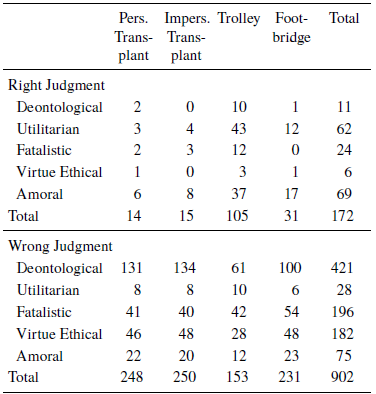
As can be seen in Table 1, the majority of the participants who judged the sacrifice of one person to be wrong chose the deontological principle as their justification in all four dilemmas. Although there is more variation among those who judge the sacrifice to be right, the two most common justifications were the utilitarian principle (n = 62) and amorality (n = 69). Somewhat surprising is the small minority which chooses utilitarianism or amoral reasons as their justification for judging that killing one person is morally wrong. That the majority points to deontological reasons for rejecting killing is consistent with Holyoak and Powell’s (2016) account that commonsense moral reasoning mostly seeks deontological coherence. In addition, fatalism and virtue ethics, rarely discussed in the psychological literature, are also seen by a sizeable part of the sample as the grounds for rejecting killing. This provides some support to Uhlmann et al.’s (2015) claim that laypeople act like naïve virtue theorists. The fact that those who condoned killing did so mostly on non-moral grounds is at odds with Greene’s dual-process account and Greene et al.’s (2001) findings. In fact, utilitarianism was less frequently chosen in the present study than amorality for judging that killing one person is morally right. This might be interpreted as supporting Kahane’s (2012) claim that the so-called utilitarian option in sacrificial dilemmas is not always the same as real-world utilitarianism, at least for some people.
Predictors of utilitarianism and minimalism.
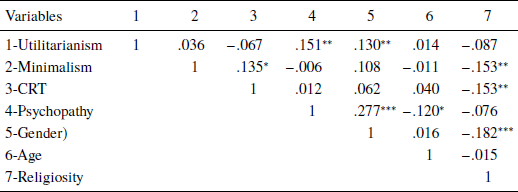
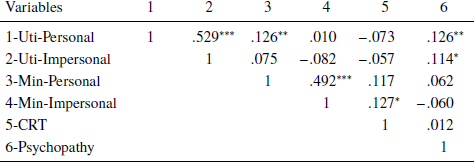
Table 2 shows the correlations among variables. Table 3 also shows the correlations of individual scenarios (Personal vs. Impersonal). Previous research (Reference Greene, Morelli, Lowenberg, Nystrom and CohenRoyzman et al., 2015) indicates that CRT predicts moral minimalism but not utilitarianism, in direct contrast to the dual-process account by Greene (2007). Unlike Royzman et al. (2015), who treated minimalism and utilitarianism as categorical variables, we measured them as continuous variables to see their relation with CRT. Results indicated an almost significant positive correlation between CRT scores and moral minimalism, r = .135, p = .061.
*** p < .01;
** p < .05;
* p < .061.
*** p< .01;
** p < .05;
* p < .075.
Kahane et al. (2015) report that utilitarianism scores in sacrificial dilemmas are positively correlated with psychopathy and rational egoism scores and negatively correlated with donating to charity and humanism. In addition, Royzman et al. (2015) suggest that the negative correlation between behaving in a utility optimizing manner and empathic concern indicates that utilitarianism is related to psychopathy rather than analytic thinking. In parallel with this account, the present study also found a positive correlation between utilitarian responses and psychopathy, r = .151, p = .019. In other words, the results replicate the previously found association of CRT scores with moral minimalism and psychopathy scores with utilitarianism with a continuous measurement scale. In Study 2, we sought to replicate the findings on a sample with a more diverse age range since the association between CRT and minimalism in Study 1 was only marginal.
3 Study 2
3.1 Method
3.1.1 Participants
A total of 246 participants took part in Study 2 (mean age = 27.31, SD = 9.41; 170 women, 69 men, seven missing). One research assistant randomly contacted the participants on the streets of Istanbul. The majority of the participants identified themselves as Muslims (n = 180). Of the remaining participants, 18 reported themselves to be atheists, 13 as being affiliated with a religion other than Islam, 32 as believing in God without being affiliated with a religion and three did not respond.
3.1.2 Materials and Procedure
Two dilemmas (Trolley and Impersonal Transplant scenarios) were used instead of four. In addition, no justification was asked of the participants regarding their right/wrong judgments. The rest of the procedure was the same as in Study 1. Mean CRT-correct score for this study is 1.36 (SD = 1.07). The reliabilities of the Psychopathy scale and the CRT were .70 and .63, respectively.
3.2 Results and Discussion
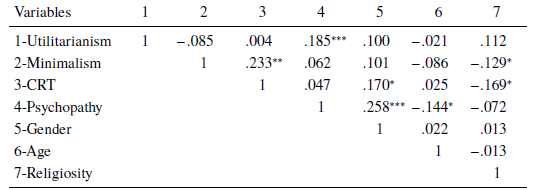
Table 4 shows the correlations among variables. While utilitarianism was significantly correlated with psychopathy (r = .185, p = .005), moral minimalism was significantly correlated with CRT (r = .233, p = .001) in this study. However, neither utilitarianism is related to CRT, nor moral minimalism to psychopathy. This replicates Royzman et al.’s (2015) findings with a continuous measure and supports Kahane’s account.
*** p < .01;
** p < .05;
* p < .061.
In addition, the previous study’s results implicate moral views other than utilitarianism and deontology that guide individuals’ moral judgments in sacrificial dilemmas. Although the majority of the participants chose deontology as their guiding principle, virtue ethics and fatalism were also chosen as the guiding principle for a sizeable portion of the sample for the wrong judgments. For the right judgments, the majority of the participants chose amorality as their guiding principle rather than utilitarianism.
4 Study 3
In Study 1, the guiding principle was measured categorically: the participants were forced to choose one principle among five. In Study 3, taking into account the possibility that more than one principle may be guiding the participants’ choices at the same time, we asked them to rate the importance of each principle on a scale from 1 to 5. Study 3 also included several questions measuring real life utilitarianism in addition to psychopathy and CRT and their relation to the guiding principles was examined.
4.1 Method
4.1.1 Participants
A total of 389 undergraduates from Doğuş University (mean age = 22.33, SD = 3.13; 244 women, 138 men, seven missing) took part in Study 3 for extra course credit. The majority identified themselves as Muslim (n = 286). Of the remaining participants, 32 were atheists, 59 believed in God but were not affiliated with a religion, nine were affiliated with a religion other than Islam and three did not respond.
4.1.2 Materials and Procedure
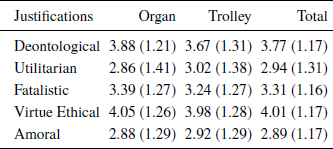
All materials and procedure were the same as in Study 1 except the following: As in Study 2, two impersonal moral dilemmas (Trolley and Impersonal Transplant scenarios) were given instead of four. Right/wrong and permissible/required judgments were asked as in Study 1. After each of the two dilemmas, participants were asked to rate five moral principles from 1 (completely disagree) to 5 (completely agree) as to how important each principle was in their choice. Consequently, a score for each of the five principles (non-moral, virtue ethics, fatalism, utilitarianism and deontology) was formed by taking the sum of the ratings in the two dilemmas (see Table 5 for mean scores obtained for the five principles).
In addition to CRT (α = .726) and the psychopathy scale (α = .690) used in the previous two studies, two items were asked to measure real life utilitarianism (see Reference Kahane, Everett, Earp, Farias and SavulescuKahane et al., 2015): “It is morally required for well-off people to give to charity for the benefit of children in poor countries” and “It is morally required to give up luxuries in our personal lives in order to slow down global warming and to leave a habitable planet to future generations” (α = .640). Mean CRT-correct score for this study is 0.80 (SD = 1.04).
4.2 Results and Discussion
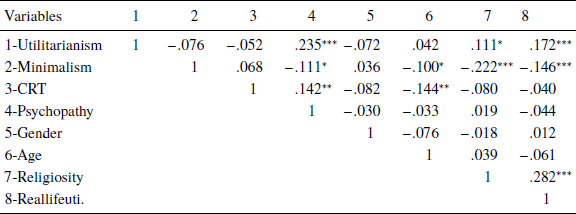
Table 5 shows the mean justifications, and Table 6 shows the correlations among variables. The utilitarian option in the sacrificial dilemmas was positively correlated with real-life utilitarianism (r = .176, p = .001) and with psychopathy (r = .186, p < .001). In addition, the utilitarian option in the dilemmas was positively correlated with the rating of the utilitarian principle as the justification of the choice (r = .308, p < .001). In other words, thinking that sacrificing one person to save five is both permissible and required is correlated with agreeing with the statement “moral behavior is that which promotes the well-being of the maximum number of people.” The utilitarian choice, on the other hand, was negatively correlated with virtue ethics (r = –.271, p < .001), deontology (r = –.311, p < .001) and fatalism (r = –.270, p < .001). No correlation was found between CRT and the utilitarian choice (r = –.084, p = .120). This replicates the findings of both Study 2 and Royzman et al. (2015). It is also consistent with Baron et al.’s (2015) account which argues that the inconsistent findings regarding the relation between CRT and utilitarian choices stem from the fact that CRT is imperfectly correlated with actively open-minded thinking, which is the real predictor of utilitarian choices.
*** p < .01;
** p < .05;
* p< .061.
Moral minimalism, thinking that sacrificing one person to save five is permissible but not required, was negatively correlated with our measure of real-life utilitarianism (r = –.146, p = .003). CRT, on the other hand, was not correlated with moral minimalism (r = .068, p = .210). Furthermore, moral minimalism was negatively correlated with deontology (r = –.203, p < .001) and fatalism (r = –.230, p < .001) as moral principles, marginally so with virtue ethics (r = –.088, p = .088), and not correlated with the utilitarianism principle (r = –.078, p = .129).
Table 7 also shows the correlations among the main variables (CRT, psychopathy and real-life utilitarianism) and justifications scores. The results showed that CRT is negatively correlated with utilitarian justification (r = –.112, p = .038), but not significantly correlated with any other justification. Psychopathy was negatively correlated with both virtue ethics (r = –.143, p = .006) and deontology (r = –.124, p = .016), but not significantly correlated with utilitarianism justification (r = .091, p = .078). Real life utilitarianism was positively correlated with all of the justifications except amorality (see Table 7).

*** p < .01;
** p < .05.
The finding that the utilitarian choice is associated with both real-life utilitarianism and psychopathy might indicate that some participants choose the utilitarian option for one reason and some for the other. The finding that real life utilitarianism is not related to psychopathy, whereas utilitarian choice in the sacrificial moral dilemmas is significantly related to psychopathy, supports this view (see Table 6)
Our findings indicate, in contrast to Greene et al.’s (2001) account, that while utilitarian choices are associated with psychopathy, it is moral minimalism that is associated with analytic thinking. On the other hand, the positive correlation between utilitarian choices and real-life utilitarianism is consistent with Greene et al. (2001). The results suggest that different, in fact diametrically opposed (i.e., caring for humanity vs. psychopathy), motives might underlie utilitarian responses in sacrificial dilemmas.
5 General Discussion
The principal aim of the study was to determine the moral principles that guided individuals’ choice of the utilitarian and moral minimalist options in sacrificial moral dilemmas. The findings supported Kahane’s (2012) account in that the participants who chose the so-called utilitarian option (sacrificing one person to save five) were not mainly guided by real-life utilitarianism defined as the immediate maximization of well-being. In addition, other moral principles which are generally neglected in the literature, like fatalism and virtue ethics (and also non-moral reasons), were chosen as guiding a significant number of participants’ choices.
All three studies indicate that when the sacrifice was rated separately as permissible and as required, psychopathy was positively correlated with utilitarianism (“permissible and required” judgments), but the findings are mixed on the relation between CRT scores and moral minimalism (“permissible but not required”). One of the three samples showed a significant, one almost significant, and one non-significant relation between CRT scores and moral minimalism. This finding provides additional empirical support to Kahane’s arguments and partial support to Royzman et al.’s (2015) from a non-western and predominantly Muslim sample.
Study 3 findings indicate that the utilitarian principle used to justify moral choices was correlated with the choice of the utilitarian option. This lends some support to the idea that the utilitarian option in the dilemmas is chosen, at least in part, because of utilitarian motives. Additionally, real-life utilitarianism is also correlated with utilitarian choices, but not with psychopathy. Interestingly, however, utilitarian choices in sacrificial moral dilemmas are also correlated with psychopathy in all three studies. This seems to suggest that some people make utilitarian choices in sacrificial dilemmas out of utilitarian concerns, as per Greene et al.’s (2001) account, and other people make utilitarian accounts out of a psychopathic lack of care for the plight of the one sacrificed person, as per Kahane’s account. Study 1 also revealed that the two most common justifications in judging that killing one person is morally right, were utilitarianism (consistent with Greene’s account) and amorality (consistent with Kahane’s account).
5.1 Implications
To the best of our knowledge, this set of studies is the first to go beyond the utilitarianism-deontology dichotomy in sacrificial moral dilemmas and to include other moral views such as virtue ethics and fatalism (agreeing with the general approach of Uhlmann et al., 2015). In addition, the scarcity of studies on non-western populations in this field of research makes it difficult to generalize the findings (see Ahlenius & Tännsjö, 2012, for a comparative analysis done in the USA, Russia and China; see also Reference Arutyunova, Alexandrov and HauserArutyunova, Alexandrov & Hauser, 2016, and Moore et al., 2011 for investigations in non-Western populations). In this respect, another contribution of the present study is to extend previous findings in moral psychology to a non-western, predominantly Muslim sample using continuous measures for moral judgments.
The findings on the principles used in moral justification, however, should be seen as preliminary since each principle for each scenario was based on a single item. One natural avenue for future research is to develop a reliable and valid instrument to assess the use of each moral principle used in this study (virtue ethics, fatalism, non-morality, utilitarianism, and deontology), and perhaps other principles, and relate them to the so-called utilitarian and deontological choices in the sacrificial dilemmas. An item without the word “moral” for the justifications might also be more informative (since the term may be interpreted narrowly, compared to its use in, e.g., philosophy). For instance, some people might simply choose the following option without any moral considerations: “If you have a choice between one death and five, you should choose the one.” Our real-life utilitarianism questions are comprised of only two items, which may not be consistent with some forms of utilitarianism, and which therefore lack a complete conception of real-life utilitarianism.
Another limitation of the present set of studies is that they are all correlational (see Reference Gawronski and BeerGawronski & Beer, 2016). One way to experimentally check the validity of the present findings would be to prime real-life utilitarian concerns and then to see whether the rate of “permissible” and “required” responses in sacrificial dilemmas increases. It should be possible to persuasively summarize the main points of real-life utilitarianism in the form of a short text as a means of manipulation (see Yilmaz & Bahçekapili, 2015, for the use of such texts to prime meta-ethical views).
Although the effect of cognitive styles on moral judgment has been investigated (i.e., Paxton et al., 2014), another theoretically interesting question would be whether various normative ethical views have differential effects on cognitive style. Priming real-life utilitarianism and moral minimalism through texts and seeing whether they change analytic thinking tendencies might be one way to experimentally test the correlational findings in all three studies.
5.2 Conclusion
In conclusion, the preliminary findings in the present set of studies suggest that there are moral principles apart from utilitarianism and deontology that guide individuals’ moral judgments. We suggest that moral psychology move beyond the utilitarianism-deontology dichotomy and try to delineate these other principles. It should perhaps also move beyond the sacrificial dilemmas to elicit moral judgments since, as Kahane argues, the options in these dilemmas (e.g., the utilitarian option) do not necessarily reflect the moral principles they are supposed to measure (e.g., utilitarianism as an impartial concern for the greater good; see also Reference Gawronski and BeerGawronski & Beer, 2016, for a recent review paper about the issue of the real meanings of the judgments on moral dilemmas). One alternative is to use “rule dilemmas” where participants decide whether to violate a deontological rule to achieve a superior outcome (e.g., whether to use an unapproved treatment method to treat a patient who is sure to die if untreated; see Reference Baron, Gürçay and LuceBaron, Gürçay & Luce, 2017). Another alternative is to use realistic moral dilemma situations and compare the results with hypothetical dilemmas since it is known that individuals’ aversion to harming others differ in the two types of situation (FeldmanHall et al., 2012; see also Baron, Gürçay & Luce, 2017; Camerer & Mobbs, 2017; Francis, et al., 2016; Reference Patil, Cogoni, Zangrando, Chittaro and SilaniPatil, Cogoni, Zangrando, Chittaro & Silani, 2014; Sabo & Giner-Sorolla, 2017, for the importance of using more realistic situations to test moral views).
Appendix: Scenarios
Surgery: Personal.
You are a doctor. You have five patients, each of whom is about to die due to a failing organ of some kind. A new person is rushed into the hospital after a serious car accident. This person is critically injured, and will die without immediate surgery. It is likely you can save this accident victim, though it would involve long and complicated surgery. You realize that if you purposely cut his carotid artery during surgery it would cause his death and no one would ever know. Then you could harvest his organs for transplant into the bodies of the other five patients. If you do this, the other five patients will live, but the accident victim will die. Is it appropriate for you to kill the accident victim in order to save your five patients?
Sugery: Impersonal-Instrumental.
You are a doctor. You have five patients, each of whom is about to die due to a failing organ of some kind. A new person is rushed into the hospital after a serious car accident. This person is critically injured, and will die without immediate surgery. While involved in long and complicated surgery on the accident victim, you notice that a nurse is about to give him an inappropriate medication. You know that this error will be lethal and by ignoring this mistake and allowing it to happen, the patient will die. This would allow you to harvest his organs for transplant into the bodies of the other five patients. If you do this, the other five patients will live. Is it appropriate for you to ignore the lethal mistake in order to save your five patients?
Modified footbridge/trolley: Personal.
A runaway trolley is heading down the tracks toward five workmen who will be killed if the trolley proceeds on its present course. You are standing next to the track on which the trolley is traveling, but you are too far away from the workmen to warn them of the impending danger. Next to you there is a very large stranger who is minding his own business. It occurs to you that if you pushed this person onto the tracks in front of the trolley, it would stop the trolley and save the five workmen from certain death. However, this would most certainly kill the stranger. Is it appropriate for you to push this stranger onto the tracks to save the five workmen?
Modified footbridge/trolley: Impersonal-incidental.
A runaway trolley is heading down the tracks toward five workmen who will be killed if the trolley proceeds on its present course. You are standing next to the track on which the trolley is traveling, but you are too far away from the workmen to warn them of the impending danger. Next to you there is a control switch for the tracks that can reroute the trolley. You could divert the trolley onto another track and spare the five workmen from certain death. However, there is another workman on the new track that will certainly die if you divert the trolley. Is it appropriate for you to divert the trolley and kill the lone workman in order to save the five workmen?


 Open access

