

Introduction
Compulsive sexual behavior disorder (CSBD) was introduced in the 11th revision of the International Classification of Diseases (ICD-11) as an impulse control disorder characterized by a persistent pattern of failure to control intense, repetitive sexual impulses or urges, resulting in repetitive sexual behavior over an extended period that causes marked distress or impairment in personal, family, social, educational, occupational, or other important areas of functioning (World Health Organization 2019). Prevalence estimates range from 3-6% of the general population, with higher rates reported among individuals actively seeking clinical care for hypersexual or compulsive sexual concerns (Bőthe et al. Reference Bőthe, Potenza, Griffiths, Kraus, Klein, Fuss and Demetrovics2020; Grubbs et al. Reference Grubbs, Hoagland, Lee, Grant, Davison, Reid and Kraus2020).
Despite its official recognition, evidence-based pharmacological treatments for CSBD remain limited. Current approaches have been extrapolated from treatments for other impulse control and addictive disorders, including selective serotonin reuptake inhibitors (SSRIs), mood stabilizers, and antiandrogens (Briken Reference Briken2020). No medications are FDA-approved specifically for CSBD, and existing evidence consists primarily of case reports and small open-label trials (Turner et al. Reference Turner, Briken, Grubbs, Malandain, Mestre-Bach, Potenza and Thibaut2022).
Naltrexone, a mu-opioid receptor antagonist, has emerged as a promising pharmacological option for CSBD. The proposed neurobiological rationale centers on opioid-dopamine coupling in reward circuits: sexual stimuli activate dopamine release in the mesolimbic pathway, a process partially mediated by endogenous opioids (Blum et al. Reference Blum, Braverman, Holder, Lubar, Monastra, Miller, Lubar, Chen and Comings2000; Koob and Volkow Reference Koob and Volkow2010). Blockade of mu-opioid receptors is hypothesized to attenuate the rewarding salience of sexual stimuli and reduce the urgency of cravings, although the precise mechanism of action in CSBD has not been established (Bostwick and Bucci Reference Bostwick and Bucci2008; Kraus et al. Reference Kraus, Meshberg-Cohen, Martino, Quinones and Potenza2015).
Several case reports and small studies have demonstrated naltrexone’s potential efficacy for CSBD. Raymond et al. (Reference Raymond, Grant, Kim and Coleman2002, Reference Raymond, Grant and Coleman2010) reported successful augmentation of SSRIs with oral naltrexone. Bostwick and Bucci (Bostwick and Bucci Reference Bostwick and Bucci2008) described complete remission of internet sex addiction with naltrexone 50 mg daily. Kraus et al. (Reference Kraus, Meshberg-Cohen, Martino, Quinones and Potenza2015) reported reduced urges with naltrexone adjunctive to psychotherapy. More recently, Savard et al. (Reference Savard, Öberg, Chatzittofis, Dhejne, Arver and Jokinen2020) conducted a feasibility study of 20 men with CSBD treated with oral naltrexone 25–50 mg, finding significant decreases on validated measures of hypersexual behavior.
Extended-release injectable naltrexone (Vivitrol), although indicated for opioid and alcohol use disorders (Alkermes 2023), may offer practical advantages over oral formulations in clinical populations where daily adherence is a concern. Monthly administration maintains consistent receptor occupancy and removes the requirement for daily medication decisions. This may be a relevant consideration in impulse control disorders, where patients could be at elevated risk of intentional dose omission during periods of heightened urges, although this has not been directly studied in CSBD. Consistent pharmacokinetic exposure is an advantage that has been documented for extended-release naltrexone in opioid use disorder (Lee et al. Reference Lee, Nunes, Novo, Bachrach, Bailey, Bhatt, Farkas, Fishman, Gauthier, Hodgkins, King, Lindblad, Liu, Matthews, May, Peavy, Ross, Salazar, Schkolnik, Shmueli-Blumberg, Stablein, Subramaniam and Rotrosen2018). A recent case report has described the use of a subcutaneous naltrexone implant in a patient with longstanding CSBD, with sustained symptomatic improvement over twelve weeks (Liu et al. Reference Liu, Tian and Zhou2025). To our knowledge, however, the extended-release injectable formulation (Vivitrol) has not previously been reported for this indication. We describe a case in which Vivitrol was added to an ongoing regimen of antidepressant pharmacotherapy and psychotherapy following inadequate response, with validated symptom measures documenting sustained improvement over three months.
Case presentation
Patient information
The patient is a 54-year-old married man with a longstanding history of compulsive sexual behavior, predominantly in the form of compulsive pornography use, extending back many years prior to presentation. In April 2025, following a period of acute psychosocial stress associated with sudden job loss, his symptoms escalated substantially in both frequency and intensity. Over the subsequent months, the content he viewed escalated to include material he experienced as ego-dystonic given his self-identification as heterosexual, and he began contemplating in-person contact with individuals met through online platforms.
The clinical picture was consistent with ICD-11 criteria for CSBD (World Health Organization 2019). The patient had been hiding money to fund pornography subscriptions and dating site memberships and was maintaining a concealed credit card for this purpose, reflecting continuation of the behavior despite clear adverse consequences. He reported secondary depressive symptoms including social withdrawal, irritability, insomnia, anhedonia, guilt, low motivation, and reduced energy, which appeared temporally and phenomenologically related to the compulsive behavior and associated shame. His sexual behavior had become the primary focus of his daily life and was causing significant occupational and interpersonal impairment.
General medical history was otherwise unremarkable, and the patient denied any history of substance use disorder. Somatic contributors to the presenting symptoms were considered on clinical grounds and were not identified; there was no evidence of endocrine dysfunction, dopaminergic medication exposure, or neurological disease known to be associated with hypersexual presentations.
Prior treatment
At the time of initiating extended-release naltrexone, the patient had been receiving ongoing psychiatric and psychological care. He had been prescribed desvenlafaxine 50 mg daily since April 17, 2025, following the initial escalation of his symptoms. He was concurrently engaged in weekly psychotherapy sessions, which incorporated motivational interviewing, cognitive-behavioral, and mindfulness-based approaches. Despite sustained engagement with both interventions over several months, the patient continued to report minimal reduction in urges, sexual behavior, or associated distress. He had also previously trialed other antidepressant medications and prior courses of psychotherapy without durable benefit. Based on this inadequate response, naltrexone augmentation was discussed as a next treatment step.
Oral naltrexone 50 mg daily was initially prescribed on August 28, 2025. In clinical discussion, the patient expressed concern about his ability to maintain daily adherence during periods of heightened urges, and the decision was made with the treating psychiatrist to transition to the extended-release injectable formulation. The injectable was selected preferentially for its more consistent receptor occupancy, absence of daily dosing decisions, and documented pharmacokinetic stability relative to oral naltrexone (Lee et al. Reference Lee, Nunes, Novo, Bachrach, Bailey, Bhatt, Farkas, Fishman, Gauthier, Hodgkins, King, Lindblad, Liu, Matthews, May, Peavy, Ross, Salazar, Schkolnik, Shmueli-Blumberg, Stablein, Subramaniam and Rotrosen2018). The absence of active opioid use was confirmed prior to initiation.
Clinical findings and diagnostic assessment
The patient was evaluated using two validated measures of compulsive sexual behavior. The Compulsive Sexual Behavior Inventory-13 (CSBI-13) is a 13-item self-report instrument developed by Coleman and Miner that assesses difficulty controlling sexual urges, emotional distress related to sexual behavior, and functional impairment (Coleman et al. Reference Coleman, Miner, Ohlerking and Raymond2001; Miner et al. Reference Miner, Raymond, Coleman and Swinburne Romine2017). Items are rated on a 5-point Likert scale (1 = Never to 5 = Very Frequently), yielding total scores from 13 to 65. The Hypersexual Behavior Inventory-19 (HBI-19) is a 19-item instrument developed for the proposed DSM-5 hypersexual disorder criteria (Kafka Reference Kafka2010) that assesses three domains: coping (using sex to manage emotions), control (difficulty controlling behavior), and consequences (negative outcomes) (Reid et al. Reference Reid, Garos and Carpenter2011). Items are rated identically, yielding scores from 19 to 95. Both measures have demonstrated adequate reliability, criterion validity, and discriminant validity in clinical samples (Coleman et al. Reference Coleman, Miner, Ohlerking and Raymond2001; Miner et al. Reference Miner, Raymond, Coleman and Swinburne Romine2017; Reid et al. Reference Reid, Garos and Carpenter2011).
At baseline in September 2025, the patient endorsed maximum or near-maximum severity on nearly all items, with a CSBI-13 score of 65/65 and an HBI-19 score of 91/95. These scores are consistent with severe symptom burden across all assessed domains. On the basis of clinical interview and assessment data, the patient met ICD-11 diagnostic criteria for CSBD (World Health Organization 2019).
Routine blood work at the initiation of treatment included hepatic function testing, which was within normal limits. Liver enzymes were monitored over the course of treatment and remained within the normal range at all time points.
Therapeutic intervention
The rationale for extended-release naltrexone was discussed in detail with the patient prior to initiation. This included the proposed mechanism of reducing the rewarding salience of sexual stimuli without rendering the behavior aversive (Blum et al. Reference Blum, Braverman, Holder, Lubar, Monastra, Miller, Lubar, Chen and Comings2000; Kooband Volkow Reference Koob and Volkow2010), the expected time course of response, and the rationale for the injectable formulation described above.
The first intramuscular gluteal injection of extended-release naltrexone 380 mg was administered on September 3, 2025, consistent with standard Vivitrol administration (Alkermes 2023). Subsequent injections were given on October 1, 2025 and October 31, 2025, maintaining the recommended monthly dosing interval (Alkermes 2023). Desvenlafaxine 50 mg daily was continued unchanged throughout the treatment period, and the patient remained engaged in weekly psychotherapy incorporating motivational interviewing, cognitive–behavioral, and mindfulness-based approaches. All pharmacological treatment was administered and supervised by the clinic psychiatrist (H.G.P.).
Timeline
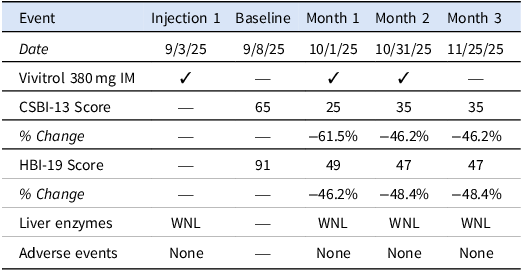
Table 1 presents the treatment timeline and assessment scores. The baseline assessment was completed five days following the first injection due to a delay in questionnaire administration, as the patient had not completed the measures prior to the injection as originally planned. Subsequent assessments were conducted in-clinic at each injection visit to avoid this issue. A pre-injection baseline assessment was therefore not obtained, a limitation that is addressed further in the Discussion.
Timeline and assessment scores across treatment

CSBI-13 = Compulsive Sexual Behavior Inventory-13 (range 13-65); HBI-19 = Hypersexual Behavior Inventory-19 (range 19–95). WNL = within normal limits. Higher scores indicate greater symptom severity. Percentage change calculated from baseline. Desvenlafaxine 50 mg daily and weekly psychotherapy were continued throughout the treatment period. Adverse events were assessed at each weekly session by unstructured clinical interview.
Follow-up and outcomes
The patient was seen for weekly psychotherapy sessions throughout the three-month observation period, during which adverse events were assessed by unstructured clinical interview by the treating psychiatrist. Monthly symptom measures were administered at each injection visit. Substantial and rapid improvement was observed following initiation of extended-release naltrexone, with scores across all four time points presented in Table 1.
On the CSBI-13, the patient’s score decreased from 65 at baseline to 25 at month one, representing a 61.5% reduction. Scores increased modestly to 35 at months two and three, still representing an overall 46.2% reduction from baseline. The most notable improvements were in items assessing loss of control over sexual urges and behaviors, justification of sexual behavior, and interference with relationships and productive activities.
On the HBI-19, scores decreased from 91 at baseline to 49 at month one (46.2% reduction), with continued stability at 47 at months two and three (48.4% total reduction). The coping subscale items, which assess using sex to manage negative emotions, showed particularly robust improvement. Items assessing returning to unwanted behavior despite promises to change and feeling that sexual behavior was taking life in an unwanted direction also showed marked improvement.
The patient tolerated the medication well throughout the treatment period. No injection site reactions, nausea, headache, or other adverse events commonly associated with Vivitrol were reported (Alkermes 2023). He did not report changes in mood, sexual function, or other domains unrelated to the target symptoms. Liver enzymes remained within normal limits at all monitoring points.
The pattern across both measures suggests a rapid initial response to treatment, with the greatest reduction occurring within the first month, followed by stabilization of gains through months two and three. The modest increase in CSBI-13 scores from month one to month two may reflect increased insight and awareness of remaining difficulties rather than true symptom worsening, as the HBI-19 continued to show slight improvement over this period.
Discussion
This case describes substantial and sustained improvement in compulsive sexual behavior following the addition of extended-release naltrexone to ongoing antidepressant pharmacotherapy and psychotherapy in a 54-year-old man with longstanding CSBD. The magnitude of improvement, nearly 50% reduction from baseline on both validated measures sustained over three months, is clinically meaningful and broadly consistent with, or somewhat greater than, improvement reported in previous studies using oral naltrexone (Raymond et al. Reference Raymond, Grant, Kim and Coleman2002, Reference Raymond, Grant and Coleman2010; Savard et al. Reference Savard, Öberg, Chatzittofis, Dhejne, Arver and Jokinen2020).
The proposed neurobiological rationale for naltrexone in CSBD parallels its role in substance use disorders and other putative behavioral addictions (Blum et al. Reference Blum, Braverman, Holder, Lubar, Monastra, Miller, Lubar, Chen and Comings2000; Koob and Volkow Reference Koob and Volkow2010; Kraus et al. 2016). Compulsive sexual behavior shares clinical features often attributed to addictive processes, including continued engagement despite negative consequences, craving, impaired control, and escalation to more intense content or behaviors (Grant et al. Reference Grant, Potenza, Weinstein and Gorelick2010; Kraus et al. Reference Kraus, Voon and Potenza2016). Mu-opioid receptor blockade is thought to attenuate the dopamine response to rewarding stimuli in the mesolimbic pathway (Blum et al. Reference Blum, Braverman, Holder, Lubar, Monastra, Miller, Lubar, Chen and Comings2000; Koob and Volkow Reference Koob and Volkow2010). Unlike aversive pharmacological strategies, naltrexone does not render the behavior unpleasant; urges may still arise, but their perceived urgency and reinforcing quality are reduced, creating room for behavioral change (Bostwick and Bucci Reference Bostwick and Bucci2008). The precise mechanism of action in CSBD, however, has not been established and these explanations remain hypothetical.
Several practical considerations supported the use of the extended-release rather than oral formulation in this case. Monthly administration maintains consistent receptor occupancy and avoids the peaks and troughs associated with daily dosing. It also eliminates daily decision-making about medication, which the patient described as a meaningful concern given his history of intense urges. Although this advantage has been most clearly demonstrated in opioid use disorder (Lee et al. Reference Lee, Nunes, Novo, Bachrach, Bailey, Bhatt, Farkas, Fishman, Gauthier, Hodgkins, King, Lindblad, Liu, Matthews, May, Peavy, Ross, Salazar, Schkolnik, Shmueli-Blumberg, Stablein, Subramaniam and Rotrosen2018), it is a clinically reasonable consideration for impulse control presentations in which daily adherence may be difficult to maintain during symptomatic peaks. The present case does not directly establish such an advantage in CSBD, and this remains a testable question for future work.
The decision to augment with naltrexone rather than rely solely on antidepressant and psychotherapeutic treatment reflected an inadequate response to these interventions over several months. This framing is consistent with current guideline-level discussion of CSBD pharmacotherapy (Briken Reference Briken2020; Turner et al. Reference Turner, Briken, Grubbs, Malandain, Mestre-Bach, Potenza and Thibaut2022), in which opioid antagonists are one of several options considered when first-line approaches do not produce sufficient clinical benefit. A preliminary oral naltrexone trial was initially prescribed on August 28, 2025, but the extended-release formulation was selected shortly thereafter based on shared clinical decision-making with the patient regarding adherence concerns and the pharmacokinetic stability of the injectable preparation. The brevity of the oral trial is acknowledged as a limitation, as a longer oral lead-in might have allowed earlier identification of any intolerance prior to administration of a long-acting formulation.
The trajectory of improvement, with the largest gains within the first month followed by stabilization, is broadly consistent with the hypothesized mechanism. Opioid receptor blockade would be expected to reduce the reinforcing quality of the behavior relatively rapidly (Blum et al. Reference Blum, Braverman, Holder, Lubar, Monastra, Miller, Lubar, Chen and Comings2000; Koob and Volkow Reference Koob and Volkow2010), whereas longer-term consolidation of behavioral change may depend on continued psychological work and sustained behavioral substitution. The modest rise in CSBI-13 scores between months one and two may reflect increasing insight and more accurate self-appraisal of residual difficulties rather than true symptomatic worsening, a pattern noted in other treatment studies (Savard et al. Reference Savard, Öberg, Chatzittofis, Dhejne, Arver and Jokinen2020). It is also possible that the concurrent antidepressant and psychotherapeutic treatment, although insufficient on their own, contributed to the maintenance of gains achieved with naltrexone.
Strengths and limitations
Strengths of this report include the use of two validated, complementary measures of CSBD symptom severity, repeated monthly assessment providing a clear trajectory of response, documentation of hepatic safety monitoring, and the novel application of extended-release injectable naltrexone to this indication.
Several limitations warrant acknowledgment. As a single uncontrolled case, causal attribution is limited, and placebo effects cannot be excluded. The concurrent administration of desvenlafaxine and ongoing psychotherapy means that the observed improvement cannot be attributed to naltrexone alone; the case is best interpreted as an augmentation response rather than a demonstration of pharmacological efficacy in isolation. A pre-injection baseline symptom assessment was not obtained because the patient had not completed the measures prior to the first injection as originally planned; the baseline reported here was collected five days after the first injection, which may have modestly attenuated the apparent treatment effect. The three-month follow-up period demonstrates durability of early response but does not establish long-term efficacy. The absence of blinding and the patient’s awareness of receiving active treatment may have influenced self-reported outcomes. The patient’s motivation to change, evidenced by his continued engagement in treatment, may also have contributed to improvement independent of medication. The brevity of the oral naltrexone trial prior to transition to the long-acting formulation is a further limitation. Finally, a formal patient perspective statement was not obtained, in part reflecting the retrospective structure of this report.
Conclusions
This case provides preliminary evidence that extended-release injectable naltrexone may be a useful augmentation option for patients with CSBD who have not responded adequately to antidepressant pharmacotherapy and psychotherapy. The rapid onset of response, sustained benefit over three months, and favorable tolerability profile support further investigation. Controlled trials comparing extended-release injectable naltrexone to placebo, and to oral naltrexone, are needed to establish efficacy and optimal dosing strategies. In the interim, extended-release injectable naltrexone may be considered on an individualized basis for patients with CSBD, particularly those for whom daily oral adherence is a meaningful clinical concern.
Acknowledgements
The author thanks Hy Gia Park, MD, for clinical supervision, administration of pharmacological treatment, and assistance with clinical details.
Author contributions
C.W. administered clinical assessments, collected data, conceptualized the case report, conducted the literature review, and wrote the manuscript.
Funding statement
This research received no specific grant from any funding agency, commercial, or not-for-profit sectors.
Competing interests
The author declares no conflicts of interest.
Ethical standards
This case report adheres to the CARE (CAse REport) guidelines (Gagnier et al. Reference Gagnier, Kienle, Altman, Moher, Sox and Riley2013) and the ethical principles outlined in the Declaration of Helsinki (World Medical Association 2013). As this constitutes a retrospective analysis of a single patient’s clinical care using de-identified data for educational purposes, it was reviewed by the Liberty University Institutional Review Board (IRB-FY25-26-1134) and determined to not constitute human subjects research. Written informed consent was obtained from the patient prior to the anonymized publication of clinical outcomes. All identifying information has been modified to protect patient confidentiality.

 Open access

