

1.1 Chapter Summary
The family Falconidae constitutes a group of small to medium-sized diurnal raptors whose monophyly is strongly supported. Kestrels are included in the subfamily Falconinae. There are at least 13 species that belong to the kestrel group, but recent genetic studies suggest that the number of kestrel species might be larger, possibly 16. The paleontological and molecular evidence is congruent in suggesting an evolutionary radiation of kestrels from the Late Miocene (4.0–9.8 million years ago) through the Early Pleistocene. However, the geographic area where kestrels originated and dispersed from is unclear.
1.2 Diversification of Falcons
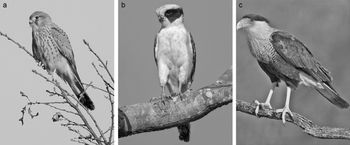
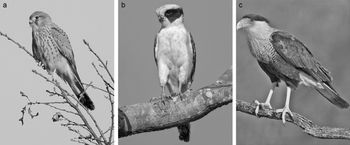
The Falconidae is a monophyletic family of diurnal birds of prey that occupy a wide variety of ecological niches and geographic regions (Reference White, Olsen, Kiff, del Hoyo, Elliott and SargatalWhite et al., 1994). Three subfamilies are currently recognised and their validity is supported by both molecular and morphological data (Reference GriffithsGriffiths, 1999; Reference Griffiths, Barrowclough, Groth and MertzGriffiths et al., 2004; Reference Fuchs, Johnson and MindellFuchs et al., 2012, Reference Fuchs, Johnson and Mindell2015): (i) Falconinae (falcons, falconets and kestrels), (ii) Herpetotherinae (forest falcons Micrastur sp. and laughing falcon Herpetotheres cachinnans) and (iii) Polyborinae (caracaras) (Figure 1.1). Reference DickinsonDickinson (2003) has recognised 11 genera and 64 species of Falconidae, but figures can vary slightly across authors.
The family Falconidae includes three subfamilies: (a) Falconinae (Falco tinnunculus, photograph by David Costantini); (b) Herpetotherinae (Herpetotheres cachinnans, photograph by Andreas Trepte, via Wikimedia Commons); (c) Polyborinae.
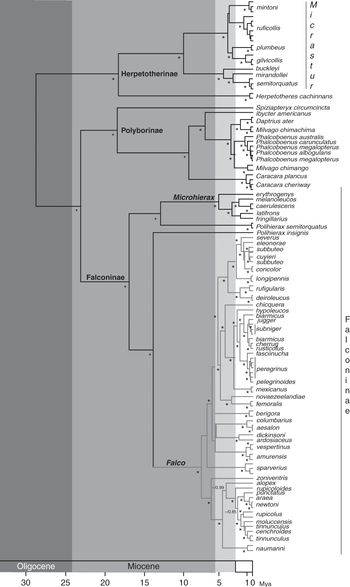
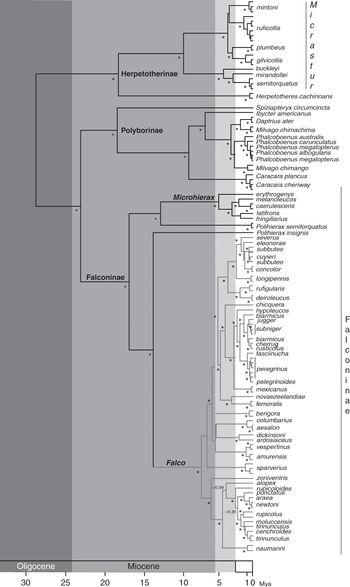
Both the Herpetotherinae and the Polyborinae occur only in the New World, while the Falconinae (the subfamily to which kestrels belong) are widespread across both the New and Old World with 46 species, 40 of which belong to the genus Falco (Reference Fuchs, Johnson and MindellFuchs et al., 2015). Molecular genetic estimates of diversification within Falconidae, based on fossil calibration using two Falco ancestors (Pedohierax and Thegornis) and on the analyses of DNA sequences from eight loci, indicated that the diversification started between 22.3 (95% confidence interval: 19.6–25.6) and 34.2 (95% confidence interval: 26.2–43.2) million years ago for the Falconidae; between 12.6 (95% confidence interval: 10.6–14.7) and 19.3 (95% confidence interval: 14.4–24.6) million years ago for the Falconinae; and between 5.0 (95% confidence interval: 4.0–6.1) and 7.7 (95% confidence interval: 5.6–9.8) million years ago for the genus Falco (Figure 1.2; Reference Fuchs, Johnson and MindellFuchs et al., 2015).
Chronogram calculated using eight genetic markers and two fossil taxa (Pedohierax and Thegornis) as calibration points. Asterisks indicate posterior probabilities and maximum likelihood bootstrap support values higher than 0.95 and 70%, respectively. The different shades of grey indicate different geological epochs. The different branch colours indicate the two parts of the tree with different diversification rates.
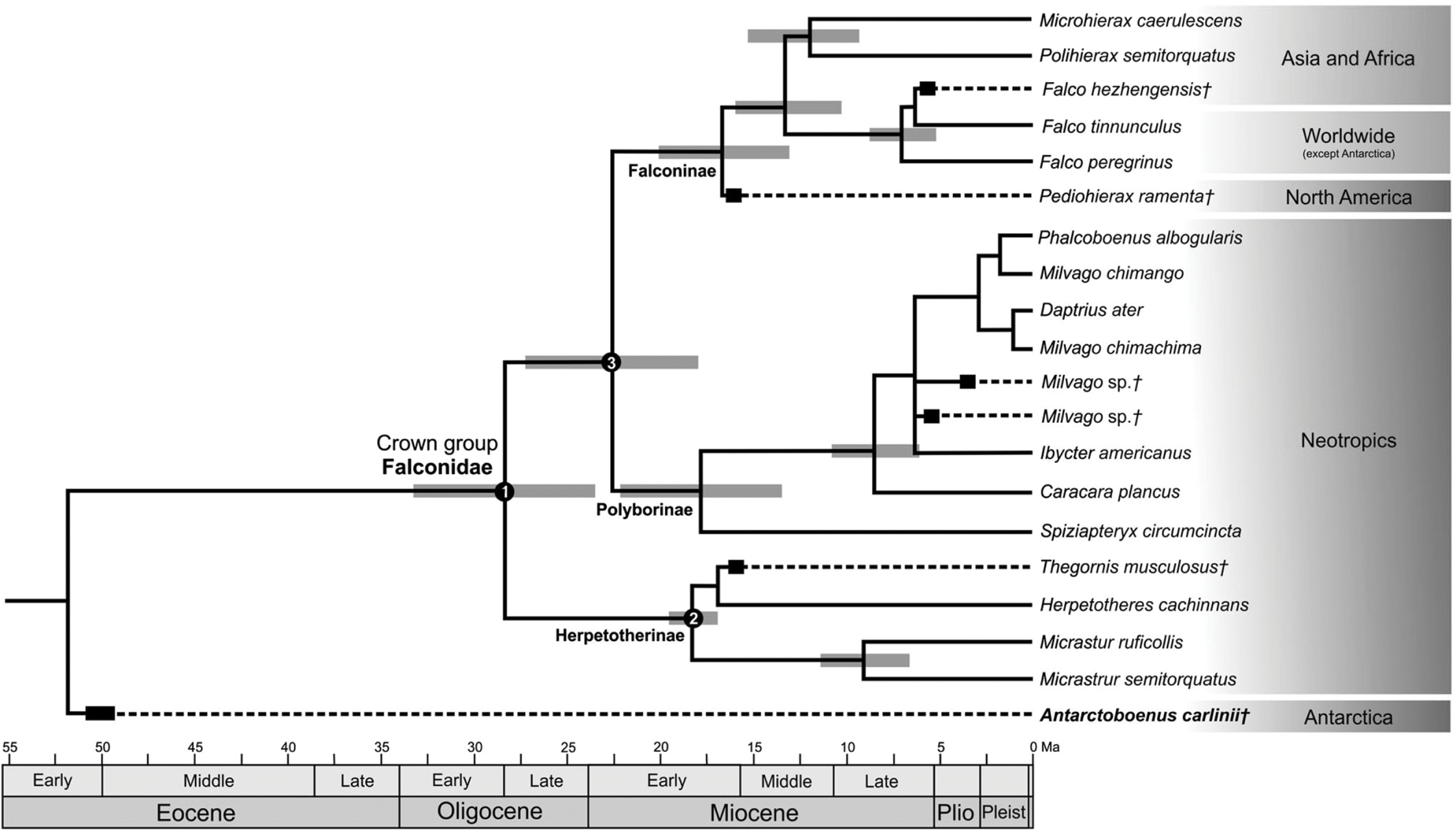
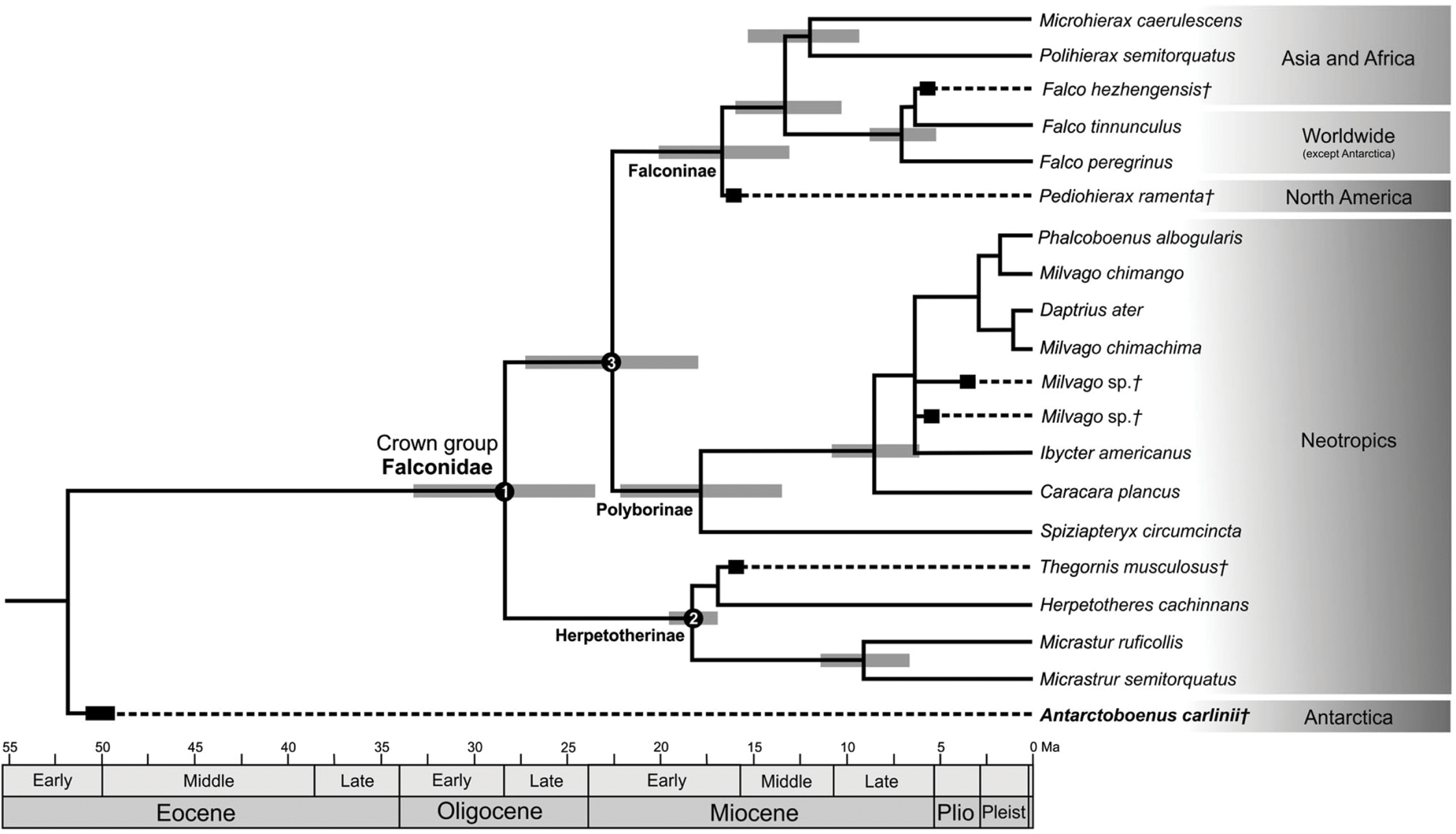
Reference Cenizo, Noriega and RegueroCenizo et al. (2016) proposed that the Lower Eocene Antarctoboenus carlinii, a fossil species found on Seymour island (west Antarctica), could represent the most ancient falconiform described so far (Figure 1.3); this discovery would give support to a Neotropical or Austral origin of Falconidae (Reference Ericson, Anderson and BrittonEricson et al., 2006; Reference EricsonEricson, 2012; Reference Fuchs, Johnson and MindellFuchs et al., 2015).
Geographical range, temporal distribution, and phylogenetic affinities of extant and fossil falconid birds. The temporal distribution of fossil taxa (dagger) is indicated by black squares. Grey bars indicate divergence times estimates for the primary lineages within the extant Falconids according to Reference Fuchs, Johnson and MindellFuchs et al. (2015).
The diversification of the genus Falco started during a period characterised by increasing aridity and the spread of open savannahs (Reference Cerling, Harris and MacFaddenCerling et al., 1997), which might have favoured the diversification of these open-land birds of prey (Reference Cade and DigbyCade & Digby, 1982). Molecular estimates of the diversification of species belonging to the genus Falco provided by Reference Fuchs, Johnson and MindellFuchs et al. (2015) are in agreement with the paleontological evidence, as fossils of several Falco paleospecies date from the Late Miocene to the Early Pliocene period (e.g. Reference UmanskajaUmanskajaa, 1981; Reference BeckerBecker, 1987; Reference BoevBoev, 1999, Reference Boev2011a, Reference Boev2011b, Reference Boev2011c; Reference Li, Zhou, Deng, Li and ClarkeLi et al., 2014). However, most Falco paleospecies are known only from fragmentary remains, which make phylogenetic inferences problematic. In conclusion, the recent molecular and paleontological data have supported the statement made by Reference Cade and DigbyCade and Digby (1982):
The Late Miocene or Early Pliocene would seem to have been about the right time, just when things were starting to go well for another group of open-country inhabitants, the early hominids. It is amusing and somehow prophetic to think that falcons and men both derive from the same evolutionary stimulus – the creation of open grasslands and savannahs with new and unexploited opportunities for both winged and bipedal hunters … Thus it appears that the association between men and falcons is deep rooted indeed. What did ‘Lucy’ and her kin (Australopithecus afarensis) experience when they looked up into the azure sky over the Afar Plains and saw hunting falcons?
1.3 Systematics and Diversification of Kestrels
1.3.1 Morphological and Behavioural Evidences
Kestrels belong to the subfamily Falconinae. It is traditionally recognised that at least 13 species belong to the kestrel group, but recent molecular analyses have suggested that this number of species might be larger (Table 1.1).
| Common name | Scientific name | Authority |
|---|---|---|
| Common kestrel | Falco tinnunculus | Linnaeus, 1758 |
| Lesser kestrel | Falco naumanni | Fleischer, 1818 |
| Fox kestrel | Falco alopex | Heuglin, 1861 |
| Seychelles kestrel | Falco araea | Oberholser, 1917 |
| Grey kestrel | Falco ardosiaceus | Vieillot, 1823 |
| Dickinson’s kestrel | Falco dickinsoni | Sclater, 1864 |
| Moluccan or spotted kestrel | Falco moluccensis | Bonaparte, 1850 |
| Madagascar kestrel | Falco newtoni | Gurney, 1863 |
| Mauritius kestrel | Falco punctatus | Temminck, 1821 |
| Greater kestrel | Falco rupicoloides | Smith, 1829 |
| Madagascar banded kestrel | Falco zoniventris | Peters, 1854 |
| Australian nankeen kestrel | Falco cenchroides | Vigors & Horsfield, 1827 |
| American kestrel | Falco sparverius | Linnaeus, 1758 |
| Rock kestrel | Falco rupicolus1 | Daudin, 1800 |
| Red-footed falcon | Falco vespertinus2 | Linnaeus, 1766 |
| Amur falcon | Falco amurensis2 | Radde, 1863 |
Reference Boyce, White, Bird and BowmanBoyce and White (1987) suggested that there are 14 or 15 species of Falco that might be considered as kestrels. The classic kestrel group includes a single New World species (the American kestrel, F. sparverius) and 12 Old World species. The majority of kestrels (10 of 13 species) have been classified within the subgenus Tinnunculus (Reference Brown and AmadonBrown & Amadon, 1968; Reference Cade and DigbyCade & Digby, 1982). This subgenus includes those species characterised by a classic kestrel form and brown-rufous plumage colouration. The three species characterised by grey plumage colouration – the grey kestrel (F. ardosiaceus), Madagascar banded kestrel (F. zoniventris) and Dickinson’s kestrel (F. dickinsoni) – are all from Africa and have been placed within the subgenus Dissodectes (Reference SnowSnow, 1978). This distinction between Tinnunculus and Dissodectes kestrels has also been supported by the electrophoretic patterns of feather proteins (Reference Olsen, Marshall and GaalOlsen et al., 1989).
There are no clear diagnostic features that define what a kestrel is and clarify the evolutionary relationships among kestrel species. For example, while many kestrel species perform hovering for hunting small mammals, this hunting technique appears to be very uncommon in the grey kestrel, Madagascar kestrel (F. newtoni) or fox kestrel (F. alopex) (Reference GaymerGaymer, 1967; Reference Boyce, White, Bird and BowmanBoyce & White, 1987; Reference LondeiLondei, 2002). However, we know very little about the behaviour and the ecology of kestrels in Africa and Asia, which limits the reliability of any conclusions. Sexual dimorphism in plumage is also not common across all kestrel species. For example, sexual dimorphism is apparent in the common kestrel (F. tinnunculus), the lesser kestrel (F. naumanni) and the Australian nankeen kestrel (F. cenchroides), while it is barely evident in other species. As for the plumage colouration in nestlings, while they usually resemble adult females, male and female American kestrel nestlings differ in plumage colouration (Reference VillageVillage, 1990).
Phylogenetic analyses carried out using data sets of morphological (e.g. plumage colouration, wing size) and behavioural (e.g. hovering) traits led Reference Boyce, White, Bird and BowmanBoyce and White (1987) to conclude that the fox kestrel might be the ancestor species of the current red and grey kestrel species, mainly because it does not hover and has negligible age or colour dimorphism between sexes. This conclusion was also based on the assumption that both the lack of hovering and the negligible colour dimorphism are primitive characters, i.e. closer to the most ancestral kestrel species. This might be plausible if the ancestor species were a raptor living in forests, where hovering would not have been an efficient hunting strategy. However, the fox kestrel can hover (Reference LondeiLondei, 2002) and the phylogenetic value of hovering is unclear. Reference Boyce, White, Bird and BowmanBoyce and White (1987) also concluded that the American kestrel might be the most recently evolved species of kestrel because (i) it has strong adult sexual dimorphism; (ii) male and female nestlings differ in colouration, with each sex resembling their respective adult sex rather than the female; and (iii) the species occupies an extensive geographic area with 17 subspecies (14 in Reference Boyce, White, Bird and BowmanBoyce & White, 1987) that have not diverged enough to be considered distinct species. Finally, the analyses further suggested that the lesser kestrel might share a direct ancestor species with the Amur falcon (F. amurensis) and the red-footed falcon (F. vespertinus).
Reconstruction of phylogenetic trees based on morphological characters may be questioned because two species might be similar to each other because of convergent evolution; this occurs when species share a trait that is different from the trait inferred to have been present in their common ancestor. Thus, the same trait has evolved independently in the two species in order to perform a similar function. Other problems in using morphological traits may arise with insular species. For example, the negligible sexual dimorphism of the Mauritius kestrel (F. punctatus) might (i) represent the ancestral condition, (ii) indicate the loss of dimorphism due to the insular isolation or (iii) suggest that barely dimorphic individuals were those that colonised the islands. Also, compared to other kestrel species, the Mauritius kestrel has more rounded wings (like those of forest-dwelling raptors), probably because of its adaptations to hunt in forested habitats. Thus, molecular data (e.g. DNA sequences of marker genes) are needed to elucidate evolutionary relationships because they are less biased by convergent evolution than are morphological traits.
1.3.2 Molecular Evidence
Finer subdivisions within the Tinnunculus kestrels have been contentious for years. Reference Groombridge, Jones and BayesGroombridge et al. (2002) constructed a molecular phylogeny of Tinnunculus kestrels using the mitochondrial cytochrome b DNA sequence. All analytical approaches used by Reference Groombridge, Jones and BayesGroombridge et al. (2002) produced phylogenetic trees of broadly similar topology, but with inconsistent positions for the Mauritius kestrel and the greater kestrel (F. rupicoloides). The molecular analyses provided strong support for a common ancestor shared between the Madagascar kestrel and the Seychelles kestrel (F. araea). The molecular data indicated that the kestrels that colonised the Seychelles likely came from Madagascar between 0.3 and 1.0 million years ago, probably favoured by the lower sea level due to glaciation (Reference Groombridge, Jones and BayesGroombridge et al., 2002). Given this scenario, it has been suggested that the Aldabran kestrel (F. newtoni aldabranus), a subspecies of the Madagascar kestrel (Reference BensonBenson, 1967; Reference Benson and PennyBenson & Penny, 1971), might be a possible relict of such dispersal (Reference Groombridge, Jones and BayesGroombridge et al., 2002). It has also been hypothesised that the colonisation of Mauritius occurred via Madagascar less than 3 million years ago (Reference Groombridge, Jones and BayesGroombridge et al., 2002). The combination of molecular and geological data led to the hypothesis that the colonisation of Mauritius by kestrels occurred about 1.9–2.6 million years ago, a period characterised by an interruption in the volcanic activity on Mauritius (Reference Groombridge, Jones and BayesGroombridge et al., 2002). As compared to the Madagascar kestrel, both the Seychelles kestrel and the Mauritius kestrel show morphological adaptations for forest-dwelling. Such adaptations might have evolved on the islands after the dispersion from Madagascar ended (Reference Groombridge, Jones and BayesGroombridge et al., 2002). Alternatively, it might be that individual Madagascar kestrels with a more forest-kestrel form might have been the pioneers of such colonisation.
Molecular data produced by Reference Groombridge, Jones and BayesGroombridge et al. (2002) suggest a close affinity between the common kestrel and the Australian nankeen kestrel, supporting a recent divergence, probably due to Pleistocene glacial events that pushed the common kestrel stock southwards from Asia, as previously hypothesised by Reference Boyce, White, Bird and BowmanBoyce and White (1987) on the basis of morphological traits. Further work based on the mitochondrial cytochrome b gene clustered the red-footed falcon, the Amur falcon, Dickinson’s kestrel and the American kestrel separately from the kestrel group (Reference Wink, Sauer-Gürth, Chancellor and MeyburgWink & Sauer-Gürth, 2004).
More recent molecular analyses made by Reference Fuchs, Johnson and MindellFuchs et al. (2015) did not provide support for the traditional hypothesis proposing (i) the American kestrel as closely related to the Old World kestrels and (ii) the Madagascar banded kestrel as closely related to the grey kestrel and Dickinson’s kestrel. Rather, Reference Fuchs, Johnson and MindellFuchs et al. (2015) hypothesised (i) the existence of a group including the Old World kestrels together with the Madagascar banded kestrel and (ii) that the American kestrel would be more closely related to other falcons (e.g. red-footed falcon) than to the Old World kestrels, as previously suggested by DNA/DNA hybridisation studies (Reference Sibley and AhlquistSibley & Ahlquist, 1990) and by analyses of mitochondrial cytochrome b DNA sequence (Reference Groombridge, Jones and BayesGroombridge et al., 2002). These results might indicate that either the kestrel group should include more than the 13 species classically recognised or that the position of the American kestrel within the kestrel group might need to be reconsidered. Analyses of molecular genetic markers made by Reference Fuchs, Johnson and MindellFuchs et al. (2015) also suggested that the Amur falcon and the red-footed falcon might be part of the kestrel group, as previously proposed by Reference Brown and AmadonBrown and Amadon (1968). Finally, Reference Fuchs, Johnson and MindellFuchs et al. (2015) found that the fox kestrel might not be the sister species of the greater kestrel as traditionally thought. Rather, both the fox kestrel and the greater kestrel would form a paraphyletic group (i.e. a group which does not include all descendants of the same ancestor), with the greater kestrel being sister to all other kestrels included in the F. tinnunculus group.
1.3.3 Paleontological Evidence
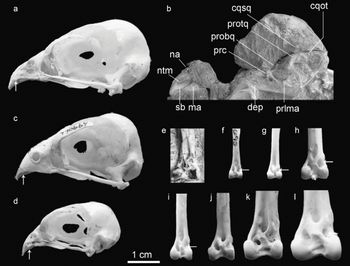
There is scarce information about the fossil history of raptors belonging to the genus Falco, particularly because of poor preservation of bone remains. Two close relative species of the common kestrel are the Late Pliocene F. bakalovi, whose remains were found near the town of Varshets in northwest Bulgaria (Reference BoevBoev, 1999, Reference Boev2011a, Reference Boev2011b), and the Late Miocene F. bulgaricus, whose remains were found near the town of Hadzhidimovo in southwest Bulgaria (Reference BoevBoev, 2011c). As with other Falco fossils, both F. bakalovi and F. bulgaricus have been described on the basis of a limited number of isolated bones, which makes their description and systematic classification problematic. One of the best-preserved specimens of a fossil falconid so far recovered has been classified as F. hezhengensis (Figure 1.4) by Reference Li, Zhou, Deng, Li and ClarkeLi et al. (2014).
Comparison of the skull and distal tibiotarsus of the holotype Falco hezhengensis with other Falconidae species: (a) F. tinnuculus (USNM 610371); (b, e) F. hezhengensis (IVPP V14586); (c) Polihierax insignis (USNM 490664); (d, f) Microhierax erythrogenys (USNM 613695); (g) P. semitorquatus (USNM 621024); (h) F. rupicoloides (USNM 430626); (i) Spiziapteryx circumcincta (USNM 319445); (j) Micrastur ruficollis (USNM 621387); (k) Herpetotheres cachinnans (USNM 346714); and (l) Caracara plancus (USNM 614583). The vertical arrows indicate the tomial notch on the premaxilla that is present in Falconinae; the horizontal arrows indicate a third opening into the extensor groove located medial to the supratendinal bridge that is present in Falconinae and Polyborinae but not in Herpetotherinae. Anatomical abbreviations: cqot, cotyla quadrati otici; cqsq, cotyla quadrati squamosa; dep, depression; ma, mandible; na, naris; ntm, notched tomial margin; prc, processus coronoideus; prlma, processus lateralis mandibulae; probq, processus orbitalis quadrati; protq, processus oticus quadrati; sb, septal bar.
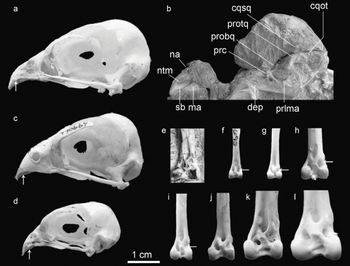
This falconid species was found in the Late Miocene deposits of Linxia Basin in north-western China. The analysis of 66 osteological characters led the authors to place this new Falco paleospecies as the sister group of the common kestrel and the greater kestrel (Reference Li, Zhou, Deng, Li and ClarkeLi et al., 2014). This new paleospecies has also provided paleontological evidence in favour of an earlier divergence of kestrels from the peregrine falcon (F. peregrinus) in the Late Miocene. Although the paleontological evidence is congruent with the molecular data in suggesting a radiation of kestrels from the Late Miocene through the Early Pleistocene, the timing and location of the radiation are still ambiguous because of the paucity of well-preserved fossils over a wide geographic area. It has been suggested that the presence of the majority of kestrel taxa on the African continent could be evidence for an African origin of the kestrel group. However, the absence of a Pre-Pleistocene kestrel fossil record from Africa has meant that assumptions of kestrel divergence within and from the African continent have not been easy to confirm. Reference Li, Zhou, Deng, Li and ClarkeLi et al. (2014) suggested that F. hezhengensis might represent an early dispersal event after the origin of kestrels occurred or, alternatively, it might be interpreted as evidence in favour of an Eurasian origin of kestrels.
1.4 Diversification and Geographic Distribution of Kestrels
The kestrel group is truly cosmopolitan, occupying wide geographical areas and different environments. Most kestrels are open-land predators, and avoid deserts, dense forests and the Arctic–Antarctic poles. Some kestrel species show large geographic variation in both morphology and genetics, which led to the recognition of several subspecies. The higher number of species and subspecies near the equator might be due to greater speciation favoured by a more sedentary style of local birds as compared to kestrels at higher latitudes, whose migratory habits limit isolation among populations. There are, however, a number of factors that have likely contributed to the diversification of kestrels, such as physical barriers and geographic isolation (Reference VillageVillage, 1990). We currently lack studies that elucidate the roles that different barriers had in driving the diversification of kestrels.
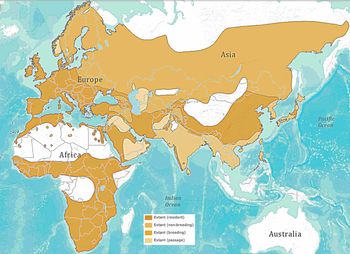
The common (also known as Eurasian) kestrel is widespread across Europe, Africa and Asia (Figure 1.5), but sporadic observations of free-ranging kestrels have been recorded in the New World (Reference CampbellCampbell, 1985; Reference Pranty, Kwater, Weatherman and RobinsonPranty et al., 2004).
Distribution map of the common kestrel (Falco tinnunculus). From BirdLife International and Handbook of the Birds of the World (2017).
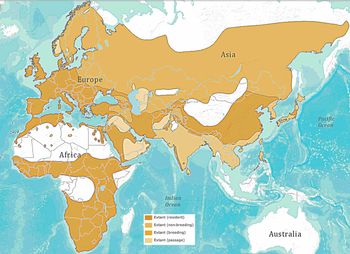
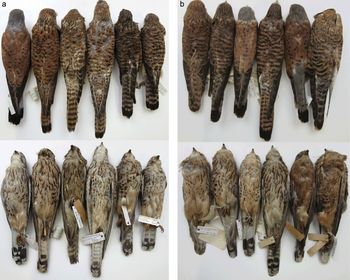
It is classically recognised that there are 11 subspecies of common kestrel (Reference VillageVillage, 1990). However, recent molecular analyses led Reference Fuchs, Johnson and MindellFuchs et al. (2015) to propose that the subspecies rupicolus (Table 1.1) may warrant species status (IOC World Bird List: Reference Gill and DonskerGill & Donsker, 2018). The species or subspecies rupicolus (illustrated in Figure 1.6b) occurs from north-western Angola and southern Democratic Republic of Congo to southern Tanzania and South Africa. The subspecies belonging to the tinnunculus group differ in colouration, body size and distribution (Figures 1.6a,b). The nominal subspecies tinnunculus breeds from Europe and north Africa east to Siberia, Bhutan and western China. It is partially migratory, wintering in the regions from south to central Africa, India and south-eastern Asia (Figure 1.6a; Reference VillageVillage, 1990; BirdLife International and Handbook of the Birds of the World, 2017). Four subspecies are endemic to the Atlantic islands of Macaronesia. The subspecies neglectus inhabits the north Cape Verde islands and the subspecies alexandri inhabits the south-east Cape Verde islands (Reference BourneBourne, 1955). The subspecies alexandri is similar in size to both subspecies from the Canary Islands, but differs from neglectus by being larger, darker and more rufous on the back (Figure 1.6a; Reference AlexanderAlexander, 1898; Reference BourneBourne, 1955; Reference VaurieVaurie, 1961). The subspecies canariensis inhabits the Madeira and western Canary Islands and the subspecies dacotiae inhabits the eastern Canary Islands. These two subspecies are similar in size, but dacotiae is paler, redder and less marked than canariensis (Figure 1.6b; Reference KoenigKoenig, 1890; Reference HartertHartert, 1912–21; Reference VaurieVaurie, 1961). The two Canary subspecies also show a significant genetic differentiation (Reference Groombridge, Jones and BayesGroombridge et al., 2002; Reference Alcaide, Serrano and NegroAlcaide et al., 2009).
Comparison of subspecies of Falco tinnunculus and of other kestrel species. Panel a from left to right: F. t. tinnunculus (male, C.G. 1967 N. 1709, MNHN); F. t. tinnunculus (female, C.G. 1912 N. 560, MNHN); F. t. interstinctus (female, C.G. 2003 N. 159, MNHN); F. t. rufescenes (female, C.G. 1977 N. 347, MNHN); F. t. alexandri (female, C.G. 1966 N. 904, MNHN); F. t. neglectus (female, C.G. 1967 N. 1756, MNHN). Panel b from left to right: F. t. dacotiae (female, C.G. 1965 N. 1492, MNHN); F. t. canariensis (female, C.G. 1911 N. 882, MNHN); F. t. canariensis (male, C.G. 1965 N. 1484, MNHN); F. moluccensis (female, C.G. 1882 N. 152, MNHN); F. rupicolus (male, C.G. 2018 N. 503, MNHN); F. r. rupicoloides (female, C.G. 2003 N. 165, MNHN). Specimens are from the collection of the Muséum National d’Histoire Naturelle (MNHN; Paris, France). The MNHN gives access to the collections in the framework of the RECOLNAT national Research Infrastructure.
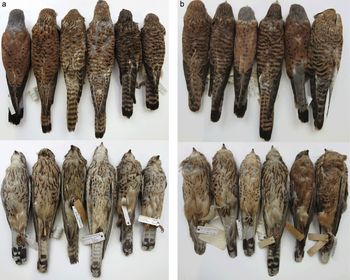
The subspecies rupicolaeformis occurs in north-east Africa and Arabia. Reference Grant and Mackworth-PraedGrant and Mackworth-Praed (1934) observed that (i) the male rupicolaeformis was more rufous, less pinkish on upper parts and rather more heavily spotted than the male tinnunculus and (ii) the female rupicolaeformis was paler than the female tinnunculus and warmer in colour, tinged with richer rufous, upper tail coverts and base of tail washed with dove grey. Reference VaurieVaurie (1961) found that rupicolaeformis tended to be darker, smaller and more spotted or barred than the subspecies tinnunculus. He also noticed that the back of male rupicolaeformis was more vinaceous and less bright than that of male tinnunculus. The subspecies interstinctus occurs in China and Japan, and winters in India, Malaysia and the Philippines (Figure 1.6a). Reference VaurieVaurie (1961) observed that (i) interstinctus was similar in size to tinnunculus and larger than rupicolaeformis and (ii) was darker and more spotted, barred and streaked than tinnunculus. These similarities and differences between tinnunculus and interstinctus are also evident in Figure 1.6a. There is also a significant genetic differentiation between the two subspecies, which might have been favoured by the glacial events that occurred during the Quaternary period (Reference Zhang, Liu and SongZhang et al., 2008). The subspecies objurgatus occurs in south India (western and eastern Ghats) and Sri Lanka. The subspecies archeri occurs in Somalia, coastal Kenya and Socotra; it is similar to the subspecies tinnunculus but smaller. Finally, the subspecies rufescens is widespread from west Africa to Ethiopia, Tanzania and Angola (Figure 1.6a; Reference VillageVillage, 1990; BirdLife International and Handbook of the Birds of the World, 2017). Reference Grant and Mackworth-PraedGrant and Mackworth-Praed (1934) observed that it is a dark subspecies; however, this is not very evident from the specimen illustrated in Figure 1.6a.
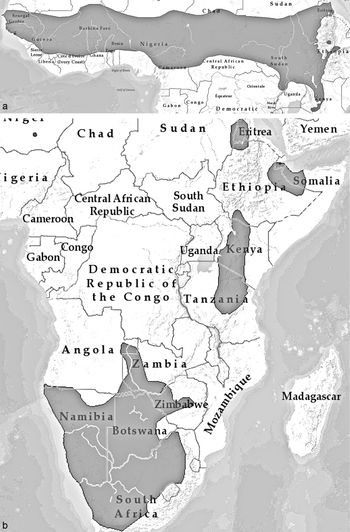
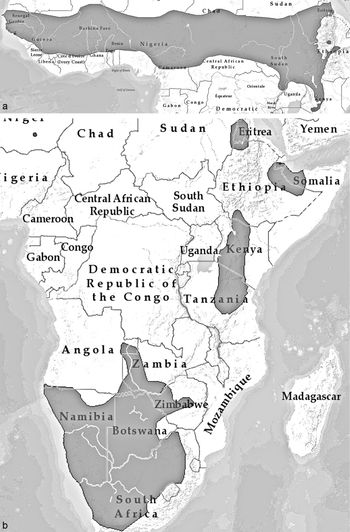
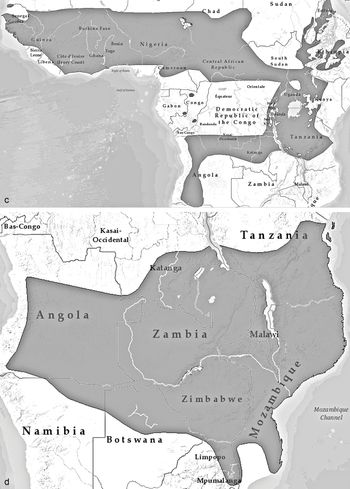
The Mauritius, Madagascar, Madagascar banded, Seychelles and Australian nankeen kestrels are all regarded as distinct species endemic to their respective islands. Two subspecies can be recognised for the Madagascar kestrel (newtoni in Madagascar and aldabranus in the Aldabra islands) and for the Australian nankeen kestrel (cenchroides in Australia and baru in New Guinea). The fox kestrel occurs in the northern regions of sub-Saharan Africa (Figure 1.7a). The greater kestrel is restricted to southern and eastern parts of Africa (Figure 1.7b), where it occurs with three subspecies: rupicoloides in South Africa (illustrated in Figure 1.6b), arthuri in east Africa and fieldi in Somalia. The grey kestrel occurs in north Africa (Figure 1.7c) and Dickinson’s kestrel occurs in south-east Africa (Figure 1.7d).
Distribution maps of the (a) fox kestrel (F. alopex), (b) greater kestrel (F. rupicoloides), (c) grey kestrel (F. ardosiaceus) and (d) Dickinson’s kestrel (F. dickinsoni). From BirdLife International and Handbook of the Birds of the World (2017).
The American kestrel is widespread across the whole American continent with 17 subspecies: sparverius from Alaska to Newfoundland, south to west Mexico; peninsularis in south Baja California, Sonora and Sinaloa; tropicalis in south Mexico to north Honduras; nicaraguensis in the savannas of Honduras and Nicaragua; paulus from the southern coasts of the USA to Florida; dominicensis in Hispaniola and Jamaica; caribaearum in the West Indies (Puerto Rico to Grenada); brevipennis in Aruba, Curaçao and Bonaire; isabellinus from Venezuela to north Brazil; aequatorialis in north Ecuador; peruvianus in south Ecuador, Peru and north Chile; fernandensis in the Juan Fernández Islands off Chile; cinnamominus in south-east Peru, Chile and Argentina to Tierra del Fuego; cearae in the Tablelands of north-east Brazil to east Bolivia; sparverioides in Bahamas, Cuba and the Isle of Pines; ochraceus on the mountains of east Colombia and north-west Venezuela; caucae on the mountains of west Colombia.
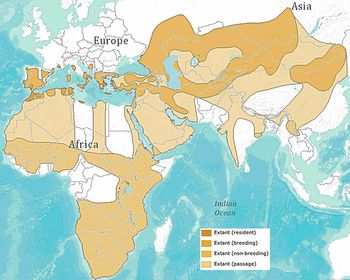
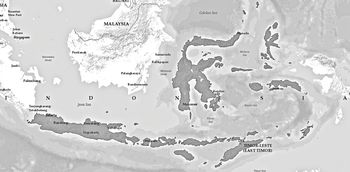
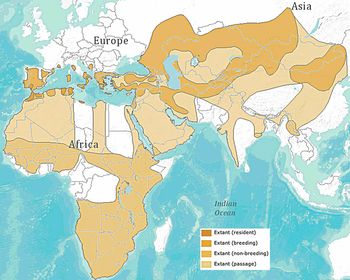
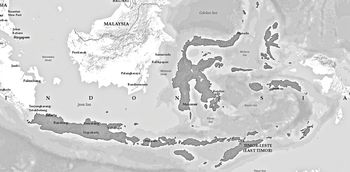
The lesser kestrel has extensive ranges across Europe, Africa and Asia (Figure 1.8). The Moluccan kestrel (F. moluccensis; illustrated in Figure 1.6b) is endemic to the East Indies (Figure 1.9), where it occurs with two subspecies: moluccensis in north and south Moluccas; microbalius from Java to Lesser Sunda Islands, Sulawesi and Tanimbar Islands.
Distribution map of the lesser kestrel (F. naumanni). From BirdLife International and Handbook of the Birds of the World (2017).
Distribution map of the Moluccan kestrel (F. moluccensis). From BirdLife International and Handbook of the Birds of the World (2017).
Although not traditionally recognised as kestrel species, recent molecular evidence suggested that the red-footed falcon and the Amur falcon are closely related to kestrels (Reference Fuchs, Johnson and MindellFuchs et al., 2015). The red-footed falcon occurs in central Eurasia and winters in sub-Saharan Africa, while the Amur falcon occurs in the steppes of north-east Asia and winters from Malawi to South Africa.
1.5 Conclusions
Kestrels are a cosmopolitan group, including 13–16 species, depending on the author and the traits used (e.g. morphological, genetic) for reconstructing evolutionary relationships among species. The phylogenetic position of the American kestrel within kestrels is still uncertain, and there is also no agreement on whether the red-footed falcon and the Amur falcon belong to the kestrel group.
The paleontological and molecular evidence is congruent in suggesting an evolutionary radiation of kestrels from the Late Miocene through the Early Pleistocene. However, the absence of a Pre-Pleistocene kestrel fossil record from Africa has not enabled fully clarification of the kestrel divergence within and from the African continent. Finally, more studies of molecular genetics at subspecies level would be needed in order to better clarify the evolutionary history of kestrel species and to define more targeted guidelines for their conservation. For example, 17 subspecies of American kestrel are currently recognised, but limited information is available about their differentiation in terms of behaviour, ecology and genetics (Reference Figueroa and CoralesFigueroa & Corales, 2002; Reference Miller, Mullins, Parrish, Walters and HaigMiller et al., 2012; Reference deMent, Rikard and WommackdeMent et al., 2014). Such paucity of data makes the geographic boundaries among the subspecies sometimes difficult to identify, as well as the systematic validity of all subspecies difficult to ascertain.