

INTRODUCTION
The agricultural sector is currently affected by various events that threaten its competitiveness and sustainability, such as climate change, energy crises, increasing costs, labour shortages and low labour efficiency and market volatility (Savary et al., Reference Savary, Castilla, Elazegui and Teng2005). To address these challenges and anticipate future changes, farmers need to constantly innovate their agricultural management (Aguilar-Gallegos et al., Reference Aguilar-Gallegos, Muñoz-Rodríguez, Santoyo-Cortés, Aguilar-Ávila and Klerkx2015; Pannell et al., Reference Pannell, Marshall, Barr, Curtis, Vanclay and Wilkinson2006) through experimentation and the creation of innovations on-farm (Dolinska and d'Aquino, Reference Dolinska and d'Aquino2016; Klerkx et al., Reference Klerkx, Aarts and Leeuwis2010) as well as through the adoption and adaptation of innovations created elsewhere, e.g., by public research or private agribusiness (Aguilar-Gallegos et al., Reference Aguilar-Gallegos, Muñoz-Rodríguez, Santoyo-Cortés, Aguilar-Ávila and Klerkx2015; Pannell et al., Reference Pannell, Marshall, Barr, Curtis, Vanclay and Wilkinson2006). We focus here on the adoption of innovations understood as technologies and practices created outside the farm and subsequently acquired by farmers and implemented on-farm. A large body of literature focusses on the adoption of technologies and practices in agriculture, focussing both on smallholder farmers and on larger commercial farms, which have their own particularities with regard to the adoption depending on farmer characteristics and resource endowments (Aguilar-Gallegos et al., Reference Aguilar-Gallegos, Muñoz-Rodríguez, Santoyo-Cortés, Aguilar-Ávila and Klerkx2015). These studies use different approaches from qualitative to quantitative analysis, looking at both systemic and individual behaviour (see Mills et al., Reference Mills, Gaskell, Ingram, Dwyer, Reed and Short2017; Pannell et al., Reference Pannell, Marshall, Barr, Curtis, Vanclay and Wilkinson2006; Wigboldus et al., Reference Wigboldus, Klerkx, Leeuwis, Schut, Muilerman and Jochemsen2016 for reviews of this literature on the adoption and diffusion of innovations in agriculture).
Taking the individual as the unit of analysis and focussing on adoption of technologies or practices, scholars have used several determinants to explain adoption, such as technology characteristics (Pannell et al., Reference Pannell, Marshall, Barr, Curtis, Vanclay and Wilkinson2006), socio-economic aspects (e.g., education level, age, financial resources, farm size, labour availability, access to credit and family situation) (Läpple et al., Reference Läpple, Renwick and Thorne2015) and the adopter's socio-psychological characteristics (e.g., attitude towards risk and self-confidence) (Pannell et al., Reference Pannell, Marshall, Barr, Curtis, Vanclay and Wilkinson2006). Additionally, it has been recognised that abilities more broadly associated with innovative behaviour can facilitate the process of adopting new technologies and practices (Pannell et al., Reference Pannell, Marshall, Barr, Curtis, Vanclay and Wilkinson2006). Innovative behaviour is defined as an individual's ability to generate, promote and implement solutions, create, communicate ideas and involve others in the transformation process (Lukeš, Reference Lukeš2013; Scott and Bruce, Reference Scott and Bruce1994). These abilities can be reinforced through interaction with social networks in which the farmer is embedded, facilitating co-learning to increase understanding, implementation and adaptation of new technologies and practices (Dabire et al., Reference Dabire, Andrieu, Djamen, Coulibaly, Posthumus, Diallo, Karambiri, Douzet and Triomphe2017), enhancing the perseverance and self-confidence (Lans et al., Reference Lans, Verstegen and Mulder2011, Reference Lans, Seuneke, Klerkx and Carayannis2013), and also recognising business opportunities to increase farm's profitability (Dolinska and d'Aquino, Reference Dolinska and d'Aquino2016; Okry et al., Reference Okry, Van Mele, Nuijten, Struik and Mongbo2011).
Social networks can also include on-farm networks, to be more precise between farmers and their workforce (Nettle et al., Reference Nettle, Mark and Petheram2006). This workforce can include both permanent and seasonal workers with practical schooling and responsible for production-related tasks such as soil preparation and harvesting (Nettle, Reference Nettle2012); but it can also include academically trained staff such as agronomists responsible for overseeing other workers and production planning. Workforce management has been studied in agriculture mainly in relation to work organisation, workforce management and policies related to occupational health and social sustainability in rural areas (Madelrieux and Dedieu, Reference Madelrieux and Dedieu2008; Nettle, Reference Nettle2012; Nettle et al., Reference Nettle, Kuehne, Lee and Armstrong2018; Santhanam-Martin and Nettle, Reference Santhanam-Martin and Nettle2014). The relation between farmers’ innovative behaviour and the capacity to involve workers in the adoption of technologies and practices at farm level has not been tackled however. Studies about innovative behaviour in agriculture generally focus on the farmer as single owner-manager in the family-farm context (Mills et al., Reference Mills, Gaskell, Ingram, Dwyer, Reed and Short2017; Pannell et al., Reference Pannell, Marshall, Barr, Curtis, Vanclay and Wilkinson2006), and the farmer's relationship as owner-manager with his/her workforce has only scarcely been addressed in the context of technology and practice adoption (except Hostiou and Dedieu (Reference Hostiou and Dedieu2009) and Nettle et al. (Reference Nettle, Kuehne, Lee and Armstrong2018), who have highlighted the importance of considering the workforce in adoption, but do not study the workforce's influence on adoption).
Studies in the corporate management literature on productive sectors other than agriculture have already more extensively explored the relationship between managers and workers regarding managers’ leadership capacities as a key component in the development of new ideas, stimulation of knowledge sharing and participation of workers in the innovation process within firms and adoption of new technologies and practices (Anderson and West, Reference Anderson and West1998; June and Kheng, Reference June and Kheng2014). This literature has highlighted some key factors that allow the stimulation and acceleration of the innovation process in enterprises. One of these factors is involving workers in the change and learning process associated with the adoption of new technologies and practices, making workers feel confident in expressing their creativity and being proactive in suggesting new ideas or solving problems (Nettle et al., Reference Nettle, Mark and Petheram2006). To achieve this, managers must have the abilities to create an atmosphere in the organisation that stimulates workers’ involvement in innovations in technologies and practices (Anderson and West, Reference Anderson and West1998; Lukeš, Reference Lukeš2013). Such abilities include: recognising workers’ good performance, motivating the sharing of knowledge and joint learning, promoting good relationships between workers, communicating the organisation's objectives clearly and proposing new ideas for developing the organisation (June and Kheng, Reference June and Kheng2014). Anderson and West (Reference Anderson and West1998) have suggested that building an organisational atmosphere where innovation is incentivized entails: (i) promoting a group vision within the workforce, (ii) generating practices for stimulating good interpersonal relationships, (iii) continuously evaluating the innovation process, (iv) motivating workers to correct their mistakes and (v) involving workers in the generation and implementation of new ideas.
Our study builds on the this literature by constructing an analysis of innovative behaviour that not only includes the well-known personal characteristics of an innovator, but also considers the influence of the workforce on innovation, adding the five determinants listed above that enhance workers’ contribution to innovation. Specifically, we used personal characteristics such as curiosity, perseverance and networking to construct a transversal component of innovative behaviour, and leadership and motivation towards workers as a construct for the ability to involve the workforce. To the best of our knowledge, empirical studies on technology and practice adoption in agriculture have not yet connected the farmer/workforce relationship to farmers’ innovative behaviour. This is where this study aims to make a contribution. Farm workers put technologies and practices into action and also have hands-on experience that can be fed back the adaptation of technologies and practices and future innovation decisions. We expect this topic to become more relevant in the future as farms become larger and more corporate in structure (Hermans et al., Reference Hermans, Chaddad, Gagalyuk, Senesi and Balmann2017; Nuthall and Old, Reference Nuthall and Old2017). Therefore, the objective of this study was (i) to describe innovative behaviour and its relation with farmers' ability to collaborate with the workforce in the adoption process; and (ii) to associate this description with the level of adoption of technologies and practices.
MATERIALS AND METHODS
Study area and sample selection
This study takes the Chilean fresh fruit export sector as its case, because the sector's export orientation is a strong driver of continuous innovation. Chile is the world's largest exporter of table grapes, plums and blueberries, and the second largest exporter of avocado. Its main markets are the USA, Europe and Latin-America, but recently Chile has also incorporated emergent markets like China and India (ODEPA, 2014). The fruit export sector accounts for 7800 farmers with different characteristics in terms of size, educational level and specialisation level. The study area is located in central southern Chile (between 33°50′S and 38°30′S), specifically the regions of O´Higgins, Maule, and Bío-Bío (Supplementary Figure S1), the main production areas for apples and blueberries. Around 92% of the total planted areas of apples and 65% of blueberries are concentrated there (ODEPA, 2014). These fruit species were chosen because of their importance in the Chilean agricultural export sector and in the area under study. Farmers were selected using non-probabilistic sampling techniques. They were interviewed in person (face-to-face), participation was voluntary, and the confidentiality of responses was ensured.
Data collection instruments
In order to identify the abilities associated with innovative behaviour, a questionnaire was developed in line with the individual- and workforce-related determinants, represented by statements adapted to the reality of the agricultural sector. We asked the respondents to rate statements on a scale from 1 to 5 (1 = strongly disagree to 5 = strongly agree). A total of 106 statements based on the literature were initially included and then narrowed down in two consecutive steps of the research approach, as explained below. The reduced list of statements was applied in a survey of apple and blueberry producers.
Additionally, we asked about the technologies and practices adopted on the farm. This question helped us to construct an adoption variable. We measured adoption level as the number of technologies and practices implemented by the farmers. We considered seven technologies and practices that may improve the production system and enable an efficient use of natural resources, namely, (i) high density plantations, (ii) automatic meteorological stations, (iii) frost control systems (sprinkler irrigation for frost damage control and wind machines), (iv) water reservoirs, (v) mechanical harvesting equipment, (vi) drip or sprinkler irrigation systems and (vii) sustainable practices implementation through participation in R&D and extension projects. Hence, the adoption level ranges from 0 (non-adoption) to 7 (highest adoption). Socio-economic questions such as educational level, age and farm size were also included in the survey.
Research strategy
In order to gather data, analyse the results and identify which factors (called components in this study) are the most relevant in defining innovative behaviour, we used a two-step factor analysis (FA) procedure. The first step was an exploratory factor analysis (EFA) to identify and calibrate the components; and the second step was a confirmatory factor analysis (CFA) (Supplementary Table S1) used to validate the results. In this two-step procedure, we identify the components that conform to the profile of innovative behaviour. In a final analysis, the correlation between innovate behaviour and actual adoption level measured as the number of practices adopted on the farm was estimated.
In an exploratory FA, the initial 106 statements identified in the literature were reduced to 54 by a panel of 6 expert judges with a minimum experience of 6 years and recognised as experts in the field of (agricultural) innovation). The experts evaluated each statement that best explained innovative behaviour using a Likert scale from 1 to 3 (where 1 = agree, 2 = moderately agree and 3 = disagree). A Kendall's coefficient of concordance (W) was used to analyse and estimate the validity of the statements (Sheskin, Reference Sheskin2003). Using this list of statements, we conducted the EFA on a sample of 101 farmers in the Maule region of central southern Chile (Sample A), covering a diversity of farm size, agricultural products and market destinations. Each respondent had to declare his/her perception regarding each of the 54 statements on a scale of 1 to 5 (1 = strongly disagree to 5 = strongly agree). The interviews were conducted in December 2013. The EFA was estimated using maximum likelihood as the extraction method and varimax rotation because it improves the estimates of the parameters for small-sized samples (100–150) (Kline, Reference Kline2010). The threshold loading factors over 0.4 were used to define which statements to include and the resulting components. This analysis identified three dimensions as part of farmers’ innovative behaviour and reduced the instrument from 54 statements to 27. The analysis was conducted in SPSS 22.0.
For the CFA, the 27 selected statements were applied to a sample of 270 apple and blueberry producers (Sample B) between January and July 2014. Although blueberry and apple are different species that differ in terms of applied agronomic practices, farmers’ required qualifications (i.e., owner/manager) and their workforce (permanent and seasonal) is the same; moreover, permanent workers are not specialised as they have to operate in all farm activities. Comparison of the management tasks for each species reveals that, throughout the growing season, the requirements are similar. For example, pesticides application and weed control practices require approximate 5 –8 h per ha for, respectively, blueberry and apple. The greatest differences occur in pruning and irrigation: apples require 25 h for pruning compared to 12 h for blueberries; for irrigation tasks, apple orchards require 15 h and blueberries 25 h. Regarding the labour requirements, apples demand 84 h of time input per ha and blueberries 70 h. The management programmes reported for blueberries and apples are available at www.odepa.cl and www.indap.cl. Hence, it is possible to compare the two species in terms of workforce management and the workforce relationship with the owner/manager in terms of innovative behaviour in relation to technology and practice adoption. We omitted harvesting requirements, as this task is usually outsourced.
Bifactor structural equation T modelling was used at this stage. The advantage of this model is that it allows the simultaneous assessment of general and specific components using the same statements, giving more flexibility to the estimation (Chen et al., Reference Chen, Hayes, Carver, Laurenceau and Zhang2012). The bifactor model used the robust unweighted least squares method. The model's goodness of fit was tested using Chi-square, degrees of freedom, the relation between them represented in CMIN/DF (<3.00 for good fit model), root mean square error of approximation, RMSEA (values lower than 0.05 indicate an excellent fit, <0.08 an acceptable fit, and between 0.08 to 0.10 a poor fit), Tucker–Lewis index (TLI) and comparative fit index (CFI) (higher than 0.90 for a good fit and > 0.95 for an excellent fit) (Kline, Reference Kline2010). The bifactor model was run in Mplus 1.4.
To measure the effect of the innovative behaviour components on the actual adoption level of technologies and practices on the farm, we estimated the correlation coefficient between the estimated values of each component and adoption level (defined as the number of technologies and practices implemented). We considered seven technologies and practices previously cited that may improve the production system and maximise the use of natural resources, and we measured the adoption level by counting the number of practices adopted by the farmer, which hence ranges from 0 (non-adoption) to 7 (highest adoption). To analyse the relationship between innovative behaviour and farmers’ characteristics, we estimated the correlation between age and educational level (years of education) and farm size measured in hectares. These variables have been used in other studies on adoption processes (Hunecke et al., Reference Hunecke, Engler, Jara-Rojas and Poortvliet2017).
The correlation analysis was performed using a Spearman's rho correlation because this analysis does not consider assumptions about distribution and it is appropriate for continuous and discrete variables (Bonett, Reference Bonett2008).
RESULTS
Relation between farmers’ innovative behaviour and the workforce
Sample A (101 farmers) used in the EFA shows that farm structure is characterised by a high variety of crops, from annual crops to a large number of fruit species and vineyards. The average farm size is 110.7 ha, with a range of 0.5–1010 ha, reflecting a high variability of productive systems. Farmers’ socio-demographic characteristics are also diverse, with an average age of 50.6 years and experience of 23.2 years in agriculture. The average duration of schooling is 12.6 years, which corresponds to high school (Table 1). The diversity of the sample allows for more representativeness of behavioural characteristics.
Descriptive statistics of farmers’ characteristics in Sample A.

The EFA results identified three components as part of farmers’ innovative behaviour: (i) ‘generation and implementation of new ideas’ (GI), (ii) ‘ability to involve workforce’ (AIW) and (iii) ‘networking’ (NW). The three components and their respective statements are presented in Table 2. The model performs well with a Kaiser–Meyer–Olkin (KMO) = 0.91, Bartlett sphericity test of p < 0.01 and Chi-square of p > 0.05, the level of reliability, Cronbach's Alpha, was > 0.90, only one component had a value near 0.70 (GI = 0.937, LW = 0.935, NW = 0.720), which is still acceptable according to the literature (Kline, Reference Kline2010).
Exploratory factor analysis results.

GI: Generation and implementation of new ideas, NW: Networking, AIW: Ability to involve workforce. Values correspond to factor loadings of the factor analysis.
The first component, ‘generation and implementation of new ideas,’ is composed of 14 statements (statements of the three components elicited in the EFA analysis are available on request) associated with cognitive abilities such as: creativity; perseverance and observation capacity; search for technology and new knowledge; and experimentation with, and implementation of, new ideas. The majority of these abilities are related to proactive behaviour. The second component, ‘ability to involve workforce’ is represented by nine statements related to stimulating participation, proactivity and worker collaboration in the implementation and development of ideas, as well as recognising workers’ achievements. The last component, ‘networking,’ is composed of four statements associated with motivating and encouraging other farmers to develop new ideas, as well as sharing knowledge and encouraging innovative behaviour.
As explained previously, the EFA results were used in CFA using a bifactor structural equation model. The model was estimated using Sample B, consisting of apple and blueberry producers. Regarding socio-demographic characteristics, in Sample B, farmers were on average 43.9 years old with an educational level that corresponded to high school. A detailed description of labour requirements for each group under study revealed that both are similar in workforce quantity and qualifications. Regarding farmers’ socio-economic characteristics and each group's farm characteristics, first, the size of apple orchards ranged from 4 to 366.5 ha, with an average of 47.9 ha; blueberry farms had an average size of 17.6 ha, with a range between 1.9 and 301.4 ha. It is relevant to note that apple and blueberry production systems have different levels of investment and returns per hectare, and a production system that explains the difference in the average and range of size. In apple orchards, average investment per hectare is US$35,000 and the average return per hectare is US$22,000 in a 5-year-old orchard. For blueberries, average investment per hectare is US$15,000 and average return is US$7500 in an orchard in its second year. Further information about the sample, by species and farm size, is presented in Table 3.
Descriptive statistics of farmers’ characteristics in Sample B.

*corresponds to significant at 1% and **significant at 5%.
n.s. means no statistical difference.
For comparison purposes, we divided the subsample of apple and blueberry producers into small, medium and large producers. For each species, different scale limits were used depending on investment level characteristics. In the case of apple producers, we based the classification of small, medium and large on the fruit producers’ typology presented in Barrena et al. (Reference Barrena, Nahuelhual, Engler, Echeverría and Cofré2013); and, for blueberry producers, we used percentiles generated by SPSS. From Table 3, it can be observed that, in both samples, regardless of farm size, farmers’ age and educational level are similar, with no statistical differences among groups and species. The only difference observed was in schooling level of blueberry producers related to size; however, the difference between small and large farmers ranges from 13.75 (technical degree) to 16.84 (college degree) years, both of which are higher education levels. Hence, from this characterisation, we can conclude that farmers’ level of human capital is comparable for different farm sizes and for both species. Given that the characteristics of the workforce for each species are similar in quantity and qualifications, we are confident that the results of the estimated model include all individuals.
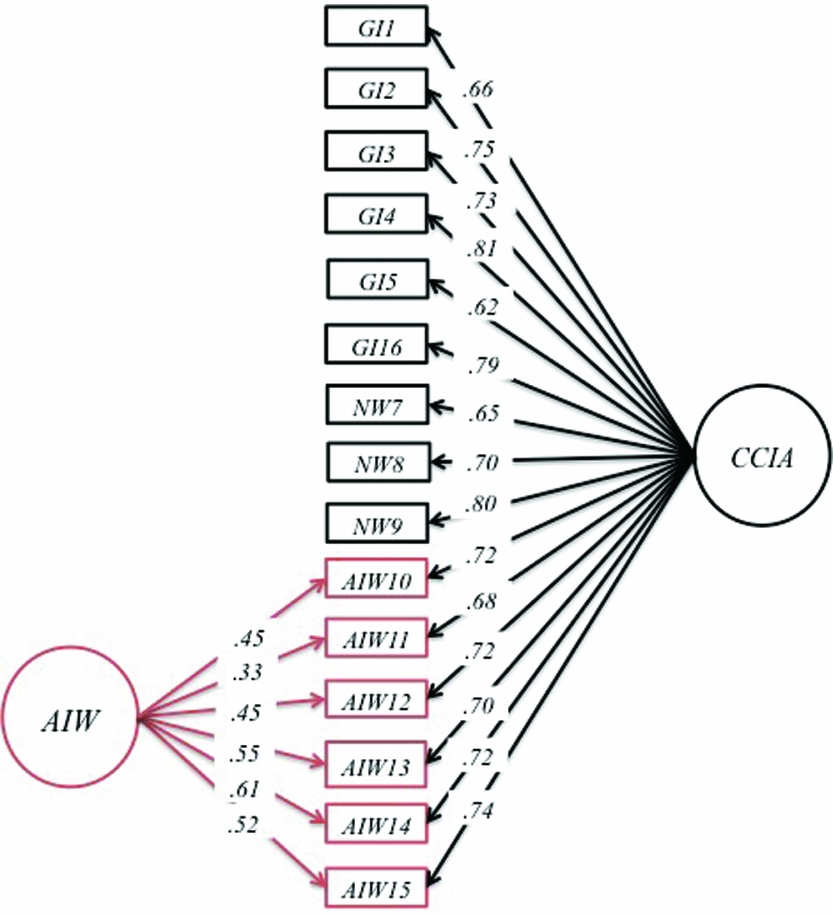
The bifactor model performed well and the factor loadings were highly significant (p < 0.001), with the standardised parameter estimations being higher than 0.50 (Table 3). Furthermore, the fitness indices achieved the values recommended in the literature, X2 = 201.617, df = 84; X2/df = 2.4, RMSEA = 0.072 (CI: 0.059–0.085), TLI = 0.969, CFI = 0.972. The original components elicited in EFA were represented in the biFA as one general component that we named ‘cross-cutting innovative abilities’ (CCIA). This general component gathers the statements representing GI and NW, and AIW (Table 2). The results for CCIA reliability were satisfactory, as the omega coefficient (ω CCIA) = 0.989, the hierarchical omega coefficient (ωh CCIA) = 0.891 and the average variances extracted (AVECCIA) were higher than 0.843.
More interestingly, however, the statements related to AIW constitute a second specific component, explaining a relevant part of the total variance of CCIA and presenting high standardised regression weights (>0.6), as shown in Figure 1. The reliability and variances extracted were also satisfactory for AIW; these were ω AIW = 0.924, ωh AIW = 0.298 and AVEAIW = 0.157. These findings reinforce the relevance of the workforce in innovative behaviour. Moreover, the factor loadings of the statements were higher than 0.30 and up to 0.61, and this component by itself explained 16% of the total variance of innovative behaviour, showing its preponderance among all the abilities in the definition of innovative behaviour. AIW statements, as mentioned previously, related to abilities such as recognising worker achievements, stimulating worker participation in the enterprise's change processes, knowledge sharing and the continuous learning process among farmers and workers. Farmers with a greater level of AIW develop a synergistic effect with CCIA to foster innovative behaviour.
Bifactor model estimation results.
Effect of ‘Cross-cutting innovative abilities’ and ‘Ability to involve workforce’ on the farm's adoption level
From the list of technologies and practices presented in the methodology section, 91.5% of the farmers have adopted at least one; farms’ average adoption level was 1.7, ranging from 0 to 6, from a total of 7 available technologies and practices. The correlation estimates for CCIA and AIW showed a positive relation with adoption level, at 0.05 and 0.01% statistical significance, respectively. These results show that both the ability to involve the workforce and farmers’ innovative behaviour relate to the adoption process.
Regarding analysis of the correlation between socio-economic characteristics and the components of innovative behaviour, there is a negative and statistically significant correlation between farmers’ age and CCIA, as well as with AIW. Educational level shows a positive correlation with both components, but only the AIW relation was significant. Farm size has a positive correlation with both components (Table 4).
Correlation analysis of ‘cross-cutting innovative abilities’ (CCIA) and ‘Ability to involve workforce’ (AIW) with the adoption level on the farm and socio-economic characteristics of farmers and their farms.

*corresponds to significant at 1% and **significant at 5% .
DISCUSSION
This study has revealed the importance of ‘ability to involve the workforce’ as part of farmers’ innovative behaviour and its influence on the adoption process. Along with confirming that ‘generation and implementation of new ideas’ and ‘networking’ are part of the development of innovative behaviour (Klerkx et al., Reference Klerkx, Aarts and Leeuwis2010; Pannell et al., Reference Pannell, Marshall, Barr, Curtis, Vanclay and Wilkinson2006), our results show the key influence of ‘ability to involve workforce’ (AIW), giving this aspect an additional weight in the definition of innovative behaviour. The traditional personal determinants such as the ability to recognise business opportunities, perseverance, generating and implementing new ideas, proactivity and networking were grouped in one component. This implies that these determinants or components of innovative behaviour need to interact to result in innovative behaviour. Furthermore, having leadership skills and traits, fostering teamwork and encouraging workers’ proactivity are other key determinants of farmers’ innovative behaviour. Whereas the literature so far has been analysing innovative behaviour by isolating roles of individual determinants of innovative behaviour, our study shows that the different determinants need to complement one another to define an innovator. Moreover, the inclusion of the role of the workforce in determining innovative behaviour has not been considered as strongly related to a farmer's individual behaviour, as previously revealed in the context of the broader management of firms.
A farmer with ‘ability to involve workforce’ has the ability to motivate and stimulate his/her workforce, to let them generate their own ideas, show initiative and be proactive when implementing new technologies and practices. This component reveals that farmers who display innovative behaviour know how to take advantage of the ideas of persons who can be considered their team members, making the team feel free to give solutions and propose improvements to production, but most probably also to logistics, business management and marketing processes (although not considered in our study). This connects to theories positing the importance of stimulating social learning processes to enhance innovation in agriculture (Conley and Udry, Reference Conley and Udry2001; Morgan, Reference Morgan2011).
‘Networking capacity’ can also facilitate and accelerate the technology and practice adoption process. As networking is one of the abilities of innovators, this is also expected to facilitate technology and practice adoption by peers. Some farmers can serve as ‘opinion leaders’ in the learning process, but, in line with ideas on mentoring leadership, they can mentor fellow farmers whereby their experience can support other individuals who are considering adopting certain technologies and practices (see also Dolinska and d'Aquino, Reference Dolinska and d'Aquino2016; Kiptot and Franzel, Reference Kiptot and Franzel2015), facilitating the co-learning process. Stimulating such peer interaction through a dedicated extension approach can be helpful in supporting adoption processes (Kilelu et al., Reference Kilelu, Klerkx and Leeuwis2017; Kiptot and Franzel, Reference Kiptot and Franzel2015).
The results of the correlation analysis of the components ‘cross-cutting innovative abilities’ and ‘ability to involve workforce’ with adoption level enabled us to conclude that the components of innovative behaviour can partly explain technology and practice adoption decisions. More innovative people will tend to be associated with more and more complex technologies and practices. It is important to note that ‘ability to involve workforce’ has the highest correlation of the two components. Hence, it is essential to motivate and stimulate the workforce because they will enact the new technologies and practices, echoing earlier findings by Nettle et al. (Reference Nettle, Mark and Petheram2006).
The correlation of both components with farmers’ characteristics confirms the results of previous studies associated with agricultural innovation and entrepreneurship (Lans et al., Reference Lans, Verstegen and Mulder2011; Läpple et al., Reference Läpple, Renwick and Thorne2015). Age of farmer is negatively correlated with CCIA; this, as Läpple et al. (Reference Läpple, Renwick and Thorne2015) pointed out, could be explained by a higher aversion to risk. However, other studies associating entrepreneurship and age conclude that age is independent of the desire to start a new venture (Kautonen et al., Reference Kautonen, Hatak, Kibler and Wainwright2015). In addition, studies that have associated age with the capacity to motivate workers present inconclusive results, arguing that the correlation will depend more on psychological and socio-emotional factors than on age (Van Solinge, Reference Van Solinge2014). Educational level is positively correlated with CCIA, a result that concurs with other studies (Lans et al., Reference Lans, Verstegen and Mulder2011; Läpple et al., Reference Läpple, Renwick and Thorne2015) indicating that schooling in the agricultural sector allows for better access to information and knowledge of production processes and more capacity to process and analyse new information.
Farm size has a positive correlation with two components; the finding associated with ‘cross-cutting innovative abilities’ confirms the results of several earlier studies in which enterprise size proves to be a relevant factor in innovation, where larger firms tend to be more innovative (Läpple et al., Reference Läpple, Renwick and Thorne2015; Pannell et al., Reference Pannell, Marshall, Barr, Curtis, Vanclay and Wilkinson2006). Regarding ‘ability to involve workforce,’ studies have identified that organisation size has a significant and positive moderating effect on leadership capacity (Length, Reference Length2009), a characteristic that could be associated with AIW. In line with our findings, Length (Reference Length2009) states that a larger firm has more resources to facilitate the suggestions of workers, thereby enhancing organisational innovation, as well as the capacity to strengthen workers’ participation in firm change processes.
CONCLUSION
The main conclusion of this study is that a central aspect of innovative behaviour is farmers’ ability to involve the workforce in the adoption of new technologies and practices, and more broadly in innovation processes. Therefore, farmers should pay close attention to workers by giving them a voice in the adoption process, encouraging learning, a cohesive team and a good working environment.
The implications of our findings are both theoretical and practical. From a theoretical view point, researchers should investigate technology and adoption processes on (family) farms beyond a focus on the owner-manager, incorporating workers into the unit of analysis. From a practical view point, support agents (e.g., extension) should pay more attention to workforce management and development (following Malanski et al., Reference Malanski, Hostiou and Ingrand2017; Nettle, Reference Nettle2012; Nettle et al., Reference Nettle, Kuehne, Lee and Armstrong2018) as well as to farmers’ transformative and inclusive leadership skills (see, e.g., June and Kheng, Reference June and Kheng2014), as these appear to be important factors in technology and practice adoption and more broadly in farms’ innovation capacity.
This study also has limitations. One limitation is that the statements associated with ‘cross-cutting innovative abilities’ and ‘ability to involve workforce’ are related only to the adoption of externally created technologies and practices. Future studies could test these statements in a broader setting of innovation activities, including innovations generated on the farm by farmers and their workers. Another limitation is that the statements, although they were calibrated in a sample with a diverse group of farmers, were validated only in a limited group of farmers within the specific context of Chilean fruit production system. Future studies could test whether the statements are also valid in other farming contexts.
AUTHOR CONTRIBUTIONS
G. Cofre-Bravo designed the study, undertook the literature review, developed the theoretical framing and argument, collected and analysed the data, and led the writing, with integral support and contributions by A. Engler to all these elements. L. Klerkx contributed to the theoretical framing and development of the argument and supported literature review, data interpretation and formulation of theoretical and practical implications, and to the overall writing of the article. M. Leiva-Bianchi contributed to the theoretical framing and data interpretation and critically reviewed the manuscript. C. Adasme-Berrios and C. Caceres contributed to data analysis and critically reviewed the manuscript.
Acknowledgements
This research was funded by CONICYT, Programme for Advanced Human Capital (National Doctoral Scholarship). We would like to thank the farmers that we interviewed for participating in our research and our colleagues for their useful comments on earlier drafts of this paper. The Knowledge, Technology and Innovation Group at Wageningen University is gratefully acknowledged for hosting the first author for a research visit during which the article was further developed.
SUPPLEMENTARY MATERIAL
To view supplementary material for this article, please visit https://doi.org/10.1017/S0014479718000315


 Open access

