


15.1 Introduction
The relationship between news media and big tech corporations is complex. It entangles important public interests and democratic values. As Bell puts it, digital platforms are ‘swallowing’ journalism in that they ‘enable journalists to do powerful work, whilst at the same time contributing towards making publishing journalism an uneconomic venture’.Footnote 1 Technology companies increasingly play a key role in the media ecosystem by distributing news content with algorithmic recommender systems, channelling audience attention and controlling the digital advertising scene.Footnote 2 There is a widely shared concern that growing dependencies of news media on global digital platforms are contributing to the crisis in journalism, undermining news media’s ability to fulfil their democratic functions.Footnote 3 Recently, debates around the use of news content for the training of generative artificial intelligence (AI) systems have once again illuminated the conflicting interests and power asymmetries between the news media sector and technology companies.Footnote 4
Remedying this uneven playing field has been a regulatory hot topic globally. The Australian News Media Bargaining Code, addressing the bargaining power imbalance between news media and digital platforms, has been a global trendsetter as similar interventions have been proposed in Canada,Footnote 5 the UK,Footnote 6 some states in the US,Footnote 7 and elsewhere in the world.Footnote 8 On the European Union (EU) regulatory stage, the news media–big tech nexus and the alleged value gap have also been extensively debated, resulting in various legislative initiatives.Footnote 9
This chapter focuses on the political activities of selected big tech companies in this EU media policy debate in order to shed a light on their lobbying narratives. We use the term ‘corporate political activity’ to refer to strategies that corporations deploy to shape public policy in a way that best suits their interests.Footnote 10 Big tech companies have considerable lobbying power in the EU, and the domain of EU media law and policy has been a battleground on which they display this lobbying power. To understand the role and influence of dominant technology companies in this domain, this chapter explores how big tech companies position themselves in the EU media policy dialogue and how they articulate their interests in relation to policy-making that aims to strengthen journalists, news media and press publishers’ rights online.
For the purposes of this chapter, our concept of big tech is aligned with the approach of the Digital Services Act (DSA), which governs very large online platforms (VLOPs) and very large online search engines (VLOSEs).Footnote 11 Our analysis particularly focuses on the VLOPs and VLOSEs operated by Alphabet, Meta and Microsoft, which are among the top spenders on EU tech lobbying.Footnote 12 Alphabet, with Google Search including Google News, plays a central intermediary role in the news ecosystem. Meta and its social media platforms Facebook and Instagram also remain prominent gateways to news content. Our decision to include Microsoft in the analysis is partially motivated by the fact that while the company does operate the networking platform LinkedIn and the search engine Bing, it has been carrying out public relations campaigns globally supporting publishers.Footnote 13 Moreover, the fact that the research project culminating in the present edited volume has received financial support from MicrosoftFootnote 14 merits a critical investigation into the underlying motivations for mitigating potential risks to academic integrity. We excluded X from the analysis, despite the strong connections to media content of its social media platform, because of its comparatively limited presence on the EU lobby scene in connection with the legislative initiatives analysed here.
In terms of substantive focus, the chapter is concerned with the lobbying activities of these three companies around three EU legislative initiatives that touch on the issues of dependencies and power asymmetries between big tech and news media: the Copyright in the Digital Single Market Directive (CDSMD),Footnote 15 the Digital Services Package (DSA and the Digital Markets Act, DMAFootnote 16), and the European Media Freedom Act (EMFA).Footnote 17 We collected openly accessible written output (position papers, open letters, submissions to consultations) as well as correspondence sent to the European Commission (received through freedom of information requests) from Alphabet, Meta and Microsoft, analysed and synthesised these, and compared the preferred policy approaches. It is important to point out that big tech companies employ complex influence networks and often use proxies to represent their interests in the EU lobby scene.Footnote 18 With our focus on written output released by these companies themselves we do not, and cannot, fully depict the political activity of big tech in this policy arena.
The chapter argues that while these big tech companies primarily seek to preserve their own business models and reputations in the context of their lobbying activities on EU media law and policy, this policy domain has also seen a split in their narratives. Due to lower exposure to reforms in digital media policy, Microsoft has been less opposed to, and in fact has campaigned for, stronger protections for news media against digital platforms. We posit that EU media law and policy has turned into an arena where conflicts between tech companies are played out, and lobbying in this arena has been instrumental for Microsoft in advancing its public image as a socially responsible tech company.
The chapter proceeds as follows. Section 15.2 reflects on the literature and empirical data regarding interest group lobbying and corporate political activity in the EU, which serves as the analytical framework of this paper. Section 15.3 unravels the complex relationship between big tech and news media, focusing in particular on the different ways Alphabet, Meta and Microsoft relate to the media sector. Section 15.4 presents and analyses the lobbying activities and main narratives employed by the three companies in relation to the proposal and legislative procedure of the four legal instruments in focus. Section 15.5 reflects on the findings, and Section 15.6 concludes.
15.2 Corporate Political Activity in the EU: The Case of Big Tech
Lobbying by corporations has become a standard element surrounding EU policy-making processes. This section reflects on the theory of corporate political activity and interest group lobbying in order to explore how corporations lobby, why they enter certain policy dialogues and how they formulate their interests. This analytical background will be crucial to better understand the positioning of Alphabet, Meta and Microsoft in the EU media policy dialogue.
Corporations deploy diverse strategies in order to influence the formation of public policy.Footnote 19 According to the traditional pluralist approach to lobbying, interest groups form, mobilise and join policy debates in order to provide information to policy-makers and shape the formation of policy.Footnote 20 Lobbying is seen as purely instrumental within this framework: in response to a policy disturbance, interest groups enter a policy dialogue with the goal of ensuring that the resulting policy aligns with their interests. Neopluralist approaches to interest group activities see lobbying as a more complex phenomenon that needs to be considered in a broader, more long-term context. Lobbying by the same interest group in different forms and on different issues cannot be considered in isolation but forms part of a broader corporate strategy. Therefore, while pluralist approaches see lobbying as instrumental to achieving a favourable outcome in a given policy arena, neopluralist approaches do not see ‘a simple and straightforward relationship between lobbying and final policy decisions’.Footnote 21
As Lowery writes, different stages of influence processes are ‘linked in complex ways’ because of which interest groups may be motivated to lobby for a multitude of reasons.Footnote 22 For instance, they may lobby on issues that are ‘less than central’ to them in order to secure ‘support from political elites or coalition allies on issues the organisation does care about’.Footnote 23 According to McCormick, lobbying may also constitute the ‘price that must be paid’ to secure regulation that inflicts particularly high costs on competitors.Footnote 24 In this sense, lobbying can be employed as part of a competitive strategy to ‘raise rivals’ costs’, rather than aiming to achieve favourable outcomes for the corporation.Footnote 25
On the EU stage, businesses dominate the lobby scene: research has repeatedly demonstrated that businesses have a considerably louder voice in EU policy-making processes than other interest groups.Footnote 26 Because corporations can provide information and expert knowledge that is necessary for devising, implementing and executing relevant policies, they are recognised as integral parts of EU policy-making.Footnote 27 In particular, corporations with high credibility, firm alliances with policy-makers and an understanding of how to navigate the complex political landscape of the EU have a strong voice in EU policy dialogues.Footnote 28
As a result of a growing range of digital policy developments on the EU regulatory stage, big tech companies have been active in EU policy dialogues. Relevant policy debates touch on a wide range of issues such as data privacy, competition, content moderation and artificial intelligence, generally seeking to mitigate the societal harms of big tech. Big tech companies respond to such policy disturbances by entering policy debates at the EU level and also at the level of its Member States with the aim of preserving their existing business models and modifying proposed policies where these would undermine their profit margins.
Big tech companies have developed sophisticated political strategies in the EU. Their lobbying capacities constitute a ‘core component of [their] political power’.Footnote 29 Corporate Europe Observatory has usefully documented this big tech lobbying machine, reporting that tech is the biggest lobby sector by spending in the EU.Footnote 30 This tech lobby universe is highly imbalanced: ten companies are responsible for the lion’s share of tech lobbying expenses, with three companies (Alphabet, Meta and Microsoft) leading the pack and significantly outspending all other tech companies.Footnote 31 Direct lobbying is not the only way big tech strives to influence EU policy-making: it is only the ‘tip of the iceberg’.Footnote 32 In Europe, big tech companies have developed a far-reaching, largely opaque influence network that represents and echoes the interests of the tech sector. Business associations representing big tech such as Digital Europe, DotEurope, and Business Software Alliance have massive firepower in Brussels. More hidden strategies include cultivating close relationships with, and a revolving door for, EU officials; financing think-tanks and interest groups; and nurturing academic partnerships.Footnote 33 There is a concern that ostensibly independent groups funded by big tech can advocate for the interests of the tech sector, creating a ‘useful impression of objectivity and impartial scholarship’.Footnote 34
A leaked document from Alphabet usefully demonstrates the sophisticated political strategies of big tech. Outlining its arsenal against the Digital Services Package, the company emphasises that it has to ‘mobilise third parties (such as think-tanks and academics) to echo Google’s message’ along with lobbying and reframing the political narrative.Footnote 35 These opaque influence networks have led commentators to aptly describe big tech’s political operations as ‘interference strategies’.Footnote 36 Following such concerns, members of the European Parliament submitted a complaint to the EU transparency register arguing that Alphabet, Meta and Amazon, along with some lobbying groups, have deceived the EU legislator by financing and instructing small lobbying groups that seemingly represented the interests of small companies.Footnote 37 An official channel called LobbyLeaks has also been set up with the support of members of the European Parliament in order to report instances of ‘deceptive and opaque’ operations that are ‘central to big tech’s lobbying tactics’.Footnote 38
This large, and often opaque, lobbying power means that big tech companies have a significant influence on the very EU digital policy that is precisely aiming to curb their influence and dominance. However, not all big tech lobbying and political activity is equally problematic from the perspective of advancing socially responsible digital policy. As Gorwa, Lechowski and Schneiß assert, it is imperative not to treat big tech as a unified industry because of their diverging services, business models and strategies.Footnote 39 In particular, ‘enterprise-oriented firms like Microsoft’ may have fundamentally different policy interest compared to more ‘consumer-oriented (and user-generated content oriented) firms like Facebook’.Footnote 40 How these intra-industry variations of interests translate into variations in lobbying activities has so far not received much attention in academic literature. These variations in lobbying activities in respect of news media will be at the focus of the rest of this chapter.
15.3 News Media and Big Tech: Complex and Diverse Relationships
Before delving deeper into the lobbying efforts of big tech, it is necessary to first briefly outline how news media and big tech companies relate to one another and why this relationship has become a policy problem in the EU. This section discusses this policy issue, the EU’s regulatory responses and the conflicting stakes and interests of publishers and big tech companies in this policy space.
The effects of digital transformations on news media and journalism have been among the key focuses of EU digital policy. The rise and dominance of big tech companies, and of digital platforms in particular, have contributed to the various layers of crises faced by news media. Digital platforms have emerged as powerful information intermediaries. As audiences rely more prominently on online platforms to access news than on news media itself, these platforms also turn into powerful intermediaries in the media sector.Footnote 41 On digital platforms, reliable journalism competes on an equal footing with user-generated content, disinformation and other less socially productive information. Digital platforms algorithmically moderate this crowded information ecosystem in order to maximise attention and profit, rather than to ensure that the public interest is served. By serving as a bridge between news media and audiences, organising news content and channelling audience attention, digital platforms ‘integrate themselves into the fabric of the news industry’.Footnote 42 With the resulting platformisation of the news media industry, the operations of newsrooms are progressively aligned with, and reliant on, digital platforms’ distribution functions.
Legacy news media have struggled to adapt to this new, platform-dominated media landscape. Advertising revenues, which traditionally sustained news media, have been to a large extent usurped by big tech companies; this has uprooted the financial stability of the news industry.Footnote 43 Moreover, the growing importance of digital platforms has created dependencies that further destabilise the position and sustainability of news media. As summarised by Nielsen and Ganter, news media are simultaneously seeking to take advantage of the ‘short-term, operational opportunities’ offered by the platformised media environment, while expressing ‘long-term worries about becoming too dependent on intermediaries’.Footnote 44 Because of the possibilities to reach wider audiences and to leverage news-related features and products on digital platforms, news media are compelled to take advantage of platforms. But in this process, news media have become dependent on a small number of powerful platforms for infrastructure, for the ability to reach audiences, for audience data, and in the hope of monetising news content online.Footnote 45 Moreover, AI, a field dominated by big tech companies, is increasingly important for all stages of news-making; this may lead the news industry ‘to become even more tethered to platform companies in the long-run’.Footnote 46 Importantly, this dependence is one-sided: while for news media, cooperation with platforms has become essential to their operation, for platforms, news is just one small segment of an abundance of content.Footnote 47 In this highly asymmetric relationship, news media are not able to negotiate and collaborate with platforms on an equal footing.Footnote 48
This complex interface between news media and certain digital platforms has been a key focus in EU media policy, prompting the proposal and adoption of various interventions. The CDSMD, the DSA, the DMA and the EMFA all include, or included in earlier versions, provisions that respond to the power imbalances between big tech and their digital platforms, and news media.
The CDSMD, adopted in 2019, aimed to address challenges to copyright brought about by digital transformations. As other contributions in this volume discuss,Footnote 49 one of the most controversial provisions of the Directive is the press publishers’ right encapsulated in Article 15. The provision seeks to respond to the financial difficulties of publishers and aims to redirect revenues from big tech to publishers. The press publishers’ right is built on the concern that the re-use of press publications is integral to the business model of digital platforms but publishers struggle to license their rights and thus recoup their investments.Footnote 50 As a result, the CDSMD awards publishers a new neighbouring right that allows them to claim remuneration for the online use of their press publications.Footnote 51 The Directive envisions that this will contribute to the ‘sustainability of the publishing industry and thereby foster the availability of reliable information’.Footnote 52
The Digital Services Package (DSA and DMA), adopted in 2022, seeks to horizontally address issues stemming from the rise and dominance of digital platforms. The DSA addresses illegal content online and sets out standards for platforms’ content moderation practices and recommender systems. The way that digital platforms algorithmically curate and moderate content, channel audience attention and enforce their terms and conditions dictate, to a large extent, how news media reach and engage with the public online. As the DSA provides a new framework for digital platforms to carry out these practices, its provisions are also enormously influential for news media.Footnote 53 The DSA provides users of digital platforms, including news media, with various procedural rights to help them better understand and contest content-related decisions and restrictions imposed by platforms. Moreover, Article 14 mandates that platforms have ‘due regard’ to freedom of expression and media freedom when moderating content.Footnote 54 Although not included in the final version of the DSA, the introduction of specific exemptions from content moderation for media content on digital platforms was a hotly debated, and widely criticised, topic in the negotiation of the regulation.Footnote 55
The DMA focuses on the gatekeeping position of platforms and aims to level the playing field between platforms and businesses that use them. As the media sector is a business domain where the adverse effects of the gatekeeping power of big tech are particularly strongly felt, the DMA’s approach to addressing this platform power has important consequences for news media too, notwithstanding the fact that the legislation does not contain specific standards for the media sector. The DMA takes a competition law approach as it seeks to reduce information asymmetries between big tech and businesses that use their gatekeeper services; it addresses anti-competitive practices such as self-preferencing and bundling of services. Particularly relevant from the perspective of the media sector, Articles 5(10), 6(8) and 6(10) of the DMA require gatekeepers to provide publishers, upon request, with detailed information regarding advertisements, performance-measuring tools and real-time data relating to the business’s use of the gatekeeper’s services.Footnote 56 Taken together, the provisions have the potential to contribute to mitigating the power imbalance between big tech and news media.Footnote 57
The EMFA in turn responds to a wide range of challenges faced by news media and journalism, such as media ownership concentrations, the deployment of spyware against journalists and the unfair allocation of state advertising. Article 18 of the regulation builds on the DSA and introduces specific content moderation standards for news content. The provision requires digital platforms to provide a functionality to platform users to declare themselves ‘media service providers’.Footnote 58 Before platforms block or restrict the visibility of content from a media service provider, Article 18 stipulates that platforms should inform the media service provider of the reasons for the decisions and allow them to respond to this.Footnote 59 When a platform repeatedly restricts or suspends content for a media service provider, a ‘meaningful and effective dialogue’ is to take place between the platform and the media service provider to find an ‘amicable solution’.Footnote 60 The EMFA thus envisions a privileged position for news media in digital platforms’ content curation practices, complementing the EU’s existing regulatory strategies, which aim to re-balance the relationship between big tech and news media on the basis of public interest values.
15.3.1 The Interests of Publishers and News Media in This Policy Debate
Publishers’ associations and news media outlets have voiced strong concerns over the dominant position of big tech companies in the news ecosystem. As the CEO of Axel Springer expressed in an open letter to Google, the relationship between big tech and news outlets is ‘evidently schizophrenic’: while news outlets are in perpetual dispute and competition with big tech companies, news media also continue to benefit from traffic and cooperation with digital giants.Footnote 61 Tense relations have materialised in lawsuits and official complaints filed by media outlets against big tech companies in various European states, raising concerns over different aspects of big tech’s dominance in the information ecosystem.Footnote 62 In the latest iteration of these legal challenges, thirty-two European media groups have teamed up to sue Google for anti-competitive practices in the ad-tech space.Footnote 63 The media groups involved assert that they ‘would have received significantly higher revenues from advertising’ without Google’s anti-competitive behaviour.Footnote 64 This underpins the unfairness perceived by news media for the role of big tech in undermining the financial stability of the news sector, and their sense of entitlement for compensation.
Evidently, then, as the contentious relationships between news media and digital platforms are at the centre of EU policy debates, news media are actively and skilfully lobbying their cause. News media and press publishers have been vocal about their support for the introduction of regulatory measures supporting media and media content on platforms. Publishers’ associations have lobbied for the press publishers’ right, positing that this right is ‘urgently needed’ in order to ‘improve press publishers’ bargaining position in the digital environment’Footnote 65 and to ‘help news publishers continue to invest in the creation of fact-checked, professional content’.Footnote 66
In the context of the DSA, a core concern for publishers was that the terms and conditions of digital platforms enforced by obscure algorithms, rather than fundamental rights law, will define the limits of freedom of expression.Footnote 67 Publishers’ associations argued that there was a clear ‘need for the legal content of the free press to be protected against the arbitrary interference of the very large online platforms’Footnote 68 and noted that in the absence of a media exemption the regulation lacks ‘the necessary safeguards to ensure a pluralistic media landscape online’.Footnote 69
The DMA negotiations gave publishers a further regulatory context in which to lobby for legislative reform in relation to big tech’s effects on news media.Footnote 70 The DMA, in the eyes of publishers, is an ‘opportunity for the news media sector to emerge stronger and more resilient from the current crisis’.Footnote 71 Publishers were vocal in their support for measures that improve news media’s access to audience data and advertising data, asserting that these are ‘critical for the development of [the news] ecosystem’.Footnote 72 Publishers’ associations, furthermore, campaigned for the DMA to remedy some of the perceived shortcomings of the press publishers’ right. According to news media, big tech companies had been offering ‘take-it-or-leave-it agreements’ in the context of the press publishers’ right with unfair clauses which deepen publishers’ dependencies on platforms.Footnote 73 To address this, publishers insisted that the DMA prescribes ‘some regulatory oversight’ or imposes bargaining codes where necessary.Footnote 74
In the context of the EMFA, publishers similarly advocated for firm privileges for media content on online platforms. Associations have urged European legislators to protect ‘editorial outputs from unjustified and arbitrary actions by platform operators’Footnote 75 and have campaigned for the establishment of ‘due process for how platforms deal with lawful content under the editorial control and legal liability of the publisher’.Footnote 76
15.3.2 The Interests of Big Tech Companies in This Policy Debate
Big tech companies have also actively participated in the policy debate on the EU’s media policy interventions. However, not all big tech companies land in this policy arena with identical stakes and interests. While tech giants such as Alphabet, Meta and Microsoft share several characteristics, such as their quasi-monopolistic positions in certain markets, their reliance on big data and the large network effects of their products,Footnote 77 they also vary in many important ways given their diverging services and underlying business models.Footnote 78 Their relations to the news industry also show important variations, resulting in unequal exposure to EU media policy.
15.3.2.1 Alphabet and News Media
Through its vast service conglomerate, Alphabet is strongly involved with news media in various forms: as an intermediary linking audiences to news content, as a digital advertising giant connecting news media with advertisers but also competing for digital advertising revenues, and, recently, as a funder of journalism.
Google Search and its Google News tab hold dominant positions as search engine and news aggregator respectively, making the company a central gateway to news in contemporary societies. Research has demonstrated that a significant proportion of internet traffic to online news content comes from search engines, and Google in particular.Footnote 79 For news media, being easily findable on Google has become indispensable in order to be accessible to the public. Google and its search algorithms, therefore, have a tremendously important position in the news ecosystem, shaping the universe of information that audiences are exposed to, how they encounter it and how they judge it.Footnote 80 In order to fare well in the Google universe, news media resort to ‘search engine optimisation’ as they adapt their news content so that it ranks high in search results.Footnote 81
As video news consumption increases, YouTube, owned by Alphabet, has also become a venue to access news. According to ‘Digital News Report 2023’, the majority of video news consumption takes place on video-led platforms, rather than directly on news websites.Footnote 82 Again, this could further entrench the dependence of news media on Alphabet’s services.
As a digital advertising behemoth, Alphabet is furthermore intertwined with the news industry in several ways. First, a key assumption is that digital intermediaries such as Google benefit handsomely from monetising user attention to online news content that they did not pay for.Footnote 83 Second, Google is a dominant supplier of digital advertising services and hence generates revenues whenever press publishers place or receive digital advertisements using Google’s services. Third, Google’s services compete with press publishers for digital advertising spending and have succeeded in being the foremost recipient of digital advertisement revenues today. As a result, the large-scale migration of advertising revenues from news media to Google has eroded the business models of predominantly advertising-funded news media.
Finally, Alphabet is increasingly involved in the industry as a funder which it is feared will compound dependencies for news media outlets further.Footnote 84 Through the Google News Initiative (previously Digital News Initiative), Alphabet has been channelling multiple millions of euros to media companies, media researchers and other media-related organisations, as well as organising and financing media training, fellowships and conferences.Footnote 85 With an extensive range of funding programmes, Alphabet is among the biggest investors in journalism. However, the positive impacts of these initiatives have been debated, and it has been suggested that these funding programs should be seen merely as a ‘subtle diversification and expansion of their lobbying activities’Footnote 86 or even just as a ‘clever PR ploy to woo media outlets and placate regulators’.Footnote 87
15.3.2.2 Meta and News Media
Launched under the holding’s new brand in 2021, Meta is primarily involved in the news industry through its dominant social media platforms, notably Facebook and Instagram. The Digital News Report has repeatedly found that social media is the most prominent gateway to news content.Footnote 88 With features such as Instant Articles and Facebook News, the platform has provided tools specifically tailored for news media to disseminate content. While publishers are in principle free to decide whether to circulate their news content via Facebook, the dominant gatekeeping position of the platform essentially forces them to do so in order to reach Facebook’s users. This, again, underpins the news industry’s strong dependence on the platform. The automated ordering of content on the Facebook News Feed, driven by what has been labelled the ‘single most controversial, influential, and secretive algorithm’, has thus far-reaching implications for news media’s ability to reach the public.Footnote 89
Amidst widespread controversies around the role of misinformation in the 2016 US presidential election, Facebook intensified its initiatives in the journalistic field. With the launch of the Facebook Journalism Project, since re-branded as the Meta Journalism Project, the company ‘broadened its fronts of action, became associated with new and diverse actors connected to journalistic activities and launched a number of initiatives in favor of journalistic institutions, especially what it called “local journalism”’.Footnote 90 Along with Alphabet, Meta also pledged to roll out multi-million-dollar support schemes in the context of the Meta Journalism Project.
In recent years, Meta has started to gradually distance itself from news and to scale back on its initiatives in the journalistic field. Meta executives have expressed that ‘hosting news on their sites can often be more trouble than it is worth’.Footnote 91 As a result, content from news media has been deprioritised in comparison to content from friends or influencers, and the Digital News Report has accordingly documented the slowly decreasing role of Facebook as a gateway to news.Footnote 92 Meta has reportedly shifted resources away from news-specific products and cut back on its grants in the context of the Meta Journalism Project.Footnote 93 In September 2023, Meta also announced that it was stopping its Facebook News feature in the United Kingdom, France and Germany because ‘people don’t come to Facebook for news’.Footnote 94 Some of the audience attention to news on Facebook has shifted to another Meta-owned platform, Instagram. However, news media have struggled to gain a foothold on this platform, as influencers are more prominent, ‘even when it comes to conversations around news’.Footnote 95
Finally, the wide reach and usage of its platforms, the oceans of behavioural data collected and highly targeted advertising give Meta a significant edge in digital advertising on its platforms. Similarly to Alphabet, the dominance of Meta has contributed to the decrease in the advertising revenues that traditionally sustained news media.
15.3.2.3 Microsoft and News Media
While Alphabet and Meta are relative newcomers as digital giants, Microsoft has been a dominant technology company since the 1990s largely due to its stronghold in software applications for personal computers (PCs).Footnote 96 In contrast with Alphabet and Meta, Microsoft’s business model does not rest predominantly on digital advertising and intermediating information is not central to its profile; this means that it has a fundamentally different relationship with news content and media.
While Microsoft retains its dominance in the realm of software applications, in the broader digital market it has been ‘increasingly overshadowed’ by platform giants such as Alphabet and Meta.Footnote 97 Beyond producing software for PCs, Microsoft also operates search engine Bing and news aggregator Bing News. Although Bing follows Google as the second most popular search engine, Google maintains a more than 90 per cent share in the European search engine market.Footnote 98 As a result, Bing occupies a much less central role as news intermediary; news media outlets are not dependent on Bing to reach audiences in the same fashion as with Google.
Since 2016, Microsoft has also owned the career social media platform LinkedIn. In the context of the LinkedIn News program, LinkedIn now employs more than 200 journalists producing and curating news items and newsletters relating to business and economics. These news-related initiatives have not seen LinkedIn’s role in the news ecosystem grow: while it is a popular platform for business networking, it is not extensively used as an access point for news.Footnote 99
Microsoft has set up its own funding and support schemes for journalism and local media. Since 2020, the Microsoft Journalism Hub has run various initiatives that pledge to rebuild the capacity of local newsrooms, restore trust in news and contribute to the financial viability of journalism.
What is more, since 2021, Microsoft has taken a public stance in support of news media in which it has openly advocated for Alphabet and Meta to pay for news content in Australia,Footnote 100 the USFootnote 101 and Canada.Footnote 102 In 2021, Microsoft notably sided with European press publishers to ensure that platforms ‘remunerate press publishers fairly for use of content’.Footnote 103
In comparison to the comparatively limited involvement of Microsoft’s services with news media, the business models of both Alphabet and Meta are much more intertwined with news content and corresponding user engagement as well as digital advertisement revenue. Although Meta has actively scaled back its involvement with news media, its social media platforms are still prone to be used to disseminate and engage with news media content. Google’s search engine, its news aggregator service and its digital advertising business continue to exert the largest impact on the news media industry, followed by Meta and to a much lesser extent Microsoft.
15.4 Analysis of Big Tech’s Lobbying Positions
Whereas news media and publishers’ associations have been outspoken in their support of initiatives strengthening the position of media and media content in relation to digital platforms, the legal instruments under examination here have also attracted intense lobbying from big tech companies. This section will summarise how Alphabet, Meta and Microsoft have positioned themselves during the legislative process leading to the adoption of the CDMSD, the DSA Package and the EMFA, and their news media-relevant aspects in particular.
15.4.1 Alphabet: We Already Support the News Industry Enough
Alphabet has been generally pushing back against stronger legal protections for news media in the digital sphere and has presented its own contributions to the European media ecosystem as overwhelmingly positive. Evidence suggests that the company joined the legislative debate on the press publishers’ right relatively late, but at later stages of the negotiation phase it reportedly unleashed ‘a legion of lawyers and lobbyists to work behind the scenes to water down the reforms’.Footnote 104 In public, Alphabet’s remarks regarding the press publishers’ right were more modest: it expressed its ‘disappointment’ with the proposal, saw it as a ‘backward step for copyright in Europe’,Footnote 105 and claimed that it would disadvantage small publishers and limit audiences’ access to diverse news.Footnote 106 Alphabet was similarly opposed to the introduction of specific safeguards for editorial content in the context of the DSA and more recently in the context of the EMFA, arguing that granting special privileges to news media content on online platforms would ‘make it harder to fight disinformation and have a pluralistic media’.Footnote 107
In its lobbying outputs, the main narrative of Alphabet has focused on the funding programs through which the company is already supporting the media sector. In the context of its lobbying on the press publishers’ right, Alphabet highlighted that its Digital News Initiative delivers ‘game-changing’ opportunities for news media to disseminate and monetise content, and it also pointed to its multi-million-euro investments in European media innovation projects.Footnote 108 Alphabet’s submission to the consultation on the DSA further reflects this narrative. Here the company insisted that Alphabet is ‘committed to supporting local news’ and pointed to the Journalist Emergency Relief Fund, the Google News Initiative and the training programs it has offered for publishers in order to suggest that it is already doing its bit to support the news industry, making regulatory obligations in this area redundant.Footnote 109 In its position papers in relation to the EMFA proposal, Alphabet echoed this argument and went as far as to declare itself ‘one of the world’s biggest financial supporters of journalism’.Footnote 110 According to Alphabet, the company has successfully helped improve the financial sustainability of news outlets, has elevated quality journalism and has facilitated an innovation culture in the news industry.Footnote 111
Beyond stressing its subsidies and innovation programmes in European news media, Alphabet also repeatedly highlighted that its products predominantly bring value to the European media ecosystem. In its response to the DSA consultation, it acknowledged the ‘undeniable difficulties’ faced by the media sector but argued that these just happened ‘in parallel with the emergence of platforms’.Footnote 112 According to Alphabet, digital platforms create ‘substantial value’ both for publishers and for citizens.Footnote 113 The company insisted that Google Search promotes news content and refers significant traffic to news media, which can then lead to more ad-based and subscription-based revenue for news outlets. The company pointed out that it creates this value for publishers ‘for free’, while publishers do not deliver similar value to Alphabet. Alphabet argued that digital platforms not only bring benefits to publishers but also provide ‘for greater media plurality than could ever previously have been imagined’.Footnote 114
In its lobbying activities on the EMFA proposal, Alphabet continued framing its platforms as a support for pluralist, quality media. It asserted that ‘Google and YouTube make a rich and multi-faceted contribution to the EU’s media ecosystem’, particularly by facilitating access to information, contributing to media plurality, increasing choice and diversity and promoting independent news outlets.Footnote 115 Elsewhere, Alphabet claimed that digital transformations have brought about ‘the golden age of high-quality content’, resulting from Google’s ‘strongly positive contribution to media plurality’.Footnote 116
Finally, Alphabet has repeatedly asserted that even if news media are struggling in the digital environment, it is not legal intervention that is necessary to address this issue. Instead of the press publishers’ right, it advocated for business innovation that is ‘key to a successful, diverse and sustainable news sector in the EU’.Footnote 117 Similarly, in its lobbying outputs on the EMFA, it emphasised that instead of legal interventions that aim to preserve legacy media, the focus should be on helping media organisations ‘thrive in 21st century markets’.Footnote 118
In sum, Alphabet has positioned itself as a key patron of news media in the EU media policy dialogue. It has underlined the positive impacts of its funding programmes and services for the sustainability of European news media and downplayed the need for additional regulatory measures such as the press publishers’ right, the media-specific provisions of the DSA proposal and the EMFA’s provisions on platforms.
15.4.2 Meta: We Do Not Need Regulation
Meta has similarly been opposing regulatory interventions that strive to strengthen news media vis-à-vis big tech. It has generally questioned the assumption that digital platforms have harmed the publishing industry and has seen a ‘regulatory push’ such as the press publishers’ right as unnecessary.Footnote 119
The most prominent theme in Meta’s lobbying outputs is its objection to regulatory intervention as a way to support news media. In the context of the DSA package, it asserted that it is ‘not necessary or appropriate to include any regulatory proposals with regards to the media sector’ because technological innovation is the ‘most appropriate way to ensure media pluralism’.Footnote 120 According to Meta, ‘innovation is critical to building a sustainable news ecosystem’ and the regulatory environment needs to be conducive to this.Footnote 121
The company has also praised the contributions of its services to the European media ecosystem. In a position paper on the EMFA proposal, it emphasised that online platforms create more ‘choice, diversity, access and engagement’, as well as a ‘free means’ for publishers to reach audiences and monetise their content.Footnote 122 Meta put forward that it ‘invested in products, programs and partnerships that drive value for news providers’Footnote 123 and pledged to ‘help the news industry build long-lasting business models’ by rolling out products on its platforms tailored for news media such as Facebook News and Facebook Watch.Footnote 124
Similarly to Alphabet, Meta has also been eager to enumerate its existing funding programs in the news arena. Particularly, it has pointed to the commercial deals it has entered into with publishers in some EU Member States.Footnote 125 Meta committed to ‘pay for news to be available to people’ and continue its ‘global investments’ in the news sector.Footnote 126
At the same time, Meta downplayed the significance of news content for its platforms. This narrative has become especially prominent in the context of its EMFA lobbying activities, in which it started to deprioritise news content and scale down on news-related initiatives. According to the company, ‘news is only a small part of the content on Facebook’, and social media platforms are ‘just one small element’ of a broader media ecosystem.Footnote 127 Moreover, Meta lobbyists have become increasingly eager to point out that Facebook is an opt-in platform, so publishers have the choice to publish their articles or not.Footnote 128
In the EU media policy dialogue, Meta has positioned itself as a neutral provider of services that help news media succeed in the digital media landscape. It strongly opposed the introduction of legally binding mechanisms that would strengthen the position of journalists and media organisations against platforms and repeatedly asserted that it is business innovation, with the help of Meta’s products, that is needed for a sustainable news sector.
15.4.3 Microsoft: Make Big Tech Pay for the News They Use
Although Microsoft has been an avid lobbyist on the EU stage, it has traditionally not taken up a vocal role in media policy dialogues, which can be explained by the comparatively limited stakes it holds in media regulation. As the EU legislator increasingly moved to regulate big tech and digital media, starting in 2021, Microsoft has also increasingly asserted its voice in this policy debate.
In its lobbying activities on the DSA package, Microsoft devoted limited attention to news-media-specific aspects of the proposal. It reiterated that any regulation of digital platforms should ‘carefully balance the competing interests at stake’ and avoid impeding innovation and consumer welfare.Footnote 129
In the context of the DMA proposal, Microsoft did express its concerns over the adverse effects of the dominance of big tech companies on news media and democracy. In its submission to the European Commission consultation on the DMA, the company pointed out that ‘some large platforms’ have a disproportionate impact on society and economy.Footnote 130 According to Microsoft, the success of these ‘supercharged’ gatekeepers ‘is undermining fundamental pillars of our society, politics, and democracy’.Footnote 131 Moreover, in the context of its lobbying on the DMA, Microsoft devoted special attention to the issue of digital advertising. It pointed out that the profitability of publishers is under pressure because the ‘lion’s share of digital advertising revenue is being siphoned off by two companies: Google and Facebook’. Microsoft argued in particular that ‘Google’s role as a gatekeeper in search and digital advertising’ needs to be strictly regulated in the DMA in order to allow other search engines and advertisers to compete fairly with its services.
In an even clearer step away from the usual ‘no hard regulation’ argument advanced by big tech companies, Microsoft joined forces with European publishers’ organisations to call for regulatory measures to make digital gatekeepers pay for the news content they use.Footnote 132 In a position paper published during the negotiation of the DSA package, Microsoft asserted that the press publishers’ right introduced by the CDSMD will not produce fair outcomes and thus additional legal intervention is necessary to support publishers vis-à-vis platforms and mitigate the ‘dominant market power’ of gatekeepers.Footnote 133 Microsoft, along with publishers’ associations, argued that the DSA or DMA should introduce an ‘Australian-style arbitration mechanism’ in order to ensure that ‘Europe’s press publishers get paid for the use of their content by gatekeepers.’Footnote 134
15.5 Discussion
The EU has been making strides in media law and policy in the past few years. A key issue that has preoccupied the growing EU media regulatory agenda is the impact of the dominance of digital platforms on the sustainability of European news media. Because regulations in this area have evident implications for the tech sector, EU media law and policy has gradually turned into a new arena in which big tech can flex its lobbying muscles. In this policy domain, different interests collide: publishers and news media have been outspoken about the urgent need for regulatory interventions that protect and promote news content and legacy media against digital platforms, while the digital platforms most exposed to such regulation have generally advocated for preserving the status quo and a hands-off approach when it comes to regulation.
While this reflects the recurring lobbying opposition to hard regulation of the global tech sector in many policy domains, in media law and policy the interests of big tech companies do not fully align. News content, user engagement and digital advertising are less central to the core services of Microsoft, which means that media law and policy have less far-reaching implications for its business model than for those of Alphabet and Meta. This variation of exposure to stricter EU media law and policy is then reflected in variations in lobbying activities, resulting in an ‘unusual split within the tech sector’.Footnote 135
In their lobbying output, all three companies have been first and foremost eager to protect their own reputations and have painted their own contributions to the European media ecosystem in an overwhelmingly positive light. Alphabet has claimed its services make a ‘strongly positive contribution to media plurality’.Footnote 136 Meta has argued that its products and global investments ‘help the news industry build long-lasting business models’.Footnote 137 Microsoft has praised its long-standing ‘commitment to preserving and promoting journalism’.Footnote 138 This is in line with the instrumentalist view on business lobbying, according to which corporations enter given policy dialogues in order to ‘win’ policy battles and preserve their business models in the face of policy disturbances.
Moreover, our findings demonstrate that corporations define their lobbying positions not only in relation to their own business models but also in relation to their competitors’ stakes and interests. As Nielsen and Ganter have proposed, big tech companies’ ‘dealings with publishers’ have been influenced by the competition among them.Footnote 139 This intra-industry competition is also manifested in their lobbying activities. Microsoft has not only been less opposed than the other two platforms to stronger protections for news media and media content in a platformised media environment, but has also actively advocated for these and has explicitly called for stronger regulation of Alphabet and Meta. These lobbying activities may thus be understood as Microsoft’s attempts to raise its rivals’ costs by securing regulations that are particularly burdensome for them.Footnote 140
In addition, these lobbying narratives follow the general trend of Microsoft’s decade-long efforts to recast its reputation ‘as a responsible developer of technology compared with the Wild West of its newer rivals’.Footnote 141 Microsoft president Brad Smith has been running a vocal public affairs campaign calling for tech regulation.Footnote 142 In its efforts to portray itself as the socially responsible tech company, Microsoft has advocated for tighter content liability rules for platforms; it has supported competition claims against big tech in the US and Europe and has even testified against Google and its ‘ubiquitous power’ in a high-profile anti-trust case in the US.Footnote 143 EU media law and policy emerges in our analysis as a new domain where Microsoft can advance this public image by taking the side of the European publishing industry and calling for regulatory measures that help re-balance the relationship between big tech and news media.
It has been regularly noted that these endeavours by Microsoft are motivated not by purely philanthropic goals but rather by an agenda to ‘exploit the difficulties of its Silicon Valley rivals’ and ‘keep Microsoft on top’.Footnote 144 Indeed, as was highlighted earlier, in the field of media law, regulatory reforms carry more serious threats to the business models of Microsoft’s competitors Alphabet and Meta. Instead of demonstrating genuine efforts to promote a vibrant and sustainable media ecosystem, Microsoft’s lobbying activities might, arguably, reflect a strategic positioning to undermine its competitors. Recent purchase of stakes in OpenAI,Footnote 145 opposition to regulation of artificial intelligence,Footnote 146 and a clash with regulators over the acquisition of ActivisionFootnote 147 have led commentators to conclude that despite its efforts to portray itself as the ‘good corporate citizen’, Microsoft is still ready ‘to throw sharp elbows to defend itself in the trillion-dollar game of thrones that is the global tech sector’.Footnote 148
Microsoft’s public image as the responsible tech company is also starting to splinter in the domain of media policy as growing evidence shows that the company’s public statements supporting the media sector are not reflected in its actions. For instance, a major European collecting society has sued Microsoft for not providing appropriate remuneration in accordance with the CDMSD for the use of press publications on its Bing search engine.Footnote 149 In the United States, Microsoft also faces a lawsuit for the alleged unauthorised use of news articles for the training of AI systems.Footnote 150
In light of this, Microsoft’s activities in EU media policy need to be understood within the broader context of the company’s long-term political strategies and its competition with other tech giants for dominance in the tech sector. This is consistent with the neopluralist approach to business lobbying according to which interest group lobbying is driven not only by a desire to win a policy battle but also by more complex and long-term reasons. Through the lens of the neopluralist approach to interest group lobbying, Microsoft’s political activity in EU media policy, a domain that is traditionally less central to its business, may be understood as a strategy to ‘secure support from political elites’ in the EU on issues that are more central to its operations.Footnote 151
Eventually, despite intense lobbying from Alphabet and Meta, the EU has gradually tightened its grip on big tech and moved to regulate big tech’s relations with news media. In their adopted versions, all the regulatory instruments discussed here include provisions that aim to re-balance the power between big tech and news media, address the dominant position of digital platforms in the information ecosystem, and mitigate the negative effects of algorithmic curation and distribution of news content.Footnote 152 This does not mean that European media ‘won’ the policy battle – commentators have expressed strong doubts over the potential effectiveness of the regulatory interventions in fostering a vibrant and sustainable media ecosystem. Academics have deemed the press publishers’ right an ‘ill-conceived plan’ that will harm rather than support journalists.Footnote 153 The discarded ‘media exemption’ proposal of the DSA, as well the EMFA’s media privilege, have attracted vehement criticism from academics and civil society alike: for its potential to be manipulated by disinformation peddlers,Footnote 154 for its controversial definition of media,Footnote 155 and for further entrenching the role of platforms as governors of fundamental rights.Footnote 156 As long as regulatory interventions deepen, rather than reduce, the dependencies of news media on big tech, it is difficult to see the EU’s adopted regulatory framework as a success for vibrant and sustainable news media and a defeat for big tech.Footnote 157 Consequently, policy debates will continue to revolve around how to genuinely reinvigorate news media in the digital era. As big tech companies are markedly abandoning news content and news-related projects, policy debates might see a reconfiguration of stakes and interests in this arena.Footnote 158
15.6 Conclusion and Reflection
This chapter has presented and compared the political strategies of selected big tech corporations over EU media policy efforts to promote news media’s position vis-à-vis digital platforms. Alphabet, Meta and Microsoft are all highly invested in lobbying EU policymakers across a wide range of issues. The chapter has demonstrated that the three corporate behemoths have adopted different and even starkly contradicting lobbying narratives about the need for regulatory intervention to strengthen news media and press. While Alphabet and Meta broadly dismissed any need for regulatory intervention, Microsoft essentially campaigned for stronger protection for news media against digital platforms. We contend that EU media law and policy has turned into an arena where conflicts between tech companies are played out: where Microsoft can advance its public image as a socially responsible tech company and simultaneously raise the costs of its rivals.Footnote 159
Journalists who have interrogated Microsoft’s motivations to co-opt democracy in its arsenal of political activity interpret this as a move that positions the company as a reliable partner for governments and policymakers.Footnote 160 This would correspond well with the literature on neopluralist approaches to interest group activities, according to which lobbying is seen as a broader effort to build political capital with governments and policymakers. The question remains whether Microsoft’s overall engagement with democracy is consistent even where it does affect own products, revenues and strategies. Especially now that Microsoft has integrated the generative AI model ChatGPT into its office software suites and search engine Bing, the company may become exposed to claims that it benefits from the AI being trained on publishers’ content without any agreement or remuneration.Footnote 161
From the outset, the fact that Microsoft provided financial support to the research project on ‘Rethinking News and Media Law in Europe’ fits neatly into its corporate commitment to promoting a healthy information ecosystem.Footnote 162 The analysis in this chapter has demonstrated that hidden goals and benefits may lie under the surface of lobbying narratives. When corporations fund scientific research, researchers should be particularly careful to develop a proper understanding of the underlying motivations of the funder in order to safeguard the integrity of their research. The collaborative research project from which this handbook emerged has been realised with the research funding Microsoft has provided. In order to safeguard the scientific integrity of this research initiative our research team has taken the following measures.
Firstly, the financial support was arranged through a donation coupled with explicit guarantees that researchers in this project enjoy complete intellectual independence from any third parties, including Microsoft.Footnote 163 The research project’s scope and description were crafted by the research team and contributors were able to develop their chapters bottom-up in order to alleviate any potential risk that Microsoft’s funding could influence the outcomes of this research project.
Secondly, this chapter has been a way of interrogating the stakes and motivations of the funder in relation to EU media policy in order to clarify whether our research project could be used to advance the funder’s own agenda. Based on this chapter’s analysis, we can conclude that our research on European media law and policy has very limited intersections with Microsoft’s current business model. Consequently, Microsoft’s funding of this research project does not directly or indirectly advance the business model of the funder in a way that would be incompatible with scientific integrity. If Microsoft’s business model becomes more entangled with news content and the media sector, the risks for scientific integrity would correspondingly increase.
16.1 Introduction: A Potted History of the Press Publishers’ Right
The introduction of the press publishers’ right has grown into one of the most controversial regulatory interventions in the intellectual property field. Provided for in Article 15 of the Directive on Copyright in the Digital Single Market (CDSM),Footnote 1 it offers publishers of press publications a primary entitlement on their news content in the shape of a related right. While the beginnings of the press publishers’ right were rather modest, linked to a single type of service (news aggregator) of a single company (Google), the discussion gained considerable momentum, with the press publishers’ right argued to be a ‘matter of life or death’ for journalism and democratic debate.Footnote 2
Digitisation has not been kind to the legacy news media, which continue to seek sustainable business models. Traditional revenue sources such as print circulation and related advertising are drying up, and the losses are not being offset by revenues from digital distribution. This has made news organisations weary of third parties using their content without permission, particularly when such uses are by digital platforms enjoying the lion’s share of digital advertising revenues and dominating search (Google) and social media (Facebook) markets. At the same time, however, press publishers have started to rely on the internet traffic coming from those platforms. The publishers first took their grievances to the national legislators; when German (2013)Footnote 3 and Spanish (2014)Footnote 4 interventions bore no fruit, they turned their efforts to the European Union, which at that time was looking to update its copyright framework to embrace the changes that digital technologies had brought to the creation, distribution and use of creative content.Footnote 5
With the publishers setting the tone of the public discussion, the European Commission consulted in 2016 on granting a new neighbouring right that should enable press publishers to license and be paid for online uses of their content.Footnote 6 The new right, modelled after the German intervention, was included in the 2016 proposal for the CDSM Directive. The positive reaction of the legacy news media was met with opposition by not only digital platforms but also civil society organisations, which pointed out that the right goes against basic principles of the internet and would subdue users’ ability to share information online.Footnote 7 Three years of discussion brought only small changes to the shape of the press publishers’ right; the EU adopted the right in 2019 as a means to guarantee the sustainability, freedom and pluralism of the press sector.Footnote 8
16.2 Bargaining Frameworks and Bargaining Theory
We have sketched in Section 16.1 how the EU press publishers’ right was invented as a private-law solution to a policy problem: how to channel money from digital platforms to news publishers in order to sustain a quality press, which was deemed to be central to democratic societies. The new intellectual property right was to be the lever that would allow press publishers to replace major losses of advertising revenues with licensing deals with the same intermediaries.
But how were such licences for news content to be negotiated in a setting of complex interdependencies? As predicted early on in the debate,Footnote 9 platform intermediaries may choose not to enter negotiations at all and reduce exposure to news content below the threshold of the press publishers’ right (which permitted ‘use of individual words or very short extracts’ – Article 15(1) CDSM Directive). During licensing negotiations, parties may promise or threaten. For example, publishers can offer APIsFootnote 10 to news content or make linking difficult; intermediaries can promote or throttle online traffic to news publishers, potentially even further reducing online advertising revenues associated with the news content of the legacy press. In such a setting, platform intermediaries may have the market power to negotiate free licences. Predicted revenue flows therefore appear to depend on a bargaining framework that has not been addressed at all in the private rights regime conceived by Article 15 CDSM Directive.
Enter Australia. In response to the same policy challenge that had driven EU intervention, in 2021 the Australian Competition and Consumer Commission (ACCC) developed a code of conduct ‘to address bargaining power imbalances between Australian news media businesses and digital platforms, specifically Google and Facebook’ (henceforth ‘the Code’).Footnote 11 Drawing on competition law concepts, the Code mandated bargaining directly, resulting in remuneration agreements between digital platforms and news businesses. The Australian compulsory bargaining approach became a factor in the national implementations of the EU’s Article 15 CDSM Directive right.Footnote 12 Considerable national variations in bargaining emerged against the background of the same statutory (intellectual property law) provision. This is of considerable theoretical interest.
In this chapter, we present four different constructions of bargaining frameworks that have been operationalised in EU Member States following the adoption of Article 15 CDSM Directive, as well as the bargaining framework that evolved in Australia (and Canada) without the underpinning of a new intellectual property right. We then analyse these frameworks from the perspective of ‘bargaining in the shadow of the law’. We intend to draw general lessons on the relationship between statutory law and private bargaining as mediated by institutional frameworks. Before setting out these four (plus one) bargaining frameworks in detail, we sketch the theoretical assumptions underpinning our bargaining analysis.
The idea that private bargaining takes place ‘in the shadow of the law’ has a long history. It is the preferences, expectations and uncertainties that (rational) parties bring to negotiations that result in different outcomes. The law intervenes in multiple ways. It may grant endowments, such as rights, that may function as bargaining chips. It may regulate enforcement that enables parties to bind each other. It may condition process and who sits around the table. Some shadows are cast directly by legislators or judges; others are cast by arrangements such as collective bargaining, which are forms of private ordering that are indirectly permitted or facilitated.
The classic expression of the ‘shadow’ theory focuses on dispute settlement in divorce cases.Footnote 13 The law provides a framework under which a married couple can negotiate their future responsibilities as a flexible (but enforceable) private ordering arrangement. A court may not adjudicate but ‘rubberstamp’ distributional arrangements concerning marital property, alimony, child support and custody. Negotiating parties implicitly attribute probabilities to certain outcomes.Footnote 14
In this chapter, we first set out four different bargaining settings that have developed in the EU in the shadow of the CDSM Directive’s press publishers’ right. We also explain the Australian bargaining framework that developed during the same period without an underlying statutory right. It influenced the national operationalisation of the press publishers’ right in the EU. We then advance an analysis of the frameworks under four criteria taken from bargaining theory: who the bargaining parties are; what endowments they have been given; what procedural mitigations are available; and what is the function of the regulatory authority. We conclude with reflections on the relationship between law and private ordering in the shadow of the press publishers’ right.
16.3 An Empirical Exploration of Negotiation Frameworks
While not exhaustive, the bargaining settings we have selected for exploration represent the main approaches to the operationalisation of the press publishers’ right in the EU. These European case studies are supplemented by the influential Australian solution.Footnote 15
The bargaining frameworks are constructed on the basis of the national implementations of the press publishers’ right, including preparatory documents, decisions of relevant public bodies, stakeholders’ press releases and public statements, and news reports. The enquiry focuses on the structure of the frameworks, not on the particular agreements signed by publishers and digital platforms, which as a rule are not available to the public.
Each negotiation framework is examined through rich descriptions, capturing its facilitator, beneficiaries and relevant uses, opening of the negotiations, criteria taken under consideration while determining the amount of remuneration, transparency obligations, and enforcement mechanisms, including the mode of distribution of licensing fees.
16.3.1 Competition Law Commitments in France
France was the first Member State to implement the press publishers’ right,Footnote 16 and to date the only one to see a competition authority’s decision on it.Footnote 17 In June 2022, the French competition authority (Autorité de la Concurrence, ADLC) approved a set of commitments proposed by Google, creating a framework for negotiations.Footnote 18 This decision followed from the proceedings initiated by the ADLC due to complaints by the Alliance de la Presse d’Information Générale (APIG), Agence France-Presse (AFP) and the Syndicat des Éditeurs de la Presse Magazine (SEPM) asserting that Google had abused its dominant position by refusing to bargain pursuant to the press publishers’ right.Footnote 19 After the imposition of an obligation to negotiate in good faith via interim measures, a failed appeal and a sizable fine of €500 million,Footnote 20 in December 2021 Google submitted a set of commitments to put an end to the competition law concerns regarding its behaviour. Pursuant to Article L 4464-2 of the French competition code, the ADLC accepted Google’s commitments as means to halt its anti-competitive practices.
The framework created by the commitments was designed to perpetuate and complete the provisional measures ordered by the ADLC in April 2020. The negotiations carried out by the parties are overseen by a Monitoring Trustee, a person or an entity chosen by Google from the candidates approved by the ADLC. The Trustee’s task is first and foremost to verify Google’s compliance with the commitments and to report back to the ADLC. For this reason the commitments include extensive provisions on potential conflicts of interest between the Trustee and Google.Footnote 21 Next to its supervisory and reporting roles, the Trustee also plays an active role in settling the disagreements between the parties, including, to some degree, the interpretation of the substantive law. While the Trustee’s involvement is optional, their opinions are binding for Google.Footnote 22
The framework is open to press publishers and news agencies who benefit from the new right pursuant to Article L 218-1 of the Intellectual Property Code (IPC), whose authorisation is required prior to the use of their ‘protected content’.Footnote 23 As such, the commitments do not refer to a press publication as an object of protection, but adopt a new concept of ‘protected content’ that includes ‘texts, photos and videos’ produced by press publishers and news agencies.Footnote 24 Rather uniquely, Article L. 218-1 IPC refers to already existing definitions of a news agency and an online press service to designate the beneficiaries of the new right.Footnote 25 If parties disagree whether a particular entity or content meets the definition, they can refer their disagreement to the Trustee.
A publisher, a news agency or a collective management organisation triggers the negotiation by sending a ‘Complete Negotiation Request’ using an online form or other means determined by Google. The contents of the request and a confidentiality agreement template are specified in the commitments, and their completeness is assessed by Google under the supervision of the Trustee. The commitments make a distinction between existing uses (Google Search, News and Discover) and Google News Showcase and other future uses, with the negotiations covering only the former. What constitutes use itself is not specified beyond a general statement that it is reproduction and communication to the public of protected content.
Google is required to make an offer of remuneration that envisages at least an annual update. If the parties cannot reach an agreement on remuneration within three months, they can refer the case to the arbitral tribunal,Footnote 26 which will then set a price per impression, a minimum remuneration that is to be paid by Google. While determining the price, the tribunal takes account of the factors enumerated in Article L 218-4 IPC, the same ones that the parties are obliged to consider during the negotiations. They take account of both direct and indirect revenues from the use of protected content: this includes, for example, the human, material and financial investments made by publishers and press agencies, the contribution of press publications to political and general information, and the importance of the use of press publications by online public communication services. Google is obliged to make information which allows the assessment of those factors available to the other party, pursuant to Article L 218-4 IPC and the commitments. The mode of payment of the agreed remuneration remains unaddressed, and thus it lies within the parties’ discretion.
AFP, APIG and SEPM,Footnote 27 the three organisations that launched complaints with the ADLC, concluded licensing agreements with Google on press publishers’ rights prior to the ADLC decision on merits. The text of the agreements is not available to the public. Additionally, the Société des Droits Voisins de la Presse, a collective management organisation dedicated to the press publishers’ rights, concluded its own agreement with Google in October 2023.Footnote 28
16.3.2 Collective Management and Licensing with Extended Effect in Denmark
A number of Member States explicitly or implicitly allow for collective management of the press publishers’ right. In some cases this includes extended collective licensing, where a collective management organisation (CMO) representative of a considerable number of rightholders can act on behalf of its non-members.Footnote 29 The extended collective licensing arrangement is characteristic of the Nordic countries, and the most notable example of its application to the press publishers’ right comes from Denmark.
The Danish implementation of Article 15 CDSM Directive, adopted in June 2021, builds on section 50 of the Danish Copyright Act, providing for a general contractual licence.Footnote 30 It is an open-ended extended licensing provision, which allows a representative CMO approved by the Ministry of Culture to conclude licensing agreements within a specific well-defined area, authorising the use of works of its members and non-members where they are of the same nature. The rights-holders who do not wish for works to be covered by the scheme are able to opt out and conduct (or not) their own licensing negotiations.
Shortly after the implementation of the press publishers’ right, on 2 July 2021, the Danish Press Publishers’ Collective Management (Danske Pressepublikationers Kollektive Forvaltningsorganisation, DPCMO) was established. The news was widely reported as the DPCMO brought together a considerable number of Danish press publishers.Footnote 31 As of July 2023 it had thirty-seven members, including well-established media houses, local and regional publishers, and public service radio and television stations, purportedly representing 97 per cent of all press publishers in Denmark.Footnote 32 To become a member of the DPCMO, an organisation needs to be registered with the Danish Press Council (Pressenævnet), an independent public body competent to decide on ethical complaints about media conduct. According to the Danish Media Liability Act, domestic periodicals and stations automatically fall under the Press Council’s jurisdiction, but any other producers of printed or digital news-reporting content need to seek registration.Footnote 33 At the time of writing, the Press Council website lists more than 2,800 registered websites.Footnote 34 Not all registered outlets are, however, eligible for DPCMO membership, but only those that ‘aim to provide the public with news or other media content published on the publisher’s initiative and under the publisher’s control and responsibility’.Footnote 35
The DPCMO had begun pursuing licensing agreements with intermediaries even before it acquired the approval of the Ministry of Culture in September 2023 for its extended collective licensing scheme.Footnote 36 It had success with Microsoft (Bing), Google, upday, Yahoo!, DuckDuckGo, Ecosia and Qwant,Footnote 37 but less so with Facebook, with whom the negotiations will now be facilitated by the mediator appointed by the Ministry of Culture pursuant to section 52 of the Danish Copyright Act.Footnote 38 Neither the text nor the details of the agreements signed by the DPCMO are made available to the public. What is also not publicly available, even though it should be accessible on each CMO’s website pursuant to section 22 of the Danish Act on Collective Management of Copyright, is a general policy for the distribution of amounts due to rightholders. It is therefore not possible to assess how the remuneration is determined, collected and distributed by the DPCMO.
While subjecting the press publishers’ right to extended collective licensing, Danish legislators decided to make only one addition to the general contractual licence scheme: a possibility for the parties to refer a question to the Copyright Licensing Board, in case the contractual conditions offered by an authorised CMO are unreasonable.Footnote 39 The Board is an administrative body set up by the Ministry of Culture to address, among other things, remuneration disputes with regard to collective management of rights.Footnote 40 Following the reference of a question, the Board assesses the terms offered, and if it finds them unfair it makes determination on remuneration and appropriate terms. The fairness determination is based on the overall assessment of case circumstances: that is, considerations of public policy and competition law.Footnote 41 The decision of the Board provides a basis for an agreement between the parties, and it cannot substitute such an agreement.
16.3.3 Final Offer Arbitration and the Key Role of a Regulator in Italy
Not unlike Australia, a selection of Member States opted for creating a negotiation framework in which a public body, a ministry or a regulator plays a key role, including making a decision on the level of remuneration due to publishers. Italy was the first to take this route. It granted considerable competences to the Autorità per le Garanzie nelle Comunicazioni (AGCOM), its communications regulator, making it responsible for determining the criteria for assessing whether the remuneration agreed between the parties is fair, and making a selection between parties’ remuneration offers in case they cannot reach an agreement (so-called final offer arbitration).Footnote 42 While the Italian example is not free of controversy, with its compatibility with the CDSM Directive being currently considered by the Court of Justice of the European Union,Footnote 43 it was quickly followed by others, including in Belgium (Institute for Postal Services and Telecommunications),Footnote 44 Greece (Hellenic Telecommunications and Post Commission)Footnote 45 and Czechia (Ministry of Culture).Footnote 46
Article 43-bis of the Italian Copyright Act settles the core of the Italian negotiation framework, with the AGCOM Regulations on the identification of reference criteria for determining fair compensation (Regulations) filling in the details.Footnote 47 The framework is open to all publishers who benefit from the press publishers’ right.Footnote 48 In its resolution approving the Regulations, the AGCOM emphasises that as a default, press publishers and intermediaries should negotiate and agree on the remuneration unaided.Footnote 49 The remuneration should cover reproduction and communication to the public of press publications,Footnote 50 which goes beyond very short extracts. Here, quite uncommonly, Italy provides a definition of such extract, building on the notion of a substitution effect: it is a portion of a press publication that ‘does not dispense with the need to consult the journalistic article in its entirety’.Footnote 51
In case the parties do not reach an agreement within thirty days, either can ask the AGCOM to determine fair remuneration. This option is an alternative to launching a case with a judicial authority and cannot be used when a court case is pending. When asking the AGCOM for an intervention, a party needs to submit the basic documentation and propose an offer of remuneration that they consider to be fair. Since the AGCOM can declare an application inadmissible, it indirectly decides on the scope of the right. In particular, it determines whether a platform is an information society service provider and if so, what type. The type matters, as the Regulations distinguish between media monitoring and press review companies on the one hand and other intermediaries on the other, providing two sets of criteria for determining fair remuneration. In devising those criteria, the AGCOM was restricted by Article 43-bis(8) of the Italian Copyright Act, which provides an open list of factors that need to be taken under consideration: these include ‘the number of online consultations of the article, the years of activity and the market relevance of the publishers … and the number of journalists employed, as well as the costs sustained for technological and infrastructural investments by both parties, and the economic benefits deriving, for both parties, from the publication in terms of visibility and advertising revenues’. This list, with an addition of a requirement for compliance with the codes of conduct and codes of ethics, was adopted for intermediaries other than media monitoring and press review companies.
While these factors look beyond the mere use of press publications, the basis for calculating fair remuneration is the direct advertising revenue an intermediary generates due to such use, minus the publisher’s revenue from the referential traffic.Footnote 52 Following the logic of the last offer arbitration, the AGCOM will chose the offer which better reflects the criteria, and if none do it will set the remuneration itself. The AGCOM is able to assess the remuneration’s fairness due to the transparency obligation included in Article 43-bis of the Italian Copyright Act and detailed by the AGCOM Regulations, safeguarded by its competence to impose pecuniary fines in case of non-compliance. The AGCOM’s decision on fair remuneration does not replace an agreement between the parties, who can, if they do not agree with the AGCOM’s determination, seek a resolution by a court or abandon the negotiations.
The Czech negotiation framework largely follows the Italian model; however, the level of procedural obligations it imposes on intermediaries depends on their type and their position in the market. Search engines and social media that occupy a dominant market position are subject to stricter procedural restrictions, including a prohibition to conclude agreements offering ‘disproportionately unfavourable’ conditions to publishers. It is not clear who is mandated to assess this disproportionality.
16.3.4 Extended News Previews Program
The Extended News Previews (ENP) program was unilaterally created by Google and launched in May 2022.Footnote 53 While it is not the first licensing framework Google has offered to publishers, it is the only one which concerns solely the press publishers’ right. The main focus of the Google News Showcase, a global licensing framework predating ENP, has always been a dedicated news product of the same name.Footnote 54 Even though the agreements made with the European publishers for the News Showcase also provided for remuneration for the press publishers’ right,Footnote 55 this remuneration has been rather ancillary. As claimed by the European Publishers Council, by incorporating the press publishers’ right into the News Showcase agreements, Google tried to ‘dictate terms and conditions’ for negotiations, pre-empting publishers’ separate claims for remuneration under the new right.Footnote 56 The growing dissatisfaction of the publishers with the bundling of the new right with other Google products, and especially the News Showcase, led some of the Member States to speak against such pairing.Footnote 57 Consequently, the ENP program was born.
Google provides basic information on the ENP on a dedicated support website.Footnote 58 It declares that ENP is open to all press publishers who ‘meet the criteria established in national laws implementing Article 15’,Footnote 59 but the ultimate assessment of who is eligible to participate in the ENP belongs to Google. A publisher can enter the ENP framework either online, using Google’s Search Console, or offline. The Search Console is an online tool providing access to information on a website’s performance in Google search, allowing optimisation of its visibility.Footnote 60 Publishers that had already claimed a website that qualified as a press publication in the Google Search Console on the day the ENP was launched were to receive an invitation to the program automatically. Those who had not, were asked to register their website with the Search Console and then enrol with the program. While the ENP website refers to publishers who ‘signed up for ENP offline’, it does not explicitly explain how such offline enrolment works. The ENP was designed to cover all EU Member States, but as of October 2023 it covered only sixteen countries.Footnote 61
While the publishers enrolled with the ENP sign standardised agreements, the standard text is not available to the public. Publishers themselves can access and download the text of an agreement they have signed by using the Search Console or by contacting a Google representative when enrolled offline. As indicated on the ENP website, the program covers ‘the use of preview content in search results that goes beyond … short extracts and hyperlinks’. This general declaration mirrors the text of the CDSM Directive, even though it recognises its ‘uncertainty’.Footnote 62 After enrolling in the ENP, a publisher receives an offer from Google. The remuneration is calculated on an annual basis, following ‘consistent criteria which respect the law and existing copyright guidance, including how often a news website is displayed and how much ad revenue is generated on pages that also display previews of news content’.Footnote 63 Offers could also account for national differences, but it is not specified what those differences are: for example in law or in the press market.Footnote 64 Publishers can ‘give feedback’ on the offer to the ‘responsible team’, but it is not clear whether and how an offer would be adjusted. It seems that if a publisher does not agree with Google’s offer, the publication will still be included in the search results free of charge, unless a publisher opts out from Google search entirely. As such, the offers seem to come on a take-it-or-leave-it basis. The agreed annual remuneration is distributed to the publishers in equal monthly instalments by a third-party service.Footnote 65
Since agreements are not made public, and Google does not report on the number of the agreements concluded except in occasional press releases, we do not know how successful the negotiation framework is, how much revenue it generates for publishers or whether there are any material differences between legacy, digital and local publishers. According to Google’s June 2023 press release, more than 1,500 agreements had been signed, a 50 per cent increase compared to its November 2022 update. Still, no information on the amount of money paid to publishers under the scheme has been made public.
16.3.5 Australian News Media Bargaining Code
Unlike the EU, Australia followed a competition law route when intervening in the relationship between news media and digital platforms. The Australian Code creates a mandatory bargaining framework without awarding new rights, relying instead on the obligation to bargain and on non-discrimination requirements. The Code applies to those news businesses registered with the Australian Communications and Media Authority (ACMA) which fulfil the four tests (revenue, content, targeted audience and professional standards) and to those digital platforms which are designated by the responsible minister. While the Code was created with Google and Facebook in mind, formally designated platforms should be those that benefit from a significant bargaining power imbalance towards Australian news businesses. To date, no platform has been designated, as both Google and Facebook ‘made a significant contribution to the sustainability of the Australian news industry through agreements relating to news content of Australian news businesses’ by signing licensing agreements outside of the framework, avoiding designation.Footnote 66
Pursuant to the Code, a digital platform is under an obligation to bargain in good faith with all registered news businesses that notify it of their desire to do so. The remuneration for making news content available is the main issue that the parties can bargain about, but not the only one. The Code defines making available as all situations when news content or an extract of it is present or linked to on a service.Footnote 67 Thus the Code’s ‘making available’ is broader than ‘the right of making available’ known to copyright. The parties have three months to reach an agreement, and if they fail to do so either can refer the case to mediation facilitated by an ACMA-appointed mediator. By default the mediation lasts two months, unless parties agree to its extension. If it terminates without agreement a media organisation can request arbitration on the remuneration, but only when the digital platform consents to the procedure.Footnote 68
As already mentioned, the Code’s arbitration is so-called final offer arbitration, where an arbitral panel composed of an ACMA-appointed chair, potentially accompanied by two members, makes a choice between the final remuneration offers submitted by the parties. To prepare those offers, each party can make a reasonable request for information from the other; its reasonableness in case of a disagreement is assessed by the panel.Footnote 69 The offers should include a lump-sum payment covering a period of two years. In making its choice between the offers, the panel takes account of the monetary and other benefits enjoyed by both parties due to the availability of news content on a platform, the reasonable respective costs incurred by the media organisation and the digital platform for producing the content and making it available to Australian audiences, and whether a particular remuneration amount would place an undue burden on the commercial interests of the digital platform service.Footnote 70 The panel can opt for making adjustments to one of the offers only when neither of them is in the public interest.Footnote 71 The panel’s decision on remuneration is final, and a case can be referred back to arbitration only after the period of two years. Compliance with the Code is subject to general provisions of the Competition and Consumer Act 2010, of which the Code is a part, with some adjustments. The ACCC can impose pecuniary penalties for the circumvention of the Code’s provisions in a sum up to 600 penalty units, which currently stand at 313 AUD.Footnote 72
As no platform has so far been designated, the Code does not apply in practice. This, however, does not discourage other countries from following suit. In June 2023 Canada adopted the Online News Act,Footnote 73 which essentially copies the Australian Code. It does so, however, with some notable modifications. First, digital platforms do not require designation for the negotiation obligation to apply. It is sufficient for a platform to self-identify as a ‘digital news intermediary’ as defined by the Act. Second, the Act introduces a transparency element, where an independent auditor is tasked with the preparation of an annual report on the effects of the agreements made by news media and digital platforms on the Canadian news market. Among others things, the report published on the website on the Canadian Radio and Broadcasting Commission, the body responsible for safeguarding the act, is supposed to disclose the aggregate value of the agreements made.
16.4 Analysis
Having assembled the institutional details of the operationalisation of bargaining in a variety of settings in the EU, as well as in Australia (and Canada), we now proceed to code the key parameters of variation under four dimensions we take from bargaining theory. The coding is based on the same set of documents we used for the construction of the negotiation frameworks, which includes, among other things, statutes, preparatory documents, stakeholders’ press releases and public statements, as well as news reports. Table 16.1 provides an overview of the key coded parameters: 1 indicates that a parameter is present, 0 that it is not. Such coding enables us to see bargaining taking place under an institutional framework. In the sections that follow, we will summarise the key patterns that emerge.
| Policy goals | Tools | Current tensions |
|---|---|---|
| Proper functioning of the internal market | E.g. EU coordination of national legislation on AVMSs, rules on jurisdiction and the country of origin principle, Commission guidelines to help Member States with the implementation of certain aspects of the Directive. | Outdated definitions delineating an ‘AVMS’, combined with the minimum harmonisation nature of the Directive, lead to differences in interpretation and application in Member States. Significant discrepancies are undesirable from an internal market point of view, considering that influencer content is often consumed across national borders, while enforcement remains a national matter. This means that a single viewer can encounter different levels of protection depending on the country of origin of the content creator. In case of ‘editorial responsibility’, discrepancies can even lead to the inability to designate one single provider as the editorially responsible entity. |
| Protection of freedom of expression | E.g. a ‘light regime’ for VSPs, transparency of media ownership, promoting media pluralism. | This policy goal is challenged by the current interpretation of the reference to Articles 56 and 57 TFEU (‘the economic service criterion’). Applying too low a threshold could result in a disproportionate regulatory burden. It blurs the line between hobby and professional activities, potentially creating a chilling effect in light of freedom of expression: platform users could be discouraged from producing audiovisual content. Increasing interference by platforms and brands in influencer content could also impact freedom of expression. |
| Protection of viewers and users, minors in particular | E.g. rules regarding commercial communication, restrictions regarding AVMSs which may impair the physical, mental, or moral development of minors, obligation for a content description system to indicate the potentially harmful nature of content, accessibility requirements. | Influencer marketing is one of the most popular and effective forms of online marketing. This can be problematic considering the significant presence of questionable practices on VSPs (see Section 6.2). Furthermore, influencers do not (yet) consistently identify the presence of commercial communication in their videos.Footnote a Knowing that they are particularly popular with minors, this requires additional attention. From a viewer/user protection perspective, it therefore essential to clarify exactly when an influencer is considered to be an AVMS provider, and consequentially has to abide by the AVMSD’s rules. Legal uncertainty in this regard negatively affects compliance and enforcement. What does the exclusion of purely promotional audiovisual content via the ‘to inform, entertain or educate’ criterion mean for influencer videos dealing with the promoted product or service from start to finish, such as unboxing videos, product reviews or live stream shopping? |
| Promoting fair competition | E.g. moving away from the graduated approach, inclusion of VSPs and certain UGC under the Directive. | The current scope of the AVMSD leads to an uneven playing field on three levels. Among influencers with a differing degree of professionalism: regardless of their following and impact, all are treated the same from the moment they are remunerated in some form. Among influencers from different Member States: as the AVMSD is not straightforward, Member States/their media regulators have their own interpretation of the Directive’s scope and sometimes even introduce tools to facilitate monitoring and enforcement (e.g. minimum thresholds to distinguish between active and passive supervision). Influencers versus other AVMS providers: influencers often still escape scrutiny as regulatory authorities are reluctant to enforce the rules. This can be due to lack of clarity regarding the application and interpretation of some provisions as well as to the fact that they are still fairly new to the AVMSD. The ruling in the Peugeot case also raises questions regarding fair competition (see Section 6.3.2.3.1). |
a European Commission, ‘Investigation of the Commission and consumer authorities finds that online influencers rarely disclose commercial content’, Press Release, 14 February 2024, available at: https://ec.europa.eu/commission/presscorner/detail/en/ip_24_708.
Under ‘Bargaining parties’, we code who has a seat at the bargaining table and on what basis. Here, ‘Group of media organisations’ refers to a formal or informal grouping of media organisations able to partake in a single negotiation, referred to for example as acting ‘in association or consortium’ (Italy). ‘CMO’ stands for a collective management organisation, regardless of an explicit reference to a statutory definition of such organisation, for example a ‘collective society or association’ (France).
Under ‘Endowments’, we code what parties are bargaining with: what are the ‘bargaining chips’ they have been given by the legislator. We consider both entitlements stemming from statutory provisions and those provided for in executive acts and agreements. The right to have a news media organisation’s content carried could be phrased as a digital platform’s obligation to refrain from ‘arbitrarily restricting’ its service so that it no longer falls within the scope of the press publishers’ right, which would give a digital platform a reason for abandoning the negotiations (Czechia).
Under ‘Dependency mitigation measures’, we code how power imbalances are being addressed procedurally. We look at both general behavioural directives and specific procedural norms: for example, those which provide negotiation parties with the right to appeal the original settlement or lack thereof to a higher, or simply a different body. Such recourse can be phrased as a right to request a relevant body to make a decision after a set period of time passes without an agreement between the parties (France) or simply as a right to appeal an unsatisfactory settlement to a competent court (Australia).
Under ‘Role of the authority’, we code the interventions of the regulator. We look at the powers and actions a regulatory body or its proxy can take during the bargaining process, which is primarily led by the bargaining parties. For example, we investigate whether a regulator might be called upon when parties disagree on the scope of the transparency obligation imposed on one of them, as in France, where the Monitoring Trustee on request provides an opinion on the feasibility of supplying additional information.
16.4.1 Bargaining Parties
The first question to be asked when looking at the negotiation frameworks is who are the parties eligible to bargain. In the EU, the matter is seemingly simple: those who may bargain are all entities that (self-) identify as publishers of press publications or as information society service providers pursuant to Articles 2(4) and 15 CDSM Directive, no matter what their effect or role in the news media market. There are, however, some notable differences between the frameworks, with some allowing publishers to band together to strengthen their bargaining position. Here, the involvement of collective management organisations sets the solutions mandated by Member States apart from code-based approaches, as well as from Google’s privately created Extended News Previews program. A CMO has no place in bargaining frameworks which belong to the competition law domain. Additionally, an authority might be explicitly (France) or implicitly (Italy) authorised to assess a particular entity’s eligibility.
The Australian solution requiring a digital platform to be explicitly designated by a ministerial act is unique on the global scale, and to date has not found any followers, with Canada taking the EU route of (self-) identification based on a statutory provision. That said, in code-based frameworks only digital platforms with qualified market status and effect on the news market in a given country are to bargain. While the EU frameworks do not include similar requirements, Czechia does support a probably unacceptable bifurcation of the press publishers’ right regime, imposing stricter obligations on digital intermediaries enjoying dominant market position during the negotiation process.Footnote 74 The CDSM Directive treats all digital intermediaries equally.
16.4.2 Endowments
When looking at the bargaining chips each of the negotiating parties enjoys, it is clear that the news media side has been better resourced. The basic endowment is that of a press publishers’ right itself, an exclusive related right, absent in the code-based frameworks. It is further supplemented by an opaque entitlement to receive fair compensation, as well as the guarantee that the display of one’s content will not be altered during the negotiations, which could negatively influence the online traffic and revenues of news media, and the right to receive information from a digital platform on the use of news content and associated revenues, allowing the publishers to better assess the remuneration they might ask for. The transparency requirements are not bilateral, unlike in Australia, and news media are under no obligation to supply digital platforms with information on the benefits they generate from their content being available in platforms’ services.
The core endowment of digital platforms is their potential power to abandon negotiations. Here, we were looking at whether a platform can walk away from the bargaining table without needing to cease the use of all news content in their services. In effect it means whether a platform can pick and choose parties they bargain with. While the code-based negotiation frameworks exclude such situations, frameworks concerning the press publishers’ right are more lenient. Even in the case of extended collective licensing, in theory a platform could abandon the negotiations with an authorised CMO and enter into an individual agreement with any news organisation which opted out from an extended collective licensing scheme. In Czechia, while in general a digital platform can walk away from negotiations, this appears not to be possible when such a platform is a dominant search engine or social medium.
16.4.3 Dependency Mitigation Measures
The parties do not come to the negotiation table on an equal footing: news organisations are dependent on intermediary traffic. This dependency makes digital platforms such as Google and Facebook unavoidable trading partners for news organisations, but the same cannot be said about any particular news organisation. Thus the negotiation frameworks anticipate digital platforms exploiting news media dependency and introduce mitigating measures. The majority of the measures come in the shape of obligations imposed on digital intermediaries, determining how an intermediary should behave procedurally. The most far-reaching is an obligation to enter negotiations, as it imposes an ultimate restriction of the digital platforms’ freedom to contract. This obligation lies at the core of code-based frameworks and is now also present in France and Italy. Less invasive, and among the most common measures, is an obligation to bargain in good faith which is not always linked to the requirement to make an offer of remuneration. Thus, a behavioural instruction (good faith) does not necessarily lead to any result (remuneration offer), and even if it does, this result does not need to come at a minimum level (e.g. permissibility of zero offer in France). Since code-based negotiations do not build on intellectual property entitlements, non-discrimination measures, mandating equal treatment of all news media operating in a particular jurisdiction, were included as a means of strengthening the bargaining obligation. Similar non-discrimination requirements are absent in the EU.
Interestingly, the measure which is the most used for dependency mitigation is that of recourse to a regulatory body. With the exception of Denmark it is bilateral, allowing both parties to direct their complaints to a regulatory body or to an agent acting on its behalf (e.g. a Monitoring Trustee in France). Only Google’s ENP framework does not envisage such a measure, as would be expected in a private framework.
16.4.4 Role of the Authority
While the negotiations take place between the parties, they are not free from the input of an authority, a regulatory body or its proxy, in whose creation or functioning such body plays a part (Monitoring Trustee in France, Copyright Licensing Board in Denmark and arbitration panel in Australia). The authorities act as facilitators of the negotiations, overseeing the functioning of the frameworks and enabling mediation or arbitration when required. In the majority of settings, they have interpretative powers and are able to make binding decisions on the frameworks’ scope and judge the extent of and adherence to the transparency obligations imposed on the parties. This, however, happens only at the parties’ request. The role of the authorities is most pronounced in the code-based frameworks and the European solutions inspired by them, with the authorities empowered not only to make decisions on the level of remuneration due to media organisations but also to impose pecuniary fines on digital platforms in case of non-compliance with its decisions and the framework in general. When the role of the authority is considered, Google’s ENP framework stands notably apart, as it does not envisage any role for the regulator or its proxy. This cannot be surprising since Google is both a party and the facilitator in the ENP, with the framework fully relying on private ordering between the parties.
In Figure 16.1, we illustrate key quantitative differences among the bargaining frameworks. The values for each framework, which were calculated based on the data shown in Table 16.1, indicate a number of parameters addressed within four dimensions taken from bargaining theory.
Quantitative differences between bargaining frameworks.
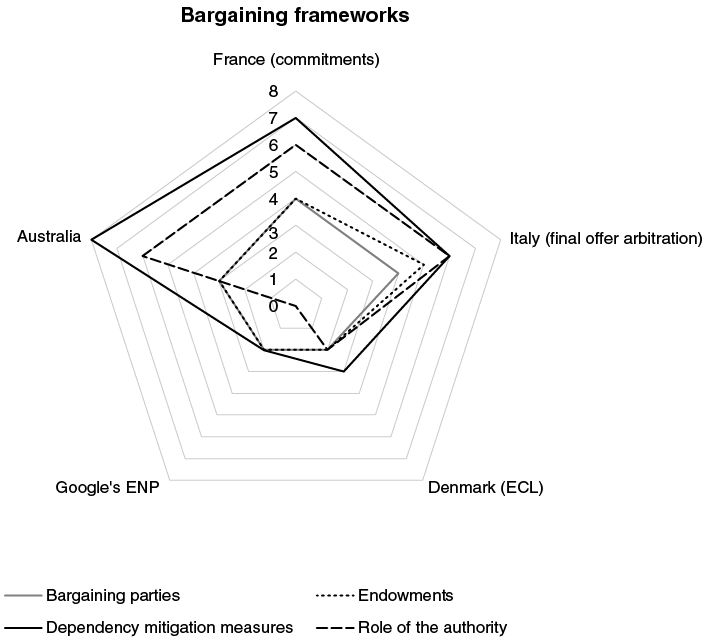
Figure 16.1 Long description
This indicates the intensity of factors that facilitate and those that force bargaining, namely: bargaining parties, endowments, dependency mitigation measures, role of the authority.

Table 16.1 Long description
The table provides an overview of the key coded parameters, namely bargaining parties, endowments, dependency mitigation measures, and role of the authority. 1 indicates that a parameter is present, 0 that it is not.
The radar graphical representation in Figure 16.1 captures the difference between frameworks that facilitate and those that force bargaining. Under forced bargaining frameworks, procedural rules and the power of the regulatory authority come to the fore (as reflected in the higher scores on these parameters for Australia and France). The private ENP framework established by Google remains silent on these points.
16.5 Conclusions
We know the policy aim of the press publishers’ right (i.e. to channel money from digital platforms to legacy, quality news publishers), but how does the intervention work? We have argued that it is important to go beyond the legal language of implementation to the structure that governs the empirical reality of bargaining. This is what we call the bargaining framework.
The bargaining framework is the invisible structure that is formed in the shadow of the statutory ‘related’ intellectual property right. Having collected the empirical details of bargaining in four EU settings and Australia, we then used bargaining theory to make the structure visible, identifying (1) bargaining parties; (2) endowments; (3) procedural mitigations; and (4) the function of the regulatory authority.
What have we learned? There are two main lessons. From a theoretical perspective, we have demonstrated how to identify and make visible different bargaining frameworks that operate under the same, or similar, statutory intervention. This makes an important contribution to the ‘shadow of the law’ literature. We show that bargaining frameworks sit as complex institutional constraints between purely private ordering and the law.
From a policy perspective, the different bargaining frameworks identified offer an appropriate unit of analysis for assessing the performance of the EU intervention. If it is the institutional translation into bargaining that matters for the range and frequency of outcomes (such as the flow of money), further empirical study should now be able to quantify the effects of the framework types. An independent impact assessment of the press publishers’ right is overdue.
17.1 Introduction
While declining revenues in the press publishing sector are not a new phenomenon, they have become particularly problematic since the early 2000s, with some commentators pointing to the internet and news aggregation services as primarily responsible for this.Footnote 1 In Europe, possible solutions to tackle this issue were initially identified at the national level. These encompassed both the conclusion of agreements between news aggregators and local press publishers (e.g., in Belgium, France, Italy) and the adoption of legislative initiatives in relation to news content (Germany, Spain).Footnote 2 With regard to the latter, prior to the introduction of Article 15 of Directive 2019/790 on Copyright in the Digital Single Market (CDSMD),Footnote 3 Germany and Spain legislated, though with different mechanisms, to achieve objectives similar to those presented in recitals 54 and 55 CDSMD.Footnote 4
In 2013, Germany introduced legislation (Sections 87f, 87g and 87h of the German Copyright Act) vesting press publishers with a waivable right over their news content. In 2014, Spain reformed its quotation exception (Article 32 of the Intellectual Property Law) and introduced a non-waivable right to ‘equitable remuneration’ that, in its substance and despite its different nature, was similar in its end goals to the German press publishers’ right. Neither initiative managed to achieve the underlying objectives though. Indeed, focusing specifically on the German and Spanish experiences, the European Commission’s Impact Assessment accompanying its 2016 Proposal for what would be adopted, three years later, as the CDSMDFootnote 5 (‘Proposal’) acknowledged that these had been somewhat ‘ineffective’, and linked such ineffectiveness to ‘the lack of scale of national solutions’.Footnote 6 Insofar as the German provisions are concerned, it should be further noted that they became unenforceable after the VG Media judgement of the Court of Justice of the European Union (CJEU).Footnote 7 There, the Court regarded the lack of notification by the German government to the European Commission as a breach of that Member State’s obligations under Directive 98/34.Footnote 8
Although neither the European Commission’s 2015 ‘Digital Single Market Strategy’Footnote 9 nor the subsequent ‘Communication Towards a Modern, More European Copyright Framework’Footnote 10 contains references to the situation of press publishers and the need for intervention in this field at EU level, in its Proposal the European Commission included a provision (Article 11) that would introduce at the EU level a new related right in favour of press publishers for the digital use of their press publications. With the stated goal of helping press publishers ‘increase their legal certainty, strengthen their bargaining position and have a positive impact on their ability to license content and enforce the rights on their press publications’Footnote 11 and ultimately reward their investment in press publications, the Proposal (Explanatory Memorandum) highlighted the difficulties that press publishers faced when seeking to license the use of their publications and prevent unauthorized uses by online services. While a number of Member States had already intervened to remedy or reduce the negative impact of reduced revenue in the press publishing sector, action at the EU level appeared necessary in order to avoid further fragmentation and remedy the already mentioned shortcomings of existing national solutions.Footnote 12
Further to a complex and admittedly contentious legislative process, Article 15 CDSMD was eventually adopted. The rationale supporting EU intervention is manifold. Recital 54 links the introduction of Article 15 to the need to facilitate press publishers when licensing the use of press publications to providers of ‘new online services’. This, in turn, would serve to support a ‘free and pluralist press’ in its function ‘to ensure quality journalism and citizens’ access to information’. Contributing to the realization of a ‘fair marketplace’ (recital 3) is one of the key objectives of the CDSMD: recital 55 is rooted in an idea of fairness, stressing the need to acknowledge ‘[t]he organisational and financial contribution of publishers in producing press publications’. This, in turn, would serve to ‘foster the availability of reliable information’.
Following the expiry of the deadline for the national transpositions of the CDSMD on 7 June 2021 and with Member States having now transposed its provisions, including Article 15, the state of copyright harmonization in the post-CDSMD landscape returns a fragmented if not altogether depressing image. With specific regard to the national transpositions of the press publishers’ right, some countries have opted to provide their own definitions of certain key concepts in the EU provision that – it is submitted – are instead to be regarded as autonomous concepts of EU law (e.g., beneficiaries, addressees, exclusions), while others have opted for problematic modalities through which the right is to be exercised.Footnote 13 An example of the latter is the Italian transposition of Article 15 CDSMD, which – at the time of writing – is already at the centre of litigation before Italian courts and also a pending referral to the CJEU.Footnote 14
By focusing on the exclusion of ‘very short extracts’ of press publications in the fourth sub-paragraph of Article 15(1) and considering some selected national transpositions thereof, this chapter seeks to investigate (i) whether the divergent national transpositions of the exclusion of ‘very short extracts’ will ultimately thwart the harmonization objective underlying Article 15 CDSMD; and (ii) whether certain national transposition approaches are to be held incompatible with EU law and, if so, what the solutions for that could be.
This analysis is connected to European media law in the sense that it focuses specifically on the press sector from the perspective of the relation (and friction) between EU harmonization goals and resulting national approaches. It is intended to add to the existing body of literature on Article 15 CDSMD from an EU perspective by focusing specifically on national transposition approaches. It is hoped that the resulting conclusions can also inform law-making at the national level in relation to other areas of the law affected by the process of EU harmonization.
The chapter is structured as follows. Section 17.2 considers the EU preemption doctrine as applied to copyright provisions and identifies Article 15 CDSMD as a provision that requires a minimalistic transposition in national law. Section 17.3 reviews selected national transpositions of Article 15 with specific regard to the exclusion of ‘very short extracts’, the goal being not to provide an exhaustive overview of all Member States’ legislations but rather to identify problematic approaches in the fulfilment of Member States’ own obligations under EU law. Section 17.4 considers the consequences of incorrect transpositions of Article 15. Section 17.5 concludes the discussion. Ultimately the questions posed in the title of the chapter (Is harmonization good if the end result is even more fragmentation?) is answered in the sense that harmonization is necessary but where the instrument chosen is a directive, it is imperative that national legislatures correctly interpret and act within the freedom afforded to them under EU law.
17.2 The EU Doctrine of Preemption and the Case of Article 15 CDSMD
In order to appreciate the freedom that Member States enjoy in transposing provisions of EU directives – including Article 15 CDSMD – into their own legal systems, a discussion needs to be undertaken of the principles of EU supremacy and the related yet distinct doctrine of EU preemption. Supremacy of EU law over EU Member States’ laws is one of the cornerstones of the overall EU integration process: it denotes the superiority of the EU legal order over national legal orders.Footnote 15 The doctrine of EU preemption is closely associated with EU supremacy yet remains distinct from itFootnote 16 and is now codifiedFootnote 17 in Article 2(1)–(2) of the Treaty on the Functioning of the European UnionFootnote 18 (TFEU). Yet, compared to EU supremacy, the attention devoted to the doctrine of EU preemption is still limited. As a leading theorist of EU preemption has bluntly put it: ‘The contrast between the academic presence of the supremacy doctrine and the shadowy existence of the doctrine of pre-emption in the European literature is arresting.’Footnote 19
All this said, insofar as intellectual property (and so copyright) is concerned, this is an area of shared competence between the EU and its Member States. This means that, once the EU has exercised its competence in a certain field and adopted rules on a particular matter, EU Member States may no longer legislate. This should not be intended as an overall ban to legislate in relation to a certain area as a whole, but only as preemption from legislating in relation to the elements of the EU action in question.Footnote 20 It has been detailed that, compared to EU supremacy, preemption is less explored. If we take the case of intellectual property and copyright, however, the situation is even more dire when contrasted to other areas where EU harmonization initiatives have been undertaken.Footnote 21 On the one hand, scholarship has not really engaged with questions of preemption in the copyright field; instead, it has advanced the idea that EU copyright law – in particular the Information Society Directive 2001/29Footnote 22 (‘ISD’) with regard to available exceptions and limitations under Article 5 therein – would allow a substantial degree of flexibility. On the other hand, Member States’ transpositions of relevant directives have often occurred through the adoption, by individual legislatures, of language departing from that of the corresponding EU provisions and envisaging an altogether different scope of resulting national provisions. Nevertheless, as consistent CJEU case law also indicates, the EU copyright system is such that a uniform approach is required and that Member States’ freedom to legislate is significantly limited.
17.2.1 Harmonization Techniques and Member States’ Discretion
The process of EU copyright harmonization has been mostly carried out through the instrument of directives. Under Article 288(3) TFEU, ‘A directive shall be binding, as to the result to be achieved, upon each Member State to which it is addressed, but shall leave to the national authorities the choice of form and methods.’ In all this, when it comes to the EU copyright directives and the degree of freedom enjoyed by Member States in the subsequent transposition process, it is possible to identify three groups of provisions.
There is a first group that allows Member States the very option of whether or not to introduce certain mechanisms into national law (Group 1). Then there is a second group of provisions that require Member States to undertake certain initiatives, while also granting them substantial discretion (Group 2). Finally, there are provisions that are prescriptive in content and scope (Group 3). In turn, the freedom of Member States, insofar as their transposition and application are concerned, is extremely limited.
While it is true, as detailed here, that the TFEU allows national authorities to determine the form and methods they use to achieve the result mandated by a certain EU directive, it would be parochial to think that the choice between different approaches to national transpositions is always something within the complete discretion of EU Member States. There are provisions of EU law that actually provide a choice between copying and elaboration (minimalistic and non-minimalistic methods of transposition), but this is not always the case.Footnote 23 In the context of the present discussion, the provisions belonging to Groups 1 and 2 grant Member States the possibility to adopt a non-minimalistic method of transposition; the provisions that are part of Group 3 require instead a minimalistic transposition approach.
17.2.2 The CDSMD and Article 15
Article 15 is an example of a Group 3 provision as defined here. It requires Member States to provide publishers of press publications established in a Member State with the rights provided for in Article 2 and Article 3(2) ISD for the online use of their press publications by information society service providers (ISSPs).Footnote 24 Among other things, Article 15(1) excludes individual words and very short extracts from the scope of protection.
Considering this configuration of the provision, the notion of ‘very short extract’ is admittedly an autonomous concept of EU law and Member States are not allowed to provide a definition thereof in their own national transpositions of Article 15. As the CJEU clarified early on in Ekro:
The need for a uniform application of Community law and the principle of equality require that the terms of a provision of Community law which makes no express reference to the law of the Member States for the purpose of determining its meaning and scope must normally be given an independent and uniform interpretation throughout the Community; that interpretation must take into account the context of the provision and the purpose of the relevant regulations.Footnote 25
All this is expression of the principle of autonomy and is regarded by the CJEU itself as ‘settled case-law’.Footnote 26 The CJEU has often employed this standard in its copyright case law, with the practical effect of strengthening the harmonization of copyright laws across the EU. Although arguably neither the Court nor its Advocates General (AGs) have systematically or even explicitly developed a doctrine of EU preemption in the EU copyright field, the application of preemption has been material and prompted by the objective of achieving certain internal-market-rooted outcomes for prejudicial questions posed by national courts. The practical, result-oriented use of EU preemption may be seen in all areas affected by copyright harmonization: subsistence requirements, exclusive rights, exceptions and limitations, and national legislative initiatives.
Three key factors have contributed to developing and shaping the Court’s application of preemption in the field of copyright. The first has been the use of and reliance on the aforementioned interpretative standard according to which, when a certain provision in an EU directive makes no reference to national legislation, relevant concepts are not to be defined at the national level but are rather intended to constitute autonomous concepts of EU law. As such, they are to be given a uniform interpretation and application throughout the EU, with the result that Member States are not allowed to determine the limits thereof in an inconsistent and unharmonized manner. The second has been the internal market-building rationale underlying the entire EU copyright harmonization process and, with that, the need to comply with the wording and scope of EU provisions and avoid fragmentation at the national level. The third has been an expansive reading of the harmonization achieved at EU level, with the result that the room for national legislative initiatives in the field of copyright has been substantially limited or even removed.
17.3 Article 15 and Its National Transpositions: The Exclusion of ‘Very Short Extracts’
Like the earlier German press publishers’ right, Article 15(1) CDSMD inter alia excludes from the scope of protection the use of very short extracts of a press publication. Like the German legislation, the CDSMD does not define what constitutes a ‘very short’ extract.
17.3.1 The Rationale of Related Rights (Including Article 15) and the Resulting Scope of Protection
The right granted under Article 15 CDSMD is a related right. As such, the conditions for and rationale of protection differ from copyright. Protection under the latter is premised on the originality of the work at hand or part thereof. In accordance with what the CJEU itself calls ‘well-established case-law’Footnote 27 and ‘well-settled case-law’,Footnote 28 originality is established when – through the choice, sequence, and combination of such elements as words, figures, or mathematical concepts – an author expresses their creativity in an original mannerFootnote 29 and exercises ‘creative freedom’.Footnote 30 What is required is thus for the author ‘to express [their] creative abilities in the production of the work by making free and creative choices’, so that they ‘can stamp the work created with [their] “personal touch”’.Footnote 31 Indeed, ‘mere intellectual effort and skill’ in creating a work are not relevant to establishing originality.Footnote 32 In addition, the originality criterion is not satisfied when the creation of a work ‘is dictated by technical considerations, rules or constraints which leave no room for creative freedom’.Footnote 33 Related and sui generis rights are not at all premised on this logic.
The right of reproduction of rightholders other than authors protects ‘not intellectual creation but financial investment’.Footnote 34 As such, the subject matter of related rights is protected irrespective of its originality. In Pelham, the CJEU considered the scope of protection afforded to phonogram producers in relation to the unauthorized reproduction of very short audio snatches from a phonogram for inclusion in another phonogram under Article 2(c) ISD in accordance with the sampling technique. The Court ruled that the reproduction of a phonogram, even when such a reproduction is very short, must in principle be regarded as a reproduction ‘in part’ of that phonogram within the meaning of the provision insofar as it is recognizable to one’s ear (the ear of whom, however, is oddly left unclearFootnote 35) and that part reflects the investment made by the rightholder.Footnote 36 This finding is consistent with the objective of guaranteeing a high level of protection and safeguarding the specific objective of the exclusive right of the phonogram producer, referred to in recital 10 ISD, ‘which is to protect a phonogram producer’s investment’.Footnote 37
With specific regard to phonograms, the CJEU also held that ‘where a user, in exercising the freedom of the arts, takes a sound sample from a phonogram in order to use it, in a modified form unrecognisable to the ear, in a new work, it must be held that such use does not constitute “reproduction” within the meaning of Article 2(c) of [the InfoSoc] Directive 2001/29’.Footnote 38 In reaching this conclusion, the Court was clearly mindful of the importance of respecting third-party freedom of artistic expression. Specifically protected under Article 13 of the EU Charter,Footnote 39 this fundamental freedom has received some timid mentions in other EU intellectual property instrumentsFootnote 40 but – insofar as copyright is concerned – the decision in Pelham represents the first explicit mention thereof.Footnote 41 Some commentators have suggested that the test of recognizability could be generally applicable as a limitation to the scope of the right of reproduction for rightholders other than authors.Footnote 42 Others have considered that, more than reproduction, the issue considered and the approach adopted by the CJEU would be a matter of adaptation, with the result of yet another de facto harmonization effort on the side of EU judiciary.Footnote 43
Despite the specific sound sampling context of the CJEU ruling in Pelham and the fact that – at the time of writing – the Court has not yet had the opportunity to address specifically the right of reproduction of the other reproduction rightholders listed in Article 2 ISD, the broader teaching appears to be that there is reproduction ‘in part’ within the meaning of Article 2(b)-(e) ISD when what is being reproduced without the permission of the relevant reproduction rightholder interferes with the opportunity, which the rightholder should have, of realizing satisfactory returns on their investment.Footnote 44 This conclusion appears consistent with the qualified test of infringement recently adopted by the CJEU in CV-Online Latvia in relation to the sui generis database right under the Database Directive.Footnote 45 There the CJEU held that not all extractions of re-utilization without consent of a database are potentially relevant under the sui generis database right. What is required, instead, is that the extraction and/or re-utilization at issue adversely affect the investment made in the obtaining, verification, or presentation of the content of a database. The test is thus whether a risk has been posed to the possibility of redeeming that investment through the normal operation of the database in question.Footnote 46
Such an approach to related rights offers the distinct advantage of setting some threshold to the protection afforded under themFootnote 47 and could be also employed in non-ISD situations. This, it is submitted, is the case of the related right of press publishers under Article 15 CDSMD. It is evident from the preamble to that directive that the rationale of the related right under Article 15 is, as stated, to allow press publishers to recoup their investments by creating licensing and enforcement opportunities (recital 54) and acknowledge the organizational and financial contribution they make in producing press publications, so as to also ensure the sustainability of the publishing industry and foster the availability of reliable information (recital 55). Like all related rights under EU law, what Article 15 protects is not the intellectual creation of press publishers but their investment. As such, the test for reproduction ‘in part’ of a press publication should be investment-based.Footnote 48 Considering this policy background, it seems justified to draw a parallel with the approach adopted in Pelham which, as explained, also evolved from the CJEU’s intention to safeguard the investment made by phonogram producers.
Bringing the notion of ‘very short extract’ in line with this approach, it becomes apparent that no hard-and-fast definition of what qualifies as ‘very short’ may be provided in national law. Instead, it is the task of the CJEU to define the concept of ‘very short extract’ with sufficient precision in its case law. Moreover, some guidance to establish when an extract is in fact too short to be protected may be derived in the first place from recital 58, which explains that the use of press publications by ISSPs may consist of the use of press publications in their entirety or parts thereof. In this sense, the use of parts of a press publication (for example, titles and headlinesFootnote 49) may also have self-standing economic relevance. However, not all uses of a press publication will have such relevance. In other words, the unauthorized use of individual words or very short extracts may not be such as to undermine the investment made by press publishers in the production of a press publication and, with that, the effectiveness of the right under Article 15. Ultimately, the goal of the right, which was adopted in a context of ‘massive aggregation and [unauthorized] use of press publications by information society service providers’, is precisely to stimulate a licensing market for press publications.
17.3.2 Exclusions of ‘Very Short Extracts’ in Selected National Laws
At the time of writing, all EU Member States have transposed Article 15 CDSMD into their domestic laws.Footnote 50 Insofar as the exclusion for very short extracts is concerned, three groups of transposition approaches may be identified.
There is a first group of Member States that, correctly, have adopted a minimalistic approach – in the sense of using the same or substantially the same language that can be found in Article 15(3). For example, the Belgian, German, Irish, and Swedish transpositions refer, respectively, to ‘très courts extraits’, ‘sehr kurzer Auszüge’, ‘very short extracts’, and ‘mycket korta utdrag’.Footnote 51 Then there is a second group of Member States that have decided to provide guidance on what is to be intended as ‘very short’ extract. The Italian transposition considers extracts of press publications ‘very short’ when what has been taken is ‘any part of such a publication which does not dispensate from the need to consult press article as a whole’ (‘qualsiasi porzione di tale pubblicazione che non dispensi dalla necessità di consultazione dell’articolo giornalistico nella sua integrità’).Footnote 52 The French transposition, which pre-dated and inspired the subsequent Italian approach, also refers the notion of ‘very short extracts’ to the need to preserve the effectiveness of the right. In turn, said effectiveness is impaired when ‘the use of very short extracts replaces the press publication itself or exempts the reader from referring to it’ (‘l’utilisation de très courts extraits se substitue à la publication de presse elle-même ou dispense le lecteur de s’y référer’).Footnote 53 Finally, there is a third group of Member States that have opted for quantitative thresholds. The Lithuanian transposition is telling: the law states that any extract of under 125 characters (without spaces) shall be regarded as ‘very short’.Footnote 54
In light of this, there are no issues of compatibility insofar as the minimalistic approach of the first group of Member States is concerned. A quantitative approach such as that of the third group of Member States is, by contrast, highly problematic from an EU law perspective. The position of Member States that have opted to provide guidance as to what is regarded as ‘very short’ (second group) also has the potential to give rise to uncertainties and fragmentation.
As stated, the CDSMD does not define the notion of ‘very short’ extract. This, however, is not unusual in EU copyright legislation. Further examples can be found in the CDSMD itself. For instance, the EU legislature refrained from fixing the notion of ‘large amount’ of copyright works or other protected subject matter that is relevant to define the notion of ‘online content-sharing service provider’ in accordance with Article 2(6) CDSMD and therefore the application of Article 17. Arguably, this omission is intentional. The objective is that of mandating a case-by-case assessment. The goal is ‘to avoid legal fragmentation through a potentially different scope … in different Member States’.Footnote 55 Such an approach is yet not possible under the law of a Member State that has opted for an inflexible, quantitative threshold.
Turning to national laws that seek to clarify what is to be meant by ‘very short’, the rationale of Article 15 CDSMD is not necessarily to incentivize the consultation in full of a press publication, but rather to allow press publishers to authorize or not the use of their press publications – in other words, to issue licences if they want to. It follows that a corrected reading of the guidance provided under, for example, French and Italian laws is needed: an extract of a press publication should be deemed ‘very short’ when an ISSP is disincentivized from seeking a licence from the concerned press publishers, and that is the case if the extract at issue dispenses from the consultation of the press publication at issue or part thereof.
17.4 Consequences of Incorrect Transpositions of Article 15 CDSMD
As discussed here, there are provisions in EU directives that are drafted in such a way that EU Member States enjoy limited or virtually no freedom when transposing them into national legal systems. What happens when a Member State has not transposed a directive or a mandatory provision therein by the relevant deadline or has done so incorrectly?
Under EU law, directives do not produce any horizontal direct effect. This means that they cannot be relied upon in private-party proceedings and do not impose obligations on individuals.Footnote 56 Nevertheless, EU directives may produce – under certain conditions – a vertical direct effect. In cases in which EU law imposes upon Member States ‘the obligation to pursue a particular course of conduct, the useful effect of such an act would be weakened if individuals were prevented from relying on it before their national courts and if the latter were prevented from taking it into consideration as an element of [EU] law’.Footnote 57 All this means that when a provision in an EU directive imposes on EU Member States, in unequivocal terms, well-defined obligations as to the result to be achieved that is not coupled with any condition regarding application of the rule laid down in them, then that provision may be directly relied upon before the courts of a Member State that has failed to implement it correctly or even altogether.Footnote 58
17.4.1 Direct Effect in CJEU Copyright Case Law
The issue of the direct effect of EU directives has been specifically tackled in a copyright context in OSA. That reference for a preliminary ruling asked the CJEU, among other things, whether Articles 3(1) ISD is unconditional enough and sufficiently precise for an individual or organization (a copyright-collecting society in that case) to rely on it in a dispute between individuals before a national court in case of incorrect transposition of that directive by a certain EU Member State. The CJEU answered in the negative due to the described lack of direct horizontal effect of directives. It is true that a national court, when hearing a case between individuals, is required, when applying the provisions of domestic law, to consider the whole body of rules of national law and to interpret them, so far as possible, in the light of the wording and purpose of the directive in order to achieve an outcome consistent with the objective pursued by the directive. However, this cannot serve as the basis for an interpretation of national law contra legem.Footnote 59
The conclusion of the CJEU in OSA differs from the view that AG Sharpston had taken in her opinion in the same case. The AG observed that, first, when national courts apply domestic law, they are bound to interpret it, so far as possible, in the light of the wording and purpose of any relevant directive, in order to achieve the result sought by the directive (Marleasing principleFootnote 60). That obligation is inherent to the Treaty system and enables national courts to ensure the full effectiveness of EU law when they determine disputes within their jurisdiction. Only if such an approach is not possible, for example because it would lead to an interpretation contra legem, is it necessary to consider whether a relevant provision of a directive has direct effect and, if so, whether that direct effect may be relied on against a party to the national dispute. The AG also stressed that it is for national courts to do whatever lies within their jurisdiction, for example taking the whole body of domestic law into consideration and applying the interpretative methods recognized by it, to ensure that the ISD is fully effective and thus to achieve outcomes consistent with the objectives pursued by it. She concluded that an interpretation of national law that would be inconsistent with the ISD would not be permissible.Footnote 61 The AG did not state expressly what the legal consequences of incorrect ISD implementations would be. Nevertheless, she appeared to agree with the OSA’s suggestion that this would be disapplication of incorrect national provisions.Footnote 62
The position advanced by AG Sharpston is correct if it is intended as meaning that the provision at hand is suitably clear, precise, and unconditional and that the disapplication by the concerned national court does not result in an additional obligation being imposed upon an individual. The latter condition serves to comply with the mandate of Article 288 TFEU and the aforementioned lack of a horizontal direct effect of directives. Vice versa, an obligation to disapply a provision of national law that is contrary to a directive does arise when someone relies on that directive against a Member State, the organs of its administration, or organizations or bodies that are subject to the authority or control of the State or which a Member State requires to perform a task in the public interest and, for that purpose, possesses special powers beyond those that result from the normal rules applicable to relations between individuals.Footnote 63
After all, it has been clear as early as SimmenthalFootnote 64 that – in order to comply with the principles of supremacy of EU law and sincere cooperation, as well as to ensure the full application of any provision of EU law with a direct effect – a national court called upon to apply a provision of EU law that produces such an effect is required to disapply any national rule of practice that is contrary to such a provision, where it is unable to interpret national law in compliance with the requirements of EU law and when the conditions detailed here are satisfied. Of course, the disapplication does not entail the automatic invalidation of the national legislation at hand. Nevertheless, it means that a court should disapply the provision at hand without having to request or await the prior setting aside of that national rule or practice by legislative or other constitutional means.Footnote 65
17.4.2 What Should a National Court Do with an Incorrect Transposition of Article 15 and the Exclusion of ‘Very Short Extracts’?
In light of what precedes, can we consider the fourth sub-paragraph in Article 15(1) as a provision with direct effect? The answer appears to be in the affirmative, as the wording is suitably clear, precise, and unconditional. Does it also confer a right on ISSPs? The answer is also in the affirmative, as the exclusion for ‘very short’ extracts is an exclusion from the scope of the related right, not an exception or limitation to it:Footnote 66 put differently, the right simply does not cover the unauthorized use of extracts that are very short.
In practice, this means that an ISSP is entitled to request the disapplication of a national transposition of that part of the provision in front of a national court in cases in which the counterpart is not a private press publisher but – for example – a press publisher that falls under one of the situations discussed here. All this is without prejudice to the right of an ISSP also to seek damages from a concerned Member State for failure to transpose Article 15 correctly into national law.
17.5 Conclusion: Harmonization Has Failed if the End Result Is Even More Fragmentation
The degree of discretion enjoyed by Member States when transposing provisions of EU directives into national law is not always the same and, when it comes to provisions that require a minimalistic transposition approach, then that obligation must be complied with and the national implementation must not depart from the wording provided in the harmonized copyright acquis. Failure by a Member State to correctly transpose a provision of EU law not only exposes that country to infraction proceedings and damage requests, but also puts national courts in a position where they may have to disapply national provisions that are not fully aligned with EU law.
This analysis has focused specifically on Article 15 CDSMD and the transposition of the exclusion of ‘very short extracts’ into national law. As seen, while that part of the provision requires a minimalistic transposition approach, several Member States have instead opted for a different wording if not scope of the exclusions. Besides the problems highlighted here, a fundamental question is the one concerning the quality of legislation and whether the underlying goals may be ultimately achieved. The related right for press publishers was adopted due to the stated existence of a fragmentation that was seen as negatively affecting the proper functioning of the EU’s internal market. However, the image given by available national transpositions more than two years after the expiry of the relevant implementation deadline is one of fragmentation or even more fragmentation than prior to the adoption of the CDMSD. All this warrants a final, twofold question: Is the instrument of directives still appropriate when seeking to harmonize aspects of the law with an online and digital component? And who is to blame for the often incoherent legislative framework that relevant stakeholders have to operate within – the EU or its Member States?
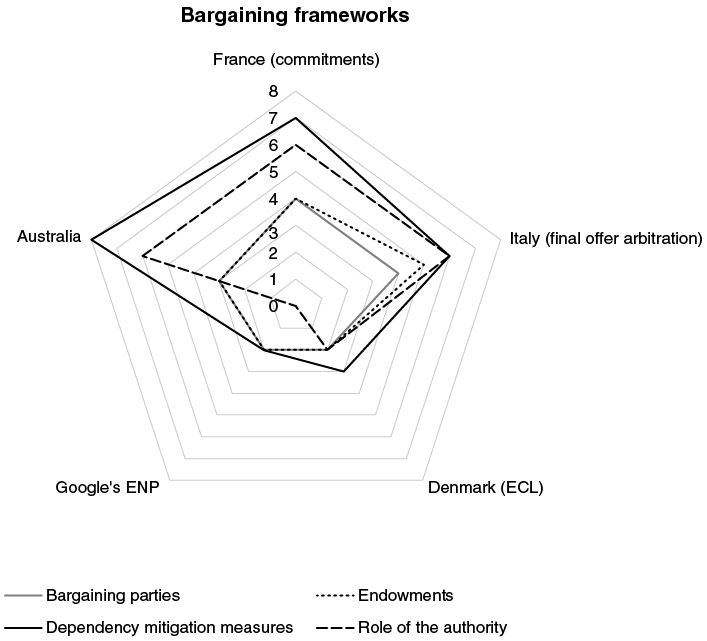
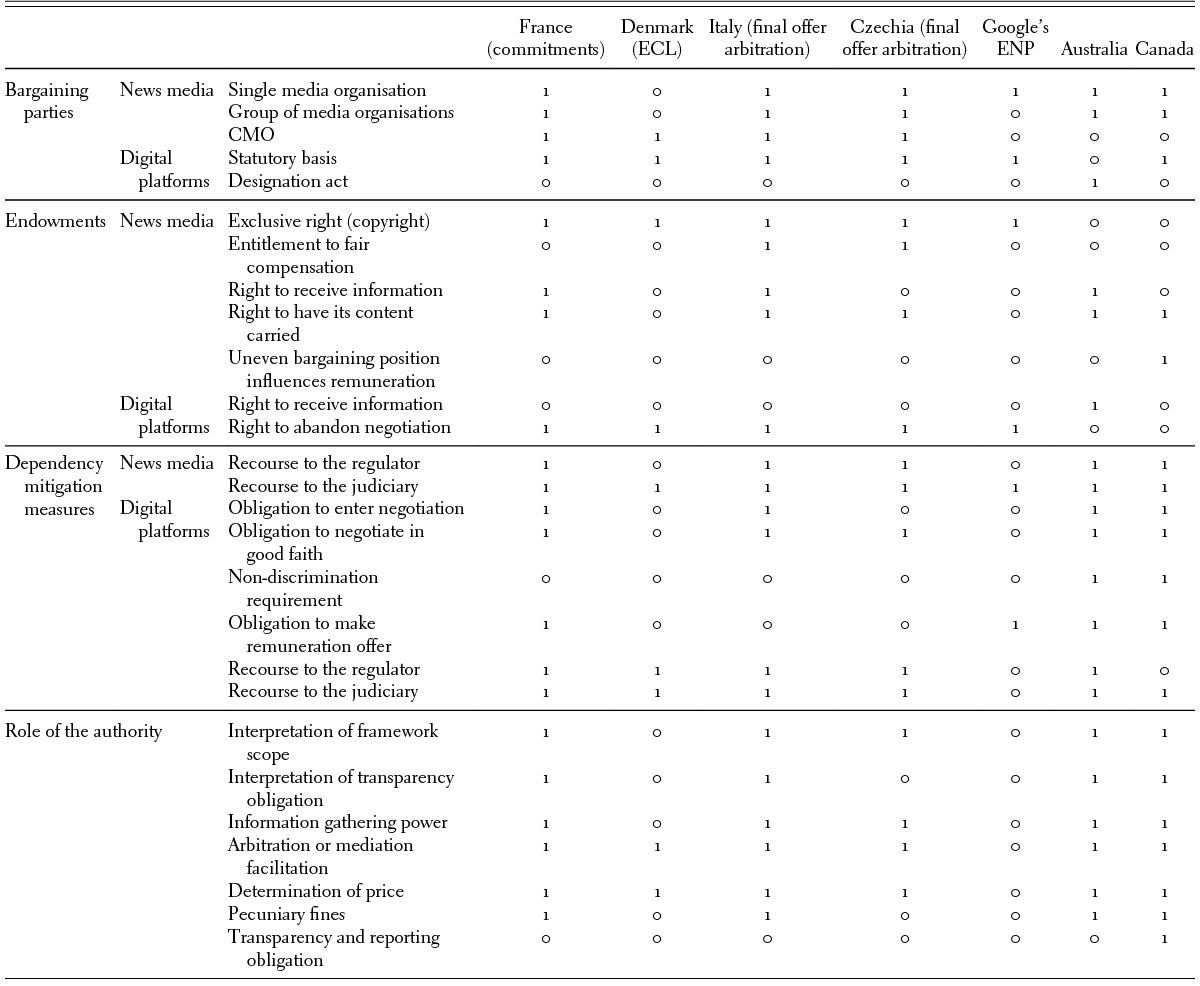

 Open access