


Introduction and purpose
The development of material living standards among the common population of Europe during the early modern period remains, despite decades of research, a debated topic. Reconstructed wage series, data on agricultural production, and aggregated data on GDP largely suggest the period was one of economic decline or stagnation, with generally increased costs of respectable living compared to wages and continuously declining standards of living for most households (Allen Reference Allen1992; Malanima Reference Malanima2010). Despite this, less aggregated data on household living conditions, such as contemporary descriptions or probate records, suggest clear long-term improvements of household material living standards (Bovenkerk and Fertig Reference Bovenkerk and Fertig2022; Mas Ferrer Reference Mas Ferrer2021; Weatherill Reference Weatherill1988). One of the more influential attempts to explain this discrepancy is Jan de Vries’ (Reference de Vries2008) industrious revolution theory. While deceptively simple, the theory appears to hold for the relatively highly urban northwest-European economic core regions of southern England and the Low Countries (Malanima and Pinchera Reference Malanima and Pinchera2012; Van Nederveen Meerkerk Reference Van Nederveen Meerkerk2008). It has, however, not been accepted without critique, especially when applied on the more rural European peripheries where most historians argue that increased industriousness, if present at all, was rather a necessity for households to uphold respectable living standards in the face of increasing costs and falling incomes (Allen and Weisdorf Reference Allen and Weisdorf2011; Gary and Olsson Reference Gary and Olsson2020; Horrell et al. Reference Horrell, Humphries and Weisdorf2021; Ogilvie Reference Ogilvie2010).
Early modern Sweden, situated firmly on the periphery and with excellent micro-data for the late seventeenth century and onward, can contribute well to our understanding of the development of rural consumption and industriousness. On a macro level, the eighteenth century was an economically stagnant period in Sweden; low levels of economic growth and agricultural production were mostly counteracted by an increase in population growth after the end of the “Great power” era and a century of almost constant wars. Reconstructed GDP per capita levels remain at constant, or even decreasing, levels throughout the century, and data on wage labor suggest an increase in the costs of (respectable) living relative to income (Edvinsson Reference Edvinsson2009, Reference Edvinsson2013; Gary and Olsson Reference Gary and Olsson2020; Olsson and Svensson Reference Olsson and Svensson2010; Schön and Krantz Reference Schön and Krantz2015). General economic growth accelerates first in the decades after 1780, with the repeal of several trade regulations that formerly restricted the export of grain from fertile southern Sweden. The nineteenth century increase in agricultural output that follows supersedes that in the more agriculturally developed England and Netherlands, leading a “catching up” of the Swedish economic compared to the Northwest European core (Hallberg et al. Reference Hallberg, Nyström, Leijonhufvud and Palm2022a; Olsson and Svensson Reference Olsson and Svensson2010).
However, for the peasant population the decades following 1720 were a period of relative prosperity. According to Gadd (Reference Gadd, Myrdal and Morell2011), national tax and land rent reforms of the late seventeenth century led to a “drop in real terms in taxes and rents [which] meant that peasant-farmers could accumulate a surplus in silver and other valuable objects” (ibid: 144). While this general decrease in the extraction rate did not benefit tenants on noble land, peasants on crown and freehold land were able to accumulate capital with which to invest in household reproduction. This affluence was not divided equally, however; apart from the disadvantaged tenants on noble land, the rapid population increase entailed a massive downward social mobility of peasant-farmers and an increase in the landless, and semi-landless, population (ibid: 142; Lindström Reference Lindström2008).
The goal of this article is to give further insights into the development of rural household consumption within the broader trends of industriousness and economic growth, using extensive micro-data on household wealth and material composition gathered from 1665 probate records from southern Sweden. While the increased peasant affluence during the decades after 1720 would have led to an improvement in the material standards for the landed, independent peasantry who could benefit from the political developments (Gadd Reference Gadd2000), we should be able to expect the main expansion in general rural household consumption – and consequent significant improvements in material living standards – to be visible first after the technological and institutional improvements in production caught up with the eighteenth-century population increase around 1800 (Olsson and Svensson Reference Olsson and Svensson2010); with the general benefits for the whole of the rural population restricted by uneven distribution of gains and exploitation, increasing land parcelization following population growth (Lindström Reference Lindström2008), and decreasing or stagnant real wages for rural work (Gary and Olsson Reference Gary and Olsson2020).
While the analyzed probate records support the evidence of the significant improvement of material standards occurring during the first half of the nineteenth century, they also present a clear – but smaller – increase in household consumption already in the eighteenth century. This earlier increase appears to have benefited the entire rural population, and occurred well before the structural improvements in the economy during the last decades of the century. Occurring roughly a century later than in comparable regions in England, this development has strong similarities to contemporary developments elsewhere in the European periphery, such as Germany and Catalonia (Bovenkerk and Fertig Reference Bovenkerk and Fertig2022; Mas Ferrer Reference Mas Ferrer2021; Overton et al. Reference Overton, Whittle, Dean and Hann2004).
While strongest among the wealthiest groups, this earlier increase in household consumption is visible across the rural population. This occurred in tandem with a diversification of rural household production – especially into proto-industrial textile production – during the eighteenth century, which would have entailed a new source of income, freed up land to be mortgaged for access to credit, as well as increased household reliance on interregional markets for reproduction (Falk et al. Reference Falk, Bengtsson and Olsson2025; Vardi Reference Vardi1993). The following increased access to markets, together with the introduction of the goods and habits of the consumer revolution to south Swedish countryside (McCants Reference McCants2008; North Reference North2008; Smith Reference Smith2002; de Vries Reference de Vries2008), appears to have led to the adoption of a rural consumption culture centered around private comfort and public sociability, rather than solely reproduction and conspicuousness.
Consumption and industriousness in early modern Europe
The seventeenth and eighteenth centuries saw a consumer revolution spread throughout Europe with the widespread introduction and popularization of new types of comfort goods: These goods – such as cushioned sofas, specialized tea- and gaming-tables, and colonial hot drinks – over the course of the period completely changed daily life in the regions in which they became available, and to a large extent reshaped the home from a place solely for the purpose of household reproduction to a place of comfort and leisure (McCants Reference McCants2008; Overton et al. Reference Overton, Whittle, Dean and Hann2004; Shammas Reference Shammas1990). The demand for these new goods, according to de Vries’ (Reference de Vries2008) influential Industrious Revolution theory, further led the early modern household to restructure their allocation of household resources: by shifting household production away from reproductive work toward market production, mainly through specialization, the early modern household was able to increase productivity, and incomes, through intensification of labor rather than technical improvement.
This increased industriousness, as de Vries terms it, allowed the early modern household to acquire these new comfort goods only accessible through the market, and in turn helped drive the European economy toward modern economic growth through an increase in productivity. In the north-European periphery, while a possible increase in household productivity is observable, it was likely driven by increased costs of living and shifting international demands for production rather than demand for new goods only available through the market (Gary and Olsson Reference Gary and Olsson2020; Hutchison Reference Hutchison2014).
Despite these reservations on the driving force behind industriousness, it appears clear that even in the more peripheral regions the increased productiveness went hand in hand with a similar increase in household consumption. Bovenkerk and Fertig (Reference Bovenkerk and Fertig2022) find, in their study of northwestern Germany, a connection between proto-industry and new consumption patterns through the closer connection between households and interregional markets. A similar conclusion is drawn by Hutchison (Reference Hutchison2014) for Norway, where the increased access to consumer goods appears to have been a consequence of Norwegian rural households’ increased production for interregional markets, rather than a driving force for it. For Sweden, studies on early modern rural consumption appear to confirm the correlation between the presence of consumer goods and access to interregional markets for rural consumers (Ahlberger Reference Ahlberger1996; Ulväng Reference Ulväng2021). However, no clear correlation has yet been identified between the changes in household production patterns during the period and the introduction of new consumption patterns, apart from the finding that, among the expanding crofter population of the late eighteenth century, a clear trend toward proletarianization appears to have had little impact on the consumption capabilities of these households (Bengtsson and Svensson Reference Bengtsson and Svensson2020).
The new goods and consumer habits associated with the consumer revolution appears to have first been introduced among the urban genteel classes in the city of Paris, in England, and the Low Countries during the seventeenth century. From there they spread both outwards geographically, and downward in the socioeconomic order. Among the urban gentility most of the goods featured in the consumer revolution – such as tea- and coffee-ware, tables, new textiles, and new utensils for cooking and dining – were central for the emerging sociability culture, chief of which was the “social visit” in which especially tea, coffee, and food played a central role (Andersson Reference Andersson2009; Brown Reference Brown2020; Crowley Reference Crowley2001; North Reference North2008; Stobart and Rothery Reference Stobart and Rothery2016). For the rural populace, the “social visit,” and all the goods and rituals associated with it, was less important as the social space for interaction remained the public places, such as church or the market, rather than the home (Ulväng Reference Ulväng2021).
Being on the European periphery, it should be expected that there is a slight lag in time between these new consumption habits being first introduced in England and the Netherlands and them reaching Sweden. Furthermore, since most of the new goods and consumer habits associated with the consumer revolution were an urban phenomenon, their diffusion among the common rural populace should have taken even longer. While an exact timing for when the new consumer habits associated with the consumer revolution became widespread in Sweden is difficult to pinpoint, it is clear that by mid-eighteenth century they had found traction among the Swedish urban elite (Andersson Reference Andersson2009; Brown Reference Brown2020), and by the second half of the century among rural elite groups in regions with good access to interregional markets (Ulväng Reference Ulväng2021). Despite being geographically close to both the coast and the continent, Scania lacked major international ports during most of the analyzed period – the city of Malmö being a minor exception in the shadow of the much more important Gothenburg circa 240 km to the north. Even when it opened to markets in the late eighteenth century most of its produce was shipped to other parts of Sweden rather than abroad (Olsson and Svensson Reference Olsson and Svensson2010). As such, most of the analyzed region lacked easy access to international markets.
Empirical strategy and sources
Sources and sampling
With the new national law that was introduced in 1734 – chapter IX §1 of the inheritance code (Sveriges Rike Lag, Gillad och antagen på Riksdagen åhr 1734) – it became mandatory to draw up a probate inventory for a household upon the death of either of its heads. These inventories were to include movable and immovable possessions, as well as both in- and outgoing debts, to facilitate the division of the estate between heirs and the payment of creditors. While most studies using probate records have investigated the post-1734 period, due to the ample availability of material, it has long been known that there also exist inventories from before 1734, which have mainly been used in studies of towns and cities in the seventeenth century (Andersson Reference Andersson2009 on Arboga; Andersson Reference Andersson2017 on Stockholm).
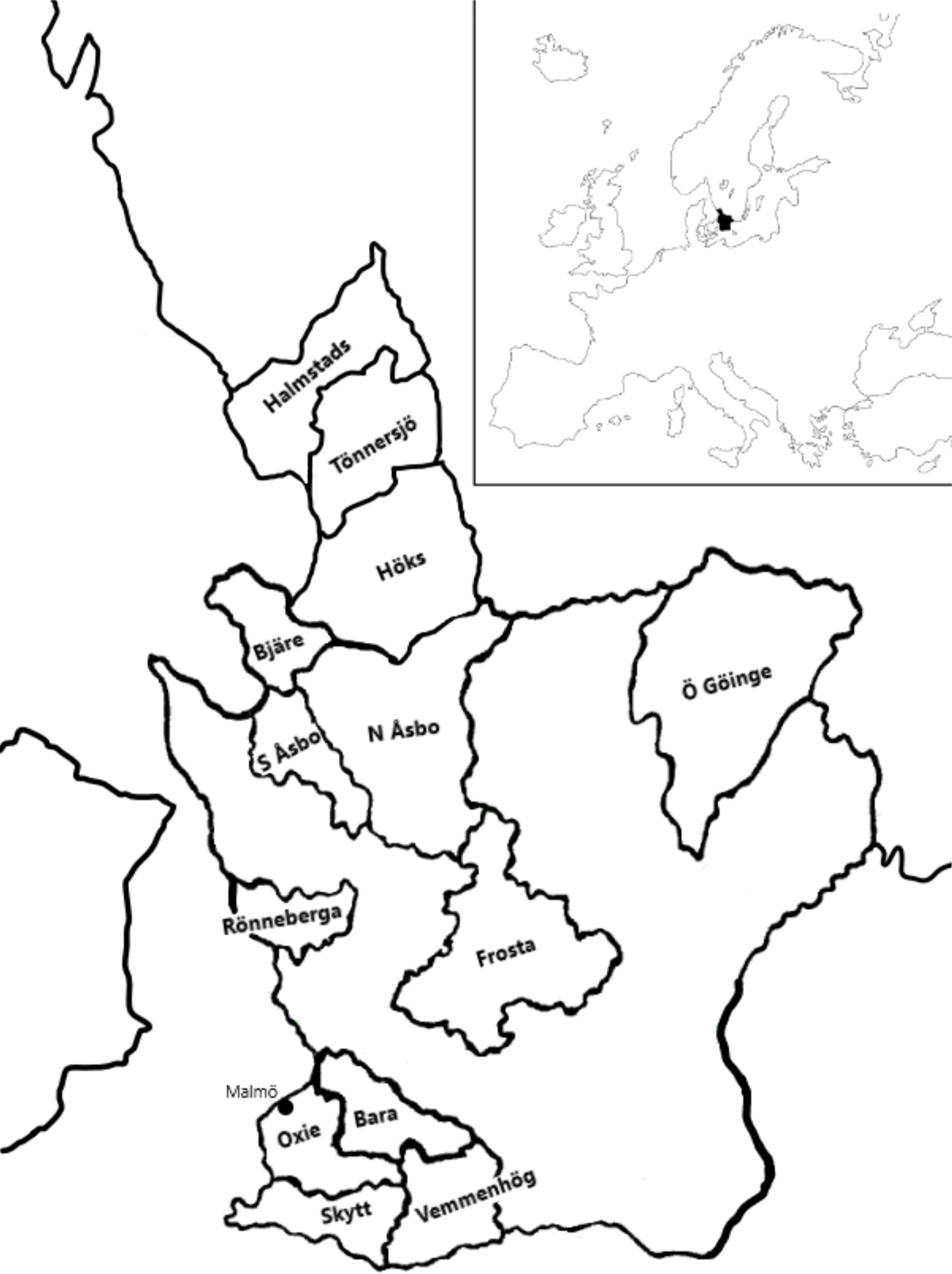
Three regions in southern Sweden were identified with ample presence of pre-1734 probate records, from which circa 600 probate records were excerpted for each of the periods 1670–1720, 1780–85, and 1860–65 (Appendix A, Table A1, Supplementary material). The regions, presented in Figure 1, represent a diverse set of geographical and economic characteristics: The rich and densely populated plains region surrounding the town of Malmö in the southernmost part of the country boasts some the most fertile agricultural lands in northern Europe. Highly cultivated already by the seventeenth century and specialized in grain production, the region led the way in the adoption of the innovations of the agricultural revolution of the early 1800s. Furthermore, due to lack of forests and meadow, it was from an early time highly dependent on market exchange with the surrounding south-Swedish regions (Bohman Reference Bohman2010; Campbell Reference Campbell1928). Halland, the northern part of the analyzed area, was, unlike the Malmöhus fields, one the poorest parts of the country, with a higher share of noble-owned land, relatively poor soils, and limited access to farmland. The population of the region was already from the early eighteenth century dependent on household textile production and seasonal, migratory wage labor as supplementary incomes. It was early on integrated with its surrounding regions – the proto-industrial Sjuhäradsbygden to the north and the more agricultural Scania to the south (Johansson Reference Johansson2001; Wiking-Faria Reference Wiking Faria2009). The Scanian regions between them are significantly less uniform, with a mix of geographical characteristics and production, though with a slight focus on animal husbandry and medium-scale farming. During the eighteenth century, many of these areas underwent a process of rapid land reclamation, which greatly expanded available farmland. (Campbell Reference Campbell1928; Hanssen Reference Hanssen1952).
The analyzed area.
Source: Author.

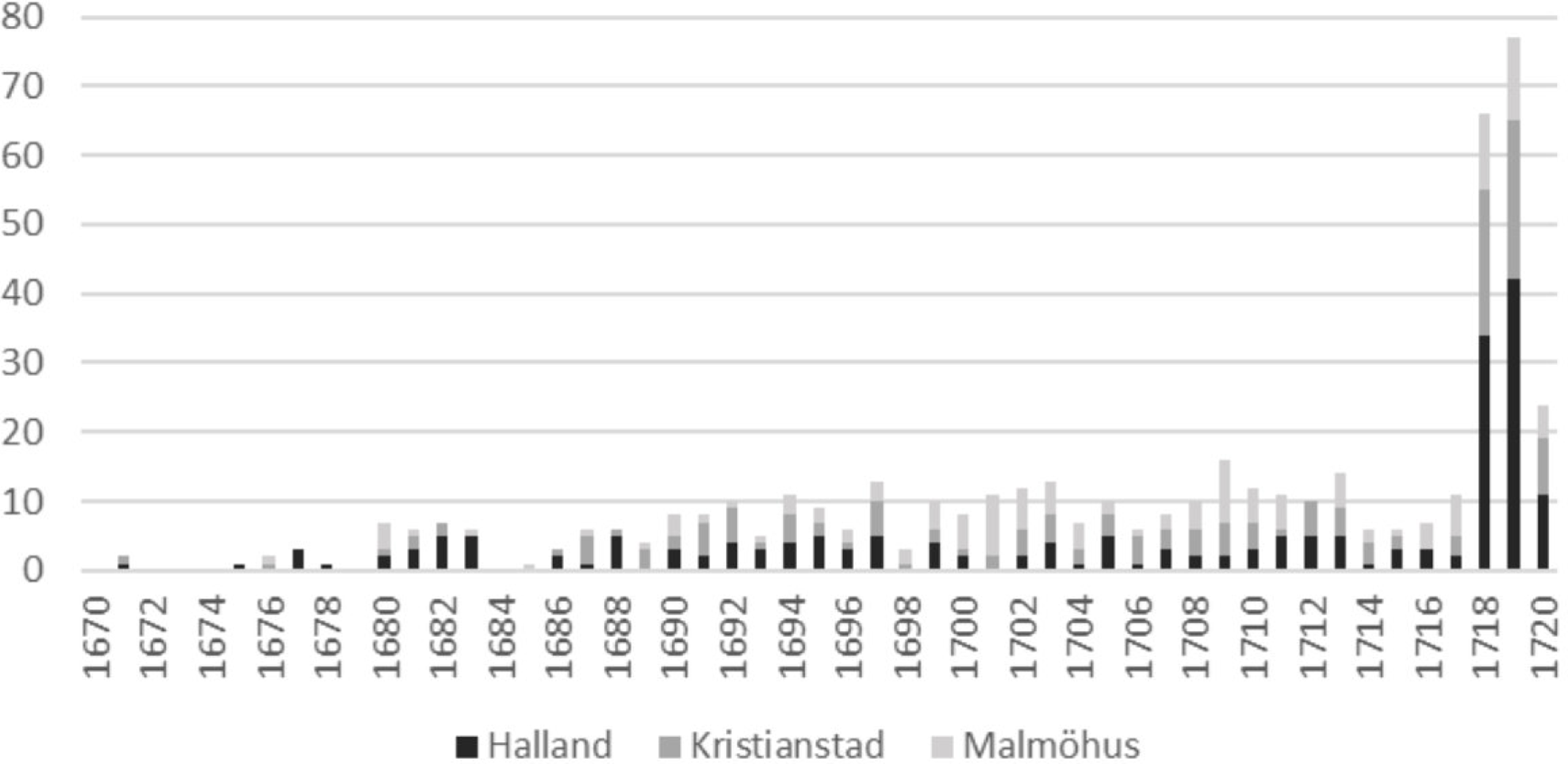
Yearly distribution of probate records, 1670–1720.
Source: Probate inventory database, as discussed in Section 3.

The relative diversity regarding both population levels – the further south the more densely populated (Forsell Reference Forsell1833; Linde Reference Linde2012; Hallberg et al. Reference Hallberg, Nyström, Palm and Leijonhufvud2022b) – and geographical characteristics allows for a broad analysis of the regional economies and how they correlate with consumption patterns. A similar number of sampled probates from each district and period was pursued to gain a representative sample, though this was often not possible due to the lower number of probate records available for the first period.
Three focus periods of study were chosen in order to capture the development over two main time periods: the eighteenth-century period of parliamentary rule during the so-called “Age of Liberty” following the fall of the Swedish empire in 1719, and the nineteenth century period of economic growth and marketization starting around 1780 leading up to the Swedish industrialization in the 1860s (Olsson and Svensson Reference Olsson and Svensson2010). Due to the low number of surviving probate records, the first period of study ending in 1720 is significantly longer than the latter two.Footnote 1 To collect a representative sample for this period, almost all the preserved probate records from before the cutoff point, fulfilling a few basic criteria of representativeness and comparability, were sampled.Footnote 2
Due to the lack of any conscious inherent order in the collected volumes of probate records – the early modern clerks would simply compile them as they arrived at the district courts – no further randomization was made for the sampling.
The impact of wealth bias on the representativeness of probate records remains a major discussion in historical research. Before becoming obligatory by law in 1734, probate records would mainly be drawn up when the division of estate was contested and brought to court, or when household debts were settled by selling of parts of the estate. Even after the law change the actual probate frequency appears to have remained low: The number of probated individuals increases over time, and in many regions exceeds 50 percent of deceased first during the nineteenth century. It appears to mostly be the propertyless or near-propertyless that are excluded from the probate records, such as paupers, vagrants, or those too poor to leave an estate to divide (Kuuse Reference Kuuse1974; Lindgren Reference Lindgren2002; Markkanen Reference Markkanen1978). The low probate rate before 1734 means that this sample likely includes a generally wealthier subsection of the population than later periods, which adds a level of uncertainty regarding the representativeness and comparability over the eighteenth century. For this study, however, the development that is identified for the eighteenth century is reinforced if the sample for the first period contains a relatively wealthier sample of households.
Coding and interpreting the probate records
The smallest economic unit for production, consumption, and taxation during the early modern period was the household, rather than the individual, with its members contributing to a shared pool of resources and labor opportunities (Ågren Reference Ågren and Ågren2017; Overton et al. Reference Overton, Whittle, Dean and Hann2004; de Vries Reference de Vries2008). This view is apparent in the probates through the items listed: apart from the strictly personal belongings, such as clothes and jewelry, records of either spouse list the shared belongings of the household. This includes everything from furniture to tools, cattle, grain, and even debt and credit held by the household. As such, every probated individual has been analyzed as representative of a household, rather than of themselves as individuals.Footnote 3
Apart from the base information about the deceased necessary for identification, detailed information on the composition and value of both the household movable and immovable goods were collected. For the purpose of this study, information on the ownership of several different types of consumption goods were of particular interest: Traditional value-holding status objects of gold, silver, and pewter, commonly held by households both as storage of value – as they generally did not degrade and could easily be resold – and as status objects (Shammas Reference Shammas1990; Weatherill Reference Weatherill1988); breakable and more easily replaceable fashion-sensitive goods, such as glass, porcelain, and earthenware, which increased in both popularity and availability throughout Europe in the eighteenth century (de Vries Reference de Vries2008; Brown Reference Brown2020); textiles, both linen, bedlinen, and clothes; objects associated with the consumption of colonial goods – i.e., tea, coffee, and tobacco – such as pipes, teapots, and coffee kettles (Ahlberger Reference Ahlberger1996; Weatherill Reference Weatherill1988; de Vries Reference de Vries2008); as well as the new specialized furniture that were introduced during especially the eighteenth century symptomatic of the so-called comfort revolution, such as cushioned sofas, tea- and gaming-tables, iron stoves, paintings, and clocks (Brown Reference Brown2020; Crowley Reference Crowley2001; de Vries Reference de Vries2008).
By collecting information on such a diverse set of objects, we can not only create a comprehensive image of the early modern household’s material wealth but also identify shifting patterns over time as the composition of objects changes between periods, both in absolute numbers and relative value. This approach to study early modern consumption is by no means new; both Weatherill (Reference Weatherill1988) and Shammas (Reference Shammas1990) made extensive use of probate inventories for their studies of early modern consumption in Britain, and de Vries (Reference de Vries2008) based large parts of his theory on industriousness on evidence from Dutch probates. For the Swedish context, studies of probate records have a long tradition in studies of both consumption and production, but has mainly been used for smaller, local studies: Either of regions already decided to be of special interest, due to tradition of certain crafts, such as Wiking Faria’s (Reference Wiking Faria2009) study of the agrarian revolution in Halland; with proximity to certain trading centers, such as Ahlberger’s (Reference Ahlberger1996) study of consumption in and around the port city of Gothenburg, and Maria Ulväng’s (Reference Ulväng2012) study of Härjedalen in northern Sweden; or of local elites, such as Gudrun Andersson’s (Reference Andersson2009) study of the burgher elite in the town of Arboga.
The issue of age at death
One of the main issues with probate records as a source for household consumption is that they only represent a single snapshot in the life of the household. Material living standard fluctuates greatly during the household life cycle: Roughly following an inverted U-shape, higher costs of living and lower total incomes during the early years of the household – as small children are raised – are followed by a spike in household income capacity as children mature and join in household production together with the wife, later followed by a sharp decline in living standards as the couple ages and dowries are paid to children setting up households of their own (Horrell et al. Reference Horrell, Humphries and Weisdorf2021).
Unfortunately, Swedish probate records very seldom record the age of the deceased. Instead, the age at death was identified by manually linking the deceased from the probate records to the parish death-books. However, these are mostly missing for the pre-1734 period, meaning that the age at death of only 16.5 percent of all sampled individuals could be identified for 1670–1720, as compared to 77.2 percent and 93.7 percent for the 1780–85 and 1860–65 periods. To identify a possible age bias, a “household age” proxy was constructed, based on the legal age of the children of the deceased – information which is consistently present in probate records.Footnote 4 Based on both age at death and this household age proxy, it seems likely that, at least during the seventeenth and eighteenth centuries, an absolute majority of all probated individuals would have died either early or at the economic peak of the household life cycle, which should reduce the age bias of the sample for the first two analyzed periods. The nineteenth century, however, appears to have seen an aging population, with a greater share of older and poorer households probated.
Socioeconomic groups
Around 60 unique occupational titles were identified in the probate records, not including the ubiquitous Wife or Widow, which were used for almost every woman in the material. Based on the title of the male head (when present), every household was assigned to one of four different socioeconomic groups. Individuals lacking a noted occupational title in the probate records were counted as peasants, and thus part of group 1.Footnote 5
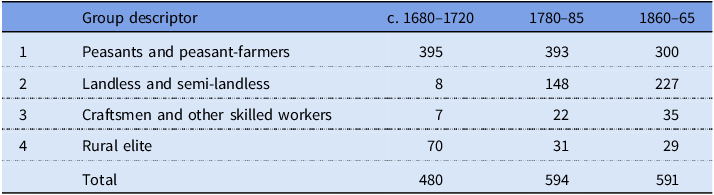
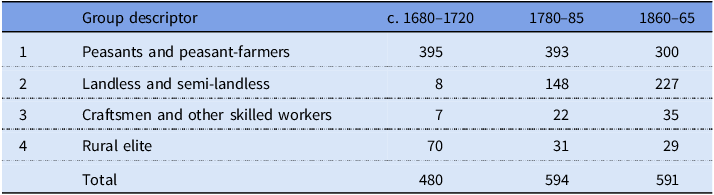
The socioeconomic groups used in the analysis are based upon their position within the early modern estate society, their main means of income and access to land, markets, and other means of production, as well as the social, cultural, and/or economic capital associated with the position.Footnote 6 Table 1 shows the composition of the dataset: It is clear that peasants are well-represented, probably even over represented, in the material while poorer groups, such as the landless and semi-landless, are most certainly under represented during the earlier periods. However, as the landless and semi-landless population increases drastically toward the end of the eighteenth century (Bengtsson and Svensson Reference Bengtsson and Svensson2020), it is difficult to ascertain the extent of this under representation.
Socioeconomic composition of the dataset
Source: Probate inventory database, as discussed in section 3.
Group 1, peasants and peasant-farmers, encompass the main bulk of the rural populace either in possession of, or with access to, farmland, all (ostensibly) mainly dependent on agriculture for household reproduction. Due to high within-group differences, it is further subdivided into three wealth groups based on total household wealth – top, middle, and bottom third. The second group includes the crofters and landless rural workers (gathusmän). This group should encompass the whole of the so-called “unskilled” rural workforce, apart from the servants who seldom had their own households. Though defined by a lack of access to enough land to support a household, they are still mainly reliant on the agricultural economy for household reproduction.
The third group includes titled craftsmen and skilled workers, such as carpenters and bricklayers; characterized by a higher degree of freedom from agricultural production and a larger reliance on market for household reproduction. Their higher degree of market integration should allow them greater access to both money and credit, increasing their access to new consumption goods.
The last group, termed the rural elite, includes priests, judges, officers, traders, and the foremen (inspector) of larger rural estates and industries; compared to the rest of the rural population, individuals often of immense economic, social, and cultural capital. Usually in possession of economic privileges, such as the right to collect rent, or supported by generous wages, these individuals would often be the first to adopt new consumer trends.
As Table 1 shows, source bias results in small sample sizes for groups 2 and 3 for the first period. With only ten and seven probated households, respectively, this sample only allow for tentative conclusions about the development for these groups over the eighteenth century. They are, however, significantly better represented from the latter half of the eighteenth century forward. A subgroup of retired individuals that were identified for the latter two periods were excluded from the analysis.
Results
Overall trends
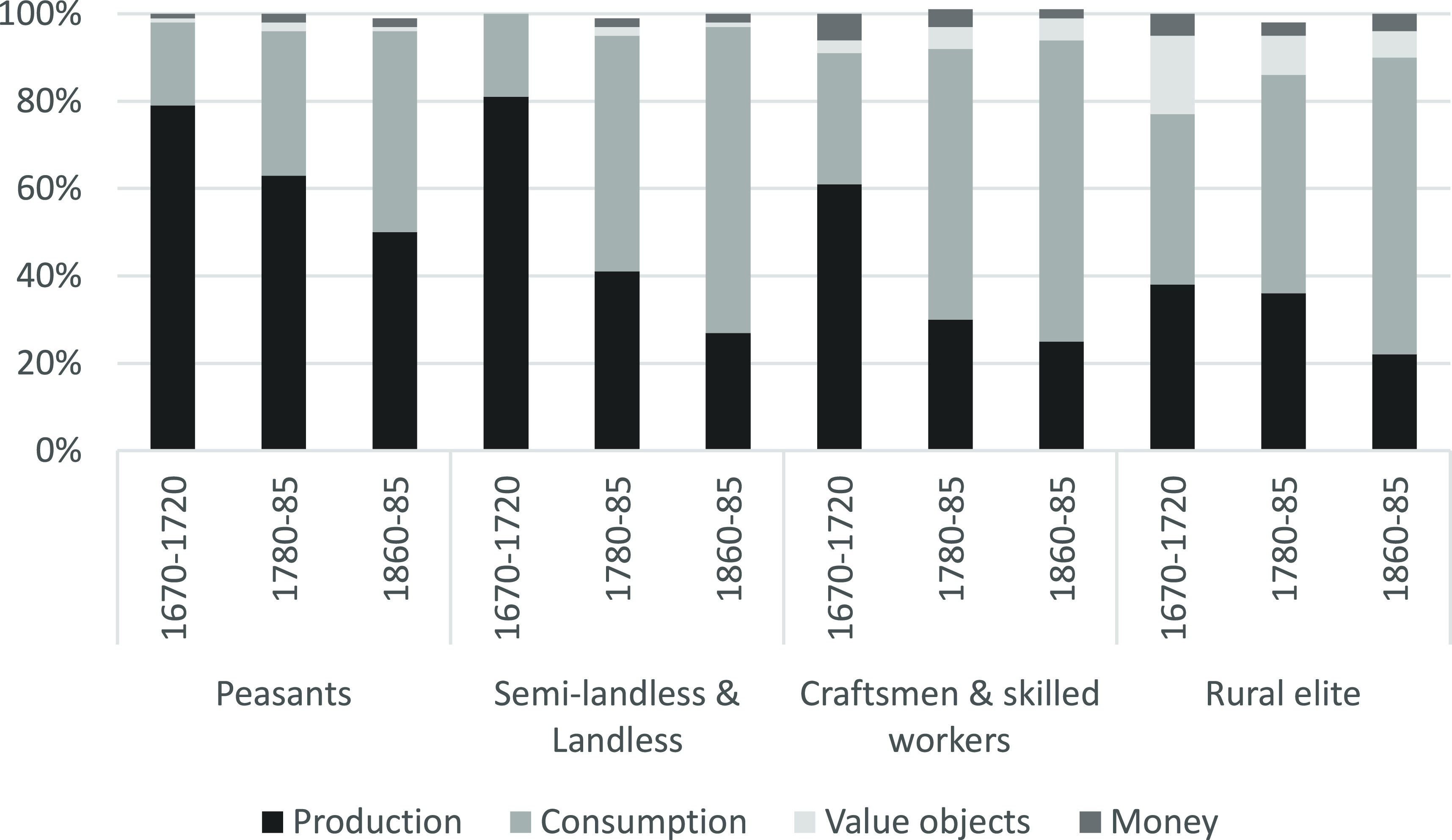
In general, there appears to be a clear trend toward more comfortable and diversified homes as the eighteenth and nineteenth centuries progressed. There is a steady increase in household consumer goods over the period, both in absolute numbers and in their share of total movable wealth. Consumption goods in the analysis is defined as the part of the movable wealth not specifically for the creation of new wealth or reproduction of the household – such as animals, tools, or goods for sale – or for the conservation of wealth over time – such as objects of gold, silver, or pewter, as well as money.Footnote 7 The group of consumer goods include such diverse sets of objects such as furniture, dinnerware and cookware, textiles of all kinds, books, paintings and similar types of art, whose main function is to increase comfort and the material living standard of the household.Footnote 8
Figure 3 shows the change in the composition of movable wealth over the analyzed period. For the peasant group, there is a clear increase in the share taken up by consumer goods, exclusively at the expense of goods dedicated to the reproduction of the household. This trend during a period of increased prosperity suggests that the peasant group prioritized comfort over further investments either in land – which would leave the movable wealth composition generally unchanged – or in capital-intensive production, such as cattle; the acquisition of otherwise inexpensive spinning wheels and looms, as found by Falk et al. (Reference Falk, Bengtsson and Olsson2025), would have entailed an investment of time rather than capital, and might have made possible for these households to purchase consumer goods instead. Whether voluntary or a consequence of limited venues for investment – mainly due to a restricted land market – is more unclear.
Composition of movable wealth.
Source: Probate inventory database, as discussed in Section 3.
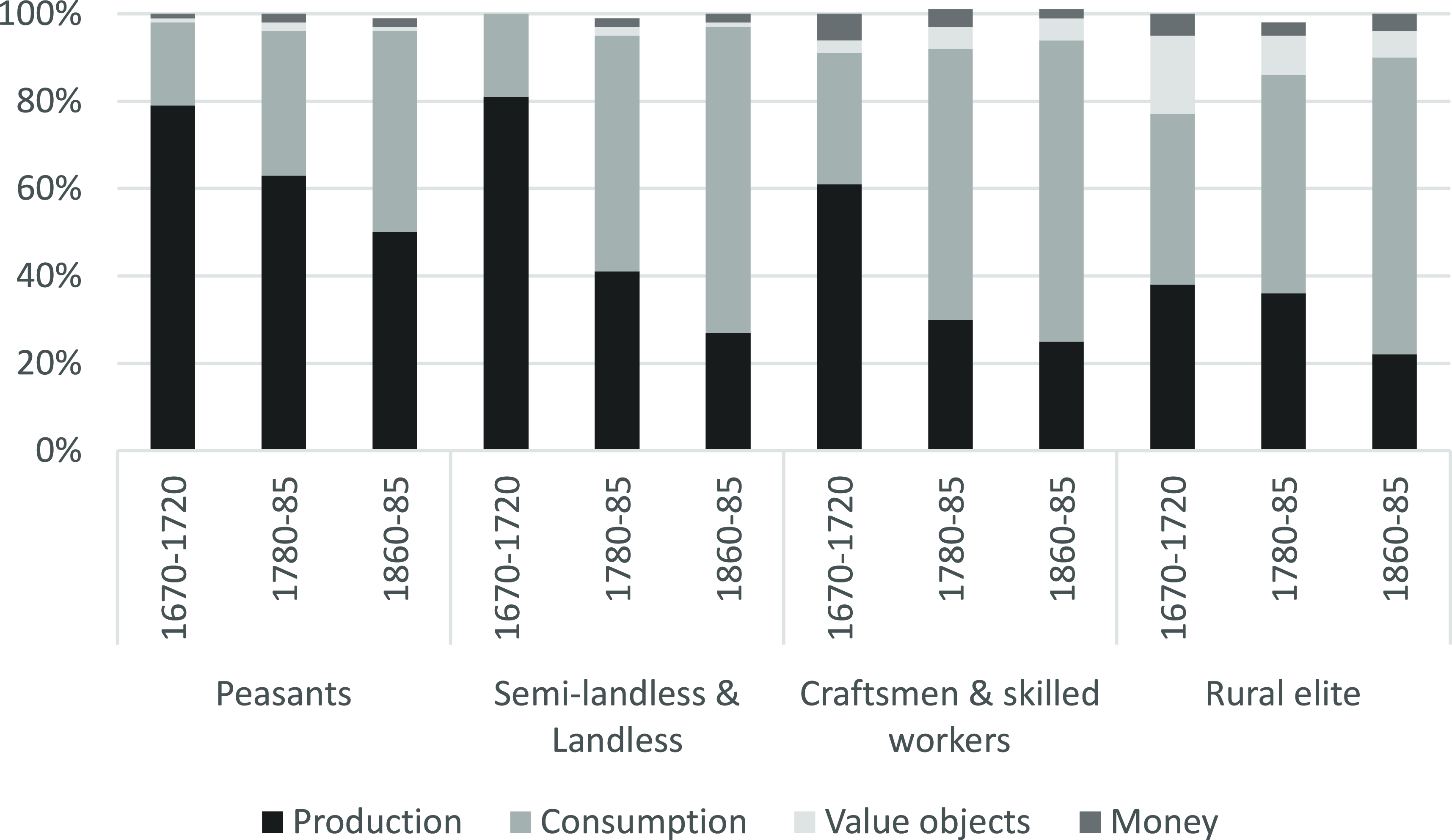
Breaking down the peasant group into wealth groups, it becomes clear that this trend was strongest among the poorest peasants. This shift in the composition of movable wealth is less drastic among the wealthiest third of the peasant group, for which it even stops over the nineteenth century (Appendix A, Table A2, Supplementary material).
While the increase in the consumer goods share of movable assets over the eighteenth century for the other two non-elite groups are more tentative due to the small sample, these too appear to have prioritized comfort over investments in productive goods at the end of the eighteenth century. For the landless and semi-landless group, this is likely a consequence of late century proletarianization, as proposed by Bengtsson and Svensson (Reference Bengtsson and Svensson2020), which would accelerate in the following century to also encompass the poorer parts of the peasant group (Falk et al. Reference Falk, Bengtsson and Olsson2025).
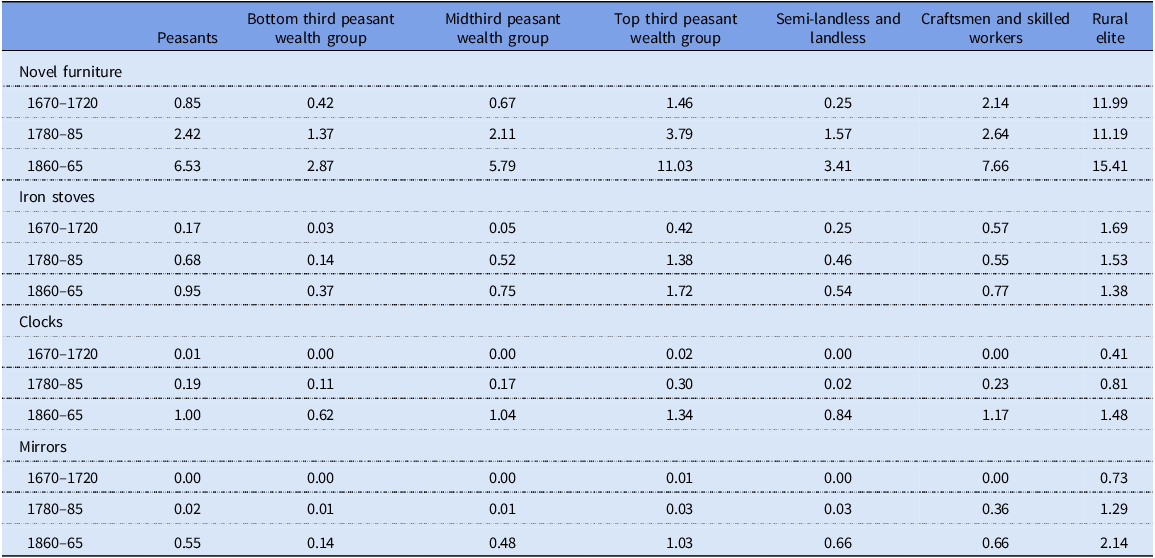
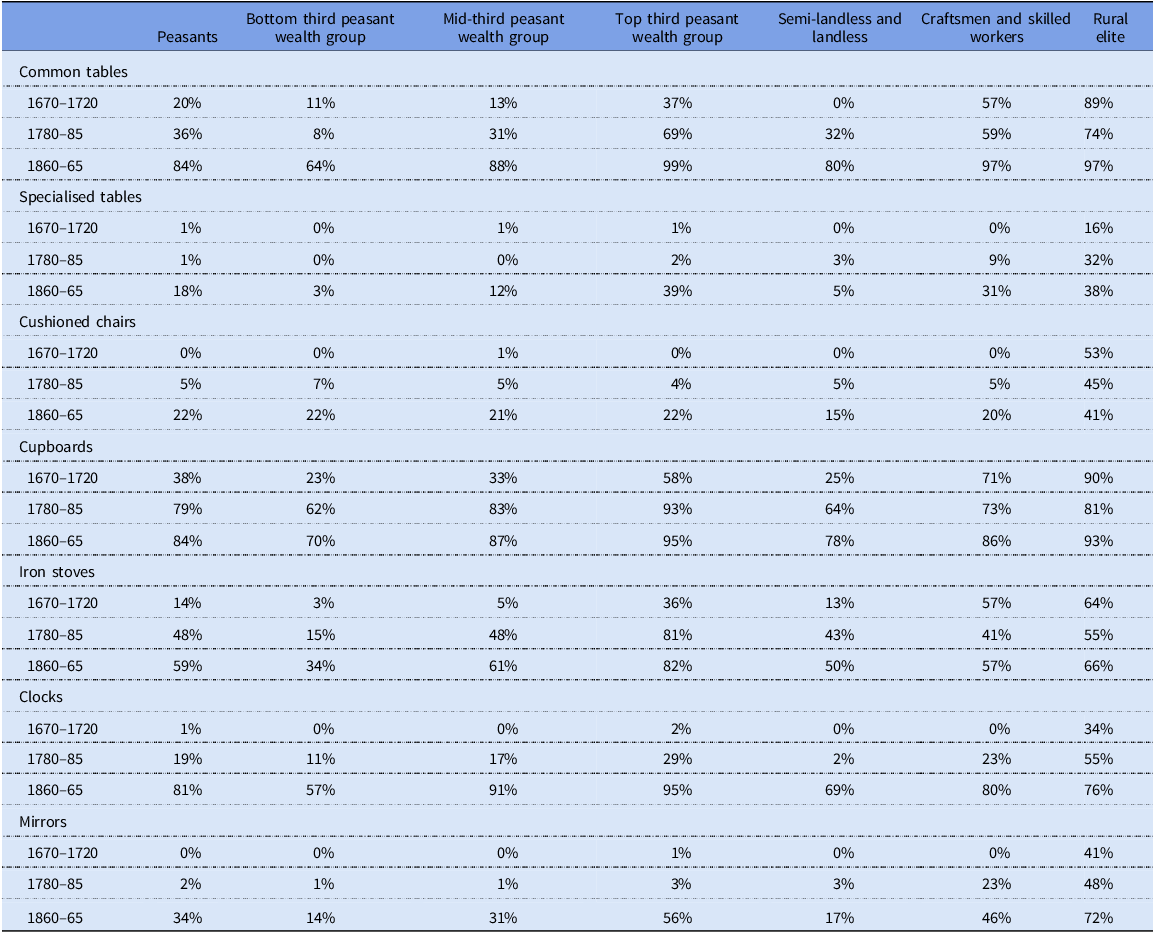
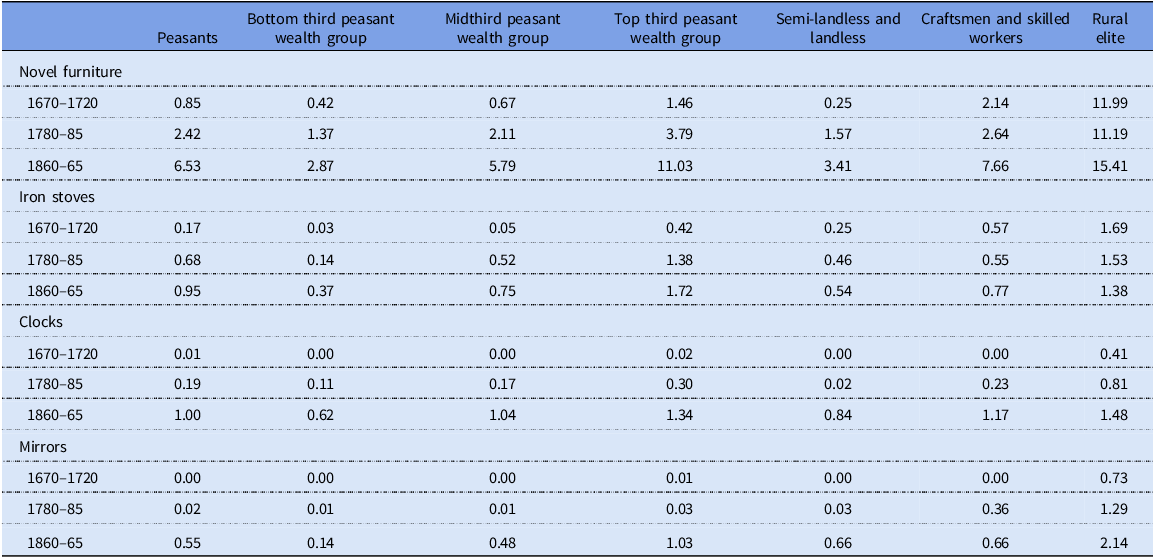
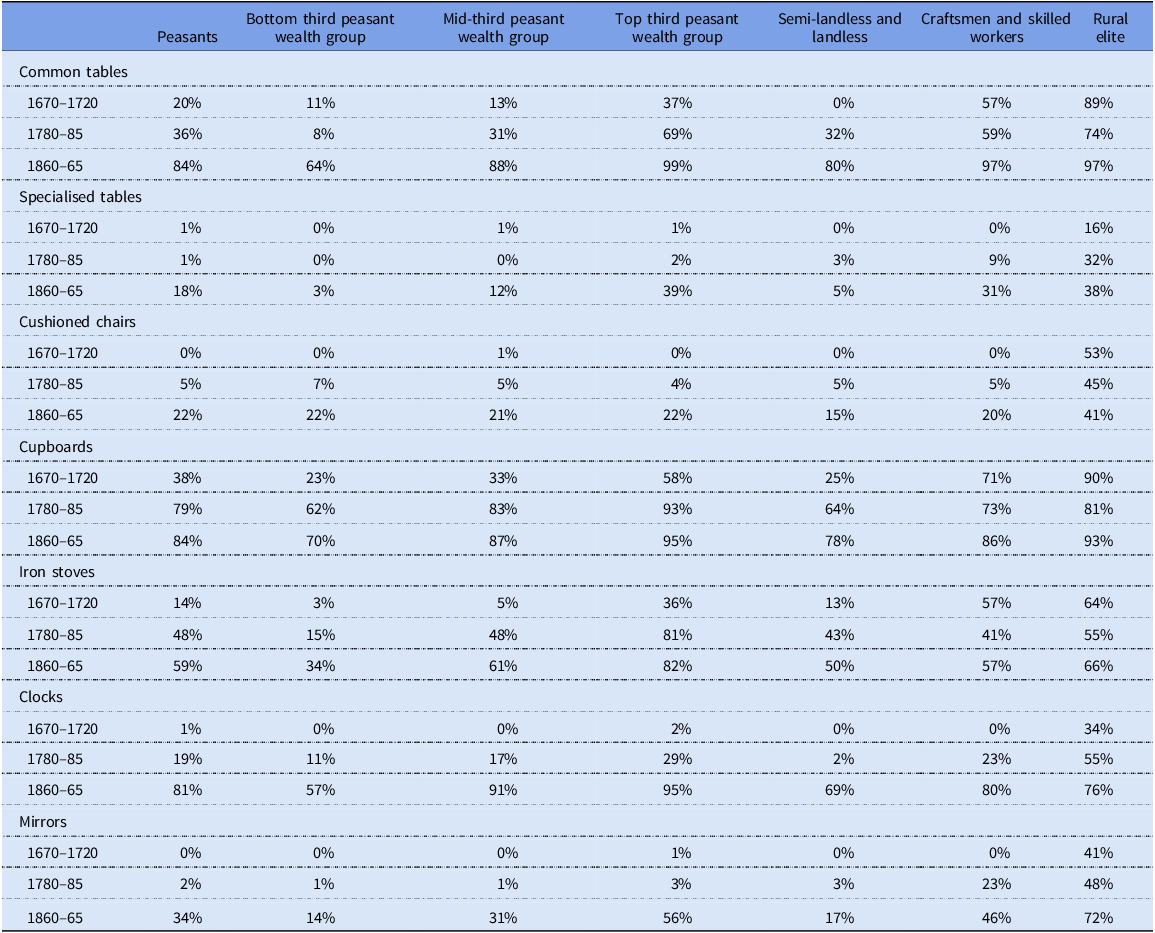
As Table 2 shows, there is a clear observable material improvement in the furnishment and comfort of non-elite rural households over the eighteenth century, a trend that accelerates over the following century: The average number of the newer types of specialized furniture introduced with the consumer revolution – freestanding as well as specialized tables, cushioned chairs, and cupboards – increases sharply to the point where even the median poorest third peasant households, as well as semi-landless and landless households, own at least one piece of crafted, non-chest and non-bed furniture – most often a cupboard or dresser.Footnote 9 There is also a significant increase in the number of households owning at least one iron stove, signifying warmer and more comfortable homes, as well as clocks, possibly one of the clearest signs of eighteenth-century modernity (Crowley Reference Crowley2001: 143; Weatherill Reference Weatherill1988: 180). Clocks, however, are still uncommon in the late eighteenth century and do not become universal, even among the elite group, before the nineteenth century.
Average number of chosen selected consumer items per household
Source: Probate inventory database, as discussed in Section 3.
Note: Novel furniture is an aggregate of the average number of tables, cushioned chairs, sofas, cupboards, dressers, and shelves; the new styles of furniture made common with the consumer revolution. For a more detailed breakdown, see Appendix Table A4, Supplementary material. Benches, regular chairs, beds, or chest – all common among virtually every household even at the start of the analyzed period – are not included.
As was the case elsewhere in Europe (Shammas Reference Shammas1990), there is a clear correlation between wealth and ownership of consumer goods; in general, the wealthier the household, the more likely it is to own any particular item, and the more individual pieces of any item it generally has. However, unlike in (especially) England, the one main exception to this trend appears to be objects made out of earthenware and glass, which, contrary to the trend, instead appear to be more common in the households of poor peasants than wealthy ones during the last decades of the eighteenth century. It should be noted that due to the probable source bias for the first period, c. 1670–1720, this period likely includes a wealthier selection of the population than do the latter two periods. This means that the increase over the eighteenth century that can be observed in Table 2, especially regarding furniture, is probably even bigger than suggested.
For a few consumer goods – especially manufactured goods that were unlikely to be produced locally – there also appear to exist regional differences (Appendix A, Table A3, Supplementary material). During the late-eighteenth century, objects of porcelain, earthenware, glass – and even clocks – appear to be considerably more common in the significantly poorer proto-industrial regions in Halland than in the comparably wealthier agricultural regions further south, around Malmö. These regional differences appear to otherwise be fairly minor; however, mainly restricted to these manufactured goods, the similarities in consumption patterns between the different regions are ultimately more pronounced than the differences, despite the huge variations in local economies.
Textiles remained one of the most important household goods throughout the analyzed period – consistently making up around half of the value of the household consumer goods, regardless of socioeconomic group. A more in-depth analysis of changes in textile consumption was unfortunately not possible within the scope of this analysis; household textiles underwent significant qualitative changes during the period – both regarding material and prices (Andersson Reference Andersson2017; Malanima and Pinchera Reference Malanima and Pinchera2012) – which are often invisible in the probate records, such as is the case for bedlinen. Furthermore, the sheer number of listed textile objects necessitates more focused studies to do justice to the material. Broad trends can, however, be identified: Consumption of textiles kept pace with the general increase in consumer goods, and it appears as if the bulk of this increase in textile consumption was in rapidly expanding personal wardrobes (Appendix A, Table A4, Supplementary material). As clothes became cheaper during the eighteenth century, people greatly increased both the amount and the number of different types of clothes they owned, as exemplified by long lists of differently colored skirts, blouses, shirts, coats, and hats in a wide array of materials and, likely but not as easy to discern from probate inventories, styles. Even a cursory comparison of probates from the two ends of the eighteenth century is enough to reveal the significant growth of personal wardrobes over the period (Appendix B, Supplementary material). Indeed, the amount of textile owned by households at the end of the eighteenth century indicates significant integration with regional markets, as the limited household production of textiles would scarcely have been enough to meet the demand.
The increased consumption of clothes does not appear to have been uniform across the sample, however. Up until the second half of the nineteenth century, it appears as if women in general spent significantly more on clothes than men, after which it reverses for the peasant group (Appendix A, Table A5, Supplementary material). This is in stark contrast with Ulväng’s (Reference Ulväng2012) findings from northern Sweden were men and women had equally valued wardrobes up until second half of the nineteenth century. Instead, the south Swedish peasant consumption of clothes appears more in line with that of the burghers in the European core (de Vries Reference de Vries2008). Furthermore, it appears as if younger people, especially women, possessed higher valued wardrobes than older people. While this fluctuates over the period – and further, more directed, studies would be required to draw any definite conclusions about the trend – it is in line with both the general idea of the European Marriage Pattern, and what Ulväng (Reference Ulväng2012) finds for northern Sweden.
Colonial hot drinks
Many historians of the consumer revolution stress the importance the introduction of colonial hot drinks – tea, coffee, and to a lesser extent chocolate – had for the change in northwest European consumption patterns that occurred during the seventeenth and eighteenth centuries. In the cities they were sold at both coffee houses and roadside stalls and quickly became a thing of daily consumption for a majority of the population – coffee with sugar quickly became morning routine for rich and poor alike and supplanted the earlier traditions of large breakfasts (McCants Reference McCants2008; Shammas Reference Shammas1990; de Vries Reference de Vries2008). For the urban genteel classes, the introduction of especially tea into the household consumption ushered in a whole new era of sociability, which saw the place of socializing move from the public to the private with the adoption of the so-called social visit (Vickery Reference Vickery2009). Unlike in England and the Low Countries, however, where tea and coffee quickly became staple goods, Sweden saw heavy restrictions on these goods, with consecutive attempts of sumptuary legislation forbidding their consumption over the eighteenth century (Ahlberger Reference Ahlberger1996; Ulväng Reference Ulväng2021).
While actual tea leaves and coffee beans, as perishables, are seldom found in probate records, the drinking of these were during the period surrounded by both social and practical rituals which necessitated specialized objects; from coffee grinders, teapots, and coffee kettles necessary for the brewing and preparation of the drinks, to special teacups and coffee cups, as well as tea trays and even tea-tables, which played a central part of the social ritual during which these drinks were imbibed (Smith Reference Smith2002; North Reference North2008). As such, the spread of tea and coffee drinking can be mapped by the occurrence of these objects associated with their consumption in the probate records; chocolate is completely absent from the entirety of the sample, and thus appears, in southern Sweden at least, to have been an exclusively urban occurrence.
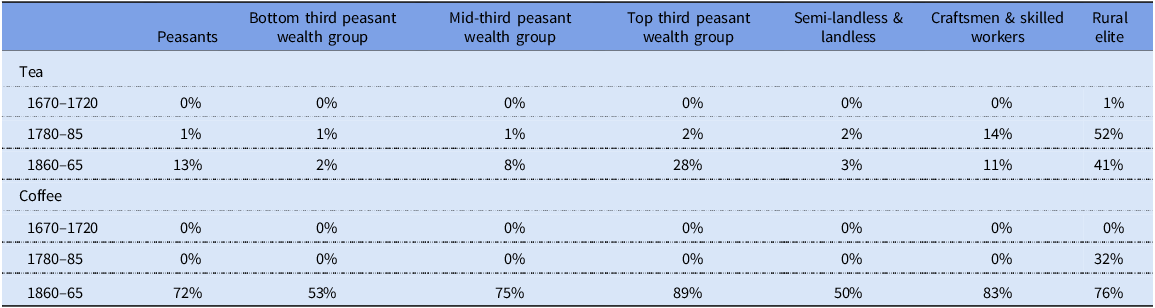
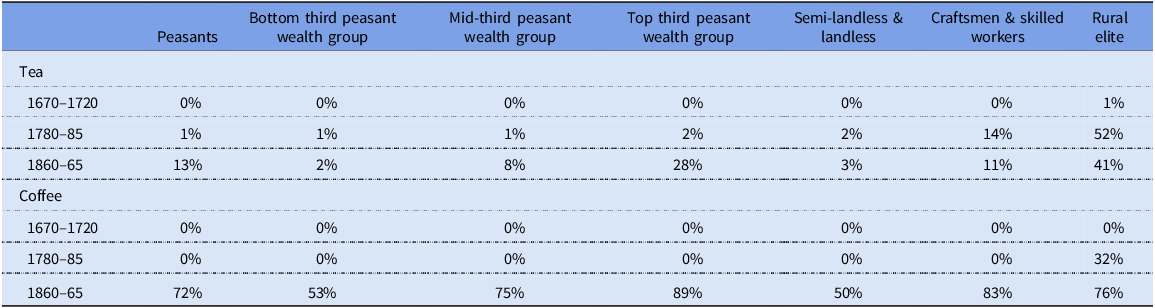
Unlike in England and the Low Countries, where it quickly became universal, tea drinking in Sweden up until the twentieth century appears to have been mainly an upper class habit (Ahlberger Reference Ahlberger1996: 102). As Table 3 shows, this trend is wholly supported by the probate evidence. While mostly absent from the homes of peasants and crofters, a substantial part of the rural elite show signs of drinking tea already in the late eighteenth century. The apparent decrease in tea drinking among these same groups over the following century is likely to do more with their small sample size for this period than any real trend, while the increase in tea drinking among the peasant group is almost exclusively driven by wealthiest third households, reinforcing the view of tea as an elite drink during the period.
Share of households with tea- and coffee-related objects.
Source: Probate inventory database, as discussed in Section 3.
Coffee, on the other hand, quickly became a drink for the common people. In his study of the consumer revolution in and around the important port city of Gothenburg, Ahlberger (Reference Ahlberger1996) argues, based on probate evidence, that coffee became a mass consumer good during the first half of the nineteenth century, driven mainly by increased consumption among the lower classes. Evidence from the southern Sweden probate not only reinforced this view, but further suggests that coffee, apart from just being the drink for the common people, supplanted tea completely as the hot drink of choice for the rural populace as a whole.Footnote 10
While the rural adoption of tea appears to have been slow and uneven – a conclusion reinforced by earlier research (Ahlberger Reference Ahlberger1996; Müller Reference Müller2004) – coffee consumption appears to have seen an extremely rapid increase during the first half of the nineteenth century: from being absent in all but elite households to being more or less universal across the socioeconomic spectrum. This was likely spurred by the lifting of the last bans on coffee drinking in the late eighteenth century, which at last made the drink fully legal to consume (Müller Reference Müller2004).
Furniture and changing cooking habits
During the first period, up until 1720, the most common household consumer goods apart from textiles were the large iron or bronze cooking pot – the main way of cooking food up until the wide introduction of new stoves in the late eighteenth century (Jacobsson Reference Jacobsson, Mårtensson, Hammar, Sörensson and Westrup1985; Weatherill Reference Weatherill1988; Wilson Reference Wilson2012), – the chest used to store textiles and valuables, the bed – in elite households placed centrally in a public room as a status symbol (Andersson Reference Andersson2009: 157) – and a plethora of different barrels and boxes.Footnote 11 While these objects remained significant during the following periods – especially the large cooking pot, which remained one of the individually more expensive items in the household – their relative significance diminished as the number of household objects greatly increased during the eighteenth century with the introduction of new, relatively cheap, and fashionable consumer goods.
New types of furniture became popular throughout Europe during the seventeenth and eighteenth centuries, and there was a clear increase of these items across the rural population, particularly among the richest groups. The most visible increase was in cupboards and “common tables” – i.e., tables without any specified use, both of which were present in lower numbers already during the late seventeenth century but saw an increase during the mid-eighteenth century. Especially noteworthy is the increase in the average number of cupboards per household over the eighteenth century, going from 0.54 to 1.71 per peasant household (Appendix A, Table A6, Supplementary material). As an easily accessible storage space – compared to the more traditional chest – this increase in cupboards is further indication of the general increase of consumer goods over the same period; especially an increase in smaller everyday objects, such as textiles or dinnerware, which would require easily accessible storage.
The trend is similar for most of the consumer goods that have been analyzed: As Table 4 shows, over the course of the eighteenth century not only do these new consumption goods become more prolific in the homes of almost every single group but a significantly larger share of households owns them, suggesting more diversified and, likely, comfortable homes. For example, clocks, one of the staple goods of the new consumer revolution and representing a new rationality introduced during the eighteenth century (Crowley Reference Crowley2001; de Vries Reference de Vries2008), go from mostly absent among non-elite households to being present in almost 20 percent of peasant households in the late eighteenth century. However, it takes until the second half of the nineteenth century before many of these items, such as cushioned chairs and mirrors, become common among the non-elite groups the countryside.
Share of households owning selected consumer goods
Source: Probate inventory database, as discussed in section 3.
The increase and spread of freestanding cast iron tile stoves (järnkakelugn) is of note, since it suggests the presence of regional consumption patterns. While the share of peasant households owning at least one iron stove increased drastically over the eighteenth century – going from 14 percent to 48 percent – this increase is almost exclusively present in the Scanian counties (Appendix A, Table A3, Supplementary material). In Halland during the 1780–85 period, only 8 percent of analyzed household noted an iron stove, almost all living within 22 kilometers of the Scanian border. This similarly helps explain the much higher share of ownership among the landless and semi-landless as compared to the poorest third peasant group, since most of this group is from the Scanian counties.
The adoption of cast iron stoves in specifically Scania appears to be traceable to Danish times, and according to Mårtensson (Reference Mårtensson and Bengtsson1963) were mainly spread through a manor-controlled rentier system. Their early adoption in specifically Scania is likely driven by a combination of geographical factors – the iron stoves being more fuel efficient in the wood-starved plains on southern Scania – and a broad eighteenth century rural rebuilding trend similar to that of England in the previous century. This especially included the introduction of purpose-built kitchen, which would have moved the main heat source of the house away from the common room, incentivizing the purchase of freestanding iron stoves to heat-adjacent rooms (Jacobsson Reference Jacobsson, Mårtensson, Hammar, Sörensson and Westrup1985; Mårtensson Reference Mårtensson and Bengtsson1963). Their increase over the eighteenth century corresponds to a period of high levels of land reclamation – at the cost of local forests and wetlands – and a northern expansion of this rebuilding trend.
Similarly, the spread of tables, chairs, and cupboards during the second half of the eighteenth century went hand in hand with the introduction of new customs for eating and cooking throughout northwestern Europe during the period (Weatherill Reference Weatherill1988, Reference Weatherill, Brewer and Porter1993; Overton et al. Reference Overton, Whittle, Dean and Hann2004; Wilson Reference Wilson2012). This change is further visible in the assortment of cookware found in the probate records: from consisting mainly of the single large iron or brass pot at the beginning of the eighteenth century – at least among the common peasant households – this had expanded at the end of the century to include frying pans and pots of different shapes and sizes, as well as waffle irons – at this point also sometimes found among the wealthier non-elite households (Appendix B, Supplementary material). The new cookware and utensils would allow for the cooking of dishes previously restricted from the peasant population due to their reliance on the single pot over the fire – also likely possible by the introduction of purpose-built kitchens – and would have entailed a considerable cost for the households over a long period of time.
Together with this new cooking ware also came new dinnerware; a move away from the traditional wooden plates and spoons to plates, bowls, and even platters in more fashionable styles and materials. While this trend appears mostly universal across the rural population and becomes even more pronounced over the following nineteenth century, it takes different forms in the different regions and depending on the wealth of the households, with especially interesting differences regarding the materials of the dinnerware.
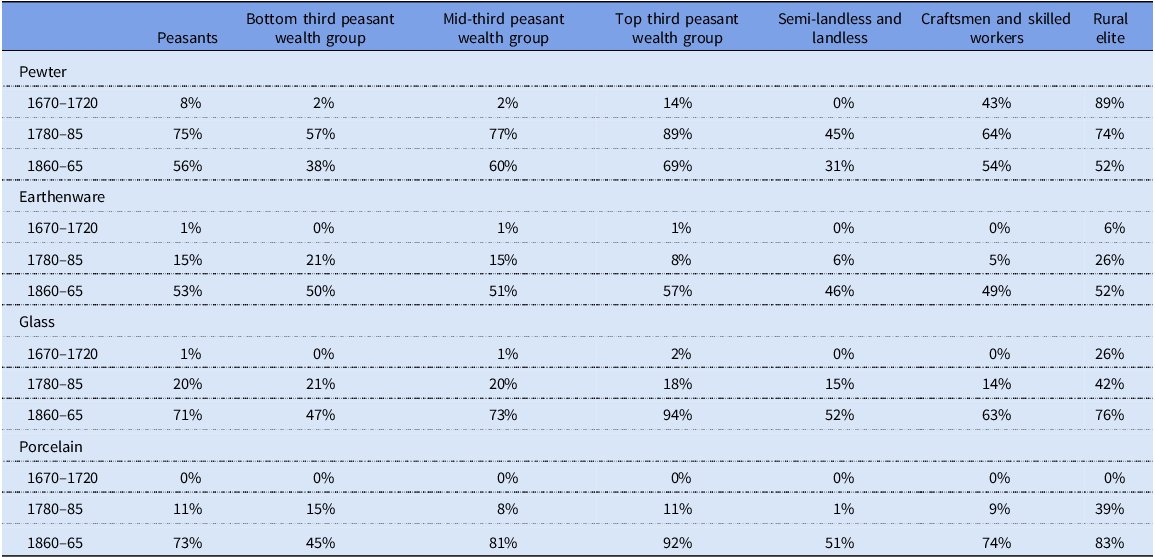
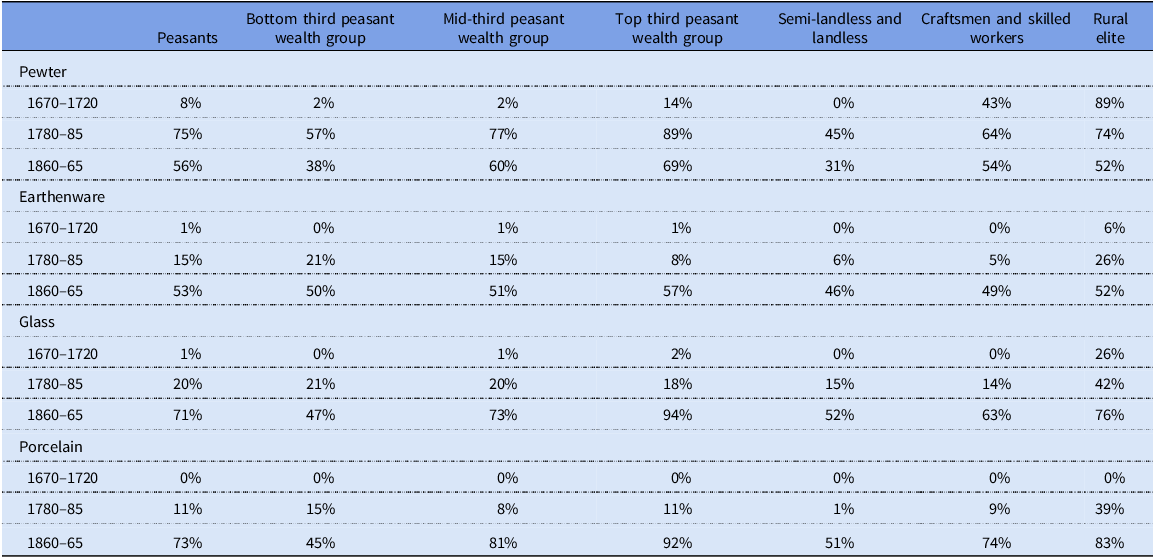
As Table 5 shows, objects in materials commonly associated with dinnerware – pewter, earthenware, glass, and porcelain – go from almost completely absent in non-elite, non-artisanal rural households to almost ubiquitous during the eighteenth century. Unlike in England, where the peasantry appears to abandon pewter in favor for porcelain and earthenware during the eighteenth century (Overton et al. Reference Overton, Whittle, Dean and Hann2004), this is the century when the south-Swedish peasant adopts pewter, going from mostly absent in all but the wealthiest peasant households to almost universal. While this large increase in pewter is likely partly driven by a sharp drop in value over the same period, the form of pewter consumption – cheap plates and platters rather than expensive, heavy, and ornate drinking vessels – also suggests new dining habits being adopted by the rural population. The proliferation of pewter objects without an apparent increase in value seems to indicate pewter losing some of its use as status and value-holding object in favor for the more practical use as dinnerware.
Dinnerware material, share of households owning objects of
Source: Probate inventory database, as discussed in Section 3.
The decline in pewter over the nineteenth century is most likely due to changing consumer habits, connected to the increasing availability and lower prices of European porcelain and locally produced earthenware (de Vries Reference de Vries2008). More interesting is that a greater share of the poorest third of the peasant population – mainly localized in the more proto-industrial or mixed economy regions in the northern part of the analyzed area (Appendix A, Table A3, Supplementary material) – owned earthenware than the much richer parts of the peasant group in the late eighteenth century.
Earthenware and pewter appear to have filled the same practical function of dinnerware for the peasant group during the late eighteenth century, with pewter being the preferred material for those who could afford it. Looking more closely in the probate records from the 1780–85 period at what objects made up the categories pewter and earthenware, we can clearly see that they are mostly the same types of objects, only with radically different prices; plates, cups, serving dishes, and eating utensils are by far the most common types of objects of both pewter and earthenware, with wealthier households preferring the former, more expensive and durable, material. All these objects related to the new dining habits being introduced during the period (Crowley Reference Crowley2001; Shammas Reference Shammas1990).
Actual porcelain – almost exclusively of European originFootnote 12 – appears to be mostly equally distributed among the peasant group during this period, though this too is significantly more common further north in the region. This distribution among the peasant group in the region is shared with the north-Swedish region analyzed by Ulväng (Reference Ulväng2021). Unlike in northern Sweden, however, where Ulväng terms porcelain as the only “class-neutral item” (ibid.: 147), porcelain ownership in southern Sweden at the end of the eighteenth century shows clear signs of class distinction: Not only is porcelain significantly more common among the households of the elite group, it is almost completely absent from the households of the semi-landless or landless population. This class distinction appears to be upheld over the following century, where it appears to exist a clear correlation between household wealth and ownership of porcelain.
The apparent advantage in ownership of non-pewter manufactured goods that appears visible for the proto-industrial and mixed economy regions in the late eighteenth century is completely absent a century later, when these goods – as should be expected – instead are significantly more common in the wealthier agricultural regions around Malmö (Appendix A Table A3, Supplementary material). It is probably no coincidence that by the later period this area has been properly integrated into interregional markets, with the lifting of restrictions on grain exports and the opening up of the region for trade after circa 1800 (Olsson and Svensson Reference Olsson and Svensson2010).
Conclusions
Historical macro-data analysis of Swedish economic growth and wages generally indicates the early modern period as one of economic stagnation, with cost of living and population increase that outpaced or matched both the improvements in grain production and the reclamation of land at least up until 1780. Economic growth, especially in agriculture, takes off after technical and institutional improvements in the following decades to ultimately match, or even surpass, that of the economic core (Edvinsson Reference Edvinsson2009, Reference Edvinsson2013; Gadd Reference Gadd, Myrdal and Morell2011; Gary and Olsson Reference Gary and Olsson2020; Olsson and Svensson Reference Olsson and Svensson2010). At the same time, however, institutional reforms during the late seventeenth century and the end of empire in 1720 significantly strengthened the political and economic position of the peasant group by practically freezing rents and entrenching peasant rights to land (Gadd Reference Gadd, Myrdal and Morell2011).
Probate data from southern Sweden confirm this narrative of greater affluence among the peasant population, with clear signs of increasing consumption and material living standards over the eighteenth century. This increased prosperity among the peasants on the southern countryside appears to have been spent on comfort and a diversification of the household goods, rather than invested in savings or greater productive capacity: The share of the total value of movable goods dedicated to consumer goods – such as furniture, textiles, and dinnerware – increased greatly over the period at the expense of productive goods – such as cattle and tools. Whether this trend is due to a conscious shift in consumer culture or determined by lack of access to productive investments – e.g., limited land markets or shrinking pastures not allowing more cattle – need more focused study to be determined. However, this trend toward greater comfort at the expense of increased productive capacity is not restricted to the peasant group only, but visible across the whole of the rural population over the eighteenth century; among the landless and semi-landless, this is likely part of the process of proletarianization visible from the second half of the century (Bengtsson and Svensson Reference Bengtsson and Svensson2020).
The eighteenth century saw a large increase in the number of consumer items in the rural homes and a clear shift toward a consumption pattern with a focus on comfort rather than household reproduction: The share of the rural population of every wealth group owning cupboards – as opposed to only chests as storage spaces – as well as freestanding tables rose drastically; textile consumption kept pace with the general increase in household consumption, most visible in greatly expanding personal wardrobes; objects of pewter – mainly in the form of dinnerware rather than singularly expensive value objects – went from mostly absent among the peasant group to being more or less universal, apart from among the poorest peasant households who seem to have substituted the pewter for similar objects of earthenware and porcelain; the range of cookware greatly expanded among the peasant households from mainly consisting of a single large brass or iron pot to a plethora of pots and pans; and lastly both clocks and books – both traditional symbols of the modern consumption of the eighteenth century (Crowley Reference Crowley2001: 143; Weatherill Reference Weatherill1988: 180) – went from almost completely absent in the records to present in circa 20 percent of all peasant households (Appendix A, Table A7, Supplementary material).Footnote 13
While most of these consumer goods, cupboards and pewter objects excluded, are not widely spread enough during the late eighteenth century to be considered “mass consumed,” the general trend does suggest the presence of a shift in rural consumer preferences already sometime during the mid-century, well before the general economic and transport improvements of the early nineteenth century (Bergenfeldt Reference Bergenfeldt2014; Olsson and Svensson Reference Olsson and Svensson2010). The general development is, furthermore, remarkably similar across the analyzed area, though with some specific regional characteristics, such as the greater occurrence of smaller, manufactured goods in the more proto-industrial and mixed regions to the north, and the adoption of freestanding iron stoves spreading from the south.
Historians on consumption in England and the Low Countries often stress the role played by the introduction of colonial goods – chief among them tea and coffee – for the consumer revolution and the eighteenth-century changes in consumption patterns (McCants Reference McCants2008; Shammas Reference Shammas1990; Smith Reference Smith2002; Vickery Reference Vickery2009; de Vries Reference de Vries2008). However, in the south-Swedish countryside tea remained an elite consumption throughout the analyzed period, with coffee instead becoming the universal drink of the people first during the nineteenth century. Both are almost completely absent outside of the elite group throughout the eighteenth century, and unlike in England and the Low Countries, therefore could not have contributed to the observed eighteenth-century shift in rural household consumption patterns.
Rather than colonial goods – and the related culture of sociability important to the urban burgher class (Andersson Reference Andersson2009; North Reference North2008; Stobart and Rothery Reference Stobart and Rothery2016) – the main development in everyday consumption in the south-Swedish countryside appears to have been related to the adoption of – at least aspects of – the new cooking and dining culture that spread throughout northwestern Europe during the eighteenth century. This development is visible in the probate records by the diversification of cooking and eating utensils over the eighteenth century, by the increasing share of households with freestanding common tables and cupboards, as well as – to an extent – the increasing use of freestanding iron tile stoves. In Scania, this increased use of iron stoves appears to be related to a rural rebuilding trend that included the introduction of purpose-built kitchens into the peasant homes. The consequence of these changes would have been more diversified and comfortable rural homes.
The development for the elite group over the eighteenth century appears to correlate with that of the urban gentility, centered around the “social visit” – with an emphasis on colonial warm drinks, large dining sets, smaller and specialized tables, cushioned seating, and the visible trappings of culture such as art and science (Andersson Reference Andersson2009; Smith Reference Smith2002; Stobart and Rothery Reference Stobart and Rothery2016; Vickery Reference Vickery2009). The peasant group, however, appears to have largely remained with a more traditional, public sociability, where status as well as economic and cultural capital were presented through apparel at public venues – such as church or market – rather than through furnishing in the home (Ulväng Reference Ulväng2021).
There is a convergence in consumption between the elite group and the richest third of the peasant group over the nineteenth century, though the richest peasants do appear to retain a distinct rural consumption pattern. The sampled craftsmen appear to hold an interesting middle position between these rural and urban patterns; in the late eighteenth century they are more likely than even the wealthiest peasants to have adopted burgher consumption behavior such as drinking tea, owning specialized tables, and furnishing with mirrors. However, in general, they are more alike the peasant group. For both the rural elite and craftsmen this is likely a consequence of greater social and professional connections to urban markets, though most of the craftsmen and skilled workers likely remained too poor to adopt the relatively more costly consumption behaviors of their urban counterparts.
The consumption patterns and level of material living standard among eighteenth-century south-Swedish peasants appear to have been roughly a century behind their English counterparts from comparable regions (Overton et al. Reference Overton, Whittle, Dean and Hann2004; Shammas Reference Shammas1990).Footnote 14 This is roughly in line with the time it takes for the consumer revolution – after its emergence among fashionable society in Paris and London during the early seventeenth century (Smith Reference Smith2002) – to reach the upper echelons of Swedish society in Stockholm (Brown Reference Brown2020). When compared to similar peripheral regions in Europe, however, the timing and similarities in the developing consumption patterns and material living standards are striking (Bovenkerk and Fertig Reference Bovenkerk and Fertig2022; Mas Ferrer Reference Mas Ferrer2021).
Rather than just maintaining earlier levels of (respectable) living standards, the observed increase in consumption over the eighteenth century would have entailed a real improvement in the material living standards of these households. While at least partly expected for the peasant group as a whole – given the improvements in their political and economic position – it appears to hold even for the poorest peasants, as well as the landless and semi-landless rural laborers who did not benefit in the same way. Correlating these new consumption patterns with the changes in household production strategies, it appears as if the increase in consumer goods during the eighteenth century went hand in hand with a diversification of household production – especially into proto-industrial textile production – during the same period (Falk et al. Reference Falk, Bengtsson and Olsson2025). As in both northwestern Germany (Bovenkerk and Fertig Reference Bovenkerk and Fertig2022) and rural Norway (Hutchison Reference Hutchison2014), the much higher share of manufactured consumption goods in the northern, more proto-industrial areas suggests that an increased reliance on interregional markets appears to have been central to this increase in household consumption; by increasing household access to money and credit, and by connecting these households to interregional markets from where these goods could be acquired and new consumer habits be adopted. The opening up of new areas to interregional markets and continued marketization of Swedish society during the nineteenth century then continued to spur consumption by further eroding the barriers between consumers and markets.
The exact correlation between production and consumption requires further study to completely disentangle, such as the impact of distance to markets, or how rural market integration during the eighteenth century more specifically affected household access to money and credit. The general trends suggested by the probate data, however, point to this development as being a conscious decision by the rural households to improve their living standards through consumption of comfort goods, rather than invest in household productive capacity. This decision likely drove the transformation of the rural home during the eighteenth and nineteenth century from a place mainly for production and reproduction, to a place of comfort and recuperation.
Supplementary material
To view supplementary material for this article, please visit https://doi.org/10.1017/ssh.2025.14
Acknowledgements
The research was supported by Handelsbankens Forskningsstiftelser grant for the project “A consumer revolution? Evidence from Sweden 1680–1860.” I am thankful to Anders Larsson for research assistance and the anonymous reviewers for invaluable comments.


 Open access

