

Discovery
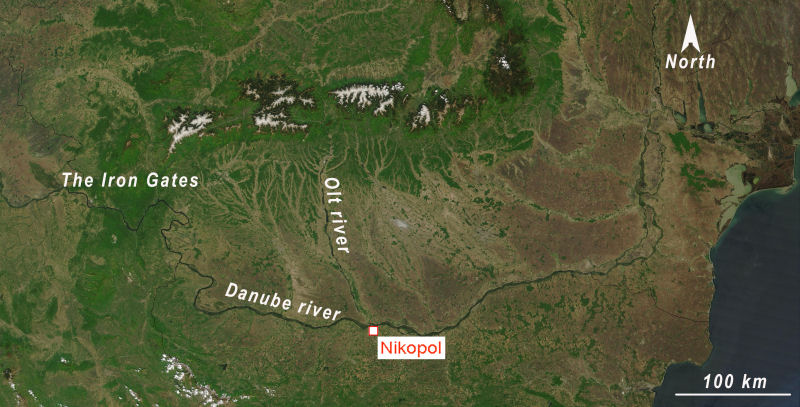
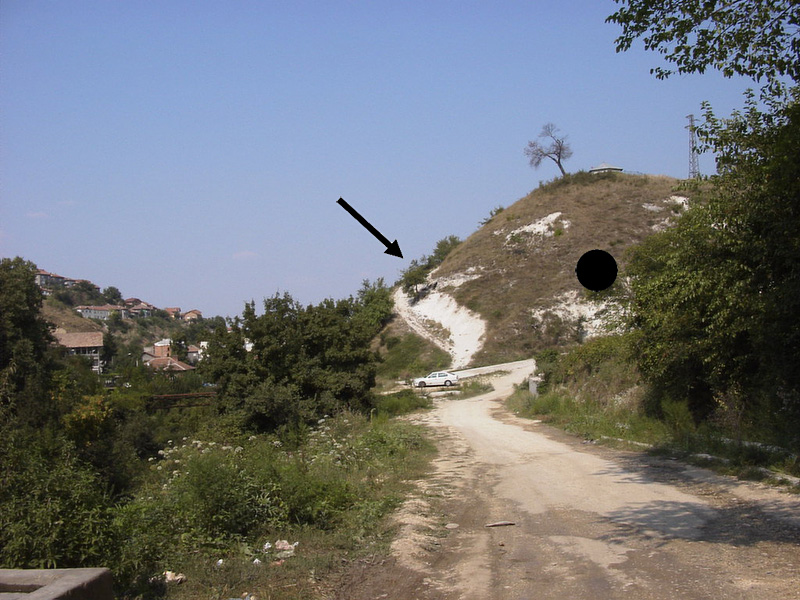
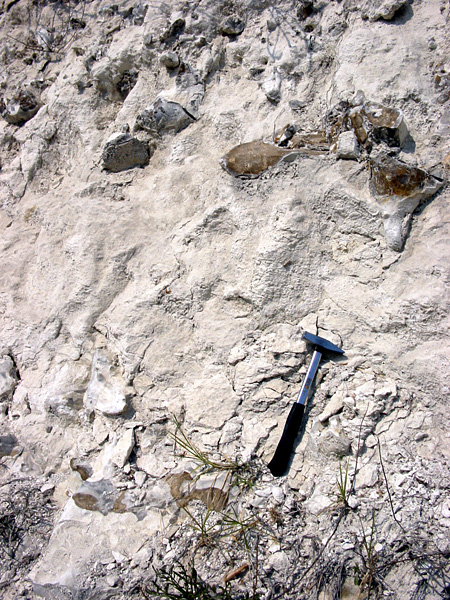
During a study trip in the Lower Danube Valley in the summer of 2009, we crossed the western part of the Moesian Platform, along a route partly following the Iskar River Valley, which brought us to the Danube throughout Pleven and Nikopol (Figure 1). Here, along the road that runs parallel to the Zass'idere torrent, close to its confluence with the Danube at the southern outskirts of Nikopol, we noticed that the cutting of the earth road along the slopes of Ali Kach Baba hill had exposed a white chalk formation (Upper Cretaceous) with several embedded seams of flint nodules (Figures 2 & 3). Many cores, flakes and by-products of blade debitage also lay on the surface of a pathway that led to a shrine of the Turkish period (Reference Biagi, Starnini, Kozłowski and RaczkyBiagi & Starnini 2010). The importance of the discovery was immediately evident, because the raw material is, without doubt, the well-known, yellow-honey coloured, white spotted, waxy, 'Balkan Flint' (Reference ComşaComşa 1976; Reference GurovaGurova & Nachev 2008), which is common to the assemblages of the Early Neolithic sites of the Balkans. Furthermore, there was evidence of flint exploitation and reduction on the spot. The geographical coordinates of the find-spot are 43°41'44" Lat. N and 24°53'28" Long. E.
Location of the 'Balkan flint' outcrop and Early Neolithic workshops at the southern outskirts of Nikopol (dot).

Ali Kach Baba hill with the position of the 'Balkan flint' outcrops (dot) and the Early Neolithic workshops (arrow).

'Balkan flint' seams embedded in the chalk deposits of the Ali Kach Baba hill.

The finds
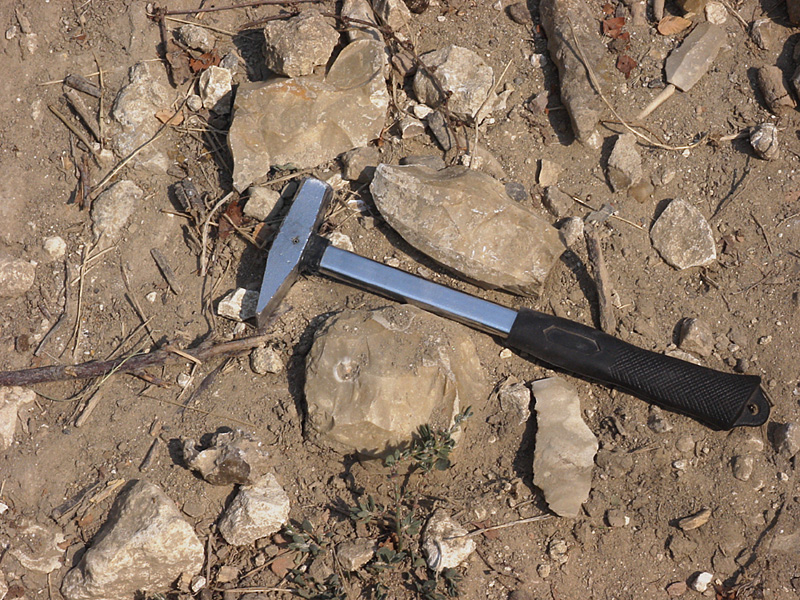
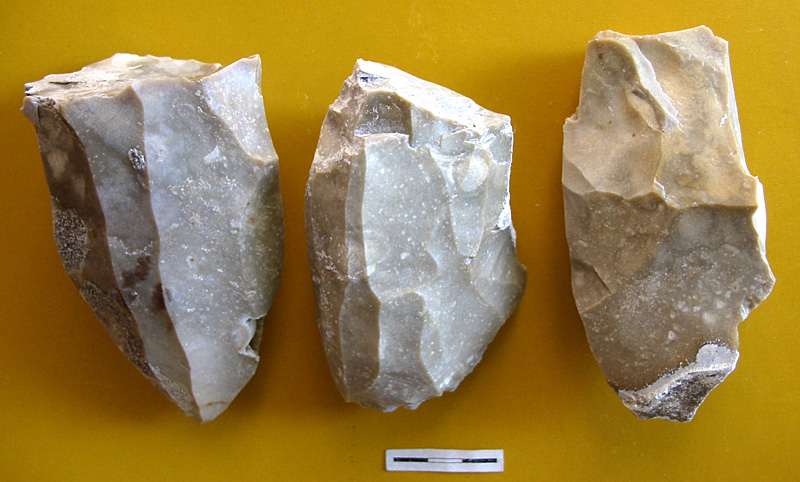
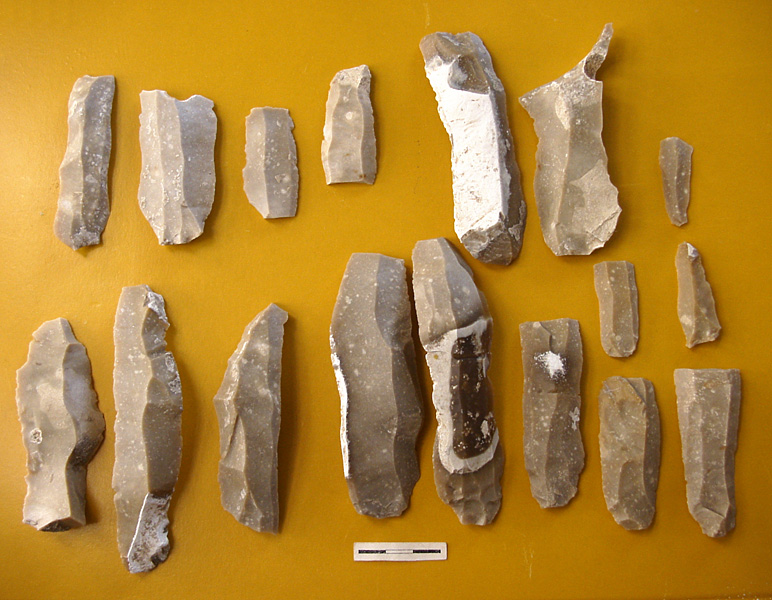
The spatial distribution and physical condition of the artefacts on the pathway indicate that they originated from a freshly eroded archaeological deposit, most probably still in situ (Figure 4). The artefacts were clustered close to each other within a radius of some 2m. They are represented by subconical blade cores (Figure 5), many blade blank fragments, a few crested blades and several decortication flakes (Figure 6). The only retouched tool consisted of a long end-scraper.
'Balkan flint' core and artefacts in situ on the footpath surface.

'Balkan flint' subconical cores.

'Balkan flint' blade products.

All the cores, except one, damaged after its secondary use as a hammer, are single-platformed, macro-blade specimens. Their flaking face is carefully prepared; the reduction started after the detachment of a crested blade. The striking platforms are horizontal and slightly concave. Flat butts prevail among the blade proximal fragments.
Discussion
The type of raw material from Nikopol outcrop, which is mainly of a pale brown colour (10YR6/3) with white spots, is identical to that employed during the Early Neolithic in the Balkans. It clearly differs from the flint from the Shumen sources, and the so-called Dobrudzha (Dobrogea) flint, whose exploitation is supposed to have started not earlier than the Copper Age (Reference Skakun and GatsovSkakun 1993; Gurova & Nachev 2008). Artefacts obtained from this latter type are commonly found, for instance, in the Copper Age tell settlements of the lower Danube course (Reference Hansen, Toderaş, Reingruber, Gatsov, Georgescu, Görsdorf, Hoppe, Nedelcheva, Prange, Wahl, Wunderlich and ZidarovHansen et al. 2007), and in the Varna and Durankulak cemeteries (Reference ManolakakisManolakakis 2008) in the form of long blades deposited as grave goods.
'Balkan Flint' is often referred to in the archaeological literature as 'Pre-Balkan Platform flint'. It is a high-quality, yellow-honey (blonde), white-spotted flint, which is considered one of the markers of Neolithisation in south-eastern Europe. The discovery of large outcrops of this type of flint along the lower Danube Valley is of major importance because it is linked with the first evidence of Early Neolithic knapping activity on the spot. The typology of the artefacts observed on the surface of the path up Ali Kach Baba hill, which match well with those found in the Early Neolithic lithic assemblages of the Balkans (Reference GurovaGurova 2008; Reference Kaczanowska and KozłowskiKaczanowska & Kozłowski 2008), assign this find-spot to an Early Neolithic phase of exploitation.