


Introduction
Distinguishing designing, in particular open design from constrained design based on problem-solving, has implications for design research and design education in particular, since much of education is based on problem-solving theories. Rooted in different professional activities, the practice of design shows the variable use of a core of characteristics that make the foundations of designing a generic thinking process (Goel and Pirolli, Reference Goel and Pirolli1992; Visser, Reference Visser2009; Vieira, Reference Vieira, Blessing, Qureshi and Gericke2021). Constrained and open design evoke different design behaviors and higher brain activity (Vieira et al., Reference Vieira, Gero, Gattol, Delmoral, Li, Cascini and Fernandes2020a). Higher freedom while externalizing the co-evolution of problem and solution (Maher and Poon, Reference Maher and Poon1996; Dorst and Cross, Reference Dorst and Cross2001; Dorst, Reference Dorst2019), ideation (Silk et al., Reference Silk, Rechkemmer, Daly, Jablokow and McKilligan2021), problem finding (Simon, Reference Simon, Collen and Gasparski1995), problem structuring (Goel, Reference Goel1994), and problem framing (Runco and Nemiro, Reference Runco and Nemiro1994) characterizes open design and plays a lesser role in problem-solving design tasks. Whether the practice of designing, open or constrained, is influenced by gender is of particular interest to understand methodological approaches in design research. Gender differences in design have been studied with several focuses, for example, to check whether gender equality is ensured in education (Moss and Gunn, Reference Moss and Gunn2007), or to analyze the effect of gender composition on team dynamics (Milovanovic and Gero, Reference Milovanovic and Gero2019). The common ultimate goal is to understand the implications of gender differences in design management, design education, and design research.
As part of a larger experiment, we have previously tested part of this claim by studying the brain activity of professional designers while designing in constrained and open design tasks in single domain studies (Vieira et al., Reference Vieira, Gero, Delmoral, Gattol, Fernandes and Fernandes2019a, Reference Vieira, Gero, Gattol, Delmoral, Li, Cascini and Fernandes2020a) and compared domains, namely mechanical engineers and architects (Vieira et al., Reference Vieira, Gero, Delmoral, Gattol, Fernandes and Fernandes2019b); mechanical engineers and industrial designers (Vieira et al., Reference Vieira, Gero, Delmoral, Gattol, Fernandes, Parente and Fernandes2020b). The original contribution of the study presented here is to report to what extent brain activity in constrained and open design differs between gender groups. Knowledge of gender differences among designers while designing is underexplored. Neuroscience methods can contribute to our understanding of this gap in design research providing methods (Borgianni and Maccioni, Reference Borgianni and Maccioni2020) for measuring the gender effect on brain activity. We use measurements from the electroencephalographic (EEG) technique to explore frequency power associated with gender differences of professional designers while performing prototypical stages of constrained and open design tasks, a problem-solving stage, and a design sketching stage, respectively.
Design research studies using EEG started by investigating cortical activation in multiple creative tasks (Martindale and Hines, Reference Martindale and Hines1975), stages of the creative process, and originality (Martindale and Hasenfus, Reference Martindale and Hasenfus1978). Other studies compared the brain activation of experts and novices (Göker, Reference Göker1997; Liang et al., Reference Liang, Lin, Yao, Chang, Liu and Chen2017). Investigations focused either on design activities in single domains (Nguyen and Zeng, Reference Nguyen and Zeng2010; Liu et al., Reference Liu, Zeng and Ben Hamza2016; Liu et al., Reference Liu, Li, Xiong, Cao and Yuan2018; Liang et al., Reference Liang, Chang and Liu2019; Vieira et al., Reference Vieira, Gero, Delmoral, Gattol, Fernandes and Fernandes2019a, Reference Vieira, Gero, Gattol, Delmoral, Li, Cascini and Fernandes2020a; Jia and Zeng, Reference Jia and Zeng2021) or compared domains (Vieira et al., Reference Vieira, Gero, Delmoral, Gattol, Fernandes and Fernandes2019b, Reference Vieira, Gero, Delmoral, Gattol, Fernandes, Parente and Fernandes2020b).
As part of this larger experiment, one single-domain design neurocognition study on the effect of gender revealed differences between male and female industrial designers while performing constrained and open design tasks (Vieira et al., Reference Vieira, Benedek, Gero, Cascini and Li2021). The present paper extends the previous studies on constrained and open design tasks comparing domains (Vieira et al., Reference Vieira, Gero, Delmoral, Gattol, Fernandes and Fernandes2019b, Reference Vieira, Gero, Delmoral, Gattol, Fernandes, Parente and Fernandes2020b) and the study investigating the effect of gender of industrial designers (Vieira et al., Reference Vieira, Benedek, Gero, Cascini and Li2021) to the effect of gender across four domains. We investigate the effect of gender on brain activity in a larger sample of design professionals including industrial designers, communication designers, architects, and mechanical engineers while performing constrained and open design tasks.
Constrained and open design
The notion that designing, as a cognitive process, commences with an exploration by generating the solution space (Yoshikawa, Reference Yoshikawa1981; Gero, Reference Gero1990; Gero and Kumar, Reference Gero and Kumar1993; Dorst and Cross, Reference Dorst and Cross2001; Kruger and Cross, Reference Kruger and Cross2006; Visser, Reference Visser2009; Dorst, Reference Dorst2019) or the problem space (Goel and Pirolli, Reference Goel and Pirolli1992; Goel, Reference Goel1994; Goldschmidt, Reference Goldschmidt1997), has been replaced by the notion that exploring or designing the problem and the solution co-evolves (Maher and Poon, Reference Maher and Poon1996; Dorst and Cross, Reference Dorst and Cross2001; Dorst, Reference Dorst2019) in constrained or open design spaces, depending on the design request's level of constraint and openness to exploration (Vieira et al., Reference Vieira, Gero, Li, Gattol, Fernandes and Boujet2020c). A constrained design space is confined by specific requirements, while an open design space expands by the introduction of new design variables allowing the unfolding of the space of solutions (Gero and Kumar, Reference Gero and Kumar1993; Mose and Halskov, Reference Mose Biskjaer and Halskov2013).
Another notion emerged when in creativity research problem finding was identified as an important component of creative performances, and distinct from problem-solving (Runco, Reference Runco1994; Abdulla et al., Reference Abdulla, Paek, Cramond and Runco2020). The problem-solving space view was shown to be incomplete with Schön's (Reference Schön1983) work and later problem finding was considered related to skills such as problem definition and problem expression, problem generation, and problem discovery (Runco and Nemiro, Reference Runco and Nemiro1994). Similar characteristics were identified in protocol studies of design and non-design problem spaces, such as problem finding and problem forming (Simon, Reference Simon, Collen and Gasparski1995), problem structuring (Goel, Reference Goel1994), problem scoping, and problem framing (Goel, Reference Goel2014). These initial studies compared designers and non-designers performing in design and non-design spaces (Goel, Reference Goel1994). These studies lead to the investigation of one of the core design research questions. When and whether designing, as a cognitive process, is distinct from problem-solving (Goel and Pirolli, Reference Goel and Pirolli1989, Reference Goel and Pirolli1992; Visser, Reference Visser2009; Vieira, Reference Vieira, Blessing, Qureshi and Gericke2021). Distinctive brain activities between design tasks, based on problem-solving and layout design (Alexiou et al., Reference Alexiou, Zamenopoulos, Johnson and Gilbert2009; Vieira et al., Reference Vieira, Gero, Gattol, Delmoral, Li, Cascini and Fernandes2020a) and problem-solving and open design (Vieira et al., Reference Vieira, Gero, Delmoral, Gattol, Fernandes, Parente and Fernandes2020b), have previously provided preliminary answers to this core design research question. Recent design neurocognition studies explore brain activity while performing constrained and open design tasks. No significant differences were found when comparing two types of tasks, based on constrained and open requests performed by product design engineers in an fMRI experiment (Hay et al., Reference Hay, Duffy, Gilbert, Lyall, Campbell, Coyle and Grealy2020). However, significant differences were found comparing two tasks, based on constrained layout design and open design tasks temporal analysis, for mechanical engineers and industrial designers in an EEG study (Vieira et al., Reference Vieira, Gero, Delmoral, Gattol, Fernandes, Parente and Fernandes2020b). In the latter study (Vieira et al., Reference Vieira, Gero, Gattol, Delmoral, Li, Cascini and Fernandes2020a), significant differences were found for alpha 2 and beta frequency bands between the constrained and open design tasks. From the qualitative observation of the experiment sessions’ video recordings, participants took different methodological approaches. Reading the instructions of the constrained task produced a direct response, while a reflecting stage took place in the open design task before sketching. Such differences in the designers’ methodological approach translated into different brain activities. We infer that problem finding, as a relevant component of creativity in design, took place in this stage of distinctive brain activity from problem-solving leading to higher brain activity differences in the sketching stage. In the present study, we compare the most prototypical stage of each task, problem-solving of the constrained task and design sketching of the unconstrained, open task, and investigate when and whether the effect of gender reveals similarities or differences in brain activation.
The investigation of gender differences and similarities might open the way to further studies on how appropriate is adopting the same educational approaches and techniques in design and insights on building design teams.
The next section provides an overview of the literature on gender differences in creative cognition and design neurocognition.
Gender differences in creative cognition and design neurocognition
In the neuroscience of creative cognition, comprehensive literature reviews have focused on topics relevant to design research (Dietrich and Haider, Reference Dietrich and Haider2017), such as mental visual imagery (Pidgeon et al., Reference Pidgeon, Grealy, Duffy, Hay, McTeague, Vuletic, Coyle and Gilbert2016). We highlight results relevant to the investigation of the effect of gender in design research. Despite the lack of clear differences in creative potential (Baer and Kaufman, Reference Baer and Kaufman2008; Abraham, Reference Abraham2016), women less often than men have outstanding creative achievements. It was found that men overestimate while women underestimate their creative efficacy (Abra and Valentine-French, Reference Abra and Valentine-French1991), which was identified in the field of the general intellect as “male hubris-female humility” (Furnham et al., Reference Furnham, Fong and Martin1999). It was further shown that the mechanisms of shaping creative self-efficacy are gender-specific (Karwowski, Reference Karwowski2011). Although there is evidence of differences in patterns and areas of strengths between the genders, there is still relative equality in creative ability (Baer and Kaufman, Reference Baer and Kaufman2008). Women appear more interested in the creative process than in its result or have a lower need of achievement reflecting cultural values and other factors contributing to differences (Ruth and Birren, Reference Ruth and Birren1985; Baer and Kaufman, Reference Baer and Kaufman2008).
Studies using the EEG technique are usually based on the analysis of activation in specific frequency bands (Sawyer, Reference Sawyer2011; Cohen, Reference Cohen2017; Stevens and Zabelina, Reference Stevens and Zabelina2019; Benedek and Fink, Reference Benedek, Fink, Runco and Pritzker2020). For reviews on creativity and EEG studies, see the studies (Fink and Benedek, Reference Fink, Benedek, Vartanian, Bristol and Kaufman2013, Reference Fink and Benedek2014).
The oscillatory neuroelectric activity of frequency bands are thought to act as resonant communication networks through large populations of neurons, with functional relations to memory and integrative functions, and complex stimuli eliciting superimposed oscillations of different frequencies (Başar et al., Reference Başar, Başar-Eroglu, Karakas and Schurmann1999). Fink and Neubauer (Reference Fink and Neubauer2006) found no behavioral differences for originality between genders, although they significantly differed with respect to task-related synchronization of EEG alpha activity in anterior regions of the cortex. Females in the high-ability group demonstrated stronger synchronization with originality than those of average verbal intelligence, whereas the opposite pattern was seen among males. Razumnikova (Reference Razumnikova2004) found that gender differences in beta 2 activity, associated with creativity in both genders, are instantiated in terms of the hemispheric organization of brain activity during creative thinking.
In design research, EEG studies associated design activities with beta 2 (Vieira et al., Reference Vieira, Gero, Gattol, Delmoral, Li, Cascini and Fernandes2020a), gamma 1, and gamma 2 (Liu et al., Reference Liu, Zeng and Ben Hamza2016). Higher alpha power is associated with open-ended tasks and divergent thinking (Liu et al., Reference Liu, Li, Xiong, Cao and Yuan2018). Upper alpha power is also associated with visual association in expert designers (Liang et al., Reference Liang, Lin, Yao, Chang, Liu and Chen2017). While theta and beta power are related to convergent thinking in decision-making and constraints tasks (Nguyen and Zeng, Reference Nguyen and Zeng2010), beta power is also associated with visual attention. Higher alpha and beta frequency bands have been found to play a key role from constrained to open design tasks (Vieira et al. Reference Vieira, Gero, Gattol, Delmoral, Li, Cascini and Fernandes2020a). Vieira et al. (Reference Vieira, Benedek, Gero, Cascini and Li2021) in their design neurocognition study on the effect of gender on frequency bands of industrial designers demonstrated hemispheric differences for alpha and beta bands while problem-solving, and theta, alpha, and beta bands while designing. Here, we explore how far these results replicate in a larger sample involving industrial designers, communication designers, architects, and mechanical engineers. The larger sample should provide more robust findings.
We look at each gender cohort's cognitive demands associated with constrained and open design tasks and how they translate into brain activation and specifically changes in frequency bands. The analysis of frequency bands describes these aspects and we relate the statistical results with selected cognitive functions associated with the respective Brodmann areas that can be inferred as connected to design cognition in constrained and open design. The brain's structure, function and connectivity studies originally made by Brodmann (Reference Brodmann1909) have been refined and correlated to various cortical functions and cognitive activities (Glasser et al., Reference Glasser, Coalson, Robinson, Hacker, Harwell, Yacoub, Ugurbil, Andersson, Beckmann, Jenkinson, Smith and Van Essen2016). Most researchers are cautious about relating specific electrode positions with higher cognitive functions, although such associations are commonly used when discussing brain regions of main findings. Through the comparison of frequency band power between the genders and tasks we connected the results to the literature on associated cognitive functions and present an overview of hypothetical inferences and interpretation in the discussion. These inferences are not intended to claim the presence of cognitive processes from observed brain activation (reverse inference, (Poldrack, Reference Poldrack2006), but selected cognitive functions associated to channels of statistical differences that relate to design cognition, in particular to these stages of design cognition.
Research question and approach
We investigate the effect of gender based on the analysis of oscillatory brain activity of frequency bands while performing constrained and open design tasks. We analyze the neurophysiological activation differences of male and female professional designers when designing for a constrained problem-solving design task and for an open design sketching task. The experiment design has been previously reported in Vieira et al. (Reference Vieira, Gero, Delmoral, Gattol, Fernandes, Parente and Fernandes2020b) (Appendix A), as has the division of the two tasks in three stages (Vieira et al. Reference Vieira, Gero, Li, Gattol, Fernandes and Boujet2020c) which is further detailed in the methods section.
We explore if differences occur between constrained and open tasks, by examining the brain activity and comparing the most prototypical stage of each task: the earliest reaction after reading the task, a problem-solving stage of the constrained design task and the open externalization sketching stage of the open design task.
The analysis focuses on the frequency band power differences observed between the two different stages of the execution of the tasks. By temporally segmenting these activations for each participant, we distinguish brain activation within design sessions across the two stages. We investigate the following research question:
• What are the similarities and differences in the brain activation of male and female designers when performing constrained design problem-solving and open design sketching?
Methods
The research question is investigated by using the problem-solving stage of the constrained design task as reference for the sketching stage of the open design task.
In this study we time-locked on a scale of multiple seconds to allow for the design activity to unfold. We shift the focus on time-locking the experiments equally for all participants, to the unfolding of the cognitive activities of designing in constrained and open tasks until the solution is produced. Hence, our experiment is time-locked for the complete unfolding of the cognitive activities involved in each task (Vieira et al., Reference Vieira, Gero, Delmoral, Gattol, Fernandes, Parente and Fernandes2020b). We examined the resting state of some participants from the different background groups and their brain activity differed considerably. Therefore, we compute absolute power instead of task-related power changes relative to resting-state activity. Moreover, participants’ cognitive effort during the resting state is unknown. By taking the problem-solving stage of the constrained task as the reference, we know that their cognitive effort is focused on solving a problem-solving task of well-defined instructions, therefore we consider this a suitable reference for comparison with the open sketching stage and with the aim of the research project.
By temporally segmenting the activations of each stage for each participant, it is possible to distinguish brain activation within design sessions across the two stages and gender.
We analyzed frequency power (Pow) across distinct frequency bands. The tasks and experimental procedure were piloted prior to the full study, resulting in the final experiment design (Vieira et al., Reference Vieira, Gero, Delmoral, Gattol, Fernandes, Parente and Fernandes2020b).
Participants
Participants were 91 professional designers with the same demographics (language and culture). Seven participants’ data were incomplete. The final sample thus consists of 84 right-handed participants, aged 23–64 (M = 35.5, SD = 8.8), including 46 men, aged 24–58 (age M = 36.5, SD = 8.7) and 38 women, aged 23–64 (age M = 33.5, SD = 10), from four design background activities namely: 23 mechanical engineers, 14 men (age M = 29, SD = 5.8) and 9 women (age M = 30, SD = 8.7); and 23 industrial designers, 11 men (age M = 36.9, SD = 7.4) and 12 women (age M = 31.1, SD = 7.1); 27 architects, 14 men (age M = 41.9, SD = 6.7) and 13 women (age M = 39.1, SD = 7.9); and 11 graphic designers, 6 men (age M = 39.8, SD = 9.3) and 5 women (age M = 36.4, SD = 11.4). The result of the unpaired t-test controlling for experience between gender cohorts revealed no statistically significant difference, t(82) = 1.79, p = 0.077. The participants are all professionals (years of experience M = 9.7, SD = 7.6). This study was approved by the local ethics committee of the University of Porto.
Experiment tasks
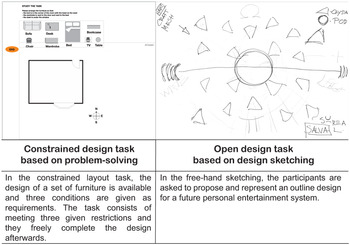
This experiment consisted of a sequence of tasks previously reported (Vieira et al., Reference Vieira, Gero, Delmoral, Gattol, Fernandes, Parente and Fernandes2020b) (Appendix A). We have adopted and replicated the constrained task based on problem-solving described in Alexiou et al. (Reference Alexiou, Zamenopoulos, Johnson and Gilbert2009) fMRI study. This task is considered a problem-solving task as the problem itself is well-defined, and the set of solutions is unique (Alexiou et al., Reference Alexiou, Zamenopoulos, Johnson and Gilbert2009). In the earliest reaction stage of this constrained task, participants’ methodological approach is immediately oriented to respond to the three well-defined instructions of the request, the strict placement of three pieces of furniture, therefore this stage reflects the problem-solving characteristics of the task. We added an open design task that included free-hand sketching. This task is an ill-defined and fully unconstrained task unrelated to formal problem-solving (see Fig. 1).
Description and depiction of the constrained layout design task based on problem-solving and the open design task based on sketching.
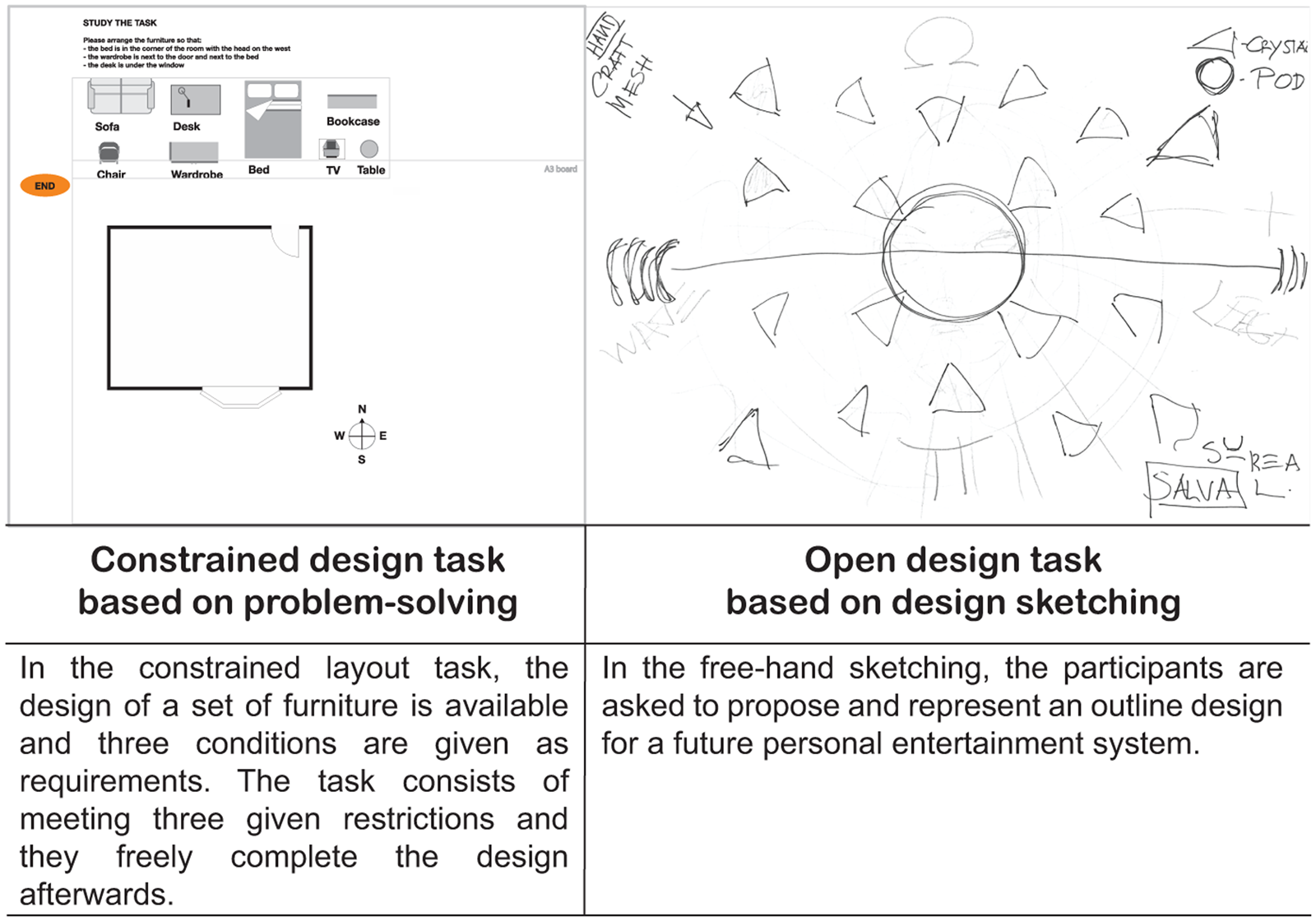
The two tasks were previously divided into three stages of categorical similarity: Stage 1, reading the task; Stage 2, earliest reaction; Stage 3, open externalization. Distinguishing the three stages is motivated by the assumptions that:
(a) designing starts by reading the task request, whether constrained or open it may evoke different levels of conceptual expansion prompting designers to different methodological approaches.
(b) while protocol analyses usually address only the third stage by relying on designers’ externalizations, we investigated what comes before the externalization of the idea and immediately after reading the task request.
(c) problem finding and problem forming (Simon, Reference Simon, Collen and Gasparski1995) and problem structuring (Goel, Reference Goel1994) have been identified as invariants of design problem spaces and for having a smaller role in problem-solving and non-design problem spaces (Goel, Reference Goel1994).
We explored differences in brain activation between female and male designers between the two most prototypical stages of constrained and open designing. The average task duration for the constrained design based on problem-solving was M = 33.7 s (SD = 14.4), and for the open design based on free-hand sketching was M = 578.3 s (SD = 317.2).
Setup and procedure
The setup, tasks sequence (Appendix A) and complete procedure have been previously described in Vieira et al. (Reference Vieira, Gero, Delmoral, Gattol, Fernandes, Parente and Fernandes2020b). A brief outline is presented here. Electromagnetic interference of the room was checked including the 50 Hz power line contamination. One researcher was present in each experiment session to instruct the participant and to check for recording issues. A period of 10 min for setting up and a few minutes for a short introduction were necessary for informing each participant, reading and signing the consent agreement and to set the room temperature. The researcher followed a script to conduct the experiment so that each participant was presented with the same information and intentional stimuli. The participants were asked to start by reading the task request which took an average of 10 s of reading period. The participants were asked to stay silent during the tasks and use the breaks for clarifying questions. In the constrained design task, participants received a tangible interface based on magnetic material for easy handling. In the open design task, each participant was given two sheets of paper (A3 size) and three instruments, a pencil, graphite and a pen. The unconstrained task always followed the constrained task.
Equipment and data collection methods
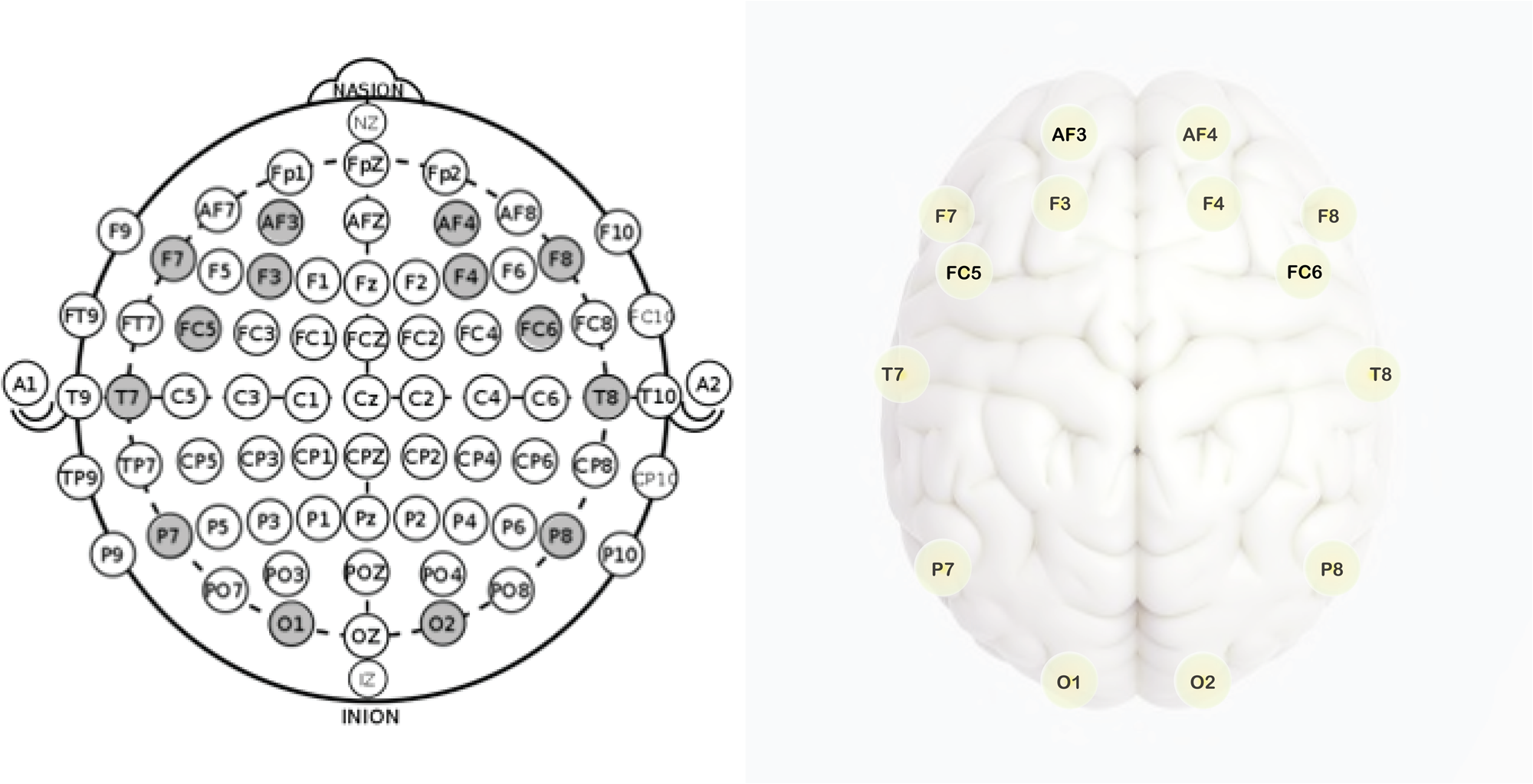
EEG activity was recorded using a portable 14-channel system Emotiv Epoc+. Each of the Emotiv Epoc+ channels collect continuous signals of electrical activity at their location. The fourteen electrodes were placed according to the 10–10 I.S., 256 Hz sampling rate (Fig. 2).
Electrodes placement according to the 10–10 I.S. in the brain cortex.
Two video cameras captured the participants’ face and activity while performing the tasks. All the data captures were streamed using Panopto software (https://www.panopto.com/). The experiment sessions took place at the University of Porto, between March and July of 2017 and June and September of 2018 in the Mouraria Creative Hub, during August 2018 between 9:00 and 15:00.
Data processing methods
In a first step, the EEG signal was band pass-filtered with a low cutoff 3.5 Hz, high cutoff 28 Hz to maintain only oscillatory brain activity between the theta and beta frequency range. As both tasks involved motor activity, we applied methods to attenuate the muscle artifact contamination of the EEG recordings. Specifically, we adopted the blind source separation (BSS) technique based on canonical correlation analysis (CCA) for the removal of muscle artifacts from EEG recordings (De Clercq et al., Reference De Clercq, Vergult, Vanrumste, Van Paesschen and Van Huffel2006; Vos et al., Reference Vos, Riès, Vanderperren, Vanrumste, Alario, Huffel and Burle2010). Additionally, the data were visually checked for the remaining artifacts, and artifactual epochs caused by muscle tension, eye blinks or eye movements were excluded from further analysis.
Data analysis included the computation of frequency-specific band power on individual and aggregate levels using MatLab and EEGLab open-source software. The decomposition of the EEG signal followed the typical component frequency bands and their approximate spectral boundaries, theta (3.5–7 Hz), alpha 1 (7–10 Hz), alpha 2 (10–13 Hz), beta 1 (13–16 Hz), beta 2 (16–20 Hz), and beta 3 (20–28 Hz). By adopting lower and upper alpha boundaries, and beta sub-bands, we ensured that the findings can be related to the literature in other domains. The total transformed power (Pow) was obtained by band-pass filtering the EEG signal at each electrode for specific frequency bands (see above) and computing the median of the squared values of the resulting signal. This measure reflects the amplitude of the frequency power per channel and per participant. An average value per participant of 5.0% in the constrained problem-solving stage and 5.5% in the open sketching stage of critical channels with unremovable artifacts were substituted by the mean of the series. The valid EEG data corresponding to each stage of the constrained and open design tasks were averaged, respectively. The segmentation of each task in three stages followed a time-stamping procedure according to the criteria presented in the methods section and then computed in MatLAB. The divisions into Stage 1, reading the task, Stage 2, earliest reaction, and Stage 3, open externalization, were visually checked through the observation of the two videos captured per session. In the constrained design task, the problem-solving stage is the earliest reaction after reading the request and starts when the participant takes action to answer to the three requests and ends when these are accomplished. This was done in one sequence by all the 84 participants. Some participants end the task here, others complete the layout design. In the open design task, a stage of reflecting is the earliest reaction after reading the request followed by the open externalization stage that starts with the beginning of sketching or notation activities and ends when the design is concluded. We thus obtained one measurement of the power (Pow) for each frequency band and selected stage per task, Appendix B.
Statistical approach
We performed standard statistical analyses based on the design of the experiment: a mixed-measures design (2 × 2 × 7 × 2) with task (problem-solving of the constrained design and sketching of the open design), hemisphere (left, right) and electrode (O1/2, P7/8, T7/8, FC5/6, F7/8, F3/4, AF3/4) as within-subject factors and gender (male, female) as between-subjects factor. Analyses were performed for the dependent variable of Pow for each frequency band. The threshold for significance in all the analyses is p ≤ 0.05. Cohen's d was calculated to measure the effect size for each electrode, and each frequency band between the genders for each stage, and between stages within gender.
Analysis of results
We focus on the frequency band power per channel, task, and participant as the study aim is to know whether there are gender differences in brain activation during constrained and open designing. Total power (Pow), for each frequency band across the 14 channels per task and gender are depicted in Figures 4 and 5.
Significant main effects and analysis by gender
From the analysis of the 84 participants, we found significant main effects and significant interaction effects between multiple factors (Appendix C, Table C1). Significant main effects were found for the between-subjects factor of gender for the following frequency bands, theta, p ≤ 0.01, alpha 2, p = 0.01, and beta 1, p ≤ 0.01. A significant interaction effect was found between the factors: hemisphere and gender for alpha 2, p = 0.02; and electrode and gender for alpha 1, p ≤0.01, alpha 2, p ≤ 0.01, beta 2, p = 0.02, and beta 3, p = 0.02.
Analysis revealed significant main effects of task for alpha 2 and the beta bands. Main effect of hemisphere and of electrode were found across the six bands. Significant interaction effect was found between the factors: task and hemisphere for alpha and beta bands among other effects, Table 1.
Significant main effects and interaction effects (*p ≤ 0.05) from the ANOVA (2 × 2× 7 × 2).
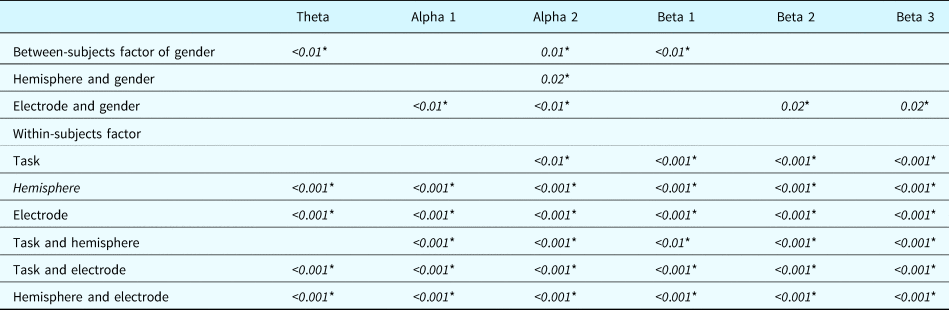
* p ≤ 0.05.
No interaction effect between task and gender was found. The sample of participants has an approximately equal percentage of female designers in each domain. We infer there is no or minimal gender domain effect.
Following the between-subjects factor of gender for theta, alpha 2 and beta 1, and the interaction effects between electrode and gender for alpha 1, alpha 2, beta 2 and beta 3, Cohen's d was calculated to measure the effect size for each electrode, and each frequency band between the genders for each stage (Appendix C, Tables C2 and C3). Problem-solving and design sketching are labels for the considered stage of each of the two different tasks.
Analysis of gender differences in constrained design
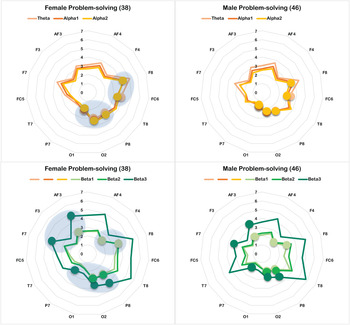
Total transformed power (Pow), for the problem-solving stage of the constrained design task across the 14 channels, frequency bands, and gender, are depicted in Figure 3. We look at the frequency bands neurophysiological activation in the problem-solving stage of the constrained design task per gender and how it translates into brain activation. The plot shows the two hemispheres by distributing the electrodes symmetrically around a vertical axis. Total power (Pow) per electrode (average of the entire stage) can be considered by comparing the vertical scale and across the two tasks, per frequency band. Cohen's d was calculated to measure the effect size of gender differences in frequency power for each electrode (Appendix C, Table C2). A positive effect size reflects higher power in females compared to males. The solid circles indicate channels of moderate (>0.50) and large (>0.80) effect size (Fig. 3).
Transformed power (Pow) per channel for theta, alpha, and beta frequency bands of the female and male designers for the problem-solving stage. The solid circles indicate channels of moderate (>0.50) or greater effect size. Shaded areas refer to higher frequency power in that group.
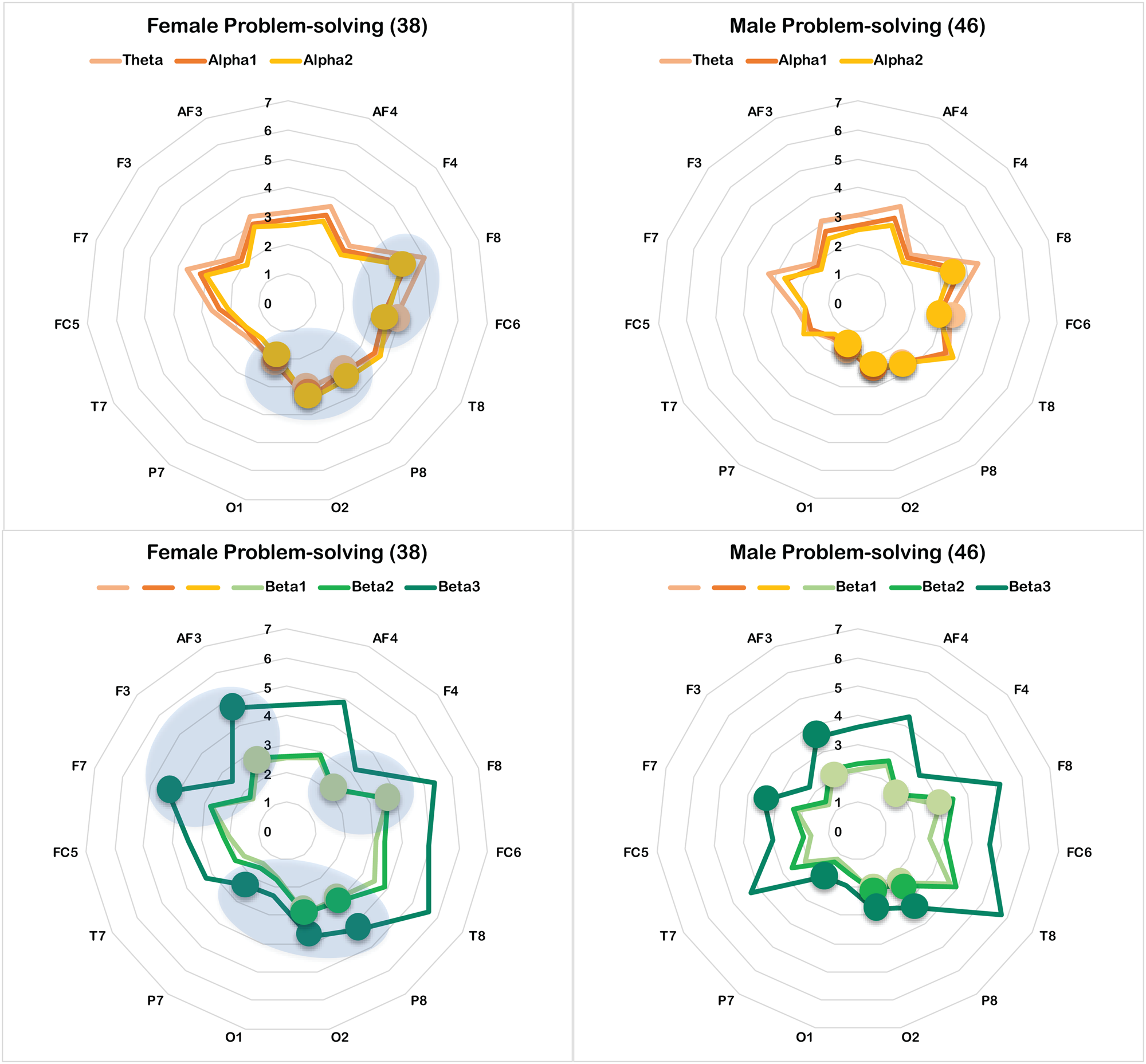
All the channels of moderate or greater effect size across the frequency bands were found in three main areas of the brains of female designers: the posterior cortices, right dorsolateral, and left prefrontal cortex. In the posterior cortices, in the right hemisphere the channel O2 for the six bands and the channel P8 for five bands except alpha 1. In the left hemisphere, the channel O1 for theta and alpha bands. Female industrial designers showed higher posterior theta and alpha bands than males, mainly in the right hemisphere: in the right dorsolateral prefrontal cortex, channel FC6 for theta and alpha 2; the channel F8 for alpha 2 and beta 1; and the channel F4 for beta 1. In the left prefrontal cortex: channel F7 for beta 3; and the channel AF3 for beta 1 and beta 3. Female designers revealed increased prefrontal beta 3 in the left hemisphere, and beta 1 in the right hemisphere. Male designers did not show significantly higher brain activation in any of the six frequency bands.
Analysis of gender differences in open design
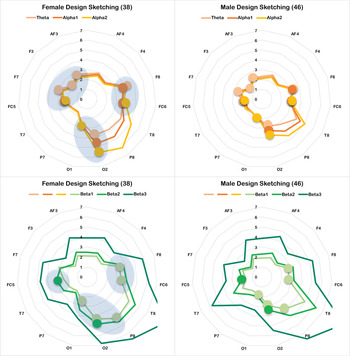
Total transformed power (Pow), for the design sketching stage of the open design task across the 14 channels, frequency bands, and gender, are depicted in Figure 4. We look at the frequency bands power in the sketching stage per gender. Cohen's d was calculated to measure the effect size for each electrode transformed power (Pow), between the genders for this stage (Appendix C, Table C3). The positive effect sizes reflect higher power in females. The solid circles indicate channels of moderate (>0.50) or larger effect size (Fig. 4).
Transformed power (Pow) per channel for theta, alpha, and beta frequency bands of the female and male designers for the sketching stage. The solid circles indicate channels of moderate (>0.50) and greater effect size. Shaded areas refer to higher frequency power in that group.
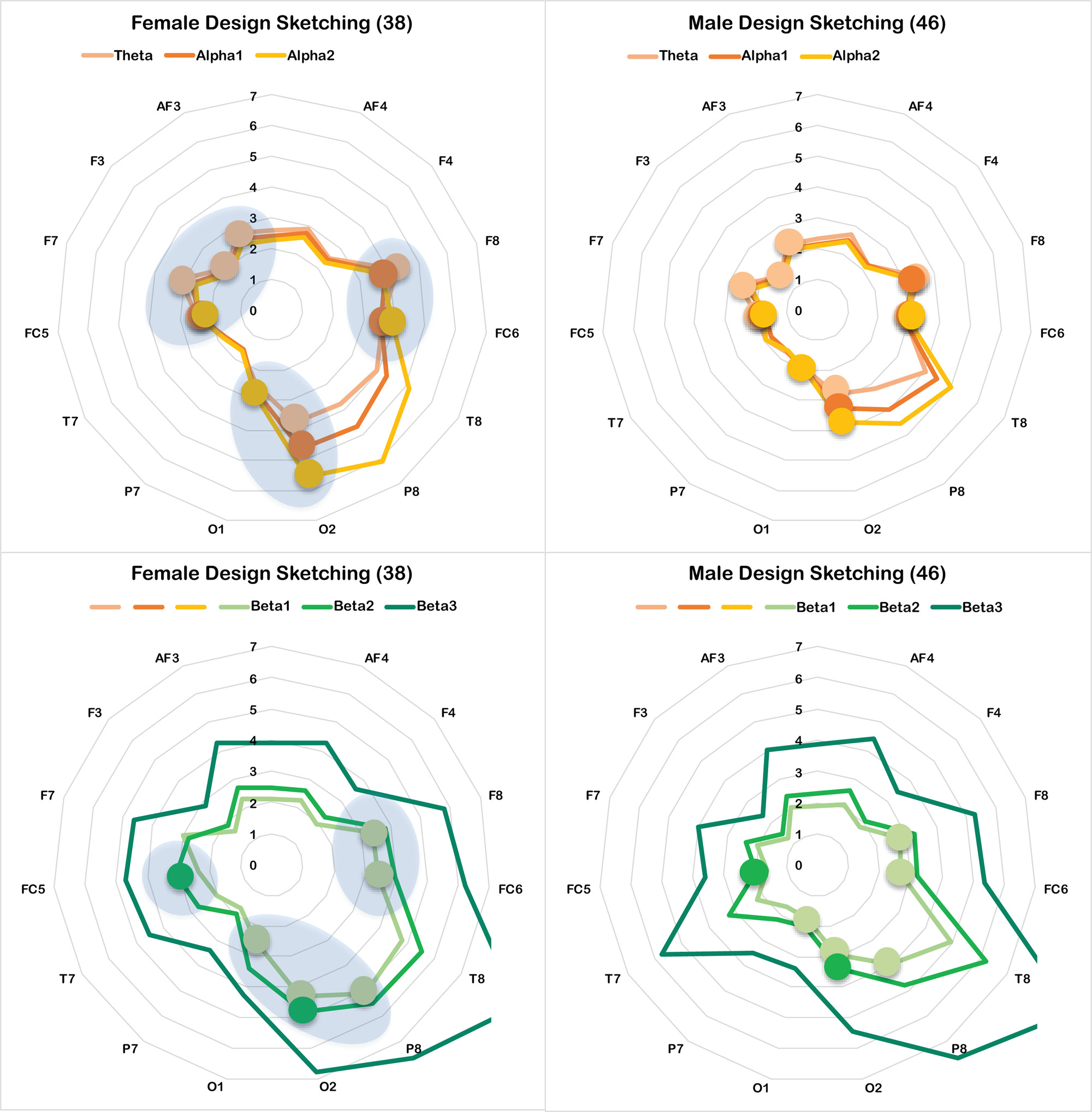
All the channels of moderate or greater effect size across the frequency bands were also found in the same three main areas of the brains of female designers: the posterior cortices, right dorsolateral, and left prefrontal cortex. In the posterior cortices, in the right hemisphere: the channel O2 for five bands except beta 3; and the channel P8 for beta 1. In the left hemisphere, the channel O1 for alpha 2 and beta 1. In the right dorsolateral prefrontal cortex: the channel FC6 for theta, alpha bands, and beta 1; the channel F8 for theta, alpha 1, and beta 1. In the left prefrontal cortex: the channel F7, F3, and the channel AF3 for theta. Female designers showed increased prefrontal theta, in the left hemisphere along with moderate effect size for theta, alpha bands, and beta 2 in the channel FC5. Male designers do not reveal channels of moderate or greater effect size across the six bands. Both genders show higher brain activity in channels of the right occipitotemporal and secondary visual cortices in designing, compared to problem-solving, as shown in Figures 3 and 4.
Analysis of differences between problem-solving and design sketching within gender
Following the main effects of stage for alpha 2 and the beta bands, and of hemisphere and of electrode across the six bands, Cohen's d was calculated to measure the effect size for each electrode, and each frequency band within gender between stages (Appendix C, Tables C4 and C5). We look at the channels of moderate and large effect size between the problem-solving and sketching stages per gender. The positive effect sizes reflect higher power in problem-solving compared to design sketching. Solid circles indicate channels of moderate (>0.50) or larger effect size, as shown in Figure 5.
Channels of moderate (>0.50) and greater effect size of higher activation in the constrained task based on problem-solving (blue) and of higher activation in the open design task based on sketching (pink) within gender for each frequency band.
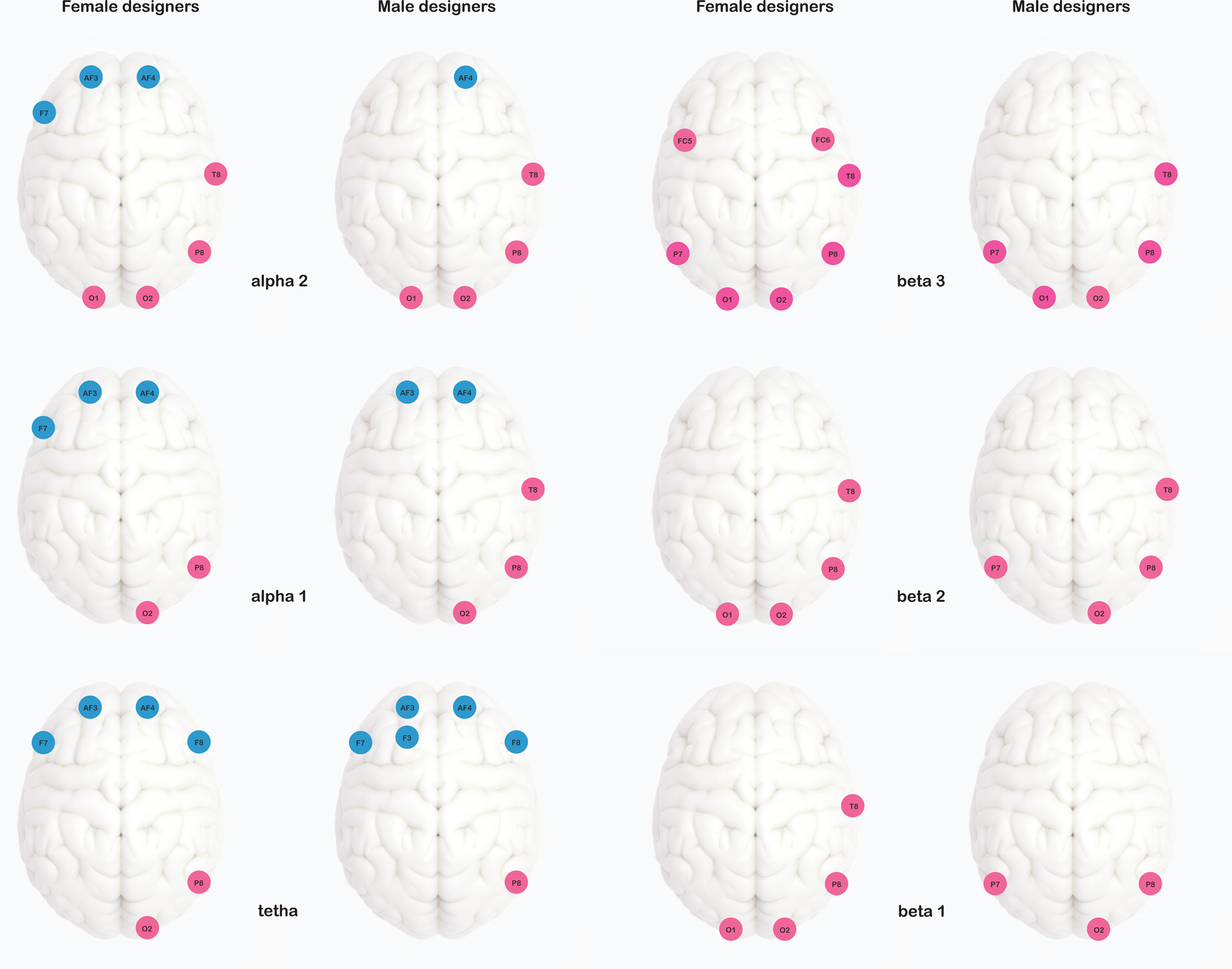
Both genders revealed channels of moderate and large effect size in areas of the prefrontal cortex for theta and alpha bands, in problem-solving. No results were found for beta bands in problem-solving for both genders.
While for design sketching, both genders revealed channels of moderate and large effect sizes in the occipitotemporal and secondary visual cortex. In the right hemisphere, the channel O2 and the channel P8 revealed large effect sizes and the channel T8 moderate effect size for theta and alpha 1, for both genders. In the left hemisphere, the channel O1 for alpha 2, and the channel P7 for beta 3. Two channels reveal specific moderate effect size for beta 2, the channel T8 for the men, and channel O1 for the women. The female designers additionally showed higher bilateral beta 3 in the channels FC5 and FC6.
Discussion
With this study, we provided evidence for the effect of gender between two prototypical stages of constrained and open design tasks, across a large sample of data including participants from four design domains, mechanical engineering, industrial design, communication design, and architecture. The brain activity found in the frequency bands power by taking the problem-solving stage as the reference for the open sketching stage support a number of inferences. Results reveal differences and similarities across the genders and provide initial answers to the research question.
Gender effect and associated cognitive functions
When comparing the frequency bands power between genders in different stages and tasks, prioritizing specific cognitive functions seems to play a role in gender's approach to constrained and open design tasks. Hence, we connect the discussion of the results to the literature on selected cognitive functions associated with channels of statistical significance, relevant to understanding the effect of gender in these stages of design cognition. These inferences based on results from studies using functional magnetic resonance imaging (FMRI) and positron emission tomography (PET) should not be confused with reverse inference (Poldrack, Reference Poldrack2006) as we do not infer cognitive processes, but selected cognitive functions related to these stages of design cognition. By doing so, we open possibilities for insights on hypotheses building, new studies, and experiments. The electrode placement of the EEG device and their associated Brodmann area is shown in Figure 6.
(a) Electrodes placement related to each cortex of the brain and (b) corresponding Brodmann areas.

Gender similarities
While being aware of the issues related to reverse inference, we suggest the following design cognition similarities between genders:
• Significant higher frequency band power in the open sketching stage for both genders on the aggregate level were measured, for alpha 2 and beta bands, meaning that from this study open design sketching is the most distinguishable design activity from problem-solving, in particular for these frequency bands. Sketching relevance to designing has been studied and identified (Goldschmidt, Reference Goldschmidt1997; Scrivener et al., Reference Scrivener, Ball and Tseng2000; Kavakli and Gero, Reference Kavakli and Gero2001; Bilda et al., Reference Bilda, Gero and Purcell2006; Cash and Maier, Reference Cash and Maier2021). This is consistent with higher brain activity reported in previous studies for mechanical engineers and industrial designers (Vieira et al., Reference Vieira, Gero, Delmoral, Gattol, Fernandes, Parente and Fernandes2020b), and mechanical engineers and architects (Vieira et al., Reference Vieira, Gero, Delmoral, Gattol, Fernandes and Fernandes2019b).
• Similar adaptive and methodological approaches can be inferred for both genders as the constraints of problem-solving disappeared in the open design sketching. Male and female designers showed higher frequency band power, in particular alpha 2 and beta bands in an open design. We hypothesize that greater adaptation to the open design invokes higher brain activation in design activities such as exploring the co-evolution space (Maher and Poon, Reference Maher and Poon1996; Dorst and Cross, Reference Dorst and Cross2001; Dorst, Reference Dorst2019), ideation (Silk et al., Reference Silk, Rechkemmer, Daly, Jablokow and McKilligan2021), problem finding (Simon, Reference Simon, Collen and Gasparski1995), problem structuring (Goel, Reference Goel1994), and problem framing (Runco and Nemiro, Reference Runco and Nemiro1994).
• Similar frequency bands results are found in the open design sketching stage, in particular, of the channel P8, for both genders, whose cognitive functions are associated with drawing (Harrington et al., Reference Harrington, Farias, Davis and Buonocore2007). We infer similarities in sketching across participants of both genders. Statistical differences are found only for beta 1 in this particular channel. Relating the underexplored beta 1 frequency band with design cognition is not an easy task. From the literature, it is known that beta 1 relates to the decision-making of constrained tasks and convergent thinking (Nguyen and Zeng, Reference Nguyen and Zeng2010), and open layout and sketching design tasks (Vieira et al., Reference Vieira, Gero, Gattol, Delmoral, Li, Cascini and Fernandes2020a).
• Hemisphere and electrode significant differences were found between the two tasks’ stages across the six frequency bands. This is consistent with results comparing the EEG total signal of mechanical engineers and industrial designers performing constrained and open design (Vieira et al., Reference Vieira, Gero, Delmoral, Gattol, Fernandes, Parente and Fernandes2020b). From the within-gender analyses, channels of moderate and large effect size between stages revealed higher theta and alpha 1 in the prefrontal cortex, in problem-solving. While for design sketching, channels of moderate and large effect size revealed higher alpha 2 and beta bands in the occipitotemporal cortex and in the dorsolateral prefrontal cortices, for both genders.
• In the first design neurocognition study on the effect of gender on frequency bands, Vieira et al. (Reference Vieira, Benedek, Gero, Cascini and Li2021) demonstrated hemispheric differences for alpha and beta bands of industrial designers while problem-solving and theta, alpha, and beta bands while designing. Theta relates to motor behavior (Başar et al., Reference Başar, Başar-Eroglu, Karakas and Schurmann1999). The present study reveals similar results, however, all hemispheric differences show higher activation for the female designers, while the previous study reports results for higher prefrontal alpha and right prefrontal beta 1 and beta 3 in problem-solving, and higher right dorsolateral prefrontal alpha and beta 1 while designing of male industrial designers.
Gender similarities from constrained to open design
Both genders revealed channels of moderate and large effect size in areas of the prefrontal cortex possibly associated with planning (Fincham et al., Reference Fincham, Carter, van Veen, Stenger and Anderson2002), decision-making (Rogers et al., Reference Rogers, Owen, Middleton, Williams, Pickard, Sahakian and Robbins1999), and deductive reasoning (Goel et al., Reference Goel, Gold, Kapur and Houle1997), for theta and alpha bands, in problem-solving. No results of higher brain activity were found for beta bands in problem-solving for both genders.
While for designing, both genders revealed channels of moderate and large effect size in channels of the occipitotemporal and secondary visual cortex. In the right hemisphere, the channel O2 can possibly be associated with visuo-spatial information processing (Waberski et al., Reference Waberski, Gobbele, Lamberty, Buchner, Marshall and Fink2008), the channel P8 with monitoring shape (Le et al., Reference Le, Pardo and Hu1998) and drawing (Harrington et al., Reference Harrington, Farias, Davis and Buonocore2007), for theta and alpha 1, and the channel T8 with the observation of motion (Rizzolatti et al., Reference Rizzolatti, Fadiga, Matelli, Bettinardi, Paulesu, Perani and Fazio1996). In the left hemisphere, the channel O1 can be associated with visual mental imagery (Platel et al., Reference Platel, Price, Baron, Wise, Lambert, Frackowiak, Lechevalier and Eustache1997) for alpha 2, and the channel P7 can possibly be associated with semantic categorization (Gerlach et al., Reference Gerlach, Law, Gade and Paulson2000) and metaphor comprehension (Rapp et al., Reference Rapp, Leube, Erb, Grodd and Kircher2004) for beta 3.
Gender differences
We can infer the following design cognition differences between genders.
Constrained problem-solving
All the channels of moderate or greater effect size across the frequency bands were found in three main areas of the brains, all for the female designers, namely, the posterior cortices, right dorsolateral, and left prefrontal cortex. In the posterior cortices, in the right hemisphere, the women revealed higher power: in the channel O2, associated with the cognitive functions of visuo-spatial information processing (Waberski et al., Reference Waberski, Gobbele, Lamberty, Buchner, Marshall and Fink2008) for the six bands; and the channel P8, associated with the cognitive functions of monitoring shape (Le et al., Reference Le, Pardo and Hu1998) and drawing (Harrington et al., Reference Harrington, Farias, Davis and Buonocore2007) for five bands except alpha 1.
In the left hemisphere, the women revealed higher power: in the channel O1, associated with the cognitive functions of visual mental imagery (Platel et al., Reference Platel, Price, Baron, Wise, Lambert, Frackowiak, Lechevalier and Eustache1997) for theta and alpha bands.
In the right hemisphere, in the dorsolateral prefrontal cortex, the women revealed higher power: in the channel FC6, associated with the cognitive functions of goal-intensive processing (Fincham et al., Reference Fincham, Carter, van Veen, Stenger and Anderson2002) and search for originality (Nagornova, Reference Nagornova2007) for theta and alpha 2; the channel F8, associated with the cognitive functions of response inhibition (Marsh et al., Reference Marsh, Zhu, Schultz, Quackenbush, Royal, Skudlarski and Peterson2006) for alpha 2 and beta 1; and the channel F4, associated with the cognitive functions of executive control (Kübler et al., Reference Kübler, Dixon and Garavan2006) and planning (Crozier et al., Reference Crozier, Sirigu, Lehéricy, van de Moortele, Pillon, Grafman, Agid, Dubois and LeBihan1999) for beta 1.
In the left prefrontal cortex, the women revealed higher power: in the channel F7, associated with the cognitive functions of deductive reasoning and semantic processing (Goel et al., Reference Goel, Gold, Kapur and Houle1997) for beta 3; and the channel AF3, associated with the cognitive functions of deductive reasoning (Goel et al., Reference Goel, Gold, Kapur and Houle1997) and metaphoric comprehension (Shibata et al., Reference Shibata, Abe, Terao and Miyamoto2007) for beta 1 and beta 3.
Female designers revealed increased prefrontal beta 3 in the left hemisphere, and beta 1 in the right hemisphere.
Open design sketching
All the channels of moderate or greater effect size across the frequency bands were also found in the same three areas of the brains of female designers, namely, the posterior cortices, right dorsolateral, and left prefrontal cortex.
In the posterior cortices, in the right hemisphere, the women revealed higher power: in the channel O2, associated with the cognitive functions of visuo-spatial information processing (Waberski et al., Reference Waberski, Gobbele, Lamberty, Buchner, Marshall and Fink2008) for five bands except beta 3; and the channel P8, associated with the cognitive functions of monitoring shape (Le et al., Reference Le, Pardo and Hu1998) and drawing (Harrington et al., Reference Harrington, Farias, Davis and Buonocore2007) for beta 1.
In the left hemisphere, the women revealed higher power: in the channel O1, associated with the cognitive functions of visual mental imagery (Platel et al., Reference Platel, Price, Baron, Wise, Lambert, Frackowiak, Lechevalier and Eustache1997) for alpha 2 and beta 1.
In the right dorsolateral prefrontal cortex, the women revealed higher power: in the channel FC6, associated with the cognitive functions of goal-intensive processing (Fincham et al., Reference Fincham, Carter, van Veen, Stenger and Anderson2002) and search for originality (Nagornova, Reference Nagornova2007) for theta, alpha bands, and beta 1; the channel F8, associated with the cognitive functions of response inhibition (Marsh et al., Reference Marsh, Zhu, Schultz, Quackenbush, Royal, Skudlarski and Peterson2006) for theta, alpha 1, and beta 1.
In the left prefrontal cortex, the women revealed higher power: in the channel F7, associated with the cognitive functions of deductive reasoning and semantic processing (Goel et al., Reference Goel, Gold, Kapur and Houle1997); the channel F3, associated with the cognitive functions of inductive reasoning (Goel et al., Reference Goel, Gold, Kapur and Houle1997); and the channel AF3, associated with the cognitive functions of deductive reasoning (Goel et al., Reference Goel, Gold, Kapur and Houle1997) and metaphoric comprehension (Shibata et al., Reference Shibata, Abe, Terao and Miyamoto2007) for theta.
Female designers showed increased prefrontal theta, in the left hemisphere along with moderate effect size for theta, alpha bands, and beta 2 in the channel FC5, associated with complex verbal functions and reasoning processes (Goel et al., Reference Goel, Gold, Kapur and Houle1997, Reference Goel, Gold, Kapur and Houle1998) and metaphor processing (Rapp et al., Reference Rapp, Leube, Erb, Grodd and Kircher2004).
Summary of gender differences
We selected the above-mentioned cognitive functions relatable to design cognition. Both stages are associated with the same cognitive functions, except for: channel F4, associated with executive control (Kübler et al., Reference Kübler, Dixon and Garavan2006) and planning (Crozier et al., Reference Crozier, Sirigu, Lehéricy, van de Moortele, Pillon, Grafman, Agid, Dubois and LeBihan1999) for beta 1 in the problem-solving stage, beta 1 is known to play a role in convergent thinking (Nguyen and Zeng, Reference Nguyen and Zeng2010); and channel F3, associated with deductive reasoning (Goel et al., Reference Goel, Gold, Kapur and Houle1997) and metaphoric comprehension (Shibata et al., Reference Shibata, Abe, Terao and Miyamoto2007) for theta, known to be related to motor behavior (Başar et al., Reference Başar, Başar-Eroglu, Karakas and Schurmann1999); and channel FC5 associated with complex verbal functions and reasoning processes (Goel et al., Reference Goel, Gold, Kapur and Houle1997, Reference Goel, Gold, Kapur and Houle1998) and metaphor processing (Rapp et al., Reference Rapp, Leube, Erb, Grodd and Kircher2004) intrinsic to design thinking in the open design sketching stage. We infer these same cognitive functions operate on different frequency bands power, in each stage, mostly theta and alpha in problem-solving and mostly alpha 2 and beta bands in open design sketching. However, we hypothesize how far the cognitive functions involved in the higher brain activity are the same or differ between the stages.
We can infer the following design cognition differences between genders:
• When problem-solving, female designers show higher theta and alpha power in the secondary visual cortex, right occipitotemporal cortex, and right dorsolateral prefrontal cortex. This is not entirely consistent with results from creativity research, where females demonstrated stronger synchronization of alpha power in the anterior cortex than males for originality (Fink and Neubauer, Reference Fink and Neubauer2006). This may be because the task is a problem-solving design task rather than a creativity task.
• Similarly, male and female designers differ in brain activation in the beta band during problem-solving. Female designers show higher beta power (1 and 3) in areas of the prefrontal cortex. Female designers also show higher beta power (1, 2, and 3) in the right occipitotemporal cortex, and secondary visual cortices.
• When design sketching female designers show higher theta power in the left prefrontal cortex, higher theta and alpha power in the right dorsolateral prefrontal cortex, and higher theta and alpha power in the secondary visual cortex.
• Differently from the results for problem-solving, female designers show higher theta power in the left hemisphere in areas of the brain associated with the cognitive functions of deductive and inductive reasoning (Goel et al., Reference Goel, Gold, Kapur and Houle1997), metaphoric comprehension (Shibata et al., Reference Shibata, Abe, Terao and Miyamoto2007), semantic processing (Goel et al., Reference Goel, Gold, Kapur and Houle1997), and complex verbal functions and reasoning processes (Goel et al., Reference Goel, Gold, Kapur and Houle1997, Reference Goel, Gold, Kapur and Houle1998).
• Male and female designers showed different brain activation with respect to beta power during sketching. Female designers show higher beta 2 power in the left prefrontal cortex, higher beta 1 in the right dorsolateral prefrontal cortex, and higher beta 1 and beta 2 in the secondary visual cortex.
• Differently from the results for problem-solving, female designers show higher beta power in the left hemisphere, in areas of the brain associated with visual mental imagery (Platel et al., Reference Platel, Price, Baron, Wise, Lambert, Frackowiak, Lechevalier and Eustache1997), and complex verbal functions and reasoning processes (Goel et al., Reference Goel, Gold, Kapur and Houle1997, Reference Goel, Gold, Kapur and Houle1998).
Significance and implications
This study has shown that EEG brain activation can be used as a measure to identify gender similarities and differences while performing problem-solving and design sketching. Results are significant to advance our understanding of the distinction between designing from problem-solving, open from constrained design tasks, and design spaces. Distinguishing brain activity in constrained and open design can open avenues to understand the practice of design when gender and task differences emerge, help design researchers and design educators rethink and improve design education, and support educational approaches based on designing.
Current research in education is based on Webb's Depth of Knowledge (DoK; Webb, Reference Webb1997) and Bloom's (Reference Bloom1956) Revised taxonomy, both of which have a level beyond problem-solving, Level 4, augmentation as extended thinking for DoK, and Level 6, creating (Anderson et al., Reference Anderson and Krathwohl2001), that became the top level in Bloom's revised taxonomy (Armstrong, Reference Armstrong2010).
The present results can also be useful in industry, by helping design professionals and educators share design thinking characteristics and support the understanding of such by novices and non-designers with interest in the transdisciplinary influence of design (Vieira, Reference Vieira, Blessing, Qureshi and Gericke2021).
The results from the different studies of this research project allowed the exploration of brain activity and specific frequency band power as proxies for assessing change between design tasks. We assume that the design tasks’ different levels of constraints frame different design spaces. Further experiments are necessary to test how far brain activity and frequency band power can work as an anchor and be correlated to other possible measures of design spaces, as items toward the development of a Design Spaces Index (DSI), a feedback system of the pliability of the design space created by the designers while designing. The ongoing analysis of think-aloud protocols of related experiments measuring EEG responses can bring further clarification and add support to this hypothesis. The development of the DSI can be relevant to support neurocognitive, ideational, and creative feedback and inspire methodological change in design thinking, management, and education.
Conclusion
This experiment has shown that frequency band power can be used to measure gender effects in constrained and open design tasks. Each task prompts male and female designers to a problem-solving methodological approach in the constrained design task, and a reflective and exploratory approach in the open design task. Female designers showed general higher activation for theta, alpha, and beta bands in areas of the brain associated with response inhibition and search for originality, of the right prefrontal cortex, monitoring shape, of the right occipitotemporal cortex, and visuo-spatial information processing and visual mental imagery of the secondary visual cortices in both tasks. Prioritizing different cognitive functions seems to play a role in both gender's approach to constrained and open design tasks. These results contribute to the knowledge of gender differences useful for researchers, design educators, and design managers. The results also contribute to the knowledge of brain activity responses across frequency bands by gender, and to the knowledge about neurocognitive measurements in design research.
Limitations of the research
The knowledge level of the participants and the task-unrelated variability of their EEG signals acquired are variables which we cannot fully control. The statistical approach, we described, and the signal processing treatment reduced the potential effects on the results of the limitations of the EEG device. Due to the low spatial resolution of the EEG device used, the results cannot support strong claims related to location, as fields extend across the brain. To better identify unique brain regions associated with neural activity, a larger number of EEG channels are needed.
Future work
The present results allowed the exploration of the effect of gender on the brain activity across frequency bands. We infer that each gender cohort of designers’ brain activity reflects the cognitive demand from the analysis of two prototypical tasks. Further experiments are necessary to test how far brain activity differs within each design domain. We infer and hypothesize that the differences between open design sketching and constrained problem-solving are due to methodological approaches prompted by reading the design task. The ongoing analysis of think-aloud protocols of related experiments can also bring further understanding and add support to this hypothesis. More data need to be collected to understand the extent of variation in EEG data of design studies necessary for the development of datasets, of potential use in Artificial Biological Intelligence.
Acknowledgements
The research is funded by the Portuguese Foundation for Science and Technology (Grant No. SFRH/BPD/104281/2014). The third author acknowledges the support of the US National Science Foundation (Grant Nos CMMI-1762415 and EEC-1929896). Any opinions, findings, and conclusions or recommendations expressed in this material are those of the authors and do not necessarily reflect the views of the National Science Foundation.
Conflict of interest
The author(s) declare none.
Sonia Vieira, Ph.D is a Design Scientist with research interests on identifying variants and invariants of design across disciplines with relevance to the understanding of design cognition, design neurocognition, and neuroscience of creativity in design. The current study derives from her Pos-Doc on design neurocognition studies across design domains (FEUP, Portugal). Her PhD, from TuDelft, is about the translation of the Lean Thinking paradigm into design research. She is also an architect who graduated from FAUP, Portugal, and master's in industrial design from FEUP, Portugal. She has been a visiting researcher of design neurocognition at Politecnico di Milano, Italy.
Mathias Benedek Ph.D is an Assistant Professor at the Institute of Psychology, University of Graz, Austria, where he directs the Creative Cognition Lab. His research focuses on cognitive and brain processes underlying creative thought, psychometric issues in creativity assessment, and individual differences in creativity, intelligence, and personality. He obtained an MSc from the University of Graz and a PhD from the University of Kiel, Germany.
John S. Gero is a Research Professor in computer science and architecture, University of North Carolina, Charlotte, and formerly Professor of Design Science, University of Sydney. He has authored or edited 54 books and over 750 papers and book chapters in the fields of design science, design computing, artificial intelligence, design cognition, and design neurocognition. He has been a Visiting Professor of architecture, civil engineering, cognitive science, computer science, design and computation, and mechanical engineering in the USA, UK, France and Switzerland. He is Chair of the conference series Design Computing and Cognition and Co-Editor-in-Chief of the journal Design Science.
Shumin Li, is a fourth-year PhD candidate at the Department of Mechanical Engineering, Politecnico di Milano. Her PhD study focuses on EEG based analysis of human behaviour in mechanical design activity. For the current project, she carried out the work of EEG signal processing. She graduated in Mechanical Engineering from Tongji University (Shanghai, China) and Politecnico di Milano (Milan, Italy) with double degrees. And she completed a master in Mechanical Engineering - Mechatronics and Robotics from Politecnico di Milano.
Gaetano Cascini. is a PhD in Machine Design and is Full Professor at Politecnico di Milano, Dept. of Mechanical Engineering. His research interests cover Engineering Design Methods and Tools with a focus on the concept generation stages both for product and process innovation. He is Co-Editor in Chief of the International Journal of Design Creativity and Innovation and Associate Editor of the Artificial Iintelligence for Engineering Design, Analysis and Manufacturing journal. He is also member of the Design Society Board of Management responsible for Publications and Events. He has (co-)authored about 50 articles published in recognized journals and more than 100 papers presented at international conferences.
Appendix A
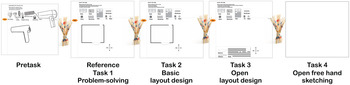
See Figure A1, Table A1, and Figure A2.
Schematic sequence of the tasks’ procedure given to the participants (Vieira et al., Reference Vieira, Gero, Delmoral, Gattol, Fernandes, Parente and Fernandes2020b).
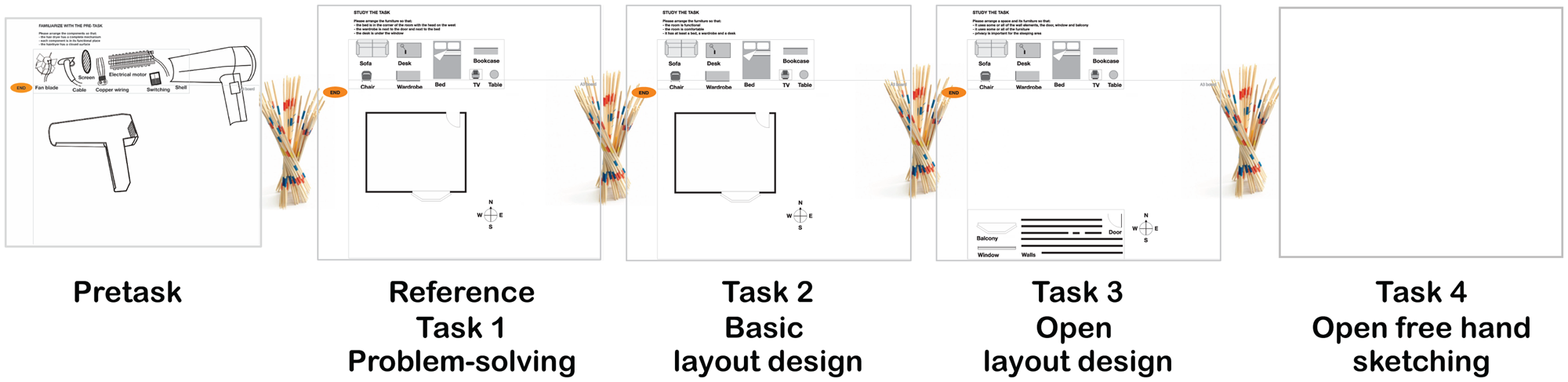
Description of the problem-solving, basic design, and open design tasks (Vieira et al., Reference Vieira, Gero, Delmoral, Gattol, Fernandes, Parente and Fernandes2020b).

Depiction of the problem-solving Task 1, layout design Task 2, open layout design Task 3, and open freehand sketching design Task 4.

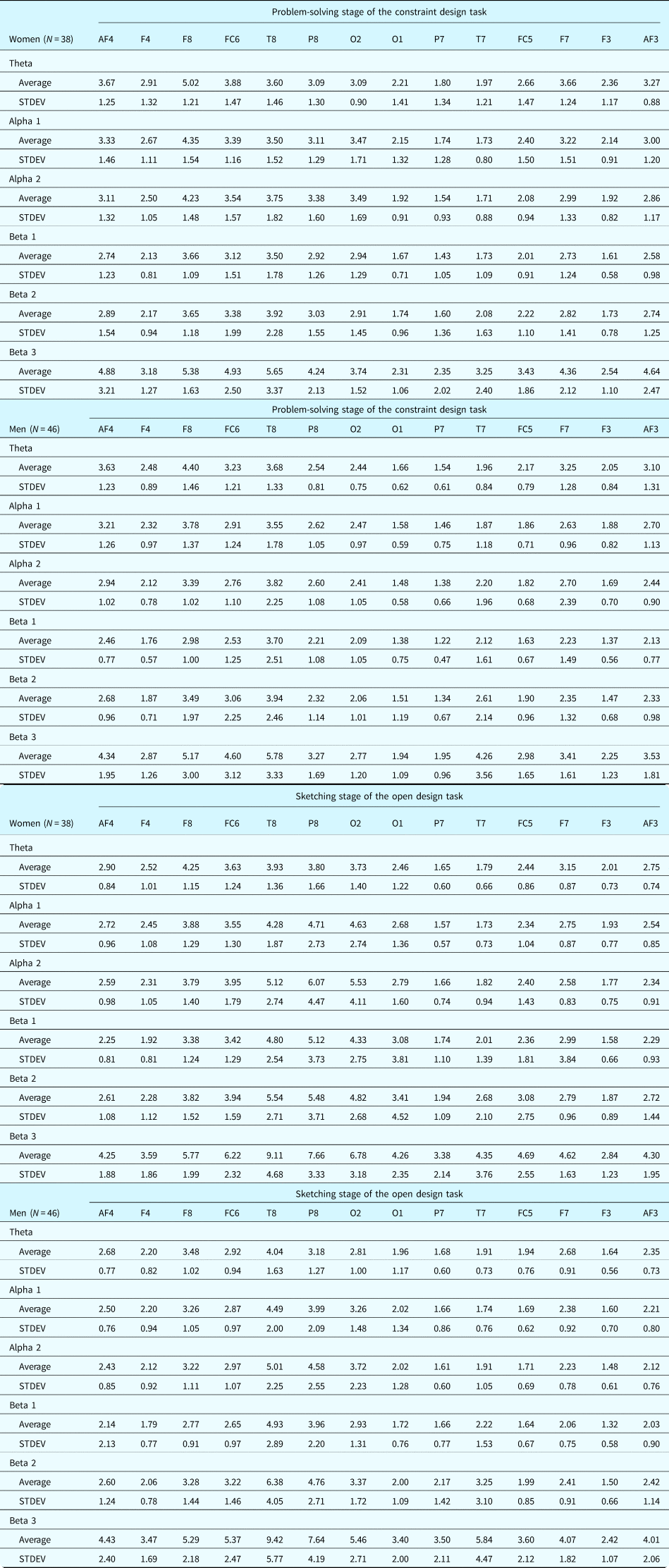
Appendix B
See Table B1.
Cleaned EEG values, namely mean and standard deviation per stage, frequency band and gender.
Appendix C
Significant main effects and interaction effects (*p ≤ 0.05) from the ANOVA (2 × 2 × 7 × 2).

Cohen'sd for gender differences in the channels and bands of problem-solving.

Cohen's d for gender differences in the channels and bands of sketching.
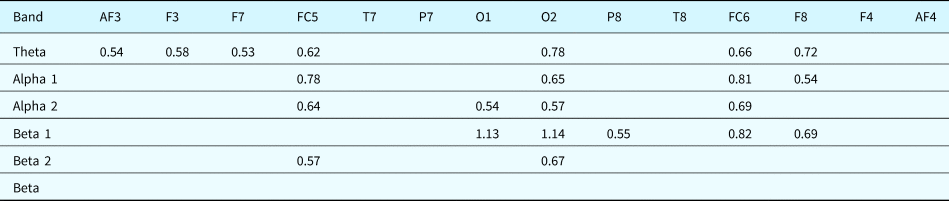
Cohen's d for differences in the channels and bands between problem-solving and sketching of the female designers.

Cohen's d for differences in the channels and bands between problem-solving and sketching of the male designers