





Introduction: psychiatry’s preference for concepts – and its limits
Contemporary psychiatry has consistently privileged concepts (classification, operationalisation, standardisation) over images. This conceptual orientation has been essential for scientific rigour and intersubjective reliability, allowing psychiatry to claim a place among the empirical sciences. However, it has also led to a growing detachment from the experiential and expressive texture of psychic life – its phenomenological ground. The nosographic lexicon, while providing ‘conceptual scaffolding’, risks obscuring what it intends to reveal, transforming the dialogical encounter into a procedural exercise in diagnostic mapping. Patients’ expressions of suffering (feelings, sensations, metaphors and images) are often reduced to quantifiable diagnostic indicators, stripped of their expressive density and contextual meaning. Reference Stanghellini1,Reference Gumbrecht2
Paradoxically, even core psychiatric concepts bear forgotten imaginal origins. Terms like ‘obsession’ (being ‘besieged’) or ‘trauma’ (‘wound’) remind us that psychiatric language was once animated by metaphor and images. Reference Lakoff and Johnson3 Over time, these living figures have ossified into technical constructs, losing their plasticity and imaginative resonance. Suffering does not speak in conceptual terms: it reveals itself in gestures, metaphors and images charged with affective energy, structured by contradiction and animated by conflict. To restore psychiatry’s contact with the vital ground of experience, we must recover the capacity to think in images rather than merely about them – cultivating an imaginal intelligence that joins precision with empathy, and reflection with presence.
Binswanger and Warburg: towards an image-based psychopathology
The work of Ludwig Binswanger and Aby Warburg offers outstanding examples on how psychiatry can go about not only registering and discussing images but also how it can go about thinking in images. Both thinkers sought to understand human existence through the forms in which affect, movement and meaning shape up. For them, the image is a site of revelation. Images are not merely tools for understanding: they are the active process through which meaning is grasped, the dynamic event of understanding itself.
Binswanger’s existential morphologies
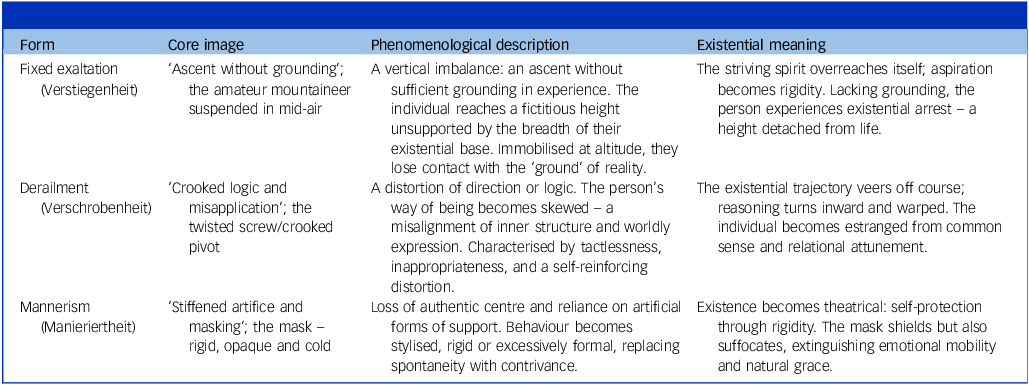
Ludwig Binswanger Reference Binswanger4 described schizophrenia not as a set of symptoms but as a distortion of existence. His three morphologies – fixed exaltation, derailment and mannerism – are not nosological syndromes but images of failed becoming, expressive forms where existence loses proportion and mobility. Drawing from architectural imagery, Binswanger defines health as the ‘anthropological proportion’ – a balance between the height of aspiration and the breadth of grounding. When this equilibrium collapses, existence takes on a characteristic ‘pathic form’. His corresponding images – the ‘poorly equipped’ mountaineer suspended in mid-air, the twisted screw, the rigid mask – are phenomenological diagrams of imbalance (see Table 1). Through such images, Binswanger transforms psychopathology into a phenomenology of dynamic forms (rather than static types), revealing that suffering has a physiognomy – a face.
Existential morphologies

Warburg’s pathosformeln
In parallel, art historian Aby Warburg, who was treated at Binswanger’s clinic, sought to trace pathic gestures in artistic figures across centuries. His formulas of pathos Reference Warburg5 are visual illustrations of affective energy: gestures, postures or expressions where emotion becomes visible. For Warburg, images are dynamic condensations of lived movement, acting as intermediaries between chaos and order. Warburg mapped these recurring forms across epochs, showing how expressive gestures reappear in art, ritual and culture. Meaning arises not from the isolated image but from tensions between images. His epistemology was analogical rather than taxonomic, Reference Hofstadter and Sander6 attentive to relation, metamorphosis and re-emergence. Warburg and Binswanger share the fundamental intuition of the image as a living form of knowledge, resisting the reduction of human life to diagnosis (Binswanger) or art to iconography (Warburg).
The epistemic position of images between sensation and concept, and the general in the particular
Between sensation and concept
Images inhabit the vital space between sensation and concept – the realm where perception takes form and meaning takes flesh. Sensations are the raw, pre-reflective, embodied matter of existence, and emotions are sensations of movement. Reference Stanghellini and Rosfort7
Images are existential morphologies that arise when sensation is shaped. They are Gestaltungen: configurations that give visibility and coherence to experience while preserving its inner motion. Unlike abstract concepts, images remain in contact with the sensory ground. Their form is metamorphic and polysemic. Concepts, by contrast, are images abstracted by logic: they stabilise and clarify, but at the cost of detachment from bodily and affective immediacy. Concepts are luminous but lack the warmth of the world they describe.
Fictional example (created for illustrative purposes): the wave. The experience of a raging sea is pure, pre-reflective sensation. The image of the wave breaking (the arching wall of water, the pounding fist of foam) emerges as a Gestaltung, giving visible shape to the chaos without dulling its dynamism. It remains polysemic (danger, desire, beauty). The concept ‘turbulence’ further abstracts and distances the experience, achieving precision but losing the sensory and affective truth.
The general in the particular
From Renaissance philosophy we inherit the idea that imagination is a genuine faculty of knowledge – the subtle body of thought, Reference Klein8 the organ through which meaning takes form. The image is not merely representational but ontological: it is the point where the general becomes incarnate in the particular. Each image condenses a general sense within a single visible, individual phenomenon. Images can be emblematic: single phenomena that, without losing their singularity, make an entire set of analogous phenomena intelligible. Reference Agamben9 The logic here is neither inductive nor deductive: it is not inductive since you don’t compare many cases to find a common rule. It is not deductive since you don’t apply a general rule to a specific case. The logic is analogical: the single phenomenon acts as an epicentre that illuminates the surrounding field, revealing similarities while respecting individual differences.
Example: the wilted rose. This is a singular, concrete phenomenon. Nevertheless, its exemplary form radiates the shared human meaning of beauty and fragility. It functions as an epicentre that illuminates analogous phenomena: ageing (the first wrinkles appearing on the face of one’s beloved), the failure of a project, political collapse. It is understood through analogy. This analogical power allows the transience to be understood in all cases while respecting the unique tensions of each.
Images thus occupy a privileged epistemic position: they mediate between the sensible and the intelligible, pathos and logos, and between the particular and the universal. They allow the clinician to think affectively – to hold the emotional density of the patient’s experience while engaging in understanding.
Why images are healing
The healing power of images, long recognised in rituals and expressive arts, Reference Kirmayer10,Reference Lévi-Strauss11 lies in their ability to mediate between embodiment and reflection – providing a bridge between what is felt and what can be understood and shared. This process, I argue, is illuminated by four dimensions: form, fidelity, embodiment and generativity. In this section I will offer a concise description of each of these dimensions, accompanied by short fictional case studies crafted for educational purposes and suitable for those in psychiatric education.
Form and containment
Images give form to the formless. In psychic disarray, the image provides a containing surface to hold what would otherwise be unmanageable. By externalising affect into visible form, the image transforms raw experience into something that can be contemplated rather than merely endured. This aesthetic containment mirrors the clinical function of recognition and understanding.
Fictional case study: the exploding clock. At the height of anxiety, the experience was a shapeless inner roar. The image that emerged was a gigantic brass clock exploding outward in slow motion. The chaos did not vanish, but the image compelled the raw clamour into discernible, bounded elements (jagged gears, uncoiling springs). By externalising the formless racket as the structured image of a disintegrating machine, the felt intensity was preserved yet the experience became something that could be seen and explored out there.
Fidelity to experience
Images maintain a high degree of fidelity to lived experience. They access the world non-verbally, bypassing the filters of conceptual language. Words abstract, edit and defend; images preserve ambiguity, simultaneity and depth. They are closer to the emotional truth of experience, especially where speech falters. Since human experience is inherently two-sided and conflicted, images are faithful to the tension of opposites, holding them together. Reference Kirmayer10,Reference Lévi-Strauss11 Conceptual language, in contrast, is a difference machine, driven by the mind’s ‘binary’ drive to distinguish and separate.
Fictional case study: the iron key. Words had failed to make sense of a guilty feeling of impotence, but the emotion persisted in the image of an old iron key, solid and heavy, yet snapped cleanly at the neck. The image held a tension of opposites: the promise of access (the key) and the absolute failure of access (the break). It simply presented the simultaneity and contradiction of a broken state with uncompromising fidelity.
Embodiment
Images are embodied phenomena. They draw directly from the sensory and motor systems of memory. When one recalls an image (a stormy sea, a broken key), the body subtly participates, re-enacting associated movements and tensions. Even in the most abstract domains of scientific inquiry, as Albert Einstein (quoted in ref. Reference Kemp and Brian12 ) famously noted, thought often unfolds through signs and images of a muscular type rather than through words. This somatic resonance is driven by embodied simulation, a pre-reflective functional mechanism that enables the direct experiential understanding of the intentional and emotional contents of images. Reference Freedberg and Gallese13 Ultimately, by reactivating the physical dimension of emotion, images serve as the vital link reconnecting psychic and physical life. Healing proceeds not through abstract insight but through restored movement – the reanimation of what had become rigid or numb.
Fictional case study: the narrow bridge. Recalling the paralysing inner conflict brought into focus the image of a narrow, rickety bridge stretching across a sheer, black drop. The body instantly responded: shoulders tightened, breath caught, core muscles braced, subtly re-enacting the motor tension of maintaining balance over a terrifying void. The psychic anxiety was reanimated, reconnecting the visceral need for stable footing with the mind’s rigid dilemma.
Generativity
Images are not inert representations but generative events. They unfold through metamorphosis, one image calling forth another in a chain of meaning. Their logic is associative and musical rather than deductive – a contrapuntal process. In therapeutic work, this imaginal unfolding sustains creative attunement, enabling discovery rather than mere definition. The characteristic of a good image is its concreteness and precision, coupled with its potential for centrifugal radiation.
Fictional case study: the forest path. Therapeutic work began with the image of a single, overgrown forest path. This was not static; it immediately summoned its counterpoint – a glint of sunlight refracting off a distant, crystalline stream. That glint, in turn, gave rise to another figure – an old carriage swaying with rhythmic, deliberate weight as it carried a necessary burden. Meaning evolved not through definition, but through this unfolding chain of metamorphic correspondences where path, stream and burden became variations enriching the initial theme of being lost yet still oriented towards movement and purpose.
The life and death of images in care
To imagine is to keep experience alive. The living image stands between two dangers: abstraction’s flight from life and sensation’s collapse into chaos. As the flesh of thought, the image holds both together – preserving vitality within form. In the clinical encounter, images perform a mediating function: they allow the patient’s inchoate experiences to take shareable shape. When the clinician and patient co-create an image, they give embodiment to meaning and meaning to embodiment. This co-production mirrors the Renaissance conception of imagination Reference Klein8 as an art of incarnation: a process where universality becomes visible in singular form, a living knot of significance, a principle of limitless activity of the spirit, an inexhaustible wellspring of meaning. Yet images can also degenerate. In psychopathological states, the dynamic, flexible image becomes static, losing its generative potential. Experience congeals into frozen representation – a ‘snapshot’ that blocks further becoming. Delusions can be understood as such frozen images: once-metaphorical configurations that have hardened into literal belief (see Table 2).
Modes of representation: distinguishing image, metaphor, metonymy and delusion
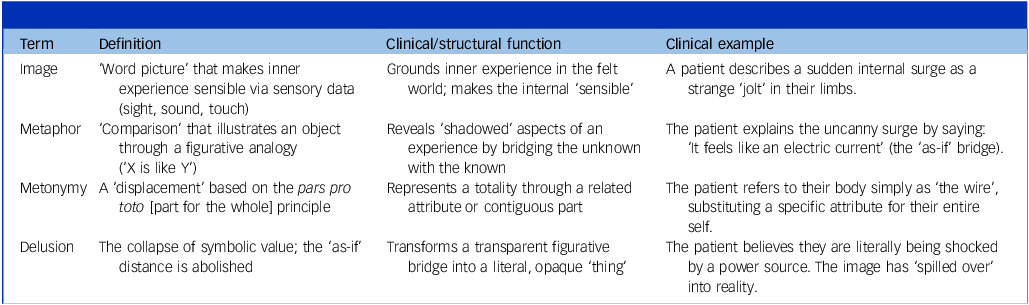
This degeneration is exemplified in the collapse of the ‘as-if’ modality. Initially, a patient uses a metaphor (‘as if electricity were running through me’). When the ‘as-if’ dissolves, metaphor becomes fact: the patient no longer experiences as if but as is – the image hardens into a delusion. The Italian poet Dino Campana, diagnosed with schizophrenia, ceased to speak in metaphors of feeling ‘electric’, instead declaring a literal identity: ‘Mi chiamo Dino, come Dino mi chiamo Edison … sono elettrico’ [my name is Dino, as Dino my name is Edison… I am electric]. Reference Vassalli14 In this self-designation as ‘Dino Edison’, the symbolic comparison collapses into an ontological statement: not ‘I feel electric’ but ‘I am electricity’. Campana’s ‘electric current’ illustrates a chiasmus where sensation, metaphor and delusion dissolve. Metaphorical and metonymic thinking is frequently used as a sense-making tool that allows the linguistic articulation of very intense and unbidden emotional and bodily feelings. People are more likely to engage in embodied metaphorical performance when in heightened emotional states. Reference Littlemore15 Metaphors can be used to restructure and reinterpret domains of experience that are excessively laden with emotion. Reference Kirmayer10 Whereas healthy subjects maintain the ‘as-if’ symbolic distance, delusional concretisation – driven by heightened emotional states – abolishes this buffer. Reference Ritunnano, Littlemore, Nelson, Humpston and Broome16 The figurative spills into the literal, transforming transparent bridges into opaque ‘things’ intended as literal facts. Reference Rhodes and Jakes17 Ultimately, the patient is a like poet imprisoned by metaphors mistaken for reality.
The same principle applies in clinical and cultural contexts. An image taught to a student dies: an image co-created with a patient lives. At the cultural level, Roland Barthes Reference Barthes18 described this process as the formation of mythologies: when living images ossify into clichés. Paul Ricoeur Reference Ricœur19 called them ‘dead metaphors’ – forms that have lost their capacity to generate meaning. Linguists speak of ‘lexicalisation’: the freezing of expressive vitality into fixed semantic units. Psychiatry, with its inherited metaphors turned technical terms, offers a striking illustration and this relates directly to charges of reductionism and reification against it. The vitality of care depends on keeping images alive, relational and open to transformation.
Dialectical images and the poetics of dynamic understanding
A paradigmatic instance of the living image is Walter Benjamin’s dialectical image Reference Benjamin20-Reference Stanghellini, Ikkos and Poltrum22 – a figure that holds contradiction without resolving it. It brings opposites into proximity (lucidity and confusion, suffering and hope) and exposes the hidden tensions of experience. Reference Stanghellini23 Benjamin’s image is non-synthetic: it sustains the tension, grasping the symptomatic dialectic – like a psychopathological symptom, it is a compromise formation where discordant forces coexist. For psychiatry, the symptom itself can be understood as a dialectical image – a crystallisation of psychic conflict. Reference Didi-Huberman24 The clinician’s role is not to dissolve the contradiction but to sustain it – to hold open the fracture through which meaning can emerge. Reference Morgan25 This is the ethics of imaginal psychiatry: to see without enclosing, to understand without mastering. Every symptom becomes a site of revelation, a living image in which psychic contradiction takes form. Healing is not the erasure of tension but the transformation of its form – from chaos to expression, from symptom to sense.
Case study: the broken mirror. Susan Brison, a philosopher and trauma survivor, was shattered by sexual assault and strangulation. Reference Brison26 She could not make sense of her loss. In a support group, the facilitator, Ann, used an image to intervene: ‘When your life is shattered, you’re forced to pick up the pieces, and you have the chance to stop and examine them. You can say “I don’t want this anymore”, or “I think I’ll work on that one”’.
The image of a broken mirror (the reflected self-image gone to pieces) holds the tension of opposites: the fragments are sharp and dangerous (the negative profile), but the shattering of the former self is also an opportunity for choice and recomposition (the positive profile). This dialectical image revealed its vital power by acknowledging the devastating violence while simultaneously suggesting a chance for the recomposition of the self.
The ethics of imaginal care
Images are the living bridge between sensation and thought, body (including brain) and meaning, the universal and the particular. To work with them in psychiatry is both an epistemic and an ethical act. The clinician’s task is to safeguard their vitality – to ensure they remain alive, flexible and dialogical. Restoring the centrality of images restores psychiatry’s contact with the sensuous ground of human existence. Healing begins, or is reinforced, when a vivid image arises between two presences – not when we merely name what the patient feels, but when we see it together. In that shared space of imagination, psychiatry becomes a poetics of recognition – a practice of seeing that allows existence to find its form again.
This paper serves as a theoretical spark to address a significant challenge in psychiatric education: the tendency for algorithmic models to overshadow the density of the patient’s lived experience. By integrating with it – rather than replacing it with – the phenomenological dimension, I propose a pedagogical shift towards a perceptive presence. This model trains the clinician to maintain the tension between literal speech and symbolic resonance. The specific instrumentalisation of psychiatric concepts may marginalise this expressive density. A checklist hegemony is at risk of transforming diagnostic tools into technocratic templates. Reference Ikkos, Becker, Stanghellini, Brencio, Morgan and Hoff27 When a patient describes existential despair as ‘a heavy fog of lead’, the requirement for structured data may force a semantic collapse, literalising the image into a discrete categorical box such as ‘psychomotor retardation’. Here, the patient’s primary medium of articulation – a metaphorical image – is treated as mere ‘noise’ to be filtered in favour of a diagnostic ‘signal’. An emphasis on containment over understanding may give precedence to administrative safety over hermeneutic depth. Prioritising immediate containment over this symbolic resonance de-metaphorises the encounter, foreclosing a dialogue about the patient’s dilemmas. In the case of ‘the narrow bridge’, a purely symptomatic reading focuses on the physiological markers of anxiety and motor tension. What is sacrificed is the metaphoric power of the image as a reanimation of a ‘terrifying void’, an essential clue to the patient’s visceral need for existential footing. The erosion of presence occurs when pedagogical models enshrine algorithmic efficiency. Rewarding rapid symptom-mapping over narrative competence may condition the clinical gaze to be ‘appropriately detached’, viewing the density of experience as an obstacle rather than a vital indicator of progress. Confronted with the image of ‘the iron key’, a clinician focused on efficiency might categorise the report as a ‘guilty feeling of impotence’ without acknowledging the image’s uncompromising fidelity to a broken state.
Conceptual clarity and imaginal attunement are complementary. A ‘both-and’ proposal is required. Concepts allow us to classify; images allow us to encounter. A mature clinical practice requires both: the stability of concepts and the vitality of images – each correcting, enriching and completing the other in the work of discovery and care. When the task is to speak about a patient (diagnosis, classification), a conceptual language is indispensable. When the task is to speak with a patient (entering their experience), pictorial intelligence is more faithful to the lived world, carrying affect, embodiment and complexity. For the clinician, precision must mean fidelity of perception. This approach offers specific gains: it distinguishes symptom classification from existential morphology, e.g. viewing Binswanger’s ‘fixed exaltation’ not as poor insight or as a pathologising of the heights, but as a spatial–dynamic disorientation – a bold and generous ascent but without horizontal breadth.
Furthermore, this approach based on imaginal intelligence utilises the chiasmus of the metaphor as a metric for recovery. In the poetry of Dino Campana, we see ‘electricity’ move between a concrete physical force and a symbolic element of vision. Progress is marked when the ‘electricity’ the patient perceives as a literal, invasive current is restored to its symbolic status, becoming once again an image of internal tension. Ultimately, conceptual clarity and imaginal intelligence are complementary. A mature clinical practice requires the meta-conceptual clinician who has mastered the rigour of diagnostic algorithms while recovering the capacity for creative presence. By integrating these dimensions, psychiatry moves from a restorative mechanics to a hermeneutic of human suffering.
Data availability
Data availability is not applicable to this article as no new data were created or analysed in this feature. The analytic code supporting the findings will be available to other researchers following publication.
Acknowledgements
The author thanks the study group ‘Precision of Images; Emil Kraepelin, Walter Benjamin and the History of Psychiatry 1926–2026’ for their support.
Funding
The author received no financial support for the research, authorship and/or publication of this article.
Declaration of interest
The author declares no conflicts of interest.
Transparency declaration
The manuscript is an honest, accurate and transparent account of the study being reported; that no important aspects of the study have been omitted; and that any discrepancies from the study as planned (and, if relevant, registered) have been explained.
Ethical standards
The author asserts that all procedures contributing to this work comply with the ethical standards of the relevant national and institutional committees on human experimentation, and with the Helsinki Declaration of 1975 as revised in 2013.

 Open access


eLetters
No eLetters have been published for this article.