





Introduction
Neonatal intensive care units (NICUs) serve vulnerable patient populations who are at increased risk of healthcare-associated infections (HAI). In this environment, Staphylococcus aureus (S. aureus) is a leading cause of HAIs, which increases morbidity and mortality. Reference Weiner-Lastinger, Abner and Benin1,Reference Jennings, Elhaissouni and Colantuoni2 S. aureus transmission and outbreaks are common in the NICU despite rigorous infection prevention measures. Controlling S. aureus is challenging in the NICU because family, visitors, and health-care workers are often asymptomatically colonized and are known reservoirs for transmission.
Prior studies have shown that enhanced infection controls precautions, such as gowns and gloves, can reduce the transmission of bacteria in ICUs. Reference Harris, Pineles and Belton3 During the pandemic, hospitals implemented enhanced infection control practices, including universal masking and limited visitation to prevent the spread of SARS-CoV-2. The pandemic provided an opportunity to assess whether masking and visitation restrictions may have decreased S. aureus transmission to infants in the NICU. Our objective was to explore the impact of pandemic infection control practices on S. aureus acquisition rates during compared to before the pandemic.
Methods
We performed a retrospective cohort study including neonates admitted to three Johns Hopkins (JH) Health System NICUs (the JH Children’s Center, JH Bayview Medical Center and JH Howard County Medical Center) between July 2017 and December 2022. These NICUs had various room configurations (eg private, open bay, shared) yet consistent staffing ratios and hand hygiene adherence during the study period. We included all neonates admitted to the NICU for more than two calendar days, regardless of transfer status. All NICUs have a S. aureus control program of weekly nasal surveillance for all patients, admission nasal surveillance for outborn neonates, and decolonization of infants with S. aureus. Reference Milstone, Voskertchian and Koontz4 All NICUs suspended 1) visitors exposed to or positive for SARS-CoV-2 throughout the duration of the pandemic and 2) sibling visitation. JHHS implemented mandatory universal staff and visitor masking in April 2020 through April 2023. This study was approved by the Johns Hopkins IRB with a waiver of informed consent.
The primary outcome was NICU-acquired S. aureus acquisition defined as having a nasal surveillance culture or a culture collected during clinical care (eg respiratory or blood culture) that grew S. aureus more than two days after NICU admission. We excluded neonates who had a positive culture within two days of admission. For infants who had positive surveillance and clinical cultures, we defined the outcome based on the timing of the first positive S. aureus culture. At-risk time was measured in patient days.
Descriptive statistics compared the characteristics of neonates admitted before and during pandemic periods. Outcomes were measured as monthly incidence rates (number of neonates per 1000 patient-days). Using Poisson regression models, we compared average monthly rate of NICU-acquired S. aureus acquisition before and during pandemic periods and fit an interrupted time series model (ITS) allowing for the immediate impact of the pandemic and potential changes in the trend of the monthly incidence. Statistical analyses were conducted using R Statistical Software v4.2.3.
Results
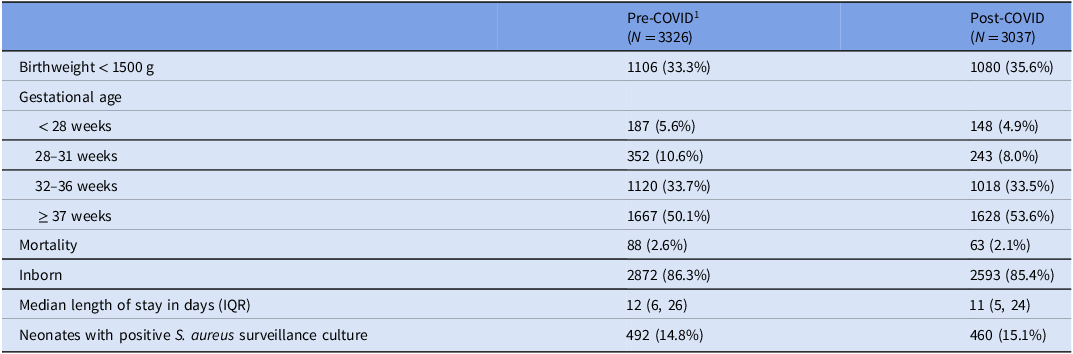
During the study period, there were 6363 eligible infants after excluding 133 neonates who had a positive culture within two days of admission. Neonates before and during the pandemic period had similar proportions of neonates with birthweights <1500grams (33.3% and 35.6%, respectively), median length of NICU stay (12 and 11 days) and mortality rates (2.6% and 2.1%) (Table 1).
Demographic and clinical characteristics of neonates in three NICUs between 2017 and 2022

1Neonates are classified in the pre- or post-pandemic period based on the date of their first nasal surveillance or clinical culture for those tested or admission date for those not tested.
Abbreviations: grams (g), interquartile range (IQR).
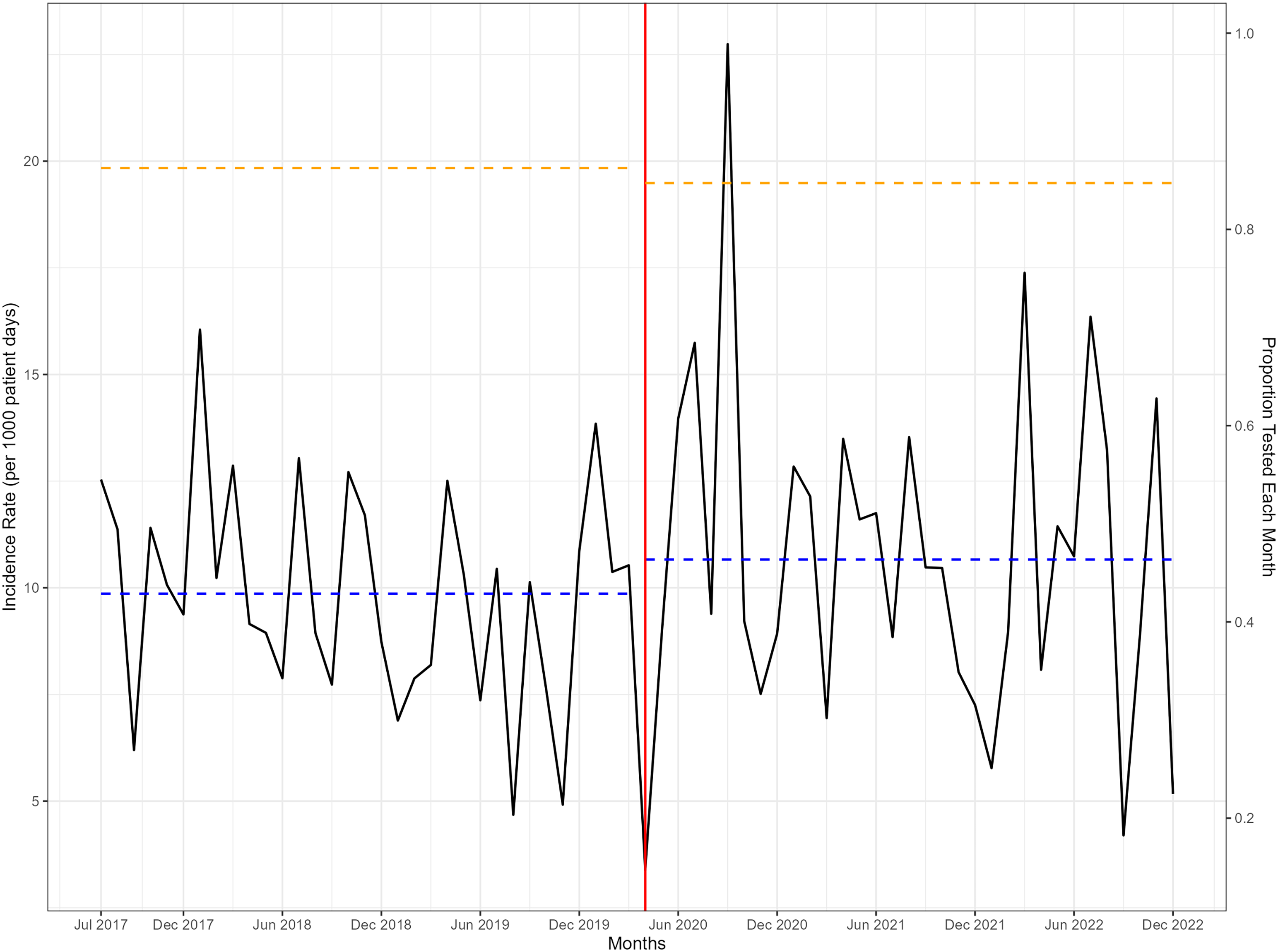
During 93,456 at-risk days, 952 infants acquired S. aureus during their NICU admission through a positive nasal surveillance or clinical culture. Of these infants, 19 had a clinical culture that grew S. aureus prior to a positive nasal surveillance culture. Similar proportions of infants acquired S. aureus before and during pandemic periods (14.80% and 15.10%, respectively). The monthly incidence ranged from 3.38 to 22.74 colonizations per 1000 patient days (Figure 1). The monthly average proportion of infants who had a nasal surveillance culture collected before the pandemic (0.86) and during the pandemic (0.85) were similar. Across the entire study duration, the monthly proportion of infants who had a surveillance culture collected ranged from 0.74 to 0.93. The average monthly incidence of NICU-acquired S. aureus colonization was similar before and during the pandemic period (9.86 and 10.66 colonizations per 1000 patient days; incidence rate ratio [IRR] 1.08, 95% CI: 0.92–1.26). In the ITS model, there was a non-significant 23.1% (95% CI: 0.73–2.07) immediate increase in the colonization rate at the start of the pandemic (eTable 1).
Monthly trend of unit-acquired S. aureus colonization, including both surveillance and clinical cultures, among infants in 3 NICUS before and after introduction of enhanced pandemic infection control measures from 2017–2022. Unit-acquired S. aureus acquisitions were defined as having either a first clinical or nasal surveillance culture that grew S. aureus more than two days after NICU admission. Incidence rates are S. aureus acquisitions per 1000 patient days. The dotted blue line represents the monthly average rate before the pandemic (9.86) and during the pandemic (10.66). The orange dotted line represents the monthly average proportion of infants who had a nasal surveillance culture collected before the pandemic (0.86) and during the pandemic (0.85) as a measure of adherence to surveillance testing.

Discussion
S. aureus remains the most common cause of HAIs in infants in the NICU. Reference Weiner-Lastinger, Abner and Benin1 Colonization is a well-known predisposing risk factor to infection. Reference Huang, Chou, Su, Lien and Lin5 Current strategies to prevent S. aureus transmission and infections in NICUs include hand hygiene, environmental cleaning, and in some settings screening and decolonization. Reference Milstone, Elward and Brady6 Enhanced infection prevention practices, such as universal masking and visitor restrictions, were introduced during the pandemic to prevent the spread of SARS-CoV-2. Reference Rusin, Saporta-Keating, Dominguez, Nyquist, Pearce and Silveira7 Our findings from three NICUs that maintained pre-pandemic prevention measures suggest that there was not a decrease in S. aureus acquisition following introduction of additional pandemic prevention measures. Our data are consistent with a previous study that reported higher NICU MRSA rates when instituting universal masking. Reference Most, Phillips and Sebert8 Additionally, the lack of influence of changes in visitor polices on S. aureus incidence in the NICU was similarly consistent with another single-center study. Reference Evans, Bailey, Verma and Cicalese9 Overall, these studies suggest that the increase in infection prevention strategies targeted to reduce the spread of SARS-CoV-2, did not reduce the spread of S aureus in the NICU.
Some important considerations may help explain why enhanced infection prevention practices may not reduce S. aureus transmission in the NICU. A recent study suggested that prolonged masking can change the nasal microbiota and increase S. aureus burden compared to mask-free periods. Reference Xiang, Xu and Jian10 This higher colonization density may increase the risk for hand contamination when people touch their face and nose during times of prolonged masking. Reference Xiang, Xu and Jian10 Regarding lack of impact of visitation strategies, parent visitation was not restricted in NICUs during the pandemic in the same fashion as in other hospital units. Visiting parents were required to wear masks, but if masking can increase S. aureus colonization burden, Reference Xiang, Xu and Jian10 and parents are a known S. aureus reservoir, Reference Milstone, Voskertchian and Koontz4 then pandemic precautions may have had an unintended consequence of temporarily increasing parent-to-child postnatal S. aureus transmission. Together, these findings suggest that although NICU policies should consider universal masking or visitor restrictions to prevent respiratory virus outbreaks, these strategies do not offer benefit to the control of S. aureus transmission in the NICU.
There were limitations to this analysis. Our study examined three NICUs in Maryland that consistently recommended S. aureus screening and decolonization, limiting the generalizability of the findings. Although there were additional infection prevention interventions used during the pandemic, implementation of and adherence to infection prevention interventions (eg masking) varied over time. While supply shortages may have reduced surveillance testing during the pandemic, the proportion of neonates screened remained consistent before and during pandemic periods. Further research is needed to identify other strategies to prevent S. aureus transmission in the NICU.
Supplementary material
To view supplementary material for this article, please visit https://doi.org/10.1017/ice.2025.10319.
Acknowledgements
We thank Laura Selway and the NICU staff for their dedication to infection prevention during the pandemic.
Financial support
This work was supported in part by the National Institutes of Health grants K24 AI141580 to Dr. Milstone, KL2 TR003099 to Dr. Prochaska, and K23 HD100594 to Dr. Johnson. NE and AM had full access to all the data in the study and take responsibility for the integrity of the data and the accuracy of the data analysis. The funding organizations took no part in the design and conduct of the study; collection, management, analysis, and interpretation of the data; preparation, review, or approval of the manuscript; and decision to submit the manuscript for publication.
Competing interests
The authors declare none.


 Open access

