


Introduction
Bustards are amongst the most endangered groups of birds in the world, threatened by hunting, habitat degradation and loss, disturbance, and infrastructure development such as roads, windfarms, solar farms, and especially overhead powerlines (Collar et al. Reference Collar, Baral, Batbayar, Bhardwaj, Brahma, Burnside, Choudhury, Combreau, Dolman, Donald, Dutta, Gadhavi, Gore, Goroshko, Hong, Jathar, Jha, Jhala, Koshkin, Lahkar, Liu, Mahood, Morales, Narwade, Natsagdorj, Nefedov, Silva, Thakuri, Wang, Zhang and Kessler2017). Overhead powerlines pose a significant collision risk for bustards, and are identified as a major source of non-natural mortality (Jenkins et al. Reference Jenkins, Smallie and Diamond2010, Martin and Shaw Reference Martin and Shaw2010, Bernardino et al. Reference Bernardino, Bevanger, Barrientos, Dwyer, Marques, Martins, Shaw, Silva and Moreira2018, Marcelino et al. Reference Marcelino, Moreira, Mañosa, Cuscó, Morales, García de la Morena, Bota, Palmeirim and Silva2018). With the expansion of electricity grids globally, driven by political, economic, egalitarian, and humanitarian considerations, and notably with the development of renewable power sources to reduce carbon emissions, there is a rapidly rising concern over the severity of the impacts of utility infrastructures on birds, and over the ways these impacts can be mitigated (Bernardino et al. Reference Bernardino, Bevanger, Barrientos, Dwyer, Marques, Martins, Shaw, Silva and Moreira2018), particularly for species such as bustards that are exceptionally susceptible to powerline collisions.
Multiple variables affect this kind of susceptibility in birds (review in Bernardino et al. Reference Bernardino, Bevanger, Barrientos, Dwyer, Marques, Martins, Shaw, Silva and Moreira2018). Environmental factors, both spatial and temporal, including topography and habitat features (APLIC 2012) and light levels, weather conditions, season, and phenology (e.g. Shaw et al. 2013), all play a role. The behaviour of the birds themselves is also important, as nocturnal flights may result in higher collision rates (Murphy et al. Reference Murphy, Dwyer, Mojica, McPherron and Harness2016a). The position (in a vertical or horizontal configuration), height and conspicuousness of wires all contribute an effect (e.g. Bevanger Reference Bevanger1994, Marques et al. Reference Marques, Martins, Silva, Palmeirim and Moreira2021). Birds that fly in flocks appear to be at higher risk, possibly because the tendency to follow leaders overrides individual vigilance (e.g. Drewitt and Langston Reference Drewitt and Langston2008). Species with larger biometrics such as weight and wing-load are associated with faster flight and lower manoeuvrability, and are therefore at greater risk (e.g. Bevanger Reference Bevanger1998). Those in which frontal visual fields are reduced are also at greater risk (Martin and Shaw Reference Martin and Shaw2010). Bustards combine these various behavioural and morphological disadvantages, being gregarious during much of their annual cycle, and relatively heavy mid-sized to large birds with very limited binocular frontal visual fields (Martin and Shaw Reference Martin and Shaw2010).
The commonest measure to mitigate bird mortality by collisions with powerlines is the marking of the conductor wires and earth wire with devices commonly called ‘bird flight diverters’ (BFDs), which aim to provide a sufficiently strong visual signal to induce evasive action in an approaching bird (Barrientos et al. Reference Barrientos, Alonso, Ponce and Palacín2011, Bernardino et al. Reference Bernardino, Bevanger, Barrientos, Dwyer, Marques, Martins, Shaw, Silva and Moreira2018). However, the efficacy of this mitigation varies greatly with device design, environment, and target species (Jenkins Reference Jenkins, Smallie and Diamond2010, Bernardino et al. Reference Bernardino, Martins, Bispo and Moreira2019); it is widely apparent that BFDs may ease but do not solve the problem for certain species. Moreover, powerlines may also cause displacement effects involving reductions in bird abundance or in the degree of occupancy of suitable habitat adjacent to the infrastructure (Silva et al. Reference Silva, Santos, Queirós, Leitão, Moreira, Pinto, Leqoc and Cabral2010, Lóránt and Vadász Reference Lóránt and Vadász2014). One hypothesis explaining this pattern relates to the use or preference of pylons and poles by raptors for perching, providing advantageous views for scanning the surrounding landscape, which may render it unattractive or unusable for prey species (Silva et al. Reference Silva, Santos, Queirós, Leitão, Moreira, Pinto, Leqoc and Cabral2010). In some situations, these tall structures (whose size varies mostly with voltage level and wire configuration) also act as barriers, changing regular flight movements between bisected patches of habitat (Pruett et al. Reference Pruett, Patten and Wolfe2009, Raab et al. Reference Raab, Spakovszky, Julius, Schütz and Schulze2011).
The impact of powerlines on bustard populations seriously compounds other major threats such as habitat change, hunting and poaching, and predation, particularly for those species that are at highest risk (Collar et al. Reference Collar, Baral, Batbayar, Bhardwaj, Brahma, Burnside, Choudhury, Combreau, Dolman, Donald, Dutta, Gadhavi, Gore, Goroshko, Hong, Jathar, Jha, Jhala, Koshkin, Lahkar, Liu, Mahood, Morales, Narwade, Natsagdorj, Nefedov, Silva, Thakuri, Wang, Zhang and Kessler2017). However, despite the issue long being flagged as a conservation challenge (APLIC 2012) and the accumulation of a considerable body of literature on the subject (review in Bernardino et al. Reference Bernardino, Bevanger, Barrientos, Dwyer, Marques, Martins, Shaw, Silva and Moreira2018), information on how powerlines and mitigation measures affect bustards in particular remains scant. Consequently, with the present rapid expansion of electricity grids, planners and conservationists are being forced to take decisions on the deployment and management of powerlines in bustard-occupied landscapes without access to scientifically validated specifications. Experience is restricted to western Europe, southern Africa, and some parts of Asia, while guidance on monitoring and mitigating powerline impacts on bustards has until now been unavailable to conservation practitioners.
This paper encompasses two distinct sections. In the first we review all available evidence on the impacts of powerlines on bustards, including mortality, displacement, and population effects based on both peer-reviewed and grey literature. In the second we outline best practice and, based on our cumulative experience, make recommendations for assessing the impacts of powerlines on bustards and for implementing and monitoring mitigation measures. We further suggest approaches for future research in this emerging area of conservation concern.
Review of the impacts of powerlines on bustards
Methods
To compile data on the effects of powerlines on bustard species we followed two complementary approaches. First, we undertook a systematic literature review, through the compilation of peer-reviewed studies from the search engines ISI Web of Knowledge and Scopus. The search was carried out in January 2021, with the term ‘line’ or ‘wire’ combined with one of the following key words: ‘bustard’, ‘Tetrax’, ‘Otis’, ‘Chlamydotis’, ‘Lissotis’, ‘Neotis’, ‘Ardeotis’, ‘Houbaropsis’, ‘Sypheotides’, ‘Lophotis’, ‘Heterotetrax’, ‘Afrotis’, ‘Eupodotis’, ‘Otididae’, ‘florican’ and ‘korhaan’. All documents referring to interactions between bustards and powerlines were considered in our analysis. Second, as this review was restricted to literature in English, we consulted with professionals working on the effects of powerlines on bustards (and on birds in general). We particularly targeted regions under-represented in peer-reviewed studies, such as eastern Europe, Asia, and Africa (except South Africa), and sought to collect data that were dispersed in non-ISI documents and those unavailable in English. The steps followed to identify, screen, and include studies are represented in a PRISMA flow diagram (Paige et al. 2020) in Figure S1 in the online supplementary material. Whenever possible, the resulting information was assigned to two powerline types: (i) ‘transmission lines’, which carry electricity at high voltages (>60 kV) from generating facilities to substations, and (ii) ‘distribution lines’, which deliver electricity from substations to consumer hubs at lower voltages (<60 kV) (IEA 2016). Typically, transmission lines are taller and wider, have a larger number of conductor wires and include thinner, less visible earth wires (i.e. wires that provide an electrical connection to the ground, hence also called ground wires, but which are usually positioned above conductor wires).
Results
We found a total of 79 studies, most of them in the grey literature (55%) reporting effects of overhead wires in bustards. The earliest record dates back to 1884 and refers to collisions of Little Bustards Tetrax tetrax with telephone wires, but this topic becomes more frequent after the year 2000 (94% after 2000, 63% after 2010).
Mortality by collision
All evidence on mortalities resulting from bustard collisions with powerlines, from both systematic monitoring studies and incidental records, was assembled, supplementing Mahood et al. (Reference Mahood, Silva, Dolman and Burnside2018) and Silva et al. (Reference Silva, Arroyo, Marques, Morales, Devoucoux, Mougeot, Bretagnolle, Traba and Morales2022). Most sources merely reported mortality events and did not estimate collision rates for species, account for survey bias, or clearly report survey effort. Comparisons among studies or species are therefore limited and subject to bias.
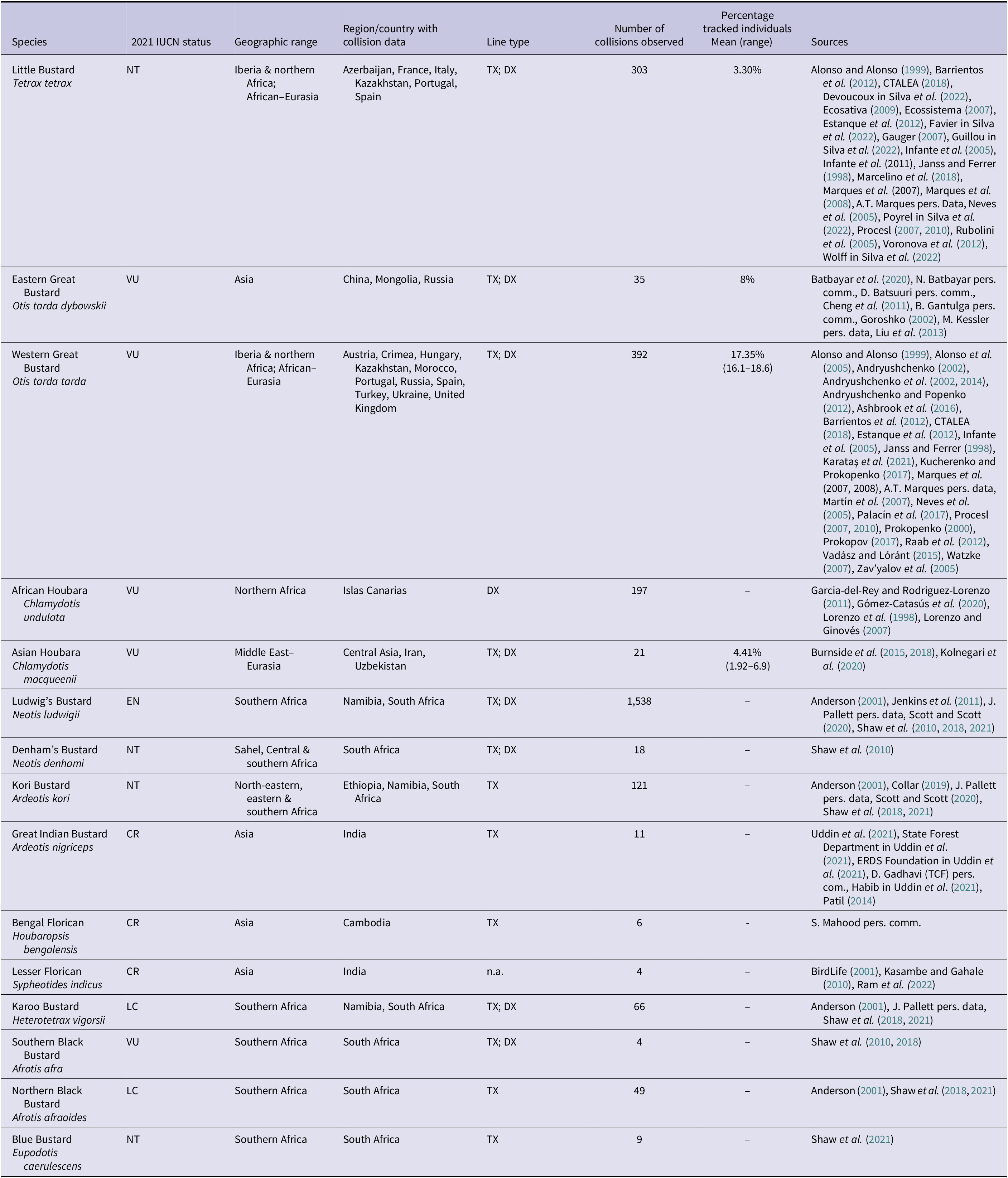
We collected 2,774 records of collisions with powerlines (almost always mortality events) involving 14 of the 26 bustard species (taxonomy following del Hoyo and Collar Reference del Hoyo and Collar2014), spanning IUCN Red List categories from ‘Least Concern’ to ‘Critically Endangered’ (Table 1, with details in Table S1). Most records involve European and southern African species or populations. We found no evidence from central Africa or Australia (although we found a collision with a telephone wire by the Australian Bustard Ardeotis australis, a 15th species; see Table S2), presumably reflecting the lower density of powerlines and/or lower number of relevant studies in these regions. The southern African Ludwig’s Bustard Neotis ludwigii produced the largest number of mortality records (c.56%), followed by the Palearctic members of the family, Little Bustard, Great Bustard Otis tarda, African Houbara Chlamydotis undulata and Asian Houbara C. macqueenii.
Summary of collision events with powerlines by bustard species (total mortality events: 2,769 individuals). Species, species range and 2021 IUCN Red List category are given based on BirdLife International (2021); Great Bustard broken into two subspecies but Red List category applies to the species. Line type: TX – transmission powerlines, DX – distribution powerlines. Number of collisions observed: total number of collision events compiled for each species. Percentage tracked individuals: powerline victims with GPS telemetry devices per study or by several studies (mean and range presented). Sources: studies or experts providing data on bustard collisions.
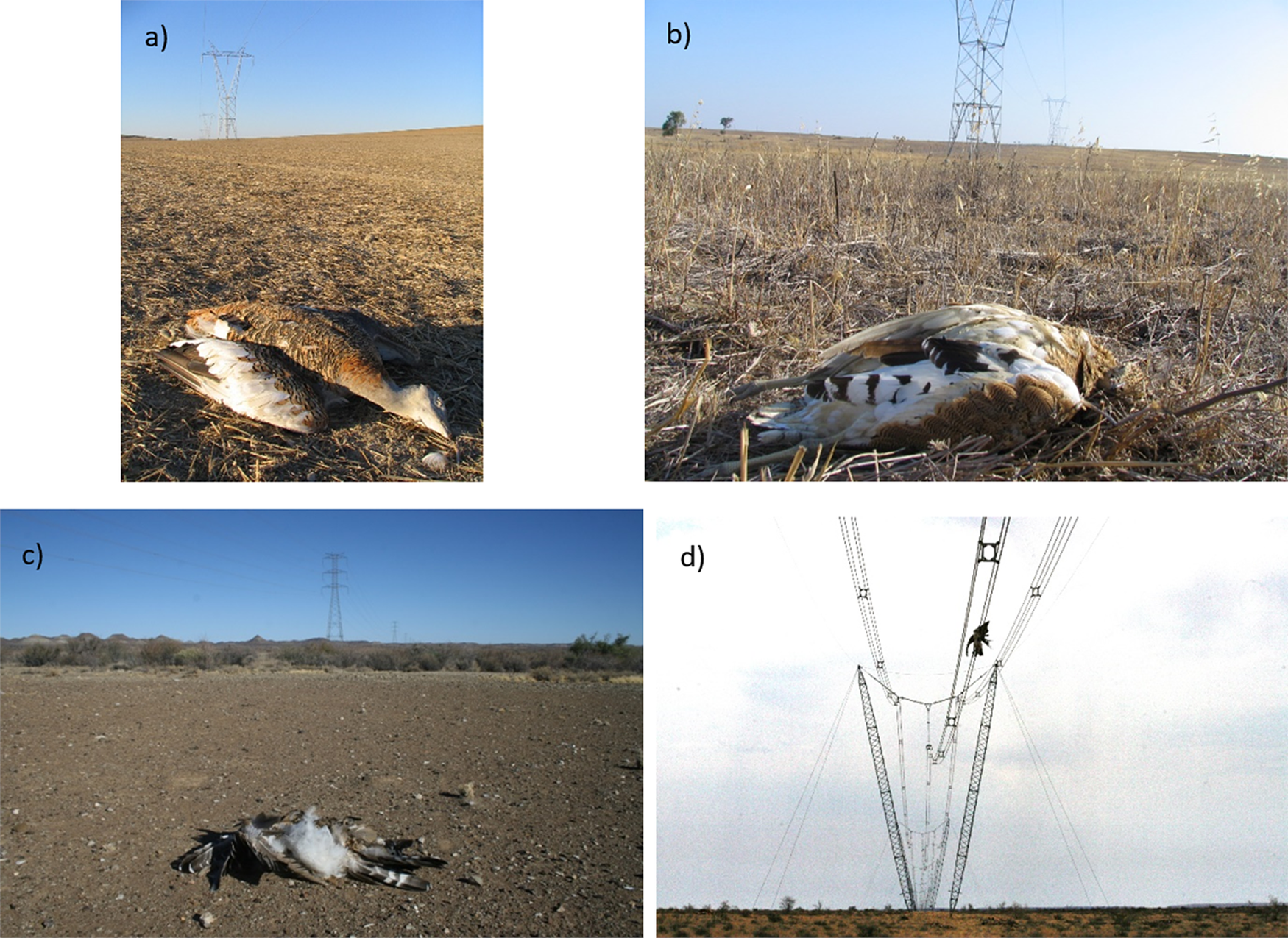
Collisions were reported for both transmission and distribution powerlines (Figure 1), but also for telephone, telegraph, and railway wires (n = 98, details in Table S2). Two studies conflated mortalities on powerlines, telephone wires and fences (Ashbrook et al. Reference Ashbrook, Taylor, Jane, Carter and Szekely2016, Gómez-Catasús et al. Reference Gómez-Catasús, Carrascal, Moraleda, Colsa, Garcés and Schuster2020). When identified in or identifiable from reports, transmission lines caused 1,963 collisions compared to 429 caused by distribution lines. These figures do not necessarily reflect the relative danger posed by the two types of line; rather they could simply reflect the greater attention given to the larger transmission lines. In fact, the highest record of collision events per km was reported for Little Bustards at a telephone wire in a single survey in Azerbaijan, where the largest known wintering flocks of this species concentrate (Ivanov and Priklonskii Reference Ivanov and Priklonskii1965). It should also be noted that the distribution grid is much larger (e.g. in Alentejo, Portugal, almost 10 times larger than that for transmission; Marques et al. Reference Marques, Martins, Silva, Palmeirim and Moreira2021), potentially representing an overall higher mortality risk. Additionally, two or more transmission lines and distribution lines often run in parallel, making it difficult to establish the structure responsible for the collision.
Bustard deaths by collision with powerlines in different countries: a) Great Bustard in Portugal (photo: A. T. Marques); b) Little Bustard in Portugal (photo: A. T. Marques); c) Ludwig’s Bustard and d) Kori Bustard in Namibia (photos: J. Pallett).
Displacement and barrier effects
We found only six studies, all European, that specifically address powerline displacement effects on bustards, involving two species, namely Great Bustard (Lane et al. Reference Lane, Alonso and Martín2001, Magaña et al. Reference Magaña, Alonso, Martín, Bautista and Martín2010, Lóránt and Vadász Reference Lóránt and Vadász2014) and Little Bustard (Silva et al. Reference Silva, Santos, Queirós, Leitão, Moreira, Pinto, Leqoc and Cabral2010, Santos et al. Reference Santos, Bessa, Cabral, Pacheco, Leitão, Moreira, Pinto, Lecoq and Silva2016, Alonso et al. Reference Alonso, Correia, Marques, Palmeirim, Moreira and Silva2020). Displaying male Great Bustards avoid sites located within 400 m of medium-voltage powerlines, and occupy areas within 500–1,000 m of them less than expected (Lóránt and Vadász Reference Lóránt and Vadász2014), while the densities of displaying male Little Bustards decline with increasing proximity to transmission powerlines (Silva et al. Reference Silva, Santos, Queirós, Leitão, Moreira, Pinto, Leqoc and Cabral2010, Santos et al. Reference Santos, Bessa, Cabral, Pacheco, Leitão, Moreira, Pinto, Lecoq and Silva2016). As noted, such displacements may reflect the increased risk posed by raptors perching on the structures (Stahlecker Reference Stahlecker1978, Lammers and Collopy Reference Lammers and Collopy2007), particularly during the breeding season, as minimising predation risk is crucial in nest-site selection (Magaña et al. Reference Magaña, Alonso, Martín, Bautista and Martín2010). However, Little Bustards do not seem to avoid powerlines when selecting stopover areas, possibly because some perform post-breeding dispersal movements at night, when they cannot detect these structures (Alonso et al. Reference Alonso, Correia, Marques, Palmeirim, Moreira and Silva2020).
Raab et al. (Reference Raab, Spakovszky, Julius, Schütz and Schulze2011) found that take-off flight directions of Great Bustards are influenced by the presence of powerlines at c.800 m, and up to 1,600 m. This behaviour may reduce the risk of collision, but it also reveals how powerlines can become barriers, fragmenting habitat by conditioning the movements of local populations, potentially at wide spatial scales (Raab et al. Reference Raab, Spakovszky, Julius, Schütz and Schulze2011).
Population, behavioural and demographic effects
Mortality at powerlines is often cited as a probable factor in local bustard population declines (e.g. Pinto et al. Reference Pinto, Rocha and Moreira2005, Collar et al. Reference Collar, Baral, Batbayar, Bhardwaj, Brahma, Burnside, Choudhury, Combreau, Dolman, Donald, Dutta, Gadhavi, Gore, Goroshko, Hong, Jathar, Jha, Jhala, Koshkin, Lahkar, Liu, Mahood, Morales, Narwade, Natsagdorj, Nefedov, Silva, Thakuri, Wang, Zhang and Kessler2017, WII 2018). However, the effects of powerlines on bustards are difficult to quantify through population approaches, specifically when aiming to assess the rate of decline caused by the infrastructure, because they require demographic and biological data that are often unavailable. Several studies finding apparently unsustainable collision rates were unable to establish a causal link between collision rates and population declines (e.g. Jenkins et al. Reference Jenkins, Shaw, Smallie, Gibbons, Visagie and Ryan2011, Marcelino et al. Reference Marcelino, Moreira, Mañosa, Cuscó, Morales, García de la Morena, Bota, Palmeirim and Silva2018, Shaw et al. Reference Shaw, Reid, Schutgens, Jenkins and Ryan2018). However, a recent population viability analysis (PVA) in Rajasthan, India, estimated an annual mortality rate of 16% for the Great Indian Bustard Ardeotis nigriceps owing to powerlines, demonstrating that this would lead to the extinction of this species within 20 years (Uddin et al. Reference Uddin, Dutta, Kolipakam, Sharma, Usmani and Jhala2021). Complementarily, a PVA found that the Great Bustard population near Madrid, Spain, would increase 1.7 times in 100 years in the absence of powerline collisions (Martín Reference Martín2008).
The effect of collisions on overall annual survival has been evaluated in some species. At least 11–15% of South Africa’s Ludwig’s Bustards were estimated to be killed annually by transmission lines alone (Jenkins et al. Reference Jenkins, Shaw, Smallie, Gibbons, Visagie and Ryan2011). GPS loggers on Iberian Little Bustards established that 3.4–3.8% of adult birds die annually at powerlines (Marcelino et al. Reference Marcelino, Moreira, Mañosa, Cuscó, Morales, García de la Morena, Bota, Palmeirim and Silva2018). In south-west Iberia densities of the species vary inversely with powerline density, possibly attributable to avoidance behaviour, increased mortality, or both (Marques et al. Reference Marques, Moreira, Alcazar, Delgado, Godinho, Sampaio, Rocha, Sequeira, Palmeirim and Silva2020).
Spatial and temporal clustering of bustard mortalities is often associated with specific times of the year when birds gather in larger numbers and undertake migration (e.g. Ivanov and Priklonskii Reference Ivanov and Priklonskii1965, Shaw et al. Reference Shaw, Reid, Schutgens, Jenkins and Ryan2018, Marques et al. Reference Marques, Martins, Silva, Palmeirim and Moreira2021). Across Spain in the years 1997–2012 the effect was sufficiently great to increase the proportion of sedentary vs migratory Great Bustards, owing to the latter group’s higher mortality at powerlines (Palacín et al. Reference Palacín, Alonso, Martín and Alonso2017).
Many bustard species display sexual size dimorphism which may in theory result in differential collision rates between the sexes. Males, which are typically heavier, and therefore presumably less manoeuvrable in flight, are probably at greater risk than females. Collision rates in Western Great Bustards Otis tarda tarda and Ludwig’s Bustards are higher in males than females (Martin et al. 2007, Jenkins et al. Reference Jenkins, Shaw, Smallie, Gibbons, Visagie and Ryan2011, Shaw et al. Reference Shaw, Reid, Schutgens, Jenkins and Ryan2018), although this finding was not confirmed for the Kori Bustard Ardeotis kori (Shaw et al. Reference Shaw, Reid, Schutgens, Jenkins and Ryan2018) or in a short Namibian study of Ludwig’s (J. Pallett unpubl. data). On the other hand, longer migrations are undertaken by the smaller sex in some bird species (e.g. Ketterson and Nolan Reference Ketterson and Nolan1976), and this is documented in the Asian Houbara and both subspecies of Great Bustard (Streich et al. Reference Streich, Litzbarski, Ludwig and Ludwig2006, Combreau et al. Reference Combreau, Riou, Judas, Lawrence and Launay2011, M. Kessler unpubl. data). The interannual variation in these movements may increase the risk of collision by taking birds into unfamiliar landscapes (Bernardino et al. Reference Bernardino, Bevanger, Barrientos, Dwyer, Marques, Martins, Shaw, Silva and Moreira2018).
Recommendations for mitigating powerline impacts on bustards
In the planning of new powerlines and the retrofitting (upgrading) of existing ones it is important first to identify the measures necessary to avoid or reduce any impacts on bustards, and only then to offset the residual impacts (Ekstrom et al. Reference Ekstrom, Bennun and Mitchell2015). Early evaluation of the risks posed by the projects and the design of effective mitigation strategies can help the successful management of the impacts on bustard populations and prevent costly project modifications later. In the following sections recommendations are made based on the available scientifical evidence, however some recommendations are expert based and may require additional validation, therefore their application requires careful consideration, depending on local and project specificities.
Strategic planning and line routing
In the European Union new powerline projects are largely assessed for their environmental impact on a case-by-case basis (EC 2018). However, project-level decision-making in powerline construction should be guided by strategic planning and assessment of the energy grid at a regional and national scale, to avoid redundancy and reduce the number of lines (D’Amico et al. Reference D’Amico, Catry, Martins, Ascensão, Barrientos and Moreira2018, EC 2018). Sensitivity maps and collision risk models (e.g. based on telemetry data) are key tools in identifying existing hazardous areas within the grid or critical ‘no-go’ areas for new energy developments and associated powerlines (Combreau et al. Reference Combreau, Riou, Judas, Lawrence and Launay2011, Silva et al. Reference Silva, Palmeirim, Alcazar, Correia, Delgado and Moreira2014, Allinson et al. Reference Allinson, Jobson, Crowe, Lammerant, den Bossche and Badoz2020). Electricity grid managers and planning authorities should therefore collect all relevant information on the temporal and spatial use of landscapes by species of conservation concern at a national or regional scale in order to enable sound decision-making to proceed.
To avoid conflicts, particularly in key bustard conservation areas, powerlines may be avoided altogether. In some contexts (e.g. low-voltage lines in rural areas), it is now possible to use microgeneration technologies to produce energy independently from centralised grid-connected power. Numerous solutions are available, principally involving solar or wind energy or both combined; they are robust, easy to install and modular in structure, aiming for low carbon footprints and cost reduction (Balcombe et al. Reference Balcombe, Rigby and Azapagic2014).
When the construction of powerlines is inevitable, optimal routing (in terms of smallest impact on bustards) is critical. It should be based on a careful evaluation of the area’s ecological characteristics, and of existing infrastructures or activities that may already affect local bustard populations. Adding new circuits to existing infrastructure is generally preferable, because it avoids impacting new areas and provides an opportunity to make the existing infrastructure safer for birds (APLIC 2012, SNH 2016). However, if a completely new powerline is unavoidable, running it parallel to existing linear structures such as roads and railways, which bustards already avoid, may be expected to limit the damage (Torres et al. Reference Torres, Palacín, Seoane and Alonso2011, Malo et al. Reference Malo, de la Morena, Hervás, Mata, Herranz, Borda-de-Água, Barrientos, Beja and Pereira2017, Shaw et al. Reference Shaw, Reid, Schutgens, Jenkins and Ryan2018). Even so, when a new powerline is installed parallel to an existing unmarked line it is advisable to retrofit the latter by installing line-marking devices (see ‘Line marking’ below) and to stagger the pylons so that, as much as possible, the pylons of one line are placed next to the mid-span of the other line (Pallett et al. Reference Pallett, Simmons and Brown2022).
Nevertheless, the best ways to prevent collision events and displacement/barrier effects are either through underground cabling (see ‘Line undergrounding’ below) or by routing the line far away both from high-quality bustard habitats (Silva et al. Reference Silva, Santos, Queirós, Leitão, Moreira, Pinto, Leqoc and Cabral2010, Lóránt and Vadász Reference Lóránt and Vadász2014, Marques et al. Reference Marques, Moreira, Alcazar, Delgado, Godinho, Sampaio, Rocha, Sequeira, Palmeirim and Silva2020, Reference Marques, Martins, Silva, Palmeirim and Moreira2021) and from bustard migratory routes and stopover sites (Raab et al. Reference Raab, Spakovszky, Julius, Schütz and Schulze2011, Palacín et al. Reference Palacín, Alonso, Martín and Alonso2017, Alonso et al. Reference Alonso, Correia, Marques, Palmeirim, Moreira and Silva2020). Avoiding migration areas is, however, a challenge for long-distance migrant bustard populations, because they show inter-individual and inter-annual variation in their migratory routes, stopovers and wintering sites (Combreau et al. Reference Combreau, Riou, Judas, Lawrence and Launay2011, Kessler et al. Reference Kessler, Batbayar, Natsagdorj, Batsuur’ and Smith2013, Burnside et al. Reference Burnside, Buchan, Salliss, Collar and Dolman2020). It may also be a challenge when species (e.g. Ludwig’s Bustard) are nomadic in arid environments (Shaw et al. Reference Shaw, Reid, Schutgens, Jenkins and Ryan2018).
Line undergrounding
Burying cables necessarily eliminates bird collisions. Undergrounding is therefore the only option if a bustard population is to be certain to survive the threat from a new or existing powerline (e.g. Raab et al. Reference Raab, Schütz, Spakovszky, Julius and Schulze2012). Undergrounding powerlines improves supply reliability, aesthetic appearance, and worker and public safety, while reducing liability expenses due to wildfires arising from downed lines (Brundy Reference Brundy2019). However, it entails financial, technical, environmental and legal challenges (Antal Reference Antal2010, Brockbank Reference Brockbank and Doucet2014).
Undergrounding demands a high initial outlay, particularly for transmission lines (Parsons Brinckerhoff 2012, Teegala and Singal Reference Teegala and Singal2015), albeit lower for distribution lines (Hall Reference Hall2013). In the longer term, however, undergrounding can reduce the operational and maintenance costs for distribution lines and improve reliability owing to fewer outages (Fenrick and Getachew Reference Fenrick and Getachew2012, Glass and Glass Reference Glass and Glass2019). Over the lifetime of a distribution cable, undergrounding appears cost-effective and is becoming standard practice in several European countries (Haas et al. Reference Haas, Nipkow, Fiedler, Schneider, Haas and Schürenberg2005, Raab et al. Reference Raab, Schütz, Spakovszky, Julius and Schulze2012); it is also increasingly used in parts of the United States to reduce the risk of wildfires (Hall Reference Hall2013). Although technically and financially more challenging, the burial of high-voltage (i.e. over 110 kV) transmission lines has been undertaken where they bisect areas of high natural value (Prinsen et al. Reference Prinsen, Smallie, Boere and Píres2012) and should not be discarded in critical areas for bustards.
Line design and construction
If the construction of an overhead line across a landscape used by bustards cannot be avoided, collision risk must be minimised. This requires decisions on the exact location of the pylons and their configuration, based on the line features known to reduce collision risk for birds generally and suspected of doing so for bustards in particular. Cables should run as low as possible, because bustards fly at fairly low altitudes and tend to cross powerlines over the cables rather than between or below them (Neves et al. Reference Neves, Infante, Ministro and Brandão2005, Marques et al. Reference Marques, Rocha and Silva2007, Reference Marques, Martins, Silva, Palmeirim and Moreira2021). Bustards evidently see and avoid pylons, and most collisions occur in the middle of the span (Anderson Reference Anderson M2002, Neves et al. Reference Neves, Infante, Ministro and Brandão2005, Shaw Reference Shaw2013, Pallett et al. Reference Pallett, Simmons and Brown2022). Thus, in powerlines with typically very long spans (e.g. transmission lines), decreasing inter-pylon distances allows lower line heights and simultaneously reduces the length of the middle section of the spans, which should accordingly reduce bustard collision risk. Moreover, the obstruction of vertical airspace should be minimised by arranging the conductors horizontally (Figure S3; Shaw et al. Reference Shaw, Reid, Schutgens, Jenkins and Ryan2018, Marques et al. Reference Marques, Martins, Silva, Palmeirim and Moreira2021). The use of earth wires, which, being thinner and thus less visible, pose greater risks to all birds (e.g. Bevanger and Brøseth Reference Bevanger and Brøseth2001), should be avoided whenever possible.
Thicker cables and bundled conductors, with as many ‘spacers’ as possible, are expected to increase line visibility and reduce bustard collisions. Thus, a further possible mitigation measure, for use at least on medium-voltage powerlines, is the ‘spacer cable’, which was developed to reduce power outages caused by contacts of lines with trees (Ramirez-Vazquez and Espino-Cortes Reference Ramírez-Vázquez and Espino-Cortés2012). This technology uses insulated cables, which allow the conductors to be positioned closer to each other than is possible with bare wires on crossarms. Spacer cables could reduce the risk of collision both by decreasing the total vertical height of the powerline assemblage and by making the conductors more visible. Research into the wider use of spacer cables would help determine the feasibility of their roll-out at least in the most urgent situations. To minimise bustard disturbance, line construction and maintenance times should be as short as possible and undertaken outside the breeding season (Nagy Reference Nagy2009, Sastre et al. Reference Sastre, Ponce, Palacín, Martín and Alonso2009).
Line marking
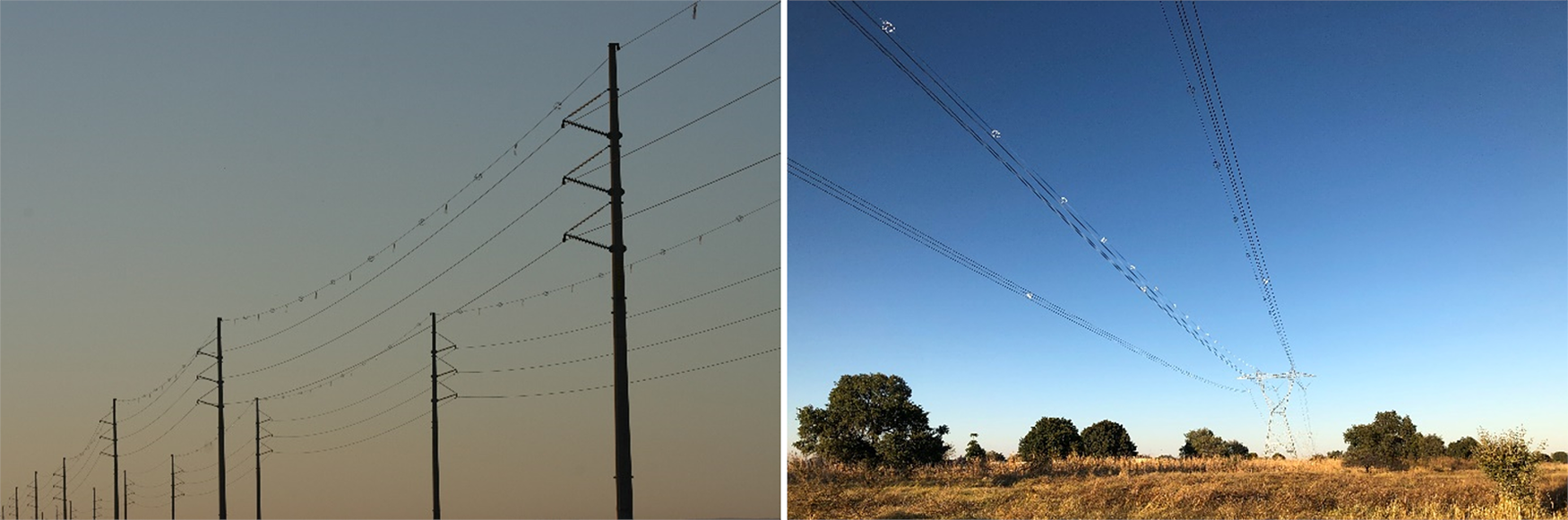
Line marking with BFDs is the commonest measure used around the world to reduce bird collisions with powerlines (Figure 2; reviewed, along with other mitigation strategies, in APLIC 2012, Bernardino et al. Reference Bernardino, Bevanger, Barrientos, Dwyer, Marques, Martins, Shaw, Silva and Moreira2018). BFDs exist in a wide range of forms, but fall into two main categories: static and dynamic. Static devices, typically in the form of small- to large-diameter PVC spirals of different colours, are wrapped around the wires and have no moving parts. Dynamic BFDs devices (also called ‘flappers’; Figure S2) are variously shaped like plates, discs, crossed bands or strips (e.g. RIBE diverters), and usually hang from the wire via a clamp which allows the wind to move them. These devices have greatly evolved over the years in terms of materials (e.g. incorporation of reflective and/or luminescent parts) and dynamic features (e.g. swinging or rotating plates), based on the assumption that moving objects are more likely to be detected by flying birds than static ones (Martin Reference Martin2011). This assumption may perhaps be mistaken in the case of bustards, as visual field studies suggest that they have poor forward vision in flight (Martin and Shaw Reference Martin and Shaw2010). Moreover, dynamic BFDs (particularly those with rotating features) may exhibit high malfunction rates (Sporer et al. Reference Sporer, Dwyer, Gerber, Harness and Pandey2013, Dashnyam et al. Reference Dashnyam, Purevsuren, Amarsaikhan, Bataa, Buuveibaatar and Dutson2016), although manufacturers have recently endeavoured to increase their quality, with some models already showing relatively good long-term performance (Shaw et al. Reference Shaw, Reid, Gibbons, Pretorius, Jenkins, Visagie, Michael and Ryan2021).
Powerlines marked with BFDs in Namibia. Left: flappers alternating with spirals on each earth wire of two powerlines running parallel to each other. Right: White spirals along one earth wire and black spirals along the other earth wire on a 400 kV transmission powerline, northern Namibia (photos: J. Pallett).
To date, experiments show that BFDs reduce overall bird collision rates with powerlines, on average, by half (Bernardino et al. Reference Bernardino, Martins, Bispo and Moreira2019), but their effectiveness is highly variable depending on the site, target species and BFD type; and with bustards the evidence is discouragingly weak, or finds no effect. Two studies reported significant but slight positive effects of static ‘spiral’ BFDs for the Little Bustard, the smallest (but not the lightest) species of bustard, which is expected to fly more slowly than larger species (Barrientos et al. Reference Barrientos, Ponce, Palacín, Martín, Martín and Alonso2012, Marques et al. Reference Marques, Martins, Silva, Palmeirim and Moreira2021). The first of these studies also found that in the far heavier and less manoeuvrable Great Bustard collisions decreased significantly (if slightly) when lines were marked with the larger (and therefore sooner seen) of two ‘spiral’ diverters (Barrientos et al. Reference Barrientos, Ponce, Palacín, Martín, Martín and Alonso2012). However, a simultaneous study somewhat contradictorily found that dynamic ‘firefly’ BFDs significantly reduced the collision rates of Little and Great Bustards combined, while large spirals and ‘crossed band’ dynamic BFDs did not (Estanque et al. Reference Estanque, Lousa, Barosa and Alcazar2012; see Figure S2 for images of BFD type). In stronger contrast, studies in the Iberian peninsula and Canary Islands either found no significant effect of line marking on bustard collision rates (Janss and Ferrer Reference Janss and Ferrer1998, Marques et al. 2007) or were inconclusive owing to low sample sizes (Alonso et al. Reference Alonso, Alonso and Muñoz-Pulido1994, Lorenzo and Cabrera Reference Lorenzo and Cabrera2009, Infante Reference Infante2011). Troublingly, the most comprehensive study to date to assess the effectiveness of BFDs on bustards, undertaken in South Africa over an eight-year period and using a Before-After Control-Impact design, found that large spirals and ‘flappers’ (in the form of discs) had no significant effect on the collision rates of bustards, including smaller species (Shaw et al. Reference Shaw, Reid, Gibbons, Pretorius, Jenkins, Visagie, Michael and Ryan2021). Aviation spheres have produced (to some extent) reductions in mortality for other large birds, such was the case of a study with Sandhill Cranes Antigone canadensis that showed a 56% of collision reduction (Morkill and Anderson Reference Morkill and Anderson1991), but their effects for bustards are not yet studied (Murphy et al. Reference Murphy, Dwyer, Mojica, McPherron and Harness2016a; review in APLIC 2012).
These findings present a serious challenge, as wire-marking seems insufficient to prevent powerlines from causing irreparable damage to bustard populations over time. Nevertheless, we regard the marking of new or existing powerlines as mandatory, partly because their effect is not non-existent, that is expected to increase with the increased size, number, and sophistication of the diverters, and partly because, when there is scientific uncertainty and until more information is available, the precautionary principle must apply. Thus, in cases where undergrounding or rerouting is not an option, the construction of powerlines in bustard-occupied areas (breeding, migration, and wintering) should involve peripheral routing coupled with line marking that observes the following requirements:
-
• Size of BFD—Larger devices can be seen at a greater distance, and must be used.
-
• Type of BFD—Despite no clear evidence indicating better performance, dynamic BFDs should be used as they are considered more likely to catch birds’ attention. For optimum effect they should be reflective, coloured contrastingly (e.g. black and white to maximise line visibility and background contrast), and self-illuminating (some bustard species are known to make dusk and nocturnal flights, and perhaps all do at times).
-
• Position—All conductors and earth wires must be marked with BFDs, which should be mounted throughout the entire span and placed alternately on each conductor and earth wire. If BFDs cannot be attached to high-voltage conductors for technical or country-specific legal reasons (e.g. Hurst Reference Hurst2004), at least the earth wires (the thinnest and least visible cables, and often the highest and therefore most dangerous ones) must be marked.
-
• Spacing—BFDs should be installed as close together on the same wire as engineering constraints allow.
-
• Aeronautical safety—Line marking with aircraft warning spheres should not exclude the installation of BFDs, as the former are usually spaced far apart (e.g. several tens of metres in profile). When technically feasible, both devices should be mounted in combination.
-
• Maintenance—Devices must remain in position and functional (in terms of reflectivity and movement) throughout the powerline’s lifetime. Energy companies must plan and budget for regular inspection and replacement of BFDs, as their lifetimes can be much shorter than those of the powerlines themselves.
Further product development of BFDs, involving size, shape, dynamism, lights (e.g. LEDs and lasers), colours and reflectiveness, is necessary in collaboration with avian ecologists, sensory biologists and powerline engineers to better match the sensory ecology of bustards. Although near-ultraviolet wavelength lights have been used to reduce twilight collisions for cranes arriving at roost sites (Dwyer et al. Reference Dwyer, Pandey, McHale and Harness2019), the visual pigment opsin sequence (NCBI Reference Sequence: XP_010124621.1) and large eye size of bustards indicate their limited ultraviolet-sensitivity (Ödeen et al. Reference Ödeen, Nathan and Håstad2009, Lind et al. Reference Lind, Mitkus, Olsson and Kelber2014). Research is required to determine the most salient wavelengths for bustards’ visual systems and, among those, the frequencies that provide maximum contrast to environmental light. The development of acoustic deterrents, or visual deterrents which fall better within the line of sight of bustards (such as ground-mounted lights), may also be productive (Boycott et al. Reference Boycott, Mullis, Jackson and Swaddle2021).
Habitat management
Habitat management could potentially be used to reduce bustard collision risk with powerlines or, as a last resort, to compensate for bustard collision mortality. Restricting anthropogenic disturbance (e.g. from hunting, recreation) close to powerlines could reduce collisions resulting from bustards flushed into flight (Sastre et al. Reference Sastre, Ponce, Palacín, Martín and Alonso2009). Lessening the attractiveness of the habitat near lines and/or creating attractive habitats further away might also contribute to lower collision rates. Such measures, however, have never been tested and would require habitat modification on a large scale.
Compensation for powerline mortalities could involve measures such as promoting bustard-friendly habitat management, giving full protection to other bustard sites, and reducing disturbance at display and nesting sites (Bretagnolle et al. Reference Bretagnolle, Villers, Denonfoux, Cornulier, Inchausti and Badenhausser2011, Raab et al. Reference Raab, Julius, Greis, Schütz, Spakovszky, Steindl and Schönemann2014, Jhala et al. Reference Jhala, Dutta, Karkarya, Awasthi and Bipin2020). To achieve long-term success, however, these actions should be species-specific, informed by rigorous research, and carefully planned with local stakeholders (e.g. farmers, NGOs). Such interventions should enhance the affected bustard populations to the point where they are measurably stronger than before.
With the current uncertainty over BFD effectiveness, compensation measures must be considered mandatory when new powerline projects threaten bustard populations. Typically, compensation is assessed on a case-by-case basis, but the cumulative impact of the existing energy grid should urgently be assessed. Powerline companies are responsible for the overall impacts that their infrastructures have on biodiversity, and should therefore assess and duly implement, to the full (encompassing the lifetime of the line), the interventions necessary to compensate for bustard mortalities and displacement.
Recommendations for monitoring impacts and mitigation effectiveness
Powerline monitoring schemes for bustards are crucial for three main purposes: (i) to determine collision mortality rates; (ii) to assess displacement and barrier effects caused by the infrastructure; and (iii) to evaluate the effectiveness of mitigation measures implemented.
Determining mortality rates
Carcass searches
Carcass searches under powerlines are the most common method for recording collision fatalities (e.g. Barrientos et al. Reference Barrientos, Ponce, Palacín, Martín, Martín and Alonso2012, Shaw et al. Reference Shaw, Reid, Schutgens, Jenkins and Ryan2018, Uddin et al. Reference Uddin, Dutta, Kolipakam, Sharma, Usmani and Jhala2021). Mortality rates should be determined through standardised surveys, following the recommendations provided in the next sections adjusted through a careful evaluation of the particularities of each project (e.g. location, powerline length, and target bustard species). Methods used and results obtained (including observed fatalities and estimated mortality rates) should be reported clearly, to allow meaningful comparisons across studies.
Carcass searches should be undertaken throughout the year where bustards are resident or else synchronised with their seasonal presence. Search frequency may be adjusted to the known persistence of bustard carcasses or remains (e.g. ‘feather spots’—patches of feathers on the ground indicating a collision event) depending on conditions at the site (Ponce et al. Reference Ponce, Alonso, Argandoña, García-Fernández and Carrasco2010, Schutgens et al. Reference Schutgens, Shaw and Ryan2014); but, ideally, searches should be conducted at least every two weeks for medium-sized species and monthly for large species. Sampling should cover the full extent of powerline sections in areas known to be more important for bustards; outside those areas, surveys should subsample the powerline sections (at least 20% of their total length) that bisect areas with confirmed or high potential occurrence of bustards (based on habitat suitability or other knowledge). When the distribution of bustard species is not well known, or in large continuous tracts of habitat, representative samples should be surveyed in all appropriate areas.
The survey strip should include the area within at least 10 m of the outermost cables on either side of the powerline, but ideally cover a distance equal to the maximum height of the cables (i.e. a total survey strip twice the width of the maximum cable height) (Shaw Reference Shaw2013, Gómez-Catasús et al. Reference Gómez-Catasús, Carrascal, Moraleda, Colsa, Garcés and Schuster2020). Preferably, survey strips should be searched by means of walked linear transects spaced no more than 10 m apart; however, depending on target species size, ground visibility and powerline length, searches may be conducted at very low speeds by car or quad bike. In a vehicle, at least two observers are needed to scan the area ahead and their respective sides of the track, with the driver doubling as an observer since the travelling speed is very low (e.g. Shaw et al. Reference Shaw, Reid, Schutgens, Jenkins and Ryan2018). Scent-detection dogs perform better than humans at finding bird remains and feather spots (Reyes et al. Reference Reyes, Rodriguez, Lindke, Ayres, Halterman, Boroski and Johnston2016), although the training of dog-handler teams possibly imposes time and availability constraints on this method. The exact location of carcasses should be recorded with a GPS, and all evidence of the carcass should be removed (or the spot marked) to prevent double counting on future surveys.
Carcass searches should cover at least a one-year period (to detect seasonal variations), but preferably last for 2–3 years. Decisions on subsequent monitoring should be based on results obtained.
Bias corrections
The number of carcasses found during surveys is only a proportion of the true mortalities, because some deaths will not be registered owing to removal bias (carcasses sequestered by scavengers or reduced by decomposition), detection bias (carcasses missed through visibility issues) and crippling bias (fatally injured birds flying or walking beyond the search area). Carcass removal and detection rates vary greatly among study sites (Barrientos et al. Reference Barrientos, Martins, Ascensão, D’Amico, Moreira and Borda-de-Água2018, Bernardino et al. Reference Bernardino, Martins, Bispo, Marques, Mascarenhas, Silva and Moreira2022), so in order to estimate true collision rates as accurately as possible, field trials to ascertain the relevant bias-correction factors are essential.
Carcass removal trials should be undertaken at least in the first year of post-construction monitoring, at every relevant season. At least 10 (and preferably 20) bird carcasses (matching the size and, if possible, coloration of the target species) are needed per season (Bispo et al. Reference Bispo, Bernardino, Paula, Marques, Costa, Mascarenhas, Köppel and Schuster2015). They should be distributed widely, evenly, and proportionately across the different powerline sections regularly searched for bird fatalities. Once placed, they should initially be checked daily and then at increasing intervals (e.g. daily up to day 4, then on day 7, 14, 21 and 28), to determine their persistence probability over time (Schutgens et al. Reference Schutgens, Shaw and Ryan2014, Bispo et al. Reference Bispo, Bernardino, Paula, Marques, Costa, Mascarenhas, Köppel and Schuster2015).
Carcass detection trials may be carried out using the same carcasses as in the removal trials but ideally also feather spots (Stevens et al. Reference Stevens, Reese and Connelly2011, Reyes et al. Reference Reyes, Rodriguez, Lindke, Ayres, Halterman, Boroski and Johnston2016). These trials can be undertaken during scheduled carcass searches, without prior knowledge of the searchers. All carcasses not detected by individual searchers or search teams should be promptly checked to confirm the persistence of the carcasses or their remains (to exclude trial errors due to rapid removal by scavengers). Trials should be repeated in two or more relevant seasons to account for differences in visibility (depending on vegetation cover and height) and, consequently, in detection probabilities of carcasses and feather spots over time (Stevens et al. Reference Stevens, Reese and Connelly2011).
Crippling bias (the proportion of birds colliding with a line that fall or die outside the survey strip) remains an important knowledge gap, although it strongly influences mortality estimates (Rioux et al. Reference Rioux, Savard and Gerick2013). This bias is extremely difficult to gather data on and, hence, unlikely to be determined under standard monitoring programmes. Moreover, the few studies investigating this bias reported such a wide range of values, between 20% and 82% (Bevanger Reference Bevanger1995, Rioux et al. Reference Rioux, Savard and Gerick2013, Murphy et al. Reference Murphy, Mojica, Dwyer, McPherron, Wright, Harness, Pandey and Serbousek2016b, Travers et al. Reference Travers, Driskill, Stemen, Geelhoed, Golden, Koike, Shipley, Moon, Anderson, Bache and Raine2021), that their use is inappropriate. Thus, until further data are available, we suggest not to adjust mortality estimates for crippling bias, and researchers should accept that, for now, the estimated mortality rates correspond to the minimum expected. When studies do adjust for crippling bias they should clearly state the correction value used.
Mortality estimators
Apart from producing observed fatality rates (based solely on carcass searches), bustard carcass counts should be adjusted for removal, detection and, if measured, crippling bias. Several mortality estimators are available but, currently, GenEst estimator (Dalthorp et al. Reference Dalthorp, Madsen, Huso, Rabie, Wolpert, Studyvin, Simonis and Mintz2018) incorporates the best features of previous estimators and is able to account for uncertainty in the final mortality estimates. In case of rare mortality events, alternative estimation approaches (e.g. Huso et al. Reference Huso, Dalthorp, Dail and Madsen2015) should be considered.
Assessing displacement and barrier effects
The study of displacement effects is feasible and valuable where bustards occur at a high enough density. Ideally, monitoring should be based on a Before-After gradient (BAG) approach, where the abundance of a given bustard species is characterised at varying distances from the powerline before and after its construction (Powell et al. Reference Powell, Brown, Smith, Harrison and Whalen2017). Bird surveys should ideally cover at least a complete year cycle before the line is constructed, so that the full effect of the infrastructure can be measured. If the line already exists, a gradient approach (‘impact gradient’, IG) can still be used, quantifying abundance as a function of distance to the infrastructure, but all other confounding effects (e.g. habitat, other sources of disturbance) must be taken into account.
Any expected barrier effects should be monitored by comparing flight paths and line-crossing rates (obtained by direct observations) before and after the powerline is built. If the line is already installed, other indirect methods based on the IG approach can be considered, such as recording take-off directions at different distances to the line (Raab et al. Reference Raab, Spakovszky, Julius, Schütz and Schulze2011).
Besides direct observations, both displacement and barrier effects may be assessed through bird-tracking technologies (e.g. satellite/GPS telemetry) which provide high spatial and temporal resolution data on bird movements (Pruett et al. Reference Pruett, Patten and Wolfe2009).
Evaluating mitigation measures
It is vital to evaluate the performance of mitigation measures, particularly line marking, in reducing bustard mortality. For existing retrofitted powerlines a Before-After Control-Impact (BACI) approach should ideally be implemented in which mortality is quantified for marked and unmarked sections of line, both before and after marking (e.g. Shaw et al. Reference Shaw, Reid, Gibbons, Pretorius, Jenkins, Visagie, Michael and Ryan2021). For new powerlines (when BFDs are installed at the construction stage) the monitoring approach must be the simple Control-Impact (CI), where mortality is assessed on marked versus unmarked sections of line. However, for a true comparison, bias correction experiments (see above) have to be undertaken in both sections, which might have, e.g., different habitats, scavenger populations and bustard abundances (Bernardino et al. Reference Bernardino, Martins, Bispo and Moreira2019). Additionally, bustard crossing rates (which can be used as a proxy of local abundance) should be determined for the marked and unmarked sections and then used to adjust/calibrate the respective estimated mortality rates (Mercker and Jödicke Reference Mercker and Jödicke2021).
Additional key issues
Local and regional bustard populations require constant monitoring so that additional mitigation and/or compensation measures can be implemented promptly in response to any demographic changes detected. The long-term threat posed by powerlines to bustard populations may be assessed through population viability analysis (e.g. Uddin et al. Reference Uddin, Dutta, Kolipakam, Sharma, Usmani and Jhala2021). It must, however, be based on robust mortality and demographic data (e.g. population size, social structure, reproduction parameters), so further basic population monitoring is needed to generate such data, particularly for threatened species. Assessments of bustard population dynamics should also consider the cumulative impacts of powerlines within their range, and impacts from other nearby structures (e.g. roads, windfarms). Long-term tracking projects, robustly sampling individually marked birds, can provide a reliable estimate of mortality rates caused by collisions with powerlines in the context of other anthropogenic sources of bustard mortality (Table 1; Palacín et al. Reference Palacín, Alonso, Martín and Alonso2017, Marcelino et al. Reference Marcelino, Moreira, Mañosa, Cuscó, Morales, García de la Morena, Bota, Palmeirim and Silva2018).
Reflections and conclusions
Of the 14 bustard species documented here as having suffered powerline mortality three have the IUCN Red List category ‘Critically Endangered’, two are ‘Endangered’, four ‘Vulnerable’, four ‘Near Threatened’ and only two ‘Least Concern’ (Table 1). Ethically, therefore, it may be questionable to experiment with the use or non-use of various mitigation measures and designs in order to assess which are effective in preventing collisions in species that are at elevated risk of extinction. Equally, however, the lack of solid information and certainty over the scale of the problem, and over the efficacy of the measures intended to address it, leaves conservationists in the unenviable position of taking crucial decisions in an information environment dominated by anecdote. It is an ironic reflection of this circumstance that the ‘Critically Endangered’ Bengal Florican Houbaropsis bengalensis was recently—and emphatically—identified as at serious risk from a new powerline in Cambodia (Mahood et al. 2016) at a time when it had not yet been recorded as a powerline victim.
Anecdote can of course be instructive, revealing for example that a small, medium-tension powerline consisting of three horizontally aligned wires can cause repeated fatalities to a bird the size and weight (up to 19 kg) of a Kori Bustard (Collar Reference Collar2019). Nevertheless, this first global review of the problem of bustard mortalities at powerlines seeks to combine anecdote with quantified analyses to provide as robust a body of evidence as possible while still necessarily invoking the precautionary principle to govern management responses. Data on bird collisions are difficult and expensive to obtain and to compare; the proposed guidelines encourage conservationists and researchers to collect data in a systematic way and enable interdisciplinary studies to better understand powerline impacts and to use and develop effective mitigation measures. An important need, therefore, is for conservationists to establish and inform relevant authorities of the distribution and numbers of bustards within their areas of concern, so as to forestall proposals for powerlines that would affect the areas on which the birds depend.
Additional risks are imposed if the landscapes in question are allowed to be fragmented by fences and criss-crossed by telephone and rail lines (both of which are also hazardous for bustards: Table S2) or repurposed for wind-turbines and principally solar farms, which may not kill birds outright but will lead in most cases to extensive habitat loss and disruption as well as to the expansion of electricity grids. Vigilance on these other issues is equally necessary. Nevertheless, an important further strategy for conservationists to pursue is engagement with energy companies. Energy delivery is one essential public good; nature conservation is another. When energy companies are reduced to vilifying conservation for obstructing their plans, as happened following the April 2021 Indian Supreme Court order to bury all powerlines affecting the survival of the Great Indian Bustard (The Economic Times 2021), the balance of those public goods has been lost.
Restoring that balance will also necessarily involve restoring real balances in nature, with energy companies obliged and, better, voluntarily agreeing to compensate fully for the negative impacts their powerlines have on bustards. Compensation should primarily be channeled towards increasing productivity in accordance with the level of mortality caused by the powerline. Additional research is needed, however, to attain a more holistic understanding of the cumulative impacts of the electric grids on bustard demography and overall impact on populations, particularly for those more threatened species. With greater appreciation of each other’s interests and needs, however, fruitful partnerships can emerge, as in South Africa, Namibia, and Portugal where conservationists and academia are working closely with the national power suppliers to find sound and equitable solutions to the bustard/powerline conflict.
Supplementary Materials
To view supplementary material for this article, please visit http://doi.org/10.1017/S0959270922000314.
Acknowledgements
We are most grateful to colleagues who provided additional data on bustard collision with powerlines: N. Batbayar, D. Batsuuri, D. Gadhavi, B. Gantulga and S. Mahood. Thanks are also due to Eskom Holdings SOC Ltd. for funding and supporting research into bustard collision mitigation in South Africa, and to Redes Energéticas Nacionais (REN) for supporting the study of the interactions between birds and powerlines in Portugal, through Cátedra REN. We also thank R. Michael Scott for his input and review of the manuscript. Fundação para a Ciência e a Tecnologia (FCT) funded JPS under contract DL57/2019/CP 1440/CT 0021. FM was funded by REN Biodiversity Chair and FCT (IF/01053/2015). The submitted manuscript benefitted from the comments of two referees. This work was co-funded by the project NORTE-01-0246-FEDER-000063, supported by Norte Portugal Regional Operational Programme (NORTE2020), under the PORTUGAL 2020 Partnership Agreement, through the European Regional Development Fund (ERDF).


 Open access

