




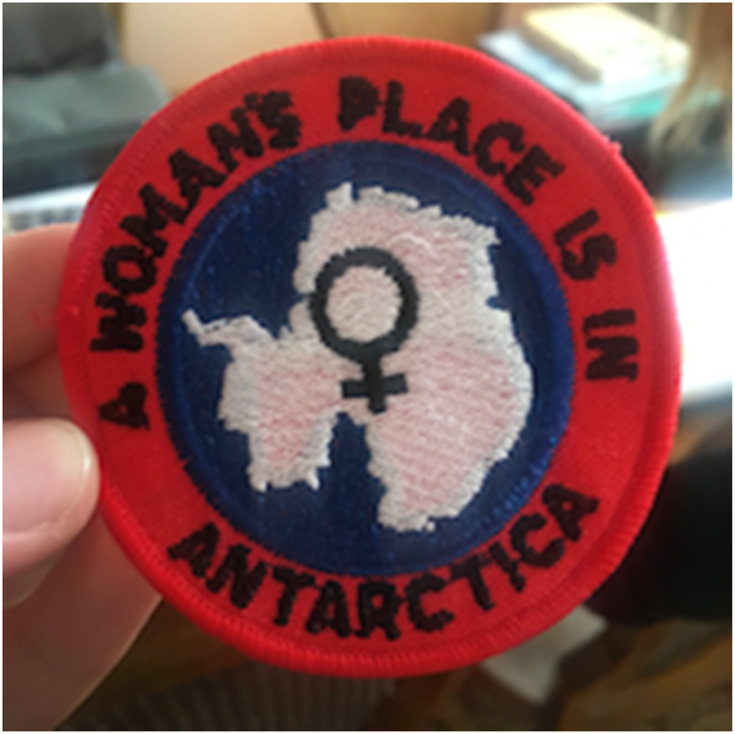
When Admiral Reedy described Antarctica as ‘the womanless white continent of peace’ in 1965 (Chipman Reference Chipman1986, p. 87), he was describing a continent that many of his contemporaries viewed as the world's last bastion of exclusively masculine endeavour. It was imagined as a place for heroic white men to stride out across the ice and battle the elements as they claimed geographical firsts, unencumbered by the presence of women. Despite demand from many highly qualified women, women were barred from participating in Antarctic fieldwork for most of Antarctica's human history and remained excluded from some Antarctic field sites until the mid-1990s (Seag Reference Seag2017). Although Antarctica is no longer the idealized masculine space of Reedy's era, Antarctica remains inaccessible to many, both physically and conceptually as a research subject. A patch sold at New Zealand's Scott Base proudly proclaims ‘A Woman's Place Is in Antarctica’ (Fig. 1); however, even now, belongingness in Antarctic research depends on numerous factors, including many that are beyond individuals’ control. The Antarctic research community has a long way to go to redress its exclusionary history.
A patch depicting a map of Antarctica with the female symbol. It reads ‘A Woman's Place Is in Antarctica’.
In this paper, Antarctic research is defined as research of all disciplines undertaken throughout the Antarctic region, including on the Antarctic continent and sub-Antarctic Islands and in the Southern Ocean. It is an area of global importance, where international collaborative research aims to benefit all humanity. Yet it is also an area where access, inclusivity and equity pose acute challenges to the participation, well-being and success of women, as well as members of other historically excluded groups. In their study of Australian Antarctic research, Nash et al. (Reference Nash, Nielsen, Shaw, King, Lea and Bax2019) identified a range of challenges that women Antarctic researchers face, from physical barriers, unpaid work and gender bias to lack of opportunities and sexual harassment (see also Nash & Nielsen Reference Nash and Nielsen2020, Barros-Delben et al. Reference Barros-Delben, Cruz, de Melo Cardoso and de Wit2020). These challenges are widespread, manifesting both in Antarctic fieldwork and in other Antarctic work settings across the world, as has been underscored in numerous publications (see Bell & Koenig Reference Bell and Koenig2017, Starkweather et al. Reference Starkweather, Seag, Lee and Pope2018, Nash & Nielsen Reference Nash and Nielsen2020) and events (e.g. ‘From Entering the Field to Taking the Helm, Women's Perspectives on Polar Research’ 2018, Association of Polar Early Career Scientists 2019, ‘Inclusive Collaborations in Antarctic Research’ 2020, ‘Inclusive Collaborations in Antarctic Research’ 2022), as well as major institutional reports (Nash Review of Diversity, Equity, and Inclusion in the Australian Antarctic Program n.d., National Science Foundation et al. 2022, Russell Performance Co. 2023). A study supported by the Scientific Committee on Antarctic Research (SCAR) found that barriers to women's Antarctic research careers have been exacerbated by the COVID-19 pandemic (Liggett & Herbert Reference Liggett and Herbert2021).
These barriers persist due to both the unique historical and geographical contexts of Antarctic research and exploration and the gendered power dynamics that underpin science across disciplines and regions. Women in science encounter significant structural hurdles worldwide, ranging from pervasive bias and hostile organizational climates to physical barriers and sexual harassment (e.g. Larivière et al. Reference Larivière, Ni, Gingras, Cronin and Sugimoto2013, Guillopé & Roy Reference Guillopé and Roy2020). Women still represent less than a third of scientists globally (UNESCO Institute for Statistics 2019) and are especially underrepresented in leadership (Grogan Reference Grogan2019). Women also do not benefit from the ‘premium’ that is attached to the identities of white non-disabled heterosexual men in science, which research has shown to be quantifiable and statistically significant (Cech Reference Cech2022). Unfortunately, although efforts to address gender inequality in science have expanded in recent years, progress has largely stagnated in the twenty-first century (Cech Reference Cech2022).
In this paper, we draw on feminist social science literature on gender inequality in science to examine two significant, interrelated factors that hamper progress towards equity for women in the context of Antarctic research. The first factor is a persistent institutional focus on addressing women's underrepresentation through diversity-centred initiatives, rather than on the structural barriers that affect women's career advancement and well-being. This is not to say that diversity is not important: on the contrary, diversity is essential to science, having wide-ranging implications for the success of collaborations and for the advancement of scientific knowledge (Campbell et al. Reference Campbell, Mehtani, Dozier and Rinehart2013, Nielsen et al. Reference Nielsen, Alegria, Börjeson, Etzkowitz, Falk-Krzesinski and Joshi2017, Nature Editors 2018). Diversity in scientific leadership helps expand the breadth of scientific questions asked (Kozlowski et al. Reference Kozlowski, Larivière, Sugimoto and Monroe-White2022), and diverse research teams produce more innovative science with higher citation rates (AlShebli et al. Reference AlShebli, Rahwan and Woon2018, Hofstra et al. Reference Hofstra, Kulkarni, Galvez, He, Jurafsky and McFarland2020).
However, a focus on diversity alone is insufficient (Cech Reference Cech2022). Diversity is a largely quantitative measure of presence and participation, which tends to celebrate difference without addressing the issues of social injustice that exist in diverse workplaces. Diversity-centred initiatives might applaud the presence of women who have successfully gained access to an organization, but they rarely account for women's experiences of marginalization at work, for the structural barriers that impede women's well-being and career advancement or for the fairness of workplace systems. To advance gender equality requires concerted attention not only to diversity, but also to inclusion and equity. Inclusion means creating cultures of belonging in which all individuals and groups feel welcomed, respected and valued; equity means ensuring that all people have access to the opportunities and resources they need to thrive, accounting for their different starting points and the different hurdles they encounter. In this paper, we argue that creating inclusive, equitable workplaces requires dismantling the structural inequalities that pervade Antarctic scientific institutions and redressing historical power imbalances. These structural inequalities are woven into the fabric of institutions as persistent legacies of exclusionary pasts, yielding structural advantages and disadvantages for various groups of people, regardless of the choices that individual members of those groups may make. Addressing these structural inequalities is not only crucial to advancing more robust and impactful science - it also is an essential ethical requirement for all scientific workplaces, including Antarctic institutions.
A second factor that is hindering progress in Antarctic research is the single-axis framework through which most scientific institutions implement equality, diversity and inclusion (EDI) initiatives (Cech Reference Cech2022). Single-axis approaches consider identity categories such as gender (or race, ethnicity, nationality, sexuality, physical ability, religion, etc.) as monolithic categories, treating each category as though it is siloed from the others. This single-axis view obscures the fact that all of our identities are multifaceted, based on a combination of our gender, sex, sexuality, race, ethnicity, age, religion, language, nationality, disability status and more. Single-axis approaches to advancing women's equality therefore fail to account for the fact that women can be impacted by multiple, overlapping systems of inequality, such as sexism, racism, homophobia, ableism and xenophobia. For instance, Cech (Reference Cech2022) has shown that LGBTQI+ Black women with disabilities experience participation in science significantly differently from cisgender, heterosexual, non-disabled white women and men. Efforts to advance equality can only be inclusive and equitable if they account for these intersecting structural barriers to equality - otherwise, they leave many women behind.
Our central argument is that a historical lack of attention to structural barriers and the reliance on single-axis frameworks can be effectively addressed through intersectional approaches to change. Intersectional approaches are guided by intersectionality, a conceptual framework that originates in the work of Black feminist scholars and has been refined over many decades. In this article, we review a growing body of multidisciplinary research that applies intersectionality to scientific workplaces (e.g. Clancy et al. Reference Clancy, Lee, Rodgers and Richey2017, Núñez et al. Reference Núñez, Rivera and Hallmark2019, Khelifa & Mahdjoub Reference Khelifa and Mahdjoub2022), including numerous contributions demonstrating its significance to polar research (e.g. Hoogensen Gjørv Reference Hoogensen Gjørv, Latola and Savela2017, Starkweather et al. Reference Starkweather, Seag, Lee and Pope2018, Nash et al. Reference Nash, Nielsen, Shaw, King, Lea and Bax2019, Seag et al. Reference Seag, Badhe and Choudhry2019, Abdel Fattah et al. Reference Fattah, Dudeck, Friedrich, Habeck, Saxinger and Thompson2020, Nash & Nielsen Reference Nash and Nielsen2020). We apply this literature to the unique institutional, historical and geographical contexts of Antarctic research.
This article begins with a brief discussion of intersectionality's origins and applications. We then apply an intersectional lens to three central values that are broadly shared across Antarctic research institutions: scientific meritocracy; fieldwork in the Antarctic region; and scientific internationalism. In each section, an intersectional lens highlights specific actions that Antarctic researchers, administrators and leaders can take to advance gender equity around these pillars of Antarctic research. Recognizing the important strides made by numerous Antarctic organizations to advance equality for many historically excluded groups - including some that have begun to explicitly integrate an intersectional framework, such as the UK Diversity in Polar Research Initiative - we aim to support wider uptake of intersectional approaches as an essential next step.
Although this article takes as its starting point the gendered barriers faced by women (referring to all who identify as women), we emphasize that gender is a non-binary social category and that non-binary people as well as many other intersectional groups also face significant barriers in Antarctic research (e.g. on the basis of race, LGBTQI+ status, nationality, socioeconomic background or disability status). In arguing the value of intersectionality to advancing equity for women, we will demonstrate that intersectional approaches contribute to dismantling the interconnected power structures that affect members of all historically excluded groups.
Understanding intersectionality
Intersectionality is a feminist social science framework for understanding and addressing the interconnected nature of structural barriers and social identities (Crenshaw Reference Crenshaw1989, Cho et al. Reference Cho, Crenshaw and McCall2013). Unlike single-axis frameworks, intersectionality allows us to look more deeply at questions of social identity and representation by foregrounding the ways in which overlapping societal structures combine to create compounding barriers for people with multiple marginalized social identities (e.g. on the basis of gender, sexuality, race, ethnicity, disability, religion or nationality; Collins & Bilge Reference Collins and Bilge2016). An intersectional lens highlights that structural barriers are not experienced in the same way or to the same degree by all women: for example, women of colour face barriers due to sexism and racism (Malcom et al. Reference Malcom, Hall and Brown1976, Clancy et al. Reference Clancy, Lee, Rodgers and Richey2017), and LGBTQI+ women face sexism as well as homophobia and/or transphobia (National Academies of Science, Engineering, and Medicine 2018, Berhe et al. Reference Berhe, Barnes, Hastings, Mattheis, Schneider, Williams and Marín-Spiotta2022). LGBTQI+ women of colour face all of these (Cech Reference Cech2022). By highlighting these intersecting identities and social structures, intersectionality facilitates more nuanced understandings of the diversity of lived experiences within and among social groups.
The concept of intersectionality was developed in relation to the lived experiences and oppression of Black American women. The term ‘intersectionality’ was coined by legal scholar Kimberlé Crenshaw, who built on decades of work by women of colour scholars and activists to highlight the oppression of Black women within the US legal system (Crenshaw Reference Crenshaw1989). As Crenshaw demonstrated, Black women were made invisible in American anti-discrimination legislation because they were required to identify either as Black or as women in order to pursue legal recourse for workplace discrimination - even though the barriers that Black women faced were compounded by sexism and racism. Crenshaw argued that efforts to dismantle the barriers Black women faced could not succeed if they were focused on either women or Black people as monolithic groups. Attention to intersecting structures of inequality was required.
In the decades since Crenshaw's groundbreaking work, intersectionality has evolved and expanded, coming into dialogue with related approaches developed by Black, Indigenous, South Asian, Latin American and other scholars from historically excluded groups whose research and activism focuses on a wide range of cultural, political, economic, geographical and historical contexts. Intersectionality is now understood as broadly applicable (Bose Reference Bose2012) and is embraced as a way to illuminate how power structures ‘interact to produce hierarchy for any limitless combination of identities’ (Cho Reference Cho2013, p. 385). The versatility of intersectionality is illustrated in the variety of ways it has been effectively put to use: for example, to address compounding inequalities on the basis of gender and caste in India (Kapilashrami et al. Reference Kapilashrami, Bisht and Ravindran2016; Banerjee & Ghosh Reference Banerjee and Ghosh2018); to evaluate the effects of affirmative action on Black women in South African businesses (Klasen & Minasyan Reference Klasen and Minasyan2021); to improve national data collection and anti-discrimination legal frameworks in Australia (Blackham & Temple Reference Blackham and Temple2020); and to deepen understanding of the challenges faced by migrants in around the world (e.g. Lafleur & Romero Reference Lafleur and Romero2018; Lee-An Reference Lee-An2020).
Intersectionality also is used to understand the complex accumulations of both disadvantage and advantage that people might experience (Castro & Collins Reference Castro and Collins2020): for example, white women who experience structural advantages as white people and structural disadvantages as women, or LGBTQI+ men who experience structural advantages as men and structural disadvantages as LGBTQI+ people. Acknowledging the intersecting structural disadvantages and advantages that each of us face is essential to creating a global Antarctic research community in which all are supported to thrive.
Intersectionality and scientific ideals
In recent years, intersectionality has been increasingly applied to gender inequality in scientific institutions (e.g. Clancy et al. Reference Clancy, Lee, Rodgers and Richey2017, Núñez et al. Reference Núñez, Rivera and Hallmark2019, Khelifa & Mahdjoub Reference Khelifa and Mahdjoub2022, Kozlowski et al. Reference Kozlowski, Larivière, Sugimoto and Monroe-White2022). This growing literature highlights the cultural, infrastructural and organizational factors that have shaped power dynamics in the scientific community, which continue to advantage some groups of researchers and disadvantage others (Mattheis et al. Reference Mattheis, Murphy and Marin-Spiotta2019; Núñez et al. Reference Núñez, Rivera and Hallmark2019). Scholars also have applied intersectionality to the fields of technology, engineering and mathematics, demonstrating that ‘intersectionality is indispensable for understanding how sexism, racism, ableism, and heteronormativity are entwined in ways that reinforce intractable patterns of inequality in STEM’ (Cech Reference Cech2022, p. 1).
However, scientific institutions have been slow to acknowledge intersecting structural barriers to gender equality. This is in part because acknowledging intersectional inequalities demands reconsideration of whether science is meritocratic. Many social groups have never had equal access to opportunities or success in science (Haraway Reference Haraway1989, Rossiter Reference Rossiter1995): in other words, advancement in science has never been dependent purely on a person's ability or ‘merit’. Certain groups of people have always been deliberately or indirectly impeded from participating or advancing in science, including in Antarctic research (Carey et al. Reference Carey, Jackson, Antonello and Rushing2016, McCahey Reference McCahey2022). Women across the world were barred from conducting Antarctic fieldwork through much of the twentieth century - in some cases, into the 1990s - despite demand from women scientists (Hulbe Reference Hulbe, Wang and Ommanney2010, Seag Reference Seag2017). Some of these women, such as American biochemist Mary Belle Allen and South African palaeobotanist Edna Plumstead, were barred despite having extraordinary qualifications well beyond those of many male fieldworkers (Seag Reference Seag2021a). Many countries also banned certain groups of men from participating in Antarctic fieldwork, including homosexual men, men with disabilities or men of colour (van der Watt & Swart Reference van der Watt, Swart, Roberts, van der Watt and Howkins2016, Leane et al. Reference Leane, Maddison and Norris2019). The centralized nature of state-sponsored Antarctic research and the high cost of maintaining Antarctic field programmes also marginalized researchers from lower-income countries. Women of colour, women with disabilities and women from low-income countries were especially underrepresented in the field (van der Watt & Swart Reference van der Watt, Swart, Roberts, van der Watt and Howkins2016, Seag Reference Seag2021b).
With women, people of colour, people with disabilities, gay men and others directly or indirectly barred from participating, global Antarctic research came into its own in the twentieth century as an endeavour dominated by white, heterosexual, non-disabled men from primarily high-income countries. This narrow demographic has become the ‘neutral (often unspoken) standard against which the experiences of women, people of color, LGBTQ persons, and persons with disabilities are believed to deviate’ (Cech Reference Cech2022, p. 2), as has been the case in many scientific disciplines (see also Lawrence & Escobedo Reference Lawrence and Escobedo2023). This narrow demographic of scientists accrued further structural advantages in Antarctic research through access to what are commonly described by social scientists as ‘old boys networks’: informal networks that have facilitated funding, collaborations, awards and promotions for ‘insider’ members of historically male-dominated fields, including in science, whether intentionally or not (Rossiter Reference Rossiter1995).
Although most overtly discriminatory rules in Antarctic research were dismantled by the end of the twentieth century, the damaging effects of historical discrimination persist. They have been reproduced over time through institutional commitments to celebrating the past without reflexive critique, through biased structures of professional recognition and through processes of career advancement that reward researchers from historically dominant groups at a higher rate than members of historically excluded groups (Meho Reference Meho2021, Sanderson Reference Sanderson2021). This manifests in leadership demographics: despite recent gains in relation to women advancing to the director level in major organizations such as National Antarctic Programs (NAPs), most women advancing to senior leadership have been white. It also manifests in award processes: between 2006 (the earliest year for which data are publicly available) and 2020, 85% of community-nominated SCAR medals were awarded to men, and no medals were awarded to women from countries outside the USA and Western Europe or to women from countries that are not high-income (i.e. low-income, lower-middle-income or upper-middle-income countries; ‘SCAR Medal Awardees’ 2020). In 2022, women represented a majority of SCAR Medal recipients (3/4) for the first time; however, all recipients were either American or British (‘2022 SCAR Medal recipients announced’ 2022). Similar disparities are evident in the award processes of the American Geophysical Union's Cryosphere Science Section (Harvey Reference Harvey2021), as well as in hiring and promotion throughout the scientific disciplines from which Antarctic researchers are drawn (National Academies of Sciences, Engineering, and Medicine Reference Colwell, Bear and Helman2020).
The recognition and promotion of white cisgender men at substantially higher rates than women (especially women of colour and women from lower-income countries) has significant effects. It reproduces the relative authority of white male voices in science while limiting the influence of women, especially women with multiple marginalized identities (Khelifa & Mahdjoub Reference Khelifa and Mahdjoub2021). Research shows that while scientists who experience fewer structural disadvantages are more likely to be promoted into positions of authority, they also are less likely to recognize structural inequalities (Clancy et al. Reference Clancy, Lee, Rodgers and Richey2017, Nash & Moore Reference Nash and Moore2018). As a result, scientific cultures and EDI initiatives, which are influenced by people with institutional authority, rarely address entrenched structural barriers or the importance of intersectionality. This discrepancy in awareness is illustrated in a 2022 report on sexual harassment in the US Antarctic Program (USAP): while 72% of women reported that sexual harassment is a problem in USAP, only 48% of men and 40% of leadership (regardless of gender) reported the same (National Science Foundation et al. 2022).
The invisibility of challenges faced by women with multiple marginalized identities is exacerbated by knowledge gaps that arise from institutional data collection processes, which also are rarely intersectional (Metcalf et al. Reference Metcalf, Russell and Hill2018). Much of the existing research on gender inequality in science has focused on white women, who historically have had greater access to research opportunities and institutional influence compared to women of colour (Malcom et al. Reference Malcom, Hall and Brown1976, Prescod-Weinstein Reference Prescod-Weinstein2019). Therefore, information on the experiences of white women is more readily available to institutional decision-makers, even though women of colour face a range of structural barriers in their fields (Nash & Nielsen Reference Nash and Nielsen2020). Similarly, because little research has been undertaken on the experiences of LGBTQI+ women in science, few data exist to guide initiatives supporting gender- and sexuality-diverse researchers (Nash et al. Reference Nash, Nielsen, Shaw, King, Lea and Bax2019). As a result, the broad Western cultural momentum around ‘women in science’ has primarily benefitted a narrow demographic of white women. To realize meritocratic scientific ideals, Antarctic research institutions must commit resources towards better understanding the experiences of all researchers. The collection of data should be informed by open dialogue with members of historically excluded groups as well as qualitative research from the humanities and social sciences, which can help shape questions and categories so that they reflect the diverse identities and experiences of respondents (Metcalf et al. Reference Metcalf, Russell and Hill2018).
Committing to understanding intersectional barriers also requires institutional acknowledgement of the exclusionary histories that have shaped Antarctic research. In some cases, histories of exclusion - as well as more inclusionary visions of Antarctic history - may be readily available through existing literature (e.g. Bloom Reference Bloom1993, Maddison Reference Maddison2014, van der Watt & Swart Reference van der Watt, Swart, Roberts, van der Watt and Howkins2016, Seag Reference Seag2017, Wehi et al. Reference Wehi, Scott, Beckwith, Rodgers, Gillies, Van Uitregt and Watene2022). In other cases, institutions may need to support new humanities and social sciences research, as the UK Antarctic Heritage Trust has done through a Public History Fellowship focused on ‘hidden histories’ in Antarctic research (‘What Histories Is Antarctica Hiding’ 2021). The American Geophysical Union's 100th anniversary programming and the centenary celebrations of the Royal Geographical Society also serve as useful examples of institutional initiatives that explicitly address organizations’ exclusionary histories (Evans et al. Reference Evans, Keighren and Maddrell2013, Núñez et al. Reference Núñez, Rivera and Hallmark2019).
To realize the meritocratic scientific ideals of Antarctic science, it is incumbent upon those with influence and authority to openly acknowledge the barriers and benefits they have experienced as a result of historical legacies. Leaders also have key roles to play in fostering allyship throughout their organizations, such as by implementing intersectional approaches to training and capacity building that encourage all members of their fields to reflect upon the structural advantages and disadvantages they experience. Leading with an intersectional mindset is an important step towards lasting institutional change.
Intersectionality and Antarctic fieldwork
Alongside broad commitment to the ideal of scientific meritocracy, fieldwork also is an emblematic feature of Antarctic research and a defining aspect of training, career advancement and prestige. This remains the case even as most labour related to Antarctic research takes place in laboratories, offices and academic departments outside the region. However, the field is not currently safe, accessible and inclusive to all. In order to move forward, it is important for Antarctic leaders and researchers to understand the intersectional inequities that pervade Antarctic fieldwork.
Risk to women's safety is exacerbated by the remoteness and isolation of Antarctic field sites. Antarctic cultures remain characterized by norms around exceptionality: the idea that Antarctic fieldwork is exempt from social norms, or that ‘what happens in the field, stays in the field’. Nash et al. (Reference Nash, Nielsen, Shaw, King, Lea and Bax2019) identified significant barriers faced by women in Australian Antarctic fieldwork, which are similar to those identified in other Antarctic contexts (Starkweather et al. Reference Starkweather, Seag, Lee and Pope2018, Barros-Delben et al. Reference Barros-Delben, Cruz, de Melo Cardoso and de Wit2020). Among the striking findings published by Nash et al. (Reference Nash, Nielsen, Shaw, King, Lea and Bax2019) were high rates of sexual harassment in the field: 63% of women surveyed reported experiencing sexual harassment during Antarctic fieldwork. This is consistent with institutional reports released since 2022 by the Australian Antarctic Program (Nash Review of Diversity, Equity, and Inclusion in the Australian Antarctic Program n.d., Russell Performance Co. 2023) and USAP (National Science Foundation et al. 2022), the latter of which found that 72% of women reported sexual harassment as a problem in the field. These also reflect broader findings on rates of sexual harassment in science worldwide: a groundbreaking study by Clancy et al. (Reference Clancy, Nelson, Rutherford and Hinde2014) suggested that over 70% of women had experienced sexual harassment during fieldwork in general, and over 20% had experienced sexual assault. Women of colour may experience higher rates of sexual harassment during Antarctic fieldwork, as has been found to be the case in other scientific field settings (Clancy et al. Reference Clancy, Lee, Rodgers and Richey2017, National Academies of Sciences, Engineering, and Medicine 2018). In the Brazilian Antarctic context, Barros-Delben et al. (Reference Barros-Delben, Cruz, de Melo Cardoso and de Wit2020) also noted that the term ‘sexual harassment’ often is conflated with physical acts of violence, ignoring other forms of harassment such as unwanted sexual attention and gender harassment (Fig. 2; see National Academies of Sciences, Engineering, and Medicine 2018), and that this might contribute to underestimation of the scope and severity of the problem of sexual harassment in Antarctic research.
An iceberg metaphor is used to depict public consciousness of what constitutes sexual harassment and sexually harassing behaviours (National Academies of Sciences, Engineering, and Medicine 2018).

To address sexual harassment in Antarctic fieldwork, scholarly and practitioner dialogues have made apparent that scientific institutions must develop and widely publicize sexual harassment policies, mechanisms for reporting and expeditioner training procedures (e.g. Nash Reference Nash2021, National Science Foundation et al. 2022). Antarctic research institutions also must ensure that people of all genders from a wide variety of backgrounds contribute to decision-making about safety in the field. Widespread discussion of institutional actions to combat sexual harassment can be found in publications from a number of disciplines (e.g. Clancy et al. Reference Clancy, Nelson, Rutherford and Hinde2014, Nelson et al. Reference Nelson, Rutherford, Hinde and Clancy2017, National Academies of Sciences, Engineering, and Medicine 2018), including several specific to Antarctic and/or polar research (e.g. Nash Review of Diversity, Equity, and Inclusion in the Australian Antarctic Program n.d., Nash et al. Reference Nash, Nielsen, Shaw, King, Lea and Bax2019, Barros-Delben et al. Reference Barros-Delben, Cruz, de Melo Cardoso and de Wit2020, Nash Reference Nash2021, National Science Foundation et al. 2022).
Fieldwork also presents challenges to women in Antarctic research because of material and infrastructural barriers, which are heightened for certain groups of women. Much of today's field infrastructures and gear were designed by a narrow demographic of men, for men. As a result, ‘clothing is often not tailored specifically for women's bodies (e.g. “too big”; men's sizing only), which can make working difficult and compromise field safety’ (Nash et al. Reference Nash, Nielsen, Shaw, King, Lea and Bax2019, p. 8). Field sites often cannot accommodate women's needs around urination and menstruation (Nash Reference Nash2023), meaning that women may be required to compromise privacy and/or safety to meet their basic bodily needs. For women with certain disabilities, these barriers are compounded by the fact that field sites generally do not incorporate infrastructure and/or resources tailored to researchers with physical, sensory, mental health, chronic medical and other disabilities, not all of which are visible (Sukhai & Mohler Reference Sukhai and Mohler2016). In some cases, physical examinations may formally prohibit the participation of people with certain disabilities from visiting the field.
Yet current approaches to disability in Antarctica are based on outdated assumptions about the abilities of fieldworkers, rather than on actual labour needs and infrastructural possibilities - let alone the capabilities of individual researchers with disabilities. Researchers have demonstrated that not only do scientists living with disabilities make essential contributions, but certain disabilities also represent unique strengths, which can benefit Antarctic communities and scientific outputs (Accessibility in Polar Research 2022). Recent community discussions reveal how stereotypes about disability have marginalized or disqualified capable researchers from working in the field through USAP, with perhaps disproportionate impacts on women and people of colour (MacFerrin Reference MacFerrin2022). Many infrastructural limitations to accessibility might be overcome if accessibility is prioritized by NAPs, provided diverse people living with disabilities (including women) are centred in scoping and planning discussions. This conversation is already advancing in other extreme environments, as the European Space Agency seeks to launch astronauts with physical disabilities into space for the first time (‘Parastronaut Feasibility Project’ n.d.; see also Becoming Interplanetary 2018, ‘Space for Persons with Disabilities’ 2021).
The cultural change required to address intersecting barriers to gender equity in Antarctic fieldwork requires shifting norms around who ‘belongs’ in the Antarctic field. Antarctic research remains characterized by the masculine trope of Antarctic researchers as ‘heroic’ explorers, which became popular during the early twentieth century. This trope normalizes the presence of white, heterosexual, non-disabled men in the field through narratives of male camaraderie and heroic, risk-taking adventure (see Glasberg Reference Glasberg2012). This trope measures fieldworkers against a white cisgender male norm and marginalizes current and would-be Antarctic researchers who do not fit this stereotype, with compounding impacts on women of colour, transgender women and women living with disabilities. This is exacerbated by the fact that women with multiple marginalized identities are less likely to have access to outdoor experiences and skills that are often perceived as prerequisites for Antarctic fieldwork within heroic narratives, having been marginalized from public outdoor spaces and excluded from outdoor adventure communities throughout much of the nineteenth and twentieth centuries (Maddrell Reference Maddrell2009). Yet heroic narratives centring white, non-disabled men persist in popular media as well as in institutional narratives (Nielsen & Jaksic Reference Nielsen and Jaksic2018). This is important because these heroic narratives influence the implicit biases of decision-makers, contribute to sexist assumptions about appropriate roles for men vs women in the field (Nash et al. Reference Nash, Nielsen, Shaw, King, Lea and Bax2019), limit the reach and effectiveness of personnel recruitment (Nielsen & Jaksic Reference Nielsen and Jaksic2018) and impede a sense of belongingness for researchers who do not fit the ‘heroic’ norm (Nash et al. Reference Nash, Nielsen, Shaw, King, Lea and Bax2019).
To shift narratives of Antarctic research away from the ‘heroic’ past and towards a more inclusive future, Antarctic research institutions must ensure intersectional diversity in public media such as outreach materials, press releases and recruitment advertisements (Nielsen & Jaksic Reference Nielsen and Jaksic2018, Nash Reference Nash2022). This requires highlighting the participation of women and non-binary people from diverse backgrounds, working both in the field and at workplaces outside the Antarctic (i.e. laboratories, archives, meetings). A move away from heroic imagery will attract strong applicants who previously may not have pictured themselves as Antarctic researchers (Nielsen & Jaksic Reference Nielsen and Jaksic2018). Antarctic institutions also can advance more gender-inclusive Antarctic narratives by implementing outreach programmes that feature diverse role models of all genders who work in a variety of settings. This highlights the range of contributions people can make to Antarctic research. The UK Diversity in Polar Science Initiative provides a useful model, having demonstrated that ‘exposing groups of students and early-career researchers (ECRs) from minority backgrounds to the human face of polar science and the exciting opportunities it can provide can help to break down the stereotype of a sector dominated by “heroic” White men’ (Griffiths et al. Reference Griffiths, Muschitiello, Hough, Logan-Park, Frater, Hendry and Schlarb-Ridley2021, p. 573).
Intersectionality and scientific internationalism
A third defining feature of Antarctic research is the widespread institutional commitment to and belief in the value of scientific internationalism. Antarctic research is often considered to be inherently international. Many Antarctic researchers work at the international scale at some point during their careers, whether through fieldwork, collaborations in other countries, publication in international journals or international events such as the biannual SCAR Open Science Conference. Certain structures of funding (e.g. SCAR, Association of Polar Early Career Scientists (APECS), Antarctic Science Ltd) and recognition (e.g. the SCAR Medals) also take shape at the international level, and research institutions and NAPs collaborate and share resources internationally. The Antarctic continent itself has been ostensibly set aside for peaceful, scientific international collaboration under the Antarctic Treaty. Not surprisingly, Figuero et al. (Reference Figuerola, Valiente, Barbosa, Brasier, Colominas-Ciuró and Convey2021) found that international mobility was among the most important success factors in Antarctic research.
Enhancing women's ability to participate and succeed in cross-cultural, international settings is therefore key to advancing gender equality in Antarctic research (Figuero et al. Reference Figuerola, Valiente, Barbosa, Brasier, Colominas-Ciuró and Convey2021). However, so far, progress has been limited. There are clear gendered disparities in researchers’ access to international resources and arenas (Jöns Reference Jöns2011). Barriers are especially pronounced for women who are caregivers (especially sole caregivers), as caring responsibilities disproportionately fall to women around the world (Ackers Reference Ackers2010). Indeed, caring responsibilities have been identified as important sources of gender inequality in Antarctic research (Nash et al. Reference Nash, Nielsen, Shaw, King, Lea and Bax2019). For caregivers, spending time away from home may cause financial and emotional strain and/or put pressure on relationships. Caring responsibilities can thus significantly impede career advancement, especially in sectors in which international mobility either is required or is linked to networking and prestige. Barriers for caregivers have been exacerbated by the COVID-19 pandemic, including in Antarctic research (Liggett & Herbert Reference Liggett and Herbert2021).
It is important to address the barriers faced by women caregivers through an intersectional lens. This lens highlights that women from high-income backgrounds are likely to have greater access to paid childcare or elder support while travelling for conferences, collaborations and fieldwork. Women in countries with socialized support systems (e.g. in Western Europe) may also be less prone to structural disadvantage than women whose governments do not offer such support (Guillopé & Roy Reference Guillopé and Roy2020). Leaders of Antarctic research institutions, conferences and international collaborations can address these barriers by providing resources for childcare and/or for breastfeeding parents, by offering short-stay visits for research collaboration and fieldwork as an alternative to months-long fellowships or field trips (Ackers Reference Ackers2010) and by ensuring the availability of options for virtual participation in events, collaborations and international fellowship schemes. At the same time, virtual/hybrid conferences are not without pitfalls. Figuero et al. (Reference Figuerola, Valiente, Barbosa, Brasier, Colominas-Ciuró and Convey2021) caution that while virtual conferences increase participation, they also decrease networking opportunities, which can have a disproportionate impact on women. Research leaders and event coordinators must include women from diverse backgrounds when making decisions about the format of collaborations and events.
Accessing international Antarctic forums is also more challenging for women from the Global South. Women from the Global South generally have less access to financial resources and research infrastructures than their peers from the Global North. They also may face barriers to securing visas for travel to meetings, events, collaborations and fieldwork (Khelifa & Mahdjoub Reference Khelifa and Mahdjoub2022). This may require diverting valuable time, money and energy towards overcoming bureaucratic hurdles - resources that could otherwise be directed towards other career-enhancing activities. This compounds the disadvantages that researchers from the Global South experience as a result of being located in countries that are less likely to host collaborations and conferences, meaning more (and more expensive) travel is required in order to benefit from the scientific internationalism that Antarctic researchers so value (Figuero et al. Reference Figuerola, Valiente, Barbosa, Brasier, Colominas-Ciuró and Convey2021). Barriers may further compound for women caregivers from the Global South. Antarctic institutions can alleviate some of these burdens by providing equitable financial support to cover visa costs and travel to events and collaborations (in addition to childcare support and breastfeeding-friendly policies, as mentioned above). They might also ensure international events are hosted in a variety of regions and countries and in relatively affordable locations and make attempts to meaningfully include women from the Global South in planning and decision-making.
Additionally, the barriers that women from the Global South face often are compounded by the anglophone bias of international Antarctic research. English is the language of most international Antarctic journals, collaborations and events. (This paper itself is limited by its reliance upon English-language references, with few exceptions.) As Brasier et al. (Reference Brasier, McCormack, Bax, Caccavo, Cavan and Ericson2020, p. 6) note, this disadvantages researchers who are non-native English speakers ‘by limiting their potential output, hindering expression of their ideas and restricting their networking abilities and the reach of their research’ (see also Figuero et al. Reference Figuerola, Valiente, Barbosa, Brasier, Colominas-Ciuró and Convey2021). For example, women's publication portfolios generally tend to be less international than those of their male colleagues (Larivière et al. Reference Larivière, Ni, Gingras, Cronin and Sugimoto2013), which means that women are less likely than their male colleagues to accrue career-enhancing ‘bonuses’ of international publication. Because women who are non-native English speakers are even less likely to publish in international Antarctic journals, they are multiply disadvantaged when competing for international resources and opportunities. Linguistic barriers are further exacerbated for women from lower-income backgrounds, given the costs associated with English-language training and/or translation services (Khelifa et al. Reference Khelifa, Amano and Nuñez2022).
As such, initiatives to advance intersectional gender equity in Antarctic research should account for barriers to equal participation by non-native English speakers. For example, institutions, researchers and networks can prepare outreach materials in multiple languages. This is particularly relevant to materials with information about resources and opportunities (e.g. events, calls for papers, trainings, webinars, funding, jobs), and especially those geared towards early-career researchers. This can be done following the examples set by APECS and SCAR, who have advertised and delivered fellowship webinars in multiple languages (Webinar on SCAR Fellowships in German 2021, Webinar on SCAR Fellowships in Portuguese 2022, Scientific Committee on Antarctic Research 2022). Research leaders and event coordinators can incorporate multilingualism into conferences and collaborations through multilingual abstracts, sessions and side events (Khelifa & Mahdjoub Reference Khelifa and Mahdjoub2022). Journal editors might also incorporate multilingual abstracts and offer language-focused peer review to contributors from non-English-speaking backgrounds (Khelifa et al. Reference Khelifa, Amano and Nuñez2022).
As a final note, we all must bear in mind that advancing gender equity at the international level is complicated by the diversity of cultures that intersect in global Antarctic research. Priorities established at a local or national level cannot necessarily be generalized to the global scale, as there is wide variation in how gender inequality is understood and addressed around the world (Falcón Reference Falcón2012). Social identities vary across places, cultures and political systems (Falcón Reference Falcón2012, Mählck Reference Mählck2016) and concepts such as ‘gender’, ‘race’ and ‘class’ may not be conceived of or experienced in the same way in different linguistic or cultural traditions. Structural barriers are similarly varied. In some geographical and cultural contexts, targeting the barriers that women face at the intersection of gender and race will be a top priority for gender equality initiatives. In other contexts, more salient intersections might be identified around gender and ethnicity, sexuality, caste and/or other categories of identity. This should not discourage researchers, administrators or institutional leaders from working towards intersectional gender equity at the international level. Rather, it should encourage all to support contextually appropriate, adaptable and inclusive approaches to institutional change (Tolhurst et al. Reference Tolhurst, Leach, Price, Robinson, Ettore and Scott-Samuel2012) that centre diverse women at all stages of planning and decision-making.
Conclusion: institutional and community collaboration towards intersectional change
This article has argued that, despite its ostensible roots in scientific meritocracy, Antarctic research remains an enterprise in which people of certain genders, sexual identities, racial identities, ethnicities, linguistic backgrounds, socioeconomic backgrounds, physical abilities and nationalities have distinct career advantages over others. We have focused on barriers to women's participation and success, arguing that dominant approaches to institutional change rarely acknowledge the overlapping structural barriers that marginalize women in Antarctic research or the varied ways in which diverse groups of women experience the field.
A key contribution of this article is to demonstrate how and why intersectional approaches are essential to advancing equity for women of all backgrounds and identities. We have examined myriad ways in which an intersectional lens improves understandings of persistent gender inequities by focusing on three key values of global Antarctic research: scientific meritocracy, research in the field and scientific internationalism. Through this discussion, we have offered numerous recommendations for how Antarctic leaders and researchers can apply intersectional insights in their institutions and communities, which supports the advancement of equity for people of all marginalized genders and historically excluded backgrounds.
Antarctic research communities are poised to benefit from strong momentum for both policy and cultural change. This is evidenced in part by the establishment of numerous grassroots networks that have been developed specifically to make global polar research more inclusive and equitable. These groups include Women in Polar Science (which aims ‘to connect women in polar science and inspire others to become polar scientists’), Women in the Arctic & Antarctic (which promotes ‘info sharing, networking & women in Northern, Arctic & Antarctic research & representation’), Pride in Polar Research (established to ‘support and bring together marginalized queer scientists in polar science’), Polar Impact (a ‘network of racial & ethnic minorities and allies in the polar research community’) and Accessibility in Polar Research (‘a group of disabled researchers aiming to signpost accessibility in the polar field, and connect the disabled community, and allies, with resources’). Additionally, APECS maintains several working groups related to diversity, equity and inclusion for early-career researchers. These and other networks and initiatives have made important contributions in bringing inclusion and equity to the attention of Antarctic research communities. Their work is essential to advancing intersectional gender equity in Antarctic research, and, in turn, intersectional approaches to gender equality should contribute to the work of these organizations.
However, institutional change cannot be left to these community efforts alone. A recent study found that in Antarctic research, ‘the primary barriers faced by polar early and mid-career researchers (EMCRs) act at institutional level’ (Figuero et al. Reference Figuerola, Valiente, Barbosa, Brasier, Colominas-Ciuró and Convey2021, p. 1). As we have argued, intentional action by major Antarctic organizations is required to address intersecting structural barriers to gender equity. The primary organizations with the power and responsibility to enact widespread change are NAPs, which oversee nearly all scientific fieldwork in Antarctica on behalf of their respective national governments and often play a role in funding Antarctic research. NAPs are highly influential in shaping the organizational cultures and policies of Antarctic research. Several NAPs are investing in EDI initiatives, including efforts by USAP and the Australian Antarctic Division to study and combat sexual harassment, as well as the gender agenda of the Chilean Antarctic Institute (Nash Review of Diversity, Equity, and Inclusion in the Australian Antarctic Program n.d., ‘NSF Launches Outreach Effort to Help Shape the USAP Sexual Assault/Harassment Prevention and Response Program’ 2021; ‘Final Report of the Forty-third Antarctic Treaty Consultative Meeting, 14–24 June 2021’ 2021, National Science Foundation et al. 2022). We welcome these important efforts towards safer, more inclusive and more effective operations, and we encourage all NAPs to ensure that their efforts are guided by intersectional approaches to change.
Like NAPs, international Antarctic organizations such as SCAR and the Council of Managers of National Antarctic Programs (COMNAP) are primary sites for advancing intersectional approaches to gender equality at a global level. Attention to gender inequity is growing within many such organizations. For example, SCAR recently formed an Action Group on Equality, Diversity, and Inclusion, which incorporates gender among its thematic focuses and articulates with similar initiatives by COMNAP and the Southern Ocean Observing System. Building an inclusive Antarctic region was identified as a priority in the 2022 Southern Ocean Action Plan (Janssen et al. Reference Janssen, Badhe, Bransome, Bricher, Cavanagh and de Bruin2022), prepared by key international Antarctic organizations. There also is increasing support for gender equality initiatives in Antarctica among national governments, as indicated during the Antarctic Treaty Consultative Meetings in 2021, 2022 and 2023 by numerous Party countries, including Argentina, Australia, Chile, Finland, France, Germany, New Zealand, Norway, Spain, Türkiye, the UK and the USA (‘Final Report of the Forty-third Antarctic Treaty Consultative Meeting, 14–24 June 2021’ 2021, ‘Final Report of the Forty-fourth Antarctic Treaty Consultative Meeting, 23 May–2 June 2022’ 2022, ‘ATCM XLV - CEP XXV: Meeting Documents’ 2023). A crucial next step for Antarctic organizations to capitalize on this momentum is to work towards change that is attentive to intersecting structural inequalities at a global scale.
At the same time, these efforts cannot be a purely top-down process. Change must involve inclusive grassroots engagement at all stages, including by engaging the networks listed above. Effective intersectional work is conceptualized and implemented by teams representing diverse voices, priorities and worldviews, who collaboratively define agendas and methods for achieving change (Hancock Reference Hancock2016; Powell Reference Powell2018). Women and non-binary individuals from historically excluded backgrounds must be meaningfully included. Antarctic research institutions can support the work already being undertaken by community networks, local teams and individuals by centring and amplifying their voices, materially supporting their work (EDI work requires time and energy, often diverted from paid work) and forming mutually beneficial partnerships. Institutional leaders must then ensure that intersectional approaches to change are not siloed within EDI initiatives, but rather permeate all aspects of the organization across all worksites (see also Griffiths et al. Reference Griffiths, Muschitiello, Hough, Logan-Park, Frater, Hendry and Schlarb-Ridley2021).
Although this article focuses on women as a starting point, an intersectional lens is applicable to all aspects of diversity, inclusion and equity work. Intersectionality requires dismantling the overlapping structural barriers that impede the well-being and advancement of many historically excluded groups in Antarctic research. To further illuminate these impacts, future research might focus on the intersecting power structures that continue to marginalize non-binary people, people of colour, LGBTQI+ individuals, people with disabilities, people from the Global South and members of other historically excluded groups in our fields.
Antarctic research has been a barometer for challenges faced by women in science worldwide, and, looking forward, Antarctic research can become a global leader in progress towards intersectional equity. By embracing intersectional approaches to change, the Antarctic research community has a powerful opportunity to harness current momentum and take a leading role in advancing inclusive global scientific cultures. In this way, we might finally realize Antarctica's potential as a place for peaceful, scientific collaboration by and for all humanity - not just a privileged few.
Acknowledgements
The authors wish to thank the anonymous reviewers for constructive feedback.
Financial support
This review was made possible by the support of a SCAR Fellowship awarded to MCS for the project ‘Toward an intersectional framework for understanding gender inequality in international Antarctic research’.
Competing interests
The authors declare none.
Author contributions
MCS conceived the SCAR Fellowship project from which this article emerged, with input from Fellowship Host HEFN and Fellowship Co-Host MN. MCS produced the first draft of the manuscript. HEFN, MN and RB undertook further drafting and editing of the article.


 Open access

