
Hostname: page-component-6766d58669-mzsfj Total loading time: 0 Render date: 2026-05-17T09:58:02.443Z Has data issue: false hasContentIssue false

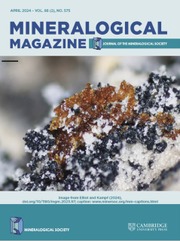
Hydroxyl-bearing bortolanite from the Lovozero alkaline massif, Kola Peninsula, Russia

Published online by Cambridge University Press:  23 May 2024

Ekaterina A. Selivanova*
Affiliation:
Geological Institute, Kola Science Centre of the Russian Academy of Sciences, 14 Fersman Street Apatity 184209 Murmansk Region, Russia Nanomaterials Research Centre, Kola Science Centre of the Russian Academy of Sciences, 14 Fersman Street Apatity 184209 Murmansk Region, Russia
Yakov A. Pakhomovsky
Affiliation:
Geological Institute, Kola Science Centre of the Russian Academy of Sciences, 14 Fersman Street Apatity 184209 Murmansk Region, Russia Nanomaterials Research Centre, Kola Science Centre of the Russian Academy of Sciences, 14 Fersman Street Apatity 184209 Murmansk Region, Russia
Lyudmila M. Lyalina
Affiliation:
Geological Institute, Kola Science Centre of the Russian Academy of Sciences, 14 Fersman Street Apatity 184209 Murmansk Region, Russia
Alena A. Kompanchenko
Affiliation:
Geological Institute, Kola Science Centre of the Russian Academy of Sciences, 14 Fersman Street Apatity 184209 Murmansk Region, Russia
Julia A. Mikhailova
Affiliation:
Geological Institute, Kola Science Centre of the Russian Academy of Sciences, 14 Fersman Street Apatity 184209 Murmansk Region, Russia Nanomaterials Research Centre, Kola Science Centre of the Russian Academy of Sciences, 14 Fersman Street Apatity 184209 Murmansk Region, Russia
Andrey A. Zolotarev
Affiliation:
St. Petersburg State University, Department of Crystallography, 7/9 Universitetskaya Emb. St. Petersburg 199034, Russia
*
Corresponding author: Ekaterina A. Selivanova; Email: e.selivanova@ksc.ru

Abstract

Bortolanite, a rare mineral of the rinkite group, seidozerite supergroup occurs in two different associations in the Lovozero massif in the Kola Peninsula, Russia: (1) together with ferri-katophorite and phlogopite, it forms porous or mesh aggregates (symplectitic accretions) with euhedral contours in the contact zone of a volcano–sedimentary xenolith and eudialyte lujavrite at Kuamdespakhk Mt and (2) in intergrowths with titanite and fluorcaphite in the poikilitic feldspathoid syenites at Sengischorr Mt. In both cases, bortolanite was found in association with rosenbuschite that is close to it in chemical composition, but unlike bortolanite, it contains no REEs. The mineral is triclinic, space group P$\bar{1}$, a = 9.5807(5), b = 5.6943(4), c = 7.2813(4) Å, α = 89.891(5)°, β = 100.959(4)°, γ = 101.241(5)°, V = 382.25(4) Å3 and Z = 1.

The Lovozero bortolanite differs from the Brazilian holotype sample from de Caldas alkaline massif, Minas Gerais, due to the presence of (OH)-groups in its composition, which is indicated by Raman data. A combination of single-crystal X-ray diffraction data and electron microprobe data provides the following crystal-chemical formula: (Ca1.97Ce0.01Nd0.01Th0.01)Σ2(Ca1.39Zr0.61)Σ2(Na0.72Ca0.28)Σ1(Na1.36Ca0.56Mn0.03Zn0.01)Σ1.96(Ti0.78Zr0.08Nb0.05Mg0.05Fe0.04)Σ1Si4O14((OH)0.92O0.87F0.21)Σ2F2.

Information

Type
Article
Copyright
Copyright © The Author(s), 2024. Published by Cambridge University Press on behalf of The Mineralogical Society of the United Kingdom and Ireland

Access options

Get access to the full version of this content by using one of the access options below. (Log in options will check for institutional or personal access. Content may require purchase if you do not have access.)

Article purchase

Temporarily unavailable

Supplementary material: File

Selivanova et al. supplementary material 1

Selivanova et al. supplementary material
Download Selivanova et al. supplementary material 1(File)
File 240 KB
Supplementary material: File

Selivanova et al. supplementary material 2

Selivanova et al. supplementary material
Download Selivanova et al. supplementary material 2(File)
File 156.4 KB