


1. Introduction
Product development (PD) is a critical determinant of long-term corporate competitiveness (Reference Ulrich and EppingerUlrich & Eppinger, 2016). Yet, it faces mounting external pressures: global competition, shortened product lifecycles, increasing quality and sustainability requirements, and growing product complexity (Reference Browning, Eppinger and LindemannBrowning et al., 2015). These dynamics demand continuous innovation and efficiency in design and engineering processes. Artificial Intelligence (AI) has been repeatedly proposed as a key enabler to address these challenges by automating cognitive tasks, enhancing decision-making, and accelerating innovation cycles (Reference Müller, Roth and KreimeyerMüller et al., 2025b).
Recent advances in deep learning architectures, large-scale datasets (Reference Radford, Wu, Child, Luan, Amodei and SutskeverRadford et al., 2019; Reference Vaswani, Shazeer, Parmar, Uszkoreit, Jones, Gomez, Kaiser and PolosukhinVaswani et al., 2017), and computational infrastructure (Reference Kaplan, McCandlish, Henighan and BrownKaplan et al., 2020) have driven rapid progress across domains such as healthcare, finance, and the creative industries yet comparable breakthroughs in engineering design (ED) and PD remain limited.
Generative AI (GenAI), in particular, has attracted significant attention for its potential to synthesize novel design solutions, automate modelling tasks, and support concept generation in PD (Reference Afifi, Wittig, Paehler, Lindenmann, Wolter, Leitenberger, Dogru, Grauberger, Düser, Albers and MatthiesenAfifi et al., 2025). A growing number of concept papers and reviews propose new use cases of GenAI across the product lifecycle from ideation to detailed CAD modelling and manufacturing planning. Existing publications often report recurring obstacles such as data scarcity, lack of explainability, high integration costs, and uncertain trustworthiness yet these are discussed in isolation rather than as part of a systemic framework. A clear synthesis of the recurring challenges and barriers which currently remains absent could advance shared objectives in GenAI for PD.
This study addresses that gap by conducting a systematic meta-review of existing reviews on GenAI in PD to identify clusters of challenges. With this review we aim to identify the most pressing challenges in the field. Then we give recommendations for research and practice that could advance shared objective. To this end, we employ a concept matrix approach (Reference Webster and WatsonWebster & Watson, 2002) to categorize and compare reported challenges across 64 publications. Our objective is to provide a structured taxonomy of barriers, critically discuss their interrelations, and derive actionable recommendations for future research and industrial practice. The central research question guiding this work is:
Which challenges hinder the effective application of GenAI methods in engineering design and the product development process?
By answering this question, we aim to clarify why the widespread adoption of GenAI in engineering remains limited and to outline pathways for developing more practically relevant AI systems supporting the PD process.
2. Background
PD is a crucial component within the product lifecycle, encompassing organizational units and processes within a company (Reference Ponn and LindemannPonn & Lindemann, 2011). It describes information processing that transforms customer requirements and needs into product design and manufacturing information. The PD process (PDP) is the systematic set of activities of introducing a new or enhanced product to the market. Digital engineering supports the PDP by employing information technologies (Reference Dally and PoultonDally & Poulton, 1998). Despite increasing digitalization, human involvement remains central in PD. The characteristics, experience, knowledge, and social competencies of individuals can determine the success of development projects (Reference Eigner and StelzerEigner & Stelzer, 2009).
GenAI methods aim to produce new, high-quality data samples that closely resemble the underlying training data distribution (Reference Goodfellow, Bengio and CourvilleGoodfellow et al., 2016). These methods are implemented through deep learning architectures such as Generative Adversarial Networks (GANs) (Reference Goodfellow, Pouget-Abadie, Mirza, Xu, Warde-Farley, Ozair, Courville and BengioGoodfellow et al., 2014), Variational Autoencoders (VAEs) (Reference Kingma and WellingKingma & Welling, 2013), Diffusion Models (Reference Sohl-Dickstein, Weiss, Maheswaranathan and GanguliSohl-Dickstein et al., 2015), and Transformers (Reference Vaswani, Shazeer, Parmar, Uszkoreit, Jones, Gomez, Kaiser and PolosukhinVaswani et al., 2017).
A GenAI system operates within a corporate environment where it performs specific tasks and interfaces with existing IT infrastructure. Developing an end-to-end AI system requires the coordinated integration of multiple interacting components. Fundamentally, such a system encompasses data acquisition, data processing, algorithmic modelling, and human–machine interaction, all contributing to a defined organizational value.
3. Research methodology
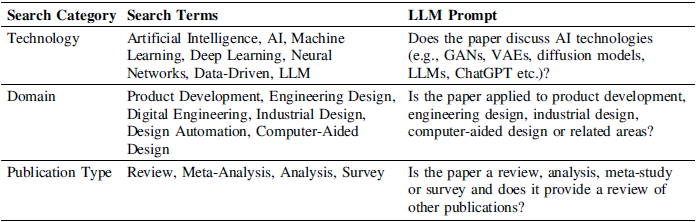
Our research methodology was grounded on the PRISMA approach (Reference Moher, Liberati, Tetzlaff and AltmanMoher et al., 2010). We established a structured search strategy based on five criteria to identify relevant literature: technology, domain, publication type, temporal constraints, and excluded terms. The specific search terms and filters applied are detailed in Table 1. The temporal scope of the search was limited to publications from the years 2024 and 2025 taking the rapid pace of advancements in the field of AI in account. Excluded terms removed publication from chemistry, bio-engineering, and architectural PD. We conducted the search across three major academic databases: Scopus, IEEE Xplore, and Web of Science. In addition to these databases, we manually reviewed proceedings from the ICED25 conference, which, at the time of data collection, had not yet been indexed in the databases.
This is an overview of the terms we used in the search strings. Within a category search terms are connected by OR, categories are connected by AND. The publications identified by the search string were subsequently each evaluated using the LLM prompts in the right column

The initial search yielded 1074 publications. To manage this volume efficiently, we employed Anthropic Claude 3.7, a large language model (LLM), to perform a preliminary relevance screening based on the title and abstract of each publication as described by Reference Bolaños, Salatino, Osborne and MottaBolaños et al. (2024). The prompts used to guide the LLM evaluation are also provided in Table 1. Following LLM-based filtering, 146 publications were retained. To assess the reliability of the LLM’s selection, we manually validated a random sample of 50 papers, confirming the generated inclusion and exclusion decisions. Subsequently, the remaining papers were reviewed by two independent human evaluators, resulting in a final set of 83 publications deemed relevant to our research objectives. The entire workflow is visualized in Figure 1.
This figure describes our literature review funnel. Using the search strings we identified 1074 publications. After the LLM evaluation 146 relevant publications remained, which were manually evaluated by two authors resulting at a final 83 publications after abstract check and 64 after full paper relevance check

3.1. Evaluation
The content of the resulting 64 publications was analysed using the concept matrix method proposed by Reference Webster and WatsonWebster & Watson (2002). In this approach, a taxonomy of challenges was first established to structure the literature systematically. Each publication was then examined by two independent researchers, and the presence of specific challenges was recorded within the concept matrix. Furthermore, for studies that reported concrete implementations or case studies, the corresponding application domain and task type were documented to enable cross-comparison across different use contexts.
4. Results
4.1. Taxonomy of challenges
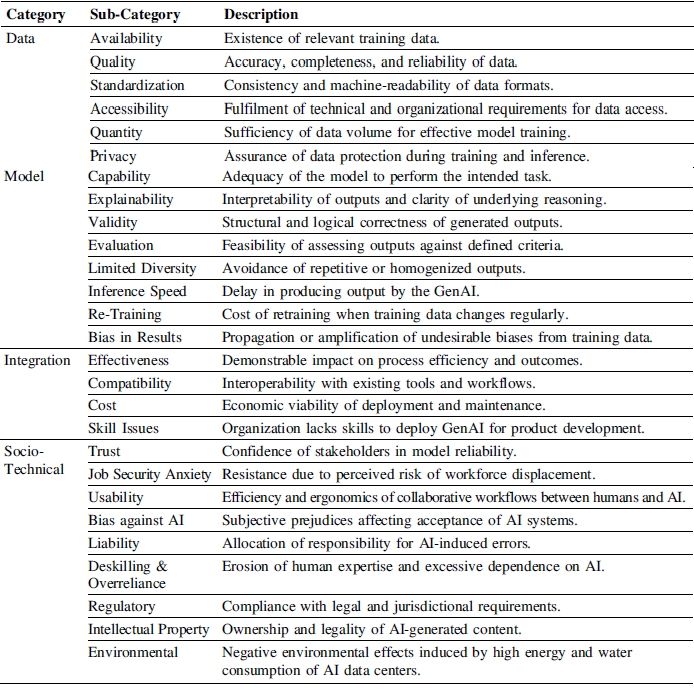
During the literature review, we systematically identified and categorized the observed challenges into distinct clusters. Based on this classification, we developed a comprehensive taxonomy comprising 27 unique challenge categories. The challenges completed with a short description are found in Table 2. This taxonomy provides a structured framework that can support practitioners in anticipating and addressing potential obstacles during the implementation of GenAI projects.
The identified challenges are organized into four overarching categories, each containing several specific subtopics. This table presents the categories and defines the associated challenges

4.2. Challenges
In this chapter we describe our results. For an overview of the total challenges count refer to Figure 2.
Distribution of the resulting totals of identified challenges across our literature meta-analysis

4.2.1. Data-related challenges
Data issues (94) emerged as one of the most frequently cited groups, reflecting their foundational role in any AI-based workflow. The most prominent challenges were quality (22), availability (20), and privacy (19) indicating persistent difficulties in finding sufficiently rich and reliable datasets for training, which might be due to data protection concerns. Further obstacles include quantity (14) and standardization (10), which highlights the lack of data volume and interoperable and machine-readable design data formats. Accessibility (8) was the least frequently mentioned challenge, yet it remains a relevant issue in AI model training.
4.2.2. Model-related challenges
Model-centric challenges (118) were mentioned the most compared to the other clusters. Capability (28) and validity (23) were the most frequent, emphasizing the uncertainty surrounding whether current AI models are able to fulfil their intended task and can reliably produce correct and functionally valid engineering outputs. Bias in results (17) is another important model-related barrier that needs to be addressed. Explainability (15) and evaluation (15) reflect the growing need for transparent reasoning and objective performance assessment in generative models. Limited diversity of results (13) is another challenge hindering the widespread utilization of AI methods in engineering. Additional aspects such as re-training (5) and inference speed (2), which are less frequently mentioned compared to the other model-centric challenges, address the robustness and adaptability of models over time.
4.2.3. Integration challenges
Integration-related challenges (61) focus on the organizational and technical embedding of AI systems into existing engineering processes. The most frequently mentioned issues were cost (21), closely followed by compatibility (20), suggesting that even promising AI tools face barriers when integrated into established CAD, PLM, or simulation environments. Skill issues (12) and effectiveness (8) appeared less often but point to a widening gap in the competencies required for effectively deploying GenAI within engineering teams.
4.2.4. Socio-technical challenges
The cluster regarding socio-technical challenges (103) reflects human, ethical, and regulatory dimensions of AI adoption. The leading concerns were trust (24), intellectual property (19), and usability (18). These issues reveal widespread uncertainty about the reliability, accountability and ownership of AI-generated design outputs, as well as the user-friendliness of the corresponding tools. Less frequently mentioned but still relevant were deskilling (10), liability (10), and job security anxiety (9). Collectively, these challenges emphasize that beyond technical and integration barriers, societal factors and judicial decisions will have an influence on the adoption rates of AI in ED. While regulatory concerns (5), bias against AI (4), and environmental factors (4) were mentioned less frequently, they still represent socio-technical considerations that should be accounted for when applying AI in the PDP.
5. Discussion
5.1. Dominant challenge areas
The taxonomy reveals that model-, socio-technical- and data-related challenges remain the most frequently cited obstacles to adopting GenAI in ED, followed by integration-related challenges. Issues of model capability, trust in AI, validity of AI-generated results, data quality and availability, as well as integration costs and compatibility issues continue to constrain the applicability of AI methods in the context of engineering.
The data-related findings align with prior reviews that identify data scarcity and heterogeneity as key bottlenecks in data-driven design and manufacturing (Reference Han, Jiang and Ahmed-KristensenHan et al., 2025; Reference Salman, Al-Shaikhli, Abbas, Ahmad and KudusSalman et al., 2025). Engineering data are often proprietary, fragmented across formats, and lack consistent labelling or ontologies (Reference Zha, Bhat, Lai, Yang, Jiang, Zhong and HuZha et al., 2023), which limits the feasibility of training large, generalizable models.
The fact that on the model side concerns about capability, validity, biased results and explainability dominate, highlights that model performance alone is insufficient; rather, trust, transparency, and interpretability ensuring valid and balanced results are essential for adoption in safety-critical engineering contexts (Reference Doshi-Velez and KimDoshi-Velez & Kim, 2017; Reference Samek, Montavon, Lapuschkin, Anders and MüllerSamek et al., 2021). Practitioners question whether generative models can reliably fulfil complex product-development tasks that require domain knowledge, constraint satisfaction, and causal reasoning. These limitations also emphasized in recent assessments of generative design systems. This reflects the inherent difficulty and diversity of challenges in PD, where decisions are multi-objective, context-dependent, and often ill-structured (Reference Pahl, Beitz, Feldhusen and GrotePahl et al., 2007).
Within integration-related barriers, cost emerges as the dominant challenge. High computational demands, licensing fees, and the need for specialized expertise raise the entry threshold for industrial adoption (Reference Bommasani, Hudson and AdeliBommasani et al., 2022). This is closely followed by barriers regarding the compatibility of GenAI solutions with existing toolchains such as existing CAD/PLM systems. A lack of skills for GenAI integration is also mentioned in the scientific literature which is in accordance with industry surveys reporting that up to 80% of AI initiatives fail to move beyond pilot stages, largely due to insufficient data infrastructure and organizational readiness (Gartner Inc., 2023; McKinsey & Company, 2023). In general, these integration issues reveal that engineering organizations face structural constraints beyond algorithmic maturity in order to achieve real-world AI deployment.
From a socio-technical point of view intellectual property concerns represent another major barrier. Debates persist over the ownership of AI-generated content and the potential infringement of protected materials (Reference Gaidartzi and StamatoudiGaidartzi & Stamatoudi, 2025; Reference Lee, Cooper and GrimmelmannLee et al., 2024). These issues are intensified by the opacity of training data sources and the uncertain legal status of AI-produced designs under copyright and patent law. Closely related are concerns about trust and usability, which mirror broader findings in human-AI interaction research emphasizing transparency, accountability, and calibrated trust as prerequisites for successful adoption (Reference Amershi, Weld, Vorvoreanu, Fourney, Nushi, Collisson, Suh, Iqbal, Bennett, Inkpen and TeevanAmershi et al., 2019; Reference Eiband, Schneider, Bilandzic, Fazekas-Con, Haug and HussmannEiband et al., 2018; Reference McGrath, Duenser, Lacey and ParisMcGrath et al., 2025). Compared with the above mentioned aspects, the remaining socio-technical barriers such as liability and job displacement appear less frequent but still reveal serious concerns around cultural and ethical dimensions that must be addressed through governance and education. Environmental impacts represent a critical yet overlooked dimension. Training and inference of large models consume significant energy and water resources (Reference Patterson, Gonzalez, Le, Liang, Munguia, Rothchild, So, Texier and DeanPatterson et al., 2021; Reference Strubell, Ganesh and McCallumStrubell et al., 2019). For example, recent estimates indicate that a single interaction with a LLM can produce 4.3 grams of CO2 emissions and requires 10 milliliters of waters multiplied by potentially tens of thousands of requests for a single GenAI tool per day. (Reference Henderson, Hu, Romoff, Brunskill, Jurafsky and PineauHenderson et al., 2020). Given that such impacts extend beyond beneficiaries of GenAI to our society at large, sustainability must be recognized as a key consideration in the future.
5.2. Interdependence of challenges
Our analysis indicates certain identified challenge categories are strongly interdependent (see Figure 3). Poor data quality propagates through the pipeline, resulting in biased or invalid model behaviour (Reference Mehrabi, Morstatter, Saxena, Lerman and GalstyanMehrabi et al., 2021; Reference Whang, Roh, Song and LeeWhang et al., 2023). Similarly, insufficient explainability undermines user trust and limits adoption in safety-critical contexts (Reference Wang, Liu, Panchal, Leng and WangWang et al., 2025). Integration challenges—such as costly deployment or lacking interoperability—further amplify organizational skill gaps and hinder scalability (Reference Costa, Oleiro Araújo, Peres and BarataCosta et al., 2024; Gartner Inc., 2023). Addressing these issues in isolation is therefore unlikely to yield sustainable progress. Instead, system-level strategies are required, including data governance frameworks to ensure consistency and traceability (Reference SchelmeticSchelmetic, 2022), human-in-the-loop evaluation to embed expert oversight (Reference Amershi, Weld, Vorvoreanu, Fourney, Nushi, Collisson, Suh, Iqbal, Bennett, Inkpen and TeevanAmershi et al., 2019), and transparent model documentation (e.g., model cards and datasheets) to communicate model limitations and intended use (Reference Gebru, Morgenstern, Vecchione, Wortman Vaughan, Wallach, Daumé and CrawfordGebru et al., 2021; Reference Mitchell, Wu, Zaldivar, Barnes, Vasserman, Hutchinson, Spitzer, Raji and GebruMitchell et al., 2019; Reference Müller, Roth and KreimeyerMüller et al., 2025a)
Heatmap of challenge co-occurrences illustrating which challenges most frequently appear together and may indicate underlying causal relationships. For example, when the capability of the GenAI is questioned, then the validity of results is also of concern

Figure 3 Long description
A heatmap matrix showing the co-occurrence of various challenges in product development, highlighting frequent pairings and potential underlying relationships. The matrix has 25 rows and 25 columns, each representing different challenges such as availability, quality, standardization, accessibility, quantity, privacy, explainability, validity of results, capability, evaluation, limited diversity of results, bias in results, inference speed, re-training and updating, effectiveness, compatibility, cost, skill issues, trust, job security anxiety, usability, human AI interaction, bias against AI, liability, regulatory concerns, deskilling, environmental concerns, and IP concerns. The matrix is symmetrical with values ranging from 0 to 14, indicating the frequency of co-occurrence between challenges. For example, the capability challenge frequently co-occurs with the validity of results challenge, as indicated by higher values in their corresponding cells. The heatmap uses color gradients to represent the frequency of co-occurrence, with darker colors indicating higher frequencies.
5.3. Recommendations for research
From a research perspective, the results underscore the persistent gap between algorithmic innovation and practical deployment. As training data availability and cost to train models are both major concerns, research can focus on small, specialized models that perform well and economical in narrow tasks, rather than employing huge LLMs (Reference Belcak, Heinrich, Diao, Fu, Dong, Muralidharan, Lin and MolchanovBelcak et al., 2025).
To address low capability and validity and consequently low trust in AI models, a move beyond purely data-driven models is recommended. Instead, GenAI can be combined with knowledge-based methods such as finite element analysis that explicitly encode physical laws and engineering knowledge into the generative process. This could drastically improve the capabilities of GenAI models facilitating outputs with increased validity. Interweaving GenAI abstractions with numerical precision of knowledge-based systems also supports explainability and usability like e.g., explainable AI techniques tailored for generative ED that can explain why a specific design feature was proposed in terms of performance or constraints.
5.4. Recommendations for practitioners
For engineering practitioners, several actionable priorities emerge from the identified challenges.
First, robust data governance and quality pipelines must be established before deploying GenAI tools. Given that data inconsistency and fragmentation directly affect model validity, organizations should prioritize standardized data formats, labeling protocols, and version control across CAD, PLM, and simulation systems. Such infrastructures enable traceability and reproducibility both essential for industrial certification and regulatory compliance.
Second, explainability and evaluation mechanisms should be embedded into AI-assisted CAD workflows. Transparent metrics for assessing performance, validity, and model uncertainty are crucial to maintain accountability and facilitate informed design decisions. Integrating interpretability tools directly into design environments allows engineers to verify results rather than treating AI outputs as opaque recommendations.
Third, organizational readiness is a prerequisite for successful adoption. This involves upskilling staff, redefining workflows to accommodate hybrid human-AI design processes and ensuring interoperability with existing digital engineering infrastructure. Pilot projects should focus on incremental integration to demonstrate value before full-scale deployment.
Fourth, ethical and legal risks require proactive management. Clear governance frameworks should define data provenance, model ownership, and liability boundaries, particularly in collaborative or cross-organizational contexts. Documentation practices, such as model cards and datasheets, can improve accountability and trust in generated outputs.
Finally, sustainability considerations must be incorporated into the design and operation of AI systems. Monitoring the energy and resource footprint of model training and inference can inform responsible use policies and support alignment with broader environmental objectives.
5.5. Limitations
The identified challenges reflect those most frequently reported in the literature rather than those most prevalent in real-world practice. This discrepancy arises because published studies tend to emphasize conceptual or high-impact barriers such as model capability or data availability while overlooking practical, context-specific difficulties encountered in industrial implementation. Consequently, the presented taxonomy captures the perceived and documented challenge landscape rather than a direct measurement of actual occurrence.
6. Conclusion and outlook
This study presents a taxonomy of 27 challenges that hinder AI adoption in engineering design and product development, spanning technical, organizational, and socio-technical barriers. It shows that success depends not only on algorithms and data, but also on integration, explainability, and trust.
Future work should focus on compact domain-specific and hybrid approaches, and validate challenge interdependencies in industrial settings. Standardized benchmarks and deployment guidelines, developed jointly by academia, industry, and policymakers, are needed to bridge research and practice.



 Open access

