


Here we shall use the expressions derived in another paper in this Journal (Reference ThomasThomas, 1973), together with measured values of creep rate from a number of ice shelves, to evaluate the parameters B and n in the flow law of ice. We shall consider separately the creep rates from relatively unconfined areas of ice shelf and those from a confined ice shelf—the Amery Ice Shelf. Finally we shall use the resultant values of B and n to interpret the behaviour of the Brunt Ice Shelf as it approaches a small ice rise.
First, however, we must note the influence of density variations with depth in equation (18) of Reference ThomasThomas (1973).
1. Depth/Density Function
The flow law for ice can be written:

where the shear strain-rate  is defined by

and for an ice shelf with  , and using the notation of Reference ThomasThomas (1973),

Also from equations (13) and (14) in Reference ThomasThomas (1973)

In order to simplify Equation (3) we might be tempted to assume the density of the ice shelf to be constant and equal to ρ i. With this assumption, however, values of τ are approximately double those obtained with a density/depth relationship similar to that found by Reference SchyttSchytt (1958) at Maudheim.
Measurements of density versus depth were not made on the Brunt Ice Shelf, so we adopt a density function compatible with the observed relationship between ice thickness H and surface elevation h. To describe the Maudheim observations Reference SchyttSchytt (1958, p. 120) suggested a function of the form:

where k and v are empirical constants and z is measured upwards from sea-level.
Measurements of density near the surface give a value for ρ i(h) (we neglect the very low-density surface snow) so

For hydrostatic equilibrium we also have:

At Maudheim v ≈ 0.0258 m−1 and H ≈ 200 m (Reference SchyttSchytt, 1958, p. 120) so exp (–vH) ⪡ 1 and, assuming ρ w = 1 028 kg m−3,

Thus we can evaluate v wherever H and h are known. The “density function” (Equation (4)) together with the values of α and β from strain-rate measurements can then be substituted in Equation (3) to give τ.
We shall consider data from four ice shelves. For Maudheim we use the values of k and v given by Schytt. For the Brunt Ice Shelf and the Amery Ice Shelf we adopt the Maudheim value of k (implying ρ i (h) = 450 kg m−3) and deduce v from local measurements of H and h (the Brunt Ice Shelf measurements are described in Reference ThomasThomas and Coslett (1970); those for the Amery Ice Shelf were from preliminary results communicated to the author by W. F. Budd in 1971). Evaluation of Equation (3) for “Little America V” on the Ross Ice Shelf was by numerical integration of the observed variation of density with depth (Reference CraryCrary, 1961, p. 42). Note that the results given by Reference ThomasThomas (1971) assumed that Equation (4) adequately represented density variation at “Little America”. However, the observed density profile shows an increased rate of densification at about 40 m depth. Reference GowGow (1963, p. 278) believed this to be the remnant effects of horizontal compression near Roosevelt Island. In these circumstances Equation (4) leads to an over-estimated value of τ. A similar situation probably exists on the Brunt Ice Shelf with compressive strain-rates up-stream from the McDonald Ice Rumples (Fig. 4).

2. Unbounded Ice Shelf
With β = 0 in Equation (2) and  in Equation (3) we have equations which apply to areas of ice shelf confined in the x-direction solely by sea pressure.
  and
and  are then the principal components of the horizontal strain-rate, and from equation (16) in Reference ThomasThomas (1973) we see that the strain-rate reaches a maximum in the x-direction where F is a minimum. Thus we take
  as the larger principal component of the horizontal strain-rate.
In Table I values of  and τ are listed for a number of apparently unconfined areas of ice shelf. Because the Amery Ice Shelf is bounded, only data from g1, situated nearer the ice front than the ice-shelf sides, has been used. g1 is situated on a small hill rising some 10 m above the surrounding ice shelf and two values of τ have been calculated corresponding to local and regional values of H and h. The Brunt Ice Shelf data were selected from areas apparently free from horizontal shear or compressive strains.

From Equation (1) we have:

So, for an almost constant
B
, we plot log  against log τ to obtain a straight line of slope n (Fig. 1). The line represented by n = 3 fits the data well, implying a behaviour consistent with Walker’s (unpublished) laboratory results at stresses down to 0.04 MN m−2. The lower stress region of Walker’s results for −14° C and −22° C is included in Figure 1 for comparison. Most of the scatter of the ice-shelf results can be attributed to differences between the mean temperatures (and hence the values of
B
) of the various ice shelves. With n = 3 in Equation (1) we can calculate values of
B
for each of the four ice shelves; the results are listed in Table I and plotted against mean ice-shelf temperature in Fig. 2. The temperature measurements used are from Reference SchyttSchytt (1960, p. 167), Reference CraryCrary (1961, p. 56) and a personal communication from W. F. Budd in 1970. The temperature/depth variation for Brunt Ice Shelf is assumed to be similar to that at Maudheim.
against log τ to obtain a straight line of slope n (Fig. 1). The line represented by n = 3 fits the data well, implying a behaviour consistent with Walker’s (unpublished) laboratory results at stresses down to 0.04 MN m−2. The lower stress region of Walker’s results for −14° C and −22° C is included in Figure 1 for comparison. Most of the scatter of the ice-shelf results can be attributed to differences between the mean temperatures (and hence the values of
B
) of the various ice shelves. With n = 3 in Equation (1) we can calculate values of
B
for each of the four ice shelves; the results are listed in Table I and plotted against mean ice-shelf temperature in Fig. 2. The temperature measurements used are from Reference SchyttSchytt (1960, p. 167), Reference CraryCrary (1961, p. 56) and a personal communication from W. F. Budd in 1970. The temperature/depth variation for Brunt Ice Shelf is assumed to be similar to that at Maudheim.

Also shown in Figure 2 is a B–T graph deduced from Walker’s (unpublished, table 3, “power law region”) laboratory results, and theoretical values of B calculated for each ice shelf using this graph and the known, or assumed, variation of temperature with depth. Because of the non-linear form of the B–T curve the creep behaviour of the ice shelf is determined more by the colder ice and this is reflected in the small difference between mean ice-shelf temperatures and those against which theoretical values of B have been plotted in Figure 2. However, in calculating the mean ice-shelf temperatures and theoretical values of B , temperatures in the upper 40 m of low density, relatively soft firn have been neglected.

Although Figure 2 shows good agreement between field results and laboratory work, it is significant that the field values of B are each slightly larger than expected and the ice shelves appear harder than laboratory ice at the same temperature. If, as discussed earlier, the density/depth curve for the Brunt Ice Shelf is similar to that found at “Little America V” the values of τ and B found using Equation (4) will be too high. Thus only the value of B from g1 on the Amery Ice Shelf significantly different from that deduced from laboratory result. This is believed to be because the ice at g1 is to a certain extent restrained by the ice-shelf sides so that its behaviour is more accurately described by the analysis given in section 3.2 of Reference ThomasThomas (1973). In section 3 we shall use measurements of the dimensions of the Amery Ice Shelf (personal communication from W. F. Budd in 1971 of thicknesses from radio echo sounding and surface elevations from precision levelling) to interpret strain-rates measured on the ice shelf. First, however, we shall use data collected on thin ice shelves to extend our knowledge of the flow law to lower stresses.
2.1. Results from areas of thin ice shelf
In a recent paper Reference DorrerDorrer (1971) presented measurements of ice velocity and strain-rates from the Ward Hunt Ice Shelf taken at a point where the ice is approximately 40 m thick. The values are shown in Figure 3 (a reproduction of Dorrer’s figure 4) Dorrer deduced values of n and B from these results, but his analysis utilised Reference NyeNye’s (1952) solution for the velocity in an infinitely deep channel (which assumes zero longitudinal strain-rate) and Reference BuddBudd’s (1966) expression for B (which is only valid for an ice shelf of uniform thickness).

The ice velocities in the neighbourhood of the strain network are so small (≈ 0.5 m a−1) that the effects of shear stresses between the grounded and floating ice are likely to be negligible. Consequently we shall consider that stresses in the direction of ice movement (the x-direction) are balanced solely by sea pressure.
We adopt a similar approach to strain-rates measured at r7 on a thin area of the Brunt Ice Shelf (Figs. 4 and 5) with x-direction parallel to the larger component of strain-rate  and τ were calculated using Equations (2) and (3).

was calculated for r7 by numerical integration of the observed variation of density with depth and for the Ward Hunt Ice Shelf by assuming a constant density of 910 kg m−3. The results are included in Table I and plotted as log τ versus log  in Figure 6. The 10 m temperature at r7 is −10°C and on the Ward Hunt Ice Shelf (Reference Lyons and RagleLyons and Ragle, 1962) the surface temperature is approximately −18° C. Assuming a linear increase of temperature with depth to −2° C at the base we estimate equivalent average temperatures of −6°C and −10° C Included in Figure 6 are the plots of log τ versus log
  appropriate to these tempertures assuming the laboratory B–T curve and a flow-law exponent of n = 3. The error boxes drawn around the field values include the effects solely of strain-rate errors, so the field result show a satisfactory agreement with the extrapolated laboratory results for stresses down to 1 × 10⁴ N m−2.


This is shown by Figure 2, where values οf
B
for the areas of thin ice shelf (obtained by substituting τ and  in Equation (1)) are plotted against temperature. However, in contrast to most of the thicker ice shelves studied, the areas of thin ice shelf appear if anything slightly softer than expected. One reason for this could be the relatively high impurity levels: the Ward Hunt Ice Shelf contains an appreciable percentage of old sea ice (Reference Lyons and RagleLyons and Ragle, 1962) and movement studies near r7 (Fig. 5) indicate that in 1967 the thin ice shelf was probably less than 20 years old and consisted largely of old sea ice with a surface cover of firn and snow. However, we should also note that on both the areas of thin ice shelf the total strain suffered by the ice is probably less than 10% and steady state may not have been reached (Reference WeertmanWeertman, 1969). In either case we expect true steady-state strain-rates to be lower than those shown in Figure 6.Footnote * This would probably lead to better agreement with the extrapolated laboratory results implying no reduction in n down to effective stresses of 104 N m−2.
The very close agreement between the value of B from r7 and that for laboratory ice at the same temperature implies that in this instance the ice shelf behaves almost as pure ice. This may be indicative of the extent to which sea ice can be desalinated.
3. Creep Rates on the Amery Ice Shelf
The Amery Ice Shelf is shown in Figure 7. Strain-rates at g1, g2, g3 and e are given in Reference BuddBudd (1966) and Reference Budd and ŌuraBudd and others (1967). Of these four stations only e is sufficiently far from the centre line to supply measurements of the shear strain-rate  necessary for the solution of equation (29) in Reference ThomasThomas (1973) to given
B
necessary for the solution of equation (29) in Reference ThomasThomas (1973) to given
B


All calculations incorporate variation of density with depth as described in section 1.
Before solving this, however, we must elaborate our definition of the line across the ice shelf defined by x = X and beyond which the sides of the ice shelf no longer affect creep behaviour. In section 2 we assumed that g1 is to seaward of this line because it is sited nearer the ice front than the ice-shelf sides. However, the resultant value of B showed that this is probably not true. Here we assume that x = X describes a quasi-circular arc through the points where the ice shelf leaves its margins and inclined at 45° to the margins at these points (Fig. 7).
There are no measurements available for ice thickness and surface elevation from the ice front to e so we assume a similar profile to that measured along the centre line (Fig. 8). The values of relevant parameters are given in Table II. Substituting these values in Equation (5) and assuming n = 3 we get


Using equation (26) of Reference ThomasThomas (1973) we can now evaluate τ s, the shear stress at the ice-shelf sides averaged over thickness

which is approximately the value associated with a plastic “yield stress” for ice (see for instance Reference PatersonPaterson, 1969, p. 88).

We are now in a position to calculate an improved value of
B
from the data obtained at g1. For positive  equation (23) of Reference ThomasThomas (1973) can be written:

with

Using the values listed in Table II we get.

if we use the regional rather than local values of surface elevation and ice thickness. This is almost identical to the value deduced from observations at e. Errors are difficult to assess, being largely due to possible deviations of the actual depth/density function from that represented by Equation (4). However, these values compare well with that deduced for ice at g1 ( ) from the laboratory B–T curve.
At greater distances from the ice front the strain-rates are considerably reduced and they become comparable with the estimated errors. Moreover near g2 there is probably a “bottleneck” effect due to the presence of Gillock Island and to the large influx of ice from Charybdis Glacier (Fig. 7). This should cause a local increase in the up-stream restraining force F which becomes the sum of the forces due to water pressure F w, shear past the sides F s and “bottleneck” restraint F b. Equation (16) of Reference ThomasThomas (1973) then becomes:

or, using equation (22) of Reference ThomasThomas (1973) and generalizing for negative 

Substituting the values listed in Table II and assuming  we get:

The errors in strain-rate are such that the values of F b at g2 and g3 are effectively equal. This means that the creep behaviour of the ice shelf up-stream of g2 can be interpreted by Equations (5) and (6) if we incorporate an additional constraint F b which is approximately constant at all points, and is probably due to the presence of Gillock Island and Charybdis Glacier. A more detailed analysis would require data from a larger number of stations and in the next section we shall use the results of the survey work on the Brunt Ice Shelf described in Reference ThomasThomas (1970) to examine the influence of a small ice rise (McDonald Ice Rumples in Fig. 4) on the creep behaviour of the Brunt Ice Shelf.
4. The Influence of the McDonald Ice Rumples on the Brunt Ice Shelf
The effect of a small ice rise on a moving ice shelf is analogous to that of a large restraining force acting at the centre of the ice rise. Because the ice is floating, this force will be largely transmitted up-stream through a zone of disturbed ice where strain-rates are affected by the ice rise. Within this zone we expect an inverse relationship between distance r from the ice rise and the local value of the restraining force F(r) per unit width of ice shelf. More specifically we can write

In this section, by examination of the observed variation of F(r) with r, we shall deduce an approximate shape for the disturbed zone and calculate the stresses acting within the area of grounded ice.
4.1. The restraining force exerted on the ice shelf by the McDonald Ice Rumples
For the strain-rates measured on the Brunt Ice Shelf up-stream from the McDonald Ice Rumples Equation (8) becomes

where F(r) is the restraining force exerted by the McDonald Ice Rumples on a unit width of the ice shelf at the point where  is measured and x is the direction from that point towards the McDonald Ice Rumples.
Principal strain-rates ( and
and  ) resulting from the ice velocity measurements described in Reference ThomasThomas (1970) were converted to their components in the x, y and xy directions using:

where θ is the angle between the directions of  and
and  . Assuming n = 3 and
  and taking appropriate values of h and H from the surface elevation and ice thickness measurements, Equation (10) was solved for numerous points within the area of ice shelf influenced by the McDonald Ice Rumples. The results are plotted as log F(r) versus log r in Figure 9.

In order to give an idea of the relative magnitudes involved, a plot of horizontal tensile force due to the weight of ice above sea-level (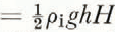 ) is included. Division by the ice thickness gives the appropriate average stresses. The rapid decrease in F(r) at r ~ 40 km is associated with entry into an area of ice shelf that consists of a matrix of loosely consolidated icebergs.
4.2. The shape of the disturbed zone
Observations on the Brunt Ice Shelf indicate that there is a discrete zone up-stream of the McDonald Ice Rumples where strain-rates are influenced by the restraining effects of the grounded ice. The first-order regression line of slope —1.07 is included in Figure 9. The degree of agreement between this line and the data points indicates that, for a given value of r, F(r) is more or less independent of position within the disturbed zone. However, this condition must break down near the margins of the zone, where F(r) decreases to zero.
Because the ice shelf is floating the total force acting at any distance r from the ice rise is constant

where ϕ(r) is the angle subtended at the ice rise by the disturbed zone at distance r. From the results illustrated in Figure 9 we also have

so we can write Equation (11) as

where k is some constant. We thus have the result that when m = 1, ϕ is independent of r. This corresponds to the case of a perfectly rigid body. In our case m ≈ 1.07, implying a more rapid stress diffusion as a result of creep deformation. From a study of the strain-rate distribution near the McDonald Ice Rumples the value of ϕ corresponding to r = 7 km was estimated to be between 100° and 120° (≈ 2 rad). Thus k in Equation (12) is given by

Substitution of this value into Equation (12) gives the boundaries to the zone of disturbance shown in Figure 4.
4.3. Stresses at the ice rise
The average stress σ acting across the boundary between the grounded ice of McDonald Ice Rumples and the ice shelf is H –1 times the value of F(r) at r equal to the radius of the ice rise (≈ 0.5 km). Thus

for H = 300 m. Figure 10 clearly illustrates the effects of these very large stresses on the ice shelf at the point of grounding.

The value of F(r) corresponding to r = 1/ϕ(r) is equal to the total force F t exerted by the ice shelf on the sea bed beneath the ice rise. Extrapolation of Figure 9 to this value of r (≈ 0.9 m) gives:

This force is distributed over the area of ice actually grounded (≈ 3.5 km2). Thus we calculate a value for the basal shear stress τ b:

which is in good agreement with the plastic “yield stress” for ice.
5. Conclusions
Because of the very low strain-rates involved, laboratory experiments on the creep of ice become both time-consuming and unreliable at stresses much below 105 N m−2. This is particularly so at temperatures less than –10° C where, for instance, a uniaxial stress of 5 × 10⁴ N m−2 produces a strain-rate of less than 1 × 10⁻³ a−1. It is in this stress region that field glaciology is likely to supply more information.
Ice shelves rest on a frictionless bed of known temperature and their creep behaviour is relatively simple to analyse in terms of the generalized ice flow law  . They are therefore the natural ice features most likely to extend our knowledge of the flow-law parameters into the low-stress region.
In this paper we have used all published creep rates from ice shelves of known dimensions to compare field values of B and n with those deduced from laboratory work at stresses greater than 1 × 10⁵ N m−2. The degree of agreement suggests that the generalized flow law can be applied with n ≈ 3 at least over the stress range 1 MN m−2 > τ > 0.04 MN m−2 and probably to stresses as low as 0.01 MN m−2.
Results from thicker ice shelves show the ice to be slightly harder than Walker’s laboratory ice at the same temperature. To a certain extent we expect this, since some of the driving force assumed to be responsible for creep may be otherwise employed. Other possible explanations include preferred fabric within ice shelves (discussed by Reference ThomasThomas, 1971) and grain-size effects. Little or no reliable work has been published on the effects of grain size on the creep properties of ice, but for polycrystalline metals the dependence of creep rate on grain size has been investigated to a greater extent. Reference Sherby and BurkeSherby and Burke (1968, p. 353) suggest that in the power-law stress region grain size is of minor importance and at lower stresses the creep rate is unaffected at grain sizes above a critical value. Below this value creep rate increases with decreasing grain size. Work reviewed by Reference GarofaloGarofalo (1965, p. 28) shows that for monel and for an iron alloy there appears to be a critical value d m of the grain diameter at which the secondary creep rate is a minimum. Values of d m are almost independent of stress, but increase with rising temperature.
The separate experiments of Glen, Steinemann, and Walker each involved samples of approximately 1 mm grain diameter, which is appreciably smaller than the mean values at Maudheim and “Little America” (Reference GowGow, 1963, p. 281) where the grain diameter increases from 2 mm near the surface to about 7 mm at a depth of 150 m. Values of B for n = 3 derived from the results of Glen and Steinemann (after Reference BuddBudd, 1966, p. 351) are included in Figure 2. Despite the large differences in grain size the ice shelf results lie between the B versus T graph of Glen and Steinemann and that of Walker. This may imply either that grain size has little effect on the creep behaviour of ice, or that d m falls between 1 mm and 7 mm in the temperature range −12° C and −18° C. However, considerably more laboratory data are required before any firm conclusions can be reached.
Acknowledgements
I thank the British Antarctic Survey for sponsoring this work, Dr W. F. Budd for supplying the Amery Ice Shelf data and members of the Scott Polar Research Institute for reading the manuscript. An anonymous referee brought to my notice the reference to Reference Sherby and BurkeSherby and Burke (1968).



