


1. Introduction
Narratives play a pivotal role in design studies, serving as facilitators of the design process, essential components of design capabilities, and integral elements of design outcomes (e.g., Zurlo & Cautela, Reference Zurlo and Cautela2014; Lloyd & Oak, Reference Lloyd and Oak2018; Grimaldi, Reference Grimaldi2018; Hayama & Zurlo, Reference Hayama and Zurlo2022). Grimaldi (Reference Grimaldi2018) introduced the concept of “Narrative Experience,” defining it as a higher-level product experience that extends beyond aesthetic, meaningful, and emotional dimensions. As service design continues to evolve as a key discipline within design research, the challenge lies in enhancing experiential value for users through more immersive and meaningful interactions.
This study applies a Research through Design (RtD) approach to examine narrative-driven service design in a Project-Based Learning (PBL) setting. It explores its value both as a design methodology and a research framework, offering insights for practitioners, researchers, and educators.
While traditional service design approaches such as Service Blueprint (Reference ShostackShostack, 1982) and Design Thinking (Reference BrownBrown, 2008) emphasize process optimization and problem-solving, narrative-driven service design focuses on embedding storytelling elements to create immersive and meaningful user experiences. Recent advancements, including Participatory Service Design (Reference Sanders and StappersSanders & Stappers, 2008) and Systems Thinking in Service Design (Reference Miettinen, Suoheimo, Morelli, de Götzen, Suoheimo, Jones, Lee and SavaldsonMiettinen et al., 2025), highlight the importance of holistic and user-centered design. This study extends these perspectives by exploring how narratives can shape service interactions and contribute to experience-driven innovation.
1.1. Narrative experiences as a higher-level product experience
In product design research, scholars have extensively examined product experiences, exploring how users interact with and perceive products in multi-dimensional ways. Desmet & Hekkert (Reference Desmet and Hekkert2007) proposed that product experiences comprise three core dimensions: aesthetic appeal, meaningfulness, and emotional resonance during product interaction. Expanding on this foundation, Grimaldi (Reference Grimaldi2018) introduced Narrative Experiences, positioning them as a higher-order user experience shaped by narrative dimensions. This perspective suggests that products, like well-crafted stories, can unfold in structured narrative arcs, creating deeper emotional engagement and memorable user journeys.
Given this emerging perspective, further research is needed to explore how narrative experiences enhance user engagement and create deeper emotional and cognitive connections in service design and user experience.
1.2. The role of narrative in service design
As economies transition from industrial production to service-driven models, the role of services has gained increasing significance—not only in enhancing customer satisfaction but also in shaping economic value. Service-Dominant Logic (S-D Logic) challenges traditional Good-Dominant Logic (G-D Logic) by emphasizing service as the fundamental basis of economic exchange (Reference Vargo and LuschVargo & Lusch, 2014). In response to this shift, the Product-Service System (PSS) has emerged as a hybrid model, integrating products and services to provide greater value and address complex user needs (Reference Baines, Lightfoot, Evans, Neely, Greenough, Peppard and WilsonBaines et al., 2007).
At its core, service design is centered on developing meaningful and user-centered experiences. It is closely linked to user experience (UX) design principles, which emphasize usability, accessibility, and user engagement. In service design, storytelling has gained attention as a powerful tool to create structured, immersive, and emotionally resonant user experiences (Reference Meroni and SangiorgiMeroni & Sangiorgi, 2011). By embedding narrative elements into service interactions, designers can facilitate cohesive and evolving user journeys, reinforcing both engagement and emotional connection.
Building on this foundation, this paper examines how narrative experience design can contribute to service design by fostering more engaging, meaningful, and memorable user interactions. This study explores how narrative experience design can advance service design by shifting its focus from problem-solving to experience-driven innovation. By integrating narrative perspectives, service design can move beyond functional solutions, fostering more immersive and emotionally resonant user interactions.
2. Methodology
Owing to the constructive design research as a way of Research through Design (RtD) approach, this paper investigates both theoretical and practical knowledge. A design challenge of designing “digital services to enhance wellbeing driven by delightful moment narratives” was the setting of the research, where a Project-Based-Learning in an Industrial Design Course at Bachelor’s level in a Japanese national design school, Kyushu University. Assuming that narratives can be powerful design triggers as well as a strong format of service design artifacts, this study put narratives at the center of the project.
2.1. Research through Design (RtD)
RtD provides a framework where design contributes to knowledge generation (Reference Stappers, Giaccardi, Soegaard and Friis-DamStappers & Giaccardi, 2017). This study embeds narrative-driven service design in a PBL setting, generating insights through iterative prototyping.
Therefore, through generating digital services and those experiences as visual representations of design outcomes, this research pursues to generate a piece of knowledge in the identified research gap between narrative experiences and service design.
Data were collected in two different formats. First, the prototypes of digital services as intermediate productions and final artifacts generated by the project participants. Second, the results of a survey conducted by the author on the participants during the project, which included both qualitative and quantitative data.
To explore the possibilities and effectiveness of designing narrative experiences in service design, PBL (Reference Krajcik, Blumenfeld and SawyerKrajcik and Blumenfeld, 2005) was conducted in an industrial design course at a Japanese design school. Project-based learning is a pedagogical approach in higher-education in order for students to learn cutting-edge academic topics within real-world practice (Reference Kokotsaki, Menzies and WigginsKokotsaki et al, 2016). Project-based learning is a student-centered form of instruction that is based on three constructivist principles: learning is context-specific, learners are involved actively in the learning process and they achieve their goals through social interactions and the sharing of knowledge and understanding. It is considered to be a particular type of inquiry-based learning where the context of learning is provided through authentic questions and problems within real-world practices that lead to meaningful learning experiences. Therefore, focusing on “narratives of joyful moments in everyday life,” this research set the practical theme of service design to enhance people’s wellbeing, and conducted a study to clarify how narrative-driven service design creates narrative experiences and the effectiveness of this approach.
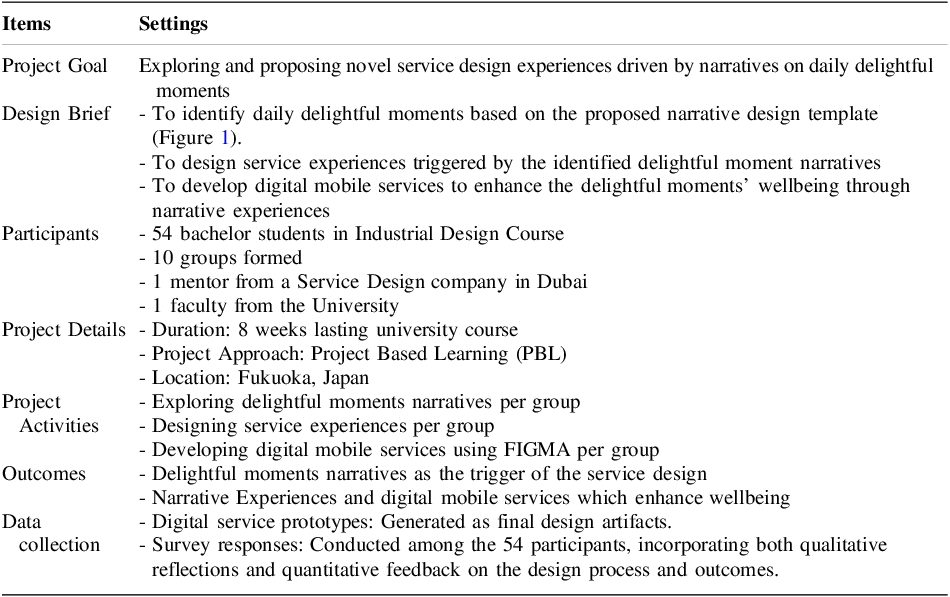
Table 1 shows the detailed setting of the project. As the basic conditions of the project, a service design project was conducted as an educational course. The project was coordinated by the faculty of design, in which 54 students and 2 teachers from the faculty and a service design company in Dubai participated. 10 groups were formulated by the participants, students, in which each group has 5-6 members. The design project theme was creating “digital services and those experiences driven by narratives on daily positive moments.” To achieve the goal, the focus of the investigation set on exploring how narratives of daily positive moments can trigger service design processes as well as create narrative experiences represented in the service design outcomes.
Research through Design (RtD) setting

2.2. Narrative-driven service design
Referencing the idea of narrative experience (Reference GrimaldiGrimaldi, 2018), this research identifies how the process of service design is facilitated by triggered with a narrative and how the narrative experience is installed in the final products of the service design prototypes.
To ensure a structured investigation, the study followed a two-phase process:
-
Divergent-exploration phase: Students conducted research to generate “daily positive moment narratives” that informed service design concepts.
-
Convergent-development phase: Students translated narratives into digital service concepts and developed interactive prototypes.
These activities of phases 1 and 2 were conducted iteratively.
2.2.1. Creating delightful moment narratives: divergent-exploration phase
In the first phase, the divergence-exploration phase, participants created a variety of stories about fun moments in their daily lives. By focusing on pleasant moments in daily life, we can focus on the experience of better wellbeing for humans. To facilitate narrative creation, a template for “positive moments” was created by the authors for this project (Figure 1).
A positive moment narrative template (Author’s own)

The template consists of the following syntax: context, desire, positive experience, opportunity. When (When = Context), what do I want to do (I want to = desire), why am I happy (so I can feel happy = positive experience), and therefore what opportunities would make me happier (Therefore =opportunity). This syntax is a narrative syntax produced uniquely for this project to examine how service design using this narrative as a starting point facilitates the service design process and how the narrative experience is reflected in the final product.
Based on the narratives, each group establishes specific personas (WHO), customer journey map (WHERE, WHEN), and purpose (WHY).
2.2.2. Narrative-driven service design: convergent-development phase
In the second phase, the convergent-development phase, the concepts of the digital services were created and prototypes were produced, starting from the narratives of everyday joyful moments that were crafted in the previous phase. In this phase, service development proceeded based on the basic service design process for designing digital application services. The detailed steps are as follows:
-
Step 1. Create the service concept
-
Step 2. Develop the digital service and its user experience (UX) with narrative formats
-
Step 3. Making prototypes of the digital service concepts, and validate them by assumed target personas
Throughout the entire project, iterative processes were prompted. In the end, utilizing Figma platform, all 10 groups generated digital service prototypes triggered by delightful moment narratives that each group formulated by themselves.
To ensure the rigor and reproducibility this research, clear design frameworks and assessment criteria were used throughout the study. The RtD approach was operationalized by structuring design activities in alignment with New Service Development (NSD) approach (Reference Yu and SangiorgiYu & Sangiorgi, 2014) and narrative experience principle (Reference GrimaldiGrimaldi, 2018). The qualitative insights were analyzed through an interpretative approach (Patton, Reference Patton2015; Denzin & Lincoln, Reference Denzin and Lincoln2018), identifying recurring themes and patterns in participants’ reflections and design outcomes. Meanwhile, the quantitative data were examined descriptively to explore trends in user perceptions (Reference Miles, Huberman and SaldañaMiles, Huberman, & Saldaña, 2019).
3. Results
The research results show that narrative-driven service design contributes to the realization of a narrative service experience. In addition, the results of the participant survey quantitatively and qualitatively support the effectiveness of the narrative-driven service design process.
3.1. Narrative experiences for service design
3.1.1. Creating delightful moment narratives
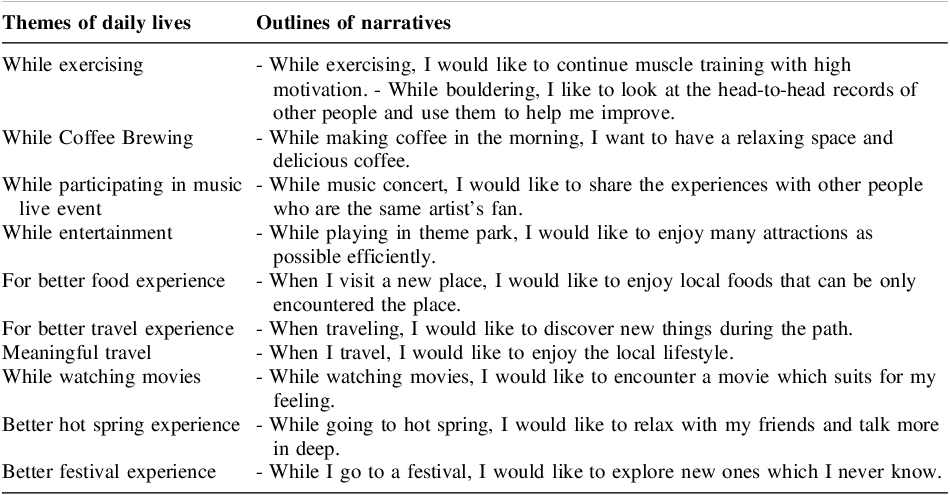
Participants created diverse narratives of joyful moments using the narrative development template (Figure 1). These included everyday experiences such as exercise, entertainment, and meaningful travel (Table 2). By structuring their reflections, participants identified when and why they felt happy, uncovering opportunities to enhance their experiences. An example is shown in Figure 2.
The lists of examples of generated positive moment narratives by each group

An example of positive moment narratives

3.1.2. Narrative-driven service design
Using the narratives spun as a starting point, all groups developed service design concepts and prototypes. In other words, 10 groups proposed 10 service design concepts and prototypes. All ideas started with an initial paper prototype, went through user flow and wire flow design, and came to fruition as UX design. Finally, a digital service prototype was designed that leverages Figma and is activated on a smartphone or smartwatch.
The concept of the digital service created relied on the narrative told in the previous phase and thus was successfully designed as a service to improve people’s well-being through a narrative experience. Figures 3 and 4 show examples of the results achieved by one group. This group illustrates a service design that was produced in the context of a more meaningful journey, starting from a narrative that was intended to enrich the experience of the journey on the way to reach a destination that would normally be passed by casually. The concept of this service design, named “Yuru-Route,” proposes the selection of a route to a destination as a different kind of fun, and the attractiveness of the route can be learned in advance through photos and comments shared by other users. In addition, users can choose a cute character, like a pet, to accompany them on their journey so that they can enjoy the journey at a leisurely pace.
An Example of the service concepts

An Example of the final prototypes

3.2. Validations of the Narrative-Driven Service Design Approach
Throughout the service design process, the results of a survey by participants were collected regarding the “narrative-driven service design” approach. In both the first phase, the divergent-exploration phase, and the second phase, the convergent-development phase, the narrative-driven service design process was evaluated from both quantitative and qualitative aspects. As a result, participants reported high quantitative evaluation and various benefits.
3.2.1. Divergent-exploration phase
First, regarding Phase 1, the quantitative survey result showed a fairly high rating of 4.32 out of 5. The question was as follow: “How much did the focus on the ‘Moment of Joy’ narrative stimulate your ideation for service design? (The more stars, the more useful it was.)”. More concretely, 15 participants rated 5, 24 participants rated 24, and 2 rated 3 per 41 active respondents respectively.
The quantitative result of the survey for the divergent-exploration phase

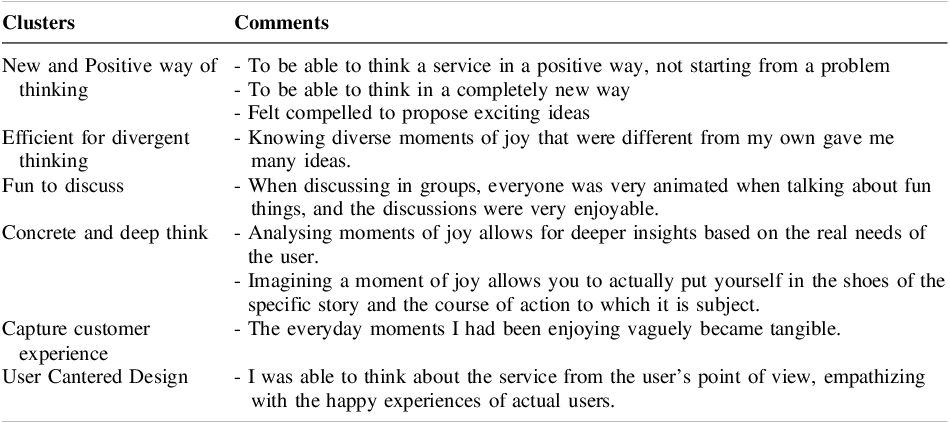
Qualitative answers were obtained in free format, providing detailed reasons for the quantitative evaluation. The responses were summarized in clusters, and these are shown in Table 3. The responses were broadly classified into six clusters.
The qualitative comments for the divergent-exploration phase

Firstly, focusing on moments of joy was evaluated as a new, positive way of thinking. Generally, service design is an approach to problem solving that starts with the development of ideas from problems, but with this approach, it is possible to think about services in a positive way, rather than starting from problems. As a result, it was evaluated as a completely new way of thinking about services. Secondly, it was found to be effective for divergent thinking. As it enabled groups to focus on various moments of joy, it led to the emergence of many ideas as participants learned about the moments of joy of various participants through the stories. Thirdly, there was a tendency for exciting ideas to be proposed. Fourthly, it enabled concrete and in-depth thinking. By analyzing moments of joy in the form of a story, it is possible to deepen thinking in a concrete way, and gain deep insight based on the true needs of users. It is also possible to actually put oneself in a particular story and the actions that accompany it. Fifth, it was evaluated as being useful for understanding customer experience. The everyday moments that had been enjoyed vaguely until now became concrete. Finally, it is possible to achieve user-centered design. It was possible to think from the perspective of the user, empathizing with the happy experiences of users actually using the service.
3.2.2. Convergent-development phase
Regarding Phase 2, the result of the quantitative survey was highly rated at 4.38 out of 5. This result is slightly higher than the result of Phase 1. The question was as follows: “How effective was focusing on the narrative of ‘Moments of Joy’ in the specific development and prototyping of service design? (The more stars, the more effective.)” More specifically, out of the 39 active respondents, 21 rated it 5, 13 rated it 4, 4 rated it 3, and 1 rated it 2.
The quantitative result of the survey for the convergent-development phase

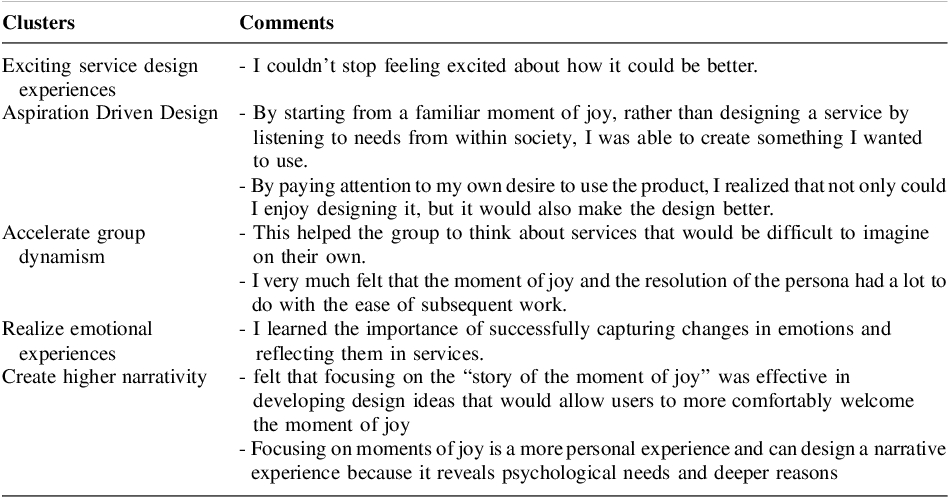
Qualitative responses were obtained in free form, and detailed explanations were provided for the reasons behind the quantitative evaluations. The responses were summarized by category and are shown in Table 4. The responses were broadly classified into five categories. First, there was an evaluation that an exciting service design experience was possible. The participants gave very positive responses, and some of them said that they could not stop feeling excited about the possibility of being able to make the service even better. Second, it was evaluated as aspiration-driven design. Rather than designing a service based on what society needs, by starting with a familiar happy moment, it was possible to create something that the participants themselves wanted to use. By focusing on the desire to use something, the participants responded that they were able to enjoy the design process and create a better design. Third, the effect of accelerating group dynamics was felt. The participants felt that the moments of joy and resolution in the personas led to an easier job afterwards. By discussing a specific story in a group, it was possible to think about services that would be difficult to imagine on one’s own. Fourth, a cluster was obtained that emotional experiences can be realized. Stories make it possible to capture changes in emotion well, and these can be reflected in services. Finally, a cluster was obtained that higher narrative quality can be achieved. In other words, it was observed that several participants felt that focusing on the story of “moments of joy” was effective in developing design ideas that would make it easier for users to experience moments of joy. Focusing on moments of joy is a more personal experience, and by uncovering psychological needs and deeper reasons, it is possible to design narrative experiences.
Qualitative feedback by the workshop participants in the development phase

4. Discussion and conclusion
This research provides important insights into the knowledge of narrative experience design in service design. The purpose of this research was to explore the process benefits of starting design activities in service design with narratives of moments of joy, and to explore the potential for introducing narrative experience into the service design outcomes that are produced.
4.1. Narrative experience design for service
The results of this research show the high effectiveness of service design based on narrative from both a quantitative and qualitative perspective. From a process perspective, rather than starting with the “wicked problem” that is generally taken in service design development, starting with the “story of a moment of joy” suggests the possibility of service development based on a completely new perspective. This suggests the effectiveness of service design not only as an approach to problem solving, but also as an approach to enhancing human wellbeing.
The narrative-driven approach enables the embodiment of experiential value in service design, reinforcing Grimaldi’s (Reference Grimaldi2018) findings on narrative experiences in product design. While these findings highlight the potential of narratives in shaping service experiences, a broader perspective is required to explore how narrative-driven approaches can be effectively implemented in multi-stakeholder design processes. Narrative experience design embeds storytelling into service interactions, while co-design fosters stakeholder collaboration. Integrating these approaches enhances user-centered design, making narrative-driven services more engaging and meaningful. A key consideration for future research is how narrative experience design can be integrated with co-design approaches that simultaneously address both product and service development. By bridging narrative thinking with participatory design, future studies can explore how stakeholders’ lived experiences contribute to crafting services that are both user-centered and experientially rich. This could lead to a more sustainable and holistic approach in service design.
4.2. Toward narrative worldmaking for service experiences
Furthermore, the results of this research suggest the effectiveness of Narrative Worldmaking in service design. In order to create a service experience that does not yet exist in the world, it is necessary to turn the world into a story, communicate it to various stakeholders, and gain their empathy (e.g. Lounsbury & Glynn,2001). The more innovative the outcome, the more essential it is to create a narrative world and build legitimacy. This idea of the importance of building legitimacy, which is particularly emphasized in the context of innovation and entrepreneurship, is also important in service design, and service design that starts with a story can be expected to effectively promote the creation of a world and, as a result, to encourage the realization of completely novel services (Reference HayamaHayama, 2024).
4.3. Limitations and future research
However, there are some limitations to this research. Since this study is based on a single design project conducted at a Japanese design university, its findings remain preliminary. Consequently, further empirical research, such as case studies, is needed to validate and generalize these insights. In particular, future studies should explore how these findings apply to real-world industry settings and diverse cultural contexts. Second, the outcomes of this design project remain at the prototype stage. While some participants were highly motivated to launch their service prototypes, further user testing and real-world adoption analysis are needed to strengthen the impact of the narrative-driven service design approach. To more comprehensively assess the effectiveness of narrative-driven service design, future research should examine its implementation in real-world societal and business contexts.
Future research should be conducted in a wide range of directions. The first direction is further empirical research on narrative-driven design development in service design. In this project, we started with “stories of joy in everyday life,” but by considering service design based on a variety of story variations and various stories, we can clarify a deeper knowledge of narrative-driven design. Secondly, there is great potential in researching the process effectiveness of narrative-driven design in fields that are extensions of service design, such as product service system design, transition design, and design for social innovation, and in embedding narrative experiences in the deliverables. Thirdly, in relation to design as worldmaking, a narrative-driven approach enables researchers to explore new research areas. One example is the theme of design for a better world, which is attracting a great deal of interest in design research and narrative research.
Acknowledgement
I would like to express my sincere gratitude to Erik Andrade for his valuable contributions. I also extend my thanks to the students who participated in the Service Design Practice lectures at the School of Design, Kyushu University, for their insightful inputs, engagements, and wonderful works.





 Open access

