

Until recently, “reuse” in archaeological research most often referred to dusting off legacy collections in forgotten corners and basements, sifting through accumulations of gray literature, or applying new scientific techniques to test older interpretations. Advocates have long argued that this is critical to sustainable archaeological practice—that the pace of excavation, limited analysis, and underutilized but data-rich collections create a missed opportunity for advancing knowledge and scholarship, not to mention being irresponsible and unethical (Bawaya Reference Bawaya2007; Cook and Burchell Reference Cook and Burchell2012; Ferris and Cannon Reference Ferris and Cannon2009). Despite ongoing pushes to safeguard collections in increasingly high-tech repositories and research facilities, and through discussions of best practice and changes to legislation, reuse of this kind remains limited (Ferris et al. Reference Ferris, Bathurst, Carter and Ahmed2015), most often relegated to small-scale graduate theses or preliminary research projects. Accessibility, quality of metadata, and institutional pressures likely influence these practices, but training opportunities, attitudes, and research structures also challenge those who reuse archaeological collections.
As in so many areas of archaeology, the internet has transformed reuse in theory and in practice. Publishing formats, copyright laws, access, preservation, and research ethics today are fundamentally shaped by electronic distribution methods, data management logistics, and even social media (Kansa Reference Kansa2012:498–499). So too have concepts of openness, comparability, and interpretation changed as the relationships between archaeologists and data evolve through digital practice (Lucas Reference Lucas2012:216; see also Shorish Reference Shorish2015:99). Seemingly the natural progression of earlier arguments for reuse, data sharing should remove the barriers that have limited the accessibility of existing collections to encourage further inquiry. However, despite predictions that primary data collection would give way to open data reuse (Beck and Neylon Reference Beck and Neylon2012:494; Naylor and Richards Reference Naylor and Richards2005:90), evidence of demand and impact remains limited (Beagrie and Houghton Reference Beagrie and Houghton2013; Huggett Reference Huggett, Wilson and Edwards2015:10). Atici and others have highlighted that,
while most see data sharing as an important goal, much attention focuses on problems relating to supplying researchers with data and less on how researchers can best consume and reuse data. . . . [F]ew studies have explored challenges researchers may face in the analysis of datasets produced by others [2013:664].
Even more concerning, Jeremy Huggett's musings on digital archaeology are both clear and cutting: “The fact remains that—whisper it quietly—few of us are actually using the archived digital data in the first place” (Reference Huggett2016).
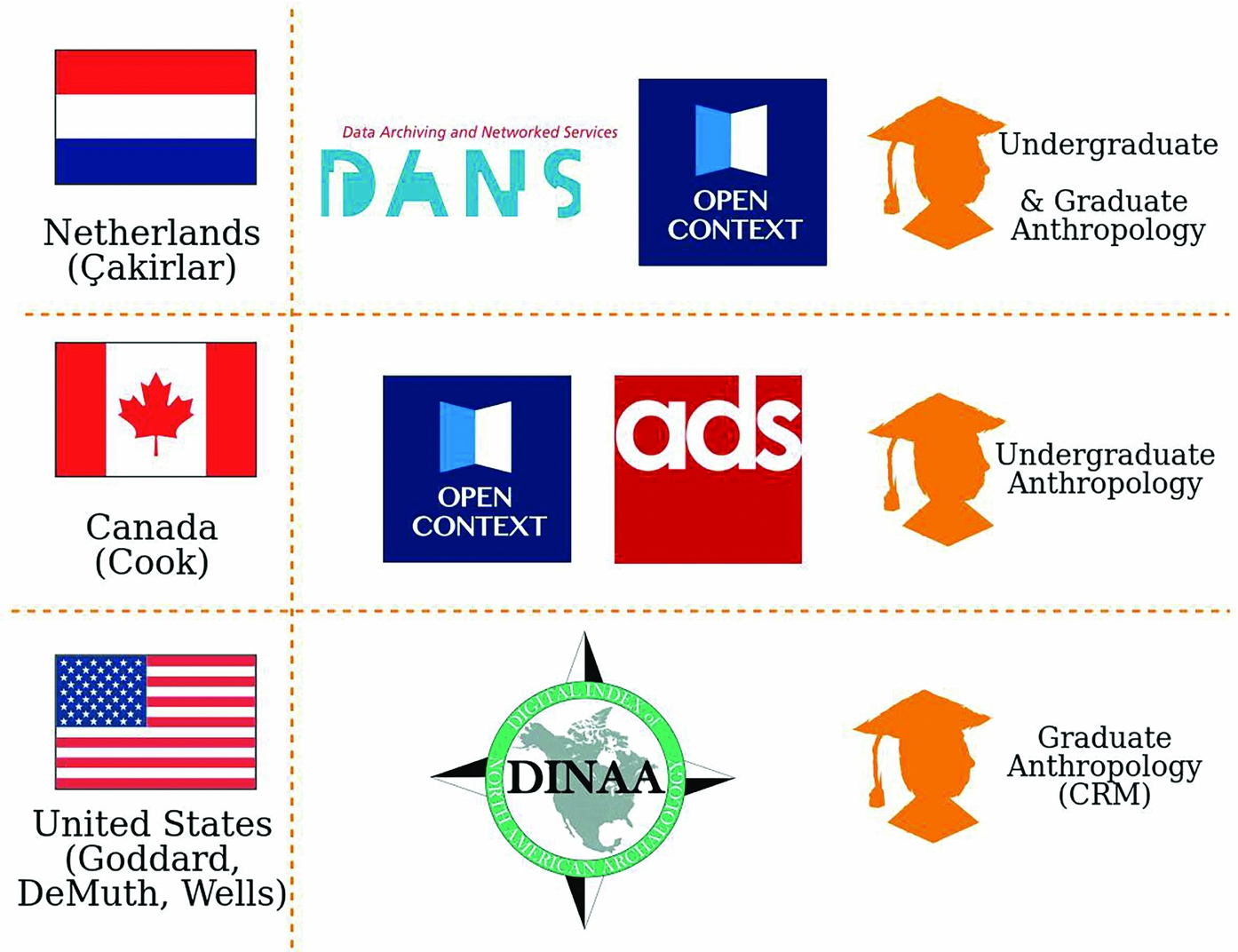
Digital literacy, in addition to data information literacy, is often cited as the primary hurdle to widespread adoption of digital data reuse in archaeological research (Shorish Reference Shorish2015:97–99). University classrooms, then, become a critical opportunity to ensure that future generations of archaeologists are comfortable with information management systems, thick/long data (Arbesman Reference Arbesman2013; Wang Reference Wang2013), and how to address the benefits and challenges of designing and managing digital data research projects. If we continue to teach archaeological practice in the same way, framed by traditional field and laboratory structures, we cannot expect skills, attitudes, and approaches to change in favor of reuse. This article brings together instructors and archaeologists involved in data publishing platforms to discuss experiences and barriers in using open data for teaching in three different countries: the Netherlands (Çakirlar), Canada (Cook), and the United States (Goddard et al.; Figure 1). We present experiences teaching at a range of levels, including undergraduate and graduate students, in advance of diverse career goals, including academic, government, and private-sector careers. These courses, which we developed independently, are used to develop collective conclusions on the role of digital data in a range of archaeology training environments. In particular, this article considers the feasibility of teaching with published digital data, what students and instructors need from information management systems to ensure success in the classroom, and how to tackle the barriers that persist in education and their legacies beyond academic contexts.
Summary of three case studies teaching with different datasets and students. ADS = Archaeology Data Service; CRM = cultural resource management.
OPEN ACCESS AND EDUCATION
In many ways, the movement for open access, defined as free of charge and free of many copyright and licensing restrictions, conceptualized by Suber (Reference Suber2012:4) as the barrier-free revolution, is perfectly suited to the demands of higher education. Discourse on open science parallels demands to remove economic and physical barriers to training within increasingly tense research and scholarly ecosystems (Kansa Reference Kansa2012:500; Suber Reference Suber2012:29–39). In North America and parts of Europe, for instance, tuition increases alongside cuts to services, library resources, salaries, funding, and hiring rates have intensified economic strains in university research and teaching. Open-access data and publications reduce costs for high-quality content that would traditionally be transmitted via costly textbooks, library subscriptions, and hands-on or applied opportunities such as field schools and volunteer positions, which are not feasible for all students. As open-access resources are increasingly drawn upon to fill in these voids, students, particularly at the graduate level, find themselves responsible for advanced digital data and information management tasks that they may not feel prepared for. Archaeological training at all levels simply does not include enough data handling components. Open data are poised to transform the way we teach archaeology; however, inconsistent and limited training opportunities, typically as a stand-alone course or isolated workshop, continue to undermine the successes of open scholarship.
At the same time, the movement toward open data has been criticized for a lack of empirical evidence of demand or use in archaeology (Huggett Reference Huggett, Wilson and Edwards2015:10). Higher education could help to stimulate shifts in digital practice by providing the foundation for a more data-literate archaeological community that can move data management and reuse forward. Teaching with real case studies is always more relevant than using fake data, providing realistic experiences of the imperfections and complexities of archaeological evidence. Moreover, it is a chance to challenge future archaeologists to think differently about the process of archaeological research and reconsider traditional models of data production through field- and lab work. Finally, as Beagrie (Reference Beagrie2008) argues, increasing expectations for accessible and reusable data across disciplines and research streams, including commercial, government, and academic contexts, have precipitated a need for individuals trained in data management, preservation, and sharing. Teaching transferrable skills is already a focus for many archaeology programs today; however, advanced digital data skills are rarely included, despite their growing demand in many of the avenues for archaeology graduates.
Digital Literacy and Data Information Training
Digital literacy, then, is pivotal to promoting open data use, both in classrooms and beyond. At a recent forum at the Society for American Archaeology meetings (Vancouver, 2017), “Beyond Data Management,” organized by Sarah Whitcher Kansa and Eric Kansa, digital literacy was cited as one of the biggest barriers to data reuse by almost every panelist and many audience members. There are common expectations that computers will make data reuse easier, particularly for younger generations of archaeologists. However, even in the wake of the disintegrating “digital native” myth, information management training remains rare, while the increasing complexity of data, curation, and digital platforms challenges and limits reuse. As Naylor and Richards have observed,
Re-use of data requires a close understanding of the context of data collection and of the vocabulary used to describe the observations. The archaeologist of tomorrow needs training not so much in methods of data collection, but in data analysis and re-use [2005:90].
Carlson and others (Reference Carlson, Fosmire, Miller and Sapp Nelson2011) have identified a complex web of 12 competencies that are foundational to training effective digital researchers; these include not only skills in data processing, management, and preservation but also cultures of practice, ethics, and attribution (see also Carlson et al. Reference Carlson, Johnston, Westra and Nichols2013). Contextualized and critical discussions and applications of digital data production, curation, and reuse therefore must be incorporated progressively into undergraduate- and graduate-level classrooms to ensure not only training in the methods, software, and logistics of digital research but also informed considerations of theoretical opportunities and constraints.
Because of these challenges in resources, attitudes, and digital literacy, teaching with published data becomes a key context from which to consider the broader climate of open data in archaeology and the future of reuse and sustainable research practices. Promoting digital data reuse means new tools, skills, professional roles, and communication standards, transforming most steps in the research process, from funding to workflow to citation (Kansa Reference Kansa2012:510). At the same time, the constant and rapid innovation of the Web environment challenges archaeologists to keep pace with active and thoughtful evolution of practice, infrastructure, and ethics policies (Kansa Reference Kansa2010:12). The following case studies aim to provide not only practical examples of the diverse methods of utilizing open data in classrooms but also broader considerations of the impact, constraints, and challenges both for higher education and for the open access movement.
OPEN ZOOARCHAEOLOGY AND BIOARCHAEOLOGY IN THE NETHERLANDS
The basic necessity to find meaning in large numbers of fragmented animal remains made zooarchaeology one of the most data-literate fields of archaeology early on (e.g., Clutton-Brock Reference Clutton-Brock and Clason1975; Uerpmann Reference Uerpmann1978). The application of standards in recording techniques was proposed in the 1970s (e.g., Grant Reference Grant, Wilson, Grigson and Payne1982; von den Driesch Reference von den Driesch1976) and widely adopted. Dutch zooarchaeology has been in the forefront of these developments, with Anneke Clason of the Groningen Institute of Archaeology highlighting the importance of distinguishing primary data from secondary data in zooarchaeology and urging zooarchaeologists to apply some general rules in publishing their observations (primary data) alongside their interpretations (secondary data [Clason Reference Clason1972, which has since become a classic; see also Reitz and Wing Reference Reitz and Wing2008:153–250]).
In the age of digital revolution, it is crucial to teach how zooarchaeological data should be designed and managed for reuse. Zooarchaeologists worldwide have demonstrated the value of data sharing and reuse more vocally than ever before (Arbuckle et al. Reference Arbuckle, Whitcher Kansa, Kansa, Orton, Çakirlar, Gourichon, Atici, Galik, Marciniak, Mulville, Buitenhuis, Carruthers, De Cupere, Demirergi, Frame, Helmer, Martin, Peters, Pöllath, Pawlowska, Russell, Twiss and Würtenberger2014; Atici et al. Reference Atici, Kansa, Lev-Tov and Kansa2013; Kansa Reference Kansa2015). However, in the Dutch context, where the Dutch Science Foundation (the primary funder of Dutch science) requests that all research results be published open access, and all development-led archaeological research results have been deposited in an online repository (Data Archiving and Networked Services [DANS]) since 2007 in compliance with the Dutch Heritage Law, data sharing becomes imperative.
The Methodology
The availability of open-access zooarchaeological data on platforms such as DANS and opencontext.org facilitates the learning process. In the Department of Archaeology, University of Groningen, which offers zooarchaeology modules (courses) to undergraduate and graduate students, Çakirlar teaches the value of data reusability using methods in line with a hands-on, continuous learning approach. First, in lectures, syllabi, and reading lists, common data types collected, field-specific conventions and standards, must-haves of faunal reports (sensu Grigson Reference Grigson, Brothwell, Thomas and Clutton-Brock1978), and online resources for zooarchaeological data are introduced and discussed. Assigned readings, particularly for postgraduate students, include Atici and colleagues Reference Atici, Kansa, Lev-Tov and Kansa2013 and Kansa Reference Kansa2015. While the lectures and readings are crucial to provide a formal framework and help students get familiar with some of the basic concepts, they lead to a passive learning atmosphere with little long-lasting effect.
Second, students are asked to peer-review open online datasets and faunal reports “relevant to their research interests,” applying a set of criteria (Table 1) suggested by Sarah Whitcher Kansa (data scientist and zooarchaeologist) to the former and a set of criteria based on Historic England's (2014) Animal Bones and Archaeology. Guidelines for Best Practice to the latter. Most students judge the datasets and reports they find as satisfactory (or pick the datasets and reports that they deem good enough in the first place). While they are “inspired” by this exercise, it does not help them to judge the reuse value of the published data, as they lack the incentive to truly reuse the data and because of the common tendency to accept published results as facts.
Class Exercise: Criteria for Peer-Reviewing Open Online Zooarchaeological Datasets.

Source: From S. Kansa, used with permission.
Third, students are assigned to extract and quantitatively explore open online zooarchaeological datasets and reports after having gained experience through analyzing clean datasets (e.g., performing simple quantifications such as comparing number of identified specimens results or constructing survivorship curves) presented by the lecturer and receiving points and feedback. The exercise has two aims: (1) to highlight that different students can reach different secondary data (e.g., minimum number of individuals) reusing the same set of primary data and (2) to aid answering a variety of research questions (e.g., What were the different animal husbandry strategies in Roman and non-Roman regions of the Netherlands? What were the main subsistence changes between late Paleolithic and Neolithic Turkey?). Now that the students are finally asked to reuse open, scholarly, “real,” sometimes peer-reviewed data (see Russell et al. Reference Russell, Twiss, Buitenhuis, Frame, Martin, Zooarchaeology, Yeomans, Marciniak, Pawlowska, Christensen, Orton, Arbuckle, Demirergi, Meese, Atici, Campbell, Carter, Henton, Aydinuloglu, Galik, Watson, Carruthers, Cameron, Mayon-White, Erwin, Dimitrijevic, Orton, Russell, Twiss, Martin, Frame, Buitenhuis, Marciniak, Arbuckle, Atici, Çakırlar, Campbell, Carter, Galik and Carruthers2013), they gain a fuller appreciation of what publishing should be like and what makes open data reusable. For a student, it may be difficult to imagine that different analysts may have massively different definitions of a zooarchaeological specimen, that even the concept of “specimen” can be interchangeable with “fragment” or “identifiable bone,” decreasing the compatibility of so-called basic quantification units such as the number of identified specimens across assemblages and analysts. By analyzing other researchers’ primary data, the importance of data compatibility and sufficient metadata becomes obvious, which is rare when working with faunal reports (secondary, interpreted data)—that is, of course, when the students are able to find open primary data online related to their research questions.
Challenges and Impact
When dealing with research questions pertaining to the Dutch setting, students search the online repository DANS, where data (a) are accessible after log-in, (b) are often embargoed by the authors, and (c) consist of secondary data (e.g., specialists’ reports). The above-mentioned regulations do not distinguish primary from secondary data, and it is the norm in commercial archaeology for specialists to finalize their contact by submitting a report to project leaders. DANS has set some strict rules on how to organize the uploaded files but does not advise on their internal organization. Students often make do with the reports, rather than contacting the authors, which researchers at later stages with more time might do. When primary datasets are available, students face other challenges, such as missing metadata (e.g., What does juvenile mean as a descriptor of a femur fragment?), causing ambiguity; lack of standardization, for instance, due to typos; and lack of crucial data (measurements or standardized tooth aging). Frustrations of this sort ease when online primary data have been edited, linked, and/or peer-reviewed prior to publication (e.g., Open Context). Students are also challenged by this exercise due to their own lack of knowledge in information management systems (how to download a .csv file) or in statistical applications, which makes them feel intimidated with large differences in sample size.
While undergraduate and early postgraduate students say that they learn from dealing with good and bad datasets, later-stage postgraduate students who have to reuse other people's primary data are disappointed and worried that they will not reach their research goals. Undergraduate students find it difficult to appreciate that the present availability of online data is a major improvement from just a few years ago, when all data could still only be retrieved through personal connections and time-consuming archival and library research (if possible, as most zooarchaeological reports are in gray literature). Graduate students are “inspired to contribute to the online platforms” with their own datasets, and “seeing other people's primary data help[s] [them] look at online datasets and publications more critically” (from graduate students’ course evaluations).
As a result of this program, throughout their zooarchaeology training students gradually learn the concept and the requirements of data reuse. They start appreciating the limitations of faunal reports and that producing reusable data, as Atici and others (Reference Atici, Kansa, Lev-Tov and Kansa2013) suggest, requires effort. However, most students remain illiterate in data management programs, and zooarchaeology courses alone cannot redress this deficiency. At Groningen University, the bachelor's curriculum in archaeology has recently been modified to include skills training necessary to prepare students to adopt the best practices in data management and data presentation in academic and professional settings, in the form of a compulsory module preceding the zooarchaeology modules. The new digital humanities master's program, in part designed by faculty members of the archaeology department, also offers modules suitable for archaeology students. A shift toward greater appreciation and more credit for reusable and reused data in both professional (heritage/commercial/salvage/contract archaeology) and academic/scientific settings will certainly encourage students and educators to place more emphasis on this crucial subject.
ADVANCED RESEARCH METHODS AND ANTHROPOLOGY IN CANADA
Considering increasing pressure on universities to offer courses providing hands-on research experience, many departments are creating opportunities for students to design and manage projects, foster independent and analytical thought, and develop transferrable skills such as time management, digital literacy, and leadership. The challenge for archaeology, as with many fields, is how to condense complex and long research processes, traditionally involving field- and/or laboratory work, into invariably short and intense semesters/terms for students. When it came to designing a new third-year research course for the Department of Anthropology at the University of Victoria (British Columbia, Canada), published data made it possible to access detailed and high-quality datasets that could be queried and analyzed within a semester, with the added benefit of building data information literacy and discussing open science in the process.Footnote 1
The Methodology
The course ANTH 319: Advanced Research Methods in Archaeology and Biological Anthropology was originally designed by Cook using Open Context, but in later versions she modified assignments to also use Archaeology Data Service to access more datasets, reflecting growing numbers of students and higher demands for data relevant to biological anthropology and bioarchaeology. The intensive research course introduced students to open data, how to access data in these particular interfaces, and how to make judgments about their research potential, before choosing their own dataset(s) to work with (Table 2). Students typically selected one to three datasets, often to compare sites, regions, or time periods to produce original interpretations. Research questions ranged from methodological and analytical in nature, for instance, evaluating the impact of the level of fragmentation of faunal remains on studies of butchery, to theoretical, for instance, exploring cremation as a reflection of differential personhood. After cleaning and coding the data, quantitative, qualitative, and statistical analysis was conducted. In the final stages, research results were presented in an academic-style paper and a piece written for general audiences.
Workflow for University of Victoria ANTH 319 Research Projects.
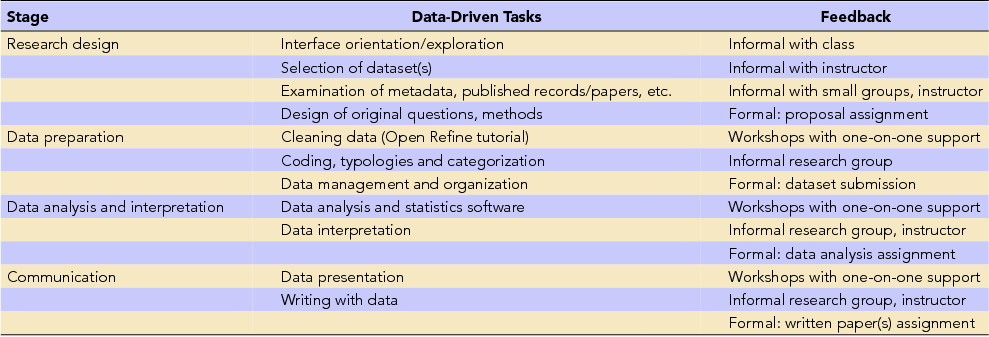
Although students worked independently, they were placed in research groups that met weekly to discuss progress, challenges, and experiences, in addition to group discussions and one-on-one meetings with the instructor. This gave students the opportunity to see other types of datasets; examine the differences in quality, metadata, and organization; and reflect on implications for research. It also provided regular opportunities to check in on students’ progress, experiences, and honest observations; address common problems; and consider the role of published data in the research process.
Challenges and Impact
Students’ digital literacy was immediately and almost universally a challenge each time this course was offered. Despite streamlined and clean platforms designed by Open Context and Archaeology Data Service, with both basic and advanced search options, students quickly became lost in rabbit holes of projects, metadata, and arrays of file types. Technically advanced concepts such as linked data, application programming interfaces, GeoJSON data, and so on quickly overwhelmed students. These elements and data formats, however, are critical to what has been termed “Mash-Up-Ready” Data—that is, content that can easily be used in different applications or combined with other sources (Kansa Reference Kansa2010:12; Kansa, Elliott, et al. Reference Kansa, Elliott, Heath, Gillies, Melero and Cano2010) to pursue original research questions. With a lack of resources written in plain language or designed for students/beginners, there was a significant investment in delivering this content in class and during office hours, not to mention developing course resources and workbooks, to explain the technology, interfaces, and terminology as well as their relevance to anthropology and how to make the most of them in research. This quickly led to frustration, anxiety, and confusion that temporarily derailed progress for many students and took the focus away from the primary course goals of independent research design and management. This stage can easily alienate researchers, whether students or professionals, particularly if they are not confident in their digital literacy skills and problem solving. It quickly became clear in teaching this course that further focus is needed on communicating how to use digital frameworks, which, although designed to make data more useful and accessible to researchers, are exceedingly complex.
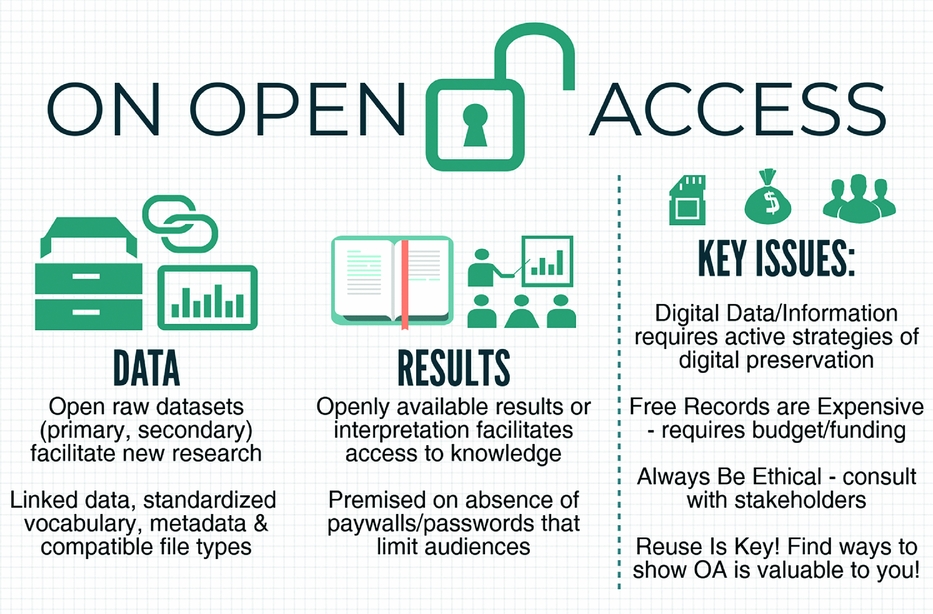
Digital literacy, however, did not in fact turn out to be the most difficult barrier to selling open data to student researchers. Expectations of what anthropological research looks like in addition to attitudes regarding worth, research impact, and contributions were routinely in conflict with the values of open science, data reuse, sustainability, and ethics that were foundational in this course's design (Figure 2). Although some may argue that the attitudes of undergraduate students do not necessarily reflect the attitudes of the professional discipline, open discussions in class did point to more deep-rooted problems than simply popular culture representations of research.
Detail of a workbook from ANTH 319, outlining open access in anthropology.
There were few examples in the literature of high-impact research using published data and none that the upper-level students were familiar with prior to the course (see Arbuckle et al. Reference Arbuckle, Whitcher Kansa, Kansa, Orton, Çakirlar, Gourichon, Atici, Galik, Marciniak, Mulville, Buitenhuis, Carruthers, De Cupere, Demirergi, Frame, Helmer, Martin, Peters, Pöllath, Pawlowska, Russell, Twiss and Würtenberger2014; Bevan Reference Bevan2012; Kintigh Reference Kintigh2006; Snow et al. Reference Snow, Gahegan, Lee Giles, Hirth, Milner, Mitra and Wang2006). Moreover, few of the studies that are based on the aggregation and interpretation of large-scale, open datasets include detailed discussion of their research methods, particularly choices in cleaning, unifying, and analyzing data to address issues of comparability and compatibility. Even more concerning was the pervasive impression that funding, for both students and professionals alike, is more likely to support research involving original field- or lab work than the analysis of existing data. Although systematic evidence was not used to support this argument, the universal belief among students that funding, employment, publication, professional recognition, and ultimately success would be undermined by pursuing research with published data does speak to wider issues in how we recognize, value, and measure the impact and place of this type of research within archaeology, not to mention communicate the realities of archaeological research.
Some of the barriers experienced in teaching this course can be addressed within university curriculum. Greater scaffolding to introduce published data, digital concepts and skills training, and diverse research processes more gradually and methodically throughout numerous courses within programs is critical to the success of students. Currently work is under way to incorporate a smaller, more guided project using Open Context datasets in a second-year, required course at the University of Victoria. It is hoped that this will make students more familiar with not only the technical side of accessing digital data but also the values and ideas behind sharing data, earlier in the anthropology curriculum. Research utilizing published data should also be highlighted in introductory archaeology courses, where students are first given a taste of what the archaeology research process looks like (often limited to excavation, laboratory, and occasionally archival research). Lecture and seminar discussions can be bolstered through reading lists that include reuse case studies for thematic and advanced skills courses.
However, some of the barriers extend beyond what can be designed into curriculum. Resources for teaching that make technical jargon more accessible, for instance, are essential for these types of courses to become more commonplace. The challenge of passing on courses like ANTH 319 to other instructors, with less experience with digital archaeology, highlights the need for further collaboration between instructors and data publishers, including training opportunities. Finally, the expansion of open-access textbooks and educational resources complements the ethos of openness, increases the potential to produce high-quality media communicating open data and digital archaeology practice and theory to students, and is, indeed, imperative.
CULTURAL RESOURCE MANAGEMENT AND PUBLISHED DATA IN THE UNITED STATES
The Digital Index of North American Archaeology (DINAA) is a project to develop a comprehensive hub for archaeological site data across North America (Wells et al. Reference Wells, Kansa, Kansa, Yerka, Anderson, Bissett, Myers and DeMuth2014). DINAA integrates these differentially sourced data into an open interoperable dataset via a controlled, common vocabulary. To account for site security, DINAA assigns each site to a raster grid system and removes all sensitive information from the data (including site locations) published on Open Context (Wells et al. Reference Wells, Kansa, Kansa, Yerka, Anderson, Bissett, Myers and DeMuth2014). In this way, DINAA creates an open, publicly available tool that can be used to examine archaeological site data from the macro perspective without putting any legally protected data at risk.
In an expansion of public outreach, the DINAA team (Wells and DeMuth) partnered with an instructor (Goddard) at Adams State University (ASU) to produce educational teaching aids for ASU's (2017a) online cultural resources management (CRM) master's program. Adams State started this master's program in 2013 to serve the critical need of CRM professionals seeking continuing education to further their careers who did not have traditional options available to them. The initial teaching aids, discussed in this case study, were developed for use in CRM 510: Technologies and Techniques. CRM 510 is a survey course focused on exposing students to “the wide variety of technologies and the necessary techniques to implement those technologies in the field and/or office in a CRM setting” (ASU 2017b). The primary foci of the course are the use of technology in “the field, analysis, and data dissemination” (ASU 2017b). The course is divided up into weekly modules on ASU's Blackboard page for CRM 510. Each week, students are provided with a series of readings, activities, and online video lectures/presentations and are required to respond to discussion questions in the classroom forums.
The Methodology
Two stand-alone geographic information system (GIS) tutorials and two educational modules were developed using DINAA's vocabularies and informational ~20-km raster grid system, which does not use or contain site coordinates.Footnote 2 The GIS tutorials are integrated with a lesson on digital data analysis and were designed as a basic introduction to the DINAA spatial interface. Students are asked to navigate to a specific data query in DINAA and download a GeoJSON file using a supplied URL. The goal of these exercises is to demonstrate how DINAA data may be used and how to access the data. One tutorial was made to introduce how to use DINAA data in QGIS, and the other was designed for Google Earth.
The two educational modules were developed to complement the CRM 510 lesson on digital data dissemination. These lessons give a more thorough introduction to DINAA through tutorials requiring students to explore the graphical user interface menus to access descriptive information within the DINAA dataset. Both modules are hosted on Indiana University's course management system, Canvas (Figure 3). The first module introduces DINAA, serving as a basic user guide to the DINAA graphical user interface. The primary assignment in the first module requires students to research site forms from two states represented in DINAA and then examine how those forms influenced the ways in which each state's data are represented in DINAA.
View of a lesson in the first module created for Adams State University CRM 510.
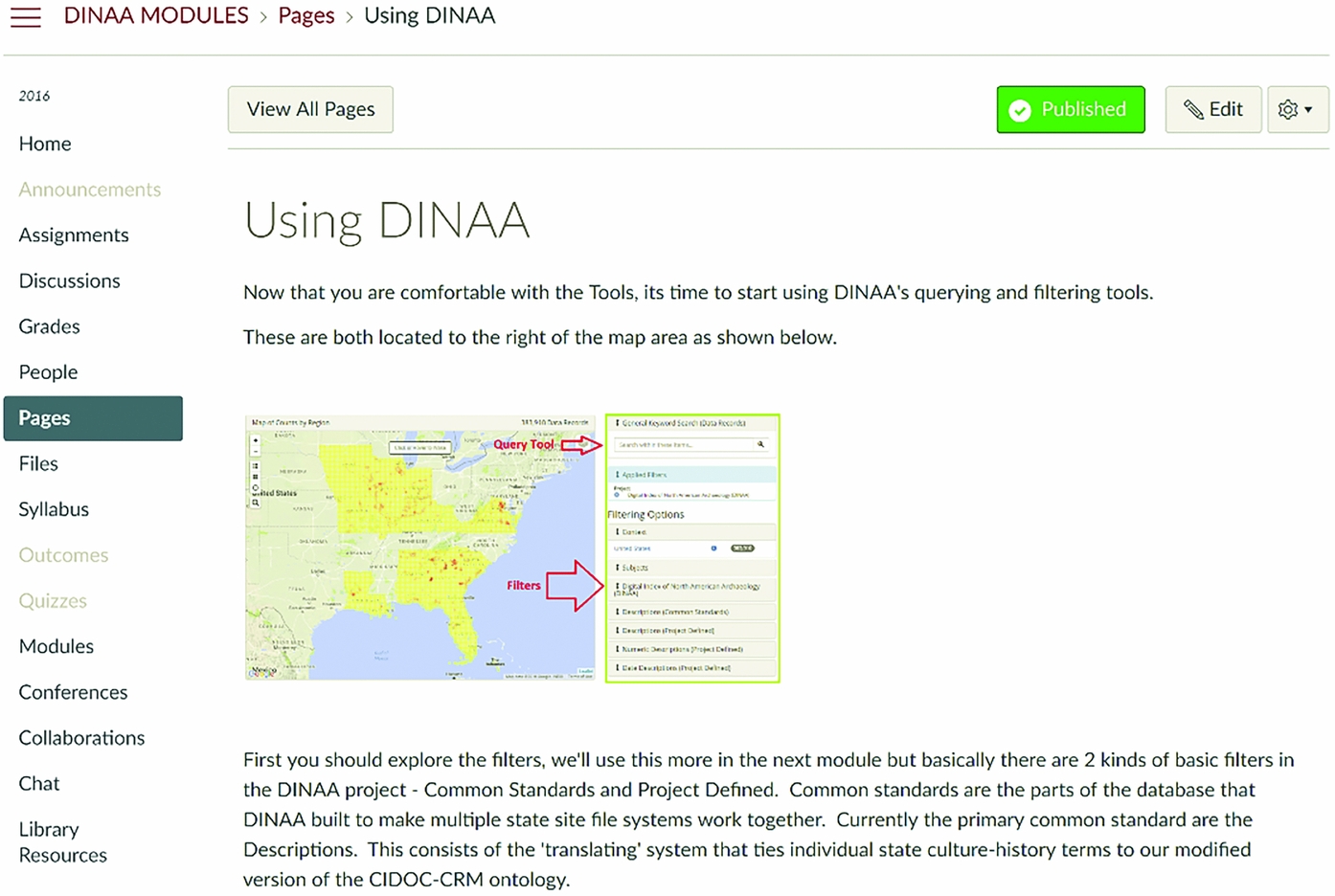
The second module involves advanced exploration and use of the DINAA dataset. Students are asked to perform specific queries, as well as access and explore individual data records. The goal is to demonstrate how the DINAA dataset can be of use to archaeologists. The module culminates in a scavenger hunt in which the students are asked to perform specific tasks using DINAA and answer questions from their resulting data.
Challenges and Impact
Working with DINAA and the modules provided gives real-world direction and examples of some of the bigger issues faced by CRM practitioners. The ASU students cover a broad range of CRM experience, from recent college graduate to more than 20 years in the profession. The overall topic during this portion of the class is about data dissemination. DINAA is a specific example of a more general discussion of websites and databases. Often in the course students ultimately focused on the data being presented and lost sight of the general technology and methodology for dissemination. Although DINAA is not designed for CRM use, it is an educational resource built in part with information from CRM activities, so the students saw the ultimate power and usefulness of this type of tool, as well as potential challenges (both technically and politically) to making such a system work.
Students indicated that despite some minor glitches in the interfaces they all recognized the power of archaeological data synthesis as a practice. The discussions in class also explored other types of Web databases, including other forms of spatial WebGIS-type sites, as Goddard has particular experience in this area. As they relate to their own field of study, the students were eager to work with government agencies to develop more useful tools like DINAA for their respective states to contribute to DINAA directly. It is clear that working with published data put the successes and challenges of this work in the minds of students, and some have continued to pursue solutions to moving this type of technology forward. Several students were inspired to seek out more experience in archaeological data management through their own research or in internships to work on the idea of digital data dissemination in various forms.
Working with ASU provided several benefits for the DINAA project, because the CRM 510 students had a diverse set of backgrounds, experiences, and plans for their archaeological careers. They were able to provide important feedback regarding how DINAA worked well and how it could be improved (Figure 4). For example, ASU students were quick to grasp the importance of DINAA as an example of comprehensive vocabulary and why such a tool is now necessary. One student stated: “Another thing that I would like to see improved is the vast inconsistencies in terms. Every project innovating their own terminology makes extracting data from DINAA a nightmare.”Footnote 3 Additionally, another student later stated:
The best part about the database is the partnerships it is creating. The states have a central hub to relay site data. . . . The public has a look into the government's way of collecting data. Researchers can connect to sites around the country and the world.
Linear bar graph of Adams State University student feedback on the Digital Index of North American Archaeology (DINAA).

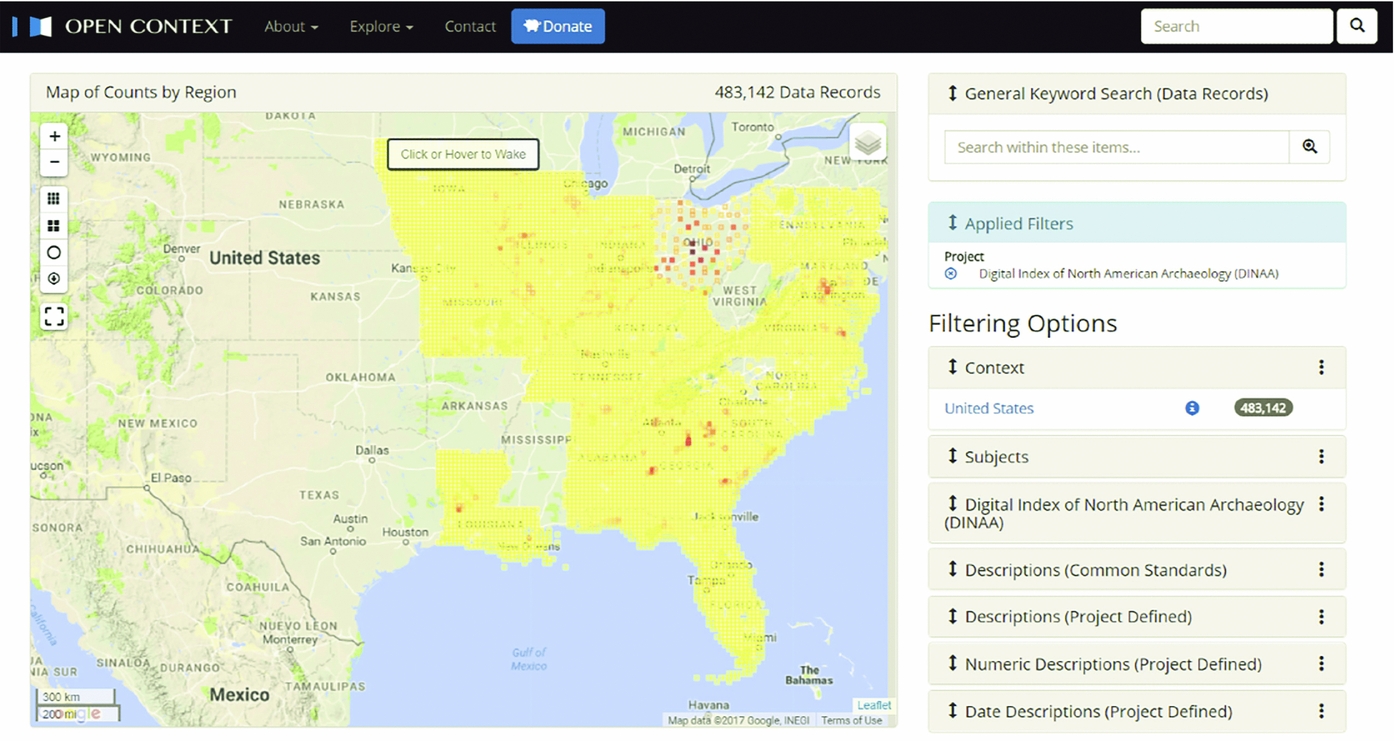
ASU students also provided constructive feedback. For example, currently when a user selects a site file in DINAA the site essentially provides elements of the basic data entered into a state site reporting form. Because each State Historic Preservation Office manages its own form, there is little immediate standardization of these data. Many students found the lack of standardization in DINAA's presentation of such data confusing. They further debated how useful a unified site data record within DINAA would be, recognizing that while such an undertaking would be helpful, it would be difficult to implement. Such considerations of design complexity mentioned by ASU students will help designers consider future growth of the DINAA system. The students also noted functionality issues more broadly oriented to access, such as lags in query completion and the rendering of maps (Figure 5); such issues involve combinations of query complexity and Web latency, which can be considered as DINAA matures. Some students found the user guide and tutorial confusing for a first-time user and made helpful editorial suggestions. A few found the entire system confusing—those in this subgroup often self-disclosed low computer literacy. Such comments suggest that DINAA may serve as a tool in the long term to promote archaeological computer literacy but that more specialized development is needed.
Overview of the Digital Index of North American Archaeology map within Open Context.
DISCUSSION
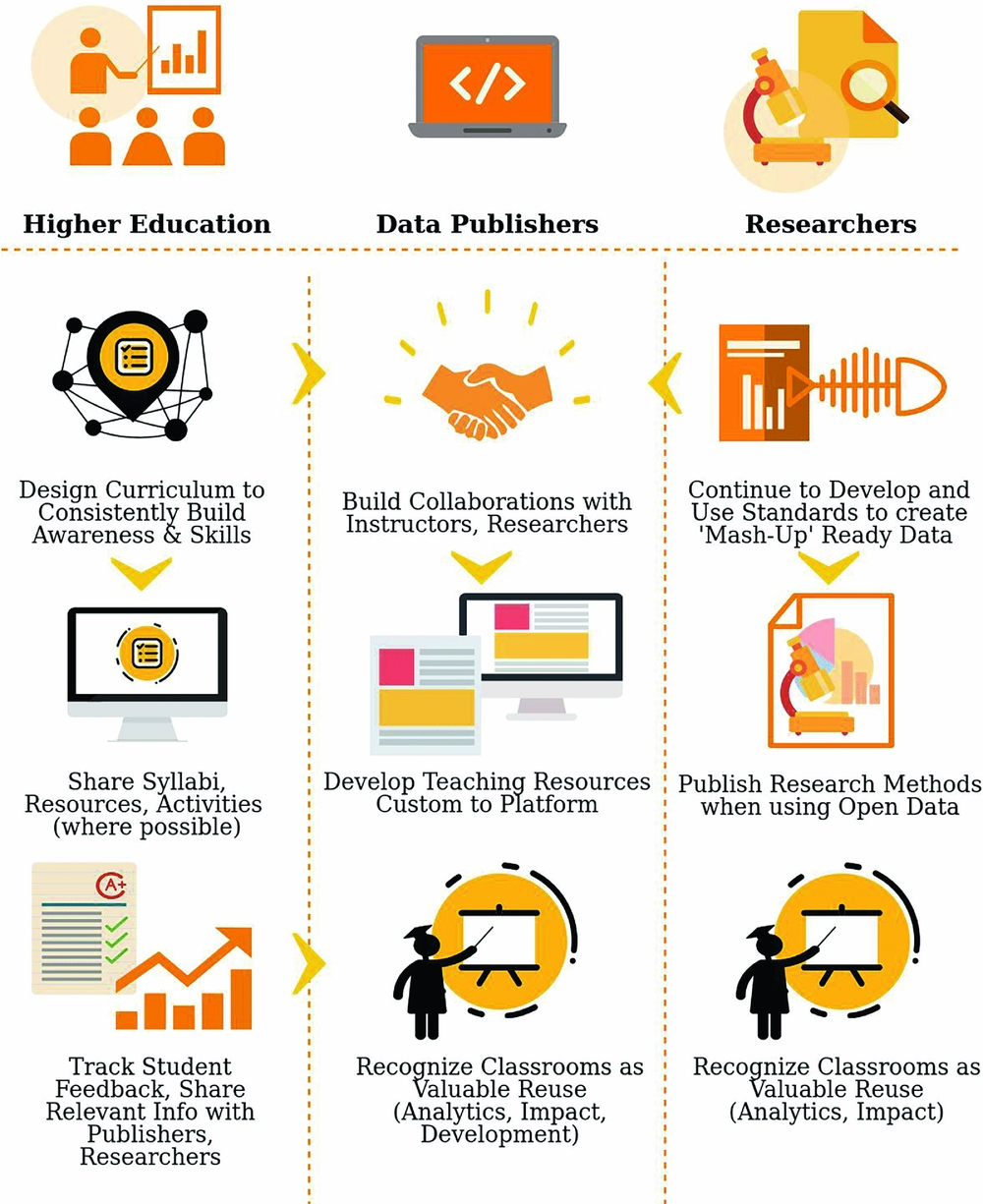
Just as analysis of how researchers use published primary data (Atici et al. Reference Atici, Kansa, Lev-Tov and Kansa2013) is critical to designing better platforms and publishing better data, collaborations between data publishers, instructors, and students help to address barriers to data reuse for future generations of archaeologists while also developing understandings relevant to increasing sustainability and impact within the discipline more broadly (Figure 6). For open data to be incorporated into classrooms more seamlessly, there is a need for more high-quality, easily digestible resources. The recentness of methodological and theoretical attention to open data in archaeology (Huggett Reference Huggett, Wilson and Edwards2015:14; Kansa, Kansa, et al. Reference Kansa, Kansa, Burton and Stankowski2010:303), and the resulting lack of consistency and agreement, has no doubt contributed to the limited availability of resources for teaching. Detailed examples of digital data–based research are starting to emerge, providing valuable and reproducible examples (see, for instance, Marwick Reference Marwick2017). However, the case studies above also found collaboration among instructors, students, and data publishers to create resources that correlate with specific interfaces invaluable in making open data accessible for students at all levels. DINAA (2017), for instance, has open-access information sheets for using the digital index for teaching and for students, in addition to the open modules described above. These are concise information sheets, easy to download and print, designed to help introduce open data and how to navigate specific platforms, to integrate into courses at a range of levels.Footnote 4 Open Context has also collaborated with Shawn Graham (Carleton University) to encourage student innovations in data visualization through the Open Context and Carleton Prize for Archaeological Visualization. This competition challenged individuals and teams, with special student categories, to create reproducible methods and applications, with the view to raising awareness of open data. Other solutions to these issues are under development, for instance, the ODATE: Open Digital Archaeology Textbook Environment (Shawn Graham, Neha Gupta, Michael Carter, and Beth Compton) is currently being built, with sections on making data useful and methods for cleaning data, using linked open data, and data publishing (Graham Reference Graham2017; Graham et al. Reference Graham, Gupta, Carter and Compton2018). As an online environment, ODATE proposes to create an e-textbook accompanied by a digital laboratory to engage students in what Graham defines as the essence of digital archaeology: “the creative use of primarily open-source and/or open-access materials to archive, reuse, visualize, analyze and communicate archaeological data” (2017). Finding creative solutions to removing barriers (economic, technological, etc.) for students to access high-quality resources must be at the core of open archaeology development strategies.
Recommendations for archaeologists involved in higher education, data publishing, and research for encouraging data reuse and literacy.
Attitudinal shifts are also critical in these contexts. Kansa warns,
The discipline should not continue to tolerate the personal, self-aggrandizing appropriation of cultural heritage that comes with data hoarding. . . . [F]ailure to incentivize greater data transparency would demonstrate an egregious failure of leadership and utter dysfunction in a discipline supposedly devoted toward building and preserving knowledge of the past [2012:507; see also Carson Reference Carson1996:316; Huggett Reference Huggett, Wilson and Edwards2015:9].
The differences in practices, requirements, and stewardship of archaeological data in the Netherlands, Canada, and the United States impact the context and concepts of best practice embedded in curriculum and students’ attitudes. The Dutch Science Foundation's requirements for published data and the complex relationship of tiered government agencies, CRM, and academic archaeologists in North America not only shape the types of open data available and their quality and accessibility but also filter into students’ outlook on data reuse. Although progress has been made in dismantling the ivory tower, there is still a long way to go toward recognizing that classrooms and students are not isolated but, rather, deeply entangled in professional and public attitudes toward open science and the legislation and policy that structure data publishing. These case studies highlight not only the impact of these contexts on the quality and quantity of open data but also the ways that they shape reuse within and beyond academia. Evidently, far more critical analysis of these structures needs to be pursued to evaluate and inform best practice in data publishing and reuse. More extensive and systematic consultation with and feedback from students and instructors is critical in moving forward.
In the history of the discipline, few inventions have so challenged archaeologists, including instructors and researchers alike, to keep pace in the rapid evolution of research, training, and publishing methods and theory as the internet has. The values of sustainability and reuse have long been threads in archaeological practice and thought, but now, more than ever, we need critical and creative solutions. Although technology has advanced to provide the opportunities for the openness and critical reengagement with archaeological data, our own frameworks for research and training have not yet caught up. Advanced digital literacy is critical to fully benefit from innovative information management systems designed to create more compatible data, detailed metadata accompaniments, and intricate systems of linked and geolocated data. The alignment of training programs with these recent technological developments can only be achieved with (1) systems of curriculum scaffolding for progressive skills development; (2) the production of high-quality, routinely updated resources and case studies detailing methods, theory, and results; (3) training for instructors and professionals; and (4) enhanced communication and collaboration between diverse avenues and roles pursued by archaeologists today. Further challenges remain for information management platforms in how best to support, track, and measure this form of demand and reuse, given that classroom use may not result in expected forms of citations and metrics but does have a high level of impact in shaping ideas and practice. As a complex ecosystem, archaeology is a tangled web of researchers, instructors, students, and now, more than ever, information management teams, governments, and community stakeholders; our strength will come from collectively challenging, engaging, integrating, and collaborating on building foundational skills, method, and theory for the future of reuse in archaeology.
Acknowledgments
The development of the Digital Index of North American Archaeology is funded by the National Science Foundation (Award ##1217240, 1623621, 1216810, 1623644) and the Institute of Museum and Library Services (Award #LG-70-16-0056-16).
Data Availability Statement
The Digital Index of North American Archaeology online course modules are available at https://iu.instructure.com/courses/1591811. Materials for the open data courses offered at the University of Victoria are available at https://github.com/KatherineRCook/TeachingOpenData (DOI:10.5281/zenodo.1009169). Other data referenced in this article are available through the Open Context, Archaeology Data Service, and Data Archiving and Networked Services publishing platforms.



