


Introduction
Adolescence, the transitional stage from childhood to adulthood, is marked by the onset of puberty (Das et al., Reference Das, Salam, Thornburg, Prentice, Campisi, Lassi, Koletzko and Bhutta2017). Puberty is a developmental phase during which a child’s body undergoes physical, hormonal, and emotional changes, transitioning from childhood to adulthood. This process prepares the body for reproductive capability and is characterized by a series of significant biological changes. In girls, puberty usually begins between the ages of 8 and 13; breast development (thelarche), which typically starts within this age range, is the first sign of puberty in girls (Stang & Story, Reference Stang and Story2005). Following thelarche, the growth of pubic hair (pubarche) typically occurs, with a growth spurt often peaking around ages 11 to 12 years. However, it is important to recognize that pubarche is primarily driven by rising androgen levels associated with adrenarche, the maturation of the adrenal glands, and the hypothalamic-pituitary-adrenal axis. As a result, pubarche and the growth of other body hair may precede thelarche in some girls. Menarche, the first menstrual period, generally occurs about 2 to 3 years after the onset of breast development (Stang & Story, Reference Stang and Story2005).
Although evidence is still limited, adolescence is the second window of opportunity for compensatory growth (Prentice et al., Reference Prentice, Ward, Goldberg, Jarjou, Moore, Fulford and Prentice2013; Soekarjo et al., Reference Soekarjo, Shulman, Graciano and Moench-Pfanner2014; Thurnham, Reference Thurnham2013). Adolescence is an important stage in human growth, although it often receives little attention as compared to the early stages of childhood regarding health issues and nutritional status (Lassi et al., Reference Lassi, Moin, Das, Salam and Bhutta2017). Adolescent nutrition is critical since inadequate nutrient intake can cause retarded growth as well as impaired development (Salam et al., Reference Salam, Hooda, Das, Arshad, Lassi, Middleton and Bhutta2016).
The onset of puberty varies among adolescents due to factors such as genetics, body fat, nutrition and overall health status (Singh, Reference Singh2016). During this period, there is a rapid growth spurt, especially during stages 2 and 3 of Tanner’s pubertal development in the breast; this is accompanied by increased height within 2 years of the start of puberty (Rogol et al., Reference Rogol, Clark and Roemmich2000; Singh, Reference Singh2016). Tanner’s stages of pubertal development are used to assess and classify physical development in children and adolescents, ranging from stage 1, which represents prepubertal status, to stage 5, indicating full maturity (post-pubertal) (Carskadon & Acebo, Reference Carskadon and Acebo1993; Petersen et al., Reference Petersen, Crockett, Richards and Boxer1988; Pompéia et al., Reference Pompéia, Zanini, Freitas, Inacio, Silva, Souza, Vitalle, Niskier and Cogo-Moreira2019). These stages offer a systematic framework for evaluating and discussing the progression of puberty.
Studies indicate that menarche occurs 6 to 12 months following a significant increase in height (Rao et al., Reference Rao, Joshi and Kanade2000; Singh, Reference Singh2016; Völgyi et al., Reference Völgyi, Tylavsky, Xu, Lu, Wang, Alén and Cheng2010). This timing highlights the relationship between growth and sexual maturation, wherein attaining a certain height is often associated with physiological changes. Adolescent girls who have completed puberty or have experienced menarche typically exhibit a higher height-for-age-z-score (HAZ), making stunting less likely. The biological mechanism underlying this process involves the interplay of hormonal changes, particularly the increased secretion of growth hormones and sex steroids, such as oestrogen (Kaplowitz, Reference Kaplowitz2008; Rodríguez-Vázquez et al., Reference Rodríguez-Vázquez, Tena-Sempere and Castellano2020; Singh et al., Reference Singh, Sanyal and Chattopadhyay2011). These hormones stimulate growth plate activity in the long bones, leading to accelerated linear growth during puberty. A study by Rogol et al. (Reference Rogol, Clark and Roemmich2000) noted that growth velocity is particularly pronounced during mid-puberty, reflecting the peak of hormonal influence on growth. Consequently, girls who have entered this developmental stage are positioned to achieve greater height before the growth plates close, thus minimizing the risk of stunting.
Menarche is the last major event that marks sexual maturity in adolescent girls. In Ghana, the average age-at-menarche (AAM) is approximately 13 years, varying between 12.5 ± 1.3 years in the Greater Accra region to about 13.7 ± 1.9 years in the Northern region (Ameade & Garti, Reference Ameade and Garti2016; Aryeetey et al., Reference Aryeetey, Ashinyo and Adjuik2011). The timing of menarche has been associated with factors such as nutrition, genetics, environmental conditions, family size, socioeconomic status, and level of education (Ameade & Garti, Reference Ameade and Garti2016; Goon et al., Reference Goon, Toriola, Uever, Wuam and Toriola2010; Hollins-Martin et al., Reference Hollins-Martin, van den Akker, Martin and Preedy2014). It has long been established that adequate protein and micronutrient intake is a key factor contributing to the earlier onset of menarche (Kralj-Cerek, Reference Kralj-čerček1956). A study in Ethiopia observed that food-secure girls tended to come from smaller families, belonged to higher socioeconomic households, and exhibited a lower average AAM (Belachew et al., Reference Belachew, Hadley, Lindstrom, Getachew, Duchateau and Kolsteren2011).
The age at which menarche occurs is experiencing a notable decline in developed countries, as well as in urban regions of some low- and middle-income countries (LMICs) (WHO, 1995). This trend has been linked to increasing rates of overweight and obesity, characterized by elevated body mass index (BMI) and insulin resistance. Dietary patterns high in saturated fatty acids have also emerged as contributing factors to this phenomenon in women (Hollins-Martin et al., Reference Hollins-Martin, van den Akker, Martin and Preedy2014; Karapanou & Papadimitriou, Reference Karapanou and Papadimitriou2010). These lifestyle and nutritional status changes, while influencing menarcheal age, may pose significant long-term health risks, including increased susceptibility to cardiovascular diseases and type-2 diabetes among women (Karapanou & Papadimitriou, Reference Karapanou and Papadimitriou2010; Petersohn et al., Reference Petersohn, Zarate-Ortiz, Cepeda-Lopez and Melse-Boonstra2019). Early menarche, defined as AAM <12 years, is also associated with a higher risk of developing breast cancer. On the other hand, late menarche, defined as AAM >15 years, is associated with osteoporosis, depression, and social anxiety problems (Hollins-Martin et al., Reference Hollins-Martin, van den Akker, Martin and Preedy2014; Karapanou & Papadimitriou, Reference Karapanou and Papadimitriou2010).
Girls with optimal nutritional status tend to grow more rapidly and reach menarche earlier than undernourished girls, who experience slower growth and delayed menarche. In Kenya, Leenstra et al. (Reference Leenstra, Petersen, Kariuki, Oloo, Kager and ter Kuile2005) found that adolescent girls with delayed menarche had lower HAZ compared to those who experienced menarche earlier. Similarly, a study in Benue State, Nigeria, reported that girls with earlier menarche had a higher body-index-for-age z-score (BAZ) than those with delayed menarche (Goon et al., Reference Goon, Toriola, Uever, Wuam and Toriola2010). Overall, these findings suggest that adequate nutritional status accelerates pre-menarche growth, whereas delayed menarche is associated with growth retardation (Leenstra et al., Reference Leenstra, Petersen, Kariuki, Oloo, Kager and ter Kuile2005). A high-fat mass is also linked to an earlier onset of menarche (Bayat et al., Reference Bayat, Ghanbari, Khazaei, Ghorbani and Amiri2012; Goon et al., Reference Goon, Toriola, Uever, Wuam and Toriola2010; Karapanou & Papadimitriou, Reference Karapanou and Papadimitriou2010). These associations illustrate the complex interplay between nutritional status, body composition, and reproductive health outcomes, highlighting the need for further research to understand the interplay.
The current literature suggests that multiple individual and household factors may influence the onset of menarche. However, there is sparse data on pubertal development and AAM among adolescent girls in rural Ghana. Three previous studies addressed this topic, all in urban settings: two in Accra (Aryeetey et al., Reference Aryeetey, Ashinyo and Adjuik2011; Gumanga & Kwame-Aryee, Reference Gumanga and Kwame-Aryee2012) and one in Tamale (Ameade & Garti, Reference Ameade and Garti2016). This study is the first to examine pubertal development, menarche attainment, AAM, and associated factors among adolescent girls in a rural setting in northern Ghana. In this study, ‘menarche attainment’ denotes the occurrence of a girl’s first menstrual period, used to indicate pre- or post-menarche status. AAM refers to the age, in years and months, at which menarche occurred, as self-reported by participants.
Methods
Study design and setting
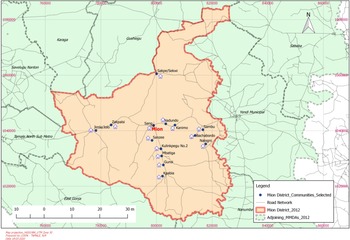
Baseline data from the Ten2Twenty-Ghana study were analysed. The study design, setting, and population have been described in detail elsewhere (Azupogo et al., Reference Azupogo, Abizari, Osendarp, Feskens and Brouwer2021). In brief, Ten2Twenty-Ghana was a randomized controlled trial that evaluated the efficacy of multiple-micronutrient fortified biscuits compared to unfortified biscuits on the micronutrient status of adolescent girls aged 10–17 years in the Mion District in north-eastern Ghana. Figure 1 shows the map of the district with the study communities. The study began with a large survey (n = 1057), which led to the trial (n = 621). The survey was conducted in November/December 2018. The research adhered to the guidelines outlined in the Declaration of Helsinki, with all procedures involving human subjects receiving approval from the Navrongo Health Research Centre Institutional Review Board (NHRCIRB323). Written informed consent was obtained from all parents, and assent was provided by the girls after receiving signed/thumb-printed informed consent from guardians/parents.
Map of Mion district, Ghana, with the Communities Included in the Ten2Twenty-Ghana study. Reproduced from Azupogo et al. (Reference Azupogo, Abizari, Osendarp, Feskens and Brouwer2021).

The Mion District has a tropical climate with two distinct seasons: a dry season from November to March and a rainy season from April to October. The district is home to approximately 94,930 people, of whom 89.6% reside in rural communities. Agriculture is the primary livelihood, supporting over 90% of the population. The area is characterized by extended family living arrangements, with large household sizes averaging about 6. The district also has high illiteracy rates, and about 20% of the female population is aged 10 to 19 (Ghana Statistical Service (GSS), 2021; 2014).
Study population and population for analysis
The study participants were adolescent girls aged 10–17 years residing in the Mion district, Northern region, Ghana. The girls were selected from 19 different elementary schools across the district. The sampling included four clusters, of which four schools in the urban district capital were chosen alongside 15 larger rural schools. A 16-item screening questionnaire ensured that all participating adolescent girls were healthy with no apparent signs of poor health, not pregnant, and not lactating at the time of the survey (Azupogo et al., Reference Azupogo, Abizari, Osendarp, Feskens and Brouwer2021). Adolescent girls with missing data on menarche status (n = 12) were excluded from the analysis of factors associated with menarche attainment and pubertal development score. Consequently, the final sample for these analyses included 1,045 girls. Of 208 girls who had attained menarche, three with missing data on AAM were excluded from the analysis of factors associated with AAM (Figure 2).
Flow Chart for the Population for Analysis from the Ten2Twenty-Ghana Cross-Sectional Survey.

Data collection procedure
The data collection methods included one-on-one interviews with a semi-structured questionnaire utilizing validated scales that assessed pubertal development and menarche attainment, anthropometry, body composition assessment, haemoglobin status assessment by finger prick, a qualitative 24-hour dietary recall, and a one-month semi-quantitative food frequency questionnaire. Details of the methods are presented in the subsequent sub-headings. The questionnaire was pre-tested in the neighbouring Yendi Municipality in November 2017. Given questions like menarche were sensitive, interviewers were trained female researchers recruited from the University for Development Studies (UDS). All questionnaires were validated in the field for consistency and completeness by trained Supervisors from the UDS.
Dependent variables
The outcome variables in the present study included menarche status (dichotomous) and continuous variables of AAM and pubertal development score (PDS) of the adolescent girls. The AAM of the girls was assessed using the recall method (Carskadon & Acebo, Reference Carskadon and Acebo1993; Crockett & Petersen, Reference Crockett and Petersen1987). The girls were initially questioned about whether they had experienced menarche. Girls who had attained menarche were next asked to recall according to the month and year when they experienced menarche or to the nearest whole years of age when they experienced menarche. When the girls had trouble remembering, calendar events such as class and term at school were utilized to help them remember the year and month they reached menarche. Early menarche was defined as AAM <12 years, while late menarche was defined as AAM >15 years (Karapanou & Papadimitriou, Reference Karapanou and Papadimitriou2010). Although the PDS has not been validated specifically in Ghana, it has been widely employed across other LMIC settings. The test-retest Cronbach’s alpha test of reliability of the PDS was 0.71, indicating acceptable internal consistency and suggesting its reliability as a measure of pubertal development in the sample.
Pubertal development was also assessed using the 5-item self-reported pubertal development scale questionnaire (Carskadon & Acebo, Reference Carskadon and Acebo1993; Crockett & Petersen, Reference Crockett and Petersen1987). The pubertal development scale consists of five items: body hair growth, growth spurt, skin changes, breast growth and age at menarche (Crockett & Petersen, Reference Crockett and Petersen1987). The girls were asked to respond to a 4-point Likert scale; ‘not yet started (1 point)’, ‘barely started (2 points)’, ‘definitely started (3 points)’ or ‘seems completed (4 points)’. Menarche was coded dichotomously, either no (1 point) or yes (4 points). The PDS was computed as the mean score of the 5-stages of puberty and varied from a mean score of 1–4 (Carskadon & Acebo, Reference Carskadon and Acebo1993; Petersen et al., Reference Petersen, Crockett, Richards and Boxer1988; Pompéia et al., Reference Pompéia, Zanini, Freitas, Inacio, Silva, Souza, Vitalle, Niskier and Cogo-Moreira2019). Pubertal development categories were computed using the scoring algorithms of Crockett and Petersen (Crockett & Petersen, Reference Crockett and Petersen1987). The algorithm uses 3 physical markers of the Tanner scale: breast development, hair growth and the onset of menarche. The girls were categorized as prepubertal (score of 2 and no menarche); early pubertal (score of 3 and no menarche); mid-pubertal (score > 3 and no menarche); late pubertal (score ≤ 7 and menarche) and post-pubertal (score ≥ 8 and menarche) (Carskadon & Acebo, Reference Carskadon and Acebo1993; Rasmussen et al., Reference Rasmussen, Wohlfahrt-Veje, Tefre de Renzy-Martin, Hagen, Tinggaard, Mouritsen, Mieritz and Main2015). Pubertal development was analysed using the mean score of the PDS and pubertal development stage.
Explanatory variables
Anthropometry and body composition
Anthropometric measures of height and weight were measured in duplicates to the nearest 0.1 decimal with the Seca stadiometer and digital weighing scale, respectively, following standard anthropometry guidelines (Cashin & Oot, Reference Cashin and Oot2018). The average of the duplicate measures was used in the analysis. HAZ and BAZ were then computed using the WHO AnthroPlus software with the WHO growth reference for 10-19-year-old adolescent girls. The WHO reference data is preferred to the United States Centre for Disease Control reference data when computing z-scores for the nutritional status of children and adolescents in Ghana due to its applicability to LMICs and the inclusion of relevant local data. WHO references are globally recognized and widely used for assessing the nutritional status of children and adolescents. This is critical for international comparisons. Stunting was defined as HAZ < -2SD, whereas BAZ was categorized as thinness (BAZ < -2SD), normal BAZ (-2SD ≤BAZ ≤ +1SD), overweight (+1SD < BAZ ≤+2SD) and obesity (BAZ > +2SD) (Onis et al., Reference Onis, Onyango, Borghi, Siyam, Nishida and Siekmann2007). Overweight and obesity were combined in this study based on the prevalence of overweight and obesity.
Bio-electric impedance using the Bodygram Plus Analyser (Akern, Germany) (AKERN, 2014) was used to assess the body composition of the girls. Measurements of body composition, precisely to the nearest 0.1 decimal, encompassed fat mass (FM) and fat-free mass (FFM) in kilograms, along with muscle mass, skeletal muscle mass, body cell mass in kilograms, and total body water, extra-cellular water, and intracellular water in litres. In the present study, only the FM and FFM of the girls were used. Anthropometric measurements were taken by a two-person team, which included a trained research assistant, and a supervisor experienced in anthropometry. For accuracy, if the height or weight measurements differed by more than 2 cm or 0.2 kg, a third measurement was taken, and the two closest values were retained. All measurements of anthropometry and body composition were conducted at a central location within each selected village/school. All research assistants and supervisors underwent two weeks of training, including five days focused on anthropometric and body composition assessments
Haemoglobin status of the girl
Experienced phlebotomists from the Tamale Teaching Hospital assessed haemoglobin status (Hb) by finger prick using a HemoCue 301 (Angelholm, Sweden; 0.1g/dL accuracy). The photometer was calibrated using certified quality control samples from the CDC/Atlanta, and measurements for 10 girls were repeated daily for quality control. Anaemia was defined as Hb<12 g/dL for girls aged 12 years and above and Hb<11.5 for girls aged < 12 years (WHO, 2011).
Dietary intake-related data
A qualitative 1-month semi-quantitative food frequency questionnaire (1-month FFQ), which utilized a 10-food group indicator (FAO, 2016), was used to assess the dietary patterns of the girls. The girls’ dietary diversity score (DDS) was also evaluated using a single qualitative 24-hour dietary recall (24-HR) utilizing the 10-food group indicator. In the 24-HR, the girl was requested to list all foods, drinks, and snacks she ate the day before, both inside and outside of the home (including at school), in the last 24 hours (from wake-up to wake-up). Then, she was probed to list the components of any mixed dishes. If a girl consumed at least one food item from any food group, she received a score of 1; otherwise, a score of 0 based on a pre-defined table listing all potential food items in the 10 food groups. The scores for all the food groups were then added to provide a summated score, with a maximum score of 10. The ten dietary groups were as follows: grains, white roots, tubers, and plantains; pulses (beans, peas, and lentils); nuts and seeds; dairy; meat, poultry, and fish; eggs; dark green leafy vegetables; other vitamin A-rich fruits and vegetables; other vegetables; and other fruits. A dichotomous variable of the minimum dietary diversity (MDD-W), as recommended by the FAO (FAO, 2016), was also defined as DDS ≥5 or DDS < 5 and explored in the analysis.
Girl-level socio-demographic data
Data on the girls’ ethnicity (categorical), religious affiliation (categorical), and age were collected using a household roster. Age was verified through official documentation, including a birth certificate, birth record, health insurance card, or by providing the exact age in years. The household roster was completed through a one-on-one interview with the mother.
Household-level data
The girls’ households’ food security status was assessed with the 8-item Food Insecurity Experience Scale (FIES) (FAO, 2015). The FIES uses yes/no responses to assess the degree of food insecurity. When the answer is ‘yes’, the questions are given a score of 1; otherwise, they are given a score of 0. FIES score was computed by summing the scores of the 8 items. The score ranged between 0 and 8, with a higher score denoting a more severe level of food insecurity, whereas a lower score indicated a less severe level of food insecurity. Based on the FIES score, food insecurity categories were defined as food-secure (FIES = 0), mildly food insecure (FIES score 1-3), moderately food insecure (FIES score 4-6), and severely food insecure (FIES score 7-8).
The International Wealth Index (IWI) evaluated the households’ socioeconomic status. The IWI, which was developed specifically to evaluate the socioeconomic status of households in LMICs, used data from 97 LMICs and has a score range of 25 to 100 (Smits & Steendijk, Reference Smits and Steendijk2015). In the IWI, households are ranked based on the household’s access to electricity, the type of water and toilet facilities they use, and the type of flooring they have. Durable assets in the IWI include things like a TV, refrigerator, phone, bicycle, car, and household utensils that are either inexpensive (under $40) or expensive (over $250). Based on the IWI score, the households were ranked into wealth quintiles.
The household roster also collected information on parental education (categorized as none, primary, or secondary/higher), occupation (none, farmer, trader/self-employed, or formal employee), and literacy status (binary: literate or non-literate). Using the household roster, ratio variables were computed for household female-to-male, literacy, and dependency ratios, consistent with definitions from the Ghana Statistical Service (Ghana Statistical Service, 2014) and included in the analysis. The dependency ratio was defined as the ratio of the dependent population (individuals aged 0–14 and those 65 and older) to the working-age population (ages 15–64), reflecting the proportion of dependents relative to those of working age. The literacy ratio was calculated as the ratio of literate household members to non-literate members, indicating literacy prevalence within the household and overall educational level. Finally, the female-to-male ratio was expressed as the total number of females to males within the household, providing insights into gender composition. These ratios offered critical insights into household demographic and educational characteristics for the analysis.
Statistical analysis
The statistical software program SAS 9.4 (SAS Institute Inc., Cary, NC.) was used to analyse the data. Continuous variables were presented as means and standard deviations, while categorical descriptive variables were expressed as frequencies and percentages. Data normality was examined visually with the normality histogram curves and Q-Q plots. Multiple variable linear and binary logistic regression analyses were fitted to identify the factors associated with attaining menarche, AAM, and PDS. The outcome variables in the linear regression analysis were the AAM and PDS mean scores, whereas the attainment of menarche was the outcome variable for the binary logistic regression analysis. In the linear regression analysis, the regression coefficient (β), its standard error (S.E) and P-value were estimated for each explanatory variable. The odds ratio (95% confidence interval) and P-value for the attainment of menarche were estimated in the binary logistic regression analysis. In the regression analyses, bivariate models were first fitted, and all variables with P-values ≤ 0.25 were then assessed in the multivariable models using a backward regression approach. Variables were retained in all final models if they were statistically associated with the outcome variable at a P-value of ≤ 0·05. The study’s design, focusing on schools, was accounted for by treating the school as a stratum in all analyses, utilizing the PROC SURVEY function in SAS (Berglund, Reference Berglund2014). The -2 log-likelihood ratio test, Wald test, and P-value were used to evaluate the model fit for the logistic regression, while the R-square and Root MSE were used to evaluate the model fit for the linear regression. Multicollinearity was found between the anthropometric variables of HAZ/stunting, BAZ or its categories (normal BAZ vs thin, overweight/obese) and the body composition variables (FM and FFM) using a tolerance value (TOL) < 0.1 and the variance inflation factor (VIF) <10 in a linear regression step. Since the model fit was best with the anthropometric variables of HAZ and BAZ or nutritional status (stunting status and BAZ category), FM and FFM were removed from the analysis for menarche attainment and AAM (Please see Tables S4 and S5 ). Using a general linear model, trends in nutritional status indices (HAZ and BAZ) and body composition (FM and FFM) were evaluated across pubertal stages. In these models, pubertal development stages were ranked in ascending order from prepubertal to post-pubertal, with each stage assigned a numerical rank from 0 (prepubertal) to 4 (post-pubertal).
Results
Population characteristics
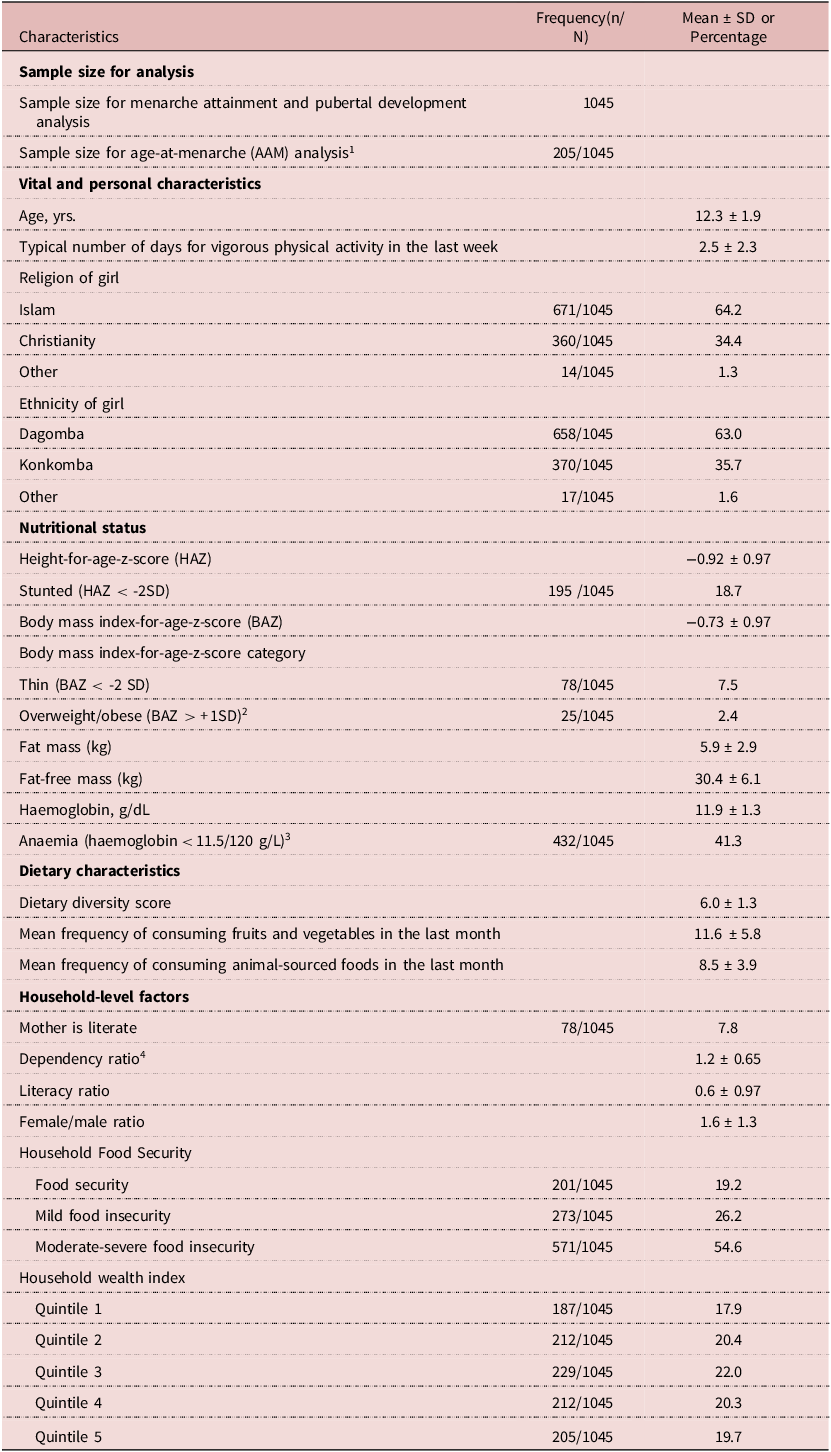
The study population consisted of 1,045 adolescent girls aged 10–17 years, assessed for menarche attainment and pubertal development. Of these, 205 girls who had experienced menarche and provided data on AAM were analysed to identify factors associated with AAM. The mean age of the participants was 12.3 ± 1.6 years (Table 1). Approximately two-thirds of the girls were of Dagomba ethnic origin (63.0%) and practised Islam (64.2%). Only 7.8% of the mothers were literate, and the average household size was 12.1 ± 5.2 members. The household literacy ratio was 0.6 ± 1.0, and the female-to-male ratio was 1.6 ± 1.3. About 19.2% of the girls’ households were food-secured, with a little over half (54.6%) moderately or severely food-insecured. The mean DDS was 6.0 ± 1.3 out of a maximum of 10. The adolescent girls consumed fruits and vegetables an average of 11.6 ± 5.8 days and animal-sourced foods 8.5 ± 3.9 days in the last month. On average, they engaged in vigorous physical activity 2.5 ± 2.3 days in the last week. The mean HAZ was -0.9 ± 1.0, with nearly 20.0% of the girls being stunted. The mean BAZ was -0.7 ± 1.0, with 7.6% of the girls classified as thin and only 2.5% being overweight or obese. The mean FM and FFM were 5.9 ± 2.9 kg and 30.4 ± 6.1 kg, respectively. The mean Hb was 11.9 ±1.3 g/dL, and the burden of anaemia among the girls was severe (≥ 40%).
Baseline Characteristics of the Population

1 The analysis was limited to only girls who had experienced menarche.
2 Overweight and obesity were combined because only 4/1045 (0.4%) were obese.
3 Hb < 11.5 g/dL for girls aged < 12 yrs. and Hb < 12.0g/dL for girls aged ≥ 12 yrs. (WHO, 2011).
4 The ratio of the dependent population (individuals aged 0–14 and those 65 and older) to the working-age population (ages 15–64), reflecting the proportion of dependents relative to those of working age. n, frequency of occureance; N=total sample.
Pubertal development and menarche
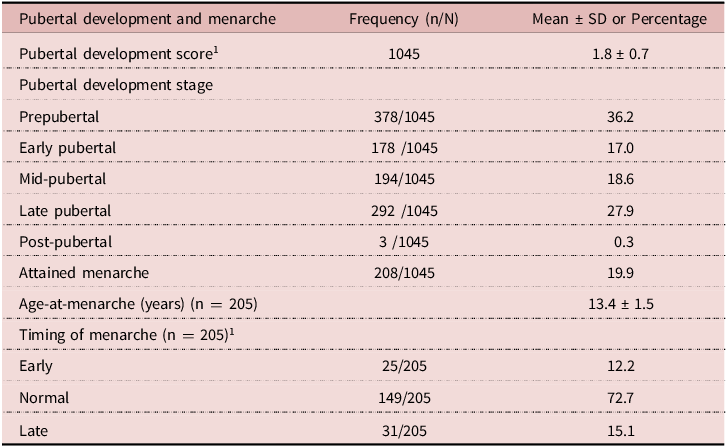
The average PDS was 1.8 ± 0.7 out of a maximum score of 4 (Table 2). Approximately 36.2% of the adolescent girls were classified as prepubertal, 17.0% were in the early pubertal stage, and 18.6% were in the mid-pubertal stage. Additionally, 27.9% were in the late pubertal stage, while less than 1.0% were post-pubertal. One-fifth (19.9%) of the girls in the study had attained menarche, with a mean AAM of 13.4 ± 1.5 years. Among those who had reached menarche, 12.2% (n = 25/205) experienced early onset, while 15.1% (n = 31/205) had delayed menarche.
The Pubertal Development and Menarche Status of the Adolescent Girls
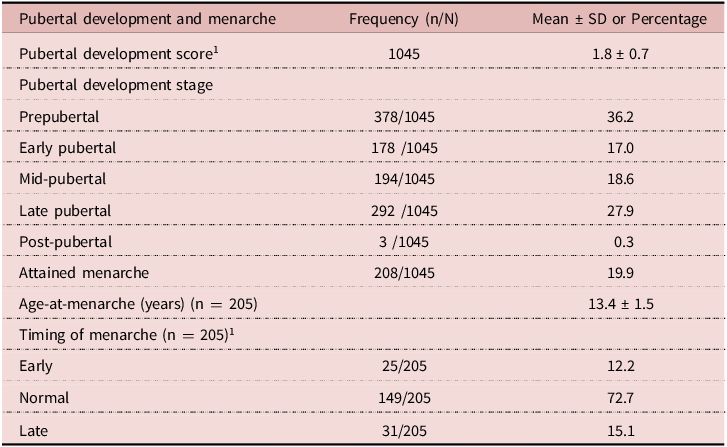
1 The timing of menarche refers to whether the onset of menstruation occurred early or late. In this context, early menarche is defined as age at menarche (AAM) less than 12 years, while late menarche is defined as an AAM greater than 15 years. n, frequency of occureance; N = total sample.
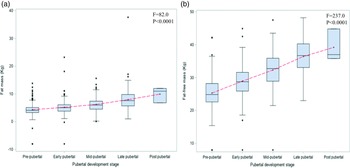
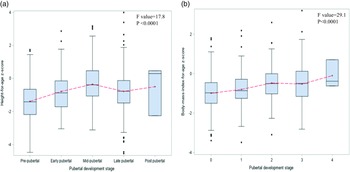
A significant increasing trend in FM (F =82.0, P-trend < 0.0001) and FFM (F = 237.0, P-trend < 0.0001) with advancing pubertal stages was observed, as illustrated in Figure 3. Likewise, HAZ (F = 29.1, P-trend < 0.0001) and BAZ (F = 17.8, P-trend < 0.0001) also increased with pubertal progression, though both slightly declined in the late pubertal stage before consistently increasing again in the post-pubertal phase (Figure 4). The decline in HAZ was more marked than in BAZ during the later stages of puberty.
The Trend in Fat Mass (a) and Fat-Free Mass (b) By Pubertal Development Stage Among Adolescent Girls.

The Trend in Height-for-Age-Z-Score (a) And Body Mass Index-for-Age-Z-Score (b) By Pubertal Development Stage Among Adolescent Girls.

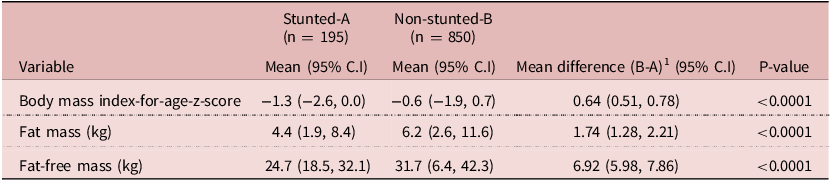
Table 3 demonstrates that non-stunted girls had significantly higher scores for BAZ (mean difference: 0.64; 95% CI: 0.51, 0.78), FM (mean difference: 1.74; 95% CI: 1.28, 2.21), and FFM (mean difference: 6.92; 95% CI: 5.98, 7.86) compared to stunted peers.
Differences in Body Composition and Body Mass Index for Age by Stunting Status
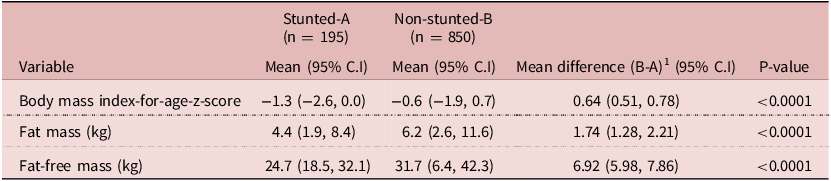
B=Non-stunted, A=stunted.
1 Mean difference was estimated with non-stunted as the reference group (B-A)
Factors associated with the attainment of menarche
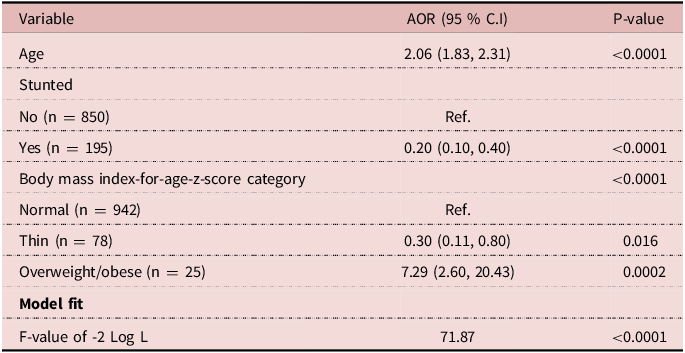
In a univariate analysis, significant predictors of menarche attainment included age (odds ratio (OR) = 1.96, 95% confidence interval (C.I.): 1.76, 2.19), HAZ (OR = 1.54, 95% C.I.: 1.36, 1.75), BAZ (OR = 2.43, 95% C.I.: 1.97, 3.01), stunting status (OR = 0.24, 95% C.I.: 0.13, 0.43), BAZ category (P = 0.001), FM (OR = 1.59, 95% C.I.: 1.46, 1.73), FFM (OR = 1.32, 95% C.I.: 1.26, 1.38), religion (P = 0.001), and ethnicity (P = 0.001) (Table S1 ). From the multiple logistic regression (Table 4), only age (adjusted odds ratio (AOR) = 2.06, 95% C.I.:1.83, 2.31), stunting (AOR = 0.20, 95% C.I.: 0.10, 0.40) and the BAZ category (P < 0.0001) of the girl remained significantly associated with menarche attainment. In detail, a unit increase in age doubled the odds of attaining menarche and compared to non-stunted girls, the odds of attaining menarche were reduced by 80.0% for stunted girls. Furthermore, compared to girls with normal nutritional status, thin girls (AOR = 0.30, 95% C.I.: 0.11, 0.80) were 70.0% less likely to have attained menarche while the odds of attaining menarche were more than 7-fold (AOR = 7.29, 95% C.I.: 2.60, 20.43) for girls who were overweight/obese.
Factors Associated with the Occurrence of Menarche (n = 1045)
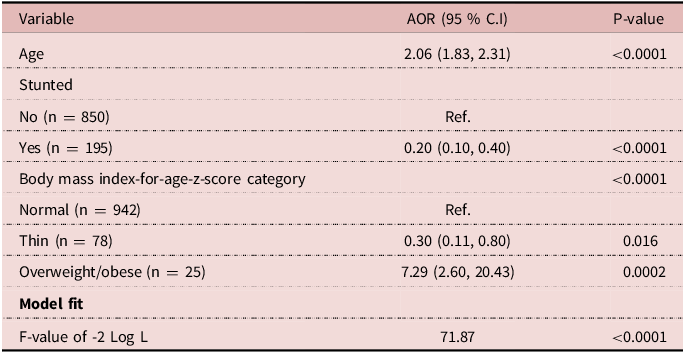
AOR = Adjusted odds ratio
Factors associated with age-at-menarche (AAM) and pubertal development
As shown in Table S2, univariate predictors of the PDS included age (β = 0.20 ± 0.01; P < 0.0001), HAZ (β = 0.13 ± 0.01; P < 0.0001), stunting (β = -0.33 ± 0.04; P < 0.0001), BAZ (β = 0.20 ± 0.02; P < 0.0001), BAZ category (P-trend < 0.0001), FM (β = 0.10 ± 0.01; P < 0.0001), FFM (β = 0.06 ± 0.02; P < 0.0001), religion (P < 0.0001), and ethnicity (P < 0.0001). Household factors associated with PDS in the univariate analysis included dependency ratio (β = -0.05 ± 0.02; P = 0.03), literacy ratio (β = -0.04 ± 0.02; P = 0.01), and household wealth quintile (P-trend = 0.02). The univariate analysis also identified several significant predictors of AAM (Table S3), including age (β = 0.38 ± 0.06; P < 0.0001), stunting (β = -0.70 ± 0.35; P = 0.046), BAZ (β = -0.29 ± 0.12; P = 0.022), FFM (β = 0.05 ± 0.02; P = 0.004), and belonging to an ethnic group other than Dagomba (β = -1.33 ± 0.12; P < 0.0001).
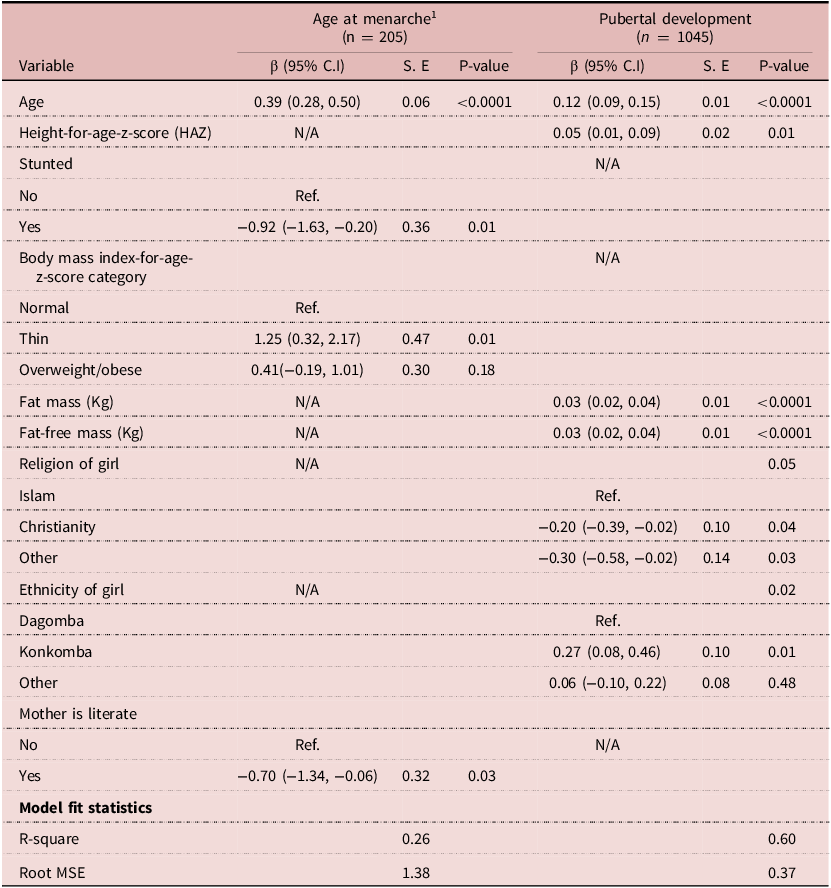
The multiple linear regression analysis showed that for every additional increase in the girl’s age, the AAM increased significantly by 0.39 (95% C.I.: 0.28, 0.50) years. Further, AAM decreased significantly by -0.92 (95% C.I.: -1.63, -0.20) years for stunted girls compared to non-stunted girls (Table 5). Compared to girls with normal nutritional status, AAM increased significantly by 1.25 (95% C.I.: 0.32, 2.17) years for thin girls. Furthermore, AAM decreased by -0.72 years (95% C.I.: -1.34, -0.06) for girls with literate mothers compared to peers with non-literate mothers.
Factors Associated with Age-at-Menarche and Pubertal Development Score
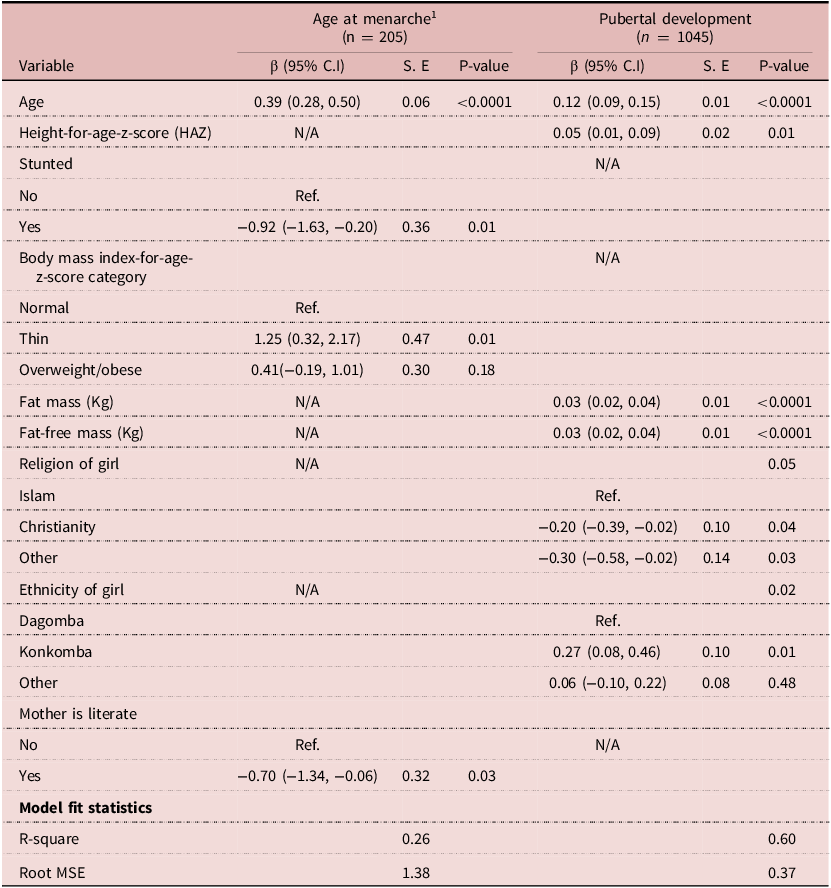
1 Analysis was conducted for only girls who attained menarche and had data for age-at menarche. N/A, not applicable, implying the variable was not selected in the multivariate backward regression.
Table 5 also shows that a unit increase in age and HAZ significantly increased the PDS by 0.12 (95% C.I.: 0.09, 0.15) and 0.05 (95% C.I.: 0.01, 0.09) units, respectively. Every additional increase in the FM (β = 0.03, 95% C.I.: 0.02, 0.04) and FFM (β = 0.03, 95% C.I.: 0.02, 0.04) of the girls also significantly increased the PDS of the girls by 0.03 units each. Compared to practising Islam, being a Christian (β = -0.20, 95% C.I.: -0.39, -0.02) and practising other religions (β = -0.30, 95% C.I.: -0.58, -0.02) decreased the PDS significantly by -0.20 and -0.30 units, respectively. Compared to girls who belonged to the Dagomba ethnic group, the PDS of girls of the Konkoba ethnicity increased significantly by 0.27 (95% C.I.: 0.08, 0.46) units.
Discussion
The present study examined pubertal development, menarche attainment, and AAM, as well as the factors associated with these, among rural adolescent girls in the Mion District, Northern Ghana. The findings of the present study shed light on the complex interplay of biological, nutritional, and socio-demographic factors influencing menarche and pubertal development among adolescent girls. In the present study, the population was relatively younger, which explains that only one-fifth of the population had attained menarche. Variations in pubertal progression and menarche attainment associated with stunting, thinness, and overweight/obesity emphasize the importance of understanding how different growth patterns affect puberty.
The mean recall AAM in the current study (13.4 ± 1.5 yrs.) was comparable to the study of Ameade and Garti (Reference Ameade and Garti2016) in Tamale, Ghana (13.7 ± 1.9 yrs.). However, the mean AAM was lower than the AAM (14.0 ± 1.4 yrs.) in the study of Adadevoh et al. (Reference Adadevoh, Agble, Hobbs and Elkins1989) in Accra, Ghana, which was the first study to examine the menarcheal age of Ghanaian girls. A recent study in rural Bangladesh by Hur et al. (Reference Hur, Schulze, Thorne-Lyman, Wu, Shaikh, Ali, Labrique and West2021) also reported a mean AAM consistent with the present findings. However, the mean AAM observed in this study is lower than the mean AAM of other African countries including Nigeria (15.3 ± 2.1 yrs.) (Tunau et al., Reference Tunau, Adamu, Hassan, Ahmed and Ekele2012) and Ethiopia (14.1 ± 1.4 yrs.) (Gultie et al., Reference Gultie, Hailu and Workineh2014), but higher than those of some high-income countries like Canada (12.7 ± 1.1 yrs.) and Britain (12.7 ± 1.5 yrs.) (Morris et al., Reference Morris, Jones, Schoemaker, Ashworth and Swerdlow2010). Although the present study did not compare the AMM of rural and urban girls, it is reasonable to speculate, based on the present findings and existing studies, that there is no difference between the AMM of girls in rural and urban settings in northern Ghana.
Evidence strongly supports a positive association between a higher BAZ and/or overweight/obesity and early menarche onset (Asrullah et al., Reference Asrullah, Hoir, Feskens and Boonstra2022; Rodríguez-Vázquez et al., Reference Rodríguez-Vázquez, Tena-Sempere and Castellano2020). The observed association between overweight/obesity and menarche attainment likely indicates that increased fat mass acts as a biological trigger for initiating puberty. In fact, each unit increase in FM was associated with a 0.05-year reduction in AAM (95% CI: -0.10, -0.05), suggesting that excess adiposity may accelerate pubertal onset (results not shown). However, FM was excluded from the statistical models due to multicollinearity with the nutritional status indices. Overall, these findings highlight the important role of body composition in pubertal timing and suggest the need for further investigation into adiposity-related mechanisms influencing menarche.
In this study, stunting and thinness were inversely associated with menarche attainment, with thinness significantly delaying menarche onset and increasing the AAM by 1.25 years (95% CI: 0.32, 2.17). This finding suggests that undernutrition and poor growth may delay pubertal onset, contributing to physical and psychosocial development disparities. The results align with studies from Bangladesh (Malitha et al., Reference Malitha, Islam, Islam, Sayed, Mamum, Chakrabarty and Hossain2020), Iran (Bayat et al., Reference Bayat, Ghanbari, Khazaei, Ghorbani and Amiri2012), and Trinidad (Uche-Nwachi et al., Reference Uche-Nwachi, Odekunle, Gray, Bethel, Burrows and Carter2007), which similarly reported later menarche among girls with lower BAZ. The biological pathway underlying this association likely involves leptin, a hormone strongly correlated with BMI, which links adipose tissue to the gonadal-hypothalamic axis, a critical driver of pubertal onset (Kaplowitz, Reference Kaplowitz2008; Rodríguez-Vázquez et al., Reference Rodríguez-Vázquez, Tena-Sempere and Castellano2020; Singh et al., Reference Singh, Sanyal and Chattopadhyay2011). Supporting evidence from Ethiopia (Yetubie et al., Reference Yetubie, Jemal, Kassa and Fallon2010) and Nigeria (Goon et al., Reference Goon, Toriola, Uever, Wuam and Toriola2010) also demonstrates that girls with lower BAZ experience delayed menarche compared to peers with higher BAZ, underscoring the importance of adequate nutrition and growth for timely pubertal development. These findings highlight the need for early nutritional interventions to promote healthy body composition and mitigate delays in pubertal timing associated with undernutrition.
The finding that stunting was inversely associated with AAM is unexpected and contrasts with previous literature, suggesting that stunted girls generally experience delayed menarche, resulting in a higher AAM (Nti et al., Reference Nti, Oaks, Prado, Aryee and Adu-Afarwuah2024; Svefors et al., Reference Svefors, Pervin, Khan, Rahman, Ekström, Arifeen, Selling and Persson2019). This discrepancy may be influenced by psychosocial stress, which has been shown to play a complex role in pubertal timing. Research suggests that psychosocial stress can sometimes accelerate puberty, potentially serving as an adaptive response to adverse environments (Ellison et al., Reference Ellison, Reiches, Shattuck-Faegre, Breakey, Konecna, Urlacher and Wobber2012). This may indicate that early pubertal onset could coincide with stunted growth in contexts of high stress or adversity, reflecting a trade-off between growth and reproductive timing. However, the mechanisms connecting psychosocial stress to stunting are equally complex. Chronic stress in childhood has been associated with impaired growth, as it may limit nutrient absorption and disrupt hormonal pathways essential for height attainment (Mousikou et al., Reference Mousikou, Kyriakou and Skordis2023). The present study indicates that stunted girls have significantly lower FM, FFM, and BAZ compared to non-stunted girls, suggesting that poor nutritional status may limit both body composition and overall growth potential. However, the cross-sectional design precludes establishing causality, making it unclear whether early menarche contributed to stunting or if stunted growth preceded pubertal onset. Longitudinal studies are essential to clarify these relationships and further explore how nutritional status and psychosocial stress interact to influence menarche timing. Insights from such studies could inform public health initiatives targeting malnutrition and stress management to support healthier reproductive development in adolescent girls.
The present study also found that girls with literate mothers had a lower AAM compared to girls with non-literate mothers. The influence of parental education on AAM has been documented in several studies (Belachew et al., Reference Belachew, Hadley, Lindstrom, Getachew, Duchateau and Kolsteren2011; Karapanou & Karapanou, 2010). These studies indicated that girls with literate mothers are more likely to have access to adequate and nutritious meals, leading to better nutritional status, which is associated with an earlier AAM.
The present study found that with each increase in FM and FFM, there was a significant rise in the PDS among the girls. This result is consistent with findings from Kirchengast & and Göstl (Reference Kirchengast and Göstl2006) and Huang et al. (Reference Huang, Hou, Fan, Tsai, Yang, Hsu and Chen2023), who also reported a positive association between pubertal progression and both FM and FFM. Biologically, puberty in girls is associated with an increase in body FM due to elevated oestrogen levels (Rogol et al., Reference Rogol, Roemmich and Clark2002). Additionally, leptin concentrations, which are typically higher in females during puberty, may further explain the positive association between FM and pubertal development (Horlick et al., Reference Horlick, Rosenbaum, Nicolson, Levine, Fedun, Wang, Pierson and Leibel2000). This link between FM and puberty could also account for the significantly higher PDS observed in girls of Konkomba ethnicity compared to those of Dagomba ethnicity in this study. Notably, the mean FFM of Konkomba girls (31.9 ± 0.4 kg) was significantly (P < 0.0001) higher than that of Dagomba girls (29.6 ± 0.2 kg). It is worth mentioning that elevated oestrogen levels are also known to promote fat accumulation (Brown & Clegg, Reference Brown and Clegg2010).
The observed increase in both FM and FFM with advancing pubertal stages highlights the significant physiological changes that occur during puberty, impacting overall body composition. The more pronounced increase in FFM, typically reflecting muscle and lean tissue growth, underscores the heightened nutritional and energy needs during this critical period of rapid growth and development (Spear, Reference Spear2002). This observation supports prior studies that highlight puberty as a period of accelerated growth, emphasizing the critical need for adequate nutrition to meet the increased demands of the developing body (Prentice et al., Reference Prentice, Ward, Goldberg, Jarjou, Moore, Fulford and Prentice2013; Soekarjo et al., Reference Soekarjo, Shulman, Graciano and Moench-Pfanner2014; Thurnham, Reference Thurnham2013). Rogol et al. (Reference Rogol, Clark and Roemmich2000) noted that growth velocity is particularly pronounced during mid-puberty, reflecting the peak of hormonal influence on growth. Consequently, girls who have entered this developmental stage are positioned to achieve greater height before the growth plates fuse, thus minimizing the risk of stunting. It suggests that adolescents may benefit from tailored dietary and physical activity recommendations that address the increased demand for macronutrients and micronutrients essential for muscle and bone development.
The pattern of increasing HAZ and BAZ has previously been reported by Rogol et al. (Reference Rogol, Clark and Roemmich2000). The marginal decline in the late stages of puberty could indicate a biological adjustment in growth rates as individuals approach the genetic potential for height and body size. This is also the period during which the growth plates are fusing (Ellison et al., Reference Ellison, Reiches, Shattuck-Faegre, Breakey, Konecna, Urlacher and Wobber2012). The steady rise in HAZ and BAZ during the post-puberty stage of development on Tanner’s scale suggests a recovery phase, during which individuals may attain adult stature and body composition. The more noticeable decline in HAZ during the late pubertal stage might reflect a variation in the timing of growth spurts among adolescents, potentially influenced by factors such as nutritional status, health conditions, and genetic predispositions. The study of Rogol et al. (Reference Rogol, Clark and Roemmich2000) also reported a peak in height velocity during mid-puberty. This underscores the importance of monitoring growth and nutritional status throughout puberty to identify deviations from expected growth patterns early, allowing timely interventions to support optimal health and development.
The correlation between religion and pubertal PDS found in this study, where Christian and other religious affiliations showed lower PDS compared to Muslim affiliation, suggests a possible influence of socio-cultural factors on pubertal timing. This finding may partly be due to the higher mean weight recorded among girls who were Christians or belonged to other religions compared to those who practised Islamic religion (37.9 ± 8.7 and 36.3 ± 9.2 vs 35.5 ± 8.2 kg, respectively; results not shown).
A key strength of this study was the use of a multistage sampling procedure, which minimized selection bias and ensured a representative sample. Additionally, conducting interviews in the girls’ native language facilitated clearer and more accurate responses. Given the sensitive nature of questions about pubertal development, female interviewers were employed to create a more comfortable setting for participants. The study also collected a wide range of data, including individual demographics, household socioeconomic factors, and several potential covariates related to AAM and pubertal development, allowing for a thorough analysis of factors influencing pubertal timing.
Despite the strengths, some limitations should be considered. The cross-sectional study design used was a limitation as a causal relationship could not be established. Also, recall bias was likely as dietary intake and especially AAM of participants were self-reported and based on recall. However, calendar events, such as class and term at school when the girl experienced menarche, were utilized to help them remember the year and month they reached menarche. Because most of the girls had not yet reached menarche, the sample size for the factors associated with the AAM group was quite small. It would have been more appropriate to collect data from girls in junior high schools as most may have already experienced menarche. However, this was not feasible for the Ten2Twenty-Ghana research project since UNICEF was running an iron supplementation programme for female junior high school students in Northern Ghana at the time of the present study. Nevertheless, considering that girl child school enrolment rates in Ghana are about 84.4% (Ghana Ministry of Education, 2022), the selected study population likely represents the broader demographic of adolescent girls in the Mion district of Ghana and comparable contexts.
Conclusion
In conclusion, this study provides valuable insights into the factors influencing AAM and pubertal development among adolescent girls in a low-income context. The mean AAM was 13.4 ±1.5 years, with early and late menarche occurring in 12.2% and 15.1% of post-menarche girls, respectively. The findings highlight that body composition, nutritional status, and socio-demographic factors, such as ethnicity and maternal literacy, significantly influence the timing and progression of puberty. Specifically, increased FM, FFM, and BAZ were associated with advancing pubertal stages, while stunting and thinness delayed menarche. The strong associations between these variables and pubertal milestones underscore the role of nutrition and growth in shaping adolescent development. The findings suggest a need for public health interventions targeting nutritional and socioeconomic disparities to promote healthy development. Early-life nutrition programmes could improve adolescent health and reproductive outcomes. Longitudinal studies are recommended to clarify the links between growth, body composition, pubertal timing, and socio-cultural factors across populations.
Supplementary material
For supplementary material accompanying this paper visit https://doi.org/10.1017/S0021932025000021
Data availability statement
All relevant data and supporting information files are included in the paper. The datasets analysed are available from the corresponding author upon reasonable request.
Acknowledgements
Author contribution
Conceived and designed the study: FA and IDB. The data were collected by FA, AA, and IDB. GAA and FA did the statistical analysis; wrote the first draft of the manuscript: GAA, FA, and AA. Contributed to the writing of the manuscript: FV, MSA, and IDB. All authors approved of the final content.
Funding statement
This study was part of a completed PhD project of the corresponding author, funded by the Edema Steernberg Foundation, Judith Zwartz Foundation, Nutricia Foundation, and Sight and Life Foundation. The funders had no role in study design, data collection and analysis, decision to publish, or preparation of the manuscript.
Competing interests
There are no conflicts of interest declared by the authors.
Ethical standard
The study protocol was approved by the Navrongo Health Research Centre Institutional Review Board (NHRCIRB323). Parents and guardians provided signed/thumb-printed informed consent for the girl child to participate in the study. Assent was also provided by the girls before participating in the study.
Abbreviations
AAM: Age-at-menarche
FM: Fat mass
FFM: Fat-free mass
PDS: Pubertal development scale
HAZ: Height-for-age-z-score
BAZ: Body mass index-for-age-z-score
BMI: Body mass index
FIES: Food insecurity access scale
DDS: Dietary diversity score
MDD-W: Minimum dietary diversity score
LMICs: Low- and middle-income countries
Hb: Haemoglobin
IWI: International Wealth Index



 Open access

