





1 Introduction
1.1.1
Joyce vertex algebras, introduced by Joyce [Reference Joyce23–Reference Joyce25], are a class of vertex algebras defined on the homology of certain moduli stacks. They are motivated by the study of wall-crossing in enumerative geometry, and it has been mysterious whether they are related to usual sources of vertex algebras, such as conformal field theories.
In some cases, this construction gives familiar vertex algebras, such as the Heisenberg vertex algebra, which arises as the homology of the space $\mathrm {BU}$
, or certain Kac–Moody vertex algebras, which arise as the homology of moduli stacks of representations of Dynkin quivers. See §6.1.3 and §6.3.1 below for these examples, and Latyntsev [Reference Latyntsev29] for more details.
$\mathrm {BU}$
, or certain Kac–Moody vertex algebras, which arise as the homology of moduli stacks of representations of Dynkin quivers. See §6.1.3 and §6.3.1 below for these examples, and Latyntsev [Reference Latyntsev29] for more details.
1.1.2
Motivated by the problem of generalizing Joyce’s [Reference Joyce24] enumerative invariants and wall-crossing formulae from the setting of abelian categories to more general algebraic stacks, the author [Reference Bu8] considered, as a first step, the orthosymplectic case, involving moduli stacks of orthogonal or symplectic objects and enumerative invariants counting them.
In this case, the author [Reference Bu8] constructed twisted modules for Joyce vertex algebras, defined on the homology of moduli stacks of orthogonal and symplectic objects. These twisted module structures were used to write down wall-crossing formulae for orthosymplectic enumerative invariants. This structure was later also studied by DeHority and Latyntsev [Reference DeHority and Latyntsev15].
1.1.3
More recently, the author, Halpern-Leistner, Ibáñez Núñez, and Kinjo [Reference Bu, Halpern-Leistner, Ibáñez Núñez and Kinjo11–Reference Bu, Núñez and Kinjo13] developed intrinsic Donaldson–Thomas theory, a new framework for enumerative geometry designed for generalizing results from abelian categories to nonlinear moduli stacks. We expect this framework to help formulating a generalization of Joyce’s [Reference Joyce24] formalism to a larger class of quasi-smooth stacks over $\mathbb {C}$
, including stacks that do not come from linear categories.
$\mathbb {C}$
, including stacks that do not come from linear categories.
Although such a generalized enumerative theory is still elusive, in this paper, we write down a natural generalization of Joyce’s vertex algebras for general stacks, which we call vertex induction, and which also generalizes the twisted modules in [Reference Bu8].
1.1.4
We expect the vertex induction to be the key operation in wall-crossing formulae for these conjectural invariants, which relate the invariants defined for different stability conditions. Moreover, these wall-crossing formulae should have the same structure as those for motivic Donaldson–Thomas invariants in [Reference Bu, Núñez and Kinjo13]. These expectations generalize Joyce’s work [Reference Joyce24] in the linear case.
Wall-crossing formulae are a powerful tool in enumerative geometry, as they provide a strong constraint on the structure of the invariants, and can sometimes be used for direct computations which can otherwise be difficult. See Gross, Joyce, and Tanaka [Reference Gross, Joyce and Tanaka20], the author [Reference Bu7], and Bojko, Lim, and Moreira [Reference Bojko, Lim and Moreira3] for examples of this approach in the linear case, where Joyce vertex algebras were an essential tool.
1.1.5
We hope that the vertex induction defined in the current work, combined with the formalism of stability and wall-crossing formulae for general stacks in [Reference Bu, Halpern-Leistner, Ibáñez Núñez and Kinjo11–Reference Bu, Núñez and Kinjo13], will enable us to formulate a precise conjecture for the existence and behaviour of the generalized invariants in §1.1.3, and will allow us to compute them in some cases, assuming the conjectural wall-crossing formulae.
Moreover, apart from Joyce’s invariants, several other types of enumerative invariants also exhibit very similar wall-crossing behaviours, including DT4 invariants and certain K-theoretic invariants, which we will discuss in §§1.1.9–1.1.10. Their wall-crossing formulae should be expressed using their corresponding variants of the vertex induction, which we also introduce in this paper.
1.1.6 Joyce vertex algebras
Before introducing the general construction of vertex induction, we will first explain its special cases where we obtain Joyce vertex algebras, and modules and twisted modules for them, to better motivate the general construction.
Roughly speaking, a vertex algebra is a vector space V, equipped with a unit $1 \in V$
and multiplication maps denoted by
$1 \in V$
and multiplication maps denoted by
 $$ \begin{align} (a_1, \dotsc, a_n) \longmapsto a_1 (z_1) \cdots a_n (z_n) \in V {[\![} z_1, \dotsc, z_n {]\!]} \, [(z_i - z_j)^{-1}] , \end{align} $$
which we may regard as a family of multiplications depending meromorphically on the formal variables $z_i$
, with possible poles along
$z_i$
, with possible poles along $z_i = z_j$
for
$z_i = z_j$
for $i \neq j$
. This multiplication should be unital, associative, and commutative in suitable senses.
$i \neq j$
. This multiplication should be unital, associative, and commutative in suitable senses.
In §2, we recall the construction of Joyce vertex algebras, with a precise statement in Theorem 2.3.3. We start with a moduli stack $\mathcal {X}$
of objects in a
$\mathcal {X}$
of objects in a $\mathbb {C}$
-linear abelian category
$\mathbb {C}$
-linear abelian category $\mathcal {A}$
. Then the graded vector space
$\mathcal {A}$
. Then the graded vector space $\mathrm {H}_{{\bullet } + 2 \operatorname {vdim}} (\mathcal {X}; \mathbb {Q})$
admits a vertex algebra structure given by
$\mathrm {H}_{{\bullet } + 2 \operatorname {vdim}} (\mathcal {X}; \mathbb {Q})$
admits a vertex algebra structure given by
 $$ \begin{align} a_1 (z_1) \cdots a_n (z_n) = \oplus_* \circ \tau (z) \Big(\! (a_1 \boxtimes \cdots \boxtimes a_n) \cap e_z^{-1} ({\mathbb{\nu}})\! \Big) , \end{align} $$
where $\operatorname {vdim}$
denotes the virtual dimension of
$\operatorname {vdim}$
denotes the virtual dimension of $\mathcal {X}$
,
$\mathcal {X}$
, $a_i \in \mathrm {H}_{\bullet } (\mathcal {X}; \mathbb {Q})$
are homology classes,
$a_i \in \mathrm {H}_{\bullet } (\mathcal {X}; \mathbb {Q})$
are homology classes, $\oplus \colon \mathcal {X}^n \to \mathcal {X}$
is the direct sum map,
$\oplus \colon \mathcal {X}^n \to \mathcal {X}$
is the direct sum map, $\tau (z)$
is a translation operator depending on the variables
$\tau (z)$
is a translation operator depending on the variables $z_i$
, and
$z_i$
, and $e_z^{-1} ({\mathbb{\nu}})$
is the inverse of the equivariant Euler class of the (virtual) normal bundle of the map
$e_z^{-1} ({\mathbb{\nu}})$
is the inverse of the equivariant Euler class of the (virtual) normal bundle of the map $\oplus $
. This n-fold multiplication will be a special case of vertex induction applied to the moduli stack
$\oplus $
. This n-fold multiplication will be a special case of vertex induction applied to the moduli stack $\mathcal {X}$
.
$\mathcal {X}$
.
1.1.7 Modules
In §3, we construct modules and twisted modules for Joyce vertex algebras.
The motivating case is from orthosymplectic enumerative geometry, where we start with a moduli stack $\mathcal {X}$
of objects in an abelian category
$\mathcal {X}$
of objects in an abelian category $\mathcal {A}$
, equipped with a contravariant involution
$\mathcal {A}$
, equipped with a contravariant involution $(-)^\vee \colon \mathcal {A} \mathrel {\overset {\smash {{} {-.8ex}{{} {\sim }}}\mspace {3mu}}{\to }} \mathcal {A}^{\mathrm {op}}$
, which induces a
$(-)^\vee \colon \mathcal {A} \mathrel {\overset {\smash {{} {-.8ex}{{} {\sim }}}\mspace {3mu}}{\to }} \mathcal {A}^{\mathrm {op}}$
, which induces a $\mathbb {Z}_2$
-action on
$\mathbb {Z}_2$
-action on $\mathcal {X}$
. The homotopy fixed locus
$\mathcal {X}$
. The homotopy fixed locus $\mathcal {X}^{\mathbb {Z}_2}$
is then the moduli of orthogonal or symplectic objects. See the author [Reference Bu9] for more details on this set-up.
$\mathcal {X}^{\mathbb {Z}_2}$
is then the moduli of orthogonal or symplectic objects. See the author [Reference Bu9] for more details on this set-up.
In this case, the involution $(-)^\vee $
induces a twisted involution of the Joyce vertex algebra
$(-)^\vee $
induces a twisted involution of the Joyce vertex algebra ${V = \mathrm {H}_{{\bullet } + 2 \operatorname {vdim}} (\mathcal {X}; \mathbb {Q})}$
, meaning that it satisfies
${V = \mathrm {H}_{{\bullet } + 2 \operatorname {vdim}} (\mathcal {X}; \mathbb {Q})}$
, meaning that it satisfies
 $$ \begin{align} \big( a_1 (z_1) \cdots a_n (z_n)\! \big)^\vee = a_1^\vee (-z_1) \cdots a_n^\vee (-z_n) \end{align} $$
for $a_1, \dotsc , a_n \in V$
. The space
$a_1, \dotsc , a_n \in V$
. The space $M = \mathrm {H}_{{\bullet } + 2 \operatorname {vdim}} (\mathcal {X}^{\mathbb {Z}_2}; \mathbb {Q})$
has the structure of a twisted module for V, given by the action
$M = \mathrm {H}_{{\bullet } + 2 \operatorname {vdim}} (\mathcal {X}^{\mathbb {Z}_2}; \mathbb {Q})$
has the structure of a twisted module for V, given by the action
 $$ \begin{align} a_1 (z_1) \cdots a_n (z_n) \, m = \diamond_* \circ \tau (z) \Big(\! (a_1 \boxtimes \cdots \boxtimes a_n \boxtimes m) \cap e_z^{-1} ({\mathbb{\nu}})\! \Big) , \end{align} $$
where $a_i \in V$
and
$a_i \in V$
and $m \in M$
are homology classes,
$m \in M$
are homology classes, $\diamond \colon \mathcal {X}^n \times \mathcal {X}^{\mathbb {Z}_2} \to \mathcal {X}^{\mathbb {Z}_2}$
is the map sending
$\diamond \colon \mathcal {X}^n \times \mathcal {X}^{\mathbb {Z}_2} \to \mathcal {X}^{\mathbb {Z}_2}$
is the map sending $(x_1, \dotsc , x_n, y) \mapsto x_1 \oplus x_1^\vee \oplus \cdots \oplus x_n \oplus x_n^\vee \oplus y$
, and
$(x_1, \dotsc , x_n, y) \mapsto x_1 \oplus x_1^\vee \oplus \cdots \oplus x_n \oplus x_n^\vee \oplus y$
, and ${\mathbb{\nu}}$
now denotes the normal bundle of
${\mathbb{\nu}}$
now denotes the normal bundle of $\diamond $
.
$\diamond $
.
Here, having a twisted module means that we have
 $$ \begin{align} a_1 (z_1) \cdots a_n (z_n)\, m \in M {[\![} z_1, \dotsc, z_n {]\!]}\, [z_i^{-1}, (z_i \pm z_j)^{-1}], \end{align} $$
where we allow extra poles at $z_i + z_j = 0$
for
$z_i + z_j = 0$
for $i \neq j$
, which are not present in a usual module, and we require the relation
$i \neq j$
, which are not present in a usual module, and we require the relation
 $$ \begin{align} a (z) \, m = a^\vee (-z) \, m \end{align} $$
for $a \in V$
and
$a \in V$
and $m \in M$
. This forces us to allow the extra poles, as it implies relations such as
$m \in M$
. This forces us to allow the extra poles, as it implies relations such as $a_1 (z_1) \cdots a_n (z_n) \, m = a_1^\vee (-z_1) \, a_2 (z_2) \cdots a_n (z_n) \, m$
. Note that our notion of twisted modules is different from the one in Frenkel and Ben-Zvi [Reference Frenkel and Ben-Zvi18: §5.6].
$a_1 (z_1) \cdots a_n (z_n) \, m = a_1^\vee (-z_1) \, a_2 (z_2) \cdots a_n (z_n) \, m$
. Note that our notion of twisted modules is different from the one in Frenkel and Ben-Zvi [Reference Frenkel and Ben-Zvi18: §5.6].
1.1.8 Vertex induction
The vertex induction is the main construction of this paper, and generalizes the constructions of Joyce vertex algebras and modules above. We will introduce it in §4, with precise statements in Theorems 4.2.3 and 4.3.7.
The motivating situation is when we are given an algebraic stack $\mathcal {X}$
over
$\mathcal {X}$
over $\mathbb {C}$
, and we consider its stack of graded points
$\mathbb {C}$
, and we consider its stack of graded points
 $$ \begin{align} \mathrm{Grad} (\mathcal{X}) = \mathcal{M}\mathit{ap}\, ({*} / \mathbb{G}_{\mathrm{m}}, \mathcal{X}) , \end{align} $$
following Halpern-Leistner [Reference Halpern-Leistner21]. It is equipped with a forgetful map $\mathrm {Grad} (\mathcal {X}) \to \mathcal {X}$
.
$\mathrm {Grad} (\mathcal {X}) \to \mathcal {X}$
.
For example, if $\mathcal {X}$
is the moduli stack of objects in an abelian category
$\mathcal {X}$
is the moduli stack of objects in an abelian category $\mathcal {A}$
, then
$\mathcal {A}$
, then $\mathrm {Grad} (\mathcal {X})$
is usually the moduli stack of
$\mathrm {Grad} (\mathcal {X})$
is usually the moduli stack of $\mathbb {Z}$
-graded objects in
$\mathbb {Z}$
-graded objects in $\mathcal {A}$
, and the forgetful map
$\mathcal {A}$
, and the forgetful map $\mathrm {Grad} (\mathcal {X}) \to \mathcal {X}$
forgets the
$\mathrm {Grad} (\mathcal {X}) \to \mathcal {X}$
forgets the $\mathbb {Z}$
-grading. As another example, if
$\mathbb {Z}$
-grading. As another example, if $\mathcal {X} = * / G$
for a linear algebraic group G over
$\mathcal {X} = * / G$
for a linear algebraic group G over $\mathbb {C}$
, then
$\mathbb {C}$
, then $\mathrm {Grad} (\mathcal {X})$
is a disjoint union of stacks of the form
$\mathrm {Grad} (\mathcal {X})$
is a disjoint union of stacks of the form $* / L$
for Levi subgroups
$* / L$
for Levi subgroups $L \subset G$
. See [Reference Bu, Halpern-Leistner, Ibáñez Núñez and Kinjo11; Reference Halpern-Leistner21] for details and more examples.
$L \subset G$
. See [Reference Bu, Halpern-Leistner, Ibáñez Núñez and Kinjo11; Reference Halpern-Leistner21] for details and more examples.
In this case, the vertex induction is the operation
 $$ \begin{align*} \mathrm{H}_{{\bullet} + 2 \operatorname{vdim}} (\mathcal{X}_\alpha; \mathbb{Q}) & \longrightarrow \mathrm{H}_{{\bullet} + 2 \operatorname{vdim}} (\mathcal{X}; \mathbb{Q}) (\!(z_i)\!) , \\a & \longmapsto \alpha_\star \circ \tau (z) \big( a \cap e_z^{-1} ({\mathbb{\nu}})\! \big) , \end{align*} $$
where $\mathcal {X}_\alpha \subset \mathrm {Grad} (\mathcal {X})$
is a connected component;
$\mathcal {X}_\alpha \subset \mathrm {Grad} (\mathcal {X})$
is a connected component; $\alpha _\star $
denotes pushing forward along the forgetful map
$\alpha _\star $
denotes pushing forward along the forgetful map $\mathcal {X}_\alpha \to \mathcal {X}$
;
$\mathcal {X}_\alpha \to \mathcal {X}$
; $z_1, \dotsc , z_n$
are formal variables, where n depends on
$z_1, \dotsc , z_n$
are formal variables, where n depends on $\alpha $
;
$\alpha $
; $\tau (z)$
is a certain translation operator; and
$\tau (z)$
is a certain translation operator; and ${\mathbb{\nu}}$
is the normal bundle of the map
${\mathbb{\nu}}$
is the normal bundle of the map $\mathcal {X}_\alpha \to \mathcal {X}$
.
$\mathcal {X}_\alpha \to \mathcal {X}$
.
For example, if $\mathcal {X}$
is the moduli stack of objects in an abelian category
$\mathcal {X}$
is the moduli stack of objects in an abelian category $\mathcal {A}$
, then each
$\mathcal {A}$
, then each $\mathcal {X}_\alpha $
is isomorphic to an n-fold product of components of
$\mathcal {X}_\alpha $
is isomorphic to an n-fold product of components of $\mathcal {X}$
for some n, and the vertex induction gives the n-fold multiplication in the Joyce vertex algebra. If, moreover,
$\mathcal {X}$
for some n, and the vertex induction gives the n-fold multiplication in the Joyce vertex algebra. If, moreover, $\mathcal {A}$
is equipped with a contravariant involution
$\mathcal {A}$
is equipped with a contravariant involution $(-)^\vee $
as in §1.1.7, then each component
$(-)^\vee $
as in §1.1.7, then each component $(\mathcal {X}^{\mathbb {Z}_2})_\alpha $
is isomorphic to a component of
$(\mathcal {X}^{\mathbb {Z}_2})_\alpha $
is isomorphic to a component of $\mathcal {X}^n \times \mathcal {X}^{\mathbb {Z}_2}$
for some n, and the vertex induction for
$\mathcal {X}^n \times \mathcal {X}^{\mathbb {Z}_2}$
for some n, and the vertex induction for $\mathcal {X}^{\mathbb {Z}_2}$
gives the multiplication
$\mathcal {X}^{\mathbb {Z}_2}$
gives the multiplication $a_1 (z_1) \cdots a_n (z_n) \, m$
in the twisted module.
$a_1 (z_1) \cdots a_n (z_n) \, m$
in the twisted module.
1.1.9 DT4 invariants
In §5.1, we discuss a variant of Joyce vertex algebras which appear in the context of DT4 invariants. These are invariants counting sheaves on Calabi–Yau fourfolds, developed by Cao and Leung [Reference Cao and Leung14], Borisov and Joyce [Reference Borisov and Joyce5], and Oh and Thomas [Reference Oh and Thomas32; Reference Oh and Thomas33]. Their existence and wall-crossing formulae were conjectured by Gross, Joyce, and Tanaka [Reference Gross, Joyce and Tanaka20: §4.4], and have not yet been proved at the time of this writing.
We define a similar variant of vertex induction on the homology of oriented n-shifted symplectic stacks for $n \in 4 \mathbb {Z} + 2$
. For example,
$n \in 4 \mathbb {Z} + 2$
. For example, $(-2)$
-shifted symplectic structures exist on moduli stacks of sheaves on Calabi–Yau fourfolds. The existence of orientations in this case is more subtle, but is recently shown for a class of Calabi–Yau fourfolds by Joyce and Upmeier [Reference Joyce and Upmeier26].
$(-2)$
-shifted symplectic structures exist on moduli stacks of sheaves on Calabi–Yau fourfolds. The existence of orientations in this case is more subtle, but is recently shown for a class of Calabi–Yau fourfolds by Joyce and Upmeier [Reference Joyce and Upmeier26].
We expect that a generalized version of DT4 invariants should be defined for a general class of oriented $(-2)$
-shifted symplectic stacks, especially in the nonlinear cases. We also expect that wall-crossing formulae for these generalized DT4 invariants should be written down using the variant of vertex induction that we define.
$(-2)$
-shifted symplectic stacks, especially in the nonlinear cases. We also expect that wall-crossing formulae for these generalized DT4 invariants should be written down using the variant of vertex induction that we define.
1.1.10 K-theoretic invariants
In §5.2, we consider another variant of Joyce vertex algebras, which are multiplicative vertex algebra structures defined on the topological K-homology of moduli stacks, instead of the homology. This type of structure was originally due to Liu [Reference Liu30], who also constructed K-theoretic enumerative invariants living in a version of K-homology, and proved their wall-crossing formulae using this multiplicative vertex algebra.
We generalize this construction to define a K-homology version of vertex induction. We expect that a generalized version of Liu’s K-theoretic invariants should be defined for a general class of quasi-smooth stacks, and that they should satisfy wall-crossing formulae expressed using the K-theoretic vertex induction.
2 Joyce vertex algebras
2.1 Vertex algebras
2.1.1
We start by providing background on vertex algebras. We recall their usual definition in §2.1.3, and then state a convenient alternative definition in §2.1.4. We also discuss a notion of weak vertex algebras, which will arise in our constructions below.
2.1.2 Formal power series
Let K be a field. For a finite-dimensional K-vector space $\Lambda $
, let
$\Lambda $
, let $K {[\![} \Lambda {]\!]} $
be the K-algebra of formal power series on
$K {[\![} \Lambda {]\!]} $
be the K-algebra of formal power series on $\Lambda $
with coefficients in K, defined as
$\Lambda $
with coefficients in K, defined as
 $$ \begin{align*} K {[\![} \Lambda {]\!]} = \prod_{n = 0}^\infty {\mathrm{Sym}}^n (\Lambda^\vee) . \end{align*} $$
Elements of $K {[\![} \Lambda {]\!]} $
are often written as
$K {[\![} \Lambda {]\!]} $
are often written as $f (z)$
, with a variable
$f (z)$
, with a variable $z \in \Lambda $
. Let
$z \in \Lambda $
. Let $K (\!(\Lambda )\!)$
be the fraction field of
$K (\!(\Lambda )\!)$
be the fraction field of $K {[\![} \Lambda {]\!]} $
. For a K-vector space V, define
$K {[\![} \Lambda {]\!]} $
. For a K-vector space V, define
 $$ \begin{align*} V {[\![} \Lambda {]\!]} = \prod_{n = 0}^\infty V \underset{K}{\otimes} \mathrm{Sym}^n (\Lambda^\vee) , \qquad V (\!(\Lambda)\!) = V {[\![} \Lambda {]\!]} \underset{K {[\![} \Lambda {]\!]}}{\otimes} K (\!(\Lambda)\!) . \end{align*} $$
For finite-dimensional K-vector spaces $\Lambda _1, \dotsc , \Lambda _n$
, writing
$\Lambda _1, \dotsc , \Lambda _n$
, writing $\Lambda = \Lambda _1 \oplus \cdots \oplus \Lambda _n$
, we have a natural isomorphism
$\Lambda = \Lambda _1 \oplus \cdots \oplus \Lambda _n$
, we have a natural isomorphism $K {[\![} \Lambda {]\!]} \simeq K {[\![} \Lambda _1 {]\!]} \cdots {[\![} \Lambda _n {]\!]} $
, and an injective
$K {[\![} \Lambda {]\!]} \simeq K {[\![} \Lambda _1 {]\!]} \cdots {[\![} \Lambda _n {]\!]} $
, and an injective $K {[\![} \Lambda {]\!]} $
-module homomorphism
$K {[\![} \Lambda {]\!]} $
-module homomorphism
 $$ \begin{align} \iota_{\Lambda_1, \dotsc, \Lambda_n} \colon K (\!(\Lambda)\!) {\hookrightarrow} K (\!(\Lambda_1)\!) \cdots (\!(\Lambda_n)\!) , \end{align} $$
given by power series expansion in the given order. We also denote this map by $\iota _{z_1, \dotsc , z_n}$
if
$\iota _{z_1, \dotsc , z_n}$
if $z_i$
is a set of coordinates of
$z_i$
is a set of coordinates of $\Lambda _i$
. For example, we have
$\Lambda _i$
. For example, we have
 $$ \begin{align} \iota_{z, w} \Big( \frac{1}{z + w} \Big) = \sum_{n = 0}^\infty {} (-1)^n \cdot \frac{w^n}{z^{n + 1}} , \end{align} $$
where the notation means that we take $\Lambda _1 \simeq \Lambda _2 \simeq K$
, and z, w are coordinates on
$\Lambda _1 \simeq \Lambda _2 \simeq K$
, and z, w are coordinates on $\Lambda _1$
,
$\Lambda _1$
, $\Lambda _2$
.
$\Lambda _2$
.
This also induces a map $\iota _{\Lambda _1, \dotsc , \Lambda _n} \colon V (\!(\Lambda )\!) \to V (\!(\Lambda _1)\!) \cdots (\!( \Lambda _n)\!)$
for any K-vector space V.
$\iota _{\Lambda _1, \dotsc , \Lambda _n} \colon V (\!(\Lambda )\!) \to V (\!(\Lambda _1)\!) \cdots (\!( \Lambda _n)\!)$
for any K-vector space V.
2.1.3 Vertex algebras
We recall the usual definition of a vertex algebra, taken from Frenkel and Ben-Zvi [Reference Frenkel and Ben-Zvi18: Definition 1.3.1].
A $\mathbb {Z}$
-graded vertex algebra over K is a quadruple
$\mathbb {Z}$
-graded vertex algebra over K is a quadruple $(V, 1, D, Y)$
, consisting of a
$(V, 1, D, Y)$
, consisting of a $\mathbb {Z}$
-graded K-vector space V, an element
$\mathbb {Z}$
-graded K-vector space V, an element $1 \in V$
of degree
$1 \in V$
of degree $0$
, a linear map
$0$
, a linear map $D \colon V \to V$
called the translation operator, and a linear map
$D \colon V \to V$
called the translation operator, and a linear map $Y (-, z) (-) \colon V \otimes V \to V (\!(z)\!)$
, satisfying the following axioms:
$Y (-, z) (-) \colon V \otimes V \to V (\!(z)\!)$
, satisfying the following axioms:
-
(i) (Unit) For all $a \in V$
, we have
$Y (a, z) (1) \in a + z V {[\![} z {]\!]} $
, and
$Y (1, z) (a) = a$
.
$a \in V$
, we have
$Y (a, z) (1) \in a + z V {[\![} z {]\!]} $
, and
$Y (1, z) (a) = a$
. -
(ii) (Translation) For any
$a, b \in V$
, we have (2.1.3.1)where
$$ \begin{align} [D, Y (a, z)] (b) = \frac{\partial}{\partial z} \, Y (a, z) (b), \end{align} $$
$[-,-]$
denotes the commutator, and we have
$D (1) = 0$
.
-
(iii) (Locality) For homogeneous elements
$a, b, c \in V$
, the elements are expansions of the same element in
$$ \begin{align*} Y (a, z) \circ Y (b, w) (c) & \in V (\!(z)\!) (\!(w)\!) , \\ (-1)^{|a| \, |b|} \cdot Y (b, w) \circ Y (a, z) (c) & \in V (\!(w)\!) (\!(z)\!) \end{align*} $$
$V {[\![} z, w {]\!]} \, [z^{-1}, w^{-1}, (z - w)^{-1}]$
, where
$|{-}|$
denotes the
$\mathbb {Z}$
-grading.


2.1.4 An equivalent definition
We introduce an alternative definition of a vertex algebra, following ideas from Kim [Reference Kim28]. This definition is perhaps more naturally motivated than the standard one, and will be important for generalizing Joyce vertex algebras to other situations below. See also Theorem 4.1.7 below for a functorial description of this approach.
A $\mathbb {Z}$
-graded vertex algebra over K is equivalently the data
$\mathbb {Z}$
-graded vertex algebra over K is equivalently the data $(V, (X_n)_{n \geq 0})$
, consisting of a
$(V, (X_n)_{n \geq 0})$
, consisting of a $\mathbb {Z}$
-graded K-vector space V and K-linear multiplication maps
$\mathbb {Z}$
-graded K-vector space V and K-linear multiplication maps
 $$ \begin{align*} X_n \colon V^{\otimes n} & \longrightarrow V {[\![} z_1, \dotsc, z_n {]\!]} \, [ (z_i - z_j)^{-1} ] , \\ a_1 \otimes \cdots \otimes a_n & \longmapsto X_n (a_1, \dotsc, a_n; z_1, \dotsc, z_n) , \end{align*} $$
preserving grading, where $\deg z_i = -2$
, and we invert
$\deg z_i = -2$
, and we invert $z_i - z_j$
for
$z_i - z_j$
for $i \neq j$
. In particular, this includes a map
$i \neq j$
. In particular, this includes a map $X_0 \colon K \to V$
, thought of as the unit. They should satisfy the following properties:
$X_0 \colon K \to V$
, thought of as the unit. They should satisfy the following properties:
-
(i) (Unit) For any
$a \in V$
, we have (2.1.4.1)
$$ \begin{align} X_1 (a; 0) = a . \end{align} $$
More precisely, we have
$X_1 (a; z) \in a + z V {[\![} z {]\!]} \subset V {[\![} z {]\!]} $
. -
(ii) (Commutativity) For any homogeneous elements
$a_1, \dotsc , a_n \in V$
, and any permutation
$\sigma \in \mathfrak {S}_n$
, we have (2.1.4.2)
$$ \begin{align} X_n (a_{\sigma (1)}, \dotsc, a_{\sigma (n)}; z_{\sigma (1)}, \dotsc, z_{\sigma (n)}) = \pm X_n (a_1, \dotsc, a_n; z_1, \dotsc, z_n) , \end{align} $$
where the sign is determined by the Koszul sign rule: it is ‘
$-$
’ if and only if
$\sigma $
restricts to an odd permutation on the odd-graded elements. -
(iii) (Associativity) For integers
$m, n \geq 0$
and elements
$b_1, \dotsc , b_m, a_1, \dotsc , a_n \in V$
, we have (2.1.4.3)where
$$ \begin{align} X_{n+1}& \Big( X_m (b_1, \dotsc, b_m; w_1, \dotsc, w_m), a_1, \dotsc, a_n; \ z_0, \dotsc, z_n \Big) \nonumber\\ &= \iota_{ \{ z_i \}, \{ w_j \} } \, X_{m+n} \big( b_1, \dotsc, b_m, a_1, \dotsc, a_n; z_0 + w_1, \dotsc, z_0 + w_m, z_1, \dotsc, z_n \big) , \end{align} $$
$\iota _{ \{ z_i \}, \{ w_j \} }$
is the map defined in (2.1.2.1).


As is common in the literature, we adopt the convenient notation
 $$ \begin{align} a_1 (z_1) \cdots a_n (z_n) = X_n (a_1, \dotsc, a_n; z_1, \dotsc, z_n) , \end{align} $$
but the reader should be aware that this is not defined using the individual terms $a_i (z_i) = X_1 (a_i; z_i)$
.
$a_i (z_i) = X_1 (a_i; z_i)$
.
2.1.5 Proof of the equivalence of definitions
Given a graded vertex algebra V as in §2.1.3, define the maps $X_n$
in §2.1.4 by
$X_n$
in §2.1.4 by
 $$ \begin{align} X_n (a_1, \dotsc, a_n; z_1, \dotsc, z_n) = \iota _{z_1, \dotsc, z_n} ^{-1} [ Y (a_1, z_1) \circ \cdots \circ Y (a_n, z_n) (1) ] , \end{align} $$
where we take the unique preimage under the embedding
 $$\begin{align*}\iota_{z_1, \dotsc, z_n} \colon V {[\![} z_1, \dotsc, z_n {]\!]} \, [(z_i - z_j)^{-1}] {\hookrightarrow} V (\!(z_1)\!) \cdots (\!(z_n)\!) . \end{align*}$$
By Kim [Reference Kim28: Theorem 3.14], this is well-defined, and satisfies the property §2.1.4 (iii). The properties §2.1.4 (i)–(ii) follow from §2.1.3 (i), (iii).
Conversely, given the data $(V, (X_n)_{n \geq 0})$
as in §2.1.4, we may define a
$(V, (X_n)_{n \geq 0})$
as in §2.1.4, we may define a $\mathbb {Z}$
-graded vertex algebra structure on V by setting
$\mathbb {Z}$
-graded vertex algebra structure on V by setting
 $$ \begin{align*} 1 = X_0 (1) , \qquad D (a) = \frac{\partial}{\partial z} \, X_1 (a; z) \Big|_{z = 0} , \qquad Y (a, z) (b) = X_2 (a, b; z, 0) \end{align*} $$
for all $a, b \in V$
. Verifying the axioms is straightforward except for (2.1.3.1), which we prove as follows. Applying the associativity relation (2.1.4.3) multiple times, we have
$a, b \in V$
. Verifying the axioms is straightforward except for (2.1.3.1), which we prove as follows. Applying the associativity relation (2.1.4.3) multiple times, we have
 $$ \begin{align*} [D, Y (a, z)] (b) & = \frac{\partial}{\partial w} \Big( X_1 \big( X_2 (a, b; z, 0), w \big) - X_2 (a, X_1 (b, w); z, 0)\! \Big) \Big|_{w = 0} \\ & = \frac{\partial}{\partial w} \big( X_2 (a, b; z + w, w) - X_2 (a, b; z, w)\! \big) \Big|_{w = 0} \\ & = \frac{\partial}{\partial z} \, X_2 (a, b; z, 0) = \frac{\partial}{\partial z} \, Y (a, z) (b) , \end{align*} $$
as desired.
2.1.6 Remark
In fact, in §2.1.4, it is enough to require the operators $X_n$
for
$X_n$
for $n = 0, 1, 2, 3$
, and only require commutativity and associativity up to
$n = 0, 1, 2, 3$
, and only require commutativity and associativity up to $3$
terms, since these are enough for converting to the usual definition, and we can then convert it back to obtain all the higher
$3$
terms, since these are enough for converting to the usual definition, and we can then convert it back to obtain all the higher $X_n$
.
$X_n$
.
2.1.7 Weak vertex algebras
We introduce a generalized version of vertex algebras, where for the product $a_1 (z_1) \cdots a_n (z_n)$
, in addition to the usual poles at
$a_1 (z_1) \cdots a_n (z_n)$
, in addition to the usual poles at $z_i = z_j$
for
$z_i = z_j$
for $i \neq j$
, we also allow arbitrary poles along any divisor. As we will see, this type of structure arises naturally from geometry, in the set-up of §2.2.
$i \neq j$
, we also allow arbitrary poles along any divisor. As we will see, this type of structure arises naturally from geometry, in the set-up of §2.2.
A $\mathbb {Z}$
-graded weak vertex algebra over K is the data
$\mathbb {Z}$
-graded weak vertex algebra over K is the data $(V, (X_n)_{n \geq 0})$
, consisting of a
$(V, (X_n)_{n \geq 0})$
, consisting of a $\mathbb {Z}$
-graded K-vector space V and K-linear multiplication maps
$\mathbb {Z}$
-graded K-vector space V and K-linear multiplication maps
 $$ \begin{align*} X_n \colon V^{\otimes n} \longrightarrow V (\!(z_1, \dotsc, z_n)\!) , \end{align*} $$
preserving grading, where $\deg z_i = -2$
, satisfying the properties §2.1.4 (i)–(iii).
$\deg z_i = -2$
, satisfying the properties §2.1.4 (i)–(iii).
Therefore, such a weak vertex algebra is a vertex algebra if and only if the image of $X_n$
lies in the subspace
$X_n$
lies in the subspace $V {[\![} z_1, \dotsc , z_n {]\!]} \, [(z_i - z_j)^{-1}] \subset V (\!(z_1, \dotsc , z_n)\!)$
.
$V {[\![} z_1, \dotsc , z_n {]\!]} \, [(z_i - z_j)^{-1}] \subset V (\!(z_1, \dotsc , z_n)\!)$
.
2.2 Moduli spaces
2.2.1
As we mentioned in the introduction, Joyce vertex algebras [Reference Joyce23–Reference Joyce25] are vertex algebra structures defined on the homology of certain moduli spaces. Here, we formulate a set of axioms for such moduli spaces.
We use the following terminology and notations:
-
○ A torus is a Lie group T isomorphic to
$\mathrm {U} (1)^n$
for some
$n \geq 0$
. -
○ For a torus T, let
$\Lambda ^T$
,
$\Lambda _T$
be the weight and coweight lattices,
$\Lambda ^T = \mathrm {Hom} (T, \mathrm {U} (1)\!)$
and
$\Lambda _T = \mathrm {Hom} (\mathrm {U} (1), T)$
, both isomorphic to
$\mathbb {Z}^{\dim T}$
. -
○
$\mathsf {hCW}$
is the category whose objects are topological spaces that are homotopy equivalent to CW complexes, and morphisms are homotopy classes of continuous maps. -
○
$K (X)$
is the topological K-theory of a space
$X \in \mathsf {hCW}$
, defined as the abelian group
$K (X) = \mathsf {hCW} (X, \mathrm {BU} \times \mathbb {Z})$
.


2.2.2 The category
$\mathcal {T}$

For convenience of presentation, we introduce a category $\mathcal {T}$
of spaces with
$\mathcal {T}$
of spaces with $\mathrm {B} T$
-actions for tori T, defined as follows:
$\mathrm {B} T$
-actions for tori T, defined as follows:
-
○ Its objects are triples
$(T, X, \odot )$
, where
$T \simeq \mathrm {U} (1)^n$
is a torus,
$X \in \mathsf {hCW}$
is a space, and is a map, such that it defines a
$$ \begin{align*} \odot \colon \mathrm{B} T \times X \longrightarrow X \end{align*} $$
$\mathrm {B} T$
-action on X in
$\mathsf {hCW}$
.
-
○ A morphism
$f \colon (T_1, X_1, \odot _1) \to (T_2, X_2, \odot _2)$
consists of a Lie group homomorphism
$f^{\smash {\sharp }} \colon T_2 \to T_1$
, together with a
$\mathrm {B} T_2$
-equivariant map
$f \colon X_1 \to X_2$
in
$\mathsf {hCW}$
.





We often abbreviate the triple $(T, X, \odot )$
as X, and call
$(T, X, \odot )$
as X, and call $\dim T$
the rank of such an object.
$\dim T$
the rank of such an object.
The category $\mathcal {T}$
admits finite products, giving a symmetric monoidal structure on
$\mathcal {T}$
admits finite products, giving a symmetric monoidal structure on $\mathcal {T}$
.
$\mathcal {T}$
.
2.2.3 Weights in K-theory
Let $(T, X, \odot )$
be an object of
$(T, X, \odot )$
be an object of $\mathcal {T}$
. For each weight
$\mathcal {T}$
. For each weight $\lambda \in \Lambda ^T$
, let
$\lambda \in \Lambda ^T$
, let $K (X)_\lambda \subset K (X)$
be the subgroup of classes E of weight
$K (X)_\lambda \subset K (X)$
be the subgroup of classes E of weight $\lambda $
, meaning that
$\lambda $
, meaning that $\odot ^* (E) = L_\lambda \boxtimes E$
, where
$\odot ^* (E) = L_\lambda \boxtimes E$
, where $L_\lambda \to \mathrm {B} T$
is the line bundle classified by the map
$L_\lambda \to \mathrm {B} T$
is the line bundle classified by the map $\lambda \colon \mathrm {B} T \to \mathrm {BU} (1)$
. Let
$\lambda \colon \mathrm {B} T \to \mathrm {BU} (1)$
. Let
 $$ \begin{align*} K^\circ (X) = \bigoplus_{\lambda \in \Lambda ^{{}{-.1ex}{{}{\scriptscriptstyle T}}}} K (X)_\lambda \subset K (X) \end{align*} $$
be the subgroup of classes which admit finite weight decompositions.
2.2.4 The setting
We assume given the data $(X, \odot , \oplus , 0, \mathbb {T}_X)$
, where
$(X, \odot , \oplus , 0, \mathbb {T}_X)$
, where
-
○
$X \in \mathsf {hCW}$
is a space. -
○
$\odot \colon \mathrm {BU} (1) \times X \to X$
is an action in
$\mathsf {hCW}$
, giving an object
$(\mathrm {U} (1), X, \odot )$
of
$\mathcal {T}$
of rank
$1$
. -
○
$\oplus \colon X \times X \to X$
and
$0 \colon {*} \to X$
are morphisms in
$\mathcal {T}$
, with
$\oplus ^\sharp \colon \mathrm {U} (1) \to \mathrm {U} (1)^2$
the diagonal map, defining a commutative monoid structure on X in
$\mathcal {T}$
. -
○
$\mathbb {T}_X \in K (X)_0 \subset K (X)$
is a class of weight
$0$
, called the obstruction theory.


In this case, the function $\operatorname {vdim} = \operatorname {rank} (\mathbb {T}_X) \colon \unicode{x3c0} _0 (X) \to \mathbb {Z}$
is called the virtual dimension of X.
$\operatorname {vdim} = \operatorname {rank} (\mathbb {T}_X) \colon \unicode{x3c0} _0 (X) \to \mathbb {Z}$
is called the virtual dimension of X.
For each $n \geq 0$
, let
$n \geq 0$
, let $\oplus _{(n)} \colon X^n \to X$
be the n-fold product using
$\oplus _{(n)} \colon X^n \to X$
be the n-fold product using $\oplus $
, and let
$\oplus $
, and let $\mathbb {T}_{X^n} = \sum _i \mathrm {pr}_i^* (\mathbb {T}_X) \in K (X^n)$
, where
$\mathbb {T}_{X^n} = \sum _i \mathrm {pr}_i^* (\mathbb {T}_X) \in K (X^n)$
, where $\mathrm {pr}_i \colon X^n \to X$
is the i-th projection for
$\mathrm {pr}_i \colon X^n \to X$
is the i-th projection for $i = 1, \dotsc , n$
. Define the (virtual) normal bundle of
$i = 1, \dotsc , n$
. Define the (virtual) normal bundle of $\oplus _{(n)}$
as the class
$\oplus _{(n)}$
as the class
 $$ \begin{align} {\mathbb{\nu}}_{(n)} = \oplus_{\smash{(n)}}^* (\mathbb{T}_X) - \mathbb{T}_{X^n} \quad {\in} \quad K (X^n) . \end{align} $$
We further assume the following condition:
-
○ For any integer
$n \geq 0$
, we have (2.2.4.2)where
$$ \begin{align} {\mathbb{\nu}}_{(n)} \in K^\circ (X^n) \quad \text{and} \quad ({\mathbb{\nu}}_{(n)})_0 = 0 , \end{align} $$
$(-)_0$
denotes the part of
$\mathrm {U} (1)^n$
-weight
$0$
.


This is a technical condition to ensure that the equivariant Euler class $e_z^{-1} ({\mathbb{\nu}}_{(n)})$
in §2.3.1 is well-defined, and is satisfied in most of our examples. See Examples 2.2.6 and 2.2.7 below.
$e_z^{-1} ({\mathbb{\nu}}_{(n)})$
in §2.3.1 is well-defined, and is satisfied in most of our examples. See Examples 2.2.6 and 2.2.7 below.
2.2.5 The topological realization of a stack
To give examples of the data in §2.2.4, we will use the topological realization functor
 $$ \begin{align} |{-}| \colon \mathsf{Fun} (\mathsf{Aff}_{\mathbb{C}}^{\smash{\mathrm{op}}}, \mathsf{S}) \longrightarrow \mathsf{S} , \end{align} $$
as in Blanc [Reference Blanc2: §3.1], where $\mathsf {Aff}_{\mathbb {C}}$
is the category of affine
$\mathsf {Aff}_{\mathbb {C}}$
is the category of affine $\mathbb {C}$
-schemes, and
$\mathbb {C}$
-schemes, and $\mathsf {S}$
is the
$\mathsf {S}$
is the $\infty $
-category of spaces. This is defined as the left Kan extension of the functor
$\infty $
-category of spaces. This is defined as the left Kan extension of the functor $(-)^{\mathrm {an}} \colon \mathsf {Aff}_{\mathbb {C}} \to \mathsf {S}$
sending an affine
$(-)^{\mathrm {an}} \colon \mathsf {Aff}_{\mathbb {C}} \to \mathsf {S}$
sending an affine $\mathbb {C}$
-scheme to the topological space of its analytification.
$\mathbb {C}$
-scheme to the topological space of its analytification.
For a derived algebraic stack $\mathcal {X}$
over
$\mathcal {X}$
over $\mathbb {C}$
, we denote by
$\mathbb {C}$
, we denote by $|\mathcal {X}|$
the topological realization of its classical truncation defined as above.
$|\mathcal {X}|$
the topological realization of its classical truncation defined as above.
2.2.6 Example
We give a class of examples of the data $(X, \odot , \oplus , 0, \mathbb {T}_X)$
as in §2.2.4.
$(X, \odot , \oplus , 0, \mathbb {T}_X)$
as in §2.2.4.
Let $\mathcal {X}$
be a derived linear moduli stack over
$\mathcal {X}$
be a derived linear moduli stack over $\mathbb {C}$
in the sense of the author et al. [Reference Bu, Halpern-Leistner, Ibáñez Núñez and Kinjo11: §7.1] and [Reference Bu, Davison, Ibáñez Núñez, Kinjo and Pădurariu10: §2.4.6], so that it is equipped with a monoid structure and an action
$\mathbb {C}$
in the sense of the author et al. [Reference Bu, Halpern-Leistner, Ibáñez Núñez and Kinjo11: §7.1] and [Reference Bu, Davison, Ibáñez Núñez, Kinjo and Pădurariu10: §2.4.6], so that it is equipped with a monoid structure and an action
 $$ \begin{align*} \oplus \colon \mathcal{X} \times \mathcal{X} & \longrightarrow \mathcal{X} , \\ \odot \colon \mathrm{B} \mathbb{G}_{\mathrm{m}} \times \mathcal{X} & \longrightarrow \mathcal{X} , \end{align*} $$
satisfying higher coherence and compatibility conditions. Typical examples include the following:
-
○ The derived moduli stack of finite-dimensional representations of a quiver, possibly with relations or a potential.
-
○ The derived moduli stack of vector bundles or coherent sheaves on a smooth, projective
$\mathbb {C}$
-variety.

Let $X = |\mathcal {X}|$
be the topological realization as in §2.2.5. The data
$X = |\mathcal {X}|$
be the topological realization as in §2.2.5. The data $\odot , \oplus , 0$
on X are defined by those on
$\odot , \oplus , 0$
on X are defined by those on $\mathcal {X}$
. The class
$\mathcal {X}$
. The class $\mathbb {T}_X$
is defined as the class of the tangent complex
$\mathbb {T}_X$
is defined as the class of the tangent complex $\mathbb {T}_{\mathcal {X}}$
of
$\mathbb {T}_{\mathcal {X}}$
of $\mathcal {X}$
.
$\mathcal {X}$
.
The condition (2.2.4.2) usually holds in this case, since if $\mathcal {X}$
is a moduli stack of objects in a
$\mathcal {X}$
is a moduli stack of objects in a $\mathbb {C}$
-linear abelian category
$\mathbb {C}$
-linear abelian category $\mathcal {A}$
, then we often have
$\mathcal {A}$
, then we often have $\mathbb {T}_{\mathcal {X}} |_E \simeq \mathrm {Ext}_{\mathcal {A}}^{1+{\bullet }} (E, E)$
at a point
$\mathbb {T}_{\mathcal {X}} |_E \simeq \mathrm {Ext}_{\mathcal {A}}^{1+{\bullet }} (E, E)$
at a point $E \in \mathcal {A}$
, so
$E \in \mathcal {A}$
, so $\oplus _{\smash {(n)}}^* (\mathbb {T}_{\mathcal {X}}) |_{E_1, \dotsc , E_n} \simeq \bigoplus _{i, j} \mathrm {Ext}_{\mathcal {A}}^{1+{\bullet }} (E_i, E_j)$
only has
$\oplus _{\smash {(n)}}^* (\mathbb {T}_{\mathcal {X}}) |_{E_1, \dotsc , E_n} \simeq \bigoplus _{i, j} \mathrm {Ext}_{\mathcal {A}}^{1+{\bullet }} (E_i, E_j)$
only has $\mathbb {G}_{\mathrm {m}}^n$
-weights of the form
$\mathbb {G}_{\mathrm {m}}^n$
-weights of the form $e_i - e_j$
for
$e_i - e_j$
for $i, j \in \{ 1, \dotsc , n \}$
, and the weight
$i, j \in \{ 1, \dotsc , n \}$
, and the weight $0$
part
$0$
part $\bigoplus _i \mathrm {Ext}_{\mathcal {A}}^{1+{\bullet }} (E_i, E_i)$
agrees with
$\bigoplus _i \mathrm {Ext}_{\mathcal {A}}^{1+{\bullet }} (E_i, E_i)$
agrees with $\mathbb {T}_{\mathcal {X}^n} |_{E_1, \dotsc , E_n}$
.
$\mathbb {T}_{\mathcal {X}^n} |_{E_1, \dotsc , E_n}$
.
2.2.7 Example
Another class of examples of $(X, \odot , \oplus , 0, \mathbb {T}_X)$
as in §2.2.4 are given as follows.
$(X, \odot , \oplus , 0, \mathbb {T}_X)$
as in §2.2.4 are given as follows.
Let $\mathcal {C}$
be a
$\mathcal {C}$
be a $\mathbb {C}$
-linear dg-category of finite type in the sense of Toën and Vaquié [Reference Toën and Vaquié35: Definition 2.4], and let
$\mathbb {C}$
-linear dg-category of finite type in the sense of Toën and Vaquié [Reference Toën and Vaquié35: Definition 2.4], and let $\mathcal {X}$
be the derived moduli stack of right proper objects in
$\mathcal {X}$
be the derived moduli stack of right proper objects in $\mathcal {C}$
, as in [Reference Toën and Vaquié35: Theorem 3.6]. Examples include the following:
$\mathcal {C}$
, as in [Reference Toën and Vaquié35: Theorem 3.6]. Examples include the following:
-
○ The derived moduli stack of finite-dimensional complexes of representations of a quiver.
-
○ The derived moduli stack of perfect complexes on a smooth, projective
$\mathbb {C}$
-variety.

Let $X = |\mathcal {X}|$
be the topological realization of
$X = |\mathcal {X}|$
be the topological realization of $\mathcal {X}$
, and define the data
$\mathcal {X}$
, and define the data $\odot , \oplus , 0, \mathbb {T}_X$
using the scalar product, the direct sum, the zero object, and the tangent complex of
$\odot , \oplus , 0, \mathbb {T}_X$
using the scalar product, the direct sum, the zero object, and the tangent complex of $\mathcal {X}$
.
$\mathcal {X}$
.
In this case, the condition (2.2.4.2) always holds, by the description of the tangent complex of $\mathcal {X}$
by Brav and Dyckerhoff [Reference Brav and Dyckerhoff6: Proposition 3.9].
$\mathcal {X}$
by Brav and Dyckerhoff [Reference Brav and Dyckerhoff6: Proposition 3.9].
For example, if $\mathcal {X} = \mathcal {P}\mkern -2mu\mathit {erf}$
is the classifying stack of perfect complexes over
$\mathcal {X} = \mathcal {P}\mkern -2mu\mathit {erf}$
is the classifying stack of perfect complexes over $\mathbb {C}$
, as in Toën and Vaquié [Reference Toën and Vaquié35: Proposition 3.7], then we have an equivalence
$\mathbb {C}$
, as in Toën and Vaquié [Reference Toën and Vaquié35: Proposition 3.7], then we have an equivalence $|\mathcal {P}\mkern -2mu\mathit {erf}| \simeq \mathrm {BU} \times \mathbb {Z}$
, by Blanc [Reference Blanc2: Theorems 4.5 and 4.21].
$|\mathcal {P}\mkern -2mu\mathit {erf}| \simeq \mathrm {BU} \times \mathbb {Z}$
, by Blanc [Reference Blanc2: Theorems 4.5 and 4.21].
2.3 Joyce vertex algebras
2.3.1 The equivariant Euler class
Let $(T, X, \odot ) \in \mathcal {T}$
, and let
$(T, X, \odot ) \in \mathcal {T}$
, and let $E \in K^\circ (X)$
be a class such that the weight
$E \in K^\circ (X)$
be a class such that the weight $0$
part
$0$
part $E_0$
is the class of a vector bundle on X, possibly of mixed rank. Define
$E_0$
is the class of a vector bundle on X, possibly of mixed rank. Define
 $$ \begin{align} e_z (E) = e (E_0) \cdot \prod_{\lambda \in \Lambda ^{{}{-.1ex}{{}{\scriptscriptstyle T}}} \setminus \{ 0 \}} \sum_{i = 0}^\infty \lambda (z)^{\operatorname{rank} E_\lambda - i} \cdot c_i (E_\lambda) \quad {\in} \quad \prod_{k = 0}^\infty \mathrm{H}^{2 k} (X; \mathbb{Q}) ( z_1, \dotsc, z_n ) , \end{align} $$
where $z = (z_1, \dotsc , z_n)$
is a set of coordinates on
$z = (z_1, \dotsc , z_n)$
is a set of coordinates on $\Lambda _T$
, and
$\Lambda _T$
, and $n = \dim T$
. For each
$n = \dim T$
. For each $k \geq 0$
, the part of
$k \geq 0$
, the part of $e_z (E)$
lying in
$e_z (E)$
lying in $\mathrm {H}^{2k}$
is a rational function in
$\mathrm {H}^{2k}$
is a rational function in $z_1, \dotsc , z_n$
, with possible poles at
$z_1, \dotsc , z_n$
, with possible poles at $\lambda (z) = 0$
for
$\lambda (z) = 0$
for $\lambda \in \Lambda ^T$
such that
$\lambda \in \Lambda ^T$
such that $E_\lambda $
is not the class of a vector bundle, although there may not be a uniform bound for the orders of poles as k increases.
$E_\lambda $
is not the class of a vector bundle, although there may not be a uniform bound for the orders of poles as k increases.
We have the relation
 $$ \begin{align*} e_z (E + F) = e_z (E) \, e_z (F) , \end{align*} $$
and in particular, if $E_0 = 0$
, then
$E_0 = 0$
, then $e_z (E) \, e_z (-E) = 1$
, in which case we also write
$e_z (E) \, e_z (-E) = 1$
, in which case we also write $e_z^{-1} (E) = e_z (-E)$
.
$e_z^{-1} (E) = e_z (-E)$
.
2.3.2 The translation operator
Let $(T, X, \odot ) \in \mathcal {T}$
. Define its translation operator
$(T, X, \odot ) \in \mathcal {T}$
. Define its translation operator
 $$ \begin{align*} \tau (z) = \exp (z_1 D_1 + \cdots + z_n D_n) \colon \mathrm{H}_{{\bullet}} (X; \mathbb{Q}) \longrightarrow \mathrm{H}_{{\bullet}} (X; \mathbb{Q}) {[\![} z_1, \dotsc, z_n {]\!]} , \end{align*} $$
with $\deg z_i = -2$
and
$\deg z_i = -2$
and $z = (z_1, \dotsc , z_n)$
, where we choose an identification
$z = (z_1, \dotsc , z_n)$
, where we choose an identification $T \simeq \mathrm {U} (1)^n$
, and define
$T \simeq \mathrm {U} (1)^n$
, and define $D_i \colon \mathrm {H}_{\bullet } (X; \mathbb {Q}) \to \mathrm {H}_{{\bullet } + 2} (X; \mathbb {Q})$
by
$D_i \colon \mathrm {H}_{\bullet } (X; \mathbb {Q}) \to \mathrm {H}_{{\bullet } + 2} (X; \mathbb {Q})$
by
 $$ \begin{align*} D_i (a) = \odot_* (t_i \boxtimes a) , \end{align*} $$
where $t_i \in \mathrm {H}_2 (\mathrm {B} T; \mathbb {Q})$
is the generator of the i-th copy of
$t_i \in \mathrm {H}_2 (\mathrm {B} T; \mathbb {Q})$
is the generator of the i-th copy of $\mathrm {H}_2 (\mathrm {BU} (1); \mathbb {Q})$
, dual to the universal first Chern class in
$\mathrm {H}_2 (\mathrm {BU} (1); \mathbb {Q})$
, dual to the universal first Chern class in $\mathrm {H}^2 (\mathrm {BU} (1); \mathbb {Q})$
.
$\mathrm {H}^2 (\mathrm {BU} (1); \mathbb {Q})$
.
This construction does not depend on the choice of identification $T \simeq \mathrm {U} (1)^n$
, provided that the coordinates
$T \simeq \mathrm {U} (1)^n$
, provided that the coordinates $z_i$
on
$z_i$
on $\Lambda _T$
are transformed accordingly.
$\Lambda _T$
are transformed accordingly.
2.3.3 Theorem
Let X be as in §2.2.4. Then the assignment
 $$ \begin{align} a_1 (z_1) \cdots a_n (z_n) = (\oplus_{(n)})_* \circ \tau (z) \Big(\! (a_1 \boxtimes \cdots \boxtimes a_n) \cap e_z^{-1} ({\mathbb{\nu}}_{(n)})\! \Big) \end{align} $$
equips the space $V = \mathrm {H}_{{\bullet } + 2 \operatorname {vdim}} (X; \mathbb {Q})$
with the structure of a
$V = \mathrm {H}_{{\bullet } + 2 \operatorname {vdim}} (X; \mathbb {Q})$
with the structure of a $\mathbb {Z}$
-graded weak vertex algebra over
$\mathbb {Z}$
-graded weak vertex algebra over $\mathbb {Q}$
, where
$\mathbb {Q}$
, where $z = (z_1, \dotsc , z_n)$
, and
$z = (z_1, \dotsc , z_n)$
, and $\tau (z)$
is the translation operator of the object
$\tau (z)$
is the translation operator of the object $X^n \in \mathcal {T}$
.
$X^n \in \mathcal {T}$
.
The product (2.3.3.1) has poles along $\lambda (z) = 0$
for nonzero weights
$\lambda (z) = 0$
for nonzero weights $\lambda \in \mathbb {Z}^n$
appearing in
$\lambda \in \mathbb {Z}^n$
appearing in $\oplus _{(n)}^* (\mathbb {T}_X)$
. In particular, if the class
$\oplus _{(n)}^* (\mathbb {T}_X)$
. In particular, if the class $\oplus ^* (\mathbb {T}_X) \in K^\circ (X^2)$
only has
$\oplus ^* (\mathbb {T}_X) \in K^\circ (X^2)$
only has $\mathrm {U} (1)^2$
-weights
$\mathrm {U} (1)^2$
-weights $(-1, 1),\, (0, 0),$
and
$(-1, 1),\, (0, 0),$
and $(1, -1),$
then V is a
$(1, -1),$
then V is a $\mathbb {Z}$
-graded vertex algebra.
$\mathbb {Z}$
-graded vertex algebra.
Proof. The property (2.1.4.1) holds since $X_1 (a; 0) = \exp (0) (a) = a$
. The relation (2.1.4.2) holds since the definition (2.3.3.1) is symmetric (with a sign rule) in the indices
$X_1 (a; 0) = \exp (0) (a) = a$
. The relation (2.1.4.2) holds since the definition (2.3.3.1) is symmetric (with a sign rule) in the indices $1, \dotsc , n$
.
$1, \dotsc , n$
.
We now verify (2.1.4.3). Write $a = a_1 \boxtimes \cdots \boxtimes a_n$
and
$a = a_1 \boxtimes \cdots \boxtimes a_n$
and $b = b_1 \boxtimes \cdots \boxtimes b_m$
for short. Expanding the left-hand side of (2.1.4.3), we obtain
$b = b_1 \boxtimes \cdots \boxtimes b_m$
for short. Expanding the left-hand side of (2.1.4.3), we obtain
 $$ \begin{align*} & {\oplus}_* \circ \exp \big( z_0 D_j + z_i D_{m + i} \big) \Big[ \Big( \exp (w_j D_j) \big( b \cap e_w^{-1} ({\mathbb{\nu}}_{(m)})\! \big) \boxtimes a \Big) \cap e_{z_0, z}^{-1} ({\mathbb{\nu}}_{(n+1)}) \Big] \\[1ex]= {} & {\oplus}_* \circ \exp \big( z_0 D_j + z_i D_{m + i} \big) \Big[ \exp (w_j D_j) \Big(\! (b \boxtimes a) \cap e_w^{-1} \big(\!\oplus_{\smash{(m)}}^*\! (\mathbb{T}_X) - (\mathbb{T}_1 + \cdots + \mathbb{T}_m)\! \big)\! \Big) \\* & \hspace{2em} {} \cap e_{z_0, z}^{-1} \Big(\!\oplus^*\! (\mathbb{T}_X) - \big(\!\oplus_{\smash{(m)}}^*\! (\mathbb{T}_X) + \mathbb{T}_{m+1} + \cdots + \mathbb{T}_{m+n} \big)\! \Big) \Big] \\[1ex]= {} & {\oplus}_* \circ \exp \big( z_0 D_j + z_i D_{m + i} \big) \circ \exp (w_j D_j) \Big[ (b \boxtimes a) \cap e_w^{-1} \big(\!\oplus_{\smash{(m)}}^*\! (\mathbb{T}_X) - (\mathbb{T}_1 + \cdots + \mathbb{T}_m)\! \big) \\* & \hspace{2em} {} \cap e_{z_0 + w, z}^{-1} \Big(\!\oplus^*\! (\mathbb{T}_X) - \big(\!\oplus_{\smash{(m)}}^*\! (\mathbb{T}_X) + \mathbb{T}_{m+1} + \cdots + \mathbb{T}_{m+n} \big)\! \Big) \Big] \\[1ex]= {} & {\oplus}_* \circ \exp \big( z_0 D_j + z_i D_{m + i} \big) \circ \exp (w_j D_j) \Big[ (b \boxtimes a) \cap e_{z_0 + w, z}^{-1} \big(\!\oplus^*\! (\mathbb{T}_X) - ( \mathbb{T}_1 + \cdots + \mathbb{T}_{m+n} )\! \big) \Big] \\[1ex]= {} & {\oplus}_* \circ \exp \big(\! (z_0 + w_j) D_j + z_i D_{m + i} \big) \Big(\! (b \boxtimes a) \cap e_{z_0 + w, z}^{-1} ({\mathbb{\nu}}_{(m+n)})\! \Big) , \end{align*} $$
where $\oplus $
is short for
$\oplus $
is short for $\oplus _{(m+n)}$
, and z is short for
$\oplus _{(m+n)}$
, and z is short for $z_1, \dotsc , z_n$
. The indices
$z_1, \dotsc , z_n$
. The indices $i, j$
are implicitly summed over the ranges
$i, j$
are implicitly summed over the ranges $1 \leq i \leq n$
and
$1 \leq i \leq n$
and $1 \leq j \leq m$
, respectively. For
$1 \leq j \leq m$
, respectively. For $i = 1, \dotsc , m+n$
, we denote by
$i = 1, \dotsc , m+n$
, we denote by $\mathbb {T}_i$
the pullback of
$\mathbb {T}_i$
the pullback of $\mathbb {T}_X$
from the i-th copy of X. The second step uses Lemma 2.3.4 below, and the third step uses the fact that
$\mathbb {T}_X$
from the i-th copy of X. The second step uses Lemma 2.3.4 below, and the third step uses the fact that ${\mathbb{\nu}}_{(m)}$
has weight zero with respect to the diagonal torus, associated to the variable
${\mathbb{\nu}}_{(m)}$
has weight zero with respect to the diagonal torus, associated to the variable $z_0$
. This computation agrees with the right-hand side of (2.1.4.3).
$z_0$
. This computation agrees with the right-hand side of (2.1.4.3).
For the final statement on usual vertex algebras, it is enough to show that for each $n \geq 0$
, the class
$n \geq 0$
, the class $\oplus _{\smash {(n)}}^* (\mathbb {T}_X)$
can only have
$\oplus _{\smash {(n)}}^* (\mathbb {T}_X)$
can only have $\mathrm {U} (1)^n$
-weights of the form
$\mathrm {U} (1)^n$
-weights of the form $e_i - e_j$
for
$e_i - e_j$
for $i, j \in \{ 1, \dotsc , n \}$
, where
$i, j \in \{ 1, \dotsc , n \}$
, where ${e_i = (0, \dotsc , 0, 1, 0, \dotsc , 0)}$
with
${e_i = (0, \dotsc , 0, 1, 0, \dotsc , 0)}$
with $1$
at the i-th position. This is because the assumption implies that for any weight
$1$
at the i-th position. This is because the assumption implies that for any weight $(k_1, \dotsc , k_n)$
appearing in
$(k_1, \dotsc , k_n)$
appearing in $\oplus _{\smash {(n)}}^* (\mathbb {T}_X)$
and any partition
$\oplus _{\smash {(n)}}^* (\mathbb {T}_X)$
and any partition $\{ 1, \dotsc , n \} = I \sqcup J$
, writing
$\{ 1, \dotsc , n \} = I \sqcup J$
, writing $k_I = \sum _{i \in I} k_i$
and
$k_I = \sum _{i \in I} k_i$
and $k_J = \sum _{j \in J} k_j$
, we have
$k_J = \sum _{j \in J} k_j$
, we have $(k_I, k_J) \in \{ (-1, 1), (0, 0), (1, -1) \}$
, which implies the desired property.
$(k_I, k_J) \in \{ (-1, 1), (0, 0), (1, -1) \}$
, which implies the desired property.
2.3.4 Lemma
Let $(T, X, \odot ) \in \mathcal {T}$
, and let
$(T, X, \odot ) \in \mathcal {T}$
, and let $E \in K^\circ (X)$
, such that its weight
$E \in K^\circ (X)$
, such that its weight $0$
part
$0$
part $E_0$
is the class of a vector bundle on X. Then for any
$E_0$
is the class of a vector bundle on X. Then for any $a \in \mathrm {H}_{\bullet } (X; \mathbb {Q})$
, we have
$a \in \mathrm {H}_{\bullet } (X; \mathbb {Q})$
, we have
 $$ \begin{align} \tau (w) (a) \cap e_z (E) = \iota_{z, w} \big( \tau (w) (a \cap e_{z + w} (E)\!)\! \big) \quad \in \quad \mathrm{H}_{\bullet} (X; \mathbb{Q}) (\!(z)\!) {[\![} w {]\!]} , \end{align} $$
where $w, z$
are sets of n variables, with
$w, z$
are sets of n variables, with $n = \dim T$
, and
$n = \dim T$
, and $\iota _{z, w}$
denotes the expansion map from
$\iota _{z, w}$
denotes the expansion map from $\mathrm {H}_{\bullet } (X; \mathbb {Q}) {[\![} w {]\!]} (z + w)$
to
$\mathrm {H}_{\bullet } (X; \mathbb {Q}) {[\![} w {]\!]} (z + w)$
to $\mathrm {H}_{\bullet } (X; \mathbb {Q}) (\!(z)\!) {[\![} w {]\!]} $
.
$\mathrm {H}_{\bullet } (X; \mathbb {Q}) (\!(z)\!) {[\![} w {]\!]} $
.
Proof. Choose an identification $T \simeq \mathrm {U} (1)^n$
, and let
$T \simeq \mathrm {U} (1)^n$
, and let $\delta _i \in \mathrm {H}^2 (\mathrm {B} T; \mathbb {Z})$
be the universal first Chern class in the i-th copy of
$\delta _i \in \mathrm {H}^2 (\mathrm {B} T; \mathbb {Z})$
be the universal first Chern class in the i-th copy of $\mathrm {BU} (1)$
, where
$\mathrm {BU} (1)$
, where $i = 1, \dotsc , n$
. We have
$i = 1, \dotsc , n$
. We have
 $$ \begin{align} {\odot}^* \, e_z (E) & = \prod_{\lambda \in \Lambda ^{{}{-.1ex}{{}{\scriptscriptstyle T}}}} \sum_{i = 0}^\infty \lambda (z)^{\operatorname{rank} E_\lambda - i} \cdot c_i (L_\lambda \boxtimes E_\lambda) \notag \\ & = \prod_{\lambda \in \Lambda ^{{}{-.1ex}{{}{\scriptscriptstyle T}}}} \sum_{i = 0}^\infty \lambda (z)^{\operatorname{rank} E_\lambda - i} \cdot \sum_{j = 0}^i {} \binom{\operatorname{rank} E_\lambda - j}{i - j} \, \lambda (\delta)^{i - j} \boxtimes c_j (E_\lambda) \notag \\ & = \prod_{\lambda \in \Lambda ^{{}{-.1ex}{{}{\scriptscriptstyle T}}}} \sum_{j = 0}^\infty {} \lambda (z + \delta)^{\operatorname{rank} E_\lambda - j} \cdot c_j (E_\lambda) = e_{z + \delta} (E) , \end{align} $$
where we write $\delta = (\delta _1, \dotsc , \delta _n)$
, and we expand
$\delta = (\delta _1, \dotsc , \delta _n)$
, and we expand $e_{z+\delta } (E)$
in nonnegative powers of
$e_{z+\delta } (E)$
in nonnegative powers of $\delta _i$
. In the final line, we pull back E along the projection to the second factor,
$\delta _i$
. In the final line, we pull back E along the projection to the second factor, $\mathrm {B} T \times X \to X$
.
$\mathrm {B} T \times X \to X$
.
Let $t_i \in \mathrm {H}_2 (\mathrm {B} T; \mathbb {Z})$
be the dual of
$t_i \in \mathrm {H}_2 (\mathrm {B} T; \mathbb {Z})$
be the dual of $\delta _i$
as in §2.3.2, and equip
$\delta _i$
as in §2.3.2, and equip $\mathrm {H}_{\bullet } (\mathrm {B} T; \mathbb {Q})$
with a ring structure given by the group structure of
$\mathrm {H}_{\bullet } (\mathrm {B} T; \mathbb {Q})$
with a ring structure given by the group structure of $\mathrm {B} T$
in
$\mathrm {B} T$
in $\mathsf {hCW}$
. Then
$\mathsf {hCW}$
. Then
 $$ \begin{align*} \tau (w) (a) \cap e_z (E) & = \odot_* \Big[ \big( \exp (w_i t_i) \boxtimes a \big) \cap \odot^* \, e_z (E) \Big] \\& = \odot_* \Big[ (a \cap e_{z + \partial / \partial t} (E)\!) \exp (w_i t_i) \Big] \\& = \odot_* \Big[ \iota_{z, w} (a \cap e_{z + w} (E)\!) \exp (w_i t_i) \Big] = \iota_{z, w} \big( \tau (w) ( a \cap e_{z + w} (E)\! )\! \big) , \end{align*} $$
where $z + \partial / \partial t$
denotes the set of variables
$z + \partial / \partial t$
denotes the set of variables $(z_1 + \partial / \partial t_1, \dotsc , z_n + \partial / \partial t_n)$
, and we expand
$(z_1 + \partial / \partial t_1, \dotsc , z_n + \partial / \partial t_n)$
, and we expand $e_{z + \partial / \partial t} (E)$
in nonnegative powers of
$e_{z + \partial / \partial t} (E)$
in nonnegative powers of $\partial / \partial t_i$
. The second step uses (2.3.4.2) and the fact that
$\partial / \partial t_i$
. The second step uses (2.3.4.2) and the fact that $\delta _i$
acts as
$\delta _i$
acts as $\partial / \partial t_i$
on
$\partial / \partial t_i$
on $\mathrm {H}_{\bullet } (\mathrm {B} T; \mathbb {Q})$
. This proves the lemma.
$\mathrm {H}_{\bullet } (\mathrm {B} T; \mathbb {Q})$
. This proves the lemma.
2.3.5 Morphisms of Joyce vertex algebras
Finally, we mention a construction of morphisms of Joyce vertex algebras, as in Gross, Joyce, and Tanaka [Reference Gross, Joyce and Tanaka20: §2.5].
Theorem
Let $X, X'$
be two spaces as in §2.2.4, and let
$X, X'$
be two spaces as in §2.2.4, and let $f \colon X \to X'$
be a map in
$f \colon X \to X'$
be a map in $\mathsf {hCW}$
, respecting the monoid structures and
$\mathsf {hCW}$
, respecting the monoid structures and $\mathrm {BU} (1)$
-actions. Assume that the class
$\mathrm {BU} (1)$
-actions. Assume that the class
 $$ \begin{align*} \mathbb{T}_f = \mathbb{T}_X - f^* (\mathbb{T}_{X'}) \end{align*} $$
is the class of a vector bundle on X, possibly of mixed rank. Then the map
 $$ \begin{align*} Y_f \colon \mathrm{H}_{{\bullet} + 2 \operatorname{vdim}} (X; \mathbb{Q}) & \longrightarrow \mathrm{H}_{{\bullet} + 2 \operatorname{vdim}} (X'; \mathbb{Q}) , \\ a & \longmapsto f_* (a \cap e (\mathbb{T}_f)\!) \end{align*} $$
is a morphism of $\mathbb {Z}$
-graded weak vertex algebras, where e denotes the Euler class.
$\mathbb {Z}$
-graded weak vertex algebras, where e denotes the Euler class.
Moreover, if $f \colon X \to X'$
and
$f \colon X \to X'$
and $g \colon X' \to X''$
are maps as above, then
$g \colon X' \to X''$
are maps as above, then $Y_{g \circ f} = Y_g \circ Y_f$
.
$Y_{g \circ f} = Y_g \circ Y_f$
.
Proof. Let $a_1, \dotsc , a_n \in \mathrm {H}_{\bullet } (X; \mathbb {Q})$
. Then
$a_1, \dotsc , a_n \in \mathrm {H}_{\bullet } (X; \mathbb {Q})$
. Then
 $$ \begin{align*} & \phantom{{} = {}} Y_f (a_1) (z_1) \cdots Y_f (a_n) (z_n) \\[1ex] & = (\oplus_{(n)})_* \circ \tau (z) \smash{ \Big(\! (f^{\times n})_* \Big(\! (a_1 \boxtimes \cdots \boxtimes a_n) \cap e (\mathbb{T}_{\smash{f}}^{\boxplus n})\! \Big) \cap e_z (\mathbb{T}_{\smash{X'}}^{\boxplus n} - \oplus_{\smash{(n)}}^* (\mathbb{T}_{X'})\!)\! \Big) } \\[1ex] & = (\oplus_{(n)})_* \circ \tau (z) \circ (f^{\times n})_* \smash{ \Big(\! (a_1 \boxtimes \cdots \boxtimes a_n) \cap e_z \Big( \mathbb{T}_{\smash{X}}^{\boxplus n} - (f^{\times n})^* \circ \oplus_{\smash{(n)}}^* (\mathbb{T}_{X'})\! \Big) \Big) } \\[1ex] & = f_* \circ (\oplus_{(n)})_* \circ \tau (z) \smash{ \Big(\! (a_1 \boxtimes \cdots \boxtimes a_n) \cap e_z (-{\mathbb{\nu}}_{(n)} + \oplus_{\smash{(n)}}^* (\mathbb{T}_f)\!)\! \Big) } \\[1ex] & = f_* \circ (\oplus_{(n)})_* \smash{ \Big( \tau (z) \Big(\! (a_1 \boxtimes \cdots \boxtimes a_n) \cap e_z (-{\mathbb{\nu}}_{(n)})\! \Big) \cap e (\oplus_{\smash{(n)}}^* (\mathbb{T}_f)\!)\! \Big) } \\[1ex] & = Y_f \big( a_1 (z_1) \cdots a_n (z_n)\! \big) , \end{align*} $$
where the second last step follows from Lemma 2.3.4 by setting $z = 0$
in the lemma, which is possible since
$z = 0$
in the lemma, which is possible since $\mathbb {T}_f$
is a vector bundle, so
$\mathbb {T}_f$
is a vector bundle, so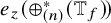 $e_z (\oplus _{\smash {(n)}}^* (\mathbb {T}_f)\!)$
does not have negative powers of z.
$e_z (\oplus _{\smash {(n)}}^* (\mathbb {T}_f)\!)$
does not have negative powers of z.
The final statement is elementary.
3 Modules
We present a construction of modules for Joyce vertex algebras from moduli spaces, which we state in Theorem 3.2.2. We also consider an important variant of this construction in Theorem 3.2.6, arising from orthosymplectic enumerative geometry, where the Joyce vertex algebra admits an involution, and we obtain a twisted module for this vertex algebra.
3.1 Vertex algebra modules
3.1.1 Modules
We recall the definition of vertex algebra modules from Frenkel and Ben-Zvi [Reference Frenkel and Ben-Zvi18: §5.1].
Let $(V, 1, D, Y)$
be a
$(V, 1, D, Y)$
be a $\mathbb {Z}$
-graded vertex algebra over K, as in §2.1.3. Then a V-module is a
$\mathbb {Z}$
-graded vertex algebra over K, as in §2.1.3. Then a V-module is a $\mathbb {Z}$
-graded K-vector space M, equipped with an operation
$\mathbb {Z}$
-graded K-vector space M, equipped with an operation $Y^M (-, z) (-) \colon V \otimes M \to M (\!(z)\!)$
, preserving grading with
$Y^M (-, z) (-) \colon V \otimes M \to M (\!(z)\!)$
, preserving grading with $\deg z = -2$
, satisfying the following conditions:
$\deg z = -2$
, satisfying the following conditions:
-
(i) (Unit) For any
$m \in M$
, we have
$Y^M (1, z) \, m = m$
. -
(ii) (Associativity) For any
$a, b \in V$
and
$m \in M$
, the elements are expansions of the same element in
$$ \begin{align*} Y^M (a, z) \circ Y^M (b, w) (m) & \in M (\!(z)\!) (\!(w)\!) , \\ Y^M (Y (a, z - w) (b), w) (m) & \in M (\!(w)\!) (\!(z - w)\!) \end{align*} $$
$M {[\![} z, w {]\!]} \, [z^{-1}, w^{-1}, (z - w)^{-1}]$
.


3.1.2 An equivalent definition
We can also give an alternative definition of a vertex algebra module, in the style of §2.1.4.
Let $(V, (X_n)_{n \geq 0})$
be a
$(V, (X_n)_{n \geq 0})$
be a $\mathbb {Z}$
-graded vertex algebra over K, in the sense of §2.1.4. Then a V-module is a
$\mathbb {Z}$
-graded vertex algebra over K, in the sense of §2.1.4. Then a V-module is a $\mathbb {Z}$
-graded K-vector space M, equipped with operations
$\mathbb {Z}$
-graded K-vector space M, equipped with operations
 $$ \begin{align*} X_n^M \colon V^{\otimes n} \otimes M & \longrightarrow M {[\![} z_1, \dotsc, z_n {]\!]} \, [ z_i^{-1}, (z_i - z_j)^{-1} ] , \\ a_1 \otimes \cdots \otimes a_n \otimes m & \longmapsto X_n^M (a_1, \dotsc, a_n, m; z_1, \dotsc, z_n) , \end{align*} $$
preserving grading, where $\deg z_i = -2$
, and we invert
$\deg z_i = -2$
, and we invert $z_i - z_j$
for
$z_i - z_j$
for $i \neq j$
. They should satisfy the following properties:
$i \neq j$
. They should satisfy the following properties:
-
(i) (Unit) We have
$X_0^M = \mathrm {id}_M$
. -
(ii) (Associativity) For integers
$k, n \geq 0$
and elements
$a_1, \dotsc , a_n, b_1, \dotsc , b_k \in V$
, we have (3.1.2.1)
$$ \begin{align} & X_{n+1}^M \Big( X_k (b_1, \dotsc, b_k; w_1, \dotsc, w_k); a_1, \dotsc, a_n, m; z_0, \dotsc, z_n \Big) \notag \\[-.5ex] & \hspace{2em} = \iota_{ \{ z_i \}, \{ w_j \} } \, X_{n+k}^M \big( b_1, \dotsc, b_k, a_1, \dotsc, a_n, m; z_0 + w_1, \dotsc, z_0 + w_k, z_1, \dotsc, z_n \big), \end{align} $$
(3.1.2.2)where the maps
$$ \begin{align} & X_{n}^M \Big( a_1, \dotsc, a_n, X_k^M (b_1, \dotsc, b_k, m; w_1, \dotsc, w_k); z_1, \dotsc, z_n \Big) \notag \\[-.5ex] & \hspace{2em} = \iota_{ \{ z_i \}, \{ w_j \} } \, X_{n+k}^M \big( a_1, \dotsc, a_n, b_1, \dotsc, b_k, m; z_1, \dotsc, z_n, w_1, \dotsc, w_k \big) , \end{align} $$
$\iota _{ \{ z_i \}, \{ w_j \} }$
are defined in (2.1.2.1).


Again, this definition may look more complicated than §3.1.1, but it will be more convenient for our purposes, such as for defining weaker notions of modules below.
We adopt the convenient notation
 $$ \begin{align} a_1 (z_1) \cdots a_n (z_n) \, m = X^M_n (a_1, \dotsc, a_n, m; z_1, \dotsc, z_n) , \end{align} $$
with the same caveats as those below (2.1.4.4) for vertex algebras.
3.1.3 Proof of the equivalence of definitions
We essentially follow the proof of Kim [Reference Kim28: Theorem 3.14], adapting it to the case of modules.
Given a V-module M in the sense of §3.1.1, define the maps $X_n^M$
by
$X_n^M$
by
 $$ \begin{align} X_n^M (a_1, \dotsc, a_n, m; z_1, \dotsc, z_n) = \iota_{z_1, \dotsc, z_n} ^{-1} \big( Y^M (a_1, z_1) \circ \cdots \circ Y^M (a_n, z_n) (m)\! \big) , \end{align} $$
where we take the unique preimage under the embedding
 $$ \begin{align} \iota_{z_1, \dotsc, z_n} \colon M {[\![} z_1, \dotsc, z_n {]\!]} \, [z_i^{-1}, (z_i - z_j)^{-1}] {\hookrightarrow} M (\!(z_1)\!) \cdots (\!(z_n)\!) . \end{align} $$
To see that such a preimage exists, note that for fixed elements $a_1, \dotsc , a_n, m$
as above, there exists
$a_1, \dotsc , a_n, m$
as above, there exists $N> 0$
such that in the expression
$N> 0$
such that in the expression
 $$ \begin{align} \bigg( \prod_{1 \leq i < j \leq n} {} (z_i - z_j) \bigg)^N \cdot Y^M (a_1, z_1) \circ \cdots \circ Y^M (a_n, z_n) (m) , \end{align} $$
the order of the operators $Y^M (a_i, z_i)$
can be permuted freely without changing the result, up to an appropriate sign. Indeed, this is true when
$Y^M (a_i, z_i)$
can be permuted freely without changing the result, up to an appropriate sign. Indeed, this is true when $n = 2$
, a proof of which can be found in Frenkel and Ben-Zvi [Reference Frenkel and Ben-Zvi18: Remark 5.1.4], and the general case follows from swapping two adjacent operators at a time.
$n = 2$
, a proof of which can be found in Frenkel and Ben-Zvi [Reference Frenkel and Ben-Zvi18: Remark 5.1.4], and the general case follows from swapping two adjacent operators at a time.
This property implies that the expression (3.1.3.3) must lie in the intersection of the spaces $M (\!(z_{\sigma (1)})\!) \cdots (\!(z_{\sigma (n)})\!) \subset M {[\![} z_i^{\pm 1} {]\!]} $
for all
$M (\!(z_{\sigma (1)})\!) \cdots (\!(z_{\sigma (n)})\!) \subset M {[\![} z_i^{\pm 1} {]\!]} $
for all $\sigma \in \mathfrak {S}_n$
, which is
$\sigma \in \mathfrak {S}_n$
, which is $M {[\![} z_i {]\!]} \, [z_i^{-1}]$
. Consequently, the element
$M {[\![} z_i {]\!]} \, [z_i^{-1}]$
. Consequently, the element $Y^M (a_1, z_1) \circ \cdots \circ Y^M (a_n, z_n) (m)$
lies in the image of (3.1.3.2).
$Y^M (a_1, z_1) \circ \cdots \circ Y^M (a_n, z_n) (m)$
lies in the image of (3.1.3.2).
From here, verifying the axioms in §3.1.2 is straightforward.
Conversely, given the data $(M, (X_n^M)_{n \geq 0})$
, define
$(M, (X_n^M)_{n \geq 0})$
, define
 $$ \begin{align} Y^M (a, z) (m) = X^M_1 (a, m; z) \end{align} $$
for all $a \in V$
and
$a \in V$
and $m \in M$
. Then this defines a vertex algebra module structure on M, where the property §3.1.1 (i) holds since
$m \in M$
. Then this defines a vertex algebra module structure on M, where the property §3.1.1 (i) holds since $Y^M (1, z) (m) = X^M_1 (X_0 (1), m; z) = X^M_0 (m) = m$
.
$Y^M (1, z) (m) = X^M_1 (X_0 (1), m; z) = X^M_0 (m) = m$
.
3.1.4 Remark
In §3.1.2, it is enough to require the operators $X_n^M$
for
$X_n^M$
for $n = 0, 1, 2$
, and the higher ones can be recovered from them, in a similar way to §2.1.6.
$n = 0, 1, 2$
, and the higher ones can be recovered from them, in a similar way to §2.1.6.
3.1.5 Weak modules
Similarly to weak vertex algebras introduced in §2.1.7, we define a weak module over a $\mathbb {Z}$
-graded weak vertex algebra
$\mathbb {Z}$
-graded weak vertex algebra $(V, (X_n)_{n \geq 0})$
to be a
$(V, (X_n)_{n \geq 0})$
to be a $\mathbb {Z}$
-graded vector space M, equipped with multiplication maps
$\mathbb {Z}$
-graded vector space M, equipped with multiplication maps
 $$ \begin{align*} X^M_n \colon V^{\otimes n} \otimes M \longrightarrow M (\!(z_1, \dotsc, z_n)\!) , \end{align*} $$
preserving grading, where $\deg z_i = -2$
, satisfying the properties §3.1.2 (i)–(ii).
$\deg z_i = -2$
, satisfying the properties §3.1.2 (i)–(ii).
For example, every weak vertex algebra is a weak module over itself.
Note that if V is a vertex algebra, then a weak module is a usual module if and only if the image of $X^M_n$
lies in the subspace
$X^M_n$
lies in the subspace $M {[\![} z_1, \dotsc , z_n {]\!]} \, [z_i^{-1}, (z_i - z_j)^{-1}] \subset M (\!(z_1, \dotsc , z_n)\!)$
.
$M {[\![} z_1, \dotsc , z_n {]\!]} \, [z_i^{-1}, (z_i - z_j)^{-1}] \subset M (\!(z_1, \dotsc , z_n)\!)$
.
3.1.6 Twisted modules
We introduce twisted modules for vertex algebras equipped with involutions, which are a special class of weak modules. They will play an important role in the theory of wall-crossing for orthosymplectic enumerative invariants. Note that these are different from the notion of twisted modules in, for example, Frenkel and Ben-Zvi [Reference Frenkel and Ben-Zvi18: §5.6].
Let V be a $\mathbb {Z}$
-graded vertex algebra over K. Suppose that V is equipped with a twisted involution
$\mathbb {Z}$
-graded vertex algebra over K. Suppose that V is equipped with a twisted involution $(-)^\vee \colon V \mathrel {\overset {\smash {{} {-.8ex}{{} {\sim }}}\mspace {3mu}}{\to }} V^{\mathrm {op}}$
, where
$(-)^\vee \colon V \mathrel {\overset {\smash {{} {-.8ex}{{} {\sim }}}\mspace {3mu}}{\to }} V^{\mathrm {op}}$
, where $V^{\mathrm {op}}$
is the vertex algebra with the same underlying graded vector space as V, with multiplication
$V^{\mathrm {op}}$
is the vertex algebra with the same underlying graded vector space as V, with multiplication
 $$ \begin{align} a_1 (z_1) \cdots a_n (z_n) \text{ in } V^{\mathrm{op}} \quad {=} \quad a_1 (-z_1) \cdots a_n (-z_n) \text{ in } V . \end{align} $$
We require that $(-)^\vee $
is an isomorphism of
$(-)^\vee $
is an isomorphism of $\mathbb {Z}$
-graded vertex algebras, and
$\mathbb {Z}$
-graded vertex algebras, and $(-)^{\vee \vee } = \mathrm {id}_V$
.
$(-)^{\vee \vee } = \mathrm {id}_V$
.
Define a twisted module for V as a weak module $(M, (X_n^M)_{n \geq 0})$
, such that the image of each
$(M, (X_n^M)_{n \geq 0})$
, such that the image of each $X^M_n$
lies in the subspace
$X^M_n$
lies in the subspace
 $$ \begin{align*} M {[\![} z_1, \dotsc, z_n {]\!]} \, [z_i^{-1}, (z_i \pm z_j)^{-1}] \subset M (\!(z_1, \dotsc, z_n)\!) , \end{align*} $$
where we invert $z_i \pm z_j$
for
$z_i \pm z_j$
for $i \neq j$
, and such that
$i \neq j$
, and such that
 $$ \begin{align} a^\vee (z) \, m = a (-z) \, m \end{align} $$
for $a \in V$
and
$a \in V$
and $m \in M$
.
$m \in M$
.
We will construct examples of twisted modules in §3.2 below.
3.1.7 Residues
Let V be a $\mathbb {Z}$
-graded vertex algebra. Recall that the quotient
$\mathbb {Z}$
-graded vertex algebra. Recall that the quotient $L = V / D (V)$
, where D is the translation operator in §2.1.3, admits a
$L = V / D (V)$
, where D is the translation operator in §2.1.3, admits a $\mathbb {Z}$
-graded Lie algebra structure given by
$\mathbb {Z}$
-graded Lie algebra structure given by
 $$ \begin{align} [a, b] = \mathrm{res}_{z = w} \, a (z) \, b (w) , \end{align} $$
with sign rules implemented for odd elements in the axioms of a Lie algebra. A usual module for V gives rise to a module for L, defined by $a \cdot m = \mathrm {res}_{z = 0} \, a (z) \, m$
.
$a \cdot m = \mathrm {res}_{z = 0} \, a (z) \, m$
.
Now, suppose that V is equipped with an involution $(-)^\vee $
as in §3.1.6, and let M be a twisted module for V. Then the Lie algebra
$(-)^\vee $
as in §3.1.6, and let M be a twisted module for V. Then the Lie algebra $L = V / D (V)$
admits an induced involution
$L = V / D (V)$
admits an induced involution $(-)^\vee \colon L \mathrel {\overset {\smash {{} {-.8ex}{{} {\sim }}}\mspace {3mu}}{\to }} L^{\mathrm {op}}$
, where
$(-)^\vee \colon L \mathrel {\overset {\smash {{} {-.8ex}{{} {\sim }}}\mspace {3mu}}{\to }} L^{\mathrm {op}}$
, where $L^{\mathrm {op}}$
is the Lie algebra with the opposite Lie bracket
$L^{\mathrm {op}}$
is the Lie algebra with the opposite Lie bracket $[a, b]^{\mathrm {op}} = -[a, b]$
. Moreover, the assignment
$[a, b]^{\mathrm {op}} = -[a, b]$
. Moreover, the assignment
 $$ \begin{align} a \mathbin{\heartsuit} m = \mathrm{res}_{z = 0} \, a (z) \, m \end{align} $$
for $a \in V$
and
$a \in V$
and $m \in M$
establishes M as a twisted module for L, in that we have
$m \in M$
establishes M as a twisted module for L, in that we have
 $$ \begin{align} \qquad\qquad\qquad a^\vee \mathbin{\heartsuit} m & = -a \mathbin{\heartsuit} m , \end{align} $$
 $$ \begin{align} a \mathbin{\heartsuit} (b \mathbin{\heartsuit} m) - (-1)^{|a| \cdot |b|} \cdot b \mathbin{\heartsuit} (a \mathbin{\heartsuit} m) & = [a, b] \mathbin{\heartsuit} m - [a^\vee, b] \mathbin{\heartsuit} m \end{align} $$
for homogeneous elements $a, b \in L$
and
$a, b \in L$
and $m \in M$
, where
$m \in M$
, where $|{-}|$
denotes the degree. The identity (3.1.7.4) can be seen by applying the residue theorem to
$|{-}|$
denotes the degree. The identity (3.1.7.4) can be seen by applying the residue theorem to $a (z) \, b (w) \, m$
, giving
$a (z) \, b (w) \, m$
, giving
 $$ \begin{align} \mathrm{res}_{z = 0} \, \mathrm{res}_{w = 0} \, a (z) \, b (w) \, m = \mathrm{res}_{w = 0} \, \big( \mathrm{res}_{z = 0} + \mathrm{res}_{z = w} + \mathrm{res}_{z = -w} \big) \, a (z) \, b (w) \, m , \end{align} $$
where each of the four terms corresponds to a term in (3.1.7.4), and we use the fact that $a (z) \, b (w) \, m = a^\vee (-z) \, b (w) \, m$
.
$a (z) \, b (w) \, m = a^\vee (-z) \, b (w) \, m$
.
Note that this structure of a twisted module for a Lie algebra also appears in motivic Donaldson–Thomas theory for orthosymplectic structure groups, described in the author [Reference Bu9: §5.2.2]. Also, as noted there, when the coefficient ring contains $1/2$
, a twisted module for L is equivalent to a usual module for the subalgebra of L consisting of elements
$1/2$
, a twisted module for L is equivalent to a usual module for the subalgebra of L consisting of elements $a \in L$
with
$a \in L$
with $a = -a^\vee $
, with the action
$a = -a^\vee $
, with the action $a \cdot m = (1/2) (a \mathbin {\heartsuit } m)$
.
$a \cdot m = (1/2) (a \mathbin {\heartsuit } m)$
.
3.2 Modules for Joyce vertex algebras
3.2.1 The setting
We assume given the data $(X, \odot , \oplus , 0, \mathbb {T}_X)$
as in §2.2.4, We also assume given the extra data
$(X, \odot , \oplus , 0, \mathbb {T}_X)$
as in §2.2.4, We also assume given the extra data $(Y, \diamond , \mathbb {T}_Y)$
, where
$(Y, \diamond , \mathbb {T}_Y)$
, where
-
○
$Y \in \mathsf {hCW}$
is a space, regarded as an object of
$\mathcal {T}$
of rank
$0$
. -
○
$\diamond \colon X \times Y \to Y$
is a map, exhibiting Y as an X-module in
$\mathsf {hCW}$
, or equivalently, in
$\mathcal {T}$
. -
○
$\mathbb {T}_Y \in K (Y)$
is a class, called the obstruction theory.


For each integer $n \geq 0$
, let
$n \geq 0$
, let
 $$ \begin{align} \diamond_{(n)} \colon X^n \times Y \longrightarrow Y \end{align} $$
denote the n-fold module multiplication map. Define the normal bundle of $\diamond _{(n)}$
by
$\diamond _{(n)}$
by
 $$ \begin{align} {\mathbb{\nu}}_{\diamond, \smash{(n)}} = \diamond_{\smash{(n)}}^* (\mathbb{T}_{Y}) - \mathbb{T}_{X^n \times Y} \in K (X^n \times Y) , \end{align} $$
where $\mathbb {T}_{X^n \times Y} = \mathrm {pr}_{\smash {X^n}}^* (\mathbb {T}_{X^n}) + \mathrm {pr}_Y^* (\mathbb {T}_{Y})$
, where
$\mathbb {T}_{X^n \times Y} = \mathrm {pr}_{\smash {X^n}}^* (\mathbb {T}_{X^n}) + \mathrm {pr}_Y^* (\mathbb {T}_{Y})$
, where $\mathrm {pr}_{X^n}$
,
$\mathrm {pr}_{X^n}$
, $\mathrm {pr}_Y$
are the projections to
$\mathrm {pr}_Y$
are the projections to $X^n$
and Y. We further assume the following condition:
$X^n$
and Y. We further assume the following condition:
-
○ For any integer
$n \geq 0$
, we have (3.2.1.3)where
$$ \begin{align} {\mathbb{\nu}}_{\diamond, \smash{(n)}} \in K^\circ (X^n \times Y) \quad \text{and} \quad ({\mathbb{\nu}}_{\diamond, \smash{(n)}})_0 = 0 , \end{align} $$
$(-)_0$
denotes the part of
$\mathrm {U} (1)^n$
-weight
$0$
.


3.2.2 Theorem
Let $X, Y$
be as in §3.2.1. Then the assignment
$X, Y$
be as in §3.2.1. Then the assignment
 $$ \begin{align} a_1 (z_1) \cdots a_n (z_n) \, m = (\diamond_{(n)})_* \circ \exp (z_1 D_1 + \cdots + z_n D_n) \Big(\! (a_1 \boxtimes \cdots \boxtimes a_n \boxtimes m) \cap e_z^{-1} ({\mathbb{\nu}}_{\diamond, \smash{(n)}})\! \Big) \end{align} $$
defines a weak module structure on $M = \mathrm {H}_{{\bullet } + 2 \operatorname {vdim}} (Y; \mathbb {Q})$
for the weak vertex algebra
$M = \mathrm {H}_{{\bullet } + 2 \operatorname {vdim}} (Y; \mathbb {Q})$
for the weak vertex algebra $V = \mathrm {H}_{{\bullet } + 2 \operatorname {vdim}} (X; \mathbb {Q})$
in Theorem 2.3.3.
$V = \mathrm {H}_{{\bullet } + 2 \operatorname {vdim}} (X; \mathbb {Q})$
in Theorem 2.3.3.
The product (3.2.2.1) has poles along $\lambda (z) = 0$
for nonzero weights
$\lambda (z) = 0$
for nonzero weights $\lambda \in \mathbb {Z}^n$
appearing in
$\lambda \in \mathbb {Z}^n$
appearing in $\diamond _{(n)}^* (\mathbb {T}_Y)$
. In particular, if the class
$\diamond _{(n)}^* (\mathbb {T}_Y)$
. In particular, if the class $\oplus ^* (\mathbb {T}_X) \in K^\circ (X^2)$
only has
$\oplus ^* (\mathbb {T}_X) \in K^\circ (X^2)$
only has $\mathrm {U} (1)^2$
-weights
$\mathrm {U} (1)^2$
-weights $(-k, k)$
with
$(-k, k)$
with $|k| \leq 1$
, so that V is a vertex algebra, and if the class
$|k| \leq 1$
, so that V is a vertex algebra, and if the class $\diamond _{\smash {(2)}}^* (\mathbb {T}_Y) \in K^\circ (X^2 \times Y)$
only has
$\diamond _{\smash {(2)}}^* (\mathbb {T}_Y) \in K^\circ (X^2 \times Y)$
only has $\mathrm {U} (1)^2$
-weights
$\mathrm {U} (1)^2$
-weights $(k, \ell )$
with
$(k, \ell )$
with $|k| + |\ell | \leq 1$
, then M is a module for V.
$|k| + |\ell | \leq 1$
, then M is a module for V.
Proof. The proof is very similar to that of Theorem 2.3.3, and an analogous computation verifies the axioms for a weak module. See also Theorem 4.2.3 below for a more general proof.
For the final statement on usual modules, let $n \geq 0$
, and consider the class
$n \geq 0$
, and consider the class $\diamond _{\smash {(n)}}^* (\mathbb {T}_Y) \in K^\circ (X^n \times Y)$
. It is enough to show that it only has
$\diamond _{\smash {(n)}}^* (\mathbb {T}_Y) \in K^\circ (X^n \times Y)$
. It is enough to show that it only has $\mathrm {U} (1)^n$
-weights of the form
$\mathrm {U} (1)^n$
-weights of the form $e_i - e_j$
for
$e_i - e_j$
for $0 \leq i \leq j \leq n$
, where we set
$0 \leq i \leq j \leq n$
, where we set $e_0 = 0$
, and for
$e_0 = 0$
, and for $i = 1, \dotsc , n$
, we set
$i = 1, \dotsc , n$
, we set $e_i = (0, \dotsc , 0, 1, 0, \dotsc , 0)$
with
$e_i = (0, \dotsc , 0, 1, 0, \dotsc , 0)$
with $1$
at the i-th position. But the assumption implies that for any
$1$
at the i-th position. But the assumption implies that for any $I, J \subset \{ 1, \dotsc , n \}$
with
$I, J \subset \{ 1, \dotsc , n \}$
with $I \cap J = \varnothing $
, writing
$I \cap J = \varnothing $
, writing $k_I = \sum _{i \in I} k_i$
and
$k_I = \sum _{i \in I} k_i$
and $k_J = \sum _{j \in J} k_j$
, we have
$k_J = \sum _{j \in J} k_j$
, we have $|k_I| + |k_J| \leq 1$
, which implies the desired property.
$|k_I| + |k_J| \leq 1$
, which implies the desired property.
3.2.3 An involution-twisted version
We now discuss a version that often arises from moduli spaces involving the orthogonal and symplectic groups, which will be important in studying enumerative invariants for such moduli spaces.
Let $(X, Y)$
be as in §3.2.1. We further assume given the following data:
$(X, Y)$
be as in §3.2.1. We further assume given the following data:
-
○ An involution
$(-)^\vee \colon X \mathrel {\overset {\smash {{} {-.8ex}{{} {\sim }}}\mspace {3mu}}{\to }} X$
, such that
$(-)^{\vee \vee } = \mathrm {id}$
in
$\mathsf {hCW}$
.


It should satisfy the following conditions:
-
○
$(-)^\vee $
preserves the monoid structure
$\oplus $
. -
○
$(-)^\vee $
reverses the
$\mathrm {BU} (1)$
-action
$\odot $
, in that it is equivariant with respect to the map
$(-)^{-1} \colon \mathrm {BU} (1) \to \mathrm {BU} (1)$
. -
○
$(-)^\vee $
preserves the module action
$\diamond $
, in that
${\diamond } \circ (\! (-)^\vee \times \mathrm {id}_Y ) = {\diamond }$
.


Again, these are conditions in $\mathsf {hCW}$
, and do not require higher coherence.
$\mathsf {hCW}$
, and do not require higher coherence.
3.2.4 Example
Our main source of examples of the situation of §3.2.3 is orthosymplectic enumerative geometry, as in the author [Reference Bu9].
Let $\mathcal {X}$
be a self-dual derived linear moduli stack over
$\mathcal {X}$
be a self-dual derived linear moduli stack over $\mathbb {C}$
, that is a derived linear moduli stack
$\mathbb {C}$
, that is a derived linear moduli stack $\mathcal {X}$
as in Example 2.2.6, equipped with an involution
$\mathcal {X}$
as in Example 2.2.6, equipped with an involution $(-)^\vee \colon \mathcal {X} \mathrel {\overset {\smash {{} {-.8ex}{{} {\sim }}}\mspace {3mu}}{\to }} \mathcal {X}$
, satisfying conditions similar to those in §3.2.3, as in [Reference Bu9: §2.2.5]. Typical examples include the following:
$(-)^\vee \colon \mathcal {X} \mathrel {\overset {\smash {{} {-.8ex}{{} {\sim }}}\mspace {3mu}}{\to }} \mathcal {X}$
, satisfying conditions similar to those in §3.2.3, as in [Reference Bu9: §2.2.5]. Typical examples include the following:
-
○ The derived moduli stack of representations of a self-dual quiver Q, possibly with potential, where being self-dual means that we are given a contravariant involution
$(-)^\vee \colon Q \mathrel {\overset {\smash {{} {-.8ex}{{} {\sim }}}\mspace {3mu}}{\to }} Q^{\mathrm {op}}$
of Q, which induces an involution of the stack. See §6.3 below for details, and see also [Reference Bu9: §6.1]. -
○ The derived moduli stack of objects in a quasi-abelian subcategory
$\mathcal {A} \subset \mathsf {Perf} (Z)$
, where Z is a smooth projective
$\mathbb {C}$
-variety, such that
$\mathcal {A}$
is stable under the dual functor
$(-)^\vee = \mathbb {R} {\mathcal {H}\mkern -3mu\mathit {om}} (-, L) [s] \colon \mathsf {Perf} (Z) \mathrel {\overset {\smash {{} {-.8ex}{{} {\sim }}}\mspace {3mu}}{\to }} \mathsf {Perf} (Z)^{\mathrm {op}}$
, where we choose a line bundle
$L \to Z$
and an integer s. See also [Reference Bu9: §6.2] for this set-up.


In this case, the derived fixed locus of the involution $\mathcal {X}^{\mathrm {sd}} = \mathcal {X}^{\mathbb {Z}_2}$
is the moduli stack of self-dual objects, whose points correspond to pairs
$\mathcal {X}^{\mathrm {sd}} = \mathcal {X}^{\mathbb {Z}_2}$
is the moduli stack of self-dual objects, whose points correspond to pairs $(x, \phi )$
with
$(x, \phi )$
with $x \in \mathcal {X}$
and
$x \in \mathcal {X}$
and $\phi \colon x \mathrel {\overset {\smash {{} {-.8ex}{{} {\sim }}}\mspace {3mu}}{\to }} x^\vee $
, such that
$\phi \colon x \mathrel {\overset {\smash {{} {-.8ex}{{} {\sim }}}\mspace {3mu}}{\to }} x^\vee $
, such that $\phi = \phi ^\vee $
. Such objects can often be interpreted as orthogonal or symplectic objects in a linear category, where the difference between being orthogonal and symplectic is encoded in the higher coherence data of the involution on
$\phi = \phi ^\vee $
. Such objects can often be interpreted as orthogonal or symplectic objects in a linear category, where the difference between being orthogonal and symplectic is encoded in the higher coherence data of the involution on $\mathcal {X}$
as a
$\mathcal {X}$
as a $\mathbb {Z}_2$
-action. Again, see [Reference Bu9] for details.
$\mathbb {Z}_2$
-action. Again, see [Reference Bu9] for details.
We have an action $\diamond \colon \mathcal {X} \times \mathcal {X}^{\mathrm {sd}} \to \mathcal {X}^{\mathrm {sd}}$
given by
$\diamond \colon \mathcal {X} \times \mathcal {X}^{\mathrm {sd}} \to \mathcal {X}^{\mathrm {sd}}$
given by $(x, y) \mapsto x \oplus y \oplus x^\vee $
, where
$(x, y) \mapsto x \oplus y \oplus x^\vee $
, where $x \oplus x^\vee $
is equipped with the obvious self-dual structure.
$x \oplus x^\vee $
is equipped with the obvious self-dual structure.
We now set $X = |\mathcal {X}|$
and
$X = |\mathcal {X}|$
and $Y = |\mathcal {X}^{\mathrm {sd}}|$
to be the topological realizations, and with the involution on X and the X-action on Y given by the involution on
$Y = |\mathcal {X}^{\mathrm {sd}}|$
to be the topological realizations, and with the involution on X and the X-action on Y given by the involution on $\mathcal {X}$
and its action on
$\mathcal {X}$
and its action on $\mathcal {X}^{\mathrm {sd}}$
. Let
$\mathcal {X}^{\mathrm {sd}}$
. Let $\mathbb {T}_X$
,
$\mathbb {T}_X$
, $\mathbb {T}_Y$
be the classes of the tangent complexes
$\mathbb {T}_Y$
be the classes of the tangent complexes $\mathbb {T}_{\mathcal {X}}$
,
$\mathbb {T}_{\mathcal {X}}$
, $\mathbb {T}_{\smash {\mathcal {X}^{\mathrm {sd}}}}$
, where we note that
$\mathbb {T}_{\smash {\mathcal {X}^{\mathrm {sd}}}}$
, where we note that $\mathbb {T}_{\smash {\mathcal {X}^{\mathrm {sd}}}}$
is given by the
$\mathbb {T}_{\smash {\mathcal {X}^{\mathrm {sd}}}}$
is given by the $\mathbb {Z}_2$
-invariant part of the pullback of
$\mathbb {Z}_2$
-invariant part of the pullback of $\mathbb {T}_{\mathcal {X}}$
to
$\mathbb {T}_{\mathcal {X}}$
to $\mathcal {X}^{\mathrm {sd}}$
.
$\mathcal {X}^{\mathrm {sd}}$
.
Then, assuming that X satisfies the conditions in §2.2.4, all the extra conditions in §3.2.1 and 3.2.3 will be automatically satisfied, where the weight condition (3.2.1.3) follows from the similar condition (2.2.4.2) for $\mathbb {T}_{\mathcal {X}}$
and the above description of
$\mathbb {T}_{\mathcal {X}}$
and the above description of $\mathbb {T}_{\smash {\mathcal {X}^{\mathrm {sd}}}}$
.
$\mathbb {T}_{\smash {\mathcal {X}^{\mathrm {sd}}}}$
.
3.2.5 Example
We also consider a derived version of Example 3.2.4, similar to Example 2.2.7.
Namely, let $\mathcal {C}$
be a
$\mathcal {C}$
be a $\mathbb {C}$
-linear dg-category as in Example 2.2.7, and suppose we are given a contravariant involution
$\mathbb {C}$
-linear dg-category as in Example 2.2.7, and suppose we are given a contravariant involution $(-)^\vee \colon \mathcal {C} \mathrel {\overset {\smash {{} {-.8ex}{{} {\sim }}}\mspace {3mu}}{\to }} \mathcal {C}^{\mathrm {op}}$
, inducing a
$(-)^\vee \colon \mathcal {C} \mathrel {\overset {\smash {{} {-.8ex}{{} {\sim }}}\mspace {3mu}}{\to }} \mathcal {C}^{\mathrm {op}}$
, inducing a $\mathbb {Z}_2$
-action on the derived moduli stack,
$\mathbb {Z}_2$
-action on the derived moduli stack, $(-)^\vee \colon \mathcal {X} \mathrel {\overset {\smash {{} {-.8ex}{{} {\sim }}}\mspace {3mu}}{\to }} \mathcal {X}$
. Examples of
$(-)^\vee \colon \mathcal {X} \mathrel {\overset {\smash {{} {-.8ex}{{} {\sim }}}\mspace {3mu}}{\to }} \mathcal {X}$
. Examples of $\mathcal {C}$
include the following:
$\mathcal {C}$
include the following:
-
○ The derived category of representations of a self-dual quiver, with the involution induced by the self-dual structure of the quiver.
-
○ The category of perfect complexes on a smooth projective
$\mathbb {C}$
-variety Z, with the involution
$(-)^\vee = \mathbb {R} {\mathcal {H}\mkern -3mu\mathit {om}} (-, L) [s]$
as in Example 3.2.4.


Again, the derived fixed locus $\mathcal {X}^{\mathrm {sd}} = \mathcal {X}^{\mathbb {Z}_2}$
is the moduli stack of self-dual objects, and we have an action
$\mathcal {X}^{\mathrm {sd}} = \mathcal {X}^{\mathbb {Z}_2}$
is the moduli stack of self-dual objects, and we have an action $\diamond \colon \mathcal {X} \times \mathcal {X}^{\mathrm {sd}} \to \mathcal {X}^{\mathrm {sd}}$
given by
$\diamond \colon \mathcal {X} \times \mathcal {X}^{\mathrm {sd}} \to \mathcal {X}^{\mathrm {sd}}$
given by $(x, y) \mapsto x \oplus y \oplus x^\vee $
.
$(x, y) \mapsto x \oplus y \oplus x^\vee $
.
Set $X = |\mathcal {X}|$
and
$X = |\mathcal {X}|$
and $Y = |\mathcal {X}^{\mathrm {sd}}|$
, and let
$Y = |\mathcal {X}^{\mathrm {sd}}|$
, and let $\mathbb {T}_X$
,
$\mathbb {T}_X$
, $\mathbb {T}_Y$
be the classes of the tangent complexes
$\mathbb {T}_Y$
be the classes of the tangent complexes $\mathbb {T}_{\mathcal {X}}$
,
$\mathbb {T}_{\mathcal {X}}$
, $\mathbb {T}_{\smash {\mathcal {X}^{\mathrm {sd}}}}$
. Then all the conditions in §2.2.4, §3.2.1, and §3.2.3 are automatically satisfied.
$\mathbb {T}_{\smash {\mathcal {X}^{\mathrm {sd}}}}$
. Then all the conditions in §2.2.4, §3.2.1, and §3.2.3 are automatically satisfied.
3.2.6 Theorem
Let $X, Y$
be as in §3.2.3. Assume the class
$X, Y$
be as in §3.2.3. Assume the class $\oplus ^* (\mathbb {T}_X) \in K^\circ (X^2)$
only has
$\oplus ^* (\mathbb {T}_X) \in K^\circ (X^2)$
only has $\mathrm {U} (1)^2$
-weights
$\mathrm {U} (1)^2$
-weights $(-k, k)$
with
$(-k, k)$
with $|k| \leq 1$
, so that
$|k| \leq 1$
, so that $V = \mathrm {H}_{{\bullet } + 2 \operatorname {vdim}} (X; \mathbb {Q})$
is a vertex algebra by Theorem 2.3.3, and the class
$V = \mathrm {H}_{{\bullet } + 2 \operatorname {vdim}} (X; \mathbb {Q})$
is a vertex algebra by Theorem 2.3.3, and the class $\diamond _{\smash {(2)}}^* (\mathbb {T}_Y) \in K^\circ (X^2 \times Y)$
only has
$\diamond _{\smash {(2)}}^* (\mathbb {T}_Y) \in K^\circ (X^2 \times Y)$
only has $\mathrm {U} (1)^2$
-weights
$\mathrm {U} (1)^2$
-weights $(k, \ell )$
with
$(k, \ell )$
with $|k| + |\ell | \leq 2$
.
$|k| + |\ell | \leq 2$
.
Then the product (3.2.2.1) establishes $M = \mathrm {H}_{{\bullet } + 2 \operatorname {vdim}} (Y; \mathbb {Q})$
as a twisted module for the vertex algebra V.
$M = \mathrm {H}_{{\bullet } + 2 \operatorname {vdim}} (Y; \mathbb {Q})$
as a twisted module for the vertex algebra V.
Proof. It follows from Theorem 3.2.2 that M is a weak module for V, and the relations (3.1.6.1)–(3.1.6.2) follow from the constructions. It remains to verify the restriction on poles, which is equivalent to requiring that the class $\diamond _{\smash {(n)}}^* (\mathbb {T}_Y) \in K^\circ (X^n \times Y)$
only has
$\diamond _{\smash {(n)}}^* (\mathbb {T}_Y) \in K^\circ (X^n \times Y)$
only has $\mathrm {U} (1)^n$
-weights of the form
$\mathrm {U} (1)^n$
-weights of the form $e_i \pm e_j$
for
$e_i \pm e_j$
for $0 \leq i \leq j \leq n$
, with notations as in the proof of Theorem 3.2.2. But the assumption implies that for any
$0 \leq i \leq j \leq n$
, with notations as in the proof of Theorem 3.2.2. But the assumption implies that for any $I, J \subset \{ 1, \dotsc , n \}$
with
$I, J \subset \{ 1, \dotsc , n \}$
with $I \cap J = \varnothing $
, we have
$I \cap J = \varnothing $
, we have $|k_I| + |k_J| \leq 2$
, again with notations as in the proof of Theorem 3.2.2, and an elementary argument shows that this implies the desired property on
$|k_I| + |k_J| \leq 2$
, again with notations as in the proof of Theorem 3.2.2, and an elementary argument shows that this implies the desired property on $\mathrm {U} (1)^n$
-weights.
$\mathrm {U} (1)^n$
-weights.
3.2.7 Morphisms of modules
Finally, we state a result analogous to Theorem 2.3.5, which gives a construction of morphisms between modules for Joyce vertex algebras.
Theorem. Let $(X, Y)$
and
$(X, Y)$
and $(X', Y')$
be as in §3.2.1,
$(X', Y')$
be as in §3.2.1, $f \colon X \to X'$
be a map as in Theorem 2.3.5, and
$f \colon X \to X'$
be a map as in Theorem 2.3.5, and $g \colon Y \to Y'$
a map compatible with the actions of X and
$g \colon Y \to Y'$
a map compatible with the actions of X and $X'$
, such that the class
$X'$
, such that the class
 $$ \begin{align*} \mathbb{T}_g = \mathbb{T}_Y - g^* (\mathbb{T}_{Y'}) \end{align*} $$
is the class of a vector bundle on Y, possibly of mixed rank. Then the map
 $$ \begin{align*} Y_g \colon \mathrm{H}_{{\bullet} + 2 \operatorname{vdim}} (Y; \mathbb{Q}) & \longrightarrow \mathrm{H}_{{\bullet} + 2 \operatorname{vdim}} (Y'; \mathbb{Q}) , \\ a & \longmapsto g_* (a \cap e (\mathbb{T}_g)\!) \end{align*} $$
is compatible with the weak vertex algebra module structures, in the sense that
 $$ \begin{align*} Y_g \big( a_1 (z_1) \cdots a_n (z_n) \, m \big) = Y_f (a_1) (z_1) \cdots Y_f (a_n) (z_n) \, Y_g (m) \end{align*} $$
for any $a_1, \dotsc , a_n \in \mathrm {H}_{\bullet } (X; \mathbb {Q})$
and
$a_1, \dotsc , a_n \in \mathrm {H}_{\bullet } (X; \mathbb {Q})$
and $m \in \mathrm {H}_{\bullet } (Y; \mathbb {Q})$
. In particular, if
$m \in \mathrm {H}_{\bullet } (Y; \mathbb {Q})$
. In particular, if $X = X'$
and
$X = X'$
and $f = \mathrm {id}_X$
, then g is a homomorphism of weak modules.
$f = \mathrm {id}_X$
, then g is a homomorphism of weak modules.
The proof is very similar to that of Theorem 2.3.5, and we omit it here. See Theorem 4.2.3 below for a proof of a more general result.
4 Vertex induction
This section presents the main construction of this paper, the vertex induction, which unifies and simultaneously generalizes Theorems 2.3.3, 2.3.5, 3.2.2, 3.2.6, and 3.2.7.
We start by introducing a paracategory of vertex spaces, in which vertex algebras are algebra objects, which we prove in Theorem 4.1.7. This construction is somewhat similar to that in Borcherds [Reference Borcherds and Kashiwara4], although not precisely the same. This will then provide a functorial approach to reformulating the constructions in §§2–3, and we will use this to describe the vertex induction in Theorem 4.2.3. We specialize to the case of algebraic stacks in Theorem 4.3.7, which is our motivating case.
4.1 Vertex algebras as algebra objects
4.1.1 Paracategories
A paracategory is, roughly speaking, a ‘category with partially defined composition’. The following definition is adapted from Hermida and Mateus [Reference Hermida and Mateus22: §2]. Compare the notion of a relaxed multilinear category in Borcherds [Reference Borcherds and Kashiwara4: §4].
A paracategory $\mathcal {C}$
is a directed graph
$\mathcal {C}$
is a directed graph $s, t \colon \mathcal {C}_1 \rightrightarrows \mathcal {C}_0$
, together with a partially defined function
$s, t \colon \mathcal {C}_1 \rightrightarrows \mathcal {C}_0$
, together with a partially defined function $\circ _n \colon \mathcal {C}_n \dashrightarrow \mathcal {C}_1$
for all
$\circ _n \colon \mathcal {C}_n \dashrightarrow \mathcal {C}_1$
for all $n \geq 0$
, meaning a function from a subset of the n-fold fibre product set
$n \geq 0$
, meaning a function from a subset of the n-fold fibre product set $\mathcal {C}_n = \mathcal {C}_1 \times _{s, \mathcal {C}_0, t} \cdots \times _{s, \mathcal {C}_0, t} \mathcal {C}_1$
to
$\mathcal {C}_n = \mathcal {C}_1 \times _{s, \mathcal {C}_0, t} \cdots \times _{s, \mathcal {C}_0, t} \mathcal {C}_1$
to $\mathcal {C}_1$
, satisfying the following axioms:
$\mathcal {C}_1$
, satisfying the following axioms:
-
(i) The map
$\circ _0 \colon \mathcal {C}_0 \to \mathcal {C}_1$
is fully defined. That is, identity morphisms always exist. -
(ii) The map
$\circ _1 \colon \mathcal {C}_1 \to \mathcal {C}_1$
is fully defined, and is the identity map. -
(iii) For
$(x_1, \dotsc , x_n) \in \mathcal {C}_{k_1} \times _{\mathcal {C}_0} \cdots \times _{\mathcal {C}_0} \mathcal {C}_{k_n}$
, we have (4.1.1.1)in the sense that whenever one side of the equality is defined, so is the other, and both sides are equal.
$$ \begin{align} \circ_{k_1 + \cdots + k_n} (x_1, \dotsc, x_n) = \circ_n (\circ_{k_1} x_1, \dotsc, \circ_{k_n} x_n) , \end{align} $$


Any (small) category can be seen as a paracategory in the obvious way.
Note that the axioms imply that composition with an isomorphism is always defined, since for example, if $x \in \mathcal {C}_1$
is an isomorphism, and
$x \in \mathcal {C}_1$
is an isomorphism, and $y \in \mathcal {C}_1$
is such that
$y \in \mathcal {C}_1$
is such that $s (y) = t (x)$
, then
$s (y) = t (x)$
, then $y = y \circ (x \circ x^{-1}) = (y \circ x) \circ x^{-1}$
, showing that
$y = y \circ (x \circ x^{-1}) = (y \circ x) \circ x^{-1}$
, showing that $y \circ x$
is defined.
$y \circ x$
is defined.
A functor of paracategories is a map of directed graphs $f \colon \mathcal {C} \to \mathcal {D}$
, such that for any
$f \colon \mathcal {C} \to \mathcal {D}$
, such that for any $x \in \mathcal {C}_k$
, if
$x \in \mathcal {C}_k$
, if $\circ _k x$
is defined, then
$\circ _k x$
is defined, then $\circ _k f (x)$
is defined and is equal to
$\circ _k f (x)$
is defined and is equal to $f (\circ _k x)$
. Note that such functors can always be composed.
$f (\circ _k x)$
. Note that such functors can always be composed.
A natural isomorphism of functors $f, g \colon \mathcal {C} \to \mathcal {D}$
consists of an isomorphism
$f, g \colon \mathcal {C} \to \mathcal {D}$
consists of an isomorphism $\eta _x \colon f (x) \mathrel {\overset {\smash {{} {-.8ex}{{} {\sim }}}\mspace {3mu}}{\to }} g (x)$
for any
$\eta _x \colon f (x) \mathrel {\overset {\smash {{} {-.8ex}{{} {\sim }}}\mspace {3mu}}{\to }} g (x)$
for any $x \in \mathcal {C}_0$
, such that the naturality squares commute. Natural isomorphisms can always be composed.
$x \in \mathcal {C}_0$
, such that the naturality squares commute. Natural isomorphisms can always be composed.
4.1.2 Monoidal paracategories
A (symmetric) monoidal structure on a paracategory $\mathcal {C}$
consists of an object
$\mathcal {C}$
consists of an object $1 \in \mathcal {C}_0$
and a functor
$1 \in \mathcal {C}_0$
and a functor $\otimes \colon \mathcal {C} \times \mathcal {C} \to \mathcal {C}$
, equipped with natural isomorphisms satisfying the usual axioms.
$\otimes \colon \mathcal {C} \times \mathcal {C} \to \mathcal {C}$
, equipped with natural isomorphisms satisfying the usual axioms.
One can also define (symmetric) monoidal functors between (symmetric) monoidal paracategories in the usual way.
For a (coloured) operad $\mathcal {O}$
and a symmetric monoidal paracategory
$\mathcal {O}$
and a symmetric monoidal paracategory $\mathcal {C}$
, an
$\mathcal {C}$
, an $\mathcal {O}$
-algebra in
$\mathcal {O}$
-algebra in $\mathcal {C}$
is a symmetric monoidal functor
$\mathcal {C}$
is a symmetric monoidal functor $\mathcal {O}^\otimes \to \mathcal {C}$
, where
$\mathcal {O}^\otimes \to \mathcal {C}$
, where $\mathcal {O}^\otimes $
is the underlying symmetric monoidal category of
$\mathcal {O}^\otimes $
is the underlying symmetric monoidal category of $\mathcal {O}$
, as in Lurie [Reference Lurie31: Remark 2.2.4.6].
$\mathcal {O}$
, as in Lurie [Reference Lurie31: Remark 2.2.4.6].
For example, an associative algebra in $\mathcal {C}$
can be described as an object
$\mathcal {C}$
can be described as an object $x \in \mathcal {C}$
, with n-ary multiplication maps
$x \in \mathcal {C}$
, with n-ary multiplication maps $m_n \colon x^{\otimes n} \to x$
for all
$m_n \colon x^{\otimes n} \to x$
for all $n \geq 0$
, satisfying the usual axioms. A commutative algebra is an associative algebra such that the maps
$n \geq 0$
, satisfying the usual axioms. A commutative algebra is an associative algebra such that the maps $m_n$
are equivariant under permutations.
$m_n$
are equivariant under permutations.
4.1.3 Vertex spaces
We now define a symmetric monoidal paracategory of vertex spaces, where vertex algebras are algebra objects.
Define a vertex space over a field K as a triple $(\Lambda , V, \tau )$
, consisting of the following:
$(\Lambda , V, \tau )$
, consisting of the following:
-
○ A finite-dimensional K-vector space
$\Lambda $
, whose dimension is called the rank of the vertex space. -
○ A
$\mathbb {Z}$
-graded K-vector space V, thought of as a space of fields on
$\Lambda $
. -
○ A K-linear map
$\tau (z) \colon V \to V {[\![} \Lambda {]\!]} $
, called the translation operator, where z is a set of coordinates for
$\Lambda $
, and
$\deg \Lambda ^\vee = -2$
, thought of as translating fields along z. It should satisfy (4.1.3.1)
$$ \begin{align} \tau (0) & = \mathrm{id}_V ,\end{align} $$
(4.1.3.2)
$$ \begin{align} \tau (z) \circ \tau (w) & = \tau (z + w) . \end{align} $$
In other words,
$\tau $
is a representation of the formal group
$\hat {\mathbb {G}}_{\mathrm {a}}^r$
of the additive group of
$\Lambda $
.


We often write V for the vertex space, and write $\Lambda _V$
and
$\Lambda _V$
and $\tau _V$
for
$\tau _V$
for $\Lambda $
and
$\Lambda $
and $\tau $
.
$\tau $
.
4.1.4 Maps of vertex spaces
A map of vertex spaces $f \colon V \to V'$
consists of a K-linear map
$f \colon V \to V'$
consists of a K-linear map $f^{\smash {\sharp }} \colon \Lambda _{V'} \to \Lambda _V$
, and a K-linear map
$f^{\smash {\sharp }} \colon \Lambda _{V'} \to \Lambda _V$
, and a K-linear map
 $$ \begin{align*} f (z) \colon V \longrightarrow V' (\!(\Lambda_V)\!) , \end{align*} $$
where $\deg \Lambda _V^\vee = -2$
, such that
$\deg \Lambda _V^\vee = -2$
, such that
 $$ \begin{align} f (z) \circ \tau_V (w) & = \iota_{z, w} \, f (z + w) ,\end{align} $$
 $$ \begin{align} \tau_{V'} (z') \circ f (z) & = \iota_{z', z} \, f (f^{\smash{\sharp}} (z') + z) , \end{align} $$
for $z, w \in \Lambda _V$
and
$z, w \in \Lambda _V$
and $z' \in \Lambda _{V'}$
. Here,
$z' \in \Lambda _{V'}$
. Here, $f (z)$
can be thought of as translating fields along the vector z, then pulling them back to
$f (z)$
can be thought of as translating fields along the vector z, then pulling them back to $\Lambda _{V'}$
along
$\Lambda _{V'}$
along $f^\sharp $
.
$f^\sharp $
.
The identity map $\mathrm {id} \colon V \to V$
is given by
$\mathrm {id} \colon V \to V$
is given by $\mathrm {id}^\sharp = \mathrm {id}_{\Lambda _V}$
and
$\mathrm {id}^\sharp = \mathrm {id}_{\Lambda _V}$
and $\mathrm {id} (z) = \tau _V (z)$
.
$\mathrm {id} (z) = \tau _V (z)$
.
Note that the relation (4.1.4.1) might tempt one think that $f (z)$
is determined by
$f (z)$
is determined by $f (0)$
via
$f (0)$
via ${f (z) = f (0) \circ \tau _V (z)}$
. However, this is not the case, as
${f (z) = f (0) \circ \tau _V (z)}$
. However, this is not the case, as $f (z)$
is often singular at
$f (z)$
is often singular at $z = 0$
, in which case
$z = 0$
, in which case $f (0)$
is undefined.
$f (0)$
is undefined.
4.1.5 Composition
Maps of vertex spaces cannot always be composed. Given a diagram

of maps of vertex spaces, we say that h is the composition of f and g, written $h = g \circ f$
, if
$h = g \circ f$
, if $h^\sharp = f^\sharp \circ g^\sharp $
, and we have
$h^\sharp = f^\sharp \circ g^\sharp $
, and we have
 $$ \begin{align} g (z') \circ f (z) = \iota_{z', z} \, h (f^\sharp (z') + z) \end{align} $$
for $z \in \Lambda _V$
and
$z \in \Lambda _V$
and $z' \in \Lambda _{V'}$
. Note that h is unique if it exists, and always exists if f or g is the identity. Composition is associative and unital whenever all involved compositions are defined.
$z' \in \Lambda _{V'}$
. Note that h is unique if it exists, and always exists if f or g is the identity. Composition is associative and unital whenever all involved compositions are defined.
Moreover, this generalizes to define n-fold compositions of maps of vertex spaces for any $n \geq 0$
. This defines the structure of a paracategory.
$n \geq 0$
. This defines the structure of a paracategory.
We denote by $\mathsf {VS}_K$
the paracategory of vertex spaces over K.
$\mathsf {VS}_K$
the paracategory of vertex spaces over K.
4.1.6 The monoidal structure
Given vertex spaces V and $V'$
, we define a vertex space structure on
$V'$
, we define a vertex space structure on $V \otimes V'$
by
$V \otimes V'$
by
 $$ \begin{align} \Lambda_{V \otimes V'} & = \Lambda_V \oplus \Lambda_{V'} ,\end{align} $$
 $$ \begin{align} \tau_{V \otimes V'} (z, z') & = \tau_V (z) \otimes \tau_{V'} (z') . \end{align} $$
The tensor product defines a symmetric monoidal structure on $\mathsf {VS}_K$
, and has a unit given by the vertex space K, with
$\mathsf {VS}_K$
, and has a unit given by the vertex space K, with $\Lambda _K = 0$
and
$\Lambda _K = 0$
and $\tau _K = \mathrm {id}$
. We include a sign rule when identifying
$\tau _K = \mathrm {id}$
. We include a sign rule when identifying $V \otimes V'$
with
$V \otimes V'$
with $V' \otimes V$
on the odd graded pieces.
$V' \otimes V$
on the odd graded pieces.
4.1.7 Theorem
A $\mathbb {Z}$
-graded weak vertex algebra over a field K, in the sense of §2.1.7, is equivalently a commutative algebra object in
$\mathbb {Z}$
-graded weak vertex algebra over a field K, in the sense of §2.1.7, is equivalently a commutative algebra object in $\mathsf {VS}_K$
of rank
$\mathsf {VS}_K$
of rank $1$
. Moreover, a
$1$
. Moreover, a $\mathbb {Z}$
-graded weak module for such an algebra, in the sense of §3.1.5, is equivalently a module object in
$\mathbb {Z}$
-graded weak module for such an algebra, in the sense of §3.1.5, is equivalently a module object in $\mathsf {VS}_K$
of rank
$\mathsf {VS}_K$
of rank $0$
.
$0$
.
Proof. These follow from the definitions.
4.2 Vertex induction
4.2.1
We now introduce the vertex induction, which is a simultaneous generalization of the constructions of Joyce vertex algebras and modules in §§2–3.
As mentioned in the introduction, we expect this construction to be useful for enumerative geometry, especially for formulating wall-crossing formulae for enumerative invariants of nonlinear moduli stacks.
4.2.2 The paracategory
$\mathcal {T}'$

To help with stating our main construction in Theorem 4.2.3, we define an auxiliary paracategory $\mathcal {T}'$
as follows. Recall the category
$\mathcal {T}'$
as follows. Recall the category $\mathcal {T}$
from §2.2.2.
$\mathcal {T}$
from §2.2.2.
-
○ An object of
$\mathcal {T}'$
is a quadruple
$(T_X, X, \odot _X, \mathbb {T}_X)$
, where
$(T_X, X, \odot _X) \in \mathcal {T}$
, and
$\mathbb {T}_X \in K^\circ (X)$
is a class of weight
$0$
. -
○ A morphism
$f \colon (T_X, X, \odot _X, \mathbb {T}_X) \to (T_Y, Y, \odot _Y, \mathbb {T}_Y)$
in
$\mathcal {T}'$
is a morphism
$f \colon (T_X, X, \odot _X) \to (T_Y, Y, \odot _Y)$
in
$\mathcal {T}$
, such that the normal bundle satisfies the following conditions:
$$ \begin{align*} {\mathbb{\nu}}_f = f^* (\mathbb{T}_Y) - \mathbb{T}_X \end{align*} $$
-
(a) We have
${\mathbb{\nu}}_f \in K^\circ (X)$
. Equivalently, we have
$f^* (\mathbb {T}_Y) \in K^\circ (X)$
. -
(b) The weight
$0$
part
$(-{\mathbb{\nu}}_f)_0$
is the class of a vector bundle on X.
-


Note that composition in $\mathcal {T}'$
is not fully defined, since these conditions are not preserved by composition in general: For example, consider the composition
$\mathcal {T}'$
is not fully defined, since these conditions are not preserved by composition in general: For example, consider the composition $X \to Y \to Z$
, where
$X \to Y \to Z$
, where $X = Y = Z = \mathrm {BU} (1)$
, the maps are identity maps,
$X = Y = Z = \mathrm {BU} (1)$
, the maps are identity maps, $T_X = \mathrm {U} (1)$
with the tautological action of
$T_X = \mathrm {U} (1)$
with the tautological action of $\mathrm {B} T_X$
on X,
$\mathrm {B} T_X$
on X, $T_Y = T_Z = \{ 1 \}$
,
$T_Y = T_Z = \{ 1 \}$
, $\mathbb {T}_X = \mathbb {T}_Y = a$
, and
$\mathbb {T}_X = \mathbb {T}_Y = a$
, and $\mathbb {T}_Z = 0$
for some
$\mathbb {T}_Z = 0$
for some $a \in K (X) \setminus K^\circ (X)$
.
$a \in K (X) \setminus K^\circ (X)$
.
4.2.3 Theorem
There is a functor of paracategories
 $$ \begin{align*} V \colon \mathcal{T}' & \longrightarrow \mathsf{VS}_{\mathbb{Q}} , \\ X & \longmapsto (\Lambda_X = \Lambda_{T_X} , \ V_X = \mathrm{H}_{{\bullet} + 2 \operatorname{vdim}} (X; \mathbb{Q}) , \ \tau_X ) , \\ \smash{(X \overset{f}{\to} Y)} & \longmapsto f_* \circ \tau_X (z) \circ \big(\! (-) \cap e_z^{-1} ({\mathbb{\nu}}_f)\! \big) , \end{align*} $$
where the translation operator $\tau _X$
is defined in §2.3.2.
$\tau _X$
is defined in §2.3.2.
Proof. The proof is very similar to that of Theorem 2.3.3, and the key is in proving that V preserves composition. Let $X \overset {\smash [t]{f}}{\to } Y \overset {\smash [t]{g}}{\to } Z$
be composable morphisms in
$X \overset {\smash [t]{f}}{\to } Y \overset {\smash [t]{g}}{\to } Z$
be composable morphisms in $\mathcal {T}'$
. Then for any
$\mathcal {T}'$
. Then for any $a \in V_X$
, we have
$a \in V_X$
, we have
 $$ \begin{align*} & g_* \circ \tau_Y (z) \Big[ f_* \circ \tau_X (w) \Big( a \cap e_w^{-1} ({\mathbb{\nu}}_f)\! \Big) \cap e_z^{-1} ({\mathbb{\nu}}_g) \Big] \\ = {} & g_* \circ f_* \circ \tau_X (f^\sharp (z)\!) \Big[ \tau_X (w) \Big( a \cap e_w^{-1} ({\mathbb{\nu}}_f)\! \Big) \cap e_z^{-1} (f^* ({\mathbb{\nu}}_g)\!) \Big] \\ = {} & g_* \circ f_* \circ \tau_X (f^\sharp (z)\!) \circ \tau_X (w) \Big( a \cap e_w^{-1} ({\mathbb{\nu}}_f) \cap e_{f^{\smash{\sharp}} (z) + w}^{-1} (f^* ({\mathbb{\nu}}_g)\!)\! \Big) \\ = {} & (g \circ f)_* \circ \tau_X (f^\sharp (z) + w) \Big( a \cap e_{f^{\smash{\sharp}} (z) + w}^{-1} ({\mathbb{\nu}}_{g \circ f})\! \Big) , \end{align*} $$
where the third line uses Lemma 2.3.4, and the last step uses the fact that ${\mathbb{\nu}}_f$
has weight
${\mathbb{\nu}}_f$
has weight $0$
with respect to
$0$
with respect to $T_Y$
, and the fact that
$T_Y$
, and the fact that ${\mathbb{\nu}}_{g \circ f} = {\mathbb{\nu}}_f + f^* ({\mathbb{\nu}}_g)$
.
${\mathbb{\nu}}_{g \circ f} = {\mathbb{\nu}}_f + f^* ({\mathbb{\nu}}_g)$
.
This generalizes the main constructions in §§2–3, in the sense that the associativity and commutativity axioms of vertex algebras and modules are now encoded as the functoriality of the functor V, in view of Theorem 4.1.7. See also §4.3.8 below for more motivations of this construction from enumerative geometry.
4.3 Vertex induction for stacks
4.3.1
We now discuss the vertex induction applied to algebraic stacks over $\mathbb {C}$
, which is the setting we expect to be useful for enumerative geometry.
$\mathbb {C}$
, which is the setting we expect to be useful for enumerative geometry.
Throughout, let $\mathcal {X}$
be a derived algebraic stack over
$\mathcal {X}$
be a derived algebraic stack over $\mathbb {C}$
, locally finitely presented, such that its classical truncation
$\mathbb {C}$
, locally finitely presented, such that its classical truncation $\mathcal {X}_{\mathrm {cl}}$
is a classical algebraic
$\mathcal {X}_{\mathrm {cl}}$
is a classical algebraic $1$
-stack over
$1$
-stack over $\mathbb {C}$
, quasi-separated, with affine stabilizers and separated inertia.
$\mathbb {C}$
, quasi-separated, with affine stabilizers and separated inertia.
4.3.2
We use the formalism of the component lattice of an algebraic stack, following the author et al. [Reference Bu, Halpern-Leistner, Ibáñez Núñez and Kinjo11]. The component lattice is a combinatorial structure attached to any algebraic stack, and is key to generalizing existing results in enumerative geometry for linear moduli stacks to nonlinear moduli stacks. It provides the indexing set for decomposition-type theorems, or for terms in wall-crossing formulae, etc. See [Reference Bu, Davison, Ibáñez Núñez, Kinjo and Pădurariu10; Reference Bu, Ibáñez Núñez and Kinjo12; Reference Bu, Núñez and Kinjo13] for these applications.
4.3.3 The component lattice
For a finite rank free $\mathbb {Z}$
-module
$\mathbb {Z}$
-module $\Lambda $
, let
$\Lambda $
, let $T_\Lambda = \operatorname {Spec} (\mathbb {C} \Lambda ^\vee ) \simeq \mathbb {G}_{\mathrm {m}}^{\operatorname {rank} \Lambda }$
be the torus with coweight lattice
$T_\Lambda = \operatorname {Spec} (\mathbb {C} \Lambda ^\vee ) \simeq \mathbb {G}_{\mathrm {m}}^{\operatorname {rank} \Lambda }$
be the torus with coweight lattice $\Lambda $
, where
$\Lambda $
, where $\mathbb {C} \Lambda ^\vee $
is the group algebra of
$\mathbb {C} \Lambda ^\vee $
is the group algebra of $\Lambda ^\vee $
. Define the stack of
$\Lambda ^\vee $
. Define the stack of $\Lambda ^\vee $
-graded points of
$\Lambda ^\vee $
-graded points of $\mathcal {X}$
as the derived mapping stack
$\mathcal {X}$
as the derived mapping stack
 $$ \begin{align*} \mathrm{Grad}^\Lambda (\mathcal{X}) = \mathcal{M}\mathit{ap}\, (* / T_\Lambda, \mathcal{X}) . \end{align*} $$
It is also a derived algebraic stack satisfying the conditions in §4.3.1, and this construction is contravariant in $\Lambda $
. We also write
$\Lambda $
. We also write $\mathrm {Grad} (\mathcal {X}) = \mathrm {Grad}^{\mathbb {Z}} (\mathcal {X})$
.
$\mathrm {Grad} (\mathcal {X}) = \mathrm {Grad}^{\mathbb {Z}} (\mathcal {X})$
.
The component lattice of $\mathcal {X}$
is the functor
$\mathcal {X}$
is the functor
 $$ \begin{align*} \mathrm{CL} (\mathcal{X}) \colon \mathsf{Lat} (\mathbb{Z})^{\mathrm{op}} & \longrightarrow \mathsf{Set} , \\ \Lambda & \longmapsto \unicode{x3c0}_0 ( \mathrm{Grad}^\Lambda (\mathcal{X})\! ) , \end{align*} $$
where $\mathsf {Lat} (\mathbb {Z})$
is the category of finite rank free
$\mathsf {Lat} (\mathbb {Z})$
is the category of finite rank free $\mathbb {Z}$
-modules, and
$\mathbb {Z}$
-modules, and $\unicode{x3c0} _0 (-)$
denotes the set of connected components. This does not depend on the derived structure, in that we have
$\unicode{x3c0} _0 (-)$
denotes the set of connected components. This does not depend on the derived structure, in that we have $\mathrm {CL} (\mathcal {X}) \simeq \mathrm {CL} (\mathcal {X}_{\mathrm {cl}})$
.
$\mathrm {CL} (\mathcal {X}) \simeq \mathrm {CL} (\mathcal {X}_{\mathrm {cl}})$
.
A presheaf on $\mathsf {Lat} (\mathbb {Z})$
is also called a formal lattice, so that
$\mathsf {Lat} (\mathbb {Z})$
is also called a formal lattice, so that $\mathrm {CL} (\mathcal {X})$
is a formal lattice. Its underlying set is the set
$\mathrm {CL} (\mathcal {X})$
is a formal lattice. Its underlying set is the set $| \mathrm {CL} (\mathcal {X}) | = \mathrm {CL} (\mathcal {X}) (\mathbb {Z}) \simeq \unicode{x3c0} _0 ( \mathrm {Grad} (\mathcal {X})\! )$
.
$| \mathrm {CL} (\mathcal {X}) | = \mathrm {CL} (\mathcal {X}) (\mathbb {Z}) \simeq \unicode{x3c0} _0 ( \mathrm {Grad} (\mathcal {X})\! )$
.
For example, if $\mathcal {X} = V / G$
is a quotient stack, where G is a linear algebraic group over
$\mathcal {X} = V / G$
is a quotient stack, where G is a linear algebraic group over $\mathbb {C}$
and V is a G-representation, then the component lattice
$\mathbb {C}$
and V is a G-representation, then the component lattice $\mathrm {CL} (\mathcal {X})$
is the quotient formal lattice
$\mathrm {CL} (\mathcal {X})$
is the quotient formal lattice $\Lambda _T / W$
, where
$\Lambda _T / W$
, where $\Lambda _T = \mathrm {Hom} (\mathbb {G}_{\mathrm {m}}, T)$
is the coweight lattice of the maximal torus
$\Lambda _T = \mathrm {Hom} (\mathbb {G}_{\mathrm {m}}, T)$
is the coweight lattice of the maximal torus $T \subset G$
, and
$T \subset G$
, and $W = \mathrm {N}_G (T) / \mathrm {Z}_G (T)$
is the Weyl group. In general,
$W = \mathrm {N}_G (T) / \mathrm {Z}_G (T)$
is the Weyl group. In general, $\mathrm {CL} (\mathcal {X})$
is usually glued from copies of
$\mathrm {CL} (\mathcal {X})$
is usually glued from copies of $\mathbb {Z}^n$
for various n, along their automorphisms and maps between them. See [Reference Bu, Halpern-Leistner, Ibáñez Núñez and Kinjo11] for details and more examples.
$\mathbb {Z}^n$
for various n, along their automorphisms and maps between them. See [Reference Bu, Halpern-Leistner, Ibáñez Núñez and Kinjo11] for details and more examples.
4.3.4 Special faces
As in [Reference Bu, Halpern-Leistner, Ibáñez Núñez and Kinjo11], define a face of $\mathcal {X}$
as a morphism of formal lattices
$\mathcal {X}$
as a morphism of formal lattices $\alpha \colon \Lambda \to \mathrm {CL} (\mathcal {X})$
for some
$\alpha \colon \Lambda \to \mathrm {CL} (\mathcal {X})$
for some $\Lambda \in \mathsf {Lat} (\mathbb {Z})$
, regarded as a formal lattice via the Yoneda embedding. Such faces naturally form a category
$\Lambda \in \mathsf {Lat} (\mathbb {Z})$
, regarded as a formal lattice via the Yoneda embedding. Such faces naturally form a category $\mathsf {Face} (\mathcal {X})$
. For a face
$\mathsf {Face} (\mathcal {X})$
. For a face $\alpha \in \mathsf {Face} (\mathcal {X})$
, write
$\alpha \in \mathsf {Face} (\mathcal {X})$
, write
 $$ \begin{align*} \mathcal{X}_\alpha \subset \mathrm{Grad}^\Lambda (\mathcal{X}) \end{align*} $$
for the connected component corresponding to $\alpha $
. For a morphism of faces
$\alpha $
. For a morphism of faces $f \colon \alpha \to \beta $
, there is an induced morphism
$f \colon \alpha \to \beta $
, there is an induced morphism $f^\circ \colon \mathcal {X}_\beta \to \mathcal {X}_\alpha $
, giving a functor
$f^\circ \colon \mathcal {X}_\beta \to \mathcal {X}_\alpha $
, giving a functor
 $$ \begin{align} \mathcal{X}_{(-)} \colon \mathsf{Face} (\mathcal{X})^{\mathrm{op}} \longrightarrow \mathsf{dSt}_{\mathbb{C}} , \end{align} $$
where $\mathsf {dSt}_{\mathbb {C}}$
is the
$\mathsf {dSt}_{\mathbb {C}}$
is the $\infty $
-category of derived stacks over
$\infty $
-category of derived stacks over $\mathbb {C}$
.
$\mathbb {C}$
.
A special face of $\mathcal {X}$
is a face
$\mathcal {X}$
is a face $\alpha $
such that one cannot enlarge
$\alpha $
such that one cannot enlarge $\alpha $
without changing
$\alpha $
without changing $\mathcal {X}_\alpha $
. More precisely,
$\mathcal {X}_\alpha $
. More precisely, $\alpha $
is special if for any morphism of faces
$\alpha $
is special if for any morphism of faces $f \colon \alpha \to \beta $
such that
$f \colon \alpha \to \beta $
such that $f^\circ $
is an isomorphism, it admits a retraction
$f^\circ $
is an isomorphism, it admits a retraction $g \colon \beta \to \alpha $
, so that
$g \colon \beta \to \alpha $
, so that $g \circ f = \mathrm {id}_\alpha $
. (Note that [Reference Bu, Halpern-Leistner, Ibáñez Núñez and Kinjo11] uses rationalized faces, but the integral version defined here also works, which we use for convenience of presentation, and taking the rationalization gives an equivalence of the two versions.)
$g \circ f = \mathrm {id}_\alpha $
. (Note that [Reference Bu, Halpern-Leistner, Ibáñez Núñez and Kinjo11] uses rationalized faces, but the integral version defined here also works, which we use for convenience of presentation, and taking the rationalization gives an equivalence of the two versions.)
For example, if $\mathcal {X} = V / G$
as in §4.3.3, then the special faces of
$\mathcal {X} = V / G$
as in §4.3.3, then the special faces of $\mathcal {X}$
are precisely the intersections of hyperplanes in
$\mathcal {X}$
are precisely the intersections of hyperplanes in $\Lambda _T$
dual to weights of V and roots of G in
$\Lambda _T$
dual to weights of V and roots of G in $\Lambda ^T = (\Lambda _T)^\vee $
. For such a face
$\Lambda ^T = (\Lambda _T)^\vee $
. For such a face $\alpha \colon \Lambda \hookrightarrow \Lambda _T \twoheadrightarrow \Lambda _T / W$
, the stack
$\alpha \colon \Lambda \hookrightarrow \Lambda _T \twoheadrightarrow \Lambda _T / W$
, the stack $\mathcal {X}_\alpha \simeq V^\alpha / L_\alpha $
is the quotient of the fixed locus
$\mathcal {X}_\alpha \simeq V^\alpha / L_\alpha $
is the quotient of the fixed locus $V^\alpha \subset V$
of the corresponding subtorus
$V^\alpha \subset V$
of the corresponding subtorus $T_\alpha \subset T$
by the Levi subgroup
$T_\alpha \subset T$
by the Levi subgroup $L_\alpha = \mathrm {Z}_G (T_\alpha ) \subset G$
.
$L_\alpha = \mathrm {Z}_G (T_\alpha ) \subset G$
.
Let $\mathsf {Face}^{\mathrm {sp}} (\mathcal {X}) \subset \mathsf {Face} (\mathcal {X})$
be the full subcategory of special faces. There is a special closure functor
$\mathsf {Face}^{\mathrm {sp}} (\mathcal {X}) \subset \mathsf {Face} (\mathcal {X})$
be the full subcategory of special faces. There is a special closure functor
 $$ \begin{align*} (-)^{\mathrm{sp}} \colon \mathsf{Face} (\mathcal{X}) \longrightarrow \mathsf{Face}^{\mathrm{sp}} (\mathcal{X}) , \end{align*} $$
which is left adjoint to the inclusion. The functor (4.3.4.1) factors through this functor, and in particular, we have $\mathcal {X}_{\alpha ^{\mathrm {sp}}} \simeq \mathcal {X}_\alpha $
for any
$\mathcal {X}_{\alpha ^{\mathrm {sp}}} \simeq \mathcal {X}_\alpha $
for any $\alpha \in \mathsf {Face} (\mathcal {X})$
, so
$\alpha \in \mathsf {Face} (\mathcal {X})$
, so $\alpha ^{\mathrm {sp}}$
is a canonical replacement of
$\alpha ^{\mathrm {sp}}$
is a canonical replacement of $\alpha $
without changing the stack
$\alpha $
without changing the stack $\mathcal {X}_\alpha $
.
$\mathcal {X}_\alpha $
.
By the finiteness theorem [Reference Bu, Halpern-Leistner, Ibáñez Núñez and Kinjo11: Theorem 6.2.3], if $\mathcal {X}$
is quasi-compact and satisfies a very mild condition called quasi-compact graded points, then
$\mathcal {X}$
is quasi-compact and satisfies a very mild condition called quasi-compact graded points, then $\mathcal {X}$
has only finitely many special faces.
$\mathcal {X}$
has only finitely many special faces.
4.3.5 Tangent weights
For any face $\alpha \colon \Lambda \to \mathrm {CL} (\mathcal {X})$
, write
$\alpha \colon \Lambda \to \mathrm {CL} (\mathcal {X})$
, write $\alpha ^\star (\mathbb {T}_{\mathcal {X}}) = \mathrm {tot}_\alpha ^* (\mathbb {T}_{\mathcal {X}}) \in \mathsf {Perf} (\mathcal {X}_\alpha )$
, where
$\alpha ^\star (\mathbb {T}_{\mathcal {X}}) = \mathrm {tot}_\alpha ^* (\mathbb {T}_{\mathcal {X}}) \in \mathsf {Perf} (\mathcal {X}_\alpha )$
, where $\mathbb {T}_{\mathcal {X}}$
is the tangent complex of
$\mathbb {T}_{\mathcal {X}}$
is the tangent complex of $\mathcal {X}$
, and
$\mathcal {X}$
, and $\mathrm {tot}_\alpha \colon \mathcal {X}_\alpha \to \mathcal {X}$
is the forgetful morphism. The canonical
$\mathrm {tot}_\alpha \colon \mathcal {X}_\alpha \to \mathcal {X}$
is the forgetful morphism. The canonical $* / T_\Lambda $
-action on
$* / T_\Lambda $
-action on $\mathcal {X}_\alpha $
induces a
$\mathcal {X}_\alpha $
induces a $\Lambda ^\vee $
-grading of
$\Lambda ^\vee $
-grading of $\alpha ^\star (\mathbb {T}_{\mathcal {X}})$
, and we have
$\alpha ^\star (\mathbb {T}_{\mathcal {X}})$
, and we have
 $$ \begin{align} \mathbb{T}_{\mathcal{X}_\alpha} \simeq \alpha^\star (\mathbb{T}_{\mathcal{X}})_0 , \end{align} $$
where $(-)_0$
denotes the degree
$(-)_0$
denotes the degree $0$
part with respect to the
$0$
part with respect to the $\Lambda ^\vee $
-grading.
$\Lambda ^\vee $
-grading.
Define the set of tangent weights of $\mathcal {X}$
on
$\mathcal {X}$
on $\alpha $
by
$\alpha $
by
 $$ \begin{align} \mathrm{wt} (\mathcal{X}, \alpha) = \{ \lambda \in \Lambda^\vee \mid \alpha^\star (\mathbb{T}_{\mathcal{X}})_\lambda \neq 0 \} . \end{align} $$
We say that $\mathcal {X}$
has finite tangent weights if this set is finite for all faces
$\mathcal {X}$
has finite tangent weights if this set is finite for all faces $\alpha $
, or equivalently, for all special faces
$\alpha $
, or equivalently, for all special faces $\alpha $
.
$\alpha $
.
4.3.6 A functor to
$\mathcal {T}'$

For any stack $\mathcal {X}$
as in §4.3.1, with finite tangent weights as in §4.3.5, and any face
$\mathcal {X}$
as in §4.3.1, with finite tangent weights as in §4.3.5, and any face $\alpha \colon \Lambda \to \mathrm {CL} (\mathcal {X})$
, there is an associated object
$\alpha \colon \Lambda \to \mathrm {CL} (\mathcal {X})$
, there is an associated object
 $$ \begin{align*} (|T_\Lambda|, |\mathcal{X}_\alpha|, \odot, \mathbb{T}_{\mathcal{X}_\alpha}) \in \mathcal{T}' , \end{align*} $$
where $|T_\Lambda | \simeq (\mathbb {C}^\times )^n \simeq \mathrm {U} (1)^n$
in
$|T_\Lambda | \simeq (\mathbb {C}^\times )^n \simeq \mathrm {U} (1)^n$
in $\mathsf {hCW}$
for
$\mathsf {hCW}$
for $n = \operatorname {rank} \Lambda $
, and
$n = \operatorname {rank} \Lambda $
, and $\odot $
is induced by the canonical
$\odot $
is induced by the canonical $* / T_\Lambda $
-action on
$* / T_\Lambda $
-action on $\mathcal {X}_\alpha $
. This defines a functor
$\mathcal {X}_\alpha $
. This defines a functor
 $$ \begin{align*} |\mathcal{X}_{(-)}| \colon \mathsf{Face} (\mathcal{X})^{\mathrm{op}} \longrightarrow \mathcal{T}' , \end{align*} $$
which factors through the special closure functor $(-)^{\mathrm {sp}} \colon \mathsf {Face} (\mathcal {X}) \to \mathsf {Face}^{\mathrm {sp}} (\mathcal {X})$
.
$(-)^{\mathrm {sp}} \colon \mathsf {Face} (\mathcal {X}) \to \mathsf {Face}^{\mathrm {sp}} (\mathcal {X})$
.
4.3.7 Theorem
Let $\mathcal {X}$
be a derived algebraic stack over
$\mathcal {X}$
be a derived algebraic stack over $\mathbb {C}$
as in §4.3.1, and assume that it has finite tangent weights as in §4.3.5. Then there is a functor
$\mathbb {C}$
as in §4.3.1, and assume that it has finite tangent weights as in §4.3.5. Then there is a functor
 $$ \begin{align*} \mathsf{Face}^{\mathrm{sp}} (\mathcal{X})^{\mathrm{op}} & \longrightarrow \mathsf{VS}_{\mathbb{Q}} , \\ \alpha & \longmapsto (\Lambda , \ V_\alpha = \mathrm{H}_{{\bullet} + 2 \operatorname{vdim}} (\mathcal{X}_\alpha; \mathbb{Q}) , \ \tau_\alpha) , \\ \smash{(\alpha \overset{f}{\to} \beta)} & \longmapsto (f^\circ)_* \circ \tau_{\beta} (z) \circ \big(\! (-) \cap e_z^{-1} ({\mathbb{\nu}}_{f^\circ})\! \big) , \end{align*} $$
where $\Lambda $
is the underlying
$\Lambda $
is the underlying $\mathbb {Z}$
-lattice of
$\mathbb {Z}$
-lattice of $\alpha $
,
$\alpha $
, $\tau _\alpha = \tau _{|\mathcal {X}_\alpha |}$
is the translation operator in §2.3.2,
$\tau _\alpha = \tau _{|\mathcal {X}_\alpha |}$
is the translation operator in §2.3.2, $f^\circ $
is defined in §4.3.4, and
$f^\circ $
is defined in §4.3.4, and ${\mathbb{\nu}}_{f^\circ } = (f^\circ )^* (\mathbb {T}_{\mathcal {X}_\alpha }) - \mathbb {T}_{\mathcal {X}_\beta } \in K^\circ (|\mathcal {X}_\beta |)$
.
${\mathbb{\nu}}_{f^\circ } = (f^\circ )^* (\mathbb {T}_{\mathcal {X}_\alpha }) - \mathbb {T}_{\mathcal {X}_\beta } \in K^\circ (|\mathcal {X}_\beta |)$
.
4.3.8
We expect that the maps of vertex spaces associated to f in Theorem 4.3.7, or the vertex induction maps, together with their residues along their poles in the z variables, will be useful in studying the structure of enumerative invariants. In particular, we expect that the wall-crossing formulae for a conjectural version of Joyce’s homological invariants, discussed in §1.1.3, should be expressed using these maps, and should have the same form as those for intrinsic Donaldson–Thomas invariants to appear in [Reference Bu, Núñez and Kinjo13].
5 Variants
5.1 A real version
5.1.1
We introduce a generalization of the vertex induction, where we allow the obstruction theory to be an oriented real K-theory class instead of a complex K-theory class. This will recover the constructions in §§2–4 if the oriented real K-theory class comes from a complex K-theory class.
We expect that this construction will be important in studying DT4 invariants for general $(-2)$
-shifted symplectic stacks, especially in the nonlinear cases, where the stack is not the moduli stack of objects in a linear category. The linear case is discussed in Gross, Joyce, and Tanaka [Reference Gross, Joyce and Tanaka20: §4.4].
$(-2)$
-shifted symplectic stacks, especially in the nonlinear cases, where the stack is not the moduli stack of objects in a linear category. The linear case is discussed in Gross, Joyce, and Tanaka [Reference Gross, Joyce and Tanaka20: §4.4].
5.1.2 Real K-theory
For a space $X \in \mathsf {hCW}$
, define the real topological K-theory of X as the commutative ring
$X \in \mathsf {hCW}$
, define the real topological K-theory of X as the commutative ring
 $$ \begin{align} \mathit{KO} (X) = \mathsf{hCW} (X, \mathrm{BO} \times \mathbb{Z}) . \end{align} $$
There is a forgetful map $\mathit {KO} (X) \to K (X)$
given by complexification.
$\mathit {KO} (X) \to K (X)$
given by complexification.
Given a class $E \in \mathit {KO} (X)$
, an orientation of E is a trivialization of the
$E \in \mathit {KO} (X)$
, an orientation of E is a trivialization of the $\mathbb {Z}_2$
-bundle on X classified by the composition
$\mathbb {Z}_2$
-bundle on X classified by the composition $X \to \mathrm {BO} \times \mathbb {Z} \to \mathrm {B} \mathbb {Z}_2$
, with the second map induced by the projection
$X \to \mathrm {BO} \times \mathbb {Z} \to \mathrm {B} \mathbb {Z}_2$
, with the second map induced by the projection $\det \colon \mathrm {O} \to \mathbb {Z}_2$
on each component. Such an orientation exists if and only if the class
$\det \colon \mathrm {O} \to \mathbb {Z}_2$
on each component. Such an orientation exists if and only if the class $w_1 (E) \in \mathrm {H}^1 (X; \mathbb {Z}_2)$
is zero, in which case the orientations form an
$w_1 (E) \in \mathrm {H}^1 (X; \mathbb {Z}_2)$
is zero, in which case the orientations form an $\mathrm {H}^0 (X; \mathbb {Z}_2)$
-torsor.
$\mathrm {H}^0 (X; \mathbb {Z}_2)$
-torsor.
Recall the category $\mathcal {T}$
from §2.2.2. For an object
$\mathcal {T}$
from §2.2.2. For an object $(T, X, \odot ) \in \mathcal {T}$
, define a subset
$(T, X, \odot ) \in \mathcal {T}$
, define a subset
 $$ \begin{align*} \mathit{KO}^\circ (X) \subset \mathit{KO} (X) \end{align*} $$
of elements that map to the subgroup $K^\circ (X) \subset K (X)$
defined in §2.2.3.
$K^\circ (X) \subset K (X)$
defined in §2.2.3.
5.1.3 The square root Euler class
For a space X and an $\mathrm {SO} (n)$
-bundle E on X, recall the square root Euler class
$\mathrm {SO} (n)$
-bundle E on X, recall the square root Euler class
 $$ \begin{align*} \mathord{\smash{\mathchoice{\textstyle}{}{}{}\sqrt{e}}\mathstrut} (E) \in \mathrm{H}^{n} (X; \mathbb{Z}) , \end{align*} $$
which is the Euler class of the underlying oriented real vector bundle, and is only nonzero if n is even. It satisfies $\mathord {\smash {\mathchoice {\textstyle }{}{}{}\sqrt {e}}\mathstrut } (E)^2 = (-1)^n \cdot e (E)$
, where
$\mathord {\smash {\mathchoice {\textstyle }{}{}{}\sqrt {e}}\mathstrut } (E)^2 = (-1)^n \cdot e (E)$
, where $e (E) = c_n (E)$
is the top Chern class of the associated complex vector bundle.
$e (E) = c_n (E)$
is the top Chern class of the associated complex vector bundle.
5.1.4 The equivariant square root Euler class
Let $(T, X, \odot ) \in \mathcal {T}$
, with X connected. Let
$(T, X, \odot ) \in \mathcal {T}$
, with X connected. Let $E \in \mathit {KO}^\circ (X)$
be a class such that the weight
$E \in \mathit {KO}^\circ (X)$
be a class such that the weight $0$
part
$0$
part $E_0$
is the class of an
$E_0$
is the class of an $\mathrm {O} (n)$
-bundle on X. Suppose that E is equipped with an orientation, so in particular,
$\mathrm {O} (n)$
-bundle on X. Suppose that E is equipped with an orientation, so in particular, $E_0$
is also an
$E_0$
is also an $\mathrm {SO} (n)$
-bundle.
$\mathrm {SO} (n)$
-bundle.
We define an equivariant square root Euler class $\mathord {\smash {\mathchoice {\textstyle }{}{}{}\sqrt {e}}\mathstrut }_z (E)$
, which is a real analogue of the class
$\mathord {\smash {\mathchoice {\textstyle }{}{}{}\sqrt {e}}\mathstrut }_z (E)$
, which is a real analogue of the class $e_z (E)$
in §2.3.1.
$e_z (E)$
in §2.3.1.
Consider the hyperplane arrangement on $\Lambda _T \otimes \mathbb {R}$
given by hyperplanes dual to nonzero T-weights appearing in E. For an open chamber
$\Lambda _T \otimes \mathbb {R}$
given by hyperplanes dual to nonzero T-weights appearing in E. For an open chamber $\sigma \subset \Lambda _T \otimes \mathbb {R}$
of this hyperplane arrangement, define
$\sigma \subset \Lambda _T \otimes \mathbb {R}$
of this hyperplane arrangement, define
 $$ \begin{align} \mathord{\smash{\mathchoice{\textstyle}{}{}{}\sqrt{e}}\mathstrut}_z (E) = \mathord{\smash{\mathchoice{\textstyle}{}{}{}\sqrt{e}}\mathstrut} (E_0) \cdot \prod_{\langle \sigma, \lambda \rangle> 0} e_z (E_\lambda) \quad \in \quad \prod_{k = 0}^\infty \mathrm{H}^{2k} (X; \mathbb{Q}) ( z_1, \dotsc, z_n ) , \end{align} $$
where $E_0$
is equipped with the orientation induced by writing
$E_0$
is equipped with the orientation induced by writing $E_0 = E - \sum _{\lambda \neq 0} E_\lambda $
, where the last term has the orientation given by
$E_0 = E - \sum _{\lambda \neq 0} E_\lambda $
, where the last term has the orientation given by $\sum _{\langle \sigma , \lambda \rangle> 0} E_\lambda $
, that is, factoring
$\sum _{\langle \sigma , \lambda \rangle> 0} E_\lambda $
, that is, factoring $\sum _{\lambda \neq 0} E_\lambda \colon X \to \mathrm {BO} \times \mathbb {Z}$
as
$\sum _{\lambda \neq 0} E_\lambda \colon X \to \mathrm {BO} \times \mathbb {Z}$
as $X \to \mathrm {BU} \times \mathbb {Z} \to \mathrm {BSO} \times \mathbb {Z} \to \mathrm {BO} \times \mathbb {Z}$
, with the first map given by
$X \to \mathrm {BU} \times \mathbb {Z} \to \mathrm {BSO} \times \mathbb {Z} \to \mathrm {BO} \times \mathbb {Z}$
, with the first map given by $\sum _{\langle \sigma , \lambda \rangle> 0} E_\lambda $
, and the second map given by
$\sum _{\langle \sigma , \lambda \rangle> 0} E_\lambda $
, and the second map given by $E \mapsto E + E^\vee $
.
$E \mapsto E + E^\vee $
.
One can verify that $\mathord {\smash {\mathchoice {\textstyle }{}{}{}\sqrt {e}}\mathstrut }_z (E)$
does not depend on the choice of
$\mathord {\smash {\mathchoice {\textstyle }{}{}{}\sqrt {e}}\mathstrut }_z (E)$
does not depend on the choice of $\sigma $
, while the orientation of
$\sigma $
, while the orientation of $E_0$
depends on
$E_0$
depends on $\sigma $
. The class
$\sigma $
. The class $\mathord {\smash {\mathchoice {\textstyle }{}{}{}\sqrt {e}}\mathstrut }_z (E)$
is only nonzero if E has even rank, and we have the relations
$\mathord {\smash {\mathchoice {\textstyle }{}{}{}\sqrt {e}}\mathstrut }_z (E)$
is only nonzero if E has even rank, and we have the relations
 $$ \begin{align} \mathord{\smash{\mathchoice{\textstyle}{}{}{}\sqrt{e}}\mathstrut}_z (E^{\mathrm{op}}) & = -\mathord{\smash{\mathchoice{\textstyle}{}{}{}\sqrt{e}}\mathstrut}_z (E) , \end{align} $$
 $$ \begin{align} \mathord{\smash{\mathchoice{\textstyle}{}{}{}\sqrt{e}}\mathstrut}_z (E)^2 & = (-1)^{\operatorname{rank} E / 2} \cdot e_z (E) , \end{align} $$
where $E^{\mathrm {op}}$
denotes E with the opposite orientation.
$E^{\mathrm {op}}$
denotes E with the opposite orientation.
When X is not connected, we define $\mathord {\smash {\mathchoice {\textstyle }{}{}{}\sqrt {e}}\mathstrut }_z (E)$
on each connected component of X as above.
$\mathord {\smash {\mathchoice {\textstyle }{}{}{}\sqrt {e}}\mathstrut }_z (E)$
on each connected component of X as above.
We have the relation
 $$ \begin{align} \mathord{\smash{\mathchoice{\textstyle}{}{}{}\sqrt{e}}\mathstrut}_z (E + F) = \mathord{\smash{\mathchoice{\textstyle}{}{}{}\sqrt{e}}\mathstrut}_z (E) \, \mathord{\smash{\mathchoice{\textstyle}{}{}{}\sqrt{e}}\mathstrut}_z (F) , \end{align} $$
where $E + F$
is equipped with the induced orientation, which does not depend on the order of E and F if they have even rank. In particular, if
$E + F$
is equipped with the induced orientation, which does not depend on the order of E and F if they have even rank. In particular, if $E_0 = 0$
, then
$E_0 = 0$
, then $\mathord {\smash {\mathchoice {\textstyle }{}{}{}\sqrt {e}}\mathstrut }_z (E) \, \mathord {\smash {\mathchoice {\textstyle }{}{}{}\sqrt {e}}\mathstrut }_z (-E) = 1$
, in which case we also write
$\mathord {\smash {\mathchoice {\textstyle }{}{}{}\sqrt {e}}\mathstrut }_z (E) \, \mathord {\smash {\mathchoice {\textstyle }{}{}{}\sqrt {e}}\mathstrut }_z (-E) = 1$
, in which case we also write $\mathord {\smash {\mathchoice {\textstyle }{}{}{}\sqrt {e}}\mathstrut }_z^{\,-1} (E) = \mathord {\smash {\mathchoice {\textstyle }{}{}{}\sqrt {e}}\mathstrut }_z (-E)$
.
$\mathord {\smash {\mathchoice {\textstyle }{}{}{}\sqrt {e}}\mathstrut }_z^{\,-1} (E) = \mathord {\smash {\mathchoice {\textstyle }{}{}{}\sqrt {e}}\mathstrut }_z (-E)$
.
5.1.5 Orientation of the normal bundle
For a map of spaces $f \colon X \to Y$
and classes
$f \colon X \to Y$
and classes $\mathbb {T}_X \in \mathit {KO} (X)$
and
$\mathbb {T}_X \in \mathit {KO} (X)$
and $\mathbb {T}_Y \in \mathit {KO} (Y)$
, equipped with orientations, the normal bundle
$\mathbb {T}_Y \in \mathit {KO} (Y)$
, equipped with orientations, the normal bundle ${\mathbb{\nu}}_f = f^* (\mathbb {T}_Y) - \mathbb {T}_X \in \mathit {KO} (X)$
is equipped with the induced orientation, defined by the property that the sum
${\mathbb{\nu}}_f = f^* (\mathbb {T}_Y) - \mathbb {T}_X \in \mathit {KO} (X)$
is equipped with the induced orientation, defined by the property that the sum $f^* (\mathbb {T}_Y) = {\mathbb{\nu}}_f + \mathbb {T}_X$
preserves orientation.
$f^* (\mathbb {T}_Y) = {\mathbb{\nu}}_f + \mathbb {T}_X$
preserves orientation.
This depends on the order of the sum, in that if we used $\mathbb {T}_X + {\mathbb{\nu}}_f$
instead, the orientation would be changed by a factor of
$\mathbb {T}_X + {\mathbb{\nu}}_f$
instead, the orientation would be changed by a factor of $(-1)^{\operatorname {rank} \mathbb {T}_X \cdot \operatorname {rank} {\mathbb{\nu}}_f}$
. The orientation is reversed whenever the orientation of either
$(-1)^{\operatorname {rank} \mathbb {T}_X \cdot \operatorname {rank} {\mathbb{\nu}}_f}$
. The orientation is reversed whenever the orientation of either $\mathbb {T}_X$
or
$\mathbb {T}_X$
or $\mathbb {T}_Y$
is reversed.
$\mathbb {T}_Y$
is reversed.
5.1.6 The paracategory
$\mathcal {T}''$

Recall the category $\mathcal {T}'$
from §4.2.2. We define a similar paracategory
$\mathcal {T}'$
from §4.2.2. We define a similar paracategory $\mathcal {T}''$
, using real K-theory, as follows:
$\mathcal {T}''$
, using real K-theory, as follows:
-
○ An object is a quintuple
$(T_X, X, \odot _X, \mathbb {T}_X, o_X)$
, where
$(T_X, X, \odot _X) \in \mathcal {T}$
, and
$\mathbb {T}_X \in \mathit {KO}^\circ (X)$
is a class of weight
$0$
, and
$o_X$
is an orientation of
$\mathbb {T}_X$
. -
○ A morphism
$f \colon (T_X, X, \odot _X, \mathbb {T}_X) \to (T_Y, Y, \odot _Y, \mathbb {T}_Y)$
is a morphism
$f \colon (T_X, X, \odot _X) \to (T_Y, Y, \odot _Y)$
in
$\mathcal {T}$
, such that the normal bundle
${\mathbb{\nu}}_f = f^* (\mathbb {T}_Y) - \mathbb {T}_X$
satisfies
${\mathbb{\nu}}_f \in \mathit {KO}^\circ (X)$
, and the part
$(-{\mathbb{\nu}}_f)_0$
of weight
$0$
is the class of a vector bundle on X.



There is a forgetful functor $\mathcal {T}'' \to \mathcal {T}'$
, although this will not be used below.
$\mathcal {T}'' \to \mathcal {T}'$
, although this will not be used below.
5.1.7 Example. Shifted symplectic stacks
Let $\mathcal {X}$
be an n-shifted symplectic stack over
$\mathcal {X}$
be an n-shifted symplectic stack over $\mathbb {C}$
, with
$\mathbb {C}$
, with $n \in 4 \mathbb {Z} + 2$
. An important special case is when
$n \in 4 \mathbb {Z} + 2$
. An important special case is when $n = -2$
, such as when
$n = -2$
, such as when $\mathcal {X}$
is a moduli stack of coherent sheaves on a Calabi–Yau fourfold.
$\mathcal {X}$
is a moduli stack of coherent sheaves on a Calabi–Yau fourfold.
In this case, the symplectic structure $\mathbb {T}_{\mathcal {X}} \mathrel {\overset {\smash {{} {-.8ex}{{} {\sim }}}\mspace {3mu}}{\to }} \mathbb {L}_{\mathcal {X}} [n]$
gives rise to an orthogonal structure on the complex
$\mathbb {T}_{\mathcal {X}} \mathrel {\overset {\smash {{} {-.8ex}{{} {\sim }}}\mspace {3mu}}{\to }} \mathbb {L}_{\mathcal {X}} [n]$
gives rise to an orthogonal structure on the complex $\mathbb {T}_{\mathcal {X}} [n/2]$
, and hence a class
$\mathbb {T}_{\mathcal {X}} [n/2]$
, and hence a class $\mathbb {T}_{X} = -[\mathbb {T}_{\mathcal {X}} [n/2]] \in \mathit {KO} (X)$
, where
$\mathbb {T}_{X} = -[\mathbb {T}_{\mathcal {X}} [n/2]] \in \mathit {KO} (X)$
, where $X = | \mathcal {X} |$
is the topological realization. An orientation of
$X = | \mathcal {X} |$
is the topological realization. An orientation of $\mathbb {T}_X$
, as defined in §5.1.2, is equivalent to an isomorphism
$\mathbb {T}_X$
, as defined in §5.1.2, is equivalent to an isomorphism $\det (\mathbb {T}_{\mathcal {X}}) \mathrel {\overset {\smash {{} {-.8ex}{{} {\sim }}}\mspace {3mu}}{\to }} \mathcal {O}_{\mathcal {X}}$
that squares to the isomorphism
$\det (\mathbb {T}_{\mathcal {X}}) \mathrel {\overset {\smash {{} {-.8ex}{{} {\sim }}}\mspace {3mu}}{\to }} \mathcal {O}_{\mathcal {X}}$
that squares to the isomorphism $\det (\mathbb {T}_{\mathcal {X}})^{\otimes 2} \simeq \mathcal {O}_{\mathcal {X}}$
given by the shifted symplectic structure, which agrees with Borisov and Joyce [Reference Borisov and Joyce5: Definition 2.12].
$\det (\mathbb {T}_{\mathcal {X}})^{\otimes 2} \simeq \mathcal {O}_{\mathcal {X}}$
given by the shifted symplectic structure, which agrees with Borisov and Joyce [Reference Borisov and Joyce5: Definition 2.12].
5.1.8 Theorem
There is a functor of paracategories
 $$ \begin{align*} V \colon \mathcal{T}" & \longrightarrow \mathsf{VS}_{\mathbb{Q}} , \\ X & \longmapsto V_X = \mathrm{H}_{{\bullet} + \operatorname{vdim}} (X; \mathbb{Q}) , \\ \smash{(X \overset{f}{\to} Y)} & \longmapsto f_* \circ \tau_X (z) \circ \big(\! (-) \cap \mathord{\smash{\mathchoice{\textstyle}{}{}{}\sqrt{e}}\mathstrut}_z^{\,-1} ({\mathbb{\nu}}_f)\! \big) , \end{align*} $$
where $V_X$
is equipped with the translation operator
$V_X$
is equipped with the translation operator $\tau _X$
defined in §2.3.2, and
$\tau _X$
defined in §2.3.2, and ${\mathbb{\nu}}_f$
is equipped with the induced orientation as in §5.1.5.
${\mathbb{\nu}}_f$
is equipped with the induced orientation as in §5.1.5.
In particular, we have the following:
-
(i) Let X be as in §2.2.4, but with
$K (-)$
,
$K^\circ (-)$
replaced by
$\mathit {KO} (-)$
,
$\mathit {KO}^\circ (-)$
instead, and assume that
$\mathbb {T}_X \in \mathit {KO} (X)$
is equipped with an orientation. Then there is a
$\mathbb {Z}$
-graded weak vertex algebra structure on
$\mathrm {H}_{{\bullet } + \operatorname {vdim}} (X; \mathbb {Q})$
, defined by (5.1.8.1)where
$$ \begin{align} a_1 (z_1) \cdots a_n (z_n) &= (-1)^{\sum_{1 \leq i < j \leq n} |a_i| \operatorname{vdim}_j} \cdot {} \nonumber\\&\qquad (\oplus_{(n)})_* \circ \tau (z) \Big(\! (a_1 \boxtimes \cdots \boxtimes a_n) \cap \mathord{\smash{\mathchoice{\textstyle}{}{}{}\sqrt{e}}\mathstrut}_z^{\,-1} ({\mathbb{\nu}}_{(n)})\! \Big) , \end{align} $$
$a_i \in \mathrm {H}_{\bullet } (X; \mathbb {Q})$
are homogeneous elements, each supported on a single connected component of X, and
$\operatorname {vdim}_i$
denotes the rank of
$\mathbb {T}_X$
on the support of
$a_i$
.
-
(ii) Let
$X, Y$
be as in §3.2.1, but with
$K (-)$
,
$K^\circ (-)$
replaced by
$\mathit {KO} (-)$
,
$\mathit {KO}^\circ (-)$
instead, and assume that
$\mathbb {T}_X$
,
$\mathbb {T}_Y$
are equipped with orientations. Then there is a weak module structure on
$\mathrm {H}_{{\bullet } + \operatorname {vdim}} (Y; \mathbb {Q})$
for the weak vertex algebra
$\mathrm {H}_{{\bullet } + \operatorname {vdim}} (X; \mathbb {Q})$
in (i), defined by (5.1.8.2)where
$$ \begin{align} a_1 (z_1) \cdots a_n (z_n) \, m &= (-1)^{\sum_{1 \leq i < j \leq n + 1} |a_i| \operatorname{vdim}_j} \cdot {} \nonumber \\& \qquad (\diamond_{(n)})_* \circ \tau (z) \Big(\! (a_1 \boxtimes \cdots \boxtimes a_n \boxtimes m) \cap \mathord{\smash{\mathchoice{\textstyle}{}{}{}\sqrt{e}}\mathstrut}_z^{\,-1} ({\mathbb{\nu}}_{\diamond, \smash{(n)}})\! \Big) , \end{align} $$
$a_i \in \mathrm {H}_{\bullet } (X; \mathbb {Q})$
and
$m \in \mathrm {H}_{\bullet } (Y; \mathbb {Q})$
are homogeneous elements supported on single components,
$\operatorname {vdim}_i$
is as in (i), and
$\operatorname {vdim}_{n + 1}$
is the rank of
$\mathbb {T}_Y$
on the support of m.
-
(iii) Let
$\mathcal {X}$
be as in Theorem 4.3.7, equipped with an n-shifted symplectic structure for
$n \in 4 \mathbb {Z} + 2$
, and an orientation. Then there is a functor (5.1.8.3)
$$ \begin{align} \mathsf{Face}^{\mathrm{sp}} (\mathcal{X})^{\mathrm{op}} & \longrightarrow \mathsf{VS}_{\mathbb{Q}} , \notag \\ \alpha & \longmapsto V_\alpha = \mathrm{H}_{{\bullet} + \operatorname{vdim}} (\mathcal{X}_\alpha; \mathbb{Q}) , \notag \\ \smash{(\alpha \overset{f}{\to} \beta)} & \longmapsto (f^\circ)_* \circ \tau_{\beta} (z) \circ \big(\! (-) \cap \mathord{\smash{\mathchoice{\textstyle}{}{}{}\sqrt{e}}\mathstrut}_z^{\,-1} ({\mathbb{\nu}}_{f^\circ})\! \big) . \end{align} $$


Proof. For the main statement, the proof of Theorem 4.2.3 can be adapted to this situation without much change, and we only need to check the real version of Lemma 2.3.4, that is, for $(T, X, \odot ) \in \mathcal {T}$
and
$(T, X, \odot ) \in \mathcal {T}$
and $E \in \mathit {KO}^\circ (X)$
, with an orientation, such that
$E \in \mathit {KO}^\circ (X)$
, with an orientation, such that $E_0$
is the class of a vector bundle, we have
$E_0$
is the class of a vector bundle, we have
 $$ \begin{align} \tau (w) (a) \cap \mathord{\smash{\mathchoice{\textstyle}{}{}{}\sqrt{e}}\mathstrut}_z (E) = \iota_{z, w} \big( \tau (w) (a \cap \mathord{\smash{\mathchoice{\textstyle}{}{}{}\sqrt{e}}\mathstrut}_{z + w} (E)\!)\! \big) \end{align} $$
for any $a \in \mathrm {H}_{\bullet } (X; \mathbb {Q})$
. But it is straightforward to adapt the proof of Lemma 2.3.4 to this situation.
$a \in \mathrm {H}_{\bullet } (X; \mathbb {Q})$
. But it is straightforward to adapt the proof of Lemma 2.3.4 to this situation.
The statement (i) follows from the main statement, where we precompose the vertex induction map $V_{X^n} \to V_X$
with the map
$V_{X^n} \to V_X$
with the map $V_{\smash {X}}^{\otimes n} \to V_{X^n}$
given by
$V_{\smash {X}}^{\otimes n} \to V_{X^n}$
given by
 $$ \begin{align*} a_1 \otimes \cdots \otimes a_n \longmapsto (-1)^{\sum_{1 \leq i < j \leq n} |a_i| \operatorname{vdim}_j} \cdot a_1 \boxtimes \cdots \boxtimes a_n , \end{align*} $$
with notations as in the statement of (i), with the sign inserted so that it is equivariant under (signed) permutations of the factors. The sign is needed because in $V_X$
, compared to homology, the parity of elements is reversed on components with odd virtual dimension.
$V_X$
, compared to homology, the parity of elements is reversed on components with odd virtual dimension.
The statement (ii) holds analogously.
For (iii), as in §4.3.6, there is a functor
 $$ \begin{align*} |\mathcal{X}_{(-)}| \colon \mathsf{Face} (\mathcal{X})^{\mathrm{op}} \longrightarrow \mathcal{T}" , \end{align*} $$
sending a face $\alpha \colon \Lambda \to \mathrm {CL} (\mathcal {X})$
to the object
$\alpha \colon \Lambda \to \mathrm {CL} (\mathcal {X})$
to the object $(|T_\Lambda |, |\mathcal {X}_\alpha |, \odot , \mathbb {T}_{\mathcal {X}_\alpha }, o_{\mathcal {X}_\alpha }) \in \mathcal {T}''$
, where we choose an arbitrary orientation of
$(|T_\Lambda |, |\mathcal {X}_\alpha |, \odot , \mathbb {T}_{\mathcal {X}_\alpha }, o_{\mathcal {X}_\alpha }) \in \mathcal {T}''$
, where we choose an arbitrary orientation of $\mathbb {T}_{\mathcal {X}_\alpha }$
for each
$\mathbb {T}_{\mathcal {X}_\alpha }$
for each $\alpha $
, which exists by (4.3.5.1), as the class of
$\alpha $
, which exists by (4.3.5.1), as the class of $\mathbb {T}_{\mathcal {X}}$
is orientable and
$\mathbb {T}_{\mathcal {X}}$
is orientable and $\alpha ^\star (\mathbb {T}_{\mathcal {X}})_\lambda = \alpha ^\star (\mathbb {T}_{\mathcal {X}})_{-\lambda }^\vee $
in
$\alpha ^\star (\mathbb {T}_{\mathcal {X}})_\lambda = \alpha ^\star (\mathbb {T}_{\mathcal {X}})_{-\lambda }^\vee $
in $K (|\mathcal {X}_\alpha |)$
.
$K (|\mathcal {X}_\alpha |)$
.
5.1.9
We can also apply Theorem 5.1.8 (i)–(ii) to shifted symplectic stacks as follows.
Suppose that $\mathcal {X}$
is an oriented n-shifted symplectic stack over
$\mathcal {X}$
is an oriented n-shifted symplectic stack over $\mathbb {C}$
, with
$\mathbb {C}$
, with $n \in 4 \mathbb {Z} + 2$
, and that it is also equipped with the structure of a derived linear moduli stack, as in Example 2.2.6. Suppose that the weight condition (2.2.4.2) is satisfied, which is usually the case, as discussed in Example 2.2.6. Then (5.1.8.1) defines a vertex algebra structure on
$n \in 4 \mathbb {Z} + 2$
, and that it is also equipped with the structure of a derived linear moduli stack, as in Example 2.2.6. Suppose that the weight condition (2.2.4.2) is satisfied, which is usually the case, as discussed in Example 2.2.6. Then (5.1.8.1) defines a vertex algebra structure on $\mathrm {H}_{{\bullet } + \operatorname {vdim}} (\mathcal {X}; \mathbb {Q})$
. If, moreover,
$\mathrm {H}_{{\bullet } + \operatorname {vdim}} (\mathcal {X}; \mathbb {Q})$
. If, moreover, $\mathcal {X}$
is equipped with a self-dual structure as in Example 3.2.4, such that its
$\mathcal {X}$
is equipped with a self-dual structure as in Example 3.2.4, such that its $\mathbb {Z}_2$
-action preserves the shifted symplectic structure, then the fixed locus
$\mathbb {Z}_2$
-action preserves the shifted symplectic structure, then the fixed locus $\mathcal {X}^{\mathrm {sd}}$
is also n-shifted symplectic, and if it is also orientable, then (5.1.8.2) defines a twisted module structure on
$\mathcal {X}^{\mathrm {sd}}$
is also n-shifted symplectic, and if it is also orientable, then (5.1.8.2) defines a twisted module structure on $\mathrm {H}_{{\bullet } + \operatorname {vdim}} (\mathcal {X}^{\mathrm {sd}}; \mathbb {Q})$
.
$\mathrm {H}_{{\bullet } + \operatorname {vdim}} (\mathcal {X}^{\mathrm {sd}}; \mathbb {Q})$
.
For example, when $\mathcal {X}$
is an open substack of the moduli stack of perfect complexes on a Calabi–Yau fourfold Z, an orientation is given by Joyce and Upmeier [Reference Joyce and Upmeier26: Theorem 13.7], under a topological assumption on Z. In this case, self-dual structures may be obtained as in Example 3.2.4, but we do not know if orientations exist on
$\mathcal {X}$
is an open substack of the moduli stack of perfect complexes on a Calabi–Yau fourfold Z, an orientation is given by Joyce and Upmeier [Reference Joyce and Upmeier26: Theorem 13.7], under a topological assumption on Z. In this case, self-dual structures may be obtained as in Example 3.2.4, but we do not know if orientations exist on $\mathcal {X}^{\mathrm {sd}}$
.
$\mathcal {X}^{\mathrm {sd}}$
.
Alternatively, we could also consider derived versions as in Examples 2.2.7 and 3.2.5. Namely, if $\mathcal {C}$
and
$\mathcal {C}$
and $\mathcal {X}$
are as in Example 2.2.7, and if
$\mathcal {X}$
are as in Example 2.2.7, and if $\mathcal {C}$
is equipped with a
$\mathcal {C}$
is equipped with a $(2-n)$
-Calabi–Yau structure, with
$(2-n)$
-Calabi–Yau structure, with $n \in 4 \mathbb {Z} + 2$
, then
$n \in 4 \mathbb {Z} + 2$
, then $\mathcal {X}$
has an n-shifted symplectic structure by Brav and Dyckerhoff [Reference Brav and Dyckerhoff6: Theorem 5.6]. If it is orientable, then (5.1.8.1) defines a vertex algebra structure on
$\mathcal {X}$
has an n-shifted symplectic structure by Brav and Dyckerhoff [Reference Brav and Dyckerhoff6: Theorem 5.6]. If it is orientable, then (5.1.8.1) defines a vertex algebra structure on $\mathrm {H}_{{\bullet } + \operatorname {vdim}} (\mathcal {X}; \mathbb {Q})$
, and if
$\mathrm {H}_{{\bullet } + \operatorname {vdim}} (\mathcal {X}; \mathbb {Q})$
, and if $\mathcal {C}$
is self-dual as in Example 3.2.5, where the involution is compatible with the Calabi–Yau structure, then
$\mathcal {C}$
is self-dual as in Example 3.2.5, where the involution is compatible with the Calabi–Yau structure, then $\mathcal {X}^{\mathrm {sd}}$
is also n-shifted symplectic, and if it is also orientable, then (5.1.8.2) defines a twisted module structure on
$\mathcal {X}^{\mathrm {sd}}$
is also n-shifted symplectic, and if it is also orientable, then (5.1.8.2) defines a twisted module structure on $\mathrm {H}_{{\bullet } + \operatorname {vdim}} (\mathcal {X}^{\mathrm {sd}}; \mathbb {Q})$
.
$\mathrm {H}_{{\bullet } + \operatorname {vdim}} (\mathcal {X}^{\mathrm {sd}}; \mathbb {Q})$
.
5.2 A K-theory version
5.2.1
We introduce a K-theory version of vertex induction, generalizing Liu’s [Reference Liu30] construction of a K-theory version of Joyce vertex algebras. We expect this to be useful for generalizing the K-theoretic invariants of Liu [Reference Liu30] to more general quasi-smooth stacks.
An important difference between the K-theory version and the homology version is that the former is multiplicative in its nature, rather than additive. This is reflected in the fact that we obtain multiplicative vertex algebras and vertex spaces, rather than the usual versions.
5.2.2 Multiplicative vertex algebras
Define a multiplicative vertex algebra over K to be the data $(V, (X_n)_{n \geq 0})$
, consisting of a K-vector space V and K-linear multiplication maps
$(V, (X_n)_{n \geq 0})$
, consisting of a K-vector space V and K-linear multiplication maps
 $$ \begin{align*} X_n \colon V^{\otimes n} & \longrightarrow V {[\![} x_1, \dotsc, x_n {]\!]} \, [(x_i - x_j)^{-1}] , \\ a_1 \otimes \cdots \otimes a_n & \longmapsto X_n (a_1, \dotsc, a_n; z_1, \dotsc, z_n) , \end{align*} $$
where we write $z_i = 1 + x_i$
, satisfying the following properties:
$z_i = 1 + x_i$
, satisfying the following properties:
-
(i) (Unit) For any
$a \in V$
, we have (5.2.2.1)
$$ \begin{align} X_1 (a; 1) = a . \end{align} $$
-
(ii) (Commutativity) For any homogeneous elements
$a_1, \dotsc , a_n \in V$
, and any permutation
$\sigma \in \mathfrak {S}_n$
, we have (5.2.2.2)
$$ \begin{align} X_n (a_{\sigma (1)}, \dotsc, a_{\sigma (n)}; z_{\sigma (1)}, \dotsc, z_{\sigma (n)}) = X_n (a_1, \dotsc, a_n; z_1, \dotsc, z_n) . \end{align} $$
-
(iii) (Associativity) For integers
$m, n \geq 0$
and elements
$b_1, \dotsc , b_m, a_1, \dotsc , a_n \in V$
, we have (5.2.2.3)
$$ \begin{align} X_{n+1} &\Big( X_m (b_1, \dotsc, b_m; w_1, \dotsc, w_m), a_1, \dotsc, a_n; \ z_0, \dotsc, z_n \Big) \nonumber \\ &= \iota_{ \{ z_i - 1 \}, \{ w_j - 1 \} } \, X_{m+n} \big( b_1, \dotsc, b_m, a_1, \dotsc, a_n; z_0 w_1, \dotsc, z_0 w_m, z_1, \dotsc, z_n \big) . \end{align} $$


Similarly, we define weak multiplicative vertex algebras as above, but with the codomain of $X_n$
enlarged to
$X_n$
enlarged to $V (\!(x_1, \dotsc , x_n)\!)$
.
$V (\!(x_1, \dotsc , x_n)\!)$
.
As usual, we abbreviate the product $X_n (a_1, \dotsc , a_n; z_1, \dotsc , z_n)$
as
$X_n (a_1, \dotsc , a_n; z_1, \dotsc , z_n)$
as $a_1 (z_1) \cdots a_n (z_n)$
.
$a_1 (z_1) \cdots a_n (z_n)$
.
5.2.3 Multiplicative modules
We have a similar notion of a module over a multiplicative vertex algebra $(V, (X_n)_{n \geq 0})$
, defined as a K-vector space M equipped with K-linear multiplication maps
$(V, (X_n)_{n \geq 0})$
, defined as a K-vector space M equipped with K-linear multiplication maps
 $$ \begin{align*} X^M_n \colon V^{\otimes n} \otimes M & \longrightarrow M {[\![} x_1, \dotsc, x_n {]\!]} \, [x_i^{-1}, (x_i - x_j)^{-1}] , \\ a_1 \otimes \cdots \otimes a_n \otimes m & \longmapsto X^M_n (a_1, \dotsc, a_n, m; z_1, \dotsc, z_n) , \end{align*} $$
where we write $z_i = 1 + x_i$
, with the following properties:
$z_i = 1 + x_i$
, with the following properties:
-
(i) (Unit) We have
$X_0^M = \mathrm {id}_M$
. -
(ii) (Associativity) For integers
$k, n \geq 0$
and elements
$a_1, \dotsc , a_n, b_1, \dotsc , b_k \in V$
, we have (5.2.3.1)
$$ \begin{align} & X_{n+1}^M \Big( X_k (b_1, \dotsc, b_k; w_1, \dotsc, w_k); a_1, \dotsc, a_n, m; z_0, \dotsc, z_n \Big) \notag \\[-.5ex]& \hspace{2em} = \iota_{ \{ z_i - 1 \}, \{ w_j - 1 \} } \, X_{n+k}^M \big( b_1, \dotsc, b_k, a_1, \dotsc, a_n, m; z_0 w_1, \dotsc, z_0 w_k, z_1, \dotsc, z_n \big) , \end{align} $$
(5.2.3.2)
$$ \begin{align} & X_{n}^M \Big( a_1, \dotsc, a_n, X_k^M (b_1, \dotsc, b_k, m; w_1, \dotsc, w_k); z_1, \dotsc, z_n \Big) \notag \\[-.5ex]& \hspace{2em} = \iota_{ \{ z_i - 1 \}, \{ w_j - 1 \} } \, X_{n+k}^M \big( a_1, \dotsc, a_n, b_1, \dotsc, b_k, m; z_1, \dotsc, z_n, w_1, \dotsc, w_k \big) . \end{align} $$


Define a weak module over a weak multiplicative vertex algebra in the same way as above, but with the codomain of $X_n^M$
enlarged to
$X_n^M$
enlarged to $M (\!(x_1, \dotsc , x_n)\!)$
.
$M (\!(x_1, \dotsc , x_n)\!)$
.
Similarly to §3.1.6, we also have a notion of twisted modules. Namely, if a multiplicative vertex algebra $(V, (X_n)_{n \geq 0})$
is equipped with a twisted involution, meaning an involution
$(V, (X_n)_{n \geq 0})$
is equipped with a twisted involution, meaning an involution $(-)^\vee \colon V \mathrel {\overset {\smash {{} {-.8ex}{{} {\sim }}}\mspace {3mu}}{\to }} V^{\mathrm {op}}$
such that
$(-)^\vee \colon V \mathrel {\overset {\smash {{} {-.8ex}{{} {\sim }}}\mspace {3mu}}{\to }} V^{\mathrm {op}}$
such that
 $$ \begin{align} \big( a_1 (z_1) \cdots a_n (z_n)\! \big)^\vee = a_1^\vee (z_1^{-1}) \cdots a_n^\vee (z_n^{-1}) \end{align} $$
for all $a_1, \dotsc , a_n \in V$
, then we define a twisted module for V as a weak module such that the image of
$a_1, \dotsc , a_n \in V$
, then we define a twisted module for V as a weak module such that the image of $X^M_n$
lies in the subspace
$X^M_n$
lies in the subspace $M {[\![} x_1, \dotsc , x_n {]\!]} \, [x_i^{-1}, (x_i - x_j)^{-1}, (x_i + x_j + x_i x_j)^{-1} : i \neq j]$
, and such that
$M {[\![} x_1, \dotsc , x_n {]\!]} \, [x_i^{-1}, (x_i - x_j)^{-1}, (x_i + x_j + x_i x_j)^{-1} : i \neq j]$
, and such that $a^\vee (z) \, m = a (z^{-1}) \, m$
for all
$a^\vee (z) \, m = a (z^{-1}) \, m$
for all $a \in V$
and
$a \in V$
and $m \in M$
. Here, inverting
$m \in M$
. Here, inverting $x_i + x_j + x_i x_j$
means we allow poles also at
$x_i + x_j + x_i x_j$
means we allow poles also at $z_i z_j = 1$
for
$z_i z_j = 1$
for $i \neq j$
.
$i \neq j$
.
As usual, we abbreviate $X^M_n (a_1, \dotsc , a_n, m; z_1, \dotsc , z_n)$
as
$X^M_n (a_1, \dotsc , a_n, m; z_1, \dotsc , z_n)$
as $a_1 (z_1) \cdots a_n (z_n) \, m$
.
$a_1 (z_1) \cdots a_n (z_n) \, m$
.
5.2.4 Topological K-homology
We now define the underlying vector space where our multiplicative vertex algebras and vertex spaces will live.
Let $X \in \mathsf {hCW}$
be a space. Define the topological K-homology of X by
$X \in \mathsf {hCW}$
be a space. Define the topological K-homology of X by
 $$ \begin{align} K_\circ (X) = \unicode{x3c0}_0 (\mathit{KU} \wedge \Sigma^\infty X_+) , \qquad K_\circ (X; \mathbb{Q}) = K_\circ (X) \otimes \mathbb{Q} , \end{align} $$
where $\mathit {KU}$
is the K-theory spectrum,
$\mathit {KU}$
is the K-theory spectrum, $X_+ = X \sqcup \{ * \}$
is X with an extra base point, and
$X_+ = X \sqcup \{ * \}$
is X with an extra base point, and $\Sigma ^\infty $
denotes taking the suspension spectrum. This is the zeroth homology group in the generalized homology theory represented by
$\Sigma ^\infty $
denotes taking the suspension spectrum. This is the zeroth homology group in the generalized homology theory represented by $\mathit {KU}$
; see Adams [Reference Adams1: Part III, §6] for background on this.
$\mathit {KU}$
; see Adams [Reference Adams1: Part III, §6] for background on this.
For example, we have
 $$ \begin{align} K_\circ (\mathrm{BU} (1)\!) \simeq \mathbb{Z} [\ell] , \qquad \ell^k \cap (-) = \frac{1}{k!} \cdot \Big( \frac{\partial}{\partial L} \Big)^k , \end{align} $$
where $\ell ^k \cap (-)$
acts on
$\ell ^k \cap (-)$
acts on $K (\mathrm {BU} (1); \mathbb {Z}) \simeq \mathbb {Z} {[\![} L - 1 {]\!]} $
, and
$K (\mathrm {BU} (1); \mathbb {Z}) \simeq \mathbb {Z} {[\![} L - 1 {]\!]} $
, and $L \to \mathrm {BU} (1)$
is the universal line bundle. See Adams [Reference Adams1: Part II, Lemma 2.14] for this fact; compare Liu [Reference Liu30: Proposition 2.3.5].
$L \to \mathrm {BU} (1)$
is the universal line bundle. See Adams [Reference Adams1: Part II, Lemma 2.14] for this fact; compare Liu [Reference Liu30: Proposition 2.3.5].
The following lemma characterizes a finiteness property of topological K-homology, which will be useful in dealing with convergence issues in §5.2.8 later.
5.2.5 Lemma
Let $X \in \mathsf {hCW}$
be a space. Then for any class
$X \in \mathsf {hCW}$
be a space. Then for any class $a \in K_\circ (X; \mathbb {Q})$
, there exists
$a \in K_\circ (X; \mathbb {Q})$
, there exists $N \in \mathbb {N}$
, such that
$N \in \mathbb {N}$
, such that $a \cap E = 0$
for all
$a \cap E = 0$
for all $E \in K (X; \mathbb {Q})$
with
$E \in K (X; \mathbb {Q})$
with $\mathrm {ch}_i (E) = 0$
for all
$\mathrm {ch}_i (E) = 0$
for all $i < N$
.
$i < N$
.
Proof. Choose a realization of X as a CW complex. Then a is supported on a finite subcomplex $U \subset X$
, since by its definition,
$U \subset X$
, since by its definition, $K_\circ (X)$
is a colimit of
$K_\circ (X)$
is a colimit of $K_\circ (U)$
over finite subcomplexes
$K_\circ (U)$
over finite subcomplexes $U \subset X$
. We may then choose
$U \subset X$
. We may then choose $N = \dim U + 1$
, so that
$N = \dim U + 1$
, so that $a \cap E = i_* (a \cap E|_U) = 0$
, because
$a \cap E = i_* (a \cap E|_U) = 0$
, because $E|_U$
is in the kernel of the isomorphism
$E|_U$
is in the kernel of the isomorphism $\mathrm {ch} \colon K (U; \mathbb {Q}) \mathrel {\overset {\smash {{} {-.8ex}{{} {\sim }}}\mspace {3mu}}{\to }} \mathrm {H}^{2 {\bullet }} (U; \mathbb {Q})$
, and is hence zero.
$\mathrm {ch} \colon K (U; \mathbb {Q}) \mathrel {\overset {\smash {{} {-.8ex}{{} {\sim }}}\mspace {3mu}}{\to }} \mathrm {H}^{2 {\bullet }} (U; \mathbb {Q})$
, and is hence zero.
5.2.6 The multiplicative translation operator
Let $(T, X, \odot ) \in \mathcal {T}$
. Let
$(T, X, \odot ) \in \mathcal {T}$
. Let $z = (z_1, \dotsc , z_n)$
be a set of coordinates on
$z = (z_1, \dotsc , z_n)$
be a set of coordinates on $\Lambda _T$
, and write
$\Lambda _T$
, and write $x_i = z_i - 1$
.
$x_i = z_i - 1$
.
Following ideas of Liu [Reference Liu30: §3.3.6], define the multiplicative translation operator
 $$ \begin{align*} D (z) \colon K_\circ (X; \mathbb{Q}) & \longrightarrow K_\circ (X; \mathbb{Q}) \, {[\![} x_i {]\!]} , \\ a & \longmapsto \odot_* \bigg( {} \sum_{k_1, \dotsc, k_n \geq 0} {} x^k \cdot (\ell^k \boxtimes a) \bigg) , \end{align*} $$
where $x^k = x_1^{\smash {k_1}} \cdots x_n^{\smash {k_n}}$
,
$x^k = x_1^{\smash {k_1}} \cdots x_n^{\smash {k_n}}$
, $\ell ^k = \ell _1^{\smash {k_1}} \boxtimes \cdots \boxtimes \ell _n^{\smash {k_n}}$
, and
$\ell ^k = \ell _1^{\smash {k_1}} \boxtimes \cdots \boxtimes \ell _n^{\smash {k_n}}$
, and $\ell _i^{\smash {k_i}} \in K_\circ (\mathrm {BU} (1)\!)$
is the element in (5.2.4.2).
$\ell _i^{\smash {k_i}} \in K_\circ (\mathrm {BU} (1)\!)$
is the element in (5.2.4.2).
By the computation in Liu [Reference Liu30: Lemma 3.3.7], we have
 $$ \begin{align} D (z) (a) \cap E_\lambda = z^{\lambda} \cdot D (z) (a \cap E_\lambda) \end{align} $$
for $a \in K_\circ (X; \mathbb {Q})$
and a class
$a \in K_\circ (X; \mathbb {Q})$
and a class $E_\lambda \in K^\circ (X)$
of weight
$E_\lambda \in K^\circ (X)$
of weight $\lambda \in \Lambda ^T$
,
$\lambda \in \Lambda ^T$
,
5.2.7 Multiplicative vertex spaces
Similarly to §4.1.3, we also define multiplicative vertex spaces, which we use to describe multiplicative versions of the constructions in §4.
A multiplicative vertex space over a field K is a triple $(\Lambda , V, D)$
, consisting of a finite-dimensional K-vector space
$(\Lambda , V, D)$
, consisting of a finite-dimensional K-vector space $\Lambda $
, a K-vector space V, and a K-linear map
$\Lambda $
, a K-vector space V, and a K-linear map $D (z) \colon V \to V {[\![} \Lambda {]\!]} $
, called the translation operator, where we set
$D (z) \colon V \to V {[\![} \Lambda {]\!]} $
, called the translation operator, where we set $z = (z_1, \dotsc , z_n)$
for
$z = (z_1, \dotsc , z_n)$
for $z_i = 1 + x_i$
, for
$z_i = 1 + x_i$
, for $(x_1, \dotsc , x_n)$
a set of coordinates for
$(x_1, \dotsc , x_n)$
a set of coordinates for $\Lambda $
, satisfying
$\Lambda $
, satisfying
 $$ \begin{align} D (1) & = \mathrm{id}_V , \end{align} $$
 $$ \begin{align} D (z) \circ D (w) & = D (z w) . \end{align} $$
In other words, D is a representation of the formal group $\hat {\mathbb {G}}_{\mathrm {m}}^n$
.
$\hat {\mathbb {G}}_{\mathrm {m}}^n$
.
We define maps of multiplicative vertex spaces similarly to §4.1.4, and define compositions similarly to §4.1.5. We obtain a paracategory $\mathsf {VS}^{\mathrm {mul}}_K$
of multiplicative vertex spaces over K.
$\mathsf {VS}^{\mathrm {mul}}_K$
of multiplicative vertex spaces over K.
5.2.8 The equivariant exterior power
Let $(T, X, \odot ) \in \mathcal {T}$
, and
$(T, X, \odot ) \in \mathcal {T}$
, and $E \in K^\circ (X)$
be a class such that
$E \in K^\circ (X)$
be a class such that $E_0$
is the class of a vector bundle.
$E_0$
is the class of a vector bundle.
Heuristically, we wish to define the equivariant exterior power ${\wedge }_{-z} (E)$
by
${\wedge }_{-z} (E)$
by
 $$ \begin{align} {\wedge}_{-z} (E) = \prod_{\lambda \in \Lambda ^{{}{-.1ex}{{}{\scriptscriptstyle T}}}} {} \bigg( {} \sum_{k \geq 0} {} (-z^\lambda)^{k} \cdot {\wedge}^k (E_\lambda) \bigg) , \end{align} $$
where $z = (z_1, \dotsc , z_n)$
is a set of coordinates on
$z = (z_1, \dotsc , z_n)$
is a set of coordinates on $\Lambda _T$
, and we write
$\Lambda _T$
, and we write $z^\lambda = z_1^{\smash {\lambda _1}} \cdots z_n^{\smash {\lambda _n}}$
, etc. However, the expression (5.2.8.1) does not make sense yet, since the sum can be infinite when
$z^\lambda = z_1^{\smash {\lambda _1}} \cdots z_n^{\smash {\lambda _n}}$
, etc. However, the expression (5.2.8.1) does not make sense yet, since the sum can be infinite when $E_\lambda $
is not the class of a vector bundle.
$E_\lambda $
is not the class of a vector bundle.
To fix this, we expand the sum in the variables $x_i = z_i - 1$
as
$x_i = z_i - 1$
as
 $$ \begin{align} {\wedge}_{-z} (E) =\,& \bigg( {} \sum_{k \geq 0} {} (-1)^k \cdot {\wedge}^k (E_0) \bigg) \cdot {} \nonumber\\ &\prod_{\lambda \in \Lambda ^{{}{-.1ex}{{}{\scriptscriptstyle T}}} \setminus \{ 0 \}} {} \bigg( {} \big( 1 - (1 + x)^\lambda \big)^{\operatorname{rank} E_\lambda} \cdot \sum_{k \geq 0} {} \bigg( \frac{-(1 + x)^\lambda}{1 - (1 + x)^\lambda} \bigg)^k \cdot {\vee}^k (E_\lambda) \bigg) \quad {\in} \quad K^\circ (X) (\!(x_i)\!)^\wedge , \end{align} $$
where $E_0$
is a vector bundle by assumption,
$E_0$
is a vector bundle by assumption, $(1 + x)^\lambda = \prod _i {} (1 + x_i)^{\smash {\lambda _i}}$
,
$(1 + x)^\lambda = \prod _i {} (1 + x_i)^{\smash {\lambda _i}}$
, $K^\circ (X) (\!(x_i)\!)^\wedge $
denotes the completion of
$K^\circ (X) (\!(x_i)\!)^\wedge $
denotes the completion of $K^\circ (X) (\!(x_i)\!)$
with respect to
$K^\circ (X) (\!(x_i)\!)$
with respect to $I^N (X) (\!(x_i)\!)$
, where
$I^N (X) (\!(x_i)\!)$
, where $I^N (X) \subset K^\circ (X)$
is the ideal of classes E with
$I^N (X) \subset K^\circ (X)$
is the ideal of classes E with $\mathrm {ch}_i (E) = 0$
for all
$\mathrm {ch}_i (E) = 0$
for all $i < N$
, and
$i < N$
, and
 $$ \begin{align} \vee^k (E_\lambda) = \sum_{i = 0}^k {} (-1)^{k-i} \cdot \binom{\operatorname{rank} E_\lambda - i}{k - i} \cdot {\wedge}^i (E_\lambda) , \end{align} $$
which satisfies $\vee ^k (E_\lambda ) \in I^k (X)$
. For example, if
$\vee ^k (E_\lambda ) \in I^k (X)$
. For example, if $E_\lambda = L_1 + \cdots + L_r$
is a sum of line bundles, then
$E_\lambda = L_1 + \cdots + L_r$
is a sum of line bundles, then $\vee ^k (E_\lambda ) = \sum _{1 \leq i_1 < \cdots < i_k \leq r} {} (L_{i_1} - 1) \cdots (L_{i_k} - 1)$
.
$\vee ^k (E_\lambda ) = \sum _{1 \leq i_1 < \cdots < i_k \leq r} {} (L_{i_1} - 1) \cdots (L_{i_k} - 1)$
.
We take (5.2.8.2) as the definition of ${\wedge }_{-z} (E)$
from now on. By Lemma 5.2.5, the operation
${\wedge }_{-z} (E)$
from now on. By Lemma 5.2.5, the operation $(-) \cap {\wedge }_{-z} (E)$
is well-defined on
$(-) \cap {\wedge }_{-z} (E)$
is well-defined on $K_\circ (X; \mathbb {Q})$
. We have the relation
$K_\circ (X; \mathbb {Q})$
. We have the relation
 $$ \begin{align} {\wedge}_{-z} (E + F) = {\wedge}_{-z} (E) \cdot {\wedge}_{-z} (F) \end{align} $$
whenever the right-hand side is defined.
5.2.9 Theorem
There is a functor of paracategories
 $$ \begin{align*} V \colon \mathcal{T}' & \longrightarrow \mathsf{VS}_{\mathbb{Q}}^{\mathrm{mul}} , \\ X & \longmapsto K_\circ (X; \mathbb{Q}) , \\ \smash{(X \overset{f}{\to} Y)} & \longmapsto f_* \circ D_X (z) \circ \big(\! (-) \cap \wedge_{-z} (-{\mathbb{\nu}}_f)^\vee \big) , \end{align*} $$
where $K_\circ (X; \mathbb {Q})$
is equipped with the translation operator
$K_\circ (X; \mathbb {Q})$
is equipped with the translation operator $D_X$
defined in §5.2.6.
$D_X$
defined in §5.2.6.
In particular, we have the following:
-
(i) Let X be as in §2.2.4. Then the assignment
(5.2.9.1)defines a weak multiplicative vertex algebra structure on
$$ \begin{align} a_1 (z_1) \cdots a_n (z_n) = (\oplus_{(n)})_* \circ D (z) \Big(\! (a_1 \boxtimes \cdots \boxtimes a_n) \cap {\wedge}_{-z} (-{\mathbb{\nu}}_{\smash{(n)}})^\vee \Big) \end{align} $$
$K_\circ (X; \mathbb {Q})$
, with poles along the locus
$z_1^{\smash {\lambda _1}} \cdots z_n^{\smash {\lambda _n}} = 1$
for nonzero weights
$\lambda \in \mathbb {Z}^n$
appearing in
$\oplus _{(n)}^* (\mathbb {T}_X)$
. In particular, if the class
$\oplus ^* (\mathbb {T}_X) \in K^\circ (X^2)$
only has
$\mathrm {U} (1)^2$
-weights
$(-1, 1),\, (0, 0),$
and
$(1, -1),$
then
$K_\circ (X; \mathbb {Q})$
is a multiplicative vertex algebra.
-
(ii) Let
$X, Y$
be as in §3.2.1. Then the assignment (5.2.9.2)defines a weak module structure on
$$ \begin{align} a_1 (z_1) \cdots a_n (z_n) \, m = (\diamond_{(n)})_* \circ D (z) \Big(\! (a_1 \boxtimes \cdots \boxtimes a_n \boxtimes m) \cap {\wedge}_{-z} (-{\mathbb{\nu}}_{\diamond, \smash{(n)}})^\vee \Big) \end{align} $$
$K_\circ (Y; \mathbb {Q})$
for the weak multiplicative vertex algebra
$K_\circ (X; \mathbb {Q})$
, with poles along the locus
$z_1^{\smash {\lambda _1}} \cdots z_n^{\smash {\lambda _n}} = 1$
for nonzero weights
$\lambda \in \mathbb {Z}^n$
appearing in
$\diamond _{(n)}^* (\mathbb {T}_Y)$
.
-
(iii) Let
$\mathcal {X}$
be as in Theorem 4.3.7. Then there is a functor (5.2.9.3)
$$ \begin{align} \mathsf{Face}^{\mathrm{sp}} (\mathcal{X})^{\mathrm{op}} & \longrightarrow \mathsf{VS}^{\mathrm{mul}}_{\mathbb{Q}} , \notag \\ \alpha & \longmapsto K_\circ (\mathcal{X}_\alpha; \mathbb{Q}) , \notag \\ \smash{(\alpha \overset{f}{\to} \beta)} & \longmapsto (f^\circ)_* \circ D_{\mathcal{X}_\beta} (z) \circ \big(\! (-) \cap {\wedge}_{-z} (-{\mathbb{\nu}}_{f^\circ})^\vee \big) . \end{align} $$


Proof. For the main statement, we need to verify that the construction preserves composition. Let $X \overset {\smash [t]{f}}{\to } Y \overset {\smash [t]{g}}{\to } Z$
be composable morphisms in
$X \overset {\smash [t]{f}}{\to } Y \overset {\smash [t]{g}}{\to } Z$
be composable morphisms in $\mathcal {T}'$
. Then for any
$\mathcal {T}'$
. Then for any $a \in K_\circ (X)$
, we have
$a \in K_\circ (X)$
, we have
 $$ \begin{align*} & g_* \circ D_Y (z) \Big[ f_* \circ D_X (w) \Big( a \cap {\wedge}_{-w} (-{\mathbb{\nu}}_f)^\vee \Big) \cap {\wedge}_{-z} (-{\mathbb{\nu}}_g)^\vee \Big] \\ = {} & g_* \circ f_* \circ D_X (f^\sharp (z)\!) \Big[ D_X (w) \Big( a \cap {\wedge}_{-w} (-{\mathbb{\nu}}_f)^\vee \Big) \cap {\wedge}_{-z} (f^* (-{\mathbb{\nu}}_g)\!)^\vee \Big] \\ = {} & g_* \circ f_* \circ D_X (f^\sharp (z)\!) \circ D_X (w) \Big( a \cap {\wedge}_{-w} (-{\mathbb{\nu}}_f)^\vee \cap {\wedge}_{-f^{\smash{\sharp}} (z) - w} (f^* (-{\mathbb{\nu}}_g)\!)^\vee \Big) \\ = {} & (g \circ f)_* \circ D_X (f^\sharp (z) + w) \Big( a \cap {\wedge}_{-f^{\smash{\sharp}} (z) - w} (-{\mathbb{\nu}}_{g \circ f})^\vee \Big) , \end{align*} $$
where the third line uses Lemma 5.2.10 below, and the last step uses the fact that ${\mathbb{\nu}}_f$
has weight
${\mathbb{\nu}}_f$
has weight $0$
with respect to
$0$
with respect to $T_Y$
.
$T_Y$
.
It is straightforward to check that the other statements follow from the main statement.
5.2.10 Lemma
Let $(T, X, \odot ) \in \mathcal {T}$
, and let
$(T, X, \odot ) \in \mathcal {T}$
, and let $E \in K^\circ (X)$
such that
$E \in K^\circ (X)$
such that $E_0$
is the class of a vector bundle. Then for any
$E_0$
is the class of a vector bundle. Then for any $a \in K_\circ (X)$
, we have
$a \in K_\circ (X)$
, we have
 $$ \begin{align} D (w) (a) \cap {\wedge}_{-z} (E) = \iota_{z - 1, w - 1} \big( D (w) (a \cap {\wedge}_{-zw} (E)\!)\! \big) . \end{align} $$
This is a K-theory version of Lemma 2.3.4. See also Liu [Reference Liu30: Lemma 3.3.12].
Proof. As ${\wedge }_{-z} (E)$
is multiplicative in E, it is enough to prove this when E is of pure weight
${\wedge }_{-z} (E)$
is multiplicative in E, it is enough to prove this when E is of pure weight $\lambda $
. If
$\lambda $
. If $\lambda = 0$
, then both sides are equal to
$\lambda = 0$
, then both sides are equal to $a \cap {\wedge }_{-1} (E)$
. If
$a \cap {\wedge }_{-1} (E)$
. If $\lambda \neq 0$
, by (5.2.6.1), it is enough to show that
$\lambda \neq 0$
, by (5.2.6.1), it is enough to show that
 $$ \begin{align} a \cap ( w^{\mathrm{wt}} \cdot {\wedge}_{-z} (E)\! ) = \iota_{z - 1, w - 1} (a \cap {\wedge}_{-z w} (E)\!) \end{align} $$
for any $a \in K_\circ (X; \mathbb {Q})$
, where
$a \in K_\circ (X; \mathbb {Q})$
, where $w^{\mathrm {wt}}$
is the operator that acts as
$w^{\mathrm {wt}}$
is the operator that acts as $w^\mu $
on the weight
$w^\mu $
on the weight $\mu $
component. To prove (5.2.10.2), we may restrict both sides to a finite subcomplex
$\mu $
component. To prove (5.2.10.2), we may restrict both sides to a finite subcomplex $U \subset X$
where a is supported, as in the proof of Lemma 5.2.5. Both sides are, by definition, expansions of rational functions in z and w valued in
$U \subset X$
where a is supported, as in the proof of Lemma 5.2.5. Both sides are, by definition, expansions of rational functions in z and w valued in $K_\circ (U; \mathbb {C})$
, and these rational functions are equal to the series
$K_\circ (U; \mathbb {C})$
, and these rational functions are equal to the series $\sum _{k \geq 0} {} (-z^\lambda w^\lambda )^k \cdot (a \cap {\wedge }^k (E)\!)$
in the region of
$\sum _{k \geq 0} {} (-z^\lambda w^\lambda )^k \cdot (a \cap {\wedge }^k (E)\!)$
in the region of $(z, w) \in \mathbb {C}^{2n}$
where the series converges. But
$(z, w) \in \mathbb {C}^{2n}$
where the series converges. But ${\wedge }^k (E) |_U$
has polynomial growth in k, which can be seen by writing it in terms of the
${\wedge }^k (E) |_U$
has polynomial growth in k, which can be seen by writing it in terms of the $\vee ^j (E) |_U$
as in §5.2.8, which vanish for
$\vee ^j (E) |_U$
as in §5.2.8, which vanish for $j \gg 0$
. The series thus converges in the region
$j \gg 0$
. The series thus converges in the region $|z^\lambda w^\lambda | < 1$
, which implies that the two rational functions are equal.
$|z^\lambda w^\lambda | < 1$
, which implies that the two rational functions are equal.
6 Examples
6.1 Classifying stacks
6.1.1
In this section, we discuss the following examples of our construction:
-
(i) A vertex algebra structure on the homology of
$|\mathcal {P}\mkern -2mu\mathit {erf}| \simeq \mathrm {BU} \times \mathbb {Z}$
, the classifying stack of perfect complexes over
$\mathbb {C}$
. This was due to Joyce [Reference Joyce23] and discussed in Latyntsev [Reference Latyntsev29: §2.6.29], and is related to the Heisenberg vertex algebra. -
(ii) Twisted module structures on the homology of
$\mathrm {BO} \times \mathbb {Z}$
and
$\mathrm {BSp} \times \mathbb {Z}$
. -
(iii) Vertex induction for the homology of
$\mathrm {B} G$
for reductive groups G over
$\mathbb {C}$
.


6.1.2 For reductive groups
We begin with the example (iii) above.
Let G be a linearly reductive algebraic group over $\mathbb {C}$
, with maximal torus
$\mathbb {C}$
, with maximal torus $T \subset G$
. Let
$T \subset G$
. Let $\mathrm {Z} (G)^\circ \subset G$
be the neutral component of the centre of G. Consider the object
$\mathrm {Z} (G)^\circ \subset G$
be the neutral component of the centre of G. Consider the object $(\mathrm {Z} (G)^\circ , \mathrm {B} G, \odot ) \in \mathcal {T}$
, where
$(\mathrm {Z} (G)^\circ , \mathrm {B} G, \odot ) \in \mathcal {T}$
, where $\mathrm {B} \mathrm {Z} (G)^\circ $
acts on
$\mathrm {B} \mathrm {Z} (G)^\circ $
acts on $\mathrm {B} G$
by translation. We identify
$\mathrm {B} G$
by translation. We identify
 $$ \begin{align*} \mathrm{H}^{\bullet} (\mathrm{B} G; \mathbb{Q}) \simeq \mathbb{Q} [x_1, \dotsc, x_n]^W , \end{align*} $$
where $x_i \in \mathrm {H}^2 (\mathrm {B} T; \mathbb {Q})$
is the i-th standard generator upon an identification
$x_i \in \mathrm {H}^2 (\mathrm {B} T; \mathbb {Q})$
is the i-th standard generator upon an identification $T \simeq \mathbb {G}_{\mathrm {m}}^n$
, and
$T \simeq \mathbb {G}_{\mathrm {m}}^n$
, and $W = \mathrm {N}_G (T) / \mathrm {Z}_G (T)$
is the Weyl group. Dually, we have
$W = \mathrm {N}_G (T) / \mathrm {Z}_G (T)$
is the Weyl group. Dually, we have
 $$ \begin{align*} \mathrm{H}_{\bullet} (\mathrm{B} G; \mathbb{Q}) \simeq \mathbb{Q} [X_1, \dotsc, X_n]_W , \end{align*} $$
where $(-)_W$
denotes taking coinvariants, and regarding
$(-)_W$
denotes taking coinvariants, and regarding $x_i$
,
$x_i$
, $X_i$
as (co)homology classes of
$X_i$
as (co)homology classes of $\mathrm {B} T$
,
$\mathrm {B} T$
, $x_i$
acts as
$x_i$
acts as $\partial / \partial X_i$
via the cap product.
$\partial / \partial X_i$
via the cap product.
We set $\mathbb {T}_{\mathrm {B} G} = -[\mathfrak {g}]$
, with the adjoint action of G on its Lie algebra
$\mathbb {T}_{\mathrm {B} G} = -[\mathfrak {g}]$
, with the adjoint action of G on its Lie algebra $\mathfrak {g}$
.
$\mathfrak {g}$
.
In fact, we are now in the situation of Example 5.1.7, where $* / G$
admits a
$* / G$
admits a $2$
-shifted symplectic structure given by choosing a Weyl-invariant inner product on
$2$
-shifted symplectic structure given by choosing a Weyl-invariant inner product on $\mathfrak {g}$
. This symplectic structure is orientable if and only if
$\mathfrak {g}$
. This symplectic structure is orientable if and only if $\unicode{x3c0} _0 (G)$
acts trivially on
$\unicode{x3c0} _0 (G)$
acts trivially on $\det (\mathfrak {g})$
via the adjoint action of G, which is always true if G has an odd number of connected components.
$\det (\mathfrak {g})$
via the adjoint action of G, which is always true if G has an odd number of connected components.
Assuming such an orientation exists, for a Levi subgroup $L \subset G$
, we have
$L \subset G$
, we have
 $$ \begin{align} \kern-3.5pt\mathord{\smash{\mathchoice{\textstyle}{}{}{}\sqrt{e}}\mathstrut}_z^{\,-1} ({\mathbb{\nu}}_{\mathrm{B} L \to \mathrm{B} G}) & = \pm \prod_{\lambda \in \Phi^{\prime}_G} {} \lambda (z - x) ,\quad\qquad\qquad\qquad\qquad \end{align} $$
 $$ \begin{align} e_z^{-1} ({\mathbb{\nu}}_{\mathrm{B} L \to \mathrm{B} G}) & = (-1)^{(\dim G - \dim L) / 2} \cdot \mathord{\smash{\mathchoice{\textstyle}{}{}{}\sqrt{e}}\mathstrut}_z^{\,-1} ({\mathbb{\nu}}_{\mathrm{B} L \to \mathrm{B} G})^2 , \end{align} $$
where $\Phi ^{\prime }_G$
is the set of roots
$\Phi ^{\prime }_G$
is the set of roots $\lambda $
of G such that
$\lambda $
of G such that $\langle \lambda , \mu \rangle> 0$
for a cocharacter
$\langle \lambda , \mu \rangle> 0$
for a cocharacter $\mu \colon \mathbb {G}_{\mathrm {m}} \to L$
with
$\mu \colon \mathbb {G}_{\mathrm {m}} \to L$
with $L = \mathrm {Z}_G (\mu )$
, and the ‘
$L = \mathrm {Z}_G (\mu )$
, and the ‘ $\pm $
’ sign depends on the choice of orientations on
$\pm $
’ sign depends on the choice of orientations on $\mathrm {B} L$
and
$\mathrm {B} L$
and $\mathrm {B} G$
and the choice of
$\mathrm {B} G$
and the choice of $\mu $
. For example, reversing
$\mu $
. For example, reversing $\mu $
will change the sign by
$\mu $
will change the sign by $(-1)^{|\Phi ^{\prime }_G|} = (-1)^{(\dim G - \dim L) / 2}$
.
$(-1)^{|\Phi ^{\prime }_G|} = (-1)^{(\dim G - \dim L) / 2}$
.
We can then write down the vertex induction map
 $$ \begin{align} \mathrm{H}_{{\bullet} - \dim L} (\mathrm{B} L; \mathbb{Q}) \longrightarrow \mathrm{H}_{{\bullet} - \dim G} (\mathrm{B} G; \mathbb{Q}) {[\![} z_1, \dotsc, z_k {]\!]} \, \end{align} $$
defined in Theorem 5.1.8 explicitly using (6.1.2.1), where $z_1, \dotsc , z_k$
is a set of coordinates on
$z_1, \dotsc , z_k$
is a set of coordinates on $\Lambda _{\mathrm {Z} (L)^\circ }$
, the coweight lattice of the neutral component of the centre of L, and the map has no poles in this case. Namely, it is given by
$\Lambda _{\mathrm {Z} (L)^\circ }$
, the coweight lattice of the neutral component of the centre of L, and the map has no poles in this case. Namely, it is given by
 $$ \begin{align} f \longmapsto \pm \exp \bigg( {} \sum_{i=1}^n z^{\prime}_i X_i \bigg) \cdot \bigg( {} \prod_{\lambda \in \Phi^{\prime}_G} {} \lambda \Big( z' - \frac{\partial}{\partial X} \Big) \bigg) \ f , \end{align} $$
where f is a polynomial in $X_1, \dotsc , X_n$
, and
$X_1, \dotsc , X_n$
, and $z^{\prime }_i$
is a linear combination of the
$z^{\prime }_i$
is a linear combination of the $z_i$
induced by the inclusion
$z_i$
induced by the inclusion $\mathrm {Z} (L)^\circ \hookrightarrow T$
, and the ‘
$\mathrm {Z} (L)^\circ \hookrightarrow T$
, and the ‘ $\pm $
’ sign depends on the choice of orientations. Similarly, this can be done for the version in Theorem 4.3.7 using (6.1.2.2).
$\pm $
’ sign depends on the choice of orientations. Similarly, this can be done for the version in Theorem 4.3.7 using (6.1.2.2).
6.1.3 Perfect complexes
Let $\mathcal {P}\mkern -2mu\mathit {erf}$
be the classifying stack of perfect complexes over
$\mathcal {P}\mkern -2mu\mathit {erf}$
be the classifying stack of perfect complexes over $\mathbb {C}$
, and consider the space
$\mathbb {C}$
, and consider the space
 $$ \begin{align*} X = | \mathcal{P}\mkern-2mu\mathit{erf} | \simeq \mathrm{BU} \times \mathbb{Z} , \end{align*} $$
as a special case of Example 2.2.7. Set $\mathbb {T}_X = -U^\vee \cdot U$
, where
$\mathbb {T}_X = -U^\vee \cdot U$
, where $U \in K (X)$
is the universal class. The class
$U \in K (X)$
is the universal class. The class $\mathbb {T}_X$
agrees with the class of the tangent complex
$\mathbb {T}_X$
agrees with the class of the tangent complex $\mathbb {T}_{\mathcal {P}\mkern -2mu\mathit {erf}} = \mathcal {U}^\vee \otimes \mathcal {U} [1]$
, where
$\mathbb {T}_{\mathcal {P}\mkern -2mu\mathit {erf}} = \mathcal {U}^\vee \otimes \mathcal {U} [1]$
, where $\mathcal {U}$
is the universal perfect complex on
$\mathcal {U}$
is the universal perfect complex on $\mathcal {P}\mkern -2mu\mathit {erf}$
. We thus have
$\mathcal {P}\mkern -2mu\mathit {erf}$
. We thus have $\operatorname {vdim} X_r = -r^2$
, where
$\operatorname {vdim} X_r = -r^2$
, where $X_r \subset X$
denotes the component
$X_r \subset X$
denotes the component $\mathrm {BU} \times \{ r \}$
of rank r.
$\mathrm {BU} \times \{ r \}$
of rank r.
The class $\mathbb {T}_X$
lifts to a class
$\mathbb {T}_X$
lifts to a class $\mathbb {T}_X \in \mathit {KO} (X)$
using the
$\mathbb {T}_X \in \mathit {KO} (X)$
using the $2$
-shifted symplectic structure on
$2$
-shifted symplectic structure on $\mathcal {P}\mkern -2mu\mathit {erf}$
given by Pantev, Toën, Vaquié, and Vezzosi [Reference Pantev, Toën, Vaquié and Vezzosi34: §2.3], as discussed in §5.1.9. It admits an orientation given by a choice of identification
$\mathcal {P}\mkern -2mu\mathit {erf}$
given by Pantev, Toën, Vaquié, and Vezzosi [Reference Pantev, Toën, Vaquié and Vezzosi34: §2.3], as discussed in §5.1.9. It admits an orientation given by a choice of identification $\det (\mathbb {T}_{\mathcal {P}\mkern -2mu\mathit {erf}}) \simeq \det (\mathcal {U}^\vee )^r \otimes \det (\mathcal {U})^r \simeq \mathcal {O}_{\mathcal {P}\mkern -2mu\mathit {erf}}$
on the component of rank r.
$\det (\mathbb {T}_{\mathcal {P}\mkern -2mu\mathit {erf}}) \simeq \det (\mathcal {U}^\vee )^r \otimes \det (\mathcal {U})^r \simeq \mathcal {O}_{\mathcal {P}\mkern -2mu\mathit {erf}}$
on the component of rank r.
We discuss two versions of Joyce vertex algebras in this case: The usual version from §2.3, and the real version from §5.1. We have
 $$ \begin{align} \mathrm{H}_{\bullet} (X; \mathbb{Q}) \simeq \bigoplus_{r \in \mathbb{Z}} \mathbb{Q} [s_1, s_2, \dotsc] , \end{align} $$
where $s_i \in \mathrm {H}_{2 i} (\mathrm {BU}; \mathbb {Q})$
are variables dual to the universal Chern characters, in that using the cap product, the i-th Chern character
$s_i \in \mathrm {H}_{2 i} (\mathrm {BU}; \mathbb {Q})$
are variables dual to the universal Chern characters, in that using the cap product, the i-th Chern character $\mathrm {ch}_i$
acts as
$\mathrm {ch}_i$
acts as $\partial / \partial s_i$
. We have
$\partial / \partial s_i$
. We have
 $$ \begin{align} {\mathbb{\nu}}_{(n)} = -\sum_{i \neq j} U_i^\vee \cdot U_j , \end{align} $$
where $U_i \in K (X^n)$
is the pullback of the universal class of the i-th factor, so that using the universal relation
$U_i \in K (X^n)$
is the pullback of the universal class of the i-th factor, so that using the universal relation
 $$ \begin{align} \sum_{i \geq 0} z^i \cdot c_i = \exp \bigg( {} \sum_{i> 0} {} (-1)^{i-1} \, (i - 1)! \, z^i \cdot \mathrm{ch}_i \bigg) , \end{align} $$
where $c_i$
is the i-th Chern class, and using a suitable choice of orientation, we have
$c_i$
is the i-th Chern class, and using a suitable choice of orientation, we have
 $$ \begin{align} \mathord{\smash{\mathchoice{\textstyle}{}{}{}\sqrt{e}}\mathstrut}_z^{\,-1} ({\mathbb{\nu}}_{(n)}) & = \prod_{i < j} {} \bigg[ (z_i - z_j)^{r_i r_j} \exp \bigg( {} \sum_{\substack{k, \ell \geq 0 {:} \\ k + \ell> 0}} {} (-1)^{k-1} (k+\ell-1)! \, (z_i - z_j)^{-k - \ell} \cdot \mathrm{ch}_{\smash{k}}^{(i)} \, \mathrm{ch}_{\smash{\ell}}^{(j)} \bigg) \bigg] , \end{align} $$
 $$ \begin{align} e_z^{-1} ({\mathbb{\nu}}_{(n)}) & = (-1)^{\sum_{i < j} r_i r_j} \cdot \mathord{\smash{\mathchoice{\textstyle}{}{}{}\sqrt{e}}\mathstrut}_z^{\,-1} ({\mathbb{\nu}}_{(n)})^2 ,\end{align} $$
where $i, j$
run over the range
$i, j$
run over the range $1 \leq i < j \leq n$
, and
$1 \leq i < j \leq n$
, and $(r_1, \dotsc , r_n) \in \mathbb {Z}^n$
corresponds to a connected component of
$(r_1, \dotsc , r_n) \in \mathbb {Z}^n$
corresponds to a connected component of $X^n$
, and
$X^n$
, and $\mathrm {ch}_{\smash {k}}^{(i)}$
is the k-th Chern character pulled back along the i-th projection
$\mathrm {ch}_{\smash {k}}^{(i)}$
is the k-th Chern character pulled back along the i-th projection $X^n \to X$
.
$X^n \to X$
.
From these, one can write down explicit formulae for the vertex algebra structures given by Theorems 2.3.3 and 5.1.8. For example, the latter version is defined on the space
 $$ \begin{align*} \bigoplus_{r \in \mathbb{Z}} \mathrm{H}_{{\bullet} - r^2} (X_r; \mathbb{Q}) , \end{align*} $$
whose vertex algebra structure is given by
 $$ \begin{align} a_1 (z_1) \cdots a_n (z_n) &= (-1)^{\sum_{i < j} {} |a_i| \, r_j} \cdot \prod_{i < j} {} (z_i - z_j)^{r_i r_j} \cdot \exp \bigg[ \sum_{i = 1}^n {} \bigg( z_i \sum_{k \geq 0} s_{\smash{k + 1}}^{(i)} \partial_{\smash{k}}^{(i)} \bigg) \bigg] \circ {} \nonumber \\ & \quad \exp \bigg[ {} \sum_{\substack{i < j; \ k, \ell \geq 0 {:} \\ k + \ell> 0}} {} \frac{(-1)^{k-1} (k+\ell-1)!} {(z_i - z_j) ^{{}{-.1ex}{{}{\scriptstyle k+\ell}}}} \cdot \partial_{\smash{k}}^{(i)} \partial_{\smash{\ell}}^{(j)} \bigg] \ \Big[ a_1 (s_{\smash{k}}^{(1)}) \cdots a_n (s_{\smash{k}}^{(n)}) \Big] \ \bigg|_{s_{\smash{k}}^{(i)} \, \mapsto \, s_k} \rlap{ ,} \end{align} $$
where each $a_i \in \mathrm {H}_{\bullet } (X; \mathbb {Q})$
is homogeneous and supported on a single component
$a_i \in \mathrm {H}_{\bullet } (X; \mathbb {Q})$
is homogeneous and supported on a single component $X_{r_i} \subset X$
, and regarded as a polynomial in the variables
$X_{r_i} \subset X$
, and regarded as a polynomial in the variables $s_{\smash {k}}^{(i)}$
, and
$s_{\smash {k}}^{(i)}$
, and
 $$ \begin{align*} \partial_{\smash{k}}^{(i)} = \begin{cases} r_i & \text{if }k = 0, \\ \partial / \partial s_{\smash{k}}^{(i)} & \text{if } k> 0. \end{cases} \end{align*} $$
As in Latyntsev [Reference Latyntsev29: §§2.6.25–29], this is a lattice vertex algebra on the lattice $\unicode{x3c0} _0 (X) \simeq \mathbb {Z}$
, and the subalgebra
$\unicode{x3c0} _0 (X) \simeq \mathbb {Z}$
, and the subalgebra $\mathrm {H}_{\bullet } (X_0; \mathbb {Q})$
at
$\mathrm {H}_{\bullet } (X_0; \mathbb {Q})$
at $0 \in \mathbb {Z}$
is isomorphic to the Heisenberg vertex algebra.
$0 \in \mathbb {Z}$
is isomorphic to the Heisenberg vertex algebra.
6.1.4 Orthosymplectic complexes
Let $X = \mathrm {BU} \times \mathbb {Z}$
as in §6.1.3, and set
$X = \mathrm {BU} \times \mathbb {Z}$
as in §6.1.3, and set
 $$ \begin{align*} Y = \mathrm{BO} \times 2 \mathbb{Z} \quad \text{or} \quad \mathrm{BO} \times (2 \mathbb{Z} + 1) \quad \text{or} \quad \mathrm{BSp} \times 2 \mathbb{Z} . \end{align*} $$
We refer to these cases as types D, B, and C, respectively.
The space Y can be seen as a homotopy fixed locus of a $\mathbb {Z}_2$
-action on
$\mathbb {Z}_2$
-action on $\mathrm {BU} \times 2 \mathbb {Z}$
or
$\mathrm {BU} \times 2 \mathbb {Z}$
or $\mathrm {BU} \times (2 \mathbb {Z} + 1)$
given by complex conjugation. See Dugger [Reference Dugger17: Corollary 7.6] for the type B and D cases, and taking the
$\mathrm {BU} \times (2 \mathbb {Z} + 1)$
given by complex conjugation. See Dugger [Reference Dugger17: Corollary 7.6] for the type B and D cases, and taking the $4$
-fold loop space gives the case of type C by Bott periodicity.
$4$
-fold loop space gives the case of type C by Bott periodicity.
Define $\mathbb {T}_Y \in \mathit {KO} (Y)$
by
$\mathbb {T}_Y \in \mathit {KO} (Y)$
by
 $$ \begin{align*} \mathbb{T}_{\mathrm{BO} \times \mathbb{Z}} = -{\wedge}^2 (U_{\mathrm{O}}) , \qquad \mathbb{T}_{\mathrm{BSp} \times 2 \mathbb{Z}} = -\mathrm{Sym}^2 (U_{\mathrm{Sp}}) , \end{align*} $$
where $U_{\mathrm {O}} \in \mathit {KO} (\mathrm {BO} \times \mathbb {Z})$
and
$U_{\mathrm {O}} \in \mathit {KO} (\mathrm {BO} \times \mathbb {Z})$
and $U_{\mathrm {Sp}} \in \mathit {KSp} (\mathrm {BSp} \times 2 \mathbb {Z})$
are the universal classes, and we use the operation
$U_{\mathrm {Sp}} \in \mathit {KSp} (\mathrm {BSp} \times 2 \mathbb {Z})$
are the universal classes, and we use the operation $\mathrm {Sym}^2 \colon \mathit {KSp} (-) \to \mathit {KO} (-)$
.
$\mathrm {Sym}^2 \colon \mathit {KSp} (-) \to \mathit {KO} (-)$
.
The class $\mathbb {T}_Y$
is orientable in types B and C, which can be checked via the
$\mathbb {T}_Y$
is orientable in types B and C, which can be checked via the $w_1$
class, where we have
$w_1$
class, where we have $w_1 ({\wedge }^2 (E)\!) = (\operatorname {rank} E - 1) \cdot w_1 (E)$
for any E, and
$w_1 ({\wedge }^2 (E)\!) = (\operatorname {rank} E - 1) \cdot w_1 (E)$
for any E, and $\mathrm {H}^1 (\mathrm {BSp}; \mathbb {Z}_2) = 0$
. However, the same reasoning shows that it is not orientable in type D. This is also similar to the orientability criterion that we obtained in §6.1.2.
$\mathrm {H}^1 (\mathrm {BSp}; \mathbb {Z}_2) = 0$
. However, the same reasoning shows that it is not orientable in type D. This is also similar to the orientability criterion that we obtained in §6.1.2.
Let X act on Y via the map $\diamond \colon X \times Y \to Y$
given by
$\diamond \colon X \times Y \to Y$
given by $x \diamond y = x \oplus y \oplus x^\vee $
, with
$x \diamond y = x \oplus y \oplus x^\vee $
, with $x \oplus x^\vee $
equipped with the obvious orthosymplectic structure. More precisely, we define it as the homotopy
$x \oplus x^\vee $
equipped with the obvious orthosymplectic structure. More precisely, we define it as the homotopy $\mathbb {Z}_2$
-fixed loci of the map
$\mathbb {Z}_2$
-fixed loci of the map $\oplus _{(3)} \colon X^3 \to X$
, where
$\oplus _{(3)} \colon X^3 \to X$
, where $\mathbb {Z}_2$
acts on
$\mathbb {Z}_2$
acts on $X^3$
by complex conjugation followed by swapping the first and third factors.
$X^3$
by complex conjugation followed by swapping the first and third factors.
We have
 $$ \begin{align} \mathrm{H}_{\bullet} (Y; \mathbb{Q}) \simeq \bigoplus_{r \in \unicode{x3c0}_0 (Y)} \mathbb{Q} [s_2, s_4, \dotsc] , \end{align} $$
where $s_{2i} \in \mathrm {H}_{4 i} (\mathrm {BO}; \mathbb {Q})$
or
$s_{2i} \in \mathrm {H}_{4 i} (\mathrm {BO}; \mathbb {Q})$
or $\mathrm {H}_{4 i} (\mathrm {BSp}; \mathbb {Q})$
is dual to the
$\mathrm {H}_{4 i} (\mathrm {BSp}; \mathbb {Q})$
is dual to the $2i$
-th Chern character, in a sense similar to that of §6.1.3.
$2i$
-th Chern character, in a sense similar to that of §6.1.3.
In types B and C, we have
 $$ \begin{align} {\mathbb{\nu}}_{\diamond, \smash{(n)}} = -\sum_{i < j} {} (U_i + U_i^\vee) \cdot (U_j + U_j^\vee) -\sum_{i} {} \Big(\! (U_i + U_i^\vee) \cdot U_0 + {\wedge}^2 (U_i) + {\wedge}^2 (U_i^\vee)\! \Big) , \end{align} $$
and the twisted module structure given by Theorem 5.1.8 can be explicitly written as
 $$ \begin{align} \hspace{1em} & \hspace{-1em} a_1 (z_1) \cdots a_n (z_n) \, m = (-1)^{\sum_{i < j} {} |a_i| \, r_j + \sum_i {} |a_i| \, r_0 (r_0 \mp 1) / 2} \cdot \prod_{i < j} {} (z_i^2 - z_j^2)^{r_i r_j} \cdot \prod_{i = 1}^n {} \big( z_i^{\smash{r_i s}} \cdot (2z_i)^{r_i (r_i \pm 1) / 2} \big) \cdot {} \nonumber \\ & \exp \bigg[ \sum_{i = 1}^n {} \bigg( z_i \sum_{k \geq 0} s_{\smash{k + 1}}^{(i)} \partial_{\smash{k}}^{(i)} \bigg) \bigg] \circ \exp \Bigg\{ {} \sum_{\substack{i < j; \ k, \ell \geq 0 {:} \\ k + \ell> 0}} {} \frac{(-1)^{k-1} (k+\ell-1)!} {(z_i - z_j) ^{{}{-.1ex}{{}{\scriptstyle k+\ell}}}} \cdot \partial_{\smash{k}}^{(i)} \partial_{\smash{\ell}}^{(j)} \nonumber \\ & {} + \sum_{\substack{i < j; \ k, \ell \geq 0 {:} \\ k + \ell> 0}} {} \frac{(-1)^{k+\ell-1} (k+\ell-1)!} {(z_i + z_j) ^{{}{-.1ex}{{}{\scriptstyle k+\ell}}}} \cdot \partial_{\smash{k}}^{(i)} \partial_{\smash{\ell}}^{(j)} + \sum_{\substack{i; \ k, \ell \geq 0 {:} \\ k + \ell > 0}} {} \frac{(-1)^{k-1} (k+2\ell-1)!} {z_{\smash{i}} ^{{}{-.1ex}{{}{\scriptstyle k+2\ell}}}} \cdot \partial_{\smash{k}}^{(i)} \partial_{\smash{2 \ell}}^{(0)} \nonumber \\ & {} + \frac{1}{2} \sum_{\substack{i; \ k, \ell \geq 0 {:} \\ k + \ell > 0}} {} \frac{(-1)^{k+\ell-1} (k+\ell-1)!} {(2z_i) ^{{}{-.1ex}{{}{\scriptstyle k+\ell}}}} \cdot \partial_{\smash{k}}^{(i)} \partial_{\smash{\ell}}^{(i)} \mp \frac{1}{2} \sum_{i; \ k > 0} {} \frac{(-1)^{k-1} (k-1)!} {z_{\smash{i}} ^{{}{-.1ex}{{}{\scriptstyle k}}}} \cdot \partial_{\smash{k}}^{(i)} \Bigg\} \nonumber \\ & \hspace{15em} \Big[ a_1 (s_{\smash{k}}^{(1)}) \cdots a_n (s_{\smash{k}}^{(n)}) \cdot m (s_{\smash{2k}}^{(0)}) \Big] \ \bigg|_{\hspace{1.5em} \substack{ {s_{\smash{2k}}^{(i)}} \, \mapsto \, {2 s_{2k}} \\ {s_{\smash{2k+1}}^{(i)}} \, \mapsto \, {0} \\ {s_{\smash{2k}}^{(0)}} \, \mapsto \, {s_{2k}} } \hspace{1.2em}} , \end{align} $$
where $a_i \in \mathrm {H}_{\bullet } (X; \mathbb {Q})$
and
$a_i \in \mathrm {H}_{\bullet } (X; \mathbb {Q})$
and $m \in \mathrm {H}_{\bullet } (Y; \mathbb {Q})$
are homogeneous and supported on components
$m \in \mathrm {H}_{\bullet } (Y; \mathbb {Q})$
are homogeneous and supported on components $X_{r_i} \subset X$
and
$X_{r_i} \subset X$
and $Y_{r_0} \subset Y$
, and ‘
$Y_{r_0} \subset Y$
, and ‘ $\pm $
’ means ‘
$\pm $
’ means ‘ $+$
’ in type B and ‘
$+$
’ in type B and ‘ $-$
’ in type C, and ‘
$-$
’ in type C, and ‘ $\mp $
’ vice versa, and
$\mp $
’ vice versa, and
 $$ \begin{align*} \partial_{\smash{k}}^{(i)} = \begin{cases} r_i & \text{if } k = 0, \\ \partial / \partial s_{\smash{k}}^{(i)} & \text{if } k> 0, \end{cases} \qquad \partial_{\smash{2k}}^{(0)} = \begin{cases} r_0 & \text{if } k = 0, \\ \partial / \partial s_{\smash{2k}}^{(0)} & \text{if } k > 0, \end{cases} \end{align*} $$
and $i, j \in \{ 1, \dotsc , n \}$
throughout. The change of variables at the end of (6.1.4.3) is the effect of pushing forward along
$i, j \in \{ 1, \dotsc , n \}$
throughout. The change of variables at the end of (6.1.4.3) is the effect of pushing forward along $\diamond _{(n)} \colon X^n \times Y \to Y$
.
$\diamond _{(n)} \colon X^n \times Y \to Y$
.
There is also the usual version given by Theorem 3.2.6, which is defined for all types B, C, and D, with a similar expression to (6.1.4.3).
6.1.5 Remark
In §6.1.4, we can also take Y to be the topological realization of classifying stacks of orthosymplectic perfect complexes. More precisely, define $\mathbb {Z}_2$
-actions on
$\mathbb {Z}_2$
-actions on $\mathcal {P}\mkern -2mu\mathit {erf}_{\mathrm {odd}}$
or
$\mathcal {P}\mkern -2mu\mathit {erf}_{\mathrm {odd}}$
or $\mathcal {P}\mkern -2mu\mathit {erf}_{\mathrm {even}}$
by taking the dual complex. The data of a
$\mathcal {P}\mkern -2mu\mathit {erf}_{\mathrm {even}}$
by taking the dual complex. The data of a $\mathbb {Z}_2$
-action includes a choice of identification
$\mathbb {Z}_2$
-action includes a choice of identification $E^{\vee \vee } \simeq E$
, which can be taken to be
$E^{\vee \vee } \simeq E$
, which can be taken to be $\pm 1$
, which gives the distinction between types C and D. Define classifying stacks
$\pm 1$
, which gives the distinction between types C and D. Define classifying stacks
 $$ \begin{align*} \mathcal{P}\mkern-2mu\mathit{erf}_{\mathrm{B}} , \qquad \mathcal{P}\mkern-2mu\mathit{erf}_{\mathrm{C}} , \qquad \mathcal{P}\mkern-2mu\mathit{erf}_{\mathrm{D}} \end{align*} $$
of orthogonal (resp. symplectic, orthogonal) perfect complexes of odd (resp. even, even) rank, as derived fixed loci of these $\mathbb {Z}_2$
-actions. We have an equivalence
$\mathbb {Z}_2$
-actions. We have an equivalence $|\mathcal {P}\mkern -2mu\mathit {erf}_{\mathrm {B}}| \mathrel {\overset {\smash {{} {-.8ex}{{} {\sim }}}\mspace {3mu}}{\to }} |\mathcal {P}\mkern -2mu\mathit {erf}_{\mathrm {D}}|$
given by
$|\mathcal {P}\mkern -2mu\mathit {erf}_{\mathrm {B}}| \mathrel {\overset {\smash {{} {-.8ex}{{} {\sim }}}\mspace {3mu}}{\to }} |\mathcal {P}\mkern -2mu\mathit {erf}_{\mathrm {D}}|$
given by $(-) \oplus \mathbb {C}$
, with homotopy inverse
$(-) \oplus \mathbb {C}$
, with homotopy inverse $(-) \oplus \mathbb {C} [1] \oplus \mathbb {C} \oplus \mathbb {C} [-1]$
.
$(-) \oplus \mathbb {C} [1] \oplus \mathbb {C} \oplus \mathbb {C} [-1]$
.
We expect that the topological realizations $| \mathcal {P}\mkern -2mu\mathit {erf}_{\mathrm {B}} |$
,
$| \mathcal {P}\mkern -2mu\mathit {erf}_{\mathrm {B}} |$
, $| \mathcal {P}\mkern -2mu\mathit {erf}_{\mathrm {C}} |$
, and
$| \mathcal {P}\mkern -2mu\mathit {erf}_{\mathrm {C}} |$
, and $| \mathcal {P}\mkern -2mu\mathit {erf}_{\mathrm {D}} |$
should agree with the spaces in §6.1.4, although we cannot prove this yet. In any case, the constructions in §6.1.4 still work when we replace Y by these topological realizations.
$| \mathcal {P}\mkern -2mu\mathit {erf}_{\mathrm {D}} |$
should agree with the spaces in §6.1.4, although we cannot prove this yet. In any case, the constructions in §6.1.4 still work when we replace Y by these topological realizations.
6.2 Principal bundles
6.2.1
We describe the vertex induction for moduli stacks of principal G-bundles or perfect complexes on a variety. We consider the following versions:
-
(i) An algebraic version, involving the moduli stack of principal G-bundles on a
$\mathbb {C}$
-variety. -
(ii) A topological version, using the topological mapping space from a
$\mathbb {C}$
-variety to
$\mathrm {B} G$
. -
(iii) A version for moduli stacks of perfect complexes on a
$\mathbb {C}$
-variety, where we obtain the Joyce vertex algebra. -
(iv) A version for moduli stacks of orthosymplectic perfect complexes on a
$\mathbb {C}$
-variety, where we obtain twisted modules for the Joyce vertex algebra.


6.2.2 The algebraic version
Let Z be a connected, smooth, projective variety over $\mathbb {C}$
, and let G be a linearly reductive algebraic group over
$\mathbb {C}$
, and let G be a linearly reductive algebraic group over $\mathbb {C}$
, with Lie algebra
$\mathbb {C}$
, with Lie algebra $\mathfrak {g}$
. Let
$\mathfrak {g}$
. Let
 $$ \begin{align} \mathcal{X} = {\mathcal{B}\mkern-1mu\mathit{un}}_G (Z) = \mathcal{M}\mathit{ap}\, (Z, * / G) \end{align} $$
be the derived mapping stack, or the moduli stack of G-bundles on Z. Its tangent complex $\mathbb {T}_{\mathcal {X}}$
satisfies that at a
$\mathbb {T}_{\mathcal {X}}$
satisfies that at a $\mathbb {C}$
-point
$\mathbb {C}$
-point $[E] \in \mathcal {X} (\mathbb {C})$
corresponding to a G-bundle
$[E] \in \mathcal {X} (\mathbb {C})$
corresponding to a G-bundle $E \to Z$
, we have
$E \to Z$
, we have $\mathbb {T}_{\mathcal {X}} |_{[E]} \simeq \mathrm {H}^{{\bullet } + 1} (Z; \mathrm {Ad} (E)\!)$
, where
$\mathbb {T}_{\mathcal {X}} |_{[E]} \simeq \mathrm {H}^{{\bullet } + 1} (Z; \mathrm {Ad} (E)\!)$
, where $\mathrm {Ad} (E) \to Z$
is the adjoint vector bundle of E, with fibres isomorphic to
$\mathrm {Ad} (E) \to Z$
is the adjoint vector bundle of E, with fibres isomorphic to $\mathfrak {g}$
.
$\mathfrak {g}$
.
By Theorem 4.3.7, there is a functor
 $$ \begin{align*} \mathsf{Face}^{\mathrm{sp}} ({\mathcal{B}\mkern-1mu\mathit{un}}_G (Z)\!)^{\mathrm{op}} & \longrightarrow \mathsf{VS}_{\mathbb{Q}} , \\ \alpha & \longmapsto V_\alpha = \mathrm{H}_{{\bullet} + 2 \operatorname{vdim}} ({\mathcal{B}\mkern-1mu\mathit{un}}_G (Z)_\alpha; \mathbb{Q}) . \end{align*} $$
In particular, for each Levi subgroup $L \subset G$
, meaning the centralizer of a cocharacter, there is a vertex induction map
$L \subset G$
, meaning the centralizer of a cocharacter, there is a vertex induction map
 $$ \begin{align} \mathrm{H}_{{\bullet} + 2 \operatorname{vdim}} ({\mathcal{B}\mkern-1mu\mathit{un}}_L (Z); \mathbb{Q}) \longrightarrow \mathrm{H}_{{\bullet} + 2 \operatorname{vdim}} ({\mathcal{B}\mkern-1mu\mathit{un}}_G (Z); \mathbb{Q}) {[\![} z_1, \dotsc, z_k {]\!]} \, [ \lambda (z)^{-1} ] , \end{align} $$
where $z_1, \dotsc , z_k$
is a set of coordinates on
$z_1, \dotsc , z_k$
is a set of coordinates on $\Lambda _{\mathrm {Z} (L)^\circ }$
, and we invert
$\Lambda _{\mathrm {Z} (L)^\circ }$
, and we invert $\lambda (z)$
for nonzero elements
$\lambda (z)$
for nonzero elements $\lambda \in \Lambda ^{\mathrm {Z} (L)^\circ }$
that are images of roots of G. The vertex induction map respects composition, in that for Levi subgroups
$\lambda \in \Lambda ^{\mathrm {Z} (L)^\circ }$
that are images of roots of G. The vertex induction map respects composition, in that for Levi subgroups $M \subset L \subset G$
, the induction for
$M \subset L \subset G$
, the induction for $M \subset G$
is the composition of the other two inductions in
$M \subset G$
is the composition of the other two inductions in $\mathsf {VS}_{\mathbb {Q}}$
.
$\mathsf {VS}_{\mathbb {Q}}$
.
If, moreover, Z is Calabi–Yau of dimension $d \in 4 \mathbb {Z}$
, then
$d \in 4 \mathbb {Z}$
, then $\mathcal {X}$
admits a
$\mathcal {X}$
admits a $(2 - d)$
-shifted symplectic structure, and we are in the situation of §5.1.9. For a Levi subgroup
$(2 - d)$
-shifted symplectic structure, and we are in the situation of §5.1.9. For a Levi subgroup $L \subset G$
, if we are given orientations of
$L \subset G$
, if we are given orientations of ${\mathcal {B}\mkern -1mu\mathit {un}}_L (Z)$
and
${\mathcal {B}\mkern -1mu\mathit {un}}_L (Z)$
and ${\mathcal {B}\mkern -1mu\mathit {un}}_G (Z)$
, then there is a vertex induction map
${\mathcal {B}\mkern -1mu\mathit {un}}_G (Z)$
, then there is a vertex induction map
 $$ \begin{align} \mathrm{H}_{{\bullet} + \operatorname{vdim}} ({\mathcal{B}\mkern-1mu\mathit{un}}_L (Z); \mathbb{Q}) \longrightarrow \mathrm{H}_{{\bullet} + \operatorname{vdim}} ({\mathcal{B}\mkern-1mu\mathit{un}}_G (Z); \mathbb{Q}) {[\![} z_1, \dotsc, z_k {]\!]} \, [ \lambda (z)^{-1} ] , \end{align} $$
given by Theorem 5.1.8, with same notations as in (6.2.2.2).
6.2.3 The topological version
Now let Z be a compact complex manifold, or more generally, a compact even-dimensional spin $^{\mathrm {c}}$
manifold, and let G be a linearly reductive algebraic group over
$^{\mathrm {c}}$
manifold, and let G be a linearly reductive algebraic group over $\mathbb {C}$
. Consider the topological mapping space
$\mathbb {C}$
. Consider the topological mapping space
 $$ \begin{align} X = \mathrm{Bun}_G^{\smash{\mathrm{top}}} (Z) = \mathrm{Map} (Z, \mathrm{B} G) , \end{align} $$
which is the space of topological G-bundles on Z. Define the class
 $$ \begin{align} \mathbb{T}_X = -(\mathrm{pr}_X)_! \circ \mathrm{ev}^* ([\mathfrak{g}]) , \end{align} $$
where $[\mathfrak {g}] \in K (\mathrm {B} G)$
is the class of the adjoint representation,
$[\mathfrak {g}] \in K (\mathrm {B} G)$
is the class of the adjoint representation, $\mathrm {ev} \colon Z \times X \to \mathrm {B} G$
is the evaluation map,
$\mathrm {ev} \colon Z \times X \to \mathrm {B} G$
is the evaluation map, $\mathrm {pr}_X \colon Z \times X \to X$
is the projection, and
$\mathrm {pr}_X \colon Z \times X \to X$
is the projection, and $(\mathrm {pr}_X)_! \colon K (Z \times X) \to K (X)$
is the Gysin map, defined in Karoubi [Reference Karoubi27: §IV.5.27] for spin
$(\mathrm {pr}_X)_! \colon K (Z \times X) \to K (X)$
is the Gysin map, defined in Karoubi [Reference Karoubi27: §IV.5.27] for spin $^{\mathrm {c}}$
manifolds, and defined here by taking the mapping space from X to the Gysin map
$^{\mathrm {c}}$
manifolds, and defined here by taking the mapping space from X to the Gysin map $\mathrm {Map} (Z, \mathrm {BU} \times \mathbb {Z}) \to \mathrm {BU} \times \mathbb {Z}$
.
$\mathrm {Map} (Z, \mathrm {BU} \times \mathbb {Z}) \to \mathrm {BU} \times \mathbb {Z}$
.
Then for each Levi subgroup $L \subset G$
, there is a vertex induction map
$L \subset G$
, there is a vertex induction map
 $$ \begin{align} \mathrm{H}_{{\bullet} + 2 \operatorname{vdim}} (\mathrm{Bun}_L^{\smash{\mathrm{top}}} (Z); \mathbb{Q}) \longrightarrow \mathrm{H}_{{\bullet} + 2 \operatorname{vdim}} (\mathrm{Bun}_G^{\smash{\mathrm{top}}} (Z); \mathbb{Q}) {[\![} z_1, \dotsc, z_k {]\!]} \, [ \lambda (z)^{-1} ] , \end{align} $$
similar to (6.2.2.2), given by Theorem 4.2.3. It respects composition in the same sense as in (6.2.2.2).
There is also a real version, similar to (6.2.2.3). Let Z be a compact spin manifold of dimension $8n$
for some
$8n$
for some $n \in \mathbb {N}$
, such as a Calabi–Yau
$n \in \mathbb {N}$
, such as a Calabi–Yau $4n$
-fold, and let G be as above. Then using the class
$4n$
-fold, and let G be as above. Then using the class $[\mathfrak {g}] \in \mathit {KO} (\mathrm {B} G)$
, and the Gysin map for such spin manifolds from Karoubi [Reference Karoubi27: §IV.5.27], we obtain a class
$[\mathfrak {g}] \in \mathit {KO} (\mathrm {B} G)$
, and the Gysin map for such spin manifolds from Karoubi [Reference Karoubi27: §IV.5.27], we obtain a class $\mathbb {T}_X \in \mathit {KO} (X)$
, where
$\mathbb {T}_X \in \mathit {KO} (X)$
, where $X = \mathrm {Bun}_G^{\smash {\mathrm {top}}} (Z)$
. If this class is orientable, then we obtain a real version of the vertex induction map
$X = \mathrm {Bun}_G^{\smash {\mathrm {top}}} (Z)$
. If this class is orientable, then we obtain a real version of the vertex induction map
 $$ \begin{align} \mathrm{H}_{{\bullet} + \operatorname{vdim}} (\mathrm{Bun}_L^{\smash{\mathrm{top}}} (Z); \mathbb{Q}) \longrightarrow \mathrm{H}_{{\bullet} + \operatorname{vdim}} (\mathrm{Bun}_G^{\smash{\mathrm{top}}} (Z); \mathbb{Q}) {[\![} z_1, \dotsc, z_n {]\!]} \, [ \lambda (z)^{-1} ] , \end{align} $$
similar to (6.2.2.3).
6.2.4 Perfect complexes
Let Z be a smooth proper $\mathbb {C}$
-scheme, and let
$\mathbb {C}$
-scheme, and let
 $$ \begin{align*} \mathcal{X} = \mathcal{P}\mkern-2mu\mathit{erf} (Z) = \mathcal{M}\mathit{ap}\, (Z, \mathcal{P}\mkern-2mu\mathit{erf}) \end{align*} $$
be the derived moduli stack of perfect complexes on Z, as in Toën and Vaquié [Reference Toën and Vaquié35: Definition 3.28], which admits a perfect tangent complex $\mathbb {T}_{\mathcal {X}}$
. Then
$\mathbb {T}_{\mathcal {X}}$
. Then
-
○ Theorem 2.3.3 defines a vertex algebra structure on
$\mathrm {H}_{{\bullet } + 2 \operatorname {vdim}} (\mathcal {X}; \mathbb {Q})$
, originally due to Joyce [Reference Joyce23]; see also Gross [Reference Gross19: Theorem 4.4]. -
○ Theorem 5.2.9 defines a multiplicative vertex algebra structure on
$K_\circ (\mathcal {X}; \mathbb {Q})$
, essentially due to Liu [Reference Liu30]. -
○ If Z is Calabi–Yau of dimension
$d \in 4 \mathbb {Z}$
, then
$\mathcal {X}$
is
$(2 - d)$
-shifted symplectic, and if we are given an orientation of
$\mathbb {T}_{\mathcal {X}}$
, then Theorem 5.1.8 defines a vertex algebra structure on
$\mathrm {H}_{{\bullet } + \operatorname {vdim}} (\mathcal {X}; \mathbb {Q})$
, also originally due to Joyce [Reference Joyce23].


Alternatively, we can consider a topological version of the above. Let Z now be a compact complex manifold, and let
 $$ \begin{align*} X = \mathrm{Map} (Z, \mathrm{BU} \times \mathbb{Z}) \end{align*} $$
be the topological mapping space. Set $\mathbb {T}_X = - (\mathrm {pr}_X)_! (U^\vee \cdot U)$
, where
$\mathbb {T}_X = - (\mathrm {pr}_X)_! (U^\vee \cdot U)$
, where $U \in K (Z \times X)$
is classified by the evaluation map to
$U \in K (Z \times X)$
is classified by the evaluation map to $\mathrm {BU} \times \mathbb {Z}$
, and
$\mathrm {BU} \times \mathbb {Z}$
, and $\mathrm {pr}_X \colon Z \times X \to X$
is the projection. Again,
$\mathrm {pr}_X \colon Z \times X \to X$
is the projection. Again,
-
○ Theorem 2.3.3 defines a vertex algebra structure on
$\mathrm {H}_{{\bullet } + 2 \operatorname {vdim}} (X; \mathbb {Q})$
. -
○ Theorem 5.2.9 defines a multiplicative vertex algebra structure on
$K_\circ (X; \mathbb {Q})$
. -
○ If Z is Calabi–Yau of dimension
$d \in 4 \mathbb {Z}$
, then
$\mathbb {T}_X$
lifts to a class in
$\mathit {KO} (X)$
, and given an orientation, Theorem 5.1.8 defines a vertex algebra structure on
$\mathrm {H}_{{\bullet } + \operatorname {vdim}} (X; \mathbb {Q})$
.


By Gross [Reference Gross19: Lemma 4.10 and Proposition 4.14], if Z is of class D in the sense of [Reference Gross19: Definition 4.8], which includes all curves and algebraic surfaces, then there is an equivalence $|\mathcal {X}| \simeq X$
identifying
$|\mathcal {X}| \simeq X$
identifying $\mathbb {T}_{\mathcal {X}}$
and
$\mathbb {T}_{\mathcal {X}}$
and $\mathbb {T}_X$
, so the algebraic and topological versions agree.
$\mathbb {T}_X$
, so the algebraic and topological versions agree.
6.2.5 Orthosymplectic complexes
Let $\mathcal {P}\mkern -2mu\mathit {erf}_{\mathrm {B/C/D}}$
be one of the three stacks in §6.1.5.
$\mathcal {P}\mkern -2mu\mathit {erf}_{\mathrm {B/C/D}}$
be one of the three stacks in §6.1.5.
Let Z be a smooth proper $\mathbb {C}$
-scheme, and let
$\mathbb {C}$
-scheme, and let $\mathcal {X}$
be as in §6.2.4. Let
$\mathcal {X}$
be as in §6.2.4. Let
 $$ \begin{align*} \mathcal{Y} = \mathcal{P}\mkern-2mu\mathit{erf}_{\mathrm{B/C/D}} (Z) = \mathrm{Map} (Z, \mathcal{P}\mkern-2mu\mathit{erf}_{\mathrm{B/C/D}}) \end{align*} $$
be the derived mapping stack, using one of the three options, which admits a perfect tangent complex $\mathbb {T}_{\mathcal {Y}}$
. Let
$\mathbb {T}_{\mathcal {Y}}$
. Let $\mathcal {X}$
act on
$\mathcal {X}$
act on $\mathcal {Y}$
by setting
$\mathcal {Y}$
by setting $x \diamond y = x \oplus y \oplus x^\vee $
, similarly to §6.1.4. Then
$x \diamond y = x \oplus y \oplus x^\vee $
, similarly to §6.1.4. Then
-
○ Theorem 3.2.6 defines a twisted module structure on
$\mathrm {H}_{{\bullet } + 2 \operatorname {vdim}} (\mathcal {Y}; \mathbb {Q})$
for the vertex algebra
$\mathrm {H}_{{\bullet } + 2 \operatorname {vdim}} (\mathcal {X}; \mathbb {Q})$
. -
○ Theorem 5.2.9 defines a twisted module structure on
$K_\circ (\mathcal {Y}; \mathbb {Q})$
for the multiplicative vertex algebra
$K_\circ (\mathcal {X}; \mathbb {Q})$
. -
○ If Z is Calabi–Yau of dimension
$d \in 4 \mathbb {Z}$
, then
$\mathcal {Y}$
is
$(2 - d)$
-shifted symplectic, and if we are given orientations of
$\mathcal {X}$
and
$\mathcal {Y}$
, then Theorem 5.1.8 defines a twisted module structure on
$\mathrm {H}_{{\bullet } + \operatorname {vdim}} (\mathcal {Y}; \mathbb {Q})$
for the vertex algebra
$\mathrm {H}_{{\bullet } + \operatorname {vdim}} (\mathcal {X}; \mathbb {Q})$
.


Similarly, there are topological versions defined using topological mapping spaces to
 $$ \begin{align*} \mathrm{BO} \times (2 \mathbb{Z} + 1) \quad \text{or} \quad \mathrm{BSp} \times 2 \mathbb{Z} \quad \text{or} \quad \mathrm{BO} \times 2 \mathbb{Z} , \end{align*} $$
and we avoid repeating the details here.
6.3 Quivers
6.3.1 Quivers
We very briefly describe the Joyce vertex algebra for quivers and its variants, which already exist in the literature.
Let $Q = (Q_0, Q_1, s, t)$
be a quiver, where
$Q = (Q_0, Q_1, s, t)$
be a quiver, where $Q_0$
,
$Q_0$
, $Q_1$
are finite sets of vertices and edges, and
$Q_1$
are finite sets of vertices and edges, and $s, t \colon Q_1 \to Q_0$
are the source and target maps.
$s, t \colon Q_1 \to Q_0$
are the source and target maps.
Consider the moduli stack of representations of Q,
 $$ \begin{align} \mathcal{X} = \coprod_{d \in \mathbb{N}^{Q_0}} V_d / G_d , \end{align} $$
where $V_d = \prod _{a \in Q_1} \mathrm {Hom} (\mathbb {C}^{d (s (a)\!)}, \mathbb {C}^{d (t (a)\!)})$
and
$V_d = \prod _{a \in Q_1} \mathrm {Hom} (\mathbb {C}^{d (s (a)\!)}, \mathbb {C}^{d (t (a)\!)})$
and $G_d = \prod _{i \in Q_0} \mathrm {GL} (\mathbb {C}^{d (i)})$
. It is a smooth algebraic stack over
$G_d = \prod _{i \in Q_0} \mathrm {GL} (\mathbb {C}^{d (i)})$
. It is a smooth algebraic stack over $\mathbb {C}$
, and has a perfect tangent complex
$\mathbb {C}$
, and has a perfect tangent complex $\mathbb {T}_{\mathcal {X}}$
. Its topological realization is given by
$\mathbb {T}_{\mathcal {X}}$
. Its topological realization is given by $|\mathcal {X}| \simeq \coprod _{d \in \mathbb {N}^{Q_0}} \mathrm {B} G_d$
.
$|\mathcal {X}| \simeq \coprod _{d \in \mathbb {N}^{Q_0}} \mathrm {B} G_d$
.
We have a vertex algebra structure on $\mathrm {H}_{{\bullet } + 2 \dim } (\mathcal {X}; \mathbb {Q})$
given by Theorem 2.3.3, due to Joyce [Reference Joyce23], and a multiplicative vertex algebra structure on
$\mathrm {H}_{{\bullet } + 2 \dim } (\mathcal {X}; \mathbb {Q})$
given by Theorem 2.3.3, due to Joyce [Reference Joyce23], and a multiplicative vertex algebra structure on $K_\circ (\mathcal {X}; \mathbb {Q})$
given by Theorem 5.2.9, due to Liu [Reference Liu30].
$K_\circ (\mathcal {X}; \mathbb {Q})$
given by Theorem 5.2.9, due to Liu [Reference Liu30].
There is also a derived version, where we consider the derived moduli stack $\bar {\mathcal {X}} = \mathcal {P}\mkern -2mu\mathit {erf} (Q)$
of complexes of representations of Q, as in Toën and Vaquié [Reference Toën and Vaquié35: Definition 3.33] or Latyntsev [Reference Latyntsev29: §4.3.2]. Its topological realization is
$\bar {\mathcal {X}} = \mathcal {P}\mkern -2mu\mathit {erf} (Q)$
of complexes of representations of Q, as in Toën and Vaquié [Reference Toën and Vaquié35: Definition 3.33] or Latyntsev [Reference Latyntsev29: §4.3.2]. Its topological realization is $|\bar {\mathcal {X}}| \simeq \prod _{i \in Q_0} {} (\mathrm {BU} \times \mathbb {Z})$
.
$|\bar {\mathcal {X}}| \simeq \prod _{i \in Q_0} {} (\mathrm {BU} \times \mathbb {Z})$
.
Again, we have Joyce’s vertex algebra structure on $\mathrm {H}_{{\bullet } + 2 \operatorname {vdim}} (\bar {\mathcal {X}}; \mathbb {Q})$
given by Theorem 2.3.3, and Liu’s multiplicative vertex algebra structure on
$\mathrm {H}_{{\bullet } + 2 \operatorname {vdim}} (\bar {\mathcal {X}}; \mathbb {Q})$
given by Theorem 2.3.3, and Liu’s multiplicative vertex algebra structure on $K_\circ (\bar {\mathcal {X}}; \mathbb {Q})$
given by Theorem 5.2.9.
$K_\circ (\bar {\mathcal {X}}; \mathbb {Q})$
given by Theorem 5.2.9.
By Latyntsev [Reference Latyntsev29: §4.3.7 and Theorem 4.4.8], the vertex algebra $\mathrm {H}_{{\bullet } + 2 \operatorname {vdim}} (\bar {\mathcal {X}}; \mathbb {Q})$
is a lattice vertex algebra, and when Q is a Dynkin quiver of type A/D/E, it gives the simple quotient
$\mathrm {H}_{{\bullet } + 2 \operatorname {vdim}} (\bar {\mathcal {X}}; \mathbb {Q})$
is a lattice vertex algebra, and when Q is a Dynkin quiver of type A/D/E, it gives the simple quotient $L_1 (\mathfrak {g})$
of the Kac–Moody vertex algebra of the same type at level
$L_1 (\mathfrak {g})$
of the Kac–Moody vertex algebra of the same type at level $1$
.
$1$
.
6.3.2 Self-dual quivers
We now discuss orthosymplectic twisted modules for Joyce vertex algebras for quivers described above.
Let Q be a quiver as above. A self-dual structure on Q is the following data:
-
(i) A contravariant involution
where
$$ \begin{align*} (-)^\vee \colon Q \mathrel{\overset{\smash{{}{-.8ex}{{}{\sim}}}\mspace{3mu}}{\longrightarrow}} Q^{\mathrm{op}} , \end{align*} $$
$Q^{\mathrm {op}} = (Q_0, Q_1, t, s)$
is the opposite quiver of Q, such that
$(-)^{\vee \vee } = \mathrm {id}$
.
-
(ii) Choices of signs
such that
$$ \begin{align*} u \colon Q_0 \longrightarrow \{ \pm 1 \} , \qquad v \colon Q_1 \longrightarrow \{ \pm 1 \} , \end{align*} $$
$u (i) = u (i^\vee )$
for all
$i \in Q_0$
, and
$v (a) \, v (a^\vee ) = u (s (a)\!) \, u (t (a)\!)$
for all
$a \in Q_1$
.


For details, see the author [Reference Bu9: §6.1], Young [Reference Young36–Reference Young38], and Derksen and Weyman [Reference Derksen and Weyman16].
As in [Reference Bu9: §6.1.3], there is a moduli stack of self-dual representations of Q,
 $$ \begin{align} \mathcal{Y} = \coprod_{d \in (\mathbb{N}^{Q_0})^{\mathrm{sd}}} V_d^{\mathrm{sd}} / G_d^{\mathrm{sd}} , \end{align} $$
where $(\mathbb {N}^{Q_0})^{\mathrm {sd}} \subset \mathbb {N}^{Q_0}$
is the subset of dimension vectors d such that
$(\mathbb {N}^{Q_0})^{\mathrm {sd}} \subset \mathbb {N}^{Q_0}$
is the subset of dimension vectors d such that $d (i) = d (i^\vee )$
for all
$d (i) = d (i^\vee )$
for all $i \in Q_0$
, and
$i \in Q_0$
, and $d (i)$
is even if
$d (i)$
is even if $i = i^\vee $
and
$i = i^\vee $
and $u (i) = -1$
. The vector space
$u (i) = -1$
. The vector space $V^{\mathrm {sd}}_d$
and the group
$V^{\mathrm {sd}}_d$
and the group $G^{\mathrm {sd}}_d$
are given by
$G^{\mathrm {sd}}_d$
are given by
 $$ \begin{align} V^{\mathrm{sd}}_d & = \prod_{a \in Q_1^{\smash{\circ}} / \mathbb{Z}_2} {} \mathrm{Hom} (\mathbb{C}^{d (s (a)\!)}, \mathbb{C}^{d (t (a)\!)}) \times \prod_{a \in Q_1^{\smash{+}}} {} \mathrm{Sym}^2 (\mathbb{C}^{d (t (a)\!)}) \times \prod_{a \in Q_1^{\smash{-}}} {} {\wedge}^2 (\mathbb{C}^{d (t (a)\!)}) , \end{align} $$
 $$ \begin{align} \!\!\!\!\!G^{\mathrm{sd}}_d & = \prod_{i \in Q_0^{\smash{\circ}} / \mathbb{Z}_2} {} \mathrm{GL} (\mathbb{C}^{d (i)}) \times \prod_{i \in Q_0^{\smash{+}}} {} \mathrm{O} (\mathbb{C}^{d (i)}) \times \prod_{i \in Q_0^{\smash{-}}} {} \mathrm{Sp} (\mathbb{C}^{d (i)}) ,\qquad\qquad\quad\ \qquad\qquad \end{align} $$
where $Q_0^\circ $
is the set of vertices i with
$Q_0^\circ $
is the set of vertices i with $i \neq i^\vee $
, and
$i \neq i^\vee $
, and $Q_0^\pm $
the sets of vertices i with
$Q_0^\pm $
the sets of vertices i with $i = i^\vee $
and
$i = i^\vee $
and $u (i) = \pm 1$
. Similarly,
$u (i) = \pm 1$
. Similarly, $Q_1^\circ $
is the set of edges a with
$Q_1^\circ $
is the set of edges a with $a \neq a^\vee $
, and
$a \neq a^\vee $
, and $Q_1^\pm $
the sets of edges a with
$Q_1^\pm $
the sets of edges a with $a = a^\vee $
and
$a = a^\vee $
and $v (a) \, u (t (a)\!) = \pm 1$
. There is a natural action
$v (a) \, u (t (a)\!) = \pm 1$
. There is a natural action ${\diamond } \colon \mathcal {X} \times \mathcal {Y} \to \mathcal {Y}$
, given by
${\diamond } \colon \mathcal {X} \times \mathcal {Y} \to \mathcal {Y}$
, given by $x \diamond y = x \oplus y \oplus x^\vee $
, where
$x \diamond y = x \oplus y \oplus x^\vee $
, where $x^\vee $
is the dual representation of x; see [Reference Bu9: §6.1.2].
$x^\vee $
is the dual representation of x; see [Reference Bu9: §6.1.2].
We have a twisted module $\mathrm {H}_{{\bullet } + 2 \dim } (\mathcal {Y}; \mathbb {Q})$
for the Joyce vertex algebra
$\mathrm {H}_{{\bullet } + 2 \dim } (\mathcal {Y}; \mathbb {Q})$
for the Joyce vertex algebra $\mathrm {H}_{{\bullet } + 2 \dim } (\mathcal {X}; \mathbb {Q})$
, given by Theorem 3.2.2, and a twisted module
$\mathrm {H}_{{\bullet } + 2 \dim } (\mathcal {X}; \mathbb {Q})$
, given by Theorem 3.2.2, and a twisted module $K_\circ (\mathcal {Y}; \mathbb {Q})$
for the multiplicative vertex algebra
$K_\circ (\mathcal {Y}; \mathbb {Q})$
for the multiplicative vertex algebra $K_\circ (\mathcal {X}; \mathbb {Q})$
, given by Theorem 5.2.9.
$K_\circ (\mathcal {X}; \mathbb {Q})$
, given by Theorem 5.2.9.
There is also a derived version, where we consider the derived stack $\bar {\mathcal {Y}} = \bar {\mathcal {X}}^{\mathbb {Z}_2}$
, the fixed locus of the
$\bar {\mathcal {Y}} = \bar {\mathcal {X}}^{\mathbb {Z}_2}$
, the fixed locus of the $\mathbb {Z}_2$
-action on
$\mathbb {Z}_2$
-action on $\mathcal {X}$
given by the self-dual structure of Q. Its topological realization is given by
$\mathcal {X}$
given by the self-dual structure of Q. Its topological realization is given by
 $$ \begin{align} |\bar{\mathcal{Y}}| \simeq \prod_{i \in Q_0^\circ / \mathbb{Z}_2} {} (\mathrm{BU} \times \mathbb{Z}) \times \prod_{i \in Q_0^+} {} |\mathcal{P}\mkern-2mu\mathit{erf}_{\mathrm{O}}| \times \prod_{i \in Q_0^-} {} |\mathcal{P}\mkern-2mu\mathit{erf}_{\mathrm{Sp}}| , \end{align} $$
where $\mathcal {P}\mkern -2mu\mathit {erf}_{\mathrm {O}} = \mathcal {P}\mkern -2mu\mathit {erf}_{\mathrm {B}} \sqcup \mathcal {P}\mkern -2mu\mathit {erf}_{\mathrm {D}}$
and
$\mathcal {P}\mkern -2mu\mathit {erf}_{\mathrm {O}} = \mathcal {P}\mkern -2mu\mathit {erf}_{\mathrm {B}} \sqcup \mathcal {P}\mkern -2mu\mathit {erf}_{\mathrm {D}}$
and $\mathcal {P}\mkern -2mu\mathit {erf}_{\mathrm {Sp}} = \mathcal {P}\mkern -2mu\mathit {erf}_{\mathrm {C}}$
as in §6.1.5.
$\mathcal {P}\mkern -2mu\mathit {erf}_{\mathrm {Sp}} = \mathcal {P}\mkern -2mu\mathit {erf}_{\mathrm {C}}$
as in §6.1.5.
We have a twisted module $\mathrm {H}_{{\bullet } + 2 \operatorname {vdim}} (\bar {\mathcal {Y}}; \mathbb {Q})$
for the Joyce vertex algebra
$\mathrm {H}_{{\bullet } + 2 \operatorname {vdim}} (\bar {\mathcal {Y}}; \mathbb {Q})$
for the Joyce vertex algebra $\mathrm {H}_{{\bullet } + 2 \operatorname {vdim}} (\bar {\mathcal {X}}; \mathbb {Q})$
, given by Theorem 3.2.2, and a twisted module
$\mathrm {H}_{{\bullet } + 2 \operatorname {vdim}} (\bar {\mathcal {X}}; \mathbb {Q})$
, given by Theorem 3.2.2, and a twisted module $K_\circ (\bar {\mathcal {Y}}; \mathbb {Q})$
for the multiplicative vertex algebra
$K_\circ (\bar {\mathcal {Y}}; \mathbb {Q})$
for the multiplicative vertex algebra $K_\circ (\bar {\mathcal {X}}; \mathbb {Q})$
, given by Theorem 5.2.9.
$K_\circ (\bar {\mathcal {X}}; \mathbb {Q})$
, given by Theorem 5.2.9.
As discussed in §6.1.5, we expect to have $|\mathcal {P}\mkern -2mu\mathit {erf}_{\mathrm {O}}| \simeq \mathrm {BO} \times \mathbb {Z}$
and
$|\mathcal {P}\mkern -2mu\mathit {erf}_{\mathrm {O}}| \simeq \mathrm {BO} \times \mathbb {Z}$
and $|\mathcal {P}\mkern -2mu\mathit {erf}_{\mathrm {Sp}}| \simeq \mathrm {BSp} \times 2 \mathbb {Z}$
, but in any case, the above construction still works if we replace
$|\mathcal {P}\mkern -2mu\mathit {erf}_{\mathrm {Sp}}| \simeq \mathrm {BSp} \times 2 \mathbb {Z}$
, but in any case, the above construction still works if we replace $|\bar {\mathcal {Y}}|$
by the product (6.3.2.4) with
$|\bar {\mathcal {Y}}|$
by the product (6.3.2.4) with $|\mathcal {P}\mkern -2mu\mathit {erf}_{\mathrm {O}}|$
,
$|\mathcal {P}\mkern -2mu\mathit {erf}_{\mathrm {O}}|$
, $|\mathcal {P}\mkern -2mu\mathit {erf}_{\mathrm {Sp}}|$
replaced by
$|\mathcal {P}\mkern -2mu\mathit {erf}_{\mathrm {Sp}}|$
replaced by $\mathrm {BO} \times \mathbb {Z}$
and
$\mathrm {BO} \times \mathbb {Z}$
and $\mathrm {BSp} \times 2 \mathbb {Z}$
.
$\mathrm {BSp} \times 2 \mathbb {Z}$
.
Acknowledgments
The author thanks Dominic Joyce for many helpful comments and suggestions, and Henry Liu for discussions related to the K-theory version.
Competing interests
The author has no competing interest to declare.
Financial support
This work was done during the author’s PhD programme supported by the Mathematical Institute, University of Oxford.


 Open access

