

In 1885, two unnamed “Manilamen” were assaulted by “lekin runners,” or Qing-government-sanctioned opium tax collectors, in the International Settlement in Shanghai. In response, a Scottish and a British member of the Shanghai Municipal Council exchanged letters with the German Senior Consul discussing whether this intrusion of the runners into the International Settlement breached the Treaty of Tianjin, one of the unequal treaties signed nearly thirty years beforehand. The Scot, who chaired the Council, noted that the presence of Chinese opium tax collectors and “a number of rowdies” created “serious ill-feeling and resentment.”Footnote 1
The tone of the letters is telling. Two Filipinos, one of whom had his arm broken, were at the center of the assault, yet the letter carried a sense of bureaucratic apathy. The Filipinos were there, yet for the Council members, diplomats, and tax collectors alike, they appeared more like rhetorical devices to test the limits of the law than actual humans. Perhaps the lekin runners felt they had more leeway to enforce their sovereignty over fellow Asians, while the Municipal Council members felt conflicted on where to draw the line on “foreign” privilege in the international city.Footnote 2 Council members eventually decided to ban lekin runners in the International Settlement altogether, but by the time they came to that decision, the Filipinos had faded from the conversation and the historical record.
The ethereal presence of Filipinos in these letters resembles the depiction of Filipinos in later histories of Shanghai. Filipinos sometimes appear in history monographs or research articles, but always in the background, never the center, and often voiceless. In some ways, this is understandable because many records of Filipino lives are difficult to trace, but the elision of the community by historians has largely moved from the realm of accidental oversight to subconscious erasure. Before addressing the erasure of Filipinos from Shanghai history, however, we will first restore that history.
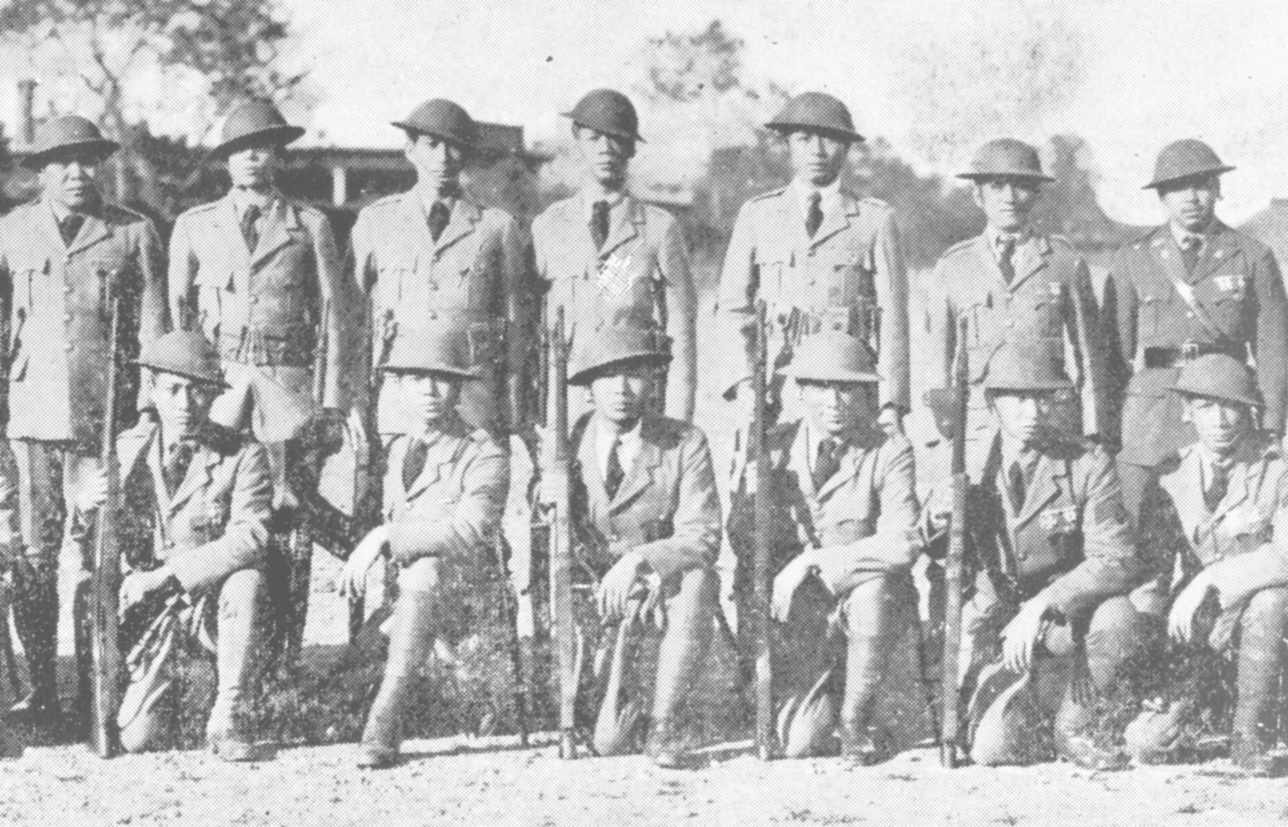
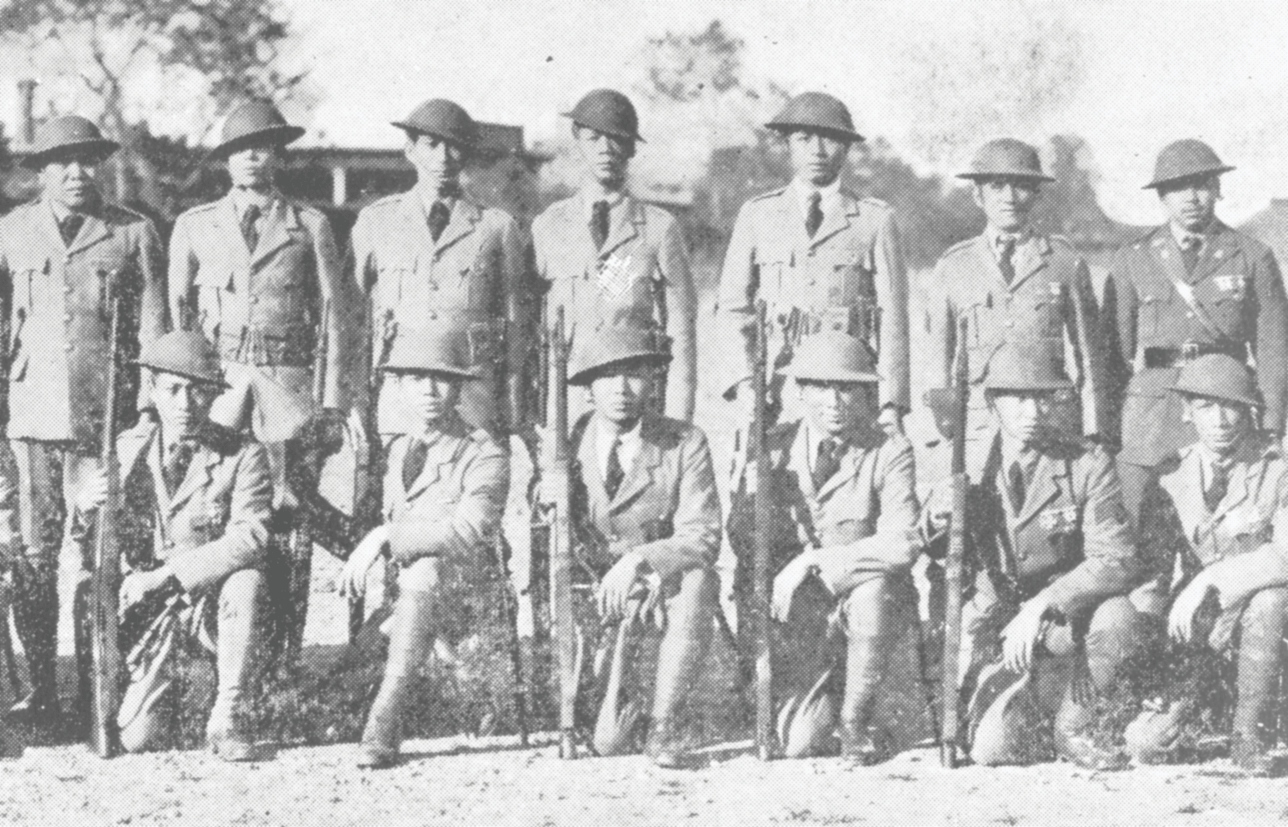
City residents created the Shanghai Volunteer Corps (Figure 1.1), whose mobilization exercise began this chapter, in 1853 in response to the threat of the Taiping Civil War spilling over into the city.Footnote 3 Although Filipinos had served in mercenary armies around Shanghai during that time, the official Philippine Platoon of the Shanghai Volunteer Corps was not founded until 1927. The platoon transformed into a full company of 100 soldiers five years later.Footnote 4 The creators of the Volunteer Corps envisioned an international organization that would mobilize during times of duress, coordinate with the Shanghai Municipal Police, and defend the city until foreign powers had time to send in their regular navies and armies.Footnote 5 At its maximum strength, the Corps boasted twenty-seven companies consisting of English, American, Russian, Japanese, Jewish, Chinese, Portuguese, and Filipino soldiers.Footnote 6
Members of the Philippine Company, Shanghai Volunteer Corps
The Shanghai Municipal Council activated the Shanghai Volunteer Corps on twenty-five occasions, but two mobilizations loom large over the others.Footnote 7 The first occurred during the Taiping Civil War and the second in response to the 1932 Japanese invasion of the Zhabei district of the city, also known as the January 28 Incident. This brief preview of World War II in Zhabei served as a catalyst for the conversion of the Philippine Platoon into a full company. Though the company suffered from similar recruitment issues as other companies during the Great Depression, it retained enough members to stay intact until the dissolution of the Corps in 1942.Footnote 8
While Filipinos made up only one of the twenty-seven companies, their eager participation in mobilization exercises, Corps parades, and annual rifle competitions made them a visible presence in the cosmopolitan city. Historian of the Corps I. I. Kounin relates how Filipino “keenness is not confined to parades,” noting, “Filipino volunteers have won many honors on the rifle range.”Footnote 9 Newspapers corroborated this success, reporting on Filipino victories in individual and group competitions of the Municipal Challenge Cup, Trueman Cup, and Durban Cup.Footnote 10 Their precision on the rifle range likely gained them some measure of respect. In an era when military power reflected well on the general prosperity of a country and its people, the Filipino volunteers earned social capital through their martial displays on the firing range.
If we take a brief detour to the Philippines to preview the next section in this chapter, we find that many Chinese living there, like their Filipino counterparts in Shanghai, volunteered for military service, fighting in the Philippine wars against Spain, the United States, and Japan.Footnote 11 Jose Ignacio Paua, who was perhaps the most famous Chinese volunteer, reportedly recruited 3,000 Chinese fighters to fight in the 1896 revolution against Spain.Footnote 12 According to historian Richard T. Chu, however, most Chinese “seem to have taken a wait-and-see attitude” during the revolution.Footnote 13 Chinese in the Philippines took a more proactive role during World War II. Japan, which invaded the Philippines in 1942 in the middle of their eight-year war with China, targeted Chinese political activists in the archipelago, causing many to go underground, where they split into left- and right-leaning guerilla movements.Footnote 14
The Filipino volunteers in China and the Chinese volunteers in the Philippines demonstrated a willingness to join in the collective protection of their new ecosystems. While the skeptic would be correct to point out that the fighter-volunteers also defended their own interests when taking up arms, this observation does not detract from the overarching contributions of the volunteer fighters.Footnote 15 Ultimately, they made the choice to fight. As a result, unlike the “sub-imperial” Sikh soldiers and officers, who became “a surrogate target for Chinese resentment of Euro-American imperialism,” Chinese in Manila and Filipinos in Shanghai, as volunteers, largely avoided direct association with white and Japanese imperial power.Footnote 16
In some ways, however, the participation of Filipinos in the defense of China and the participation of Chinese in defense of the Philippines is obscured in historiography and popular memory.Footnote 17 In his groundbreaking article on the Chinese Company of the Shanghai Volunteer Corps, for example, Xu Tao does not mention the Philippine Company despite their sharing many commonalities with the Chinese Company. Members of the Chinese and Philippine companies had to overcome racial discrimination and prove their worth through physical displays of aptitude.Footnote 18 Yung Li Yuk-wai, in her work on Chinese mobilizations against Japan in the Philippines during the Second World War, noted how she had to work against stereotypes that depicted Chinese “not just as grasping and disloyal, but as essentially cowardly.”Footnote 19
“Huaqiao warriors” in the Philippines and Filipino Corpsmen in Shanghai did not belong to an overarching imperial mission, and, as a result, did not appear consistently in any specific archive. In the gardens of historical records, they are visible for all to see, but without labels, historians have trouble identifying them.Footnote 20 By contrast, historians have traced in some detail the contributions of Indians in the “British world.”Footnote 21 Even if Filipinos and Chinese acted in their own interest when volunteering to defend their host countries, they were clearly not furthering the goals of Chinese or Philippine empires, which sets them apart from Sikh, Vietnamese, Javanese, and other Asian imperial migrants.
If Filipinos were not traveling to Shanghai as sub-imperial agents or colonizers, why did they uproot themselves and move to the city? There is no simple answer. Their participation in the Volunteer Corps hints at their visibility in and relationship with the city, but it does not divulge their reasons for coming. It turns out that some Filipinos, like the Russian and Jewish refugees who began to crowd the city by the 1930s, came as political refugees from the wars for independence at the turn of the twentieth century.Footnote 22 Others just traveled to the city on vacation, like Mrs. Marcos Roces, Isabel Roces, and Ontonia Roces of the famous media mogul family.Footnote 23 Dr. Riego de Dios, a registered physician, came to Shanghai to practice.Footnote 24 Another Filipino operated a casino that served the Filipino community in the city.Footnote 25
The brothers Jose, Vicente, and Julian Cobarrubias worked for an American import–export firm. At least one of the brothers also volunteered for the Shanghai Volunteer Corps. Vicente Alobog owned a hat store on Nanjing Road near what would become the Philippine Consulate in 1947.Footnote 26 Captain Honorio Evangelista, the leader of the Philippine Company of the Shanghai Volunteer Corps, served as the city’s sole Filipino veterinarian.Footnote 27 Other “Manilamen” worked on vessels that prowled the Yangtze.Footnote 28 In other words, as historian Gregorio F. Zaide observes, “Filipinos went to China in search of commercial profits, new homes, and adventure.”Footnote 29
In many ways, Honorio Evangelista, Riego de Dios, Vicente Alobog, and other Filipinos lived uniquely Shanghai stories. Shanghai – the “demon capital,” “paradise of adventurers,” “pleasure capital,” and “Paris of the Orient” – was a vibrant metropolis and open port known for cultural innovation, leading universities, student and worker activism, industrial production, and capital flows.Footnote 30 It was no accident that Filipinos decided to establish roots in the city. Like many cities at the time, Shanghai contained sharp contrasts, with countless residents living in dire poverty while others commuted in gold-plated sedans.Footnote 31 The city’s diverse industries, including construction and entertainment, attracted all types of people.Footnote 32 Filipinos, like the city’s Russians, Sikhs, Jews, Americans, Portuguese, and Japanese, leveraged their talents to carve out a community, becoming one of the largest foreign contingents in the megacity.Footnote 33
Determining the overall population of Filipinos in Shanghai in the early twentieth century is a daunting task because they had no consulate until 1947 and no Philippine imperial archive to accumulate their records afterward. According to the official census of the International Settlement, 382 Filipinos lived in the city in 1930.Footnote 34 But censuses are capricious creatures. Recent debates about the categorization of people of Southwest Asian or North African descent in the United States hint at the uncertainty involved in categorizing and counting people.Footnote 35 Uncertainty grows during periods of greater racial and political malleability like in the early twentieth century when competing and overlapping ethno-nationalist movements cropped up across the world.
Moving beyond the census only muddies the waters. Although a period guidebook, All about Shanghai, registered zero Filipino residents in the French Concession, the Concession hosted a “Manila Road,” and Philippine Consul General Mariano Ezpeleta reported numerous Filipino residents in the former Concession in 1947.Footnote 36 Estimating the aggregate population of Filipinos in Shanghai in 1947, Ezpeleta wrote, “The Filipinos number over one thousand.”Footnote 37 In fact, his first major task as Consul General was to do what the British, Japanese, French, and Americans leaders in the city had felt little incentive to do when they ran the city – track down and properly document Filipinos.
Tallying the Filipino population no doubt proved difficult for Ezpeleta considering that many Filipinos in the city had not registered marriages or births, while those who had registered often did so with the incorrect consulate.Footnote 38 If Ezpeleta’s number of 1,000 is accurate, though, then the number of Filipinos in the city approached the French and German communities, both of which totaled around 1,400 residents in 1935.Footnote 39 Considering the Philippine Company of the Shanghai Volunteer Corps had nearly 100 members, pinning the overall population at above or around 1,000 does not seem far-fetched.
While censuses are problematic, they can still reveal some telling information. According to the 1935 census, for instance, reflecting the general pattern in Shanghai, males accounted for 63 percent of the adult Filipino population in the International Settlement, with 169 men and 99 women.Footnote 40 Curiously, the census revealed a similar imbalance with Filipino children, with seventy-one boys and forty-eight girls, which might suggest that families sent daughters back to the Philippines or removed them through some other means. The gender skew of the adult population mirrored global patterns during this era of “proletarian mass migrations.”Footnote 41 Anecdotal evidence suggests that some Filipinos found local partners.Footnote 42 Captain Honorio Evangelista of the Shanghai Volunteer Corps, for example, married Shanghai native Nancy Ting Evangelista, who unfortunately left a sparse paper trail.Footnote 43
Though likely an exaggeration, according to Consul General Ezpeleta, “most Filipinos married Chinese girls.”Footnote 44 This situation no doubt created the same types of legal uncertainties that confronted Chinese–Filipino couples in the Philippines, where Filipino women could lose their citizenship or American national status by marrying a Chinese national. In Shanghai, where the Municipal Mixed Court and separate national courts and consulates complicated jurisdiction and jurisprudence, as we saw with the case of the Filipinos and lekin runners at the start of this chapter, cases regarding disappearance, divorce, and domestic violence with mixed families must have been complicated and contentious.Footnote 45
Legal ambiguities aside, children of mixed families appear to have faced issues of identity and belonging. One mixed Filipino-Chinese lad in Shanghai, for instance, felt obligated to prove he was truly a Filipino when acting as a trilingual translator for visiting Filipinos. Consul General Ezpeleta assured Filipino readers of his memoir that the young man participated in Filipino social gatherings and was “one of us.”Footnote 46
To move beyond the surface and dig out topics like wages, community, and family, we will utilize the records of the Shanghai Municipal Orchestra, but before we continue with the Filipino experience, let us hop aboard a steamer and take a closer look at the lives of Chinese in the Philippines.
Chinese in Manila
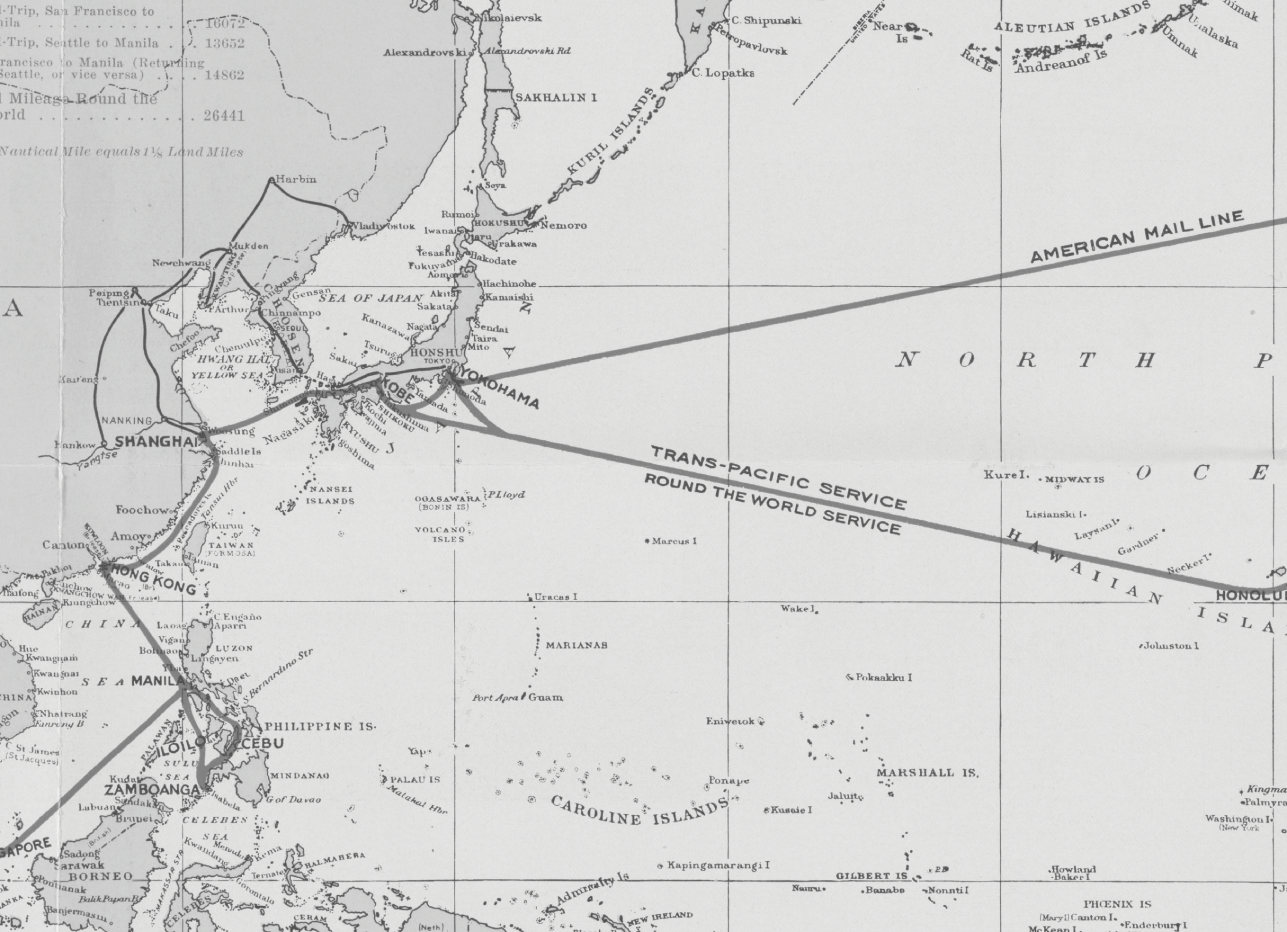
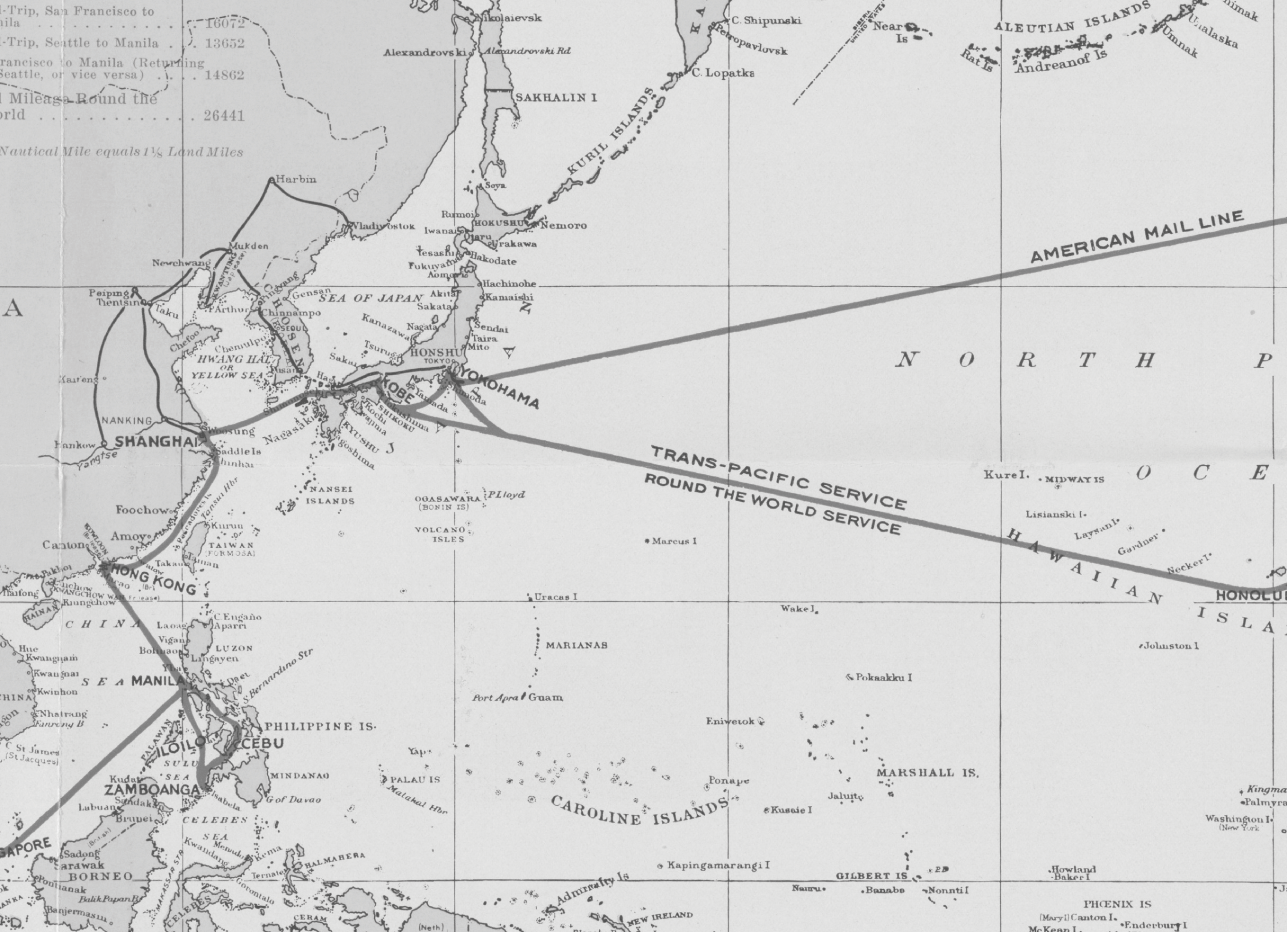
What is currently a two-and-a-half-hour flight from Shanghai-Pudong Airport to Ninoy Aquino International Airport in Manila was a three- to four-day voyage in the 1930s. Though it might seem like an endless journey by today’s impatient standards, back then it was a breeze. By contrast, it required at least three weeks to travel to Europe or the United States from either city. Xiamen to Luzon is even closer, measuring only seven hundred miles as the bird flies, or about the same distance as New York to Chicago. As historian Andrew Wilson observes, “steaming from Xiamen to Manila was perhaps as mundane as my morning commute and probably carried about as much political consequence.”Footnote 47 More important than distance, however, is connectedness, and multiple lines from several steamship companies linked Shanghai, Xiamen, and Manila (Figure 1.2).
Entrepreneurs catered to passenger, post, and commercial transportation needs in Asian waters. The Dollar Steamship Company, founded by American businessman Robert Dollar, ran several passenger liners from Shanghai and Hong Kong to Manila.Footnote 48 Five main Dollar Steamship routes served American imperial and business interests, and two of them, the Round the World and Trans-Pacific lines, connected Shanghai and Manila.Footnote 49 Competitors from Russia, Japan, and Canada also plied the Shanghai–Manila route. In other words, China and the Philippines were bound by the “helix of imperial and global power,” as historian Antoinette Burton theorizes in a different context, and this helix brought Chinese to Manila just as it brought Filipinos to Shanghai.Footnote 50
Route of the world-famous president liners
Like Shanghai, “Manila was one of the world’s most spectacular emporia with cosmopolitan sensibilities and a genuinely global outlook.”Footnote 51 A thrice-colonized city as opposed to a co-colonized city like Shanghai, it also absorbed foreign populations and new ideas. Through the early Maynila sultanate, Spanish colonial period, First Republic, and American colonial period, one factor remained constant in the city: a sizable and aspiring Chinese community. Yet while the Chinese community has received deserved if uneven scholarly attention, the city itself “is a place remarkably deficient of comprehensive urban historical analysis.”Footnote 52 Whereas Shanghai flourishes in a well-fertilized field of scholarship, Manila has weltered in the dusty margins of obscurity.Footnote 53
When Manila appears in historical scholarship, it often fills the role of a trade waystation or an axis of conflict. Many scholars, for instance, have tracked the famed Manila galleons along their route between Acapulco and Manila.Footnote 54 This highly profitable and surprisingly durable luxury route budded when what Spanish officials called “the China Enterprise” – a euphoric dream of Spanish conquest and Christianization of China – came to a rapid and inglorious end, and Spanish officials in Manila instead became increasingly reliant on the growing Chinese community in the city to supply luxury goods for new and old Spain.Footnote 55 Chinese traders engaging in the lucrative “triangular trade” between China, Japan, and Manila, meanwhile, viewed the archipelago as a reliable port, if not a promised land.Footnote 56
The stable profits of the Manila trade ensured that Chinese would continue to sojourn there throughout the Spanish colonial period despite numerous obstacles placed by Chinese and Spanish authorities. The Spaniards implemented a long-standing tripartite policy of taxation, control, and conversion.Footnote 57 In 1581, only ten years after Miguel López de Legazpi first set foot in the already-thriving port, the fourth governor general, following a new global pattern of segregation, established the segregated Parián neighborhood in Manila, requiring non-Christian Chinese to reside within its borders. For many centuries afterward, Chinese lived in segregated communities in the Parián and Binondo neighborhoods of Manila.Footnote 58 Together, these neighborhoods served as the fulcrum for trade and specialized industries in Manila and beyond.Footnote 59
Throughout the Spanish colonial period, the Chinese maintained a tenuous relationship with Spanish authorities. With the China dream dead and decayed for Spaniards, the Philippine dream of Chinese people dominated the relationship. However, Spaniards feared the influential, connected, and sizable Chinese community, which had quickly grown to outnumber theirs. Periodic pogroms and expulsion orders that threatened the foundations of the Chinese community defined the seventeenth and eighteenth centuries.Footnote 60 The Chinese feared the arbitrary justice and reactionary blindsides of Spanish authorities, but they consistently reestablished themselves after pogroms despite staggering casualty figures, such as the estimated 23,000 who perished in 1603.Footnote 61
To compensate for their insecurity and uncertainty as non-colonizing and non-native members of the Manila community, Chinese turned to numerous strategies, including organizing the community through the Chamber of Commerce and cabecilla, or community leader; establishing and invoking hometown or qiaoxiang (僑鄉) ties; maintaining lines of credit with powerful Spaniards; and fostering extra-consanguine family ties such as compadrazgo, or co-parenthood and padrinazgo, or godparenthood.Footnote 62 Like their Filipino counterparts in Shanghai, to whom we will return in the next chapter, in times of duress, Chinese people came together as a community to help one another.
Much of the community cohesion stemmed from shared linguistic and hometown ties, with most residents hailing from a few towns in southern Fujian, or Minnan. Scholars have noted how these Hokkien speakers became “undisputed leaders in seafaring enterprises.”Footnote 63 In this regard, one could argue that they shared more in common with seafaring “Manilamen” than their Chinese peers.Footnote 64 Yet for all of its advantages as a seafaring region, southern Fujian faced the dual dilemma of severe shortage of arable land and a bumper population.Footnote 65 Fortunately for them, the Philippines, like much of Southeast Asia before the twentieth century, remained comparatively underpopulated. This led many Fujianese to try their luck in Manila, which Richard T. Chu describes as a “magnet to many Minnanese.”Footnote 66
Just like today, Manila served as the economic, cultural, and political center of the Philippines. Local Chinese opened a branch of the Protect the Emperor Society, a famous Qing loyalist organization, in Manila in 1899.Footnote 67 Likewise, nationalist-minded activists established the first Philippine branch of the Tongmenghui, Sun Yatsen’s (Sun Zhongshan 孫中山) anti-Manchu revolutionary organization, in Manila right before the revolution.Footnote 68 As we will explore in more detail in Chapter 6, leading community members also established the Philippine Chinese Chamber of Commerce, the China Banking Corporation, and other prominent Chinese business ventures in Manila. As historian Edgar Wickberg notes in his work, “Unlike other parts of the archipelago, Manila had a Chinese population that was constantly being replenished.”Footnote 69
Like Filipinos in Shanghai, Chinese in Manila mingled and interacted widely with the city’s diverse denizens, forming business partnerships, lasting friendships, and intimate relationships.Footnote 70 According to censuses, the gender ratio skewed even further out of proportion for the Chinese community in the Philippines than it did for the Filipino community in Shanghai, with only 194 women out of a total of 66,000 in 1886 and 3,098 women out of 43,802 in 1918.Footnote 71 While this data, as mentioned earlier in the Filipino case, was almost certainly incomplete, the official tally is quite shocking for its implications on family life.
With fewer than 100,000 Chinese residents for most of the American colonial period, and only half of them residing in Manila, the Chinese community remained more compact than comparable Chinese or Indian communities in Southeast Asia.Footnote 72 So, while the Chinese population in the Philippines, and in Manila in particular, was significantly larger than the Filipino population in Shanghai, which we pinned at approximately 1,000, perhaps Chinese in Manila had more in common with Shanghai’s Filipinos than appears at first glance. If we consider the overall population of China, which was approaching 500 million, and the overall population of the Philippines, which had just passed 10 million, the emigration numbers, or outward flow of migrants, were similar percentage-wise but clearly on a different scale.Footnote 73
With a gender ratio of 92.9 percent male to 7.1 percent female in 1918, there must have been many cases of underreporting, sojourning, or informal relationships. As Richard T. Chu notes, the 7.1 percent tally in the census also included Filipino women who married male Chinese nationals because citizenship became linked with the husband after the extension of exclusionary policies to the Philippines.Footnote 74 On the flip side, this meant that if a Chinese woman were to marry a Filipino man, which was no doubt quite rare given the demographics, she would face legal limbo. A commentator in a Singaporean newspaper observed that in such cases, the Chinese woman would lose her Chinese citizenship and but could not acquire Philippine citizenship due to exclusionist laws.Footnote 75 Lawmakers heaped these legal obstacles on Chinese people to disincentivize migration and complicate their lives, and we will explore this topic in more detail in the next chapter.
The census, which recorded a sizable mestizo or “half-breed” population, as the census labeled them, also shows a glimpse at the long history of intimate relations between Chinese and Filipinos.Footnote 76 Furthermore, many Filipinos with Chinese heritage did not even report their Chinese background to census takers. The well-known author José Rizal, whose family famously rejected their Chinese heritage, supposedly for tax purposes, is a case in point.Footnote 77 Church records and anecdotal evidence generally corroborate the long history of intermarriage.Footnote 78 In other words, Chinese in the Philippines, like their Filipino peers in Shanghai, despite the many societal pressures and legal barriers designed to hinder such unions, adjusted to the new soil in these cosmopolitan cities by forming intimate partnerships.
Unlike the Filipino community in Shanghai, the Chinese community had clear and traceable leadership and organizational structures. Of course, these organizations sometimes masked underlying divisions within the community, and we will return to those divisions in Part III. By the twentieth century, the Philippine Chinese Chamber of Commerce, which theoretically only dealt with financial affairs, had replaced earlier Spanish-era institutions as the de facto community governing body.Footnote 79 Coupled with a vibrant Chinese press, which shapes Part IV, and a semi-independent school system, which we touch upon in Part II, the Chinese community was well defined and comparably unified. This unity allowed for a quick resolution of issues, such as a 1922 incident that entangled the Chinese community in Manila and Filipino one in Shanghai.
The incident began when “news flashed from Shanghai, stating that Filipino colonists, mostly musicians and their families, who were living in that city were being maltreated by the Chinese there.”Footnote 80 According to historian Eufronio M. Alip, Filipinos in Manila responded to this news by harassing local Chinese residents until Philippine Senator Manuel Roxas intervened to quell the riots.Footnote 81 Just as American transplants in China suffered in the anti-American exclusion-inspired riots of 1905, Chinese residents in the Philippines suffered when rumors spread regarding ill treatment toward Filipinos in China.Footnote 82 In other words, the Chinese and Filipino diasporas were not just similar; they were also intertwined.

 Open access