




Introduction
In 2014, Hong Kong's Umbrella Movement rekindled, however briefly, global hopes for a city that a local TV series had described as ‘dying’ in as early as 2011.Footnote 1 Named after the ubiquitous umbrellas shielding hundreds of thousands of demonstrators from police skirmishes, the movement saw protesters occupying the roads of the city's commercial districts for 79 days.Footnote 2 They made posters, slogans, installation artworks, and makeshift facilities to adorn the occupation sites, calling for electoral rights, distributive justice, and respect for local distinctiveness. Observers have commented on this ‘Umbrella art’ in terms of Hong Kong's ‘different cultural repertoires’, ‘bringing together traditional Chinese political vocabulary and modern Chinese culture, local and international pop icons’.Footnote 3 Umbrella art showcased Hong Kong's vernacular hybridity, featuring a rich repertoire to articulate local culture against rigid national homogeneity. The idioms and expressive forms of Umbrella art became constitutive of the ensuing social movements, leaving imprints even on the much more confrontational protests that roiled the city in 2019.
However, some of the most critically acclaimed Hong Kong writers complicate this picture of the Umbrella culture as a liberal, cosmopolitan resistance against nationalization. The 2014 Umbrella Movement itself was preceded by the ‘Occupy Central with Love and Peace’ (‘Occupy Central’), a civil-disobedience campaign for progressive electoral reform that began in 2013. Intense public discussion followed. At a time when ‘speaking out’ was trending as the idiom for local commitment, Dung Kai-cheung (董啟章, 1967–), the appointed ‘Writer of the Year’, instigated a public debate with a speech at the Hong Kong Book Fair in July 2014 entitled ‘The Silence that Is Necessary’ (必要的沉默).Footnote 4 Speaking two months before the onset of the Umbrella Movement, Dung contended that Occupy Central had monopolized the discourse of local identity and devalued contemplative silence, which, in his view, was central to literary creation and Hong Kong's historical self-understanding. His co-speaker, the acclaimed writer Wong Bik-wan (黃碧雲, 1961–), also dwelled on the experience during the writing of her previous novel to consider silence as a challenge to traditional modes of civic participation in public space.Footnote 5 Their speeches, later reprinted in newspapers, were met with considerable, if divided, public commentary.Footnote 6
The public mobilization surrounding the Umbrella Movement was nothing short of a collective soul-searching for Hong Kong's divisive cultural identity—a moment of political woes experienced as identity crisis. So far, studies of Umbrella-related cultural production have focused primarily on artistic and textual materials found in situ and generally reproduced the celebratory narrative about its local assertion and world-savvy ingenuity.Footnote 7 Yet the ‘silence’ controversy and its repercussions tell a different story: a cultural emergency whereby Hong Kong people were compelled to ask what its time-honoured local distinctiveness and cosmopolitan eclecticism mean in real-time practice. This article, therefore, proposes to scrutinize the negotiations with, and discursive refashioning of, Hong Kong identity during and after the Umbrella Movement. It does so by investigating both the protesters’ on-site cultural expressions and the literary works by Dung Kai-cheung and Wong Bik-wan, two of the most celebrated writers in contemporary Hong Kong. With literary works as a hitherto neglected facet of the same cultural formation in conjunction with on-site protest expressions, this ‘Umbrella culture’ broadly defined represents a discursive laboratory in which art and literature mediate discrepant theorizations of Hong Kong identity and democratic subjectivity. ‘Detached’ literary reflections seemingly tangential to social movement are in fact deep contemplative engagement invested in pushing the movement's discursive envelop even further by interrogating its cultural premises.
I argue that these discrepant, reflexive discursive experiments upon Hong Kong identity under the ‘Umbrella culture’ exceed the analytic framework of traditional Hong Kong studies, as they are new cultural articulations of democratic self-determination. Hong Kong studies have generally been organized around the city's metropolitan modernity, postcolonial hybridity, and vernacular resistance to nationalism. These interpretative apparatuses owed much to how the field took shape in the 1970s, following the 1967 leftist riots inspired by China's Cultural Revolution, and in the 1980s, when Britain and China were negotiating Hong Kong's fate. Hong Kong's cultural texts have been frequently read within this paradigm centred on urbanity, cosmopolitan hybridity, and vernacular locality. As evidenced by the different responses to the Umbrella Movement, however, these paradigmatic categories passed through the same prism of Hong Kong identity only to be refracted into divergent applications by various actors. Therefore, this article seeks to work from the bottom up methodologically, engaging these working definitions of Hong Kong identity tentatively devised by different actors in real time. Instead of slotting cultural expressions into a historically unchanging model of locality and cosmopolitanism, I approach every identity claim as a new conceptual act that revisits and rewrites the fundamental discourses of identity within history. My point is that rather than objects of knowledge, these cultural producers should be considered as producers of local knowledge who define and theorize their own ‘idea’ of Hong Kong. This methodological framework sustains a pluralist approach towards Hong Kong culture—one in constant flux of self-definition and -revision by multiple actors under the rubric of self-determination. While no single viewpoint coming from either the protest site or through literature can be wholly representative of the ‘Umbrella culture’, let alone post-Umbrella Hong Kong, collectively they have effected an important turn in Hong Kong's cultural discourses.
I propose to comprehend these discursive interventions into cultural identity through a conceptual dyad—the performative and the ethnographic. The performative refers to the enactment of codified social scripts to express in-groupness; the ethnographic addresses the enframement of manifold community experiences and the plethora of perspectives into collective identity. I argue that both are crucial creative and epistemological processes by which activist arts and literary works evoke cultural identity while transforming it. The concept of performativity has been pervasive in cultural sociology and political theory, as proven by how accustomed we are to conceiving social action as ‘scripted’, in other words as citational performance whose efficacy hinges upon a normative scheme.Footnote 8 In contrast, the political import of ethnographic knowledge production has so far eluded theories of social action. The ‘ethnographic’ as used in this article names the intellectual labour expended in participant observation and cultural documentation for the sake of discursive intervention. This usage is informed by the rich tradition in postcolonial anthropology to be reflexive of the power relations involved in ethnographic documentation of others’ experiences, as well as the effects of ethnographic discourse among indigenous cultures and the general public as political advocacy, cultural criticism, and sometimes literary creation.Footnote 9 These efforts contribute to a transdisciplinary notion of ‘ethnography’—a concept of culture understood as collaborative and contested work-in-progress rather than a generalized closure. I draw on this enlarged anthropological sense in my approach as to how activists and authors perform ethnographically inflected cultural expressions and critique. They legitimize their action by fostering descriptive thickness with respect to Hong Kong culture as not just ‘native informants’, but also ‘fieldworkers’ of their city.
The concepts of performativity and ethnography help to explicate the interventions performed by literary text and social activism, as both use and transform cultural forms. Performative actions are incomplete realization of the ‘essential’ identity, comparable to ethnographic accounts that are partial translations of the ‘target’ culture. From one performative or ethnographic instance to another, the variations and discrepancies introduced in between are where individual agency is manifested, where new knowledge about cultural identity is produced. Together, concepts of performativity and ethnography outline the creative processes by which Hong Kong identity is mobilized and transcribed by different actors. These processes constitute the identity negotiation and articulation in the discursive field of the Umbrella Movement's contestatory cultural politics, whose complex dynamic, like those in many other oppositional movements globally speaking, is sometimes swept under the carpet of ‘identity politics’. These divergent formulations of Hong Kong identity make a more general case that democratic deliberation is not merely about the free exchange of speech-acts under the universal rubrics of communicative rationality (Habermas); it equally involves creative interventions weighing into community-specific values and identity-defining discourses constituting the culture-bound public space.
The article is divided into three sections. The next section analyses the Umbrella protesters’ artistic expressions as creative translation of the aesthetic form of Saisai's 西西 (Xi Xi in pinyin) novel, My City (我城, 1975), often cited as the ur-text epitomizing the ‘self-writing’ of Hong Kong identity.Footnote 10 As ‘speaking out’ (發聲) is incorporated as the performance of cultural localism,Footnote 11 the protesters are eager to find an expressive form to proclaim Hong Kong culture as a ‘total way of life’, at which point they reactivated Saisai's literary idiom. Not only has Saisai's neologism 我城 (literally ‘I-city’) found its way into the protesters’ discursive materials, but the Umbrella artworks and social performances recall Saisai's stylistic registers and utopian citizenship. The protesters thus authorize themselves as the authentic, democratic subject, the ‘we the Hong Kong people’, by transmitting and updating Saisai's original project of auto-ethnographic self-determination. The third and fourth sections turn to Dung Kai-cheung's and Wong Bik-wan's Umbrella-related texts. Making ‘silence’ a signifier of more subtle forms of local commitment as opposed to overt protest participation, Dung and Wong resort to performative and ethnographic strategies, respectively, to reformulate Hong Kong identity, teasing out the ‘silences’ in an already complex Umbrella discourse. Each section has one analytic focus: for Dung, it is on how he over-performs Hong Kong's cosmopolitan breadth and individual liberty to oppose the Umbrella Movement's communitarian insularity; for Wong, it is on her ethnographic fictionalization of Hong Kong's subaltern populations to confront the Umbrella protesters with the omissions in their proclaimed democratic totality. Accordingly, these writers are not so much opposed to the Umbrella Movement itself as its critical complements.Footnote 12 In the conclusion, I suggest that these critical strategies are still in play even as the authors discussed here publicly expressed different opinions in 2019. First, we turn to how Saisai's novel genealogically enables the Umbrella protesters’ ‘speaking out’ as the authentic Hong Kong people.
Polyphony of the local: from My City to the Umbrella artworks
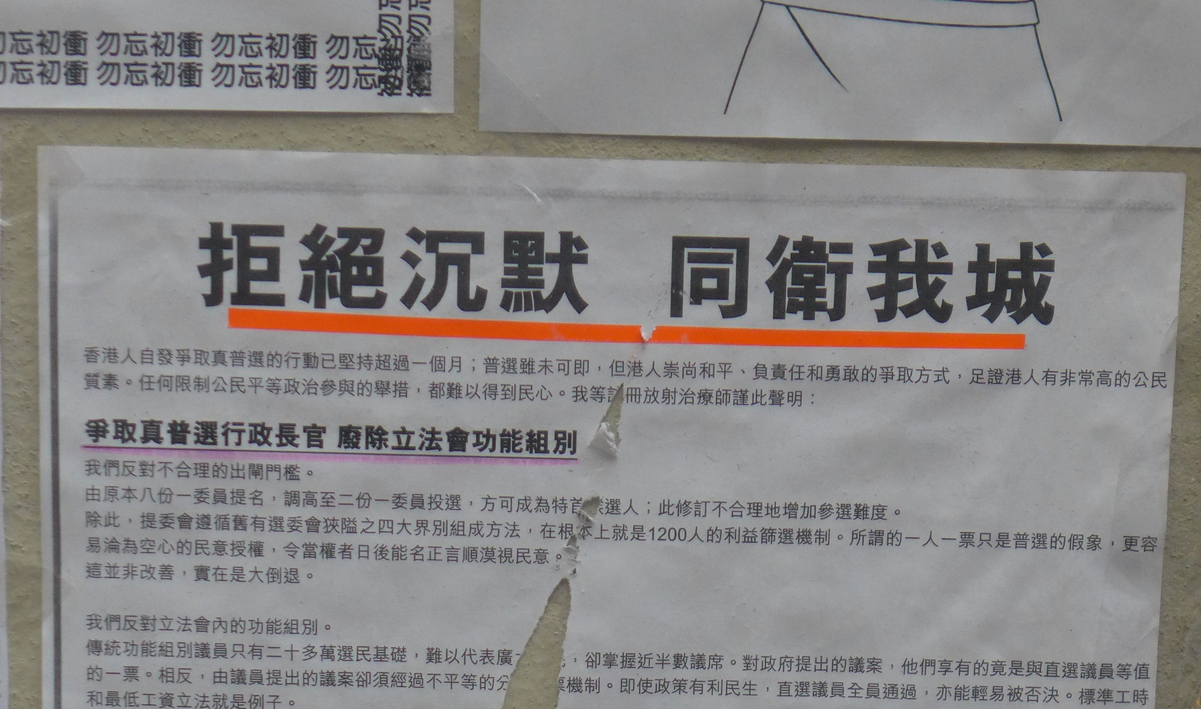
‘Who Has Yet to Speak Out’ (問誰未發聲), an Umbrella-themed song originally adapted from ‘Do You Hear the People Sing’ of the musical Les Misérables, opens with the line ‘who to defend My City besides me’ (捨我其誰衛我城). Saisai's neologism 我城 (literally ‘I-city’) is militated by the Umbrella Movement, notably in protest songs and poster slogans (Figures 1 and 2), in their political performance of ‘speaking out’. Although such citations never explicitly acknowledged the writer herself, the term is a staple in the language of local activism, having taken on a life of its own.Footnote 13 The city's colonial past and China's overshadowing presence call for a language that escapes both colonialist and nationalist containment. 我城 correlates with Hong Kong's urban identity, while contrasting with the competing term ‘我國’ (‘my/our country’) used in sovereign nation states including mainland China and Taiwan. The term's morphology signifies a city-subject refusing to be interpellated by national sovereignty.
‘Keep on “Defending Our City,” Never Say Give Up’, Admiralty, 28 October 2014. Source: Photo courtesy of Sebastian Veg.

‘Reject Silence, Defend Our City Together’, Mongkok, 15 November 2014. Source: Photo courtesy of Sebastian Veg.
It is by more than a term that Saisai's novel resonates with the Umbrella Movement. A remarkably similar creative impulse underlies both Saisai's playful reinvention of Hong Kong's urban lifeworld and the protesters’ social imaginaries. To begin, the spectacular artworks in the Umbrella protest site are a surreal realization of Saisai's speculation in My City: ‘Will our city one day pave itself an avenue filled with drawings? If we cover the ground with pictures, we'll have painting exhibitions in the streets every day. Then we'll have more space for a stroll in this city maybe?’Footnote 14 The Umbrella cartoons that reimagine the participants as cute figurines call to mind Saisai's hand-drawn illustrations in My City (Figures 3 and 4). Saisai's fantastical descriptions of cable workers ‘growing’ telephone poles in the countrysideFootnote 15 literally comes to life in the ‘organic garden’ maintained by the protesters in Admiralty, where freedom is ‘cultivated’ as plants and flowers.Footnote 16 Overall, My City is a loosely organized narrative series about a group of young, cartoon-esque characters setting out on fantastic escapades in the city and abroad. In a magical-realist, imaginatively metaphorical language (such as children being eaten by ‘pineapples’, a local slang for bombs), the novel addresses local and international issues such as the 1967 leftist riots, Vietnamese boat refugees, and global energy crisis. Its open-ended plot and globally conscious themes foreshadow the protesters’ appropriation of the urban spaces to address, beyond the direct goals of political franchise, other ‘post-materialist’ pursuits such as ecological self-organization, and critique of crony neoliberalism.Footnote 17 Juxtaposing analyses of the Umbrella artworks with readings of Saisai's novel clarify the nature of local commitment underlying the emergent cultural performance of ‘speaking out’ during the Umbrella Movement. As moments of identity consolidation, both draw on a rich repertoire of performative tropes and ethnographic strategies, materializing a genealogy in Hong Kong cultural works of giving expressive form to the open-ended, polyphonic community as a ‘total way of life’.
Little Mr and Mrs Hong Kong People. Source: Photo by Sebastian Veg, ‘Creating a Textual Public Space’, p. 24.

Cover art of My City 1996 edition, hand-drawn by Saisai.

My City and the Umbrella Movement put together make evident the historical connections between activist citizenship and local identification. Throughout the novel, Saisai conveys harmony between the characters and their urban lifeworld, as opposed to the metropolitan drabness and estrangement typical in literary modernism. As Saisai puts it in her 1996 My City preface, having freshly turned away from stark existentialist fictions to embrace the playful fecundity of fauvism and magical-realism, she ‘decided to write a cheerful story about the young generation, about their lives and their city, to feel in their sensibilities and to speak in their language’.Footnote 18 Saisai's proclamation of ‘my city’ coincides with her ethnographic observation of, and sympathetic identification with, ‘the young generation’ as ‘natives’ to the city. This ‘young generation’ is none other than the so-called ‘Fiery Red Years’ (火紅年代)—a high tide of college-student activism in Hong Kong. Stimulated by the epochal promise of decolonization of the post-’68 generation, this wave of activism brought about some major social changes such as the recognition of Chinese as the official language in colonial Hong Kong.Footnote 19 Commonly regarded as a phase of cultural realignment with China, Saisai recasts this trend in Hong Kong as a budding sense of local social responsibility in line with the age of decolonization. She wrote in My City about the young Ah Fa who wishes to ‘change the world’ under the influence of her class teacher:
The class teacher says, the world now is not good. It's shameful of us to bring you kids into this world without building an ideal living environment for you. But there's little we could do, or maybe we're just lazy. We have nothing to say except sorry. But you don't need to feel frustrated or sad. Now that you've come, you've seen, you've learnt, and you're young, you can create a beautiful new world according to your wishes.Footnote 20
My City's imaginative exuberance is Saisai's ‘rite of passage’ into the youthful activist optimism in changing the world and making it home, as they imagined collective coming of age through decolonization endeavours. The Umbrella Movement reinscribes the utopian dimension in Saisai's text, as it defines itself as a youthful rebellion against the global regime of colonialist realpolitik.
My City and Umbrella street artworks both articulate the polyphonic urban community using street collage as its democratic form. Marshall Berman showed that social movements and experimental literary modernism are undergirded by the same creative drive to critically appropriate urban modernity. Urban space is indispensable to democratic activist expressions—‘no streets, no People’Footnote 21—and artists find inspiration from the ‘intricate sidewalk ballet’ that is urban everyday experiences, giving rise to the avant-garde invention of the collage.Footnote 22 One of the most salient examples from the Umbrella artworks is ‘Along the River under the Umbrella’ (雨傘上河圖, later published as ‘Harcourt Village Scroll’ attributed to Maoshan Connie 貓珊) (Figure 5), inspired by the Song-dynasty scroll painting ‘Along the River during Qingming Festival’ (清明上河圖).Footnote 23 This Umbrella illustration depicts the daily life in the Admiralty occupation. Different moments of the 79-day movement overlap, corresponding to the movement's ever-changing nature that defies static visualization. Cartoonish animal characters are found alongside smiling human figures. No conflict is depicted and instead all these strangers, including the police, interact in cheerful leisure and neighbourly informality. Wholesome acts of sharing are numerously represented. By no means an objective portrayal, the scroll painting nevertheless palpates and exudes the euphoria of activist optimism that the protesters wanted to be remembered for, registering the movement's affective intensities and utopian forms of social exchange. Ethnographic in technique, it entails a speculative mode of knowledge production to uncover the (inter)subjective realities of the movement, namely the collective fantasies and imaginaries not directly observable to journalistic reportage.
Overhaul of ‘Along the River under the Umbrella’ as seen in the Admiralty protest site. Source: Photo by Sebastian Veg, ‘Creating a Textual Public Space’, p. 26.
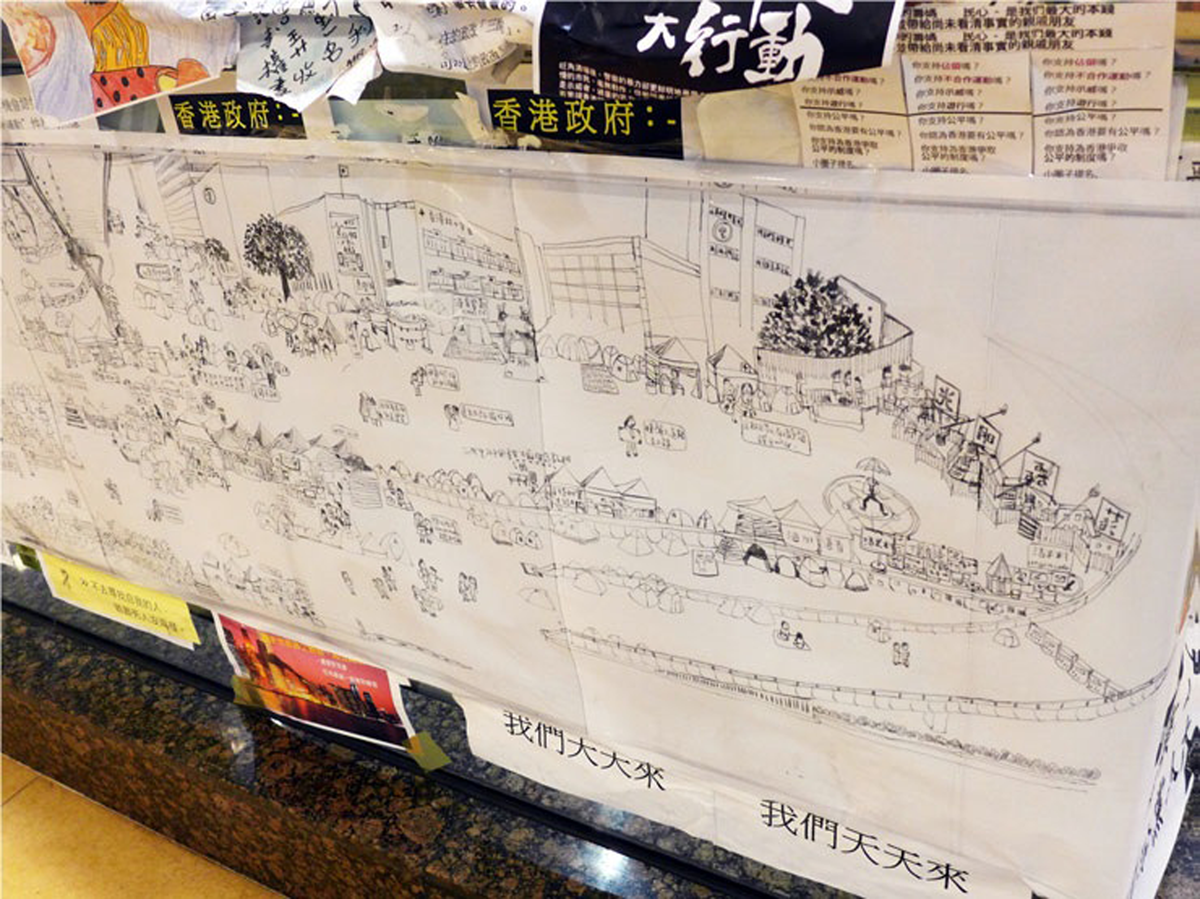
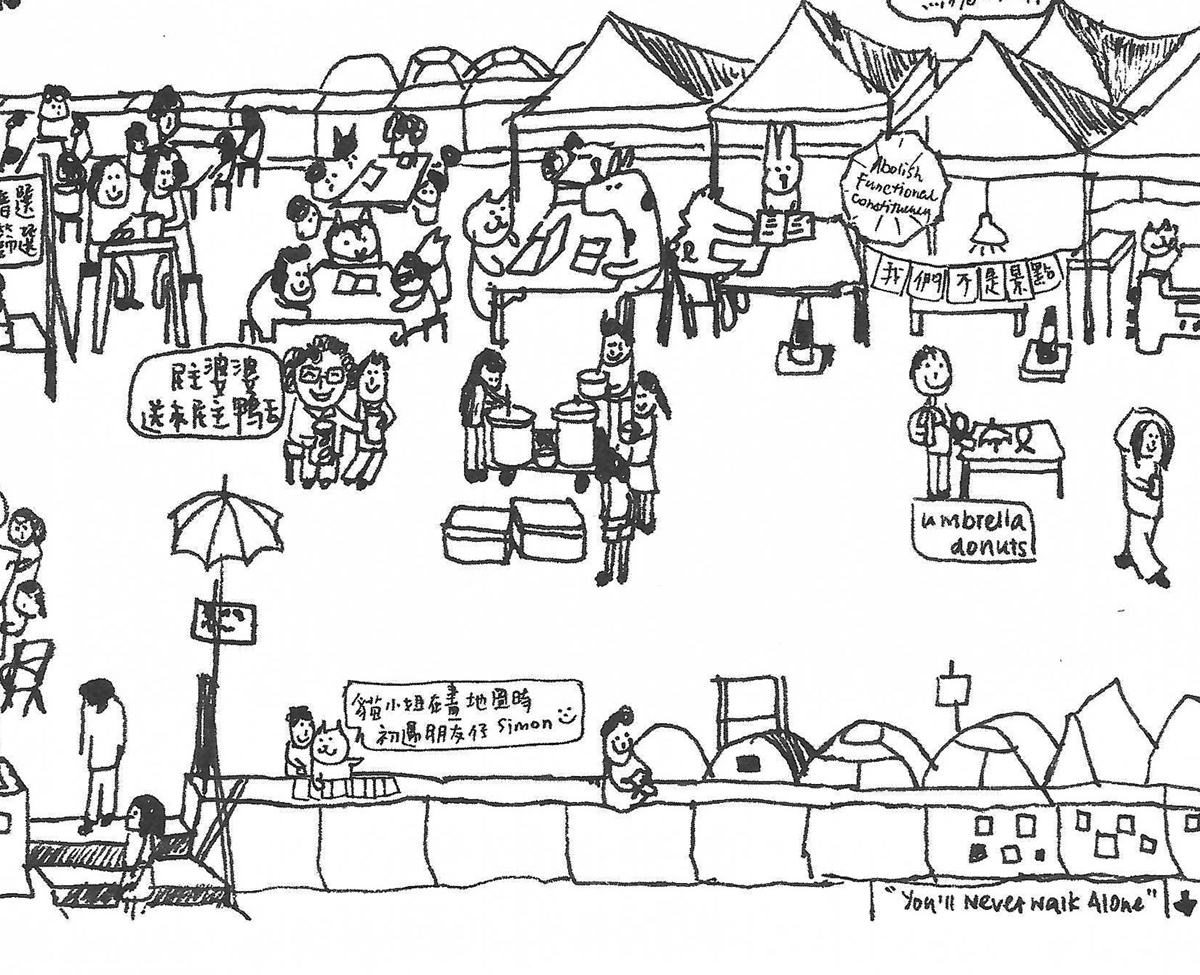
The Umbrella artwork dramatizes the perplexity over the protest's fluidity. Maoshan the illustrator doubles as observer and participant, immersed in the everyday rhythm of the protest community. Strikingly, its perspective is not an aerial view or constructed from stationary vantage points; rather, the perspective shifts along the scroll in a manner quite like the flâneur, or the discerning stroller, observing as she walks along the occupied road. The illustrator's diegetic presence, however, complicates the dichotomy of ‘insider’ and ‘outsider’, observing and being observed. The slogan ‘we are not a tourist spot’ that reproaches idle curiosity coexists with many tourist-looking, photo-taking characters, pointing to the protesters’ ambivalence towards the performativity of the movement (Figure 6). Aware that her illustration is not entirely safe from the criticism of the tourist gaze, Maoshan resolves this predicament by adopting a flâneuristic perspective, representing the protest as a street panorama—a more complete, multidimensional vista than a voyeuristic snapshot. This ethnographic mode of participant observation places the observer as simultaneously ‘inside’ and ‘outside’ the movement, while redefining participation to include other engagements such as documentary art-making (which are not immediately audible ways of ‘speaking out’). The polyphony and porosity of Hong Kong culture preclude uncomplicated relation to a purely native ‘inside’, thus requiring multiply-located perspectives to make fuller sense of such a cultural field.
Detail of the published ‘Harcourt Village Scroll’. Note the banner ‘we are not a tourist spot’ near the top-right corner. In the bottom-left corner, it reads ‘Here Miss Cat [the painter Maoshan] meets little friend Simon for the first time :)’. Source: Maoshan Connie 貓珊, Harcourt Village Voice Editional No. 1: Harcourt Village Scroll.
This flâneuristic perspective of ‘Along the River under the Umbrella’ has its predecessor in My City. Literary critic Ho Fuk-yan suggested in the epilogue that My City can be read together with the Song-dynasty painting, since it ‘brings out the city's collective physiognomy through the multiple perspectives of the various I's’.Footnote 24 In identifying with a multitude of subjective perspectives, the Shanghai-born Saisai takes on Hong Kong as a multiply-situated field, thereby navigating between the ‘inside’ and the ‘outside’ of its culture (which also explains the cosmopolitan scope of a titular ‘Hong Kong’ novel). Performatively, both Maoshan's Umbrella art and Saisai's novel draw from the repertoire of traditional Chinese visuality. But they localize the cultural form with ethnographic experimentations that register at the level of artistic form the local community's discrepant plurality, the identity-in-difference of ‘the people’ as such. Both the literary and visual works are creative responses to the formal question of how to represent adequately the polyphonic ‘Hong Kong people’. Their ethnographic investment points to the intellectual labour performed to reconcile with the city's polymorphous identity and internal diversity.
The Umbrella art is not just a derivative, ‘expressive’ performance potentially crowding out democratic deliberation as it has been argued.Footnote 25 In the search for an adequate representational form, the protesters creatively rerouted Saisai's playful aesthetics and multilayered ethnographic rendition of the local community. In an ethnographic article on the Balinese cockfight as community art, Clifford Geertz argues that the game, useless as it may seem from a functionalist perspective, is in fact a meta-commentary on the culture itself—a kind of ‘sentimental education’ representing one of the ‘positive agents in the creation and maintenance of [Balinese] sensibility’.Footnote 26 In observing and participating in the game, suggests Geertz, the Balinese become ethnographers of their own people. In the same vein, the Umbrella art performs the sentimental re-education seeking to describe and realize Hong Kong's cultural sensibilities through the simultaneous documentary portraiture and creative commentary of its people. The artwork may be of no political utility, incapable of even ensuring the protest's performative felicity in the general public's eyes. But, through the artwork, the protesters visualize Hong Kong's cultural ethos with depth and layers, reflecting their local identity as more than black-and-white slogans and cut-and-dried labels, but rather an organic ‘total way-of-life’ that the protest aims to preserve and create. This project genealogically extends My City's psycho-cartographic documentation of the local community to create its complex identity through its many interwoven slices of life. By conducting ethnography of their own people, Saisai's novel and Maoshan's Umbrella artwork articulate a nativity without nativism.
The political stake of the novel and the Umbrella art consists of its self-reflexive, pluralist framing of ‘self-determination’. Performative participation and ethnographic immersion are inextricably intertwined in this holistic approach to cultural identity without losing sight of its inherent heterogeneity. In slogan claims such as ‘Hong Kong history, written by Hongkongers’,Footnote 27 Hong Kong is placed as both the speaking subject and the subject of statement—a performative creation and an ethnographic holism. ‘Speaking out’ in the Umbrella parlance thus constitutes an auto-ethnographic project of narrating oneself into a subject of history. This explains why protesters were so actively engaged in ‘the continual production of self-portrayal, self-description, and self-commentary’.Footnote 28 It echoes in ambition Saisai's creative (self-)portraiture of the ever-evolving local community. As she would write in 1996, 22 years after My City's initial publication: ‘In a blink of an eye comes the year 2018 [in another 22 years]. What will the city look like? I only wish to go on portraying the city's face, narrating its people's lives, telling its never-ending story.’Footnote 29
The Umbrella protesters, then, redefine political self-determination auto-ethnographically as cultural self-disclosure. In their ‘speaking out’ as the ‘Hong Kong people’, they seek and reinvent cultural tactics to represent adequately the democratic collective as a polyphonic whole.Footnote 30 The aesthetic forms that the Umbrella art invented to accommodate diversity by reconstituting unity attest to the perennial challenge, which Saisai also grappled with, to present Hong Kong identity through concerting its internal disparities. It is at this conjuncture that Dung Kai-cheung and Wong Bik-wan's propositions of ‘silence’ come into play. The negativity of silence opens up an empty space in which they can dwell in greater depth on the conceptual conundrum of articulating Hong Kong as this identity that is not ‘one’: an ‘identity without identity’. It captures their insistence that the question of Hong Kong identity can only be grasped through paradox, not resolved into coherence as the Umbrella discourse would have it. But neither Dung nor Wong simply rehashes old theories. As they contest how the Umbrella Movement renders the category of ‘Hong Kong people’ transparent by probing its gaps and omissions, they make use of performative or ethnographic techniques to mark their differences from the existing Hong Kong discourse. Each thus extends as well as diversifies Saisai's original project of ‘creative (self-)portraiture of the ever-evolving local community’. In the coming section, I will explore Dung Kai-cheung's performance of literary cosmopolitanism and contemplative selfhood to call to attention the blindness in the ‘Hong Kong’ envisaged by the Umbrella protesters. The fourth section turns to Wong's subaltern ethnography that pokes at the ellipsis in the Umbrella Movement's ‘people’.
Theatre of the inner self: Dung Kai-cheung
Two months before the Umbrella Movement began, Dung Kai-cheung delivered several speeches (one with Wong Bik-wan as co-speaker) at the July 2014 Hong Kong Book Fair, one of the city's largest literary events. The speeches drew inspirations from the concepts ‘Vita Activa’ and ‘Vita Contemplativa’ borrowed from Hannah Arendt, who is also featured in The Apprenticeship (學習年代), the officially unfinished final volume of Dung's massive Trilogy of Natural History.Footnote 31 In the speech, Dung made erudite references drawn from literature, religion, film, and philosophy to support his argument that the literary vocation should embody the contemplative life and give expression to the inexpressible, in order to reveal the limits of language and ‘renew meanings’ through silence. According to Dung, this requires the writer to withdraw from public life, because literary truths necessarily defy ordinary language that includes political discourses.Footnote 32
Dung's speech was directed towards Hong Kong people galvanized by the Occupy Central campaign, with agitations for ‘speaking out’ already stirring on the eve of the Umbrella Movement. His reflection on the writer's ‘necessary silence’ was meant to preserve conceptual precision from the rhetorical abuse of language across the political spectrum. (At one point, Dung told protesters to consult Arendt's theoretical distinctions of power and violence before making ‘inflated’ claims about ‘institutional violence’.) In Dung's view, the hot-headed protesters, moralizing on ‘speaking out’, transgressed the boundary protecting literary autonomy from political interferences. Dung is careful enough to leave space for political writers; he cites as a model the Nobel-winning Portuguese writer José Saramago, whose acclaimed novel Blindness allegorizes literature's enlightening power by revealing reading as the miraculous antidote to a mystical blindness epidemic. Even for engaged literature, its social impact must come through unintentionally. Literature remains ostensibly functionless, or autonomous from other social realms and protected from their means–end pragmatism. Simply put, literature must not be reduced to the logic of goal-oriented political action: ‘Literature, with its impractical wisdom, is resigned and helpless; while action, in its pragmatic ignorance, is passionate and blind.’Footnote 33
If Hong Kong appears at all in Dung's vision, it is because local identity for Dung has always been defined in terms of its individualistic liberty and cosmopolitan breadth, now somehow threatened by the increasingly divisive political climate. A few days before the Umbrella Movement began, Dung wrote a review of The Golden Era, the biopic of the republican-era writer Xiao Hong (蕭紅, 1911–42) by the Hong Kong director Ann Hui. In the review, Dung wondered whether the rise of the ‘local’ in public discourses signalled that the city was becoming so navel-gazing that people could no longer understand a Chinese writer from the not-so-distant past. In Dung's reading, Xiao Hong, originally from north-eastern China, is reminiscent of Hong Kong, since her life shows ‘an attitude for treating Chinese history and politics reminiscent of Hong Kong: evasive from ideological confrontations and weary of the maelstrom of grand history. [They] practice in between cracks the humble freedom of an individual, which is nevertheless one way to be responsible to the epoch’.Footnote 34 Hong Kong viewers ought to have understood her, Dung maintained, since Hong Kong was the locus of the ‘enlarged mentality’Footnote 35: that Hong Kong, in between communist China and nationalist Taiwan, provided sanctuary for individual liberty and literary free-spiritedness. In Dung's view, literature's political uselessness mirrors Hong Kong's historical marginality.
The statements that Dung made of literature and Hong Kong history reflect his own politics more than a logically inherent reality. Peter Bürger argues that the notion of artistic autonomy is an ideology historically based on the bourgeois division of labour. In professionalizing art-making, the artist is secluded in a specialized sphere, disconnected from other life practices, resulting in the ‘shrinking of experience’ that avant-gardism actually militated against.Footnote 36 Law Wing-sang coined the term ‘virtual liberalism’ to describe post-1970s Hong Kong colonial governance whereby the ‘minimal state’ of late coloniality conceded new civil rights to the emergent middle class without actual democratic progress.Footnote 37 There is no intrinsic relation between isolation and great art, nor did liberal individualism function transhistorically as Hong Kong's cultural character. But Dung's literary utopia of ‘freedom from political interference’ sounds close to home, since he bases himself on concepts routinely evoked in discourses of Hong Kong identity: cosmopolitan hybridity, ideological in-betweenness, and marginality from national grand narratives.
Once Dung's depiction of Hong Kong as the sanctuary of literary freedom is contextualized within the academic discourses of Hong Kong studies, his criticisms of the Umbrella Movement become intelligible. Dung's writings are often conceptually dense—a profusion of theory and academic discourses including those from the ‘heydays of Hongkongology’. Atlas, first published in 1997, makes evident Dung's modus operandi. Not quite the conventional novel, it is a series of imaginative essays in the style of academic prose, influenced by writers such as Italo Calvino and Jorge Luis Borges. The narrator discusses fabricated research findings about maps and speculates on various thought experiments about Hong Kong, riffing on the form of local folklore, classical Chinese cartography, and colonial historiography to the effect that all ‘origin-myths’ of Hong Kong identity become suspicious. Atlas refuses to represent the local as fixed in reality, but rather performs the poststructuralist idea that representations are inevitably contaminated by fiction: ‘Fiction is the essence of the Victoria City [Dung's fictional name for Hong Kong], if not every city; the map of a city is a novel that expands, revises, conceals and subverts itself.’Footnote 38
Atlas may be conceived of as the performative choreography of academic formulations of Hong Kong identity as it dances around many classical discourses of Hong Kong studies, liberally miming and parodying them. As such, Atlas prefigures the performative strategy by which Dung would stage his negotiation with the Umbrella discourse in 2014. Hong Kong studies, conceived of in light of post-structuralism and postcolonial theory, relishes in framing Hong Kong through hybridity and immunity to nativist myths. Effectively, it defines Hong Kong identity in deliberately contradictory terms as an ‘identity without identity’—a perpetual flight from essentialisms.Footnote 39 Dung cites a forged geography PhD thesis that purportedly analyses geological formation as cultural statement:
Local-centric theorists argue … that local culture was not grown on the igneous or volcanic rock formed in the remote past (Jurassic to Cretaceous), but instead on the more recent sedimentation, some of which could be less than a hundred years old… Due to its sedimentary impurities …, such theorists relish in emphasizing ‘hybridity’ as the defining feature of the local.Footnote 40
Dung satirizes the cultural critic's obsession with over-interpretation to confirm a ‘hidden’ pattern that they construct. Dung gives the critics a taste of their own medicine, mocking them for being self-defeatingly essentialist by fetishizing hybridity in their poststructuralist definitions of Hong Kong identity. He seeks to outperform his academic interlocutors by radicalizing the core commitment of Hong Kong discourses to anti-essentialism. Dung's ironic performance of Hong Kong critical discourses is strategically one with his subsequent criticism of the Umbrella protesters: as they passionately claim a local identity in resolutely collectivist, not individualist, terms, they have flouted the rules of the game according to the writer's logic. Dung's post-Umbrella novel, Heart, is where the intellectual writer makes his case.
Heart, published in February 2016, takes its title from Natsume Soseki's (1867–1916) novel of the same name: Kokoro, a classic in Japanese modernism. The narrator ‘I’, married to a literary scholar on sabbatical in the United Kingdom (a salient autobiographical reference), receives a surprise guest named Kokoro (written in hiragana, which adds to the linguistic dissonance). The kimono-wearing Kokoro is prone to psychological breakdowns that are even more serious than the narrator's anxiety disorder and psychosomatic conditions. Nevertheless, she impresses him with highly original readings of Soseki and the Buddhist scriptures that he is reading. She also intriguingly reads his mind and knows his whereabouts all the time. Despite the rows between them, she starts accompanying him as he goes through his daily routines of writing, childcare, and even a family trip to Singapore. A second female character, Ansai (安賽, for ‘anxiety’), appears intermittently, being his former student who plans to study his works in graduate school and also a sometime Umbrella protester before an unspecified illness stops her.
Heart is less an allegory of Hong Kong's post-Umbrella politics than a writer's meticulous self-analysis in the wake of personal crisis that somehow is reflected through politics. Neither Kokoro nor Ansai is real—they are personifications of the narrator's psychological states. Ansai is a projection of Dung's anxiety over an increasingly elusive ‘Hong Kong’ in a twofold manner. First, as a graduate student, she embodies a critical readership who makes all too clear his failure in his earlier incomplete project to reconcile the ‘public’ and ‘private’ roles of literature. Ansai says to Dung of her putative thesis: ‘I plan to focus on critiquing the contradictions, or shall we say inconsistencies, in your works, especially those between concern for public life and exaltation of extreme individualism.’Footnote 41 Second, as an Umbrella protester, she represents the pathos of the bleeding-heart Umbrella protesters that undermines Dung's cool-headed composure. In a flashback to when tear gas was being fired in Admiralty,
I saw Ansai online and got a text right away,—Have you no heart? I flared up. There she goes again, belting out her self-righteous charges. I answered, What do you think a heart is? She stayed online the whole time, shooting a reply without sparing a second,—It's passion like a jet of hot blood! It was as if these words had sprayed blood all over my face, and before I could wipe it away I answered, That's not what the heart is in my heart. She said, What is it, a heart inside a heart? There's only one heart! Footnote 42
The Umbrella Movement cuts so close to the heart of local identity, and yet its undivided passion is utterly alien to the cerebral writer who prides himself in writing the local through its duplexity.
Kokoro is also a personification; she is Dung's ‘heart’. Through Kokoro, Dung confesses, in a nod to the Japanese ‘I-novel’, his reluctance to assume the role of the engaged writer. Erotic tension serves as a fictional stage for the writer's confession of his internal struggles over flirting with the notion of engaged literature. The Apprenticeship, the last to ever appear of the unfinished Trilogy, centres on a reading group featuring university students and social activists: the so-called ‘apprentices’. As talking heads, they perform dense readings of Arendt, Bakhtin, Thoreau, Ōe Kenzaburō, and so on, and participate in preservationist activism outside. The novel then asks how literary dialogism can develop in tandem with community solicitude, entwining personal growth with collective maturation in an anti-monological, non-monolithic way. That the book was never finished suggests a creative bottleneck that Dung stumbles upon in working through the question of relating the literary self non-repressively to the public world. As auto-fiction, Heart revisits this abortive attempt and exposes how the garb of the engaged writer he was wearing in his monumental Trilogy chafed against his authentic inner self. Kokoro criticizes Dung, the ‘Botchan-type person’ (a pampered ‘young master’, another Soseki reference), for ‘suspending your practical personal duties but all the while clinching tightly onto the so-called public responsibilities which are even more vacuous’.Footnote 43 He admits defeat to Kokoro:
I could not but confess that I indeed feared to confront the epoch facing me, as my imagination failed to ground or orient itself to the new realities which I had no terms for … I realized that my epic writing had already self-destructed before I knew it, scrambling as I was to expand even further this imaginary monument of mine, in ignorance or perhaps self-deception.Footnote 44
Heart ends with Dung rediscovering Kokoro's true identity: she is, as his heart, the implied author of all his works, the true origin of his literary creativity. In a metafictional moment, she has Heart the novel already finished before him. Kokoro thus reunites with Dung, who has been literally ‘beside himself’ all along. The divided self restores unity, whereas considerations about the public role of literature are eschewed. Dialogic engagement with the world, the theme of Dung's previous novels, is absorbed into the ‘two-in-one’ of literary authorship and philosophical contemplation. Freed from public responsibility, the writer can finally write from his heart.
But what becomes of Ansai, the allegorical figure of the ‘public’ at large? She disappears from the narrative, after Kokoro reveals her to be ‘a figment of your imagination all along’.Footnote 45 Before that revelation, the novel suggests that the narrator almost had an affair with her. In a confrontation scene, Ansai hurls accusations at Dung:
What I said about the contradictions and inconsistencies in your works is precisely what I have been experiencing myself! … You must approach me and possess me to placate your inner anxiety. But there is no bottom to the pit of angst. With deepening exchanges and closer contact comes even greater anxiety. Do you think it pains you only? That it doesn't torture me too?Footnote 46
Threatening to bring erotic fantasies to a close, Ansai's ‘mistake’ is to desire to consummate an identity that should remain unfulfilled, spelling the end of the infinite play of interpretation. Ansai allegorizes the writerly predicament of fictional construct speaking back to her author such that he cannot fold back into his usual (poststructuralist) frame of reference. The politicization of Hong Kong identity that emerged during the Umbrella Movement is precisely this traumatic moment at which ‘fiction’ dares to become reality. Curiously, it fulfils what Dung himself wrote in Atlas: ‘For a novelist, to find out that the world you fabricated is actually real is the most terrible nightmare.’Footnote 47
Consistent from Atlas to Heart is the author's insistence that, all the intertextual play and performative game notwithstanding, he is, or at least tries to be, ‘authentic’. Atlas's epilogue bears the title ‘A Game Played Earnestly’ (真誠的遊戲) and the central question that Heart revolves around is whether or not the injunction to ‘be true to oneself’ can coexist with public responsibility (Dung's answer is no). Dung redirects his irony for the cultural critic in Atlas towards the protesters in Heart, questioning whether one can claim total commitment to an identity intrinsically defined by multiplicity and mobility. The modern search for ‘authenticity’, an unalienable inner selfhood, is, as Lionel Trilling once pointed out, an infinite regress leading to an antisocial notion of personal identity unavailable to social presentation.Footnote 48 Dung's negotiation with the protesters has virtually the same logic. If the protesters justify their political virtuosity through performing cultural identity, Dung contends that to be authentically committed to Hong Kong requires this ironic distance towards any identity. Dung's performative rebuttal to the protesters’ use of Hong Kong identity while using their own terms makes for an interesting addition to recent criticisms of ‘identity politics’. Just as Trilling suggests that personal sincerity in modernity is incompatible with the scripted play of social drama, Dung's search for cultural authenticity is resolutely recalcitrant to the strategic machinations of political mobilization. Dung's cosmopolitan literary persona constructed through playing identity politics against itself, however, marks the inevitability of identity performance even when one is ostentatiously opposed to it.
Dung's central proposition is the importance of (the impossibility of) being earnest in the cultural sense. Resolutely against the ‘fetishization of the local’ as a bad-faith performance of Hong Kong, Dung finds himself at the other end of the performative spectrum. It is little surprise, then, that, despite its explicitly anti-political stance, Heart continues to attest to classical discourses of Hong Kong's cultural politics. Performativity, pervasive in Dung's tactic to articulate local culture is also what academic formulations of Hong Kong identity, with which Dung is surely familiar, traditionally resort to. These discourses have internalized fugitivity from identity essences as the essential performance of Hong Kong's cultural assertion. Dung's retreat into the World Republic of Letters of Xiao Hong, Saramago, and Soseki is his last-ditch effort to shore up ‘Hongkongness’ by performing the cosmopolitan port-city spirit to remind the protesters of the ineluctable borderlessness of their culture. A literature bound by politics would have its value ‘crossed out by itself’ (自我勾銷), writes Dung in his pre-Umbrella film review.Footnote 49 It is in these same words that Kokoro offers Dung, the paradigmatic Hong Kong writer, her surprise antidote for his ‘anxiety-inducing responsibilities’: ‘Forget such a thing as “Hong Kong literature.” Cross it out (一筆勾銷)!’Footnote 50 Ever the lover of paradoxes, Dung performatively inscribes his view that Hong Kong identity, to be authentic to itself, should also reject the Umbrella interpellation to repatriate itself. He effects the discursive transition of Hong Kong identity from ‘identity without identity’ to ‘identity against identity’ (emphasis).Footnote 51
Ethnography of the silent Other: Wong Bik-wan
At first glance, Wong Bik-wan's Book Fair speech corroborates Dung's logic. She cites Kierkegaard and Dostoevsky to illustrate her ideas about the necessity for contemplative silence for great literature, circumscribing Hong Kong as a site of cosmopolitan encounters. Closer reading shows that what Wong means by silence is not Dung's philosophical retreat into the reflective realm of transcendental truths. An example she offers for the power of silence is a photo in the Nazi history museum in Berlin showing a man standing in lone defiance amidst a mass performing the Roman salute to Hitler: ‘This man's silence moved me far more than any theories about Nazi crimes spun by intellectuals. Silence has its opening: how should I understand this man folding his arms?’Footnote 52 Silence—of both the ordinary individual and the writer—plays a double function, as a gesture of dissent amidst mass intoxication and as the prerequisite of attentive understanding of another person. Wong challenges the taken-for-granted complicity between inaction and oppression presumed in the ‘speaking-out’ in Occupy Central: ‘If I remain silent, should that mean I am an accomplice with the powers-that-be? Is that so simple?’Footnote 53
Weeks later, the public learnt that Wong won the Hongloumeng Award, a major literary prize across the Sinophone literary space, for her novel Lielaozhuan (roughly Biography of a Chap, alternatively known as Children of Darkness, 2012), the writing process of which is visibly related to her reflections on silence in her speech. The slang-inflected nickname lielao (烈佬, literally the ‘intense-dude’) given to these former inmates conveys dauntlessness, obstinacy, heroism. It echoes Wong's previous work, Lienütu, a fictional take on Hong Kong women's history also based on interview materials (this time, of women of three generations). Lielaozhuan tells from the first-person perspective the story of Chow Mei-nan (周未難), a male heroin addict and lifelong recidivist who joined the underworld triads in the 1960s. Mixing vernacular Cantonese, standard written Chinese, and underworld slang, Lielaozhuan writes in an austere, emotionally restrained language meant to approximate these barely literate, inarticulate ex-convicts—a break from Wong's usual ornate, lyrical style. Hybridity of the spoken (Cantonese) and the written (standard Chinese) is evident already in the novel's first sentence: ‘In the [prison] sewing room I was lookin’ at the sewing machine, for how long I dunno.’Footnote 54
James Clifford has discussed how postcolonial ethnographers became more sensitive to their discursive power over the ‘natives’ they speak for, adopting more dialogic, polyphonic textual forms to negotiate this asymmetry.Footnote 55 Based on seven years of interviews with old ex-gangsters, Lielaozhuan may be seen as a radical experimentation with democratizing ethnographic narratives by redistributing power between writer and informant. In Wong's own words, when writing Lielaozhuan, she had to choose the first-person perspective because she ‘could not show an exotic spectacle in a third-person perspective like those Hong Kong [gangster] movies’ that sensationalize the triad and the prison.Footnote 56 Lielaozhuan hence writes against the voyeurism of local popular culture that glamourizes the underworld. To narrate the life stories of the lielaos in their own terms would require long immersion in their lifeworld and full reconstruction of their perspective—a process of becoming the Other through empathetic fictionalization: ‘What is written in the novel is mostly from what I've heard or seen: I record, organize, fictionalize, and transform I into “I.” This I-becoming-“I” is my most difficult task.’Footnote 57
This empathy is difficult to achieve, not least because Wong is acutely sensitive to its ethical implications. Lielaozhuan may be read as Wong's creative response to Gayatri Spivak's famous question ‘Can the subaltern speak?’ as Wong complicates the subaltern's perceived silence. If the subaltern is silent, it is possibly because, Wong shows through the novel, he chooses to withdraw into his interiority, to protect himself from a punitive world with apparent acquiescence: ‘In the juvie I learned not to talk back. People say their stuff, I think my own stuff …. Say, yea, yea, gotcha. No sweat. Just words.’Footnote 58 The narrator's linguistic atrophy is his defence against the outside world where speaking his mind is futile—his way to salvage a modicum of self-respect: ‘Whether or not I'm worthless scum is not up to y'all to tell, you folks in blue shirt or not, takin’ yourself as some friggin’ big shots with a gun in the pocko, fallin’ in line for your monthly dough. I picked this road. I paid my price too.’Footnote 59 Silence emerges as the novel's main concern, since the protagonist finds speech superfluous in these dehumanizing zones that he inhabits, while the writer must suspend her own linguistic style and ‘enter his language’ in empathetic silence.Footnote 60 Linguistic hybridity is motivated not so much by performing mastery of multiple cultural codes as by the need to render specific life experiences concrete.
But in the novel, the lielao does speak—on a metatextual level, through literature. To speak in lielao's terms requires not only re-enacting his idiolect, but also reconstructing organically his worldview and perspective:
In 2004 I started to have the idea of writing about Hong Kong prison history, thinking historicity is just about putting historical events into the novel …. About two years later I didn't want to do that anymore, because I don't have that immediacy, I am not them [the interviewed ex-convicts]. But I continued my visits. I don't know why.Footnote 61
Wong is aware that ‘prison history’, like the concept of ‘women's history’ that she had engaged with in Lienütu previously, is a meta-historical framework that could not have come organically from the population it speaks for. It could only have come from an educated intellectual who wanted to extract historical knowledge from the lielao rather than learn from his history: ‘Because what I wanted to do is to write history, not the tools to explain it [away].’Footnote 62
Lielaozhuan cautions readers to unlearn their privileges and assumptions in approaching its subject. To be sure, the protagonist's story revolves around modern state authorities like the police, law courts, prison, rehabilitation centres, and hospitals. It is also true that it intersects significantly with Hong Kong's (post-)colonial history, evidenced by the numerous references to British (and subsequently Chinese) prison commissioners. But to impose a political reading on Lielaozhuan using our tried-and-tested postcolonial theory or Foucauldian biopower is to miss the point. Lielao's heroic intensity consists of how he pitilessly ekes out an impossible living from society's margins—a space where the inhumane need to survive renders our usual sense of ‘resistance’ irrelevant. He could only understand resistance in his own terms, as radical refusal of mitigation guised as passive acceptance of fate: ‘The judge asked, so you make no plea for lenience. I said I spent my whole life in jail, ain't begging for lenience ever.’Footnote 63 As he is kept away from the mainstream society, major local events like the 1989 democracy movement, the 1997 handover, or the 2003 SARS outbreak have no place in his narrative. Not even the 1973 Stanley Prison Riot, one of the most reported events in Hong Kong prison history, has more luck here because the protagonist was serving in another prison and could only hear vague recollections about it from other inmates years later.Footnote 64 For the Vietnamese-boat-refugee crisis and the 1967 leftist riot (both referenced in My City), lielao witnessed the police brutality in colonial internment behind the scenes. He embodies local knowledge that defamiliarizes Hong Kong's conventional historiography.
Lielaozhuan takes the lielao's subaltern knowledge production into full account. Most importantly, lielao thinks: pondering decades later over the death of his former boss caused in part by his failure to tip off an attack, he reflects: ‘what if our life, is not really ours, but also other people's, then whatever we do, can't just be about ourselves. It's horrible to think’—thus he arrives at the philosophical insight of eternal return without having read Nietzsche.Footnote 65 Though not part of the better-known Stanley Prison Riot, he describes an undated and undocumented unrest in Tong Fuk Prison: ‘Tong Fuk became a rehab. People gone, place changed, not a trace left. Nobody remembered this happened’Footnote 66—except lielao himself. As narrator, lielao acts as a grassroots ethnohistorian gleaning fragments of forgotten historical memories from the margins. Through him, the novel decentralizes ethnographic authority towards a marginal group.
Lielaozhuan is important as the pretext for Wong's later position towards the Umbrella Movement. The Umbrella protesters proudly assert local identification and civil rights; Lielaozhuan challenges the coherence of the local and probes whether speaking of ‘rights’ is not already some sort of privilege. The discourse of rights can only appear ironic to lielao, as its high-handed gestures of humanitarianism make no meaningful difference to his actual standing: ‘After the meal [we] squat on the plain ground waitin’ for the roll call. Later comes the human-rights talk, so no more squattin’, and we can wait standin’ for the Sirs to get the roll call done and send us to the cells.’Footnote 67 Conversely, Lielaozhuan ponders on how freedom might be experienced by a person who depends on drug and prison confinement for his entire life—an aberration to liberal citizenship under social contract: ‘What Boss wanted was walk a dead-end road. So he'd become free only by takin’ a road like this? Sent him to ruins, but he did what he wanted.’Footnote 68 Lielaozhuan illuminates the impossibility of elevating every person to state-recognized rights-bearer on one hand and the possibility of the rule-of-law state being redundant in personal conceptions of freedom on the other. What Lielaozhuan achieves is an ethnography of freedom, of a hard-boiled survivalist ethos that leaves little room for what would be the melodramatic narrative of the life-and-death struggle over Hong Kong as espoused by the Umbrella discourse.
Lielaozhuan is, like every text analysed here, multiply situated at local and cosmopolitan levels. But no existing local discourse has accounted for the life experience conveyed in Lielaozhuan despite its rootedness in Hong Kong's locality; the perspective of lielao is the least represented in our democratic practices. Wong's circumspection with the limits of local and democratic representations greatly informs her critique of the Umbrella Movement. One day before the Umbrella Movement ended, Wong published ‘Overcast, Occasionally Clear’ in the Mingpao newspaper.Footnote 69 The essay's title alludes to the weather report that lielao is always watching during his sleepless nights in the halfway house: ‘In this world there're still many places out there, sometimes clear, sometimes dark.’Footnote 70 The constantly changing weather around the world conjures the only cosmopolitanism he could ever have, staging all the possibilities he is deprived of in a world that has utterly forgotten him.
Wong's Mingpao article intersperses her daily interactions with one of her sisters during their trip to Paris in between her personal reflections about the protests in Hong Kong, referring to herself in the third person. Playing upon the equivocal word ‘Square’ (廣場), Wong makes scenes of the Umbrella Movement overlap with the 1989 Beijing Spring (which she followed in her journalist days) and the French Revolution, evoking a sense of disillusioned déjà vu:
After 1997, she never set foot in the [Tiananmen] Square again. And later people hardly knew what happened in the Square. The occupied roads, she has been to, and after she left, the occupiers were at a loss. In La Place de la Concorde [another ‘Square’], those in the revolutionary masses were met by their dusty death like the king they were keen to kill.Footnote 71
The Umbrella Movement, in Wong's view, betrays the same wasted passions—the same lost illusions as other revolutionary movements dotting the long history of human vanity in thinking the world can be changed. But Wong's pessimism is concerned less with the revolution's inevitable defeat than its likely deformation by the protesters’ passion. Mistaking themselves as the vox populi, the protesters, in their ‘speaking-out’, have sown the seeds of all the infightings in the movement: ‘The people in the Square started squabbling. She saw it coming. The people on the roads took themselves as the be-all-and-end-all (當初與唯一).’Footnote 72 Wong's point is that protest passion blinds the protesters to the fact that they represent only part of the people, not ‘the people’ as such (the ‘be-all-and-end-all’). Wong thus takes issue with the eclipse of plural vocalities—inarticulate utterances, ambiguous statements, and subaltern refusal of speech—by the singular ‘voice of conscience’. Against the self-righteousness of ‘speaking out’, Wong highlights listening, the attentive openness towards the Other, as the superior democratic ethos that she chastises the Umbrella protesters for neglecting. In the Mingpao article, Wong remarks ironically: ‘In fact we don't really need ears. We need only voices, without content.’Footnote 73 Wong's critique of the protesters’ sanctimonious impatience to genuinely listen to others, perhaps overly strident if compared to the systematic injustice denounced by the protesters, echoes in fact a student activist's reflection that, in the occupied areas, there was ‘no possibility to persuade one another through debate’.Footnote 74 In some sense, Wong seems reasoned to wonder whether the crippling difficulties in coordinating different factions of the Umbrella Movement stemmed from its intolerance and lack of ‘empty’ listening.
Wong may come across as cynical as to whether mass movements can square the circle of adequately representing the ‘people’. But she is indeed sympathetic in some way with the protest's utopian vision: ‘That non-existent perfect society, you forever look forward to it.’Footnote 75 The Umbrella Movement marks for Wong an intensely personal experience: ‘Every single person asks, how is the Umbrella? Going fine? As if the Umbrella was an ex-lover. Maybe it is.’Footnote 76 But Wong's sympathy is qualified by her call for greater awareness of our limits of representing others in the name of ‘the people’. If Dung is preoccupied primarily with the fear of inauthenticity, then Wong's concern is one of dishonesty—the hubristic pretension that one can fully speak for the Other and claim decisively the place of the ‘people’: ‘Despite the openness of empathy, what we need is more honesty: to be aware of our limitation. We observe and record, we feel in others’ shoes … but we should understand that we will never be able to truly disclose someone's heart, nor completely document our epoch.’Footnote 77 The politics of Wong's ethnographic defamiliarization of Hong Kong identity thus makes a case for a more expansive notion of democratic conduct through decentring authority to the least represented and re-emptying the centre of cultural representation. The ‘people’ is divorced from the sovereign collective or nativized whole and is rendered instead as an interstitial contact zone in which the self constantly listens for the ‘silent’ Other.
Conclusion
The performative and the ethnographic in this article are meant to capture the overlap of literature and social movement in their intellectual engagement with the collective space. The two terms name the processes by which literary and social discourses become production sites of cultural representations and public spaces in which to debate their representational adequacy. They are not mutually exclusive: ethnographic writings can be performative, as Wong's linguistic stylization shows; and Dung's self-reflexive performance also makes sense as an auto-ethnography of literary culture. The advantage of specifying the two lies primarily in that they clarify two different cultural sources of the legibility and legitimacy of discursive action. Canonical theories of nationalism, the idea that a cultural unit determines political legitimacy, invariably frames the imagined community in a developmental scheme with a ‘birth’, a gestation sociologically nurtured by modernity.Footnote 78 In contrast, postcolonial theory is inclined to see nationhood as a Eurocentric form superimposed on some precolonial local ideas of ‘community’ or the so-called ‘Third-World cosmopolitanisms’.Footnote 79 Hong Kong is arguably the most intellectually fertile soil in which to open up new avenues for these two fields because, stripped of any illusion of primordial identity, one cannot avoid addressing the ongoing, open-ended negotiation of collective identity—a question dogging postcolonial societies in general. Claude Lefort once argued that the people, being infinitely plural and never fully representable, create an empty centre of power at the heart of democracy that is susceptible to perpetual contestation.Footnote 80 This article specifies that it is through strategies of performativity and ethnography that the ‘people’ is set in a constant flux of public negotiation and discursive renewal within the framework of self-determination. In each of the three positions that the article discussed, cosmopolitanism never fails to find expressions through localism, and vice versa. The performative enactment of the political ‘people’ is never dissociable from the ethnographic encasement of their cultural identity: the ‘Hong Kong people’. The people as such can never be shoehorned into the territorial form of the nation, nor are they reducible to local native sociality. The partiality of cultural identity (Clifford) meets the indeterminacy of democratic peoplehood (Lefort).
Besides movement politics that makes global headlines for its spectacular value, we also need concepts that allow us to discern the micropolitics that may seem marginal to the ‘real’ events but is indeed constitutive of a more expansive understanding of democratic social action. As we speak out passionately as ‘the people’, very likely people will say otherwise, if not simply withdraw in silence—a reaction almost always immediately scoffed at by progressive activists. This circumspection, however, turns out to be but another political sensibility that the language of transformative activism must learn to parse in order to strengthen itself. After the Umbrella Movement, activists in Hong Kong called for ‘returning to the community for deep plough and intensive cultivation’ (回歸社區,深耕細作)—an even more fine-grained, bottom-up social engagement. These calls for ‘thickening’ ethnographic investment in the community led to a new wave of district-specific literary writings and documentary films, as well as a new rush of community-focused pressure groups. These initiatives reverberate with Wong's literary-ethnographic exhuming of small voices—the activists, too, rediscovered the potency of ‘silence’.Footnote 81 When citywide protests broke out again in 2019, the slogan ‘bros climbing mountains together, each making own effort’ (兄弟爬山,各自努力) was often heard. It signals how the new movement has recognized the importance of empty listening and epistemic modesty to work through internal differences—a hurdle that was never overcome in 2014.Footnote 82 ‘Silence’, it is at last recognized, is not necessarily antithetical to ‘speaking out’, as some of the writers discussed here also changed tack to express their opinions more directly, seemingly less alienated by this reciprocal mode of public voicing.Footnote 83 Literature, considered only for its documentary value in our political analyses if considered at all, may have contributed in some roundabout but no less crucial ways the most creative tools and critical strategies to enlarge our repository of political performance and our understanding of culture.


 Open access

