





1 Introduction
In Remark 2 of his note A Brief Survey on the Theta Correspondence, Dipendra Prasad expresses the following expectation:
It will be interesting to construct a model of the Weil representation which is defined over a number field. Since all the known models require the additive character $\psi $
in an essential way, it does not seem obvious if it can be done at all.
$\psi $
in an essential way, it does not seem obvious if it can be done at all.
And he continues
We note that the Weil representation of $\text {SL}(2)$
can be defined over a number field because it is sum of its even and odd pieces, both of which are defined over number fields: the even piece because it occurs in an explicit principal series, and the odd piece because it is induced from compact open subgroup.
$\text {SL}(2)$
can be defined over a number field because it is sum of its even and odd pieces, both of which are defined over number fields: the even piece because it occurs in an explicit principal series, and the odd piece because it is induced from compact open subgroup.
One of the main goals of this article is to address this question and define the Weil representation over a number field. This is achieved in the second part of the manuscript. To do so, we perform an explicit Galois descent on the Weil representation to obtain a model defined over a number field. We work in the finite case and in the non-archimedean local case, that is, over a field F of characteristic not $2$
that is either local non-archimedean of residual cardinality
$2$
that is either local non-archimedean of residual cardinality $q = p^f$
or finite with cardinality
$q = p^f$
or finite with cardinality $q=p^f$
. Because our methods are explicit, we are able to describe the minimal number fields over which the Weil representation can be realized. We let
$q=p^f$
. Because our methods are explicit, we are able to describe the minimal number fields over which the Weil representation can be realized. We let $p^*$
be
$p^*$
be $-p$
if
$-p$
if $p \equiv 3 [4]$
and p if
$p \equiv 3 [4]$
and p if $p \equiv 1 [4]$
. We denote by
$p \equiv 1 [4]$
. We denote by $\omega ^+$
the even part and by
$\omega ^+$
the even part and by $\omega ^-$
the odd part of the Weil representation. Here is a summary of the results we obtain in Section 9.
$\omega ^-$
the odd part of the Weil representation. Here is a summary of the results we obtain in Section 9.
Theorem A (Character fields and realization fields when $p \neq 2$
)
$p \neq 2$
)


We note that these fields do not depend on the size of the symplectic group on which the Weil representation is built and only depend on q. We also obtain explicit results when $p=2$
but there are more subcases which not only depend on q but also on the field F itself, so we do not explain them here and rather refer to Theorems 10.2 and 10.3. The character and realization fields of the Weil representation are obtained as the composite of the character and realization fields of the even and odd parts.
$p=2$
but there are more subcases which not only depend on q but also on the field F itself, so we do not explain them here and rather refer to Theorems 10.2 and 10.3. The character and realization fields of the Weil representation are obtained as the composite of the character and realization fields of the even and odd parts.
When our article was finished, Dipendra Prasad kindly informed us of the existence of two papers unknown to the author on the rationality of the Weil representation, one in the finite case [Reference Gross6, Section 13] and another one in the non-archimedean case [Reference Cliff and McNeilly2]. They both assume that p is odd. It should be noted that they do not perform an explicit descent, as we do in this article. Therefore, they can’t obtain an explicit model of the Weil representation over a number field, but this can be extracted from our Galois descent data by Theorem 9.1 and the explicit obstruction norm problem in Lemma 9.5. Moreover, [Reference Cliff and McNeilly2] does not describe the Schur index in all cases. Our explicit descent relies on an interpretation of the Weil representation in [Reference Trias11] which is different from [Reference Cliff and McNeilly2] and is simpler to manipulate than the classical Schrödinger model they use, which is realized over $\mathbb {Q}(\psi ,\sqrt {-1})$
, where
$\mathbb {Q}(\psi ,\sqrt {-1})$
, where $\mathbb {Q}(\psi )$
is the character field of a nontrivial smooth character
$\mathbb {Q}(\psi )$
is the character field of a nontrivial smooth character $\psi : F \to \mathbb {C}^\times $
, whereas the model we use is directly realized over
$\psi : F \to \mathbb {C}^\times $
, whereas the model we use is directly realized over $\mathbb {Q}(\psi )$
.
$\mathbb {Q}(\psi )$
.
We now explain the main results of the first part of the manuscript, where we study some generalities about rationality in the representation theory of locally profinite groups and prove a result about the rationality of the largest isotypic quotient, that is, a compatibility between the largest isotypic quotients over a perfect field R and over its algebraic closure. This applies in particular to theta lifts, which are obtained as largest isotypic quotients. We then define the local theta correspondence over R in Section 6 as a set of statements about finiteness, irreducibilty, and uniqueness of the theta lifts. We prove in Theorem 6.3 that the local theta correspondence is valid over R if and only if it is valid over its algebraic closure. The other main result we obtain is a compatibility of the theta lifts with Galois action in a sense we now explain. Let $\psi : F \to R^\times $
be a nontrivial smooth character and let
$\psi : F \to R^\times $
be a nontrivial smooth character and let $\omega _\psi $
be the Weil representation. For
$\omega _\psi $
be the Weil representation. For $a \in F^\times $
, let
$a \in F^\times $
, let $\psi ^a : t \in F \mapsto \psi (at) \in R^\times $
, which is a nontrivial character. We denote by
$\psi ^a : t \in F \mapsto \psi (at) \in R^\times $
, which is a nontrivial character. We denote by $[\psi ]$
the orbit of the character
$[\psi ]$
the orbit of the character $\psi $
under the action of
$\psi $
under the action of $F^{\times 2}$
. Then
$F^{\times 2}$
. Then $\omega _\psi \simeq \omega _{\psi '}$
if and only if
$\omega _\psi \simeq \omega _{\psi '}$
if and only if $\psi ' \in [\psi ]$
. We denote by
$\psi ' \in [\psi ]$
. We denote by $\Theta _{[\psi ]}$
the theta lift to insist on the dependence in the character
$\Theta _{[\psi ]}$
the theta lift to insist on the dependence in the character $\psi $
. Let
$\psi $
. Let $H_1$
and
$H_1$
and $H_2$
be a reductive dual pair in a symplectic group, or its lifts to the metaplectic group to be more rigorous. Here is the compatibility we obtain at the end of the first part.
$H_2$
be a reductive dual pair in a symplectic group, or its lifts to the metaplectic group to be more rigorous. Here is the compatibility we obtain at the end of the first part.
Theorem B (Theorem 6.8)
Let $R = \overline {\mathbb {Q}}$
and let
$R = \overline {\mathbb {Q}}$
and let $\sigma \in \mathrm{Gal}(\overline {\mathbb {Q}}/\mathbb {Q})$
. Then
$\sigma \in \mathrm{Gal}(\overline {\mathbb {Q}}/\mathbb {Q})$
. Then $\Theta _{[\psi ]}$
is equivariant for the action of the Galois group in the sense that, for all
$\Theta _{[\psi ]}$
is equivariant for the action of the Galois group in the sense that, for all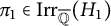 $\pi _1 \in \text {Irr}_{\overline {\mathbb {Q}}}(H_1)$
, we have
$\pi _1 \in \text {Irr}_{\overline {\mathbb {Q}}}(H_1)$
, we have
 $$ \begin{align*}{}^\sigma \Theta_{[\psi]}(\pi_1) \simeq \Theta_{[\psi^\sigma]}({}^\sigma \pi_1).\end{align*} $$
There are several perspectives we would like to explore after this work, that appeared as some sources of motivation at a late stage of writing, such as questions related to the global theta correspondence and its rationality – the rationality of certain automorphic periods seems of great interest and there is a series of papers [Reference Prasanna8–Reference Prasanna10] by Prasanna in this direction in the context of the Shimura correspondence and the work of Waldspurger. There are also two additional questions that we do not address in this work and intend to study later. On the one hand, we simply bound the field of realization in the local theta correspondence as it could shrink even more by pulling back the Weil representation to a specific dual pair, though our result is optimal for the pair $(\text {Sp}(W),\{\pm 1 \})$
. On the other hand, we did not consider the local archimedean version of the Weil representation. Though its usual archimedean model may not be well suited for a descent argument, its Fock model is more likely to be. Finally, one should be very cautious toward splittings in the theta correspondence as they may require to introduce some
$(\text {Sp}(W),\{\pm 1 \})$
. On the other hand, we did not consider the local archimedean version of the Weil representation. Though its usual archimedean model may not be well suited for a descent argument, its Fock model is more likely to be. Finally, one should be very cautious toward splittings in the theta correspondence as they may require to introduce some $4$
-th or
$4$
-th or $8$
-th roots of unity that could take us out of the realization field.
$8$
-th roots of unity that could take us out of the realization field.
1.1 Content of the article
In Section 3, we recall the definition of the character field of a representation as well as the notion of a field of realization. In Sections 4 and 5, we develop some general background about representations with coefficients in a perfect field that is not necessarily algebraically closed. We explain how extension and restriction of scalars behave and compare the largest isotypic quotients over a base field and its algebraic closure. In Section 6, we apply the results of the previous sections in the context of theta lifts. We also introduce the Schur index. In Section 7, we expose the Galois descent theorems we are going to use and we rephrase them in terms of Morita equivalences – representation theorists may find this perspective appealing. Section 8 points out that the representation which is at the heart of the construction of the Weil representation, namely, the Heisenberg representation, does not descend to a number field. This could look like a negative answer to descending the Weil representation over a number field, but the answer is a bit more subtle because, as we show in Sections 9 and 10, the Weil representation does descend to a number field even though the Heisenberg representation does not. This is, in some sense, the obstacle Dipendra Prasad already remarked by referring to the additive character $\psi $
. Sections 9 and 10 are dedicated to performing our explicit Galois descent on the Weil representation. On top of finding the character field and the fields of realization for the – even and odd parts of the – Weil representation, we are also able to determine its Schur index. Our results also apply in the modular setting – that is, for coefficient fields of positive characteristic – and in families – that is, for coefficient rings such as rings of integers.
$\psi $
. Sections 9 and 10 are dedicated to performing our explicit Galois descent on the Weil representation. On top of finding the character field and the fields of realization for the – even and odd parts of the – Weil representation, we are also able to determine its Schur index. Our results also apply in the modular setting – that is, for coefficient fields of positive characteristic – and in families – that is, for coefficient rings such as rings of integers.
2 Notations
A locally profinite group G is a locally compact totally disconnected topological group. Let K be a compact open subgroup of G. The pro-order of K is the least common multiple of the cardinality of the finite quotients of K [Reference Vignéras12, Section I.1.5]. The pro-order $|G|$
of G is the least common multiple of the
$|G|$
of G is the least common multiple of the $|K|$
’s, where K runs over all compact open subgroups of G. When G is a reductive group over F, that is, the F-points of a reductive algebraic group defined over F, we usually have
$|K|$
’s, where K runs over all compact open subgroups of G. When G is a reductive group over F, that is, the F-points of a reductive algebraic group defined over F, we usually have $|G| = n_f p^k$
, where
$|G| = n_f p^k$
, where $n_f \in \mathbb {N}$
is prime-to-p and
$n_f \in \mathbb {N}$
is prime-to-p and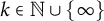 $k \in \mathbb {N} \cup \{\infty \}$
.
$k \in \mathbb {N} \cup \{\infty \}$
.
Let R be a commutative ring. Let $C_c^\infty (G,R)$
be the space of locally constant compactly supported functions on G valued in R. If G contains an open subgroup of invertible pro-order in R, there exists a Haar measure
$C_c^\infty (G,R)$
be the space of locally constant compactly supported functions on G valued in R. If G contains an open subgroup of invertible pro-order in R, there exists a Haar measure $\mu $
of G with values in R by [Reference Vignéras12, Section I.2.4]. If a compact open subgroup K has invertible pro-order in R, there exists a unique measure
$\mu $
of G with values in R by [Reference Vignéras12, Section I.2.4]. If a compact open subgroup K has invertible pro-order in R, there exists a unique measure $\mu _K$
such that K has volume
$\mu _K$
such that K has volume $1$
. We call it the normalized measure on K. All such normalized measures are unique up to a scalar in
$1$
. We call it the normalized measure on K. All such normalized measures are unique up to a scalar in $R^\times $
and the normalized measures generate all Haar measures on G. After fixing a normalized measure of G, we can endow
$R^\times $
and the normalized measures generate all Haar measures on G. After fixing a normalized measure of G, we can endow $C_c^\infty (G,R)$
with a structure of R-algebra and we denote this algebra by
$C_c^\infty (G,R)$
with a structure of R-algebra and we denote this algebra by $\mathcal {H}_R(G)$
and call it the Hecke algebra.
$\mathcal {H}_R(G)$
and call it the Hecke algebra.
An $R[G]$
-module V is smooth if
$R[G]$
-module V is smooth if $\text {Stab}_G(v) = \{ g \in G \ | \ g \cdot v = v \}$
is open in G for all
$\text {Stab}_G(v) = \{ g \in G \ | \ g \cdot v = v \}$
is open in G for all $v \in V$
. We also use the word representation for a smooth
$v \in V$
. We also use the word representation for a smooth $R[G]$
-module. We denote by
$R[G]$
-module. We denote by $\text {Rep}_R(G)$
the category of smooth
$\text {Rep}_R(G)$
the category of smooth $R[G]$
-modules and by
$R[G]$
-modules and by $\text {Irr}_R(G)$
the isomorphism classes of irreducible representations. We say that
$\text {Irr}_R(G)$
the isomorphism classes of irreducible representations. We say that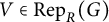 $V \in \text {Rep}_R(G)$
is admissible if the subspace of K-fixed vectors
$V \in \text {Rep}_R(G)$
is admissible if the subspace of K-fixed vectors $V^K$
is a finitely generated R-module for all compact open subgroups K of G. Let H be a closed subgroup of G, we define a functor
$V^K$
is a finitely generated R-module for all compact open subgroups K of G. Let H be a closed subgroup of G, we define a functor $\text {Ind}_H^G : \text {Rep}_R(H) \to \text {Rep}_R(G)$
by associating to
$\text {Ind}_H^G : \text {Rep}_R(H) \to \text {Rep}_R(G)$
by associating to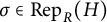 $\sigma \in \text {Rep}_R(H)$
the space
$\sigma \in \text {Rep}_R(H)$
the space $\text {Ind}_H^G(\sigma )$
of smooth functions
$\text {Ind}_H^G(\sigma )$
of smooth functions $f : G \to \sigma $
such that
$f : G \to \sigma $
such that $f(hg) = \sigma (h) f(g)$
for all
$f(hg) = \sigma (h) f(g)$
for all $h \in H$
and all
$h \in H$
and all $g \in G$
, endowed with the smooth G-action
$g \in G$
, endowed with the smooth G-action $g \cdot f(g') = f(g' g)$
. We also define the subfunctor
$g \cdot f(g') = f(g' g)$
. We also define the subfunctor $\text {ind}_H^G$
of
$\text {ind}_H^G$
of $\text {Ind}_H^G$
by moreover requiring that functions have compact support modulo H.
$\text {Ind}_H^G$
by moreover requiring that functions have compact support modulo H.
A representation or a module is called isotypic if it is semisimple and all its simple subquotients are isomorphic. We may specify the simple subquotient when needed, that is, for $\pi $
simple, we have V is
$\pi $
simple, we have V is $\pi $
-isotypic if and only if
$\pi $
-isotypic if and only if $V \simeq \oplus \pi $
.
$V \simeq \oplus \pi $
.
For $n \in \mathbb {N}$
, we denote by
$n \in \mathbb {N}$
, we denote by $\zeta _n \in \mathbb {C}$
the usual primitive n-root of unity, that is,
$\zeta _n \in \mathbb {C}$
the usual primitive n-root of unity, that is, $\zeta _n = e^{\frac {2 i \pi }{n}}$
. If R is an integral domain and a nontrivial smooth (additive) character
$\zeta _n = e^{\frac {2 i \pi }{n}}$
. If R is an integral domain and a nontrivial smooth (additive) character $\psi : F \to R^\times $
exists, then the characteristic
$\psi : F \to R^\times $
exists, then the characteristic $\ell $
of R is necessarily different from p. Moreover, R must contain enough p-roots or p-power roots of unity. Let
$\ell $
of R is necessarily different from p. Moreover, R must contain enough p-roots or p-power roots of unity. Let $\mathbb {Z}[\zeta _{p^\infty }] = \cup _k \mathbb {Z}[\zeta _{p^k}]$
and let
$\mathbb {Z}[\zeta _{p^\infty }] = \cup _k \mathbb {Z}[\zeta _{p^k}]$
and let
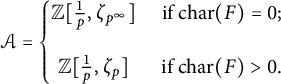 $$ \begin{align*}\mathcal{A} = \left\{ \begin{array}{@{}cc} \mathbb{Z}[\frac{1}{p},\zeta_{p^\infty}] & \text{ if } \text{char} (F) = 0; \\ & \\ \mathbb{Z}[\frac{1}{p},\zeta_p] & \text{ if } \text{char}(F)> 0. \end{array} \right.\end{align*} $$
Then there exists a nontrivial character $\psi : F \to R^\times $
with
$\psi : F \to R^\times $
with $p \in R^\times $
if and only if R can be endowed with a structure of
$p \in R^\times $
if and only if R can be endowed with a structure of $\mathcal {A}$
-algebra. We always assume that R satisfies this condition.
$\mathcal {A}$
-algebra. We always assume that R satisfies this condition.
Let F be a field of characteristic different from $2$
, which is either a finite field of cardinality q or a non-archimedean local field of residue cardinality q. We write
$2$
, which is either a finite field of cardinality q or a non-archimedean local field of residue cardinality q. We write $q=p^f$
. When F is local non-archimedean, we let
$q=p^f$
. When F is local non-archimedean, we let $\mathcal {O}_F$
be its ring of integers and
$\mathcal {O}_F$
be its ring of integers and $k_F$
be its residue field and we fix a uniformizer
$k_F$
be its residue field and we fix a uniformizer $\varpi _F$
in
$\varpi _F$
in $\mathcal {O}_F$
. Let
$\mathcal {O}_F$
. Let $( - , - )_F$
be the quadratic Hilbert symbol, which is trivial if F is finite. If F is local non-archimedean and V is a finite-dimensional F-vector space, a lattice in V is a free
$( - , - )_F$
be the quadratic Hilbert symbol, which is trivial if F is finite. If F is local non-archimedean and V is a finite-dimensional F-vector space, a lattice in V is a free $\mathcal {O}_F$
-module of rank the dimension of V.
$\mathcal {O}_F$
-module of rank the dimension of V.
Let $(W, \langle - , - \rangle )$
be a symplectic vector space of dimension
$(W, \langle - , - \rangle )$
be a symplectic vector space of dimension $n=2m$
over F. A subspace
$n=2m$
over F. A subspace $X \subseteq W$
is totally isotropic if
$X \subseteq W$
is totally isotropic if $\langle - , - \rangle |_{X \times X}$
is identically zero. A totally isotropic subspace is maximal if and only if it has dimension m. Such a maximal space is called a Lagrangian in W. A complete polarization
$\langle - , - \rangle |_{X \times X}$
is identically zero. A totally isotropic subspace is maximal if and only if it has dimension m. Such a maximal space is called a Lagrangian in W. A complete polarization $W=X \oplus Y$
is made of two transverse Lagrangians X and Y in W. The symplectic group
$W=X \oplus Y$
is made of two transverse Lagrangians X and Y in W. The symplectic group $\text {Sp}(W)$
is the group of isometries of W.
$\text {Sp}(W)$
is the group of isometries of W.
Part I
Generalities about rationality
3 Rationality
3.1
Let R be a commutative ring. Let $\mathcal {H}$
be an R-algebra. Let V be an
$\mathcal {H}$
be an R-algebra. Let V be an $\mathcal {H}$
-module that is finite free as an R-module. Let
$\mathcal {H}$
-module that is finite free as an R-module. Let $\mathcal {B} = (e_i)_{i \in I}$
be an R-basis of V and let
$\mathcal {B} = (e_i)_{i \in I}$
be an R-basis of V and let $(e_i^*)_{i \in I}$
be its dual basis in
$(e_i^*)_{i \in I}$
be its dual basis in $\text {Hom}_R(V,R)$
. This defines endomorphisms
$\text {Hom}_R(V,R)$
. This defines endomorphisms $e_{m,n} = e_n^* \otimes _R e_m \in \text {End}_R(V)$
for
$e_{m,n} = e_n^* \otimes _R e_m \in \text {End}_R(V)$
for $m, n \in \mathcal {B}$
via
$m, n \in \mathcal {B}$
via
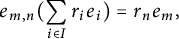 $$ \begin{align*}e_{m,n}(\sum_{i \in I} r_i e_i) = r_n e_m,\end{align*} $$
where $(r_i)_{i \in I}$
are elements in R.
$(r_i)_{i \in I}$
are elements in R.
For $h \in \mathcal {H}$
, we denote by
$h \in \mathcal {H}$
, we denote by $h_V \in \text {End}_R(V)$
the action of h on V. There exists a unique family
$h_V \in \text {End}_R(V)$
the action of h on V. There exists a unique family $(\alpha _{m,n})_{m,n \in I}$
of elements of R such that
$(\alpha _{m,n})_{m,n \in I}$
of elements of R such that $h_V = \sum _{m,n \in I} \alpha _{m,n} e_{m,n}$
. We define
$h_V = \sum _{m,n \in I} \alpha _{m,n} e_{m,n}$
. We define $\text {tr}_V : \mathcal {H} \to R$
by
$\text {tr}_V : \mathcal {H} \to R$
by
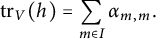 $$ \begin{align*}\text{tr}_V (h) = \sum_{m \in I} \alpha_{m,m}.\end{align*} $$
It is well-known that $\text {tr}_V$
is actually independent of the choice of the basis
$\text {tr}_V$
is actually independent of the choice of the basis $\mathcal {B}$
.
$\mathcal {B}$
.
Definition 3.1 We call $\text {tr}_V$
the trace-character of V.
$\text {tr}_V$
the trace-character of V.
3.2
From now on, let $R_0$
be
$R_0$
be $\mathbb {Q}$
or
$\mathbb {Q}$
or $\mathbb {F}_\ell $
and assume R is an algebraic extension of
$\mathbb {F}_\ell $
and assume R is an algebraic extension of $R_0$
. We define
$R_0$
. We define $R_c(V)$
as the subfield of R generated by
$R_c(V)$
as the subfield of R generated by $R_0$
and the values of
$R_0$
and the values of $\text {tr}_V$
.
$\text {tr}_V$
.
Definition 3.2 We call $R_c(V)$
the character field of V and we call any subfield of R containing
$R_c(V)$
the character field of V and we call any subfield of R containing $R_c(V)$
a field of character of V.
$R_c(V)$
a field of character of V.
3.3
Let $\text {Aut}(R)$
be the automorphism of fields of R. Such automorphisms are necessarily
$\text {Aut}(R)$
be the automorphism of fields of R. Such automorphisms are necessarily $R_0$
-linear, so this is also
$R_0$
-linear, so this is also $\text {Aut}_{R_0}(R)$
. For Z a subset of
$\text {Aut}_{R_0}(R)$
. For Z a subset of $\text {Aut}(R)$
, we denote by
$\text {Aut}(R)$
, we denote by $R^Z$
the subfield of R formed by the elements fixed by Z.
$R^Z$
the subfield of R formed by the elements fixed by Z.
For $\sigma \in \text {Aut}(R)$
, let
$\sigma \in \text {Aut}(R)$
, let $f_\sigma : V \to V$
be the
$f_\sigma : V \to V$
be the $\sigma $
-equivariant isomorphism defined by
$\sigma $
-equivariant isomorphism defined by
 $$ \begin{align*}f_\sigma(\sum r_i e_i) = \sum \sigma(r_i) e_i.\end{align*} $$
We endow the R-vector space $V^{f_\sigma } = V$
with the
$V^{f_\sigma } = V$
with the $\mathcal {H}$
-action defined by
$\mathcal {H}$
-action defined by
 $$ \begin{align*}h_{V^{f_\sigma}} = f_\sigma h_V f_\sigma^{-1} \in \text{End}_R(V) \text{ for } h \in \mathcal{H}.\end{align*} $$
If $\mathcal {B}' = (e_i')$
is another R-basis of V, we can define
$\mathcal {B}' = (e_i')$
is another R-basis of V, we can define $f_\sigma '$
and
$f_\sigma '$
and $V^{f_\sigma '}$
in an analogous way. The two
$V^{f_\sigma '}$
in an analogous way. The two $\mathcal {H}$
-modules
$\mathcal {H}$
-modules $V^{f_\sigma }$
and
$V^{f_\sigma }$
and $V^{f_\sigma '}$
thus obtained are isomorphic. We denote by
$V^{f_\sigma '}$
thus obtained are isomorphic. We denote by $V^\sigma $
this well-defined isomorphism class.
$V^\sigma $
this well-defined isomorphism class.
Let $H(V) = \{ \sigma \in \text {Aut}(R) \ | \ V^\sigma \simeq V\}$
and set
$H(V) = \{ \sigma \in \text {Aut}(R) \ | \ V^\sigma \simeq V\}$
and set $R_r(V) = R^{H(V)}$
.
$R_r(V) = R^{H(V)}$
.
Definition 3.3 We call $R_r(V)$
the rationality field of V and we call any subfield of R containing
$R_r(V)$
the rationality field of V and we call any subfield of R containing $R_r(V)$
a field of rationality of V.
$R_r(V)$
a field of rationality of V.
3.4
Let $\bar {R}$
be an algebraic closure of R. We say that V is absolutely simple if
$\bar {R}$
be an algebraic closure of R. We say that V is absolutely simple if $V \otimes _R \bar {R}$
is a simple
$V \otimes _R \bar {R}$
is a simple $(\mathcal {H} \otimes _R \bar {R})$
-module. By the linear independence of characters [Reference Bourbaki1, A VIII.376, Corollary], we deduce the following proposition.
$(\mathcal {H} \otimes _R \bar {R})$
-module. By the linear independence of characters [Reference Bourbaki1, A VIII.376, Corollary], we deduce the following proposition.
Proposition 3.4 If V is absolutely simple, then $R_c(V) = R_r(V)$
.
$R_c(V) = R_r(V)$
.
In this situation, we simply write $R(V)$
for the character/rationality field of V.
$R(V)$
for the character/rationality field of V.
Remark 3.5. Note that, in positive characteristic $\ell $
, we have
$\ell $
, we have $\text {tr}_{\ell V} = \ell \text {tr}_V$
is always identically zero, so
$\text {tr}_{\ell V} = \ell \text {tr}_V$
is always identically zero, so $R_c(\ell V)= R_0$
in this case, though
$R_c(\ell V)= R_0$
in this case, though $R_r(\ell V)$
may be a strict extension of
$R_r(\ell V)$
may be a strict extension of $R_0$
. Therefore, the proposition does not extend to all V semisimple.
$R_0$
. Therefore, the proposition does not extend to all V semisimple.
3.5
Let $\mathcal {H}_0$
be an
$\mathcal {H}_0$
be an $R_0$
-algebra and assume
$R_0$
-algebra and assume $\mathcal {H} = \mathcal {H}_0 \otimes _{R_0} R$
. The algebraic closure
$\mathcal {H} = \mathcal {H}_0 \otimes _{R_0} R$
. The algebraic closure $\bar {R}$
of R is also an algebraic closure of
$\bar {R}$
of R is also an algebraic closure of $R_0$
. If
$R_0$
. If $R' \subseteq \bar {R}$
is a subfield, we set
$R' \subseteq \bar {R}$
is a subfield, we set $\mathcal {H}_{R'} = \mathcal {H}_0 \otimes _{R_0} R'$
.
$\mathcal {H}_{R'} = \mathcal {H}_0 \otimes _{R_0} R'$
.
Definition 3.6 We say that a subfield $R' \subseteq \bar {R}$
is a field of realization of V if there exists an
$R' \subseteq \bar {R}$
is a field of realization of V if there exists an $\mathcal {H}_{R'}$
-module
$\mathcal {H}_{R'}$
-module $V'$
such that
$V'$
such that $V' \otimes _{R'} \bar {R} \simeq V \otimes _R \bar {R}$
as
$V' \otimes _{R'} \bar {R} \simeq V \otimes _R \bar {R}$
as $\mathcal {H}_{\bar {R}}$
-modules.
$\mathcal {H}_{\bar {R}}$
-modules.
When $V'$
is a realization of V over
$V'$
is a realization of V over $R'$
, it is clear that
$R'$
, it is clear that $R_c(V') = R_c(V)$
. Therefore, a field of realization of V is always a field of character. In the context of Proposition 3.4, a field of realization is also a field of rationality if V is absolutely simple.
$R_c(V') = R_c(V)$
. Therefore, a field of realization of V is always a field of character. In the context of Proposition 3.4, a field of realization is also a field of rationality if V is absolutely simple.
3.6
We assume that V is absolutely simple. Let $m(V) \in \mathbb {N} \cup \{+ \infty \}$
be the infimum of the degrees
$m(V) \in \mathbb {N} \cup \{+ \infty \}$
be the infimum of the degrees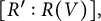 $[R':R(V)],$
where
$[R':R(V)],$
where $R'$
runs over the fields of realization of V.
$R'$
runs over the fields of realization of V.
Definition 3.7 We call $m(V)$
the Schur index of V.
$m(V)$
the Schur index of V.
3.7
Let G be a locally profinite group and assume G contains a compact open subgroup of invertible pro-order in R. Following [Reference Vignéras12, Section I.6], the trace-character of an admissible representation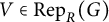 $V \in \text {Rep}_R(G)$
is a linear form
$V \in \text {Rep}_R(G)$
is a linear form $\text {tr}_V : \mathcal {H}_R(G) \to R$
on the Hecke algebra. When K is a compact open subgroup of G, its restriction to the relative Hecke algebra
$\text {tr}_V : \mathcal {H}_R(G) \to R$
on the Hecke algebra. When K is a compact open subgroup of G, its restriction to the relative Hecke algebra $\mathcal {H}_R(G,K)$
of K-bi-invariant functions gives a trace-character as considered above.
$\mathcal {H}_R(G,K)$
of K-bi-invariant functions gives a trace-character as considered above.
If moreover V is finitely generated, then V is generated by $V^K$
for some compact open subgroup K of G. We then set
$V^K$
for some compact open subgroup K of G. We then set $R_c(V) = R_c(V^K)$
and
$R_c(V) = R_c(V^K)$
and $R_r(V) = R_r(V^K)$
, which do not depend on the choice of K. When V is absolutely simple, we simply write
$R_r(V) = R_r(V^K)$
, which do not depend on the choice of K. When V is absolutely simple, we simply write $R(V)$
.
$R(V)$
.
4 Scalar extension and restriction of scalars
In this section, let R be a field of characteristic $\ell $
.
$\ell $
.
4.1
Let $G_1$
and
$G_1$
and $G_2$
be locally profinite groups. We assume that
$G_2$
be locally profinite groups. We assume that $G_1$
and
$G_1$
and $G_2$
contain compact open subgroups of invertible pro-order in R. Let
$G_2$
contain compact open subgroups of invertible pro-order in R. Let $(\pi _1,V_1) \in \text {Rep}_R(G_1)$
and set
$(\pi _1,V_1) \in \text {Rep}_R(G_1)$
and set $D_1 = \text {End}_{R[G_1]}(\pi _1)$
. The representation
$D_1 = \text {End}_{R[G_1]}(\pi _1)$
. The representation $(\pi _1,V_1)$
is a left
$(\pi _1,V_1)$
is a left $D_1$
-module via
$D_1$
-module via $f_1 \cdot v_1 = f_1(v_1)$
for
$f_1 \cdot v_1 = f_1(v_1)$
for $f_1 \in D_1$
and
$f_1 \in D_1$
and $v_1 \in V_1$
. This module structure commutes with the
$v_1 \in V_1$
. This module structure commutes with the $G_1$
-action, so
$G_1$
-action, so $V_1$
is a module over
$V_1$
is a module over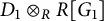 $D_1 \otimes _R R[G_1]$
. We use similar notations for
$D_1 \otimes _R R[G_1]$
. We use similar notations for $G_2$
.
$G_2$
.
We now assume that $(\pi _1,V_1) \in \text {Rep}_R(G_1)$
and
$(\pi _1,V_1) \in \text {Rep}_R(G_1)$
and $(\pi _2,V_2) \in \text {Rep}_R(G_2)$
are two irreducible representations. Their endomorphism rings
$(\pi _2,V_2) \in \text {Rep}_R(G_2)$
are two irreducible representations. Their endomorphism rings $D_1 = \text {End}_{R[G_1]}(\pi _1)$
and
$D_1 = \text {End}_{R[G_1]}(\pi _1)$
and $D_2 = \text {End}_{R[G_2]}(\pi _2)$
are division algebras by Schur’s lemma. We apply [Reference Bourbaki1, A VIII.210, Theorem 2] to obtain the following lemma.
$D_2 = \text {End}_{R[G_2]}(\pi _2)$
are division algebras by Schur’s lemma. We apply [Reference Bourbaki1, A VIII.210, Theorem 2] to obtain the following lemma.
Lemma 4.1 We set $V=V_1 \otimes _R V_2 \in \mathrm{Rep}_R(G_1 \times G_2)$
and
$V=V_1 \otimes _R V_2 \in \mathrm{Rep}_R(G_1 \times G_2)$
and $D =\mathrm{End}_{R[G_1 \times G_2]}(V_1 \otimes _R V_2)$
. Then
$D =\mathrm{End}_{R[G_1 \times G_2]}(V_1 \otimes _R V_2)$
. Then
 $$ \begin{align*}D \cong D_1 \otimes_R D_2.\end{align*} $$
Moreover, the set $\mathbb {V}$
of subrepresentations of V is in bijection with the set
$\mathbb {V}$
of subrepresentations of V is in bijection with the set $\mathbb {D}$
of right sub-D-modules of D, thanks to the inclusion preserving bijection
$\mathbb {D}$
of right sub-D-modules of D, thanks to the inclusion preserving bijection
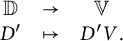 $$ \begin{align*}\begin{array}{ccc} \mathbb{D} & \to & \mathbb{V} \\ D' & \mapsto & D' V. \end{array}\end{align*} $$
4.2
We are going to generalize [Reference Vignéras12, Section II.4.4], whose proof is valid only when $\ell $
is
$\ell $
is $0$
, since it relies on the linear independence of trace-characters. In the modular setting, Lemma 4.1 provides a suitable substitute. We now need to introduce some notations.
$0$
, since it relies on the linear independence of trace-characters. In the modular setting, Lemma 4.1 provides a suitable substitute. We now need to introduce some notations.
Let G be a locally profinite group containing a compact open subgroup of invertible pro-order in R. We recall the definition of the action of a “Galois” element on a given representation. Let $R'$
be an algebraic extension of R and let
$R'$
be an algebraic extension of R and let $w : R' \to R'$
be an automorphism of R-algebras. For any representation
$w : R' \to R'$
be an automorphism of R-algebras. For any representation $(\rho ,V) \in \text {Rep}_{R'}(G)$
, choosing an
$(\rho ,V) \in \text {Rep}_{R'}(G)$
, choosing an $R'$
-basis
$R'$
-basis $(e_i)_{i \in I}$
of V, we define
$(e_i)_{i \in I}$
of V, we define $({}^w \rho , V) \in \text {Rep}_R(G)$
by
$({}^w \rho , V) \in \text {Rep}_R(G)$
by
 $$ \begin{align*}[{}^w \rho(g)]_{i,j} = w([\rho(g)]_{i,j}) \text{ where } i, j \in I \text{ and } g \in G.\end{align*} $$
We obtain a well-defined representation in the sense that the isomorphism class of $({}^w \rho ,V)$
is independent of the choice of the basis
$({}^w \rho ,V)$
is independent of the choice of the basis $(e_i)_{i \in I}$
[Reference Vignéras12, Section II.4.1.a].
$(e_i)_{i \in I}$
[Reference Vignéras12, Section II.4.1.a].
We fix an algebraic closure $\bar {R}$
of R and recall a few notions from [Reference Vignéras12, Section II.4]. The rationality field
$\bar {R}$
of R and recall a few notions from [Reference Vignéras12, Section II.4]. The rationality field $R_r(\rho )$
of a representation
$R_r(\rho )$
of a representation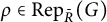 $\rho \in \text {Rep}_{\bar {R}}(G)$
is defined as the fixed field of
$\rho \in \text {Rep}_{\bar {R}}(G)$
is defined as the fixed field of $H(\rho ) = \{ w \in \text {Gal}_R(\bar {R}) \ | \ {}^w \rho \simeq \rho \}$
in
$H(\rho ) = \{ w \in \text {Gal}_R(\bar {R}) \ | \ {}^w \rho \simeq \rho \}$
in $\bar {R,}$
that is,
$\bar {R,}$
that is,
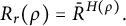 $$ \begin{align*}R_r(\rho) = \bar{R}^{H(\rho)}.\end{align*} $$
Note that the extension $R_r(\rho )/R$
is not normal in general, or equivalently,
$R_r(\rho )/R$
is not normal in general, or equivalently, $H(\rho )$
is not necessarily normal in
$H(\rho )$
is not necessarily normal in $\text {Gal}_R(\overline {R})$
, even if
$\text {Gal}_R(\overline {R})$
, even if $R=\mathbb {Q}$
. Indeed, endow
$R=\mathbb {Q}$
. Indeed, endow $G=\mathbb {Z}$
with the discrete topology. The character
$G=\mathbb {Z}$
with the discrete topology. The character $\chi $
sending
$\chi $
sending $1 \in \mathbb {Z}$
to
$1 \in \mathbb {Z}$
to $\sqrt [3]{2} \in \overline {\mathbb {Q}}$
has rationality field
$\sqrt [3]{2} \in \overline {\mathbb {Q}}$
has rationality field $\mathbb {Q}[\sqrt [3]{2}]$
since
$\mathbb {Q}[\sqrt [3]{2}]$
since $H(\chi ) = \text {Gal}(\overline {\mathbb {Q}}/\mathbb {Q}[\sqrt [3]{2}])$
but the extension
$H(\chi ) = \text {Gal}(\overline {\mathbb {Q}}/\mathbb {Q}[\sqrt [3]{2}])$
but the extension $\mathbb {Q}[\sqrt [3]{2}]/\mathbb {Q}$
is not normal. For finite groups however, normality is ensured by the fact that there exists a cyclotomic extension, depending on the exponent of G, that is a splitting field, that is, all irreducible representations can be realized over that field.
$\mathbb {Q}[\sqrt [3]{2}]/\mathbb {Q}$
is not normal. For finite groups however, normality is ensured by the fact that there exists a cyclotomic extension, depending on the exponent of G, that is a splitting field, that is, all irreducible representations can be realized over that field.
If R is not perfect, we also remark that $R_r(\rho )/R$
can be really big because
$R_r(\rho )/R$
can be really big because $R_r(\rho )$
must contain the perfect closure of R. To avoid complication coming from the imperfect case, we exclude it from now on.
$R_r(\rho )$
must contain the perfect closure of R. To avoid complication coming from the imperfect case, we exclude it from now on.
Remark 4.2. This definition of $R_r(\rho )$
agrees with the definition of Section 3.7 as long as
$R_r(\rho )$
agrees with the definition of Section 3.7 as long as $\rho $
is finitely generated and admissible.
$\rho $
is finitely generated and admissible.
4.3
From now on, assume R is a perfect field. A field of realization of $\rho $
is a field E such that there exists
$\rho $
is a field E such that there exists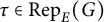 $\tau \in \text {Rep}_E(G)$
irreducible such that
$\tau \in \text {Rep}_E(G)$
irreducible such that $\tau \otimes _E \bar {R} \simeq \rho $
. In this case, we say that
$\tau \otimes _E \bar {R} \simeq \rho $
. In this case, we say that $\rho $
can be realized over E. Since R is perfect, the algebraic extension
$\rho $
can be realized over E. Since R is perfect, the algebraic extension $\bar {R}/R$
is Galois and we know [Reference Vignéras12, Section II.4.1.c] that a field of realization of
$\bar {R}/R$
is Galois and we know [Reference Vignéras12, Section II.4.1.c] that a field of realization of $\rho $
must contain its rationality field
$\rho $
must contain its rationality field $R_r(\rho )$
and its character field
$R_r(\rho )$
and its character field $R_c(\rho )$
. If
$R_c(\rho )$
. If $\rho $
is irreducible and admissible, we recall that its character/rationality field
$\rho $
is irreducible and admissible, we recall that its character/rationality field $R(\rho )$
is not necessarily a field of realization and the Schur index
$R(\rho )$
is not necessarily a field of realization and the Schur index $m(\rho )$
measures the smallest degree of a field of realization over
$m(\rho )$
measures the smallest degree of a field of realization over $R(\rho )$
. For E a field extension of R, we let
$R(\rho )$
. For E a field extension of R, we let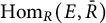 $\text {Hom}_R(E,\bar {R})$
denote the R-linear embeddings of the field E in
$\text {Hom}_R(E,\bar {R})$
denote the R-linear embeddings of the field E in $\bar {R}$
.
$\bar {R}$
.
Theorem 4.3 Let R be a perfect field. Let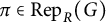 $\pi \in \mathrm{Rep}_R(G)$
be irreducible and admissible. Then
$\pi \in \mathrm{Rep}_R(G)$
be irreducible and admissible. Then $D=\mathrm{End}_{R[G]}(\pi )$
has finite dimension over R. Let
$D=\mathrm{End}_{R[G]}(\pi )$
has finite dimension over R. Let
-
• E be the center of D and
$n = \mathrm{dim}_R(E)$
; -
• m be the degree of D over its center E, that is,
$m^2 = \mathrm{dim}_E(D)$
.


Let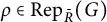 $\rho \in \mathrm{Rep}_{\bar {R}}(G)$
be an irreducible factor in
$\rho \in \mathrm{Rep}_{\bar {R}}(G)$
be an irreducible factor in $\pi \otimes _R \bar {R}$
. Let
$\pi \otimes _R \bar {R}$
. Let $\mathcal {O}_\rho $
be the
$\mathcal {O}_\rho $
be the $\mathrm{Gal}_R(\bar {R})$
-orbit of
$\mathrm{Gal}_R(\bar {R})$
-orbit of $\rho $
. Then
$\rho $
. Then $\mathcal {O}_\rho $
is a finite set, that is,
$\mathcal {O}_\rho $
is a finite set, that is, $R(\rho )/R$
is finite and we have
$R(\rho )/R$
is finite and we have
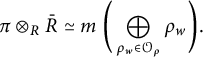 $$ \begin{align*}\pi \otimes_R \bar{R} \simeq m \ \bigg( \bigoplus_{\rho_w \in \mathcal{O}_\rho} \rho_w \bigg).\end{align*} $$
Moreover, there exists a bijection $\mathcal {O}_\rho \simeq \mathrm{Hom}_R(E,\bar {R})$
compatible with the
$\mathcal {O}_\rho \simeq \mathrm{Hom}_R(E,\bar {R})$
compatible with the $\mathrm{Gal}_R(\bar {R})$
-actions on each side. In particular,
$\mathrm{Gal}_R(\bar {R})$
-actions on each side. In particular, $|\mathcal {O}_\rho | = n$
and
$|\mathcal {O}_\rho | = n$
and $R(\rho ) \simeq E$
.
$R(\rho ) \simeq E$
.
Proof We are going to show that there exists a finite extension $R'$
of R in
$R'$
of R in $\bar {R}$
such that the result is true over
$\bar {R}$
such that the result is true over $R'$
. Our goal is to prove that the representation
$R'$
. Our goal is to prove that the representation $\pi _1 \otimes _R R'$
is a sum of absolutely irreducible representations with the same multiplicity and obtained as Galois conjugate of one another. First of all, D is a division algebra by Schur’s lemma and R is contained in its center E. This division algebra has finite dimension over R because
$\pi _1 \otimes _R R'$
is a sum of absolutely irreducible representations with the same multiplicity and obtained as Galois conjugate of one another. First of all, D is a division algebra by Schur’s lemma and R is contained in its center E. This division algebra has finite dimension over R because $\pi $
is admissible and irreducible. In particular, there exists a (separable) extension
$\pi $
is admissible and irreducible. In particular, there exists a (separable) extension $E'$
of E of degree m, where
$E'$
of E of degree m, where $m^2 = \text {dim}_E(D)$
, such that
$m^2 = \text {dim}_E(D)$
, such that $D \otimes _E E' \simeq M_{m}(E')$
is split.
$D \otimes _E E' \simeq M_{m}(E')$
is split.
We embed $E'$
, and therefore E, in
$E'$
, and therefore E, in $\bar {R}$
and take the Galois closure
$\bar {R}$
and take the Galois closure $R'$
of
$R'$
of $E'$
in
$E'$
in $\bar {R}$
. We see
$\bar {R}$
. We see $R'$
as an irreducible representation of the group
$R'$
as an irreducible representation of the group $\mathbb {Z}$
endowed with the discrete topology in the following way. Thanks to the primitive element theorem, there exists a nonzero
$\mathbb {Z}$
endowed with the discrete topology in the following way. Thanks to the primitive element theorem, there exists a nonzero $\beta \in R'$
with minimal polynomial P such that
$\beta \in R'$
with minimal polynomial P such that $R' = R[\beta ] \simeq R[X]/(P(X))$
. The representation
$R' = R[\beta ] \simeq R[X]/(P(X))$
. The representation $(\pi ',R') \in \text {Rep}_R(\mathbb {Z})$
defined by
$(\pi ',R') \in \text {Rep}_R(\mathbb {Z})$
defined by $\pi '( 1 ) = \beta \in \text {GL}_R(R')$
is irreducible.
$\pi '( 1 ) = \beta \in \text {GL}_R(R')$
is irreducible.
According to Lemma 4.1, the subrepresentations of $\pi _1 \otimes _R \pi _2 = \pi _1 \otimes _R R'$
correspond to right sub-
$\pi _1 \otimes _R \pi _2 = \pi _1 \otimes _R R'$
correspond to right sub- $(D \otimes _R R')$
-modules of
$(D \otimes _R R')$
-modules of $D \otimes _R R' = \text {End}_G(\pi ) \otimes _R R'$
. Since
$D \otimes _R R' = \text {End}_G(\pi ) \otimes _R R'$
. Since
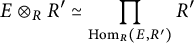 $$ \begin{align*}E \otimes_R R' \simeq \prod_{\text{Hom}_R(E,R')} R'\end{align*} $$
and $|\text {Hom}_R(E,R')| = n$
, we deduce that
$|\text {Hom}_R(E,R')| = n$
, we deduce that
 $$ \begin{align*}D \otimes_R R' \simeq \prod_{1 \leq k \leq n} M_m(R').\end{align*} $$
Moreover, $\pi \otimes _R R'$
is semisimple by [Reference Vignéras12, Section II.4.2]. Since
$\pi \otimes _R R'$
is semisimple by [Reference Vignéras12, Section II.4.2]. Since $D \otimes _R R' = \text {End}_G(\pi \otimes _R R')$
by Lemma 4.1 again, there exist non-isomorphic irreducible representations
$D \otimes _R R' = \text {End}_G(\pi \otimes _R R')$
by Lemma 4.1 again, there exist non-isomorphic irreducible representations $(\tau _k)$
in
$(\tau _k)$
in $\text {Rep}_{R'}(G)$
such that
$\text {Rep}_{R'}(G)$
such that
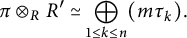 $$ \begin{align*}\pi \otimes_R R' \simeq \bigoplus_{1 \leq k \leq n} (m \tau_k).\end{align*} $$
Moreover, $\text {End}_G(\tau _k) = R'$
, so each
$\text {End}_G(\tau _k) = R'$
, so each $\tau _k$
is absolutely irreducible. As a result,
$\tau _k$
is absolutely irreducible. As a result,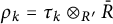 $\rho _k = \tau _k \otimes _{R'} \bar {R}$
is irreducible. Hence,
$\rho _k = \tau _k \otimes _{R'} \bar {R}$
is irreducible. Hence, $\pi \otimes _R \bar {R} \simeq m (\bigoplus _{1 \leq k \leq n} \rho _k)$
.
$\pi \otimes _R \bar {R} \simeq m (\bigoplus _{1 \leq k \leq n} \rho _k)$
.
It remains to show that $\text {Gal}_R(R')$
acts simply transitively on the n isomorphism classes defined by the family
$\text {Gal}_R(R')$
acts simply transitively on the n isomorphism classes defined by the family $(\tau _k)$
. Because
$(\tau _k)$
. Because $\pi $
is defined over R, the representations
$\pi $
is defined over R, the representations ${}^\sigma (\pi \otimes _R R')$
and
${}^\sigma (\pi \otimes _R R')$
and $\pi \otimes _R R'$
are isomorphic for all
$\pi \otimes _R R'$
are isomorphic for all $\sigma \in \text {Gal}_R(R')$
. Let
$\sigma \in \text {Gal}_R(R')$
. Let $e_k$
be the idempotent in
$e_k$
be the idempotent in $D \otimes _R R'$
which cuts out the
$D \otimes _R R'$
which cuts out the $\tau _k$
-isotypic part of
$\tau _k$
-isotypic part of $\pi \otimes _R R'$
. Note that
$\pi \otimes _R R'$
. Note that $e_k \in E \otimes _R R'$
belongs to the center of
$e_k \in E \otimes _R R'$
belongs to the center of $D \otimes _R R'$
. The Galois group
$D \otimes _R R'$
. The Galois group $\text {Gal}_R(R')$
acts transitively on
$\text {Gal}_R(R')$
acts transitively on $\text {Hom}_R(E,R')$
. It also induces an action on
$\text {Hom}_R(E,R')$
. It also induces an action on $E \otimes _R R'$
which acts transitively on the
$E \otimes _R R'$
which acts transitively on the $e_k$
’s. Let
$e_k$
’s. Let $\sigma \in \text {Gal}_R(R')$
and let
$\sigma \in \text {Gal}_R(R')$
and let $k'$
be such that
$k'$
be such that ${}^\sigma e_k = e_{k'}$
. We obtain
${}^\sigma e_k = e_{k'}$
. We obtain
 $$ \begin{align*}{}^\sigma(m \tau_k) \simeq {}^\sigma(e_k (\pi \otimes_R R')) \simeq e_{k'} {}^\sigma(\pi \otimes_R R') \simeq e_{k'} (\pi \otimes_R R') \simeq m \tau_{k'}.\end{align*} $$
So the $\tau _k$
form a single orbit under
$\tau _k$
form a single orbit under $\text {Gal}_R(R')$
. Furthermore, there exists a unique
$\text {Gal}_R(R')$
. Furthermore, there exists a unique $\tau $
among the
$\tau $
among the $\tau _k$
’s such that
$\tau _k$
’s such that $E \to D \otimes _R R' \to \text {End}_{R'[G]}(\tau ) = R'$
corresponds to the natural containment
$E \to D \otimes _R R' \to \text {End}_{R'[G]}(\tau ) = R'$
corresponds to the natural containment $E \subseteq R'$
. We have
$E \subseteq R'$
. We have $\mathcal {O}_\tau \simeq \text {Hom}_R(E,R')$
by associating to
$\mathcal {O}_\tau \simeq \text {Hom}_R(E,R')$
by associating to $\tau _k$
the embedding
$\tau _k$
the embedding $E \to D \otimes _R R' \to \text {End}_{R'[G]}(\tau _k) =R'$
. This bijection is compatible with the natural action of
$E \to D \otimes _R R' \to \text {End}_{R'[G]}(\tau _k) =R'$
. This bijection is compatible with the natural action of $\text {Gal}_R(R')$
on each side. Let
$\text {Gal}_R(R')$
on each side. Let $\sigma \in \text {Gal}_R(R')$
. Then
$\sigma \in \text {Gal}_R(R')$
. Then ${}^\sigma \tau \simeq \tau $
if and only if
${}^\sigma \tau \simeq \tau $
if and only if $E \subseteq R'$
is preserved by
$E \subseteq R'$
is preserved by $\sigma ,$
that is, if
$\sigma ,$
that is, if $i_1 : E \subseteq R'$
is the natural containment, we have
$i_1 : E \subseteq R'$
is the natural containment, we have $\sigma \circ i_1 = i_1$
. We deduce that
$\sigma \circ i_1 = i_1$
. We deduce that $E(\tau ) = E$
in
$E(\tau ) = E$
in $R'$
. This completes the proof.
$R'$
. This completes the proof.
4.4
We have the following lemma for the restriction of scalars.
Lemma 4.4 Let R be a perfect field. Let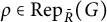 $\rho \in \mathrm{Rep}_{\bar {R}}(G)$
be an irreducible admissible representation that can be realized over a finite extension of R. Then there exists an irreducible admissible representation
$\rho \in \mathrm{Rep}_{\bar {R}}(G)$
be an irreducible admissible representation that can be realized over a finite extension of R. Then there exists an irreducible admissible representation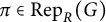 $\pi \in \mathrm{Rep}_R(G)$
, unique up to isomorphism, such that
$\pi \in \mathrm{Rep}_R(G)$
, unique up to isomorphism, such that $\pi \otimes _R \bar {R}$
contains
$\pi \otimes _R \bar {R}$
contains $\rho $
as a subquotient. We denote it by
$\rho $
as a subquotient. We denote it by $\pi (\rho ,R)$
. Moreover, if
$\pi (\rho ,R)$
. Moreover, if $R'$
is a field of realization of
$R'$
is a field of realization of $\rho $
of minimal degree such that
$\rho $
of minimal degree such that $\tau \otimes _{R'} \bar {R} = \rho $
with
$\tau \otimes _{R'} \bar {R} = \rho $
with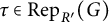 $\tau \in \mathrm{Rep}_{R'}(G)$
, then
$\tau \in \mathrm{Rep}_{R'}(G)$
, then
 $$ \begin{align*}\pi(\rho,R) \simeq \tau|_R.\end{align*} $$
Proof We start by proving the uniqueness statement. For all irreducible admissible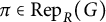 $\pi \in \text {Rep}_R(G)$
, the representation
$\pi \in \text {Rep}_R(G)$
, the representation $(\pi \otimes _R \bar {R})|_R$
is
$(\pi \otimes _R \bar {R})|_R$
is $\pi $
-isotypic. Therefore, for any subquotient W of
$\pi $
-isotypic. Therefore, for any subquotient W of $\pi \otimes _R \bar {R}$
, the representation
$\pi \otimes _R \bar {R}$
, the representation $W|_R$
is
$W|_R$
is $\pi $
-isotypic. In particular, this holds when
$\pi $
-isotypic. In particular, this holds when $W = \rho $
. As
$W = \rho $
. As $\rho |_R$
is isotypic, this ensures the uniqueness of the representation
$\rho |_R$
is isotypic, this ensures the uniqueness of the representation $\pi $
assuming it exists.
$\pi $
assuming it exists.
We realize $\rho $
over a finite extension
$\rho $
over a finite extension $R'$
of R with
$R'$
of R with $\tau \otimes _{R'} \bar {R} = \rho $
. It is clear that
$\tau \otimes _{R'} \bar {R} = \rho $
. It is clear that $\tau $
is admissible because
$\tau $
is admissible because $\rho $
itself is. This implies that
$\rho $
itself is. This implies that $\tau |_R$
is admissible. Since
$\tau |_R$
is admissible. Since $\tau |_R$
is finitely generated, it admits an irreducible quotient
$\tau |_R$
is finitely generated, it admits an irreducible quotient $\pi ,$
that is, there exists a nonzero morphism
$\pi ,$
that is, there exists a nonzero morphism $f : \tau |_R \to \pi $
. Let
$f : \tau |_R \to \pi $
. Let $\phi : R[G] \to R'[G]$
be the obvious inclusion. Then the forgetful functor
$\phi : R[G] \to R'[G]$
be the obvious inclusion. Then the forgetful functor $\text {Rep}_{R'}(G) \to \text {Rep}_R(G)$
has the functor
$\text {Rep}_{R'}(G) \to \text {Rep}_R(G)$
has the functor $\text {Hom}_{R[G]}(R'[G],-)$
as a right adjoint. By adjunction, there corresponds to f a nonzero morphism
$\text {Hom}_{R[G]}(R'[G],-)$
as a right adjoint. By adjunction, there corresponds to f a nonzero morphism $f' : \tau \to \text {Hom}_{R[G]}(R'[G],\pi )$
so
$f' : \tau \to \text {Hom}_{R[G]}(R'[G],\pi )$
so $f'$
is injective. Hence,
$f'$
is injective. Hence, $\tau |_R$
is a subrepresentation of
$\tau |_R$
is a subrepresentation of
 $$ \begin{align*}(\text{Hom}_{R[G]}(R'[G],\pi))|_R \simeq \bigoplus_{[R':R]} \pi.\end{align*} $$
So $\tau |_R$
is
$\tau |_R$
is $\pi $
-isotypic with finite multiplicity. We deduce that
$\pi $
-isotypic with finite multiplicity. We deduce that $\pi $
is admissible because
$\pi $
is admissible because $\tau |_R$
is and the functor of invariants for compact open subgroups is left exact. Therefore,
$\tau |_R$
is and the functor of invariants for compact open subgroups is left exact. Therefore, $\pi = \pi (\rho ,R)$
exists and is admissible.
$\pi = \pi (\rho ,R)$
exists and is admissible.
It remains to show that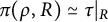 $\pi (\rho ,R) \simeq \tau |_R$
if the extension
$\pi (\rho ,R) \simeq \tau |_R$
if the extension $R'/R$
has minimal degree. We let
$R'/R$
has minimal degree. We let $\pi $
denote
$\pi $
denote $\pi (\rho ,R)$
below to lighten notations. We have already shown that
$\pi (\rho ,R)$
below to lighten notations. We have already shown that $\tau |_R$
is
$\tau |_R$
is $\pi $
-isotypic with finite multiplicity. So we simply need to show that it is irreducible. By Theorem 4.3, there exists a subfield
$\pi $
-isotypic with finite multiplicity. So we simply need to show that it is irreducible. By Theorem 4.3, there exists a subfield $E'$
of
$E'$
of $R'$
isomorphic to the center E of
$R'$
isomorphic to the center E of $D = \text {End}_G(\pi )$
such that
$D = \text {End}_G(\pi )$
such that $R'/E'$
has degree m. In particular,
$R'/E'$
has degree m. In particular,
 $$ \begin{align*}\pi \otimes_{E'} R' \simeq m \tau \text{ and } (\pi \otimes_{E'} R')|_R = \oplus_{[R':E']} \pi = m \pi.\end{align*} $$
Then $m \tau |_R \simeq m \pi ,$
that is,
$m \tau |_R \simeq m \pi ,$
that is, $\tau |_R \simeq \pi $
.
$\tau |_R \simeq \pi $
.
Corollary 4.5 Let G be a reductive group over a non-archimedean local field. Suppose R is a perfect field and G contains open subgroups of invertible pro-order in R. Then an irreducible representation in $\mathrm{Rep}_R(G)$
is admissible.
$\mathrm{Rep}_R(G)$
is admissible.
Proof We first assume that G is connected. On the one hand, it is well-known [Reference Vignéras12, Section II.2.8] that an irreducible representation $\rho $
in
$\rho $
in $\text {Rep}_{\bar {R}}(G)$
is admissible. On the other hand, any irreducible representation
$\text {Rep}_{\bar {R}}(G)$
is admissible. On the other hand, any irreducible representation $\rho $
in
$\rho $
in $\text {Rep}_{\bar {R}}(G)$
can be realized over a finite extension of R by [Reference Vignéras12, Section II.4.7]. We can apply Lemma 4.4 to conclude. In general, the identity component of G is a subgroup of finite index, so we can reduce the problem to the connected case by restriction to the identity component.
$\text {Rep}_{\bar {R}}(G)$
can be realized over a finite extension of R by [Reference Vignéras12, Section II.4.7]. We can apply Lemma 4.4 to conclude. In general, the identity component of G is a subgroup of finite index, so we can reduce the problem to the connected case by restriction to the identity component.
Remark 4.6. The corollary also applies to covering groups because they have parabolic subgroups, we can define cuspidality and we have the existence of the cuspidal support.
5 Largest isotypic quotients
Let R be a perfect field. Let $G_1$
and
$G_1$
and $G_2$
be locally profinite groups. We suppose there exists an open subgroup of
$G_2$
be locally profinite groups. We suppose there exists an open subgroup of $G_1 \times G_2$
of invertible pro-order in R.
$G_1 \times G_2$
of invertible pro-order in R.
5.1
Below is a generalization of the results of [Reference Flath3] when $R=\mathbb {C}$
and [Reference Vignéras13, Theorem A.4] when R is algebraically closed.
$R=\mathbb {C}$
and [Reference Vignéras13, Theorem A.4] when R is algebraically closed.
Theorem 5.1
-
(1) If
$\pi _1 \in \mathrm {Rep}_R(G_1)$
and
$\pi _2 \in \mathrm {Rep}_R(G_2)$
are two irreducible admissible representations, then
$\pi _1 \otimes _R \pi _2 \in \mathrm {Rep}_R(G_1 \times G_2)$
is a semisimple admissible representation. -
(2) If
$\pi $
is an irreducible admissible representation in
$\mathrm {Rep}_R(G_1 \times G_2)$
, there exist irreducible admissible representations
$\pi _1$
of
$G_1$
and
$\pi _2$
of
$G_2$
such that
$\pi $
is a quotient of
$\pi _1 \otimes _R \pi _2$
. Moreover,
$\pi _1$
and
$\pi _2$
are unique up to isomorphism, that is,
$\pi $
determines these isomorphism classes.







Proof a) Note that $D = \text {End}_{G_1}(\pi _1) \otimes _R \text {End}_{G_2}(\pi _2)$
has finite dimension over R as
$D = \text {End}_{G_1}(\pi _1) \otimes _R \text {End}_{G_2}(\pi _2)$
has finite dimension over R as $\pi _1$
and
$\pi _1$
and $\pi _2$
are admissible. We first assume that D is a simple R-algebra, that is, D is isomorphic to a matrix algebra over a division algebra. Then D is an isotypic right-D-module, so Lemma 4.1 ensures that
$\pi _2$
are admissible. We first assume that D is a simple R-algebra, that is, D is isomorphic to a matrix algebra over a division algebra. Then D is an isotypic right-D-module, so Lemma 4.1 ensures that $\pi _1 \otimes _R \pi _2$
is isotypic.
$\pi _1 \otimes _R \pi _2$
is isotypic.
Therefore, by combining Lemma 4.1 and Wedderburn–Artin theorem, the result holds if D is a semisimple R-algebra, or equivalently, if the center E of D is a reduced ring [Reference Bourbaki1, A VIII.217, Proposition 7], that is, if E does not contain any nonzero nilpotent elements. Let $E_1$
be the center of
$E_1$
be the center of $D_1$
and let
$D_1$
and let $E_2$
be the center of
$E_2$
be the center of $D_2$
. Then
$D_2$
. Then $E = E_1 \otimes _R E_2$
, where
$E = E_1 \otimes _R E_2$
, where $E_1$
and
$E_1$
and $E_2$
are finite field extensions of the perfect field R, so E itself is a finite product of fields. In particular, E is reduced. Therefore, D is semisimple.
$E_2$
are finite field extensions of the perfect field R, so E itself is a finite product of fields. In particular, E is reduced. Therefore, D is semisimple.
b) Same proof as [Reference Vignéras13, Theorem A.4], which follows [Reference Flath3] and uses [Reference Bourbaki1, A VIII.208, Proposition 2].
In the second point above, the representation $\pi $
can happen to be a strict quotient of
$\pi $
can happen to be a strict quotient of $\pi _1 \otimes _R \pi _2$
since the latter is not necessarily irreducible. We give a sufficient condition so that the tensor product of two irreducible representations is irreducible.
$\pi _1 \otimes _R \pi _2$
since the latter is not necessarily irreducible. We give a sufficient condition so that the tensor product of two irreducible representations is irreducible.
Lemma 5.2 Suppose the representations $\pi _1$
and
$\pi _1$
and $\pi _2$
are irreducible admissible and there exists a nonzero morphism of R-algebras
$\pi _2$
are irreducible admissible and there exists a nonzero morphism of R-algebras $D_2 \to D_1^{\text {op}}$
. Then
$D_2 \to D_1^{\text {op}}$
. Then $\pi _1 \otimes _{D_2} \pi _2 \in \mathrm {Rep}_R(G_1 \times G_2)$
is an irreducible admissible representation.
$\pi _1 \otimes _{D_2} \pi _2 \in \mathrm {Rep}_R(G_1 \times G_2)$
is an irreducible admissible representation.
Proof Let $v = \sum v_1^i \otimes _{D_2} v_2^i \in \pi _1 \otimes _{D_2} \pi _2$
. Since
$v = \sum v_1^i \otimes _{D_2} v_2^i \in \pi _1 \otimes _{D_2} \pi _2$
. Since $D_2= \text {End}_{G_2}(\pi _2)$
is a division algebra, we can choose a finite family
$D_2= \text {End}_{G_2}(\pi _2)$
is a division algebra, we can choose a finite family $v_2^i$
that is free over
$v_2^i$
that is free over $D_2$
and such that
$D_2$
and such that $v = \sum v_1^i \otimes _{D_2} v_2^i$
with
$v = \sum v_1^i \otimes _{D_2} v_2^i$
with $v_1^i \neq 0$
. We are going to show that
$v_1^i \neq 0$
. We are going to show that $V_1 \otimes _{D_2} v_2^1$
is contained in the subrepresentation generated by v, which is enough to show that v generates
$V_1 \otimes _{D_2} v_2^1$
is contained in the subrepresentation generated by v, which is enough to show that v generates $\pi _1 \otimes _{D_2} \pi _2$
. To do so, we choose an element
$\pi _1 \otimes _{D_2} \pi _2$
. To do so, we choose an element $f_2 \in R[G_2]$
such that
$f_2 \in R[G_2]$
such that
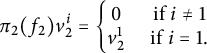 $$ \begin{align*}\pi_2(f_2) v_2^i = \left\{ \begin{array}{@{}cc} 0 & \text{ if } i\neq 1 \\ v_2^1 & \text{ if } i=1. \end{array} \right.\end{align*} $$
Such an element always exists. Indeed, let A be the image of the map $R[G_2] \to \text {End}_R(\pi _2)$
. Then A is contained in
$R[G_2] \to \text {End}_R(\pi _2)$
. Then A is contained in $\text {End}_{\text {End}_{G_2}(\pi _2)}(\pi _2) = \text {End}_{\text {comm}(A)}(\pi _2) = \text {comm}(\text {comm}(A)),$
where
$\text {End}_{\text {End}_{G_2}(\pi _2)}(\pi _2) = \text {End}_{\text {comm}(A)}(\pi _2) = \text {comm}(\text {comm}(A)),$
where $\text {comm}$
means the centralizer of an algebra in
$\text {comm}$
means the centralizer of an algebra in $\text {End}_R(\pi _2)$
. We consider the subspace
$\text {End}_R(\pi _2)$
. We consider the subspace $W_2$
of
$W_2$
of $\pi _2$
generated by the
$\pi _2$
generated by the $v_2^i$
’s. The map we want to interpolate is the projection on
$v_2^i$
’s. The map we want to interpolate is the projection on $v_2^1$
with kernel generated by the other
$v_2^1$
with kernel generated by the other $v_2^i$
’s. By the basis extension theorem, there exists
$v_2^i$
’s. By the basis extension theorem, there exists $b \in \text {End}_{D_2}(\pi _2) = \text {comm}(\text {comm}(A))$
whose restriction
$b \in \text {End}_{D_2}(\pi _2) = \text {comm}(\text {comm}(A))$
whose restriction $b|_{W_2}$
to
$b|_{W_2}$
to $W_2$
realizes this projection. As the family
$W_2$
realizes this projection. As the family $v_2^i$
is finite, there exists
$v_2^i$
is finite, there exists $a \in A$
such that
$a \in A$
such that $a|_{W_2} = b|_{W_2}$
by the Jacobson density theorem [Reference Vignéras12, Section I.B.6]. Hence, the existence of
$a|_{W_2} = b|_{W_2}$
by the Jacobson density theorem [Reference Vignéras12, Section I.B.6]. Hence, the existence of $f_2$
. Therefore, the subrepresentation generated by v contains
$f_2$
. Therefore, the subrepresentation generated by v contains $V_1 \otimes _{D_2} v_2^1$
and the irreducibility follows.
$V_1 \otimes _{D_2} v_2^1$
and the irreducibility follows.
5.2
The following two lemmas generalize [Reference Moeglin, Vignéras and Waldspurger7, Chapter 2, Lemmas III.3 and III.4]. The modifications in the proofs are very minor, by considering tensor products over division algebras instead of algebraically closed fields, so we omit the proofs.
Lemma 5.3 Let $(\pi _1,V_1) \in \mathrm {Rep}_R(G_1)$
be an irreducible admissible representation. Let
$(\pi _1,V_1) \in \mathrm {Rep}_R(G_1)$
be an irreducible admissible representation. Let $(\pi _2,V_2) \in \mathrm {Rep}_R(G_2)$
. Suppose
$(\pi _2,V_2) \in \mathrm {Rep}_R(G_2)$
. Suppose $V_2$
is endowed with a structure of right
$V_2$
is endowed with a structure of right $D_1$
-module compatible with the action of
$D_1$
-module compatible with the action of $G_2$
, this means that we have a morphism of R-algebras
$G_2$
, this means that we have a morphism of R-algebras
 $$ \begin{align*}D_1 \to D_2^{\text{op}}.\end{align*} $$
Let $V \in \mathrm {Rep}_R(G_1 \times G_2)$
be a subrepresentation in
$V \in \mathrm {Rep}_R(G_1 \times G_2)$
be a subrepresentation in $V_2 \otimes _{D_1} V_1$
. There exists a subrepresentation
$V_2 \otimes _{D_1} V_1$
. There exists a subrepresentation $V_2'$
of
$V_2'$
of $V_2$
, endowed with a structure of right
$V_2$
, endowed with a structure of right $D_1$
-module, such that
$D_1$
-module, such that $V = V_2' \otimes _{D_1} V_1$
in
$V = V_2' \otimes _{D_1} V_1$
in $\mathrm {Rep}_R(G_1 \times G_2)$
.
$\mathrm {Rep}_R(G_1 \times G_2)$
.
From now on, we will call $R[G_2]-D_1$
-bimodule a smooth
$R[G_2]-D_1$
-bimodule a smooth $R[G_2]$
-module with a compatible structure of right
$R[G_2]$
-module with a compatible structure of right $D_1$
-module. When the field R is algebraically closed, the results above simplify significantly because
$D_1$
-module. When the field R is algebraically closed, the results above simplify significantly because $D_1$
and
$D_1$
and $D_2$
are simply R. The result below generalizes the usual largest isotypic quotient, which has a simpler form again over algebraically closed fields.
$D_2$
are simply R. The result below generalizes the usual largest isotypic quotient, which has a simpler form again over algebraically closed fields.
Lemma 5.4 Let $(\pi ,V) \in \mathrm {Rep}_R(G_1 \times G_2)$
. Let
$(\pi ,V) \in \mathrm {Rep}_R(G_1 \times G_2)$
. Let $(\pi _1,V_1) \in \mathrm {Rep}_R(G_1)$
be irreducible admissible.
$(\pi _1,V_1) \in \mathrm {Rep}_R(G_1)$
be irreducible admissible.
-
• We define a subrepresentation of V by
$$ \begin{align*}V[\pi_1]= \bigcap_{f \in \mathrm{Hom}_{G_1}(V,V_1)} \mathrm{Ker} (f) \in \mathrm{Rep}_R(G_1 \times G_2).\end{align*} $$
The largest
$\pi _1$
-isotypic quotient of V is the representation
$$ \begin{align*}V_{\pi_1} = V / V[\pi_1] \in \mathrm{Rep}_R(G_1 \times G_2).\end{align*} $$
-
• There is an
$R[G_2]-D_1$
-bimodule
$(\pi _2,V_2)$
, unique up to isomorphism, such that
$$ \begin{align*}V_{\pi_1} \simeq \pi_2 \otimes_{D_1} \pi_1.\end{align*} $$
Moreover, we have an isomorphism of
$R[G_2]-D_1$
-bimodule
$$ \begin{align*}V_2 \simeq (V \otimes_R \mathrm{Hom}_{D_1}(V_1,D_1)^{\infty})_{1_{G_1}}.\end{align*} $$








We can also consider several largest isotypic quotients at once. The proof of the result below is rather straightforward for two irreducible representations, and the general case follows by a simple induction argument, so the proof is left as an exercise for the reader.
Corollary 5.5 Let $(\pi _{1,i})_{i \in I}$
be a finite family of non-isomorphic irreducible admissible representations. For
$(\pi _{1,i})_{i \in I}$
be a finite family of non-isomorphic irreducible admissible representations. For $V \in \mathrm {Rep}_R(G_1 \times G_2)$
, let
$V \in \mathrm {Rep}_R(G_1 \times G_2)$
, let $p_i$
be the projection
$p_i$
be the projection $V \twoheadrightarrow V_{\pi _{1,i}}$
. Then
$V \twoheadrightarrow V_{\pi _{1,i}}$
. Then
 $$ \begin{align*}p_I : v \in V \mapsto (p_i(v) )_{i\in I} \in \oplus_{i\in I} V_{\pi_{1,i}}\end{align*} $$
is surjective and has kernel
 $$ \begin{align*}\bigcap_{i \in I} V[\pi_{1,i}] = \bigcap_{f \in \mathrm{Hom}_{G_1}(V, \oplus_{i \in I} \pi_{1,i})} \mathrm{Ker} (f).\end{align*} $$
5.3
We fix an algebraic closure $\bar {R}$
of the perfect field R. For all irreducible admissible representation
$\bar {R}$
of the perfect field R. For all irreducible admissible representation $\pi _1$
in
$\pi _1$
in $\text {Rep}_R(G_1)$
, Theorem 4.3 guarantees the existence of an irreducible admissible
$\text {Rep}_R(G_1)$
, Theorem 4.3 guarantees the existence of an irreducible admissible $\rho _1 \in \text {Rep}_{\bar {R}}(G_1)$
such that
$\rho _1 \in \text {Rep}_{\bar {R}}(G_1)$
such that
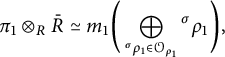 $$ \begin{align*}\pi_1 \otimes_R \bar{R} \simeq m_1 \bigg( \bigoplus_{{}^\sigma \rho_1 \in \mathcal{O}_{\rho_1}} {}^\sigma \rho_1 \bigg),\end{align*} $$
where $\mathcal {O}_{\rho _1}$
is the Galois orbit of
$\mathcal {O}_{\rho _1}$
is the Galois orbit of $\rho _1$
, which is a finite set in bijection with the embeddings of fields
$\rho _1$
, which is a finite set in bijection with the embeddings of fields $\text {Hom}_R(R(\rho _1),\bar {R})$
. We write
$\text {Hom}_R(R(\rho _1),\bar {R})$
. We write ${}^w \rho _1$
for the corresponding
${}^w \rho _1$
for the corresponding ${}^\sigma \rho _1 \in \mathcal {O}_{\rho _1}$
.
${}^\sigma \rho _1 \in \mathcal {O}_{\rho _1}$
.
Let $V \in \text {Rep}_R(G_1 \times G_2)$
. We relate the space of
$V \in \text {Rep}_R(G_1 \times G_2)$
. We relate the space of $\pi _1$
-coinvariants
$\pi _1$
-coinvariants $V_{\pi _1}$
to the spaces of
$V_{\pi _1}$
to the spaces of $({}^w \rho _1)$
-coinvariants
$({}^w \rho _1)$
-coinvariants $V_{{}^w \rho _1}$
for
$V_{{}^w \rho _1}$
for $w \in \text {Hom}_R(R(\rho _1),\bar {R})$
in the result below.
$w \in \text {Hom}_R(R(\rho _1),\bar {R})$
in the result below.
Theorem 5.6 Let $(\pi _1,V_1) \in \mathrm {Rep}_R(G_1)$
be an irreducible and admissible. Consider the decomposition of
$(\pi _1,V_1) \in \mathrm {Rep}_R(G_1)$
be an irreducible and admissible. Consider the decomposition of $\pi _1 \otimes _R \bar {R}$
in Theorem 4.3. Then for all
$\pi _1 \otimes _R \bar {R}$
in Theorem 4.3. Then for all $V \in \mathrm {Rep}_R(G_1 \times G_2)$
, we have
$V \in \mathrm {Rep}_R(G_1 \times G_2)$
, we have
 $$ \begin{align*}V_{\pi_1} \otimes_R \bar{R} \simeq \bigoplus_{w \in \mathrm{Hom}_R(R(\rho_1),\bar{R})} (V \otimes_R \bar{R})_{{}^w \rho_1}.\end{align*} $$
Proof By Corollary 5.5, the map
 $$ \begin{align*}V \otimes_R \bar{R} \to \bigoplus_{w \in \text{Hom}_R( R(\rho_1),\bar{R})} (V\otimes_R \bar{R})_{{}^w \rho_1}\end{align*} $$
is surjective and has kernel $\bigcap _w (V \otimes _R \bar {R}) [{}^w \rho _1]$
. We are going to show that
$\bigcap _w (V \otimes _R \bar {R}) [{}^w \rho _1]$
. We are going to show that
 $$ \begin{align*}V[\pi_1] \otimes_R \bar{R} = \bigcap_{w \in \text{Hom}_R(R(\rho_1),\bar{R})} (V \otimes_R \bar{R})[{}^w \rho_1].\end{align*} $$
Since $(V \otimes _R \bar {R})/ (V[\pi _1] \otimes _R \bar {R}) \simeq V_{\pi _1} \otimes _R \bar {R}$
, the latter is also the largest isotypic quotient of V associated with the finite family
$(V \otimes _R \bar {R})/ (V[\pi _1] \otimes _R \bar {R}) \simeq V_{\pi _1} \otimes _R \bar {R}$
, the latter is also the largest isotypic quotient of V associated with the finite family $({}^w \rho _1)_w$
in the sense of Corollary 5.5.
$({}^w \rho _1)_w$
in the sense of Corollary 5.5.
The direct inclusion is the easiest part. Let $v \in V[\pi _1]$
. We want to prove that for all
$v \in V[\pi _1]$
. We want to prove that for all $w \in \text {Hom}_R(R(\rho _1),\bar {R})$
and all
$w \in \text {Hom}_R(R(\rho _1),\bar {R})$
and all $f \in \text {Hom}_{\bar {R}[G_1]}(V \otimes _R \bar {R},{}^w \rho _1)$
, we have
$f \in \text {Hom}_{\bar {R}[G_1]}(V \otimes _R \bar {R},{}^w \rho _1)$
, we have $v \otimes _R 1 \in \text {Ker}(f)$
. In particular, such an f defines a morphism of
$v \otimes _R 1 \in \text {Ker}(f)$
. In particular, such an f defines a morphism of $R[G_1]$
-modules
$R[G_1]$
-modules $(V \otimes _R \bar {R})|_R \to ({}^w \rho _1)|_R$
by restriction of scalars. Moreover, the morphism f is nonzero if and only if its restriction to
$(V \otimes _R \bar {R})|_R \to ({}^w \rho _1)|_R$
by restriction of scalars. Moreover, the morphism f is nonzero if and only if its restriction to $V\otimes _R 1 = \{ v \otimes _R 1 \ | \ v \in V\}$
is nonzero. However, according to the first lines of the proof of Lemma 4.4, we know that the representation
$V\otimes _R 1 = \{ v \otimes _R 1 \ | \ v \in V\}$
is nonzero. However, according to the first lines of the proof of Lemma 4.4, we know that the representation $({}^w \rho _1)|_R$
is
$({}^w \rho _1)|_R$
is $\pi _1$
-isotypic. Therefore,
$\pi _1$
-isotypic. Therefore, $f|_{V \otimes _R 1} : V \simeq V \otimes _R 1 \to ({}^w \rho _1)|_R \simeq \oplus \pi _1$
. So
$f|_{V \otimes _R 1} : V \simeq V \otimes _R 1 \to ({}^w \rho _1)|_R \simeq \oplus \pi _1$
. So $f(v \otimes _R 1) =0$
by definition of
$f(v \otimes _R 1) =0$
by definition of $V[\pi _1]$
.
$V[\pi _1]$
.
Regarding the reverse inclusion, we know thanks to Lemma 5.4 that there exists a smooth $R[G_2]-D_1$
-bimodule
$R[G_2]-D_1$
-bimodule $V_2$
such that
$V_2$
such that $V_{\pi _1} \simeq V_2 \otimes _{D_1} V_1,$
where
$V_{\pi _1} \simeq V_2 \otimes _{D_1} V_1,$
where $D_1 = \text {End}_{G_1}(\pi _1)$
is a division algebra of degree
$D_1 = \text {End}_{G_1}(\pi _1)$
is a division algebra of degree $m_1$
over its center. Moreover, we have an isomorphism of representations
$m_1$
over its center. Moreover, we have an isomorphism of representations
 $$ \begin{align*}V_{\pi_1} \otimes_R \bar{R} \simeq (V_2 \otimes_R \bar{R}) \otimes_{D_1 \otimes_R \bar{R}} (V_1 \otimes_R \bar{R}).\end{align*} $$
Thanks to Theorem 4.3, the ring $D_1 \otimes _R \bar {R}$
is isomorphic to
$D_1 \otimes _R \bar {R}$
is isomorphic to $\prod _w e_w (D_1 \otimes _R \bar {R}) \simeq \prod _w M_{m_1}(\bar {R}),$
where
$\prod _w e_w (D_1 \otimes _R \bar {R}) \simeq \prod _w M_{m_1}(\bar {R}),$
where $(e_w)_w$
is a system of primitive central idempotents in
$(e_w)_w$
is a system of primitive central idempotents in $D_1 \otimes _R \bar {R}$
. We deduce that
$D_1 \otimes _R \bar {R}$
. We deduce that
 $$ \begin{align*}V_{\pi_1} \otimes_R \bar{R} \simeq \bigoplus_w V_w \otimes_{M_{m_1}(\bar{R})} (m_1 {}^w \rho_1),\end{align*} $$
where $m_1 {}^w \rho _1 = e_w (\pi _1 \otimes _R \bar {R})$
and
$m_1 {}^w \rho _1 = e_w (\pi _1 \otimes _R \bar {R})$
and $V_w = V_2 e_w$
.
$V_w = V_2 e_w$
.
We now prove that there exists a representation $V_{2,w} \in \text {Rep}_{\bar {R}}(G_2)$
such that
$V_{2,w} \in \text {Rep}_{\bar {R}}(G_2)$
such that
 $$ \begin{align*}V_w \otimes_{M_{m_1}(\bar{R})} (m_1 ({}^w \rho_1)) \simeq V_{2,w} \otimes_{\bar{R}} ({}^w \rho_1).\end{align*} $$
Indeed, by denoting $e_{i,j}$
the elementary matrix in
$e_{i,j}$
the elementary matrix in $M_{m_1}(\bar {R})$
, we have
$M_{m_1}(\bar {R})$
, we have $e_{1,1} + \dots + e_{m_1,m_1} = \text {Id}_{m_1}$
which is a decomposition of the unit as a sum of idempotents. These idempotents are not necessarily central in
$e_{1,1} + \dots + e_{m_1,m_1} = \text {Id}_{m_1}$
which is a decomposition of the unit as a sum of idempotents. These idempotents are not necessarily central in $M_{m_1}(\bar {R})$
. Nevertheless, each
$M_{m_1}(\bar {R})$
. Nevertheless, each $e_{i,i}$
defines a map
$e_{i,i}$
defines a map $v \in V_w \mapsto v e_{i,i} \in V_w$
which is a morphism of
$v \in V_w \mapsto v e_{i,i} \in V_w$
which is a morphism of $\bar {R}[G_2]$
-modules. In addition,
$\bar {R}[G_2]$
-modules. In addition, $e_{i,i} V_w \simeq e_{1,1} V_w$
for all i. Denoting
$e_{i,i} V_w \simeq e_{1,1} V_w$
for all i. Denoting $V_{2,w} = V_w e_{1,1} \in \text {Rep}_{\bar {R}}(G_2)$
, we have
$V_{2,w} = V_w e_{1,1} \in \text {Rep}_{\bar {R}}(G_2)$
, we have $V_w \simeq m_1 V_{2,w}$
and
$V_w \simeq m_1 V_{2,w}$
and $(m_1 V_{2,w}) \otimes _{M_{m_1}(\bar {R})} (m_1 ({}^w \rho _1)) \simeq V_{2,w} \otimes _{\bar {R}} ({}^w \rho _1)$
. Therefore, the quotient
$(m_1 V_{2,w}) \otimes _{M_{m_1}(\bar {R})} (m_1 ({}^w \rho _1)) \simeq V_{2,w} \otimes _{\bar {R}} ({}^w \rho _1)$
. Therefore, the quotient $V \otimes _R \bar {R} \to V_{2,w} \otimes _{\bar {R}} ({}^w \rho _1)$
factors through
$V \otimes _R \bar {R} \to V_{2,w} \otimes _{\bar {R}} ({}^w \rho _1)$
factors through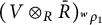 $(V \otimes _R \bar {R})_{{}^w \rho _1}$
by definition of the largest
$(V \otimes _R \bar {R})_{{}^w \rho _1}$
by definition of the largest ${}^w \rho _1$
-isotypic quotient. So the quotient
${}^w \rho _1$
-isotypic quotient. So the quotient $V \otimes _R \bar {R} \to V_{\pi _1} \otimes _R \bar {R} \simeq \oplus _w V_{2,w} \otimes _{\bar {R}} ({}^w \rho _1)$
factors through
$V \otimes _R \bar {R} \to V_{\pi _1} \otimes _R \bar {R} \simeq \oplus _w V_{2,w} \otimes _{\bar {R}} ({}^w \rho _1)$
factors through $\oplus _w (V \otimes _R \bar {R})_{{}^w \rho _1}$
. In other words,
$\oplus _w (V \otimes _R \bar {R})_{{}^w \rho _1}$
. In other words, $\cap _w (V\otimes _R \bar {R})[{}^w \rho _1] \subseteq V[\pi _1] \otimes _R \bar {R}$
.
$\cap _w (V\otimes _R \bar {R})[{}^w \rho _1] \subseteq V[\pi _1] \otimes _R \bar {R}$
.
6 Isotypic lifts and rationality
Let $H_1$
and
$H_1$
and $H_2$
be locally profinite groups. Let R be a perfect field and assume there exist open subgroups of
$H_2$
be locally profinite groups. Let R be a perfect field and assume there exist open subgroups of $H_1 \times H_2$
of invertible pro-order in R. Assume all irreducible representations in
$H_1 \times H_2$
of invertible pro-order in R. Assume all irreducible representations in $\text {Rep}_R(H_1)$
and
$\text {Rep}_R(H_1)$
and $\text {Rep}_R(H_2)$
are admissible. Let
$\text {Rep}_R(H_2)$
are admissible. Let $V \in \text {Rep}_R(H_1 \times H_2)$
.
$V \in \text {Rep}_R(H_1 \times H_2)$
.
6.1
Given an irreducible representation $\pi _1$
of
$\pi _1$
of $H_1$
, Lemma 5.4 allows us to define the isotypic lift
$H_1$
, Lemma 5.4 allows us to define the isotypic lift $\Theta (\pi _1)$
, which is a representation of
$\Theta (\pi _1)$
, which is a representation of $H_2$
endowed with a compatible right action of
$H_2$
endowed with a compatible right action of $D_1 = \text {End}_{R[H_1]}(\pi _1)$
, such that
$D_1 = \text {End}_{R[H_1]}(\pi _1)$
, such that $V_{\pi _1} \simeq \Theta (\pi _1) \otimes _{D_1} \pi _1$
. We use the notation
$V_{\pi _1} \simeq \Theta (\pi _1) \otimes _{D_1} \pi _1$
. We use the notation $\Theta $
for the
$\Theta $
for the $\pi _1$
-isotypic lift as there is an obvious analogy with the definition of the theta lifts.
$\pi _1$
-isotypic lift as there is an obvious analogy with the definition of the theta lifts.
Theorem 6.1 Let $\pi _1 \in \mathrm {Irr}_R(H_1)$
. There exists
$\pi _1 \in \mathrm {Irr}_R(H_1)$
. There exists $\Theta (\pi _1) \in \mathrm {Rep}_R(H_2)$
, endowed with a compatible structure of right
$\Theta (\pi _1) \in \mathrm {Rep}_R(H_2)$
, endowed with a compatible structure of right $D_1$
-module, such that
$D_1$
-module, such that $V_{\pi _1} \simeq \Theta (\pi _1) \otimes _{D_1} \pi _1$
. Moreover,
$V_{\pi _1} \simeq \Theta (\pi _1) \otimes _{D_1} \pi _1$
. Moreover, $\Theta (\pi _1)$
is unique up to isomorphism of smooth
$\Theta (\pi _1)$
is unique up to isomorphism of smooth $R[H_2]-D_1$
-bimodules.
$R[H_2]-D_1$
-bimodules.
When R is algebraically closed, or $\pi _1$
is absolutely irreducible, the division algebra
$\pi _1$
is absolutely irreducible, the division algebra $D_1$
above is simply R. The structure of right
$D_1$
above is simply R. The structure of right $D_1$
-module then corresponds to the natural R-module structure of the representation
$D_1$
-module then corresponds to the natural R-module structure of the representation $\Theta (\pi _1)$
. When
$\Theta (\pi _1)$
. When $R=\mathbb {C}$
, we then find the usual definition of an isotypic lift, such as the big theta lift.
$R=\mathbb {C}$
, we then find the usual definition of an isotypic lift, such as the big theta lift.
6.2
Let $\pi _1 \in \text {Irr}_R(H_1)$
. We are going to define the three main statements at the heart of a correspondence, such as the theta correspondence. The first one is
$\pi _1 \in \text {Irr}_R(H_1)$
. We are going to define the three main statements at the heart of a correspondence, such as the theta correspondence. The first one is
(Fin) the $R[H_2]-D_1$
-bimodule
$R[H_2]-D_1$
-bimodule $\Theta (\pi _1)$
has finite length.
$\Theta (\pi _1)$
has finite length.
If (Fin) holds, the maximal semisimple quotient $\theta (\pi _1)$
of the
$\theta (\pi _1)$
of the $R[H_2]-D_1$
-bimodule
$R[H_2]-D_1$
-bimodule $\Theta (\pi _1)$
, also called the cosocle, is well-defined. We add the second statement
$\Theta (\pi _1)$
, also called the cosocle, is well-defined. We add the second statement
(Irr) $\theta (\pi _1)$
is irreducible or zero.
$\theta (\pi _1)$
is irreducible or zero.
We also add when (Fin) and (Irr) hold for all $\pi _1$
, the third statement
$\pi _1$
, the third statement
(Uni) $0 \neq \theta (\pi _1) \simeq \theta (\pi _1')$
if and only if
$0 \neq \theta (\pi _1) \simeq \theta (\pi _1')$
if and only if $\pi _1 \simeq \pi _1'$
.
$\pi _1 \simeq \pi _1'$
.
Remark 6.2. In particular, $0 \neq \theta (\pi _1) \simeq \theta (\pi _1')$
means an isomorphism of
$0 \neq \theta (\pi _1) \simeq \theta (\pi _1')$
means an isomorphism of $R[H_2]$
-module that is compatible with the respective structures of right modules via some isomorphism
$R[H_2]$
-module that is compatible with the respective structures of right modules via some isomorphism $\text {End}_{R[H_1]}(\pi _1) \simeq \text {End}_{R[H_1]}(\pi _1')$
.
$\text {End}_{R[H_1]}(\pi _1) \simeq \text {End}_{R[H_1]}(\pi _1')$
.
These statements are related to the field R and we want to show that these three statements over R are equivalent to the analogous statements over an algebraic closure $\bar {R}$
of R using
$\bar {R}$
of R using $V \otimes _R \bar {R}$
. We call (
$V \otimes _R \bar {R}$
. We call ( $\Theta _R$
) the statements (Fin)-(Irr)-(Uni) over R. The goal of the section is to prove the following.
$\Theta _R$
) the statements (Fin)-(Irr)-(Uni) over R. The goal of the section is to prove the following.
Theorem 6.3 Recall that R is a perfect field and fix an algebraic closure $\bar {R}$
of R. Then the following assertions are equivalent:
$\bar {R}$
of R. Then the following assertions are equivalent:
-
(1)
$(\Theta _{\text {R}})$
hold for all
$\pi _1 \in \mathrm {Irr}_R(H_1)$
; -
(2)
$(\Theta _{\bar {\text {R}}})$
hold for all
$\rho _1 \in \mathrm {Irr}_{\bar {R}}(H_1)$
.




The proof of the theorem will occupy the next paragraphs. We prove the equivalence of the three statements separately.
6.3
We start by explaining how the isotypic lift behaves with respect to scalar extension. Let $\pi _1 \in \text {Irr}_R(H_1)$
. By choosing an irreducible factor
$\pi _1 \in \text {Irr}_R(H_1)$
. By choosing an irreducible factor $\rho _1$
in
$\rho _1$
in $\pi _1 \otimes _R \bar {R}$
, we can consider the decomposition of Theorem 4.3
$\pi _1 \otimes _R \bar {R}$
, we can consider the decomposition of Theorem 4.3
 $$ \begin{align*}\pi_1 \otimes_R \bar{R} \simeq m_1 \bigg(\bigoplus_{w \in \text{Hom}_R(R(\rho_1),\bar{R})} {}^w \rho_1 \bigg).\end{align*} $$
Moreover, $E_1 \simeq R(\rho _1),$
where
$E_1 \simeq R(\rho _1),$
where $E_1$
is the center of
$E_1$
is the center of $D_1$
.
$D_1$
.
Lemma 6.4 We have an isomorphism of representations in $\mathrm {Rep}_{\bar {R}}(H_1 \times H_2)$
 $$ \begin{align*}(\Theta(\pi_1) \otimes_{D_1} \pi_1) \otimes_R \bar{R} \simeq \bigoplus_{w \in \mathrm{Hom}_R(R(\rho_1),\bar{R})} \Theta({}^w \rho_1) \otimes_{\bar{R}} {}^w \rho_1.\end{align*} $$
Moreover, by considering $\Theta (\pi _1)$
as a representation in
$\Theta (\pi _1)$
as a representation in $\mathrm {Rep}_{E_1}(H_2)$
, there exists a bijection
$\mathrm {Rep}_{E_1}(H_2)$
, there exists a bijection $\varphi : \mathrm {Hom}_R(R(\rho _1), \bar {R}) \to \mathrm {Hom}_R(E_1,\bar {R})$
such that
$\varphi : \mathrm {Hom}_R(R(\rho _1), \bar {R}) \to \mathrm {Hom}_R(E_1,\bar {R})$
such that
 $$ \begin{align*}\Theta(\pi_1) \otimes_{E_1,\varphi(w)} \bar{R} \simeq m_1 \Theta({}^w \rho_1)\end{align*} $$
as $R[H_2]-\mathcal {M}_{m_1}(\bar {R})$
-modules via
$R[H_2]-\mathcal {M}_{m_1}(\bar {R})$
-modules via $D_1 \otimes _{E_1, \varphi (w)} \bar {R} \simeq \mathcal {M}_{m_1}(\bar {R})$
.
$D_1 \otimes _{E_1, \varphi (w)} \bar {R} \simeq \mathcal {M}_{m_1}(\bar {R})$
.
Proof Theorem 5.6 ensures that
 $$ \begin{align*}V_{\pi_1} \otimes_R \bar{R} \simeq \bigoplus_{w \in \text{Hom}_R(R(\rho_1),\bar{R})} (V \otimes_R \bar{R})_{{}^w \rho_1}.\end{align*} $$
Now we can use Theorem 6.1 to obtain the first isomorphism of the lemma.
Any representation $V_{\pi _1} \otimes _{E_1,w'} \bar {R}$
with
$V_{\pi _1} \otimes _{E_1,w'} \bar {R}$
with $w' \in \text {Hom}_R(E_1, \bar {R})$
is isomorphic to one and only one of
$w' \in \text {Hom}_R(E_1, \bar {R})$
is isomorphic to one and only one of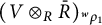 $(V \otimes _R \bar {R})_{{}^w \rho _1}$
with
$(V \otimes _R \bar {R})_{{}^w \rho _1}$
with $w \in \text {Hom}_R(R(\rho _1),\bar {R})$
. This defines the bijection
$w \in \text {Hom}_R(R(\rho _1),\bar {R})$
. This defines the bijection $\varphi $
.
$\varphi $
.
To end the proof, the isomorphism $(\Theta (\pi _1) \otimes _{D_1} \pi _1) \otimes _{E_1,\varphi (w)} \bar {R} \simeq \Theta ({}^w \rho _1) \otimes _{\bar {R}} {}^w \rho _1$
induces the desired isomorphism thanks to the fact that
$(\Theta (\pi _1) \otimes _{D_1} \pi _1) \otimes _{E_1,\varphi (w)} \bar {R} \simeq \Theta ({}^w \rho _1) \otimes _{\bar {R}} {}^w \rho _1$
induces the desired isomorphism thanks to the fact that $D_1' = D_1 \otimes _{E_1,\varphi (w)} \otimes \bar {R} \simeq \mathcal {M}_{m_1}(\bar {R})$
and
$D_1' = D_1 \otimes _{E_1,\varphi (w)} \otimes \bar {R} \simeq \mathcal {M}_{m_1}(\bar {R})$
and
 $$ \begin{align*} (\Theta(\pi_1) \otimes_{D_1} \pi_1) \otimes_{E_1,\varphi(w)} \bar{R} & \simeq (\Theta(\pi_1) \otimes_{E_1,\varphi(w)} \bar{R}) \otimes_{D_1'} (\pi_1 \otimes_{E_1,\varphi(w)} \bar{R}) \\ & \simeq (\Theta(\pi_1) \otimes_{E_1,\varphi(w)} \bar{R}) \otimes_{D_1'} (m_1 {}^w\rho_1) \\ & \simeq \Theta({}^w \rho_1) \otimes_{\bar{R}} {}^w \rho_1. \end{align*} $$
By Morita equivalence of $\mathcal {M}_{m_1}(\bar {R})$
and
$\mathcal {M}_{m_1}(\bar {R})$
and $\bar {R}$
, we obtain
$\bar {R}$
, we obtain $\Theta (\pi _1) \otimes _{E_1,\varphi (w)} \bar {R} \simeq m_1 \Theta ({}^w\rho _1)$
.
$\Theta (\pi _1) \otimes _{E_1,\varphi (w)} \bar {R} \simeq m_1 \Theta ({}^w\rho _1)$
.
6.4
The three propositions below prove the equivalence for each statement.
Proposition 6.5 The following assertions are equivalent:
-
(1) the
$R[H_2]-D_1$
-bimodule
$\Theta (\pi _1)$
has finite length; -
(2) all representations
$\Theta ({}^w \rho _1)$
have finite length; -
(3) there exists
${}^w \rho _1$
such that
$\Theta ({}^w \rho _1)$
has finite length.


Proof We only need to show that a) $\Rightarrow $
b) and c)
$\Rightarrow $
b) and c) $\Rightarrow $
a), since b)
$\Rightarrow $
a), since b) $\Rightarrow $
c) is obvious.
$\Rightarrow $
c) is obvious.
For a) $\Rightarrow $
b), we first recall that irreducible representations are admissible thanks to Corollary 4.5 and the remark thereafter. Therefore, if the
$\Rightarrow $
b), we first recall that irreducible representations are admissible thanks to Corollary 4.5 and the remark thereafter. Therefore, if the $R[H_2]-D_1$
-bimodule
$R[H_2]-D_1$
-bimodule $\Theta (\pi _1)$
has finite length, Lemma 5.2 implies that
$\Theta (\pi _1)$
has finite length, Lemma 5.2 implies that $\Theta (\pi _1) \otimes _{D_1} \pi _1$
is an admissible representation of finite length in
$\Theta (\pi _1) \otimes _{D_1} \pi _1$
is an admissible representation of finite length in $\text {Rep}_R(H_1 \times H_2)$
. By extending scalars to
$\text {Rep}_R(H_1 \times H_2)$
. By extending scalars to $\bar {R}$
as in Theorem 4.3, the representation
$\bar {R}$
as in Theorem 4.3, the representation $(\Theta (\pi _1)\otimes _{D_1} \pi _1 ) \otimes _R \bar {R}$
has finite length in
$(\Theta (\pi _1)\otimes _{D_1} \pi _1 ) \otimes _R \bar {R}$
has finite length in $\text {Rep}_{\bar {R}}(H_1 \times H_2)$
. Then Lemma 6.4 allows us to conclude that
$\text {Rep}_{\bar {R}}(H_1 \times H_2)$
. Then Lemma 6.4 allows us to conclude that $\Theta ({}^w \rho _1)$
has finite length for all
$\Theta ({}^w \rho _1)$
has finite length for all ${}^w \rho _1$
.
${}^w \rho _1$
.
For the last implication c) $\Rightarrow $
a), we use Lemma 6.4 again. The isomorphism
$\Rightarrow $
a), we use Lemma 6.4 again. The isomorphism
 $$ \begin{align*}\Theta(\pi_1) \otimes_{E_1,\varphi(w)} \bar{R} \simeq m_1 \Theta({}^w \rho_1)\end{align*} $$
is compatible with the right action of $D_1 \otimes _{E_1,\varphi (w)} \bar {R} \simeq \mathcal {M}_{m_1}(\bar {R})$
, therefore the
$D_1 \otimes _{E_1,\varphi (w)} \bar {R} \simeq \mathcal {M}_{m_1}(\bar {R})$
, therefore the $\bar {R}[H_2]-\mathcal {M}_{m_1}(\bar {R})$
-bimodule
$\bar {R}[H_2]-\mathcal {M}_{m_1}(\bar {R})$
-bimodule $\Theta (\pi _1) \otimes _{E_1,\varphi (w)} \bar {R}$
has finite length provided that
$\Theta (\pi _1) \otimes _{E_1,\varphi (w)} \bar {R}$
has finite length provided that $\Theta (\rho _1^w)$
has finite length in
$\Theta (\rho _1^w)$
has finite length in $\text {Rep}_{\bar {R}}(H_2)$
. This implies that
$\text {Rep}_{\bar {R}}(H_2)$
. This implies that $\Theta (\pi _1)$
is an
$\Theta (\pi _1)$
is an $R[H_2]-D_1$
-bimodule of finite length.
$R[H_2]-D_1$
-bimodule of finite length.
Proposition 6.6 Suppose $\Theta (\pi _1)$
is an
$\Theta (\pi _1)$
is an $R[H_2]-D_1$
-bimodule of finite length and denote by
$R[H_2]-D_1$
-bimodule of finite length and denote by $\theta (\pi _1)$
its cosocle. When
$\theta (\pi _1)$
its cosocle. When $\Theta (\pi _1) \neq 0$
, the following assertions are equivalent:
$\Theta (\pi _1) \neq 0$
, the following assertions are equivalent:
-
(1) the
$R[H_2]-D_1$
-bimodule
$\theta (\pi _1)$
is irreducible; -
(2) all representations
$\theta ({}^w \rho _1)$
are irreducible; -
(3) there exists
${}^w \rho _1$
such that
$\theta ({}^w \rho _1)$
is irreducible.


Proof As in the previous proof, the implication b) $\Rightarrow $
c) is obvious.
$\Rightarrow $
c) is obvious.
For a) $\Rightarrow $
b), we prove the contraposition. We then suppose there exists
$\Rightarrow $
b), we prove the contraposition. We then suppose there exists ${}^w \rho _1$
such that
${}^w \rho _1$
such that $\theta ({}^w \rho _1)$
is not irreducible. We want to show that there exist two irreducible representations
$\theta ({}^w \rho _1)$
is not irreducible. We want to show that there exist two irreducible representations $\tau _2$
and
$\tau _2$
and $\tau _2'$
in
$\tau _2'$
in $\text {Rep}_{\bar {R}}(H_2)$
such that
$\text {Rep}_{\bar {R}}(H_2)$
such that $\Theta ({}^w \rho _1) \otimes _{\bar {R}} ({}^w \rho _1)$
admits
$\Theta ({}^w \rho _1) \otimes _{\bar {R}} ({}^w \rho _1)$
admits $(\tau _2 \otimes _{\bar {R}} ({}^w \rho _1)) \oplus (\tau _2' \otimes _{\bar {R}} ({}^w \rho _1))$
as a quotient.
$(\tau _2 \otimes _{\bar {R}} ({}^w \rho _1)) \oplus (\tau _2' \otimes _{\bar {R}} ({}^w \rho _1))$
as a quotient.
On the one hand, the representation $(\tau _2 \otimes _{\bar {R}} ({}^w \rho _1))|_R$
of
$(\tau _2 \otimes _{\bar {R}} ({}^w \rho _1))|_R$
of $H_1$
is
$H_1$
is $\pi _1$
-isotypic. According to Lemma 5.4, there exists an
$\pi _1$
-isotypic. According to Lemma 5.4, there exists an $R[H_2]-D_1$
-bimodule
$R[H_2]-D_1$
-bimodule $\sigma _2$
such that
$\sigma _2$
such that $(\tau _2 \otimes _{\bar {R}} ({}^w \rho _1))|_R \simeq \sigma _2 \otimes _{D_1} \pi _1$
. Moreover, it is semisimple as a representation in
$(\tau _2 \otimes _{\bar {R}} ({}^w \rho _1))|_R \simeq \sigma _2 \otimes _{D_1} \pi _1$
. Moreover, it is semisimple as a representation in $\text {Rep}_R(H_1 \times H_2)$
. So
$\text {Rep}_R(H_1 \times H_2)$
. So $\sigma _2$
is isotypic and we let
$\sigma _2$
is isotypic and we let $\pi _2$
be any irreducible factor of
$\pi _2$
be any irreducible factor of $\sigma _2$
. We use similar notations for
$\sigma _2$
. We use similar notations for $\tau _2'$
and
$\tau _2'$
and $\sigma _2'$
and
$\sigma _2'$
and $\pi _2'$
.
$\pi _2'$
.
On the other hand, Lemma 6.4 implies $\Theta ({}^w \rho _1) \otimes _{\bar {R}} ({}^w \rho _1) \simeq (\Theta (\pi _1) \otimes _{D_1} \pi _1) \otimes _{E_1,\varphi (w)} \bar {R}$
. We deduce that the obvious morphism of
$\Theta ({}^w \rho _1) \otimes _{\bar {R}} ({}^w \rho _1) \simeq (\Theta (\pi _1) \otimes _{D_1} \pi _1) \otimes _{E_1,\varphi (w)} \bar {R}$
. We deduce that the obvious morphism of $\Theta (\pi _1) \otimes _{D_1} \pi _1$
in the right-hand side guarantees that
$\Theta (\pi _1) \otimes _{D_1} \pi _1$
in the right-hand side guarantees that $\Theta (\pi _1) \otimes _{D_1} \pi _1$
admits
$\Theta (\pi _1) \otimes _{D_1} \pi _1$
admits $(\pi _2 \otimes _{D_1} \pi _1) \oplus (\pi _2' \otimes _{D_1} \pi _1)$
as a quotient. The kernel of this quotient map is of the form
$(\pi _2 \otimes _{D_1} \pi _1) \oplus (\pi _2' \otimes _{D_1} \pi _1)$
as a quotient. The kernel of this quotient map is of the form $\sigma _2" \otimes _{D_1} \pi _1,$
where
$\sigma _2" \otimes _{D_1} \pi _1,$
where $\sigma _2"$
is a sub-
$\sigma _2"$
is a sub- $R[H_2]-D_1$
-bimodule of
$R[H_2]-D_1$
-bimodule of $\Theta (\pi _1)$
by Lemma 5.4. As a result, this quotient map induces a quotient
$\Theta (\pi _1)$
by Lemma 5.4. As a result, this quotient map induces a quotient $\Theta (\pi _1) \to \pi _2 \oplus \pi _2'$
of
$\Theta (\pi _1) \to \pi _2 \oplus \pi _2'$
of $R[H_2]-D_1$
-bimodules whose kernel is precisely
$R[H_2]-D_1$
-bimodules whose kernel is precisely $\sigma _2"$
. Hence,
$\sigma _2"$
. Hence, $\theta (\pi _1)$
is not irreducible.
$\theta (\pi _1)$
is not irreducible.
Finally, the implication c) $\Rightarrow $
a), we will prove the contraposition again. We then suppose that
$\Rightarrow $
a), we will prove the contraposition again. We then suppose that $\theta (\pi _1)$
is not irreducible. We need to show that for all
$\theta (\pi _1)$
is not irreducible. We need to show that for all ${}^w \rho _1$
, the representation
${}^w \rho _1$
, the representation $\theta ({}^w \rho _1)$
is not irreducible. However,
$\theta ({}^w \rho _1)$
is not irreducible. However, $\Theta (\pi _1) \otimes _{D_1} \pi _1$
admits
$\Theta (\pi _1) \otimes _{D_1} \pi _1$
admits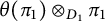 $\theta (\pi _1) \otimes _{D_1} \pi _1$
as a quotient. As a result,
$\theta (\pi _1) \otimes _{D_1} \pi _1$
as a quotient. As a result, $(\Theta (\pi _1) \otimes _{D_1} \pi _1)\otimes _R \bar {R}$
admits
$(\Theta (\pi _1) \otimes _{D_1} \pi _1)\otimes _R \bar {R}$
admits $(\theta (\pi _1) \otimes _{D_1} \pi _1) \otimes _R \bar {R}$
as a quotient. But
$(\theta (\pi _1) \otimes _{D_1} \pi _1) \otimes _R \bar {R}$
as a quotient. But $(\Theta (\pi _1) \otimes _{D_1} \pi _1)\otimes _{E_1,\varphi (w)} \bar {R}$
admits
$(\Theta (\pi _1) \otimes _{D_1} \pi _1)\otimes _{E_1,\varphi (w)} \bar {R}$
admits $(\theta (\pi _1) \otimes _{D_1} \pi _1) \otimes _{E_1,\varphi (w)} \pi _1$
and
$(\theta (\pi _1) \otimes _{D_1} \pi _1) \otimes _{E_1,\varphi (w)} \pi _1$
and $\theta (\pi _1) \otimes _{E_1,\varphi (w)} \bar {R} = m_1 \theta ({}^w \rho _1)$
as a quotient. Hence,
$\theta (\pi _1) \otimes _{E_1,\varphi (w)} \bar {R} = m_1 \theta ({}^w \rho _1)$
as a quotient. Hence, $\theta ({}^w \rho _1)$
is not irreducible because
$\theta ({}^w \rho _1)$
is not irreducible because $\theta (\pi _1)$
is not and the scalar extension functor is exact, therefore
$\theta (\pi _1)$
is not and the scalar extension functor is exact, therefore $\theta (\pi _1) \otimes _{E_1,\varphi (w)} \bar {R}$
has length at least
$\theta (\pi _1) \otimes _{E_1,\varphi (w)} \bar {R}$
has length at least $2 m_1$
.
$2 m_1$
.
Proposition 6.7 Suppose $\Theta (\pi _1)$
and
$\Theta (\pi _1)$
and $\Theta (\pi _1')$
are two
$\Theta (\pi _1')$
are two $R[H_2]-D_1$
-bimodules of finite length whose respective cosocles
$R[H_2]-D_1$
-bimodules of finite length whose respective cosocles $\theta (\pi _1)$
and
$\theta (\pi _1)$
and $\theta (\pi _1')$
are irreducible. Let
$\theta (\pi _1')$
are irreducible. Let $\rho _1$
and
$\rho _1$
and $\rho _1'$
be irreducible representations contained in the scalar extension to
$\rho _1'$
be irreducible representations contained in the scalar extension to $\bar {R}$
of
$\bar {R}$
of $\pi _1$
and
$\pi _1$
and $\pi _1'$
. Assume
$\pi _1'$
. Assume $D_1 = \mathrm {End}_{R[H_1]}(\pi _1) \simeq \mathrm {End}_{R[H_1]}(\pi _1')$
. Then the following assertions are equivalent:
$D_1 = \mathrm {End}_{R[H_1]}(\pi _1) \simeq \mathrm {End}_{R[H_1]}(\pi _1')$
. Then the following assertions are equivalent:
-
(1)
$\theta (\pi _1) \simeq \theta (\pi _1')$
as
$R[H_2]-D_1$
-bimodules; -
(2) for all
${}^w \rho _1$
, there exists
${}^{w'} \rho _1'$
such that
$\theta ({}^w \rho _1) \simeq \theta ({}^{w'} \rho _1')$
; -
(3) there exists
${}^w \rho _1$
and
${}^{w'} \rho _1'$
such that
$\theta ({}^w \rho _1) \simeq \theta ({}^w \rho _1')$
.







Proof The implication b) $\Rightarrow $
c) is still obvious.
$\Rightarrow $
c) is still obvious.
For a) $\Rightarrow $
b), the isomorphism
$\Rightarrow $
b), the isomorphism $\theta (\pi _1) \otimes _{E_1,\varphi (w)} \bar {R} \simeq m_1 \theta ({}^w \rho _1)$
is an isomorphism of
$\theta (\pi _1) \otimes _{E_1,\varphi (w)} \bar {R} \simeq m_1 \theta ({}^w \rho _1)$
is an isomorphism of $\bar {R}[H_2]-(D_1 \otimes _{E_1,\varphi (w)} \bar {R})$
-bimodules. And likewise for
$\bar {R}[H_2]-(D_1 \otimes _{E_1,\varphi (w)} \bar {R})$
-bimodules. And likewise for $\theta (\pi _1')$
and some
$\theta (\pi _1')$
and some $\theta ({}^{w'}\rho _1')$
. If
$\theta ({}^{w'}\rho _1')$
. If $\theta (\pi _1) \simeq \theta (\pi _1')$
, then
$\theta (\pi _1) \simeq \theta (\pi _1')$
, then $\theta ({}^w \rho _1) \simeq \theta ({}^{w'} \rho _1')$
in
$\theta ({}^w \rho _1) \simeq \theta ({}^{w'} \rho _1')$
in $\text {Rep}_{\bar {R}}(H_2)$
.
$\text {Rep}_{\bar {R}}(H_2)$
.
Regarding the last implication c) $\Rightarrow $
a), there exists thanks to the previous paragraph an isomorphism
$\Rightarrow $
a), there exists thanks to the previous paragraph an isomorphism $\theta (\pi _1) \otimes _{E_1,\varphi (w)} \bar {R} \simeq \theta (\pi _1') \otimes _{E_1,\varphi '(w')} \bar {R}$
because
$\theta (\pi _1) \otimes _{E_1,\varphi (w)} \bar {R} \simeq \theta (\pi _1') \otimes _{E_1,\varphi '(w')} \bar {R}$
because $\theta ({}^w \rho _1) \simeq \theta ({}^{w'} \rho _1')$
. Let
$\theta ({}^w \rho _1) \simeq \theta ({}^{w'} \rho _1')$
. Let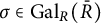 $\sigma \in \text {Gal}_R(\bar {R})$
. Then
$\sigma \in \text {Gal}_R(\bar {R})$
. Then ${}^{\sigma }(\theta (\pi _1) \otimes _{E_1,\varphi (w)} \bar {R}) \simeq \theta (\pi _1) \otimes _{E_1 , \varphi (\sigma w)} \bar {R}$
. In particular, this implies that
${}^{\sigma }(\theta (\pi _1) \otimes _{E_1,\varphi (w)} \bar {R}) \simeq \theta (\pi _1) \otimes _{E_1 , \varphi (\sigma w)} \bar {R}$
. In particular, this implies that $\theta ({}^{\sigma w} \rho _1) \simeq \theta ({}^{\sigma w'} \rho _1)$
. Therefore, there exists a bijection
$\theta ({}^{\sigma w} \rho _1) \simeq \theta ({}^{\sigma w'} \rho _1)$
. Therefore, there exists a bijection $\psi $
of
$\psi $
of $\text {Hom}_R(R(\rho _1),\bar {R})$
such that for all
$\text {Hom}_R(R(\rho _1),\bar {R})$
such that for all $w_0 \in \text {Hom}_R(R(\rho _1),\bar {R})$
, we have
$w_0 \in \text {Hom}_R(R(\rho _1),\bar {R})$
, we have $\theta ({}^{w_0} \rho _1) \simeq \theta ({}^{\psi (w_0)} \rho _1')$
. We thus have isomorphisms of
$\theta ({}^{w_0} \rho _1) \simeq \theta ({}^{\psi (w_0)} \rho _1')$
. We thus have isomorphisms of $\bar {R}[H_2]-(D_1\otimes _R \bar {R})$
-bimodules
$\bar {R}[H_2]-(D_1\otimes _R \bar {R})$
-bimodules
 $$ \begin{align*}\theta(\pi_1) \otimes_R \bar{R} \simeq \oplus_{w_0} \theta(\pi_1) \otimes_{E_1 , \varphi(w_0)} \bar{R} \simeq \theta(\pi_1') \otimes_R \bar{R}.\end{align*} $$
By restriction of scalars, $(\theta (\pi _1) \otimes _R \bar {R})|_R$
is an
$(\theta (\pi _1) \otimes _R \bar {R})|_R$
is an $R[H_2]-D_1$
-bimodule which is at the same time
$R[H_2]-D_1$
-bimodule which is at the same time $\theta (\pi _1)$
-isotypic and
$\theta (\pi _1)$
-isotypic and $\theta (\pi _1')$
-isotypic. Therefore,
$\theta (\pi _1')$
-isotypic. Therefore, $\theta (\pi _1) \simeq \theta (\pi _1')$
.
$\theta (\pi _1) \simeq \theta (\pi _1')$
.
6.5
We now assume that R is algebraically closed. Let $V \in \text {Rep}_R(H_1 \times H_2)$
, we can define
$V \in \text {Rep}_R(H_1 \times H_2)$
, we can define $\Theta _V$
as earlier. We add the subscript V here because we want to be able to consider
$\Theta _V$
as earlier. We add the subscript V here because we want to be able to consider $\Theta _{V'}$
for another
$\Theta _{V'}$
for another $V' \in \text {Rep}_R(H_1 \times H_2)$
. We have a compatibility of the isotypic lifts with the Galois action in the following sense.
$V' \in \text {Rep}_R(H_1 \times H_2)$
. We have a compatibility of the isotypic lifts with the Galois action in the following sense.
Theorem 6.8 The isotypic lifts are compatible with the action of $\mathrm {Gal}_{R_0}(R)$
in the sense that, for all
$\mathrm {Gal}_{R_0}(R)$
in the sense that, for all $\sigma \in \mathrm {Gal}_{R_0}(R)$
and for all
$\sigma \in \mathrm {Gal}_{R_0}(R)$
and for all $\pi _1 \in \mathrm {Irr}_R(H_1)$
, we have
$\pi _1 \in \mathrm {Irr}_R(H_1)$
, we have
 $$ \begin{align*}{}^\sigma \Theta_V(\pi_1) \simeq \Theta_{{}^\sigma V}({}^\sigma \pi_1).\end{align*} $$
Proof The morphism $V \twoheadrightarrow V_{\pi _1}$
induces
$V \twoheadrightarrow V_{\pi _1}$
induces ${}^\sigma V \twoheadrightarrow ({}^\sigma V)_{{}^\sigma \pi _1}$
and
${}^\sigma V \twoheadrightarrow ({}^\sigma V)_{{}^\sigma \pi _1}$
and ${}^\sigma (V_{\pi _1}) \simeq ({}^\sigma V)_{{}^\sigma \pi _1}$
. Therefore,
${}^\sigma (V_{\pi _1}) \simeq ({}^\sigma V)_{{}^\sigma \pi _1}$
. Therefore, ${}^\sigma (\Theta _V(\pi _1) \otimes _R \pi _1) \simeq {}^\sigma \Theta _V(\pi _1) \otimes _R {}^\sigma \pi _1 \simeq \Theta _{{}^\sigma V}({}^\sigma \pi _1) \otimes _R {}^\sigma \pi _1$
, so
${}^\sigma (\Theta _V(\pi _1) \otimes _R \pi _1) \simeq {}^\sigma \Theta _V(\pi _1) \otimes _R {}^\sigma \pi _1 \simeq \Theta _{{}^\sigma V}({}^\sigma \pi _1) \otimes _R {}^\sigma \pi _1$
, so ${}^\sigma \Theta _V(\pi _1) \simeq \Theta _{{}^\sigma V}({}^\sigma \pi _1)$
by Theorem 6.1 and the uniqueness of the lift.
${}^\sigma \Theta _V(\pi _1) \simeq \Theta _{{}^\sigma V}({}^\sigma \pi _1)$
by Theorem 6.1 and the uniqueness of the lift.
Part II
Galois descent on the Weil representation
7 Galois descent as Morita equivalences
The Galois descent theorems – obtained by taking the fixed points under the action of some Galois group – can be seen as a particular case of faithfully flat descent. We present an alternative interpretation of the Galois descent theorems in terms of Morita equivalences, adopting a representation theoretic perspective.
7.1
Let $A \hookrightarrow B$
be a morphism of commutative rings and let
$A \hookrightarrow B$
be a morphism of commutative rings and let $\text {Aut}_A(B)$
be the ring automorphisms of B which fix all elements of A. Let
$\text {Aut}_A(B)$
be the ring automorphisms of B which fix all elements of A. Let $G \subseteq \text {Aut}_A(B)$
be a finite subgroup.
$G \subseteq \text {Aut}_A(B)$
be a finite subgroup.
Definition 7.1 The twisted group algebra $B'[G]$
is the A-algebra on the free B-module
$B'[G]$
is the A-algebra on the free B-module $\bigoplus _{g \in G} B \cdot g$
of basis G endowed with the twisted multiplication
$\bigoplus _{g \in G} B \cdot g$
of basis G endowed with the twisted multiplication $(\alpha \cdot g) \times ( \beta \cdot g') = \alpha g(\beta ) \cdot g g'$
.
$(\alpha \cdot g) \times ( \beta \cdot g') = \alpha g(\beta ) \cdot g g'$
.
A $B'[G]$
-module is equivalently a B-module endowed with a semilinear action of G. Following [Reference Greither5, Chapter 0, Definition 1.5 and Theorem 1.6], we say that
$B'[G]$
-module is equivalently a B-module endowed with a semilinear action of G. Following [Reference Greither5, Chapter 0, Definition 1.5 and Theorem 1.6], we say that $B/A$
is G-Galois if
$B/A$
is G-Galois if $B=A^G$
and B is a finitely generated projective A-module and the ring morphism
$B=A^G$
and B is a finitely generated projective A-module and the ring morphism $B'[G] \to \text {End}_A(B)$
is an isomorphism.
$B'[G] \to \text {End}_A(B)$
is an isomorphism.
According to [Reference Greither5, Chapter 0, Section 4], if $L/K$
is a finite Galois extension of number fields and
$L/K$
is a finite Galois extension of number fields and $G = \text {Gal}(L/K)$
, we obtain a G-Galois extension for their rings of integers if we exclude the ramification locus, that is, if S is the set of places in K which ramify in
$G = \text {Gal}(L/K)$
, we obtain a G-Galois extension for their rings of integers if we exclude the ramification locus, that is, if S is the set of places in K which ramify in $L/K$
and
$L/K$
and $S'$
is the set of places in L above S, then
$S'$
is the set of places in L above S, then $\mathcal {O}_{K,S} \hookrightarrow \mathcal {O}_{L,S'}$
is G-Galois. For instance,
$\mathcal {O}_{K,S} \hookrightarrow \mathcal {O}_{L,S'}$
is G-Galois. For instance, $\mathbb {Z} \hookrightarrow \mathbb {Z}[i]$
is not Galois, whereas
$\mathbb {Z} \hookrightarrow \mathbb {Z}[i]$
is not Galois, whereas $\mathbb {Z}[1/2] \hookrightarrow \mathbb {Z}[1/2][i]$
is.
$\mathbb {Z}[1/2] \hookrightarrow \mathbb {Z}[1/2][i]$
is.
Let $B/A$
be G-Galois. We have the following equivalence of categories.
$B/A$
be G-Galois. We have the following equivalence of categories.
Theorem 7.2 The category of A-modules is equivalent to the category of $B'[G]$
-modules. Given a
$B'[G]$
-modules. Given a $B'[G]$
-module V, the natural map
$B'[G]$
-module V, the natural map $V^G \otimes _A B \to V$
is an isomorphism.
$V^G \otimes _A B \to V$
is an isomorphism.
Proof This theorem can be seen as an instance of Morita equivalences. We claim that B is a progenerator of the category of A-modules. By definition of G-Galois rings, it is finitely generated and projective. Moreover, $\text {Spec}(B) \to \text {Spec}(A)$
is surjective because
$\text {Spec}(B) \to \text {Spec}(A)$
is surjective because $A \hookrightarrow B$
is faithfully flat by [Reference Greither5, Chapter 0, Lemma 1.9], so B is a generator. Therefore,
$A \hookrightarrow B$
is faithfully flat by [Reference Greither5, Chapter 0, Lemma 1.9], so B is a generator. Therefore, $V \mapsto V \otimes _A B$
provides a Morita equivalence between the categories of A-modules and
$V \mapsto V \otimes _A B$
provides a Morita equivalence between the categories of A-modules and $\text {End}_A(B)$
-modules.
$\text {End}_A(B)$
-modules.
We need to explain why $V^G \otimes _A B \to V$
is an isomorphism. As a consequence of the previous equivalence of categories, there exists an A-submodule W of V such that
$V^G \otimes _A B \to V$
is an isomorphism. As a consequence of the previous equivalence of categories, there exists an A-submodule W of V such that $V = W \otimes _A B$
. But
$V = W \otimes _A B$
. But $(W \otimes _A B)^G = W$
, so we deduce that
$(W \otimes _A B)^G = W$
, so we deduce that $W = V^G$
.
$W = V^G$
.
7.2
Let B be the limit of commutative rings $B_i$
’s ordered by inclusion. Let
$B_i$
’s ordered by inclusion. Let $A \hookrightarrow B_i$
be a compatible system of
$A \hookrightarrow B_i$
be a compatible system of $G_i$
-Galois rings in the sense that for all
$G_i$
-Galois rings in the sense that for all $B_i \hookrightarrow B_{i'}$
the restriction to
$B_i \hookrightarrow B_{i'}$
the restriction to $B_i$
induces a surjection
$B_i$
induces a surjection $G_{i'} \twoheadrightarrow G_i$
. Consider the ring morphism
$G_{i'} \twoheadrightarrow G_i$
. Consider the ring morphism $A \hookrightarrow B$
thus obtained as well as the profinite group
$A \hookrightarrow B$
thus obtained as well as the profinite group
 $$ \begin{align*}G = \underset{\leftarrow}{\text{lim}} \ G_i.\end{align*} $$
In particular, the action of G on B is smooth. In this situation, we say that $B/A$
is G-Galois.
$B/A$
is G-Galois.
The profinite case is very similar to the finite case, except that the action must be coming from finite groups, that is, be smooth in the usual sense. In particular, V is a smooth $B'[G]$
-module if and only if
$B'[G]$
-module if and only if $V = \cup _i V^{G_i}$
. We easily deduce from the finite case the following theorem.
$V = \cup _i V^{G_i}$
. We easily deduce from the finite case the following theorem.
Theorem 7.3 The category of A-modules is equivalent to the category of B-modules with semilinear smooth action of G. Given a smooth $B'[G]$
-module V, the natural map
$B'[G]$
-module V, the natural map $V^G \otimes _A B \to V$
is an isomorphism.
$V^G \otimes _A B \to V$
is an isomorphism.
8 Preliminaries on the Weil representation
Let F be a field of characteristic not $2$
, that is either a finite field of cardinality q or a non-archimedean local field of residual cardinality q. We write
$2$
, that is either a finite field of cardinality q or a non-archimedean local field of residual cardinality q. We write $q=p^f$
where p is a prime number. Let
$q=p^f$
where p is a prime number. Let $(W, \langle \ , \ \rangle )$
be a symplectic vector space of finite dimension
$(W, \langle \ , \ \rangle )$
be a symplectic vector space of finite dimension $n=2m$
over F. Let H be the Heisenberg group, that is,
$n=2m$
over F. Let H be the Heisenberg group, that is, $H = W \times F$
as a set with group law
$H = W \times F$
as a set with group law
 $$ \begin{align*}(w,t) \cdot (w',t') = (w+w',t+t'+\frac{1}{2} \langle w,w' \rangle)\end{align*} $$
for $w, w' \in W$
and
$w, w' \in W$
and $t, t' \in F$
. The center of H is identified with F via
$t, t' \in F$
. The center of H is identified with F via $t \mapsto (0,t)$
.
$t \mapsto (0,t)$
.
Let $R_0$
be
$R_0$
be $\mathbb {Q}$
or
$\mathbb {Q}$
or $\mathbb {F}_\ell $
with
$\mathbb {F}_\ell $
with $\ell \neq p$
and let
$\ell \neq p$
and let $\mathcal {K}$
be the field extension
$\mathcal {K}$
be the field extension $R_0[\zeta _p]$
if
$R_0[\zeta _p]$
if $\text {char}(F)> 0$
and
$\text {char}(F)> 0$
and $R_0[\zeta _{p^\infty }]$
if
$R_0[\zeta _{p^\infty }]$
if $\text {char}(F)=0$
. The Galois group
$\text {char}(F)=0$
. The Galois group $G = \text {Gal}(\mathcal {K}/R_0)$
is abelian. It is a subgroup of
$G = \text {Gal}(\mathcal {K}/R_0)$
is abelian. It is a subgroup of $(\mathbb {Z}/p \mathbb {Z})^\times $
if
$(\mathbb {Z}/p \mathbb {Z})^\times $
if $\text {char}(F)> 0$
and an open subgroup of
$\text {char}(F)> 0$
and an open subgroup of $\mathbb {Z}_p^\times $
otherwise.
$\mathbb {Z}_p^\times $
otherwise.
Let $\psi : F \to \mathcal {K}^\times $
be a nontrivial smooth character. If
$\psi : F \to \mathcal {K}^\times $
be a nontrivial smooth character. If $\sigma \in G$
, we define a nontrivial character
$\sigma \in G$
, we define a nontrivial character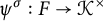 $\psi ^\sigma : F \to \mathcal {K}^\times $
via
$\psi ^\sigma : F \to \mathcal {K}^\times $
via $\psi ^\sigma (t) = \sigma ( \psi (t))$
. If
$\psi ^\sigma (t) = \sigma ( \psi (t))$
. If $\gamma \in F^\times $
, we define a nontrivial character
$\gamma \in F^\times $
, we define a nontrivial character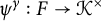 $\psi ^\gamma : F \to \mathcal {K}^\times $
via
$\psi ^\gamma : F \to \mathcal {K}^\times $
via $\psi ^\gamma (t) = \psi (\gamma t)$
. Since the action of
$\psi ^\gamma (t) = \psi (\gamma t)$
. Since the action of $F^\times $
on nontrivial characters is simply transitive, we deduce that for each
$F^\times $
on nontrivial characters is simply transitive, we deduce that for each $\{ (\sigma ,\gamma ) \in G \times F^\times \ | \ \psi ^\sigma = \psi ^\gamma \}$
is the graph of a homeomorphism which identifies G with a compact subgroup of
$\{ (\sigma ,\gamma ) \in G \times F^\times \ | \ \psi ^\sigma = \psi ^\gamma \}$
is the graph of a homeomorphism which identifies G with a compact subgroup of $F^\times $
.
$F^\times $
.
Let $W = X \oplus Y$
be a complete polarization. In particular, X and Y are Lagrangians. It also defines a duality between Y and X by identifying Y and
$W = X \oplus Y$
be a complete polarization. In particular, X and Y are Lagrangians. It also defines a duality between Y and X by identifying Y and $X^*$
via
$X^*$
via $y \mapsto \langle y , - \rangle $
.
$y \mapsto \langle y , - \rangle $
.
8.1
The Schrödinger model of the Heisenberg representation associated with $\psi $
and X is the representation
$\psi $
and X is the representation $(\rho _{\psi ,X},S_{\psi ,X}) \in \text {Rep}_{\mathcal {K}}(H)$
with central character
$(\rho _{\psi ,X},S_{\psi ,X}) \in \text {Rep}_{\mathcal {K}}(H)$
with central character $\psi $
defined by
$\psi $
defined by
 $$ \begin{align*}S_{\psi,X} = \text{ind}_{X_H}^H(\psi_X),\end{align*} $$
where $X_H = X \times F$
is a subgroup of H and
$X_H = X \times F$
is a subgroup of H and $\psi _X : (x,t) \in X_H \mapsto \psi (t) \in \mathcal {K}^\times $
is a character. Thanks to our complete polarization, we have a canonical isomorphism between
$\psi _X : (x,t) \in X_H \mapsto \psi (t) \in \mathcal {K}^\times $
is a character. Thanks to our complete polarization, we have a canonical isomorphism between $S_{\psi ,X}$
and
$S_{\psi ,X}$
and $C_c^\infty (Y,\mathcal {K})$
via
$C_c^\infty (Y,\mathcal {K})$
via $f \mapsto f|_Y$
. This allows us to consider
$f \mapsto f|_Y$
. This allows us to consider $S_{\psi ,X}$
on the space
$S_{\psi ,X}$
on the space $C_c^\infty (Y,\mathcal {K})$
, which is a vector space independent of
$C_c^\infty (Y,\mathcal {K})$
, which is a vector space independent of $\psi $
, though the action of H on this vector space will depend on
$\psi $
, though the action of H on this vector space will depend on $\psi $
. To be more explicit
$\psi $
. To be more explicit
 $$ \begin{align*}\rho_{\psi,X}(x+y,t) \cdot f (y') = \psi(t) \psi(\langle y' , x \rangle + \frac{1}{2} \langle y , x \rangle) f(y'+y)\end{align*} $$
for $x \in X$
,
$x \in X$
, $y \in Y$
,
$y \in Y$
, $t \in F,$
and
$t \in F,$
and $f \in C_c^\infty (Y,\mathcal {K})$
.
$f \in C_c^\infty (Y,\mathcal {K})$
.
For $\sigma \in G$
, we define
$\sigma \in G$
, we define $\sigma \cdot f \in C_c^\infty (Y,\mathcal {K})$
via
$\sigma \cdot f \in C_c^\infty (Y,\mathcal {K})$
via $(\sigma \cdot f) (y) = \sigma (f(y))$
. The morphism
$(\sigma \cdot f) (y) = \sigma (f(y))$
. The morphism $f \mapsto \sigma \cdot f$
defines a semilinear isomorphism
$f \mapsto \sigma \cdot f$
defines a semilinear isomorphism $(\rho _{\psi ,X},S_{\psi ,X}) \simeq (\rho _{\psi ^\sigma ,X},S_{\psi ^\sigma ,X})$
of representations, that is,
$(\rho _{\psi ,X},S_{\psi ,X}) \simeq (\rho _{\psi ^\sigma ,X},S_{\psi ^\sigma ,X})$
of representations, that is,
 $$ \begin{align*}\sigma \cdot (\rho_{\psi,X}(h) f) = \rho_{\psi^\sigma,X}(h) (\sigma \cdot f)\end{align*} $$
for all $h \in H$
and all
$h \in H$
and all $f \in C_c^\infty (Y,\mathcal {K})$
. In particular,
$f \in C_c^\infty (Y,\mathcal {K})$
. In particular, ${}^\sigma \rho _{\psi ,X} \simeq \rho _{\psi ^\sigma ,X}$
.
${}^\sigma \rho _{\psi ,X} \simeq \rho _{\psi ^\sigma ,X}$
.
8.2
Thanks to the Stone–von Neumann Theorem [Reference Moeglin, Vignéras and Waldspurger7, Reference Trias11], there exists a unique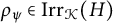 $\rho _\psi \in \text {Irr}_{\mathcal {K}}(H)$
with central character
$\rho _\psi \in \text {Irr}_{\mathcal {K}}(H)$
with central character $\psi $
. Moreover,
$\psi $
. Moreover, $\rho _\psi $
is admissible and absolutely irreducible. Let
$\rho _\psi $
is admissible and absolutely irreducible. Let $\text {tr}_{\rho _\psi } : \mathcal {H}_{\mathcal {K}}(H) \to \mathcal {K}$
be the trace-character of
$\text {tr}_{\rho _\psi } : \mathcal {H}_{\mathcal {K}}(H) \to \mathcal {K}$
be the trace-character of $\rho _\psi $
defined in Section 3.7 and recall that
$\rho _\psi $
defined in Section 3.7 and recall that $R(\rho _\psi )$
is its rationality/character field and
$R(\rho _\psi )$
is its rationality/character field and $m(\rho _\psi )$
its Schur index.
$m(\rho _\psi )$
its Schur index.
Proposition 8.1 We have $R(\rho _\psi ) = \mathcal {K}$
and
$R(\rho _\psi ) = \mathcal {K}$
and $m(\rho _\psi ) = 1$
.
$m(\rho _\psi ) = 1$
.
Proof Let $\sigma \in G$
. Since the representation
$\sigma \in G$
. Since the representation ${}^\sigma \rho _\psi $
is irreducible and has central character
${}^\sigma \rho _\psi $
is irreducible and has central character $\psi ^\sigma $
, it is isomorphic to
$\psi ^\sigma $
, it is isomorphic to $\rho _{\psi ^\sigma }$
by Stone–von Neumann Theorem. Then
$\rho _{\psi ^\sigma }$
by Stone–von Neumann Theorem. Then ${}^\sigma \rho _\psi \simeq \rho _\psi $
only if
${}^\sigma \rho _\psi \simeq \rho _\psi $
only if $\psi ^\sigma = \psi ,$
that is, only if
$\psi ^\sigma = \psi ,$
that is, only if $\sigma = \text {id}$
since the image of
$\sigma = \text {id}$
since the image of $\psi $
consists of all p-roots of unity if
$\psi $
consists of all p-roots of unity if $\text {char}(F)>0$
and all p-power roots of unity if
$\text {char}(F)>0$
and all p-power roots of unity if $\text {char}(F)=0$
. So
$\text {char}(F)=0$
. So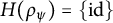 $H(\rho _\psi ) = \{ \text {id} \}$
and
$H(\rho _\psi ) = \{ \text {id} \}$
and $R(\rho _\psi )= \mathcal {K}$
. Since
$R(\rho _\psi )= \mathcal {K}$
. Since $\rho _\psi $
is already realized over
$\rho _\psi $
is already realized over $R(\rho _\psi )$
, we obtain
$R(\rho _\psi )$
, we obtain $m(\rho _\psi ) = 1$
.
$m(\rho _\psi ) = 1$
.
8.3
Let $\text {Mp}(W) = \text {Sp}(W) \times _{c_X} \{ \pm 1 \}$
be the metaplectic group and let
$\text {Mp}(W) = \text {Sp}(W) \times _{c_X} \{ \pm 1 \}$
be the metaplectic group and let $(\omega _{\psi ,X},S_{\psi ,X}) \in \text {Rep}_{\mathcal {K}}(\text {Mp}(W))$
be the Weil representation associated with
$(\omega _{\psi ,X},S_{\psi ,X}) \in \text {Rep}_{\mathcal {K}}(\text {Mp}(W))$
be the Weil representation associated with $\psi $
and X [Reference Trias11]. As earlier, we realize the Weil representations
$\psi $
and X [Reference Trias11]. As earlier, we realize the Weil representations $\omega _{\psi ,X}$
for each character
$\omega _{\psi ,X}$
for each character $\psi $
in a uniform way via the isomorphism
$\psi $
in a uniform way via the isomorphism $S_{\psi ,X} \simeq C_c^\infty (Y,\mathcal {K})$
of vector spaces.
$S_{\psi ,X} \simeq C_c^\infty (Y,\mathcal {K})$
of vector spaces.
From now on, we will write $(\omega _{\psi ,X},C_c^\infty (Y,\mathcal {K}))$
for the Weil representation associated with
$(\omega _{\psi ,X},C_c^\infty (Y,\mathcal {K}))$
for the Weil representation associated with $\psi $
and X. Let
$\psi $
and X. Let $P(X)$
be the stabilizer of X in
$P(X)$
be the stabilizer of X in $\text {Sp}(W)$
, also called the Siegel parabolic, and denote by
$\text {Sp}(W)$
, also called the Siegel parabolic, and denote by $P(X) = M(X) N(X)$
its Levi decomposition with respect to the complete polarization
$P(X) = M(X) N(X)$
its Levi decomposition with respect to the complete polarization $W = X \oplus Y$
. We have an antiisomorphism
$W = X \oplus Y$
. We have an antiisomorphism $a \in \text {GL}_F(X) \mapsto a^* \in \text {GL}_F(Y)$
and an isomorphism
$a \in \text {GL}_F(X) \mapsto a^* \in \text {GL}_F(Y)$
and an isomorphism $b \in \text {Hom}_F(Y,X) \mapsto b^* \in \text {Hom}_F(Y,X)$
via
$b \in \text {Hom}_F(Y,X) \mapsto b^* \in \text {Hom}_F(Y,X)$
via $Y \cong X^*$
and
$Y \cong X^*$
and $X^* \cong Y$
. We let
$X^* \cong Y$
. We let $\text {Hom}_F^{*,-}(Y,X) = \{ b \in \text {Hom}_F(Y,X) \ | \ b^* = - b\}$
be the antisymmetric morphisms.
$\text {Hom}_F^{*,-}(Y,X) = \{ b \in \text {Hom}_F(Y,X) \ | \ b^* = - b\}$
be the antisymmetric morphisms.
Thanks to the non-normalized Weil factor $\Omega $
introduced in [Reference Trias11], we can describe the Weil representation in a more straightforward way. We do not recall the construction of this factor and refer to [Reference Trias11] for any of its properties. We simply note that the representation
$\Omega $
introduced in [Reference Trias11], we can describe the Weil representation in a more straightforward way. We do not recall the construction of this factor and refer to [Reference Trias11] for any of its properties. We simply note that the representation $\omega _{\psi ,X}$
is given on the following set of generators of
$\omega _{\psi ,X}$
is given on the following set of generators of $\text {Sp}(W)$
by
$\text {Sp}(W)$
by
-
• if
$m \in M(X)$
with
$m|_X = a \in \text {GL}_F(X)$
, then
$$ \begin{align*}(\omega_{\psi,X}(m,1) \cdot f) (y) = \Omega_{1,\text{det}(a)}^\psi f(a^* y).\end{align*} $$
-
• if
$n \in N(X)$
with
$n-\text {id}_W = b \in \text {Hom}_F^{*,-}(Y,X)$
, then
$$ \begin{align*}(\omega_{\psi,X}(n,1) \cdot f)(y) = \psi(\frac{1}{2} \langle b y , y \rangle ) f(y).\end{align*} $$
-
• if
$w \in \text {Sp}(W)$
with
$w(X) = Y$
and
$w|_X = c \in \text {Iso}_F(X,Y)$
, then
$$ \begin{align*}(\omega_{\psi,X}(w,1) \cdot f)(y) = \int_X \psi(\langle x , y \rangle) f(c x) d\mu_w^\psi(x),\end{align*} $$
where
$\mu _w^\psi = \Omega _\mu (\psi \circ Q_w)^{-1} \mu $
and
$Q_w(x) = \frac {1}{2} \langle w x , x \rangle = \frac {1}{2} \langle c x , x \rangle $
.












8.4
Let $\sigma \in G$
and consider the morphism
$\sigma \in G$
and consider the morphism $f \mapsto \sigma \cdot f$
as before. The non-normalized Weil factor satisfies
$f \mapsto \sigma \cdot f$
as before. The non-normalized Weil factor satisfies $\sigma (\Omega _{\mu }(\psi \circ Q)) = \Omega _{\mu ^\sigma }(\psi ^\sigma \circ Q)$
. In particular,
$\sigma (\Omega _{\mu }(\psi \circ Q)) = \Omega _{\mu ^\sigma }(\psi ^\sigma \circ Q)$
. In particular,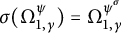 $\sigma (\Omega _{1,\gamma }^\psi ) = \Omega _{1,\gamma }^{\psi ^\sigma }$
for all
$\sigma (\Omega _{1,\gamma }^\psi ) = \Omega _{1,\gamma }^{\psi ^\sigma }$
for all $\ \gamma \in F^\times $
. Therefore, for all
$\ \gamma \in F^\times $
. Therefore, for all $f \in C_c^\infty (Y,\mathcal {K})$
and
$f \in C_c^\infty (Y,\mathcal {K})$
and $(g,\lambda ) \in \text {Mp}(W)$
, we have
$(g,\lambda ) \in \text {Mp}(W)$
, we have
 $$ \begin{align*}\sigma \cdot (\omega_{\psi,X}(g,\lambda) f) = \omega_{\psi^\sigma,X}(g,\lambda) (\sigma \cdot f)\end{align*} $$
because the metaplectic cocycle $c_X$
takes values in
$c_X$
takes values in $\{ \pm 1 \}$
. In particular,
$\{ \pm 1 \}$
. In particular, ${}^\sigma \omega _{\psi ,X} \simeq \omega _{\psi ^\sigma ,X}$
.
${}^\sigma \omega _{\psi ,X} \simeq \omega _{\psi ^\sigma ,X}$
.
8.5
For $\gamma \in F^\times $
, it is well-known that
$\gamma \in F^\times $
, it is well-known that $\omega _{\psi ^\gamma ,X} \simeq \omega _{\psi ,X}$
if and only
$\omega _{\psi ^\gamma ,X} \simeq \omega _{\psi ,X}$
if and only $\gamma \in F^{\times 2}$
. The proof is the same as in the complex case, where the if part comes from the action of
$\gamma \in F^{\times 2}$
. The proof is the same as in the complex case, where the if part comes from the action of $\text {GSp}(W)$
by conjugation [Reference Gan, Kudla and Takeda4, Section 9.1.2] and the only if part from a computation of twisted Jacquet functors [Reference Gan, Kudla and Takeda4, Section 9.4.3]. We need to be more precise than that to perform our Galois descent. Recall that
$\text {GSp}(W)$
by conjugation [Reference Gan, Kudla and Takeda4, Section 9.1.2] and the only if part from a computation of twisted Jacquet functors [Reference Gan, Kudla and Takeda4, Section 9.4.3]. We need to be more precise than that to perform our Galois descent. Recall that $( - , - )_F$
is the quadratic Hilbert symbol.
$( - , - )_F$
is the quadratic Hilbert symbol.
Proposition 8.2 For $\gamma \in F^\times $
, we have the following identities:
$\gamma \in F^\times $
, we have the following identities:
 $$ \begin{align} \omega_{\psi^\gamma,X}(m(a),1) =&\ (\gamma,\mathrm{det}(a))_F \omega_{\psi,X}(m(a),1) \end{align} $$
 $$ \begin{align} \omega_{\psi^{\gamma},X}(n(b),1) =&\ \omega_{\psi,X}(n(\gamma b),1) \end{align} $$
 $$ \begin{align} \omega_{\psi^\gamma,X}(w(c),1) =&\ \Omega_{w,\gamma} \omega_{\psi,X}(w(\gamma c),1), \end{align} $$
where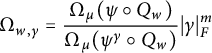 $\displaystyle \Omega _{w,\gamma } = \frac {\Omega _\mu (\psi \circ Q_w)}{\Omega _\mu (\psi ^\gamma \circ Q_w)} |\gamma |_F^m$
.
$\displaystyle \Omega _{w,\gamma } = \frac {\Omega _\mu (\psi \circ Q_w)}{\Omega _\mu (\psi ^\gamma \circ Q_w)} |\gamma |_F^m$
.
Proof We have $\Omega _{1,\text {det}(a)}^{\psi ^\gamma } = (\gamma ,\text {det}(a))_F \Omega _{1,\text {det}(a)}^\psi $
by the properties of the non-normalized Weil factor according to [Reference Trias11, Section 4], so this proves the first formula. The second one is very straightforward. The last one comes from a simple change of variables.
$\Omega _{1,\text {det}(a)}^{\psi ^\gamma } = (\gamma ,\text {det}(a))_F \Omega _{1,\text {det}(a)}^\psi $
by the properties of the non-normalized Weil factor according to [Reference Trias11, Section 4], so this proves the first formula. The second one is very straightforward. The last one comes from a simple change of variables.
Corollary 8.3 Let $\gamma \in \mathcal {O}_F^\times $
and write
$\gamma \in \mathcal {O}_F^\times $
and write $m_\gamma $
for
$m_\gamma $
for $m(\gamma \text {id}_X)$
. We have
$m(\gamma \text {id}_X)$
. We have
 $$ \begin{align*}\omega_{\psi^{\gamma^2},X}(g,\lambda) = \omega_{\psi,X}^{m_\gamma}(g,\lambda).\end{align*} $$
Proof In the metaplectic group, we have $(m_\gamma ,\mu ) (g,\lambda ) (m_\gamma ,\mu )^{-1} = (m_\gamma g m_\gamma ^{-1},\lambda )$
. Recall that the quadratic Hilbert symbol
$(m_\gamma ,\mu ) (g,\lambda ) (m_\gamma ,\mu )^{-1} = (m_\gamma g m_\gamma ^{-1},\lambda )$
. Recall that the quadratic Hilbert symbol $( - , - )_F$
is trivial on squares and that the non-normalized Weil factor satisfies
$( - , - )_F$
is trivial on squares and that the non-normalized Weil factor satisfies $\Omega _\mu (\psi ^{\gamma ^2} \circ Q_w) = \Omega _\mu (\psi \circ Q_w \circ \gamma ) = |\gamma |_F^m \Omega _\mu (\psi \circ Q_w)$
when
$\Omega _\mu (\psi ^{\gamma ^2} \circ Q_w) = \Omega _\mu (\psi \circ Q_w \circ \gamma ) = |\gamma |_F^m \Omega _\mu (\psi \circ Q_w)$
when $\gamma \in F^\times $
. Therefore, when
$\gamma \in F^\times $
. Therefore, when $\gamma \in \mathcal {O}_F^\times $
, we obtain from Proposition 8.2 three equalities
$\gamma \in \mathcal {O}_F^\times $
, we obtain from Proposition 8.2 three equalities
 $$ \begin{align} \omega_{\psi^{\gamma^2},X}(m,1) =&\ \omega_{\psi,X}(m,1) = \omega_{\psi,X}(m_\gamma m m_\gamma^{-1},1) \end{align} $$
 $$ \begin{align} \omega_{\psi^{\gamma^2},X}(n,1) =&\ \omega_{\psi,X}(m_\gamma n m_\gamma^{-1},1) \end{align} $$
 $$ \begin{align} \omega_{\psi^{\gamma^2},X}(w,1) =&\ \omega_{\psi,X}(m_\gamma w m_\gamma^{-1},1). \end{align} $$
Since the symplectic group $\text {Sp}(W)$
is generated by elements of the form
$\text {Sp}(W)$
is generated by elements of the form $m, n, w$
, the genuine representations
$m, n, w$
, the genuine representations $\omega _{\psi ^{\gamma ^2},X}$
and
$\omega _{\psi ^{\gamma ^2},X}$
and $\omega _{\psi ,X}^{m_\gamma }$
of
$\omega _{\psi ,X}^{m_\gamma }$
of $\text {Mp}(W)$
must be equal.
$\text {Mp}(W)$
must be equal.
9 Descent when
$p \neq 2$

9.1
Write $G = G_2 \times G_{2'}$
where
$G = G_2 \times G_{2'}$
where $G_2$
is a finite
$G_2$
is a finite $2$
-group and
$2$
-group and $G_{2'}$
has pro-order prime-to-
$G_{2'}$
has pro-order prime-to- $2$
. In particular, the square morphism
$2$
. In particular, the square morphism $\sigma \mapsto \sigma ^2$
induces a group automorphism of
$\sigma \mapsto \sigma ^2$
induces a group automorphism of $G_{2'}$
. Let
$G_{2'}$
. Let $\mathcal {L} = \mathcal {K}^{G_{2'}}$
be the fixed field of
$\mathcal {L} = \mathcal {K}^{G_{2'}}$
be the fixed field of $G_{2'}$
, which is a finite extension of
$G_{2'}$
, which is a finite extension of $R_0$
. We can always operate a Galois descent to this subfield.
$R_0$
. We can always operate a Galois descent to this subfield.
Theorem 9.1 The Weil representation can be realized over $\mathcal {L}$
.
$\mathcal {L}$
.
Proof We define an $\text {Mp}(W)$
-equivariant semilinear action of
$\text {Mp}(W)$
-equivariant semilinear action of $G_{2'}$
on
$G_{2'}$
on $(\omega _{\psi ,X},C_c^\infty (Y,\mathcal {K}))$
. For
$(\omega _{\psi ,X},C_c^\infty (Y,\mathcal {K}))$
. For $\sigma \in G_{2'}$
, there exists a unique element
$\sigma \in G_{2'}$
, there exists a unique element $\gamma \in {(\mathcal {O}_F^\times )}_{2'}$
in the prime-to-
$\gamma \in {(\mathcal {O}_F^\times )}_{2'}$
in the prime-to- $2$
part of
$2$
part of $\mathcal {O}_{F^\times }$
such that
$\mathcal {O}_{F^\times }$
such that $(\psi ^{\gamma ^2})^\sigma = \psi $
. We set
$(\psi ^{\gamma ^2})^\sigma = \psi $
. We set
 $$ \begin{align*}(r_\sigma \cdot f )(y)= \sigma\bigg( (\omega_{\psi,X}(m_\gamma,1) \cdot f) (y)\bigg).\end{align*} $$
Corollary 8.3 ensures that $\omega _{\psi ,X}(g,\lambda )$
and
$\omega _{\psi ,X}(g,\lambda )$
and $r_\sigma $
commute for all
$r_\sigma $
commute for all $(g,\lambda ) \in \text {Mp}(W)$
and all
$(g,\lambda ) \in \text {Mp}(W)$
and all $\sigma \in G_{2'}$
. It is easy to see that the semilinear action thus defined is smooth. As
$\sigma \in G_{2'}$
. It is easy to see that the semilinear action thus defined is smooth. As $\text {Spec}(\mathcal {K}) \to \text {Spec}(\mathcal {L})$
is proétale, we are in the situation of an effective descent data of Theorem 7.3 so the subspace
$\text {Spec}(\mathcal {K}) \to \text {Spec}(\mathcal {L})$
is proétale, we are in the situation of an effective descent data of Theorem 7.3 so the subspace $\mathcal {V}$
of
$\mathcal {V}$
of $G_{2'}$
-fixed points in
$G_{2'}$
-fixed points in $C_c^\infty (Y,\mathcal {K})$
satisfies
$C_c^\infty (Y,\mathcal {K})$
satisfies $\mathcal {V} \otimes _{\mathcal {L}} \mathcal {K} \overset {\sim }{\to } C_c^\infty (Y,\mathcal {K})$
. This
$\mathcal {V} \otimes _{\mathcal {L}} \mathcal {K} \overset {\sim }{\to } C_c^\infty (Y,\mathcal {K})$
. This $\mathcal {V}$
clearly inherits a smooth action of
$\mathcal {V}$
clearly inherits a smooth action of $\text {Mp}(W)$
.
$\text {Mp}(W)$
.
9.2
We can improve this theorem by looking at a finer decomposition of $\omega _{\psi ,X}$
involving the so-called even and odd parts of the Weil representation. We only pursue this goal when
$\omega _{\psi ,X}$
involving the so-called even and odd parts of the Weil representation. We only pursue this goal when $R_0=\mathbb {Q}$
because the even and odd parts are known to be absolutely irreducible representation. Denote by
$R_0=\mathbb {Q}$
because the even and odd parts are known to be absolutely irreducible representation. Denote by
-
•
$(\omega _{\psi ,X}^+,S_{\psi ,X}^+)$
the even functions on Y; -
•
$(\omega _{\psi ,X}^-,S_{\psi ,X}^-)$
the odd functions on Y.
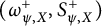
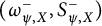
Both are admissible absolutely irreducible representations of $\text {Mp}(W)$
that can be realized over
$\text {Mp}(W)$
that can be realized over $\mathcal {L}$
by Theorem 9.1, where
$\mathcal {L}$
by Theorem 9.1, where $\mathcal {L}/\mathbb {Q}$
has degree
$\mathcal {L}/\mathbb {Q}$
has degree $|G_2|$
. We let
$|G_2|$
. We let $p^*$
be
$p^*$
be $-p$
if
$-p$
if $p \equiv 3 [4]$
and p if
$p \equiv 3 [4]$
and p if $p \equiv 1 [4]$
. We rephrase a well-known fact about the dependence of the isomorphism class of
$p \equiv 1 [4]$
. We rephrase a well-known fact about the dependence of the isomorphism class of $\omega _{\psi ,X}$
on the character
$\omega _{\psi ,X}$
on the character $\psi $
in the following way.
$\psi $
in the following way.
Theorem 9.2 $R(\omega _{\psi ,X}^+) = R(\omega _{\psi ,X}^-) = \left \{ \begin {array}{@{}cl} \mathbb {Q} & \text { if } q \in p^{2 \mathbb {N}} \\ \mathbb {Q}[\sqrt {p^*}] & \text { if } q \in p^{2 \mathbb {N}+1}. \end {array} \right .$
Proof Via the identification of G with a subgroup of $\mathcal {O}_F^\times $
, let
$\mathcal {O}_F^\times $
, let $\sigma \in G$
and let
$\sigma \in G$
and let $\gamma \in \mathcal {O}_F^\times $
be the unique element such that
$\gamma \in \mathcal {O}_F^\times $
be the unique element such that $\psi ^\sigma = \psi ^\gamma $
. The map
$\psi ^\sigma = \psi ^\gamma $
. The map $\sigma \mapsto \lambda $
induces a group isomorphism with
$\sigma \mapsto \lambda $
induces a group isomorphism with $\mathbb {Z}/(p-1)\mathbb {Z}$
or
$\mathbb {Z}/(p-1)\mathbb {Z}$
or $\mathbb {Z}_p^\times $
, as embedded subgroups in
$\mathbb {Z}_p^\times $
, as embedded subgroups in $\mathcal {O}_F^\times $
, according to whether
$\mathcal {O}_F^\times $
, according to whether $\text {char}(F)$
is positive or not. We know by Section 8.4 that
$\text {char}(F)$
is positive or not. We know by Section 8.4 that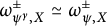 $\omega _{\psi ^\gamma ,X}^\pm \simeq \omega _{\psi ,X}^\pm $
if and only if
$\omega _{\psi ^\gamma ,X}^\pm \simeq \omega _{\psi ,X}^\pm $
if and only if $\gamma \in \mathcal {O}_F^{\times 2}$
.
$\gamma \in \mathcal {O}_F^{\times 2}$
.
Therefore, $H(\omega _{\psi ,X}^\pm ) = \{ \sigma \in G \ | \ \omega _{\psi ^\sigma ,X}^\pm \simeq \omega _{\psi ,X}^\pm \} = G \cap \mathcal {O}_F^{\times 2}$
. The subgroup
$H(\omega _{\psi ,X}^\pm ) = \{ \sigma \in G \ | \ \omega _{\psi ^\sigma ,X}^\pm \simeq \omega _{\psi ,X}^\pm \} = G \cap \mathcal {O}_F^{\times 2}$
. The subgroup $G \cap \mathcal {O}_F^{\times 2}$
of G is equal to G if and only if
$G \cap \mathcal {O}_F^{\times 2}$
of G is equal to G if and only if $q \in p^{2 \mathbb {N}}$
, and is a subgroup of index
$q \in p^{2 \mathbb {N}}$
, and is a subgroup of index $2$
otherwise. As a result, the fixed field of
$2$
otherwise. As a result, the fixed field of $G \cap \mathcal {O}_F^{\times 2}$
gives the character field, which is either
$G \cap \mathcal {O}_F^{\times 2}$
gives the character field, which is either $\mathbb {Q}$
or
$\mathbb {Q}$
or $\mathbb {Q}[\sqrt {p^*}]$
according to whether q is a square or not.
$\mathbb {Q}[\sqrt {p^*}]$
according to whether q is a square or not.
9.3
We first deal with the even part, as it is simpler.
Theorem 9.3 The even part $\omega _{\psi ,X}^+$
can be realized over its character field
$\omega _{\psi ,X}^+$
can be realized over its character field $R(\omega _{\psi ,X}^+)$
.
$R(\omega _{\psi ,X}^+)$
.
Proof We first consider the case $q \equiv 3 [4]$
or equivalently
$q \equiv 3 [4]$
or equivalently $p \equiv 3 [4]$
and
$p \equiv 3 [4]$
and $q \in p^{2 \mathbb {N}+1}$
. Note that we already have that
$q \in p^{2 \mathbb {N}+1}$
. Note that we already have that $\mathcal {L} = \mathbb {Q}[\sqrt {-p}] = R(\omega _{\psi ,X}^+)$
and therefore the theorem holds.
$\mathcal {L} = \mathbb {Q}[\sqrt {-p}] = R(\omega _{\psi ,X}^+)$
and therefore the theorem holds.
We can assume $-1 \in \mathcal {O}_F^{\times 2}$
as this is equivalent to
$-1 \in \mathcal {O}_F^{\times 2}$
as this is equivalent to $q \equiv 1 [4]$
. Therefore,
$q \equiv 1 [4]$
. Therefore, $\Omega _{1,-1}^\psi = 1$
and
$\Omega _{1,-1}^\psi = 1$
and $(-1,\gamma )_F=1$
for all
$(-1,\gamma )_F=1$
for all $\gamma \in F^\times $
. In particular,
$\gamma \in F^\times $
. In particular, $\omega _{\psi ,X}^+((-\text {id}_W,1)) = \text {id}_{S_{\psi ,X}^+}$
and
$\omega _{\psi ,X}^+((-\text {id}_W,1)) = \text {id}_{S_{\psi ,X}^+}$
and
 $$ \begin{align*}\omega_{\psi,X}^+(m_{- \gamma},1) = \omega_{\psi,X}^+(m_\gamma,1) \text{ for all } \gamma \in F^\times.\end{align*} $$
we recall that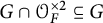 $G \cap \mathcal {O}_F^{\times 2} \subseteq G$
is a subgroup of index
$G \cap \mathcal {O}_F^{\times 2} \subseteq G$
is a subgroup of index $1$
or
$1$
or $2$
according to whether q is a square or not. Let
$2$
according to whether q is a square or not. Let $\sigma \in G \cap \mathcal {O}_F^{\times 2} \mapsto \gamma \in \mathcal {O}_F^\times $
be any map subject to the relation
$\sigma \in G \cap \mathcal {O}_F^{\times 2} \mapsto \gamma \in \mathcal {O}_F^\times $
be any map subject to the relation $\sigma = \gamma ^2$
.
$\sigma = \gamma ^2$
.
Because p is odd, the restriction of the quadratic Hilbert symbol to $\mathcal {O}_F^\times \times \mathcal {O}_F^\times $
is trivial. Since
$\mathcal {O}_F^\times \times \mathcal {O}_F^\times $
is trivial. Since $\omega _{\psi ,X}^+(m_{-\gamma },1) = \omega _{\psi ,X}^+(m_\gamma ,1)$
, the earlier descent formula
$\omega _{\psi ,X}^+(m_{-\gamma },1) = \omega _{\psi ,X}^+(m_\gamma ,1)$
, the earlier descent formula
 $$ \begin{align*}(r_\sigma \cdot f )(y)= \sigma\bigg( (\omega_{\psi,X}^+(m_\gamma,1) \cdot f) (y)\bigg)\end{align*} $$
still defines a continuous semilinear action of $G \cap \mathcal {O}_F^{\times 2}$
on
$G \cap \mathcal {O}_F^{\times 2}$
on $\omega _{\psi ,X}^+$
. So the representation can be realized over the fixed field of
$\omega _{\psi ,X}^+$
. So the representation can be realized over the fixed field of $G \cap \mathcal {O}_F^{\times 2}$
which is
$G \cap \mathcal {O}_F^{\times 2}$
which is $R(\omega _{\psi ,X}^+)$
.
$R(\omega _{\psi ,X}^+)$
.
9.4
The odd part requires more work.
Theorem 9.4 The odd part $\omega _{\psi ,X}^-$
can be realized over
$\omega _{\psi ,X}^-$
can be realized over
-
•
$R(\omega _{\psi ,X}^-)$
if
$p \equiv 3 [4]$
and
$q \in p^{2\mathbb {N} + 1}$
; -
•
$R(\omega _{\psi ,X}^-)[\sqrt {-p}]$
and
$m(\omega _{\psi ,X}^-) = 2$
otherwise.


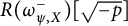
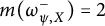
Proof The easiest case to deal with is $q \equiv 3 [4]$
or equivalently
$q \equiv 3 [4]$
or equivalently $p \equiv 3 [4]$
and
$p \equiv 3 [4]$
and $q \in p^{2\mathbb {N}+1}$
. In this case,
$q \in p^{2\mathbb {N}+1}$
. In this case,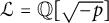 $\mathcal {L} = \mathbb {Q}[\sqrt {-p}]$
already, and Theorem 9.2 ensures this is the character field.
$\mathcal {L} = \mathbb {Q}[\sqrt {-p}]$
already, and Theorem 9.2 ensures this is the character field.
To deal with the other two cases, we use information about the endomorphism ring of $\omega _{\psi ,X}^-$
. First of all, for all
$\omega _{\psi ,X}^-$
. First of all, for all $\mathbb {Q} \subseteq \mathcal {M} \subseteq \mathcal {L}$
, we have
$\mathbb {Q} \subseteq \mathcal {M} \subseteq \mathcal {L}$
, we have
 $$ \begin{align*}\omega_{\psi,X}^-|_{\mathcal{M}} \otimes_{\mathcal{M}} \mathcal{L} \simeq \bigoplus_{\sigma \in \text{Gal}(\mathcal{L}/\mathcal{M})} \omega_{\psi^\sigma,X}^-.\end{align*} $$
Recall that $G_2 = \text {Gal}(\mathcal {L}/\mathbb {Q})$
is a finite cyclic group of order
$G_2 = \text {Gal}(\mathcal {L}/\mathbb {Q})$
is a finite cyclic group of order $2^k,$
where
$2^k,$
where $k=\text {val}_2(p-1) \geq 2$
. According to Theorem 9.2, two cases now arise:
$k=\text {val}_2(p-1) \geq 2$
. According to Theorem 9.2, two cases now arise:
-
•
$\omega _{\psi ^\sigma ,X}^- \simeq \omega _{\psi ,X}^-$
for all
$\sigma \in G_2,$
that is,
$G \cap \mathcal {O}_F^{\times 2} = G,$
that is, q is a square; -
• there exists
$\sigma \in G_2$
such that
$\omega _{\psi ^\sigma ,X}^-$
is not isomorphic to
$\omega _{\psi ,X}^-$
.
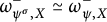

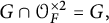


In particular, this distinction implies that the character field is $\mathbb {Q}$
or
$\mathbb {Q}$
or $\mathbb {Q}[\sqrt {p^*}]$
.
$\mathbb {Q}[\sqrt {p^*}]$
.
We first prove a negative result: it is impossible to descend further than $\mathcal {L}$
along
$\mathcal {L}$
along $\mathcal {L}$
.
$\mathcal {L}$
.
Lemma 9.5 The representation $\omega _{\psi ,X}^- \in \mathrm {Rep}_{\mathcal {L}}(\text {Mp}(W))$
is not defined over any strict subextension of
$\omega _{\psi ,X}^- \in \mathrm {Rep}_{\mathcal {L}}(\text {Mp}(W))$
is not defined over any strict subextension of $\mathcal {L}$
.
$\mathcal {L}$
.
Proof Since $\mathcal {L}/\mathbb {Q}$
is cyclic, the extension
$\mathcal {L}/\mathbb {Q}$
is cyclic, the extension $\mathcal {L}/\mathcal {L}'$
is cyclic for any subextension
$\mathcal {L}/\mathcal {L}'$
is cyclic for any subextension $\mathcal {L}'$
of
$\mathcal {L}'$
of $\mathcal {L}$
. By cyclicity, if any descent can be achieved along
$\mathcal {L}$
. By cyclicity, if any descent can be achieved along $\mathcal {L}$
, then it can be achieved over the totally real subextension
$\mathcal {L}$
, then it can be achieved over the totally real subextension $\mathcal {L}_0$
of index
$\mathcal {L}_0$
of index $2$
of the CM-field
$2$
of the CM-field $\mathcal {L}$
. Let
$\mathcal {L}$
. Let $\tau \in \text {Gal}(\mathcal {L}/\mathcal {L}_0) \subseteq \text {Gal}(\mathcal {L}/\mathbb {Q})$
be the complex conjugation, which is the unique element of order
$\tau \in \text {Gal}(\mathcal {L}/\mathcal {L}_0) \subseteq \text {Gal}(\mathcal {L}/\mathbb {Q})$
be the complex conjugation, which is the unique element of order $2$
.
$2$
.
If $\omega _{\psi ,X}^-$
descends to
$\omega _{\psi ,X}^-$
descends to $\mathcal {L}_0$
, there is a
$\mathcal {L}_0$
, there is a $\tau $
-linear
$\tau $
-linear $\text {Mp}(W)$
-automorphism of
$\text {Mp}(W)$
-automorphism of $\omega _{\psi ,X}^-$
of order
$\omega _{\psi ,X}^-$
of order $2$
. Note that
$2$
. Note that $\tau $
-linear
$\tau $
-linear $\text {Mp}(W)$
-automorphisms are unique up to a scalar thanks to Schur’s lemma. Choose
$\text {Mp}(W)$
-automorphisms are unique up to a scalar thanks to Schur’s lemma. Choose $i \in \mathcal {O}_F^\times $
such that
$i \in \mathcal {O}_F^\times $
such that $i^2=-1$
. Then
$i^2=-1$
. Then
 $$ \begin{align*}r_\tau \cdot f = \tau(\omega_{\psi,X}^-(m_i,1)f)\end{align*} $$
is a $\tau $
-linear
$\tau $
-linear $\text {Mp}(W)$
-automorphism of
$\text {Mp}(W)$
-automorphism of $\omega _{\psi ,X}^-$
. It satisfies
$\omega _{\psi ,X}^-$
. It satisfies $r_\tau ^2 = \omega _{\psi ,X}^-(m_{-1},1) = - \text {id}_{S_{\psi ,X}^-}$
.
$r_\tau ^2 = \omega _{\psi ,X}^-(m_{-1},1) = - \text {id}_{S_{\psi ,X}^-}$
.
Remark that any $\lambda r_\tau $
with
$\lambda r_\tau $
with $\lambda \in \mathcal {L}$
satisfies
$\lambda \in \mathcal {L}$
satisfies
 $$ \begin{align*}(\lambda r_\tau)^2 = - \lambda \tau(\lambda) \text{id}_{S_{\psi,X}^-}.\end{align*} $$
But $\lambda \tau (\lambda ) \in \mathbb {R}_+$
since
$\lambda \tau (\lambda ) \in \mathbb {R}_+$
since $\mathcal {L}$
is a CM-field, so there is no
$\mathcal {L}$
is a CM-field, so there is no $\tau $
-linear
$\tau $
-linear $\text {Mp}(W)$
-automorphism of order
$\text {Mp}(W)$
-automorphism of order $2$
and
$2$
and $\omega _{\psi ,X}^-$
does not descend to any strict subextension of
$\omega _{\psi ,X}^-$
does not descend to any strict subextension of $\mathcal {L}$
.
$\mathcal {L}$
.
Let $\sigma $
be a generator of
$\sigma $
be a generator of $G_2$
. Then
$G_2$
. Then $G_2 \cap \mathcal {O}_F^{\times 2} = \langle \sigma ^a \rangle ,$
where
$G_2 \cap \mathcal {O}_F^{\times 2} = \langle \sigma ^a \rangle ,$
where $a=1$
if q is a square and
$a=1$
if q is a square and $a=2$
otherwise. We set
$a=2$
otherwise. We set $\tau = \sigma ^a$
and choose
$\tau = \sigma ^a$
and choose $\alpha \in \mathcal {O}_F^\times $
such that
$\alpha \in \mathcal {O}_F^\times $
such that $\tau =\alpha ^2$
. The element
$\tau =\alpha ^2$
. The element $\tau $
has order
$\tau $
has order $2^{k_a}$
, where
$2^{k_a}$
, where $k_a=k-a+1$
is k or
$k_a=k-a+1$
is k or $k-1$
. Define
$k-1$
. Define
 $$ \begin{align*}r_\tau \cdot f = \tau(\omega_{\psi,X}^-(m_\alpha,1)f).\end{align*} $$
Then $r_\tau ^{2^{k_a}} = \omega _{\psi ,X}^-(m_{-1},1) = - \text {id}_{S_{\psi ,X}^-}$
.
$r_\tau ^{2^{k_a}} = \omega _{\psi ,X}^-(m_{-1},1) = - \text {id}_{S_{\psi ,X}^-}$
.
To simplify notations, we set R for the character field, which is also the fixed field of $G_2 \cap \mathcal {O}_F^{\times 2}$
in
$G_2 \cap \mathcal {O}_F^{\times 2}$
in $\mathcal {L}$
. Let
$\mathcal {L}$
. Let $A = \text {End}_{R[\text {Mp}(W)]}(\omega _{\psi ,X}^-|_R)$
. On the one hand, A contains
$A = \text {End}_{R[\text {Mp}(W)]}(\omega _{\psi ,X}^-|_R)$
. On the one hand, A contains $\mathcal {L}$
and
$\mathcal {L}$
and $r_\tau $
, so it contains the twisted R-algebra generated by
$r_\tau $
, so it contains the twisted R-algebra generated by $\mathcal {L}$
and
$\mathcal {L}$
and $r_\tau ,$
which is of the form
$r_\tau ,$
which is of the form
 $$ \begin{align*}A_\tau = \mathcal{L}'[X_\tau]/(X_\tau^{2^{k_a}}+1).\end{align*} $$
On the other hand, $\omega _{\psi ,X}^-|_R \otimes _R \mathcal {L} \simeq 2^{k_a} \cdot \omega _{\psi ,X}^-$
, therefore
$\omega _{\psi ,X}^-|_R \otimes _R \mathcal {L} \simeq 2^{k_a} \cdot \omega _{\psi ,X}^-$
, therefore
 $$ \begin{align*}\text{End}_{\mathcal{L}[\text{Mp}(W)]}(\omega_{\psi,X}^-|_R \otimes_R \mathcal{L}) \simeq \mathcal{M}_{2^{k_a}}(\mathcal{L}).\end{align*} $$
Comparing the latter with the dimension of $A_\tau \otimes _R \mathcal {L}$
, we deduce that
$A_\tau \otimes _R \mathcal {L}$
, we deduce that $A_\tau \otimes _R \mathcal {L} \simeq \mathcal {M}_{2^{k_a}}(\mathcal {L})$
. Therefore,
$A_\tau \otimes _R \mathcal {L} \simeq \mathcal {M}_{2^{k_a}}(\mathcal {L})$
. Therefore, $A_\tau = A$
is a central simple R-algebra.
$A_\tau = A$
is a central simple R-algebra.
Lemma 9.6 Let $D/R$
be the unique quaternion division algebra ramified at
$D/R$
be the unique quaternion division algebra ramified at
-
• the places p and
$\infty $
if
$R=\mathbb {Q}$
; -
• the places
$\infty $
’s if
$R=\mathbb {Q}[\sqrt {p}]$
.


Then A is isomorphic to $\mathcal {M}_{2^{k_a-1}}(D)$
.
$\mathcal {M}_{2^{k_a-1}}(D)$
.
Proof We know that $A = A_\tau = \mathcal {L}'[X_\tau ]/(X_\tau ^{2^{k_a}}+1)$
. We show that
$A = A_\tau = \mathcal {L}'[X_\tau ]/(X_\tau ^{2^{k_a}}+1)$
. We show that $A \otimes _R R_v$
is split if the place v does not lie above p or
$A \otimes _R R_v$
is split if the place v does not lie above p or $\infty $
. Since
$\infty $
. Since $\mathcal {L}/R$
is not ramified at v, we have
$\mathcal {L}/R$
is not ramified at v, we have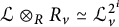 $\mathcal {L} \otimes _R R_v \simeq \mathcal {L}_v^{2^i}$
, where
$\mathcal {L} \otimes _R R_v \simeq \mathcal {L}_v^{2^i}$
, where $\mathcal {L}_v/R_v$
is an unramified field extension. The group
$\mathcal {L}_v/R_v$
is an unramified field extension. The group $G_2 \cap \mathcal {O}_F^{\times 2}$
acts on
$G_2 \cap \mathcal {O}_F^{\times 2}$
acts on $\mathcal {L} \otimes _R R_v$
in the following way. There exists a generator
$\mathcal {L} \otimes _R R_v$
in the following way. There exists a generator $\tau _v$
of
$\tau _v$
of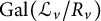 $\text {Gal}(\mathcal {L}_v/R_v)$
and an ordering on
$\text {Gal}(\mathcal {L}_v/R_v)$
and an ordering on $\mathcal {L}_v^{2i}$
such that
$\mathcal {L}_v^{2i}$
such that $\tau $
acts via
$\tau $
acts via
 $$ \begin{align*}\tau \cdot (\lambda_1,\ldots,\lambda_{2^i}) = (\tau_v(\lambda_{2^i}),\lambda_1, \ldots, \lambda_{2^i-1}).\end{align*} $$
By local class field theory, there exists $\lambda _v \in \mathcal {L}_v$
such that
$\lambda _v \in \mathcal {L}_v$
such that $N_{\mathcal {L}_v/R_v}(\lambda _v) = -1$
and therefore the element
$N_{\mathcal {L}_v/R_v}(\lambda _v) = -1$
and therefore the element $\lambda = (\lambda _v,1,\ldots ,1) \in \mathcal {L}_v^{2^i}$
satisfies
$\lambda = (\lambda _v,1,\ldots ,1) \in \mathcal {L}_v^{2^i}$
satisfies
 $$ \begin{align*}N_{\mathcal{L}_v^{2^i}/R_v}(\lambda) = \prod_{k=0}^{2^i-1} \tau^k(\lambda) = (-1,\ldots,-1) = -1.\end{align*} $$
As a result, $\lambda r_\tau $
has order
$\lambda r_\tau $
has order $2^{k_a}$
and we obtain a semilinear action of
$2^{k_a}$
and we obtain a semilinear action of $\langle \tau \rangle = G_2 \cap \mathcal {O}_F^{\times 2}$
on the Weil representation, or in other words, there exists
$\langle \tau \rangle = G_2 \cap \mathcal {O}_F^{\times 2}$
on the Weil representation, or in other words, there exists $\mathcal {V} \in \text {Irr}_{R_v}(\text {Mp}(W))$
such that
$\mathcal {V} \in \text {Irr}_{R_v}(\text {Mp}(W))$
such that
 $$ \begin{align*}(\omega_{\psi,X}^- |_R) \otimes_R R_v \simeq 2^{k_a} \mathcal{V}.\end{align*} $$
This implies that $A \otimes _R R_v$
is split.
$A \otimes _R R_v$
is split.
We claim that $A \simeq A^{\text {op}}$
. Indeed, since
$A \simeq A^{\text {op}}$
. Indeed, since $-1$
is a square in
$-1$
is a square in $\mathcal {O}_F^\times $
, we have
$\mathcal {O}_F^\times $
, we have $\omega _{\psi ^{-1},X}^- \simeq \omega _{\psi ,X}^-$
. Furthermore, we have the well-known result
$\omega _{\psi ^{-1},X}^- \simeq \omega _{\psi ,X}^-$
. Furthermore, we have the well-known result
 $$ \begin{align*}(\omega_{\psi,X}^-)^\vee \simeq \omega_{\psi^{-1},X}^-.\end{align*} $$
When V is a representation, there is a canonical identification $\text {End}(V^\vee ) \cong \text {End}(V)^{\text {op}}$
. Therefore, A is isomorphic to
$\text {End}(V^\vee ) \cong \text {End}(V)^{\text {op}}$
. Therefore, A is isomorphic to $A^{\text {op}}$
so the order of A in the Brauer group is either
$A^{\text {op}}$
so the order of A in the Brauer group is either $1$
or
$1$
or $2$
.
$2$
.
Since R is a number field, the $2$
-torsion in the Brauer group of R is generated by quaternion algebras. Therefore, there exists a quaternion algebra D over R such that
$2$
-torsion in the Brauer group of R is generated by quaternion algebras. Therefore, there exists a quaternion algebra D over R such that $A \simeq \mathcal {M}_{2^{k_a-1}}(D)$
. Note that A can’t be split because of Lemma 9.5; otherwise, we would be able to descend the Weil representation to a strict subextension of
$A \simeq \mathcal {M}_{2^{k_a-1}}(D)$
. Note that A can’t be split because of Lemma 9.5; otherwise, we would be able to descend the Weil representation to a strict subextension of $\mathcal {L}$
. This implies that D is a quaternion division algebra, which only ramifies at an even number of places.
$\mathcal {L}$
. This implies that D is a quaternion division algebra, which only ramifies at an even number of places.
If $R= \mathbb {Q}$
, we proved that A splits at all places different from p and
$R= \mathbb {Q}$
, we proved that A splits at all places different from p and $\infty $
. So D is the unique quaternion algebra ramified at p and
$\infty $
. So D is the unique quaternion algebra ramified at p and $\infty $
. When
$\infty $
. When $R=\mathbb {Q}[\sqrt {p}]$
, recall that
$R=\mathbb {Q}[\sqrt {p}]$
, recall that $k_a = k-1$
and
$k_a = k-1$
and $\tau $
has order
$\tau $
has order $2^{k-1}$
, where
$2^{k-1}$
, where $k=\text {val}_2(p-1)$
. Let v be the place above p. Then
$k=\text {val}_2(p-1)$
. Let v be the place above p. Then $A \otimes _R R_v$
is split. Indeed,
$A \otimes _R R_v$
is split. Indeed, $\mathbb {Q}_p$
contains a primitive
$\mathbb {Q}_p$
contains a primitive $2^k$
-root of unity
$2^k$
-root of unity $\lambda $
, therefore
$\lambda $
, therefore $\lambda r_\tau $
had order
$\lambda r_\tau $
had order $2^{k-1}$
so defines a descent data. We conclude as in the first paragraph. So D ramifies at
$2^{k-1}$
so defines a descent data. We conclude as in the first paragraph. So D ramifies at $\infty $
’s.
$\infty $
’s.
Since $\omega _{\psi ,X}^-|_R$
is semisimple and its endomorphism ring A is isomorphic to
$\omega _{\psi ,X}^-|_R$
is semisimple and its endomorphism ring A is isomorphic to $\mathcal {M}_{2^{k_a-1}}(D)$
, there exists
$\mathcal {M}_{2^{k_a-1}}(D)$
, there exists $\mathcal {V} \in \text {Irr}_R(\text {Mp}(W))$
such that
$\mathcal {V} \in \text {Irr}_R(\text {Mp}(W))$
such that
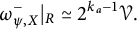 $$ \begin{align*}\omega_{\psi,X}^-|_R \simeq 2^{k_a-1} \mathcal{V}.\end{align*} $$
Moreover, $\text {End}_{R[\text {Mp}(W)]}(\mathcal {V}) \simeq D$
and
$\text {End}_{R[\text {Mp}(W)]}(\mathcal {V}) \simeq D$
and $\mathcal {V} \otimes _R \mathcal {L} \simeq 2 \omega _{\psi ,X}^-$
.
$\mathcal {V} \otimes _R \mathcal {L} \simeq 2 \omega _{\psi ,X}^-$
.
Note that D splits over the quadratic extension $R[\sqrt {-p}]$
of R, therefore there exists
$R[\sqrt {-p}]$
of R, therefore there exists $\mathcal {V}' \in \text {Irr}_{R[\sqrt {-p}]}(\text {Mp}(W))$
such that
$\mathcal {V}' \in \text {Irr}_{R[\sqrt {-p}]}(\text {Mp}(W))$
such that $\mathcal {V} \otimes _R R[\sqrt {-p}] \simeq 2 \mathcal {V}'$
. Going to the composite
$\mathcal {V} \otimes _R R[\sqrt {-p}] \simeq 2 \mathcal {V}'$
. Going to the composite $\mathcal {L}[\sqrt {-p}]$
of
$\mathcal {L}[\sqrt {-p}]$
of $R[\sqrt {-p}]$
and
$R[\sqrt {-p}]$
and $\mathcal {L}$
, we get that
$\mathcal {L}$
, we get that $\mathcal {V}'$
is a realization of
$\mathcal {V}'$
is a realization of $\omega _{\psi ,X}^- \otimes _{\mathcal {L}} \mathcal {L}[\sqrt {-p}]$
over
$\omega _{\psi ,X}^- \otimes _{\mathcal {L}} \mathcal {L}[\sqrt {-p}]$
over $R[\sqrt {-p}]$
and the Schur index
$R[\sqrt {-p}]$
and the Schur index $m(\omega _{\psi ,X}^-)$
must be
$m(\omega _{\psi ,X}^-)$
must be $2$
as
$2$
as $\omega _{\psi ,X}^-$
can’t be realized over R.
$\omega _{\psi ,X}^-$
can’t be realized over R.
9.5
In the modular setting $R_0 = \mathbb {F}_\ell $
with
$R_0 = \mathbb {F}_\ell $
with $\ell \neq 2$
, we still have the decomposition into even and odd functions of the Weil representation, though these representations may fail to be irreducible. The obvious analog of Theorem 9.2 is valid, that is,
$\ell \neq 2$
, we still have the decomposition into even and odd functions of the Weil representation, though these representations may fail to be irreducible. The obvious analog of Theorem 9.2 is valid, that is,
 $$ \begin{align*}R(\omega_{\psi,X}^\pm) = \left\{ \begin{array}{@{}cl} \mathbb{F}_\ell & \text{ if } q \in p^{2 \mathbb{N}} \\ \mathbb{F}_\ell[\sqrt{p^*}] & \text{ if } q \in p^{2 \mathbb{N}+1}, \end{array} \right.\end{align*} $$
where $\mathbb {F}_\ell (\sqrt {p^*}) = \mathbb {F}_\ell $
if
$\mathbb {F}_\ell (\sqrt {p^*}) = \mathbb {F}_\ell $
if $p^*$
is a square. Likewise, the proof of Theorem 9.3 still works. However, we note the following major difference with the
$p^*$
is a square. Likewise, the proof of Theorem 9.3 still works. However, we note the following major difference with the $R_0 = \mathbb {Q}$
case: as a consequence of Wedderburn’s Theorem, the Schur index is always
$R_0 = \mathbb {Q}$
case: as a consequence of Wedderburn’s Theorem, the Schur index is always $1$
when
$1$
when $R_0 = \mathbb {F}_\ell $
. In particular,
$R_0 = \mathbb {F}_\ell $
. In particular, $\omega _{\psi ,X}^-$
can be realized over its character field. Indeed, in Theorem 9.4, the obstruction to descent comes from a norm problem which can always be solved for finite fields by surjectivity of the norm, as we can always find
$\omega _{\psi ,X}^-$
can be realized over its character field. Indeed, in Theorem 9.4, the obstruction to descent comes from a norm problem which can always be solved for finite fields by surjectivity of the norm, as we can always find $\lambda \in \mathcal {L}$
such that
$\lambda \in \mathcal {L}$
such that
 $$ \begin{align*}N_{\mathcal{L}/R(\omega_{\psi,X}^-)}(\lambda) = -1.\end{align*} $$
9.6
We simply remark that most of the arguments we developed could be applied in families, that is, for ring of integers of number fields. We point out that Theorem 9.1 is still valid over $\mathcal {O}_{\mathcal {L}}[1/p]$
as
$\mathcal {O}_{\mathcal {L}}[1/p]$
as $\mathcal {O}_{\mathcal {L}}[1/p] \to \mathcal {O}_{\mathcal {K}}[1/p]$
is proétale and
$\mathcal {O}_{\mathcal {L}}[1/p] \to \mathcal {O}_{\mathcal {K}}[1/p]$
is proétale and $\omega _{\psi ,X}$
can be realized over
$\omega _{\psi ,X}$
can be realized over $\mathcal {O}_{\mathcal {K}}[1/p]$
. Therefore, the Weil representation can be realized over
$\mathcal {O}_{\mathcal {K}}[1/p]$
. Therefore, the Weil representation can be realized over $\mathcal {O}_{\mathcal {L}}[1/p]$
. If we invert
$\mathcal {O}_{\mathcal {L}}[1/p]$
. If we invert $2$
as well, we can use the decomposition
$2$
as well, we can use the decomposition $\omega _{\psi ,X} \cong \omega _{\psi ,X}^+ \oplus \omega _{\psi ,X}^-$
and our descent arguments still work over the localized version
$\omega _{\psi ,X} \cong \omega _{\psi ,X}^+ \oplus \omega _{\psi ,X}^-$
and our descent arguments still work over the localized version $\mathcal {O}[1/2p]$
of the rings of integers of the fields appearing in Theorems 9.3 and 9.4.
$\mathcal {O}[1/2p]$
of the rings of integers of the fields appearing in Theorems 9.3 and 9.4.
10 Descent when
$p = 2$

10.1
Let F be a $2$
-adic field. As opposed to the previous
$2$
-adic field. As opposed to the previous $p \neq 2$
case, the restriction of
$p \neq 2$
case, the restriction of $( - , - )_F$
to
$( - , - )_F$
to $\mathcal {O}_F^\times \times \mathcal {O}_F^\times $
is no longer trivial. For example,
$\mathcal {O}_F^\times \times \mathcal {O}_F^\times $
is no longer trivial. For example, $(-1,-1)_{\mathbb {Q}_2}=-1$
. The Galois group
$(-1,-1)_{\mathbb {Q}_2}=-1$
. The Galois group $G = \text {Gal}(\mathcal {K}/R_0)$
is an open subgroup of
$G = \text {Gal}(\mathcal {K}/R_0)$
is an open subgroup of $\mathbb {Z}_2^\times \subseteq \mathcal {O}_F^\times $
. We have
$\mathbb {Z}_2^\times \subseteq \mathcal {O}_F^\times $
. We have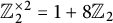 $\mathbb {Z}_2^{\times 2} = 1 + 8 \mathbb {Z}_2$
so the cardinality of
$\mathbb {Z}_2^{\times 2} = 1 + 8 \mathbb {Z}_2$
so the cardinality of $\mathbb {Z}_2^\times / \mathbb {Z}_2^{\times 2}$
is
$\mathbb {Z}_2^\times / \mathbb {Z}_2^{\times 2}$
is $4$
. However, unlike the case
$4$
. However, unlike the case $p \neq 2$
, the pro-order of
$p \neq 2$
, the pro-order of $\mathbb {Z}_2^\times $
only has one single prime divisor and the torsion elements in
$\mathbb {Z}_2^\times $
only has one single prime divisor and the torsion elements in $\mathbb {Z}_2^\times $
are simply
$\mathbb {Z}_2^\times $
are simply $1$
and
$1$
and $-1$
. Another key difference is the fact that
$-1$
. Another key difference is the fact that $\mathbb {Z}_2^\times $
is not procyclic as
$\mathbb {Z}_2^\times $
is not procyclic as $\mathbb {Z}_2^\times /\mathbb {Z}_2^{\times 2} \simeq \mathbb {Z}/2\mathbb {Z} \times \mathbb {Z}/2\mathbb {Z}$
. However,
$\mathbb {Z}_2^\times /\mathbb {Z}_2^{\times 2} \simeq \mathbb {Z}/2\mathbb {Z} \times \mathbb {Z}/2\mathbb {Z}$
. However, $\mathbb {Z}_2^{\times 2}$
is procyclic. There are three maximal procyclic subgroups, namely,
$\mathbb {Z}_2^{\times 2}$
is procyclic. There are three maximal procyclic subgroups, namely, $1+(2+4)\delta + 8\mathbb {Z}_2$
and
$1+(2+4)\delta + 8\mathbb {Z}_2$
and $1+ 2 \delta + 8\mathbb {Z}_2$
and
$1+ 2 \delta + 8\mathbb {Z}_2$
and $1+4 \delta + 8 \mathbb {Z}_2$
, where
$1+4 \delta + 8 \mathbb {Z}_2$
, where $\delta $
runs over
$\delta $
runs over $\{0,1\}$
.
$\{0,1\}$
.
10.2
We define a descent argument on $G_{2'} = \mathbb {Z}_2^{\times 2} \cap \text {Gal}(\mathcal {K}/R_0)$
. Note that
$G_{2'} = \mathbb {Z}_2^{\times 2} \cap \text {Gal}(\mathcal {K}/R_0)$
. Note that $G_{2'}$
has pro-order
$G_{2'}$
has pro-order $2^\infty $
, but we use this notation by analogy with the previous case. Let
$2^\infty $
, but we use this notation by analogy with the previous case. Let $\mathcal {L} = \mathcal {K}^{G_{2'}}$
. The degree of
$\mathcal {L} = \mathcal {K}^{G_{2'}}$
. The degree of $\mathcal {L}/R_0$
is
$\mathcal {L}/R_0$
is $1$
,
$1$
, $2,$
or
$2,$
or $4$
. When
$4$
. When $R_0 = \mathbb {Q}$
, the extension
$R_0 = \mathbb {Q}$
, the extension $\mathcal {L}/\mathbb {Q}$
has degree
$\mathcal {L}/\mathbb {Q}$
has degree $4$
and is biquadratic as
$4$
and is biquadratic as $\mathcal {L} = \mathbb {Q}[\sqrt {-1},\sqrt {2}] = \mathbb {Q}[\zeta _8]$
.
$\mathcal {L} = \mathbb {Q}[\sqrt {-1},\sqrt {2}] = \mathbb {Q}[\zeta _8]$
.
Theorem 10.1 The Weil representation can be realized over $\mathcal {L}$
.
$\mathcal {L}$
.
Proof The situation is rather similar to the case $p \neq 2$
, but there are a few technical complications. In order to define our descent argument, we first want to be able to extract roots from
$p \neq 2$
, but there are a few technical complications. In order to define our descent argument, we first want to be able to extract roots from $G_{2'}$
to
$G_{2'}$
to $\mathcal {O}_F^\times $
, that is, to define a group morphism
$\mathcal {O}_F^\times $
, that is, to define a group morphism $\sigma \in G_{2'} \mapsto \lambda \in \mathcal {O}_F^\times $
subject to the relation
$\sigma \in G_{2'} \mapsto \lambda \in \mathcal {O}_F^\times $
subject to the relation $\sigma = \lambda ^2$
. To do so, we can embed
$\sigma = \lambda ^2$
. To do so, we can embed $G_{2'}$
in
$G_{2'}$
in $1+ 2 \delta + 8\mathbb {Z}_2$
– note that
$1+ 2 \delta + 8\mathbb {Z}_2$
– note that $1+4 \delta + 8 \mathbb {Z}_2$
works equally well – and extract roots in this subgroup of
$1+4 \delta + 8 \mathbb {Z}_2$
works equally well – and extract roots in this subgroup of $\mathbb {Z}_2^\times \subseteq \mathcal {O}_F^\times $
, that is, for all
$\mathbb {Z}_2^\times \subseteq \mathcal {O}_F^\times $
, that is, for all $\sigma \in G_{2'}$
, there exists a unique
$\sigma \in G_{2'}$
, there exists a unique $\lambda \in 1+ 2 \delta + 8\mathbb {Z}_2$
such that
$\lambda \in 1+ 2 \delta + 8\mathbb {Z}_2$
such that $\sigma = \lambda ^2$
. We obtain a group isomorphism
$\sigma = \lambda ^2$
. We obtain a group isomorphism $\sigma \in G_{2'} \mapsto \lambda \in \mathcal {O}_F^\times $
and we denote by
$\sigma \in G_{2'} \mapsto \lambda \in \mathcal {O}_F^\times $
and we denote by $G'$
its image in
$G'$
its image in $\mathcal {O}_F^\times $
, which contains
$\mathcal {O}_F^\times $
, which contains $G_{2'}$
as an index
$G_{2'}$
as an index $2$
subgroup.
$2$
subgroup.
As opposed to the case $p \neq 2$
, the quadratic Hilbert symbol for
$p \neq 2$
, the quadratic Hilbert symbol for $\lambda , \lambda ' \in \mathcal {O}_F^\times $
in the action of
$\lambda , \lambda ' \in \mathcal {O}_F^\times $
in the action of $M(X)$
is nontrivial, that is,
$M(X)$
is nontrivial, that is, $\omega _{\psi ,X}(m_\lambda ,1) \omega _{\psi ,X}(m_{\lambda '},1) = (\lambda ,\lambda ')_F \omega _{\psi ,X}(m_{\lambda \lambda '},1)$
. We can consider the restriction of
$\omega _{\psi ,X}(m_\lambda ,1) \omega _{\psi ,X}(m_{\lambda '},1) = (\lambda ,\lambda ')_F \omega _{\psi ,X}(m_{\lambda \lambda '},1)$
. We can consider the restriction of $(-,-)_F$
to
$(-,-)_F$
to $G'$
, which is a subgroup of
$G'$
, which is a subgroup of $\mathcal {O}_F^\times $
. We define an action of
$\mathcal {O}_F^\times $
. We define an action of $G_{2'}$
on the Weil representation via
$G_{2'}$
on the Weil representation via
 $$ \begin{align*}r_\sigma \cdot f = \sigma(\omega_{\psi,X}(m_\lambda,\gamma_\lambda) f),\end{align*} $$
where $\partial \gamma $
trivializes the
$\partial \gamma $
trivializes the $2$
-cocycle
$2$
-cocycle $(- , - )_F$
on
$(- , - )_F$
on $G'$
, for example, we can take
$G'$
, for example, we can take
-
•
$\gamma _u = 1$
for
$u \in G'$
when
$(-,-)_F$
is trivial on
$G'$
; -
•
$\gamma _u = 1$
for
$u \in G_{2'}$
and
$\gamma _u = i$
for
$u \in G' \backslash G_{2'}$
otherwise.


This defines an effective descent data as in the proof of Theorem 9.1 and we can realize the Weil representation over the fixed field of $G_{2'}$
, that is, over
$G_{2'}$
, that is, over $\mathcal {L}$
.
$\mathcal {L}$
.
10.3
We now focus on the case $R_0=\mathbb {Q}$
. Let
$R_0=\mathbb {Q}$
. Let $\{1,-1,3,5\}$
be representatives of
$\{1,-1,3,5\}$
be representatives of $\mathbb {Z}_2^\times / \mathbb {Z}_2^{\times 2}$
in
$\mathbb {Z}_2^\times / \mathbb {Z}_2^{\times 2}$
in $\mathbb {Z}_2^\times $
and write
$\mathbb {Z}_2^\times $
and write $[\alpha ] = \langle \alpha , \mathbb {Z}_2^{\times 2} \rangle $
for
$[\alpha ] = \langle \alpha , \mathbb {Z}_2^{\times 2} \rangle $
for $\alpha \in \mathbb {Z}_2^\times $
. Let
$\alpha \in \mathbb {Z}_2^\times $
. Let $\mathbb {Z}_2^{\times } \supseteq A = \mathcal {O}_F^{\times 2} \cap \mathbb {Z}_2^\times \supseteq \mathbb {Z}_2^{\times 2}$
. We simply recall that
$\mathbb {Z}_2^{\times } \supseteq A = \mathcal {O}_F^{\times 2} \cap \mathbb {Z}_2^\times \supseteq \mathbb {Z}_2^{\times 2}$
. We simply recall that $\zeta _8 = \frac {1+i}{\sqrt {2}}$
and
$\zeta _8 = \frac {1+i}{\sqrt {2}}$
and $\mathbb {Q}[\zeta _8] = \mathbb {Q}[\sqrt {-2},\sqrt {-1}]$
contains three quadratic extensions of
$\mathbb {Q}[\zeta _8] = \mathbb {Q}[\sqrt {-2},\sqrt {-1}]$
contains three quadratic extensions of $\mathbb {Q}$
.
$\mathbb {Q}$
.
Theorem 10.2 The even part $\omega _{\psi ,X}^+$
can be realized over its character field, which is
$\omega _{\psi ,X}^+$
can be realized over its character field, which is
-
•
$\mathbb {Q}$
if
$A=\mathbb {Z}_2^\times $
; -
•
$\mathbb {Q}[\sqrt {-2}]$
if
$A=[3]$
; -
•
$\mathbb {Q}[\sqrt {-1}]$
if
$A=[5]$
; -
•
$\mathbb {Q}[\sqrt {2}]$
if
$A=[-1]$
; -
•
$\mathbb {Q}[\zeta _8]$
if
$A=\mathbb {Z}_2^{\times 2}$
.


Proof Let $A=\mathbb {Z}_2^\times $
and choose
$A=\mathbb {Z}_2^\times $
and choose $\sqrt {-1}$
and
$\sqrt {-1}$
and $\sqrt {3}$
in
$\sqrt {3}$
in $\mathcal {O}_F^\times $
. For
$\mathcal {O}_F^\times $
. For $\sigma _{-1}$
and
$\sigma _{-1}$
and $\sigma _3$
, the Galois elements corresponding to
$\sigma _3$
, the Galois elements corresponding to $-1$
and
$-1$
and $3$
, we define
$3$
, we define
 $$ \begin{align*}r_{\sigma_{-1}} \cdot f = \sigma_{-1} (\omega_{\psi,X}^+(m_{\sqrt{-1}},1)f) \text{ and } r_{\sigma_3} \cdot f = \sigma_3 (\omega_{\psi,X}^+(m_{\sqrt{3}},1)f).\end{align*} $$
Since the actions of $\sigma _{-1}$
and
$\sigma _{-1}$
and $\sigma _3$
commute, we obtain a semilinear Galois action of
$\sigma _3$
commute, we obtain a semilinear Galois action of $\text {Gal}(\mathbb {Q}[\zeta _8]/\mathbb {Q})$
, so
$\text {Gal}(\mathbb {Q}[\zeta _8]/\mathbb {Q})$
, so $\omega _{\psi ,X}^+$
descends to
$\omega _{\psi ,X}^+$
descends to $\mathbb {Q}$
.
$\mathbb {Q}$
.
Let $A=[3]$
and choose
$A=[3]$
and choose $\sqrt {3}$
in
$\sqrt {3}$
in $\mathcal {O}_F^\times $
. Define
$\mathcal {O}_F^\times $
. Define
 $$ \begin{align*}r_{\sigma_3} \cdot f = \sigma_3 (\omega_{\psi,X}^+(m_{\sqrt{3}},\gamma)f),\end{align*} $$
where $\gamma \in \mathbb {Q}[\zeta _8]$
satisfies
$\gamma \in \mathbb {Q}[\zeta _8]$
satisfies $\sigma _3(\gamma ) \gamma = (\sqrt {3},\sqrt {3})_F = (-1,\sqrt {3})_F$
. We can take
$\sigma _3(\gamma ) \gamma = (\sqrt {3},\sqrt {3})_F = (-1,\sqrt {3})_F$
. We can take $\gamma = 1$
when
$\gamma = 1$
when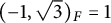 $(-1,\sqrt {3})_F=1$
and
$(-1,\sqrt {3})_F=1$
and $\gamma =\zeta _8$
when
$\gamma =\zeta _8$
when $(-1,\sqrt {3})_F=-1$
. We obtain a semilinear Galois action of
$(-1,\sqrt {3})_F=-1$
. We obtain a semilinear Galois action of $\text {Gal}(\mathbb {Q}[\zeta _8]/\mathbb {Q}[\sqrt {-2}])$
as
$\text {Gal}(\mathbb {Q}[\zeta _8]/\mathbb {Q}[\sqrt {-2}])$
as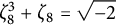 $\zeta _8^3+\zeta _8 = \sqrt {-2}$
, so
$\zeta _8^3+\zeta _8 = \sqrt {-2}$
, so $\omega _{\psi ,X}^+$
descends to
$\omega _{\psi ,X}^+$
descends to $\mathbb {Q}[\sqrt {-2}]$
, which is also the character field because
$\mathbb {Q}[\sqrt {-2}]$
, which is also the character field because $\omega _{\psi ^{-1},X}^+$
is not isomorphic to
$\omega _{\psi ^{-1},X}^+$
is not isomorphic to $\omega _{\psi ,X}^+$
.
$\omega _{\psi ,X}^+$
.
The case $A=[5]$
is similar to
$A=[5]$
is similar to $A=[3]$
. We omit the details of the proof.
$A=[3]$
. We omit the details of the proof.
Let $A=[-1]$
and choose
$A=[-1]$
and choose $\sqrt {-1}$
in
$\sqrt {-1}$
in $\mathcal {O}_F^\times $
. Define
$\mathcal {O}_F^\times $
. Define
 $$ \begin{align*}r_{\sigma_{-1}} \cdot f = \sigma_{-1} (\omega_{\psi,X}^+(m_{\sqrt{-1}},1)f).\end{align*} $$
We obtain a semilinear Galois action of $\text {Gal}(\mathbb {Q}[\zeta _8]/\mathbb {Q}[\sqrt {2}])$
as
$\text {Gal}(\mathbb {Q}[\zeta _8]/\mathbb {Q}[\sqrt {2}])$
as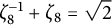 $\zeta _8^{-1}+\zeta _8 = \sqrt {2}$
, so
$\zeta _8^{-1}+\zeta _8 = \sqrt {2}$
, so $\omega _{\psi ,X}^+$
descends to
$\omega _{\psi ,X}^+$
descends to $\mathbb {Q}[\sqrt {2}]$
, which is also the character field as
$\mathbb {Q}[\sqrt {2}]$
, which is also the character field as $\omega _{\psi ^3,X}^+$
is not isomorphic to
$\omega _{\psi ^3,X}^+$
is not isomorphic to $\omega _{\psi ,X}^+$
.
$\omega _{\psi ,X}^+$
.
Let $A=\mathbb {Z}_2^{\times 2}$
. Then
$A=\mathbb {Z}_2^{\times 2}$
. Then $\omega _{\psi ^\alpha ,X}^+$
for
$\omega _{\psi ^\alpha ,X}^+$
for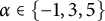 $\alpha \in \{-1,3,5\}$
is not isomorphic to
$\alpha \in \{-1,3,5\}$
is not isomorphic to $\omega _{\psi ,X}^+$
, so the character field is
$\omega _{\psi ,X}^+$
, so the character field is $\mathbb {Q}[\zeta _8]$
, which was already a field of realization for
$\mathbb {Q}[\zeta _8]$
, which was already a field of realization for $\omega _{\psi ,X}^+$
.
$\omega _{\psi ,X}^+$
.
10.4
Once again, the odd part requires a bit more work.
Theorem 10.3 The representation $\omega _{\psi ,X}^-$
can be realized over
$\omega _{\psi ,X}^-$
can be realized over
-
•
$\mathbb {Q}[\sqrt {-2}]$
or
$\mathbb {Q}[\sqrt {-1}]$
if
$A=\mathbb {Z}_2^\times $
and its character field is
$\mathbb {Q}$
; -
• its character field
$\mathbb {Q}[\sqrt {-2}]$
if
$A=[3]$
; -
• its character field
$\mathbb {Q}[\sqrt {-1}]$
if
$A=[5]$
; -
•
$\mathbb {Q}[\zeta _8]$
if
$A=[-1]$
and its character field is
$\mathbb {Q}[\sqrt {2}]$
; -
• its character field
$\mathbb {Q}[\zeta _8]$
if
$A=\mathbb {Z}_2^{\times 2}$
.


The Schur index is $2$
if
$2$
if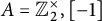 $A = \mathbb {Z}_2^\times , [-1]$
and
$A = \mathbb {Z}_2^\times , [-1]$
and $1$
otherwise.
$1$
otherwise.
Proof Let $A=\mathbb {Z}_2^\times $
. The character field is
$A=\mathbb {Z}_2^\times $
. The character field is $\mathbb {Q}$
. However, the representation
$\mathbb {Q}$
. However, the representation $\omega _{\psi ,X}^-|_K,$
where K is either
$\omega _{\psi ,X}^-|_K,$
where K is either $\mathbb {Q}[\sqrt {-1}]$
or
$\mathbb {Q}[\sqrt {-1}]$
or $\mathbb {Q}[\sqrt {-2}]$
satisfies
$\mathbb {Q}[\sqrt {-2}]$
satisfies $\omega _{\psi ,X}^-|_K \otimes _K \mathbb {Q}[\zeta _8] \simeq 2 \omega _{\psi ,X}^-$
. Moreover,
$\omega _{\psi ,X}^-|_K \otimes _K \mathbb {Q}[\zeta _8] \simeq 2 \omega _{\psi ,X}^-$
. Moreover, $\text {End}_{K[\text {Mp}(W)]}(\omega _{\psi ,X}^-|_K) \simeq \mathbb {Q}[\zeta _8]'[X_\sigma ]/(X_\sigma ^2 - 1),$
where
$\text {End}_{K[\text {Mp}(W)]}(\omega _{\psi ,X}^-|_K) \simeq \mathbb {Q}[\zeta _8]'[X_\sigma ]/(X_\sigma ^2 - 1),$
where $\langle \sigma \rangle = \text {Gal}(\mathbb {Q}[\zeta _8]/K)$
and define
$\langle \sigma \rangle = \text {Gal}(\mathbb {Q}[\zeta _8]/K)$
and define
 $$ \begin{align*}r_\sigma \cdot f = \sigma(\omega_{\psi,X}^-(m_{\sqrt{\sigma}},1)f),\end{align*} $$
where $(\sqrt {\sigma },\sqrt {\sigma })_F = (-1,\sqrt {\sigma })_F = 1$
. Note that
$(\sqrt {\sigma },\sqrt {\sigma })_F = (-1,\sqrt {\sigma })_F = 1$
. Note that $\text {End}_{K[\text {Mp}(W)]}(\omega _{\psi ,X}^-|_K) \simeq \mathcal {M}_2(K)$
and therefore
$\text {End}_{K[\text {Mp}(W)]}(\omega _{\psi ,X}^-|_K) \simeq \mathcal {M}_2(K)$
and therefore $\omega _{\psi ,X}^-|_K$
has length
$\omega _{\psi ,X}^-|_K$
has length $2$
and is semisimple, that is,
$2$
and is semisimple, that is, $\omega _{\psi ,X}^-$
descends to K. We now assume that
$\omega _{\psi ,X}^-$
descends to K. We now assume that $\omega _{\psi ,X}^-$
has coefficients in K. Then
$\omega _{\psi ,X}^-$
has coefficients in K. Then $\omega _{\psi ,X}^-|_{\mathbb {Q}} \otimes _{\mathbb {Q}} K \simeq 2 \omega _{\psi ,X}^-$
. Let
$\omega _{\psi ,X}^-|_{\mathbb {Q}} \otimes _{\mathbb {Q}} K \simeq 2 \omega _{\psi ,X}^-$
. Let $\langle \tau \rangle = \text {Gal}(K/\mathbb {Q})$
and define
$\langle \tau \rangle = \text {Gal}(K/\mathbb {Q})$
and define
 $$ \begin{align*}r_\tau \cdot f = \tau(\omega_{\psi,X}^-(m_{\sqrt{\tau}},1)).\end{align*} $$
Then $r_\tau ^2 = -\text {id}_{S_{\psi ,X}^-}$
, that is,
$r_\tau ^2 = -\text {id}_{S_{\psi ,X}^-}$
, that is, $\text {End}_{\mathbb {Q}[\text {Mp}(W)]}(\omega _{\psi ,X}^-|_{\mathbb {Q}}) \simeq K'[X_\tau ]/(X_\tau ^2 + 1) =A_\tau $
. Let
$\text {End}_{\mathbb {Q}[\text {Mp}(W)]}(\omega _{\psi ,X}^-|_{\mathbb {Q}}) \simeq K'[X_\tau ]/(X_\tau ^2 + 1) =A_\tau $
. Let $D_{a,b}$
be the quaternion algebra over
$D_{a,b}$
be the quaternion algebra over $\mathbb {Q}$
associated with a and b. Then
$\mathbb {Q}$
associated with a and b. Then $A_\tau \simeq D_{-1,-1}$
or
$A_\tau \simeq D_{-1,-1}$
or $A_\tau \simeq D_{-2,-1}$
, depending on K. Note that
$A_\tau \simeq D_{-2,-1}$
, depending on K. Note that $D_{-1,-1} \simeq D_{-2,-1}$
is the quaternion division algebra ramified at
$D_{-1,-1} \simeq D_{-2,-1}$
is the quaternion division algebra ramified at $2$
and
$2$
and $\infty $
. Therefore,
$\infty $
. Therefore, $\omega _{\psi ,X}^-$
does not descend to
$\omega _{\psi ,X}^-$
does not descend to $\mathbb {Q}$
and the Schur index is
$\mathbb {Q}$
and the Schur index is $2$
.
$2$
.
Let $A=[3]$
and choose
$A=[3]$
and choose $\sqrt {3}$
in
$\sqrt {3}$
in $\mathcal {O}_F^\times $
. Define
$\mathcal {O}_F^\times $
. Define
 $$ \begin{align*}r_{\sigma_3} \cdot f = \sigma_3 (\omega_{\psi,X}^-(m_{\sqrt{3}},\gamma)f),\end{align*} $$
where $\gamma \in \mathbb {Q}[\zeta _8]$
satisfies
$\gamma \in \mathbb {Q}[\zeta _8]$
satisfies $\sigma _3(\gamma ) \gamma = (\sqrt {3},\sqrt {3})_F = (-1,\sqrt {3})_F$
. We can take
$\sigma _3(\gamma ) \gamma = (\sqrt {3},\sqrt {3})_F = (-1,\sqrt {3})_F$
. We can take $\gamma = 1$
when
$\gamma = 1$
when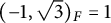 $(-1,\sqrt {3})_F=1$
and
$(-1,\sqrt {3})_F=1$
and $\gamma =\zeta _8$
when
$\gamma =\zeta _8$
when $(-1,\sqrt {3})_F=-1$
. We obtain a semilinear Galois action of
$(-1,\sqrt {3})_F=-1$
. We obtain a semilinear Galois action of $\text {Gal}(\mathbb {Q}[\zeta _8]/\mathbb {Q}[\sqrt {-2}])$
as
$\text {Gal}(\mathbb {Q}[\zeta _8]/\mathbb {Q}[\sqrt {-2}])$
as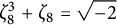 $\zeta _8^3+\zeta _8 = \sqrt {-2}$
, so
$\zeta _8^3+\zeta _8 = \sqrt {-2}$
, so $\omega _{\psi ,X}^-$
descends to
$\omega _{\psi ,X}^-$
descends to $\mathbb {Q}[\sqrt {-2}]$
, which is also the character field because
$\mathbb {Q}[\sqrt {-2}]$
, which is also the character field because $\omega _{\psi ^{-1},X}^-$
is not isomorphic to
$\omega _{\psi ^{-1},X}^-$
is not isomorphic to $\omega _{\psi ,X}^-$
.
$\omega _{\psi ,X}^-$
.
The case $A=[5]$
is similar to
$A=[5]$
is similar to $A=[3]$
. We omit the details of the proof.
$A=[3]$
. We omit the details of the proof.
Let $A=[-1]$
and choose
$A=[-1]$
and choose $\sqrt {-1}$
in
$\sqrt {-1}$
in $\mathcal {O}_F^\times $
. The character field is
$\mathcal {O}_F^\times $
. The character field is $\mathbb {Q}[\zeta ^8]^A = \mathbb {Q}[\sqrt {2}]$
. Define
$\mathbb {Q}[\zeta ^8]^A = \mathbb {Q}[\sqrt {2}]$
. Define
 $$ \begin{align*}r_{\sigma_{-1}} \cdot f = \sigma_{-1} (\omega_{\psi,X}^-(m_{\sqrt{-1}},1)f).\end{align*} $$
Then $\text {End}_{\mathbb {Q}[\sqrt {2}][\text {Mp}(W)]}(\omega _{\psi ,X}^-|_{\mathbb {Q}[\sqrt {2}]}) \simeq \mathbb {Q}[\zeta _8]'[X_\tau ] / (X_\tau ^2+1),$
where
$\text {End}_{\mathbb {Q}[\sqrt {2}][\text {Mp}(W)]}(\omega _{\psi ,X}^-|_{\mathbb {Q}[\sqrt {2}]}) \simeq \mathbb {Q}[\zeta _8]'[X_\tau ] / (X_\tau ^2+1),$
where $\langle \tau \rangle = \text {Gal}(\mathbb {Q}[\zeta _8]/\mathbb {Q}[\sqrt {2}])$
. This is a central simple algebra over
$\langle \tau \rangle = \text {Gal}(\mathbb {Q}[\zeta _8]/\mathbb {Q}[\sqrt {2}])$
. This is a central simple algebra over $\mathbb {Q}[\sqrt {2}]$
which is ramified at
$\mathbb {Q}[\sqrt {2}]$
which is ramified at $\infty $
’s. Indeed it is isomorphic to
$\infty $
’s. Indeed it is isomorphic to $D_{-1,-1} \otimes _{\mathbb {Q}} \mathbb {Q}[\sqrt {2}]$
. As
$D_{-1,-1} \otimes _{\mathbb {Q}} \mathbb {Q}[\sqrt {2}]$
. As $(-1,-1)_{\mathbb {Q}_2[\sqrt {2}]} = 1$
, it is split at the place above
$(-1,-1)_{\mathbb {Q}_2[\sqrt {2}]} = 1$
, it is split at the place above $2$
. It is clearly ramified at
$2$
. It is clearly ramified at $\infty $
’s because
$\infty $
’s because $\mathbb {Q}[\sqrt {2}]$
is totally real. As a result, the Schur index of
$\mathbb {Q}[\sqrt {2}]$
is totally real. As a result, the Schur index of $\omega _{\psi ,X}$
is
$\omega _{\psi ,X}$
is $2$
and a field of realization is
$2$
and a field of realization is $\mathbb {Q}[\zeta _8]$
.
$\mathbb {Q}[\zeta _8]$
.
Let $A=\mathbb {Z}_2^{\times 2}$
. Then
$A=\mathbb {Z}_2^{\times 2}$
. Then $\omega _{\psi ^\alpha ,X}^-$
for
$\omega _{\psi ^\alpha ,X}^-$
for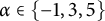 $\alpha \in \{-1,3,5\}$
is never isomorphic to
$\alpha \in \{-1,3,5\}$
is never isomorphic to $\omega _{\psi ,X}^-$
, so the character field is
$\omega _{\psi ,X}^-$
, so the character field is $\mathbb {Q}[\zeta _8]$
, which is already a field of realization for
$\mathbb {Q}[\zeta _8]$
, which is already a field of realization for $\omega _{\psi ,X}^-$
.
$\omega _{\psi ,X}^-$
.
10.5
In the modular setting $R_0 = \mathbb {F}_\ell $
, note that
$R_0 = \mathbb {F}_\ell $
, note that $\ell \neq p = 2$
as
$\ell \neq p = 2$
as $\ell \neq p$
, so we still have the decomposition into even and odd functions of the Weil representation, though these representations may fail to be irreducible. The obvious analog of Theorem 10.3 is valid – that is, replacing
$\ell \neq p$
, so we still have the decomposition into even and odd functions of the Weil representation, though these representations may fail to be irreducible. The obvious analog of Theorem 10.3 is valid – that is, replacing $\mathbb {Q}$
by
$\mathbb {Q}$
by $\mathbb {F}_\ell $
– allowing
$\mathbb {F}_\ell $
– allowing $\mathbb {F}_\ell [\alpha ] = \mathbb {F}_\ell $
if
$\mathbb {F}_\ell [\alpha ] = \mathbb {F}_\ell $
if $\alpha $
already belonged to
$\alpha $
already belonged to $\mathbb {F}_\ell $
. As noted in the
$\mathbb {F}_\ell $
. As noted in the $p \neq 2$
case, Wedderburn’s Theorem ensures that the character field is always a field of realization. Similarly, the analog of Theorem 10.3 is valid, replacing
$p \neq 2$
case, Wedderburn’s Theorem ensures that the character field is always a field of realization. Similarly, the analog of Theorem 10.3 is valid, replacing $\mathbb {Q}$
by
$\mathbb {Q}$
by $\mathbb {F}_\ell $
.
$\mathbb {F}_\ell $
.
10.6
Once again, we remark that most of the arguments we developed could be applied in families, that is, for ring of integers of number fields. We point out that Theorem 10.1 is still valid over $\mathcal {O}_{\mathcal {L}}[1/p]$
as
$\mathcal {O}_{\mathcal {L}}[1/p]$
as $\mathcal {O}_{\mathcal {L}}[1/2] \to \mathcal {O}_{\mathcal {K}}[1/2]$
is proétale and
$\mathcal {O}_{\mathcal {L}}[1/2] \to \mathcal {O}_{\mathcal {K}}[1/2]$
is proétale and $\omega _{\psi ,X}$
can be realized over
$\omega _{\psi ,X}$
can be realized over $\mathcal {O}_{\mathcal {K}}[1/2]$
. Therefore, the Weil representation can be realized over
$\mathcal {O}_{\mathcal {K}}[1/2]$
. Therefore, the Weil representation can be realized over $\mathcal {O}_{\mathcal {L}}[1/p]$
. Moreover,
$\mathcal {O}_{\mathcal {L}}[1/p]$
. Moreover, $2$
is invertible, so we can use the decomposition
$2$
is invertible, so we can use the decomposition $\omega _{\psi ,X} \cong \omega _{\psi ,X}^+ \oplus \omega _{\psi ,X}^-$
and our descent arguments still work over the localized version
$\omega _{\psi ,X} \cong \omega _{\psi ,X}^+ \oplus \omega _{\psi ,X}^-$
and our descent arguments still work over the localized version $\mathcal {O}[1/p]$
of the rings of integers of the fields appearing in Theorems 10.2 and 10.3.
$\mathcal {O}[1/p]$
of the rings of integers of the fields appearing in Theorems 10.2 and 10.3.
Acknowledgements
This article would likely have remained at the stage of an interesting future project without a question raised in a discussion with Daniel Disegni. His interest in the topic and his encouragement truly energized the author and helped bring this project to fruition as the present article. No expression of thanks can fully capture my appreciation for him. I am also indebted to Alberto Mínguez and Shaun Stevens for their constant support and for their helpful comments on the final draft of this article. Moreover, I greatly benefited from fruitful discussions with Petar Bakić, Raphaël Beuzart-Plessis, Marcela Hanzer, Gil Moss, and Jack Sempliner. The short surveys by Dipendra Prasad on the theta correspondence have long been a great source of inspiration, especially during my Ph.D., and I remain deeply grateful each time I return to them. I would also like to express my gratitude to him for a stimulating conversation on the final draft of this article and for pointing out two already existing papers in the topic. Finally, I want to thank the anonymous referee for their careful and prompt report, which significantly improved the manuscript.
Views and opinions expressed are however those of the author only and do not necessarily reflect those of the European Union or the European Research Council. Neither the European Union nor the granting authority can be held responsible for them.


 Open access

