

Artifact identification is a cornerstone of archaeological practice. Recognizing that objects are temporally, spatially, and culturally bounded, we rely on a variety of methods to characterize patterned variation (Ford and Steward Reference Ford and Steward1954). Most of these techniques rely to some extent on the human eye as a tool for identifying similarities and differences. While the capacity to see difference is an innate evolutionary trait, we must be trained to interpret which differences are meaningful and what they represent. Moreover, for comparative projects, or those incorporating data collected by multiple researchers, it is critical to have shared definitions and methods to ensure that our categories are constituted in the same way (Austin et al. Reference Austin, Faniel, Brannon and Kansa2024; Beebe Reference Beebe2017; VanValkenburgh et al. Reference Van Valkenburgh, Silva, Repetti-Ludlow, Gardner, Crook and Ballsun-Stanton2018).
Yet, the identification stage of archaeological analysis is often underreported, with little acknowledgment that interpretation begins here, and not after the data have been identified, classified, and entered into a database. Training is highly variable, as is access to type collections and other resources. Archaeological identification is often taught inductively, with the expectation that experience and repeated exposure to a type of material will lead researchers to develop a “feel for” the artifacts. Famously, James Ford, an early archaeologist of the southeastern United States, was said to identify pottery sherds by the way they sounded when he dropped them (Phillips Reference Phillips1970:47). In other words, identification is typically an interpretation derived from our own experiences working with context-specific archaeological assemblages and is dependent on training and access to resources that are by no means standardized. When classification systems are developed to address the subjective nature of pottery identification, they necessarily favor some types of variation while minimizing others. This may push analysts to ignore important variation in their dataset, another interpretative choice made during the identification process. While our senses are critical to identification, the constellations of attributes that we consciously or unconsciously assess in order to make an identification can be formally described and taught. We argue that it should be a disciplinary goal to standardize the methodology underlying artifact identification.
Here we describe how a standardized attribute-level approach to ceramic classification, specifically related to temper characterization, can be operationalized for a multi-sited research project. We created fired clay briquettes with specific paste recipes to cover the expected range of variation within our dataset. We conducted a survey of our peers to validate the utility of the resource, finding that standardized guides improved accuracy and confidence among respondents. As one survey participant explained, “Pottery analysis in general is all over the place. Having a common referent would help with creating comparative datasets.” Since our discipline is built on making comparisons, we propose a method for developing pottery resources that standardizes the classification of archaeological data so that it can be applied to other research contexts.
Background
Our Project
Our development of standardized visual guides for identification of shell temper attributes was prompted by our interest in understanding the processes of cultural change that occurred along the central portion of the northern Gulf of Mexico Coast from the twelfth century AD onward. This region includes coastal portions of Louisiana, Mississippi, Alabama, and the Florida panhandle. “Mississippianization” involved widespread transformations in ideology, political structure, material culture, and economy among diverse societies across the eastern half of North America, a phenomenon initiated at the site of Cahokia (11MS2) in the eleventh century (Kelly Reference Kelly, Dietler and Hayden2001; Pauketat Reference Pauketat2009, Reference Pauketat2013; Pauketat et al. Reference Pauketat, Kelly, Fritz, Lopinot, Elias and Hargrave2002; Wilson et al. Reference Wilson, Bardolph, Esarey and Wilson2020). Coastal fisher/foragers from the northern Gulf of Mexico coast likely interacted with Mississippian traders who wished to acquire highly prized marine shells that were only available to inland communities through long-distance trade networks (Ashley and Thunen Reference Ashley and Thunen2020; Kozuch Reference Kozuch2023). Interactions intensified when Mississippian people began processing salt for trade at salines near the coast (Dumas Reference Dumas2007, Reference Dumas, Ashley and Paul2021; Fuller Reference Fuller and Brown2003:24). These interactions initiated, among other things, the adoption of shell as a tempering agent in pottery, a hallmark of interior Mississippian groups, who relied on freshwater mussel for this purpose (Feathers Reference Feathers2006; Weinstein and Dumas Reference Weinstein and Dumas2008). Shell-tempered pottery sourced to the Black Warrior Valley and to the Lower Mississippi Valley has been recovered at key sites along the northern Gulf Coast, and potters began to incorporate calcined and crushed shell into local potting traditions (Figure 1). At the same time, coastal people incorporated maize into their economies and diets (e.g., Scarry Reference Scarry and Brown2003), necessitating changes in vessel form. Both shell tempering and squat, globular jars allow for the long simmering times necessary to prepare maize-based dishes (Briggs Reference Briggs2016; Steponaitis Reference Steponaitis, van der Leeuw and Pritchard1984).
Examples of common shell-tempered pottery types in the Pensacola Culture area, McInnis Site (1BA664), Baldwin County, Alabama. Clockwise from bottom left: (a) Moundville Incised jar fragment with coarse shell temper; (b) Moundville Incised with leached shell temper; (c) Pensacola Incised sherd with fine shell temper; (d) Moundville Incised, var. Waltons Camp with fine leached shell temper. Images courtesy University of South Alabama Center for Archaeological Studies (photographs by Erin S. Nelson).

Unlike better-known Mississippian expressions of the interior, sociopolitical organization within the Pensacola Mississippian variant is not well understood. Some researchers have considered the monumental site of Bottle Creek (1BA2), located in the Mobile Tensaw Delta north of Mobile Bay, as the paramount town of a complex chiefdom emanating from this center (Bense Reference Bense1994:234; Brown Reference Brown2003:216), yet it is not clear how well-integrated smaller Pensacola sites were with Bottle Creek. Rather, these inferences are based on Bottle Creek’s size and the broad similarity in ceramic vessels found on contemporaneous sites. However, assuming that pottery types are a straightforward reflection of cultural affiliation discounts the active role that material culture plays in communication and emulation (e.g., Hodder Reference Hodder1982; Sackett Reference Sackett, Margaret and Christine1990; Wobst Reference Wobst and Charles1977; Worth Reference Worth, Gregory and Marvin2017) and ignores the complicated and often protracted processes of intercultural encounters that lead to new forms of hybridity and entanglement (e.g., Alt Reference Alt, Butler and Welch2006; Thomas Reference Thomas1991; Worth Reference Worth, Gregory and Marvin2017). Rather than assume that Pensacola people shared a particular political identity or affiliation, we will employ social network analysis (SNA) to explore relationships among Pensacola potters. We expect SNA to reveal communities of practice or “small-scale arenas of face-to-face learning and doing” (Roddick and Stahl Reference Roddick, Stahl, Andrew and Ann2016:6). For potters, communities of practice revolve around activities such as collecting and processing clays and tempers, and forming, finishing, and firing vessels. Archaeologically, we can observe these processes in low-visibility attributes such as choice of temper size and material, subtleties in rim morphology, and relatively inconspicuous surface treatments such as polishing (Eckert et al. Reference Eckert, Schleher and James2015; Gosselain Reference Gosselain2000; Lulewicz Reference Lulewicz2019; Van Keuren Reference Van Keuren, Habicht-Mauche, Eckert and Huntley2006; Wallis Reference Wallis2011:183).
While a traditional approach to ceramic typology broadly captures similarity in paste, temper, and decoration, examining small-scale social practices requires a much finer-grained analysis. Coastal potters, for instance, could choose to temper their pottery with freshwater mussel species, as potters from the interior did. But they could and did depart from this practice by incorporating estuarine and marine shellfish species such as clam, oyster, and occasionally other species such as scallop. Since each mollusk species inhabits specific ecological environments, shell-tempered pottery provides evidence for the accessibility of saline and freshwater resources, which we know varied under different seasonal and climatic regimes. On the other hand, ongoing research at Pensacola sites suggests that potters considered factors other than nearby availability of resources in their choice of tempering material. Shell temper preferences may therefore signal discrete potting communities of practice. Temper size or density may also convey different functional attributes.
Existing Pottery Identification Resources
Analysts typically rely on two types of resource for pottery identification: published descriptions of pottery recovered from excavations or regional surveys and type collections composed of archaeological specimens. Variation is often culturally, temporally, and regionally specific, requiring specialized knowledge and training. For the Pensacola culture area, published descriptions include those for coastal Alabama (Wimberly Reference Wimberly1960), coastal Florida (Willey Reference Willey1949), the Lower Mississippi Valley (Phillips Reference Phillips1970), and Moundville/Black Warrior River Valley (Steponaitis Reference Steponaitis1983). Syntheses and additions to these initial works include Fuller and Stowe (Reference Fuller, Stowe and Curren1982) and Fuller and Brown (Reference Fuller and Brown1993), among others. In some cases, analysts may also have access to (typically unpublished) identification manuals created for specific regions that walk the analyst through a series of flowcharts composed of ceramic attributes to arrive at an identification (e.g., Brown Reference Brown1998; Fuller Reference Fuller1996). Type collections can be physical or digital—composed either of archaeological pottery that has been classified according to an established classification system, or online photo galleries of archaeological pottery, such as the one maintained by the Ceramic Technology Laboratory (CTL) at the Florida Museum of Natural History (FLMNH). All these resources share goals of typological classification, and all have benefits and drawbacks.
For classification of ceramic pastes via magnification, there are resources such as those Matthew and colleagues (Reference Matthew, Woods, Oliver, Middleton and Freestone1991) developed for ceramic petrography, which provide generalized size classes and density charts for characterizing inclusions and tempers. The W. F. McCullough Sand-Gauge (Beltsville, Maryland), designed for geological and pedological applications, contains mounted examples of sand particle sizes and shapes, using standard Wentworth Scale size classes (Wentworth Reference Wentworth1922). These are helpful tools for training but are often difficult to apply directly to archaeological specimens. Pottery tends to have much greater complexity due to variation in color, texture, preservation, and many other variables. In addition to general resources, researchers have developed regional- or project-specific solutions for paste classification, such as “grain boxes” and inclusion characterization flowcharts based on collected geological resource samples (e.g., Heidke Reference Heidke2024; Miksa et al. Reference Miksa, Montague-Judd, Heidke, Van Keuren, Elson and Herr2007). Cordell and colleagues (Reference Cordell, Wallis and Kidder2017) outline a process for the collection of clays and their processing into fired briquettes, sieved grain sizes, and petrographic thin sections, so that they may be directly compared with archaeological specimens. Building on these procedures, experimental fired briquettes with known composition may also be produced (e.g., Lollis et al. Reference Lollis, Wallis and Cordell2015; van Doosselaere et al. Reference van Doosselaere, Delhon and Hayes2014). Experimental trials of shell tempering have been conducted by Million (Reference Million1975) for the purposes of identifying shrinkage rates, but no visual guides were produced.
In a broad sense, establishing replicable typological categories standardizes pottery identifications among different analysts by attempting to define which variables are meaningful, setting aside those that simply reflect the variable nature of handmade objects. Ideally, typologies strike a balance between “lumping” and “splitting,” allowing archaeologists to track material culture similarity and change through space and time without getting overwhelmed by infinite variation. Regional classification systems are indispensable tools for achieving the basic goals of archaeology, by defining the expected range of variation within a particular context. However, they are not without limitations, which our Pensacola case study demonstrates. First, conventions for classifying pottery may be locally confined, not crossing modern regional or state boundaries. Fuller’s (Reference Fuller1996) classification guide for shell-tempered pottery from the Mobile-Tensaw delta of Alabama incorporates a binomial type-variety system modeled on the one established by Phillips (Reference Phillips1970) for the Lower Mississippi Valley. However, researchers in Florida never adopted this system (despite Scarry Reference Scarry1985), so published analyses from either side of the Alabama–Florida state line are not directly comparable.
Even when analysts use the same system of classification, problems arise where there is a lack of precision in type descriptions. Reliance on ill-defined terms like “coarse” and “fine” to describe temper particle size, for instance, introduces inconsistencies in classification among analysts. Conversely, imposing strict type or variety definitions on pottery that varies according to available materials, preference of the potter, et cetera, can lead to a confusing proliferation of named varieties when real-world variation exceeds some threshold that differs according to individual analysts’ tolerance for messiness. Finally, while typological classification is well-suited to its original purpose of bringing spatial and temporal order to large amounts of data, it is very frequently applied to problems for which it was not designed, often with little thought given to its suitability for other purposes (Rice Reference Rice, Olin and Franklin1982:48).
Our goal of using SNA to explore potting communities of practice necessitates a more precise and replicable approach than currently exists. We needed to refine existing Pensacola pottery identification resources to include attributes of shell temper type, size, and density that could be measured objectively, and we wanted to provide quick reference guides to analysts that could standardize attribute measurement and recording. After systematically recording vessel tempering data using the visual guides, we can use the resulting data to explore questions, including raw material selection and processing, human–environment interactions, and potting communities of practice, among others. Our methods can be adapted by others to create visual identification guides relevant to tempering practices in their region.
Producing the Briquettes and Guides
Our first objective was to create a standardized pictorial guide to identify shell and shell voids in archaeological pottery based on attributes of particle shape, size, and density. We expected particle shape to differ according to shell species, as their carbonate microstructures result in unique breakage patterns (Carter and Clark Reference Carter and Clark II.1985). Analysts of Pensacola pottery currently distinguish between lamellar/platy and angular/blocky shell temper particles, which are broadly understood to relate to breakage patterns of mussel/oyster and clam respectively (Fuller Reference Fuller1996). However, species characteristics have not been clearly defined in the context of pottery manufacture, and we wondered whether mussel and oyster, which can both break in a lamellar or platy pattern, could be distinguished from one another. While mussel has a primarily prismatic microstructure with an interior nacre layer that forms in organized parallel layers, oyster has a foliate microstructure, which is “chalky” and forms irregular layers. The irregular nature of oyster shell formation can make it difficult to identify in pottery, as its breakage patterns are variable (Caner et al. Reference Caner, Bandel, de Buffrénil, Carlson, Castanet, Dalingwater, Francillon-Vieillot and Carter1989; Carter and Clark Reference Carter and Clark II.1985).
In addition to particle shape, particle size and density are typically understood to relate to vessel performance characteristics such as mechanical strength or resistance to thermal shock. Current Pensacola classification systems distinguish between fine-to-medium and medium-to-coarse shell-tempered wares, usually understood as serving- and utilitarian- (cooking or storage) wares, respectively, while acknowledging that temper size grades between the two. Combining attributes of temper shape and size results in four ware categories: Mississippi Plain (coarse lamellar shell), Bell Plain (fine lamellar shell), Guillory Plain (coarse angular shell), and Graveline Plain (fine angular shell; Fuller Reference Fuller1996:Appendix:1–5). Varieties of each type may be further defined by size. Density of shell temper is not typically recorded, though it does appear in descriptions for some pottery types. Our preliminary observations of shell-tempered Pensacola pottery suggested that much more variation existed among Pensacola pottery than was captured in existing resources and type descriptions. We hypothesized that this variation may be related to social processes of teaching and learning and was thus valuable to capture.
Not only were there no existing visual guides for identifying different mollusk species used to temper pottery, no attempts had yet been made to understand variables in resource selection or performance characteristics conveyed by different shell types, sizes, and/or densities, which require detailed knowledge of potters’ choices. To address these issues, we turned to experimental archaeology. To aid in issues of species identification, we created clay briquettes using freshwater mussel, clam, and oyster temper particles of various sizes and densities, then used the briquettes to create a visual guide for analysts that notably improves identification and standardization.
Examples of each shell type were calcined, or heat-treated. Most shell is composed primarily of calcium carbonate (CaCO3) in the form of aragonite. However, aragonite is very hard, and expands when heated, which can lead to vessel failure during firing and use. Heat-treating shell converts the aragonite to calcite, which is softer but more stable. Due to the presence of organics including sulfur compounds, the smell of burning shell is very unpleasant and should be done outdoors. We calcined the shell in a wood fire, keeping the species separated within steel cans. Shells were heated until they became grayish and chalky. The temperature of the fire remained below 700°C, to avoid the transformation of calcite to calcium oxide; that is, quicklime (CaCO3→ CaO + CO2), which would render the temper unstable (Herbert Reference Herbert2008). Once cooled, they were crushed with a rock into small fragments.
For particle size, we followed the conventions of the Wentworth Scale (Wentworth Reference Wentworth1922), which is commonly used for paste inclusions in pottery (e.g., Rice Reference Rice2015:41–42). We decided on three classes within the Wentworth Scale that we anticipated could be quickly distinguished with magnification: fine/medium (<0.5 mm), coarse (0.5 mm–1.0 mm), and very coarse (>1.0 mm). The calcined shell was sieved using geological sieves into these three classes (Figure 2). A portion was set aside and left unsieved as a reference for unsorted tempering material.
Burned and crushed shell by shell type, sieved by size. Top to bottom: clam, oyster, mussel. Temper particle size increases from left to right (Wentworth Scale): Medium (<0.5 mm), Coarse (0.5 mm–1.0 mm), Very Coarse (>1.0 mm), Unsorted (photograph by Lindsay C. Bloch).

For the clay matrix, we wanted a material that was similar to the archaeological pottery in terms of texture, color, and inclusions. We recommend the use of local clays when available, to provide the closest possible match. Typical clay from the project area is fine-grained, with few visible aplastic inclusions (i.e., quartz, hematite, etc.). We began with a silty clay from Mobile Bay, curated at CTL, FLMNH, and added a 1:1 ratio of a commercial kaolin clay from Georgia (Georgia Diamond) to ensure workability and sufficient quantity of material.
As we were interested in the percentage of temper as well as type and size, we mixed shell with clay in standard proportions. To best represent the temper proportion of fired archaeological pottery, we mixed the ratio according to the dry volume (Table 1). For ease, we converted the dry clay measurement to the equivalent in prepared clay (10 g of wet clay = 50 ml of dry clay). We prepared one batch of clay with distilled water for all briquettes, portioned out appropriately for each shell type and inclusion density. It reduced waste and time required to rehydrate dry clay for individual briquettes. Our tempering material had the same weight by volume as our clay, which simplified the calculations. Each briquette had a wet weight of 10 g.
Volume to Weight Conversions for Shell-Tempered Briquette Preparation.

Table 1 Long description
The table lists ingredient amounts used to prepare shell-tempered briquettes, pairing dry volumes of clay and crushed shell with wet weight of clay and dry weight of shell at four temper percentages. At 5 percent temper, the mix uses 47.5 milliliters dry clay and 2.5 milliliters dry shell, with 9.5 grams wet clay and 0.5 grams dry shell. At 10 percent, clay decreases to 45.0 milliliters and 9.0 grams wet, while shell increases to 5.0 milliliters and 1.0 gram dry. At 20 percent, clay is 40.0 milliliters and 8.0 grams wet, and shell is 10.0 milliliters and 2.0 grams dry. At 30 percent, clay is 35.0 milliliters and 7.0 grams wet, and shell is 15.0 milliliters and 3.0 grams dry. Overall, increasing temper percentage shifts the mixture from more clay to more shell, with both volume and weight values changing in step. Wet clay weight is reported rather than dry clay weight, so weight comparisons between clay and shell reflect different moisture conditions.
To produce representative briquettes for each combination of variables, we determined that we needed 48 briquettes: 3 shell types × 4 size classes × 4 temper densities. We made one additional briquette untempered as a reference for the clay itself. After thoroughly mixing the appropriate temper into the clay, a briquette was formed, approximately 1” (25.6 mm) square, numbered with incising, and allowed to dry (Figure 3). Once dry, the 49 briquettes were fired in a muffle furnace at 600°C (Cordell et al. Reference Cordell, Wallis and Kidder2017). This temperature was chosen because it approximates the most common temperature of open firings (Gosselain and Livingstone Smith Reference Gosselain and Smith1995; Livingstone Smith Reference Livingstone Smith2001), and it is below the temperature threshold where calcium carbonate converts to quicklime. While most low-fired archaeological pottery has uneven patterns of oxidation and reduction, the use of an oxidizing muffle furnace standardized the paste color to produce equivalent images. Depending on the research question, a less controlled firing procedure may be appropriate. After firing, we sawed each briquette in half using a lapidary saw to expose a fresh surface (Figure 4).
Batch of briquettes drying. The first 13 paler briquettes are bone dry, while 14–37 are still wet (photograph by Lindsay C. Bloch).

First 37 briquettes after firing, sawn in half (photograph by Lindsay C. Bloch).

Owing to acidic soils, water, and specific kinds of use wear, calcium-based temper has often leached out of archaeological pottery, leaving only voids. These voids retain the characteristic shape and size of the temper but can be especially difficult to identify. While voids are related to diagenesis rather than production, developing a standardized way to determine the characteristics of shell temper based on voids was a priority for this project. We took one half of each briquette and placed it in a 1.5M HCl solution for several hours to dissolve shell temper particles, then rinsed it with distilled water. This provided us with a direct visual comparison of present versus leached shell temper for each briquette (Figure 5). This step is only necessary for carbonate tempers. A similar procedure using hydrogen peroxide (Poppe et al. Reference Poppe, Paskevitch, Hathaway and Blackwood2001) could be conducted for research on pottery tempered with organic materials such as fiber or dung, which may be incompletely burned out of archaeological specimens.
Difference in appearance with shell present versus shell leached, in freshly sawn cross-section of briquette containing 30% very coarse oyster shell. For all others, see supplemental material 1 (photographs by Lindsay C. Bloch).

The sawn edges of each briquette half were imaged under standard conditions at 20× magnification using a Dino-lite digital microscope, producing 98 separate reference images. The images were compiled into a series of six color charts (two per shell type) consisting of 16 images each (supplemental material 1). For each shell type, one chart contained images with shell present, the other with voids where shell has been leached. Density increased in images from left to right, and particle size increased from top to bottom. To heighten the contrast between temper grains and paste, each chart was also reproduced in grayscale.
Initial Results
The experimental briquettes confirmed that there were visual differences among different shell types in terms of temper grain morphology. We observed that mussel shell temper tended to be very platy, while clam shell temper had a few platy particles but was dominated by blocky particles (supplemental material 1). Oyster temper fell in between these two, with a mixture of platy and blocky. The briquette charts were incorporated into vessel analysis for the project. Using a Dino-lite digital microscope (AnMo Electronics) under 20× magnification, we compared a freshly broken (when permitted) or a clean cross-section of a sherd to the charts to find the closest match. Anecdotally, we were finding this system useful for our analysis, but we were curious to verify that it was the guides, and not only our growing familiarity with the archaeological material, that was responsible for our increased confidence. We determined that a survey of our peers would provide useful validation of the guide and its capacity for standardizing artifact characterization.
Survey Methodology
We developed an online survey in Qualtrics (supplemental material 2). As no sensitive or personally identifiable data were collected, it was not subject to internal review board (IRB) approval (per UF IR Office). The survey consisted of several anonymous demographic questions, asking participants to share their degree of expertise in archaeology and in the identification of ceramic inclusions. While the language of the survey was intended to be easily comprehensible, common archaeological terms such as temper, voids, and Wentworth Scale were not defined. This was done intentionally, as we wanted the participants to answer the questions according to their self-identified skill level, without receiving in-survey training. The content questions were divided into two parts, with multiple choice and Likert scale questions. Part 1 asked participants to identify shell temper attributes in magnified cross-sections (fresh breaks) of archaeological pottery without reference guides (Figure 6). This was to establish the baseline of their expertise. Part 2 asked participants to identify shell temper attributes alongside relevant excerpted images of the charts. We asked participants to rate their confidence in responses for both sections.
Sample survey question. For the rest of the survey, see supplemental material 2.

Figure 6 Long description
The image is a multiple-choice survey question with four reference micrographs. The top row includes image a, labeled Sherd 5, showing various particle shapes and image b, labeled ′PLATY SHELL′, displaying elongated, flat particles. The bottom row has image d, labeled ′PLATY AND BLOCKY′, showing a mix of both shapes and image c, labeled ′BLOCKY SHELL′, with angular, block-like particles. Each micrograph includes a scale bar from 0 to 2 millimeters. Below the images, the survey question asks, ′Considering Sherd 5 (image a) and references (images b-d) above, how would you characterize the dominant shell temper particle shape?′ with radio-button options: ′Platy (lamellar or flaky)′, ′Blocky (angular)′ and ′Both platy and blocky′.
To be successful, we agreed that the guide should both improve accuracy (the percentage of correct answers among the respondents) and improve consistency or reproducibility (less spread of answers). We anticipated that areas that did not show improvement would relate to attributes that are more difficult to identify, require additional training, or are not sufficiently addressed in a two-dimensional guide. Correct answers were determined via consensus of the coauthors. In 4/14 responses, consensus was not reached, indicating areas we expected to show continued challenges. The survey was kept brief to increase the odds of completion.
The online survey was first introduced at the Southeastern Archaeological Conference in November 2022, in Little Rock, Arkansas. It was shared via email and social media for six weeks. Participation was open to archaeologists from around the world, though responses from southeastern archaeologists were particularly sought. A total of 259 respondents completed all required survey questions. The average time to complete the survey was eight minutes (median = six minutes).
Survey Results
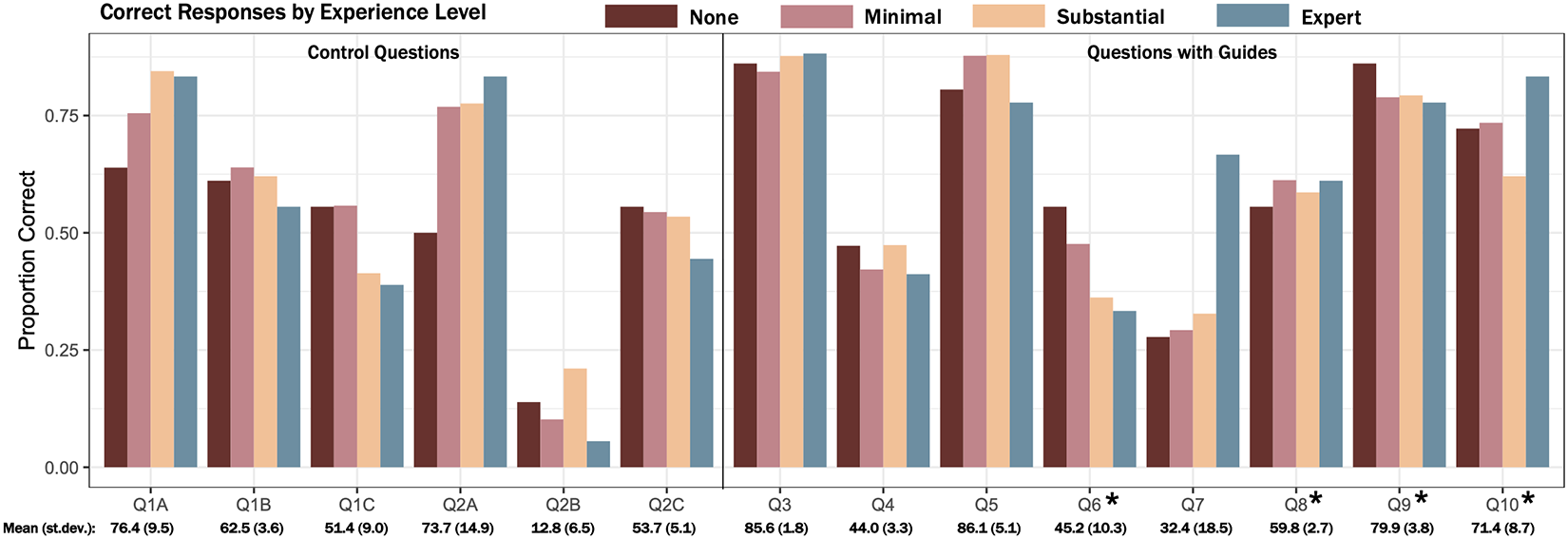
Our survey clarified patterns that we saw with our own small group trials as we worked through how to translate the attributes we observed into standardized categories. As we anticipated, certain attribute identifications showed marked improvement with guides, while others remained challenging. The ability to identify particle shape and particle density increased with image guides, while particle size remained difficult (Figure 7).
Proportion of correct survey responses by respondent type.

Figure 7 Long description
Correct Responses by Experience Level. Legend: None, Minimal, Substantial, Expert. Y-axis label: Proportion Correct. Y-axis range: 0.00 to 1.00. Two sections: Control Questions and Questions with Guides. Control Questions. X-axis categories: Q1A, Q1B, Q1C, Q2A, Q2B, Q2C. Q1A: None about 0.63; Minimal about 0.75; Substantial about 0.85; Expert about 0.83. Q1B: None about 0.60; Minimal about 0.63; Substantial about 0.61; Expert about 0.55. Q1C: None about 0.55; Minimal about 0.55; Substantial about 0.40; Expert about 0.38. Q2A: None about 0.50; Minimal about 0.76; Substantial about 0.77; Expert about 0.83. Q2B: None about 0.13; Minimal about 0.10; Substantial about 0.21; Expert about 0.05. Q2C: None about 0.55; Minimal about 0.54; Substantial about 0.53; Expert about 0.44. Questions with Guides. X-axis categories: Q subscript 3, Q subscript 4, Q subscript 5, Q subscript 6 asterisk, Q subscript 7, Q subscript 8 asterisk, Q subscript 9 asterisk, Q subscript 10 asterisk. Q subscript 3: None about 0.86; Minimal about 0.84; Substantial about 0.87; Expert about 0.88. Q subscript 4: None about 0.47; Minimal about 0.42; Substantial about 0.47; Expert about 0.40. Q subscript 5: None about 0.80; Minimal about 0.88; Substantial about 0.88; Expert about 0.78. Q subscript 6 asterisk: None about 0.55; Minimal about 0.47; Substantial about 0.36; Expert about 0.33. Q subscript 7: None about 0.27; Minimal about 0.29; Substantial about 0.32; Expert about 0.66. Q subscript 8 asterisk: None about 0.55; Minimal about 0.60; Substantial about 0.58; Expert about 0.61. Q subscript 9 asterisk: None about 0.86; Minimal about 0.79; Substantial about 0.78; Expert about 0.77. Q subscript 10 asterisk: None about 0.72; Minimal about 0.74; Substantial about 0.62; Expert about 0.83. Text below the x-axis: Mean left parenthesis st dot dev dot right parenthesis colon 0.62 left parenthesis 0.23 right parenthesis.
Questions 1A and 2A asked survey participants to identify particle shape intuitively, resulting in a correct response rate of 74% and 76%, respectively. When reference images were provided (Questions 3 and 5), the correct response rate jumped to 86%. However, even with guides, identification of particle shape for shell temper voids was low (Question 4, 44% correct).
The correct identification of particle density rose from 51% and 54% (Questions 1C, 2C) to as high as 80% (Question 9). In the free response section, one participant explained, “I find the percentages especially difficult to estimate, so I think those references are particularly useful.” However, we noted difficulties with this variable. Whether the correct answer of 0%–10% or >20% was chosen as the dominant response, a significant percentage of respondents selected 10%–20% for these questions (18%–30%). This was also the main type of question where we authors lacked consensus in our responses. Identification of density is complex, as it is affected by particle size, shape, and orientation (Matthew et al. Reference Matthew, Woods, Oliver, Middleton and Freestone1991), as well as matrix attributes such as color and breakage pattern. Our results suggest that this variable requires significant practice and inter-operator checks to ensure consistency.
Questions of particle size using the Wentworth Scale had the lowest successful response rates, with limited improvement from reference guides. Question 7 asked respondents to assess the particle size of leached shell voids; only 32% of respondents correctly identified the particle size. We noted that both we and the respondents had difficulty discerning whether a sample was unsorted by particle size (containing an equal proportion of all sizes) or whether coarse or very coarse particles dominated the particle size. Since large particles are more apparent than small particles, it may require special training or practice to quantify the relative area covered by each particle size and determine whether a sample is unsorted.
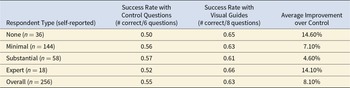
Responses were classified by expertise, with survey participants self-identifying as having no expertise, minimal expertise, moderate expertise, or expert (Figure 7; Table 2). We hypothesized that respondents with greater familiarity with pottery analysis would have more correct responses. This was true, but with the guides, participants self-identifying as having no experience were able to substantially improve, approaching or exceeding the proportion of correct expert responses. For example, control Question 2a and Question 5 used the same image, asking participants to identify shell temper shape. While only 50% of those with no experience correctly identified the shell shape in Question 2a, correct identification jumped to 81% with the guides. Responses from those with minimal and moderate experience improved by about 10%, and expert identification decreased slightly, with one participant changing their answer.
Response Success Rate with and without Visual Guides, by Respondent Type.

Table 2 Long description
The table reports average success rates on two sets of questions, comparing a control condition to a visual guide condition, grouped by self-reported respondent type and sample size. For respondents with no self-reported experience, success rises from 0.50 on the control questions to 0.65 with visual guides, an average improvement of 14.60 percent. Minimal experience increases from 0.56 to 0.63, improving by 7.10 percent. Substantial experience increases from 0.57 to 0.61, improving by 4.60 percent, the smallest gain. Expert respondents increase from 0.52 to 0.66, improving by 14.10 percent, similar to the no-experience group. Overall across 256 respondents, success rises from 0.55 to 0.63, an average improvement of 8.10 percent. Because the control and visual guide conditions use different numbers of questions, the rates are comparable as proportions, but the raw counts are not directly comparable across conditions.
Overall, the guides were effective at generating consistent responses (i.e., low standard deviation; Figure 7) for particle shape and density, regardless of expertise. One question at which experts excelled was in the identification of particle size for leached shell (Question 7). Those identifying as experts had a 66% successful response rate, compared with 28%–33% for the other categories of respondent. Here we may see where guides cannot overcome the need for training and practice.
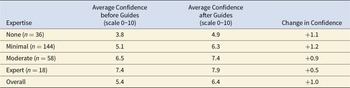
Finally, we considered participant confidence before and after using the shell temper guides. Respondent confidence for all groups increased with guides (Table 3). As anticipated, the largest gains were in the groups with the least experience and the most to learn. We recognize that confidence during a survey of unfamiliar materials does not reflect real-world conditions; however, one participant with minimal experience noted, after increasing their confidence from a seven to an eight: “While my confidence appears to have increased only slightly, I would definitely use reference images if they were available to me.”
Change in Response Confidence by Respondent Type.

Table 3 Long description
The table reports average response confidence on a zero to ten scale before and after using guides, grouped by respondent expertise and sample size. Confidence increases in every group after the guides. People with no expertise, 36 respondents, rise from 3.8 to 4.9, a gain of 1.1 points. Minimal expertise, 144 respondents, rises from 5.1 to 6.3, a gain of 1.2 points, the largest increase. Moderate expertise, 58 respondents, rises from 6.5 to 7.4, a gain of 0.9 points. Experts, 18 respondents, rise from 7.4 to 7.9, a gain of 0.5 points, the smallest increase. Overall confidence increases from 5.4 to 6.4, a gain of 1.0 point, suggesting guides help most for less experienced respondents, though expert results are based on the smallest group.
Discussion
Our survey results make it clear that this sort of guide is useful and needed. The use of the images improved the accuracy and consistency of responses, particularly for shape and density. One participant explained, “Reference images [are] very helpful. I don’t usually analyze pottery often, but visually it helps recalibrate my ability to estimate percentages.” This calibration is the key function of the guides. Yet, a set of idealized images cannot encompass all possible variation within an assemblage. Further, while we recommend them, destructive preparation methods such as sawing or fresh breaks are typically not permitted for an entire pottery assemblage, limiting the ability to make direct or ideal comparisons with reference materials. Human interpretation remains a critical feature of the analysis, and it requires experience. Through the survey, we identified several attributes that require additional training. Particle size was particularly challenging, as was the classification of shell voids. Our findings suggest that while people with minimal experience may be able to correctly identify particle shape or density, particle size data from the same researchers may not be as reliable. At the same time, we recognize that under real-world conditions, instead of a brief online survey, participants may quickly gain the necessary proficiency. Hands-on work with sherds under good lighting and standard magnification with a hand lens or microscope is very different from working only from two-dimensional images. In our experience, incorporating the high-resolution reference images from the guide with laboratory processing of pottery sherds has greatly improved our confidence.
For our project, by establishing the diagnostic features of shell temper in a standard way, we maintain consistent recording among catalogers and collections. This standardized information on tempering practices across the Pensacola culture area will be key to marking temporal or geographic variation and communities of practice related to pottery production. Next steps include replicating whole pots to see if the temper characteristics we have identified have distinct performance characteristics. Our ongoing collaboration with potters from Choctaw Nation of Oklahoma involves replication of Pensacola pottery using paste and temper recipes observed in archaeological pottery, the first step in understanding the performance characteristics of coastal shell species on ceramic vessels and foodways.
More broadly, we recognize that our ability to answer questions about past communities is contingent on increasing reliability, which can be done through building reference materials and continuing to envision new techniques. Increasingly, researchers are developing tools that rely less on human sight and other senses. The application of machine learning within the last decade has become more widespread and been applied to answer archaeological questions (Jalandoni et al. Reference Jalandoni, Zhang and Zaidi2022; Lyons Reference Lyons2021; Reedy et al. Reference Reedy, Anderson, Reedy and Liu2014; Rubo et al. Reference Rubo, de Carvalho Carneiro, Michelon and Gioria2019). Computer vision techniques in particular have shown great promise in helping to standardize and improve classification, as convolutional neural networks (CNN) are trained to parse out various aspects of an image (e.g., textures, colors, shapes, etc.) to be able to discriminate between different types of object (Chollet et al. Reference Chollet2022). However, the accuracy and reliability of these models is dependent on the data put in and thus, like any other tool, is reliant on good practices that limit subjectivity.
For those studying shell-tempered pottery, we provide our reference images for their use (supplemental material 1). While it is beyond the scope of our project, we encourage archaeologists working on pottery in other areas to consider developing their own contextually relevant temper and inclusion reference guides from this model. We look forward to the new collaborative and synthetic research that can be possible with greater data standardization.
Acknowledgments
Resources including clay and tempering materials were provided by the Ceramic Technology Laboratory (CTL) at the Florida Museum of Natural History (FLMNH), University of Florida, with additional materials donated by the Environmental Archaeology and Historical Archaeology programs at the FLMNH. We thank Nicole Fuller and Gifford Waters for their assistance. Mobile Bay clay was donated to the CTL by Dr. Greg Waselkov. We extend our gratitude to Dr. Gerald Kidder, a volunteer in the CTL, for producing the test briquettes. We are grateful to all the respondents of our survey, especially those of the Southeastern Archaeological Conference (SEAC). SEAC attendees also provided helpful feedback on earlier presentations of these methods and results. Dr. Linda Sanchez Crawford assisted with our Spanish abstract. We thank the three anonymous reviewers who provided valuable feedback that has improved this article. No permits were required for this project. No grant funds were applied to this project.
Funding Statement
No funding was obtained for the development of this guide. The broader project “Pensacola Culture and the Mississippianization of the Northern Gulf Coast, ca. AD 1150–1700” is supported by the National Science Foundation (NSF 2148034).
Data Availability Statement
All reported data and materials are provided. The images resulting from the experimental temper briquettes are available as supplemental material 1, the complete survey is available as supplemental material 2, and the anonymous survey results are available as supplemental material 3, all available at https://doi.org/10.5281/zenodo.15717882.
Competing Interests
The authors declare none.



 Open access

