
Skip to main content Accessibility help
×
  • Cited by 28
    • Show more authors
    • You may already have access via personal or institutional login
    • Select format
    • Publisher:
      Cambridge University Press
      Publication date:
      22 September 2009
      12 August 2004
      ISBN:
      9780511488443
      9780521830706
      9780521120708
      Dimensions:
      (228 x 152 mm)
      Weight & Pages:
      0.615kg, 280 Pages
      Dimensions:
      (229 x 152 mm)
      Weight & Pages:
      0.42kg, 280 Pages
    You may already have access via personal or institutional login
  • Selected: Digital
    Add to cart View cart Buy from Cambridge.org

    Book description

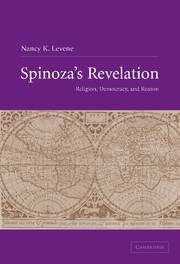
    Nancy Levene reinterprets a major early modern philosopher, Benedict de Spinoza - a Jew who was rejected by the Jewish community of his day but whose thought contains, and critiques, both Jewish and Christian ideas. It foregrounds the connection of religion, democracy, and reason, showing that Spinoza's theories of the Bible, the theologico-political, and the philosophical all involve the concepts of equality and sovereignty. Professor Levene argues that Spinoza's concept of revelation is the key to this connection, and above all to Spinoza's view of human power. This is to shift the emphasis in Spinoza's thought from the language of amor Dei (love of God) to the language of libertas humana (human freedom) without losing either the dialectic of his most striking claim - that man is God to man - or the Jewish and Christian elements in his thought. Original and thoughtfully argued, this book offers fresh insights into Spinoza's thought.

    Reviews

    'Nancy Levene … has written an energetic and inspiring book on Spinoza. Based on a thorough reading of Spinoza's Theologico-Political Treatise and his other works, and in constant conversation with previous interpretations, Levene retrieves a constructive agenda from Spinoza's writing about Biblical revelation that makes it once mire possible to fathom why some earlier readers, such as the Romantic poet Novalis, considered Spinoza a 'God intoxicated' man rather than an athiest.'

    Source: Scottish Journal of Theology

    Refine List

    Actions for selected content:

    Select all | Deselect all
    • View selected items
    • Export citations
    • Download PDF (zip)
    • Save to Kindle
    • Save to Dropbox
    • Save to Google Drive

    Save Search

    You can save your searches here and later view and run them again in "My saved searches".

    Please provide a title, maximum of 40 characters.
    ×

    Contents

    Bibliography
    WORKS BY SPINOZA
    Spinoza, Benedictus de. The Collected Works of Spinoza. Ed. and trans. Edwin Curley. Vol. I. Princeton, N. J.: Princeton University Press, 1985
    Spinoza, Benedictus de. The Letters. Trans. Samuel Shirley. Indianapolis: Hackett, 1995
    Spinoza, Benedictus de. The Political Works. Ed. and trans. A. G. Wernham. Oxford: Clarendon Press, 1958
    Spinoza, Benedictus de.Theological-Political Treatise. Trans. Samuel Shirley. Indianapolis: Hackett, 1998
    Spinoza, Benedictus de.Spinoza Opera. Ed. Carl Gebhardt. 4 vols. Heidelberg: Carl Winter, 1925
    OTHER WORKS
    Anselm, Proslogion. Trans. M. J. Charlesworth. Notre Dame, Ind.: University of Notre Dame Press, 1965
    Aquinas, St. Thomas. Saint Thomas Aquinas on Law, Morality, and Politics. Ed. William P. Baumgarth and Richard J. Regan, S J. Indianapolis: Hackett, 1988
    Aristotle. The Complete Works of Aristotle. Ed. Jonathan Barnes. 2 vols. Princeton, N. J.: Princeton University Press, 1984
    Balibar, Etienne. Spinoza: From Individuality to Transindividuality. Delft: Eduron 1997
    Balibar, Etienne. “Jus-Pactum-Lex: On the Constitution of the Subject in the Theologico-Political Treatise.” In The New Spinoza. Ed. Warren Montag and Ted Stolze. Minneapolis: University of Minnesota Press, 1997
    Balibar, Etienne. Spinoza and Politics. Trans. Peter Snowdon. London: Verso, 1998
    Balibar, Etienne. “Spinoza, the Anti-Orwell: The Fear of the Masses.” Trans. Ted Stolze, rev. J. Swenson and E. Balibar. In Masses, Classes, Ideas: Studies on Politics and Philosophy Before and After Marx. New York: Routledge, 1994
    Barbone, Steven. “Power in the Tractatus Theologico-Politicus.” In Piety, Peace, and the Freedom to Philosophize. Ed. Paul Bagley. Dordrecht: Kluwer Academic Publishers, 1999
    Bartuschat, W. “The Ontological Basis of Spinoza's Theory of Politics.” In Spinoza's Political and Theological Thought. Ed. C. De Deugd. Amsterdam: North-Holland, 1984
    Bayle, Pierre. Historical and Critical Dictionary [1697]. Indianapolis: Hackett, 1991
    Belaief, Gail. Spinoza's Philosophy of Law. The Hague: Mouton, 1971
    Bennett, Jonathan. “Eight Questions about Spinoza.” In Spinoza On Knowledge and the Human Mind. Ed. Yirmiyahu Yovel. Leiden: E. J. Brill, 1994
    Bennett, Jonathan. A Study of Spinoza's “Ethics.” Indianapolis: Hackett, 1984
    Berman, Lawrence V.Maimonides on the Fall of Man”. AJS Review 5 (1980): 1–15
    Boyarin, Daniel. A Radical Jew: Paul and the Politics of Identity. Berkeley: University of California Press, 1994
    Buber, Martin. Between Man and Man. Trans. Ronald Gregor Smith. New York: Collier Books, 1965
    Curley, Edwin. Behind the Geometrical Method. Princeton, N. J.: Princeton University Press, 1988
    Curley, Edwin. “Notes on a Neglected Masterpiece: Spinoza and the Science of Hermeneutics.” In Spinoza: The Enduring Questions. Ed. Graeme Hunter. Toronto: University of Toronto Press, 1994, 64–99
    Davidson, Herbert. “Maimonides' Secret Position on Creation.” In Studies in Medieval Jewish History and Literature. Ed. Isadore Twersky. Cambridge, Mass.: Harvard University Press, 1979
    De Deugd, C., ed. Spinoza's Political and Theological Thought. Amsterdam: North-Holland, 1984
    Den Uyl, Douglas J. Power, State, and Freedom. Assen: Van Gorcum, 1983
    Den Uyl, Douglas J. “Power, Politics, and Religion in Spinoza's Political Thought.” In Piety, Peace, and the Freedom to Philosophize. Ed. Paul Bagley. Dordrecht: Kluwer Academic Publishers, 1999, 133–158
    Descartes, René. The Philosophical Writings of Descartes. Ed. and trans. John Cottingham, Robert Stoothoff, and Dugald Murdoch. 3 vols. Cambridge: Cambridge University Press, 1985
    Donagan, Alan. Spinoza. Chicago: University of Chicago Press, 1988
    Donagan, Alan. “Spinoza's Theology.” In The Cambridge Companion to Spinoza. Ed. Don Garrett. Cambridge: Cambridge University Press, 1996
    Fix, Andrew C. Prophecy and Reason: The Dutch Collegiants in the Early Enlightenment. Princeton, N. J.: Princeton University Press, 1991
    Freudenthal, J. Spinoza: Sein Leben und seine Lehre. Vol. I: Das Lebens Spinozas. Stuttgart: Frommann, 1904. Vol. II: Die Lehre Spinozas auf Grund des Nachlasses. Heidelberg: Carl Winter, 1927
    Frymer-Kensy, Tikvah. “Revelation Revealed: The Doubt of Torah.” In Textual Reasonings: Jewish Philosophy and Text Study at the End of the Twentieth Century. Ed. Peter Ochs and Nancy Levene. Grand Rapids, Mich.: Eerdman's, 2002
    Haddad-Chamakh, F. “Liberté individuelle et paix civile d'après le Traité théologico-politique de Spinoza.” In Spinoza's Political and Theological Thought. Ed. C. De Deugd. Amsterdam: North-Holland, 1984
    Harris, Jay M. How Do We Know This? Midrash and the Fragmentation of Modern Judaism. Albany: State University of New York Press, 1995
    Harvey, Warren Zev. “A Portrait of Spinoza as a Maimonidean”. Journal of the History of Philosophy 19 (1981): 151–72
    Harvey, Warren ZevMaimonides' Commentary on Genesis 3: 22”. Daat 12 (1984): 15–22
    Hazard, Paul. The European Mind 1680–1715. Trans. J. Lewis May. New York: Meridian, 1963
    Hegel, Georg Wilhelm Friedrich. Lectures on the Philosophy of Religion. Vol. I. Ed. Peter C. Hodgson, trans. R. F. Brown, P. C. Hodgson, and J. M. Stewart. Berkeley: University of California Press, 1984
    Hobbes, Thomas. Leviathan. Ed. Richard Tuck. Cambridge: Cambridge University Press, 1996
    Hobbes, Thomas. On the Citizen. Ed. Richard Tuck and Michael Silverthorne. Cambridge: Cambridge University Press, 1998
    Israel, Jonathan. “The Banning of Spinoza's Works in the Dutch Republic (1670–1678).” In Disguised and Overt Spinozism around 1700. Ed. Wiep van Bunge and Wim Klever. Leiden: E. J. Brill, 1996, 3–14
    Israel, Jonathan. The Dutch Republic: Its Rise, Greatness, and Fall 1477–1806. New York: Clarendon Press, 1995
    Israel, Jonathan. Radical Enlightenment: Philosophy and the Making of Modernity 1650–1750. New York: Oxford University Press, 2001
    Israel, Menasseh ben. The Conciliator: Reconcilement of the Apparent Contradictions in Holy Scripture. London, 1842
    Ivry, Alfred. “Maimonides on Possibility.” In Mystics, Philosophers, and Politicians: Essays in Jewish Intellectual History in Honor of Alexander Altmann. Ed. Judah Reinharz and Daniel Swetschinski. Durham, N. C.: Duke University Press, 1982
    Kant, Immanuel. Critique of Pure Reason. Trans. Norman Kemp Smith. New York: Macmillan, 1929
    Kant, Immanuel. Religion Within the Limits of Reason Alone. Trans. Theodore M. Greene and Hoyt H. Hudson. New York: Harper Torchbooks, 1960
    Kaplan, Yosef. From Christianity to Judaism: The Story of Isaac Orobio de Castro. Oxford: Oxford University Press, 1989
    Katz, D. S. and J. Israel, eds. Sceptics, Millenarians, and Jews. Leiden: E. J. Brill, 1990
    Kellner, Menachem Marc. Maimonides on Human Perfection. Atlanta, Ga.: Scholars Press, 1990
    Kierkegaard, Søren. Philosophical Fragments. Trans. Howard V. Hong and Edna H. Hong. Princeton, N. J.: Princeton University Press, 1985
    Klein-Braslavy, Sara. “The Creation of the World and Maimonides' Interpretation of Genesis I–V.” In Maimonides and Philosophy. Ed. Shlomo Pines and Yirmiyahu Yovel. Dordrecht: M. Nijhoff, 1986
    Levene, Nancy. “Ethics and Interpretation, or How to Study Spinoza's Tractatus Theologico-Politicus without Strauss”. Journal of Jewish Thought and Philosophy 10 (2000): 57–110
    Levene, Nancy and Peter Ochs, eds. Textual Reasonings: Jewish Philosophy and Text Study at the End of the Twentieth Century. Grand Rapids, Mich.: Eerdmans, 2002
    Levy, Ze'ev. Baruch or Benedict: On Some Jewish Aspects of Spinoza's Philosophy. New York: Peter Lang, 1989
    Locke, John. An Essay Concerning Human Understanding. Ed. Peter Nidditch. Oxford: Clarendon Press, 1975
    Macherey, Pierre. Hegel ou Spinoza. Paris: François Maspero, 1979
    Machiavelli, Niccolò. The Chief Works and Others. Trans. Allan Gilbert. Vol. I. Durham, N. C.: Duke University Press, 1989
    Maimonides, Moses. Guide of the Perplexed. Ed. and trans. Shlomo Pines. 2 vols. Chicago: University of Chicago Press, 1963
    Maimonides, Moses. A Maimonides Reader. Ed. Isadore Twersky. West Orange, N. J.: Behrman House, 1972
    Mark, Thomas Carson. Spinoza's Theory of Truth. New York: Columbia University Press, 1972
    Marx, Karl. “On the Jewish Question.” In The Marx-Engels Reader. Ed. Robert Tucker. 2nd edn. New York: W. W. Norton and Co., 1978, 26–53
    Mason, Richard. “Faith Set Apart from Philosophy? Spinoza and Pascal.” In Piety, Peace, and the Freedom to Philosophize. Ed. Paul Bagley. Dordrecht: Kluwer Academic Publishers, 1999
    Mason, Richard. The God of Spinoza: A Philosophical Study. New York: Cambridge University Press, 1997
    Matheron, Alexandre. Le Christ et le salut des ignorants chez Spinoza. Paris: Aubier, 1971
    Matheron, Alexandre. Individu et communauté chez Spinoza. Paris: Editions de Minuit, 1969
    Matheron, Alexandre. “Le Problème de l'évolution de Spinoza du Traité théologico-politique au Traité politique.” In Spinoza: Issues and Directions. Ed. Edwin Curley and Pierre-François Moreau. Leiden: E. J. Brill, 1990
    Matheron, Alexandre. “The Theoretical Function of Democracy in Spinoza and Hobbes.” In The New Spinoza. Ed. Warren Montag and Ted Stolze. Minneapolis: University of Minnesota Press, 1997
    Matheron, Alexandre. “Le Traité théologique-politique vu par le jeune Marx”. Cahiers Spinoza 1 (1977): 159–212
    Meinsma, K. O. Spinoza et son cercle [1896]. Ed. Henri Méchoulan and Pierre-François Moreau. Paris: Vrin, 1980
    Mignini, F. “Theology as the Work and Instrument of Fortune.” In Spinoza's Political and Theological Thought. Ed. C.De Deugd. Amsterdam: North-Holland, 1984
    Montag, Warren. Bodies, Masses, Power: Spinoza and his Contemporaries. London: Verso, 1999
    Montag, Warren and Ted Stolze, eds. The New Spinoza: Theory out of Bounds. Minneapolis: University of Minnesota Press, 1997
    Moreau, Pierre-François. “Fortune and the Theory of History.” In The New Spinoza: Theory Out of Bounds. Ed. Warren Montag and Ted Stolze. Minneapolis: University of Minnesota Press, 1997
    Moreau, Pierre-François. Spinoza: L'Expérience et l'éternité. Paris: Presses Universitaires de France, 1994
    Nadler, Steven. Spinoza: A Life. Cambridge: Cambridge University Press, 1999
    Negri, Antonio. “Reliqua Desiderantur: A Conjecture for a Definition of the Concept of Democracy in the Final Spinoza.” In The New Spinoza. Ed. Warren Montag and Ted Stolze. Minneapolis: University of Minnesota Press, 1997
    Negri, Antonio. The Savage Anomaly: The Power of Spinoza's Metaphysics and Politics. Trans. Michael Hardt. Minneapolis: University of Minnesota Press, 1991
    Nesher, Dan. “Spinoza's Theory of Truth.” In Spinoza: The Enduring Questions. Ed. Graeme Hunter. Toronto: University of Toronto Press, 1994, 140–177
    Niermeyer, J. F. Mediae Latinitatis Lexicon Minus. Leiden: E. J. Brill, 1984
    Norris, Christopher. Spinoza and the Origins of Modern Critical Theory. Oxford: Blackwell, 1991
    Novak, David. The Election of Israel: The Idea of the Chosen People. Cambridge: Cambridge University Press, 1995
    Novak, David. Natural Law in Judaism. Cambridge: Cambridge University Press, 1998
    Novak, David, ed. Leo Strauss and Judaism: Athens and Jerusalem Critically Revisited. Lanham, Md.: Rowman & Littlefield, 1996
    Otten, Willemien. “Nature and Scripture: Demise of a Medieval Analogy”. Harvard Theological Review 88.2 (1995): 257–84
    Pascal, Blaise. Pensées. Trans. A. J. Krailsheimer. New York: Penguin Books, 1966
    Pines, Shlomo. “The Limitations of Human Knowledge According to Al Farabi, Ibn Bajja, and Maimonides.” In Studies in Medieval Jewish History and Literature. Ed. Isadore Twersky. Cambridge, Mass.: Harvard University Press, 1979
    Pines, Shlomo. “Spinoza's Tractatus Theologico-Politicus, Maimonides, and Kant.” In Further Studies in Philosophy. Ed. Ora Segal. Scripta Hierosolymitana, vol. XX. Jerusalem: Magnes Press, 1968
    Plato. Euthyphro and Phaedo. In Five Dialogues. Trans. G. M. A. Grube. Indianapolis: Hackett, 1981
    Plato. Republic. Trans. G. M. A. Grube. Indianapolis: Hackett, 1981
    Polka, Brayton. “Spinoza and Biblical Interpretation: The Paradox of Modernity”. The European Legacy 1.5 (1996): 1673–1682
    Polka, Brayton. “Spinoza and the Separation between Philosophy and Theology”. Journal of Religious Studies 16.1–2 (1990): 91–119
    Polka, Brayton. “Spinoza's Concept of Biblical Interpretation”. Journal of Jewish Thought and Philosophy 2 (1992): 19–44
    Popkin, Richard H. Isaac La Peyrère (1596–1676): His Life, Work, and Influence. Leiden: E. J. Brill, 1987
    Popkin, Richard H.The Religious Background of Seventeenth-Century Philosophy”. Journal of the History of Philosophy 25 (1987): 35–50
    Popkin, Richard H. “Spinoza and Bible Scholarship.” In The Cambridge Companion to Spinoza. Ed. Don Garrett. Cambridge: Cambridge University Press, 1996
    Preus, J. Samuel. “The Bible and Religion in the Century of Genius.” Part I: “Religion on the Margins.” Part II: “The Rise and Fall of the Bible.” Part III: “The Hidden Dialogue in Spinoza's Tractatus”. Part IV: “Prophecy, Knowledge, and Study of Religion”. Religion 28 (1998): 3–27, 111–138
    Preus, J. Samuel. Spinoza and the Irrelevance of Biblical Authority. Cambridge: Cambridge University Press, 2001
    Ravven, Heidi M., “The Garden of Eden: Spinoza's Maimonidean Account of the Genealogy of Morals and the Origin of Society”. Philosophy and Theology 13.1 (2001): 3–51
    Ravven, Heidi M., “Spinoza's Rupture with Tradition: His Hints of a Jewish Modernity.” In Jewish Themes in Spinoza's Philosphy. Ed. Heidi M. Ravven and Lenn E. Goodman. Albany: State University of New York Press, 2002, 187–223
    Rice, Lee C.Emotion, Appetition, and Conatus in Spinoza”. Revue internationale de philosophie 31 (1977): 101–116
    Rice, Lee C.Faith, Obedience, and Salvation”. Lyceum 6 (1994): 1–20
    Rice, Lee C. “Individual and Community in Spinoza's Social Psychology.” In Spinoza: Issues and Directions. Ed. Edwin Curley and Pierre-François Moreau. Leiden: E. J. Brill, 1990
    Rice, Lee C.Meyer as Precursor to Spinoza on the Interpretation of Scripture”. Philosphy and Theology 13.1 (2001): 159–180
    Rosenthal, Michael. “Why Spinoza Chose the Hebrews: The Exemplary Function of Prophecy in the Theological-Political Treatise.” In Jewish Themes in Spinoza's Philosphy. Ed. Heidi M. Ravven and Lenn E. Goodman. Albany: State University of New York Press, 2002, 225–260
    Rousseau, Jean-Jacques. The Social Contract and Discourses. Trans. G. D. H. Cole. London: J. M. Dent & Sons, 1973
    Sacksteder, W. “Communal Orders in Spinoza.” In Spinoza's Political and Theological Thought. Ed. C.De Deugd. Amsterdam: North-Holland, 1984
    Sacksteder, W. “Spinoza on Part and Whole: The Worm's Eye View”. Southwest Journal of Philosphy II (1980): 25–40
    Seeskin, Kenneth. “Maimonides, Spinoza, and the Problem of Creation.” In Jewish Themes in Spinoza's Philosophy. Ed. Heidi M. Ravven and Lenn E. Goodman. Albany: State University of New York Press, 2002
    Shahan, Robert and J. I. Biro, eds. Spinoza: New Perspectives. Norman: University of Oklahoma Press, 1978
    Shapin, Steven. A Social History of Truth: Civility and Science in Seventeenth-Century England. Chicago: University of Chicago Press, 1994
    Siebrand, H. J. Spinoza and the Netherlanders: An Inquiry into the Early Reception of his Philosophy of Religion. Assen: Van Gorcum, 1988
    Simon, Richard. Histoire critique du Vieux Testament [1678]. Geneva: Slatkin Reprints, 1971
    Skinner, Quentin. “The Idea of Negative Liberty.” In Philosophy and History. Ed. Richard Rorty, J. B. Schneewind, and Quentin Skinner. Cambridge: Cambridge University Press, 1984
    Smith, Steven B. Spinoza, Liberalism, and the Question of Jewish Identity. New Haven, Conn.: Yale University Press, 1997
    Steinmann, Jean, Richard Simon et les origines de l'exégèse biblique. Paris: Desclée de Brouwer, 1960
    Strauss, Leo. Persecution and the Art of Writing. Chicago: University of Chicago Press, 1952
    Tosel, André. Spinoza ou le crépuscule de la servitude: Essai sur le Traité Théologico-Politique. Paris: Aubier Montaigne, 1984
    Twersky, Isadore, ed. A Maimonides Reader. West Orange, N. J.: Behrman House, 1972
    Twersky, Isadore, Studies in Medieval Jewish History and Literature. 2 vols. Cambridge, Mass.: Harvard University Press, 1979
    Van Bunge, Wiep and Wim Klever, eds. Disguised and Overt Spinozism Around 1700. Leiden: E. J. Brill, 1996
    Walther, Manfred. “Spinoza's Critique of Miracles: A Miracle of Criticism?” In Spinoza: The Enduring Questions. Ed. Graeme Hunter. Toronto: University of Toronto Press, 1994, 100–112
    Wolfson, Harry Austryn. The Philosophy of Spinoza. 2 vols. Cambridge, Mass.: Harvard University Press, 1934
    Wolfson, Harry Austryn. “The Platonic, Aristotelian, and Stoic Theories of Creation in Halevi and Maimonides.” In Studies in the History of Philosophy and Religion. Vol. I. Ed. Isadore Twersky and George H. Williams. Cambridge, Mass.: Harvard University Press, 1973
    Yovel, Yirmiyahu. “Bible Interpretation as Philosophical Praxis: A Study of Spinoza and Kant”. Journal of the History of Philosophy 11 (1973): 189–212
    Yovel, Yirmiyahu. “Spinoza: The Psychology of the Multitude and the Uses of Language”. Studia Spinozana 1 (1985): 305–333
    Yovel, Yirmiyahu Spinoza and Other Heretics. Vol. I: The Marrano of Reason. Vol. II: The Adventures of Immanence. Princeton, N. J.: Princeton University Press, 1989
    Yovel, Yirmiyahu, ed. Spinoza on Knowledge and the Human Mind. Leiden: E. J. Brill, 1994
    Zac, Sylvain. L'Idée de vie dans la philosophie de Spinoza. Paris: Presses Universitaires de France, 1963
    Zac, Sylvain. “On the Idea of Creation in Spinoza's Philosophy.” In God and Nature: Spinoza's Metaphysics. Ed. Yirmiyahu Yovel. Leiden: E. J. Brill, 1991

    Metrics

    Full text views

    Total number of HTML views: 0
    Total number of PDF views: 0 *
    Loading metrics...

    Book summary page views

    Total views: 0 *
    Loading metrics...

    * Views captured on Cambridge Core between #date#. This data will be updated every 24 hours.

    Usage data cannot currently be displayed.

    Accessibility standard: Unknown

    Why this information is here

    This section outlines the accessibility features of this content - including support for screen readers, full keyboard navigation and high-contrast display options. This may not be relevant for you.

    Accessibility Information

    Accessibility compliance for the PDF of this book is currently unknown and may be updated in the future.
