





1 Introduction
Consider the operator
 $$ \begin{align} \mathcal{L}_h=-h^2\Delta+x_1 \quad\text{ in }\quad L^2(\Omega) \end{align} $$
with Dirichlet boundary conditions, where $\Omega \subset \mathbb {R}^2$
is an open, bounded and connected region. Suppose that there is a unique point
$\Omega \subset \mathbb {R}^2$
is an open, bounded and connected region. Suppose that there is a unique point $X_0=(x_0,y_0)\in \partial \Omega $
that minimises the first coordinate, and that around
$X_0=(x_0,y_0)\in \partial \Omega $
that minimises the first coordinate, and that around $X_0$
the boundary is smooth with positive curvature at
$X_0$
the boundary is smooth with positive curvature at $X_0$
. Then, as the semiclassical parameter h tends to zero, the bound states of (1.1) cluster near the boundary at
$X_0$
. Then, as the semiclassical parameter h tends to zero, the bound states of (1.1) cluster near the boundary at $X_0$
, where the repulsive potential is smallest. The confined Stark effect is characterised by the splitting of the energy levels in this limit.
$X_0$
, where the repulsive potential is smallest. The confined Stark effect is characterised by the splitting of the energy levels in this limit.
In [Reference Cornean, Krejčiřík, Pedersen, Raymond and Stockmeyer1] Cornean, Krejčiřík, Pedersen, Raymond and Stockmeyer examined this splitting. They determined that for any fixed $k\geq 1$
the kth eigenvalue of (1.1) satisfies
$k\geq 1$
the kth eigenvalue of (1.1) satisfies
 $$ \begin{align} \lambda_k(\mathcal{L}_h)=x_{0}+z_1 h^{2/3}+(2k-1)\sqrt{\frac{\kappa_0}{2}}h+\mathcal{O}_{h\rightarrow 0_+}(h^{4/3}) \end{align} $$
where $-z_1\approx - 2.338$
is the first zero of the Airy function and
$-z_1\approx - 2.338$
is the first zero of the Airy function and $\kappa _0>0$
is the curvature of the boundary of
$\kappa _0>0$
is the curvature of the boundary of $\Omega $
at
$\Omega $
at $X_0$
. We note that a higher-dimensional analogue of this expansion has been found in [Reference Fahs3].
$X_0$
. We note that a higher-dimensional analogue of this expansion has been found in [Reference Fahs3].
The idea behind the expansion (1.2) is that as the bound states of (1.1) become concentrated near $X_0$
, the curvature in the boundary acts as an effective harmonic oscillator in the tangential component, whilst the orthogonal component produces the Airy zero. Indeed, the approach taken in [Reference Cornean, Krejčiřík, Pedersen, Raymond and Stockmeyer1] was to construct quasi-states using the eigenfunctions of the Airy operator and harmonic oscillator in tubular coordinates around
$X_0$
, the curvature in the boundary acts as an effective harmonic oscillator in the tangential component, whilst the orthogonal component produces the Airy zero. Indeed, the approach taken in [Reference Cornean, Krejčiřík, Pedersen, Raymond and Stockmeyer1] was to construct quasi-states using the eigenfunctions of the Airy operator and harmonic oscillator in tubular coordinates around $X_0$
on a suitable scale in h.
$X_0$
on a suitable scale in h.
In this work, we are concerned with the directly related question of how many eigenvalues accumulate below the different levels in (1.2). To introduce this, first consider the general case of a Schrödinger operator $-h^2\Delta +V$
in
$-h^2\Delta +V$
in $L^2(\omega )$
with Dirichlet conditions, on an open set
$L^2(\omega )$
with Dirichlet conditions, on an open set $\omega \subset \mathbb {R}^d$
with suitably regular potential V. The well-known Weyl’s law states that the counting function,
$\omega \subset \mathbb {R}^d$
with suitably regular potential V. The well-known Weyl’s law states that the counting function,
 $$ \begin{align*} N(-h^2\Delta+V,\Lambda)=\#\left\{k\in \mathbb{N} \colon \lambda_k(-h^2\Delta+V)<\Lambda\right\}, \end{align*} $$
satisfies the asymptotics
 $$ \begin{align} \lim_{h\rightarrow 0_+}h^d N(-h^2\Delta+V,\Lambda)=L_{0,d}^{\mathrm{cl}}\int_{\omega}\left(\Lambda-V(x)\right)_{+}^{d/2}\, \mathrm{d} x \end{align} $$
where $a_\pm =(\left \vert {a}\right \vert \pm a)/2$
and
$a_\pm =(\left \vert {a}\right \vert \pm a)/2$
and $L_{0,d}^{\mathrm {cl}}$
is an instance of
$L_{0,d}^{\mathrm {cl}}$
is an instance of
 $$ \begin{align} L_{\gamma,d}^{\mathrm{cl}}=\frac{\Gamma(\gamma+1)}{(4\pi)^{d/2}\Gamma(\gamma+1+d/2)}. \end{align} $$
We investigate this limit for the Stark operator (1.1), where for the counting function we take $\Lambda $
dependent on h, choosing either
$\Lambda $
dependent on h, choosing either
 $$ \begin{align*} x_0+\mu h^{2/3} \qquad\text{or}\qquad x_0+z_1h^{2/3}+\mu h^{\alpha}, \end{align*} $$
with $\mu \geq 0$
and
$\mu \geq 0$
and $\alpha \in (2/3,1)$
. In doing so, we count the number of low-lying eigenvalues, corresponding to the expansion (1.2). We note that a similar regime was considered by Frank in [Reference Frank4], who determined the asymptotic number of edge states for a magnetic Laplacian with Neumann boundary conditions.
$\alpha \in (2/3,1)$
. In doing so, we count the number of low-lying eigenvalues, corresponding to the expansion (1.2). We note that a similar regime was considered by Frank in [Reference Frank4], who determined the asymptotic number of edge states for a magnetic Laplacian with Neumann boundary conditions.
1.1 Main results
Before stating our main results, we establish the construction of tubular coordinates about $X_0$
. For the latter, we follow [Reference Cornean, Krejčiřík, Pedersen, Raymond and Stockmeyer1] and its notation as closely as possible. Without loss of generality, we will assume that
$X_0$
. For the latter, we follow [Reference Cornean, Krejčiřík, Pedersen, Raymond and Stockmeyer1] and its notation as closely as possible. Without loss of generality, we will assume that $x_0=0$
.
$x_0=0$
.
Consider an arc-length parameterisation $\gamma (s)$
of
$\gamma (s)$
of $\partial \Omega $
in the vicinity of
$\partial \Omega $
in the vicinity of $X_0$
, such that
$X_0$
, such that $\gamma (0)=X_0$
. The outward normal at any point on this curve can be represented by
$\gamma (0)=X_0$
. The outward normal at any point on this curve can be represented by $n(s)=(\cos (\theta (s)),\sin (\theta (s)))$
and the curvature by
$n(s)=(\cos (\theta (s)),\sin (\theta (s)))$
and the curvature by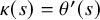 $\kappa (s)=\theta ^\prime (s)$
, with
$\kappa (s)=\theta ^\prime (s)$
, with  . We can then fix $\delta>0$
to be sufficiently small so that the mapping
$\delta>0$
to be sufficiently small so that the mapping $\tau \colon (-\delta ,\delta )\times (0,\delta )\rightarrow \Omega $
defined by
$\tau \colon (-\delta ,\delta )\times (0,\delta )\rightarrow \Omega $
defined by
 $$ \begin{align} \tau(s,t)=\gamma(s)-t n(s) \end{align} $$
establishes a diffeomorphism between the strip and its image in $\Omega $
, where the determinant of its Jacobian is given by
$\Omega $
, where the determinant of its Jacobian is given by $1-\kappa (s)t$
.
$1-\kappa (s)t$
.
Our first result reveals Weyl-type asymptotics for the $\gamma $
-Riesz means of the Stark operator (1.1),
$\gamma $
-Riesz means of the Stark operator (1.1), $\operatorname {\mathrm {Tr}}\left (\mathcal {L}_h-\Lambda \right )_{-}^\gamma $
, for which we identify
$\operatorname {\mathrm {Tr}}\left (\mathcal {L}_h-\Lambda \right )_{-}^\gamma $
, for which we identify $\gamma =0$
with the counting function.
$\gamma =0$
with the counting function.
Theorem 1.1. Let $\gamma \geq 0$
,
$\gamma \geq 0$
, $\alpha \in (2/3,1)$
and
$\alpha \in (2/3,1)$
and $\mu \geq 0$
, then
$\mu \geq 0$
, then
 $$ \begin{align*} \lim_{h\rightarrow 0_+}h^{(1-2\gamma)/3}\operatorname{\mathrm{Tr}}\left(\mathcal{L}_h-\mu h^{2/3}\right)_{-}^\gamma&=\frac{4\pi L_{\gamma,2}^{\mathrm{cl}}}{\sqrt{2\kappa_0}}\sum_{k=1}^\infty\left(\mu-z_k\right)_+^{\gamma+1},\text{ and }\\ \lim_{h\rightarrow 0_+}h^{1-\alpha(1+\gamma)}\operatorname{\mathrm{Tr}}\left(\mathcal{L}_h-z_1h^{2/3}-\mu h^{\alpha}\right)_{-}^\gamma &=\frac{4\pi L_{\gamma,2}^{\mathrm{cl}}}{\sqrt{2\kappa_0}}\mu^{\gamma+1}, \end{align*} $$
where $-z_k$
is the kth zero of the Airy function and
$-z_k$
is the kth zero of the Airy function and $4\pi L^{\mathrm {cl}}_{\gamma ,2}=(\gamma +1)^{-1}$
arises from (1.4).
$4\pi L^{\mathrm {cl}}_{\gamma ,2}=(\gamma +1)^{-1}$
arises from (1.4).
The result shows that at the relevant energy thresholds, the operator becomes semiclassical in the tangential direction while remaining quantised in the orthogonal one. In the remark below, we compare the result with the quantity appearing in the standard semiclassical Weyl law. Moreover, the result gives some control over the remainder term in the expansion (1.2).
Remark 1.2 (Semiclassical approximation).
In the first regime, a phase–space heuristic correctly predicts the order of the asymptotics. For $\gamma =0$
, the standard semiclassical approximation predicts that
$\gamma =0$
, the standard semiclassical approximation predicts that
 $$ \begin{align*} N(\mathcal{L}_h,\mu h^{2/3})&\approx (2\pi)^{-2}\left\vert{\left\{ (\xi,x)\in \mathbb{R}^2\times \Omega\,\colon\, h^2|{\xi}|^2+x_1<\mu h^{2/3}\right\}}\right\vert. \end{align*} $$
Approximating, in tubular coordinates, the domain near $X_0$
by a half-plane whose height grows like
$X_0$
by a half-plane whose height grows like $t + \frac {\kappa _0}{2}s^2$
, we find
$t + \frac {\kappa _0}{2}s^2$
, we find
 $$ \begin{align*} (2\pi)^{-2}\left\vert{\left\{ (\xi,x)\in \mathbb{R}^2\times \Omega\,\colon\, h^2|{\xi}|^2+x_1<\mu h^{2/3}\right\}}\right\vert=\; \frac{4}{15\pi\sqrt{2\kappa_0}}\, \mu^{5/2}\,h^{-1/3}\; (1+o_{h\to0_+}(1)), \end{align*} $$
which gives the correct leading-order exponent $h^{-1/3}$
. Up to a constant, this can be made rigorous by using the CLR bound from [Reference Laptev, Read and Schimmer8].
$h^{-1/3}$
. Up to a constant, this can be made rigorous by using the CLR bound from [Reference Laptev, Read and Schimmer8].
The consistency of this approximation with the result above is reflected in the known asymptotics for the Airy zeros:
 $$\begin{align*}z_k=\frac{1}{4} (3 \pi )^{2/3} (4 k-1)^{2/3}(1+o_{k\rightarrow \infty}(1)).\end{align*}$$
Thus, as $\mu $
unlocks more levels in the leading order term the number of eigenvalues becomes semiclassical.
$\mu $
unlocks more levels in the leading order term the number of eigenvalues becomes semiclassical.
The same heuristic fails to capture the correct order at the finer threshold in the second statement of the theorem.
The approach we employ involves the use of Dirichlet–Neumann bracketing and a rescaling of tubular coordinates around $X_0$
. The former operation is carried out exclusively in the tangential coordinate, whilst in the orthogonal component we construct quasi-states, as in [Reference Cornean, Krejčiřík, Pedersen, Raymond and Stockmeyer1]. The eigenvalues of this operator are the absolute values of the zeros of the Airy function,
$X_0$
. The former operation is carried out exclusively in the tangential coordinate, whilst in the orthogonal component we construct quasi-states, as in [Reference Cornean, Krejčiřík, Pedersen, Raymond and Stockmeyer1]. The eigenvalues of this operator are the absolute values of the zeros of the Airy function, $z_k$
. We denote the corresponding normalised eigenfunctions by
$z_k$
. We denote the corresponding normalised eigenfunctions by $a_k$
, which are given by
$a_k$
, which are given by
 $$ \begin{align} \mathrm{a}_k(t)=\frac{\mathrm{Ai}(t-z_k)}{\left\|{\mathrm{Ai}(\cdot-z_k)}\right\|_{2}} \text{ for } \ k \in\mathbb{N}, \end{align} $$
where $\mathrm {Ai}$
denotes the Airy function.
$\mathrm {Ai}$
denotes the Airy function.
Now, let $\rho _h(\cdot ;\Lambda )$
denote the density of
$\rho _h(\cdot ;\Lambda )$
denote the density of $(\mathcal {L}_h-\Lambda )^0_{-}$
. Namely, if
$(\mathcal {L}_h-\Lambda )^0_{-}$
. Namely, if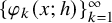 $\{\varphi _k(x;h)\}_{k=1}^\infty $
denote the normalised eigenfunctions of
$\{\varphi _k(x;h)\}_{k=1}^\infty $
denote the normalised eigenfunctions of $\mathcal {L}_h$
with corresponding eigenvalues
$\mathcal {L}_h$
with corresponding eigenvalues $\{\lambda _k(h)\}_{k=1}^\infty $
, then
$\{\lambda _k(h)\}_{k=1}^\infty $
, then
 $$ \begin{align*} \rho_h(x;\Lambda)=\sum_{k\colon \lambda_k(h)<\Lambda}\left\vert{\varphi_k(x;h)}\right\vert{}^2. \end{align*} $$
In our second result we find weak-type asymptotics for $\rho _h$
in tubular coordinates rescaled in
$\rho _h$
in tubular coordinates rescaled in  .
.
Theorem 1.3. Let $\alpha \in (2/3,1)$
and
$\alpha \in (2/3,1)$
and $\mu \geq 0$
, then as
$\mu \geq 0$
, then as $h\rightarrow 0_+$
 $$ \begin{align*} h^{4/3}\rho_h(\tau(h^{1/3}s,h^{2/3}t);\mu h^{2/3})&\rightarrow \frac{1}{\pi}\sum_{k=1}^\infty\left(\mu-\frac{\kappa_0}{2}s^2-z_k\right)_+^{1/2}\mathrm{a}_k(t)^2, \text{ and }\\h^{5/3-\alpha/2}\rho_h(\tau(h^{\alpha/2}s,h^{2/3}t);z_1 h^{2/3}+\mu h^\alpha)&\rightarrow \frac{1}{\pi}\left(\mu-\frac{\kappa_0}{2}s^2\right)_{+}^{1/2}\mathrm{a}_1(t)^2 \end{align*} $$
in the sense of distributions on $\mathbb {R}^2_+$
, where
$\mathbb {R}^2_+$
, where $\tau $
is given by (1.5).
$\tau $
is given by (1.5).
This result not only identifies the scale at which low-lying eigenfunctions concentrate near the boundary point, but also determines their profile. It further demonstrates how the operator becomes semiclassical in the tangential direction, while remaining quantised in the orthogonal one. Thus, the result provides direct insight into the confinement of low-energy electrons in the strong electric field limit.
To obtain these local asymptotics, we extend a weak-type argument previously developed in the works [Reference Evans, Lewis, Siedentop and Solovej2, Reference Lieb and Simon9, Reference Frank and Brown5]. The main idea is that, for Schrödinger operators, one can derive local asymptotics from trace asymptotics with an additional potential. For our operator, we carry this out, but with potentials that are rescaled in the semiclassical constant on a scale relative to the concentration of the low-lying states. We anticipate that this approach could be applied to investigate other concentration phenomena.
Remark 1.4. Theorems 1.1 and 1.3 can be extended to more general $\Omega $
. In particular, the assumptions on the uniqueness of the potential minimum,
$\Omega $
. In particular, the assumptions on the uniqueness of the potential minimum, $X_0$
, and the nondegeneracy of the curvature,
$X_0$
, and the nondegeneracy of the curvature, $\kappa _0>0$
, are kept for simplicity but can be adjusted for. Changing these in the local context would lead to weak-type asymptotics about each minima, and where the curvature is degenerate we would see a change in the scaling.
$\kappa _0>0$
, are kept for simplicity but can be adjusted for. Changing these in the local context would lead to weak-type asymptotics about each minima, and where the curvature is degenerate we would see a change in the scaling.
The structure of the paper is as follows. In Section 2 we reduce the operator to a neighbourhood of $X_0$
and prove a generalised version of Theorem 1.1, with the addition of a rescaled potential. In Section 3 we apply this result to prove Theorem 1.3.
$X_0$
and prove a generalised version of Theorem 1.1, with the addition of a rescaled potential. In Section 3 we apply this result to prove Theorem 1.3.
2 Trace asymptotics for low-lying states
In this section we begin with a geometric reduction: Dirichlet–Neumann bracketing, combined with a Taylor expansion of $x_{1}$
in the tubular coordinates from (1.5), allows us to replace the Stark operator by a flat-strip model acting in a small neighbourhood of the boundary point
$x_{1}$
in the tubular coordinates from (1.5), allows us to replace the Stark operator by a flat-strip model acting in a small neighbourhood of the boundary point $X_{0}$
.
$X_{0}$
.
Once the reduction is in place, the analysis separates into two regimes. Subsection 2.1 addresses the principal threshold at scale $h^{2/3}$
; after a suitable rescaling, Agmon estimates in the orthogonal direction and Weyl’s law in the tangential direction yield the trace asymptotics. Subsection 2.2 focuses on a narrower window of width
$h^{2/3}$
; after a suitable rescaling, Agmon estimates in the orthogonal direction and Weyl’s law in the tangential direction yield the trace asymptotics. Subsection 2.2 focuses on a narrower window of width $h^{\alpha }$
for
$h^{\alpha }$
for $2/3<\alpha <1$
, using a finer rescaling to isolate the ground Airy mode. We begin with the reduction step.
$2/3<\alpha <1$
, using a finer rescaling to isolate the ground Airy mode. We begin with the reduction step.
Fix a function $\Lambda (h)=\mathcal {O}_{h\rightarrow 0_+}(h^{2/3})$
. The first step is to reduce the analysis to a neighbourhood of the unique boundary point
$\Lambda (h)=\mathcal {O}_{h\rightarrow 0_+}(h^{2/3})$
. The first step is to reduce the analysis to a neighbourhood of the unique boundary point $X_{0}\in \partial \Omega $
, where
$X_{0}\in \partial \Omega $
, where $x_{1}$
attains its minimum,
$x_{1}$
attains its minimum, $x_1=0$
and the curvature
$x_1=0$
and the curvature $\kappa _{0}$
is positive. We use the tubular map
$\kappa _{0}$
is positive. We use the tubular map
 $$ \begin{align} \tau(s,t)=\gamma(s)-t\,n(s),\qquad (s,t)\in(-\delta,\delta)\times(0,\delta), \end{align} $$
with Jacobian $m(s,t)=1-\kappa (s)t$
. Taking
$m(s,t)=1-\kappa (s)t$
. Taking $\tau =(\tau _1,\tau _2)$
as in (1.5), we have from [Reference Cornean, Krejčiřík, Pedersen, Raymond and Stockmeyer1] that the Taylor series expansion for
$\tau =(\tau _1,\tau _2)$
as in (1.5), we have from [Reference Cornean, Krejčiřík, Pedersen, Raymond and Stockmeyer1] that the Taylor series expansion for $\tau _1$
about
$\tau _1$
about $(0,0)$
is given by
$(0,0)$
is given by
 $$ \begin{align} \tau_1(s,t)=t+\frac{\kappa_0}{2}s^2+\mathcal{O}_{t\rightarrow 0, s\rightarrow 0}(|s|^3+|t s^2|). \end{align} $$
For a fixed, small, parameter $\eta>0$
we restrict attention to the h-dependent window
$\eta>0$
we restrict attention to the h-dependent window
 $$\begin{align*}\mathcal{W}_{h}=(-h^{1/3-\eta},h^{1/3-\eta})\times(0,h^{2/3-\eta}), \end{align*}$$
which contains the set $\{x\in \Omega :x_{1}<\Lambda (h)\}$
once h is small. Then, applying the variational principle, we have that
$\{x\in \Omega :x_{1}<\Lambda (h)\}$
once h is small. Then, applying the variational principle, we have that
 $$ \begin{align*} \mathcal{L}_h-\Lambda(h)\leq \left(-h^2\Delta_{\tau(\mathcal{W}_h)}^D+x_1-\Lambda(h)\right)&\oplus \left(-h^2\Delta_{\Omega\backslash\tau(\mathcal{W}_h)}^D+x_1-\Lambda(h)\right), \text{ and }\\ \mathcal{L}_h-\Lambda(h)\geq \left(-h^2\Delta_{\tau(\mathcal{W}_h)}^M+x_1-\Lambda(h)\right)&\oplus \left(-h^2\Delta_{\Omega\backslash\tau(\mathcal{W}_h)}^M+x_1-\Lambda(h)\right) \end{align*} $$
in the sense of quadratic forms, where for $\omega \subset \Omega $
we take
$\omega \subset \Omega $
we take $-\Delta ^{D}_{\omega }$
to denote the Dirichlet Laplacian and
$-\Delta ^{D}_{\omega }$
to denote the Dirichlet Laplacian and $-\Delta ^M_{\omega }$
to denote the Laplacian with Dirichlet conditions along
$-\Delta ^M_{\omega }$
to denote the Laplacian with Dirichlet conditions along $\partial \Omega \cap \partial \omega $
and Neumann conditions on
$\partial \Omega \cap \partial \omega $
and Neumann conditions on $\partial \omega \cap \Omega $
. Consequently, since
$\partial \omega \cap \Omega $
. Consequently, since $\{x\in \Omega \colon x_1<\mu h^{2/3}\}\subset \tau (\mathcal {W}_h)$
for sufficiently small h, it follows that for any
$\{x\in \Omega \colon x_1<\mu h^{2/3}\}\subset \tau (\mathcal {W}_h)$
for sufficiently small h, it follows that for any $\gamma \geq 0$
 $$ \begin{align} \begin{aligned} \operatorname{\mathrm{Tr}}\left(\mathcal{L}_h-\Lambda(h)\right)_{-}^\gamma&\geq \operatorname{\mathrm{Tr}}\left(-h^2\Delta_{\tau(\mathcal{W}_h)}^D+x_1-\Lambda(h)\right)_{-}^\gamma, \, \text{and} \\ \operatorname{\mathrm{Tr}}\left(\mathcal{L}_h-\Lambda(h)\right)_{-}^\gamma&\leq \operatorname{\mathrm{Tr}}\left(-h^2\Delta_{\tau(\mathcal{W}_h)}^M+x_1-\Lambda(h)\right)_{-}^\gamma. \end{aligned} \end{align} $$
Each of these operators, the restrictions of $\mathcal {L}_h$
to
$\mathcal {L}_h$
to $\tau (\mathcal {W}_h)$
, can be written in tubular coordinates as
$\tau (\mathcal {W}_h)$
, can be written in tubular coordinates as
 $$ \begin{align*} -h^2 m^{-1} \partial_s m^{-1}\partial_s-h^2 m^{-1}\partial_t m \partial_t +\tau_1(s,t) \quad \text{in}\quad L^2(\mathcal{W}_h,m\, \mathrm{d} s \, \mathrm{d} t). \end{align*} $$
Their quadratic forms correspond to
 $$ \begin{align*} q_{h}[\psi]=\iint\nolimits_{\mathcal{W}_h}\left[h^2\left(m^{-2}|\partial_s \psi|^2+|\partial_t\psi|^2\right)+\tau_1(s,t)|\psi|^2\right] m\, \mathrm{d} s\, \mathrm{d} t, \end{align*} $$
considered for suitable classes of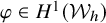 $\varphi \in H^1(\mathcal {W}_h)$
, depending on the boundary conditions.
$\varphi \in H^1(\mathcal {W}_h)$
, depending on the boundary conditions.
The second step is to flatten the geometry near $X_{0}\in \partial \Omega $
. Given the Taylor expansion (2.2), the fact that the boundary of
$X_{0}\in \partial \Omega $
. Given the Taylor expansion (2.2), the fact that the boundary of $\Omega $
is smooth, and that
$\Omega $
is smooth, and that $\kappa _0>0$
, we can take h to be sufficiently small so that for every
$\kappa _0>0$
, we can take h to be sufficiently small so that for every $(s,t)\in \mathcal {W}_{h}$
 $$ \begin{align*} \left\vert{\tau_1(s,t)-\left(t+\frac{\kappa_0}{2}s^2\right)}\right\vert\lesssim h^{1-3\eta}\quad \text{ and }\quad -h^{2/3-\eta}\lesssim m(s,t)-1\leq 0, \end{align*} $$
with implicit constants that are independent of h. We can use these estimates to approximate $q_h$
from above and below correspondingly. To simplify notation, where we have used implicit constants above, we bound them by
$q_h$
from above and below correspondingly. To simplify notation, where we have used implicit constants above, we bound them by $h^{-\eta }$
and assume that h is sufficiently small. We find that for any
$h^{-\eta }$
and assume that h is sufficiently small. We find that for any $\psi \in H^1(\mathcal {W}_h)$
 $$ \begin{align*} q_{h}[\psi]-h^{1-4\eta}\left\|{\psi}\right\|_2^2\leq \left(1- h^{2/3-2\eta}\right)^{-1}\iint\nolimits_{\mathcal{W}_h}h^2\left(|\partial_s \psi|^2+|\partial_t\psi|^2\right)+\left(t+\frac{\kappa_0}{2}s^2\right)|\psi|^2\, \mathrm{d} s\, \mathrm{d} t , \end{align*} $$
and
 $$ \begin{align*} q_{h}[\psi]+h^{1-4\eta}\left\|{\psi}\right\|_2^2\geq \left(1-h^{2/3-2\eta}\right)\iint\nolimits_{\mathcal{W}_h}h^2\left(|\partial_s \psi|^2+|\partial_t\psi|^2\right)+\left(t+\frac{\kappa_0}{2}s^2\right)|\psi|^2\, \mathrm{d} s\, \mathrm{d} t. \end{align*} $$
We therefore arrive at operators acting on $L^2(\mathcal {W}_h,\, \mathrm {d} s\, \mathrm {d} t)$
. Applying the estimates (2.3), together with those for
$L^2(\mathcal {W}_h,\, \mathrm {d} s\, \mathrm {d} t)$
. Applying the estimates (2.3), together with those for $q_h$
above, we obtain
$q_h$
above, we obtain
 $$ \begin{align} \begin{aligned} \operatorname{\mathrm{Tr}}(\mathcal{L}_h-\Lambda(h))^\gamma_{-} & \geq \operatorname{\mathrm{Tr}}\left(-h^2\Delta_{\mathcal{W}_h}^D+\frac{\kappa_0}{2}s^2+t-\Lambda(h)+h^{1-5\eta}\right)_{-}^\gamma, \text{ and } \\ \operatorname{\mathrm{Tr}}(\mathcal{L}_h-\Lambda(h))^\gamma_{-} & \leq \operatorname{\mathrm{Tr}}\left(-h^2\Delta_{\mathcal{W}_h}^M+\frac{\kappa_0}{2}s^2+t-\Lambda(h)-h^{1-5\eta}\right)^\gamma_{-}. \end{aligned} \end{align} $$
Before proving Theorem 1.1, we require two auxiliary one-dimensional results: Weyl’s law for Riesz means and an Agmon-type decay estimate.
Weyl’s law is a classical result; see, for example, [Reference Frank, Laptev and Weidl7]. It states for any $\gamma \geq 0$
, any open
$\gamma \geq 0$
, any open $I\subset \mathbb {R}$
and any potential
$I\subset \mathbb {R}$
and any potential $W\in L^{1+\gamma }(I)$
,
$W\in L^{1+\gamma }(I)$
,
 $$ \begin{align} \lim_{h\rightarrow 0_+}h\operatorname{\mathrm{Tr}}\left(-h^2\frac{\mathrm{{d}^2}}{\mathrm{{d}x^2}}\bigg\vert_{I}^{D/N}-W\right)_{-}^\gamma=L^{\mathrm{{cl}}}_{\gamma,1}\int_{I}W(x)_{+}^{\gamma+1/2}\, \mathrm{d} x, \end{align} $$
where the operator is equipped with either Dirichlet or Neumann boundary conditions, and $L^{\mathrm {{cl}}}_{\gamma ,1}$
is the semiclassical constant given in (1.4).
$L^{\mathrm {{cl}}}_{\gamma ,1}$
is the semiclassical constant given in (1.4).
We also make use of the following Agmon-type estimate:
Lemma 2.1 (Agmon estimate).
Let $\Lambda>0$
and
$\Lambda>0$
and $W\in C_0^\infty (\mathbb {R}_+)$
then there exist positive and finite constants
$W\in C_0^\infty (\mathbb {R}_+)$
then there exist positive and finite constants $R=R\left (\Lambda ,\left \|{W}\right \|_\infty \right )$
and
$R=R\left (\Lambda ,\left \|{W}\right \|_\infty \right )$
and $C=C\left (\Lambda ,\left \|{W}\right \|_\infty \right )$
such that for any
$C=C\left (\Lambda ,\left \|{W}\right \|_\infty \right )$
such that for any $\ell>R$
and any eigenvalue
$\ell>R$
and any eigenvalue $\lambda <\Lambda $
of the operator
$\lambda <\Lambda $
of the operator
 $$ \begin{align*} -\frac{\mathrm{d}^2}{\mathrm{d}t^2}+t+W(t) \text{ in } L^2(0,\ell), \end{align*} $$
with Dirichlet conditions at $t=0$
and Dirichlet or Neumann conditions at
$t=0$
and Dirichlet or Neumann conditions at $t=\ell $
, the corresponding eigenfunction
$t=\ell $
, the corresponding eigenfunction $\varphi _\lambda $
satisfies
$\varphi _\lambda $
satisfies
 $$ \begin{align*} \int_{R}^\ell \left(\left\vert{\varphi_\lambda^\prime}\right\vert{}^2+ \left\vert{\varphi_\lambda}\right\vert{}^2\right) e^{t^{3/2}}\, \mathrm{d} t&\leq C\left\|{\varphi_\lambda}\right\|_{L^2(0,\ell)}^2. \end{align*} $$
This estimate is essentially the same as [Reference Cornean, Krejčiřík, Pedersen, Raymond and Stockmeyer1, Proposition 2.1], though we work at a different scale and include an additional potential W. Since W is bounded, the structure of the proof remains unchanged.
2.1 Proof of Theorem 1.1: scale $h^{2/3}$

We prove a generalised version of Theorem 1.1 that will be essential for the local analysis later.
For $V\in C_0^\infty (\mathbb {R}^2_+)$
we define the rescaled potential
$V\in C_0^\infty (\mathbb {R}^2_+)$
we define the rescaled potential $V_h$
as a function in
$V_h$
as a function in $\Omega $
, zero outside of
$\Omega $
, zero outside of $\tau (\mathcal {W}_h)$
, with
$\tau (\mathcal {W}_h)$
, with
 $$ \begin{align} V_h(\tau(s,t))=V(h^{-1/3}s,h^{-2/3}t) \quad \text{ for }\quad (s,t)\in \mathcal{W}_h. \end{align} $$
The idea is to introduce a potential that acts on the same scale as the low-lying eigenvalues we are concerned with. In this case, we use separation of variables and the construction of quasi-states to extract the eigenvalues of the operator
 $$ \begin{align} L(s)=-\frac{\mathrm{d}^2}{\mathrm{d}t^2}+t+V(s,t)\quad\text{ in }\quad L^2(\mathbb{R}_+,\, \mathrm{d} t) \end{align} $$
with Dirichlet boundary conditions, which we denote by $\{\lambda _k(s;V)\}^\infty _{k=1}$
. We note that for smooth and compactly supported V, these eigenvalues are well-defined continuous functions of s.
$\{\lambda _k(s;V)\}^\infty _{k=1}$
. We note that for smooth and compactly supported V, these eigenvalues are well-defined continuous functions of s.
Proposition 2.2. Let $\gamma \geq 0$
,
$\gamma \geq 0$
, $\mu \geq 0$
and
$\mu \geq 0$
and $V\in C_0^\infty (\mathbb {R}^2_+)$
, then
$V\in C_0^\infty (\mathbb {R}^2_+)$
, then
 $$ \begin{align*} \lim_{h\rightarrow 0_+}h^{(1-2\gamma)/3}\operatorname{\mathrm{Tr}}\left(\mathcal{L}_h+h^{2/3}V_h-h^{2/3}\mu\right)_{-}^\gamma=L_{\gamma,1}^{\mathrm{cl}}\sum^\infty_{k=1}\int_{\mathbb{R}}\left(\mu-\frac{\kappa_0}{2}s^2-\lambda_k(s;V)\right)^{\gamma+1/2}_+\, \mathrm{d} s. \end{align*} $$
Taking $V\equiv 0$
, it follows that the eigenvalues extracted from (2.7) are just Airy zeros, independent of s. Putting this into the expression above precisely yields the first result in Theorem 1.1.
$V\equiv 0$
, it follows that the eigenvalues extracted from (2.7) are just Airy zeros, independent of s. Putting this into the expression above precisely yields the first result in Theorem 1.1.
Proof. To ease notation, we label

We fix $\gamma \geq 0$
and start by recalling the construction in the previous section with the addition of a potential. Due to the boundedness of the potential
$\gamma \geq 0$
and start by recalling the construction in the previous section with the addition of a potential. Due to the boundedness of the potential $V_h$
it follows analogously to the reduction above, (2.4), that for sufficiently small h,
$V_h$
it follows analogously to the reduction above, (2.4), that for sufficiently small h,
 $$ \begin{align} \begin{aligned} \operatorname{\mathrm{Tr}}\mathcal{L}_h\left(\mu,V\right)_{-}^\gamma &\geq \operatorname{\mathrm{Tr}}\left(-h^2\Delta_{\mathcal{W}_h}^D+\frac{\kappa_0}{2}s^2+t+h^{2/3}\left(V_h\circ\tau-\mu+h^{1/3-5\eta}\right)\right)_{-}^\gamma \\ \operatorname{\mathrm{Tr}}\mathcal{L}_h\left(\mu,V\right)_{-}^\gamma &\leq \operatorname{\mathrm{Tr}}\left(-h^2\Delta_{\mathcal{W}_h}^M+\frac{\kappa_0}{2}s^2+t+h^{2/3}\left(V_h\circ\tau-\mu-h^{1/3-5\eta}\right)\right)_{-}^\gamma \end{aligned} \end{align} $$
where we recall that $-\Delta ^M_{\mathcal {W}_h}$
here denotes the Laplacian with mixed boundary conditions, where we keep Dirichlet boundary conditions where
$-\Delta ^M_{\mathcal {W}_h}$
here denotes the Laplacian with mixed boundary conditions, where we keep Dirichlet boundary conditions where $t=0$
and impose Neumann conditions elsewhere. In deriving (2.8) from (2.4) we have used that
$t=0$
and impose Neumann conditions elsewhere. In deriving (2.8) from (2.4) we have used that
 $$ \begin{align*} \left\vert{t\kappa(s) h^{2/3} V_h(\tau(s,t))}\right\vert\lesssim h^{4/3-\eta}\left\|{V}\right\|_\infty. \end{align*} $$
Now we carry out a change of scale directly and use separation of variables. Applying the unitary transformation $\mathcal {U}_h\varphi (s,t)=h^{-1/2}\varphi (h^{-1/3}s,h^{-2/3}t)$
to the operators on the right in (2.8), without the constant terms, we obtain
$\mathcal {U}_h\varphi (s,t)=h^{-1/2}\varphi (h^{-1/3}s,h^{-2/3}t)$
to the operators on the right in (2.8), without the constant terms, we obtain
 $$ \begin{align*} -h^{4/3}\partial_s^2+h^{2/3}\left(-\partial_t^2+t+\frac{\kappa_0}{2}s^2+V(s,t)\right) \text{ in } L^2((-h^{-\eta},h^{-\eta})\times(0,h^{-\eta})). \end{align*} $$
with their respective boundary conditions. It is then helpful to reformulate these, writing them as one-dimensional Schrödinger operators in s with operator-valued potentials. In this form, the operators with Dirichlet and mixed boundary conditions are, up to a factor of $h^{2/3}$
, given by
$h^{2/3}$
, given by
 $$ \begin{align*} -&h^{2/3}\frac{\mathrm{d}^2}{\mathrm{d}s^2}\Big\vert^D_{(-h^{-\eta},h^{-\eta})}\otimes \mathbb{I}+\frac{\kappa_0}{2}s^2\otimes\mathbb{I} +\mathcal{V}^D_h (s), \text{ and }\\ -&h^{2/3}\frac{\mathrm{d}^2}{\mathrm{d}s^2}\Big\vert^N_{(-h^{-\eta},h^{-\eta})}\otimes \mathbb{I}+\frac{\kappa_0}{2}s^2\otimes\mathbb{I} +\mathcal{V}^M_h(s) \end{align*} $$
in $L^2((-h^{-\eta },h^{-\eta }),\, \mathrm {d} s;L^2(0,h^{-\eta }))$
, where for each s
$L^2((-h^{-\eta },h^{-\eta }),\, \mathrm {d} s;L^2(0,h^{-\eta }))$
, where for each s
 $$ \begin{align*} \mathcal{V}^D_h(s)&=-\frac{\mathrm{d}^2}{\mathrm{d}t^2}\Big\vert^D_{(0,h^{-\eta})}+t+V(s,t)\text{ and }\\ \mathcal{V}^M_h(s)&=-\frac{\mathrm{d}^2}{\mathrm{d}t^2}\Big\vert^M_{(0,h^{-\eta})}+t+V(s,t) \end{align*} $$
as operators in $L^2(0,h^{-\eta })$
, where M symbolises the imposition of Dirichlet conditions at
$L^2(0,h^{-\eta })$
, where M symbolises the imposition of Dirichlet conditions at $t=0$
and Neumann conditions at
$t=0$
and Neumann conditions at $t=h^{-\eta }$
. Furthermore, we can fix the domain of the operators in s. Noting that
$t=h^{-\eta }$
. Furthermore, we can fix the domain of the operators in s. Noting that
 $$ \begin{align*} \lambda_1(\mathcal{V}_h^M(s))\geq-\left\|{V}\right\|_{L^\infty(\mathbb{R}_+^2)} \end{align*} $$
we can restrict the Neumann operator to the interval $(-\widetilde {R},\widetilde {R})$
with
$(-\widetilde {R},\widetilde {R})$
with
 $$ \begin{align} \widetilde{R}=\sqrt{2/\kappa_0}(\left\|{V}\right\|_\infty+2\mu)^{1/2} \end{align} $$
so that the potential is purely repulsive outside of this set. Whilst for the Dirichlet case we can restrict it to any smaller interval and use domain monotonicity.
Thus, we obtain from (2.8) and the above that for every $\varepsilon \in (1/2,1)$
and
$\varepsilon \in (1/2,1)$
and $R>0$
there exists
$R>0$
there exists $h^\prime>0$
such that for all
$h^\prime>0$
such that for all $h<h^\prime $
,
$h<h^\prime $
,
 $$ \begin{align} \begin{aligned} \operatorname{\mathrm{Tr}}\mathcal{L}_h\left(\mu,V\right)_{-}^\gamma\geq &h^{2\gamma/3}\sum_{k=1}^\infty\operatorname{\mathrm{Tr}}\left(-h^{2/3}\frac{\mathrm{d}^2}{\mathrm{d}s^2}\Big\vert^D_{(-R,R)}+\frac{\kappa_0}{2}s^2+\lambda_k\left(\mathcal{V}^D_h(s)\right)-\varepsilon\mu\right)^\gamma_{-} \\ \operatorname{\mathrm{Tr}}\mathcal{L}_h\left(\mu,V\right)_{-}^\gamma \leq &h^{2\gamma/3}\sum_{k=1}^\infty\operatorname{\mathrm{Tr}}\left(-h^{2/3}\frac{\mathrm{d}^2}{\mathrm{d}s^2}\Big\vert^N_{(-\widetilde{R},\widetilde{R})}+\frac{\kappa_0}{2}s^2+\lambda_k\left(\mathcal{V}^M_h(s)\right)-\varepsilon^{-1}\mu \right)^\gamma_{-}. \end{aligned} \end{align} $$
Moreover, we note that the number of eigenvalues of $\mathcal {V}_h^M(s)$
and
$\mathcal {V}_h^M(s)$
and $\mathcal {V}_h^D(s)$
that we need to consider in the sums above are finite, uniformly in
$\mathcal {V}_h^D(s)$
that we need to consider in the sums above are finite, uniformly in $s\in \mathbb {R}$
and
$s\in \mathbb {R}$
and $h<h^\prime $
, in particular
$h<h^\prime $
, in particular

The idea now is to use Lemma 2.1 to show that the eigenvalues $\lambda _k(\mathcal {V}^D(s))$
and
$\lambda _k(\mathcal {V}^D(s))$
and $\lambda _k(\mathcal {V}^M(s))$
converge to the eigenvalues of the Dirichlet operator
$\lambda _k(\mathcal {V}^M(s))$
converge to the eigenvalues of the Dirichlet operator $L(s)$
as
$L(s)$
as $h\rightarrow 0_+$
, uniformly in s. Then we can apply the standard form of Weyl’s law for
$h\rightarrow 0_+$
, uniformly in s. Then we can apply the standard form of Weyl’s law for $\gamma -$
Riesz means of Schrödinger operators on finite intervals. Finally, by taking
$\gamma -$
Riesz means of Schrödinger operators on finite intervals. Finally, by taking $R\rightarrow \infty $
and
$R\rightarrow \infty $
and $\varepsilon \rightarrow 1_{-}$
we will obtain the result.
$\varepsilon \rightarrow 1_{-}$
we will obtain the result.
We begin with the eigenvalues of $\mathcal {V}^M_h(s)$
. Fixing
$\mathcal {V}^M_h(s)$
. Fixing $s\in \mathbb {R}$
, we denote by
$s\in \mathbb {R}$
, we denote by $\varphi _{k,h}$
the eigenfunction corresponding to
$\varphi _{k,h}$
the eigenfunction corresponding to $\lambda _k(\mathcal {V}_h^M(s))$
, satisfying Neumann conditions at
$\lambda _k(\mathcal {V}_h^M(s))$
, satisfying Neumann conditions at $t=h^{-\eta }$
. Take
$t=h^{-\eta }$
. Take $\chi \in C^\infty (\mathbb {R})$
with
$\chi \in C^\infty (\mathbb {R})$
with $0\leq \chi \leq 1$
with
$0\leq \chi \leq 1$
with $\chi (t)=1$
for
$\chi (t)=1$
for $t<0$
and
$t<0$
and $\chi (t)=0$
for
$\chi (t)=0$
for $t\geq 1$
and such that
$t\geq 1$
and such that $\left \|{\partial _t\chi }\right \|_\infty < \infty $
. Then for
$\left \|{\partial _t\chi }\right \|_\infty < \infty $
. Then for $0<\widetilde {\eta }<\eta $
define
$0<\widetilde {\eta }<\eta $
define $\chi _h(t)=\chi (t-h^{-\widetilde {\eta }})$
. It follows that the cut-off functions
$\chi _h(t)=\chi (t-h^{-\widetilde {\eta }})$
. It follows that the cut-off functions $\chi _h\varphi _{k,h}$
lie in the form domain of the operator
$\chi _h\varphi _{k,h}$
lie in the form domain of the operator $L(s)$
given by (2.7), after being trivially extended by zero. The min–max principle for eigenvalues then yields
$L(s)$
given by (2.7), after being trivially extended by zero. The min–max principle for eigenvalues then yields
 $$ \begin{align*} \lambda_1(s;V)\leq \frac{\left(L(s)\varphi_{1,h}\chi_h,\varphi_{1,h}\chi_h\right)_{L^2(\mathbb{R}_+)}}{\left\|{\varphi_{1,h}\chi_h}\right\|_{L^2(\mathbb{R}_+)}^2}&=\frac{\left(\mathcal{V}^M_{h}(s)\varphi_{1,h}\chi_h,\varphi_{1,h}\chi_h\right)_{L^2(0,h^{-\eta})}}{\left\|{\varphi_{1,h}\chi_h}\right\|_{L^2(0,h^{-\eta})}^2}\\ &\leq \lambda_1(\mathcal{V}^M_h(s))+C e^{- h^{-3\widetilde{\eta}/2}} \end{align*} $$
with a finite constant $C<\infty $
that is independent of h and s. In the last line we have used the decay estimate from Lemma 2.1 together with the boundedness of
$C<\infty $
that is independent of h and s. In the last line we have used the decay estimate from Lemma 2.1 together with the boundedness of $\chi $
and
$\chi $
and $\partial _t\chi $
, to show that for all
$\partial _t\chi $
, to show that for all $1\leq k\leq \widetilde {N}$
we have
$1\leq k\leq \widetilde {N}$
we have
 $$ \begin{align*} \left\vert{(\mathcal{V}^M_{h}\varphi_{k,h},\varphi_{k,h})_{L^2(0,h^{-\eta})}-\left(\mathcal{V}^M_{h}\varphi_{k,h}\chi_h,\varphi_{k,h}\chi_h\right)_{L^2(0,h^{-\eta})}}\right\vert & \lesssim e^{- h^{-3\widetilde{\eta}/2}}\left\|{\varphi_{k,h}}\right\|_{L^2(0,h^{-\eta})}^2,\text{ and }\\ \left\vert{\left\|{\chi_h\varphi_{k,h}}\right\|_{L^2(0,h^{-\eta})}^2-\left\|{\varphi_{k,h}}\right\|_{L^2(0,h^{-\eta})}^2}\right\vert &\lesssim e^{- h^{-3\widetilde{\eta}/2}}\left\|{\varphi_{k,h}}\right\|_{L^2(0,h^{-\eta})}^2 \end{align*} $$
where the implicit constants depend only on $\chi $
,
$\chi $
, $\mu $
and
$\mu $
and $\left \|{V}\right \|_{L^\infty (\mathbb {R}^2_+)}$
.
$\left \|{V}\right \|_{L^\infty (\mathbb {R}^2_+)}$
.
To deduce a similar statement for the higher eigenvalues, we note that
 $$ \begin{align*} \left\vert{\left(\chi \varphi_{k,h},\chi_h \varphi_{j,h}\right)_{L^2(\mathbb{R}_+)}-\delta_{jk}}\right\vert\lesssim e^{- h^{-3\eta/2}}, \end{align*} $$
uniformly in $1\leq j,k\leq \widetilde {N}$
and independent of s. Thus, h can be chosen sufficiently small so that for all
$1\leq j,k\leq \widetilde {N}$
and independent of s. Thus, h can be chosen sufficiently small so that for all $k\leq \widetilde {N}$
the set
$k\leq \widetilde {N}$
the set $\{\chi _h \varphi _{j,h}\}_{j=1}^k$
forms a k-dimensional subspace of
$\{\chi _h \varphi _{j,h}\}_{j=1}^k$
forms a k-dimensional subspace of $L^2(\mathbb {R}_+)$
. Therefore, by the min-max principle and the decay estimates above, we have
$L^2(\mathbb {R}_+)$
. Therefore, by the min-max principle and the decay estimates above, we have
 $$ \begin{align} \begin{aligned} \lambda_k(s;V)\leq \max_{\varphi\in \{\chi_h \varphi^h_j\}_{j=1}^k}\frac{(L(s)\varphi,\varphi)_{L^2(\mathbb{R}_+)}}{\left\|{\varphi}\right\|_{L^2(\mathbb{R}_+)}}&=\frac{\left(\mathcal{V}^M_{h}(s)\varphi_{k,h}\chi_h,\varphi_{k,h}\chi_h\right)_{L^2(0,h^{-\eta})}}{\left\|{\varphi_{k,h}\chi_h}\right\|_{L^2(0,h^{-\eta})}^2} \\ &\leq \lambda_k(\mathcal{V}_h^M(s))+\widetilde{C} e^{-h^{-3\widetilde{\eta}/2}} \end{aligned} \end{align} $$
for all $k\leq \widetilde {N}$
, with the constant
$k\leq \widetilde {N}$
, with the constant $\widetilde {C}<\infty $
independent of k, h and s.
$\widetilde {C}<\infty $
independent of k, h and s.
We now turn to the Dirichlet operator $\mathcal {V}_h^D(s)$
. This time we fix
$\mathcal {V}_h^D(s)$
. This time we fix $s\in \mathbb {R}$
and work with the eigenfunctions of
$s\in \mathbb {R}$
and work with the eigenfunctions of $L(s)$
, which we denote by
$L(s)$
, which we denote by $\psi _k$
. Cutting these off in the set
$\psi _k$
. Cutting these off in the set $(0,h^{-\eta })$
and using estimates analogous to the above from Lemma 2.1 we see that there exists h sufficiently small so that for all
$(0,h^{-\eta })$
and using estimates analogous to the above from Lemma 2.1 we see that there exists h sufficiently small so that for all $k\leq \widetilde {N}$
 $$ \begin{align} \begin{aligned} \lambda_k(\mathcal{V}_h^D(s))\leq\max_{\psi\in\{\psi_j\}_{j=1}^k} \frac{(\mathcal{V}_h^D(s) \psi_1,\psi_1)_{L^2(0,h^{-\eta})}}{\left\|{\psi_1}\right\|^2_{L^2(0,h^{-\eta})}}&=\frac{(L(s) \psi_k,\psi_k)_{L^2(0,h^{-\eta})}}{\left\|{\psi_k}\right\|^2_{L^2(0,h^{-\eta})}} \\ &\leq \lambda_k(s;V)+\widetilde{\widetilde{C}} e^{-h^{-3\eta/2}} \end{aligned} \end{align} $$
with some constant $\widetilde {\widetilde {C}}<\infty $
independent of k, h and s.
$\widetilde {\widetilde {C}}<\infty $
independent of k, h and s.
We insert the estimates (2.11) and (2.12) in (2.10), where we incorporate the errors into $\varepsilon $
, noting that we can still take it as close to
$\varepsilon $
, noting that we can still take it as close to $1$
for all
$1$
for all $h<h^{\prime }$
with
$h<h^{\prime }$
with $h^\prime $
small. Then after applying the Weyl asymptotics (2.5), it follows that
$h^\prime $
small. Then after applying the Weyl asymptotics (2.5), it follows that
 $$ \begin{align*} \limsup_{h\rightarrow 0_+}h^{(1-2\gamma)/3}\operatorname{\mathrm{Tr}}\mathcal{L}_h\left(\mu,V\right)_{-}^\gamma\leq L_{\gamma,1}^{\mathrm{cl}}\sum_{k=1}^\infty\int_{\mathbb{R}}\left(\varepsilon^{-1} \mu-\lambda_k(s,V)-\frac{\kappa_0}{2}s^2\right)_+^{\gamma+1/2}\, \mathrm{d} s \end{align*} $$
and
 $$ \begin{align*} \liminf_{h\rightarrow 0_+}h^{(1-2\gamma)/3}\operatorname{\mathrm{Tr}}\mathcal{L}_h\left(\mu,V\right)_{-}^\gamma &\geq L_{\gamma,1}^{\mathrm{cl}}\sum_{k=1}^\infty\int_{-R}^R \left(\varepsilon\mu-\lambda_{k}(s;V)-\frac{\kappa_0}{2}s^2\right)_+^{\gamma+1/2}\, \mathrm{d} s, \end{align*} $$
thus by taking $\varepsilon \rightarrow 1_+$
and
$\varepsilon \rightarrow 1_+$
and $R\rightarrow \infty $
we obtain the result.
$R\rightarrow \infty $
we obtain the result.
Remark 2.3. The assumption in Proposition 2.2 that $V \in C_0^\infty (\mathbb {R}_+^2)$
can be relaxed. For
$V \in C_0^\infty (\mathbb {R}_+^2)$
can be relaxed. For $\gamma> 0$
, the result extends to all
$\gamma> 0$
, the result extends to all $V \in L^{\gamma +1}(\mathbb {R}_+^2)$
, using the Lieb–Thirring inequality together with a standard approximation argument; see, for example, [Reference Frank, Laptev and Weidl7, Section 4.7]. The extension to bounds on the counting function is more delicate; see, for example, [Reference Frank and Laptev6].
$V \in L^{\gamma +1}(\mathbb {R}_+^2)$
, using the Lieb–Thirring inequality together with a standard approximation argument; see, for example, [Reference Frank, Laptev and Weidl7, Section 4.7]. The extension to bounds on the counting function is more delicate; see, for example, [Reference Frank and Laptev6].
2.2 Proof of Theorem 1.1: scale
$h^{\alpha }$
(
$2/3<\alpha <1$
)


Next, look at the asymptotic number of eigenvalues between the second and third levels in (1.2). Let $\alpha \in (2/3,1)$
, then we consider for
$\alpha \in (2/3,1)$
, then we consider for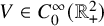 $V\in C_0^\infty (\mathbb {R}_+^2)$
a modified form of rescaled potential
$V\in C_0^\infty (\mathbb {R}_+^2)$
a modified form of rescaled potential $V_{h,\alpha }$
, supported in
$V_{h,\alpha }$
, supported in $\tau (\mathcal {W}_h)$
, with
$\tau (\mathcal {W}_h)$
, with
 $$ \begin{align} V_{h,\alpha}(\tau(s,t))=V(h^{-\alpha/2}s,h^{-2/3}t). \end{align} $$
To simplify the notation, we employ

and find asymptotics for the sums of its negative eigenvalues. The crucial element here is that we find an explicit dependence on the normalised Airy function $\mathrm {a}_1$
given by (1.6). That is, the eigenfunction of the operator
$\mathrm {a}_1$
given by (1.6). That is, the eigenfunction of the operator $L(s)$
given in (2.7), which arises in the following result from linear perturbation theory.
$L(s)$
given in (2.7), which arises in the following result from linear perturbation theory.
Proposition 2.4. Let $\gamma \geq 0$
,
$\gamma \geq 0$
, $\alpha \in (2/3,1)$
,
$\alpha \in (2/3,1)$
, $\mu \geq 0$
and
$\mu \geq 0$
and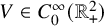 $V\in C_0^\infty (\mathbb {R}^2_+)$
, then
$V\in C_0^\infty (\mathbb {R}^2_+)$
, then
 $$ \begin{align*} \lim_{h\rightarrow 0_+} h^{1-\alpha(1+\gamma)} \operatorname{\mathrm{Tr}} \mathcal{L}\left(\mu,V;\alpha\right)_{-}^\gamma=L_{\gamma,1}^{\mathrm{cl}}\int_{\mathbb{R}}\left(\mu-\frac{\kappa_0}{2}s^2-\int_{\mathbb{R}_+}V(s,t)\mathrm{a}_1(t)^2\, \mathrm{d} t\right)^{\gamma+1/2}_+\, \mathrm{d} s. \end{align*} $$
Proof. We begin by fixing $\gamma \geq 0$
and choosing
$\gamma \geq 0$
and choosing $\eta \in (0,(1-\alpha )/5)$
. The latter ensures that the errors introduced in (2.4) can be kept on a scale of
$\eta \in (0,(1-\alpha )/5)$
. The latter ensures that the errors introduced in (2.4) can be kept on a scale of $o_{h\rightarrow 0_+}(h^{\alpha })$
. Then we find that for any
$o_{h\rightarrow 0_+}(h^{\alpha })$
. Then we find that for any $\varepsilon \in (1/2,1)$
there exists
$\varepsilon \in (1/2,1)$
there exists $h^\prime $
such that for all
$h^\prime $
such that for all $h<h^\prime $
 $$ \begin{align*} \begin{aligned} \operatorname{\mathrm{Tr}}\mathcal{L}_h(\mu,V;\alpha)_{-}^\gamma &\geq \operatorname{\mathrm{Tr}}\left(-h^2\Delta_{\mathcal{W}_h}^D+\frac{\kappa_0}{2}s^2+t-z_1h^{2/3}+h^{\alpha}\left(V_{h,\alpha}\circ\tau-\varepsilon\mu\right)\right)_{-}^\gamma \\ \operatorname{\mathrm{Tr}}\mathcal{L}_h(\mu,V;\alpha)_{-}^\gamma &\leq \operatorname{\mathrm{Tr}}\left(-h^2\Delta_{\mathcal{W}_h}^M+\frac{\kappa_0}{2}s^2+t-z_1h^{2/3}+h^{\alpha}\left(V_{h,\alpha}\circ\tau-\varepsilon^{-1}\mu\right)\right)_{-}^\gamma \end{aligned} \end{align*} $$
where we have used the boundedness of V in $\mathbb {R}^2_+$
.
$\mathbb {R}^2_+$
.
Applying a change of scale induced by the unitary transformation $\mathcal {U}_{h,\alpha }\varphi (s,t)=h^{-1/3-\alpha /4}\varphi (h^{-\alpha /2}s,h^{-2/3}t)$
to the operators above we obtain
$\mathcal {U}_{h,\alpha }\varphi (s,t)=h^{-1/3-\alpha /4}\varphi (h^{-\alpha /2}s,h^{-2/3}t)$
to the operators above we obtain
 $$ \begin{align*} -h^{2-\alpha}\partial_s^2+h^{\alpha}\frac{\kappa_0}{2}s^2+h^{2/3}\left(-\partial_t^2+t+h^{\alpha-2/3}V(s,t)\right) \end{align*} $$
in the rescaled domain, with their respective boundary conditions. We then think of these operators as one-dimensional Schrödinger operators in s with operator-valued potentials. We find that operators with Dirichlet and mixed boundary conditions are, up to a factor of $h^{2/3}$
, given by
$h^{2/3}$
, given by
 $$ \begin{align*} -&h^{4/3-\alpha}\frac{\mathrm{d}^2}{\mathrm{d}s^2}\Big\vert^D_{(-h^{1/3-\alpha/2-\eta},h^{1/3-\alpha/2-\eta})}\otimes \mathbb{I}+h^{\alpha-2/3}\frac{\kappa_0}{2}s^2\otimes\mathbb{I} +\mathcal{V} D_h (s), \text{ and }\\ -&h^{4/3-\alpha}\frac{\mathrm{d}^2}{\mathrm{d}s^2}\Big\vert^N_{(-h^{1/3-\alpha/2-\eta},h^{1/3-\alpha/2-\eta})}\otimes \mathbb{I}+h^{\alpha-2/3}\frac{\kappa_0}{2}s^2\otimes\mathbb{I} +\mathcal{V}^M_h(s) \end{align*} $$
in $L^2((-h^{1/3-\alpha /2-\eta },h^{1/3-\alpha /2-\eta }),\, \mathrm {d} s;L^2(0,h^{-\eta }))$
, where for each s
$L^2((-h^{1/3-\alpha /2-\eta },h^{1/3-\alpha /2-\eta }),\, \mathrm {d} s;L^2(0,h^{-\eta }))$
, where for each s
 $$ \begin{align*} \mathcal{V}^D_h(s;\alpha)&=-\frac{\mathrm{d}^2}{\mathrm{d}t^2}\Big\vert^D_{(0,h^{-\eta})}+t+h^{\alpha-2/3}V(s,t)\text{ and }\\ \mathcal{V}^M_h(s;\alpha)&=-\frac{\mathrm{d}^2}{\mathrm{d}t^2}\Big\vert^M_{(0,h^{-\eta})}+t+h^{\alpha-2/3}V(s,t) \end{align*} $$
as operators in $L^2(0,h^{-\eta })$
, with M denoting mixed conditions as before.
$L^2(0,h^{-\eta })$
, with M denoting mixed conditions as before.
Therefore, together with domain monotonicity we see that for every $\varepsilon \in (1/2,1)$
and
$\varepsilon \in (1/2,1)$
and $R>0$
there exists
$R>0$
there exists $h^\prime>0$
such that for all
$h^\prime>0$
such that for all $h<h^\prime $
,
$h<h^\prime $
, $\operatorname {\mathrm {Tr}}\mathcal {L}_h\left (\mu ,V;\alpha \right )_{-}^\gamma $
is bounded from below by
$\operatorname {\mathrm {Tr}}\mathcal {L}_h\left (\mu ,V;\alpha \right )_{-}^\gamma $
is bounded from below by
 $$ \begin{align} & h^{2\gamma/3}\sum_{k=1}^\infty\operatorname{\mathrm{Tr}}\left(-h^{4/3-\alpha}\frac{\mathrm{d}^2}{\mathrm{d}s^2}\Big\vert^D_{(-R,R)}+h^{\alpha-2/3}\left(\frac{\kappa_0}{2}s^2-\mu\right)+\lambda_k\left(\mathcal{V}^D_h(s;\alpha)\right)-z_1\right)^\gamma_{-} \end{align} $$
and bounded from above by
 $$ \begin{align} h^{2\gamma/3}\sum_{k=1}^\infty\operatorname{\mathrm{Tr}}\left(-h^{4/3-\alpha}\frac{\mathrm{d}^2}{\mathrm{d}s^2}\Big\vert^N_{(-\widetilde{R},\widetilde{R})}+h^{\alpha-2/3}\left(\frac{\kappa_0}{2}s^2-\mu\right)+\lambda_k\left(\mathcal{V}^M_h(s;\alpha)\right)-z_1 \right)^\gamma_{-} \end{align} $$
where $\widetilde {R}$
is given by (2.9). The approach now is to use Lemma 2.1 to show that the first eigenvalues of
$\widetilde {R}$
is given by (2.9). The approach now is to use Lemma 2.1 to show that the first eigenvalues of $\mathcal {V}^D_h(s;\alpha )$
and
$\mathcal {V}^D_h(s;\alpha )$
and $\mathcal {V}^M_h(s;\alpha )$
converge to the first eigenvalue of the operator
$\mathcal {V}^M_h(s;\alpha )$
converge to the first eigenvalue of the operator

in $L^2(\mathbb {R}_+)$
with Dirichlet conditions, as
$L^2(\mathbb {R}_+)$
with Dirichlet conditions, as $h\rightarrow 0_+$
, uniformly in s. To do this, we use regular perturbation theory for the eigenvalues of
$h\rightarrow 0_+$
, uniformly in s. To do this, we use regular perturbation theory for the eigenvalues of $L_h(s;\alpha )$
, see, for example, [Reference Reed and Simon10, Section XII.2]. It follows that for any fixed
$L_h(s;\alpha )$
, see, for example, [Reference Reed and Simon10, Section XII.2]. It follows that for any fixed $k\geq 1$
, if
$k\geq 1$
, if $\varphi _k$
is the normalised kth eigenfunction of
$\varphi _k$
is the normalised kth eigenfunction of $L_0(s;\alpha )$
, then
$L_0(s;\alpha )$
, then
 $$ \begin{align} \begin{aligned} \lambda_k(L_h(s;\alpha))&=\lambda_k(L_0(s;\alpha))+h^{\alpha-2/3}\int_{\mathbb{R}_+}V(s,t)\varphi_k(t)^2 \, \mathrm{d} t+\mathcal{O}_{h\rightarrow 0_+}\left(h^{2\alpha-4/3}\right) \\ &=z_k+h^{\alpha-2/3}\int_{\mathbb{R}_+}V(s,t)\mathrm{a}_k(t)^2\, \mathrm{d} t+\mathcal{O}_{h\rightarrow 0_+}\left(h^{2\alpha-4/3}\right). \end{aligned} \end{align} $$
The fact that for any given k the error term in (2.16) is uniformly finite in s can be seen from the boundedness and compact support of V. It is then clear from (2.16) that we only need to consider the first eigenvalue in both (2.14) and (2.15), since all other terms will be zero for suitably small h.
Then we perform the same cutting off of the eigenfunctions of $\mathcal {V}_h^M(s;\alpha )$
and of
$\mathcal {V}_h^M(s;\alpha )$
and of $L_h(s;\alpha )$
as in the proof of Proposition 2.2. With the exponential decay estimate from Lemma 2.1 and the min–max principle we obtain that
$L_h(s;\alpha )$
as in the proof of Proposition 2.2. With the exponential decay estimate from Lemma 2.1 and the min–max principle we obtain that
 $$ \begin{align} \begin{aligned} \lambda_1(\mathcal{V}^M_h(s;\alpha))&\geq z_1+h^{\alpha-2/3}\int_{\mathbb{R}_+}\mathrm{a}_1(t)^2 V(s,t)\, \mathrm{d} t - C h^{2\alpha-4/3} \\ \lambda_1(\mathcal{V}^D_h(s;\alpha)) & \leq z_1+h^{\alpha-2/3}\int_{\mathbb{R}_+}\mathrm{a}_1(t)^2 V(s,t)\, \mathrm{d} t+C h^{2\alpha-4/3} \end{aligned} \end{align} $$
with a finite constant $C<\infty $
that is independent of h and s.
$C<\infty $
that is independent of h and s.
Inserting (2.17) into (2.14) and (2.15), absorbing the error into $\varepsilon $
, we conclude that
$\varepsilon $
, we conclude that
 $$ \begin{align*} \begin{aligned} \operatorname{\mathrm{Tr}}\mathcal{L}_h(\mu,V;\alpha)_{-}^\gamma\geq &h^{\alpha\gamma}\operatorname{\mathrm{Tr}}\left(-h^{2-2\alpha}\frac{\mathrm{d}^2}{\mathrm{d}s^2}\Big\vert^D_{(-R,R)}+\frac{\kappa_0}{2}s^2-\int_{\mathbb{R}_+}V(s,t)\mathrm{a}_1(t)^2\, \mathrm{d} t-\varepsilon\mu\right)^\gamma_{-} \\ \operatorname{\mathrm{Tr}}\mathcal{L}_h(\mu,V;\alpha)_{-}^\gamma \leq &h^{\alpha\gamma}\operatorname{\mathrm{Tr}}\left(-h^{2-2\alpha}\frac{\mathrm{d}^2}{\mathrm{d}s^2}\Big\vert^N_{(-\widetilde{R},\widetilde{R})}+\frac{\kappa_0}{2}s^2+\int_{\mathbb{R}_+}V(s,t)\mathrm{a}_1(t)^2\, \mathrm{d} t-\varepsilon^{-1}\mu \right)^\gamma_{-}. \end{aligned} \end{align*} $$
Then by applying Weyl’s asymptotics (2.5) to these operators and taking $\varepsilon \rightarrow 1_+$
and
$\varepsilon \rightarrow 1_+$
and $R\rightarrow \infty $
we obtain the result.
$R\rightarrow \infty $
we obtain the result.
Applying Proposition 2.4 to $V\equiv 0$
completes the proof of Theorem 1.1.
$V\equiv 0$
completes the proof of Theorem 1.1.
3 Concentration of low-lying states
In this final section, we culminate our results from previous sections to deduce asymptotics for the density of the spectral projector onto low-lying states. The argument follows from a weak-type argument developed in the works [Reference Evans, Lewis, Siedentop and Solovej2, Reference Lieb and Simon9], and used most recently by Frank in [Reference Frank and Brown5]. The twist in our case is the use of a rescaled potential together with perturbation theory, as in Proposition 2.4.
Proof of Theorem 1.3.
Let $\rho _h$
denote the density of
$\rho _h$
denote the density of $\Gamma _h=(\mathcal {L}_h-h^{2/3}\mu )^0_{-}$
. Then we fix
$\Gamma _h=(\mathcal {L}_h-h^{2/3}\mu )^0_{-}$
. Then we fix $V\in C_0^\infty (\mathbb {R}_+^2)$
and take
$V\in C_0^\infty (\mathbb {R}_+^2)$
and take $V_h$
as the rescaling of V according to (2.6). It follows from the variational principle that
$V_h$
as the rescaling of V according to (2.6). It follows from the variational principle that
 $$ \begin{align*} h^{2/3}\int_{\Omega}V_h(x)\rho_h(x)\, \mathrm{d} x&=\operatorname{\mathrm{Tr}}\left(\mathcal{L}_h+h^{2/3}V_h-h^{2/3}\mu\right)\Gamma_h-\operatorname{\mathrm{Tr}}\left(\mathcal{L}_h-h^{2/3}\mu\right)\Gamma_h\\ &\geq -\operatorname{\mathrm{Tr}}\left(\mathcal{L}_h+h^{2/3}V_h-h^{2/3}\mu\right)_{-}+ \operatorname{\mathrm{Tr}}\left(\mathcal{L}_h-h^{2/3}\mu\right)_{-} \end{align*} $$
where we have used equality in the second term. Thus, from Proposition 2.2 we have
 $$ \begin{align*} \liminf_{h\rightarrow 0_+}h^{1/3}\int_{\Omega}V_h\rho_h\geq \frac{2}{3\pi}\sum_{k=1}^\infty\int_{\mathbb{R}}\left(\mu-\frac{\kappa_0}{2}s^2-z_k\right)^{3/2}_{+}-\left(\mu-\frac{\kappa_0}{2}s^2-\lambda_k(s;V)\right)^{3/2}_{+}\, \mathrm{d} s, \end{align*} $$
and applying it again after replacing V by $-V$
we see that
$-V$
we see that
 $$ \begin{align*} \limsup_{h\rightarrow 0_+}h^{1/3}\int_{\Omega}V_h\rho_h\leq \frac{2}{3\pi}\sum_{k=1}^\infty\int_{\mathbb{R}}\left(\mu-\frac{\kappa_0}{2}s^2-\lambda_k(s;-V)\right)^{3/2}_{+}-\left(\mu-\frac{\kappa_0}{2}s^2-z_k\right)^{3/2}_{+}\, \mathrm{d} s. \end{align*} $$
Then, considering $\varepsilon V$
instead, it follows from the above that the
$\varepsilon V$
instead, it follows from the above that the $\liminf $
term is bounded from below by
$\liminf $
term is bounded from below by
 $$ \begin{align*} \liminf_{\varepsilon\rightarrow 0}L_{1,1}^{\mathrm{cl}}\sum_{k=1}^\infty\int_{\mathbb{R}}\frac{1}{\varepsilon}\left[\left(\mu-\frac{\kappa_0}{2}s^2-z_k\right)^{3/2}_{+}-\left(\mu-\frac{\kappa_0}{2}s^2-\lambda_k(s;\varepsilon V)\right)^{3/2}_{+}\right]\, \mathrm{d} s. \end{align*} $$
Given that the sum in k is finite, we can apply Fatou’s Lemma to move the limit into the integrand and use that for each s
 $$ \begin{align*} \frac{\mathrm{d}}{\mathrm{d}\varepsilon}\left(\mu-\frac{\kappa_0}{2}s^2-\lambda_k(s;\varepsilon V)\right)^{3/2}_+\Big\vert_{\varepsilon=0}=\frac{3}{2}\left(\mu-\frac{\kappa_0}{2}s^2-z_k\right)^{1/2}_+ \frac{\mathrm{d}}{\mathrm{d}\varepsilon}\lambda_k(s;\varepsilon V)\Big\vert_{\varepsilon=0}, \end{align*} $$
where from perturbation theory we have
 $$ \begin{align*} \frac{\mathrm{d}}{\mathrm{d}\varepsilon}\lambda_k(s;\varepsilon V)\Big\vert_{\varepsilon=0}=\int_{0}^\infty V(s,t)\mathrm{a}_k(t)^2\, \mathrm{d} t. \end{align*} $$
Performing the same calculation for the $\limsup _{h\rightarrow 0_+}$
yields
$\limsup _{h\rightarrow 0_+}$
yields
 $$ \begin{align} \lim_{h\rightarrow 0_+}h^{1/3}\int_\Omega V_h \rho_h\, \mathrm{d} x=\frac{1}{\pi}\sum_{k=1}^\infty\int_{\mathbb{R}^2_+}\left(\mu-\frac{\kappa_0}{2}s^2-z_k\right)^{1/2}_{+}\mathrm{a}_k(t)^2 V(s,t)\, \mathrm{d} s\, \mathrm{d} t. \end{align} $$
Now we note that the integral on the left-hand side can be written as
 $$ \begin{align*} \int_{\Omega} V_h\rho_h &=\int_{\mathcal{W}_h}V_h(\tau(s,t))\rho_h(\tau(s,t))m(s,t)\, \mathrm{d} s\, \mathrm{d} t\\ &=h\int_{-h^{-\eta}}^{h^{-\eta}}\int_0^{h^{-\eta}}V(s,t)\rho_h(\tau(h^{1/3}s,h^{2/3}t))(1-h^{2/3}t\kappa(h^{1/3}s))\, \mathrm{d} s\, \mathrm{d} t. \end{align*} $$
Thus, using the boundedness of the curvature $\kappa $
and combining this with (3.1) we conclude that
$\kappa $
and combining this with (3.1) we conclude that
 $$ \begin{align*} \lim_{h\rightarrow 0_+}h^{4/3}\int_{\mathbb{R}^2_+}V(s,t)\widetilde{\rho_h}(s,t)\, \mathrm{d} s\, \mathrm{d} t=\frac{1}{\pi}\int_{\mathbb{R}^2_+}\sum_{k=1}^\infty\left(\mu-\frac{\kappa_0}{2}s^2-z_k\right)^{1/2}_{+}\mathrm{a}_k(t)^2 V(s,t)\, \mathrm{d} s\, \mathrm{d} t \end{align*} $$
where  . Since this holds for any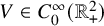 $V\in C_0^\infty (\mathbb {R}_+^2)$
, we obtain the first statement in Theorem 1.3. The proof of the second part follows by the same argument using the rescaled potential (2.13) and Proposition 2.4.
$V\in C_0^\infty (\mathbb {R}_+^2)$
, we obtain the first statement in Theorem 1.3. The proof of the second part follows by the same argument using the rescaled potential (2.13) and Proposition 2.4.
Acknowledgements
This work was funded by the Deutsche Forschungsgemeinschaft (DFG) project TRR 352 – Project-ID 470903074. The author is grateful to Rupert L. Frank for his direction and insight and thanks the anonymous reviewers for their valuable feedback.

 Open access

