

1. Introduction
Research in prosthetic design is marked by persistent plurality in what counts as success. Across engineering, clinical, design, and user-centered traditions, prostheses are evaluated through biomechanical performance, rehabilitation outcomes, social and aesthetic meaning, or lived experience and identity (Reference Balk, Gazula, Markozannes, Kimmel, Saldanha, Resnik and TrikalinosBalk et al., 2018; Reference Beckerle, Christ, Schürmann, Vogt, von Stryk and RinderknechtBeckerle et al., 2017; Reference Dalibert, Gourinat and GroudDalibert et al., 2023; Reference MurrayMurray, 2005; Reference Sansoni, Wodehouse, McFadyen and BuisSansoni et al., 2015; Reference Vlachaki, Paterson, Porter and BibbVlachaki et al., 2020). These divergences reflect fundamentally different ways of prosthetic design problem framing. Medical and technical standards commonly conceptualize prostheses as replacements for missing body part, with success is define by the emulation of normative function (Reference SchuntermannSchuntermann, 1996; World Health Organization, 2001). In contrast, disability studies and critical design perspective understand prostheses as cultural, relational, or aesthetic artefacts embedded in social context (Reference Hamraie and FritschHamraie & Fritsch, 2019; Reference Holt and MurrayHolt & Murray, 2020; Reference ShewShew, 2020). From a design research standpoint, this tension echoes the design paradox in which problem and solution co-evolve (Reference DorstDorst, 2006). What counts as an “ideal” prosthesis depends on how disability is framed, revealing tacit assumption about knowledge, value, and design purposes.
To make tacit assumptions around disability and prosthesis explicit, the study follows an abductive-deductive-inductive sequence operating across different epistemic levels. Abductively, recurrent disability models are interpreted in relation to underlying epistemological orientation, surfacing paradigmatic framings without claiming exhaustive classification. Deductively, Wittgenstein’s concept of language game is used as a structural lens, moving from form of life to grammar to use in order to analyze how prosthetic meaning becomes intelligible within each worldview. Inductively, the analysis proceeds in reverse, starting from observable patterns of prosthetic use in scholarly practice and working back toward the grammar and form of life that render these practices intelligible.
2. Approach and result
2.1. Abduction phase
Divergent framings of prosthetic can be understood as manifestation of deeper paradigmatic orientations toward disability and its design purposes. In this paper, disability models are treated not as exhaustive classification but as paradigmatic lenses that recurrently shape how prosthetic problems are formulated and evaluated in research and practice. Following Reference AdamsAdams’ (2015) account of scientific terminology, these models operate at a tacit level, guiding what is foregrounded, what is set aside, and what counts as a legitimate design outcome.
To surface the paradigmatic difference underlying prosthetic research approaches, this study adopts an abductive stance (Reference Cramer-Petersen, Christensen and Ahmed-KristensenCramer-Petersen et al., 2019; Reference Kovács and SpensKovács & Spens, 2005; Reference Timmermans and TavoryTimmermans & Tavory, 2012; Reference VeenVeen, 2021). Rather than attempting to exhaustively catalogue all possible perspectives, abduction is employed to interpret recurring patterns observed across scholarly literature and situated discussion within prosthetic design context. Through this iterative engagement between theory and empirical material, four disability model, medical, social, relational, and critical, emerged as particularly salient. These models repeatedly appeared as coherent yet contrasting ways of framing disability and defining prosthetic success across engineering, clinical, design, and critical scholarship.
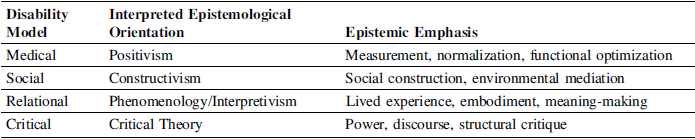
The abductive process did not stop at identifying these models as descriptive framing. It also involves interpreting that each model implicitly sustains different epistemological orientation, reflected in how knowledge is justified, validated, and mobilized in prosthetic research. The medical, social, relational, and critical models were therefore abductively related to positivist, constructivist, phenomenological–interpretivist, and critical epistemologies, respectively. This correspondence is not proposed as an established taxonomy within disability studies, but as an interpretive reconstruction of implicit epistemic commitments intended to make tacit epistemic commitments visible. Table 1 summarizes this abductively inferred alignment between disability models and epistemological orientations, highlighting the distinct epistemic emphases that underpin each framing.
This abductive mapping establishes the paradigmatic diversity underlying prosthetic design research, yet it does not explain how these orientations are enacted, stabilized, or reproduced in practice. To address this, a deductive analysis is conducted using Wittgenstein’s notion of language games to structurally relate underlying worldviews, their epistemological grammar, and corresponding prosthetic framings.
Interpreted alignment between disability models and epistemological orientations

2.2. Deduction phase
In the deduction phase, we draw on Reference WittgensteinWittgenstein’s (1967) later philosophy of language games to structure the relationship between disability models, epistemological orientations, and prosthetic framing. A language game can be understood as a rule-governed social practice constituted through the interplay of three interrelated dimensions that is, form of life, grammar, and use. Together, these dimensions determine what can be meaningfully articulated, justified, and enacted within a particular community, thereby establishing criteria of intelligibility and legitimacy.
The logic of language games can be illustrated through games themselves. In chess, a knight’s L-shaped movement is intelligible because it follows rules embedded in the game’s grammar and sustained within its form of life. In another game, such as Monopoly, a horse-shaped figure may appear only as a player token whose movement is governed by dice rather than by piece-specific rules. Although the physical object may be similar, what counts as a valid move differs entirely because the grammar and form of life differ. Meaning and legitimacy arise not from the object itself, but from the rule structure that organizes its use.
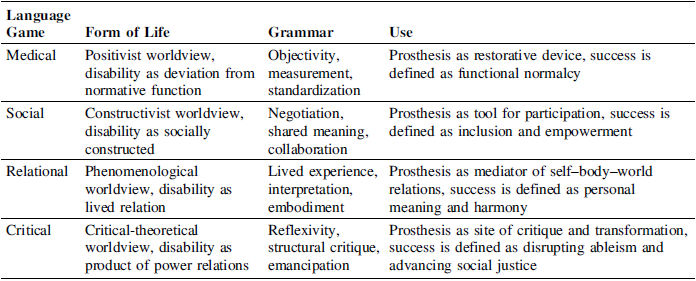
Applied to prosthetic design research, this perspective clarifies why concepts such as disability, function, and success are interpreted differently across disciplines. These differences do not arise because researchers refer to different prosthetic objects, but because they operate within distinct language games, each grounded in a particular form of life and regulated by its own grammar of justification. These structures shape what counts as valid knowledge, acceptable evidence, and legitimate value in practice. On this basis, the language game corresponds to the disability model as an overarching paradigm, the form of life reflects its underlying ontological and epistemological orientation, the grammar specifies its standards of justification, and use captures how prosthetic are framed, enacted, and evaluated in practice. Table 2 summarizes this structure by relating Wittgensteinian layers to their corresponding roles in prosthetic design research. By making the internal structure of prosthetic language games explicit, we clarify how disability models, epistemologies, and prosthetic framing are systematically related. In the next subsection, we examine how these layers operate across four prosthetic language games.
Wittgensteinian layers in prosthetic design epistemology

2.2.1. Medical language game: form of life, grammar, and use
The medical language game is grounded in a positivist worldview in which the body is understood as a measurable system subject to diagnosis, optimization, and restoration. Within this form of life, disability is framed as a deviation from normative function, and prosthetic intervention is oriented toward correction or compensation (Reference SchuntermannSchuntermann, 1996). Its grammar privileges quantification, objectivity, and standardization as criteria of valid knowledge. Progress and success are justified through measurable indicators such as gait symmetry, grip strength, control accuracy, and biomechanical efficiency (Reference Baars, Schrier, Dijkstra and GeertzenBaars et al., 2018; Reference Balk, Gazula, Markozannes, Kimmel, Saldanha, Resnik and TrikalinosBalk et al., 2018; Reference Beckerle, Christ, Schürmann, Vogt, von Stryk and RinderknechtBeckerle et al., 2017; Reference Pylatiuk, Schulz and DöderleinPylatiuk et al., 2007). Within this language game, users are positioned primarily as patients, prosthetics as restorative instruments, and success is defined as the recovery or approximation of functional normalcy (Reference Resnik, Meucci, Lieberman-Klinger, Fantini, Kelty, Disla and SassonResnik et al., 2012; Reference Salminger, Stino, Pichler, Gstoettner, Sturma, Mayer, Szivak and AszmannSalminger et al., 2022). Prosthetic meaning is thus enacted through performance metrics and clinical outcomes, reflecting a restorative and corrective orientation toward disability (Reference ShakespeareShakespeare, 2006).
2.2.2. Social language game: form of life, grammar, and use
The social language game is grounded in a constructivist worldview in which disability is understood not as an individual deficit, but as the outcome of social, environmental, and institutional barriers (Reference Barnes and MercerBarnes & Mercer, 2018; Reference OliverOliver, 1990; Union of the Physically Impaired Against Segregation (UPIAS) & Disability Alliance, 1976). Within this form of life, the problem of disability is located in the organization of society rather than in the body itself, and prosthetic intervention is oriented toward enabling access, participation, and inclusion. Its grammar emphasizes negotiation, contextual sensitivity, and the socially constructed nature of meaning as the basis of valid knowledge (Reference Berger and LuckmannBerger & Luckmann, 1967; Reference Schwandt, Denzin and LincolnSchwandt, 2006). Evidence is therefore grounded less in standardized physiological metrics and more in assessments of accessibility, usability, participation, and the reduction of social barriers. User experience, collaborative decision-making, and attention to stigma are treated as legitimate sources of justification (Reference Sansoni, Torrens, Yang, Hanim Binti Suroya and WangSansoni et al., 2023; Reference Vlachaki, Paterson, Porter and BibbVlachaki et al., 2020). Within this language game, users are positioned as citizens and co-designers rather than patients, prosthetic are framed as tools for social participation, and success is defined by the extent to which prosthetic use supports inclusion, autonomy, and equal access within everyday social contexts.
2.2.3. Relational language game: form of life, grammar, and use
The relational language game is grounded in a phenomenological and interpretivist worldview that situates disability within the lived relations between body, identity, and context (Reference ReindalReindal, 2008; Reference ThomasThomas, 2004). Within this form of life, disability is understood not as a fixed condition, but as an ongoing process of meaning-making that unfolds through bodily experience, social interaction, and spatiotemporal circumstances. Its grammar prioritizes interpretation, embodiment, and lived experience as valid sources of knowledge. Meaning is not derived from abstract norms or generalized metrics, but from how prosthetic use is experienced and negotiated in everyday life. Knowledge is justified through narrative and reflective interpretation, consistent with hermeneutic traditions associated with Dilthey and Gadamer (see Reference MakkreelMakkreel, 2020; Reference MalpasMalpas, 2022). Within this language game, users are positioned as interpretive agents rather than patients or abstract users. Prosthetic are framed as mediators of embodied interaction, and success is defined by the extent to which prosthetic use supports embodied harmony, personal meaning, and continuity of self across changing contexts (Reference Dalibert, Gourinat and GroudDalibert et al., 2023; Reference MurrayMurray, 2004). Prosthetic design is thus oriented towards enabling ongoing negotiation between the self, the body, and the world.
2.2.4. Critical language game: form of life, grammar, and use
The critical language game is grounded in critical theory and critical disability studies, which conceptualize disability as a product of power relations, social categorization, and historically situated norms rather than as an individual bodily deficit (Reference Goodley, Lawthom, Liddiard and Runswick-ColeGoodley et al., 2021; Reference Meekosha and ShuttleworthMeekosha & Shuttleworth, 2009). Within this form of life, disability is understood as inseparable from broader political, economic, and cultural structures that shape whose bodies, capacities, and technologies are considered legitimate. Its grammar emphasizes reflexivity, critique, and emancipation as criteria of valid knowledge. Knowledge is justified through the analysis of power, ideology, and normalization processes that underlie prosthetic design, evaluation, and deployment. This includes questioning implicit assumptions embedded in technological solutions, institutional practices, and market-driven logics that may reproduce ableism or techno-normative ideals, consistent with critical theory traditions associated with Adorno, Horkheimer, and Habermas (see Reference BerendzenBerendzen, 2022; Reference Bohman and RehgBohman & Rehg, 2014; Reference ZuidervaartZuidervaart, 2015). Within this language game, prosthetic are framed not only as functional devices but as socio-technical artifacts that participate in the reproduction or disruption of dominant narratives about ability, productivity, and normalcy. Users and other stakeholders are positioned as agents of reflection and critique, and success is defined by the extent to which prosthetic design contributes to challenging ableist structures, exposing techno-ableist assumptions, and supporting broader projects of social justice (Reference HarawayHaraway, 1991; Reference ShewShew, 2020). To conclude the deduction phase, we summarize all the prosthetic language game that consist of form of life, grammar, and use in Table 3.
Summary of prosthetic language games across Wittgensteinian layers

2.3. Induction phase
In the inductive phase, the analysis proceeds in reverse to the deductive structure, moving from observable prosthetic research practices (use) toward the grammars and forms of life that render them intelligible. Induction is used here as an illustrative interpretive strategy, not to generate theory or establish empirical generalization, but to situate the proposed prosthetic language games within concrete scholarly practice.
To support this exploratory phase, a Large Language Model (LLM) was used as a visibility-expanding search aid. The aim was not to delegate epistemological inference to the model, but to counterbalance the structural dominance of biomedical framings within prosthetic research and to ensure exploratory visibility across heterogeneous perspectives. In this sense, the LLM functioned analogously to an extended search engine, synthesizing publicly available academic information to surface candidate author networks, laboratories, and research groups.
For methodological transparency, the exact exploratory prompt is reproduced below:
“Search prosthetic research publications (2015–2025) and identify major author networks, labs, or research groups. For each, summarize: main research focus and disciplinary orientation (engineering, design, rehabilitation, sociology, etc.); conceptual language used to describe the prosthetic (e.g., device, interface, body extension, assistive system, aesthetic object); typical methods and epistemological assumptions (quantitative validation, participatory design, phenomenological study, critical theory, etc.); institutional or geographical cluster (e.g., biomechatronic labs, inclusive design centres, critical disability studies groups). Then classify each group according to the four disability models (medical, social, relational, critical) and corresponding epistemologies (positivism, constructivism, phenomenology, critical theory).”
The instruction to “classify” was used heuristically to reduce search blind spots created by disciplinary siloing rather than to produce authoritative epistemological categorization. The LLM’s suggested classification were not treated as analytical conclusions. Instead, all candidate cases were subjected to subsequent human interpretive review.
Once candidate cases were identified, the analytic work proceeded independently of the model’s tentative suggestions. Each body of work was examined in terms of how prosthetic were framed, justified, and evaluated. The analysis began with observable framings of prosthetic purpose and evaluative criteria (use), from which implicit standards of validation (grammar) and underlying ontological–epistemological orientations (form of life) were interpretatively inferred. Where LLM-suggested classifications conflicted with theoretical criteria derived from this reading, they were revised or rejected. Interpretive judgment, rather than automated categorization, governed the final presentation.
The illustrative, not representative, authors presented in the following subsections, therefore do not represent a systematic or exhaustive classification of prosthetic research. Rather, they demonstrate how the deductively articulated language-game structure can be read within selected cases. Together with the abductive and deductive phases, this inductive step completes an interpretive sequence in which paradigmatic differences are surfaced, structurally organized, and situated in scholarly practice without collapsing epistemic plurality into a single classificatory scheme.
2.3.1. Medical language game: illustrative authors
Within the medical language game, the work of Hugh Herr (MIT Media Lab) and Oskar Aszmann (AGRE Aszmann) is presented as illustrative of a prosthetic research practice oriented towards functional restoration and biological normalization. Across their work, prosthetic problems are framed as technical and clinical challenges aimed at reproducing or restoring normative bodily function, with success evaluated through performance metrics such as control accuracy, functional equivalence, and system integration. Prostheses are treated as corrective instruments, and users are positioned primarily as patients whose impairment is addressed through technological optimization. Read through the deductive structure articulated earlier, these practices can be interpreted as operating within a form of life that treats disability as deviation, a grammar grounded in positivist validation, and a use of prosthetic oriented toward functional normalcy (Reference Shu, Herrera-Arcos, Taylor and HerrShu et al., 2024; Reference Tereshenko, Dotzauer, Schmoll, Harnoncourt, Carrero Rojas, Gfrerer, Eberlin, Austen, Blumer, Farina and AszmannTereshenko et al., 2024)
2.3.2. Social language game: illustrative authors
Within the social language game, the work of Graham Pullin (Duncan of Jordanstone College of Art and Design) is presented as illustrative of a prosthetic design practice oriented toward participation, inclusion, and social meaning-making. In this body of work, prosthetic are framed not primarily as corrective devices, but as mediators of access, identity, and social interaction, with success evaluated in terms of inclusivity, user agency, and cultural acceptance. Design problems are addressed through participatory processes that position disabled people as collaborators rather than patients, emphasizing co-design, negotiation, and shared authorship. Read through the deductive structure articulated earlier, these practices can be interpreted as operating within a form of life that understands disability as socially produced, a grammar grounded in constructivist notions of meaning and legitimacy, and a use of prosthetic oriented toward enabling participation and reducing stigma (Reference PullinPullin, 2011; University of Dundee, 2022).
2.3.3. Relational language game: illustrative authors
Within the relational language game, the work of Craig Murray is presented as illustrative of a prosthetic research practice centered on lived experience, embodiment, and identity negotiation. Across his qualitative studies, prosthetics are framed as technologies that mediate ongoing relationships between the self, the body, and the social world, rather than as instruments of correction or access alone. Success is evaluated in terms of how individuals integrate prosthetic use into their sense of self over time, negotiate meaning in everyday life, and adapt emotionally and socially to bodily differences. Read through the deductive structure articulated earlier, this body of work can be interpreted as operating within a form of life that foregrounds disability as lived relation, a grammar grounded in phenomenological and interpretive validation, and a use of prosthetic oriented toward supporting embodied coherence and personal meaning (Reference MurrayMurray, 2004; Reference Murray and ForshawMurray & Forshaw, 2013; Reference Oliver, Dixon and MurrayOliver et al., 2020).
2.3.4. Critical language game: illustrative authors
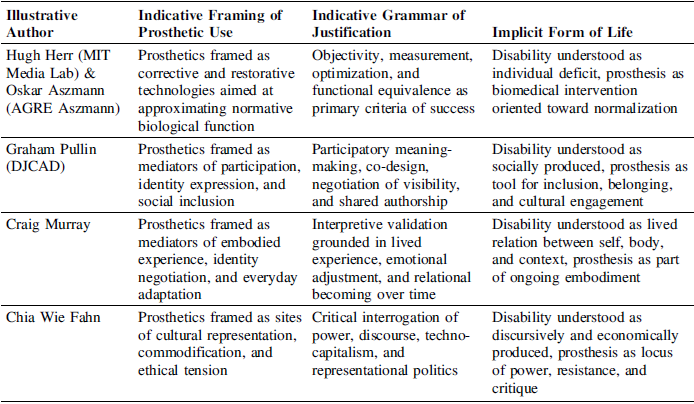
Within the critical language game, the work of Chia Wie Fahn is presented as illustrative of a prosthetic research practice oriented toward reflexivity, power analysis, and resistance to techno-ableist narratives. In this body of work, prosthetic are framed not as neutral technological solutions, but as sites where cultural representation, political economy, and ethical tension intersect. Success is evaluated not through functional performance or inclusion alone, but through the extent to which prosthetic technologies expose, contest, or reproduce dominant assumptions about ability, productivity, and human enhancement. Read through the deductive structure articulated earlier, this work can be interpreted as operating within a form of life attentive to power and discourse, a grammar grounded in critical-theoretical justification, and a use of prosthetic oriented toward critique, disruption, and social justice (Reference FahnFahn, 2020). To conclude the induction phase, we summarize all the language game illustrative author and their form of life, grammar, and use in Table 4.
Summary of illustrative authors

3. Discussion
3.1. Language games as a diagnostic lens for prosthetic research
Prosthetic design research does not operate within a single coherent paradigm, but across multiple language games, each organized by a distinct form of life, grammar, and use. These language games shape how prosthetic problems are framed, how evidence is evaluated, and how success is defined. Rather than forming a hierarchy, they coexist as parallel and often incommensurable ways of knowing (Reference KuhnKuhn, 1962). From this perspective, persistent disagreement in prosthetic research is not a failure of integration, but a structural condition of epistemic plurality. The central challenge, therefore, is not to resolve differences between approaches, but to render them legible to one another. Reference GadamerGadamer’s (2004) notion of the fusion of horizons provides a way to conceptualize such engagement, in which understanding expands through partial translation across epistemic boundaries rather than epistemic collapse.
From a design research perspective, this work of translation can itself be understood as a design activity. Drawing on Reference BuchananBuchanan’s (1992) fourth order of design, what is being designed is not the prosthesis as an object, but the conceptual and relational infrastructure that enables different language games to encounter one another productively. Design thus functions as a mediating practice rather than an epistemic arbiter, constructing spaces for negotiation across heterogeneous forms of knowledge without enforcing closure. By making implicit language games explicit, the framework proposed here operates as a diagnostic tool for identifying sources of misalignment, while sustaining an ecology of practices in which plural forms of knowledge can coexist without reduction to a single normative standard (Reference EscobarEscobar, 2018; Reference KimbellKimbell, 2011).
3.2. On the stability and openness of prosthetic language games
The prosthetic language games articulated in this paper should be understood as relatively stable yet inherently open. Their stability arises from shared forms of life, recurring practices, and established grammars of justification that allow communities to recognize what counts as legitimate knowledge and success. In Wittgensteinian terms, language games persist not because they are universal or fixed, but because they are sustained through repeated use within particular forms of life. At the same time, they remain historically situated and contingent, shaped by institutional arrangements, technological trajectories, and cultural values. Stability, in this sense, denotes temporary coherence rather than epistemic closure.
The framework does not claim to exhaust all possible framings of prosthetics. Other approaches, such as biopsychosocial or human rights–based models, continue to inform prosthetic discourse (Reference DegenerDegener, 2016; Reference EngelEngel, 1977), but tend to operate as integrative or normative overlays rather than as distinct language games with their own internal grammars. More radical perspectives, including posthuman and assemblage-oriented approaches, further destabilize the notion of bounded epistemic positions by foregrounding entanglements among bodies, technologies, environments, and power (Reference Goodley, Lawthom, Liddiard and Runswick-ColeGoodley et al., 2019). Rather than constituting additional language games, such perspectives expose the limits of stabilization itself. The openness of prosthetic language games is therefore not a methodological weakness, but a reflection of an evolving field in which epistemic orientations shift, overlap, and occasionally dissolve as new horizons emerge.
3.3. Implications for design research practice
Understanding prosthetic design research as an ecology of language games reframes interdisciplinary disagreement as a structural feature of epistemic plurality rather than a failure of evidence or rigor. When plural definition of success co-exist, disagreements often arise from differing grammars of justification embedded in distinct forms of life. From this perspective, conflict reflects incommensurable standards of intelligibility rather than empirical deficiency. This interpretation resonates with Reference Boland and TenkasiBoland and Tenkasi’s (1995) account of perspective making and perspective taking in differentiated communities of knowing. By making underlying epistemic grammar explicit, researchers can situate the scope and limits of their claims while preserving difference rather than prematurely collapsing it.
If epistemic misalignment is structural, then coordination in prosthetic design depends not on unification but on mediation. In distributed sociotechnical contexts, heterogeneous communities must collaborate without sharing a single epistemology. Boundary objects provide one such mechanism by enabling cooperation across divergent perspectives without requiring consensus (Reference StarStar, 1989). Studies in rehabilitation design illustrate how artefacts and visual representations can facilitate shared sensemaking among stakeholders holding partial and contrasting views (Reference Cooney, Stewart, Ivanka and HaslemCooney et al., 2018). In this sense, the prosthetic language-game framework itself functions as a representational artefact, especially as a boundary object. It does not resolve epistemic plurality, but renders distinct grammars and forms of life visible in a structured way, supporting reflexive negotiation across them.
These implications extend to design education. If design practice unfolds across multiple language games, then navigating epistemic plurality becomes a foundational competence. Epistemic fluency, that is the ability to recognize, translate between, and work productively across distinct ways of knowing without collapsing them into a single framework, thus becomes a core educational goal (Reference Klaassen, MacLeod, Nizamis and IsaacKlaassen et al., 2025). Prosthetic design therefore becomes not only a site of technical innovation, but also a pedagogical context for cultivating the capacity to design with difference rather than against it.
Acknowledgement
This research was supported by the Lembaga Pengelola Dana Pendidikan (LPDP), the Indonesia Endowment Fund for Education, through a doctoral scholarship awarded to the first author. The authors gratefully acknowledge this support. The first author also thanks Arief, Fisti, Julfendi, and Karis for discussions that introduced us to the medical, social, relational, and critical models of disability, opening the first author’s eyes to the limits of his own horizon and to the possibility of meeting another. First author also thank Institut Teknologi Bandung for early research funding, and PT Pegadaian and Rumah Amal Salman for supporting the initial implementation of our prosthetic projects, which enabled engagement with diverse stakeholders. Finally, we thank the anonymous reviewers for their thoughtful comments that strengthened the manuscript.


 Open access

