





Introduction
The far right has become a globally successful force. Over the past decades, research on this party family has expanded significantly (Castelli Gattinara Reference Castelli Gattinara2020), generating lively theoretical and empirical debates on what drives its success, and how it challenges democracy. An increasing number of political scientists now use the term ‘far right’ to emphasise the growing links between illiberal-democratic (radical right) and anti-democratic (extreme right) collective actors – a phenomenon that is far from niche today (Mudde Reference Mudde2019: 7; Pirro Reference Pirro2023: 103).Footnote 1 Many scholars also agree that we are currently witnessing a phase of far-right mobilisation that is characterised by its increasing mainstreaming and normalisation – a development that is significantly enabled by mainstream parties (Mudde Reference Mudde2019; Weisskircher Reference Weisskircher2023). As Miller-Idriss (Reference Miller-Idriss2020: 46) puts it, mainstreaming the far right has important consequences, as it reduces the ‘likelihood that the public will raise the alarm about their efforts. The normalization of extreme ideas reduces barriers to entry […] and broadens the base of sympathizers’.
While the processes of mainstreaming and normalisation are receiving increasing attention in research, the concepts often remain buzzwords (Rothut, Schulze, Rieger et al. Reference Rothut, Schulze, Rieger and Naderer2024). In the rapidly emerging, interdisciplinary research field – including disciplines such as communication studies, cultural studies, political science, sociology, and terrorism studies – they often remain vague, inconsistently defined, or interchangeably used (eg Miller-Idriss Reference Miller-Idriss2018; de Jonge and Gaufman Reference de Jonge and Gaufman2022; Sengul Reference Sengul and Feldman2022; Brown, Mondon and Winter Reference Brown, Mondon and Winter2023; Valentim Reference Valentim2024). As we argue in this article, there is thus a need for clarity on the usage of these concepts. Ultimately, both concepts describe ways in which far-right ideas and actors are legitimised in the public sphere. While the question of how far-right parties moderate themselves has been thoroughly investigated (eg Downs, Manning and Engstrom Reference Downs, Manning and Engstrom2009; Akkerman and Rooduijn Reference Akkerman and Rooduijn2015; Akkerman, de Lange and Rooduijn Reference Akkerman, de Lange, Rooduijn, Akkermann, de Lange and Rooduijn2016), the role of mainstream parties in legitimising the far right has only recently gained more attention. This article therefore focuses on the literature on how they – as part of mainstream actors more generally – legitimise the far right. Herein, mainstream actors are often defined as the opposite to the ‘pariah’, with a moving ‘threshold of acceptability’ separating the two (Moffitt Reference Moffitt2022: 386). Therefore, the mainstream itself is ‘constructed, contingent and fluid’ (Brown, Mondon and Winter Reference Brown, Mondon and Winter2023: 166).
Among mainstream actors, studies increasingly focus on how mainstream parties – alongside the media – contribute to legitimising the far right (Meguid Reference Meguid2005; Art Reference Art2011; Mudde Reference Mudde2019; de Jonge Reference de Jonge2021; Rovira Kaltwasser Reference Rovira Kaltwasser and Rovira Kaltwasser2024a; Daur Reference Daur2025), for instance by adopting far-right positions – a strategy that has proved rather unsuccessful in winning back far-right voters (Bale Reference Bale2018; Gidron and Ziblatt Reference Gidron and Ziblatt2019; Down and Han Reference Down and Han2020; Krause, Cohen and Abou-Chadi Reference Krause, Cohen and Abou-Chadi2023; Lewandowsky and Wagner Reference Lewandowsky and Wagner2023; Jacobs and Pilet Reference Jacobs and Pilet2024). As established and/or governing political actors (de Vries and Hobolt Reference de Vries and Hobolt2020), mainstream parties have the power to either contain or adopt far-right agendas. Their decisions – to cooperate with or isolate the far right – are thereby crucial in determining whether far-right actors and ideas gain legitimacy in the public sphere.
It is this emerging and vibrant research strand that we believe can most benefit from reflections on greater conceptual clarity, clearer operationalisations, deeper theorisation, and broader analytical perspectives. Therefore, this article raises the following research questions: How are the concepts of mainstreaming and normalisation used and analysed in this research field? How can they be distinguished from one another, who are the main actors, and what are the consequences in these processes?
This paper first maps how the existing literature has conceptualised and operationalised the terms mainstreaming and normalisation. We then further disentangle the phenomena by introducing our conceptual framework, distinguishing these processes. Based on this, we identify three avenues for future research, where further conceptual development may be beneficial: (a) the need for better operationalisations of what constitutes the mainstream/normal and the non-mainstream/abnormal; (b) more refined theories about the role of different mainstream parties in these processes; and (c) a broader analytical perspective that goes beyond immigration issues and national-level dynamics.
Literature review: mainstreaming and normalisation
Methodology of the literature review
We conduct a ‘scoping review’ to map the state of the field and to provide a structured overview of recent scholarship on mainstreaming and normalisation (Pham, Rajić, Greig et al., Reference Pham, Rajić, Greig, Sargeant, Papadopoulos and McEwen2014). It follows a transparent multi-step procedure designed to combine rigour with breadth. For our primary search, we use Web of Science (WoS), which is widely used in political science for literature reviews and ensures transparency and replicability. To broaden coverage and capture relevant works not indexed in WoS, we complement this search with Google Scholar, which includes books and book chapters. While Google Scholar is less systematic, its inclusion serves as a supplement to reduce the risk of overlooking influential contributions.
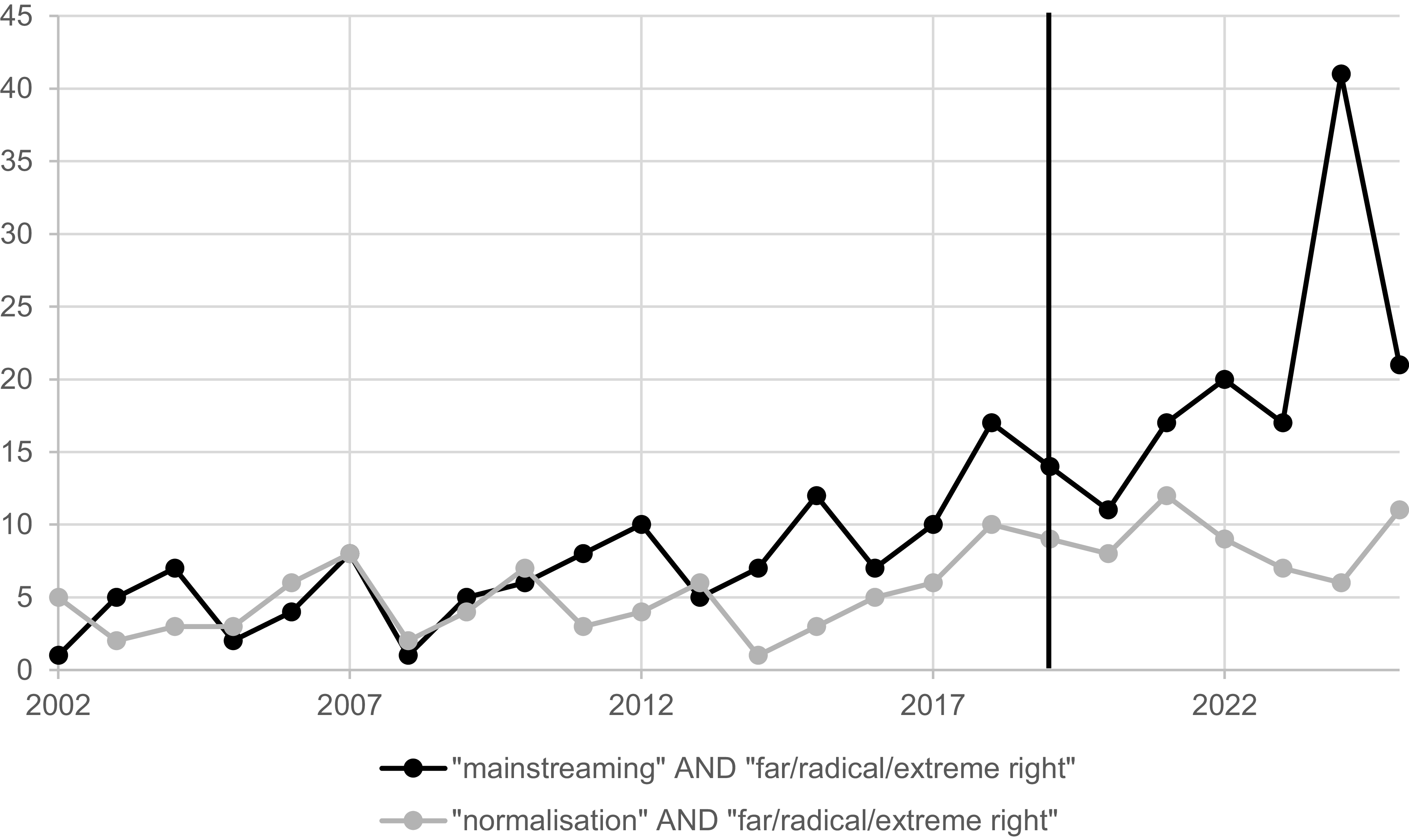
Figure 1 visualises the WoS search result frequencies from 2002 to 2025. It shows a particular peak of research on mainstreaming and the far/radical/extreme right in 2024, following a trend of increases in research on mainstreaming after 2016. In comparison, research on normalisation did not grow as strikingly but still relatively consistently in the last decade.
WoS search result frequencies, 2002–2025.
Note: Searches were last updated on 27 August 2025. Consequently, search result frequencies for 2025 only cover part of the year. The vertical line indicates the year 2019.
Our review particularly focuses on English-language publications from 2019 to 2025, reflecting the most recent wave of scholarship in this field. We used combinations of the following search strings (applied to titles, abstracts, and keywords): ‘far right’ AND mainstreaming and ‘far right’ AND normalisation.Footnote 2 In WoS, we applied a time filter (2019–2025) and restricted the queries to the Social Sciences Citation Index. In Google Scholar, we applied a custom time range (2019–2025).
We included peer-reviewed journal articles, books, and book chapters published in English that directly address mainstreaming or normalisation of the far/radical right. We mostly excluded grey literature, policy briefs, non-peer-reviewed reports, and works only tangentially engaging with the topic. Two reviewers screened the literature in two stages: first, titles and abstracts were assessed for relevance; second, full texts were reviewed for eligibility. Disagreements between the reviewers were resolved through discussion. In total, the WoS search yielded 396 studies (with some appearing in both searches and therefore appearing twice in Figure 1).
For each publication, we focused on the theoretical framework and substantive focus. We did not conduct a formal quality appraisal, as the aim of a scoping review is to map and synthesise the breadth of research rather than to assess the quality of individual studies (Pham, Rajić, Greig et al., Reference Pham, Rajić, Greig, Sargeant, Papadopoulos and McEwen2014).
Use of the concepts in research
Most existing studies refer to mainstreaming and normalisation as processes that reflect shifting boundaries between mainstream and far-right parties, actors, positions, frames, and issues, and ultimately, lead to the legitimisation of the far right (eg Mudde Reference Mudde2019; Brown, Mondon and Winter Reference Brown, Mondon and Winter2023; Valentim Reference Valentim2024). These terms are often used interchangeably. However, there tends to be a (blurred) conceptual distinction between mainstreaming – often referred to in the context of party competition – and normalisation, which also describes broader societal and normative shifts beyond the realm of party competition. Based on our review, we argue that the varied and sometimes overlapping use of different conceptualisations presents a key challenge to clarity in this scholarly debate and may hinder a comprehensive and nuanced understanding of the phenomena.
When speaking about mainstreaming, most political scientists refer to the behaviour of political actors or organisations, especially political parties. This usually involves party competition and specific positions on individual issues or in relation to democracy in general. According to Mudde (Reference Mudde2019: 164), mainstreaming takes place ‘because populist radical-right parties and mainstream parties address increasingly similar issues and because they offer increasingly similar issue positions’. This change can stem from the ‘moderation’ of the far right, the ‘radicalisation’ of the mainstream, or both at the same time (‘convergence’) (Mudde Reference Mudde2019: 164–165). In doing so, Mudde emphasises that mainstreaming can be driven by both the mainstream and far-right actors. In a similar vein, Völker and Saldivia Gonzatti (Reference Völker and Saldivia Gonzatti2024: 357) characterise mainstreaming as ‘far-right actors participating in mainstream politics and mainstream actors adapting far-right positions’. While we acknowledge this literature focusing on the far right as an actor in mainstreaming, this article focuses on the more recently growing literature focusing on mainstream parties in the mainstreaming process.
The literature on mainstream parties’ policy adaptation towards the far right has focused on the extent to which mainstream parties have adapted more critical positions on immigration, being the key issue of far-right mobilisation. To describe this process, many authors prefer the – rather technical than ideology-focused – term adaptation/accommodation. For example, Abou-Chadi and Krause (Reference Abou-Chadi and Krause2018) investigate how mainstream left and mainstream right parties shift their policy positions in response to the success of radical-right parties. They consider this move in policy positions as strategic, aiming ‘to take the wind out of its sails’ (Abou-Chadi and Krause Reference Abou-Chadi and Krause2018: 831). This is in line with Meguid’s (Reference Meguid2005) theory that mainstream party strategies can influence a niche party’s success by ‘stealing’ its ownership over an issue. Although the far right is not a niche phenomenon anymore (Pirro Reference Pirro2023), it still often owns the immigration issue, meaning it has the reputation to most credibly represent anti-immigration stances (Bélanger and Meguid Reference Bélanger and Meguid2008). To challenge far-right parties’ issue ownership, mainstream parties often adopt more anti-immigration and culturally protectionist positions (Wolinetz and Zaslove Reference Wolinetz and Zaslove2018; Down and Han Reference Down and Han2020; Krause, Cohen and Abou-Chadi Reference Krause, Cohen and Abou-Chadi2023). Especially when mainstream parties are internally divided, they may accommodate far-right stances to overcome their internal divisions (Lehmann Reference Lehmann2025).
Other authors in the mainstreaming literature prefer the term radicalisation, which is more normative than policy adaptation/accommodation. While some scholars use the term radicalisation to describe a process by which individuals and groups turn to extreme ideologies and violence (eg in the fields of terrorism and security studies; Abbas Reference Abbas2024), we focus on the literature on mainstream parties’ radicalisation as part of the mainstreaming process. For instance, Rovira Kaltwasser (Reference Rovira Kaltwasser and Rovira Kaltwasser2024a: 20) argues that mainstream parties – especially on the centre right – endorse more radical positions along the socioeconomic or sociocultural left-right political spectrum and/or modify their ‘rhetoric and actions concerning the liberal democratic system (eg questioning judicial independence and willingness to limit certain fundamental rights)’ (Rovira Kaltwasser Reference Rovira Kaltwasser and Rovira Kaltwasser2024a: 20–21). Akkerman, de Lange and Rooduijn (Reference Akkerman, de Lange, Rooduijn, Akkermann, de Lange and Rooduijn2016: 6) explicitly advocate using the term radicalisation instead of mainstreaming. Accordingly, radical parties do not moderate their stances, but mainstream parties ideologically or discursively move closer towards radical parties. Importantly, while this is not the focus of our article, parties outside the mainstream can also radicalise – as was the case for the ‘Alternative for Germany’, which has radicalised towards the far right since its foundation in 2013, partly driven by intra-party groups and actors (Heinze Reference Heinze2025).
While much research on mainstreaming explores processes of mainstream parties’ changing political stances, Moffitt (Reference Moffitt2022) further focuses on the social norms about far-right parties, that is, their social acceptability. He defines mainstreaming as ‘the process of portraying or designating a party as legitimate and/or normal’, compared to the opposite process of ‘ostracising’ a party (Moffitt Reference Moffitt2022: 386). Considering mainstreaming as a process of increasing the social acceptability of far-right parties, mainstream parties are not the only actors that can drive mainstreaming. For instance, the media can be another crucial actor in this process (eg Brown and Mondon Reference Brown and Mondon2021; Völker and Saldivia Gonzatti Reference Völker and Saldivia Gonzatti2024). While many authors agree that media actors contribute to increasing the far right’s social acceptability, some refer to this as normalisation rather than mainstreaming (eg de Jonge Reference de Jonge2021) – illustrating a lack of conceptual clarity in this literature.
Similarly, some scholars include the role of public opinion and discourse in their definition of mainstreaming, while others consider these as indicators of normalisation. Brown, Mondon and Winter (Reference Brown, Mondon and Winter2023: 164), for instance, propose a framework ‘which sees both the far right and the mainstream as agents and subjects but also focuses on discourse as key to understanding how both actors and ideas become mainstream’. In a relatively comprehensive definition of the concept, they understand mainstreaming as ‘the process by which parties/actors, discourses, and/or attitudes move from marginal positions on the political spectrum or public sphere to more central ones, shifting what is deemed to be acceptable or legitimate in political, media, and public circles and contexts’ (Brown, Mondon and Winter Reference Brown, Mondon and Winter2023: 170).
Again, this definition of mainstreaming strongly overlaps with common definitions of normalisation. While the concept itself is rarely defined, most authors use the term to refer to the question of which ideas and behaviour (rather than individual actors or parties) can be considered legitimate or acceptable in society, extending beyond formal organisations and institutions (Valentim Reference Valentim2024; Bolet and Foos Reference Bolet and Foos2025). Similarly, Mudde (Reference Mudde2019: 168) argues that one consequence of mainstreaming is that ‘the populist radical right is becoming increasingly normalised’. Brown, Mondon and Winter (Reference Brown, Mondon and Winter2023: 170), too, argue that a consequence of mainstreaming by mainstream political actors lays in the ‘discursive normalisation’ of the far right. Normalisation refers to far-right ideas and actors being ‘increasingly tolerated, and even embraced, by business, civil society, economic, media, and political circles’ (Brown, Mondon and Winter Reference Brown, Mondon and Winter2023: 169). From a discourse perspective, normalisation describes a process, in which ‘formerly tabooed topics, wordings and impolite or shameless behaviour (ie “bad manners”)’ become normal and ‘the boundaries of the “sayable” are being shifted’ (Wodak Reference Wodak2020: 6) – a process, which Wodak (Reference Wodak2020: 6) describes as ‘shameless normalisation’.
Similarly, de Jonge and Gaufman (Reference de Jonge and Gaufman2022: 774) speak about normalisation as ‘the various ways in which certain ideas, expressions, and behaviours that were once ruled out as illegitimate have become salonfähig or socially acceptable by the general public’ (see also Ekström, Patrona and Thornborrow Reference Ekström, Patrona and Thornborrow2020). They define it as a process that involves introducing new norms and (gradually) eroding old ones by legitimising a new normative order, leading to the acceptance of what was once considered unacceptable or deviant.
Nicolaisen (Reference Nicolaisen and Bourne2024) refers to mainstream parties’ actions and rhetoric, including cooperation, policy co-optation, and a softened objection to radical-right immigration policies, which has led to the normalisation of the Danish People’s Party. Similarly, Valentim (Reference Valentim2021) argues that established democratic political institutions and processes, such as parliaments and elections, provide information to the population that can contribute to normalising stigmatised behaviour. Key democratic institutions and processes can signal to voters both public support for the far right and its institutional recognition. While parties and election results can contribute to normalisation by signalling the scope of the socially (in)acceptable, Valentim (Reference Valentim2021) considers normalisation a process that primarily happens in the general population beyond the realm of politics. As such, Alvarez-Benjumea and Valentim (Reference Alvarez-Benjumea and Valentim2024) show that social sanctioning by fellow citizens enforces the norm of unacceptability of the far right. Some authors emphasise the role of the media, showing that media presence of the far right contributes to its normalisation in society (eg Arias Reference Arias2019; Bolet and Foos Reference Bolet and Foos2025).
Normalisation also occurs when large groups of citizens change their behaviour, and these changes become visible to others (Dinas, Martínez and Valentim Reference Dinas, Martínez and Valentim2024). Valentim (Reference Valentim2024: 66) argues that ‘all it takes is an information shock’ to change people’s perception of what is socially acceptable or stigmatised, enabled by an ‘exogenous trigger’. In the case of far-right normalisation, such a trigger may be an economic crisis, a terrorist attack, or a threat to territorial integrity, provoking the perception of an outgroup threat (Valentim Reference Valentim2024: 73). Similarly, Krzyżanowski, Wodak, Bradby et al. (Reference Krzyżanowski, Wodak, Bradby, Gardell, Kallis, Krzyżanowska, Mudde and Rydgren2023) argue that (perceived) crises can trigger normalisation processes by creating opportunities to recontextualise a phenomenon and reassess its social acceptability. In such situations, individuals with socially stigmatised political attitudes may temporarily feel more comfortable to express them. This increased visibility can signal to others that these attitudes are more prevalent than assumed. Consequently, such views may become less stigmatised and more normalised in society.
Crucially, the normalisation literature differs in its underlying assumptions about the initial prevalence of stigmatised ideas in society. Some definitions of normalisation assume that stigmatised (eg far-right) ideas are uncommon in society before normalisation happens and become more widespread as they become normalised (eg Brown, Mondon and Winter Reference Brown, Mondon and Winter2023). In contrast, recent scholarship argues that far-right ideas have long been relatively widespread but remained ‘hidden’ due to social stigma. As they become normalised, people feel more comfortable in disclosing their previously stigmatised ideas (eg Valentim Reference Valentim2024). In the latter definition, normalisation does not (only) lead to the spread but also to more disclosure of far-right ideas that were already prevalent but hidden among relatively large parts of the population.
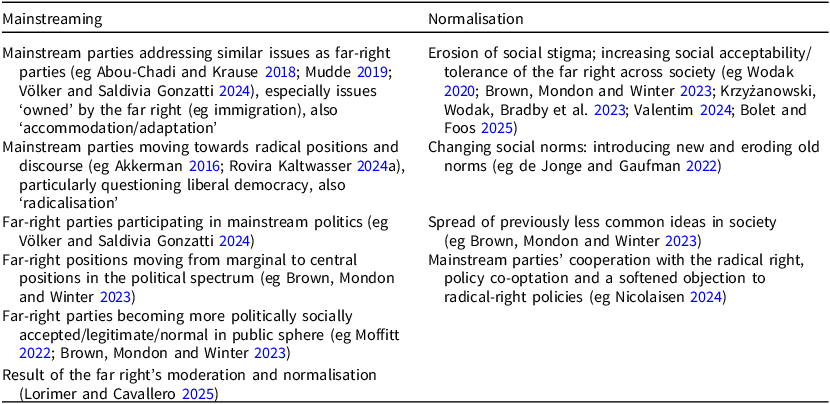
Connecting mainstreaming and normalisation processes, Rovira Kaltwasser (Reference Rovira Kaltwasser and Rovira Kaltwasser2024b: 158) argues that normalisation processes may have long-term consequences on political preferences and democratic norms. In the long term, the far right’s parliamentary presence can erode stigma and thus drive normalisation. Moreover, it creates opportunities for legislative and executive cooperation (Heinze Reference Heinze2022). This can further normalise far-right parties across federal levels, potentially leading to their acceptance as ‘normal’ coalition partners among other ‘mainstream’ parties – illustrating the interconnectedness of these processes. Lorimer and Cavallaro (Reference Lorimer and Cavallaro2025) conceptualise mainstreaming as a result of the far right’s moderation or normalisation – again pointing to the interconnectedness of these concepts. To summarise this review, Table 1 provides an overview of definitions used in the literature for each concept.
Definitions of mainstreaming and normalisation in the literature
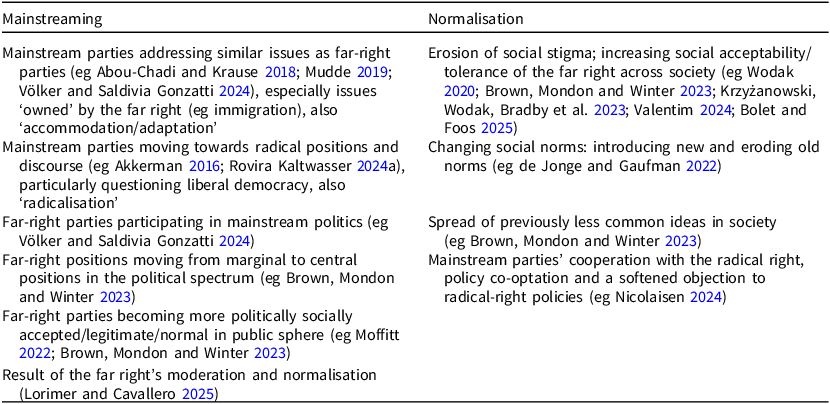
Note: These definitions are not mutually exclusive and often interconnected. The listed references constitute examples and are incomplete. The order of the table does not imply a ranking/weighting of the approaches.
Introduction of our conceptual framework
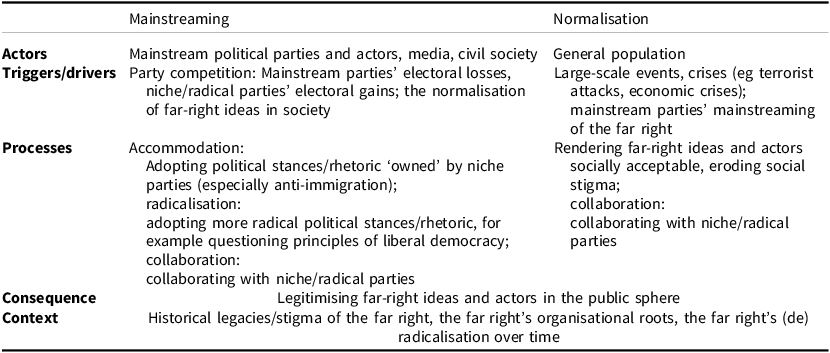
As our review has shown, mainstreaming and normalisation are often mentioned in the same breath, and sometimes interchangeably, while referring to partly distinct while interconnected processes. To contribute conceptual, theoretical, and analytical clarity to this literature, we now introduce our conceptual framework that further differentiates these processes (see Table 2). In doing so, we focus on the actors, triggers/drivers, processes, consequences, and contextual factors influencing mainstreaming and normalisation.
Conceptual distinctions: mainstreaming and normalisation as legitimising processes of far-right actors and ideas
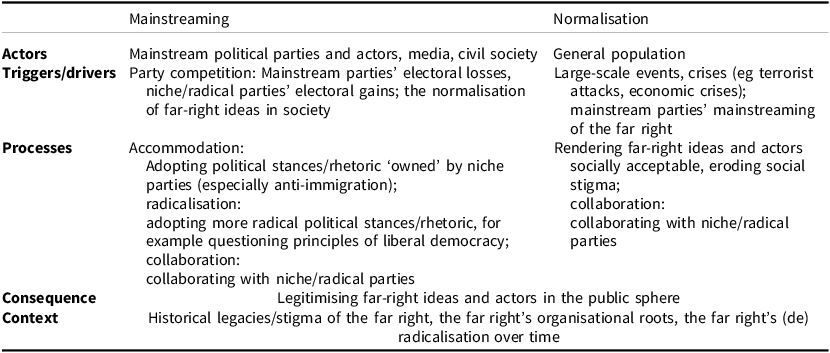
Building on the literature, we understand mainstreaming to refer to the process by which a position or rhetoric previously ‘owned’ by a niche and/or radical party is accommodated by mainstream political actors. In this process, previous understandings of the mainstream are extended to increasingly include niche/radical positions. In the case of the niche/radical party being far right, mainstreaming implies that mainstream political actors change their positions/rhetoric towards more radical ones, that is more critical ones regarding liberal democracy.Footnote 3 Mainstreaming is driven by party competition: If mainstream political parties lose support, while a niche/radical party gains support, mainstream political parties are likely to engage in accommodation/radicalisation processes.Footnote 4 Mainstreaming may also be facilitated by normalisation: Mainstream parties are more likely to adopt niche/radical positions, if these positions are not socially stigmatised (anymore) in the general population.
However, not every niche party necessarily forwards radical stances, and thus, not every mainstreaming process concurs with radicalisation. For example, if a niche party mobilises around the demand for more infrastructure projects at the local level, accommodating such claims may foster their mainstreaming (see Paxton Reference Paxton2023). In this example, mainstreaming does not concur with radicalisation, that is with the questioning of liberal democracy. It is in the specific case of far-right mainstreaming that mainstream political actors’ mainstreaming activities tend to concur with their radicalisation, because political stances and rhetoric ‘owned’ by the far right often conflict with principles of liberal democracy.
In contrast, the term normalisation refers to broader changes in social norms and public discourses rather than shifts in policy positions and rhetoric. In the case of the far right, this includes an erosion of stigma of far-right actors and ideas. While this can be a consequence of the mainstreaming of mainstream political actors, it can also have other reasons, such as shifts in media discourse (Arias Reference Arias2019), and large-scale events or crises (Krzyżanowski, Wodak, Bradby et al. Reference Krzyżanowski, Wodak, Bradby, Gardell, Kallis, Krzyżanowska, Mudde and Rydgren2023; Valentim Reference Valentim2024: 72). Moreover, the normalisation of far-right stances in society may affect party behaviour, as parties react to the updated information on public preferences. Therefore, far-right normalisation in society can be both a consequence and a cause of mainstreaming.
In these processes, mainstream political actors are key agents. With regard to mainstreaming, the actions of mainstream parties and actors – being the core of the political ‘mainstream’ – are crucial. Their agency is key, since they dominate the political institutions. They can decide which political positions and rhetoric to adopt and with whom to build coalitions or enter political debates, thereby potentially legitimising niche/radical parties and positions. However, also other mainstream political actors from the non-electoral arena can contribute to these processes, such as social movements and protest actors, by collaborating with far-right movements and/or adopting their stances (eg Castelli Gattinara and Pirro Reference Castelli Gattinara and Pirro2024; Volk Reference Volk2025). Normalisation, on the other hand, can be driven by even more actors outside political institutions. These include, for example, the media and civil society, which are key actors in signalling what is socially acceptable or stigmatised to a greater population.
Ultimately, both processes contribute to the legitimisation, that is the increasing acceptance as rightful and appropriate actors and ideas, of the far right in politics and society. Previous studies already hint to the fact that mainstreaming and normalisation are unidirectional, meaning their consequences can hardly be reversed. In the context of policy accommodation, Bale (Reference Bale2008: 322) described: ‘Once the toothpaste is out of the tube, the can of worms opened, the issues rarely go away’. Similarly, Heinze (Reference Heinze2018) argued that once mainstream parties begin co-opting far-right policies or collaborating with far-right parties, it becomes difficult to fully revert to excluding them or their positions. Moffitt (Reference Moffitt2022), too, underlines that different strategies are indeed possible, but he remains agnostic as to whether ‘pariahing’ can be implemented once mainstreaming has occurred. However, he is among the few scholars who explicitly consider the opposite process of mainstreaming (see also Rothut, Schulze, Rieger et al. Reference Rothut, Schulze, Rieger and Naderer2024; Lorimer and Cavallaro Reference Lorimer and Cavallaro2025). Overall, it seems difficult to re-stigmatise a party once its positions have been normalised, to rebuild a cordon sanitaire once it has been torn down, or to exclude a party from the mainstream once it has been recognised as mainstream. Conceptually, we therefore consider it useful to treat mainstreaming and normalisation as unidirectional and irreversible until proven otherwise.
Finally, we emphasise the role of the context, in which these processes are embedded. Country contexts differ in terms of historical legacies associated with (far-right) stigma or the organisational roots of far-right parties. For instance, whether a country’s far-right party is rooted in extremism and de-radicalised towards more mainstream positions over time (eg the Sweden Democrats), or whether a country’s far-right party was founded as a relatively more moderate party and radicalised over time (eg the Alternative for Germany) may affect how mainstream parties, the media, and civil society interact with these parties and the social norms and connotations associated with them. Further, countries’ historical experience with the far right, for instance in the form of far-right dictatorships, and the collective memory associated with such history may affect how mainstream parties, the media, civil society, and the public interact with the far right. Given the partly relative and shifting definition of what is mainstream or normal, the conceptualisation and operationalisation of mainstreaming and normalisation should be embedded in an analysis of the studied contexts and what is considered as mainstream or normal in those settings.
Avenues for future research
Given the important consequences of mainstreaming and normalisation for democratic institutions, liberal values, and an inclusive society, the study of these processes is highly important. Based on our literature review and conceptual framework, we propose three avenues for future research, where further conceptual development may be beneficial.
Better operationalisations of who is mainstream or what is normal
While more and more studies focus on mainstreaming and normalisation processes, the literature still lacks clear operationalisations of what is considered mainstream or normal. Although we acknowledge that this is no easy task, we argue that future studies need clear, operationalisable thresholds to study mainstreaming and normalisation over time and across countries. Only a clear operationalisation of what constitutes the mainstream or normal radical in a certain time and space can prevent researchers’ bias in defining the mainstream or non-mainstream, and the normal or abnormal, in hindsight.
An important exception is the study by Crulli and Albertazzi (Reference Crulli and Albertazzi2024), which offers an operationalisation of the mainstream that considers its constructed, contingent, and fluid nature (see also Brown, Mondon and Winter Reference Brown, Mondon and Winter2023). Accordingly, for certain attitudes to be considered mainstream, they must be represented by parties with government experience, shared by a majority of the public, and supported relatively consistently across partisan groups (Crulli and Albertazzi Reference Crulli and Albertazzi2024: 7). The authors further criticise the literature for equalling the terms ‘established’ and ‘mainstream’, thereby considering any party with government experience as mainstream. They also argue that, to consider a party mainstream, its ideas and discourses must be considered moderate/centrist and legitimate. Then again, they ‘reject basing the definition of the mainstream on the notion of legitimisation’ because it risks considering tiny one-issue parties as mainstream (Crulli and Albertazzi Reference Crulli and Albertazzi2024: 6). Importantly, the authors also provide a conceptualisation of the non-mainstream, defined as attitudes represented by parties without government experience, supported by a minority of the public, and endorsed only by individual partisan groups.
Krause and Wagner (Reference Krause and Wagner2021), too, offer an operationalisation of the mainstream that considers the fluid nature of the mainstream and a degree of acceptance in both political institutions and society, which goes beyond the factor of government experience. They construct a continuous index capturing parties’ degree of establishment as defined by party age, party size in terms of vote share, and government experience. However, it does not include a clear cut-off point of what is mainstream and what is not. The same is the case with earlier approaches, such as by Meguid (Reference Meguid2005: 348), who understands mainstream parties as ‘electorally dominant actors’ with a centrist political positioning (see also Spoon and Klüver Reference Spoon and Klüver2019; Brown Reference Brown2024).
Building on these approaches, we argue that operationalisations of the mainstream/normal should entail clear and specific criteria, while ensuring that thresholds are not too restrictive. While this is certainly a balancing act, it is the only way to ensure they remain a powerful analytical tool across different contexts and over time. For instance, one may consider Crulli and Albertazzi’s (Reference Crulli and Albertazzi2024) definition of the mainstream – wherein mainstream attitudes are shared by the majority of a population and similarly endorsed by voters of different political groups – as too restrictive. This definition has the important advantage of clearly defining thresholds and operationalising the mainstream and non-mainstream, while allowing for the mainstream to change its meaning over time and across contexts. However, it may exclude a range of issues that traditionally divide political families and populations but are generally considered mainstream, such as stances on socioeconomic issues related to the size of the welfare state, the kind and amount of taxation, or the regulation of the market.
Therefore, we propose that a definition of the mainstream should include political stances that constitute the ideological core of mainstream parties’ political conflict – even if they remain disputed between them. Further research may develop less restrictive definitions of the mainstream and the non-mainstream, allowing for clear operationalisations while maintaining a fluid aspect that allows for changes over time and across space. Further, the definition of a mainstream party should consider its policy stances and go beyond party size and government experience, which does not necessarily concur with party positions that are considered mainstream (see also Minkenberg Reference Minkenberg2013: 19).
One possible way to define the non-mainstream/abnormal may be to define the radical. To do so, researchers may need to agree on which political stances are considered radical in a particular context. In liberal democracies, for instance, Mudde (Reference Mudde2007: 25) defines the radical as ‘opposition to some key features of liberal democracy, most notably political pluralism and the constitutional protection of minorities’. Similarly, Rovira Kaltwasser (Reference Rovira Kaltwasser and Rovira Kaltwasser2024a: 21) argues that radical stances involve questioning the liberal democratic system, including judicial independence and fundamental rights and civil liberties. Thus, defining the radical incorporates a normative assessment of party positions and the extent to which they question liberal democracy.
Importantly, these definitions of the radical are specific to the context of liberal democracies, in which the above-outlined stances radically diverge from the status quo. As such, definitions of the radical are inherently context-specific, which in turn complicates their operationalisation across contexts and regime types. Against this background, we suggest that future research may discuss the concept of radicalisation and its thresholds in more detail. For example, which conceptualisation is more useful for analytical purposes: absolute or relative radicalisation? In absolute radicalisation, we would only speak of radicalisation when a party takes a radical position. In this case, we need to define what we consider radical, as already proposed by Mudde (Reference Mudde2007) and Rovira Kaltwasser (Reference Rovira Kaltwasser and Rovira Kaltwasser2024a). In contrast, relative radicalisation describes any movement toward a more radical position than the party’s previous position – even if the resulting position is not necessarily radical according to the above-outlined definitions (see also Akkerman, de Lange and Rooduijn Reference Akkerman, de Lange, Rooduijn, Akkermann, de Lange and Rooduijn2016). Future research may consider whether we can establish relatively time-invariant context-independent criteria by which a political position is considered radical (in absolute terms), or whether it is more useful to apply the term radicalisation to any movement toward a more radical position – although we risk softening its meaning this way.
Finally, defining and measuring what is normal, or acceptable by a large part of society and/or political actors, is equally difficult due to constantly changing social norms. This is also reflected in existing measurements. Bolet and Foos (Reference Bolet and Foos2025: 10) refer to descriptive norms as people’s perception of how society thinks about immigration, criminality, terrorism, and Islam (see also, eg Valentim Reference Valentim2021, Reference Valentim2024). Importantly, this variable differs from individual attitudes towards such issues but rather considers society overall. Once again, this way of defining and measuring what is normal does not include a clear cut-off point of what is normal and what is not. Clear and operationalisable definitions and thresholds of the (ab)normal and (non-)mainstream that account for shifting social norms and political opportunity structures over time and across space remain a key challenge in this literature.
Refined theories on different mainstream actors’ role in mainstreaming and normalisation
As we have shown, various actors play a role in mainstreaming and normalisation. However, these are rarely differentiated from one another, even though they can influence the processes in different ways. While much literature focuses on mainstream parties as central actors, different mainstream parties are often either lumped together (eg Dahlström and Sundell Reference Dahlström and Sundell2012; Abou-Chadi and Krause Reference Abou-Chadi and Krause2018; Down and Han Reference Down and Han2020) or analysed in separate studies without theoretical reference to each other. Akkerman (Reference Akkerman2015a) constitutes an exception, explicitly theorising about different party families’ changes in policy positions in reaction to the rise of immigration salience in the 1990s and 2000s. In line with her theorisation, we argue that future work may differentiate more conceptually and empirically between different mainstream party families for at least three reasons.
First, different party families’ scope for action differs significantly due to their ideologies and core positions, which also impacts normalisation. For instance, if (even) a left-wing mainstream party takes anti-immigration positions, implying a stronger shift in party positions and a shift in positions ‘across the aisle’ of political competition, this can intensify public discourse and legitimise anti-immigration stances more than if a mainstream right party returns to its roots of stricter anti-immigration stances. This is in line with Dahlström and Sundell (Reference Dahlström and Sundell2012), who show that mainstream left parties’ radicalisation on immigration issues legitimises the far right more strongly than the mainstream right’s radicalisation.
Second, the radicalisation of mainstream left and mainstream right parties can have different implications for coalition-building and party competition. A mainstream right party’s radicalisation opens ways for (in)formal collaboration between the mainstream right and the far right, enabled by the ideological convergence between the two parties and the normalisation of radical stances that occurs as mainstream parties radicalise. As a result, we have seen government coalitions and collaborations between mainstream right and radical-right parties in countries such as Austria, the Netherlands, and Sweden (Lorimer, Griffini and de Jonge Reference Lorimer, Griffini and de Jonge2025).
Conversely, a mainstream left party’s radicalisation towards positions of the far right is less likely to result in direct collaborations between the mainstream left and far right, that is across the aisle of political conflict. Instead, the normalisation of far-right stances within the mainstream left opens up a new market for party competition: The mobilisation of voters who combine socioeconomically left-wing positions with socio-culturally right-wing positions, a phenomenon labelled left-authoritarianism (Wagner, Wurthmann and Thomeczek Reference Wagner, Wurthmann and Thomeczek2023). In Germany, the recently founded party Bündnis Sahra Wagenknecht (BSW) exemplifies a left-authoritarian party. Importantly, the BSW is not a mainstream left party that has radicalised towards authoritarian stances, but a new, non-mainstream party that illustrates how political parties can tap into the potential of voters combining socioeconomically left-wing and socio-culturally right-wing positions. The party’s early electoral success has already affected coalition-building at the subnational level, which is often considered a laboratory for national cooperation.
As some have argued, the mainstream right parties’ radicalisation on immigration and anti-EU stances unlocked a market for the rising radical right in the 1990s (Gidron and Ziblatt Reference Gidron and Ziblatt2019). Similarly, the emergence of left-wing authoritarianism has the potential to reshape political party landscapes across Western Europe. While this has not yet happened in Western Europe, examples from Central and Eastern Europe suggest that left-authoritarian parties may also collaborate with far-right parties, which could significantly impact political competition and coalition-building among all political parties. For example, the Slovak left-authoritarian party Smer has repeatedly formed government coalitions with the far-right Slovak National Party. It remains to be seen how far-right mainstreaming within the mainstream left will affect political party landscapes across Western Europe.
Whether far-right mainstreaming occurs within a political camp or across the aisle of political competition can thus affect a country’s political party competition in different ways. Both types of mainstreaming have important consequences for government formation and coalition-building. However, the mechanisms by which they affect these processes differ. Mainstream right parties’ radicalisation and far-right accommodation may lead to direct collaborations between the mainstream and the far right, while mainstream left parties’ radicalisation and far-right accommodation are more likely to unlock new markets for party competition, potentially influencing coalition-building in different ways.
Third, regarding consequences of mainstreaming for mainstream parties, recent political science research shows that neither mainstream right nor mainstream left parties win back voters from far-right parties when they mainstream their positions (Dahlström and Sundell Reference Dahlström and Sundell2012; Bale Reference Bale2018; Gidron and Ziblatt Reference Gidron and Ziblatt2019; Abou-Chadi and Wagner Reference Abou-Chadi and Wagner2020; Krause, Cohen and Abou-Chadi Reference Krause, Cohen and Abou-Chadi2023). Still, the consequences for mainstream parties tend to differ by party family. While mainstream right parties have been able to assume power by collaborating with the far right in several countries, mainstream left parties are less likely to collaborate and do not win additional coalition partners by mainstreaming the far right. Therefore, while both right and left mainstream parties tend not to gain electorally from mainstreaming the far right, unlike mainstream left parties, mainstream right parties may still enter government coalitions and gain power as a result of it. Mainstream left and right parties thus face different consequences from far-right mainstreaming, which implies they have different incentives to do so.
After all, it is not only mainstream political parties that play a role but also the mainstream media and civil society – especially in the normalisation of the far right. Different mechanisms apply to these actors, which future studies should theorise in greater detail. Existing studies indicate that mainstream media actors play a decisive role in shaping how far-right actors and positions are reported on (and how they become ‘normal’), while their understanding of their own role varies considerably (de Jonge Reference de Jonge2021). Civil society can also influence the extent to which far-right actors and positions remain stigmatised – for example, by using confrontational tactics such as protests or civil disobedience (Lundberg Reference Lundberg2021). Nevertheless, there is comparatively little research on civil society actors’ role in far-right normalisation. Mondon and Winter (Reference Mondon and Winter2020: 113) argue: ‘No matter how hard a far-right party tries to reform itself, if the broader political system is not open to welcoming it and its ideas, it is bound to remain at the margins’. Overall, these studies emphasise that the far right typically relies on the support of mainstream actors to move into the mainstream.
In sum, we argue that the mainstreaming and normalisation literature may theoretically and empirically distinguish more between mainstream left and mainstream right parties. This is due to the different consequences of the mainstream left’s and right’s far-right mainstreaming for public discourse, coalition-building, the emergence of new political markets, and the mainstream parties’ own prospects. Moreover, the role of other mainstream actors in normalising the far right should be more closely investigated, such as civil society and the media.
Broadening the focus from immigration issues and national-level dynamics
Finally, our review shows that many studies focus on mainstreaming and normalisation regarding immigration policy. This focus is understandable, given that immigration has long been a core far-right and increasingly salient issue across many European societies. However, the far right today is by no means a single-issue phenomenon (Mudde Reference Mudde2019). Moreover, it increasingly mobilises beyond national-level politics. Therefore, we propose that future studies on mainstreaming and normalisation may broaden their focus to other issues and political arenas.
As numerous studies have shown, contemporary far-right parties not only oppose immigration, but also often take distinctly conservative stances on other issues such as gender and climate (Akkerman Reference Akkerman2015b; de Lange and Mügge Reference de Lange and Mügge2015; Schwörer and Fernández-García Reference Schwörer and Fernández-García2024). At the same time, far-right voters have recently been shown to partly base their vote choice on conservative attitudes toward gender and climate issues, especially when these issues are salient to them (Otteni and Weisskircher Reference Otteni and Weisskircher2022; Anduiza and Rico Reference Anduiza and Rico2024; Off Reference Off2023). In an attempt to appeal to these voters and potentially win them back, mainstream parties may thus shift towards more conservative positions on gender and climate issues, thereby contributing to the mainstreaming and normalisation of such positions in their respective political and societal contexts. Abou-Chadi, Breyer and Gessler (Reference Abou-Chadi, Breyer and Gessler2021) show that gender issues have been increasingly discussed since 2016 by all party families, and especially by the far and mainstream right (underlining once again that research should differentiate between mainstream party families). There is thus reason to believe that the increasing salience and politicisation of gender and climate issues may lead to the mainstreaming and normalisation of conservative stances on these issues, partly driven by mainstream parties’ far-right accommodation and (relative) radicalisation on these issues. It is up to future research to investigate whether the increase in parties’ mentions of gender issues concurs with a shift toward more conservative stances on gender issues among mainstream parties and whether similar trends can be observed regarding climate issues.
Future studies may broaden their view of mainstreaming and normalisation to include other issues than immigration. This could include GAL-TAN issues such as gender or climate, but also foreign policy. Are the far right’s stances on foreign policy also mainstreamed and normalised? Weisskircher (Reference Weisskircher2025) shows that the far right in Germany increasingly mobilises around the question of (military) support to Ukraine and the resulting high energy prices – topics of growing salience in many European countries. Nevertheless, we still know little about how far-right positions on other issues than immigration influence the positions of mainstream parties (or, eg media discourses).
In this context, future studies should not only concentrate on the national level, as is often the case, but also examine subnational mainstreaming and normalisation processes. The far right frequently exploits local issues – such as questions of infrastructure or municipal finances – to position itself within the mainstream (Paxton Reference Paxton2023). Whether these attempts succeed, however, depends largely on the responses of other mainstream actors, including political parties, the media, and civil society. Practices such as joint motions, party voting behaviour in political institutions (Schroeder, Ziblatt and Bochert Reference Schroeder, Ziblatt and Bochert2025), public events, or protests (Ellinas and Lamrianou Reference Ellinas and Lamrianou2021) can contribute to either the normalisation or the non-normalisation of the far right in political institutions and society. Future studies should therefore pay closer attention to the wide range of issues and arenas involved in these processes, and to their interconnections.
Conclusion
This article had two main goals: first, we sought to map out how the concepts of mainstreaming and normalisation are used and analysed in previous studies on the far right, thus pushing for more conceptual clarity in a highly relevant, rapidly growing, but often conceptually vague field. Building on this, we proposed a conceptual framework, further distinguishing the processes from each another and focusing on their various actors, drivers, and consequences and developed three future research avenues.
We began by reviewing the conceptualisation of mainstreaming and normalisation. While they are often used interchangeably and generally treated as dynamic processes that legitimise the far right, important differences emerge in their usage. While mainstreaming is predominantly employed in the context of party competition and political institutions (eg Akkerman, de Lange and Rooduijn Reference Akkerman, de Lange, Rooduijn, Akkermann, de Lange and Rooduijn2016), normalisation tends to describe broader societal and normative shifts (eg Valentim Reference Valentim2021; de Jonge and Gaufman Reference de Jonge and Gaufman2022). Normalisation thus relates primarily to changing social norms and the erosion of social stigma, while mainstreaming is sometimes treated in a rather technical manner (eg when analysing mainstream parties’ accommodation of far-right positions; see Down and Han Reference Down and Han2020) and sometimes in a more normative manner (eg mainstream parties radicalising by questioning liberal democratic principles; see Rovira Kaltwasser Reference Rovira Kaltwasser and Rovira Kaltwasser2024b).
Building on existing research, we proposed a conceptual framework which seeks to more clearly distinguish these interlinked processes as well as their actors, triggers/drivers, and consequences. We argue that mainstreaming occurs primarily within formal political organisations and institutions, while normalisation also reflects changes in public discourse and social norms. As a result, agency varies across them: while political parties are key actors in mainstreaming, more actors can drive the process of normalisation, for example the mainstream media and civil society. Further, while mainstreaming is usually driven by changes in party competition, eg the rising far right, normalisation may also be driven by large-scale events or crises that reveal and foster outgroup resentment in society. Ultimately, both processes contribute to the legitimisation of the far right. Moreover, we discussed that these processes are likely to be unidirectional and irreversible – an aspect future studies may wish to revisit. We also emphasised the importance of context for understanding these processes. For instance, historical legacies and the far right’s organisational roots and over-time development can shape the trajectory of these dynamics.
We finally discussed three future research avenues. First, we proposed that the field requires better operationalisations of the mainstream and the normal (and their respective counterfactuals) as well as clearer, operationalisable thresholds. While this is no easy task (eg thresholds should not be too strict to reflect the concepts’ fluidity and context dependence), this is crucial to avoid bias in studying these processes across time and space. Amongst others, we argued that criteria should go beyond the question of electoral success or government participation but also include an assessment of policy positions. Second, we called for future work with stronger theoretical distinctions between different mainstream actors, such as party families. Studies often treat these as a homogeneous group or examine individual cases in isolation. We suggest a more comparative approach that theoretically accounts for differences between mainstream party families, whose actions can lead to different consequences (eg regarding public discourse, coalition-building, or the emergence of new political markets). Thirdly, future research should broaden its focus beyond the issue of immigration and national-level dynamics and include other salient issues, such as gender and climate, foreign policy, and the various topics politicised by the far right on the local level. In doing so, future studies may acknowledge that the far right is no longer a single-issue actor.
From a broader perspective, while our article primarily concentrated on political science literature, scholars from different disciplinary backgrounds may emphasise different actors: political scientists may tend to focus on parties and electoral politics, whereas communication and cultural studies scholars are more likely to highlight the role of media actors and public discourses. Bringing these research strands together, and ensuring conceptual coherence across disciplines, remains an ongoing challenge. While we hope that our article makes a contribution in this regard, we encourage other scholars to critically assess and refine the conceptual and methodological approaches employed across diverse (research) disciplines. Only by doing so, we can develop powerful analytical frameworks that allow for meaningful comparisons across contexts and, ultimately, enhance our understanding of one of the most pressing challenges facing liberal democracies.
Data availability statement
No data other than this review have been produced.
Acknowledgements
We would like to express our gratitude to the anonymous reviewers for their constructive comments, as well as all the colleagues who provided valuable feedback on earlier drafts of this paper, especially Tim Bale, Pietro Castelli Gattinara, Léonie de Jonge, Sarah Engler, and Aurelien Mondon, as well as the participants of the Conference of ECPR Standing Group on Extremism & Democracy in London 2025.
Funding statement
Funding for the open access was received from the Volkswagen Foundation (NurtureDEMOS Project).
Competing interests
The author(s) declared no potential conflicts of interest with respect to the research, authorship, and/or publication of this article.
Ethics standard
This study did not involve human participants or sensitive personal data and therefore did not require ethical approval.

 Open access

