

Introduction
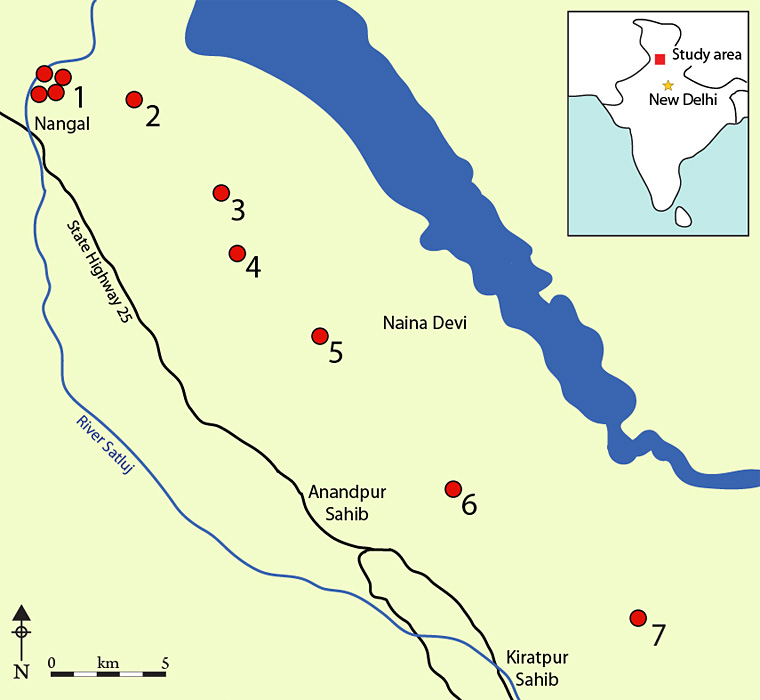
Locations of sites which yielded pitted stones in the Nangal-Kiratpur region: 1) Nangal-Barmala; 2) Goalthai; 3) Nangethakur; 4) Jandori; 5) Bika; 6) Nainowal; 7) Luhund.

Assemblages including pitted stones have been recovered from many early prehistoric contexts, for example at Acheulian Gesher Benot Ya'aqov, Israel (Goren-Inbar et al. 2002), as well as Holocene ones, widely separated in time, space and function, for example in northern America (Reference Ellis, Wortner and FoxEllis 1991: 2021; Breschini & Haversat 1993; Fitzgerald & Jones 1999: 77, 80, 83; Reference AdamsAdams 2001: 13, 15; Reference HolsteinHolstein 2002: 18990). In this short note we draw attention to the pitted cobbles of the north-western sub-Himalayas, recovered from Holocene sites in the area of Nangal in Punjab, India (Figure 1).
Context
The north-western sub-Himalayas have been known for their Soanian lithic industries (de Terra & Paterson 1939; Mohapatra 1974) but pitted cobbles have, to our knowledge, not been reported. During the last decade, lithic assemblages containing Soanian elements have come to light in Holocene contexts in the region (Soni et al. 2008; Soni & Reference Soni and SoniSoni 2009) and among many new tool types the pitted cobbles are a conspicuous class of artefacts. These tools have been collected by the authors from an area of c. 35 x 5km² located between Nangal and Kiratpur Sahib in the Siwaliks of Punjab and Himachal Pradesh in India. Forty-five pitted cobbles (41 un-flaked) were recovered from seven sites (Figure 1). They were encountered either singly (at Goalthai, Jandori, Bika and Luhund) or in two exemplars (at Nainowal and Nangethakur) near the ephemeral tributaries of the River Satluj, but the Nangal-Barmala site complex produced 37 specimens. This location yielded 8 pitted cobbles from the lowest terrace on the left bank of the River Satluj while 26 came from the next terrace, 10m higher up, and 3 from a further remnant terrace, 9m higher up. The lowest terrace of the River Satluj at Nangal was dated to 6250±840 BP by OSL (lab No. LD 53, Wadia Institute of Himalayan Geology, Dehradun, India), using the Single Aliquot Regeneration (SAR) protocol (Murray & Wintle 2000, 2003). For this purpose, a sample of the sediment was taken 60cm below the surface of the terrace bearing the pitted cobbles. These were found in assemblages containing utilised flakes, choppers, cores, core-tools and other tool types (all unrolled) along with weathered pottery sherds (Soni et al. 2008). Apart from the OSL date, a mid Holocene context is suggested, as the assemblage accompanying the pitted cobbles has parallels in mid to late Holocene ceramic and lithic material found elsewhere in the region (Agrawal & Kusumgar 1975; Soni & Reference Soni and SoniSoni 2009) and some lithic components appear to show technological traits similar to those of the mid to late Holocene industries of the southeast Indo-Malaysian archipelago (Bellwood 2007: 181200).
Form and possible functions
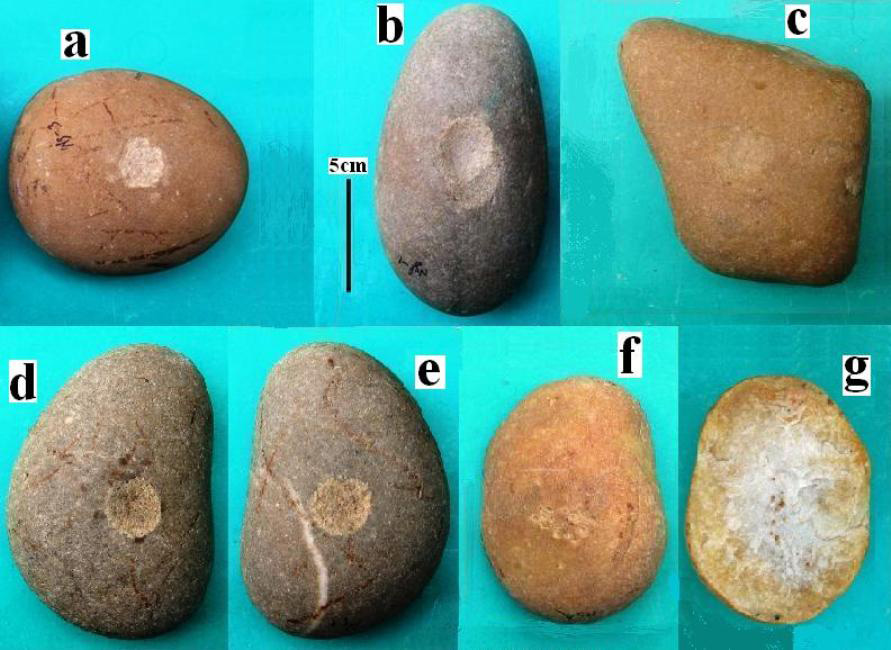
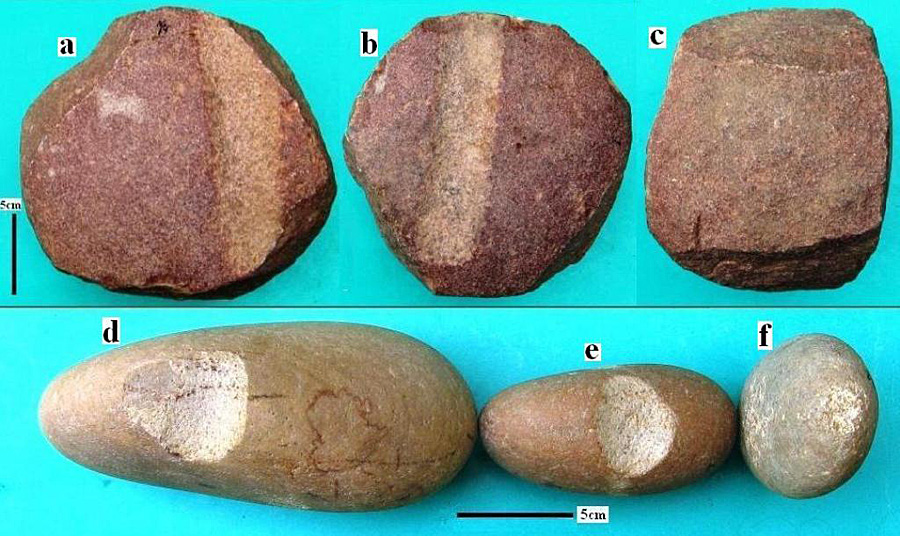
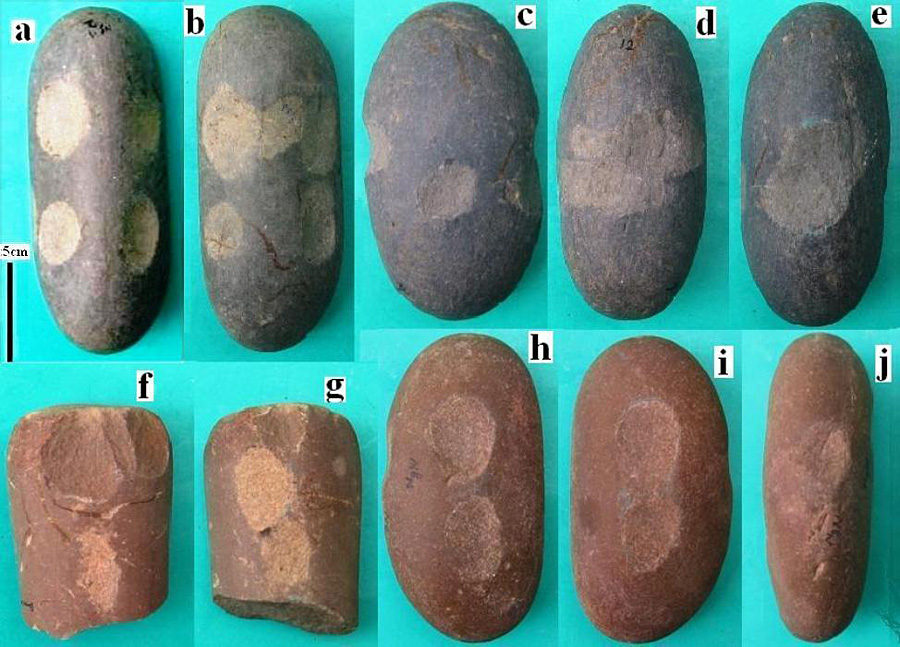
a) Single pit on one face of a circular cobble; b) overlapping pits on one face of an oval cobble; c) pit on one face and edge of a rhomboid; d & e) pits on both faces; f & g) centrally pecked dorsal face and flaked ventral faces of a cobble.
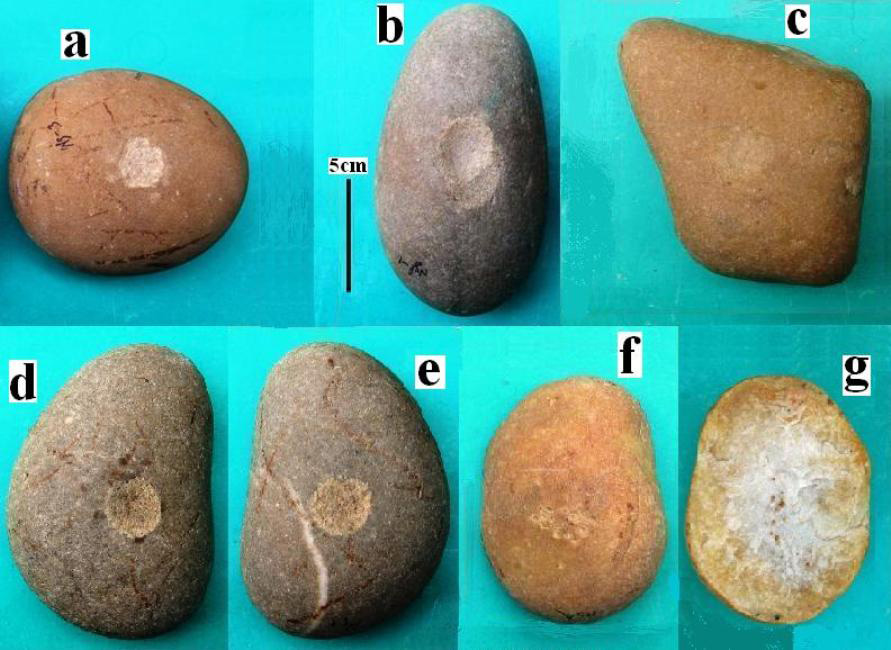
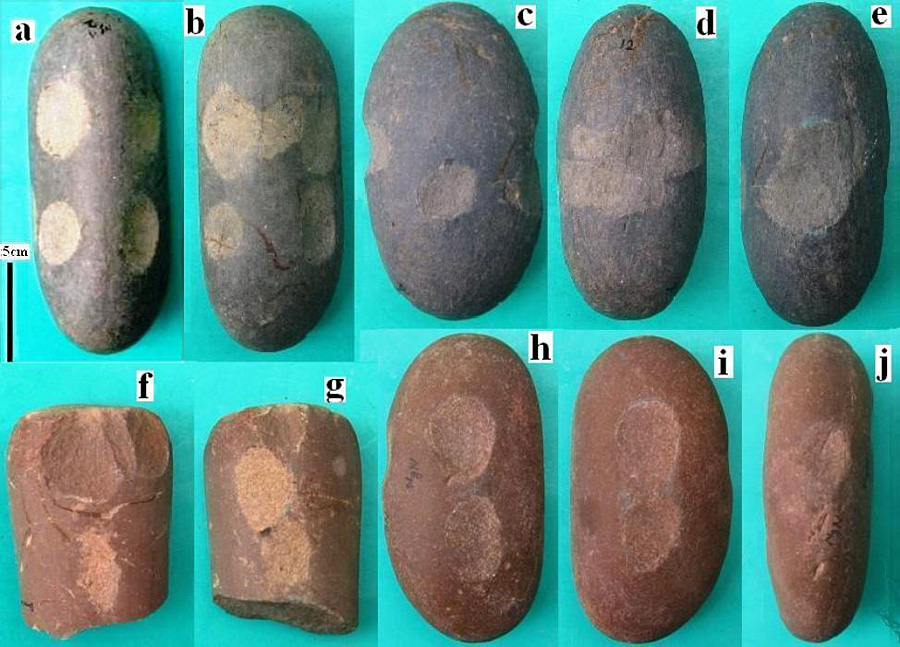
a & b) Two faces of an elongate cobble showing twin and multiple pits; ce) Multiple pits on one face and overlapping pits on both edges of an oval cobble; f & g) twin pits on one face and a single pit on the opposite face of a broken hammer with highly battered proximal end; hj) twin pits on both faces and one edge of a cobble.
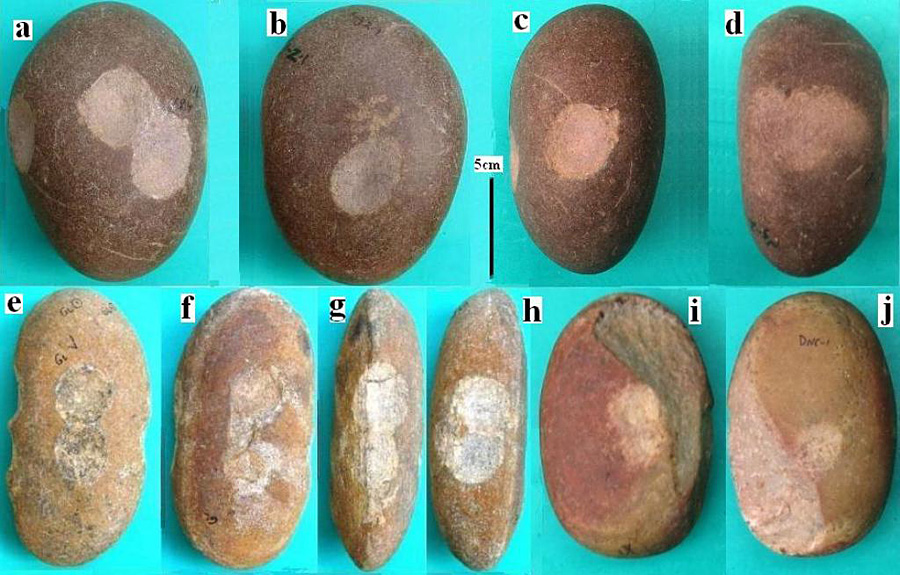
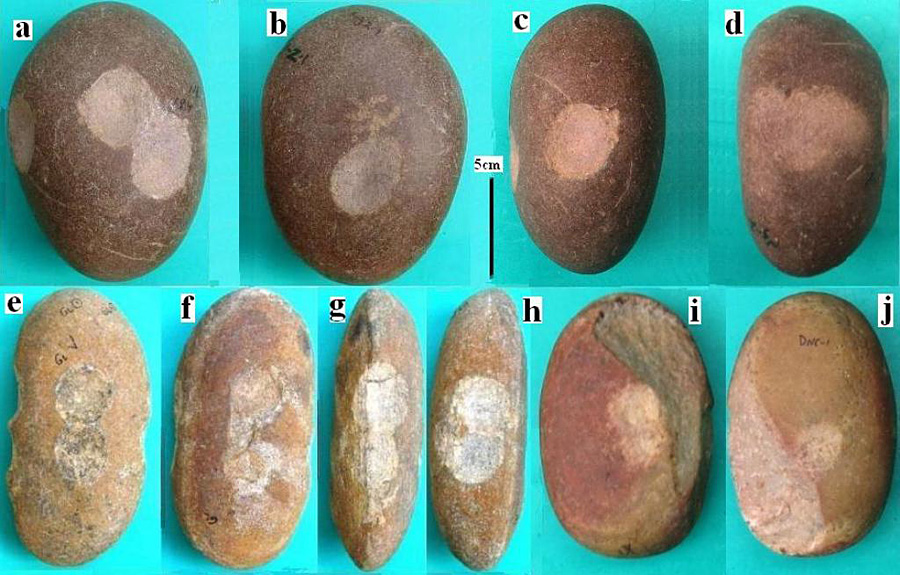
ad) Pits on faces and edges of an oval cobble ('b' with a design pecked above a pit and 'd' with overlapping pits); eh) twin pits on both faces and edges of a cobble; i & j) twin pits on one face and a single pit on the opposite face of a bifacially flaked cobble.
ac) Cortical faces and one lateral side of a hexagonoidal core with an elongate groove ground on each face; d & e) overlapping oblong pits on one edge each of two cobbles with multiple pits on faces; f) battered end and pecked face of a small cobble.

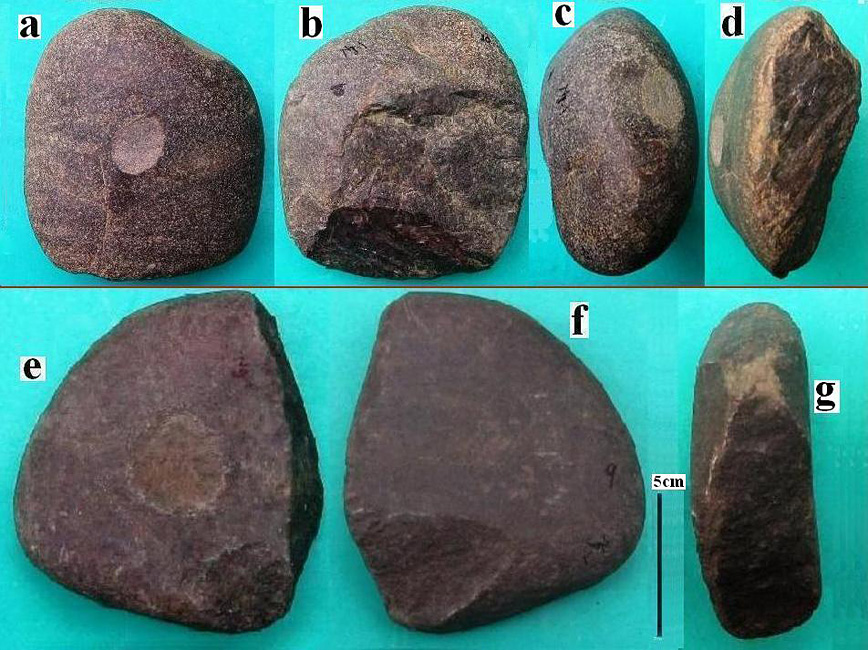
ad) Split cobble, showing pitted dorsal face and flaked ventral face, pitted proximal end and battered distal end; eg) half circular cobble with one face pitted, opposite face pecked and battering on its pointed corner.

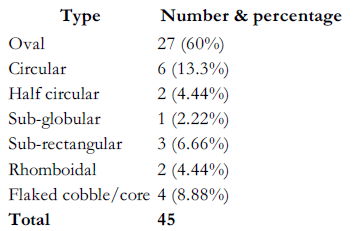
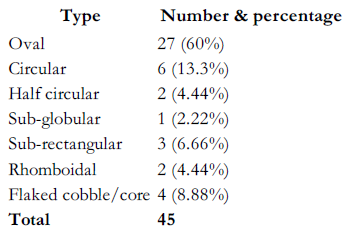
The pitted cobbles from the Nangal-Kiratpur region can be classified according to their shapes (Table 1). Their sizes range from 8.3 x 5.2 x 3.5cm (length x breadth x thickness) to 20.1 x 15.5 x 12.4cm and weights range from 210g to 1930g. The pits on the cobbles range in length, breadth and depth from 9 x 7 x 0.4mm to 43.4 x 33 x 8mm. The pits have different locations on the supports and vary in form; most are oval or circular but a few are oblong. The single and twin pits are mostly located in the centre of the faces and edges of the cobbles (Figures 2a, ce; 3hj; 4ej); multiple pits can be off-centre and others overlap each other (Figures 3 & 4). One stone is a core with six unequal flaked sides and elongated and wide grooves made by longitudinal grinding on both its flat cortical faces (Figure 5ac). Many specimens could have been used as hammers as 15 exemplars show signs of battering at their extremities (Figures 3fg; 5f & 6). Some cobbles have shallow pits made by pecking (Figures 2f & 5f), probably prior to grinding, and about 25% of all the pits on all the cobbles are pecked in circular shapes. Some ground circular pits on the faces and oblong pits on the lateral edges could have been caused by friction, for example for making fire. Pits on the faces of some cobbles with battered extremities might have provided an easy grip for pounding. The pitted cobbles from the Nangal site complex may perhaps also have been used for breaking seeded nuts or processing shellfish, which would have been available locally.
Earlier surveys in the sub-Himalayas did not report pitted cobbles, but our collection from a small area shows that they certainly do exist. Most of these tools appear to belong to Holocene contexts: we hope to have drawn attention to this class of artefact in India which raises intriguing archaeological as well as ethnological questions.
Acknowledgements
We are thankful to N. Suresh for dating of the sediment sample and to Parth Chaohan for useful suggestions on the initial manuscript.