


4.1 Introduction
The Russian invasion of Ukraine was preceded and accompanied by the Kremlin-driven portrayal of its neighbour as a non-sovereign state, run by a ‘junta’, a nation that had to be ‘de-nazified’ and ‘de-militarized’.Footnote 1 Starting as the central point of the daily current affairs agenda of the Russian media at the end of 2013, it became Putin’s main narrative for legitimising, at first, the annexation of Crimea and covert encroachment in the east of Ukraine, and since 24 February 2022 the full-scale invasion, in clear violation of international law.Footnote 2
The unequivocal condemnation of the full-scale invasion by states around the globe triggered a multiplicity of reactions, including the rapid adoption and implementation of extensive sanctions by, inter alia, the European Union (EU), the United States, Australia, Canada, Japan, Norway, South Korea, and the United Kingdom. In the absence of actions from the United Nations, paralyzed by the position of the aggressor as a permanent member of the Security Council with veto power, the protection of global security fell upon states and intergovernmental organisations such as the EU.Footnote 3 The latter played the key role in the process of enacting the sanctions, described as that of the ‘militant defender of democracy’ against military aggression and ‘foreign information manipulations and interference’.Footnote 4
A particularly significant tier of the EU sanctions was born out of the Decision and Regulation of the Council of the EU of 1 March 2022. It was aimed at certain Russian state-run audiovisual media and key media actors that were using manipulative propaganda narratives related to the war in Ukraine and directed by the Kremlin.Footnote 5 The regulation by the Council of the European Union on media sanctions prohibited ‘operators to broadcast or to enable, facilitate or otherwise contribute to broadcast, any content by [the targeted media], including through transmission or distribution by any means such as cable, satellite, IP-TV, internet service providers, internet video-sharing platforms or applications, whether new or pre-installed’.Footnote 6
Later during 2022–2025, the regulation was expanded and extended.Footnote 7 The additional sanctions were separately introduced to target Russian individuals with prominent positions within broadcasting, online, and/or print media who were considered ‘responsible for supporting actions and policies which undermine the territorial integrity, sovereignty and independence of Ukraine’.Footnote 8
These ‘propaganda sanctions’ and subsequent judgements by the Court of Justice of the European Union (CJEU) challenge the infallible status of an almost absolute media freedom in the Western regulatory debate on harmful media content. Arguments on the impermissibility of censorship and on the limited power of the state to interfere with editorial independence were tabled by entrenched critics. On one hand the sanctions have been sceptically received and scrutinised, while others have called for a more expansive use of sanctions to counter foreign influence operations.Footnote 9 Adverse reactions highlight the measures’ chilling effect on freedom of expression, freedom of information, and media freedom and the potentially dangerous precedent that this case forms. Outright sanctions have suddenly become a ‘new normal’ in international and national media regulation,Footnote 10 blessed by a number of top court decisions.Footnote 11
In the authors’ view, there is no doubt of a pressing social need to find ways and means to address the proliferation of harmful disinformation and propaganda, especially online, including through reinterpretation of the international paradigm of freedom and pluralism of the media while preserving democratic principles. Acknowledging different views, this chapter centres on the question of whether sanctions on media outlets are capable, sustainable, and appropriate to fit the future free-speech rights-based regulatory and policy paradigm and, if so, which parameters should be taken into consideration to prevent endangerment of fundamental freedoms.
The argument stands that the present pattern of sanctions by the EU is something of a novelty and raises a number of questions, problems, and opportunities. The divergence of the EU’s restrictive measures’ objective from the traditional economic sanctions paradigm and the centralisation of propagandistic content and disinformation as the earmark for banning the outlets raise conceptual questions and expose the problem with content-based regulatory approaches. Comparable sanctions against Russian media on the national level show that there are alternatives to be considered that are less content-focused. Building on these considerations, to answer the outlined question we propose a different, tripartite framework, focusing on self-regulation and ‘aggressor state’ features rather than on the notion of war propaganda.
In addressing these points of contention, this chapter works towards proposing an alternative approach to media sanctions focusing on three key elements: 1) behaviour and content; 2) the essence of independent media and quality journalism; and 3) the country of origin. After positioning the EU’s restrictive measures (Section 4.2) amidst the broader landscape of sanctions on Russian media (Section 4.3), the core issues with the ‘propaganda model’ of the EU are highlighted, with a focus on the lack of conceptual clarity and inconsistent interpretation (Section 4.4). The framework presented does not aspire to overcome all these hurdles but aims to present an alternative to achieve a similar outcome through more befitting means.
4.2 The EU’s Restrictive Measures
Traditionally, the basic objective of national or international economic sanctions has been defined as ‘applying political and economic pressure upon the governing élite of the country to persuade them to conform to international law’.Footnote 12 These inherently political tools have long formed part of international discourse as the instrument of choice to respond to international threats to peace and security, and they have increasingly become the go-to tool to address such behaviour.Footnote 13 The nature of the recent EU sanctions, or ‘restrictive measures’, towards alien Russian media actors, however, seems to be far from putting economic or political pressure on the governing élite, although they clearly are part of the broader condemnation of Russia’s behaviour and of efforts to end the aggression in Ukraine.
The recitals of both the decision and the regulation outline the direct cause of the measures: that the Russian Federation ‘has engaged in a systematic, international campaign of media manipulation and distortion of facts in order to enhance its strategy of destabilisation of its neighbouring countries and of the Union and its Member States’ (Recital 6), whereby it is of particular importance that ‘[t]hese propaganda actions have been channelled through a number of media outlets under the permanent direct or indirect control of the leadership of the Russian Federation’. The legitimising factor is attributed to the observation that ‘[s]uch actions constitute a significant and direct threat to the Union’s public order and security’ (Recital 8) and ‘are essential and instrumental in bringing forward and supporting the aggression against Ukraine, and for the destabilisation of its neighbouring countries’ (Recital 9). The restrictive measures will be kept in place ‘until the aggression against Ukraine is put to an end, and until the Russian Federation, and its associated media outlets, cease to conduct propaganda actions against the Union and its Member States’ (Recital 10).Footnote 14
In short, the apparent aim is to protect the population of the state(s) responsible for the imposition, maintenance, and implementation of the sanctions from ‘manipulation and distortion of facts’ as part of the strategy of destabilisation.Footnote 15 The measure is seemingly considered among ‘possible new tools’ ‘to counter hybrid threats, including disinformation’, both as ‘preventive measures’ and ‘possible responses’.Footnote 16 ‘Destabilisation’, by being included as a threat in the EU regulation, appears, through its positioning alongside concerns for national security and public order, to receive the status of a threat to protected public interests in international law.
The choice of prohibitive sanctions against media – in comparison with less intrusive measures – was explained by the CJEU: ‘other measures would not have achieved the same outcome, since some of them – such as the prohibition on the broadcasting of certain content, in the case of a rolling news channel – would have been practically impossible to implement, while others – such as the obligation to display a banner or indeed a warning – would have been of limited effectiveness’.Footnote 17
Notwithstanding these considerations, the expeditious use of the sanctions to target media without legally defined safeguards to protect fundamental rights, alongside the questionable application of freedom of expression principles by the CJEU, appear somewhat antithetical to the aim of media pluralism in Europe.Footnote 18 The way the CJEU made the restrictive measures not targeted to narrowly understood propaganda for war,Footnote 19 but general in nature,Footnote 20 opens the door for sanction regimes affecting a variety of journalistic activities in other fields that are not war-related.Footnote 21 The argument that the EU, not being a direct party to the military conflict from a legal standpoint, considers the maintenance of peace and international security to outweigh the negative effects on the freedom of Russian media outlets in Europe has been considered ‘a dangerous Rubicon crossed’.Footnote 22 In addition, the effectiveness of these actions has already been questioned.Footnote 23 Circumvention of the broadcasting measures through the use of different domains, proxy services, more covert platforms such as Telegram, and even Russian diplomatic missions’ online channels, illustrates the need for more consideration of enforcement tout court and a sharper focus on what exactly it is the measures aim to achieve and whether alternatives should be considered.
4.3 Sanctions on Russian Media
These sanctions may appear unprecedented, but in fact certain Eastern European and Baltic states have relied for many years on existing national regulations of media authority and media legislation on, inter alia, countering foreign media market influence, addressing foreign commercial advertising, prohibiting disinformation and propaganda through specific broadcasting rules, journalistic principles and codes, and/or recognised forms of illegal speech (incitement to violence, glorification of terrorism, hate speech, etc.) to reduce the presence of the Kremlin’s narratives in their media landscape.Footnote 24 As part of the response to the hysteria in Moscow’s state-run media following Crimean annexation, Ukraine, the Baltic states, and Moldova imposed seemingly unpreceded restrictive national measures in the form of broadcasting suspensions and bans on Russian audiovisual media channels, companies, and actors.Footnote 25 In 2014, the EU, as well, introduced personal economic sanctions against those responsible for the aggression; these included one media actor, Dmitry Kiselyov, described as a ‘[c]entral figure of the government propaganda supporting the deployment of Russian forces in Ukraine’.Footnote 26
Many of the national sanctions did not take a propaganda-based approach like that of the 2022 EU restrictive measures. Ukraine, for example, after the 2014 annexation of Crimea, developed a workable legislative model against foreign and then domestic alien propaganda and disinformation though a system of sanctions, which was challenged by Russians broadcasting outlets but upheld by the highest national courts.Footnote 27 Rather than focusing on the content of the messages, leading to nearly unprovable standards of malicious intent and harmful consequences, the Ukrainian model bans all messages from an adversarial source through legislation and the subsequent rulings of national media regulators.Footnote 28
In a similar vein, Latvia and Lithuania have since 2015 systematically suspended rebroadcasting of Russian media on the grounds of inciting hatred with reference to Articles 3(4)(a)(i) and 6 of the Audiovisual Media Services Directive.Footnote 29 Additionally, the EU’s personal sanctions against Dmitry Kiselyov started a chain reaction in Estonia and Latvia, where governments used them as a basis to sanction ‘non-designated entities’: national media affiliates of the news agency that Kiselyov managed in those countries, as economic resources controlled by the ‘designated’ sanctioned person. Likewise, the restrictive measures against the ‘designated’ Rossiya Bank, its chair and key shareholders were also applied to the bank’s media assets in the Baltics.Footnote 30 The Baltic model of long-term suspensions and related sanctions was known to, and even approved by, the European Commission.Footnote 31
4.4 The ‘Propaganda’ Model
These sanctions strongly rely on the implied illegitimacy of propaganda and disinformation, specifically propaganda for war. Both notions, however, suffer from significant conceptual uncertainty and lack legal delineation. Exposing this conceptual vagueness reveals the tension between the EU model and requirement of legal certainty, and the risks of censorship and chilling effects on other, legitimate journalistic activities.
4.4.1 Propaganda or Propaganda for War?
The definition of ‘propaganda’ is ambiguous:Footnote 32 propaganda might be false or true, and it may pursue a variety of purposes and be driven by different motives. Despite the lack of conceptual consensus, some characteristics have been identified over the past century. The aim of influencing people’s opinion is essential to an understanding of propaganda.Footnote 33 In one of its recent opinions, the Venice Commission of the Council of Europe stated that the notion ‘propaganda’ usually ‘makes reference to an activity aimed at proselytising people to certain ideas and opinions’.Footnote 34 Sinha, in a legal article aimed at defining propaganda, points to a general consensus that the notion includes an element of manipulation or distortion of the rational will of a person, and that it must also have both persuasive power and persuasive effect.Footnote 35 In this context it is important to recall that in the early days of the UN, the General Assembly pointed out that propagandistic activity goes hand in hand with the media being controlled and/or deprived of its freedom to report on relevant events and dissenting opinions.Footnote 36 Likewise, Lumley – one of the first scholars to comprehensively address the phenomenon of propaganda – described the set of propaganda techniques as a combination of ‘suppression, distortion, diversion and fabrication’.Footnote 37
Emphasising its versatile character, McGonagle notes that ‘propaganda’ covers ‘a range of different types of expression which vary in terms of the harmfulness of their content, the sophistication of their presentation and strategies of dissemination and the gravity of their effects’.Footnote 38 Indeed, there is a need to distinguish – at the level of law and policy – two sorts of propaganda. The first covers illegal forms of speech, including propaganda for war, as well as expressions of national, racial, or religious hatred that constitute incitement to discrimination or violence, as defined in international and national law. It demands judicial action with the appropriate measures in line with international human rights law (IHRL) standards. The second type of propaganda includes all the rest, popularly characterised as ‘awful but lawful’; it may be inappropriate and contemptible activity, it may damage the profession of journalism, but it does not necessarily call for legal action.
Unlike ‘propaganda’ in general, ‘war propaganda’ has more solid features,Footnote 39 even though the UN Special Rapporteur on Freedom of Expression recently observed a ‘confusion among some States and companies about [the] scope [of propaganda for war]’ and underlined the need for its further clarification.Footnote 40 This was an unsurprising conclusion since the notion (re)entered international debate only after it was brought back from near-oblivion following the start of the military conflict in Ukraine in 2014.
Historically, in 1947, the UN General Assembly (UNGA) gave a rather distinct definition of war propaganda by saying that it may represent any form of propaganda ‘which is either designed or likely to provoke or encourage any threat to the peace, breach of the peace, or act of aggression’.Footnote 41 It thus gave an intent or a threat of hostilities as the criterion for the illegal act. At about the same time, the UNGA further elaborated on the definition of propaganda for war by stating that it also includes ‘propaganda against peace’: that is, ‘measures tending to isolate the peoples from any contact with the outside world, by preventing the Press, radio and other media of communication from reporting international events, and thus hindering mutual comprehension and understanding between peoples’.Footnote 42 Thus an intrinsic element of such propaganda became activities by governments ‘tending to silence or distort the activities of United Nations in favour of peace or to prevent their peoples from knowing the views of other States Members’.Footnote 43
Following the entry into force of the obligation to prohibit propaganda for war by national law in Article 20(1) of the International Covenant on Civil and Political Rights (ICCPR),Footnote 44 any distinct formula of such propaganda will also take into account its scope as suggested by the UN Human Rights Committee (UNHRC). This entails that such prohibitions would need to extend to all forms of propaganda threatening or resulting in an act of aggression or breach of the peace contrary to the Charter of the United Nations and aimed at both the internal and the external public to the state concerned.Footnote 45
While the UNHRC refers to all forms of propaganda for war, it makes an important exclusion from the scope of the crime by saying that ‘[t]he provisions of article 20, paragraph 1, do not prohibit advocacy of the sovereign right of self-defence or the right of peoples to self-determination and independence in accordance with the Charter of the United Nations’.Footnote 46 By self-defence, the Charter means exclusively measures taken by a member of the United Nations ‘if an armed attack occurs against’ it.Footnote 47 Other forms of propaganda inciting to such manifestations of violence as civil war or rebellion against the government are treated under either Article 20(2) or Article 19(3) of the ICCPR in the context of the Preamble of the Universal Declaration of Human Rights.Footnote 48 In the current situation in Europe, it is important to watch attempts to include, within the meaning of ‘propaganda for war’, propaganda for and conduct of an ‘ideological war’, ‘information warfare’, or a ‘hybrid war’.Footnote 49
In upholding the 2022 EU sanctions, the CJEU referred to Article 20(1) of the ICCPR and interpreted it by saying that propaganda for war includes:
(1) propaganda ‘in favour of the military aggression against Ukraine targeted at civil society in the [European] Union and neighbouring countries’,
(2) broadly understood propaganda at war, described as propaganda being ‘part of the context of an ongoing war’, started by an aggressor state, ‘in breach of the prohibition on the use of force’, and
(3) ‘not only incitement to a future war, but also continuous, repeated and concerted statements in support of an ongoing war’, unleashed contrary to international law, ‘especially where those statements come from a media outlet under the direct or indirect control of the aggressor State’.
Importantly, this statement observed that ‘maintaining peace and international security’ outweighs ‘significantly’ the negative effect on/for the freedom of the sanctioned Russian media outlet in Europe.Footnote 50
Some experts criticise the court’s argumentation for the fact that, although Article 20(1) ICCPR indeed imposes an obligation upon states to prohibit propaganda for war, it has been a dormant provision for decades and continues to suffer from considerable conceptual ambiguity. In addition, critics argue that by no means does its norm indicate that a ban on media outlets for broadcasting propaganda for or at war by an executive authority, without an order from a court, would comply with international law.Footnote 51 In addition, the legal distinction between propaganda for war and other forms of propaganda or disinformation is blurred.
Recently, doubts have also been voiced as to whether a prohibition of propaganda for war can be applied during an armed conflict or whether it is appropriate only in times of peace.Footnote 52 Perhaps the latter understanding is rooted in the misconception that during war the rules of international humanitarian law (IHL) prevail,Footnote 53 while IHRL goes into the shadows. On the other hand, it is broadly recognised today that both IHL and IHRL apply during armed conflicts and that they provide complementary and mutually reinforcing protection.Footnote 54 This means that while the emergence of an armed conflict triggers the applicability of IHL, it does not suspend the applicability of IHRL.Footnote 55 Such a position was also confirmed by the CJEU, which noted that propaganda for war should be stopped even after a war has started.Footnote 56
4.4.2 Information or Disinformation?
The notion of disinformation possibly faces even more controversy, in part due to its conceptual overlap with other, similar terms. We acknowledge the existence and use of such terminology by, inter alia, Wardle and Derakhshan, who draw a distinction between disinformation, misinformation, and malinformation based on the harm, the intent, and the level of facticity.Footnote 57 We suggest, though, sticking to ‘disinformation’ as exactly this tactic is used in propaganda; it is also a less politicised term; and it reflects both the 2021 EU regulations and some national laws in Europe.Footnote 58
The ordinary meaning of ‘disinformation’ ranges from ‘false information deliberately and often covertly spread (as by the planting of rumours) in order to influence public opinion or obscure the truth’ (Merriam-Webster), and ‘false information spread in order to deceive people’ (Cambridge Dictionary), to ‘false information which is intended to mislead, especially propaganda issued by a government organization to a rival power or the media’ (Oxford English Dictionary). Spreading outright false content is, however, only one technique used in disinformation; others include distortion of information, as well as misleading the audience and manipulative tactics such as fake profiles and false engagement to artificially amplify narratives on, inter alia, specific political issues and to exploit existing divisions in society.Footnote 59
The European Commission (EC) provides a relevant practical definition of disinformation as ‘verifiably false or misleading information that, cumulatively, is created, presented and disseminated for economic gain or to intentionally deceive the public and that may cause public harm’.Footnote 60 Public harm includes threats to democratic processes as well as to public goods such as EU citizens’ health, environment, or security. The EC concludes that disinformation does not include misleading advertising, reporting errors, satire and parody, or clearly identified partisan news and commentary.Footnote 61
A further analysis of international documents and commentaries has brought us towards a differentiation between the following three types of political lies: (1) illegal disinformation, (2) legal disinformation that ‘may cause public harm’, and (3) legal and harmless disinformation.Footnote 62
Under international law, (dis)information is illegal if it serves propaganda for war or aggression or the advocacy of national, racial, or religious hatred that constitutes incitement to discrimination or violence (Article 20 ICCPR). It may also be subject to certain restrictions if it violates the rights of others or national security, public order, public health, or morals (Article 19 ICCPR). But with certain exceptions, it remains generally irrelevant, whether such illegal information is false or truthful. In fact, the European Court of Human Rights (ECtHR) and other intergovernmental institutions underline that disinformation should not be prohibited merely on the grounds of falsity.Footnote 63 Moreover, scholars agree that ‘[l]imiting news output to “true” – essentially state-sanctioned – information could pose an even greater threat to democracy than disinformation itself’.Footnote 64
Harmful but legal disinformation consists of threats to democratic processes as well as to public goods, which include health, the environment, and security.Footnote 65 Again, such threats typically come from the propaganda campaigns rather than disinformation for the sake of lying, although we admit that falsities may be used just to spread panic and test the integrity of public order or national security. At least on the EU level, they are countered with
(1) improving the capabilities of EU institutions to detect, analyse, and expose disinformation;
(2) strengthening coordinated and joint responses of the states to disinformation;
(3) mobilising the private sector to tackle disinformation through co-regulation and self-regulation; and
(4) raising awareness and improving societal resilience.Footnote 66
All other falsities should remain legal and exist without governmental or intergovernmental interference; this category may include, in particular, satire and parody, as well as clearly identifiable partisan news and voices.
Within our categorisation, disinformation is a subset, a means of propaganda, while the ends or goals are generally determined by the broader propagandist’s aims. Unfortunately, certain intergovernmental institutions and scholars use the two terms interchangeably or exclusively focus on disinformation as the public evil in itself.Footnote 67 The terminological debate remains far from settled and is becoming increasingly polarised. Legal prohibition or restriction of any disinformation or all propaganda, including through sanctions, should therefore be approached with restraint and great caution. With this in mind and to more effectively achieve the objectives of the EU’s restrictive measures, we propose a model that limits the qualification as ‘propaganda’ or ‘disinformation’ to when the content of the messages falls within the internationally recognised scope of forms of illegal speech.
4.5 Looking Forward: Cornering Alien Propaganda Media
For future regulation, through sanctions or otherwise, the alternative lies in the promotion of quality journalism, editorial independence, and independent media. The balance between under- and over-inclusion of sanctions against media outlets – leading to undue restriction or the risk of ineffectiveness – should be found by looking at three elements (see Figure 4.1):
(1) the content of the messages and how these are disseminated by the respective outlet (behaviour and content);
(2) to what extent the targeted outlets align with the essence of independent media and quality journalism (media essence); and
(3) the level of involvement of an aggressor state with the outlets (control by an ‘aggressor state’).
A nuanced reflection, rather than exclusive reliance, on these three pillars would provide for a more structured and consistent assessment of whether (due) restrictions on media are capable of falling within the legitimate limits of the media entities’ freedom of expression, thus minimising unwanted interference with media freedom and media pluralism.
Limits of media freedom.
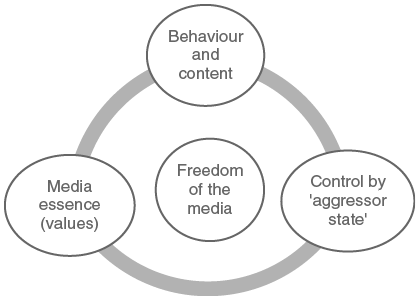
Figure 4.1 Long description
The balance between under- and overinclusion of sanctions of media outlets leading to undue restriction or the risk of ineffectiveness should be found by looking at: (I) The content of the messages and how these are disseminated by the respective outlet (‘Behaviour and content’); (II) to what extent the targeted outlets align with the essence of independent media and quality journalism (‘Media essence’); and (III) The level of involvement of an aggressor State with the outlets (‘Control by ‘aggressor State’).
4.5.1 Behaviour and Content
Disseminating illegal content or engaging in non-authentic behaviour, through, inter alia, the use of fake accounts, automated bots, or algorithmic amplification of content, is irreconcilable with any standard for quality journalism and independent media. Nevertheless, as explained in Section 4.4, it is only where messages or statements characterised as ‘propaganda’ or ‘disinformation’ effectively, substantially, and systematically overlap with illegal forms of speech (such as incitement to terrorism, ‘hate speech’, propaganda for war, etc.) that there is a convincing legal justification for restricting free speech, including through sanctions. The only content-based restriction in European jurisprudence without regard to the context and the effect is the public denial of the Holocaust.Footnote 68 Many occurrences of disinformation or propaganda, including those named in the EU’s restrictive measures, do not fall into this category. This does not make their content irrelevant, but it makes it insufficient to uphold such interference with fundamental rights. In light of the present confusion about the precise meaning and scope of ‘propaganda for war’, a modern UNHRC General Comment on that matter, taking on board the views and practice that have emerged over the last forty years, would be a very welcome and much-needed development.
When the illegality of content is disputed, the behaviour surrounding the dissemination of the messages could justify a legal response. The authenticity of the actors active on or within media outlets is directly connected to a democratic understanding of media freedom; automated content and the use of artificial personas and bots indicates a lack of transparency and lack of dedication by the media actors to contributing to democratic public debate.
4.5.2 Media Essence
Centralising the characterisation of the media entity as such, different indicators could be taken into consideration to differentiate independent news media from (state) propagandists, including by focusing on indicators that reflect the core of independent media and quality journalism.Footnote 69 Such indicators include the adherence to and actual use of editorial guidelines, journalistic professional standards, self-regulation mechanisms, and broad public control and/or transparency of media’s business side. These indicators are by no means exhaustive but help to gauge the level of opaqueness that is irreconcilable with the parameters of said standards.Footnote 70
4.5.2.1 Editorial Guidelines and Media Self-Regulation
Omnipresent propaganda and disinformation challenge public trust in the media are alien to the spirit of free media. They hit at the core of the prestige and respect that independent media can enjoy in a democratic society. This practice also makes bona fide journalists victims of intentionally false, manufactured, and biased news.
A feature of the media targeted by the sanctions, which was largely missing from the research and discussion of the issue, is that unlike their Western counterparts that target foreign audiences, none of the Russian international channels make publicly available their editorial guidelines (and we doubt that they exist at all) or programming principles, the editorial statutes (charters) of their media outlets, their professional and ethical codes for their journalists, or any other professional standards. Dmitri Kiselyov once made the illustrative remark that ‘[i]f we speak about the editorial policy, of course, I would certainly want it to be associated with love for Russia’.Footnote 71 The only identified standards in the national Russian media are the style guides, which, though they generally focus on how to structure and implement content rather than on substance, may still play an important role in terms of political editorial directives.Footnote 72 Research, however, shows that although the style guides exist, they are hardly used for editorial checks.Footnote 73
Forms of self-regulation may assist in finding the balance between independence and keeping political censorship at a distance, while imposing the necessary professional standards. The presence of self-regulation initiatives, through establishing independent press councils, (digital) ombudspersons, or organised peer review, has already been considered essential in realising free media as a pillar of democratic society. In addition to independence and ensuring professionalism, self-regulation also serves as a tool for media accountability.Footnote 74 Decisions of self-regulation bodies can also lay grounds for the courts and national regulatory authorities to distinguish bona fide journalists from propagandists who perform under the guise of media actors. The media councils of the countries of the EU Eastern PartnershipFootnote 75 (as well as their Russian equivalent) even conveniently approved, in 2016, specific and practical criteria to distinguish propaganda from journalism in mass media.Footnote 76
For a number of years, the ECtHR has reiterated that ‘[i]n a world in which the individual is confronted with vast quantities of information circulated via traditional and electronic media and involving an ever-growing number of players, monitoring compliance with journalistic ethics takes on added importance’.Footnote 77 As can be seen from a number of its judgements, the level of protection for journalists and other media actors under Article 10 (‘Freedom of Expression’) of the European Convention on Human Rights (ECHR)Footnote 78 often depends on whether they act in line with their professional standards as defined by domestic codes of practice and the assessments of domestic self-regulation bodies.Footnote 79 The ECtHR is very sensitive to the evaluations made by journalists’ self-regulation mechanisms in cases related to freedom of the media. When deciding whether or not the applicant mass media entity or journalist has additional privileges under Article 10 of the ECHR, the court has reasoned that violations of professional codes or rulings by press councils were sufficient indications for depriving the applicants of additional privileges under the right to freedom of expression.Footnote 80
To draw on the case of Russian ‘designated’ media, both RT and Sputnik have consistently refused to engage in available complaints procedures or self-regulation mechanisms.Footnote 81 Nor have they recognised the Russian Union of Journalists’ Code of Professional Ethics or the Ethical Standards of the MediaFootnote 82 – the only two practically applicable national codes – as professional standards.Footnote 83 Repeated violation of these standards by Russian state propagandists is also noted in the statements of international civil society organisations that advocate media freedom.Footnote 84 Although the Russian media are largely funded by the state, the conditions of their broadcast licences also do not refer to any editorial standards or accountability to the public. The CJEU, when adjudicating on the applicability of sanctions against Dmitry Kiselyov, referred in its judgement also to the resolution made by the Russian self-regulation body wherein it found that Kiselyov’s presentation of a TV programme on the coverage of events in Ukraine contained propaganda contrary to journalistic principles and aimed to manipulate Russian public opinion through disinformation techniques. It was then that Kiselyov refused to stand before the self-regulation body.Footnote 85
While the courts generally do not assess adherence to professional or ethical norms by the media and media professionals, such peer assessment may play a role in a court judgement as to the intent, approach, or (systematic) practice of media actors in disseminating lies and manipulating audiences.
4.5.2.2 Control Structures and Financial Transparency
The European media model comprises public service media involving the coexistence of public service, commercial, and community media.Footnote 86 This model does not envision, and can actually be threatened by, state-run media, a phenomenon that is in itself alien to freedom of expression in a democracy.
The role of the financial and organisational structures of media outlets within this sanction paradigm is twofold. In Russia, many large media companies are owned either by the state or by state-controlled oil/gas and financial companies.Footnote 87 Sectoral sanctions, such as those imposed in 2014 targeting the ‘parent’ companies, had already had an indirect effect on the Russian media landscape.Footnote 88 From the perspective of targeted sanctions, the extent to which media outlets are under (permanent) direct or indirect control of a state could be considered as having implications for their qualification as bona fide ‘independent media’ within a European model or as detrimental to media freedom ‘propaganda channels’,Footnote 89 thus facilitating an assessment of the appropriateness and proportionality of sanctions. In the case of Russian state-run media, several indicators show that these outlets again differ significantly from publicly owned Western media. They lack transparent organisational and financial structures; the degree of government involvement in their activities is significant, reflecting a lack of editorial independence;Footnote 90 and, remarkably, representatives of such outlets have even acknowledged their role in disseminating and amplifying Kremlin-driven narratives.Footnote 91 Detailed research has illustrated that their managerial structure, leadership hierarchy, and general staffing are near inscrutable. The same applies to their financial transparency: the outlets provide unverifiable and contradictory budgetary information and do not provide public budget sheets or detailed annual financial reports, even in violation of national reporting obligations.Footnote 92
Though a lack of transparency in these financial and organisational structures does not automatically mean that they are de facto agents of the state, the degree of affiliation provides a valuable indicator for standard setting: if these media outlets are under effective control of a state, they are less eligible to invoke freedom of expression rights.Footnote 93 Conversely, if this is not the case, the focal point of enquiry shifts towards determining whether the content’s nature allows for reasonably warranted limitations. Incorporating these indicators in future standard-setting would allow for a more objective determination based on the status of the actor.
4.5.3 Control by an ‘Aggressor State’
A more general indicator of the threefold approach to restrictive measures includes the state of origin rather than the media outlet itself. Intrinsically linked to the previously discussed indicators, it is the overt or covert involvement and influence of an aggressor state that ultimately makes the problem for the international community.
An example can be found in part of Ukraine’s sanction model. Following the Ukrainian Parliament’s declaration of Russia as an ‘aggressor state’ in 2015, a blanket ban on ownership or participation in television or radio entities that are registered in countries formally recognised as aggressor states was introduced, along with other restrictions.Footnote 94 Similarly, in the United States, there have been calls to impose the same label upon Russia, enabling maximum ‘diplomatic and economic tools’ and aiming to ‘create a blueprint for coordination with partners’.Footnote 95
Several neighbouring countries and the European Parliament have declared Russia a ‘state sponsor of terrorism’, another label instrumental in the country-of-origin considerations of media restrictions.Footnote 96 Outlets that are under the permanent direct or indirect control of such a state lose their claim of qualifying as independent media and cannot present their output as quality journalism. How and under whose authority such declarations or labels come into being, and which procedural safeguards are in place to prevent their arbitrary and abusive application, remain points of contention that warrant close scrutiny.
4.6 Conclusion
There is no doubt that current propaganda campaigns in favour of Russia’s armed invasion in Ukraine are full of disinformation and Kremlin narratives, and present risks to security in the EU and beyond. Security concerns should not, however, overtake the discussion on propaganda and disinformation today; the issue should rather be tackled jointly within both the human rights framework and that of national security and other public interests.
The right to freedom of expression is not absolute, and its exercise may indeed be subject to restrictions when necessary for the protection of internationally recognised interests. Such limitations may be relevant for both truthful and untrue information; however, they should always be proportionate and entail the least intrusive measures.
International law narrowly prohibits only some sorts of speech, such as propaganda for war and incitement to hatred, but does not prohibit speech on the grounds of its falsity. In the authors’ view, the modern national experience of introducing sanctions targeting Kremlin’s media actors – and having them approved by the national courts – served as a model for the EU’s post-2021 sanctions. Broadly formulated objectives that fall outside the paradigm of traditional economic sanctions, however, raise questions on effectiveness and undue reliance on equivocal legal doctrine that are cause for concern.
In the authors’ opinion, the same end can, however, be achieved through different, more fitting, means. For sanctions and other regulatory endeavours to be justified and to fit the liberal understanding of media freedom, there should be clearly defined criteria in international law. These should enable the distinguishing of alien propaganda channels from bona fide independent news media. The crucial indicators we have singled out, beyond actual content and behaviour, include those reflecting the nature of independent media and quality journalism (in the eyes of the professional community), as well as the absence of administrative and financial ties of media outlets with the state, especially when the state is formally recognised as an aggressor.

 Open access