





Introduction
Legislators across the world have always come from more privileged social classes than the average citizen, but the class composition of parliaments has become even more homogeneous over the past decades. While legislators from working-class occupations make up only 5 percent of parliamentarians in OECD countries on average today (Carnes and Lupu Reference Carnes, Lupu, Lupu and Pontusson2024), we see a parallel rise of professionalized ‘career politicians’ (Henn Reference Henn2018), meaning legislators with high formal education and little occupational experience outside politics. Inequality scholars have pointed to the implications of these narrowing class backgrounds for political representation, showing that legislators from working-class occupations tend to push for more economically liberal policies than their white-collar colleagues (Borwein Reference Borwein2022; Carnes Reference Carnes2013; Curto-Grau and Gallego Reference Curto-Grau, Gallego, Lupu and Pontusson2024), while ‘careerists’ tend to align with the dominant party position due to strategic concerns (O’Grady Reference O’Grady2019). In addition to these implications for substantive representation, workers’ underrepresentation might also influence the perceived legitimacy of the legislature, alienating (working-class) citizens from policymakers and the political system in general (Barnes, Kerevel, and Saxton Reference Barnes, Kerevel and Saxton2023; Heath Reference Heath2018).
Against this background, scholars have increasingly started to ask why so few workers run for office and how the increased professionalization of parties relates to this trend (Best and Cotta Reference Best and Cotta2000; Carnes Reference Carnes2018; Norris Reference Norris1997). As central gatekeepers to legislative officeholding, parties and their selectorates play a major role in mobilizing, recruiting, and nominating candidates. The few existing studies suggest that party elites tend to support people from lower class backgrounds less than other candidates, while a ‘careerist’ biography can be an advantage when nominations are decided upon (Carnes Reference Carnes2018; Durose et al. Reference Durose, Richardson, Combs, Eason and Gains2013; Rehmert Reference Rehmert2022). However, the selectorate’s role in contributing to the narrowing class profile is still poorly understood and evidence so far concentrates on the Anglo-Saxon context.
Focusing on the nomination processes of federal political candidates in Germany, this paper analyses whether and how the class background of candidates influences the chances of being nominated in more electorally safe positions by their parties. Germany has a mixed-member electoral system in which parties have many opportunities to ‘balance the ticket’, and parties use various formal and informal selection criteria to foster different kinds of group representation (Reiser Reference Reiser2014). This makes it a good case to study parties’ priorities with regard to the different social backgrounds of their candidates. Using original data on the MPs in the German Bundestag, we first describe how the class profile of German federal MPs has changed since the late 1960s. Based on survey data from the GLES Candidate Study (rounds 2013, 2017, 2021) and official data on election results, we then analyse how having a working-class background or a ‘careerist’ profile affects the likelihood of being placed in a safe, contested or unsafe position. Going beyond the existing literature, we construct a measure of ‘nomination safety’ that considers both the list position of a candidate and the electoral prospects of his or her district. Measuring nomination safety in this way accounts for the important but often neglected fact that most candidates in Germany are district and list candidates at the same time, meaning that parties can offset nominations in unsafe districts with safe list rankings (and vice versa) when assigning safe positions.
Our findings show that the share of working-class MPs in the German federal parliament has sharply decreased over time, while careerists nowadays make up a third of all federal legislators, pointing to an increasing professionalization of politics. Regarding the nomination process, we find that candidates with a working-class background have lower chances to be placed in safe positions than candidates from non-working-class backgrounds, while being a careerist sharply increases the likelihood of being nominated in an electorally safe position. Testing for potential ‘double burdens’ of women from working-class backgrounds, we do not find that they are more disadvantaged than their male counterparts. Differentiating between left and right parties, we show that the disadvantage for working-class candidates is more pronounced among center-right parties, while careerists enjoy systematic advantages in leftwing parties. While both public and academic discussions often attribute the descriptive misrepresentation of class mainly to individual resource constraints, our findings thus strengthen the view that party selectorates play an active role in shaping the unequal class makeup of contemporary parliaments.
The remainder of the paper is structured as follows: First, we provide a brief overview of the existing literature on the implications and potential causes of the descriptive (mis-)representation of class, focusing on candidates’ selection processes inside parties. After deriving our hypotheses, we discuss our data and methods for the analysis, followed by the presentation of the results. The last section concludes.
Literature
Recent research on political inequality shows that policy decisions in rich democracies are systematically tilted towards the preferences of the affluent – across institutionally diverse countries such as the US (Bartels Reference Bartels2008; Gilens Reference Gilens2012), Netherlands (Schakel Reference Schakel2021), Germany (Elsässer, Hense, and Schäfer Reference Elsässer, Hense and Schäfer2021), Sweden (Persson and Gilljam Reference Persson and Gilljam2017), Norway (Mathisen Reference Mathisen2023), or Spain (Lupu and Tirado Castro Reference Lupu and Tirado Castro2023). This common finding of unequal policy responsiveness has triggered a lively debate about its underlying causes, and scholars have started to critically (re-)assess different mechanisms through which interests get represented in the political arena (Burgoon et al. Reference Burgoon, Lupu, Pontusson and Schakel2022). While this debate is far from settled, one potential mechanism has recently gained particular attention: the narrowing class background of legislators and its implications for both policy output and citizens’ perceptions of their representatives. People from lower social classes have always been underrepresented in parliaments, but two (interrelated) trends have further narrowed the occupational composition of parliaments in recent decades: a growing underrepresentation of parliamentarians from working-class backgrounds (Best Reference Best2007; Carnes Reference Carnes2018; Wauters Reference Wauters2012) and the parallel rise of ‘career politicians’ (Henn Reference Henn2018; O’Grady Reference O’Grady2019; Cairney Reference Cairney2007), meaning parliamentarians who have spent almost their entire professional lives in jobs related to policymaking and their party.Footnote 1
Both theorists of political representation and political economy scholars have long regarded other channels of representation as more important to foster working class interests − such as the strength of leftist parties and trade unions – largely neglecting the potential impact of descriptive (mis-)representation (Mansbridge Reference Mansbridge1999; Phillips Reference Phillips1995). However, rising socioeconomic inequality, waning trade union power, and more middle-class oriented leftist parties have altered the circumstances under which representation takes place. At the same time, the descriptive misrepresentation of class has further increased rather than decreased. Against these changing circumstances and in light of the findings on unequal responsiveness, descriptive representation is increasingly discussed as one potential mechanism fostering the political representation of lower-class interests (Mansbridge Reference Mansbridge2015; Elsässer and Schäfer Reference Elsässer and Schäfer2022).
Recent empirical evidence strengthens the view that the class composition of parliaments does indeed impact on the policy decisions taken. Existing studies from the US, Canada, Latin America, and Europe show that legislators from working-class backgrounds tend to bring more economically leftist policy perspectives into the legislative process than their white-collar colleagues, which manifests itself in both attitudinal differences and legislative activities such as bill sponsoring or voting behavior (Carnes Reference Carnes2013; Griffin and Anewalt-Remsburg Reference Griffin and Anewalt-Remsburg2013; Hemingway Reference Hemingway2022; O’Grady Reference O’Grady2019). Parliaments (or governments) with a higher share of workers display higher social spending (Alexadiou Reference Alexadiou2022; Borwein Reference Borwein2022; Curto-Grau and Gallego Reference Curto-Grau, Gallego, Lupu and Pontusson2024; Hayo and Neumeier Reference Hayo and Neumeier2012;), while especially female working-class legislators seem to foster spending on education and social services (Barnes, Beall, and Holman Reference Barnes, Beall and Holman2021). Professionalized ‘career politicians’, on the other hand, seem to adopt policy positions often for strategic reasons. As they are more dependent on their political success than MPs from other backgrounds, they concentrate more strategically on activities that serve and safeguard their careers (O’Grady Reference O’Grady2019; Warncke, Searing, and Allen Reference Warncke, Searing and Allen2023) – thus sacrificing working-class interests when it seems necessary for career advancement, especially in leftist parties (O’Grady Reference O’Grady2019).
Apart from these impacts on substantive representation, descriptive (mis-)representation can also influence the perceived legitimacy of the legislature, alienating underrepresented citizens from policymakers and the political system in general (Mansbridge Reference Mansbridge1999). As Barnes and Saxton (Reference Barnes and Saxton2019) show for eighteen Latin American countries, for instance, legislatures with a higher working-class share receive better evaluation in legislative performance. Working-class voters seem to abstain in higher numbers if their representatives come predominantly from higher social backgrounds (Heath Reference Heath2018) and feel particularly alienated if they perceive politicians as highly professionalized and detached from their own life and work experiences (Noordzij, de Koster, and van der Waal Reference Noordzij, de Koster and van der Waal2021).
While existing research thus suggests that the changing class composition of modern parliaments has profound implications for representational inequality, we know much less about the causes underlying these changes. How can we explain the shrinking number of working-class legislators and the increasing number of ‘careerists’?
Studying the ‘passages to power’ (Norris Reference Norris1997) is very complex, since potential political candidates may be screened out at different stages of the recruitment, nomination, and election processes (Carnes and Lupu Reference Carnes and Lupu2023). People from the working classes are often assumed to be screened out at very early stages in these processes, mainly due to resource constraints. Fewer individual resources – both financially and in terms of time and flexibility – pose higher hurdles on political engagement, which might discourage workers from even trying to run (Carnes Reference Carnes2018; Murray Reference Murray2023; Norris and Lovenduski Reference Norris and Lovenduski1995). While this resource argument is certainly important and concerns the ‘supply’ of political aspirants, workers might face obstacles at later stages, too. One especially important stage is the nomination of potential candidates by their parties − the main gatekeeper institutions to political office. Recent research on the causes of workers’ underrepresentation suggests that the behavior of political actors, such as parties or unions, play a decisive role in encouraging or discouraging workers to run for office, while there is little evidence of voter bias against working-class legislators (Campbell and Cowley Reference Campbell and Cowley2014; Carnes and Lupu Reference Carnes and Lupu2016; Kevins Reference Kevins2021) or differences in qualifications (Carnes Reference Carnes2018). The attitudes and behavior of party selectors structure the ‘demand’ for candidates and strongly influence who is selected and supported in running for office (Norris and Lovenduski Reference Norris and Lovenduski1995). Candidates from marginalized social groups can be disadvantaged due to the conscious or unconscious discrimination of party selectorates. One often discussed mechanism here is homophily, meaning that party selectors tend to encourage and select candidates that share their own social characteristics (Cheng and Tavits Reference Cheng and Tavits2011). In addition, party selectors might decide against a candidate if they assume voters to be biased against the social group to which he or she belongs –a process Norris and Lovenduski (Reference Norris and Lovenduski1995) call ‘imputed discrimination’.
Following these lines of reasoning, recent research suggests that party selectors responsible for recruitment and nominations tend to disadvantage working-class candidates. Focusing on the attitudes of party selectorates, studies from different country contexts suggest that party elites tend to be biased against potential candidates from working-class backgrounds and prefer candidates with high formal education (Carnes Reference Carnes2018; Durose et al. Reference Durose, Richardson, Combs, Eason and Gains2013; Rehmert Reference Rehmert2022), but this evidence is still sketchy and confined mostly to Anglo-Saxon countries with plurality voting systems. Carnes’ (Reference Carnes2018) research on the US, for instance, shows that recruiters do not consider qualified workers as equally suitable since they do not think they want to run or, if they did, could raise enough funds or were good at campaigning. Durose et al. (Reference Durose, Richardson, Combs, Eason and Gains2013) report for the UK that university educated professionals enjoy advantages in the selection process, and that an occupational biography of a ‘careerist’ is an advantage in the eyes of selectors that can even overcome discrimination due to other social characteristics. For Germany, Rehmert (Reference Rehmert2022) shows that party delegates deciding on party list positions prefer candidates with higher formal education, in particular when they are highly educated themselves, thus supporting the homophily thesis. However, Berz and Jankowski (Reference Berz and Jankowski2022) do not find a similar bias for nominations at the district level. Using observational data and focusing on the actual outcomes of nomination processes, Buisseret et al. (Reference Buisseret, Folke, Prato and Rickne2022) show for the universe of Swedish municipal elections from 1990 to 2014 that parties systematically assign candidates with lower formal education to lower list rankings, especially those parties with strong electoral prospects of controlling the executive. In sum, while this research points to systematic attitudinal biases against working-class candidates, it tells us less about how (and to what extent) these biases play out in the actual nomination processes.
Based on the existing literature, we expect that working-class candidates face disadvantages in intraparty nominations due to conscious or unconscious discrimination by party selectors, leading to less secure nomination positions for them. Regarding homophily, we should see this pattern especially in contexts where party selectors themselves come predominantly from higher social classes. As party membership has decreased and parties have professionalized, party members and delegates responsible for candidate nominations come predominantly from higher class backgrounds, and Germany is no exception in this regard (Klein et al. Reference Klein, Becker, Czeczinski, Lüdecke, Schmidt and Springer2019; Wiesendahl Reference Wiesendahl and Wiesendahl2017). We thus derive our first hypothesis:
H1: Candidates with a working-class background (operationalized as those without university education) are nominated in less secure positions by their parties than those with university education.
Contrary to political aspirants from the working classes, those with a ‘careerist’ background are often assumed to enjoy particular advantages when trying to gain political office. A key characteristic of career politicians is their early and strong devotion to political work. Since they typically work in politics-related occupations before running for parliament or they run rather shortly after their university studies, this implies little ‘ordinary’ occupational and life experience (Allen et al. Reference Allen, Magni, Searing and Warncke2020). In particular, politics-related occupations (or ‘instrumental occupations’ as termed by Cairney (Reference Cairney2007)) are seen as stepping stones to political office, because they provide both crucial resources and privileged access to party networks (Cairney Reference Cairney2007; Henn Reference Henn2018). As to the resources, politics-related occupations help to gain skills needed for political office and are often highly flexible, thus facilitating time-intensive party activism, which is often a precondition for being nominated (Norris and Lovenduski Reference Norris and Lovenduski1995). This activism often already starts during university education, which also – different from vocational training or working-class jobs – provides enough time and flexibility for intensive engagement. While these resource advantages are likely to increase the ‘supply’ of aspirants with careerist backgrounds, their privileged access to party networks is likely to increase their chances of being nominated by the party selectorate, thus also influencing the ‘demand’ side of recruitment. However, even though this ‘politics-facilitating’ thesis is widely used in the literature on rising careerism, it has–to our best knowledge – not yet been tested empirically (but see Durose et al. (Reference Durose, Richardson, Combs, Eason and Gains2013) for recent qualitative evidence on the UK). Based on these considerations, we derive the following hypothesis:
H2: ‘Careerist’ candidates are nominated in more secure positions by their parties than those without a ‘careerist’ background.
Apart from these general assumptions, there are reasons to believe that class background − in particular having a working-class background − intersects with gender and other characteristics in nomination processes (Mügge and Erzeel Reference Mügge and Erzeel2016). Even though women have increasingly gained access to parliaments, they still face disadvantages in nomination processes (Teele, Kalla, and Rosenbluth Reference Teele, Kalla and Rosenbluth2018). Against this background, recent research increasingly raises the question whether ‘glass and class ceilings’ intersect to put additional obstacles for working-class women (Murray Reference Murray2023). Even though the existing literature is scarce and focuses mainly on Anglo-Saxon countries, it points to cumulative barriers for women from lower class backgrounds. Women from lower class backgrounds have been found to be more dependent on personal and political support networks to develop the ambition to run than their male counterparts (Crowder-Meyer Reference Crowder-Meyer2020), face even greater resource constraints (Murray Reference Murray2023) and tend to be more negatively assessed by voters (Kim and Kwoen Reference Kim and Kweon2024), which might lead to imputed discrimination by the selectorate. Based on these considerations, we expect
H3: Female candidates with a working-class background are nominated in less secure positions by their parties than male working-class candidates.
However, the ideological orientation of parties should also play a role in the attitudes and nomination behavior of party elites (Debus and Himmelrath Reference Debus and Himmelrath2024; Sobolewska Reference Sobolewska2013). Especially in the West European context, left parties are expected to be more likely to promote the representation of women or ethnic minority groups, which manifests itself for instance in the adoption of rigorous quotas for female candidates in leftist parties (Caul Reference Caul2001). At the same time, it is far from clear whether we should expect the same for candidates with lower class backgrounds. While socialist and social democratic parties with strong party-union ties were the main promoters of the parliamentary representation of workers in the past (Mor and Boix Reference Mor and Boix2024), leftist parties have turned more towards the middle classes over the past decades. The ‘third way’ policies of the 1990s and 2000s (Keman Reference Keman2013; Manwaring and Holloway Reference Manwaring and Holloway2022) not only resonated more with middle-class voters than with the voters from the working class (Gingrich and Häusermann Reference Gingrich and Häusermann2015; Karreth, Polk, and Allen Reference Karreth, Polk and Allen2013) but also led to a weakening of party-union ties in many places. More generally, the electoral realignment observed over the past decades has changed the constituencies of leftist parties, with the new middle classes now being core voter groups of the left (Gingrich and Häusermann Reference Gingrich and Häusermann2015; Rennwald Reference Rennwald2020). This raises the question whether the turn towards middle-class voters also affects candidate nomination strategies. Taken together, while we expect right-wing parties to be less likely to promote the inclusion of marginalized groups in general, we do not have clear expectations as to the nomination behavior of leftist parties, especially regarding candidate’s class background. Since we think that it is crucial to understand the effects of party ideology, however, we account for potential differences in our analyses by differentiating across left and right parties.
Finally, we are interested in further investigating the effect of personal resources for the nomination of working-class candidates and careerists. As described above, workers face higher resource constraints, while careerists can be assumed to have resource advantages – especially regarding time and flexibility. In addition, it can be assumed that careerists have better access to strategically important party networks, raising the question whether the time they need to invest in party activities to secure a safe nomination is less for them than for those without these networks. The opposite can be assumed for working-class candidates, and this issue might further be exacerbated by differences in networking skills. Working-class citizens – especially those from blue-collar occupations – tend to be less reliant on rhetoric skills within their occupation, which are skills that typically facilitate networking activities. Therefore, they potentially need more time to establish and strengthen contacts within their party. Based on these considerations, we formulate the following hypotheses:
H4a: Working-class candidates need to invest more time for politics for a secure position than other candidates.
H4b: Candidates with a careerist background need to invest less time for politics for a secure position than other candidates.
Research design
Germany has a mixed-member electoral system in which around half of the candidates are elected by plurality voting in 299 single-member districts. The other half is elected by a proportional representation system on closed state party lists (every Land constitutes one multi-member district). The final distribution of parliamentary seats is based on the vote share in the party list vote, with a five percent threshold nationwide. For the nomination process, this means that there are two types of candidacies with two levels of selection. District level candidates are selected by the local party branches, and local party executives usually have a strong influence on their nomination (Berz and Jankowski Reference Berz and Jankowski2022; Steg Reference Steg2016). The nomination and ranking of list candidates formally occurs at nominating conventions at the state level, but regional and state party leaders often pre-compile the list ranking, in particular in the large catch-all parties (Reiser Reference Reiser2014; Wessels Reference Wessels and N.1997). The two forms of candidacy are formally independent, but since the 2000s, more than 80 percent of the candidates run under both formulas simultaneously (‘double candidacy’) (Manow Reference Manow2009). The two forms of candidacies have become increasingly interlinked since the 1950s, and all parties today deploy a strong priority rule for district candidates, meaning that being nominated as a district candidate is basically a precondition for getting a winnable slot on a state party list (Ceyhan Reference Ceyhan2018; Manow Reference Manow2009; Reiser Reference Reiser2014). Most important for our analysis, this implies that a party can put a candidate on a ‘safe seat’ either by nominating her as a district candidate in a safe district or by putting her on a safe spot on a state party list (or both). From the perspective of party selectors, a nomination in a safe district can thus serve as a substitute to a winnable list position, and vice versa.
Our analysis proceeds in two steps. Based on original data on German legislators, we first give an overview of the social composition of the German Bundestag since the late 1960s. We then proceed with our main analysis of nomination patterns, which is based on the German GLES Candidate Study. We explain both datasets and the methods used below.
Data on the background of German legislators
We draw on an original database that contains information on the social, educational, and occupational background of all MPs since 1969. To be consistent with the indicators used in our main analysis on nomination patterns, we use an education-based indicator classifying whether an MP has a working-class background. We code an MP as ‘non-graduate’ if he or she has not had any university education before entering parliament. This means that both those with a completed and with an uncompleted university education count as ‘graduates’, the latter often being young parliamentarians who entered parliament while still studying at a university. We also exclude people with a short-cycle tertiary education (e.g. ‘Meister’ in the German education system) from the ‘non-graduate’ category, since the short-cycle tertiary education tier typically allows skilled craftsmen to open their own business or work in higher-grade occupations. Due to the strong vocational training system in Germany, most people without tertiary education enter vocational training after school, which typically qualifies for skilled working-class jobs (according to the occupation-based class scheme by Daniel Oesch (Reference Oesch2006)).Footnote 2
Careerists, on the other hand, are coded based on their employment history prior to entering parliament. An MP is coded as a ‘careerist’ if he or she has no more than 5 years job experience outside politics-related occupations (party workers, political advisors, NGO or pressure group activists, elected office at local or regional level) before entering parliament for the first time (see O’Grady (Reference O’Grady2019) for a similar operationalization). This definition of careerism implies that careerists either enter parliament at a rather young age with only little work experience in general, or they enter after having worked for longer in a politics-related occupation.
Data and methods for the analysis of nomination patterns
Our analysis is based on three consecutive rounds of the German GLES Candidate Study (2013, 2017, and 2021).Footnote 3 Since 2009, the GLES Candidate Study surveys all candidates for the federal elections from the currently relevant parties in Germany (SPD, The Greens, The Left, CDU, CSU, FDP, and AfD). The response rate varies between 29 and 41 percent across survey rounds. The data include information on the socio-demographic background of the candidates, their political attitudes, and their election campaigns.
Since our aim is to analyse how the occupational background of a candidate impacts on a candidate’s chances for a ‘safe seat’, our main dependent variable is ‘nomination safety’. There are different approaches in the literature as to how to operationalize and analyse ‘safe seats’ in mixed-member proportional systems (Manow Reference Manow2009). One common approach is to focus on either list positions or on the safety of districts when analysing nomination procedures, thus analytically separating the two types of candidacies (Berz and Jankowski Reference Berz and Jankowski2022; Ceyhan Reference Ceyhan2018; Rehmert Reference Rehmert2022). As outlined above, however, this largely ignores the fact that the two nomination procedures are highly interdependent and safe districts and safe list positions are often seen as substitutes by the party selectorate. To reveal parties’ priorities in candidate selection, one thus has to consider both types of candidacies simultaneously. Based on these considerations, we construct an indicator that takes into account both the list position and the district of a candidate and relate these to the election results of the past three federal elections, to estimate the chances of being elected.Footnote 4 More concretely, the indicator captures the following information for each candidate: given the combination of her state list position and district, how many times would she have won a seat in the German Bundestag in the last three federal elections?Footnote 5 For the cases of pure district or list candidates (those without a ‘double candidacy’), only the information of their list position or district is used. The indicator ranges from 0 (never won over the past three elections) to 3 (always won over the past three elections). We categorise a position as ‘safe’ if the indicator takes the value 3, as ‘contested’ if it takes the value 1 or 2, and as ‘unsafe’ if it takes the value 0. Our dependent variable ‘nomination safety’ thus takes on the values 0 (unsafe), 1 (contested), and 2 (safe). While 93 percent of all candidates with a safe seat got elected, only 6 percent of those in an unsafe position did. Of those with a contested position, 53 percent got elected (see Figure A4 in the online Appendix). We are thus confident that our indicator measures nomination safety in a plausible way.
In addition, it needs to be mentioned that we exclude those candidates from the analysis who are not seriously running for office, but only fill state party lists. The German electoral law states that when an MP drops out of parliament (due to death, sickness or other reasons), he is replaced by a list candidate. Most parties therefore fill the bottom of their party lists with regular party activists or party employees to secure the party against the highly unlikely event of mass dropouts during the legislature. Since these candidates are not going through the parties’ usual nomination procedures, they are likely to bias the analysis. Candidates are identified as ‘fillers’ if they meet two criteria at the same time. Firstly, they are not competing for an electoral district, and secondly, they are competing for a list position that has no prospect of success. In our case, this means that they are running on a list position that is 50 percent higher than the maximum position at which a candidate from that party has been elected to parliament in that state in the last three elections.Footnote 6
Our main independent variables concern the class background of the candidates. As in the data on legislators, we code candidates as ‘working class’ if they have no tertiary education, meaning that they have neither studied at a university nor do they have any short-cycle tertiary education. To capture whether a candidate is likely to be a ‘careerist’, we combine several characteristics. Based on our definition of careerists above, we seek to identify those candidates who have little occupational experience outside politics-related jobs before running for office. This can mean either that a candidate decides to run for office shortly after (or during) her education, thus having little occupational experience in general, or that a candidate has occupational experience, but mostly in politics-related occupations (working for a party or a legislator, having a paid political mandate). We code a candidate as a careerist if he or she holds a university degree and in addition fulfills one of the following criteria: 1) the candidate competes for office not more than five years after the estimated year of finishing his/her education and 2) the candidate competes for office not more than ten years after the estimated year of finishing his/her education and has previously worked for the party/had a paid political mandate.Footnote 7 For incumbents, we do not use the election period for which the survey was fielded, but the period in which he or she was first elected to parliament as a benchmark.
Apart from the class background variables, we include variables on several socio-demographic and political characteristics that are likely to influence nomination chances. As discussed above, we include gender – and an interaction term between class and gender – to test for the possibility that working-class women face double disadvantages. In Germany, all leftist parties have formal gender quotas for their state party lists, but women are still underrepresented among district candidates in safe districts (Davidson-Schmich Reference Davidson-Schmich2014). Youth representation and the representation of people with a migration background is also becoming more important, but less institutionalized (Reiser Reference Reiser2014). Regarding political characteristics of candidates, one common finding from the recruitment literature is that parties usually deploy strong incumbency and seniority rules when selecting candidates, meaning that incumbents and those with important positions in the parliamentary groups or executive are given priority over newcomers (Reiser Reference Reiser2014, Reference Reiser2024). Against this background, we include controls for incumbency, age, gender, self-reported migration background, and urban residency. We estimate ordered logit models to analyse how these social and political characteristics of the candidates impact on their chances of being nominated in safe positions. Dummies for each election year are included in all models. Since lists are compiled at the state level by the state party branches, we also use party and state fixed effects in all models.
Results
Before we turn to the empirical analysis of nomination patterns, this section shows how the class background of Germany federal parliamentarians has changed over the last decades.
Trends in the German parliament
As Figure 1 shows, the share of working-class parliamentarians has decreased steadily since the late 1960s, falling from around 30 percent at the beginning of the 1970s to 9 percent in the present legislature. Even though the share of non-graduates in the wider population also fell over the same period (see Figure A1 in the online Appendix), the expansion of higher education did not offset the vast underrepresentation, since people without university education still account for almost 70 percent of the population today. What is more, even though party membership is strongly biased towards members with higher formal education, it is noteworthy that the share of active party members without university education is still between 25 and 33 percent in the main German catch-all parties, meaning that parties have – at least theoretically – the potential to nominate more non-graduate candidates.Footnote 8 Careerists, on the other hand, have been growing in numbers, albeit with a temporal decrease around the years of the German reunification. This increase in professional political careers has been already noted in the 1990s (Wessels Reference Wessels and N.1997) but has further accelerated since then. As in other countries, Germany thus has a decreasing share of legislators with a working-class background, while careerism is on the rise.
Descriptive trends in the German parliament.

What is more, this rise in careerism is associated with a change in the typical profile of career politicians. First, the latest increase is particularly driven by those entering at a rather young age, without any substantial work experience (compared to those with longer, but politics-related work experience, see Figure A2 in the online Appendix). Second, while university degrees in law, economics, and political science are the most typical degrees held by careerists, their relative importance has changed over time. Every second careerist held a law degree in the 1970s, but this share fell to around 25 percent today. At the same time, the share of those with a background in political science rose since the 1990s, today even outnumbering those with a background in law (see Figure A3 in the online Appendix). Studying law or political science is thus the most typical ‘stepping stone’ today for these career trajectories.
Since occupational background and other social characteristics intersect, the question arises how other social changes are related to the observed trends. Most notably, the share of female legislators has risen over the past decades in most countries, and different scholars have started to ask whether this inclusion of one formerly excluded group might come at the expense of other disadvantaged groups – thus, whether the increase of female legislators has come at the expense of those with a lower class background (Barnes and Holman Reference Barnes and Holman2020; Ray Reference Ray2022).Footnote 9 In addition, recruitment scholars increasingly pay attention to intersectionality, asking for instance, whether ‘glass and class ceilings’ intersect to put additional obstacles for working-class women (Murray Reference Murray2023).
Figure 2 displays the share of female MPs in the German Bundestag since the late 1960s, along with the share of women among the groups of non-graduate MPs and career politicians. Two points are noteworthy: first, working-class MPs have never been a more male-dominated group than parliament on average, and the increase of female MPs over the last decades is resembled among working-class MPs to the same extent than in other occupational groups. Since the mid-1980s, the share of women is even higher among non-graduates than among all MPs, but still moving in parallel with the general trend. Second, careerists, in turn, used to be a more male-dominated group than the parliament on average, even though this seems to be changing in recent years.
Share of female MPs among different groups of parliamentarians.

Finally, when differentiating by party, we see that the observed trends are not uniform across parties. As Figure 3 shows, the steepest increase in careerism can be observed in leftist parties, in particular among the Greens and Social Democrats. In the present legislature, almost 60 percent of the Green MPs and 40 percent of the Social Democratic MPs are career politicians. However, the share of careerists is also relatively high among Christian Democratic MPs, hovering between 25 and 30 percent since the 1970s, with a further increase in the last federal election.
Careerists and working-class MPs by party.

The decrease of working-class legislators, on the other hand, is a common trend in all parties, but starting from very different levels. While the share of working-class MPs has always been low among the Mainstream Right and the Green party, it was – and still is – highest among the Social Democrats. Among the Social Democratic MPs, the share of non-graduates fell from almost 30 percent at the beginning of the 1980s to around 14 percent in the present legislature, while it fell from around 14 to around 5 percent among the Conservative and Liberal MPs. Taken together, the observed trends are most strongly driven by the two catch-all parties, CDU and SPD (and to a lesser extent by the Greens), pointing to the importance of their internal party organization and nomination processes for the class composition of parliament. Against this background, we now turn to our main analysis to understand how intraparty nomination processes contribute to the observed trends.
Nomination patterns
Before we turn to the multivariate analysis, we first look at the distribution of our dependent variable across different social and political groups (Figure 4). In line with our expectations, incumbents are predominantly placed in safe seats, pointing to the strong priority parties give to securing the reelection of those already in parliament. While 70 percent of safe seats are filled with incumbents, the share of incumbents in unsafe seats is only 3 percent. The picture is more mixed with regard to female candidates. The highest share of women can be found in contested seats, suggesting that women are still disadvantaged when it comes to being nominated in the most secure positions, but at the same time are not predominantly put on unwinnable positions. Candidates with a migration background have a relatively equal chance of being placed in an unsafe position, a contested position and a safe position – however, their chance of being placed in a safe position is slightly lower than their chance of being placed in the other two categories.
Nomination safety by group.

Concerning the class background of the candidates, the pattern points to the expected disadvantages of candidates with a working-class background. The share of working-class candidates is highest in unsafe positions and lowest in safe seats. The share of careerists, on the other hand, increases with electoral prospects. Taken together, these descriptive results all point in the expected direction. To see whether they hold when other characteristics are controlled for, we now turn to the multivariate analysis.
Figure 5 shows the coefficient estimates from the ordered logit regressions (see Table A1 in the online Appendix for full results). In line with the descriptive results, incumbency has a strong positive and statistically significant effect on nomination safety. Incumbents are more likely to be placed on safe seats, and this effect is even stronger for those who have already been in parliament for more than one legislative term. Most important for our analysis, the effect of a working-class background is both negative and statistically significant. Candidates without a tertiary education are less likely to be placed on safe seats by their parties. The opposite is true for those candidates with a ‘careerist’ biography, who are more likely to be placed on safe seats than those without a professionalized background in politics. While being a careerist is often correlated with age, the result holds even when controlling for age. Gender and self-reported migration background have no significant effect on nomination safety.
Results of the ordered regression analysis.

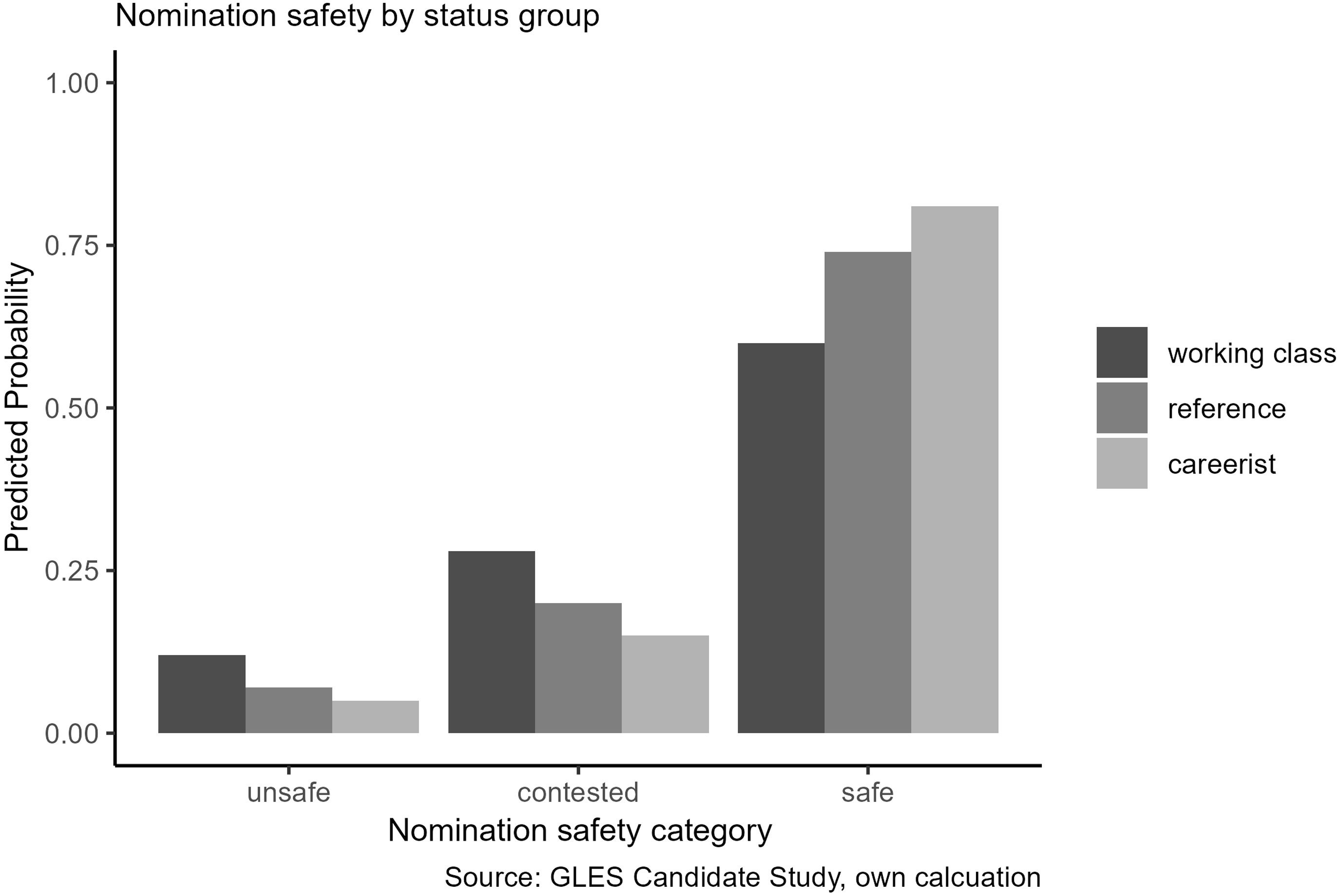
To better grasp the substantive size of the class effects, Figure 6 displays the predicted probabilities of being placed in each of the nomination safety categories, depending on the class background of the candidate (holding all other characteristics constant). The predictions are based on a hypothetical male candidate who is an incumbent Social Democrat from the state of North-Rhine Westphalia, aged between 50 and 65, without migration background and living in a small or medium sized town. As can be seen from the figure, such a candidate has a 84 percent probability of being placed in a safe position if he is a careerist, while it is only 76 if he is neither a careerist nor a worker (the reference category). Most important, this probability further drops to 67 percent if he has a working-class background. The opposite is true if it comes to both unsafe and contested seats. The probability of being placed in an unsafe position is highest for workers and lowest – almost negligible – for careerists. Taken together, these results lend strong support to our first and second hypotheses.
Visualization of effect sizes.

As discussed above, disadvantages can also intersect, making it plausible that women from lower social classes experience a double burden. To test for this potential intersectionality, we run additional models in which we interact gender with the working-class variable. However, as Figure 7 shows, we do not find any significant effect that would point to a double disadvantage (see Table A2 in the online Appendix for full results). If anything, working-class women are less disadvantaged than working-class men, but this positive interaction does not reach conventional levels of statistical significance. We thus have to reject hypothesis 3.
Interaction between class and gender.

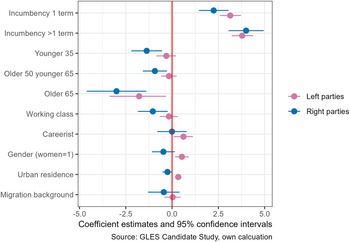
However, the analysis so far might conceal important differences across party families. Attitudes on group representation and priorities for certain groups vary across the ideological spectrum, which is most visible in the adoption or the refusal of gender quotas. To capture potential differences across party families, we split our sample into left (SPD, the Greens, the Left) and right parties (CDU, CSU, and FDP).
Figure 8 visualizes the results from the split sample. Three points are noteworthy: first, careerists predominantly enjoy advantages in left parties. This fits with the observation that the increase in careerism is particularly strong among the Greens and the Social Democrats. Second, while the effect for candidates with a working-class background is negative across the ideological spectrum, it is only statistically significant for right parties. Third, women are more likely placed in less secure positions in right parties (albeit the effect does not reach conventional levels of significance), but not in left parties. Taken together, the ideological differences reveal different nomination priorities regarding gender and, to a lesser extent, class. While working-class candidates face higher obstacles in right-wing parties, their disadvantage is more indirect in leftist parties, where the systematic advantage of careerists risks ‘crowding out’ those with working-class biographies. We also run additional models with a split sample and an interaction term between class and gender. As in the model with the full sample, we do not find that working-class women are more disadvantaged than working-class men (see Table A2 in the online Appendix for full results). If anything, working-class women are less disadvantaged than their male counterparts in right parties, but since the positive interaction does not reach conventional levels of statistical significance, we refrain from drawing strong conclusions from this result.
Results of the ordered regression analysis by party family.

Finally, we take the individual candidate’s time for politics into account. In a first step, we test whether the effects of working-class membership and a careerist background hold when additionally controlling for this variable. Theoretically, a negative effect of a working-class background could be driven by individual resource constraints rather than by the (conscious) behaviour of party selectorates in the nomination process. Working-class occupations are often more inflexible and allow for less intense political engagement, which could result in weaker party networks and disadvantages in the selection process. We thus additionally control for a candidate’s time spent in party activities (measured in self-reported hours per week) to separate effects of party recruitment processes from potential effects of individual resources. However, as the left panel of Figure 9 shows, the effect of our two variables of interest remains statistically significant, even when we include this additional variable in the model.
Results of the ordered regression including time for politics.

In a second step, we test the interaction between working-class membership (H4a) and careerism (H4b) with time for politics. However, as demonstrated by the right panel in Figure 9, we do not find support for these hypotheses, as both interaction effects are not statistically significant (see Table A4 in the online Appendix for full results).
Conclusion
While recent research has shown that parliaments have become more socially homogeneous regarding the class background of their members, the role of parties and their recruitment processes in fostering this trend is still poorly understood. Based on new data on the social background of German federal MPs, we have first shown that the class composition of the German Bundestag has vastly changed since the 1970s, resembling trends in other countries. The share of parliamentarians without tertiary education has decreased from around 30 percent to 9 percent over that period, and several parties today have hardly any MPs with a working-class background among their ranks. At the same time, we see a steep rise in the share of highly educated MPs with very streamlined careers within their parties or affiliated political organizations and with little occupational experience outside the political realm – in the current Bundestag, more than every third parliamentarian is such a ‘career politician’.
Starting from this observation, we have shown that the way parties nominate and rank their candidates in federal elections contributes to these trends. Based on three rounds of data from the GLES Candidates Study, we analysed how different social characteristics influence the likelihood of being nominated in electorally safe positions. Our measure of ‘safe seats’ takes into account the complex interdependencies of district nominations and list rankings, thus going beyond existing analyses of nomination processes in the German mixed-member electoral system. Our findings show that workers face systematic disadvantages in the nomination process, having a higher likelihood of being placed in less safe positions, at least in parties of the mainstream right. The opposite is true for careerists, who have a systematically higher likelihood of being nominated in districts and/or on list positions with safe electoral prospects in parties of the left.
These findings have several important implications for our understanding of unequal representation. First, our findings underscore that parties are central actors in influencing the social composition of parliaments. The recruitment literature rightly highlights that the process of becoming an elected MP is long and complex, starting with the stage of ‘expressing one’s ambition to run’, followed by ‘being nominated and placed by your party’, and ending with ‘being elected’. At each of these stages, a candidate can be screened out, and ‘supply side factors’ (individual resources such as time, money or nascent ambition) and ‘demand side factors’ (parties’ and voters’ preferences for certain types of candidates) interact (Carnes and Lupu Reference Carnes and Lupu2023; Norris Reference Norris1997). Regarding disadvantages for working-class people, the main obstacles are often seen in the early stages of the process – they less often express the ambition to run – and in supply side factors, especially time and resource constraints (Carnes Reference Carnes2018). While we do not dispute that these factors are of major importance, our findings show that the behaviour of party selectorates puts additional obstacles to successful candidacies for people with less privileged backgrounds. The same is true for careerists, albeit with the opposite effect, whose advantages are also often discussed as stemming purely from their type of ‘politics-facilitating’ occupations (Cairney Reference Cairney2007). To understand differences across parties and/or countries, focusing on parties and other meso-level actors seems promising for future research. Second, regarding its political implications, these recruitment patterns suggest that if inner party selection processes do not change, we are likely to witness a further narrowing of the class background of politicians in the future. One consequence of this could be a further widening of the participation gap among younger citizens: if the newly recruited generations of candidates are becoming even more professionalized and less ‘working-class’, younger cohorts of working-class voters are likely to feel even less ‘symbolically’ represented than they are today. Already today, the class gap in participation is much higher among the younger cohorts than among the old (Schäfer et al. Reference Schäfer, Roßteutscher and Abendschön2020) – the recruitment patterns shown in this article could further aggravate this trend.
Supplementary material
The supplementary material for this article can be found at https://doi.org/10.1017/S1475676525100017.
Data availability statement
Replication material for this article can be accessed online at https://doi.org/10.17605/OSF.IO/C6KWV
Acknowledgements
Earlier versions of this article have been presented at the Politics Lecture Series 2023 at the Humboldt University Berlin, the Research Network on Political Economy at the Max Planck Institute for the Study of Societies in Cologne in 2024, and the workshop ‘Representation and Responsiveness’ at the University Mainz in 2024. We thank all participants for valuable feedback. In particular, we would like to thank Tarik Abou-Chadi, Claudia Landwehr, Miquel Pellicer, Armin Schäfer, Hanna Schwander and Nils Steiner for constructive comments. Furthermore, we would like to thank Larissa Henkst and Timo Sprang for their excellent assistance with data collection.
Funding Statement
Open Access funding enabled and organized by Projekt DEAL.





 Open access

