


1. Introduction
Developing new product families allows companies to enter new market segments and enhance their competitiveness through innovative technologies. To minimize internal variety within these product families while maintaining desired external variety, the systematic design of modular product structures offers a promising approach (Reference Krause and GebhardtKrause & Gebhardt, 2018). Additionally, the development of product series provides advantages for reducing part variety within product families (Reference EhrlenspielEhrlenspiel, 2009). However, existing methodologies address modularization and size graduation separately, leaving practitioners without integrated guidance when both strategies must be combined. Particularly in early development phases, significant degrees of freedom exist for architectural decisions that determine long-term economic viability and adaptability to changing customer requirements. At this stage, modular structuring and size scaling decisions are closely connected and must be considered together. However, both strategies can impose conflicting requirements on the product architecture, creating design trade-offs that must be systematically addressed. Therefore, this paper addresses the following research question:
How can an approach for the development and evaluation of concepts for modular, size-variable product families be structured that incorporates the systematic consideration of product-specific design trade-offs?
The study follows the design science research approach (Reference HevnerHevner, 2007) which connects scientific foundations with practice through the development of a methodological artifact. It is implemented as a single case study of a medium-sized enterprise specializing in air technology units (e.g., air filtration and extraction units). Small and medium-sized enterprises (SMEs) face particular challenges in practical implementation despite numerous existing methodologies, among other things due to high initial modularization costs combined with uncertain benefits (Reference Silva, Santos, Otto, Eisenbart, Eckert, Eynard, Krause, Oehmen and TroussierSilva & Santos, 2023).
The approach presented in this paper builds on the generic product structure model for air technology units developed in Reference Ganze, Jakschik, Paetzold-Byhain, Krause, Paetzold-Byhain and WartzackGanze et al. (2025) and demonstrates its systematic application for concept generation and evaluation, addressing product-specific trade-offs between product series design and modular structuring approaches.
Air filtration units are particularly suited for this investigation, as their sequential component arrangement along the airflow path creates direct interdependencies where size changes in one module significantly affect other components. At the same time, strict requirements for pressure loss minimization, structural stability, and sealing performance impose tight design constraints that become more challenging to satisfy as products are scaled. These properties make air filtration units a well-suited case for studying how design trade-offs can be systematically addressed in modular, size-variable product family development.
2. State of the art and research
Customer-specific product configurations are essential in air filtration applications. Different industrial processes demand varying specifications, for example extraction volumes, filter areas, and filtration components, resulting in high product variety that increases organizational complexity. To manage this complexity effectively, companies strive to minimize internal variety while maintaining adequate external variety to meet market demands (Reference JonasJonas, 2013). Reference EhrlenspielEhrlenspiel (2009) emphasizes that both technical and organizational measures are necessary to reduce the variety of components and capitalize on the efficiency gains from streamlined product structures. Product series and modular design approaches offer viable strategies for economically realizing variant-rich product families (Reference Vietor, Stechert, Feldhusen and GroteVietor & Stechert, 2013).
For developing new product families across different size categories, both approaches must be combined. Product series design facilitates geometric scaling while maintaining consistent functionality. Modular design enables functional differentiation and promotes component reuse across product variants with each module serving a distinct functional role (Reference EhrlenspielEhrlenspiel, 2009). However, combining these approaches requires careful consideration of design trade-offs, particularly when product-specific interdependencies between components limit complete functional decoupling. The following sections examine the methodologies of both dimensions and analyze the inherent trade-offs in air filtration unit design.
2.1. Definition of sizes in series design
When varying the size of products and components, the qualitative function and design solution remain unchanged. Furthermore, the use of identical materials and manufacturing processes is pursued (Reference EhrlenspielEhrlenspiel, 2009). Additional sizes are derived from a base design according to specific scaling principles. This derivation can be based on geometric, mechanical, and physical relationships (Reference FrankeFranke, 2002).
The similarity between size-scaled modules within a product series offers several advantages, such as improved manufacturing efficiency through the use of identical work plans despite different size categories. From a quality perspective, additional sizes benefit from the maturity already achieved in the base size, as design weaknesses and manufacturing issues have been identified and resolved. From a design standpoint, scaling from a medium-sized base design both upward and downward enables development with reduced effort (Reference EhrlenspielEhrlenspiel, 2009).
A central challenge in product series design is determining appropriate size levels. Two approaches have become established in practice (Reference KippKipp, 2013, pp. 116, 117):
-
• Determining new configurations based on geometric preferred number series
-
• Manual derivation of configurations from market requirements
Since knowledge about market requirements is limited at the beginning of new product family development for emerging market segments, the first approach is suitable for determining size categories (Reference KippKipp, 2013). Preferred numbers are members of decimal-geometric series according to DIN 323. The step ratio between series members represents the relationship of one member to the previous one. Different preferred number series exist with varying associated step ratios (Deutsches Institut für Normung, 1974). Size ranges can also be divided by varying within or between different preferred number series (Reference Vietor, Stechert, Feldhusen and GroteVietor & Stechert, 2013). Using decimal-geometric preferred number series is not mandatory for defining product size categories. Instead, geometric series with appropriate constant step ratios can be determined using the following formula (Reference KippKipp, 2013, p. 117) Equation (1):
 $$\varphi = \;^{\left( {z - 1} \right)}\!\!\sqrt{B}{\rm{\;}}with{\rm{\;}}B = {{{largest\;size}}\over{{smallest\;size}}}{\rm{\;}}and{\rm{\;}}z = {\rm{number\;of\;sizes}}$$
Early in the lifecycle, product series typically feature large step intervals and are later densified with intermediate sizes in areas of high market demand. The size categories of a product series are used to scale all dimensions of a product, creating geometric similarity among product variants. Reference KippKipp (2013) notes that common components across size variants typically do not occur. This limitation should be addressed through structured consideration of the entire product family.
2.2. Development of modular product families
Modularization involves decomposing systems into independent, functionally distinct units, where modules represent both physical and conceptual groupings of components. Although the decomposition should occur in early phases of product development (Verein deutscher Ingenieure, 2019), modularization processes are inherently iterative and may require substantial structural modifications when integrating new technologies or responding to changing market demands (Reference Habib, Omair, Habib, Zahir, Khattak, Yook, Aamir and AkhtarHabib et al., 2023). Systematic modularization approaches must therefore be flexible enough to incorporate adjustments as new insights emerge.
The Integrated PKT approach from Hamburg University of Technology provides comprehensive methods for variant-oriented product design and life phase modularization. Key methodological tools include the Variety Allocation Model (VAM), which maps external and internal variety, and the Module Interface Graph (MIG), which visualizes spatial configuration and interface relationships (Reference Krause and GebhardtKrause & Gebhardt, 2018). These methods have been adapted for air technology units and integrated into a generic product structure model that serves as a reusable knowledge framework (Reference Ganze, Jakschik, Paetzold-Byhain, Krause, Paetzold-Byhain and WartzackGanze et al., 2025).
Effective visualization and intuitive usability represent critical success factors for the practical application of modularization methods. Coordinated visualization tools significantly facilitate implementation and establish a common foundation for interdisciplinary team discussions (Reference Krause and GebhardtKrause & Gebhardt, 2018). For industrial applications, methods should prioritize intuitive operation, clarity, and focus on essential elements. User-centered approaches that align with established work practices form the foundation for successful practical implementation (Reference BeckmannBeckmann, 2021). Beyond methodological considerations, team composition represents a decisive factor in developing effective modular structures. Both vertical integration through management and practitioner involvement and horizontal integration across departments – including production, sales, and development – are essential for incorporating practical knowledge from different product lifecycle phases and developing sustainable, implementable solutions (Reference Mortensen, Bertram and LundgaardMortensen et al., 2019).
For systematic concept evaluation, Reference RipperdaRipperda (2019) presents a cost forecasting methodology based on projected material and process costs. It quantifies resource requirements using time-driven activity-based costing as developed by Reference Kaplan and AndersonKaplan and Anderson (2007). The next step involves identifying relevant changes in product, process, and cost structures for alternative product structure concepts, followed by forecasting the impact on material and process costs. Material cost projections utilize supplier quotations or expert estimates for individual components, while process cost forecasting is based on labor rates and process durations across all lifecycle phases of the product family. Combining material and process costs yields a complexity cost projection that enables comprehensive cost estimation and comparison of concept alternatives. Effective evaluation requires incorporating semi-quantitative criteria alongside quantitative cost assessments to capture factors not reflected in pure cost calculations. (Reference RipperdaRipperda, 2019)
The methodology is well-suited for assessing newly developed modular product families (Reference Ridder, Berschik, Krause, Krause, Paetzold-Byhain and WartzackRidder, 2025), though practical application requires simplification to enable early-stage integration and effective use in size scaling scenarios.
2.3. Design trade-offs in the development of air filtration systems
Design trade-offs occur when not all desired properties can be optimized simultaneously within a single design decision. Systematically identifying and addressing design trade-offs is crucial for successful design outcomes (Reference Beibl, Zumach, Wehrend, Züfle, Hein, Plaumann and KrauseBeibl et al., 2024). This is particularly relevant in the development of product families with size variability, where size-dependent interdependencies frequently introduce conflicting requirements. Air filtration units exemplify this challenge, as their sequential arrangement along the airflow path means that changes in size or configuration of one module directly affect adjacent components. When scaling these systems to different size levels, geometric and functional dependencies between modules become more pronounced and create conflicting requirements. The integral housing design illustrates this challenge, as shown in Figure 1. This representation, while simplified, shows how scaling based on the air volume flow creates interdependencies across all major system components. For reference, these components are shown in Figure 3.
Effect of size scaling on the main components of an air filtration unit

Figure 1 Long description
A flowchart illustrating the effect of size scaling on the main components of an air filtration unit. The process begins with the nominal volume flow rate increasing, which then splits into two paths: increasing the filter area and increasing the fan dimensions. If the filter area increases, it leads to a decision point where either the number or size of filter cartridges increases. Both options lead to an increase in filter housing dimensions. If the fan dimensions increase, it leads to a decision point where either the number or size of the secondary filter increases. Both options also lead to an increase in funnel dimensions. The increase in filter housing dimensions and funnel dimensions both lead to an increase in material costs. Additionally, the increase in funnel dimensions leads to a decision point where either filter replacement ergonomics decrease, product height increases, or product footprint increases.
The sequential arrangement of components along the airflow path and the minimization of pressure losses constitute fundamental design constraints. The defined sequence significantly limits flexibility in modular design implementation. Additional flow redirections and interfaces resulting from modular design may adversely affect energy efficiency due to increased pressure losses.
Furthermore, air filtration units must meet stringent requirements for pressure surge resistance and air tightness. This particularly concerns housing construction and component interfaces, as physical interfaces resulting from modular design represent potential weak points. The design of robust interfaces that meet these demanding requirements may lead to substantial increases in manufacturing costs.
Addressing these trade-offs requires systematic evaluation of alternative design concepts. Certain properties have fixed threshold values that cannot be compromised, while others offer room for optimization. To explore these different possibilities, alternative product concepts were developed with different optimization objectives.
3. Application of modularization methods
Building upon the theoretical foundation and identified design trade-offs presented in the previous section, this chapter demonstrates the practical implementation of modularization methods for air filtration units. The approach addresses the dual challenge of systematic size scaling while accounting for product-specific interdependencies, illustrating how product series design and modular product structures can be integrated to develop and evaluate alternative product family concepts.
The study follows the design science research approach (Reference HevnerHevner, 2007), developing a methodological artifact based on scientific foundations and demonstrating its application in an industrial context. Based on action research principles, the authors actively participating in the development process. This provided direct access to expert knowledge as well as detailed insights into processes and their challenges, enabling effective evaluation and iterative refinement of the methodological approach.
3.1. Presentation of application context and investigated product
The case study is conducted in the context of ULT AG, a medium-sized company based in Germany that develops and manufactures air technology units in single and small batch production. The company focuses on product engineering and assembly, while sheet metal components are manufactured externally by specialized suppliers. This paper focuses on the development of a new product family of large-scale units in the field of industrial air filtration units. Product variants arise, for example, from different customer processes, air volume flow rates, and installation conditions at customers’ sites.
3.2. Methodical approach for developing modular product families
When developing a modular product family with different size levels based on a Minimum Viable Product (MVP), the product structure is iteratively revised. The approach applied in the case study is illustrated in Figure 2.
Definition of product sizes and modular product structure based on an MVP

The individual steps and their implementation are presented below.
3.3. Development of an initial product structure
Product family development in practice often begins with an MVP that addresses basic market requirements and enables rapid feedback on product-market fit. At this early stage, future product extensions are often not yet fully defined, and time pressure limits comprehensive modular considerations. Nevertheless, the MVP creates the baseline for subsequent modularization. Accordingly, an initial product structure was defined during the MVP design process. While the primary goal was to realize a single, market-ready product, the long-term objective of establishing a scalable product family with different size levels was already considered. With new insights gained during development, the product structure required iterative refinements, making it essential to use modularization approaches that are adaptable to evolving requirements.
To systematically translate customer requirements into design specifications, a House of Quality (HoQ) was developed (Reference Theden and ColsmanTheden & Colsman, 2013), consolidating the viewpoints of all stakeholders. This supported the identification and prioritization of key product features and guided architectural decisions in the early design phase. The most influential customer requirements included ergonomic and contamination-reduced replacement of filter cartridges and a compact overall footprint.
Based on these requirements, the MVP was designed with distinct and largely decoupled main modules allowing future adaptation and upscaling. Additionally, a compact and energy-efficient design was targeted to meet performance and operational cost objectives. The development also focused on integrating new technologies to enable their early testing and validation under real operating conditions, gathering application feedback for subsequent modularization and optimization steps. Despite this early consideration of scalability, the product structure was further refined during later development phases.
3.4. Definition of product sizes
The initial definition of product sizes was based on the air volume flow rate, which represents the primary sizing parameter for air filtration units. Expert knowledge from sales and product management played a crucial role in determining the number of size levels and range of volume flow rates that adequately reflect market expectations. In the investigated case, four size levels were defined.
Using the formula introduced in Section 2.1, reference scaling factors were calculated to provide guidance for the proportional relationship between size levels. For the defined volume flow range from 1,500 m3/h to 10,000 m³/h across four size levels, this calculation yielded a step ratio of Equation (2):
 $$\varphi = 1.88$$
This results in the following theoretical size levels: 1,500 m³/h, 2,800 m³/h, 5,300 m³/h, and 10,000 m³/h. However, the final determination of sizes levels could not rely solely on this theoretical geometric progression, as the filter surface loading imposes a physical constraint on scaling of air filtration units. While the calculated step ratio provides a systematic foundation for size definition, practical limitations must be considered. To ensure proper filter performance, the permissible surface loading must not exceed defined threshold values, which are calculated as follows (Deutsche Gesetzliche Unfallversicherung, 2020) Equation (3):
 $${\rm{filter\;surface\;loading}} = {{{volume{\rm{\;}}flow{\rm{\;}}rate{\rm{\;}}\left[ {{{{{m^3}}}\over{h}}} \right]}}\over{{filter{\rm{\;}}surface{\rm{\;}}\left[ {{m^2}} \right]}}}$$
These threshold values are based on regulatory requirements and empirical data, with specific limits varying by application. Because filter cartridges can only be installed in discrete quantities, the defined size levels must be adjusted to accommodate available filter cartridges and fan capacities.
In later stages, when developing alternative product concepts, these dependencies may require further modifications. The filter module and its filter cartridges can be scaled either horizontally or vertically. This results in design trade-offs between footprint and ergonomic accessibility.
3.5. Development of alternative product family concepts
Once the size levels are defined, systematic identification of required components becomes necessary. Each critical component is documented using a matrix with two dimensions – size scaling and functional variance – to capture its changes across the product family. This preparatory analysis not only enables clearer communication of modular impacts but also facilitates the comparison and selection of alternative components, for example with respect to price, performance, and dimensions. The resulting transparency serves as a foundation for adapting the design of the initial MVP and developing alternative concepts in the subsequent phase, while improving the product structure.
Based on this matrix analysis, the development of alternative product structure concepts focused exclusively on components whose dimensions vary across the product family. These size-dependent components primarily include such as housing elements, filter modules, and fans, which scale directly with volume flow rate. Components with constant dimensions across all variants were not the focus at this stage. The modular design regarding components that vary only in type or configuration – without dimensional changes – will be addressed in subsequent development phase, once the basic modular structure for size scaling is defined.
Alternative product structure concepts were systematically developed in workshops involving an interdisciplinary team from engineering, project management and product management. Prior to the workshops, the requirements for the new product family were consolidated from existing documentation (e.g., HoQ, list of main features) and mapped to the corresponding MVP modules. The previously created VAM and MIG models of the MVP served as the methodological foundation for developing alternative product structure concepts.
At the beginning of the first workshop, participants were introduced to the basic principles and objectives of modularization, as well as to the implications of internal product variety. At this stage, the MVP had already been built and tested as the first functional prototype. Participants then engaged in a short reflection phase to discuss which features of the MVP should be retained and which should be modified. This served to re-establish a shared understanding of the project status and to identify open discussion points after a break in development.
The primary objective of the workshops was to increase the proportion of standard and reusable components across all size levels of the product family in order to reduce internal variety. The starting point was a concept with the previously defined size levels and a scaled product structure, not yet optimized for component commonality (left side of Figure 3).
Vertical and horizontal partitioning of the product for differential product structure

To develop alternative solutions, the team was divided into two groups (right side of Figure 3):
-
• Group 1 focused on a horizontal partitioning of the housing
-
• Group 2 focused on vertical partitioning of the housing
For both groups, the advantages and disadvantages of integral and differential design approaches were discussed beforehand. The two groups developed different concepts. In the subsequent step, the advantages and disadvantages of each concept were analyzed and presented. Design trade-offs that emerged during the concept development process were systematically documented and characterized.
Based on the presentations a simplified Module Interface Graph (MIG) was created for each concept and validated with the groups. In total, five alternative product structure concepts were derived and subsequently evaluated in the next phase of the study. The concepts are illustrated in Figure 4. For reasons of simplification, the MIG representations are shown in one dimension only, although the original workshop analysis considered two-dimensional spatial relationships. The standard MIG color coding was refined: the original standard category was subdivided into standard across all sizes (white) and standard within size level (blue), while the original variant (gray) and optional (dashed) classifications were maintained.
Alternative product structure concepts developed in the workshop sessions

Figure 4 Long description
Panel A.1: Diagram showing three variations of a product structure concept. Each variation includes a top section with multiple circles, a middle section with a shaded area, and a bottom section with a rectangular base. The shaded areas are highlighted in blue. Panel A.2: Diagram showing three variations of another product structure concept. Each variation includes a top section with multiple circles, a middle section with a shaded area, and a bottom section with a rectangular base. The shaded areas are highlighted in gray. Panel A.3: Diagram showing three variations of a third product structure concept. Each variation includes a top section with multiple circles, a middle section with a shaded area, and a bottom section with a rectangular base. The shaded areas are highlighted in blue. Panel B: Diagram showing a single variation of a fourth product structure concept. The variation includes a top section with multiple circles, a middle section with a shaded area, and a bottom section with a rectangular base. The shaded area is highlighted in gray. The legend indicates that the shaded areas represent standard components within size levels, while the unshaded areas represent optional or variant components.
3.6. Assessment of alternative concepts
The assessment of the developed concept alternatives was carried out in additional workshops and expert interviews. The objective was an assessment of the concepts with regard to both qualitative and quantitative criteria. Accordingly, the evaluation was divided into two parts:
-
• a qualitative assessment based on the fulfilment of criteria, and
-
• a quantitative assessment based on cost forecasting.
The qualitative assessment of the concept alternatives was based, first, on the weighted requirements derived from the previously developed HoQ. In addition, evaluation criteria (e.g., installation height and flexible positioning) were derived from the advantages and disadvantages identified during the workshops. Criteria directly related to effort or costs were deliberately excluded, as these aspects were considered separately in the cost forecasting process.
Prior to evaluation, requirements were classified into mandatory and desirable requirements. Mandatory requirements served as exclusion criteria and were further differentiated into fixed requirements and minimum requirements. The latter define threshold values. Concepts failing to meet mandatory requirements had to be either revised or excluded from the evaluation. The qualitative assessment focused on evaluating the degree to which requirements were fulfilled, particularly minimum requirements and desirable requirements.
The assessment was conducted collaboratively in a structured joint session. Criteria weighting through pairwise comparison ensured objective prioritization. Interactive discussions facilitated consensus building and shared understanding among participants, revealing strengths and weaknesses of each concept and enabling identification of improvement opportunities. Establishing clear and consistent definitions for all evaluation criteria proved essential for ensuring common understanding and enabling reliable comparisons across concepts. The results are presented in Figure 5.
Assessment of qualitative criteria (normalized)

The quantitative assessment showed that standard components could be increased across all concept alternatives while variant-specific parts were reduced. The subsequent cost forecasting for material and process costs followed the approach of Reference RipperdaRipperda (2019), adapted to the company context and based on the MVP’s product, process, and cost structures. The evaluation was performed by independent experts of the company.
The process cost estimation was carried out with representatives of all product life phases, such as production, assembly, and procurement, who estimated the effort for relevant process steps over a five-year period. Material costs of the components were derived from the MVP baseline and scaled to each size level. The estimation considered volume discounts based on forecasted quantities for each size level. Components shared across multiple sizes achieved additional cost savings through economies of scale. A comprehensive comparison of material costs for all concept variants was conducted for each individual size level. This size-specific evaluation enabled detailed analysis of how different modular approaches affect costs across the product family.
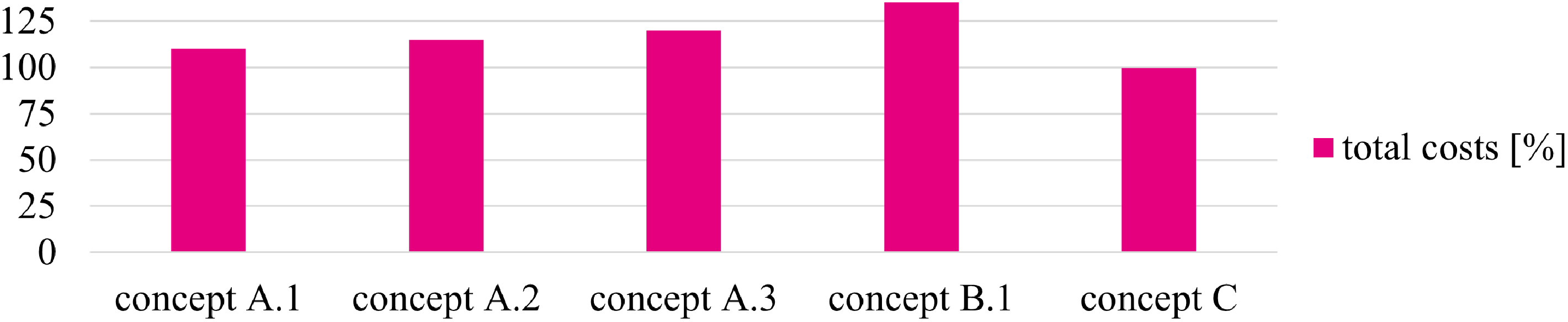
The results of the material and process cost estimations were consolidated into an overall cost evaluation, which is shown in Figure 6. These complexity costs reflect not only the direct material and process costs but also the indirect implications of structural diversity across the product family.
Total costs (normalized)

3.7. Selection of product family concept
Overall, this assessment approach combined qualitative criteria with quantitative cost forecasting to enable an evaluation of concept alternatives. It provided a transparent basis for decision-making. The results revealed divergent outcomes between qualitative and quantitative assessments, highlighting the complexity of multi-criteria decision-making in modular product family development. While the qualitative assessment identified concept A.2 as the preferred solution based on the requirements of the HoQ and the evaluation criteria, the cost forecasting clearly favored concept C. The stringent air tightness and pressure stability requirements led to selecting welded assemblies over smaller modules. Meeting these technical requirements with smaller modules would require excessive design and manufacturing efforts that cannot be offset by the benefits of component standardization. Due to the significant cost advantages demonstrated by concept C, this concept was selected as the foundation for the final modular product structure. The selected concept was subsequently refined by incorporating improvements identified during the development process and assessment phase, demonstrating how insights gained through the structured process can compensate for initial shortcomings. The refinement enabled improved transportability, simplified collection module design, and enhanced design for assembly.
3.8. Definition of modular product structure
The modular product structure developed in this study focused on components that vary with size scaling across the four defined product sizes. This approach represents the first part of modularization. In the next phase, components that vary due to different customer requirements and application contexts will be addressed, such as requirements for containment systems or explosion protection. These components create additional complexity dimensions. For the development of modular product structures, diverse approaches exist, such as lifecycle modularization from the integrated PKT approach of TU Hamburg or modular function deployment, which is why this phase is not focused on this paper.
4. Discussion
The case study followed a structured approach for developing and evaluating product structure alternatives for modular product families. The clear visualization through the simplified MIG improved shared understanding within the interdisciplinary team and provided an effective basis for discussion. Workshop discussions established a unified knowledge base, enabling identification of viable improvement measures and supporting well-founded decision-making despite conflicting evaluation results. Participants noted the unified project understanding as a positive outcome and expressed interest in applying this approach more frequently to gain routine experience.
Several methodological insights emerged from the case study. The pairwise weighting of criteria proved relatively time-consuming. Future applications should investigate alternative weighting methods, to reduce evaluation effort while maintaining decision quality. The dual evaluation of qualitative criteria could appear redundant at first glance. However, this approach proved beneficial as it enabled clear separation between stakeholder requirements and comparison of concept-specific advantages and disadvantages. A critical insight was that dimensions and specifications of all size-scaling affected components should be systematically investigated before concept development begins. This preparatory analysis streamlines the design process and improves cost estimation accuracy. Based on this insight, the methodological approach was refined by introducing the matrix representation for component scaling and variance, as described in Section 3.4.
The systematic approach was demonstrated on air filtration units, which represent a moderate level of product complexity. The approach remains applicable to more complex products, as the systematic focus on size scaling at the beginning of the development process facilitates methodological transfer. However, the effort for matrix creation and evaluation increases with number of components, which may require prioritization of critical components in early development phases.
The case study demonstrated that the structured approach enables systematic concept development and evaluation within a reasonable timeframe, while providing flexibility to adapt to emerging uncertainties.
5. Conclusion and outlook
This case study successfully demonstrated the practical application of methods for developing new product families with different size levels for air filtration units in an SME context. The systematic approach enabled the development and evaluation of alternative modular concepts while managing product-specific design trade-offs by integrating product series design. The matrix representation for component scaling and variance provides a structured foundation for systematic concept development.
Future research should explore additional design objectives for concept development beyond the vertical and horizontal partitioning strategies examined in this study. This would extend the methodology’s transferability to other industrial sectors. Furthermore, rigorous guidelines for criterion specification and characterization should be developed to eliminate assessment redundancy and interpretative ambiguity in qualitative evaluation.
Overall, this study demonstrates the value of integrating size scaling considerations with modular structuring from early development phases. Systematic visualization tools and structured evaluation methods support this process. This combination provides a foundation for managing the inherent trade-offs in modular product family development.
Acknowledgement
This project is co funded by the European Union and co financed from tax revenues on the basis of the budget adopted by the Saxon State Parliament.




 Open access

