


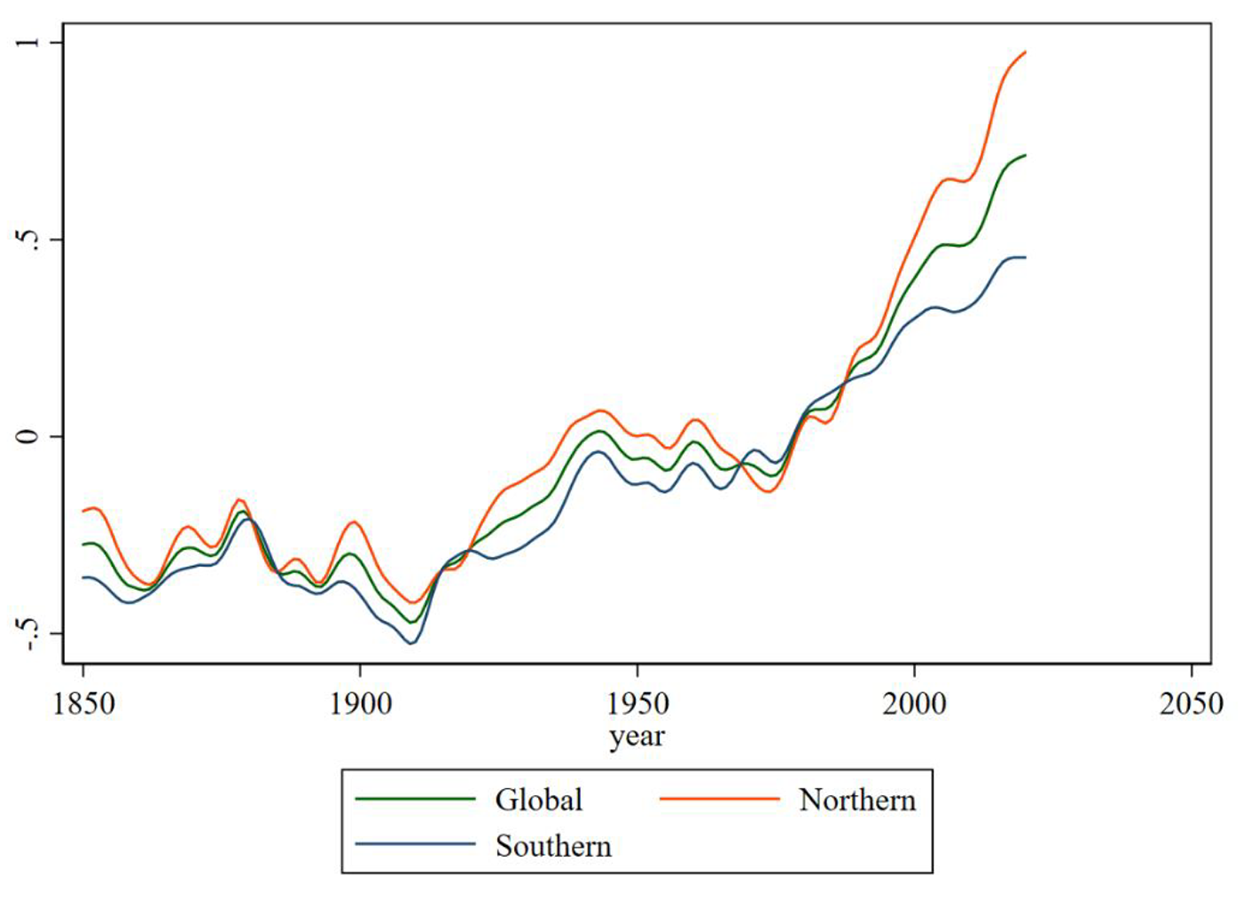
Climate change is one of the most serious risks facing humanity. Temperature rises can lead to catastrophic climate and natural events that threaten livelihoods. From rising sea levels to flooding, bush fires, extreme temperatures and droughts, the economic and human cost is too large to ignore. More than 190 world leaders got together in Glasgow during November 2021 at the UN’s COP26 climate change summit to discuss progress on the Paris Agreement (COP21) and to agree on new measures to limit global warming. In Paris, countries agreed to limit global warming to well below 2° and aim for 1.5° as well as to adapt to the impacts of a changing climate and raise the necessary funding to deliver on these aims. However, actions to date were not nearly enough as highlighted by the IPCC (2018) special report. The world is still on track to reach warming above 3° by 2100. As evident from figure 1, global temperatures have been on a steadily increasing path since the start of the 20th century and this process has substantially accelerated since the beginning of the 1980s. This has been unevenly distributed, with temperatures in the Northern hemisphere being a full 1°C higher than for the 1961–1990 average, whilst temperatures in the Southern hemisphere have increased by almost 0.5°C.
(Colour online) Median near-surface temperatures (°C) relative to 1961–1990, decadally smoothed. Data for Global temperatures, Northern, and Southern hemispheres.
Source: MetOffice Hadley Centre observations datasets, https://www.metoffice.gov.uk/hadobs/hadcrut4/data/current/download.html#regional_series.
The Glasgow Climate Pact has been received with mixed feelings. On the one hand, it achieved an ambitious agreement on adaptation finance and requesting countries more stringent climate pledges. On the other hand, it has been noted that it failed to pledge sufficient financial resources for vulnerable nations and to secure an end to unabated coal use. Although COP26 signified a step forward in achieving the 1.5°C target, doubts remain about whether the agreement is sufficient.
The Autumn’s Special Issue of the National Institute Economic Review contains a set of contributions to the ‘Macroeconomics of Climate Change’. Most of the papers in this special issue were selected from presentations at the 17th EUROFRAME Conference on ‘Climate change: Economic implications, tools and challenges for policy-makers in Europe’ held online on 17 and 18 June 2021. Economics as a discipline has a crucial role to contribute to the debate on how to tackle climate change: it emphasises trade-offs and opportunity costs of alternative policies with a focus on the human consequences of climate change actions. Specifically, macroeconomic models, with their dynamic nature, emphasis on market and non-market interdependencies, and core role for anticipation effects, are well equipped to contribute to the design of optimal policies to tackle global warming. This Special Issue brings together four timely contributions of leading scholars in this area.
Van der Ploeg (Reference van der Ploeg2021) proposes a four pillars approach to attaining net-zero emissions based on: (a) announcing a credible path for rising carbon prices; (b) temporary hikes in clean energy subsidies; (c) the implementation of climate finance initiatives and (d) the creation of tipping points to encourage increased take up of climate change initiatives. He then discusses the economic and political economy distortions that stand in the way, and offers an overview of the state of the literature and limitations of macro-climate models.
Klusak et al. (Reference Klusak, Agarwala, Burke, Kraemer and Mohaddes2021) investigate how climate change may impact the financial system, namely fiscal sustainability, and sovereign debt markets. They examine the growing literature on how fiscal risks affect sovereign creditworthiness and the cost of public borrowing, and present a taxonomy of how physical and transition impacts from climate change might translate into fiscal risks. By applying their model to the UK and the renewable energy’s industry, they argue that their proposed taxonomy may be used both to identify economically important blind spots in climate risk evaluations and to comprehend the complexities that occur when attempting to quantify both the costs of decarbonization and the pace at which it can be attained.
Dasgupta and Robinson (Reference Dasgupta and Robinson2021) delve into the interactions between climate change, weather-related shocks and food security. Undernourishment and food insecurity are on the rise worldwide. Climate change can be expected to exacerbate this trend, making the effective design of food policies to improve food security all the more urgent. Based on evidence from Ethiopia, the authors study the socioeconomic characteristics of households that are most susceptible to food insecurity, and the effectiveness of various food policy measures that have been introduced. Their results have important implications for well-targeted policy design.
Holland et al. (Reference Holland, Hurst, Kara and Liadze2021) discuss the macroeconomic transmission channels of a global carbon tax, paying particular attention to the terms-of-trade implications for importers and exporters of fossil fuels. Carbon pricing is likely to play a key role in meeting the commitments of the Paris Agreement and the new measures under discussion at the COP26 summit in Glasgow. The authors highlight some of the key factors that distinguish country-specific sensitivities to a carbon tax, and stress the importance of the macroeconomic policy reaction.
We hope this Special Issue of the National Institute Economic Review will help contribute towards our understanding of climate change and its economic consequences and, thus, provide our grain of sand towards achieving the goal of stopping global warming.


 Open access

