





1. Introduction
What do the markedly different campaigns in (1)–(3) have in common apart from their phenomenal success?

Linguistically, their slogans use presuppositions. If someone states (2), they presuppose—but do not assert—that America has been great before. Here, we will test experimentally if and how presuppositions can make arguments more persuasive.
According to Stalnaker’s (Reference Stalnaker1973, Reference Stalnaker2002) pragmatic account, presuppositions are background assumptions that speakers take for granted by relying on common knowledge and shared beliefs. While semantic accounts assume that presuppositions are a truth-related property of sentences (Karttunen, Reference Karttunen1973), Stalnaker argues that the evaluation of the truth of an utterance with a presupposition must consider the relation between propositions and language users to establish a common ground for communication. Therefore, “it is persons, and not sentences, that have presuppositions in the primary sense” (Stalnaker, Reference Stalnaker1973, p. 451).
Presuppositions are omnipresent in natural language and can be triggered by lexical items, syntax, and intonation (for overview, see Pistoia-Reda & Domaneschi, Reference Pistoia-Reda and Domaneschi2017; Schwarz, Reference Schwarz2015a). They have two key characteristics (Schwarz & Tiemann, Reference Schwarz and Tiemann2017). First, while assertions provide new information, presuppositions typically rely on knowledge considered given. Yet, when information is presupposed that addresses do not know, they usually try to accommodate it (Lewis, Reference Lewis1979) by tactically treating it as if it was already given and shared. Second, presupposed meaning remains present if the proposition of a statement is called into question or negated, so that even if someone doesn’t make America great again, it still once was great.
Descriptive research has claimed that presuppositions are effective rhetoric devices for persuasive communication such as advertising and political campaigning because they convey messages more implicitly and politely (Bouso, Reference Bouso2012; Saarinen, Reference Saarinen2008), endow arguments with “a curios property of undeniability,” and create “an emotional bond” (Sedivy & Carlson, Reference Sedivy and Carlson2011, p. 99; 137). Recently, Lombardi Vallauri (Reference Lombardi Vallauri2021, p. 6) hypothesized presuppositions are more persuasive than assertions because “presupposed content is presented as already agreed upon,” which would result in more “shallow processing,” in that addressees evaluate the content less critically. However, he acknowledged that the existing behavioral and neurophysiological evidence on processing speed and intensity does not consistently indicate that presuppositions are processed with less cognitive effort than assertions. We will review the evidence later.
Sbisà (Reference Sbisà and Verschueren1999) presented one of the earliest systematic accounts of “persuasive presuppositions.” She theorized that (a) presuppositions are more persuasive than assertions if they are informative, that is, introduce new content and (b) the persuasive function gets stronger if the discourse topic is of ideological value to the addressee. Then, utterances require the accommodation of the presupposed information, and addressees are motivated to update or refresh their memory or discourse model via accommodation. Mind that “new” is relative and can refer to the addresses’ knowledge and the presence and recency of information in the discourse context. Pragmatically, new presupposed content lacking support from memory or context can lead addressees to interpret an utterance as infelicitous or motivate them to accommodate, which ensures the acceptability of an utterance and ongoing communication (Lewis, Reference Lewis1979; Schwarz, Reference Schwarz and Schwarz2015b).
Sbisà (Reference Sbisà and Verschueren1999) argued for the language-philosophical unity of presupposition as a discourse element and presupposition accommodation. However, she also suggested that it is the addressee’s task to “identify the presupposition and take it for granted” (p. 500) that induces persuasion. From a psycholinguistic perspective, this implies that the cognitive process of presupposition accommodation rather than presupposed content as such enhances persuasiveness. Sbisà (Reference Sbisà and Verschueren1999) illustrated her argument with examples from political discourse in Italian newspaper headlines as in (4) (her English translation, p. 496).

The presupposition trigger too requires an antecedent in the discourse, namely someone else than Scalfaro who has delivered an ultimatum to Bossi. The writer of the headline, however, cannot reliably assume that every reader is familiar with this background, so that the presupposition becomes informative. The more a reader is concerned with politics, the more they are willing to accommodate by updating their knowledge. Therefore, presuppositions are not only shared assumptions but normatively “assumptions which ought to be shared” (Sbisà, Reference Sbisà and Verschueren1999, p. 502). The extent of accommodation and thus persuasion varies with the newness of the presupposed content as defined by the context and addressee.
Surprisingly, to our knowledge, no study has tested Sbisà’s (Reference Sbisà and Verschueren1999) theory experimentally and provided causal evidence for “persuasive presuppositions.” The present research aims to fill this gap by investigating whether sentences are more persuasive if they include informative presuppositions ideologically relevant to the reader. As our approach and method are new, we varied the type of presupposition trigger and ideological domain across three experiments to foster generalizability.
In the following, we first review the theoretical links between presupposition processing and persuasion from which we developed two moderation hypotheses. We then report on our experiments and discuss how their results matched with the hypotheses.
1.1. Presupposition accommodation
Language comprehension depends on the integration of grammatical meaning with factual and linguistic contexts (Haviland & Clark, Reference Haviland and Clark1974). The status or infelicity of a presupposition that is unsupported by its context has been a core question in research (Schwarz, Reference Schwarz and Schwarz2015b). Practically, discourse is full of unsupported presuppositions, so that their accommodation must be a routine process in language comprehension (Lewis, Reference Lewis1979). Von Fintel (Reference von Fintel2008, p. 142) used example (5) uttered in a situation where the audience does not know if the speaker has a daughter:

In (5), the context does not satisfy or support the required presupposition that the speaker has a daughter. However, the intuitive incompatibility between utterance and context can be resolved as the hearer can accommodate the speaker’s beliefs about their parental status and add them to the common ground to continue the conversation. This is consistent with the pragmatic view of accommodation, which can be understood as a repair strategy addressees use to avoid infelicity of an utterance when a presupposition is not entailed by the context but consistent with it (Schwarz, Reference Schwarz and Schwarz2015b). In a first step, the addressee realizes that the context does not satisfy the required presupposition. It is commonly assumed that the missing information is added by the addressee based on the conversation and the assumption of a cooperative speaker or writer, once the asserted content is processed (Domaneschi & Di Paola, Reference Domaneschi and Di Paola2018; Kripke, Reference Kripke2009). This new information is typically accepted by the addressee and becomes common ground (Stalnaker, Reference Stalnaker2002). The process of updating the common ground can be understood as keeping only possible worlds with true propositions, while removing those worlds with false propositions (von Fintel, Reference von Fintel2008). Whereas the classic view is that only assertions can introduce new information (Haviland & Clark, Reference Haviland and Clark1974), the accommodation process can empower presuppositions to present new information as well, in particular, “if it is not necessary to assert it” (Abbott, Reference Abbott2000, p. 1419). Stalnaker’s (Reference Stalnaker1973, Reference Stalnaker2002) conception even includes using presuppositions to convey new information as a rule rather than an exception. Semantic accounts of presupposition also view infelicity as the first step of two steps in the accommodation process. The addressee realizes that the presupposed content of an utterance is not entailed by the given context and then integrates the respective presupposed content into their assumptions, which updates the mental discourse model with the lacking presupposition (Domaneschi & Di Paola, Reference Domaneschi and Di Paola2018).
Consistent with these conceptual arguments, psycholinguistic research has confirmed that presupposition accommodation involves more intense cognitive processing than its satisfaction (for review, Lombardi Vallauri, Reference Lombardi Vallauri2021; Schwarz, Reference Schwarz2015a; Schwarz & Tiemann, Reference Schwarz and Tiemann2017; Shetreet et al., Reference Shetreet, Alexander, Romoli, Chierchia and Kuperberg2019). For example, Tiemann et al. (Reference Tiemann, Kirsten, Beck, Hertrich, Rolke and Schwarz2015, p. 45, their English translation) used a paradigm illustrated in (6–7) to manipulate accommodation, where the iterative presupposition triggered by again in (7-a) is supported in (6-b) but unsupported in (6-a), and the presupposition of (7-b) is satisfied in (6-a), but not in (6-b), the neutral context. Self-paced reading times of the critical verb (which was the fourth word after again in the original German sentences) were significantly longer in the neutral, unsupported condition presumably indexing the effort of accommodating the presupposition.

Most research has worked with lexically triggered presuppositions. They can be definite descriptions, that is, the fact that definite noun phrases presuppose the existence of their semantic entities in a context (e.g., America exists in (1)). Perceptually more salient triggers are adverbs, particles, and verbs. For example, the focus-sensitive particle too in (1, 4) presupposes a comparable situation and the iterative particle again in (2) the truth of a prior state. The change-of-state verb stop in (3) presupposes a continuous process, and the adverb before in (3) introduces a temporal clause that presupposes that you will change. At the interface to syntactic processing, factive verbs (e.g., accept, know, and remember) trigger the presupposition that the proposition expressed by their complements is true. For example, the state conveyed by the complement clause in (8) appears as a fact irrespective of the negation particle never in the main clause. Yet, if the factive forget would be replaced with an assertive verb such as assume, believe, or think, the complement clause proposition would turn into a possibility.

Different types of triggers seem to differ in how feasible or effortful the accommodation process is (Abrusán, Reference Abrusán2014; Domaneschi et al., Reference Domaneschi, Canal, Masia, Lombardi Vallauri and Bambini2018; Grubic & Wierzba, Reference Grubic and Wierzba2019; Jayez et al., Reference Jayez, Mongelli, Reboul, van der Henst and Schwarz2015). Kripke (Reference Kripke2009, pp. 372–374) proposed that many presuppositional elements have an anaphoric component that links them with an antecedent or focus element in the syntactic or factual context as illustrated in his famous example in (9)

The focus element of too in each of these sentences is Sam, but there is a crucial difference between (9-a) and (9-b) or (9-c), with the latter two sentences conveying the same main content. While addressees who encounter (9-a) cannot rely on contextual support, they can refer to given information in the first clause when they hear or read too in (9-b), that is, many other people or (9-c), that is, many others. Therefore, Kripke (Reference Kripke2009) referred to a neutral context not providing specific contextual support but only a general background as “passive” context and to a supporting and explicitly mentioned context as “salient” or “active.” Accordingly, Kripke (Reference Kripke2009) and others (Abrusán, Reference Abrusán2014; Stalnaker, Reference Stalnaker2002; Zeevat, Reference Zeevat1992) argued that presupposed content triggered by focus sensitive particles such as too, also, and again are more resistant to accommodation than, for example, existential presuppositions or those induced by change-of-state verbs. However, recent experimental research showed that—if considered in the context of discourse coherence—such “strong” triggers can well be accommodated, for example, auch “too/also” in German (Grubic & Wierzba, Reference Grubic and Wierzba2019) and aussi “too” in French (Jayez et al., Reference Jayez, Mongelli, Reboul, van der Henst and Schwarz2015).
1.2. Presuppositions and persuasion
Presuppositions frequently occur in persuasive communication such as advertising and political propaganda (Lombardi Vallauri, Reference Lombardi Vallauri2021; Sedivy & Carlson, Reference Sedivy and Carlson2011), which may have inspired researchers to argue qualitatively that presuppositions have a persuasive function. For instance, Saarinen (Reference Saarinen2008) pragmatically analyzed the use of presuppositions in higher education policy documents. She concluded that they are a more effective tool to achieve persuasion than explicit assertions, as asserted content can be contested, whereas presupposed content is typically accepted. Bouso (Reference Bouso2012) found many presuppositions triggered by definite noun phrases, comparative constructions, and change-of-state verbs in nutritional advertising. She argued that presuppositions make advertisements more pervasive because they allow for a concise and euphemistic rhetoric. Recently, Lombardi Vallauri (Reference Lombardi Vallauri2021) hypothesized that presuppositions are more persuasive because they present information as already shared on common ground, so that addressees process presupposed content with less effort and less critically. He follows Givón’s (Reference Givón1982) logic that we have less reason to challenge information if it “is presented as already agreed upon” (Lombardi Vallauri, Reference Lombardi Vallauri2021, p. 6). He elaborated on three parallel functions: First, supported presuppositions entail less new information than assertions, so that they require less cognitive work. Second, when the presupposed content is not in focus and seems trivial for comprehending a message, addressees will not devote much attention, that is, processing effort, to it. Third, when a presupposition is not shared but obviously false or questionable, addresses will barely think about it but accept, that is, accommodate, it more willingly than the same content in an assertion. Lombardi Vallauri (Reference Lombardi Vallauri2021) substantiated his reasoning with examples from advertising and experimental research on presupposition processing.
Psycholinguistic research using self-paced reading and eye-tracking paradigms showed indeed that supported presuppositions are read faster and more fluently than content-equivalent assertions (Schwarz, Reference Schwarz and Schwarz2015c; Schwarz & Tiemann, Reference Schwarz and Tiemann2017). Further, recognizing what is false in an utterance requires more time if the falsity is induced by a presupposition (definite description) than an assertion (Schwarz, Reference Schwarz2016). Lombardi Vallauri (Reference Lombardi Vallauri2021) considered this support for his hypothesis that presuppositions reduce cognitive effort directly or discourage addressees from thinking about questionable assumptions for the sake of cognitive economy. However, presuppositions are not always processed more fluently. For example, based on ERP data on presuppositions triggered by definite descriptions, change-of-state verbs, and temporal subordinate clauses, Domaneschi et al. (Reference Domaneschi, Canal, Masia, Lombardi Vallauri and Bambini2018) and Masia et al. (Reference Masia, Canal, Ricci, Vallauri and Bambini2017) concluded that discourse-new, that is, unsupported, presuppositions are associated with higher processing costs than new assertions. These findings align with those Singh et al. (Reference Singh, Fedorenko, Mahowald and Gibson2016) gained from self-paced reading experiments with the triggers the and too. Most studies did not compare presuppositions and assertions but varied presupposition support. Here, the evidence is relatively consistent that accommodation-demanding presuppositions triggered by focus sensitive particles, definite descriptions, and change-of-state verbs require more effort than supported ones, which is reflected in longer self-paced (Domaneschi & Di Paola, Reference Domaneschi and Di Paola2018; Schwarz, Reference Schwarz2007; Tiemann et al., Reference Tiemann, Kirsten, Beck, Hertrich, Rolke and Schwarz2015) and eye-tracked (Schwarz & Tiemann, Reference Schwarz and Tiemann2017) reading times.
In sum, the evidence from research on their linguistic processing raises the question if presuppositions should be generally more persuasive than assertions because they require less or more cognitive effort. Lombardi Vallauri (Reference Lombardi Vallauri2021) speculated that his shallow processing hypothesis holds if the accommodation effort distracts attention from processing the asserted information in the same utterance and thereby amplifies the already uncritical evaluation of the presupposed content. While this is a viable explanation, hypotheses about the persuasive function of presuppositions are difficult to validate by measuring psycholinguistic processing without measuring persuasion. This is a gap in current research.
1.3. The present study
It is intriguing that to our knowledge no study has tested experimentally if and how presuppositions can manipulate persuasion. With persuasion, humans actively attempt to modify other’s thoughts, feelings, and behavior (Petty & Briñol, Reference Petty and Briñol2015; Rocklage et al., Reference Rocklage, Rucker and Nordgren2018). Currently dominant dual-process models of persuasion (Chaiken, Reference Chaiken1980; Petty & Cacioppo, Reference Petty, Cacioppo and Berkowith1986) assume that both less and more cognitive processing can foster persuasion. They include a peripheral route based on intuitive and shallow processing as well as a central route based on deliberate, analytic, and more effortful processing of the content of a persuasive message. Which route addressees take often depends on how engaged or involved they are in the communication process and topic. This links to Sbisà’s (Reference Sbisà and Verschueren1999) theory that the accommodation process rather than the presupposition as such (Bouso, Reference Bouso2012; Lombardi Vallauri, Reference Lombardi Vallauri2021; Saarinen, Reference Saarinen2008; Sedivy & Carlson, Reference Sedivy and Carlson2011) enhances persuasion because it requires the active integration of new information, which is more likely to happen if addressees are ideologically involved in the topic.
Against the background of Sbisà’s (Reference Sbisà and Verschueren1999) theory, the present study investigated the persuasiveness of presuppositions in three structurally parallel experiments. We tested if claims in advertising and political discourse that include informative, that is, contextually unsupported, discourse-new, presuppositions ideologically relevant to the reader are more persuasive than the same messages in the form of an assertion. In full factorial designs, we manipulated the presence of a lexical presupposition trigger in target sentences each preceded by a neutral (unsupporting) or supporting context sentence and measured what we will call participants’ ideological involvement in the discourse topic. Accordingly, we formulated two moderation hypotheses:
H1 Claims with presuppositions are more persuasive than assertions when the preceding context weakly supports the presupposed content (neutral context), compared to a context that strongly supports the presupposition (supporting context).
In other words, unsupported presuppositions tend to be informative and require accommodation (Lewis, Reference Lewis1979), which initiates their persuasive function. The more factually new information addressees accommodate, the more common ground they think they share with the speaker or writer, which makes the overall message more persuasive (Givón, Reference Givón1982; Lombardi Vallauri, Reference Lombardi Vallauri2021; Sbisà, Reference Sbisà and Verschueren1999). But presupposition accommodation can be cognitively challenging (e.g., Kripke, Reference Kripke2009) and requires additional effort that addressees do not always invest (e.g., Domaneschi & Di Paola, Reference Domaneschi and Di Paola2018). Although Sbisà (Reference Sbisà and Verschueren1999) has only argued with examples from ideologically laden texts, we therefore tentatively predict that addressees are more willing to accommodate presupposed content, that is, “think harder,” if it is ideologically important to them. In theory, the requirement and the will to accommodate should strengthen each other in the form of a moderated moderation:
H2 The persuasive advantage of unsupported presuppositions over assertions increases with addressees’ ideological involvement.
1.3.1. Experiments and analyses
We tested the hypotheses in three experiments in German, where participants rated the persuasiveness of two-sentence advertisements or political statements. The experiments had a 2 (PSP: assertion | presupposition) by 2 (context: neutral | supporting) within-subjects design that included ideological involvement as a moderator. We operationalized the type of lexical presupposition trigger and ideological involvement differently in each experiment. Study 1 contrasted the otherwise identical statement without or with the additive particle auch “too” in the context of green advertising and environmental concern. In a similar comparative mode, Study 2 used the iterative particle wieder “again” in the context of pharmaceutical advertising and health consciousness. Finally, Study 3 contrasted statements that differed in the use of assertive versus factive verbs heading complement clauses in political statements about equal opportunities and considered differences in concern in feminism. In all studies, we empirically verified that assertive and presuppositional statements were comparably semantically acceptable. Prior research showed that the German presupposition triggers auch and wieder induce longer reading times after neutral, as opposed to supporting contexts. For example, Schwarz and Tiemann (Reference Schwarz and Tiemann2017) and Tiemann et al. (Reference Tiemann, Kirsten, Beck, Hertrich, Rolke and Schwarz2015) observed slowdowns of 7–8% at the level of the critical word and Schwarz (Reference Schwarz2007) of 35% at clause level. Theoretically, longer reading times reflect the cognitive effort of accommodating unsupported presuppositions. We are not aware of any comparable studies on the reading times of German factives. Therefore, Study 3 was a laboratory eye-tracking study that also measured reading times as a manipulation check for the induction of accommodation.
In all experiments, persuasiveness was measured with a composite mean score based on the responses to four rating-scale questions adopted from a meta-study by Thomas et al. (Reference Thomas, Masthoff and Oren2019). The scales (1 = “very strongly disagree,” 7 = “very strongly agree”) represented the dimensions effectiveness, quality (trustworthiness), capability, and relevance as perceived characteristics of a message to persuade. They were fine-tuned in their wording to fit the different discourse topics. The experiments complied with the Declaration of Helsinki and the APA Ethics Code.
The persuasiveness scores of each experiment were analyzed with linear mixed-effects regression models using the lmer function from the lme4 package (Bates et al., Reference Bates, Maechler, Bolker, Walker, Bojesen Christensen, Singmann, Dai, Scheipl, Grothendieck, Green and Fox2021) in R Studio (RStudio Team, 2022). Categorical fixed factors were deviation-coded with PSP (−0.5 = assertion, 0.5 = presupposition) and context (−0.5 = neutral, 0.5 = supporting). The mean scores for ideological concern were centered to achieve comparable regression estimates. P-values were estimated with lmerTest (Kuznetsova et al., Reference Kuznetsova, Brockhoff and Christensen2017), and interactions (Long, Reference Long2021) was used for plots.
All fitted models included the maximal random effects structure that converged (Barr et al., Reference Barr, Levy, Scheepers and Tily2013). In case of nonconvergence, we first removed random correlations followed by an iterative exclusion of the random effect with the least variance until the model converged. As it represents the moderated moderation hypothesis H2, we kept the three-way interaction of (PSP x context) x concern (and the logically associated two-way interactions) in all models, even if it did not improve model fit significantly in log-likelihood comparisons. To analyze the nature of interactions, we fitted separate models to data subsets split according to the categorical values of the moderator variable.
Following the same coding and approximation procedures, we fitted ordinal mixed effects models (Bross, Reference Bross2019) to the acceptability responses as well as a further linear model to predict reading times and a generalized mixed model from the Poisson family to the fixation count data in Study 3. Since these models served only as manipulation checks, they did not include ideological concern.
2. Study 1: Auch – “too”
2.1. Participants
The survey study included 124 participants who could win prizes in an online lottery. The 87 women and 37 men were 34.07 years (SD = 13.43) old on average. Participants were German secondary school graduates and self-assessed their German reading skills (1 = “very good,” 6 = “insufficient”) as high, M = 1.53, SD = 0.58, max = 3.
2.2. Materials
We created 20 stimuli with context-target sentences framed as green advertising campaigns (Chang et al., Reference Chang, Zhang and Xie2015). The context sentence supported the presupposition triggered by the German additive particle auch “too” in the subsequent target sentence or not (compare Tiemann et al., Reference Tiemann, Kirsten, Beck, Hertrich, Rolke and Schwarz2015). Further, the target sentence contained the presupposition trigger or not. This resulted in four possible combinations of sentences. Based on the anaphoric nature of auch, which initiates a search for parallel information included in the context or in another clause (Abrusán, Reference Abrusán2014; Jayez et al., Reference Jayez, Mongelli, Reboul, van der Henst and Schwarz2015; Kripke, Reference Kripke2009; Zeevat, Reference Zeevat1992), the supporting context sentences stated a human subject as a plausible antecedent. For example, the auch du “you too” in (11-b) presupposes other environmentally concerned customers indeed (can) replace plastic bottles. This presupposition is supported by (10-a), naming other environmentally conscious customers, but unsupported by the neutral context in (10-b), where the inanimate shampoo product is the agent of the sentence. Therefore, following Kripke’s (Reference Kripke2009) argument, the neutral context requires the reader to accommodate presupposed information triggered by auch—at least more so than the supported context. The structure of the two target versions was identical except for the inclusion of the trigger auch and du (“you”) in the presupposition as in (11-b) or not in the assertion as in (11-a). The preposed additive particle auch unambiguously associates with the subsequent personal pronoun du (Grubic & Wierzba, Reference Grubic and Wierzba2019). By explicitly addressing the recipients of the imperative target sentences as in (11), du disambiguates auch, which could otherwise also mean that one should use the advertised product in addition to another one. The neutral context sentences were syntactically and lexically identical to the supportive ones, but their grammatical subject was the inanimate product beneficial for the environment as in (10-b), instead of a reference group of environmentally conscious consumers helping the environment by using the product as in (10-a). To avoid effects of authority on persuasion (Villarino & Font, Reference Villarino and Font2015), the animate agents were groups and not individuals.
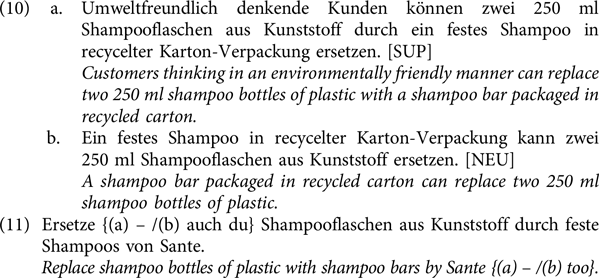
All context sentences contained a complex predicate including the modal können (“can”) and a lexical verb. This weakened their proposition and thus the presupposition for the back-reference of auch, for example, environmentally concerned customers may not make use of the possibility. Yet, unconditional declaratives seemed unauthentic in advertisement claims, and prior research on framing green advertising also used present tense in conjunction with conditional constructions (Chang et al., Reference Chang, Zhang and Xie2015). Supporting context sentences were in active voice, approximately half of the neutral sentences in active and half in passive voice stressing the environmental action that can result from buying the product. We introduced passive voice to generate enough authentic items and to maintain semantic plausibility if a product cannot perform a specific action, for example, a sponge cannot compost itself.
2.3. Procedure
Participants were recruited via social networks to take part in an advertising evaluation study for environmentally sustainable products. The task was implemented with the experiment builder OpenSesame and OSWeb (Mathôt et al., Reference Mathôt, Schreij and Theeuwes2012) and hosted on the JATOS server MindProbe (Lange et al., Reference Lange, Kühn and Filevich2015). A self-programed link distributor randomly assigned participants to one of four list versions of the experiment ensuring that every experimental item (product) was displayed in every trial type. Moreover, the item-order was random within each experiment version. After providing informed consent, participants were instructed to carefully read and evaluate advertising claims, that is, two sentences of advertising text. Following a practice trial, the main part of the experiment proceeded with 20 trials with five trials per condition.
Each trial started with the presentation of a nature landscape photo for 2 s, which served as intertrial pause and should benefit task authenticity. Next, participants saw a 500-ms fixation screen with a centered dot, followed by a context sentence in two lines and a target sentence in one line on separate screens in 24-point Arial font in black on a white background. Participants proceeded by pressing the space bar after reading a sentence. Then, they rated the persuasiveness of the previously read advertisement using four dimensions and questions adopted and translated from Thomas et al. (Reference Thomas, Masthoff and Oren2019) on ascending 7-point scales displayed on separate screens: Effectiveness (the advertising text motivates me to purchase such a product), capability (the advertising text has the potential to influence consumer behavior), quality (the advertising text is trustworthy), and relevance (the advertising text is relevant for me). Afterward, participants saw the context-target pair again and rated its acceptability on a semantic differential scale adapted from Tiemann et al. (Reference Tiemann, Kirsten, Beck, Hertrich, Rolke and Schwarz2015): “How reasonable is the advertising message?” with 1 = “very unreasonable” and 4 = “very reasonable.” A trial finished with another 500-ms fixation screen. After completing all trials, participants reported their environmental concern by rating five statements selected from Kim and Choi (Reference Kim and Choi2005) on 7-point Likert scales, answered demographic questions, and self-assessed their German reading skills.
2.4. Results and discussion
2.4.1. Acceptability and environmental concern
Consistent with the design, context-target pairs were equally acceptable without (M = 2.87, SD = 1.01) and with the trigger auch (M = 2.87, SD = 0.99). Claims with supporting context (M = 2.90, SD = 1.00) were slightly more acceptable than with neutral context (M = 2.84, SD = 1.00), which was a plausible consequence of the design. As the ordinal mixed effects model in Table 1 shows, the main effects of PSP, context, and their interaction were not significant.
Ordinal cumulative link mixed models predicting acceptability in Study 1 and Study 2
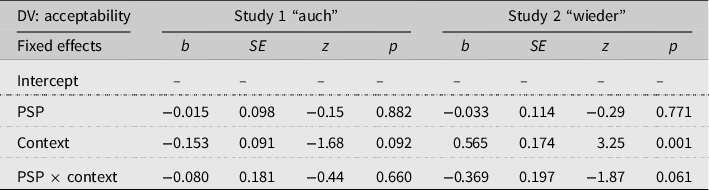
Formula. clmm(Acceptability∼1 + PSP * Context + (1 + PSP * Context | Participant) + (1 + PSP * Context | Item). Factor coding: PSP (assertive = −.5 | presupposition = +.5); Context (neutral = −.5 | supporting = +.5).
The internal consistency of the 5-item scale of environmental concern was good with Cronbach’s α = .84. Participants’ environmental concern was high (M = 5.91, range = 2.80–7.00) and skewed to the upper end of the scale (skew = −0.88, SE = 0.21).
2.4.2. Persuasiveness
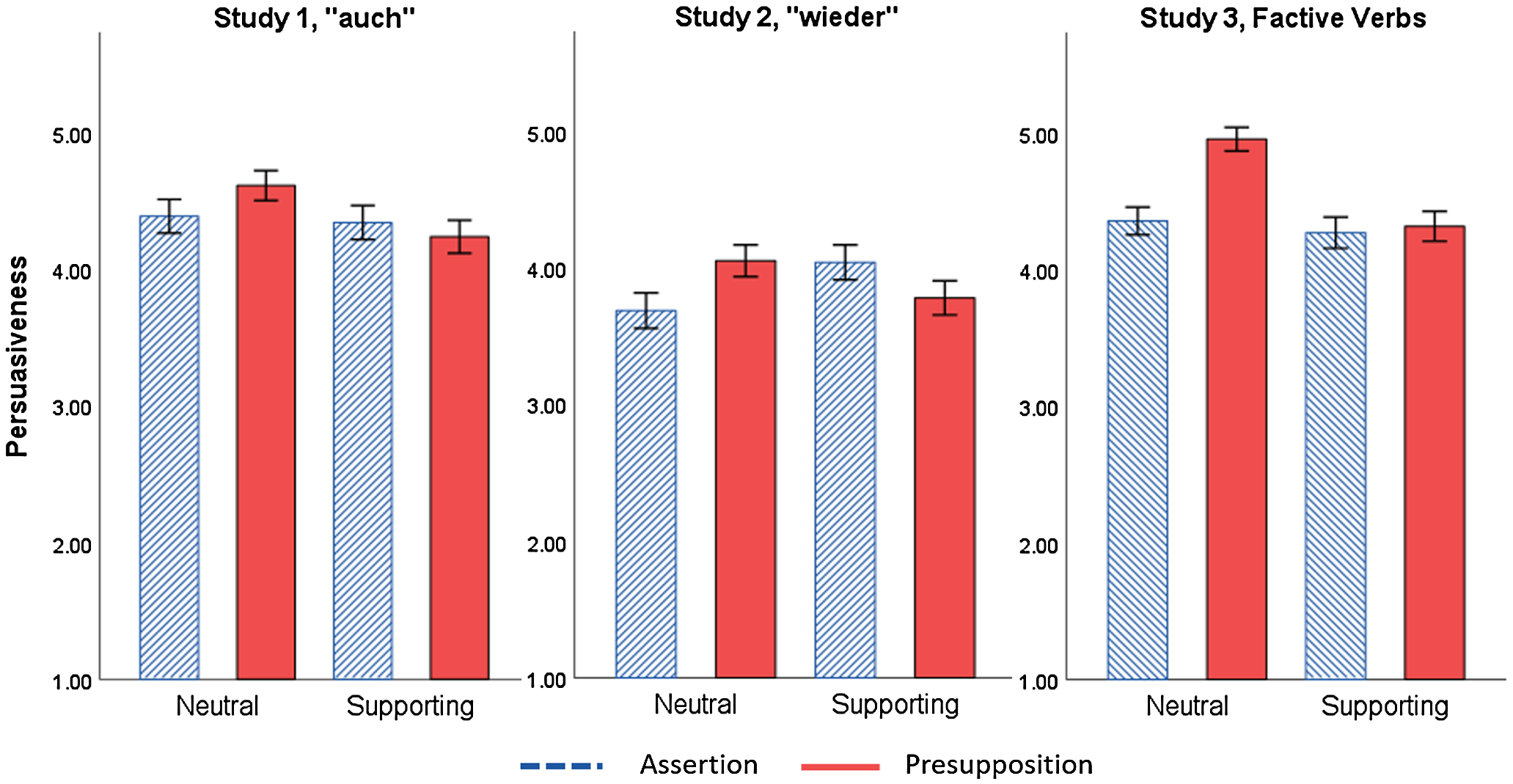
The persuasiveness score was highly reliable with Cronbach’s α = .91. Responses based on dwell times on the target advertisement screens faster than 200 ms were excluded as unrealistic reading times (3 of 2460). Figure 1 plots the mean persuasiveness scores across the four PSP-context conditions. Table 2 summarizes the fitted linear mixed-effects model. It found no significant main effect of PSP as advertisements with the trigger auch (M = 4.43, SD = 1.46) were not generally considered more persuasive than assertions (M = 4.37, SD = 1.57). There was a significant main effect of context, such that advertising claims in a neutral context were perceived as more persuasive (M = 4.50, SD = 1.48) than advertising claims in a supporting context (M = 4.29, SD = 1.55). Consistent with the moderation hypothesis H1, there was a significant PSP-context interaction. Subset analyses indicated that if the context sentence was neutral and did not satisfy the presupposition, advertising claims with auch were perceived as significantly more persuasive than advertising claims without auch (b = 0.234, SE = 0.064, t = 3.67, p < .001). After the supporting context, the persuasiveness of the presupposition did not differ from that of the assertion (b = −0.090, SE = 0.067, t = −1.35, p = .179). The panels in the interactions plots in Figure 2 illustrate this interaction in the gap between less persuasive assertion and more persuasive presupposition targets in combination with neutral contexts.
Study 1–3: Bar charts for persuasiveness (score range 1 to 7) across context and PSP conditions. Error bars indicate 95%-CIs.
Linear mixed effects regression models predicting persuasiveness in Study 1, Study 2, and Study 3
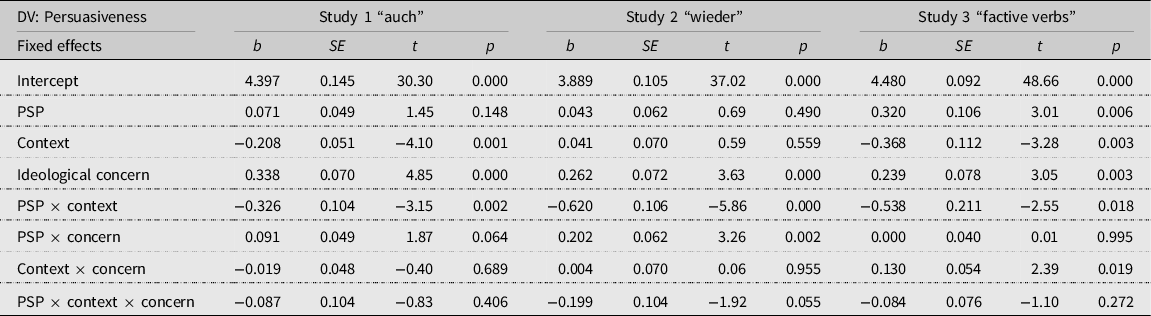
Formulas. Study 1: lmer(Persuasiveness∼1 + PSP1 * Context * scale(Concern) + (1 + PSP * Context || Participant) + (1 + Context || Item), Study 2 and Study 3: lmer(Persuasiveness∼1 + PSP1 * Context * scale(Concern) + (1 + PSP + Context || Participant) + (1| Item). Factor coding: PSP (assertive = −.5 | presupposition = +.5); Context (neutral = −.5 | supporting = +.5).
Study 1: Covariate adjusted interaction plots for PSP-effect for “auch” moderated by context and environmental concern. Shades indicate 95%-CIs.
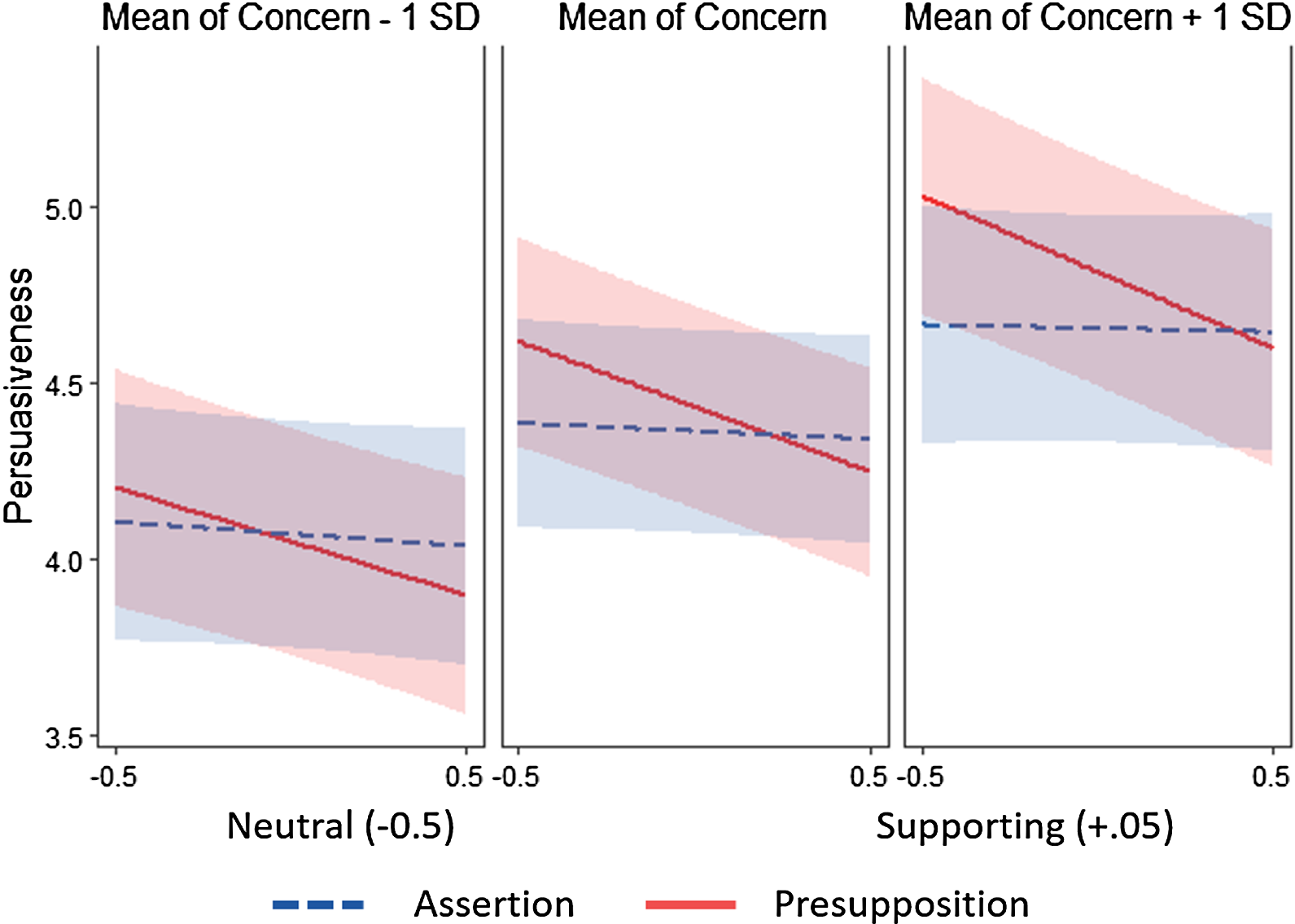
The main model in Table 2 also included a significant main effect of environmental concern, that is, ideological involvement, visible in gradually higher persuasiveness scores for participants split into groups with below-average (−1 SD), average (Mean), and above-average (+1 SD) environmental concern in Figure 2. Further, the PSP-concern interaction, reflected in an increasing persuasiveness advantage of presuppositions over assertions with increasing environmental concern, approached significance. This is visible in the larger gap between the assertion and the presupposition line for the sample terciles with medium and high concern, relative to those with low concern in Figure 2. However, the three-way interaction testing if this advantage was stronger for unsupported presuppositions (H2) was not significant.
An additional analysis indicated that the variation in voice (active | passive), we introduced in neutral context sentences for reasons of authenticity had no significant direct or interaction effects. In a log-likelihood comparison, voice did not improve model fit (χ 2(2) = 8.38, p = .398) over the model reported in Table 2.
2.4.3. Interim summary
In sum, addressees perceived presuppositions more persuasive than assertions in neutral, unsupported contexts confirming that presupposed content is more persuasive than asserted content if addressees need to accommodate it (H1). A main effect of context suggested that claims where the product rather than the consumer is the agent were more persuasive, which probably was a familiarity effect reflecting the typical structure of product advertisements. Unsurprisingly, participants with higher environmental concern perceived the environmental sustainability claims more persuasive. With increasing concern, claims with the presupposition trigger auch became generally more persuasive (two-way interaction), but higher ideological involvement did not predominantly boost the persuasiveness of unsupported presuppositions over assertions as hypothesized in H2 (three-way interaction).
3. Study 2: Wieder—“again”
3.1. Participants
Eighty-three participants, 53 women and 30 men, took part in the study in exchange for €5. They were 18 to 67 years old (M = 24.42, SD = 9.16), had a German secondary school education, and reported very good German reading skills (1 = “very good,” 6 = “insufficient”), (M = 1.48, SD = 0.56, max = 4).
3.2. Materials
In parallel to Study 1, the persuasiveness rating task included 24 items with context-target sentences framed as pharmaceutical advertising. The context sentence supported the presupposition triggered by the German iterative particle wieder “again” in the target sentence or not. The context sentences declared that recognizable physical changes indicated a health issue. While the two context versions were otherwise identical, the supporting context contained the scalar expression häufig “frequently” or oft “often” as in (12-a), whereas the neutral context included the scalar expression selten “seldom” as in (12-b).
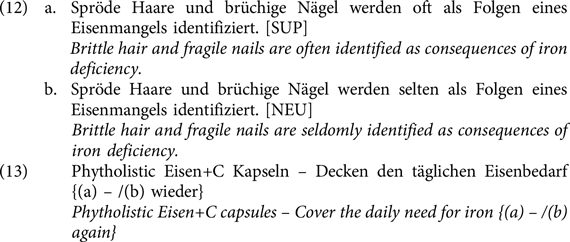
As the design was fully factorial, the context sentences were crossed with two target versions, namely assertion (13-a) and presupposition (13-b) targets. They were advertising claims for prescription-free pharmaceutical products designed to treat the deficit behind a health issue introduced in the context sentence. The wieder in (13-b) presupposes that there is a deficit or insufficiency to be compensated. The supporting (12-a) states that hair and nail issues are a frequent indication of iron insufficiency, whereas the neutral (12-b) suggests that it is rare. When unsupported, the presupposed information is less likely to be true and, therefore, the neutral condition requires more accommodation.
In other words, the context stated that “health issue X is {often/rarely} a consequence of deficit Y” and the target that “product Z compensates deficit Y {-/again}.” Note that wieder functions as a restitutive particle here, rather than as eventive particle like in most prior research. Both context versions require the additional inference about the frequency of the deficit, which should distract readers from the repetition of the presupposed information in the supporting condition. All claims followed this schema for real but little-known pharmaceutical products. They were displayed in self-created visual advertisements. Their layout showed a slightly blurred nature photo in the background, a pack shot of the product in the righter bottom half, and in the left corner, a colored text box with the claim in the order: brand and product name—advertising claim.
3.3. Procedure
Participants were recruited via an email newsletter for a study on advertising persuasiveness. They completed the experiment individually in a university lab. All tasks were programed in OpenSesame (Mathôt et al., Reference Mathôt, Schreij and Theeuwes2012). The persuasiveness task generally proceeded as in Study 1. Differences were that the context-target pairs were displayed together in the advertising template and a trial started directly with a fixation screen. Acceptability was also measured as in Study 1. Ideological involvement was assessed with a German version (Rathmann et al., Reference Rathmann, Zelfl, Kleine and Dadaczynski2022) of Hong’s (Reference Hong2009) 11-item, 7-point health consciousness scale.
3.4. Results and discussion
3.4.1. Acceptability and health consciousness
As intended by the design, participants rated assertions (M = 2.82, SD = 1.02) and presuppositions (M = 2.82, SD = 0.95) equally acceptable. Whereas the corresponding main effect of PSP was not significant in the ordinal mixed effects model (Table 1), advertising claims with neutral context sentences—describing that a certain health issue would occur rarely as a symptom—were significantly less acceptable (M = 2.71, SD = 1.01) than those with supporting sentences postulating that the health issue was frequent (M = 2.94, SD = 0.95). This is plausible because the neutral context condition created less familiar advertisements.
The health consciousness scale was reliable with Cronbach’s α = .83. Most participants’ mean ratings were above the middle of the scale with M = 5.14, SD = 1.03.
3.4.2. Persuasiveness
The persuasiveness score was reliable with α = .85. Responses based on dwell times on the target advertisement screens faster than 200 ms were excluded (18 of 1992 trials). Table 2 summarizes the best-fitting linear model testing the persuasiveness of the presupposition trigger wieder “again,” and Figure 1 plots the corresponding descriptive bars. The model showed no significant main effects of the experimental conditions. Assertions (M = 3.86, SD = 1.47) were comparable to presuppositions (M = 3.91, SD = 1.37) and neutral (M = 3.87, SD = 1.40) to supportive (M = 3.91, SD = 1.44) contexts. Yet, as predicted by H1, PSP interacted significantly with context. An inspection of this interaction indicated that after a neutral context sentence, wieder made the pharmaceutical advertisement claims more persuasive than the assertive equivalents (b = 0.328, SE = 0.074, t = 4.46, p < .001). If the context supported the presupposition of wieder and therefore required less or no accommodation, presuppositions were in fact less persuasive than assertions (b = −0.257, SE = 0.079, t = −3.26, p = .002). Figure 3 visualizes this interaction in that the straight presupposition line is clearly above the dotted assertion line in neutral contexts for most participants (middle and right panel).
Study 2: Covariate adjusted interaction plots for PSP-effect for “wieder” moderated by context and health consciousness (concern). Shades indicate 95%-CIs.
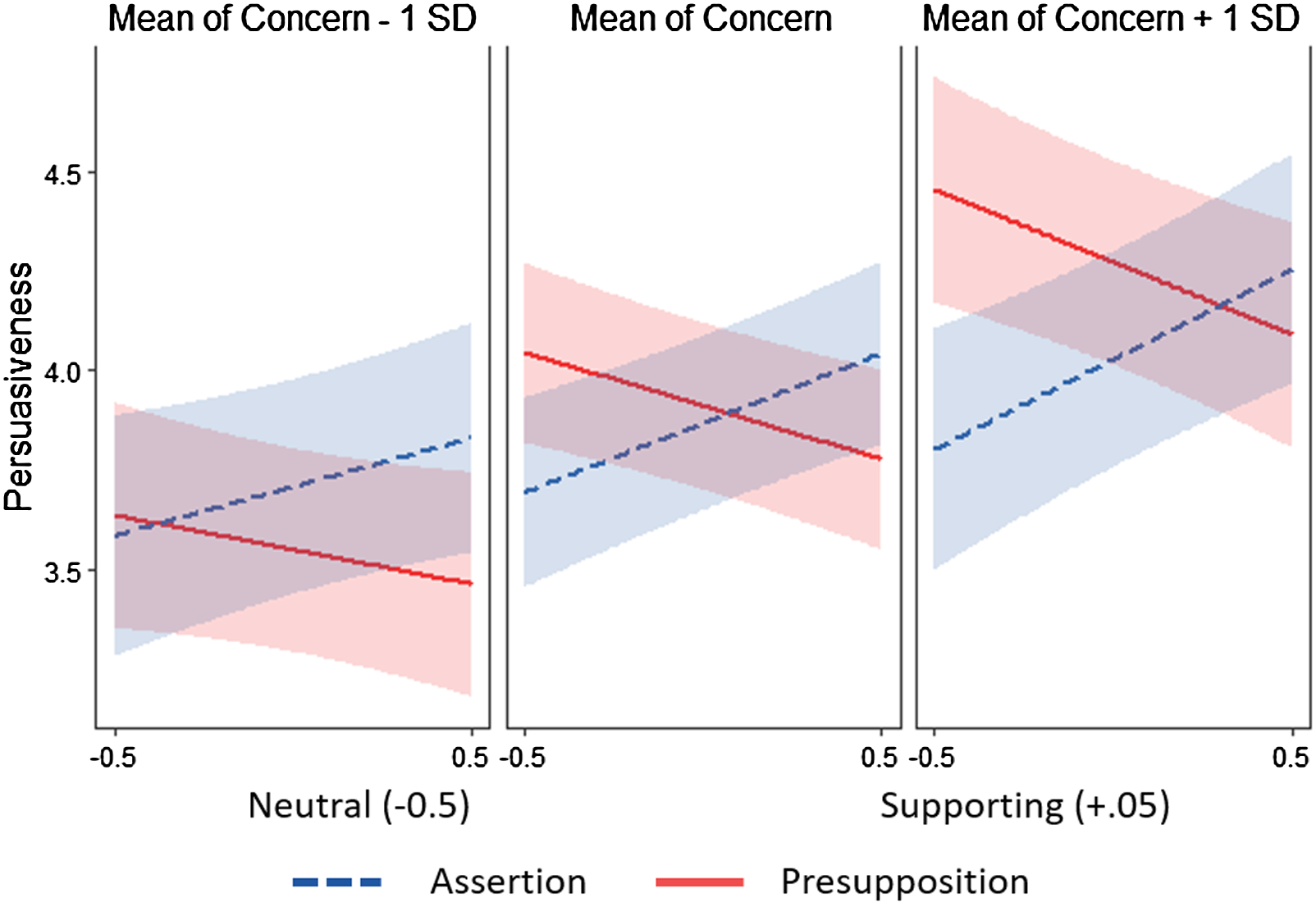
Next to a positive main effect of health concern, that is, ideological involvement, shown by gradually higher intercepts for groups of individuals with low, medium, and high concern in Figure 3, there was a significant two-way PSP-concern interaction. Figure 3 suggests that the persuasive advantage of presupposed vs. asserted claims was stronger in individuals who were more concerned about their health. With respect the hypothesis that concern moderates the PSP-context effect (H2), Figure 3 creates the impression that presuppositions were most persuasive when highly concerned participants read them after neutral contexts, while low-concern individuals were most responsive to supported assertions. However, the corresponding three-way interaction testing H2 was only marginally significant.
3.4.3. Interim summary
To summarize, in neutral contexts, claims with the trigger wieder “again” pragmatically required the accommodation of the presupposition that a certain nutritional health deficit exists. In this condition, and as hypothesized in H1, presuppositions were logically informative and empirically more persuasive than assertions. After supporting contexts, where the context already proposed that such a deficit is more likely, assertions were more persuasive than presuppositions, particularly for low-concern individuals. This makes sense as this combination was probably the most familiar and expectable version of advertising. As for H2, there was only a statistical trend suggesting that the persuasive advantage of unsupported presuppositions over assertions increases with addressees’ health consciousness, the measure representing ideological involvement.
4. Study 3: Factive verbs
4.1. Participants
A total of 76 participants (56 women, 20 men) with a mean age of 21.95 years (SD = 2.61) participated in the eye-tracking experiment and received €5 as a thank you. They had all graduated from a German secondary school and rated their German reading skills (1 = “very good,” 6 = “insufficient”) as high, M = 1.28, SD = 0.62, max = 4. Their vision was normal or corrected-to-normal. Data from another three participants was excluded because their eye calibration was unreliable.
4.2. Materials
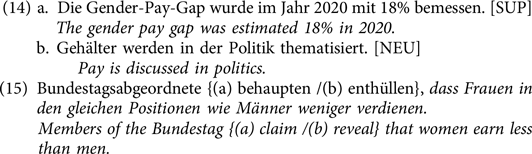
The experiment consisted of 24 context-target sentence pairs framed as media-reported statements by politicians about equal opportunity issues. The item design used 24 different factive verbs as presupposition triggers in the experimental and 24 different nonfactive, assertive verbs in the control condition. Supporting context sentences as in (14-a) stated the content conveyed by the complement clause on the syntactically complex target sentence as in (15). Neutral contexts as in (14-b) mentioned the political topic of the whole item. The target sentences only varied in their main clause verb that was either assertive as in (15-a) or factive as in (15-b). Pragmatically, the factives presuppose the truth of the proposition of their complement clause, whereas assertive verbs do not. If the presupposition is unsupported and therefore presents newer information than the supporting condition, accommodation is required.
We selected the verbs from the lists by Shetreet et al. (Reference Shetreet, Alexander, Romoli, Chierchia and Kuperberg2019), who had extensively normed them for being factive or assertive in empirical pretests. We used those originally English verbs that allowed for straightforward translations into German. We then created factive-assertive pairs that fitted into the semantics of the sentence frames and matched in terms of morphological complexity and length. To achieve a partial Latin-square design, we created four experimental lists, which included six different target sentences of each possible combination (neutral-factive, neutral-assertive, supporting-factive, and supporting-assertive). Thus, each condition contained all 24 political statements. To avoid carry-over effects within a list, the order of PSP-context combinations alternated, so that the next trial always represented a different combination.
The mean log-frequency (“COSMAS II Web,” 2022) of the factive (M = 1.39, SD = 0.63) and assertive verbs (M = 1.07, SD = 0.78) did not differ significantly, t(46) = 1.56, p = .126, d = .45. The verbs were not emotion or emotion-laden words, that is, not listed in the ANGST (Schmidtke et al., Reference Schmidtke, Schröder, Jacobs and Conrad2014). Pretests showed that quantitative semantic acceptability ratings for the statements as in Study 1 and Study 2 would be unreliable because most individuals were unable to evaluate the equal opportunity statements at a metalinguistic level, irrespective of their political value. Therefore, a team of four researchers discussed qualitatively if the statements made sense and selected the 24 items from an original pool of 40.
4.3. Procedure
Participants were invited to a study on the persuasiveness of political communication. The experiment followed the procedure of Study 1 and Study 2. In addition, we eye-tracked participants’ reading of the statements to validate that our neutral-factive sentences induced accommodation. In individual sessions, participants sat approximately 70 centimeters in front of a 24”-computer screen combined with a remote SMI RED 500 Hertz eye-tracker and a keyboard. The remote tracking setup allowed for a noninvasive, naturalistic reading situation. It was sufficiently accurate as we were only interested at reading fluency at sentence level, similar to Schwarz (Reference Schwarz2007). Each session started with a 9-point eye-tracking calibration aiming for a position accuracy ≤ .5 degrees of visual angle. Participants were assigned randomly to the four experimental lists. After a practice trial, they read the 24 statements at their own pace and then rated the persuasiveness of each statement. The context and target sentences were displayed centered on separate screens, in 28-point Arial font in black on a white background, the targets in one line. Persuasiveness ratings reflected four dimensions (Thomas et al., Reference Thomas, Masthoff and Oren2019) and were tuned to political statements, for example, effectiveness: The statements motivates me to reconsider my attitude toward the topic. The same landscape photo with a central vanishing point served as a 500-ms intertrial fixation screen. After the rating task, participants reported their “feminism concern” on six 7-point scales, for example, I consider myself a feminist, sampled from three sociological studies (Case & Coventry, Reference Case and Coventry2018; Heger & Hoffmann, Reference Heger and Hoffmann2021; Szymanski, Reference Szymanski2004), answered demographic questions, and were paid and debriefed.
4.4. Results and discussion
4.4.1. Feminism concern
As a validity check of the feminism concern scale (Cronbach’s α = .86, M = 4.52, SD = 1.34), we compared the mean scores of female and male participants. As expected, women were more concerned about feminism (M = 5.25, SD = 1.24) than men (M = 3.99, SD = 1.19, t(74) = 3.94, p < .001, d = 1.01).
4.4.2. Manipulation check: Reading data
We conducted a manipulation check to confirm that the factive-neutral condition indeed induced (the most) presupposition accommodation reflected in longer reading times (Schwarz, Reference Schwarz2007; Schwarz & Tiemann, Reference Schwarz and Tiemann2017; Tiemann et al., Reference Tiemann, Kirsten, Beck, Hertrich, Rolke and Schwarz2015). Note that the target sentences only differed in their main clause verb, which was assertive or factive and similar in frequency and morphology, so that differences in reading times should mainly indicate differences in semantic integration. We defined each target sentence as an area of interest and used the sum of all fixation durations (gaze duration) within this area as a measure of total reading time. We excluded unrealistic reading times < 200 ms (4.4% of data) and reading times longer than 11 s (2.0%) and log-transformed the remaining values to normalize the data.
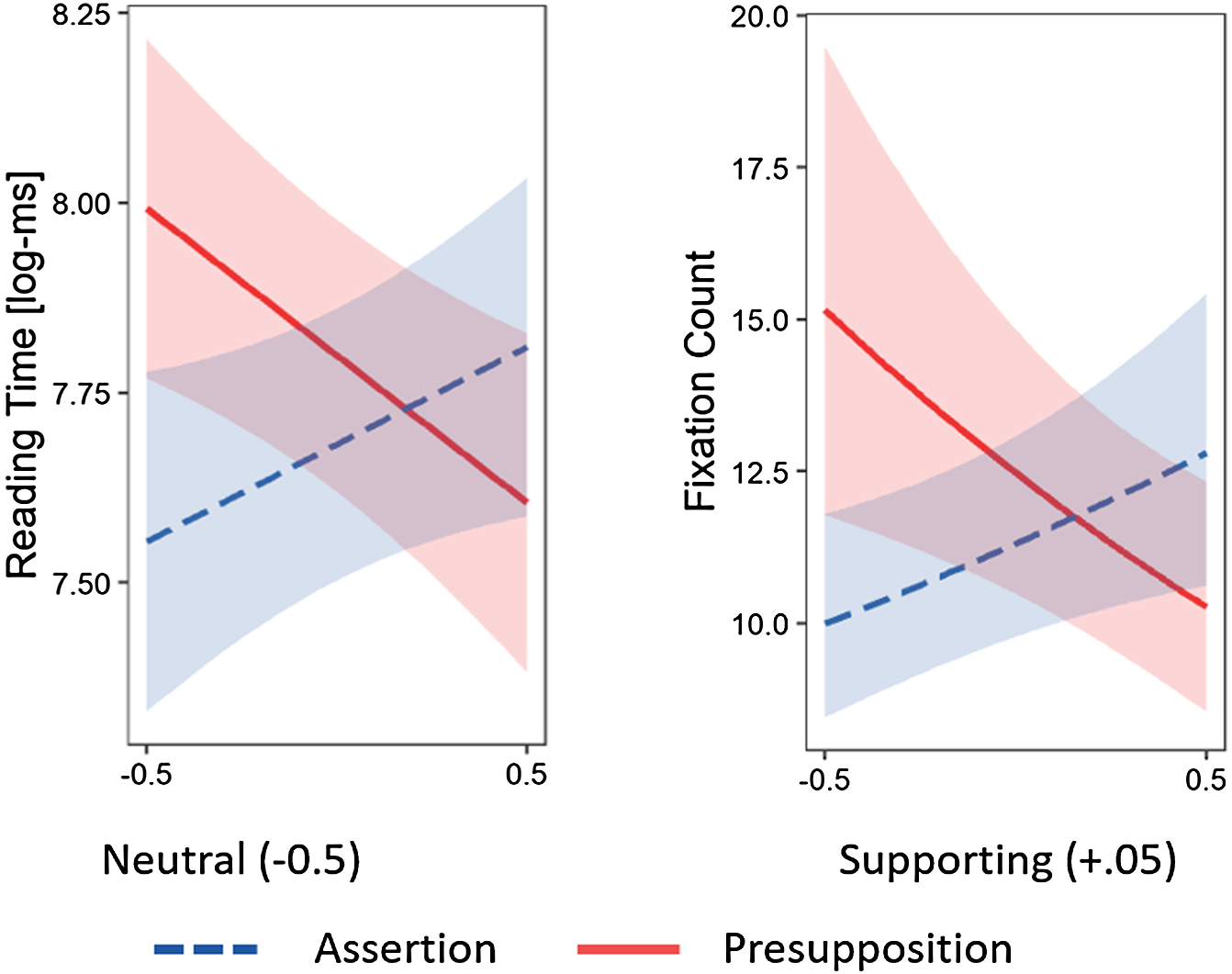
Table 3 summarizes the outcome of the linear model predicting reading time with a significant PSP-context interaction. Subset analyses showed participants read factives slower after neutral (M = 3815, SD = 2422) than supporting (M = 2610, SD = 1588) contexts. This difference was significant (b = −0.380, SE = 0.151, t = −2.51, p = .028). The slowdown of 33% is comparable to the one reported by Schwarz (Reference Schwarz2007) for unsupported iterative presupposition triggers at clause level, and it suggests that the factive verbs in the neutral condition successfully triggered accommodation of their presupposed content. In contrast, reading times for assertive statements after neutral contexts (M = 2503, SD = 1533) were (just) significantly faster than after supporting ones (M = 3166, SD = 2073; b = 0.255, SE = 0.225, t = 2.224, p = .047). The supporting-assertive condition may have created slight confusion, for example, in first reporting a fact that politicians then claim to be true. An additional analysis of the number of fixations on the target sentences as an alternative measure of processing intensity revealed an interaction effect parallel to reading time (see Table 3). Figure 4 shows the interaction plots for reading times and fixations.
Linear and generalized linear mixed models predicting total reading time and fixation count in Study 3
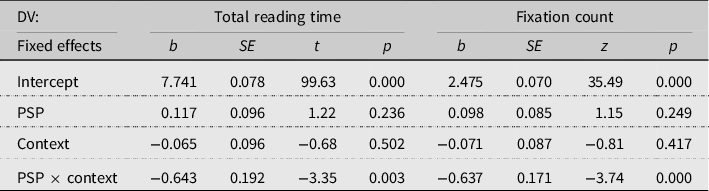
Formulas. Total Reading Time (TRT): lmer(log(TRT) ∼ 1 + PSP * Context + (1 | Participant) + (1 | Item)
Fixations: glmer (Fixations ∼ 1 + PSP * Context + (1 + Context * PSP | ID) + (1 + Context * PSP | Item), family = ‘poisson’, control = glmerControl(optimizer = ‘bobyqa’), nAGQ = 0). Factor coding: PSP (assertive = −.5 | presupposition = +.5); Context (neutral = −.5 | supporting = +.5).
Study 3, manipulation check: Covariate adjusted interaction plots visualizing the reading times and gaze fixations for target sentences with factive vs. assertive verbs as a function of context. Shades indicate 95%-CIs.
4.4.3. Persuasiveness
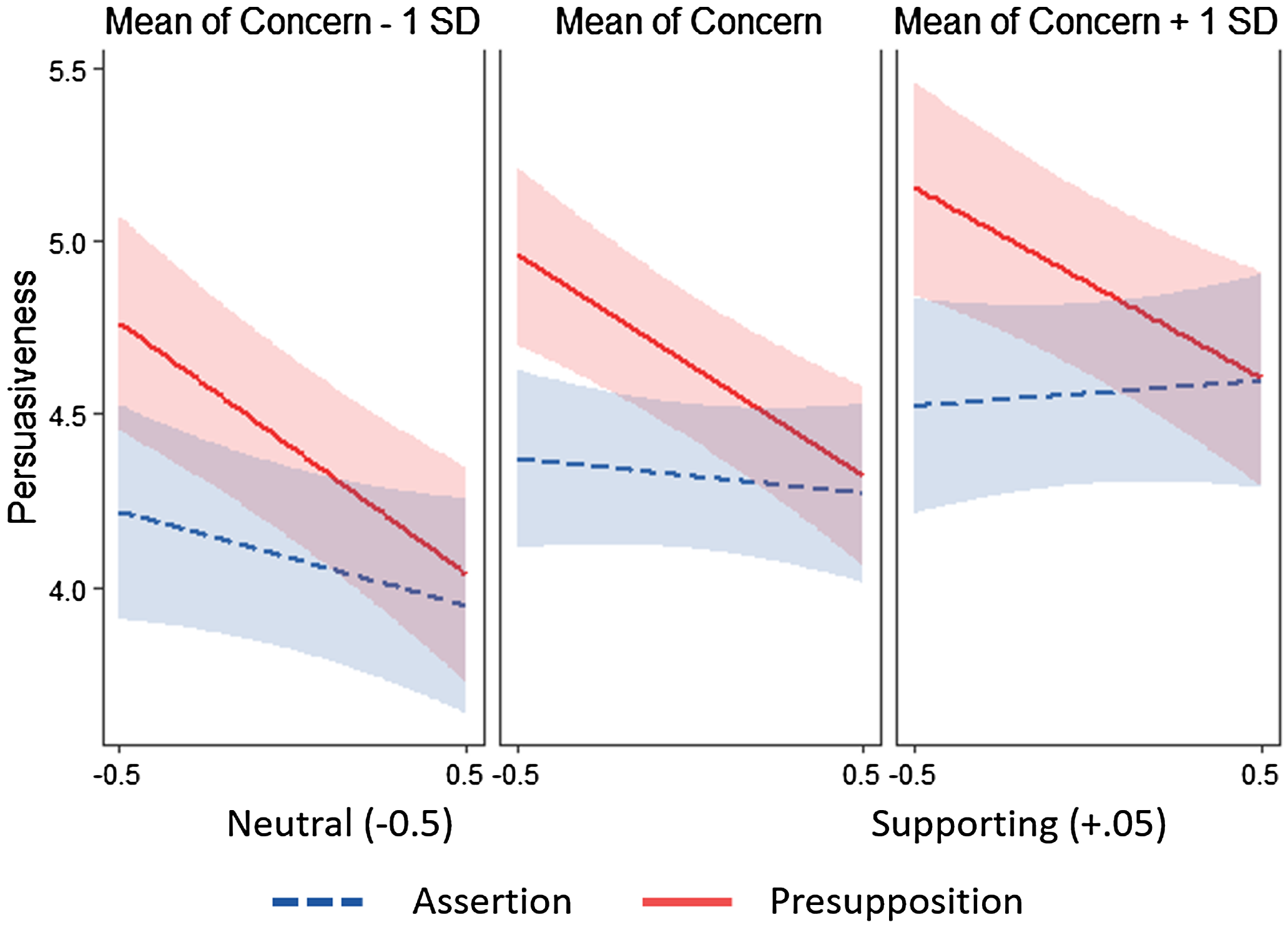
The reliability of the score indexing the persuasiveness of the political statements was acceptable with α = .67. Responses of trials with target reading times shorter than 200 ms were excluded (93 of 1842). Figure 1 visualizes the descriptive means and variation in the four experimental conditions. The fitted linear mixed-effects model in Table 2 documents three significant main effects of PSP, context, and feminism concern. Overall, participants perceived political statements with assertive verbs (M = 4.31, SD = 1.16) less persuasive than those with factive verbs (M = 4.64, SD = 1.10), while statements with neutral context sentences (M = 4.66, SD = 1.04) were more persuasive than supporting ones (M = 4.30, SD = 1.20). As a third main effect, individuals with greater feminism concern, that is, ideological involvement, evaluated the statements as more persuasive. In line with the moderation hypothesis H1, a significant two-way interaction qualified the main effects of PSP and context, such that target sentences with assertive and factive verbs were comparably persuasive when the context supported the factive presupposition (b = 0.049, SE = 0.169, t = 0.29, p = .777). In turn, the corresponding subset analysis found that the overall persuasiveness advantage of factives over assertives originated in the neutral condition (b = 0.592, SE = 0.129, t = 4.58, p < .001).
The visual comparison of the three panels in Figure 5 also indicates the significant PSP-context interaction, that is, the closing gap between the straight and the dotted line. This pattern was very similar at different levels of feminism concern, which matches the nonsignificance of the three-way interaction (see Table 2) testing the moderation of the PSP-context effect by ideological concern as hypothesized in H2. Finally, a significant context-concern interaction suggested that the positive effect of feminism concern on persuasiveness was slightly weaker in combination with neutral (b = 0.183, SE = 0.068, t = 2.70, p = .008), than with supporting context sentences (b = 0.302, SE = 0.094, t = 3.20, p = .002). This is plausible given that the supporting sentences were more explicit about gender inequality.
Study 3: Covariate adjusted interaction plots for PSP-effect for factive vs. assertive verbs moderated by context and feminist concern. Shades indicate 95%-CIs.
4.4.4. Interim summary
As a manipulation check, a significant PSP-context interaction that originated in longer reading times and increased fixations for neutral-factive relative to supporting-factive trials provided initial evidence that the neutral-factive condition triggered presupposition accommodation successfully across 24 different German factives. With respect to the research question, readers perceived political statements with factive verbs as more persuasive than otherwise identical ones with assertive verbs and more so if the presupposition required accommodation. This means that the presupposition, namely, that the proposition of a complement clause is true, was more persuasive than the corresponding assertion—if the presupposition presented discourse-new information that needed accommodation. This finding supports H1. In contrast to the prediction of H2, the persuasiveness of unsupported factives did not increase further if readers were more ideologically involved in the discourse topic of equal opportunities, that is, if they were more concerned about feminism.
5. General discussion
Best practice recommendations for persuasive communication in marketing and politics as well as descriptive and language philosophical research have argued that messages with presuppositions have a persuasive advantage over assertions. To date, however, there seems to be no causal psycholinguistic evidence for the persuasiveness of presuppositions. The present research addressed this gap. Building on Sbisà (Reference Sbisà and Verschueren1999), we theorized that presupposition accommodation rather than presuppositional statements as such make a message more persuasive. In three experiments, we tested if the pragmatic requirement and participants’ ideological willingness to accommodate presupposed content of advertising and political statements increase perceived persuasiveness. In factorial designs, we manipulated (a) the presupposition trigger using either the German additive particle auch “too,” the iterative particle wieder “again,” or 24 factive verbs, compared to assertive equivalents and (b) the preceding discourse context, which was either neutral or supporting with respect to the presupposition.
Consistent with our first hypothesis, the three experiments provided converging evidence that addressees perceive statements with presupposition triggers as more persuasive than their assertive equivalents, given the prior discourse context does not (strongly) support the presupposition. For the persuasiveness of statements with factive verbs, but not for auch and wieder, mixed-effects regression analyses indeed found significant main effects of presupposition (see Table 2 to compare the experiments), yet this main effect was moderated by the discourse context. In fact, the persuasiveness advantage of the unsupported presuppositions was strong enough to overcompensate the statistical indifference between supported presuppositions and assertions.
This first finding aligns with Sbisà’s (Reference Sbisà and Verschueren1999) account of persuasive presuppositions that are more likely if a message presents the addressee with sufficiently new presupposed information triggering an accommodation process. On this note, it also supports more general prior claims based on descriptive analyses that presuppositions per se have a persuasive edge (Bouso, Reference Bouso2012; Saarinen, Reference Saarinen2008; Sedivy & Carlson, Reference Sedivy and Carlson2011) —contingently, because these case studies sampled their presupposition statements from one-sided communication in advertising and political propaganda, where writers present readers with information that is very likely new to them or at least discourse-new, so that the statements in fact convey unsupported presuppositions. Presuppositions thus have the potential to be more persuasive than assertions as persuasive communication usually does not explicate the presupposed content before presupposing it as our—in this sense unrealistic—experimental control condition did.
Consistent with reading studies using auch and wieder (e.g., Schwarz, Reference Schwarz2007; Tiemann et al., Reference Tiemann, Kirsten, Beck, Hertrich, Rolke and Schwarz2015), the eye-tracking manipulation check in Study 3 showed that presupposition accommodation also induces longer reading times and more fixations with unsupported, compared to supported factive verb statements. In conjunction with the finding that unsupported presuppositions and thus accommodation accounts for the persuasiveness of presuppositions, the present results are difficult to align with Lombardi Vallauri’s (Reference Lombardi Vallauri2021) position that the reduced effort of presupposition processing or what he called shallow processing explains their persuasiveness. Presuppositions seem to be more persuasive when and because they require more cognitive effort. However, our findings are limited in that we measured persuasiveness at a self-report level rather than persuasion directly. Therefore, it may be possible that during and after the initial increase in effort during accommodation, presuppositions still lead to shallower and less critical thinking about the presupposed content. In line with Lombardi Vallauri (Reference Lombardi Vallauri2021), this is because the accommodation process consumes cognitive resources at the cost of critical evaluation. In other words, once addressees have fully or partially accommodated presupposed but new information, (1) it seems more familiar, (2) deserves less attention, and (3) is accepted more willingly even if it is false. Future research could expand our methodology in three major ways to disentangle direct and indirect effects of accommodation on persuasion. First, it would be useful to measure persuasion, for example, in the form of changed preference or choice behavior, changes in opinion, or convergence rates in online communication. Second, more powerful experimental designs could test a mediation model representing the relationship between presupposition processing and persuasion. Finally, one could try to manipulate accommodation (via presupposition support) and evaluation (e.g., via the induction of cognitive load during the decision process) simultaneously.
As for our second hypothesis, we did not find consistent support for the assumption that the persuasiveness of informative presuppositions depends on ideological involvement in the discourse topic. In all three experiments, advertisements or political statements about environmental, health, and equal opportunity were perceived as increasingly persuasive with increasing ideological involvement in the form of environmental concern, health consciousness, and feminism concern. This grants the measures some validity, but only health consciousness in Study 2 tended to increase the persuasiveness of unsupported presuppositions. Retrospectively, our research design may have had limitations veiling such an ideology-increases-accommodation effect. First, it may be necessary to measure ideological involvement for each individual statement at item level rather than using the current operationalization of ideological involvement at the level of the discourse topic and task. Second, in all three experiments, mean ideological involvement was located above the middle of the scale, which may have been due to biases induced by the selection of topics, the self-selective sampling of participants for a study with an “interesting” topic, and the positioning of the ideological involvement questions after the persuasiveness task when participants were sensitized towards the topics. Consequently, the willingness to accommodate unsupported presuppositions may have become the default, so that participants generally preferred presupposed content to be true and shared in Sbisà’s (Reference Sbisà and Verschueren1999, p. 502). The cross-experimental generalizability of the present findings is also limited in that environmental, health, and feminism concern operationalized ideological involvement differently. Future research should thus aim for more variation in ideological involvement in individuals and ideological content in the discourse topic.
Our experimental approach was new and, therefore, has further methodological limitations. First, designing claims that rigorously implement the context-PSP conditions and remain authentic persuasive messages included compromises that may have created confounds undermining the size of the observed effects and the validity of the interpretations. For example, Study 1 used context sentences with the modal can, which made the presupposition triggered by auch “too” an option rather than a fact. Similarly, the restitutive presupposition triggered by wieder “again,” namely, that a deficit needs compensation, was less likely but not invalid after a neutral rather than a supporting context in Study 2. In Study 3, some supporting contexts contained additional (mostly existential) presupposition triggers, for example, the “gender-pay gap” in (14), compared to the typically more abstract neutral condition, so that the target presupposition depended on further presuppositions. Therefore, we cannot argue that presuppositions in neutral contexts triggered discourse-new information in a categorical sense, relative to discourse-old in the supporting contexts. Although we believe that the supporting conditions provided more support for the target presupposition than the neutral conditions, future experiments should sharpen the contrast and consider more concise or nonverbal discourse contexts.
Second, our experiments did not include fillers, which may have distorted the local independence of trials in contrast to most prior experiments on presupposition processing (e.g., Domaneschi & Di Paola, Reference Domaneschi and Di Paola2018; Schwarz, Reference Schwarz2007). We spared fillers to maximize the number of items per condition in a within-subjects design that restricts random individual differences in presupposition accommodation. Yet, pretests showed that participants lost their motivation if we included more than 24 trails with five questions per item, that is, 100 rating responses in total. Their open comments did not suggest that they recognized the purpose of the experiments, since they were fully engaged in rating advertisements. Still, future research could work with between-subjects designs including fillers.
6. Conclusion
The present research is one of the first to investigate experimentally if and why arguments with presuppositions induced by lexical triggers are more persuasive, compared to equivalent assertive ones. Our findings suggests that “persuasive presuppositions” depend on the accommodation process. When addressees accommodate presupposed content that is factually new to them or at least not very prominent in their memory at the time of message processing, they seem to make their world more similar to the one of the writer. If they then believe to already agree upon more content with the writer, the overall message becomes more persuasive than all-new assertions (Lombardi Vallauri, Reference Lombardi Vallauri2021; Sbisà, Reference Sbisà and Verschueren1999). Theoretically, our work sheds new light on the important question of the status as well as the cognitive and behavioral consequences of presupposition processing. Practically, it suggests that the use of lexically conveyed presuppositions can increase the effectiveness of persuasive communication if they are sufficiently informative to induce accommodation.
Acknowledgements
The authors thank Elisabeth Bomhard and Jacqueline Ruffler for their help with item design and data collection for Study 3.
Replication package
The materials and result data are available at https://osf.io/ec53b. The analysis code is provided with the result tables.


 Open access

